EP0103972A2 - Identifizierungsverfahren von komplexen Lithologien in einer unterirdischer Formation - Google Patents
Identifizierungsverfahren von komplexen Lithologien in einer unterirdischer Formation Download PDFInfo
- Publication number
- EP0103972A2 EP0103972A2 EP83304594A EP83304594A EP0103972A2 EP 0103972 A2 EP0103972 A2 EP 0103972A2 EP 83304594 A EP83304594 A EP 83304594A EP 83304594 A EP83304594 A EP 83304594A EP 0103972 A2 EP0103972 A2 EP 0103972A2
- Authority
- EP
- European Patent Office
- Prior art keywords
- formation
- gamma rays
- log
- nuclear
- induced polarization
- Prior art date
- Legal status (The legal status is an assumption and is not a legal conclusion. Google has not performed a legal analysis and makes no representation as to the accuracy of the status listed.)
- Granted
Links
Images
Classifications
-
- G—PHYSICS
- G01—MEASURING; TESTING
- G01V—GEOPHYSICS; GRAVITATIONAL MEASUREMENTS; DETECTING MASSES OR OBJECTS; TAGS
- G01V5/00—Prospecting or detecting by the use of ionising radiation, e.g. of natural or induced radioactivity
- G01V5/04—Prospecting or detecting by the use of ionising radiation, e.g. of natural or induced radioactivity specially adapted for well-logging
- G01V5/08—Prospecting or detecting by the use of ionising radiation, e.g. of natural or induced radioactivity specially adapted for well-logging using primary nuclear radiation sources or X-rays
- G01V5/10—Prospecting or detecting by the use of ionising radiation, e.g. of natural or induced radioactivity specially adapted for well-logging using primary nuclear radiation sources or X-rays using neutron sources
- G01V5/101—Prospecting or detecting by the use of ionising radiation, e.g. of natural or induced radioactivity specially adapted for well-logging using primary nuclear radiation sources or X-rays using neutron sources and detecting the secondary Y-rays produced in the surrounding layers of the bore hole
- G01V5/102—Prospecting or detecting by the use of ionising radiation, e.g. of natural or induced radioactivity specially adapted for well-logging using primary nuclear radiation sources or X-rays using neutron sources and detecting the secondary Y-rays produced in the surrounding layers of the bore hole the neutron source being of the pulsed type
-
- G—PHYSICS
- G01—MEASURING; TESTING
- G01V—GEOPHYSICS; GRAVITATIONAL MEASUREMENTS; DETECTING MASSES OR OBJECTS; TAGS
- G01V11/00—Prospecting or detecting by methods combining techniques covered by two or more of main groups G01V1/00 - G01V9/00
-
- G—PHYSICS
- G01—MEASURING; TESTING
- G01V—GEOPHYSICS; GRAVITATIONAL MEASUREMENTS; DETECTING MASSES OR OBJECTS; TAGS
- G01V3/00—Electric or magnetic prospecting or detecting; Measuring magnetic field characteristics of the earth, e.g. declination, deviation
- G01V3/18—Electric or magnetic prospecting or detecting; Measuring magnetic field characteristics of the earth, e.g. declination, deviation specially adapted for well-logging
- G01V3/20—Electric or magnetic prospecting or detecting; Measuring magnetic field characteristics of the earth, e.g. declination, deviation specially adapted for well-logging operating with propagation of electric current
- G01V3/24—Electric or magnetic prospecting or detecting; Measuring magnetic field characteristics of the earth, e.g. declination, deviation specially adapted for well-logging operating with propagation of electric current using AC
Definitions
- This invention relates to a method for identifying complex lithologies in subsurface formations by means of induced polarization and nuclear logs.
- a method for identifying complex lithologies in a subsurface formation surrounding a borehole is logged to produce an induced polarization log, a nuclear log of delayed gamma rays from the activation of aluminum in the formation, and a nuclear log of inelastic scattering gamma rays from the activation of iron in the formation.
- the formation is identified as a low resistivity sand with a large surface area clay that produces water-free oil or gas when the combination of the induced polarization log and the nuclear logs indicate a large induced polarization, no inelastic scattering gamma rays from iron, and delayed gamma rays from aluminum.
- the formation is identified as a clear sand with a small surface area clay that produces water and little or no oil or gas when the combination of the induced polarization log and the nuclear logs indicate a small induced polarization, inelastic scattering gamma rays from iron and no delayed gamma rays from aluminum.
- the induced polarization log is produced by introducing an electrical current into the formation through a pair of in situ current electrodes and the resulting out-of-phase voltage in the formation is measured, such voltage representing the reactive component of the elecrical impedance of the formation.
- the nuclear log of delayed gamma rays is produced by irradiating the formation with neutrons of sufficient energy to produce delayed gamma rays of about 1.78 MEV from the activation of aluminum in the formation.
- the nuclear log of inelastic scattering gamma rays is produced by irradiating the formation with neutrons of sufficient energy to produce inelastic scattering gamma rays of about 0.847 MEV from the activation of iron in the formation.
- the metnod of tne invention represents a new logging procedure for identification of the composition of complex lithologies encountered in oil and gas exploration and production, and more particularly to the identification of low resistivity sands associated with large surface area clays that produce mostly water-free oil and gas.
- Iron and iron minerals adversely affect neutron and density logs, basic logs for measuring porosity. Pyrite, a conductive iron mineral, can also affect electrical logs causing them to indicate a higher-than-actual water saturation.
- Large surface area clays and pyrite produce a large induced polarization (IP) response. Clean sands, low surface area clays, and other iron minerals produce a much smaller IP response.
- IP induced polarization
- Clean sands, low surface area clays, and other iron minerals produce a much smaller IP response.
- the method of the invention permits tne identification of these various types of compositions tnrough the combination of an IP electrical log, a nuclear log to identify characteristic elements of clays, such
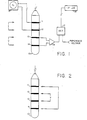
- FIGS. 1 and 2 illustrate logging systems for recording an induced polarization log of formations surrounding a borehole
- tnere is snown a logging sonde 10 employing a dipole-dipole array for carrying out induced polarization measurements.
- induced polarization logging is a method in which electrical current is induced in the formation surrounding the borehole through a pair of current electrodes 11 and 1 2 and the resulting out-of-phase voltage is measured across a pair of voltage electrodes 13 and 14. This voltage measurement represents the quadrature or reactive component of the electrical impedance of the formation.
- S. H. Ward and D. C. Frazer in "Conduction of Electricity In Rocks," Mining Geophysics, 1967, 2, 198-223.
- a description of induced polarization as it relates to borehole logging, along with a detailed description of a logging sonde for carrying out such induced polarization measurements in situ is provided in G. B. Patent Application 2,068,563.
- an AC current source is coupled to the pair of electrodes 11 and 12.
- the voltage measured across the pair of electrodes 13 and 14 is applied to a differential amplifier 16.
- the signal from amplifier 16 is compared by a phase detector 17 with a reference voltage that is proportional to the AC current supplied to the pair of current electrodes 11 and 12.
- Phase detector 17 measures the in-phase V 1 and quadrature V 2 components and the phase angle 6 oetween tne V 1 and V 2 components of the signal from amplifier 16 by comparing sucn signal with the reference voltage.
- Such measured quadrature component V 2 may be either a positive quadrature component (negative IP phase shift ⁇ ) lagging tne AC current or a negative quadrature component (positive IP phase shift 0) leading the AC current input depending on the characterization of the formation surrounding the borehole.
- Such measurements of the induced polarization of the formation surrounding the borehole is then recorded up-hole in the form of an IP log in correlation with the depth of tne sonde witnin tne borehole.
- FIG. 2 An alternative arrangement, termed the Wenner Array, for the current and voltage electrodes is illustrated in FIG. 2. While the dipole-dipole array of FIG. 1 will yield the best resolution, the Wenner Array will yield tne best sensitivity.
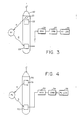
- the logging sonde 20 includes a neutron source 21, preferably a Californium-252 source, a neutron shield 22, and a gamma-ray detector 23, preferably a NaI scintillation detector.
- the average energy of neutrons from the Californium-252 neutron source 21 is about 2.348 MEV and is sufficient to produce delayed gamma radiation of 1.78 MEV from the activation of any aluminum in the formation in accordance with the following activation reaction:
- the spacing between the neutron source 21 and the gamma-ray detector 23 is selected to yield maximum response by the gamma ray detector 23 to the 1.78 MEV aluminum gamma rays.
- a particularly suitable spacing is in the order of 1.5 to 1.8 m.
- the gamma ray measurement from detector 23 is applied uphole to a single-channel analyzer 24 which is biased to pass to a count rate meter 25 only those amplified signals from detector 23 that are in an energy window centered about 1.78 MEV gamma rays. It is in this energy band that the most intense gamma rays are produced from any aluminum element present in the formation.
- the count rate from count rate meter 25 is recorded on a recorder 26 as the measure of aluminum content with depth in any clay-bearing formation surrounding the borehole being logged.
- the logging sonde 30 includes a neutron source 31 and a gamma-ray detector 32.
- Neutron source 31 is preferably a relatively moderate energy deuterium-deuterium source producing neutrons of about 2.5 to 2.56 MEV. Pulsing of the neutron source 31 is carried out in response to a trigger pulse supplied by the uphole system. The output of the neutron source 31 is a burst of fast neutrons spaced in time for irradiation of the formation surrounding the borehole.
- the gamma-ray detector 32 is preferably a bismuth germanate high-Z scintillator of the type supplied by Harshaw Chemical Company. Other suitable detectors are the sodium iodide scintillator and the cesium iodide scintillator on a germanium solid-state photon detector.
- the output of gamma-ray detector 32 is applied uphole to a single channel analyzer 33, a count rate meter 34 and a recorder 35.
- a neutron source energy _level of 2.56 MEV any 56 Fe element present in the formation surrounding the borehole will be activated to produce 0.847 MEV inelastic scattering gamma rays only during the neutron burst time period.
- Single channel analyzer 33 is biased with an energy window centered around gamna-ray pulse heights of 0.847 MEV energy level so as to maximize the measurement of gamma rays from any 56 Fe element within the formation.
- the count rate meter 33 counts the gamma rays passed by the single channel analyzer 32. Such a count of 56 Fe gamma rays is then recorded on the recorder 35 as the measure of the iron element content with depth in the formation surrounding the borehole being logged.
- the description of separate in situ measuring equipment and uphole recording equipment for each of the induced polarization and nuclear logging operations is for the purpose only of describing the methods by which the IP log, the iron log, and the aluminum log are preferably generated.
- the three logs may be generated by the use of a single logging sonde incorporating the required in situ components for each measurement. Such measurements may be recorded on a single uphole recording system utilizing similar components on a time-shared basis.
- the IP, iron and aluminum logs may be used in identifying low resistivity sands associated with large surface area clays from which water-free oil or gas can be produced, in conjunction with the following mineral identification table:
Landscapes
- Physics & Mathematics (AREA)
- Life Sciences & Earth Sciences (AREA)
- High Energy & Nuclear Physics (AREA)
- General Life Sciences & Earth Sciences (AREA)
- General Physics & Mathematics (AREA)
- Geophysics (AREA)
- Geology (AREA)
- Remote Sensing (AREA)
- Environmental & Geological Engineering (AREA)
- Engineering & Computer Science (AREA)
- Geophysics And Detection Of Objects (AREA)
- Analysing Materials By The Use Of Radiation (AREA)
- Pharmaceuticals Containing Other Organic And Inorganic Compounds (AREA)
Applications Claiming Priority (2)
| Application Number | Priority Date | Filing Date | Title |
|---|---|---|---|
| US06/411,409 US4464930A (en) | 1982-08-25 | 1982-08-25 | Method for identifying complex lithologies in a subsurface formation |
| US411409 | 2003-04-09 |
Publications (3)
| Publication Number | Publication Date |
|---|---|
| EP0103972A2 true EP0103972A2 (de) | 1984-03-28 |
| EP0103972A3 EP0103972A3 (en) | 1984-10-24 |
| EP0103972B1 EP0103972B1 (de) | 1988-04-20 |
Family
ID=23628799
Family Applications (1)
| Application Number | Title | Priority Date | Filing Date |
|---|---|---|---|
| EP83304594A Expired EP0103972B1 (de) | 1982-08-25 | 1983-08-09 | Identifizierungsverfahren von komplexen Lithologien in einer unterirdischer Formation |
Country Status (5)
| Country | Link |
|---|---|
| US (1) | US4464930A (de) |
| EP (1) | EP0103972B1 (de) |
| CA (1) | CA1212782A (de) |
| DE (1) | DE3376363D1 (de) |
| NO (1) | NO833027L (de) |
Families Citing this family (13)
| Publication number | Priority date | Publication date | Assignee | Title |
|---|---|---|---|---|
| US4890486A (en) * | 1984-01-26 | 1990-01-02 | Schlumberger Technology Corp. | In situ determination of hydrocarbon characteristics |
| US4712424A (en) * | 1984-01-26 | 1987-12-15 | Schlumberger Technology Corp. | Quantitative determination by elemental logging of subsurface formation properties |
| US4914944A (en) * | 1984-01-26 | 1990-04-10 | Schlumberger Technology Corp. | Situ determination of hydrocarbon characteristics including oil api gravity |
| US4903527A (en) * | 1984-01-26 | 1990-02-27 | Schlumberger Technology Corp. | Quantitative clay typing and lithological evaluation of subsurface formations |
| US4722220A (en) * | 1984-09-28 | 1988-02-02 | Schlumberger Technology Corp. | Quantitative determination by elemental logging of subsurface formation properties |
| US4583397A (en) * | 1985-06-06 | 1986-04-22 | Amoco Corporation | Method of geophysical exploration in a well borehole |
| US4686477A (en) * | 1985-09-30 | 1987-08-11 | Mobil Oil Corporation | Multiple frequency electric excitation method and identifying complex lithologies of subsurface formations |
| US4769606A (en) * | 1986-09-30 | 1988-09-06 | Shell Oil Company | Induced polarization method and apparatus for distinguishing dispersed and laminated clay in earth formations |
| DE69412825T2 (de) * | 1993-06-10 | 1999-02-18 | Shell Internationale Research Maatschappij B.V., Den Haag/S'gravenhage | Elektrisches bohrlochmessungssystem |
| US6275563B1 (en) | 1999-01-12 | 2001-08-14 | Core Laboratories, I.P., Inc. | Portable gamma apparatus for core analysis and method therefor |
| US7073378B2 (en) * | 2003-08-07 | 2006-07-11 | Schlumberger Technology Corporation | Integrated logging tool for borehole |
| RU2263211C1 (ru) * | 2004-03-04 | 2005-10-27 | Арбузов Владимир Михайлович | Способ контроля за разработкой многопластовой нефтяной залежи |
| CN113123779B (zh) * | 2021-04-06 | 2023-08-18 | 长江大学 | 一种基于铁非弹性散射伽马的随钻气层识别装置及方法 |
Family Cites Families (6)
| Publication number | Priority date | Publication date | Assignee | Title |
|---|---|---|---|---|
| US3256479A (en) * | 1962-10-24 | 1966-06-14 | Pan Geo Atlas Corp | Automatic programmed circuitry and instrumentation for well logging and servicing |
| US3746871A (en) * | 1970-12-02 | 1973-07-17 | Union Carbide Corp | Method of determining the presence and amount of vanadium in an earth formation |
| US3979716A (en) * | 1974-08-28 | 1976-09-07 | Texaco Inc. | Means and method for transmitting a high count rate pulse signal over a common well logging cable |
| DE2523116A1 (de) * | 1975-05-24 | 1976-12-02 | Orszagos Koolaj Gazipari | Einrichtung zum messen in einem einzigen arbeitsgang des spezifischen elektrischen widerstandes, der natuerlichen radioaktivitaet und der neutron- gamma-intensitaet der von einem bohrloch durchoerterten gesteinsschichten |
| US4239965A (en) * | 1979-03-05 | 1980-12-16 | Dresser Industries, Inc. | Method and apparatus for neutron induced gamma ray logging for direct porosity identification |
| US4359687A (en) * | 1980-01-25 | 1982-11-16 | Shell Oil Company | Method and apparatus for determining shaliness and oil saturations in earth formations using induced polarization in the frequency domain |
-
1982
- 1982-08-25 US US06/411,409 patent/US4464930A/en not_active Expired - Fee Related
-
1983
- 1983-08-09 DE DE8383304594T patent/DE3376363D1/de not_active Expired
- 1983-08-09 EP EP83304594A patent/EP0103972B1/de not_active Expired
- 1983-08-23 NO NO833027A patent/NO833027L/no unknown
- 1983-08-24 CA CA000435306A patent/CA1212782A/en not_active Expired
Also Published As
| Publication number | Publication date |
|---|---|
| EP0103972B1 (de) | 1988-04-20 |
| DE3376363D1 (en) | 1988-05-26 |
| EP0103972A3 (en) | 1984-10-24 |
| NO833027L (no) | 1984-02-27 |
| US4464930A (en) | 1984-08-14 |
| CA1212782A (en) | 1986-10-14 |
Similar Documents
| Publication | Publication Date | Title |
|---|---|---|
| US4467642A (en) | Method for identifying complex lithologies in a subsurface formation | |
| EP1119781B1 (de) | Messung der formationsdichte mit impuls-neutronen | |
| US7642507B2 (en) | Apparatus and methods for interlaced density and neutron measurements | |
| US5440118A (en) | Methods and apparatus for determining formation lithology by gamma ray spectroscopy | |
| CA1162329A (en) | Measurement of gamma-ray energy due to inelastic neutron scattering | |
| EP0103972B1 (de) | Identifizierungsverfahren von komplexen Lithologien in einer unterirdischer Formation | |
| US4484470A (en) | Method and apparatus for determining characteristics of clay-bearing formations | |
| US3108188A (en) | Nuclear well logging | |
| US4404467A (en) | Salinity and lithology determination from the sodium and chlorine activation lines | |
| US3508439A (en) | Combination sidewall neutron porosity and sonic tool | |
| Borsaru et al. | Determination of ash content in coal by borehole logging in dry boreholes using gamma-gamma methods | |
| US3752984A (en) | Methods and system for detecting subsurface minerals | |
| Scholes et al. | Coalbed methane applications of wireline logs | |
| Muller et al. | Preliminary analysis of geophysical logs from drill hole UE-25p# 1, Yucca Mountain, Nye County, Nevada | |
| CA1162328A (en) | Measurement of gamma-ray energy due to thermal neutron capture of copper and nickel | |
| Kerr et al. | Nuclear logging techniques for hydrocarbon, mineral, and geological applications | |
| US3058000A (en) | Diffusion logging | |
| Ellis | Neutron and gamma ray scattering measurements for subsurface geochemistry | |
| Duval | Radioactivity method | |
| Russell | Interpretation of neutron well logs | |
| Schweitzer et al. | Review of nuclear techniques in subsurface geology | |
| Heflin et al. | Formation evaluation utilizing gamma ray spectral analysis | |
| Caldwell | Nuclear logging methods | |
| Zak et al. | Gamma ray-density logging | |
| US2346789A (en) | Well logging |
Legal Events
| Date | Code | Title | Description |
|---|---|---|---|
| PUAI | Public reference made under article 153(3) epc to a published international application that has entered the european phase |
Free format text: ORIGINAL CODE: 0009012 |
|
| AK | Designated contracting states |
Designated state(s): DE GB NL |
|
| PUAL | Search report despatched |
Free format text: ORIGINAL CODE: 0009013 |
|
| AK | Designated contracting states |
Designated state(s): DE GB NL |
|
| 17P | Request for examination filed |
Effective date: 19850329 |
|
| 17Q | First examination report despatched |
Effective date: 19860811 |
|
| GRAA | (expected) grant |
Free format text: ORIGINAL CODE: 0009210 |
|
| AK | Designated contracting states |
Kind code of ref document: B1 Designated state(s): DE GB NL |
|
| REF | Corresponds to: |
Ref document number: 3376363 Country of ref document: DE Date of ref document: 19880526 |
|
| PLBE | No opposition filed within time limit |
Free format text: ORIGINAL CODE: 0009261 |
|
| STAA | Information on the status of an ep patent application or granted ep patent |
Free format text: STATUS: NO OPPOSITION FILED WITHIN TIME LIMIT |
|
| 26N | No opposition filed | ||
| PGFP | Annual fee paid to national office [announced via postgrant information from national office to epo] |
Ref country code: DE Payment date: 19890728 Year of fee payment: 7 |
|
| PGFP | Annual fee paid to national office [announced via postgrant information from national office to epo] |
Ref country code: GB Payment date: 19890731 Year of fee payment: 7 |
|
| PGFP | Annual fee paid to national office [announced via postgrant information from national office to epo] |
Ref country code: NL Payment date: 19890831 Year of fee payment: 7 |
|
| PG25 | Lapsed in a contracting state [announced via postgrant information from national office to epo] |
Ref country code: GB Effective date: 19900809 |
|
| PG25 | Lapsed in a contracting state [announced via postgrant information from national office to epo] |
Ref country code: NL Effective date: 19910301 |
|
| GBPC | Gb: european patent ceased through non-payment of renewal fee | ||
| NLV4 | Nl: lapsed or anulled due to non-payment of the annual fee | ||
| PG25 | Lapsed in a contracting state [announced via postgrant information from national office to epo] |
Ref country code: DE Effective date: 19910501 |