EP0104171B1 - Hebemastzusammenbau - Google Patents
Hebemastzusammenbau Download PDFInfo
- Publication number
- EP0104171B1 EP0104171B1 EP82901388A EP82901388A EP0104171B1 EP 0104171 B1 EP0104171 B1 EP 0104171B1 EP 82901388 A EP82901388 A EP 82901388A EP 82901388 A EP82901388 A EP 82901388A EP 0104171 B1 EP0104171 B1 EP 0104171B1
- Authority
- EP
- European Patent Office
- Prior art keywords
- movable
- fixed
- upright
- uprights
- assembly
- Prior art date
- Legal status (The legal status is an assumption and is not a legal conclusion. Google has not performed a legal analysis and makes no representation as to the accuracy of the status listed.)
- Expired
Links
- 230000000712 assembly Effects 0.000 claims description 23
- 238000000429 assembly Methods 0.000 claims description 23
- 230000001419 dependent effect Effects 0.000 description 1
- 230000000694 effects Effects 0.000 description 1
- 230000005484 gravity Effects 0.000 description 1
- 238000004904 shortening Methods 0.000 description 1
Images


Classifications
-
- B—PERFORMING OPERATIONS; TRANSPORTING
- B66—HOISTING; LIFTING; HAULING
- B66F—HOISTING, LIFTING, HAULING OR PUSHING, NOT OTHERWISE PROVIDED FOR, e.g. DEVICES WHICH APPLY A LIFTING OR PUSHING FORCE DIRECTLY TO THE SURFACE OF A LOAD
- B66F9/00—Devices for lifting or lowering bulky or heavy goods for loading or unloading purposes
- B66F9/06—Devices for lifting or lowering bulky or heavy goods for loading or unloading purposes movable, with their loads, on wheels or the like, e.g. fork-lift trucks
- B66F9/075—Constructional features or details
- B66F9/08—Masts; Guides; Chains
Definitions
- This invention relates to a lift mast assembly and more particularly to a lift mast assembly having a movable upright mounted on a fixed upright and elevationally extensibly movable relative thereto and a lift jack mounted on said lift mast assembly at a location between the fixed and movable uprights.
- Lift mast assemblies for use on a vehicle such as a lift truck are well known in the art.
- Such lift masts typically have a fixed pair of spaced apart uprights which are pivotally mounted on the lift truck and a movable pair of spaced apart uprights mounted on the fixed pair of uprights and elevationally extensibly movable relative thereto and a carriage mounted on the movable uprights and elevationally movable relative to the movable uprights.
- a lift jack is operatively connected between the fixed and movable uprights and carriage for effecting selective elevational movement of the movable uprights and the carriage.
- Lift chain and sheave arrangements are usually provided to connect the carriage and/or lift mast assembly to the lift jacks to effect elevational movement of the uprights and/or the carriage in response to movement of the lift jack. It is also advantageous to place the chain and sheave assemblies at locations wherein the visibility past the mast is maximized.
- a lift mast assembly wherein the lift cylinders and chain and sheave arrangement are positioned at a location wherein the obstruction caused by the lift jack, chain and sheave arrangement, and the uprights, (both fixed and movable) are at a minimum. Further, it would be advantageous to keep the lift mast assembly as close to the vehicle as possible so that the load moment about the center of gravity of the vehicle is kept at a minimum thereby increasing or maximizing the load carrying capacity for a given vehicle size and weight. Additionally, it would be advantageous to provide fixed and movable uprights and bearing assemblies associated therewith which requires less space than the conventional fixed and movable upright and bearing assemblies and thereby further improve the operator's visibility through a reduction in bulk.
- the present invention is directed to overcoming one or more of the problems as set forth above.
- a lift mast assembly as set forth in the preamble of claim 1 is characterized by the features of its characterizing portion. Preferred embodiments of the invention are disclosed in the dependent claims.
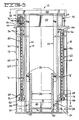
- a lift mast assembly 10 has a fixed upright assembly 12 and a movable upright assembly 14.
- the fixed upright assembly 12 has a first upright 16 and a second upright 18.
- These first and second fixed uprights 16 and 18 are interconnected to one another by upper and lower tie structure assemblies 20 and 22 which maintains the fixed uprights 16 and 18 a preselected spaced apart distance one from the other and forms a rigid structure with these uprights.
- the movable upright assembly 14 has a first and second upright 24 and 26.
- the first and second movable uprights are interconnected by upper and lower tie structure assemblies 28 and 30. These upper and lower tie assemblies maintain the first and second movable uprights a preselected spaced apart distance and form a rigid structure with these uprights.
- the movable upright assembly 14 is mounted on and between the fixed upright assembly 12 and elevationally extensible relative thereto.
- the fixed upright assembly 12 is pivotly mounted on one end portion 32 of a lift truck 34 having a pair of spaced front wheels 35 in any suitable well known applicable manner.
- a carriage assembly 36 of a type well known in the industry is mounted on the movable upright assembly 14 and elevationally positionable relative to the movable upright assembly.
- the carriage has an upper pair of guide rollers 38 and a lower pair of guide rollers 40 mounted thereon.
- One roller of each of the upper and lower pair is engageable with the first movable upright 26 and the other rollers of each of the upper and lower pair is engageable with the second movable upright 24.
- the first and second fixed uprights 16 and 18 and the first and second movable uprights 24, 26 each have a substantially rectangular elongate shaped web 42, 42' having first and second sides 44 and 46 and a surface 47.
- the surface 47 of the first fixed and first movable uprights 16 and 24 face one another and the surface 47 of the second fixed and movable uprights 18 and 26 face one another.
- Surface 47 of the first fixed and first movable uprights 16 and 24 are maintained a predetermined minimum distance apart by a first upper and first lower bearing assembly 48 and 50 and the surface 48 of the second fixed and movable uprights 18 and 26 are maintained a preselected minimum distance apart by a second upper and second lower bearing assembly 52 and 54.
- the upper bearing assemblies 48 and 52 are structurally identical but reversed and the lower bearing assemblies 50 and 54 are structurally identical but reversed.
- the first 16 and second 18 fixed uprights and the first 24 and second 26 movable uprights each have an upper and a lower end portion 56 and 58.
- the first upper bearing assembly 48 is connected to the upper end portion 56 of the first fixed upright 16 and the second upper bearing assembly 52 is connected to the upper end portion 56 of the second fixed upright 18.
- the first lower bearing assembly 50 is connected to the lower end portion 58 of the first movable upright 24 and the second lower bearing assembly 54 is connected to the lower end portion 58 of the second movable upright 26.
- First and second lift jack 60 and 62 each have a tubular cylinder 64 and a piston rod 66 slideably disposed in the tubular cylinder.
- the cylinders 64 each have a lower end 68 and the piston rods 66 each have an upper end portion 70.
- the first lift jack 60 is mounted on one of the first fixed 16 and first movable 24 uprights and connected to the other of the first fixed 16 and first movable 24 uprights.
- the second lift jack 62 is mounted on one of the second fixed 18 and second movable 26 uprights and connected to the other of the second fixed 18 and second movable uprights 26.
- the first lift jack 60 is mounted on thefirst fixed upright 16 at its lower end portion 58 and the upper end portion 70 of its piston rod 66 is connected to the first movable upright 24.
- the second lift jack 62 is mounted on the second fixed upright 18 at its lower end portion 58 and the upper end portion 70 of the second lift jacks 62 piston rod 66 is connected to the second movable upright 26.
- the first lift jack 60 is positioned between the web 42 of the first fixed upright 16 and the web 42' of the first movable upright 24 and the second lift jack 62 is positioned between the web 42 of the second fixed upright 18 and the web 42' of the second movable upright 26.
- first lift jack 60 is preferably located between the first side 44 and the second side 46 of the web 42, 42' of either one or both of the first fixed 16 and first movable 24 uprights and the second lift jack 62 is preferably located between the first and second sides 44 and 46 of the web 42, 42' either or both the second fixed and second movable uprights 18 and 26. It is to be noted that when the lift jacks are positioned in this nested manner with respect to their adjacent uprights that the uprights will shield the lift jacks from contact with objects so that damage will be prevented and the life of the lift jacks themselves will be extended.
- a first bracket assembly 72 is provided for mounting the first lift jack 60 on the first fixed upright 16 and a second bracket assembly 74 is provided for mounting the second lift jack 62 on the second fixed upright 18.
- the first bracket 72 is preferably connected to the web 42 of the first fixed upright 16 and extends a preselected distance in a direction from the surface 47 toward the web 42 of the first 24 and second fixed 18 upright.
- the second bracket assembly similarly, is connected to web 42 of the second fixed upright 18 and extends a preselected distance in a direction from the surface 47 toward the web 42' of the second movable 26 and first fixed 16 upright. It is to be noted that although the brackets were described as being two separate members it is to be understood that a single structure connected to the web 42 of both fixed uprights which extends transversely between these fixed uprights would be a suitable equivalent.
- the lower end 68 of cylinder 64 of the first lift jack 60 is connected to the first bracket assembly 72 in any conventional suitable manner, for example such as by a pin, bolt, or ball joint and the lower end 68 of cylinder 64 of the second lift jack 62 is connected to the second bracket assembly 74 in a like manner.
- this connection will permit a limited amount of pivotable movement of each of the cylinders about their respective bracket connections.
- a first sheave 76 is rotatably connected to the upper end portion 70 of piston rod 66 of the first lift jack and in a like manner a second sheave 78 is rotatably connected to the upper end portion 70 of piston rod 66 of the second lift jack 62.
- a first flexible tension member 80 having a first and second end 82 and 84 is trained over the first sheave and connected at the first end to the carriage assembly 36 and at the second end to the fixed upright assembly. It is to be noted that the first sheave and first flexible tension members are at least positioned between the webs 42, 42' of the first fixed 16 and first movable 24 uprights.
- a second flexible tension member 86 (Fig.
- First fixed upright 16 and second fixed upright 18 each have a first 92 and second 94 rear flange mounted thereon.
- the first rear flanges 92 are each positioned on their respective fixed uprights 16 and 18 a preselected distance from the second side 46 of their respective webs 42 and the second rear flanges 94 are positioned on their respective fixed uprights 16 and 18 a preselected distance from the second side 46 of their respective webs 42.
- the distance between the second side 46 and its adjacent first rear flange 92 being smaller in magnitude than the distance between the adjacent second rear flange and the second side.
- the first and second rear flanges 92, 94 are preferably elongate rectangular members and are mounted on their respective fixed uprights inwardly thereof so that the first and second rear flanges 92 and 94 of the first fixed upright and the first and second rear flange 92 and 94 of the second fixed upright 18 face one another.
- the first and second rear flanges are mounted on the surface 47 of the web 42 of their respective first and second fixed uprights 16 and 18.
- Each of the first and second rear flanges 92 and 94 of the first fixed upright 16 are substantially parallel along their length and the first and second rear flanges 92 and 94 of the second fixed upright 18 are parallel along their length.
- a first movable upright rear flange 96 and a second movable upright rear flange 98 each have a first and second surface 100 and 102 and a first and second side 104 and 106.
- the first movable upright rear flange 96 is connected to the second side 46 of the web 42' of the first movable upright 24 and the second movable upright rear flange 98 is connected to the second side 46 of the web 42' of the second movable upright 26.
- the first and second movable upright rear flanges are preferably elongate rectangular shaped members which extend the full length of the adjacent web 42'.
- a first movable upright front flange 108 and a second movable upright front flange 110 are connected to the first movable upright 24 and second movable upright 26, respectively.
- the first movable upright front flange 108 is a substantially elongate rectangular member connected to the web 42' of the first movable upright 24 at a preselected distance spaced from the first movable upright rear flange 96.
- the second movable upright front flange 110 is an elongate rectangular member and is connected to the web 42' of the second movable upright 26 at a preselected distance spaced from the second .
- movable upright rear flange 98 is an elongate rectangular member and is connected to the web 42' of the second movable upright 26 at a preselected distance spaced from the second .
- the first and second movable upright front flanges 108 and 110 are oriented inwardly of their respective uprights and in a facing relationship one with the other and parallel to their respectively adjacent rear flanges 96, 98.
- the first and second upper and lower bearing assemblies 48, 52, 50, and 54 each include a nonmetallic plastic bearing block 112 which is slideably engaged with one of the fixed and movable uprights 16, 18, 24, and 26.
- the bearing blocks 112 of the first and second upper bearing assemblies 48 and 52 are of an L-shaped configuration and engageable with the first surface 100 and second side 106 of their respectively adjacent movable uprights 24 and 26 and the bearing blocks 112 of the lower bearing assemblies 50 and 54 are substantially L-shaped in configuration and engageable with their respectively adjacent first and second fixed upright rear flanges 92.
- the cylinders 64 of each of the first and second lift jacks 60 and 62 have a preselected diameter "D" and the distance "E" between the web of the first fixed upright 16 and first movable upright is greater in magnitude at the cylinder mounted location than the diameter "D" of the first cylinder and the distance "E” between the web of the second fixed and second movable uprights 18 and 26 at the cylinder mounted location being greater in magnitude than the diameter "D" of the cylinder.
- the distance between these adjacent webs is only slightly greater than the cylinder diameter so as to reduce the cross- sectional width and thereby minimize the bulk of obstruction.
- the first and second flexible tension members 80 and 86 are nested between the respective webs 42, 42' of the adjacent pairs of fixed and movable uprights and thereby improving the operator's visibility.
- the web 42 of first and second fixed uprights 16 and 18 are preferably oriented at a predetermined angle "A" relative to the webs 42' of their respectively adjacent movable uprights 24 and 26.
- the angle of each of the fixed upright webs is determined by the location of an operator's station 114 and the lines of sight "L" (see Fig. 2) from the operator's station for a given operator norm.
- the angle of each of the webs 42 of the fixed uprights 16 and 18 are the same relative to the web 42' of their respectively adjacent movable upright 24 and 26 and each angle "A" is equal to one half the included angle established by the lines "L" of sight.
- the web 42 of the first fixed upright 16 is spaced a preselected first distance from the web 42' of the first movable upright 24 at the web second side 46 and a second preselected distance from the web 42' of the first movable upright at the webs first side 44.
- the web 42 of the second fixed upright 18 is spaced an equal first preselected distance from the web 42' of the second movable upright 26 at the web's second side and the same second preselected distance from the web 42' of the second movable upright 26 at the web's first side 44.
- this first preselected distance is smaller in magnitude than the second preselected distance.
- elevational movement of the movable upright assembly 14 along the fixed upright assembly 12 and elevational movement of the carriage along the guideways provided by the front and rear flanges 96, 98, 108, and 110forthe carriage rollers 38, 40 is achieved through extension and retraction of the lift jacks 60 and 62.
- Extension of the rods 66 will cause extension of the movable upright assembly 14 through the previously discussed movable upright and rod connection and elevational movement of the carriage 36 relative to the movable upright assembly 14 is achieved through the connection of the sheaves 76 and 78 and the first and second flexible tension members 80 and 86.
- first lift jack 60 and associated first sheave 76 and first flexible tension member 80 are nested between the webs 42, 42' of the first fixed 16 and first movable upright 24 and the second lift jack 62 and associated second sheave 78 and second flexible tension member 86 are nested between the webs 42, 42' of the second fixed 18 and second movable 26 uprights the obstruction relative to the line of sight of the vehicle operator is minimized.
- the diameter of cylinder 66 is substantially reduced which permits the webs 42, 42' of the adjacent fixed and movable uprights to be spaced a closer distance apart than previously permitted. Further utilizing the bearing assemblies 48, 50, 52 and 54 as previously discussed reduces the distance required between the adjacent fixed and movable uprights which permits this total overall reduction in the mast obstruction. Finally, by placing the webs 42 of the fixed uprights 16 and 18 at an angle relative to the webs 42' of their adjacent movable uprights 24 and 26, respectively, further enhances the operator's visibility is further enhanced as the angle at which the webs 42 are placed is parallel to the line of sight of the operator.
- Locating the lift jacks 60 and 62 between the first and second sides of the webs 42,42' of either one of the respectively adjacent fixed and movable uprights 16,18, 24 and 26 improves the load moment constant of the vehicle and thereby maximizes the load carrying capacity thereof for a given vehicle size and weight.
- the mast assembly may be located between the front wheels 35 without reducing the visibility, shortening the lift jacks 60, 62, or reducing overall lift height.
Landscapes
- Engineering & Computer Science (AREA)
- Transportation (AREA)
- Structural Engineering (AREA)
- Civil Engineering (AREA)
- Life Sciences & Earth Sciences (AREA)
- Geology (AREA)
- Mechanical Engineering (AREA)
- Forklifts And Lifting Vehicles (AREA)
- Transition And Organic Metals Composition Catalysts For Addition Polymerization (AREA)
- Acyclic And Carbocyclic Compounds In Medicinal Compositions (AREA)
- Conveying And Assembling Of Building Elements In Situ (AREA)
Claims (11)
Applications Claiming Priority (1)
| Application Number | Priority Date | Filing Date | Title |
|---|---|---|---|
| PCT/US1982/000354 WO1983003406A1 (en) | 1982-03-22 | 1982-03-22 | Lift mast assembly |
Publications (3)
| Publication Number | Publication Date |
|---|---|
| EP0104171A1 EP0104171A1 (de) | 1984-04-04 |
| EP0104171A4 EP0104171A4 (de) | 1985-09-18 |
| EP0104171B1 true EP0104171B1 (de) | 1989-05-10 |
Family
ID=22167877
Family Applications (1)
| Application Number | Title | Priority Date | Filing Date |
|---|---|---|---|
| EP82901388A Expired EP0104171B1 (de) | 1982-03-22 | 1982-03-22 | Hebemastzusammenbau |
Country Status (7)
| Country | Link |
|---|---|
| US (1) | US4441585A (de) |
| EP (1) | EP0104171B1 (de) |
| JP (1) | JPS59500414A (de) |
| CA (1) | CA1179646A (de) |
| DE (1) | DE3279681D1 (de) |
| NO (1) | NO160430C (de) |
| WO (1) | WO1983003406A1 (de) |
Cited By (1)
| Publication number | Priority date | Publication date | Assignee | Title |
|---|---|---|---|---|
| DE3532827A1 (de) * | 1984-09-14 | 1986-03-27 | Linde Ag, 6200 Wiesbaden | Mehrfach ausfahrbares hubgeruest |
Families Citing this family (10)
| Publication number | Priority date | Publication date | Assignee | Title |
|---|---|---|---|---|
| US5000293A (en) * | 1988-11-03 | 1991-03-19 | Clark Equipment Company | Upright for lift truck |
| US4949816A (en) * | 1988-11-03 | 1990-08-21 | Clark Equipment Company | Upright for lift truck |
| EP0574615B1 (de) * | 1992-06-15 | 1996-02-07 | R. Blom Beheer B.V. | Teleskopmast für einen Hublader |
| SE523505C2 (sv) * | 2000-03-03 | 2004-04-27 | Smv Lifttrucks Ab | Anordning vid motviktstruckar |
| GB2387376B (en) * | 2002-04-10 | 2005-12-21 | Lansing Linde Ltd | Industrial trucks having lifting masts |
| US7096999B2 (en) * | 2003-08-05 | 2006-08-29 | The Raymond Corporation | Mast construction for a lift truck |
| DE202007003491U1 (de) * | 2007-03-08 | 2007-05-10 | Jungheinrich Aktiengesellschaft | Lageranordnung für Hubkettenrollen in einem Teleskophubgerüst für Hubstapler |
| US8757326B2 (en) | 2011-10-12 | 2014-06-24 | Crown Equipment Corporaton | Pallet stops for lift trucks |
| US10087059B1 (en) * | 2017-01-11 | 2018-10-02 | Custom Mobile Equipment, Inc. | Double column boom attachment for a lift truck |
| CN107931453B (zh) * | 2017-11-24 | 2023-10-17 | 安徽鲲鹏装备模具制造有限公司 | 一种冷柜内胆的底板预铆接设备 |
Family Cites Families (10)
| Publication number | Priority date | Publication date | Assignee | Title |
|---|---|---|---|---|
| US1899751A (en) * | 1929-12-20 | 1933-02-28 | Westinghouse Elec Elevator Co | Elevator guide |
| US2456320A (en) * | 1947-02-24 | 1948-12-14 | Ross Carrier Company | Lift truck |
| US3127956A (en) * | 1954-02-25 | 1964-04-07 | Clark Equipment Co | Lift truck |
| US3394778A (en) * | 1966-11-25 | 1968-07-30 | Eaton Yale & Towne | Lift truck mast assembly |
| US4030568A (en) * | 1976-03-24 | 1977-06-21 | Caterpillar Tractor Co. | High visibility mast for lift trucks |
| US4219302A (en) * | 1978-02-13 | 1980-08-26 | Towmotor Corporation | Cylinder arrangement for raising a carriage and uprights of a mast |
| GB2043029B (en) * | 1978-08-17 | 1982-10-20 | Toyoda Automatic Loom Works | Device for loading and unloading lift truck |
| US4238004A (en) * | 1979-07-18 | 1980-12-09 | Cascade Corporation | Hidden chain assembly for lift truck mast |
| JPS5637994A (en) * | 1979-09-03 | 1981-04-11 | Toyoda Automatic Loom Works | Mast device in fork lift |
| US4312427A (en) * | 1980-03-10 | 1982-01-26 | Caterpillar Tractor Co. | Extra lift mast for lift trucks |
-
1982
- 1982-03-22 EP EP82901388A patent/EP0104171B1/de not_active Expired
- 1982-03-22 WO PCT/US1982/000354 patent/WO1983003406A1/en not_active Ceased
- 1982-03-22 DE DE8282901388T patent/DE3279681D1/de not_active Expired
- 1982-03-22 JP JP57501429A patent/JPS59500414A/ja active Pending
- 1982-03-22 US US06/375,114 patent/US4441585A/en not_active Expired - Fee Related
- 1982-12-17 CA CA000417971A patent/CA1179646A/en not_active Expired
-
1983
- 1983-10-07 NO NO83833658A patent/NO160430C/no unknown
Cited By (2)
| Publication number | Priority date | Publication date | Assignee | Title |
|---|---|---|---|---|
| DE3532827A1 (de) * | 1984-09-14 | 1986-03-27 | Linde Ag, 6200 Wiesbaden | Mehrfach ausfahrbares hubgeruest |
| DE3532827C2 (de) * | 1984-09-14 | 1995-11-16 | Linde Ag | Mehrfach ausfahrbares Hubgerüst |
Also Published As
| Publication number | Publication date |
|---|---|
| EP0104171A4 (de) | 1985-09-18 |
| EP0104171A1 (de) | 1984-04-04 |
| DE3279681D1 (en) | 1989-06-15 |
| NO160430C (no) | 1989-04-19 |
| NO833658L (no) | 1983-10-13 |
| WO1983003406A1 (en) | 1983-10-13 |
| NO160430B (no) | 1989-01-09 |
| JPS59500414A (ja) | 1984-03-15 |
| US4441585A (en) | 1984-04-10 |
| CA1179646A (en) | 1984-12-18 |
Similar Documents
| Publication | Publication Date | Title |
|---|---|---|
| JPH0111680Y2 (de) | ||
| US4441585A (en) | Lift mast assembly | |
| US4030568A (en) | High visibility mast for lift trucks | |
| US3561628A (en) | Load handling in fork-lift trucks movable fork cover for forklift truck | |
| US3841442A (en) | Lift truck upright | |
| KR880003809A (ko) | 후면 플랫포움 리프트 | |
| US20140219760A1 (en) | Reach assembly with offset pivot points for a materials handling vehicle | |
| US4759452A (en) | Articulated load bearing wear pad assembly | |
| US3998346A (en) | Material handling apparatus | |
| CA1089415A (en) | Cylinder arrangement for raising a carriage and uprights of a mast | |
| US6554145B1 (en) | Universal traversing assembly for legs of cranes or the like | |
| US4356893A (en) | Load lifting carriage and mast assembly | |
| US4721187A (en) | Lift truck mast structure | |
| US3777853A (en) | Hose guide for lift truck | |
| US5816768A (en) | Reach type forklift truck with a mast assembly of reduced jerking motion | |
| US3727781A (en) | Lift truck load lifting mechanism | |
| WO1983001434A1 (en) | Lift mast assembly | |
| GB2077224A (en) | Load handling mast for a truck | |
| CN116101940B (zh) | 一种矿用防爆胶轮式单元支架叉装搬运车 | |
| US20040037687A1 (en) | Transport system for the transport of components | |
| KR20200091729A (ko) | 개량된 신축구조를 갖는 지게차 포크암 어셈블리 | |
| US4276961A (en) | Mast and carriage assembly | |
| EP0058150B1 (de) | Ausgleichsystem für lasthebegeräte | |
| KR102368663B1 (ko) | 크레인용 와이어 가이딩 장치 | |
| JPS6011030Y2 (ja) | フォ−クリフトの荷役装置 |
Legal Events
| Date | Code | Title | Description |
|---|---|---|---|
| PUAI | Public reference made under article 153(3) epc to a published international application that has entered the european phase |
Free format text: ORIGINAL CODE: 0009012 |
|
| AK | Designated contracting states |
Kind code of ref document: A1 Designated state(s): DE FR GB NL SE |
|
| 17P | Request for examination filed |
Effective date: 19840404 |
|
| RAP1 | Party data changed (applicant data changed or rights of an application transferred) |
Owner name: CATERPILLAR INDUSTRIAL INC. |
|
| 17Q | First examination report despatched |
Effective date: 19860524 |
|
| D17Q | First examination report despatched (deleted) | ||
| GRAA | (expected) grant |
Free format text: ORIGINAL CODE: 0009210 |
|
| AK | Designated contracting states |
Kind code of ref document: B1 Designated state(s): DE FR GB NL SE |
|
| REF | Corresponds to: |
Ref document number: 3279681 Country of ref document: DE Date of ref document: 19890615 |
|
| ET | Fr: translation filed | ||
| PGFP | Annual fee paid to national office [announced via postgrant information from national office to epo] |
Ref country code: FR Payment date: 19900209 Year of fee payment: 9 |
|
| PGFP | Annual fee paid to national office [announced via postgrant information from national office to epo] |
Ref country code: SE Payment date: 19900227 Year of fee payment: 9 |
|
| PGFP | Annual fee paid to national office [announced via postgrant information from national office to epo] |
Ref country code: GB Payment date: 19900228 Year of fee payment: 9 |
|
| PLBE | No opposition filed within time limit |
Free format text: ORIGINAL CODE: 0009261 |
|
| STAA | Information on the status of an ep patent application or granted ep patent |
Free format text: STATUS: NO OPPOSITION FILED WITHIN TIME LIMIT |
|
| PGFP | Annual fee paid to national office [announced via postgrant information from national office to epo] |
Ref country code: DE Payment date: 19900313 Year of fee payment: 9 |
|
| PGFP | Annual fee paid to national office [announced via postgrant information from national office to epo] |
Ref country code: NL Payment date: 19900331 Year of fee payment: 9 |
|
| 26N | No opposition filed | ||
| PG25 | Lapsed in a contracting state [announced via postgrant information from national office to epo] |
Ref country code: FR Effective date: 19901130 |
|
| REG | Reference to a national code |
Ref country code: FR Ref legal event code: ST |
|
| PG25 | Lapsed in a contracting state [announced via postgrant information from national office to epo] |
Ref country code: GB Effective date: 19910322 |
|
| PG25 | Lapsed in a contracting state [announced via postgrant information from national office to epo] |
Ref country code: SE Effective date: 19910323 |
|
| PG25 | Lapsed in a contracting state [announced via postgrant information from national office to epo] |
Ref country code: NL Effective date: 19911001 |
|
| NLV4 | Nl: lapsed or anulled due to non-payment of the annual fee | ||
| GBPC | Gb: european patent ceased through non-payment of renewal fee | ||
| PG25 | Lapsed in a contracting state [announced via postgrant information from national office to epo] |
Ref country code: DE Effective date: 19920101 |
|
| EUG | Se: european patent has lapsed |
Ref document number: 82901388.7 Effective date: 19911009 |