EP0104305A2 - Recouvrement de sol du genre tapis - Google Patents
Recouvrement de sol du genre tapis Download PDFInfo
- Publication number
- EP0104305A2 EP0104305A2 EP83102139A EP83102139A EP0104305A2 EP 0104305 A2 EP0104305 A2 EP 0104305A2 EP 83102139 A EP83102139 A EP 83102139A EP 83102139 A EP83102139 A EP 83102139A EP 0104305 A2 EP0104305 A2 EP 0104305A2
- Authority
- EP
- European Patent Office
- Prior art keywords
- adhesive
- floor covering
- covering according
- underside
- floor
- Prior art date
- Legal status (The legal status is an assumption and is not a legal conclusion. Google has not performed a legal analysis and makes no representation as to the accuracy of the status listed.)
- Withdrawn
Links
Images
Classifications
-
- D—TEXTILES; PAPER
- D06—TREATMENT OF TEXTILES OR THE LIKE; LAUNDERING; FLEXIBLE MATERIALS NOT OTHERWISE PROVIDED FOR
- D06N—WALL, FLOOR, OR LIKE COVERING MATERIALS, e.g. LINOLEUM, OILCLOTH, ARTIFICIAL LEATHER, ROOFING FELT, CONSISTING OF A FIBROUS WEB COATED WITH A LAYER OF MACROMOLECULAR MATERIAL; FLEXIBLE SHEET MATERIAL NOT OTHERWISE PROVIDED FOR
- D06N7/00—Flexible sheet materials not otherwise provided for, e.g. textile threads, filaments, yarns or tow, glued on macromolecular material
- D06N7/0063—Floor covering on textile basis comprising a fibrous top layer being coated at the back with at least one polymer layer, e.g. carpets, rugs, synthetic turf
- D06N7/0071—Floor covering on textile basis comprising a fibrous top layer being coated at the back with at least one polymer layer, e.g. carpets, rugs, synthetic turf characterised by their backing, e.g. pre-coat, back coating, secondary backing, cushion backing
-
- A—HUMAN NECESSITIES
- A47—FURNITURE; DOMESTIC ARTICLES OR APPLIANCES; COFFEE MILLS; SPICE MILLS; SUCTION CLEANERS IN GENERAL
- A47G—HOUSEHOLD OR TABLE EQUIPMENT
- A47G27/00—Floor fabrics; Fastenings therefor
- A47G27/04—Carpet fasteners; Carpet-expanding devices ; Laying carpeting; Tools therefor
- A47G27/0437—Laying carpeting, e.g. wall-to-wall carpeting
-
- D—TEXTILES; PAPER
- D06—TREATMENT OF TEXTILES OR THE LIKE; LAUNDERING; FLEXIBLE MATERIALS NOT OTHERWISE PROVIDED FOR
- D06N—WALL, FLOOR, OR LIKE COVERING MATERIALS, e.g. LINOLEUM, OILCLOTH, ARTIFICIAL LEATHER, ROOFING FELT, CONSISTING OF A FIBROUS WEB COATED WITH A LAYER OF MACROMOLECULAR MATERIAL; FLEXIBLE SHEET MATERIAL NOT OTHERWISE PROVIDED FOR
- D06N2203/00—Macromolecular materials of the coating layers
- D06N2203/04—Macromolecular compounds obtained by reactions only involving carbon-to-carbon unsaturated bonds
- D06N2203/042—Polyolefin (co)polymers
-
- D—TEXTILES; PAPER
- D06—TREATMENT OF TEXTILES OR THE LIKE; LAUNDERING; FLEXIBLE MATERIALS NOT OTHERWISE PROVIDED FOR
- D06N—WALL, FLOOR, OR LIKE COVERING MATERIALS, e.g. LINOLEUM, OILCLOTH, ARTIFICIAL LEATHER, ROOFING FELT, CONSISTING OF A FIBROUS WEB COATED WITH A LAYER OF MACROMOLECULAR MATERIAL; FLEXIBLE SHEET MATERIAL NOT OTHERWISE PROVIDED FOR
- D06N2203/00—Macromolecular materials of the coating layers
- D06N2203/06—Macromolecular compounds obtained otherwise than by reactions only involving carbon-to-carbon unsaturated bonds
- D06N2203/068—Polyurethanes
-
- D—TEXTILES; PAPER
- D06—TREATMENT OF TEXTILES OR THE LIKE; LAUNDERING; FLEXIBLE MATERIALS NOT OTHERWISE PROVIDED FOR
- D06N—WALL, FLOOR, OR LIKE COVERING MATERIALS, e.g. LINOLEUM, OILCLOTH, ARTIFICIAL LEATHER, ROOFING FELT, CONSISTING OF A FIBROUS WEB COATED WITH A LAYER OF MACROMOLECULAR MATERIAL; FLEXIBLE SHEET MATERIAL NOT OTHERWISE PROVIDED FOR
- D06N2209/00—Properties of the materials
- D06N2209/04—Properties of the materials having electrical or magnetic properties
- D06N2209/041—Conductive
-
- D—TEXTILES; PAPER
- D06—TREATMENT OF TEXTILES OR THE LIKE; LAUNDERING; FLEXIBLE MATERIALS NOT OTHERWISE PROVIDED FOR
- D06N—WALL, FLOOR, OR LIKE COVERING MATERIALS, e.g. LINOLEUM, OILCLOTH, ARTIFICIAL LEATHER, ROOFING FELT, CONSISTING OF A FIBROUS WEB COATED WITH A LAYER OF MACROMOLECULAR MATERIAL; FLEXIBLE SHEET MATERIAL NOT OTHERWISE PROVIDED FOR
- D06N2209/00—Properties of the materials
- D06N2209/10—Properties of the materials having mechanical properties
- D06N2209/106—Roughness, anti-slip, abrasiveness
-
- D—TEXTILES; PAPER
- D06—TREATMENT OF TEXTILES OR THE LIKE; LAUNDERING; FLEXIBLE MATERIALS NOT OTHERWISE PROVIDED FOR
- D06N—WALL, FLOOR, OR LIKE COVERING MATERIALS, e.g. LINOLEUM, OILCLOTH, ARTIFICIAL LEATHER, ROOFING FELT, CONSISTING OF A FIBROUS WEB COATED WITH A LAYER OF MACROMOLECULAR MATERIAL; FLEXIBLE SHEET MATERIAL NOT OTHERWISE PROVIDED FOR
- D06N2211/00—Specially adapted uses
- D06N2211/06—Building materials
- D06N2211/066—Floor coverings
-
- D—TEXTILES; PAPER
- D06—TREATMENT OF TEXTILES OR THE LIKE; LAUNDERING; FLEXIBLE MATERIALS NOT OTHERWISE PROVIDED FOR
- D06N—WALL, FLOOR, OR LIKE COVERING MATERIALS, e.g. LINOLEUM, OILCLOTH, ARTIFICIAL LEATHER, ROOFING FELT, CONSISTING OF A FIBROUS WEB COATED WITH A LAYER OF MACROMOLECULAR MATERIAL; FLEXIBLE SHEET MATERIAL NOT OTHERWISE PROVIDED FOR
- D06N2213/00—Others characteristics
- D06N2213/06—Characteristics of the backing in carpets, rugs, synthetic lawn
- D06N2213/066—Characteristics of the backing in carpets, rugs, synthetic lawn having an adhesive on the undersurface to allow removal of the whole carpet, rug or synthetic lawn from the floor, e.g. pressure sensitive adhesive
Definitions
- the invention relates to a floor covering made of carpet, which rests with an underside on a floor and the top of which is opposite the underside can be walked on.
- the carpet can be attached to the floor using double-sided adhesive tapes. This method is also complicated and requires very careful work. In addition, it does not in all cases result in the carpet lying evenly on the surface, regardless of fluctuations in temperature and humidity.
- the object of the present invention is therefore to provide a floor covering made of carpet which is easy to install, has good adhesion to the subsurface independent of ambient temperatures and air humidity and can be adapted to the floor relatively easily without the risk that there is Having to cut carpet.
- the laying of such carpeting does not cause the previously known difficulties. It can be adapted to the design of a floor. After careful cutting, the self-adhesive underside is connected to the floor. There is no need to use any special additional materials, such as an adhesive to be applied later or adhesive tapes that stick on both sides. The application is simple and quick to accomplish without the time-consuming bracing of the carpet goods being necessary. For the purpose of laying, only a suitable carpet knife is used to cut the carpet. The self-adhesive underside is connected to the floor by simply rolling on or stepping on. Depending on the type of adhesive applied, it is also unnecessary to heat the self-adhesive underside or to dissolve it with solvents.
- the self-adhesive underside is particularly suitable for three-dimensionally shaped carpet parts which are used, for example, when forming an interior of a motor vehicle. Especially with spatially shaped carpet parts application of the adhesive or even application of double-sided adhesive tapes is only inadequately possible, while such parts cannot be braced.
- a self-adhesive covering is applied to the underside.
- This covering can be designed as an adhesive. It is always necessary if the underside of the carpet itself has no adhesive properties. However, the underside can also be designed as a self-adhesive object back, which at the same time takes on the function of a binding layer.
- the carpet flooring according to the invention is designed in a punctiform manner on the underside of the floor covering.
- This embodiment is particularly suitable for carpets that are to be laid over a large area and flat, so that an adhesive connection to the substrate is only required to a certain grid dimension.
- the undersides of the floor covering can be in the form of strips, zigzags or waves.
- other shapes of the self-adhesive areas of the underside of the floor covering are also conceivable, for example only the edge areas in the case of pre-assembled floor covering sizes.
- the underside facing the floor to be laid out is provided with a special layering which is self-adhesive.
- the adhesive must be selected in order to prevent mutually incompatible materials from acting on one another.
- a hot-melt adhesive can advantageously be used. However, others are applicable.
- the self-adhesive underside of the floor covering can be provided with a non-slip protective film, which can consist of several independent sheets. These sheets are only removed after the covering has been cut to ensure that the underside adheres to the floor.
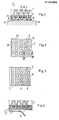
- a carpet product essentially consists of a binding layer 2, a base material 5 and threads 4.
- the threads 4 are pierced into the base material 5 and form a loop 22 on an underside 21 facing a floor 20.
- This loop 22 is in the base material 5 applied bonding layer 2 attached.
- the loop 22 with a pole 23 protrudes from the binding layer 2.
- the poles 23 and the binding layer 2 extending between the poles 23 form the underside 21.
- the carpet material is formed on its upper side 1 facing away from the underside 21 in the case of the formation of a velor quality of individual threads 24, 25 in which the loop 22 ends. However, it is also possible to produce carpet quality in loop quality.
- the underside 21 is self-adhesive.
- a material can be used for the production of the binding layer 2 that adheres to the bottom 20 itself.
- a self-adhesive covering 3 can be applied to the underside 21 as a full-surface back layer.
- the material forming the binding layer 2 or the covering 3 can be cured to different extents either by a hardener or by temperature.
- the binding layer 2 in the area of Loops 22 to harden completely, so that each loop 22 is firmly connected to the binding layer 2.
- the binding layer 2 has not yet fully hardened, so that it still has self-adhesive properties. The binding layer 2 develops these properties as soon as it has been applied to the base 20 and pressed with it.
- FIGS 3 are shown.
- self-adhesive points 6 are applied to the underside 21.
- self-adhesive strips 7 extend over the underside 21, which is shown in FIG. 3. These strips 7 can extend in a straight line over the underside 21. But they can also be designed in the form of a zigzag 8 or in the form of a shaft 9. Depending on the type of use, differently shaped self-adhesive areas are also possible.
- the entire underside 21 with a self-adhesive covering 3, from which only a few regions 11 protrude.
- These areas 11 preferably stick to the floor 20, while the covering 3 adheres only loosely to the floor 20 between the areas 11. Should be due to heat or humidity shifts of the carpet material as against the bottom 20, then differences in length can choose between the B-rich e compensate. 11 While these areas 11 adhere firmly to the floor 20, the covering 3 detaches from the floor 20 in all parts lying between the areas 11, so that tensions occurring on the floor 20 can be compensated for despite sufficient adhesion of the carpet goods. After the tension has been equalized, a connection between the covering 3 and the floor 20 is also established in the parts lying between the areas 11, which ensures that the carpet is firmly supported on the floor 20.
- Various adhesives come into consideration as self-adhesive material.
- a hot melt adhesive should be considered, which develops its adhesive strength when it is heated to a certain temperature.
- This heating can be carried out with the aid of a hot air device, with which the self-adhesive covering 3 is heated over its entire surface or in the area of points 6 or strips 7.
- a combination of different adhesives is possible if raised areas 11 protrude from a full-surface covering 3 as shown in FIG. 4: These raised areas 11 are formed, for example, in the form of a hot-melt adhesive, the adhesive force of which is reactivated by heating.
- the covering 3 is formed with the aid of a weakly adhesive permanent adhesive which is able to hold the carpet goods on the floor 20 until certain displacement forces occur, but then to detach them from them and then again with them to glue the floor 20.
- the covering 3 can be covered by a protective film 12 which extends over the entire area over the underside 21.
- This protective film 12 can easily be detached from the covering 3.
- On their topping 3 facing away from the protective film 12 does not have any adhesive force, so that it prevents the self-adhesive covering 3 from unintentionally adhering to the top 1 of the winding layer adjacent to it when the carpeting is wound up.
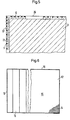
- the protective film 12 has a very important function, which considerably simplifies the laying of the carpet. As long as the protective film 12 adheres to the self-adhesive covering 3, it prevents the covering 3 from adhering to the floor 20. In this state, the carpet goods spread out on the floor 20 can be carefully tailored to the spatial requirements of the floor 2. The protective film 12 is then removed from the covering 3 and this is glued to the floor 20. In order to simplify the removal of the protective film 12 from the covering 3, the protective film 12 is designed in the form of individual strips 13 which extend parallel to one another in the longitudinal direction of the carpet. After the carpet goods have been cut to size, the strips 13 can be detached piece by piece from the underside 21, depending on the progress of the laying work, so that they stick to the floor 20 in the area of the detached strips 13.
- the protective film 12 is expediently provided on its side facing away from the covering 3 with a design 14 which prevents the protective film 12 from slipping on the upper side 1.
- This design 14 can be designed as a roughening which is introduced into the surface 15 of the protective film 12 facing away from the covering 3.
- This roughening 14 is to be selected so that it does not slip on the threads 4 when the carpet is rolled up. In this way it is avoided that a rolled up Carpet unintentionally pulls apart during transport, so that the roll becomes much longer than it corresponds to the width of the carpet.
- the formation 14 can also consist of a paper that is firmly connected to the surface 15 of the protective film 12. This paper prevents the threads 4 from slipping on the protective film 12.
- the protective film 12 is expediently releasably connected to the covering 3 only in the central region.
- the protective film 12 lies loosely on the underside 21, so that it can be easily gripped and pulled off.
- the strips 13 can also be formed in the region of their edges 16.
- the formation 14 can extend over the entire surface 15 of the protective film 12. In many cases it will be sufficient to carry out the training 14 only in individual areas of the surface 15.
- the protective film 12 can consist of a material that is as tear-resistant as possible. It is expediently made of polyethylene. However, other plastics are also suitable.
- the self-adhesive covering 3 can also be applied to the underside 21 in different distributions. For example, it is conceivable to provide the entire central region of a specific underside 21 with a covering 3 over the entire surface. Only in the area of the edges 26, 27 delimiting the carpet product can the self-adhesive covering 3 only be applied in individual areas 11 which are separate from one another. These areas 11 can in
- any adhesive to be used must be neutral both with respect to the bonding layer 2 and to the bottom 20. He must not attack the binding layer 2 or the floor 20. If, for example, a polyurethane is used as the binding layer, the adhesive must be selected with a view to this binding layer. He must also have no reaction with the threads 4. If a solvent adhesive or a water-activatable adhesive is used for the adhesive, care must be taken to ensure that both the binding layer 2 and the threads 4 and the base 20 are neither attacked by the solvent nor destroyed by the water evaporating from the adhesive. In addition, the adhesive should have electrically conductive properties in order to prevent an electrical potential from building up in the carpet.
Landscapes
- Engineering & Computer Science (AREA)
- Textile Engineering (AREA)
- Floor Finish (AREA)
- Carpets (AREA)
Applications Claiming Priority (2)
| Application Number | Priority Date | Filing Date | Title |
|---|---|---|---|
| DE19823235382 DE3235382A1 (de) | 1982-09-24 | 1982-09-24 | Bodenbelag aus teppichware |
| DE3235382 | 1982-09-24 |
Publications (2)
| Publication Number | Publication Date |
|---|---|
| EP0104305A2 true EP0104305A2 (fr) | 1984-04-04 |
| EP0104305A3 EP0104305A3 (fr) | 1985-01-23 |
Family
ID=6174057
Family Applications (1)
| Application Number | Title | Priority Date | Filing Date |
|---|---|---|---|
| EP83102139A Withdrawn EP0104305A3 (fr) | 1982-09-24 | 1983-03-04 | Recouvrement de sol du genre tapis |
Country Status (3)
| Country | Link |
|---|---|
| EP (1) | EP0104305A3 (fr) |
| JP (1) | JPS5990516A (fr) |
| DE (1) | DE3235382A1 (fr) |
Cited By (7)
| Publication number | Priority date | Publication date | Assignee | Title |
|---|---|---|---|---|
| WO1988006666A1 (fr) * | 1987-02-27 | 1988-09-07 | Udo Jodeit | Plinthes pour moquettes et leur procede de production |
| EP0307694A3 (en) * | 1987-09-15 | 1990-02-07 | Metzeler Gesellschaft Mit Beschrankter Haftung | Method of making a flexible self-adhesive floor covering for aircraft |
| DE9015144U1 (de) * | 1990-11-03 | 1991-03-07 | Engelking, Martha, 3257 Springe | Rutschhemmende Badematte |
| GB2371980A (en) * | 2001-02-07 | 2002-08-14 | Dennis Davy Anderson | Protecting a stair covering |
| EP1317897A1 (fr) * | 2001-12-05 | 2003-06-11 | Carpetboy, Coöperatieve Vennootschap | Bande de tapis prêt à poser |
| DE19914337B4 (de) * | 1998-07-24 | 2005-03-31 | Dura Tufting Gmbh | Bodenbelag aus Teppichware |
| EP1872696A1 (fr) * | 2006-06-27 | 2008-01-02 | New Carpetboy b.v.b.a. | Procédé pour préparation d'un rouleau de revêtement de sol |
Families Citing this family (4)
| Publication number | Priority date | Publication date | Assignee | Title |
|---|---|---|---|---|
| DE3236131A1 (de) * | 1982-09-24 | 1984-03-29 | Siemens AG, 1000 Berlin und 8000 München | Verfahren zur herstellung von mis-feldeffektanordnungen |
| US4849267A (en) * | 1988-04-29 | 1989-07-18 | Collins & Aikman Corporation | Foam backed carpet with adhesive release surface and method of installing same |
| JP6560021B2 (ja) * | 2015-05-08 | 2019-08-14 | オカ株式会社 | 滑り止めマットの製法 |
| AT519641B1 (de) * | 2017-02-02 | 2019-02-15 | Itd Vertriebsgesellschaft M B H | Verfahren zur herstellung eines temporär festhaftenden teppichs |
Family Cites Families (12)
| Publication number | Priority date | Publication date | Assignee | Title |
|---|---|---|---|---|
| CH180017A (de) * | 1934-12-11 | 1935-10-15 | Meyer Gasser Max | Gleitschutz an Teppichen, Läufern usw. |
| US2763587A (en) * | 1953-05-07 | 1956-09-18 | Masland C H & Sons | Tile floor covering |
| DE1848335U (de) * | 1961-09-20 | 1962-03-15 | Perex Chem Fab G M B H | Teppich. |
| AT271846B (de) * | 1967-05-29 | 1969-06-10 | Bunzl & Biach Ag | Textiler Fußbodenbelag mit erhöhter elektrischer Leitfähigkeit |
| CH974367A4 (fr) * | 1967-07-17 | 1971-03-31 | ||
| SE309050B (fr) * | 1967-12-29 | 1969-03-10 | Inva Ab | |
| DE6930880U (de) * | 1969-08-04 | 1969-12-18 | Weinsheim Gmbh Chem Werke | Belagplatte, vorzugsweise fuer fussboeden |
| DE2333726B2 (de) * | 1973-07-03 | 1979-10-04 | Dlw Ag, 7120 Bietigheim-Bissingen | Im Freien verlegbarer textiler Bodenbelag |
| GB1552626A (en) * | 1975-06-06 | 1979-09-19 | Ici Ltd | Bakc coated floor covering |
| DE7904078U1 (de) * | 1979-02-15 | 1979-09-20 | Herforder Teppichfabrik Huchzermeyer & Co Gmbh, 4900 Herford | Teppichbodenbahn |
| DE8012318U1 (de) * | 1980-05-06 | 1980-11-27 | Walther Laesser Ag, Erlinsbach (Schweiz) | Textile belagbahn fuer boeden oder waende |
| DE8017450U1 (de) * | 1980-06-30 | 1980-10-16 | Transatlantic H. Bernhardt Gmbh, 1000 Berlin | Selbstklebendes gewebe fuer vollflaechige, wiederaufnehmbare verklebung von teppichboeden |
-
1982
- 1982-09-24 DE DE19823235382 patent/DE3235382A1/de not_active Ceased
-
1983
- 1983-03-04 EP EP83102139A patent/EP0104305A3/fr not_active Withdrawn
- 1983-09-22 JP JP58174423A patent/JPS5990516A/ja active Pending
Cited By (9)
| Publication number | Priority date | Publication date | Assignee | Title |
|---|---|---|---|---|
| WO1988006666A1 (fr) * | 1987-02-27 | 1988-09-07 | Udo Jodeit | Plinthes pour moquettes et leur procede de production |
| EP0307694A3 (en) * | 1987-09-15 | 1990-02-07 | Metzeler Gesellschaft Mit Beschrankter Haftung | Method of making a flexible self-adhesive floor covering for aircraft |
| DE9015144U1 (de) * | 1990-11-03 | 1991-03-07 | Engelking, Martha, 3257 Springe | Rutschhemmende Badematte |
| DE19914337B4 (de) * | 1998-07-24 | 2005-03-31 | Dura Tufting Gmbh | Bodenbelag aus Teppichware |
| GB2371980A (en) * | 2001-02-07 | 2002-08-14 | Dennis Davy Anderson | Protecting a stair covering |
| GB2371980B (en) * | 2001-02-07 | 2004-07-28 | Dennis Davy Anderson | An apparatus for protecting a covering on a stair |
| EP1317897A1 (fr) * | 2001-12-05 | 2003-06-11 | Carpetboy, Coöperatieve Vennootschap | Bande de tapis prêt à poser |
| BE1014527A3 (nl) * | 2001-12-05 | 2003-12-02 | New Carpetboy Bvba | Legklare tapijtbaan. |
| EP1872696A1 (fr) * | 2006-06-27 | 2008-01-02 | New Carpetboy b.v.b.a. | Procédé pour préparation d'un rouleau de revêtement de sol |
Also Published As
| Publication number | Publication date |
|---|---|
| DE3235382A1 (de) | 1984-03-29 |
| JPS5990516A (ja) | 1984-05-25 |
| EP0104305A3 (fr) | 1985-01-23 |
Similar Documents
| Publication | Publication Date | Title |
|---|---|---|
| DE2723239C2 (de) | Verbindungsmaterial | |
| DE68916477T2 (de) | Teppich mit Schaumunterseite mit einem selbsthaftenden Belag und Verfahren zu dessen Verlegung. | |
| DE69414033T2 (de) | Verfahren zum Verlegen eines Fussbodens | |
| DE3328165A1 (de) | Belag fuer eine zu verkleidende flaeche | |
| DE3818283A1 (de) | Bahn zur herstellung von zeichen und verfahren zu deren verwendung | |
| EP0104305A2 (fr) | Recouvrement de sol du genre tapis | |
| EP2131693B1 (fr) | Système de fixation | |
| EP1313819B1 (fr) | Utilisation de ruban adhésif | |
| DE3041074A1 (de) | Klebeband fuer bodenbelaege o.dgl. | |
| DE1994462U (de) | Poroeser textiler bodenbelag. | |
| EP1311643A1 (fr) | Film autocollant | |
| EP1117746B1 (fr) | Feuille auto-adh sive | |
| DE3706412C2 (fr) | ||
| DE8226915U1 (de) | Bodenbelagbahn aus teppichware | |
| DE2649644A1 (de) | Mass- und klebeecken zum verlegen von bodenbelaegen, insbesondere von teppichboeden | |
| EP4215688B1 (fr) | Lamelle en forme de baguette | |
| EP3216943B1 (fr) | Éléments de sous-couche d'isolation pour parquet et sol stratifié comprenant des raccords latéraux et bandes adhésives | |
| DE102011001102A1 (de) | Fußbodensystem und Verfahren zum Verlegen eines Fußbodens | |
| DE8710779U1 (de) | Fußmatte für Kraftfahrzeuge | |
| EP0607616B1 (fr) | Plaque d'isolation | |
| DE29620377U1 (de) | Verlegevorrichtung für Heizungsrohre o.dgl. | |
| DE9312987U1 (de) | Schaumstoffelement | |
| DE29824685U1 (de) | Selbstklebefolie | |
| DE3101255A1 (de) | "werkstueck zur befestigung an einer arbeitsflaeche sowie verfahren zur herstellung des werkstueckes" | |
| DE29706989U1 (de) | Hakenbahn für einen, aus einer Hakenbahn und einer Schlaufenbahn bestehenden Klettverschluß |
Legal Events
| Date | Code | Title | Description |
|---|---|---|---|
| PUAI | Public reference made under article 153(3) epc to a published international application that has entered the european phase |
Free format text: ORIGINAL CODE: 0009012 |
|
| AK | Designated contracting states |
Designated state(s): AT BE CH FR GB IT LI LU NL SE |
|
| PUAL | Search report despatched |
Free format text: ORIGINAL CODE: 0009013 |
|
| AK | Designated contracting states |
Designated state(s): AT BE CH FR GB IT LI LU NL SE |
|
| STAA | Information on the status of an ep patent application or granted ep patent |
Free format text: STATUS: THE APPLICATION IS DEEMED TO BE WITHDRAWN |
|
| 18D | Application deemed to be withdrawn |
Effective date: 19850724 |
|
| RIN1 | Information on inventor provided before grant (corrected) |
Inventor name: HAAS, HEINZ Inventor name: STRUVE, KLAUS-DIETER |