EP0104335A2 - Verfahren zur Reinigung von Abgasen - Google Patents
Verfahren zur Reinigung von Abgasen Download PDFInfo
- Publication number
- EP0104335A2 EP0104335A2 EP83106818A EP83106818A EP0104335A2 EP 0104335 A2 EP0104335 A2 EP 0104335A2 EP 83106818 A EP83106818 A EP 83106818A EP 83106818 A EP83106818 A EP 83106818A EP 0104335 A2 EP0104335 A2 EP 0104335A2
- Authority
- EP
- European Patent Office
- Prior art keywords
- stage
- reactant
- gas
- added
- amount
- Prior art date
- Legal status (The legal status is an assumption and is not a legal conclusion. Google has not performed a legal analysis and makes no representation as to the accuracy of the status listed.)
- Granted
Links
Images
Classifications
-
- B—PERFORMING OPERATIONS; TRANSPORTING
- B01—PHYSICAL OR CHEMICAL PROCESSES OR APPARATUS IN GENERAL
- B01D—SEPARATION
- B01D53/00—Separation of gases or vapours; Recovering vapours of volatile solvents from gases; Chemical or biological purification of waste gases, e.g. engine exhaust gases, smoke, fumes, flue gases, aerosols
- B01D53/34—Chemical or biological purification of waste gases
- B01D53/46—Removing components of defined structure
- B01D53/48—Sulfur compounds
- B01D53/50—Sulfur oxides
-
- B—PERFORMING OPERATIONS; TRANSPORTING
- B01—PHYSICAL OR CHEMICAL PROCESSES OR APPARATUS IN GENERAL
- B01D—SEPARATION
- B01D53/00—Separation of gases or vapours; Recovering vapours of volatile solvents from gases; Chemical or biological purification of waste gases, e.g. engine exhaust gases, smoke, fumes, flue gases, aerosols
- B01D53/34—Chemical or biological purification of waste gases
- B01D53/46—Removing components of defined structure
- B01D53/68—Halogens or halogen compounds
Definitions
- the invention relates to a method according to the preamble of patent claim 1.
- a reagent solution is sprayed into the gas stream inside a tower.
- the supply of the reagent solution sprayed in the form of a fine mist is made in this way on the concentration of impurities and the temperature of the to be cleaned exhaust gases that the temperature of the gas stream leaving the tower is kept above the dew point; practically all liquid in the tower evaporates and the reaction product is obtained in solid form at the exit of the tower.
- the required amount of reactant is naturally proportional to the harmful gas concentration and corresponds to 1.5 times the stoichiometric ratio under favorable conditions.
- the amount of water must at least be sufficient to keep the reactant in solution or suspension.
- the method is therefore limited to cases in which the temperature drop calculated from the amount of water to be evaporated is smaller than the difference between the initial temperature of the gas and its dew point temperature.
- the temperature at which the exhaust gases enter the gas cleaning system is relatively low, for example at 130-140 ° C., for reasons of heat economy.
- the temperature should be at least between 100 and 110 ° C in order to maintain the necessary safety distance from the dew point.
- the temperature drop in gas cleaning must therefore only be about 30 °. With coal or oil-fired steam generators and with the use of slaked lime as a reactant, this condition can only be met if the sulfur content in the fuel is not significantly greater than 1%. Therefore, the "wet-dry" process is not applicable to the combustion of fuels containing high sulfur, the sulfur content of which can reach 2 to 3% depending on the origin.
- DE-OS 25 18 079 describes a two-stage process consisting of a first "wet-dry” and a subsequent dry stage.
- the present invention has for its object to provide a method of the type specified in the introduction, in which the temperature drop does not exceed the temperature range available in steam generating plants even under high harmful gas concentrations and in which the consumption of reactants is substantially lower than in known dry methods.
- the harmful gas content is considerably reduced, for example to 30 to 50% of the initial concentration.
- the partially reacted dry reagent as well as the remaining harmful gas reaches the second stage with the exhaust gas stream and is moistened there. This activates it so that it is able to react again with the remaining harmful gas. This reaction is promoted by the turbulence caused by the spraying and evaporation of the aqueous medium.
- the moisture content of the gas required to activate the particles is on the amount of dry substance added in the first stage and thus also on the initial harmful gas concentration. Therefore, even with high concentrations of harmful gases, the amount of water can be limited so that a drop below the dew point is avoided.
- the control according to claim 4 is advantageous for exhaust gases with fluctuating concentrations of harmful gases.
- the measure according to claim 5 further reduces the consumption of reactants.
- the measure according to claim 6 avoids that fly ash is also returned together with the reaction products.
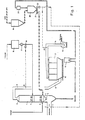
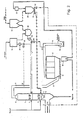
- Figures 1 and 2 show schematically an embodiment of a gas cleaning system for performing the method according to the invention.
- a horizontal exhaust gas line 2 emanating from a steam boiler (not shown) opens tangentially, similar to a cyclone.
- a measuring nozzle 3 for the amount of flue gas and the concentration of harmful gas is attached therein.
- Exhaust pipe 2 has a funnel-shaped insert 4 with an axial immersion tube 5 that fills the cross section.
- a nozzle system 6 is located above it.
- Another nozzle system 7 is attached approximately halfway between the nozzle system 6 and the upper outlet 8 of the reaction container 1. The nozzles of the two nozzle systems 6, 7 are distributed in a known manner in a horizontal plane across the cross section of the reaction container 1.
- the outlet 8 is connected to the inlet of a dust separator 11 by a line 9, which is equipped with a temperature measuring device 10.
- the dust separator 11 for example designed as a fabric filter, is provided with a discharge screw 12, under the dropout of which there is a silo 13.
- a clean gas line 14 is guided from the dust separator 11 to a fan 15.
- the system also includes a water tank 16 with pump 17 and control valve 18, a lime silo 19, a mixer 20 with a metering and discharge device 21, the drive 22 of which can be controlled, and a mill 23 for returned reaction products.
- the flue gas flowing in at a temperature of, for example, 140 ° C. is freed from the fly ash carried in the lower part of the reaction vessel 1 according to the centrifugal force principle.
- the separated fly ash is withdrawn continuously or in batches through the funnel-shaped bottom outlet and can be brought to a landfill, for example.
- the largely dedusted exhaust gas reaches the area of the nozzle system 6 through the immersion tube 5.
- the nozzle system 6 uses steam to dry it. Powdery reactant, such as slaked lime, if necessary. in a mixture with recycled reaction product, which forms a diffuse cloud in the central part of the reaction container 1. Above, ie downstream, water is sprayed into the gas stream with the nozzle system 7.
- the amount of water is controlled by means of a controlled system, which is symbolized by a dashed line drawn from the temperature measuring device 10 to the control valve 18, so that the exhaust gas temperature in the line 9 is always kept above the dew point, for example at 105 ° C.
- the harmful gas contained in the exhaust gas for example S0 2 , initially reacts in the central part of the reaction container 1 with the dry particles. A thin, fully reacted layer forms on the surface of the particles, which initially stops the reaction.
- the particles are carried into the upper part of the reaction vessel by the exhaust gas stream and come into contact with the sprayed water. They become reactive again through diffusion processes that take place inside the particles.
- the reaction between particles and harmful gas therefore starts again in the upper part of the reaction container 1 and continues in the line 9 and within the dust separator 11.
- the harmful gas concentration of the clean gas expelled into the atmosphere via line 14 and fan 15 is below the limit prescribed by law.
- the reaction product obtained in the dust separator 11 is collected in the silo 13 and from there partly fed to a landfill, partly returned via the mill 23 to the mixer 20 where it is mixed with fresh lime for recirculation.
- a mixing container 24 is provided, which is connected to the spray system 7 via a pump 25 and a control valve 26.
- the control valve 26 is connected via a controlled system to a measuring device 27 for the harmful gas concentration which is attached in the line 14.
- the mixing tank 24 is continuously supplied with water from the tank 16 and lime from the silo 19 in a constant quantitative ratio. Lime milk of constant concentration is produced from this by stirring.
- the lime milk is fed to the nozzle system 7 in an amount which depends on the residual concentration of the harmful gases after leaving the dust separator 11.
- a quantity of water regulated via the temperature of the exhaust gas emerging from the reaction vessel 1 is fed to the nozzle system 7.
- the nozzle system 7 is equipped with two-component nozzles which are supplied with steam.
- This variation of the method according to the invention is recommended, for example, if, in addition to a main harmful gas component in fluctuating concentrations, other harmful gases occur which cannot be measured, e.g. in waste incineration plants.
- the measuring nozzle 3 only detects the main component. Accordingly, the addition of the dry reactant is only measured according to the concentration of the main component. Since the other, unrecognized components also consume reactants, the concentration of the main component in the dry process stage is not reduced to the extent calculated. Therefore, an increased concentration appears on the measuring device 27. This effect is compensated for by the increased addition of dissolved or suspended reagent via the nozzle system 7.
Landscapes
- Chemical & Material Sciences (AREA)
- Engineering & Computer Science (AREA)
- General Chemical & Material Sciences (AREA)
- Environmental & Geological Engineering (AREA)
- Biomedical Technology (AREA)
- Analytical Chemistry (AREA)
- Health & Medical Sciences (AREA)
- Oil, Petroleum & Natural Gas (AREA)
- Chemical Kinetics & Catalysis (AREA)
- Treating Waste Gases (AREA)
- Vaporization, Distillation, Condensation, Sublimation, And Cold Traps (AREA)
- Glass Compositions (AREA)
- Silicon Compounds (AREA)
Abstract
Description
- Die Erfindung betrifft ein Verfahren gemäß dem Oberbegriff des Patentanspruchs 1.
- Zur Abtrennung von gasförmigen Schadstoffen wie SÜ2 und. HCl, aus Abgasen, sind seit langem die Naßwaschverfahren bekannt. Diese haben zwei schwere Nachteile:
- 1. die gelösten oder suspendierten Reaktionsprodukte belaste das Abwasser
- 2. die Abgase werden bis unter ihren Taupunkt abgekühlt, so daß eine energieverbrauchende Wiederaufheizung erforderlich ist.
- Diese Nachteile werden durch ein sogenanntes "naß-trockenes' Verfahren vermieden, das in der DE-AS 21 59 186 beschrieben ist. Dabei wird eine Reagenzlösung innerhalb eines Turmes in den Gasstrom eingesprüht. Die Zufuhr der in Form eines feinen Nebels eingesprühten Reagenzlösung wird derart auf d. Konzentration der Verunreinigungen und die Temperatur der zu reinigenden Abgase abgestimmt, daß die Temperatur des den Turm verlassenden Gasstromes über den Taupunkt gehalten; praktisch alle Flüssigkeit im Turm verdampft und das Reaktionsprodukt am Ausgang des Turmes in fester Form erhalten wird. Die erforderliche Menge an Reaktionsmittel ist naturgemäß proportional zur Schadgaskonzentration und entspricht unter günstigen Bedingungen z.B. dem 1,5-fachen stöchiometrischen Verhältnis. Die Wassermenge muß zumindest ausreichen, um das Reaktionsmittel in Lösung bzw. Suspension zu halten. Das Verfahren ist daher auf solche Fälle beschränkt, bei denen der aus der zu verdampfenden Wassermenge errechnete Temperaturabfall kleiner ist als die Differenz zwischen der Anfangstemperatur des Gases und seiner Taupunkttemperatur. Insbesondere bei Dampferzeugern liegt die Temperatur, mit der die Abgase in die Gasreinigung eintreten, aus wärmewirtschaftlichen Gründen relatly niedrig, z.B. bei 130-140 °C. Am Ausgang der Gasreinigungsstufe soll die Temperatur mindestens noch zwischen 100 und 110 °C liegen, um den nötigen Sicherheitsabstand vom Taupunkt einzuhalten. Der Temperaturabfall in der Gasreinigung darf demnach nur etwa 30 ° betragen. Diese Bedingung läßt sich bei kohle- oder ölgefeuerten Dampferzeugern und bei Verwendung von gelöschtem Kalk als Reaktionsmittel nur erfüllen, wenn der Schwefelgehalt im Brennstoff nicht wesentlich größer als 1 % ist. Daher ist das "naß-trockene" Verfahren bei der Verfeuerung hochschwefelhaltiger Brennstoffe, deren Schwefelgehalt je nach Herkunft 2 bis 3 % erreichen kann, nicht anwendbar.
- Ferner ist es z.B. durch die DE-OS 25 20 045 bekannt, fein aufgemahlene Absorptionsmassen, u.a. auch Kalkstaub, trocken in das Rohgas einzublasen. Dabei wird eine Temperaturabsenkung praktisch völlig vermieden. Ein schwerer Nachteil des Trockenverfahrens besteht aber darin, daß eine befriedigende Abscheideleistung, wenn überhaupt, dann nur unter Einsatz einer Menge an Reaktionsmittel erreichbar ist, die das stöchiometrische Verhältnis um ein Mehrfaches übersteigt Dadurch ergibt sich eine Kostensteigerung, die in vielen Fällen untragbar ist.
- In der DE-OS 25 18 079 wird ein zweistufiges Verfahren beschrieben, bestehend aus einer ersten "naß-trockenen" und einer nachgeschalteten trockenen Stufe. Dabei wird der weitaus größte Teil der Schadstoffe - z.B. 90 % - auf "naß-trockenem" Wege abgeschieden. Nur der verbleibende geringe Rest wird mit dem Trockenverfahren dem Gasstrom entzogen. Es wird ausdrücklich erwähnt, daß es nicht ökonomisch wäre, mit einer höheren Schadgaskonzentration in die Trockenstufe zu gehen, da nur 7 bis 15 % des Trockenstoffes für die Sorption der Schadgase wirksam sind. Da also nahezu die gesamte Schadgasmenge in der "naß-trockenen" Stufe abgeschieden wird, ist die erforderliche Wassermenge bei diesem 2-stufigen Verfahren nur unwesentlich geringer als bei dem 1-stufigen "naß-trockenen" Verfahren. Hier wie dort bedingen hohe Schadgaskonzentrationen hohe Wassermengen, die wiederum einen starken Temperaturabfall verursachen. Dies wird durch die in der DE-OS 25 18 079 angegebenen Beispiele bestätigt, bei denen jeweils in der ersten Stufe ein Temperaturabfall von mehreren hundert °C verzeichnet ist. Dieses Verfahren unterliegt daher hinsichtlich seiner Anwendung hinter Dampferzeugern den gleichen Beschränkungen wie das "naß-trockene" Verfahren.
- Der vorliegenden Erfindung liegt die Aufgabe zugrunde, ein Verfahren der eingangs angegebenen Gattung zu schaffen, bei dem der Temperaturabfall auch unter hohen Schadgaskonzentrationen die bei Dampferzeugungsanlagen zur Verfügung stehende Temperaturspanne nicht überschreitet und bei dem der Verbrauch an Reaktionsmitteln wesentlich geringer ist als bei bekannten trockenen Verfahren.
- Diese Aufgabe wird durch die im Kennzeichen des Anspruchs 1 angegebene Maßnahme gelöst.
- Bei dem Verfahren gemäß der Erfindung wird in der ersten Stufe im Trockenverfahren, d.h. ohne nennenswerte Abkühlung des Gases, der Schadgasgehalt erheblich reduziert, z.B. auf 30 bis 50 % der Anfangskonzentration. Das nur teilweise ausreagierte trockene Reaktionsmittel gelangt ebenso wie das verbliebene Schadgas mit dem Abgasstrom in die zweite Stufe und wird dort angefeuchtet. Dadurch wird es aktiviert, so daß es zu einer erneuten Reaktion mit dem verbliebenen Schadgas fähig ist. Diese Reaktion wird durch die Turbulenz gefördert, die durch die Einsprühung und die Verdampfung des wässrigen Mediums verursacht wird. Der zur Aktivierung der Partikel erforderliche Feuchtegehalt des Gases istvon der Menge des in der ersten Stufe zugegebenen Trockenstoffes und damit auch von der anfänglichen Schadgaskonzentration. Daher läßt sich auch bei hohen Schadgaskonzentrationen die Wassermenge so beschränken, daß eine Taupunktunterschreitung vermieden wird.

- Die in Anspruch 2 empfohlene Verwendung von reinem Wasser, d.h. Leitungswasser oder Brauchwasser ohne Zusatz von Reaktionsmitteln, ist insbesondere dann vorteilhaft, wenn die Schadgaskonzentration nicht extrem hoch und zeitlich einigermaßen konstant ist. Die Vorteile bestehen darin, daß Verstopfungen und Verschleiß der Düsen vermieden werden, daß die Gefahr von Anbackungen an den Wänden des Reaktionsgefäßes praktisch ausgeschaltet ist und daß durch die Verwendung von einfachen Einstoffdüsen Energiekosten gespart werden können.
- Insbesondere bei extrem hohen Schadgaskonzentrationen empfiehlt sich jedoch die Zugabe von frischem Reaktionsmittel in gelöster oder suspendierter Form in der zweiten Stufe gemäß Anspruch 3.
- Die Steuerung gemäß Anspruch 4 ist vorteilhaft bei Abgasen mit schwankenden Schadgaskonzentrationen.
- Durch die Maßnahme gemäß Anspruch 5 wird der Verbrauch an Reaktionsmitteln weiter gesenkt.
- Durch die Maßnahme gemäß Anspruch 6 wird dabei vermieden, daß zusammen mit den Reaktionsprodukten auch Flugasche zurückgeführt wird.
- Die Zeichnung dient zur Erläuterung der Erfindung. Die Figuren 1 und 2 zeigen schematisch je ein Ausführungsbeispiel einer Gasreinigungsanlage zur Durchführung des erfindungsgemäßen Verfahrens.
- In den unteren Teil eines Reaktionsbehälters 1, der Form eines schlanken, senkrecht stehenden Zylinders hat, mündet tangential, ähnlich wie bei einem Zyklon, eine waagerecht liegende, von einem nicht dargestellten Dampfkessel ausgehende Abgasleitung 2 ein. Darin ist ein Meßstutzen 3 für die Rauchgasmenge und die Schadgaskonzentration angebracht. In geringem Abstand oberhalb der Einmündung der. Abgasleitung 2 ist in dem Reaktionsbehälter 1 ein trichterförmiger, den Querschnitt ausfüllender Einsatz 4 mit einem axialen Tauchrohr 5 angeordnet. Darüber befindet sich ein Düsensystem 6. Ein weiteres Düsensystem 7 ist etwa auf halber Höhe zwischen dem Düsensystem 6 und dem oberen Ausgang 8 des Reaktionsbehälters 1 angebracht. Die Düsen der beiden Düsensysteme 6, 7 sind in bekannter Weise in je einer horizontalen Ebene über den Querschnitt des Reaktionsbehälters 1 verteilt. Der Ausgang 8 ist durch eine Leitung 9, die mit einer Temperaturmeßeinrichtung 10 ausgestattet ist, mit dem Eingang eines Staubabscheiders 11 verbunden. Der beispielsweise als Gewebefilter ausgeführte Staubabscheider 11 ist mit einer Austragschnecke 12 versehen, unter deren Ausfallende sich ein Silo 13 befindet.
- Von dem Staubabscheider 11 ist eine Reingasleitung 14 zu einem Ventilator 15 geführt. Zur Anlage gehören ferner ein Wasserbehälter 16 mit Pumpe 17 und Regelventil 18, ein Kalksilo 19, ein Mischer 20 mit einer Dosier- und Austragvorrichtung 21, deren Antrieb 22 regelbar ist, und eine Mühle 23 für rückgeführte Reaktionsprodukte.
- Das mit einer Temperatur von z.B. 140 °C einströmende Abgas wird im unteren Teil des Reaktionsbehälters 1 nach dem Fliehkraftprinzip von der mitgeführten Flugasche befreit. Die abgeschiedene Flugasche wird durch den trichterförmigen Bodenauslaß kontinuierlich oder chargenweise abgezogen und kann z.B. auf eine Deponie gebracht werden. Das weitgehend entstaubte Abgas gelangt durch das Tauchrohr 5 in den Bereich des Düsensystems 6. Durch das Düsensystem 6 wird mit Hilfe von Dampf ein trockenes. pulverförmiges Reaktionsmittel, wie z.B. gelöschter Kalk, ggfls. in Mischung mit rückgeführtem Reaktionsprodukt, eingeblasen, das im mittleren Teil des Reaktionsbehälters 1 eine diffuse Wolke bildet. Darüber, d.h. stromabwärts, wird mit dem Düsensystem 7 Wasser in den Gasstrom eingesprüht. Die Wassermenge wird mittels einer Regelstrecke, die durch eine von der Temperaturmeßeinrichtung 10 zu dem Regelventil 18 gezogene gestrichelte Linie symbolisiert ist, so geregelt, daß die Abgastemperatur in der Leitung 9 stets über dem Taupunkt gehalten wird, z.B. auf 105 °C. Das in dem Abgas enthaltene Schadgas, z.B. S02, reagiert im mittleren Teil des Reaktionsbehälters 1 zunächst mit den trockenen Partikeln. Dabei bildet sich an der Oberfläche der Partikel eine dünne, ausreagierte Schicht, die zunächst die Reaktion zum Stillstand bringt. Die Teilchen werden durch den Abgasstrom in den oberen Teil des Reaktionsbehälters getragen und kommen mit dem eingesprühten Wasser in Kontakt. Dabei werden sie durch Diffusionsvorgänge, die im Innern der Partikel ablaufen, wieder reaktionsfähig.
- Die Reaktion zwischen Partikeln und Schadgas kommt daher im oberen Teil des Reaktionsbehälters 1 wieder in Gang und setzt sich in der Leitung 9 und innerhalb des Staubabscheiders 11 fort. Die Schadgaskonzentration des über -die Leitung 14 und den Ventilator 15 in die Atmosphäre ausgestoßenen Reingases liegt unter der vom Gesetzgeber vorgeschriebenen Grenze. Das in dem Staubabscheider 11 anfallende Reaktionsprodukt wird in dem Silo 13 gesammelt und von dort teils einer Deponie zugeführt, teils Ober die Mühle 23 zu dem Mischer 20 zurückgeführte wo es zwecks Rezirkulation mit frischem Kalk vermischt wird.
- Bei der Anlage gemäß Figur 2 besteht die zusätzliche Möglichkeit, auch in der zweiten Verfahrensstufe dem Gasstrom Reaktionsmittel zuzugeben, und zwar in Form einer wäßrigen Lösung oder Suspension. Zur Herstellung der Lösung oder Suspension ist ein Mischbehälter 24 vorgesehen, der über eine Pumpe 25 und ein Regelventil 26 mit dem Sprühsystem 7 verbunden ist. Das Regelventil 26 ist über eine Regelstrecke mit einer in der Leitung 14 angebrachten Meßeinrichtung 27 für die Schadgaskonzentration verbunden.
- Dem Mischbehälter 24 werden kontinuierlich in konstantem Mengenverhältnis Wasser aus dem Behälter 16 und Kalk aus dem Silo 19 zugeführt. Daraus wird durch Rühren Kalkmilch von gleichbleibender Konzentration erzeugt. Die Kalkmilch wird in einer Menge, die von der Restkonzentration der Schadgase nach Verlassen des Staubabscheiders 11 abhängt, dem Düsensystem 7 zugeführt. Außerdem wird dem Düsensystem 7 eine über die Temperatur des aus dem Reaktionsbehälter 1 austretenden Abgases geregelte Menge Wasser zugeführt. Das Düsensystem 7 ist mit Zweistoffdüsen ausgestattet, die mit Dampf beaufschlagt sind.
- Diese Variation des erfindungsgemäßen Verfahrens empfiehlt sich z.B., wenn neben einer Hauptschadgaskomponente in schwankenden Konzentrationen noch andere Schadgase auftreten, die meßtechnisch nicht erfaßbar sind, wie z.B. bei Müllverbrennungsanlagen. Der Meßstutzen 3 erfaßt nur die Hauptkomponente. Dementsprechend wird die Zugabe des trockenen Reaktionsmittels nur nach der Konzentration der Hauptkomponente bemessen. Da die anderen, nicht erfaßten Komponenten ebenfalls Reaktionsmittel verbrauchen, wird die Konzentration der Hauptkomponente in der trockenen Verfahrensstufe nicht in dem vorausberechneten Maße reduziert. Daher erscheint am Meßgerät 27 eine erhöhte Konzentration. Dieser Effekt wird durch erhöhte Zugabe von gelöstem oder suspendiertem Reaktionsmittel über das Düsensystem 7 kompensiert.
Claims (6)
Priority Applications (1)
| Application Number | Priority Date | Filing Date | Title |
|---|---|---|---|
| AT83106818T ATE16983T1 (de) | 1982-09-24 | 1983-07-12 | Verfahren zur reinigung von abgasen. |
Applications Claiming Priority (2)
| Application Number | Priority Date | Filing Date | Title |
|---|---|---|---|
| DE19823235341 DE3235341A1 (de) | 1982-09-24 | 1982-09-24 | Verfahren zur reinigung von abgasen |
| DE3235341 | 1982-09-24 |
Publications (4)
| Publication Number | Publication Date |
|---|---|
| EP0104335A2 true EP0104335A2 (de) | 1984-04-04 |
| EP0104335A3 EP0104335A3 (en) | 1984-06-06 |
| EP0104335B1 EP0104335B1 (de) | 1985-12-18 |
| EP0104335B2 EP0104335B2 (de) | 1989-11-15 |
Family
ID=6174024
Family Applications (1)
| Application Number | Title | Priority Date | Filing Date |
|---|---|---|---|
| EP83106818A Expired EP0104335B2 (de) | 1982-09-24 | 1983-07-12 | Verfahren zur Reinigung von Abgasen |
Country Status (5)
| Country | Link |
|---|---|
| US (1) | US4753785A (de) |
| EP (1) | EP0104335B2 (de) |
| AT (1) | ATE16983T1 (de) |
| CA (1) | CA1217033A (de) |
| DE (2) | DE3235341A1 (de) |
Cited By (12)
| Publication number | Priority date | Publication date | Assignee | Title |
|---|---|---|---|---|
| GB2169887A (en) * | 1984-11-09 | 1986-07-23 | Tampella Oy Ab | A process for removing gaseous sulphur compounds, such as sulphur dioxide, from the flue gases of a furnace |
| EP0173403A3 (en) * | 1984-08-29 | 1986-10-15 | Metallgesellschaft Ag | Control method for a sorption-agent |
| GB2174081A (en) * | 1985-04-24 | 1986-10-29 | Tampella Oy Ab | A process and apparatus for causing gaseous sulphur compounds in flue gases to react to form solid compounds which can be separated from the flue gases |
| GB2174082A (en) * | 1985-04-24 | 1986-10-29 | Tampella Oy Ab | A process for removing gaseous sulphur compounds, particularly sulphur dioxide, from the flue gases of a furnace |
| EP0225178A1 (de) * | 1985-11-28 | 1987-06-10 | Aalborg Vaerft A/S | Verfahren zum Reinigen, insbesondere Entschwefelung von Rauchgas |
| EP0199828A3 (de) * | 1985-03-06 | 1988-09-14 | GebràDer Sulzer Aktiengesellschaft | Verfahren und Vorrichtung zum Reinigen von Gasen |
| WO1991012876A1 (en) * | 1990-02-23 | 1991-09-05 | A. Ahlstrom Corporation | Method and apparatus for purification of waste gases |
| EP0460697A1 (de) * | 1990-06-08 | 1991-12-11 | Haldor Topsoe A/S | Verfahren zur Reinigung von Abgas |
| EP0596229A1 (de) * | 1992-10-02 | 1994-05-11 | Abb Fläkt Ab | Verfahren zur Reinigung von Rauchgas aus Abfallverbrennungsanlagen |
| DE4333481C1 (de) * | 1993-10-01 | 1995-02-23 | Abb Patent Gmbh | Verfahren zur trockenen oder quasitrockenen Reinigung von Rauchgasen aus der Abfallverbrennung |
| DE102006038443B3 (de) * | 2006-08-16 | 2007-09-13 | Andreas Friedl | Vorrichtung zur Reinigung von Rauchgas |
| FR2948883A1 (fr) * | 2009-08-05 | 2011-02-11 | Lab Sa | Procede et installation d'epuration de fumees de combustion |
Families Citing this family (14)
| Publication number | Priority date | Publication date | Assignee | Title |
|---|---|---|---|---|
| BE902935A (fr) * | 1984-07-27 | 1985-11-18 | Hitachi Shipbuilding Eng Co | Procede et dispositif d'epuration de gaz d'echappement. |
| JPS61287419A (ja) * | 1985-04-24 | 1986-12-17 | オサケ イフテイオ タンペラ ア−ベ− | 炉の煙道ガスから気体硫黄化合物を除去する方法 |
| DE3526008A1 (de) * | 1985-07-20 | 1987-01-22 | Metallgesellschaft Ag | Verfahren zur entfernung von schadstoffen aus rauchgas |
| AT382529B (de) * | 1985-10-02 | 1987-03-10 | Eichhorn Karl | Einrichtung zum reinigen von abgasen |
| DE3610408A1 (de) * | 1986-03-27 | 1987-10-01 | Hoelter Heinz | Zweistufiges, halbtrockenes entschwefelungsverfahren |
| FI81024B (fi) * | 1987-05-11 | 1990-05-31 | Tampella Oy Ab | Foerfarande foer oeverfoering av gasformiga spaoraemnespartiklar fraon stroemmande het gas till damm med hjaelp av vatten. |
| US5238666A (en) * | 1989-02-03 | 1993-08-24 | Oy Tampella Ab | Process for separating sulfur compounds from flue gases |
| ATE104932T1 (de) * | 1990-08-31 | 1994-05-15 | Rheinische Kalksteinwerke | Verfahren zur herstellung von chlorosilikaten. |
| FI86599C (fi) * | 1990-12-28 | 1994-08-09 | Tampella Power Oy | Foerfarande och anordning foer avlaegsning av svaveloxider fraon roekgaser |
| US5480624A (en) * | 1991-08-22 | 1996-01-02 | A. Ahlstrom Corporation | Method for purification of waste gases |
| SE500419C2 (sv) * | 1992-10-08 | 1994-06-20 | Flaekt Ab | Munstycke för finfördelning av en vätska med trycksatt gas |
| EP2671626B1 (de) | 2012-06-04 | 2018-10-24 | Hitachi Zosen Inova AG | Verfahren zur Reinigung von Abgasen der Müllverbrennung mit einer Rückführung eines Sorbens, die einen Wärmetauscher zur Kühlung des Sorbens umfasst |
| US10828600B1 (en) * | 2019-08-06 | 2020-11-10 | General Electric Company | System and method for removing sulfur trioxide from a flue gas |
| CN111659235A (zh) * | 2020-05-22 | 2020-09-15 | 红云红河烟草(集团)有限责任公司 | 一种利用蒸汽加湿的锅炉烟气脱硫的控制方法 |
Family Cites Families (8)
| Publication number | Priority date | Publication date | Assignee | Title |
|---|---|---|---|---|
| AT255380B (de) * | 1963-07-10 | 1967-07-10 | Waagner Biro Ag | Verfahren zur Neutralisation von Waschflüssigkeiten |
| GB1119432A (en) * | 1965-01-30 | 1968-07-10 | Mitsubishi Heavy Ind Ltd | Gas-powder contact process and apparatus therefor |
| US3520649A (en) * | 1967-09-28 | 1970-07-14 | James P Tomany | System for removal of so2 and fly ash from power plant flue gases |
| JPS4924342B1 (de) * | 1970-12-04 | 1974-06-21 | ||
| DE2331156B2 (de) * | 1973-06-19 | 1978-05-24 | Stahlwerke Roechling - Burbach Gmbh, 6620 Voelklingen | Vorrichtung zum Beseitigen von in Abgasen enthaltenen gasförmigen Schadstoffen |
| US3969482A (en) * | 1974-04-25 | 1976-07-13 | Teller Environmental Systems, Inc. | Abatement of high concentrations of acid gas emissions |
| DE2939908A1 (de) * | 1979-10-02 | 1981-04-09 | L. & C. Steinmüller GmbH, 5270 Gummersbach | Verfahren zur trockenen rauchgasreinigung |
| US4309393A (en) * | 1980-10-14 | 1982-01-05 | Domtar Inc. | Fluidized bed sulfur dioxide removal |
-
1982
- 1982-09-24 DE DE19823235341 patent/DE3235341A1/de not_active Withdrawn
-
1983
- 1983-07-12 EP EP83106818A patent/EP0104335B2/de not_active Expired
- 1983-07-12 DE DE8383106818T patent/DE3361559D1/de not_active Expired
- 1983-07-12 AT AT83106818T patent/ATE16983T1/de active
- 1983-09-23 CA CA000437495A patent/CA1217033A/en not_active Expired
- 1983-09-23 US US06/535,773 patent/US4753785A/en not_active Expired - Lifetime
Cited By (14)
| Publication number | Priority date | Publication date | Assignee | Title |
|---|---|---|---|---|
| EP0173403A3 (en) * | 1984-08-29 | 1986-10-15 | Metallgesellschaft Ag | Control method for a sorption-agent |
| GB2169887A (en) * | 1984-11-09 | 1986-07-23 | Tampella Oy Ab | A process for removing gaseous sulphur compounds, such as sulphur dioxide, from the flue gases of a furnace |
| EP0199828A3 (de) * | 1985-03-06 | 1988-09-14 | GebràDer Sulzer Aktiengesellschaft | Verfahren und Vorrichtung zum Reinigen von Gasen |
| GB2174082A (en) * | 1985-04-24 | 1986-10-29 | Tampella Oy Ab | A process for removing gaseous sulphur compounds, particularly sulphur dioxide, from the flue gases of a furnace |
| FR2580951A1 (fr) * | 1985-04-24 | 1986-10-31 | Tampella Oy Ab | Procede et dispositif pour amener les composes sulfures gazeux des gaz de combustion a reagir pour former des composes solides pouvant etre separes de ces gaz |
| GB2174081A (en) * | 1985-04-24 | 1986-10-29 | Tampella Oy Ab | A process and apparatus for causing gaseous sulphur compounds in flue gases to react to form solid compounds which can be separated from the flue gases |
| EP0225178A1 (de) * | 1985-11-28 | 1987-06-10 | Aalborg Vaerft A/S | Verfahren zum Reinigen, insbesondere Entschwefelung von Rauchgas |
| WO1991012876A1 (en) * | 1990-02-23 | 1991-09-05 | A. Ahlstrom Corporation | Method and apparatus for purification of waste gases |
| EP0460697A1 (de) * | 1990-06-08 | 1991-12-11 | Haldor Topsoe A/S | Verfahren zur Reinigung von Abgas |
| EP0596229A1 (de) * | 1992-10-02 | 1994-05-11 | Abb Fläkt Ab | Verfahren zur Reinigung von Rauchgas aus Abfallverbrennungsanlagen |
| DE4333481C1 (de) * | 1993-10-01 | 1995-02-23 | Abb Patent Gmbh | Verfahren zur trockenen oder quasitrockenen Reinigung von Rauchgasen aus der Abfallverbrennung |
| DE102006038443B3 (de) * | 2006-08-16 | 2007-09-13 | Andreas Friedl | Vorrichtung zur Reinigung von Rauchgas |
| FR2948883A1 (fr) * | 2009-08-05 | 2011-02-11 | Lab Sa | Procede et installation d'epuration de fumees de combustion |
| EP2292315A1 (de) * | 2009-08-05 | 2011-03-09 | Lab Sa | Verfahren und Vorrichtung zur Reinigung von Verbrennungsabgasen |
Also Published As
| Publication number | Publication date |
|---|---|
| EP0104335A3 (en) | 1984-06-06 |
| DE3361559D1 (en) | 1986-01-30 |
| EP0104335B1 (de) | 1985-12-18 |
| DE3235341A1 (de) | 1984-03-29 |
| US4753785A (en) | 1988-06-28 |
| EP0104335B2 (de) | 1989-11-15 |
| ATE16983T1 (de) | 1986-01-15 |
| CA1217033A (en) | 1987-01-27 |
Similar Documents
| Publication | Publication Date | Title |
|---|---|---|
| EP0104335B2 (de) | Verfahren zur Reinigung von Abgasen | |
| DE3588075T2 (de) | Apparat für die nasse Rauchgasentschwefelung | |
| DE2431130C3 (de) | Verfahren zur Entfernung von sauren Komponenten aus Abgasen | |
| DE2919542C2 (de) | ||
| DE102007050904B4 (de) | Anlage und Verfahren zur Reinigung von Rauchgasen | |
| DE3782036T2 (de) | Nassverfahren und vorrichtung zur rauchgasreinigung. | |
| DE2159186C3 (de) | Verfahren und Vorrichtung zur Reinigung von Verbrennungsabgasen | |
| DE69015248T2 (de) | Methode und Apparat zur Behandlung eines Staub und chemische Verunreinigungen enthaltenden Gases. | |
| DE69829261T2 (de) | Verfahren zur Rauchgasbehandlung | |
| DE68918706T2 (de) | Verfahren und vorrichtung zur trockenentfernung von verunreinigungen aus gasströmen. | |
| CH672264A5 (de) | ||
| DD215573A5 (de) | Verfahren und vorrichtung zur beseitigung von schwefeloxiden aus heissem rauchgas | |
| EP0044916A2 (de) | Verfahren und Vorrichtung zum Entfernen von Schwefeldioxyd und anderen Schadstoffen aus Rauchgas | |
| DE69212426T2 (de) | Gaswäscher | |
| DE3609025A1 (de) | Verfahren zur verringerung der so(pfeil abwaerts)2(pfeil abwaerts)-emission von mit fossilen brennstoffen befeuerten kesseln | |
| DD262593A5 (de) | Verfahren zum reinigen von schadgasverbindungen enthaltendem abgas | |
| DE69103747T2 (de) | Methode und vorrichtung zur reinigung von abgasen. | |
| DE68919774T2 (de) | Entschwefelungsverfahren und -vorrichtung. | |
| AT405249B (de) | Vorrichtung zur vereinfachten trockenentschwefelung | |
| DE69832649T2 (de) | Verfahren zur Abgasbehandlung | |
| DE3034896A1 (de) | Verfahren zur abscheidung aggressiver und umweltschaedlicher gase aus abgasen, und anlage zur ausuebung des verfahrens | |
| DE69124496T2 (de) | Vorrichtung zum Entschwefeln von Abgas | |
| DE4405010C2 (de) | Verfahren zur Reinigung eines Verbrennungsabgases | |
| DE3235020C2 (de) | ||
| EP0196481B1 (de) | Verfahren und Vorrichtung zum Abtrennen von Schadstoffen aus einem Trägergas |
Legal Events
| Date | Code | Title | Description |
|---|---|---|---|
| PUAI | Public reference made under article 153(3) epc to a published international application that has entered the european phase |
Free format text: ORIGINAL CODE: 0009012 |
|
| PUAL | Search report despatched |
Free format text: ORIGINAL CODE: 0009013 |
|
| AK | Designated contracting states |
Designated state(s): AT BE CH DE FR GB IT LI LU NL SE |
|
| AK | Designated contracting states |
Designated state(s): AT BE CH DE FR GB IT LI LU NL SE |
|
| AK | Designated contracting states |
Designated state(s): AT BE CH DE FR GB IT LI LU NL SE |
|
| 17P | Request for examination filed |
Effective date: 19840616 |
|
| ITF | It: translation for a ep patent filed | ||
| GRAA | (expected) grant |
Free format text: ORIGINAL CODE: 0009210 |
|
| AK | Designated contracting states |
Designated state(s): AT BE CH DE FR GB IT LI LU NL SE |
|
| REF | Corresponds to: |
Ref document number: 16983 Country of ref document: AT Date of ref document: 19860115 Kind code of ref document: T |
|
| REF | Corresponds to: |
Ref document number: 3361559 Country of ref document: DE Date of ref document: 19860130 |
|
| ET | Fr: translation filed | ||
| PLBI | Opposition filed |
Free format text: ORIGINAL CODE: 0009260 |
|
| PLBI | Opposition filed |
Free format text: ORIGINAL CODE: 0009260 |
|
| 26 | Opposition filed |
Opponent name: GOTTFRIED BISCHOFF BAU KOML. GASREINIGUNGS- UND WA Effective date: 19860902 |
|
| NLR1 | Nl: opposition has been filed with the epo |
Opponent name: G.BISCHOFF BAU KOML.GASREINIGUNGS-UND WASSERRUECKK |
|
| 26 | Opposition filed |
Opponent name: STANDARD FILTERBAU DR. E. ANDREAS GMBH & CO. Effective date: 19860918 Opponent name: A/S NIRO ATOMIZER Effective date: 19860917 |
|
| NLR1 | Nl: opposition has been filed with the epo |
Opponent name: STANDARD FILTERBAU DR. E. ANDREAS GMBH & CO. Opponent name: A/S NIRO ATOMIZER |
|
| PUAH | Patent maintained in amended form |
Free format text: ORIGINAL CODE: 0009272 |
|
| STAA | Information on the status of an ep patent application or granted ep patent |
Free format text: STATUS: PATENT MAINTAINED AS AMENDED |
|
| 27A | Patent maintained in amended form |
Effective date: 19891115 |
|
| AK | Designated contracting states |
Kind code of ref document: B2 Designated state(s): AT BE CH DE FR GB IT LI LU NL SE |
|
| ET3 | Fr: translation filed ** decision concerning opposition | ||
| NLR2 | Nl: decision of opposition | ||
| NLR3 | Nl: receipt of modified translations in the netherlands language after an opposition procedure | ||
| PGFP | Annual fee paid to national office [announced via postgrant information from national office to epo] |
Ref country code: CH Payment date: 19900516 Year of fee payment: 8 |
|
| PGFP | Annual fee paid to national office [announced via postgrant information from national office to epo] |
Ref country code: AT Payment date: 19900529 Year of fee payment: 8 |
|
| PGFP | Annual fee paid to national office [announced via postgrant information from national office to epo] |
Ref country code: NL Payment date: 19900731 Year of fee payment: 8 |
|
| PG25 | Lapsed in a contracting state [announced via postgrant information from national office to epo] |
Ref country code: AT Effective date: 19910712 |
|
| ITTA | It: last paid annual fee | ||
| PG25 | Lapsed in a contracting state [announced via postgrant information from national office to epo] |
Ref country code: LI Effective date: 19910731 Ref country code: CH Effective date: 19910731 |
|
| PG25 | Lapsed in a contracting state [announced via postgrant information from national office to epo] |
Ref country code: NL Effective date: 19920201 |
|
| NLV4 | Nl: lapsed or anulled due to non-payment of the annual fee | ||
| PGFP | Annual fee paid to national office [announced via postgrant information from national office to epo] |
Ref country code: BE Payment date: 19920325 Year of fee payment: 10 |
|
| REG | Reference to a national code |
Ref country code: CH Ref legal event code: PL |
|
| PGFP | Annual fee paid to national office [announced via postgrant information from national office to epo] |
Ref country code: DE Payment date: 19920707 Year of fee payment: 10 |
|
| REG | Reference to a national code |
Ref country code: GB Ref legal event code: 732 |
|
| PGFP | Annual fee paid to national office [announced via postgrant information from national office to epo] |
Ref country code: LU Payment date: 19920715 Year of fee payment: 10 |
|
| PGFP | Annual fee paid to national office [announced via postgrant information from national office to epo] |
Ref country code: SE Payment date: 19920720 Year of fee payment: 10 |
|
| REG | Reference to a national code |
Ref country code: FR Ref legal event code: TP Ref country code: FR Ref legal event code: CD |
|
| EPTA | Lu: last paid annual fee | ||
| BECA | Be: change of holder's address |
Free format text: 920710 *DEUTSCHE BABCOCK ANLAGEN G.M.B.H.:D-4150 KREFELD |
|
| BECH | Be: change of holder |
Free format text: 920710 *DEUTSCHE BABCOCK ANLAGEN G.M.B.H. |
|
| PG25 | Lapsed in a contracting state [announced via postgrant information from national office to epo] |
Ref country code: LU Free format text: LAPSE BECAUSE OF NON-PAYMENT OF DUE FEES Effective date: 19930712 |
|
| PG25 | Lapsed in a contracting state [announced via postgrant information from national office to epo] |
Ref country code: SE Effective date: 19930713 |
|
| PG25 | Lapsed in a contracting state [announced via postgrant information from national office to epo] |
Ref country code: BE Effective date: 19930731 |
|
| BERE | Be: lapsed |
Owner name: DEUTSCHE BABCOCK ANLAGEN G.M.B.H. Effective date: 19930731 |
|
| PG25 | Lapsed in a contracting state [announced via postgrant information from national office to epo] |
Ref country code: DE Effective date: 19940401 |
|
| EUG | Se: european patent has lapsed |
Ref document number: 83106818.4 Effective date: 19940210 |
|
| PGFP | Annual fee paid to national office [announced via postgrant information from national office to epo] |
Ref country code: GB Payment date: 19990505 Year of fee payment: 17 |
|
| PGFP | Annual fee paid to national office [announced via postgrant information from national office to epo] |
Ref country code: FR Payment date: 19990512 Year of fee payment: 17 |
|
| PG25 | Lapsed in a contracting state [announced via postgrant information from national office to epo] |
Ref country code: GB Free format text: LAPSE BECAUSE OF NON-PAYMENT OF DUE FEES Effective date: 20000712 |
|
| GBPC | Gb: european patent ceased through non-payment of renewal fee |
Effective date: 20000712 |
|
| PG25 | Lapsed in a contracting state [announced via postgrant information from national office to epo] |
Ref country code: FR Free format text: LAPSE BECAUSE OF NON-PAYMENT OF DUE FEES Effective date: 20010330 |
|
| REG | Reference to a national code |
Ref country code: FR Ref legal event code: ST |
|
| APAH | Appeal reference modified |
Free format text: ORIGINAL CODE: EPIDOSCREFNO |