EP0104617A2 - Procédé de préparation d'une préforme pour étirage de fibres optiques en verre - Google Patents
Procédé de préparation d'une préforme pour étirage de fibres optiques en verre Download PDFInfo
- Publication number
- EP0104617A2 EP0104617A2 EP83109454A EP83109454A EP0104617A2 EP 0104617 A2 EP0104617 A2 EP 0104617A2 EP 83109454 A EP83109454 A EP 83109454A EP 83109454 A EP83109454 A EP 83109454A EP 0104617 A2 EP0104617 A2 EP 0104617A2
- Authority
- EP
- European Patent Office
- Prior art keywords
- heteropolysiloxane
- thread
- polysiloxane
- glass
- tape
- Prior art date
- Legal status (The legal status is an assumption and is not a legal conclusion. Google has not performed a legal analysis and makes no representation as to the accuracy of the status listed.)
- Granted
Links
- 238000000034 method Methods 0.000 title claims abstract description 39
- 239000005304 optical glass Substances 0.000 title 1
- -1 polysiloxane Polymers 0.000 claims abstract description 24
- 238000004804 winding Methods 0.000 claims abstract description 24
- 229920001296 polysiloxane Polymers 0.000 claims abstract description 21
- 239000011521 glass Substances 0.000 claims abstract description 18
- 239000000835 fiber Substances 0.000 claims abstract description 12
- 238000004519 manufacturing process Methods 0.000 claims abstract description 11
- 239000003365 glass fiber Substances 0.000 claims abstract description 6
- 125000005842 heteroatom Chemical group 0.000 claims abstract description 4
- 238000001125 extrusion Methods 0.000 claims abstract description 3
- 238000010438 heat treatment Methods 0.000 claims abstract 2
- 239000000463 material Substances 0.000 claims description 18
- 239000000203 mixture Substances 0.000 claims description 13
- 239000007787 solid Substances 0.000 claims description 9
- 238000006243 chemical reaction Methods 0.000 claims description 6
- KZBUYRJDOAKODT-UHFFFAOYSA-N Chlorine Chemical compound ClCl KZBUYRJDOAKODT-UHFFFAOYSA-N 0.000 claims description 5
- 239000003795 chemical substances by application Substances 0.000 claims description 4
- 229910004298 SiO 2 Inorganic materials 0.000 claims description 3
- 239000001307 helium Substances 0.000 claims description 3
- 229910052734 helium Inorganic materials 0.000 claims description 3
- SWQJXJOGLNCZEY-UHFFFAOYSA-N helium atom Chemical compound [He] SWQJXJOGLNCZEY-UHFFFAOYSA-N 0.000 claims description 3
- 238000005245 sintering Methods 0.000 claims description 3
- 239000000126 substance Substances 0.000 claims description 3
- 239000000919 ceramic Substances 0.000 claims description 2
- 239000011248 coating agent Substances 0.000 claims description 2
- 238000000576 coating method Methods 0.000 claims description 2
- 239000002131 composite material Substances 0.000 claims description 2
- 238000002156 mixing Methods 0.000 claims description 2
- 239000011368 organic material Substances 0.000 claims description 2
- 229920000620 organic polymer Polymers 0.000 claims description 2
- 150000003961 organosilicon compounds Chemical class 0.000 claims description 2
- 230000001590 oxidative effect Effects 0.000 claims description 2
- 229920000642 polymer Polymers 0.000 claims description 2
- 238000011144 upstream manufacturing Methods 0.000 claims description 2
- 229910052731 fluorine Inorganic materials 0.000 claims 2
- 210000004127 vitreous body Anatomy 0.000 claims 2
- PXGOKWXKJXAPGV-UHFFFAOYSA-N Fluorine Chemical compound FF PXGOKWXKJXAPGV-UHFFFAOYSA-N 0.000 claims 1
- 229910052782 aluminium Inorganic materials 0.000 claims 1
- 229910052787 antimony Inorganic materials 0.000 claims 1
- 229910052785 arsenic Inorganic materials 0.000 claims 1
- 229910052796 boron Inorganic materials 0.000 claims 1
- 239000000945 filler Substances 0.000 claims 1
- 239000011737 fluorine Substances 0.000 claims 1
- 229910052733 gallium Inorganic materials 0.000 claims 1
- 229910052732 germanium Inorganic materials 0.000 claims 1
- 229910052745 lead Inorganic materials 0.000 claims 1
- 229910052758 niobium Inorganic materials 0.000 claims 1
- 239000013307 optical fiber Substances 0.000 claims 1
- 229910052698 phosphorus Inorganic materials 0.000 claims 1
- 238000007669 thermal treatment Methods 0.000 claims 1
- 229910052718 tin Inorganic materials 0.000 claims 1
- 229910052719 titanium Inorganic materials 0.000 claims 1
- 229910052727 yttrium Inorganic materials 0.000 claims 1
- 229910052726 zirconium Inorganic materials 0.000 claims 1
- VYPSYNLAJGMNEJ-UHFFFAOYSA-N Silicium dioxide Chemical compound O=[Si]=O VYPSYNLAJGMNEJ-UHFFFAOYSA-N 0.000 abstract description 4
- 238000001035 drying Methods 0.000 abstract description 3
- 239000000377 silicon dioxide Substances 0.000 abstract description 2
- 235000012239 silicon dioxide Nutrition 0.000 abstract 1
- 239000007789 gas Substances 0.000 description 7
- 239000012071 phase Substances 0.000 description 3
- VEXZGXHMUGYJMC-UHFFFAOYSA-N Hydrochloric acid Chemical compound Cl VEXZGXHMUGYJMC-UHFFFAOYSA-N 0.000 description 2
- 238000004132 cross linking Methods 0.000 description 2
- KPUWHANPEXNPJT-UHFFFAOYSA-N disiloxane Chemical class [SiH3]O[SiH3] KPUWHANPEXNPJT-UHFFFAOYSA-N 0.000 description 2
- 238000001704 evaporation Methods 0.000 description 2
- 230000008020 evaporation Effects 0.000 description 2
- 229910000041 hydrogen chloride Inorganic materials 0.000 description 2
- IXCSERBJSXMMFS-UHFFFAOYSA-N hydrogen chloride Substances Cl.Cl IXCSERBJSXMMFS-UHFFFAOYSA-N 0.000 description 2
- 230000003287 optical effect Effects 0.000 description 2
- 239000004848 polyfunctional curative Substances 0.000 description 2
- 229910052710 silicon Inorganic materials 0.000 description 2
- 239000010703 silicon Substances 0.000 description 2
- XLYOFNOQVPJJNP-UHFFFAOYSA-N water Substances O XLYOFNOQVPJJNP-UHFFFAOYSA-N 0.000 description 2
- XUIMIQQOPSSXEZ-UHFFFAOYSA-N Silicon Chemical compound [Si] XUIMIQQOPSSXEZ-UHFFFAOYSA-N 0.000 description 1
- 230000015572 biosynthetic process Effects 0.000 description 1
- 229920001971 elastomer Polymers 0.000 description 1
- 239000000499 gel Substances 0.000 description 1
- 238000005816 glass manufacturing process Methods 0.000 description 1
- 239000012535 impurity Substances 0.000 description 1
- 239000007788 liquid Substances 0.000 description 1
- 239000007791 liquid phase Substances 0.000 description 1
- 210000004072 lung Anatomy 0.000 description 1
- 239000002184 metal Substances 0.000 description 1
- 239000000178 monomer Substances 0.000 description 1
- 230000003647 oxidation Effects 0.000 description 1
- 238000007254 oxidation reaction Methods 0.000 description 1
- 230000035699 permeability Effects 0.000 description 1
- 238000006068 polycondensation reaction Methods 0.000 description 1
- 230000000717 retained effect Effects 0.000 description 1
- HBMJWWWQQXIZIP-UHFFFAOYSA-N silicon carbide Chemical compound [Si+]#[C-] HBMJWWWQQXIZIP-UHFFFAOYSA-N 0.000 description 1
- 229910010271 silicon carbide Inorganic materials 0.000 description 1
- 229920002379 silicone rubber Polymers 0.000 description 1
- 239000004945 silicone rubber Substances 0.000 description 1
- 238000003980 solgel method Methods 0.000 description 1
- 239000007858 starting material Substances 0.000 description 1
- 230000008961 swelling Effects 0.000 description 1
Images
Classifications
-
- C—CHEMISTRY; METALLURGY
- C03—GLASS; MINERAL OR SLAG WOOL
- C03C—CHEMICAL COMPOSITION OF GLASSES, GLAZES OR VITREOUS ENAMELS; SURFACE TREATMENT OF GLASS; SURFACE TREATMENT OF FIBRES OR FILAMENTS MADE FROM GLASS, MINERALS OR SLAGS; JOINING GLASS TO GLASS OR OTHER MATERIALS
- C03C13/00—Fibre or filament compositions
- C03C13/04—Fibre optics, e.g. core and clad fibre compositions
- C03C13/045—Silica-containing oxide glass compositions
-
- C—CHEMISTRY; METALLURGY
- C03—GLASS; MINERAL OR SLAG WOOL
- C03B—MANUFACTURE, SHAPING, OR SUPPLEMENTARY PROCESSES
- C03B37/00—Manufacture or treatment of flakes, fibres, or filaments from softened glass, minerals, or slags
- C03B37/01—Manufacture of glass fibres or filaments
- C03B37/012—Manufacture of preforms for drawing fibres or filaments
- C03B37/014—Manufacture of preforms for drawing fibres or filaments made entirely or partially by chemical means, e.g. vapour phase deposition of bulk porous glass either by outside vapour deposition [OVD], or by outside vapour phase oxidation [OVPO] or by vapour axial deposition [VAD]
- C03B37/016—Manufacture of preforms for drawing fibres or filaments made entirely or partially by chemical means, e.g. vapour phase deposition of bulk porous glass either by outside vapour deposition [OVD], or by outside vapour phase oxidation [OVPO] or by vapour axial deposition [VAD] by a liquid phase reaction process, e.g. through a gel phase
-
- C—CHEMISTRY; METALLURGY
- C03—GLASS; MINERAL OR SLAG WOOL
- C03C—CHEMICAL COMPOSITION OF GLASSES, GLAZES OR VITREOUS ENAMELS; SURFACE TREATMENT OF GLASS; SURFACE TREATMENT OF FIBRES OR FILAMENTS MADE FROM GLASS, MINERALS OR SLAGS; JOINING GLASS TO GLASS OR OTHER MATERIALS
- C03C1/00—Ingredients generally applicable to manufacture of glasses, glazes, or vitreous enamels
-
- Y—GENERAL TAGGING OF NEW TECHNOLOGICAL DEVELOPMENTS; GENERAL TAGGING OF CROSS-SECTIONAL TECHNOLOGIES SPANNING OVER SEVERAL SECTIONS OF THE IPC; TECHNICAL SUBJECTS COVERED BY FORMER USPC CROSS-REFERENCE ART COLLECTIONS [XRACs] AND DIGESTS
- Y10—TECHNICAL SUBJECTS COVERED BY FORMER USPC
- Y10S—TECHNICAL SUBJECTS COVERED BY FORMER USPC CROSS-REFERENCE ART COLLECTIONS [XRACs] AND DIGESTS
- Y10S65/00—Glass manufacturing
- Y10S65/901—Liquid phase reaction process
Definitions
- the present invention relates to a method for producing a glass body, in particular a preform for pulling glass fiber optical waveguides according to the preamble of claim 1.
- a method of the type mentioned is known for example from ElectronicsLetters 18 (1982) pages 499 to 500. This method adapts the known as a sol-gel method glass manufacturing process for the Faserglasherstel - lung.
- the preforms for drawing glass fiber optical waveguides are obtained by separating glass from the gas phase. High-quality fibers are obtained from this, but the production rate is still low. The rate at which the fiber preform is obtained by separating glass from the gas phase limits the speed. So far, maximum rates, expressed in equivalent fiber length, of 5 km / h have been achieved.
- Processes of the type mentioned at the outset which bypass the gas phase are suitable for larger production rates.
- the known method of this type is based on a silicon alkoxide, that is to say an organosilicon material which is hydrolyzed in the liquid phase and gels to form a large-volume body by polycondensation of the silica. By drying and sintering you can win out a glass mold.
- preforms with a predetermined gradient profile can hardly be obtained using this method.
- the object of the invention is to provide a method of the type mentioned at the outset with which glass bodies with predetermined refractive index profiles can also be produced.
- organosilicon compounds from the class of polysiloxanes and / or heteropolysiloxanes are particularly suitable as solid organosilicon material.
- the refractive index can be set via the heteropolysiloxanes.
- the silicon sites are partially substituted by heterocouples, which determine the refractive index.
- heteropolysiloxanes are possible in which the Si sites are replaced by at least one of the heterocouples specified in claim 3.
- polysiloxanes and heteropolysiloxanes which are also known as silicone rubber, are also known as silicone rubber, is that they can be produced free of foreign metal impurities from distillable monomers, the alkylchlorosilanes.
- the solid organosilicon material has finely dispersive oxidic felt materials or is “filled” with such materials.
- the body is heated in an oxidizing atmosphere, as a result of which the CH portions of the organosilicon material are oxidized and removed and SiO 2 and optionally oxides of the hetero elements are left behind, and the resulting oxide body sintered to the glass.
- the body is preferably heated in a 0 2 He atmosphere.
- the oxide body is sintered at 1200 - 1500 ° C to the glass.
- a winding body made of filament or ribbon-shaped silicon-organic material is used as the body.
- Predefined refractive index profiles can be preset by using a winding body made of different threads and / or tapes.
- the threads or tapes can be different both in terms of their material and in terms of their dimensions or cross-sectional shapes.
- the method according to claim 11 is particularly suitable for the production of rod-shaped preforms with a radial refractive index profile for the production of gradient fibers, in which a winding body is used which lay as different compositions of different threads and / or tapes.
- this winding body the composition of different threads and / or tapes can change from layer to layer, while it can be constant within one layer.
- threads or tapes are used for the winding body, which are produced according to claims 19 or 20.
- the hardening process is carried out using a previously added hardener. one of keeping the thread or tape in shape, and on the other. this prevents evaporation of the siloxanes in the subsequent temperature steps.
- the oxide body can be easily removed after the separating agent has been incinerated.
- polysiloxane and heteropolysiloxane are used as starting materials.
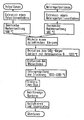
- a Polysiloxanfaden is injected and cured by short thermal post-crosslinking at 500 * C of the polysiloxane.
- a Heteropolysiloxanfaden is injected from the heteropolysiloxane by extrusion, which is also cured by thermal post-crosslinking at 500 0 C.
- the hardening using a previously added hardener serves on the one hand to maintain the shape of the thread and on the other hand it prevents evaporation of the siloxanes in the following temperature steps.
- the hardened polymer threads are wound on a mandrel.
- the mandrel consists of a ceramic rod, for example made of A1203, which has been provided with a thin coating of organic polymer as a release agent.
- the winding body created during winding is a cylindrical body.
- the predetermined radial refractive index profile determines the composition of the threads to be wound. If, for example, a core-sheath fiber, that is to say a fiber with a step-like refractive index profile, is to be produced; the procedure is such that first a polysiloxane thread and a heteropolysiloxane thread are wound simultaneously, so that several layers with this thread composition are formed. Then only one polxsiloxane thread is wound up, so that several layers are formed which contain only polysiloxane.
- the core is later made from the inner layers of polysiloxane and heteropolysiloxane, and the outer layer of polysiloxane is the sheath of the fiber.
- a thread consisting of a polysiloxane-heteropolysiloxane mixture is extruded, the composition of which is continuously changed by a mixing unit connected upstream of the extruder. It is also possible to use a composite thread with a core and a sheath, which for example consists of heteropolysiloxane in the core and polysiloxane in the sheath.
- the thread composition is changed layer by layer gradually.
- a high proportion of heteropolysiloxane which can be gradually removed from the outside, and then optionally only puts on polysiloxane threads which later form a coat of the gradient fiber.
- the proportion of polysiloxane can be set, for example, by the cross section of a heteropolysiloxane thread placed simultaneously with a polysiloxane thread. If the cross section of the heteropolysiloxane thread is changed continuously during winding, the heteropolysiloxane content also changes continuously.
- the rubber winding body For the transfer of the rubber winding body into a glass body, the latter is heated in a 0 2 or ° 2 He atmosphere, whereby the CH portions of the siloxane are removed by oxidation. What remains is an oxide body made of SiO 2 , which may contain oxides of the hetero elements contained in the heteropolysiloxane.
- the high gas permeability in the spaces between the threads of the winding body is advantageous, which ensures a more uniform and faster implementation over the cross section. This also makes the body inclined Flaking is reduced and undesirable silicon carbide formation is suppressed.
- the winding body is expediently carried out slowly (in 3 to 24 hours) at temperatures of 300 to 600 ° C. In this way, swelling of the siloxane due to the rapid development of reaction gases can be avoided, which would lead to blistery and voluminous material of low consistency.
- the mandrel is expediently removed from the oxide body and can be easily removed after the release agent has been incinerated.
- porous oxide body is then flushed with chlorine gas in helium to remove traces of water.
- chlorine gas in helium to remove traces of water.
- hydrogen chloride is formed, which is transported from the reaction chamber in the gas stream.
- the oxide body is sintered at 1200 to 1500 ° C to the glass.
- the result is a transparent glass tube, which now collapses into a solid rod in a drawing furnace at around 1900 ° C and is simultaneously pulled out to the glass fiber.
- An advantage of the method described above is that a directed, sharply bundled material flow from high speed to the cold preform can be realized.
Landscapes
- Chemical & Material Sciences (AREA)
- Chemical Kinetics & Catalysis (AREA)
- Engineering & Computer Science (AREA)
- Materials Engineering (AREA)
- Organic Chemistry (AREA)
- Life Sciences & Earth Sciences (AREA)
- General Chemical & Material Sciences (AREA)
- Geochemistry & Mineralogy (AREA)
- Dispersion Chemistry (AREA)
- Physics & Mathematics (AREA)
- Optics & Photonics (AREA)
- General Life Sciences & Earth Sciences (AREA)
- Manufacturing & Machinery (AREA)
- Surface Treatment Of Glass Fibres Or Filaments (AREA)
- Manufacture, Treatment Of Glass Fibers (AREA)
- Glass Melting And Manufacturing (AREA)
- Glass Compositions (AREA)
Priority Applications (1)
| Application Number | Priority Date | Filing Date | Title |
|---|---|---|---|
| AT83109454T ATE32211T1 (de) | 1982-09-28 | 1983-09-22 | Verfahren zur herstellung einer vorform zum ziehen von glasfaser-lichtwellenleitern. |
Applications Claiming Priority (2)
| Application Number | Priority Date | Filing Date | Title |
|---|---|---|---|
| DE19823235869 DE3235869A1 (de) | 1982-09-28 | 1982-09-28 | Verfahren zur herstellung eines glaskoerpers, insbesondere einer vorform zum ziehen von glasfaser-lichtwellenleitern |
| DE3235869 | 1982-09-28 |
Publications (3)
| Publication Number | Publication Date |
|---|---|
| EP0104617A2 true EP0104617A2 (fr) | 1984-04-04 |
| EP0104617A3 EP0104617A3 (en) | 1985-05-15 |
| EP0104617B1 EP0104617B1 (fr) | 1988-01-27 |
Family
ID=6174348
Family Applications (1)
| Application Number | Title | Priority Date | Filing Date |
|---|---|---|---|
| EP83109454A Expired EP0104617B1 (fr) | 1982-09-28 | 1983-09-22 | Procédé de préparation d'une préforme pour étirage de fibres optiques en verre |
Country Status (5)
| Country | Link |
|---|---|
| US (2) | US4547210A (fr) |
| EP (1) | EP0104617B1 (fr) |
| JP (1) | JPS5983954A (fr) |
| AT (1) | ATE32211T1 (fr) |
| DE (2) | DE3235869A1 (fr) |
Cited By (2)
| Publication number | Priority date | Publication date | Assignee | Title |
|---|---|---|---|---|
| EP0208343A3 (fr) * | 1985-07-05 | 1988-06-01 | Bell Communications Research, Inc. | Méthode de préparation de verres silicatés d'indice de réfraction contrôlé et système optique les incluant |
| DE102014017678A1 (de) | 2014-11-28 | 2016-06-02 | Reiner Schneider | Gleitsichtlinse mit unterschiedlicher intrinsischer Brechung |
Families Citing this family (14)
| Publication number | Priority date | Publication date | Assignee | Title |
|---|---|---|---|---|
| DE3235869A1 (de) * | 1982-09-28 | 1984-04-05 | Siemens AG, 1000 Berlin und 8000 München | Verfahren zur herstellung eines glaskoerpers, insbesondere einer vorform zum ziehen von glasfaser-lichtwellenleitern |
| US4902650A (en) * | 1987-06-09 | 1990-02-20 | The University Of Rochester | Gradient-index glass |
| US5180694A (en) * | 1989-06-01 | 1993-01-19 | General Electric Company | Silicon-oxy-carbide glass method of preparation and articles |
| CA2010675A1 (fr) * | 1989-06-01 | 1990-12-01 | Gary M. Renlund | Verre de silicium-oxygene-carbure et articles connexes |
| US4956000A (en) * | 1989-06-28 | 1990-09-11 | Reeber Robert R | Gradient lens fabrication |
| US4960451A (en) * | 1989-08-21 | 1990-10-02 | United Technologies Corporation | Method of making fused hollow composite articles |
| US5615295A (en) * | 1994-09-14 | 1997-03-25 | The Furukawa Electric Co., Ltd. | Optical fiber and process of producing the same |
| DE69601749T3 (de) * | 1995-06-07 | 2004-04-29 | Corning Inc. | Verfahren zur thermischen Behandlung und zum Konsolidieren von Vorformen aus Siliciumdioxid zur Verminderung von durch Laser hervorgerufenen optischen Defekten |
| US5999681A (en) * | 1997-10-17 | 1999-12-07 | Lucent Technologies Inc. | Chemical treatment for silica-containing glass surfaces |
| US6546757B1 (en) | 1998-07-28 | 2003-04-15 | Brown University Research Foundation | Liquid spray pyrolysis method for the fabrication of optical fiber preforms, with reactant mixing |
| DE19936478A1 (de) * | 1999-08-03 | 2001-02-15 | Degussa | Sinterwerkstoffe |
| JP5146897B2 (ja) * | 2004-04-05 | 2013-02-20 | 日本電気硝子株式会社 | 照明用ガラス |
| WO2007122630A2 (fr) * | 2006-04-24 | 2007-11-01 | Sterlite Optical Technologies Ltd. | Fibre optique monomode à perte de macrocourbure et d'atténuation réduites et procédé de fabrication de celle-ci |
| US8611756B1 (en) * | 2008-04-16 | 2013-12-17 | Cirrex Systems, Llc | Highly integrated system and method for optical communication |
Family Cites Families (19)
| Publication number | Priority date | Publication date | Assignee | Title |
|---|---|---|---|---|
| US2908545A (en) * | 1955-05-25 | 1959-10-13 | Montedison Spa | Spinning nonfused glass fibers from an aqueous dispersion |
| US3314817A (en) * | 1960-08-23 | 1967-04-18 | Owens Corning Fiberglass Corp | High temperature insulation for electrical conductors |
| CH431972A (fr) * | 1965-10-15 | 1967-03-15 | Battelle Memorial Inst Interna | Procédé de fabrication d'une couche de protection |
| US3907954A (en) * | 1971-02-12 | 1975-09-23 | Bayer Ag | Production of fibers containing silicon-oxygen bonds |
| DE2645375A1 (de) * | 1974-03-28 | 1978-04-13 | Siemens Ag | Herstellung von lichtleitfasern nach einem fluessigphasen-abscheidungsverfahren |
| US4173459A (en) * | 1976-08-30 | 1979-11-06 | Siemens Aktiengesellschaft | Method for producing a light conducting fiber |
| US4100240A (en) * | 1976-09-30 | 1978-07-11 | Dow Corning Corporation | Liquid polymer extrusion process and product |
| GB1552518A (en) * | 1976-10-07 | 1979-09-12 | Siemens Ag | Production of light conducting fibres |
| US4250131A (en) * | 1979-01-15 | 1981-02-10 | Uop Inc. | Refractory inorganic oxide fibers |
| JPS55100231A (en) * | 1979-01-19 | 1980-07-31 | Hitachi Ltd | Production of optical fiber base material |
| DE2935198C2 (de) * | 1979-08-31 | 1981-12-24 | Heraeus Quarzschmelze Gmbh, 6450 Hanau | Verfahren zur werkzeugfreien Herstellung von porösen Formkörpern aus Quarzglas und Verwendung dieser Formkörper |
| EP0029590B1 (fr) * | 1979-11-21 | 1984-03-21 | Hitachi, Ltd. | Procédé de préparation de verre optique |
| JPS5858292B2 (ja) * | 1980-01-21 | 1983-12-24 | 株式会社日立製作所 | シリカガラスの製造方法 |
| US4578096A (en) * | 1980-08-13 | 1986-03-25 | Warner-Lambert Technologies, Inc. | Gradient index optical components |
| FR2490211B1 (fr) * | 1980-09-17 | 1990-09-21 | Passaret Michel | |
| DE3111963C2 (de) * | 1981-03-26 | 1986-07-17 | Siemens AG, 1000 Berlin und 8000 München | Verfahren und Einrichtung zur Herstellung einer Lichtwellenleiter-Ader |
| US4419115A (en) * | 1981-07-31 | 1983-12-06 | Bell Telephone Laboratories, Incorporated | Fabrication of sintered high-silica glasses |
| US4426216A (en) * | 1982-01-06 | 1984-01-17 | Hitachi, Ltd. | Process for producing optical glass |
| DE3235869A1 (de) * | 1982-09-28 | 1984-04-05 | Siemens AG, 1000 Berlin und 8000 München | Verfahren zur herstellung eines glaskoerpers, insbesondere einer vorform zum ziehen von glasfaser-lichtwellenleitern |
-
1982
- 1982-09-28 DE DE19823235869 patent/DE3235869A1/de not_active Withdrawn
-
1983
- 1983-09-22 AT AT83109454T patent/ATE32211T1/de not_active IP Right Cessation
- 1983-09-22 DE DE8383109454T patent/DE3375474D1/de not_active Expired
- 1983-09-22 EP EP83109454A patent/EP0104617B1/fr not_active Expired
- 1983-09-27 JP JP58179061A patent/JPS5983954A/ja active Pending
- 1983-09-28 US US06/536,954 patent/US4547210A/en not_active Expired - Fee Related
-
1985
- 1985-06-13 US US06/744,381 patent/US4749395A/en not_active Expired - Fee Related
Cited By (2)
| Publication number | Priority date | Publication date | Assignee | Title |
|---|---|---|---|---|
| EP0208343A3 (fr) * | 1985-07-05 | 1988-06-01 | Bell Communications Research, Inc. | Méthode de préparation de verres silicatés d'indice de réfraction contrôlé et système optique les incluant |
| DE102014017678A1 (de) | 2014-11-28 | 2016-06-02 | Reiner Schneider | Gleitsichtlinse mit unterschiedlicher intrinsischer Brechung |
Also Published As
| Publication number | Publication date |
|---|---|
| DE3375474D1 (en) | 1988-03-03 |
| JPS5983954A (ja) | 1984-05-15 |
| EP0104617A3 (en) | 1985-05-15 |
| ATE32211T1 (de) | 1988-02-15 |
| US4749395A (en) | 1988-06-07 |
| DE3235869A1 (de) | 1984-04-05 |
| US4547210A (en) | 1985-10-15 |
| EP0104617B1 (fr) | 1988-01-27 |
Similar Documents
| Publication | Publication Date | Title |
|---|---|---|
| DE2906070C2 (de) | Verfahren zum Herstellen von optischen Wellenleitern | |
| DE2930398C2 (fr) | ||
| EP0104617B1 (fr) | Procédé de préparation d'une préforme pour étirage de fibres optiques en verre | |
| DE2906071C2 (de) | Verfahren zum Ziehen einer Faser aus thermoplastischem Material zur Herstellung optischer Wellenleiter | |
| DE3105295C2 (fr) | ||
| DE3136838C2 (fr) | ||
| DE2660697C2 (de) | Verfahren zur Herstellung eines Glas-Rohlings | |
| DE2947074C2 (fr) | ||
| DE69300600T2 (de) | Verfahren zum Dotieren von porösen Glasvorformen. | |
| DE2358880C3 (de) | Verfahren zur Herstellung einer Lichtleitfaser | |
| DE2919080B2 (de) | Verfahren zum Herstellen einer optischen Faser aus Kern und Mantel | |
| DE2727054A1 (de) | Verfahren zur herstellung eines glasfaserlichtleiters | |
| DE2536456B1 (de) | Halbzeug fuer die herstellung von lichtleitfasern, verfahren zur herstellung des halbzeugs und aus dem halbzeug hergestellte lichtleitfasern | |
| DE2755373A1 (de) | Verfahren zur kontinuierlichen herstellung von lichtleitern | |
| EP0117009B1 (fr) | Procédé de fabrication d'une préforme pleine pour l'étirage de fibres optiques | |
| DE2833051A1 (de) | Verfahren zur herstellung von glasteilen | |
| DE2313276A1 (de) | Verfahren zur herstellung von optischem glas | |
| EP0046281A1 (fr) | Procédé pour la fabrication d'un verre à profil d'indice de réfraction prédéterminé ayant la forme d'un profil gradient d'indice et procédé d'obtention d'une préforme en verre pour l'étirage de fibres optiques pour la technique des communications | |
| DE2625010A1 (de) | Verfahren zur herstellung von optischen fasern | |
| DE2804467B2 (de) | Optische Faser mit einer zwischen Kern und Mantel angeordneten, durch chemische Dampfreaktion hergestellten Zwischenschicht, die im wesentlichen den gleichen Brechungsindex hat wie der Mantel, sowie Verfahren zur Herstellung einer derartigen Faser | |
| DE2730346C3 (de) | Verfahren zur Herstellung eines Vorformlings für optische Glasfasern | |
| DE3201342C2 (de) | Optische Faser für Einmodenwelle mit einer einzigen Polarisation und Verfahren zu ihrer Herstellung | |
| DE2939339C2 (fr) | ||
| DE2447353B2 (de) | Verfahren zum herstellen von lichtleitfasern | |
| WO2001040126A1 (fr) | Preforme de verre de quartz pour fibre optique et son procede de production |
Legal Events
| Date | Code | Title | Description |
|---|---|---|---|
| PUAI | Public reference made under article 153(3) epc to a published international application that has entered the european phase |
Free format text: ORIGINAL CODE: 0009012 |
|
| AK | Designated contracting states |
Designated state(s): AT BE CH DE FR GB IT LI NL SE |
|
| 17P | Request for examination filed |
Effective date: 19841212 |
|
| PUAL | Search report despatched |
Free format text: ORIGINAL CODE: 0009013 |
|
| AK | Designated contracting states |
Designated state(s): AT BE CH DE FR GB IT LI NL SE |
|
| 17Q | First examination report despatched |
Effective date: 19860910 |
|
| GRAA | (expected) grant |
Free format text: ORIGINAL CODE: 0009210 |
|
| AK | Designated contracting states |
Kind code of ref document: B1 Designated state(s): AT BE CH DE FR GB IT LI NL SE |
|
| REF | Corresponds to: |
Ref document number: 32211 Country of ref document: AT Date of ref document: 19880215 Kind code of ref document: T |
|
| REF | Corresponds to: |
Ref document number: 3375474 Country of ref document: DE Date of ref document: 19880303 |
|
| ET | Fr: translation filed | ||
| ITF | It: translation for a ep patent filed | ||
| GBT | Gb: translation of ep patent filed (gb section 77(6)(a)/1977) | ||
| PLBE | No opposition filed within time limit |
Free format text: ORIGINAL CODE: 0009261 |
|
| STAA | Information on the status of an ep patent application or granted ep patent |
Free format text: STATUS: NO OPPOSITION FILED WITHIN TIME LIMIT |
|
| 26N | No opposition filed | ||
| PGFP | Annual fee paid to national office [announced via postgrant information from national office to epo] |
Ref country code: AT Payment date: 19890825 Year of fee payment: 7 |
|
| PGFP | Annual fee paid to national office [announced via postgrant information from national office to epo] |
Ref country code: GB Payment date: 19890831 Year of fee payment: 7 |
|
| PGFP | Annual fee paid to national office [announced via postgrant information from national office to epo] |
Ref country code: SE Payment date: 19890912 Year of fee payment: 7 |
|
| PGFP | Annual fee paid to national office [announced via postgrant information from national office to epo] |
Ref country code: BE Payment date: 19890919 Year of fee payment: 7 |
|
| PGFP | Annual fee paid to national office [announced via postgrant information from national office to epo] |
Ref country code: FR Payment date: 19890928 Year of fee payment: 7 |
|
| ITTA | It: last paid annual fee | ||
| PG25 | Lapsed in a contracting state [announced via postgrant information from national office to epo] |
Ref country code: LI Effective date: 19890930 Ref country code: CH Effective date: 19890930 |
|
| PGFP | Annual fee paid to national office [announced via postgrant information from national office to epo] |
Ref country code: NL Payment date: 19890930 Year of fee payment: 7 |
|
| REG | Reference to a national code |
Ref country code: CH Ref legal event code: PL |
|
| PG25 | Lapsed in a contracting state [announced via postgrant information from national office to epo] |
Ref country code: DE Effective date: 19900601 |
|
| PG25 | Lapsed in a contracting state [announced via postgrant information from national office to epo] |
Ref country code: GB Effective date: 19900922 Ref country code: AT Effective date: 19900922 |
|
| PG25 | Lapsed in a contracting state [announced via postgrant information from national office to epo] |
Ref country code: SE Effective date: 19900923 |
|
| PG25 | Lapsed in a contracting state [announced via postgrant information from national office to epo] |
Ref country code: BE Effective date: 19900930 |
|
| BERE | Be: lapsed |
Owner name: SIEMENS A.G. BERLIN UND MUNCHEN Effective date: 19900930 |
|
| PG25 | Lapsed in a contracting state [announced via postgrant information from national office to epo] |
Ref country code: NL Effective date: 19910401 |
|
| NLV4 | Nl: lapsed or anulled due to non-payment of the annual fee | ||
| GBPC | Gb: european patent ceased through non-payment of renewal fee | ||
| PG25 | Lapsed in a contracting state [announced via postgrant information from national office to epo] |
Ref country code: FR Effective date: 19910530 |
|
| REG | Reference to a national code |
Ref country code: FR Ref legal event code: ST |
|
| EUG | Se: european patent has lapsed |
Ref document number: 83109454.5 Effective date: 19910527 |