EP0104985B1 - Enrouleur statique de fil métallique - Google Patents
Enrouleur statique de fil métallique Download PDFInfo
- Publication number
- EP0104985B1 EP0104985B1 EP83401770A EP83401770A EP0104985B1 EP 0104985 B1 EP0104985 B1 EP 0104985B1 EP 83401770 A EP83401770 A EP 83401770A EP 83401770 A EP83401770 A EP 83401770A EP 0104985 B1 EP0104985 B1 EP 0104985B1
- Authority
- EP
- European Patent Office
- Prior art keywords
- rotation
- drum
- hollow shaft
- cam
- driven
- Prior art date
- Legal status (The legal status is an assumption and is not a legal conclusion. Google has not performed a legal analysis and makes no representation as to the accuracy of the status listed.)
- Expired
Links
Images
Classifications
-
- B—PERFORMING OPERATIONS; TRANSPORTING
- B21—MECHANICAL METAL-WORKING WITHOUT ESSENTIALLY REMOVING MATERIAL; PUNCHING METAL
- B21C—MANUFACTURE OF METAL SHEETS, WIRE, RODS, TUBES, PROFILES OR LIKE SEMI-MANUFACTURED PRODUCTS OTHERWISE THAN BY ROLLING; AUXILIARY OPERATIONS USED IN CONNECTION WITH METAL-WORKING WITHOUT ESSENTIALLY REMOVING MATERIAL
- B21C47/00—Winding-up, coiling or winding-off metal wire, metal band or other flexible metal material characterised by features relevant to metal processing only
- B21C47/02—Winding-up or coiling
- B21C47/10—Winding-up or coiling by means of a moving guide
- B21C47/14—Winding-up or coiling by means of a moving guide by means of a rotating guide, e.g. laying the material around a stationary reel or drum
-
- B—PERFORMING OPERATIONS; TRANSPORTING
- B65—CONVEYING; PACKING; STORING; HANDLING THIN OR FILAMENTARY MATERIAL
- B65H—HANDLING THIN OR FILAMENTARY MATERIAL, e.g. SHEETS, WEBS, CABLES
- B65H54/00—Winding, coiling, or depositing filamentary material
- B65H54/76—Depositing materials in cans or receptacles
- B65H54/80—Apparatus in which the depositing device or the receptacle is rotated
- B65H54/82—Apparatus in which the depositing device or the receptacle is rotated and in which coils are formed before deposition
Definitions
- the present invention relates to a static wire winder.
- a static winder is known, marketed by the Belgian company N.V. MACHINES FRANS-SENS under the references BS 800 or BS 1000, in which the wire is wound on a drum immobilized in rotation.
- the wire first passes through a hollow shaft which rotates coaxially with the axis of the drum before being wound on the drum by rollers driven by this hollow shaft.
- the last turns wound on the drum push the previous turns which, escaping from the drum, fall on a star wheel which is driven in rotation around a horizontal axis and which has the function of controlling the evacuation of the wire turns.
- This star evacuation wheel turns in jerks of a fraction of a turn at each turn of the hollow shaft.
- the star wheel drive is currently performed by a link and ratchet mechanism.
- the rotation of the star wheel is not regular and the extraction of the turns is not itself regular. Therefore the wire supports have a bad presentation because the turns fall in bundles.
- the star wheel drive mechanism cannot be disengaged manually and incidents can occur. Staff intervention is frequent. Wear is also important.
- the present invention relates to a wire winder comprising a winding drum immobilized in rotation and a wire winding device driven in rotation by a shaft which rotates coaxially with the drum, the wire turns being pushed from the drum so falling on a star wheel which is rotated about a horizontal axis.
- the invention aims to provide a mechanism. star wheel drive operating regularly and capable of being disengaged manually or automatically in the event of the star wheel accidentally immobilizing so as to avoid breakage. This mechanism takes no play and does not require adjustment.
- the reel comprises a drive cam which is rotated by the hollow shaft and is arranged so as to push a branch of the star wheel towards the drum and means for clutching and disengaging for securing or disengaging in rotation said drive cam and said hollow shaft.
- the clutch and declutching means consist of a bolt guided radially on a part carrying the cam and returned by at least one spring so as to engage in a notch of a part linked in rotation to the 'hollow tree.
- the reel comprises a declutching cam enabling the lock to be released from the notch.
- the reel comprises a frame 1 which supports, via bearings 11, a shaft 21.
- This shaft is driven in rotation about its axis 211 by a drive mechanism.
- the shaft 21 is integral with a toothed wheel 22 which meshes with an endless screw 23 driven by a motor.
- a longitudinal channel 212 opening at one end through an axial inlet orifice 213 and through a lateral outlet orifice 214.
- the wire, marked 4 runs in this channel from the inlet port 213 to outlet port 214, both formed outside the frame.
- a winding drum 3 Downstream of the lateral outlet 214 is disposed a winding drum 3 which has a cylindrical surface on which the wire can be wound.
- This drum has a hub which is crossed by the hollow shaft 21 which supports it by means of bearings 31.
- the drum 3 is immobilized in rotation.
- the wire 4 is wound at the periphery of the drum by a roller winding device which is integral in rotation with the hollow shaft 21.
- This device consists of a support 51, wedged on the hollow shaft 21 between the drum and the frame and rollers 52, 53, 54 mounted on this support.
- the central roller 52 rotates around an axis perpendicular to 211 near the outlet orifice 214.
- the peripheral roller 54 rotates around an axis parallel to the axis 211 outside the drum.
- the wire is wound on an intermediate roller 53 which rotates around an axis inclined with respect to 211.
- the planetary movement of the rollers cause the wire to be wound. on the drum.
- the roller winding device also includes a stopper (roller), not shown, which rotates near the cylindrical surface of the drum so as to stop the last wound turn and consequently to push back (in the direction of the arrow) the turns already rolled up.
- a stopper roller
- the drum 3 carries, on the discharge side and above the hub, a star wheel 6 which rotates around a horizontal axis of rotation 61. This star wheel rotates between pads 8 which are fixed and which immobilize this makes the drum 3 in rotation.
- the star wheel 6 receives jerky pulses from a drive cam 71 rotatably coupled to the hollow shaft 21 by means of clutch and declutching means.
- the hollow shaft 21 is integral in rotation with a plate 73 which is housed between a plate 72 carrying the cam 71 and the drum hub. This plate 73 is provided with a cylindrical axis 731 coaxial with 211.
- the cam 71 is mounted on the plate 72 which is guided in rotation coaxially with the hollow shaft 21.
- the plate 72 is integral with a cylindrical tube 721 which acts as a bearing by swiveling on the axis 731.
- the plate 72 and plate 73 are immobilized in translation with respect to each other by a washer 78 screwed on the axis 731.
- the plate 72 serving to support the cam 71 is capable of being coupled and uncoupled in rotation with the hollow shaft 21 by means of clutching and disengaging.
- the plate 73 is provided at its periphery with a notch 732 whose position relative to the roller 54 allows synchronization between the fall of a turn of wire and the stopping time of the star wheel.
- the plate 72 carrying the cam 71 is provided with a radial notch 722 serving as a slide for a movable lock 74 which is subjected to at least one return spring 77 tending to move it towards the center so as to engage it in the peripheral notch 732.
- the cam holder plate 72 is fixed in rotation with the plate 73 and therefore with the hollow shaft 21. Conversely, when the latch 74 is released from the notch 732 , the two plates 73 and 72 are free to rotate relative to each other.
- a declutching cam 75 used to unlock the latch 74 is disposed next to the plate 72. It is integral with a tube 751 in which is housed a cylindrical friction ring 76 which is engaged on the tube 721.
- the cam is guided in rotation about the axis 211 by the tube 751 so that it can be turned manually.
- the rotation of the cam moves the lock 74 radially between a central position where the - lock 74 is engaged in the notch 732 so as to secure in rotation the plates 72 and 73 and a more eccentric position (shown in Figure 2) where the latch 74 is released from the notch 732 so as to disengage in rotation the plates 72 and 73.
- the friction ring 76 makes it possible to stabilize the disengaged position of the cam 75 and serves as its lateral stop.
- the cam 75 is housed in a housing 79.
- the tube 751 protrudes from this housing so as to allow the cam to be maneuvered.
- the drum 3 carries, on the discharge side, inclined ramps 32 which serve to guide the turns which are discharged.
- the cam holder plate 72 When the latch 74 is engaged in the notch 732, the cam holder plate 72 is rotated. By turning the cam 71 rubs at the rear (outside side) of a lower branch of the star wheel and pushes this lower branch towards the drum. The star wheel turns in the direction of the arrow and it carries a turn by a notch which, when released, slides on the ramps 32.
- the clutch means could be constituted by a friction clutch.
Landscapes
- Engineering & Computer Science (AREA)
- Mechanical Engineering (AREA)
- Storage Of Web-Like Or Filamentary Materials (AREA)
- Mechanical Operated Clutches (AREA)
- Coiling Of Filamentary Materials In General (AREA)
- Storing, Repeated Paying-Out, And Re-Storing Of Elongated Articles (AREA)
- Wire Processing (AREA)
- Winding Filamentary Materials (AREA)
Description
- La présente invention se rapporte à un enrouleur statique de fil métallique.
- On connaît un enrouleur statique, commercialisé par la société belge N.V. MACHINES FRANS-SENS sous les références BS 800 ou BS 1000, dans lequel le fil est enroulé sur un tambour immobilisé en rotation. Le fil passe d'abord dans un arbre creux qui tourne coaxialement à l'axe du tambour avant d'être enroulé sur le tambour par des galets entraînés par cet arbre creux. Les dernières spires enroulées sur le tambour poussent les spires antérieures qui en s'échappant du tambour tombent sur une roue étoilée qui est entraînée en rotation autour d'un axe horizontal et qui a pour fonction de contrôler l'évacuation des spires de fil. Cette roue étoilée d'évacuation tourne par saccades d'une fraction de tour à chaque tour de l'arbre creux.
- L'entraînement de la roue étoilée est actuellement réalisé par un mécanisme à biellette et à cliquets. Toutefois, à cause des jeux inhérents à l'usure, la rotation de la roue étoilée n'est pas régulière et l'extraction des spires n'est elle-même par régulière. De ce fait les supports de fils ont une mauvaise présentation car les spires tombent par paquets. Par ailleurs le mécanisme d'entraînement de la roue étoilée n'est pas débrayable manuellement et des incidents peuvent se produire. L'intervention du personnel est fréquente. L'usure est par ailleurs importante.
- La présente invention se rapporte à un enrouleur de fil métallique comportant un tambour d'enroulement immobilisé en rotation et un dispositif d'enroulement de fil entraîné en rotation par un arbre qui tourne coaxialement au tambour, les spires de fil étant poussées du tambour de manière à tomber sur une roue étoilée qui est entraînée en rotation autour d'un axe horizontal.
- L'invention a pour but de fournir un mécanisme . d'entraînement de la roue étoilée fonctionnant de manière régulière et susceptible d'être débrayé manuellement ou automatiquement en cas d'immobilisation accidentelle de la roue étoilée de manière à éviter les casses. Ce mécanisme ne prend pas de jeu et ne nécessite pas de réglage.
- Conformément à l'invention, l'enrouleur comporte une came d'entraînement qui est entraînée en rotation par l'arbre creux et est agencée de manière à pousser une branche de la roue étoilée vers le tambour et des moyens d'embrayage et de débrayage permettant de solidariser ou désolidariser en rotation ladite came d'entraînement et ledit arbre creux.
- Selon une caractéristique, les moyens d'embrayage et de débrayage sont constitués par un verrou guidé radialement sur une pièce portant la came et rappelé par au moins un ressort de manière à s'engager dans une encoche d'une pièce liée en rotation à l'arbre creux.
- Selon une autre caractéristique, l'enrouleur comporte une came de débrayage permettant de dégager le verrou de l'encoche.
- L'invention va maintenant être décrite avec plus de détails en se référant à un mode de réalisation donné à titre d'exemple et représenté par les dessins annexés.
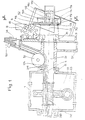
- La figure 1 représente une coupe axiale de l'enrouleur.
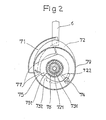
- La figure 2 représente une coupe selon II-II de la figure 1.
- En se référant aux figures, l'enrouleur comporte un bâti 1 qui supporte, par l'intermédiaire de roulements 11, un arbre 21. Cet arbre est entraîné en rotation autour de son axe 211 par un mécanisme d'entraînement. A cet effet l'arbre 21 est solidaire d'.une roue dentée 22 qui engrène avec une vis sans fin 23 entraînée par un moteur.
- A l'intérieur de l'arbre 21 est ménagé un canal longitudinal 212 débouchant à un bout par un orifice d'entrée axial 213 et par un orifice de sortie latéral 214. Le fil, repéré 4, défile dans ce canal, de l'orifice d'entrée 213 vers l'orifice de sortie 214, tous deux ménagés à l'extérieur du bâti.
- En aval de la sortie latérale 214 est disposé un tambour d'enroulement 3 qui présente une surface cylindrique sur laquelle le fil peut être enroulé. Ce tambour présente un moyeu qui est traversé par l'arbre creux 21 qui le supporte par l'intermédiaire de roulements 31. Le tambour 3 est immobilisé en rotation.
- Le fil 4 est enroulé à la périphérie du tambour par un dispositif d'enroulement à galets qui est solidaire en rotation de l'arbre creux 21. Ce dispositif se compose d'un support 51, calé sur l'arbre creux 21 entre le tambour et le bâti et de galets 52, 53, 54 montés sur ce support. Le galet central 52 tourne autour d'un axe perpendiculaire à 211 près de l'orifice de sortie 214. Le galet périphérique 54 tourne autour d'un axe parallèle à l'axe 211 à l'extérieur du tambour. Entre les galets 52 et 54, le fil s'enroule sur un galet intermédiaire 53 qui tourne autour d'un axe incliné par rapport à 211. Le mouvement planétaire des galets provoquent l'enroulement du fil . sur le tambour.
- Le dispositif d'enroulement à galets comporte aussi un arrêtoir (galet) non représenté qui tourne à proximité de la surface cylindrique du tambour de manière à arrêter la dernière spire enroulée et en conséquence à repousser (suivant le sens de la flèche) les spires déjà enroulées.
- Le tambour 3 porte, du côté de l'évacuation et au-dessus du moyeu, une roue étoilée 6 qui tourne autour d'un axe de rotation horizontal 61. Cette roue étoilée tourne entre des patins 8 qui sont fixes et qui immobilisent de ce fait le tambour 3 en rotation.
- La roue étoilée 6 reçoit des impulsions saccadées d'une came d'entraînement 71 accouplée en rotation à l'arbre creux 21 par l'intermédiaire de moyens d'embrayage et de débrayage. L'arbre creux 21 est solidaire en rotation d'un plateau 73 qui est logé entre un plateau 72 portant la came 71 et le moyeu du tambour. Ce plateau 73 est pourvu d'un axe cylindrique 731 coaxial à 211.
- La came 71 est montée sur le plateau 72 qui est guidée en rotation coaxialement à l'arbre creux 21. A cet effet le plateau 72 est solidaire d'un tube cylindrique 721 qui fait office de palier en tourillonnant sur l'axe 731. Le plateau 72 et le plateau 73 sont immobilisés en translation l'un par rapport à l'autre par une rondelle 78 vissée sur l'axe 731. Le plateau 72 servant de support à la came 71 est susceptible d'être accouplé et désaccouplé en rotation avec l'arbre creux 21 par des moyens d'embrayage et de débrayage.
- Le plateau 73 est muni à sa périphérie d'une encoche 732 dont la position par rapport au galet 54 permet la synchronisation entre la tombée d'une spire de fil et le temps d'arrêt de la roue étoilée. Le plateau 72 portant la came 71 est pourvu d'une encoche radiale 722 servant de glissière à un verrou mobile 74 qui est soumis à au moins un ressort de rappel 77 tendant à le déplacer vers le centre de manière à l'engager dans l'encoche périphérique 732. Lorsque le verrou 74 est dans l'encoche 732, le plateau porte-came 72 est solidaire en rotation du plateau 73 et donc de l'arbre creux 21. Inversement, lorsque le verrou 74 est dégagé de l'encoche 732, les deux plateaux 73 et 72 sont libres en rotation l'un par rapport à l'autre.
- Une came de débrayage 75 servant à déverrouiller le verrou 74 est disposée à côté du plateau 72. Elle est solidaire d'un tube 751 dans lequel est logée une bague cylindrique de friction 76 qui est engagée sur le tube 721. La came est guidée en rotation autour de l'axe 211 par le tube 751 de manière à pouvoir être tournée manuellement. La rotation de la came déplace radialement le verrou 74 entre une position centrale où le - verrou 74 est engagé dans l'encoche 732 de manière à solidariser en rotation les plateaux 72 et 73 et une position plus excentrée (représentée sur la figure 2) où le verrou 74 est dégagé de l'encoche 732 de manière à désolidariser en rotation les plateaux 72 et 73. La bague de friction 76 permet de stabiliser la position de débrayage de la came 75 et lui sert de butée latérale.
- La came 75 est logée dans un boitier 79. Le tube 751 dépasse de ce boitier de manière à permettre de manoeuvrer la came.
- Le tambour 3 porte, du côté de l'évacuation, des rampes inclinées 32 qui servent à guider les spires qui sont évacuées.
- Le fonctionnement va maintenant être expliqué.
- Lorsque le verrou 74 est engagé dans l'encoche 732, le plateau porte-came 72 est entrainé en rotation. En tournant la came 71 frotte à l'arrière (côté extérieur) d'une branche inférieure de la roue étoilée et pousse cette branche inférieure vers le tambour. La roue étoilée tourne dans le sens de la flèche et elle transporte une spire par encoche qui en se dégageant glisse sur les rampes 32.
- Les moyens d'embrayage pourraient être constitués par un embrayage à friction.
Claims (3)
Priority Applications (1)
| Application Number | Priority Date | Filing Date | Title |
|---|---|---|---|
| AT83401770T ATE20037T1 (de) | 1982-09-10 | 1983-09-09 | Stationaere aufwickelvorrichtung fuer metalldraht. |
Applications Claiming Priority (2)
| Application Number | Priority Date | Filing Date | Title |
|---|---|---|---|
| FR8215326 | 1982-09-10 | ||
| FR8215326A FR2532921A1 (fr) | 1982-09-10 | 1982-09-10 | Enrouleur statique de fil metallique |
Publications (2)
| Publication Number | Publication Date |
|---|---|
| EP0104985A1 EP0104985A1 (fr) | 1984-04-04 |
| EP0104985B1 true EP0104985B1 (fr) | 1986-05-28 |
Family
ID=9277344
Family Applications (1)
| Application Number | Title | Priority Date | Filing Date |
|---|---|---|---|
| EP83401770A Expired EP0104985B1 (fr) | 1982-09-10 | 1983-09-09 | Enrouleur statique de fil métallique |
Country Status (4)
| Country | Link |
|---|---|
| EP (1) | EP0104985B1 (fr) |
| AT (1) | ATE20037T1 (fr) |
| DE (1) | DE3363778D1 (fr) |
| FR (1) | FR2532921A1 (fr) |
Families Citing this family (1)
| Publication number | Priority date | Publication date | Assignee | Title |
|---|---|---|---|---|
| CN103464522B (zh) * | 2013-09-15 | 2015-07-29 | 无锡平盛科技有限公司 | 象鼻式收线机上的出线导轮组件 |
Family Cites Families (8)
| Publication number | Priority date | Publication date | Assignee | Title |
|---|---|---|---|---|
| GB191314294A (en) * | 1913-06-20 | 1914-06-18 | Nicholas King Turnbull | Improvements in Drums for Wire Drawing Machinery. |
| GB712799A (en) * | 1952-07-15 | 1954-07-28 | Herman Bocher | Improvements in and relating to wire winding blocks |
| BE539886A (fr) * | 1954-07-16 | |||
| GB991055A (en) * | 1963-05-02 | 1965-05-05 | Barron & Crowther Ltd | Improvements in wire coiling or drawing machines |
| DE1285435C2 (de) * | 1966-02-17 | 1973-10-04 | Schloemann Ag | Drehrohrhaspel zum ablegen von draht auf eine foerdereinrichtung |
| DE1602355A1 (de) * | 1967-02-04 | 1970-08-27 | Schloemann Ag | Verfahren zum Ablegen von einem kontinuierlichen Drahtwindungsstrang auf ein mit horizontal angeordneter Foerderebene ausgebildetes Foerdermittel |
| FR2091882B1 (fr) * | 1970-03-26 | 1974-03-15 | Telecommunications Sa | |
| NL7612811A (nl) * | 1976-11-17 | 1978-05-19 | Rueti Te Strake Bv | Inrichting voor het vormen van een voorraadwikkel uit een van een garenvoorraad aangevoerde draad. |
-
1982
- 1982-09-10 FR FR8215326A patent/FR2532921A1/fr active Granted
-
1983
- 1983-09-09 EP EP83401770A patent/EP0104985B1/fr not_active Expired
- 1983-09-09 DE DE8383401770T patent/DE3363778D1/de not_active Expired
- 1983-09-09 AT AT83401770T patent/ATE20037T1/de not_active IP Right Cessation
Also Published As
| Publication number | Publication date |
|---|---|
| ATE20037T1 (de) | 1986-06-15 |
| FR2532921B1 (fr) | 1985-01-18 |
| FR2532921A1 (fr) | 1984-03-16 |
| EP0104985A1 (fr) | 1984-04-04 |
| DE3363778D1 (en) | 1986-07-03 |
Similar Documents
| Publication | Publication Date | Title |
|---|---|---|
| EP0871390B1 (fr) | Appareil distributeur de materiaux d'essuyage pouvant etre distribues sous forme pliee ou non pliee | |
| US4813627A (en) | Rewindable hose reel | |
| CH634896A5 (fr) | Dispositif de commande pour moto-reducteur electrique. | |
| FR2546225A1 (fr) | Dispositif d'entrainement d'une banne de protection | |
| EP0104985B1 (fr) | Enrouleur statique de fil métallique | |
| FR3000165A1 (fr) | Dispositif de transmission automatiquement embrayable et debrayable | |
| FR2477888A1 (fr) | Enrouleur automatique pour une ceinture de securite | |
| CH453027A (fr) | Dispositif d'enroulement continu de fil sur des bobines réceptrices | |
| EP0229736A1 (fr) | Dispositif pour recouvrir un corps cylindrique d'une bande d'un matériau de protection | |
| WO2019162380A1 (fr) | Système d'entrainement en rotation d'un organe d'enroulement | |
| EP0838071B1 (fr) | Appareil de distribution automatique de feuille de conditionnement | |
| FR2552409A1 (fr) | Dispositif porte-bobine | |
| FR2544825A1 (fr) | Dispositif de commande selective du mouvement de rotation d'un arbre | |
| EP0195172A1 (fr) | Roue libre à transmission irréversible, en particulier pour dispositif d'entraînement des roues motrices d'une tondeuse à gazon autotractée | |
| FR2646684A1 (fr) | Mecanisme d'enroulement et de deroulement d'un store autour d'un rouleau horizontal | |
| FR2468667A1 (fr) | Dispositif de commande s'un systeme d'etirage de meches de fibres | |
| FR2670897A1 (fr) | Dispositif pour vehiculer rapidement et avec precision une source entre une position de travail et une position de repli. | |
| FR3090024A1 (fr) | Dispositif d’enroulement d’une bâche à barres pour piscine et procédé d’enroulement | |
| EP0995392B1 (fr) | Enrouleur de cordon électrique pour appareils électroménager | |
| FR2678695A1 (fr) | Dispositif d'entrainement selectif d'un arbre de sortie au moyen d'un arbre moteur et machine pour distribuer les fourrages, qui en est equipee. | |
| JPH0125191Y2 (fr) | ||
| EP0190531A1 (fr) | Procédé et dispositif pour le stockage, le transfert et la distribution d'objets | |
| CH372557A (fr) | Appareil ascenseur-descenseur individuel | |
| FR2706878A1 (en) | Stop and rapid-return device for a tie rolling-up machine | |
| WO2021074520A1 (fr) | Treuil pour la manutention, en particulier pour le levage, de charge |
Legal Events
| Date | Code | Title | Description |
|---|---|---|---|
| PUAI | Public reference made under article 153(3) epc to a published international application that has entered the european phase |
Free format text: ORIGINAL CODE: 0009012 |
|
| AK | Designated contracting states |
Designated state(s): AT BE CH DE FR GB IT LI LU NL SE |
|
| 17P | Request for examination filed |
Effective date: 19840302 |
|
| GRAA | (expected) grant |
Free format text: ORIGINAL CODE: 0009210 |
|
| AK | Designated contracting states |
Kind code of ref document: B1 Designated state(s): AT BE CH DE FR GB IT LI LU NL SE |
|
| REF | Corresponds to: |
Ref document number: 20037 Country of ref document: AT Date of ref document: 19860615 Kind code of ref document: T |
|
| ITF | It: translation for a ep patent filed | ||
| REF | Corresponds to: |
Ref document number: 3363778 Country of ref document: DE Date of ref document: 19860703 |
|
| PGFP | Annual fee paid to national office [announced via postgrant information from national office to epo] |
Ref country code: AT Payment date: 19860820 Year of fee payment: 4 |
|
| PG25 | Lapsed in a contracting state [announced via postgrant information from national office to epo] |
Ref country code: LU Free format text: LAPSE BECAUSE OF NON-PAYMENT OF DUE FEES Effective date: 19860930 |
|
| PLBE | No opposition filed within time limit |
Free format text: ORIGINAL CODE: 0009261 |
|
| STAA | Information on the status of an ep patent application or granted ep patent |
Free format text: STATUS: NO OPPOSITION FILED WITHIN TIME LIMIT |
|
| 26N | No opposition filed | ||
| PGFP | Annual fee paid to national office [announced via postgrant information from national office to epo] |
Ref country code: NL Payment date: 19870930 Year of fee payment: 5 |
|
| PG25 | Lapsed in a contracting state [announced via postgrant information from national office to epo] |
Ref country code: GB Effective date: 19890909 Ref country code: AT Effective date: 19890909 |
|
| PG25 | Lapsed in a contracting state [announced via postgrant information from national office to epo] |
Ref country code: SE Effective date: 19890910 |
|
| PG25 | Lapsed in a contracting state [announced via postgrant information from national office to epo] |
Ref country code: LI Effective date: 19890930 Ref country code: CH Effective date: 19890930 Ref country code: BE Effective date: 19890930 |
|
| BERE | Be: lapsed |
Owner name: SOCIETE METALLURGIQUE DE NORMANDIE Effective date: 19890930 |
|
| PG25 | Lapsed in a contracting state [announced via postgrant information from national office to epo] |
Ref country code: NL Effective date: 19900401 |
|
| GBPC | Gb: european patent ceased through non-payment of renewal fee | ||
| NLV4 | Nl: lapsed or anulled due to non-payment of the annual fee | ||
| PG25 | Lapsed in a contracting state [announced via postgrant information from national office to epo] |
Ref country code: FR Effective date: 19900531 |
|
| REG | Reference to a national code |
Ref country code: CH Ref legal event code: PL |
|
| PG25 | Lapsed in a contracting state [announced via postgrant information from national office to epo] |
Ref country code: DE Effective date: 19900601 |
|
| REG | Reference to a national code |
Ref country code: FR Ref legal event code: ST |
|
| EUG | Se: european patent has lapsed |
Ref document number: 83401770.9 Effective date: 19900521 |