EP0105019A2 - Procédé de préparation de dihydroxybenzène - Google Patents
Procédé de préparation de dihydroxybenzène Download PDFInfo
- Publication number
- EP0105019A2 EP0105019A2 EP83630157A EP83630157A EP0105019A2 EP 0105019 A2 EP0105019 A2 EP 0105019A2 EP 83630157 A EP83630157 A EP 83630157A EP 83630157 A EP83630157 A EP 83630157A EP 0105019 A2 EP0105019 A2 EP 0105019A2
- Authority
- EP
- European Patent Office
- Prior art keywords
- oxidizer
- organic phase
- dialkylbenzene
- dihydroperoxide
- aqueous
- Prior art date
- Legal status (The legal status is an assumption and is not a legal conclusion. Google has not performed a legal analysis and makes no representation as to the accuracy of the status listed.)
- Granted
Links
Images
Classifications
-
- C—CHEMISTRY; METALLURGY
- C07—ORGANIC CHEMISTRY
- C07C—ACYCLIC OR CARBOCYCLIC COMPOUNDS
- C07C409/00—Peroxy compounds
- C07C409/02—Peroxy compounds the —O—O— group being bound between a carbon atom, not further substituted by oxygen atoms, and hydrogen, i.e. hydroperoxides
- C07C409/04—Peroxy compounds the —O—O— group being bound between a carbon atom, not further substituted by oxygen atoms, and hydrogen, i.e. hydroperoxides the carbon atom being acyclic
- C07C409/08—Compounds containing six-membered aromatic rings
-
- C—CHEMISTRY; METALLURGY
- C07—ORGANIC CHEMISTRY
- C07C—ACYCLIC OR CARBOCYCLIC COMPOUNDS
- C07C37/00—Preparation of compounds having hydroxy or O-metal groups bound to a carbon atom of a six-membered aromatic ring
- C07C37/68—Purification; separation; Use of additives, e.g. for stabilisation
- C07C37/70—Purification; separation; Use of additives, e.g. for stabilisation by physical treatment
- C07C37/72—Purification; separation; Use of additives, e.g. for stabilisation by physical treatment by liquid-liquid treatment
-
- C—CHEMISTRY; METALLURGY
- C07—ORGANIC CHEMISTRY
- C07C—ACYCLIC OR CARBOCYCLIC COMPOUNDS
- C07C407/00—Preparation of peroxy compounds
-
- C—CHEMISTRY; METALLURGY
- C07—ORGANIC CHEMISTRY
- C07C—ACYCLIC OR CARBOCYCLIC COMPOUNDS
- C07C407/00—Preparation of peroxy compounds
- C07C407/003—Separation; Purification; Stabilisation; Use of additives
-
- C—CHEMISTRY; METALLURGY
- C07—ORGANIC CHEMISTRY
- C07C—ACYCLIC OR CARBOCYCLIC COMPOUNDS
- C07C409/00—Peroxy compounds
- C07C409/02—Peroxy compounds the —O—O— group being bound between a carbon atom, not further substituted by oxygen atoms, and hydrogen, i.e. hydroperoxides
- C07C409/04—Peroxy compounds the —O—O— group being bound between a carbon atom, not further substituted by oxygen atoms, and hydrogen, i.e. hydroperoxides the carbon atom being acyclic
- C07C409/08—Compounds containing six-membered aromatic rings
- C07C409/12—Compounds containing six-membered aromatic rings with two alpha,alpha-dialkylmethyl hydroperoxy groups bound to carbon atoms of the same six-membered aromatic ring
Definitions
- This invention relates to the production of dihydric phenols by the oxidation of dialkylbenzenes to dialkylbenzene dihydroperoxides and the acid-catalyzed rearrangement of the dihydroperoxides to the dihydric phenol.
- the dialkylbenzene is oxidized with oxygen to dialkylbenzene monohydroperoxide, e.g. para-diisopropyl- benzene monohydroperoxide, which is further oxidized to the dihydroperoxide.
- dialkylbenzene monohydroperoxide e.g. para-diisopropyl- benzene monohydroperoxide
- the hydroperoxide groups are decomposed in various degrees which gives rise to several by-products including alcoholic and ketonic decomposition products and their further oxidation products.
- the main by-product is the hydroxyhydroperoxide which results from the oxidation of monocarbinol which itself results from the decomposition of the monohydroperoxide.
- the process is optimized by choosing the reaction conditions to minimize the production of the hydroxyhydroperoxide.
- Elevation of the reaction temperature increases the production of the dihydroperoxide and the hydroxyhydroperoxide.
- the production of the hydroxyhydroperoxide increases at a greater rate with an increase in temperature.
- the reaction is generally conducted at a temperature in the range from about 83°C. to about 87°C. in order to insure good dihydroperoxide yield and to minimize the reactor space required.
- the oxygen content of the exhaust gas from the reactor is kept below about 8% for safety reasons. This allows sufficient oxygen to be present in the reaction liquid such that the rate of oxidation is independent of the oxygen content in the liquid and thus- is maximal.
- Formic acid is formed as a by-product of the reaction.
- Low concentration sodium hydroxide, 0.3% is added to the oxidizer with the oxidate to maintain the pH in the oxidizer from about 7.0 to about 7.5. The pH must be carefully controlled otherwise decomposition reactions are catalyzed increasing the concentration of by-products.
- the aqueous caustic waste stream is separated from the organic oxidate stream after oxidation.
- the organic oxidate is extracted with 4% by weight aqueous sodium hydroxide solution.
- the dihydroperoxide and the hydroxyhydroperoxide enter the aqueous phase, together with other by-products, and unreacted dialkylbenzene, e.g. p-diisopropylbenzene, and monohydroperoxide is recovered for recycling to the oxidizer.
- entrained sodium hydroxide must be removed to insure adequate pH control in the oxidizer. Generally, this is accomplished by subjecting the recycle oxidate to the action of carbon dioxide and several subsequent water washes.
- the fourth step of the process comprises transfer of the organic components in the 4% aqueous caustic solution into an organic solvent such as methyl isobutyl ketone and recycling the caustic solution.
- the fifth step in the process comprises the acid- cataylzed splitting of the diisopropylbenzene dihydroperoxide, in the organic solvent, to the dihydric phenol and acetone.
- the sixth step in the process comprises the separation and recovery of the dihydric phenol from the by-products and organic solvent.
- the aqueous caustic waste stream separated from the oxidate in step two contains organic impurities and the desired intermediate, meta or para-diisopropylbenzene dihydroperoxide. These impurities result in a loss of product, and further processing is required to render the waste stream environmentally safe for disposal.
- the aqueous caustic waste stream can be utilized to wash the recycle oxidate in the third step of the process described above. In this manner, the caustic concentration is reduced to an acceptable level in the recycle oxidate,.and dialkylbenzene dihydroperoxide in the aqueous caustic waste stream is recovered for recycling to the oxidizer.
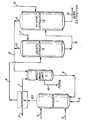
- the single figure is a schematic flowsheet illustrating the process of this invention.
- the process of this invention is practiced by flowing the aqueous waste stream from the oxidizer to the vessel containing the recycle oxidate, washing the recycle oxidate with the aqueous waste stream to decrease the entrained caustic concentration in the recycle oxidate and increase the concentration of p-diisopropylbenzene dihydroperoxide in the recycle oxidate, and thereafter separating the waste aqueous stream from the recycle oxidate.
- P-diisopropylbenzene was oxidized to p-diisopropylbenzene dihydroperoxide and various by-products with oxygen at a temperature of 105° to 110°C.
- the pH was maintained at 7 to 7.5 by the addition of a 0.3% by weight aqueous sodium hydroxide solution.
- the oxidate is separated into an aqueous stream 7 and an organic stream 8, the organic stream 8 being fed to a caustic extractor 9 wherein the p-diisopropylbenzene dihydroperoxide, the p-hydroxyhydroperoxide, and certain impurities were extracted into the 4% aqueous caustic solution introduced into extractor 9 via line 17.
- Recycle oxidate from extractor 9 was fed to a water wash unit 11 via line 10. Simultaneously, the aqueous waste stream 7 from oxidizer 1 was admitted to wash unit 11.
- An aqueous stream from caustic extractor 9 and containing dihydroperoxide, monohydroperoxide and hydroxyhydroperoxide was fed via line 12 to extractor 13 where it was contacted with fresh p-diisopropylbenzene, introduced via 16, which extracted the valuable precursor p-diisopropylbenzene monohydroperoxide from the aqueous phase.
- the organic phase from extractor 13 was then fed to the wash unit 11 via line 10, the aqueous phase being fed via line 15 to a methyl isobutyl ketone extractor for further processing to hydroquinone.
- the caustic solution entrained in the recycle oxidate 22, from the caustic extractor 9 and in the organic phase 14 from the p-diisopropylbenzene (p-DIPB) extractor 13 is removed by the aqueous waste stream 7 from the oxidizer 1. Simultaneously, p-diisopropylbenzene dihydroperoxide present in the aqueous waste stream enters the organic phase which is recycled to the oxidizer via line 5, the aqueous phase from the wash unit 11 being purged from the system via line 16.
- Example 2 The same procedure that was employed in Example 1 was utilized here except that m-diisopropylbenzene was used in lieu of p-diisopropylbenzene. In this procedure the temperature utilized was 110°C. and the caustic was 0.4% by weight aqueous sodium hydroxide solution. The result obtained was identical to Example 1 except that m-diisopropylbenzene dihydroperoxide was recovered.
Landscapes
- Chemical & Material Sciences (AREA)
- Organic Chemistry (AREA)
- Organic Low-Molecular-Weight Compounds And Preparation Thereof (AREA)
Applications Claiming Priority (2)
| Application Number | Priority Date | Filing Date | Title |
|---|---|---|---|
| US427972 | 1982-09-29 | ||
| US06/427,972 US4670609A (en) | 1982-09-29 | 1982-09-29 | Dihydric phenol recovery process |
Publications (3)
| Publication Number | Publication Date |
|---|---|
| EP0105019A2 true EP0105019A2 (fr) | 1984-04-04 |
| EP0105019A3 EP0105019A3 (en) | 1985-10-30 |
| EP0105019B1 EP0105019B1 (fr) | 1987-08-05 |
Family
ID=23697062
Family Applications (1)
| Application Number | Title | Priority Date | Filing Date |
|---|---|---|---|
| EP83630157A Expired EP0105019B1 (fr) | 1982-09-29 | 1983-09-19 | Procédé de préparation de dihydroxybenzène |
Country Status (5)
| Country | Link |
|---|---|
| US (1) | US4670609A (fr) |
| EP (1) | EP0105019B1 (fr) |
| JP (1) | JPS5982327A (fr) |
| CA (1) | CA1196019A (fr) |
| DE (1) | DE3372855D1 (fr) |
Cited By (4)
| Publication number | Priority date | Publication date | Assignee | Title |
|---|---|---|---|---|
| US4849549A (en) * | 1987-12-22 | 1989-07-18 | Indspec Chemical Corporation | Process for preparation of resorcinol |
| EP0394813A3 (fr) * | 1989-04-26 | 1992-04-08 | The Dow Chemical Company | Copolyesters termotropes, aromatiques transformable à l'état fondu et procédé pour leur préparation |
| WO2004076408A3 (fr) * | 2003-02-28 | 2005-03-10 | Shell Int Research | Procede |
| BE1017297A5 (fr) * | 2006-02-22 | 2008-05-06 | Sumitomo Chemical Co |
Families Citing this family (5)
| Publication number | Priority date | Publication date | Assignee | Title |
|---|---|---|---|---|
| FI73194C (fi) * | 1985-11-19 | 1987-09-10 | Neste Oy | Foerfarande foer framstaellning av hydrokinon. |
| US4935551A (en) * | 1987-12-22 | 1990-06-19 | Indspec Chemical Corporation | Hydroperoxidation of diisopropylbenzene |
| RU2300520C2 (ru) * | 2001-09-19 | 2007-06-10 | Шелл Интернэшнл Рисерч Маатсхаппий Б.В. | Способ получения органических гидропероксидов |
| US7763755B2 (en) | 2006-02-16 | 2010-07-27 | Sumitomo Chemical Company, Limited | Method for producing dialkylhydroperoxybenzenes |
| CN112679403B (zh) * | 2019-10-18 | 2022-11-01 | 中国石油化工股份有限公司 | 制备间位二异丙苯二过氧化氢和对位二异丙苯二过氧化氢的方法 |
Family Cites Families (14)
| Publication number | Priority date | Publication date | Assignee | Title |
|---|---|---|---|---|
| GB785607A (en) * | 1954-04-24 | 1957-10-30 | Distillers Co Yeast Ltd | Manufacture of organic hydroperoxides |
| GB893634A (en) * | 1959-07-13 | 1962-04-11 | Phenolchemie Gmbh | Improvements in or relating to the oxidation of aromatic compounds |
| BE608250A (fr) * | 1960-09-17 | |||
| NL301578A (fr) * | 1962-12-17 | |||
| US3376352A (en) * | 1963-02-21 | 1968-04-02 | Montedison Spa | Process for producing hydroquinone from p-dialkyl-benzene-bis-hydroperoxides |
| US3911020A (en) * | 1969-07-25 | 1975-10-07 | Goodyear Tire & Rubber | Process for the preparation of dialkylbenzene dihydroperoxide |
| US3968171A (en) * | 1970-03-05 | 1976-07-06 | The Goodyear Tire & Rubber Company | Process for the continuous isolation of dihydric phenols |
| US3883600A (en) * | 1970-05-04 | 1975-05-13 | Goodyear Tire & Rubber | Production of paradialkylbenzene dihydroperoxide |
| US4053520A (en) * | 1970-05-04 | 1977-10-11 | The Goodyear Tire & Rubber Company | Production of para-dialkylbenzene dihydroperoxide |
| US3882600A (en) * | 1971-04-01 | 1975-05-13 | Richard W Plymale | Composition in method for treating teeth |
| JPS59489B2 (ja) * | 1972-11-21 | 1984-01-07 | 住友化学工業株式会社 | ジハイドロパ−オキサイドの分解法 |
| US3978142A (en) * | 1974-01-14 | 1976-08-31 | The Goodyear Tire & Rubber Company | Process for producing polyphenols |
| JPS5136430A (en) * | 1974-09-20 | 1976-03-27 | Mitsui Petrochemical Ind | Hidorokinon no seiseihoho |
| DE2843957A1 (de) * | 1978-10-09 | 1980-04-17 | Huels Chemische Werke Ag | Verfahren zur herstellung von araliphatischen dihydroperoxiden |
-
1982
- 1982-09-29 US US06/427,972 patent/US4670609A/en not_active Expired - Lifetime
-
1983
- 1983-09-15 CA CA000436793A patent/CA1196019A/fr not_active Expired
- 1983-09-19 EP EP83630157A patent/EP0105019B1/fr not_active Expired
- 1983-09-19 DE DE8383630157T patent/DE3372855D1/de not_active Expired
- 1983-09-27 JP JP58179067A patent/JPS5982327A/ja active Granted
Cited By (6)
| Publication number | Priority date | Publication date | Assignee | Title |
|---|---|---|---|---|
| US4849549A (en) * | 1987-12-22 | 1989-07-18 | Indspec Chemical Corporation | Process for preparation of resorcinol |
| EP0322245A3 (fr) * | 1987-12-22 | 1991-04-10 | Indspec Chemical Corporation | Procédé de préparation du résorcinol |
| EP0394813A3 (fr) * | 1989-04-26 | 1992-04-08 | The Dow Chemical Company | Copolyesters termotropes, aromatiques transformable à l'état fondu et procédé pour leur préparation |
| WO2004076408A3 (fr) * | 2003-02-28 | 2005-03-10 | Shell Int Research | Procede |
| BE1017297A5 (fr) * | 2006-02-22 | 2008-05-06 | Sumitomo Chemical Co | |
| US7488853B2 (en) | 2006-02-22 | 2009-02-10 | Sumitomo Chemical Co., Ltd. | Process for producing phenols |
Also Published As
| Publication number | Publication date |
|---|---|
| US4670609A (en) | 1987-06-02 |
| DE3372855D1 (en) | 1987-09-10 |
| EP0105019A3 (en) | 1985-10-30 |
| CA1196019A (fr) | 1985-10-29 |
| JPH0253416B2 (fr) | 1990-11-16 |
| JPS5982327A (ja) | 1984-05-12 |
| EP0105019B1 (fr) | 1987-08-05 |
Similar Documents
| Publication | Publication Date | Title |
|---|---|---|
| US4016213A (en) | Recovery of phenol, acetone and dimethyl phenyl carbinol from cumene oxidation product | |
| US4283570A (en) | Process for preparing resorcinol | |
| US4670609A (en) | Dihydric phenol recovery process | |
| US4237319A (en) | Process for liquid-phase oxidation of m-diisopropylbenzene | |
| US2856432A (en) | Aromatic dihydroperoxide production | |
| US2856433A (en) | Separation of organic compounds | |
| US3950431A (en) | Process for removing impurities in an oxidation mixture | |
| US3190924A (en) | Process for the production of organic dihydroperoxides | |
| US4339615A (en) | Process for producing resorcinol | |
| EP2379495B1 (fr) | Amélioration de l'oxydation du cumène | |
| US4469899A (en) | Process for producing phloroglucin | |
| US4408083A (en) | Method of treating hydroperoxide mixtures | |
| US4059637A (en) | Method for extraction of dihydroperoxide | |
| EP0322245A2 (fr) | Procédé de préparation du résorcinol | |
| US5120902A (en) | Process for the preparation of a cumene feed for cumene oxidation | |
| US5220103A (en) | Process for the preparation of a cumene feed for cumene oxidation | |
| US3978142A (en) | Process for producing polyphenols | |
| US4271321A (en) | Process for the preparation of araliphatic dihydroperoxides | |
| US7763755B2 (en) | Method for producing dialkylhydroperoxybenzenes | |
| US5003113A (en) | Process of producing isopropylnaphthols | |
| US3360570A (en) | Recovery of oxidation products | |
| US4080386A (en) | Production of aralkyl tertiary hydroperoxides | |
| US3647886A (en) | Hydrocarbon oxidation | |
| US4297518A (en) | Decomposition of cumene hydroperoxide with a homogeneous catalyst | |
| US5962747A (en) | Process for producing 1,3-di-(2-hydroperoxy-2-propyl) benzene |
Legal Events
| Date | Code | Title | Description |
|---|---|---|---|
| PUAI | Public reference made under article 153(3) epc to a published international application that has entered the european phase |
Free format text: ORIGINAL CODE: 0009012 |
|
| 17P | Request for examination filed |
Effective date: 19831001 |
|
| AK | Designated contracting states |
Designated state(s): BE DE FR GB IT |
|
| PUAL | Search report despatched |
Free format text: ORIGINAL CODE: 0009013 |
|
| AK | Designated contracting states |
Designated state(s): BE DE FR GB IT |
|
| 17Q | First examination report despatched |
Effective date: 19860414 |
|
| GRAA | (expected) grant |
Free format text: ORIGINAL CODE: 0009210 |
|
| AK | Designated contracting states |
Kind code of ref document: B1 Designated state(s): BE DE FR GB IT |
|
| REF | Corresponds to: |
Ref document number: 3372855 Country of ref document: DE Date of ref document: 19870910 |
|
| ET | Fr: translation filed | ||
| ITF | It: translation for a ep patent filed | ||
| PLBE | No opposition filed within time limit |
Free format text: ORIGINAL CODE: 0009261 |
|
| STAA | Information on the status of an ep patent application or granted ep patent |
Free format text: STATUS: NO OPPOSITION FILED WITHIN TIME LIMIT |
|
| 26N | No opposition filed | ||
| REG | Reference to a national code |
Ref country code: FR Ref legal event code: CL |
|
| REG | Reference to a national code |
Ref country code: FR Ref legal event code: CL |
|
| ITTA | It: last paid annual fee | ||
| PGFP | Annual fee paid to national office [announced via postgrant information from national office to epo] |
Ref country code: GB Payment date: 19990806 Year of fee payment: 17 |
|
| PGFP | Annual fee paid to national office [announced via postgrant information from national office to epo] |
Ref country code: FR Payment date: 19990901 Year of fee payment: 17 |
|
| PGFP | Annual fee paid to national office [announced via postgrant information from national office to epo] |
Ref country code: DE Payment date: 19990927 Year of fee payment: 17 |
|
| PGFP | Annual fee paid to national office [announced via postgrant information from national office to epo] |
Ref country code: BE Payment date: 19991015 Year of fee payment: 17 |
|
| PG25 | Lapsed in a contracting state [announced via postgrant information from national office to epo] |
Ref country code: GB Free format text: LAPSE BECAUSE OF NON-PAYMENT OF DUE FEES Effective date: 20000919 |
|
| PG25 | Lapsed in a contracting state [announced via postgrant information from national office to epo] |
Ref country code: BE Free format text: LAPSE BECAUSE OF NON-PAYMENT OF DUE FEES Effective date: 20000930 |
|
| BERE | Be: lapsed |
Owner name: THE GOODYEAR TIRE & RUBBER CY Effective date: 20000930 |
|
| GBPC | Gb: european patent ceased through non-payment of renewal fee |
Effective date: 20000919 |
|
| PG25 | Lapsed in a contracting state [announced via postgrant information from national office to epo] |
Ref country code: FR Free format text: LAPSE BECAUSE OF NON-PAYMENT OF DUE FEES Effective date: 20010531 |
|
| PG25 | Lapsed in a contracting state [announced via postgrant information from national office to epo] |
Ref country code: DE Free format text: LAPSE BECAUSE OF NON-PAYMENT OF DUE FEES Effective date: 20010601 |
|
| REG | Reference to a national code |
Ref country code: FR Ref legal event code: ST |