EP0105146A1 - Verfahren zur Herstellung von Diaminen oder Diamingemischen - Google Patents
Verfahren zur Herstellung von Diaminen oder Diamingemischen Download PDFInfo
- Publication number
- EP0105146A1 EP0105146A1 EP83108026A EP83108026A EP0105146A1 EP 0105146 A1 EP0105146 A1 EP 0105146A1 EP 83108026 A EP83108026 A EP 83108026A EP 83108026 A EP83108026 A EP 83108026A EP 0105146 A1 EP0105146 A1 EP 0105146A1
- Authority
- EP
- European Patent Office
- Prior art keywords
- diamines
- optionally
- hydrogen
- diamine
- formula
- Prior art date
- Legal status (The legal status is an assumption and is not a legal conclusion. Google has not performed a legal analysis and makes no representation as to the accuracy of the status listed.)
- Granted
Links
- 150000004985 diamines Chemical class 0.000 title claims abstract description 42
- 239000000203 mixture Substances 0.000 title claims abstract description 36
- 238000000034 method Methods 0.000 title claims abstract description 21
- 230000008569 process Effects 0.000 title claims abstract description 17
- 238000002360 preparation method Methods 0.000 title claims abstract description 6
- 239000001257 hydrogen Substances 0.000 claims abstract description 25
- 229910052739 hydrogen Inorganic materials 0.000 claims abstract description 25
- UFHFLCQGNIYNRP-UHFFFAOYSA-N Hydrogen Chemical compound [H][H] UFHFLCQGNIYNRP-UHFFFAOYSA-N 0.000 claims abstract description 24
- 150000004984 aromatic diamines Chemical class 0.000 claims abstract description 12
- 125000004432 carbon atom Chemical group C* 0.000 claims abstract description 9
- 125000000217 alkyl group Chemical group 0.000 claims abstract description 7
- 229920006395 saturated elastomer Polymers 0.000 claims abstract description 3
- 239000003054 catalyst Substances 0.000 claims description 15
- 238000005984 hydrogenation reaction Methods 0.000 claims description 12
- SYSQUGFVNFXIIT-UHFFFAOYSA-N n-[4-(1,3-benzoxazol-2-yl)phenyl]-4-nitrobenzenesulfonamide Chemical class C1=CC([N+](=O)[O-])=CC=C1S(=O)(=O)NC1=CC=C(C=2OC3=CC=CC=C3N=2)C=C1 SYSQUGFVNFXIIT-UHFFFAOYSA-N 0.000 claims description 5
- 150000002484 inorganic compounds Chemical class 0.000 claims description 2
- 229910010272 inorganic material Inorganic materials 0.000 claims description 2
- 230000000737 periodic effect Effects 0.000 claims description 2
- OKKJLVBELUTLKV-UHFFFAOYSA-N Methanol Chemical compound OC OKKJLVBELUTLKV-UHFFFAOYSA-N 0.000 description 24
- QGZKDVFQNNGYKY-UHFFFAOYSA-N Ammonia Chemical compound N QGZKDVFQNNGYKY-UHFFFAOYSA-N 0.000 description 16
- 239000000047 product Substances 0.000 description 9
- IJGRMHOSHXDMSA-UHFFFAOYSA-N Atomic nitrogen Chemical compound N#N IJGRMHOSHXDMSA-UHFFFAOYSA-N 0.000 description 8
- 229910021529 ammonia Inorganic materials 0.000 description 8
- 239000007858 starting material Substances 0.000 description 8
- 150000001875 compounds Chemical class 0.000 description 7
- 229910052707 ruthenium Inorganic materials 0.000 description 7
- 238000006243 chemical reaction Methods 0.000 description 5
- KJTLSVCANCCWHF-UHFFFAOYSA-N Ruthenium Chemical compound [Ru] KJTLSVCANCCWHF-UHFFFAOYSA-N 0.000 description 4
- 238000004821 distillation Methods 0.000 description 4
- 238000011010 flushing procedure Methods 0.000 description 4
- 150000002431 hydrogen Chemical class 0.000 description 4
- 229910052757 nitrogen Inorganic materials 0.000 description 4
- 239000002904 solvent Substances 0.000 description 4
- 238000003756 stirring Methods 0.000 description 4
- 239000000126 substance Substances 0.000 description 4
- AFEORBFSJSJGDW-UHFFFAOYSA-N 4-[(4-aminophenyl)methyl]-2-methylaniline Chemical compound C1=C(N)C(C)=CC(CC=2C=CC(N)=CC=2)=C1 AFEORBFSJSJGDW-UHFFFAOYSA-N 0.000 description 3
- RTZKZFJDLAIYFH-UHFFFAOYSA-N Diethyl ether Chemical compound CCOCC RTZKZFJDLAIYFH-UHFFFAOYSA-N 0.000 description 3
- LFQSCWFLJHTTHZ-UHFFFAOYSA-N Ethanol Chemical compound CCO LFQSCWFLJHTTHZ-UHFFFAOYSA-N 0.000 description 3
- WSFSSNUMVMOOMR-UHFFFAOYSA-N Formaldehyde Chemical compound O=C WSFSSNUMVMOOMR-UHFFFAOYSA-N 0.000 description 3
- 125000003118 aryl group Chemical group 0.000 description 3
- 239000012043 crude product Substances 0.000 description 3
- 238000004817 gas chromatography Methods 0.000 description 3
- 125000002496 methyl group Chemical group [H]C([H])([H])* 0.000 description 3
- 239000011541 reaction mixture Substances 0.000 description 3
- 230000009257 reactivity Effects 0.000 description 3
- KVYKVPYEGXESDC-UHFFFAOYSA-N 1-(cyclohexylmethyl)-1-phenylhydrazine Chemical class C=1C=CC=CC=1N(N)CC1CCCCC1 KVYKVPYEGXESDC-UHFFFAOYSA-N 0.000 description 2
- UUKHBVGVGQVJGQ-UHFFFAOYSA-N 2-n-cyclohexyl-2-n-methylbenzene-1,2-diamine Chemical class C=1C=CC=C(N)C=1N(C)C1CCCCC1 UUKHBVGVGQVJGQ-UHFFFAOYSA-N 0.000 description 2
- VBNMFUUHIPHYTG-UHFFFAOYSA-N 4-[(4-aminocyclohexyl)methyl]-2-methylaniline Chemical compound C1=C(N)C(C)=CC(CC2CCC(N)CC2)=C1 VBNMFUUHIPHYTG-UHFFFAOYSA-N 0.000 description 2
- DZIHTWJGPDVSGE-UHFFFAOYSA-N 4-[(4-aminocyclohexyl)methyl]cyclohexan-1-amine Chemical compound C1CC(N)CCC1CC1CCC(N)CC1 DZIHTWJGPDVSGE-UHFFFAOYSA-N 0.000 description 2
- PAYRUJLWNCNPSJ-UHFFFAOYSA-N Aniline Chemical compound NC1=CC=CC=C1 PAYRUJLWNCNPSJ-UHFFFAOYSA-N 0.000 description 2
- OKTJSMMVPCPJKN-UHFFFAOYSA-N Carbon Chemical compound [C] OKTJSMMVPCPJKN-UHFFFAOYSA-N 0.000 description 2
- 239000004970 Chain extender Substances 0.000 description 2
- DGAQECJNVWCQMB-PUAWFVPOSA-M Ilexoside XXIX Chemical compound C[C@@H]1CC[C@@]2(CC[C@@]3(C(=CC[C@H]4[C@]3(CC[C@@H]5[C@@]4(CC[C@@H](C5(C)C)OS(=O)(=O)[O-])C)C)[C@@H]2[C@]1(C)O)C)C(=O)O[C@H]6[C@@H]([C@H]([C@@H]([C@H](O6)CO)O)O)O.[Na+] DGAQECJNVWCQMB-PUAWFVPOSA-M 0.000 description 2
- PXHVJJICTQNCMI-UHFFFAOYSA-N Nickel Chemical compound [Ni] PXHVJJICTQNCMI-UHFFFAOYSA-N 0.000 description 2
- 239000004952 Polyamide Substances 0.000 description 2
- WYURNTSHIVDZCO-UHFFFAOYSA-N Tetrahydrofuran Chemical compound C1CCOC1 WYURNTSHIVDZCO-UHFFFAOYSA-N 0.000 description 2
- UBADKKCCQHYPIX-UHFFFAOYSA-N aluminum oxygen(2-) ruthenium(3+) Chemical compound [O-2].[Al+3].[Ru+3].[O-2].[O-2] UBADKKCCQHYPIX-UHFFFAOYSA-N 0.000 description 2
- 125000003277 amino group Chemical group 0.000 description 2
- 150000001448 anilines Chemical class 0.000 description 2
- 150000004982 aromatic amines Chemical class 0.000 description 2
- 238000009835 boiling Methods 0.000 description 2
- 230000003197 catalytic effect Effects 0.000 description 2
- PAFZNILMFXTMIY-UHFFFAOYSA-N cyclohexylamine Chemical compound NC1CCCCC1 PAFZNILMFXTMIY-UHFFFAOYSA-N 0.000 description 2
- 238000007701 flash-distillation Methods 0.000 description 2
- 239000000543 intermediate Substances 0.000 description 2
- 238000004519 manufacturing process Methods 0.000 description 2
- 238000002844 melting Methods 0.000 description 2
- 229910052751 metal Inorganic materials 0.000 description 2
- 239000002184 metal Substances 0.000 description 2
- 239000010412 oxide-supported catalyst Substances 0.000 description 2
- BASFCYQUMIYNBI-UHFFFAOYSA-N platinum Chemical compound [Pt] BASFCYQUMIYNBI-UHFFFAOYSA-N 0.000 description 2
- 229920002647 polyamide Polymers 0.000 description 2
- 229920002635 polyurethane Polymers 0.000 description 2
- 239000004814 polyurethane Substances 0.000 description 2
- BDERNNFJNOPAEC-UHFFFAOYSA-N propan-1-ol Chemical compound CCCO BDERNNFJNOPAEC-UHFFFAOYSA-N 0.000 description 2
- 150000003304 ruthenium compounds Chemical class 0.000 description 2
- WOCIAKWEIIZHES-UHFFFAOYSA-N ruthenium(iv) oxide Chemical compound O=[Ru]=O WOCIAKWEIIZHES-UHFFFAOYSA-N 0.000 description 2
- 229910052708 sodium Inorganic materials 0.000 description 2
- 239000011734 sodium Substances 0.000 description 2
- 238000006467 substitution reaction Methods 0.000 description 2
- 0 *c1cccc(*)c1N Chemical compound *c1cccc(*)c1N 0.000 description 1
- RYHBNJHYFVUHQT-UHFFFAOYSA-N 1,4-Dioxane Chemical compound C1COCCO1 RYHBNJHYFVUHQT-UHFFFAOYSA-N 0.000 description 1
- YBRVSVVVWCFQMG-UHFFFAOYSA-N 4,4'-diaminodiphenylmethane Chemical compound C1=CC(N)=CC=C1CC1=CC=C(N)C=C1 YBRVSVVVWCFQMG-UHFFFAOYSA-N 0.000 description 1
- XFZZMFVHNZJNIZ-UHFFFAOYSA-N 4-[(2-aminocyclohexyl)methyl]-2,6-dimethylaniline Chemical compound CC1=C(N)C(C)=CC(CC2C(CCCC2)N)=C1 XFZZMFVHNZJNIZ-UHFFFAOYSA-N 0.000 description 1
- CRHCRZNTDDWSCP-UHFFFAOYSA-N 4-[(2-aminocyclohexyl)methyl]-2-methylaniline Chemical compound C1=C(N)C(C)=CC(CC2C(CCCC2)N)=C1 CRHCRZNTDDWSCP-UHFFFAOYSA-N 0.000 description 1
- HWVIWIDTBYWXGB-UHFFFAOYSA-N 4-[(4-aminophenyl)methyl]-2-ethylaniline Chemical compound C1=C(N)C(CC)=CC(CC=2C=CC(N)=CC=2)=C1 HWVIWIDTBYWXGB-UHFFFAOYSA-N 0.000 description 1
- OYPRJOBELJOOCE-UHFFFAOYSA-N Calcium Chemical compound [Ca] OYPRJOBELJOOCE-UHFFFAOYSA-N 0.000 description 1
- XDTMQSROBMDMFD-UHFFFAOYSA-N Cyclohexane Chemical compound C1CCCCC1 XDTMQSROBMDMFD-UHFFFAOYSA-N 0.000 description 1
- KFZMGEQAYNKOFK-UHFFFAOYSA-N Isopropanol Chemical compound CC(C)O KFZMGEQAYNKOFK-UHFFFAOYSA-N 0.000 description 1
- FYYHWMGAXLPEAU-UHFFFAOYSA-N Magnesium Chemical compound [Mg] FYYHWMGAXLPEAU-UHFFFAOYSA-N 0.000 description 1
- 238000005481 NMR spectroscopy Methods 0.000 description 1
- ZLMJMSJWJFRBEC-UHFFFAOYSA-N Potassium Chemical compound [K] ZLMJMSJWJFRBEC-UHFFFAOYSA-N 0.000 description 1
- VYPSYNLAJGMNEJ-UHFFFAOYSA-N Silicium dioxide Chemical compound O=[Si]=O VYPSYNLAJGMNEJ-UHFFFAOYSA-N 0.000 description 1
- BQCADISMDOOEFD-UHFFFAOYSA-N Silver Chemical compound [Ag] BQCADISMDOOEFD-UHFFFAOYSA-N 0.000 description 1
- 239000013543 active substance Substances 0.000 description 1
- 150000001298 alcohols Chemical class 0.000 description 1
- 238000009876 asymmetric hydrogenation reaction Methods 0.000 description 1
- 229910052788 barium Inorganic materials 0.000 description 1
- DSAJWYNOEDNPEQ-UHFFFAOYSA-N barium atom Chemical compound [Ba] DSAJWYNOEDNPEQ-UHFFFAOYSA-N 0.000 description 1
- 230000008901 benefit Effects 0.000 description 1
- 230000015572 biosynthetic process Effects 0.000 description 1
- 239000006227 byproduct Substances 0.000 description 1
- 229910052791 calcium Inorganic materials 0.000 description 1
- 239000011575 calcium Substances 0.000 description 1
- 229910017052 cobalt Inorganic materials 0.000 description 1
- 239000010941 cobalt Substances 0.000 description 1
- GUTLYIVDDKVIGB-UHFFFAOYSA-N cobalt atom Chemical compound [Co] GUTLYIVDDKVIGB-UHFFFAOYSA-N 0.000 description 1
- 230000000052 comparative effect Effects 0.000 description 1
- 238000009833 condensation Methods 0.000 description 1
- 230000005494 condensation Effects 0.000 description 1
- 238000005260 corrosion Methods 0.000 description 1
- 230000007797 corrosion Effects 0.000 description 1
- 238000006481 deamination reaction Methods 0.000 description 1
- 230000001419 dependent effect Effects 0.000 description 1
- 239000000975 dye Substances 0.000 description 1
- 229920001971 elastomer Polymers 0.000 description 1
- 150000002170 ethers Chemical class 0.000 description 1
- 238000001704 evaporation Methods 0.000 description 1
- 230000008020 evaporation Effects 0.000 description 1
- 238000001914 filtration Methods 0.000 description 1
- 238000004508 fractional distillation Methods 0.000 description 1
- 239000007789 gas Substances 0.000 description 1
- 229930195733 hydrocarbon Natural products 0.000 description 1
- 150000002430 hydrocarbons Chemical class 0.000 description 1
- 239000011261 inert gas Substances 0.000 description 1
- 239000012442 inert solvent Substances 0.000 description 1
- 239000003112 inhibitor Substances 0.000 description 1
- 239000007788 liquid Substances 0.000 description 1
- 229910052749 magnesium Inorganic materials 0.000 description 1
- 239000011777 magnesium Substances 0.000 description 1
- OETHQSJEHLVLGH-UHFFFAOYSA-N metformin hydrochloride Chemical compound Cl.CN(C)C(=N)N=C(N)N OETHQSJEHLVLGH-UHFFFAOYSA-N 0.000 description 1
- 229910052759 nickel Inorganic materials 0.000 description 1
- 125000000449 nitro group Chemical group [O-][N+](*)=O 0.000 description 1
- -1 o-nitrobenzyl halides Chemical class 0.000 description 1
- 150000002894 organic compounds Chemical class 0.000 description 1
- TWNQGVIAIRXVLR-UHFFFAOYSA-N oxo(oxoalumanyloxy)alumane Chemical compound O=[Al]O[Al]=O TWNQGVIAIRXVLR-UHFFFAOYSA-N 0.000 description 1
- IUSPGFXRAJDYRG-UHFFFAOYSA-I pentafluororuthenium Chemical compound F[Ru](F)(F)(F)F IUSPGFXRAJDYRG-UHFFFAOYSA-I 0.000 description 1
- 229910052697 platinum Inorganic materials 0.000 description 1
- 239000011591 potassium Substances 0.000 description 1
- 229910052700 potassium Inorganic materials 0.000 description 1
- 230000035484 reaction time Effects 0.000 description 1
- 230000008707 rearrangement Effects 0.000 description 1
- 230000009467 reduction Effects 0.000 description 1
- 229910052703 rhodium Inorganic materials 0.000 description 1
- 239000010948 rhodium Substances 0.000 description 1
- MHOVAHRLVXNVSD-UHFFFAOYSA-N rhodium atom Chemical compound [Rh] MHOVAHRLVXNVSD-UHFFFAOYSA-N 0.000 description 1
- 229910001927 ruthenium tetroxide Inorganic materials 0.000 description 1
- BPWBCNIZWICJBV-UHFFFAOYSA-J ruthenium(4+) tetrafluoride hydrate Chemical compound O.F[Ru](F)(F)F BPWBCNIZWICJBV-UHFFFAOYSA-J 0.000 description 1
- YBCAZPLXEGKKFM-UHFFFAOYSA-K ruthenium(iii) chloride Chemical compound [Cl-].[Cl-].[Cl-].[Ru+3] YBCAZPLXEGKKFM-UHFFFAOYSA-K 0.000 description 1
- 150000003335 secondary amines Chemical class 0.000 description 1
- 238000000926 separation method Methods 0.000 description 1
- 239000000741 silica gel Substances 0.000 description 1
- 229910002027 silica gel Inorganic materials 0.000 description 1
- 229910052709 silver Inorganic materials 0.000 description 1
- 239000004332 silver Substances 0.000 description 1
- YLQBMQCUIZJEEH-UHFFFAOYSA-N tetrahydrofuran Natural products C=1C=COC=1 YLQBMQCUIZJEEH-UHFFFAOYSA-N 0.000 description 1
Classifications
-
- C—CHEMISTRY; METALLURGY
- C08—ORGANIC MACROMOLECULAR COMPOUNDS; THEIR PREPARATION OR CHEMICAL WORKING-UP; COMPOSITIONS BASED THEREON
- C08G—MACROMOLECULAR COMPOUNDS OBTAINED OTHERWISE THAN BY REACTIONS ONLY INVOLVING UNSATURATED CARBON-TO-CARBON BONDS
- C08G18/00—Polymeric products of isocyanates or isothiocyanates
- C08G18/06—Polymeric products of isocyanates or isothiocyanates with compounds having active hydrogen
- C08G18/28—Polymeric products of isocyanates or isothiocyanates with compounds having active hydrogen characterised by the compounds used containing active hydrogen
- C08G18/30—Low-molecular-weight compounds
- C08G18/32—Polyhydroxy compounds; Polyamines; Hydroxyamines
- C08G18/3225—Polyamines
- C08G18/3234—Polyamines cycloaliphatic
Definitions
- the invention relates to new diprimary aminocyclohexylmethyl anilines mono- or disubstituted on the aromatic ring, which may represent mixtures of isomers and / or which may be present in a mixture with minor amounts of the corresponding unhydrogenated or perhydrogenated diamines, and a process for the preparation of the new Compounds by catalytic partial hydrogenation of the aromatic diamines on which they are based.
- This object could be achieved by providing the diamines or diamine mixtures according to the invention described in more detail below and the process suitable for their preparation.
- aromatic diamines suitable as starting material according to the invention are those of the general formula Corresponding diamines, such as those obtained by arylamine / formaldehyde condensation using a mixture of aniline and substituted anilines of the formula as "arylamine” according to DE-A 2 133 870, 2 149 998, 2 700 185 or by reaction of o-nitrobenzyl halides with substituted anilines of the above formula, reduction of the nitro group and subsequent rearrangement according to BE-PS 864 533 or GB-PS 1 567 114 are accessible.
- the aromatic diamines to be used as starting material are catalytically hydrogenated with the addition of 3 moles of hydrogen per mole of diamine.
- the hydrogenation is carried out at 20 to 300 ° C., preferably 70 to 300 ° C. and in particular 120 to 250 ° C. under a pressure of 20 to 300 bar, preferably 70 to 300 bar and in particular 120 to 250 bar.
- the partially hydrogenated "H6" diamines consist practically exclusively of those diamines whose alkyl substituents are fixed to the remaining aromatic ring.
- the hydrogenation reaction according to the invention takes place in the presence of 0.1 to 10% by weight, preferably 0.1 to 1% by weight, based on catalytically active metal on the one hand and diamino compound on the other Hydrogenation catalyst.
- Suitable catalysts are, for example, elements of subgroup 8 of the Periodic Table of the Elements, optionally on inert supports such as activated carbon, silica gel and in particular aluminum oxide, or catalytically active inorganic compounds of these elements.
- ruthenium, platinum, rhodium, nickel and / or cobalt catalysts in elemental or chemically bound form are particularly suitable.
- Ruthenium or catalytically active ruthenium compounds are particularly preferably used.
- Suitable ruthenium compounds are ruthenium dioxide, ruthenium tetroxide, barium perruthenite, sodium, potassium, silver, calcium or magnesium ruthenate, sodium perruthenate, ruthenium pentafluoride, ruthenium tetrafluoride hydrate or ruthenium trichloride.
- the metal content of the supported catalyst is generally 1 to 10% by weight, preferably 1 to 5% by weight.
- the type and amount of the catalyst to be used is of course in no way essential to the invention, since the hydrogenation reaction takes place according to the methods known in the art.
- ammonia suppresses undesired deamination reactions and the formation of secondary amines as by-products. If ammonia is also used, this is done in amounts of 0.1 to 30% by weight, preferably 5 up to 10% by weight, based on the starting materials to be hydrogenated.
- the process according to the invention can be carried out without solvents or in the presence of inert solvents.
- low-melting or liquid diamines are hydrogenated in substance, whereas high-melting diamines are hydrogenated in dissolved form.
- Suitable solvents under the reaction conditions are organic compounds with a low boiling point, preferably alcohols such as methanol, ethanol, n-propanol, i-propanol or ethers such as e.g. Dioxane, tetrahydrofuran or diethyl ether or hydrocarbons such as cyclohexane.
- the process according to the invention is carried out continuously in a reaction tube, a pressure vessel cascade or, preferably, discontinuously in a stirred autoclave, by charging the autoclave with catalyst, the substance to be hydrogenated and, if appropriate, a solvent, flushing it several times with inert gas and, if appropriate, metering in ammonia. Then you press on hydrogen, bring the mixture to the reaction temperature and hydrogenate until the theoretically required amount of hydrogen is absorbed. After the reaction mixture has cooled and the catalyst has been separated off, the process product can be worked up by distillation.
- less than 35% by weight, preferably less than 20% by weight, of perhydrogenated cycloaliphatic diamines and less than 10% by weight, based on the total amount of diamines are present in the reaction mixtures obtained in the process according to the invention less than 5% by weight of unhydrogenated aromatic diamines.
- the main product generally consists of the desired partially hydrogenated cycloaliphatic aromatic diamine.
- diamines according to the invention are generally mixtures of isomers and largely correspond to the starting materials used with regard to positional isomerism.
- a separation into the individual position and stereoisomers is generally not necessary with regard to the technical usability of the process products according to the invention, since it is by no means dependent on the position or stereoisomerism, especially when the process products according to the invention are used as chain extenders in polyurethane chemistry with graduated reactivity. it is only important that the main component of the diamine mixture consists of partially hydrogenated aminocyclohexyl-methylanilines.
- a 1.3 l stirred autoclave is charged with 721.7 g (3.65 mol) of 4,4'-diaminodiphenylmethane, 72.2 g of ruthenium catalyst (5% Ru on A1203), flushed several times with nitrogen and hydrogen and metered in 72 , 2 g of ammonia.
- the mixture is then heated to 125 ° C. with vigorous stirring and hydrogenated at 200 bar until 10.95 mol of hydrogen have been absorbed after about 10 hours.
- the autoclave is allowed to cool, let down, and the contents of the autoclave are taken up in methanol.
- the catalyst is filtered off, washed and the crude product subjected to fractional distillation.
- fraction 1 consists of 72.4% of 4,4'-diaminodicyclohexylmethane and 25.5% of 4- / 4th -Aminobenzyl / -cyclohexylamine and fraction 2 to 9.0% from 4,4'-diaminodicyclohexylmethane and to 86.3% from 4- / 4th -Aminobenzyl / cyclohexylamine, so that the overall yield from the desired semi-hydrogenated diamine is 55.6% of theory.
- the catalyst is then filtered off, washed with methanol and the combined solutions are subjected to flash distillation.
- a boiling temperature of 114-152 ° C / 0.015 mbar 228.6 g of diamine pass over, 93.0% of which is 2- (4-amino-3,5-dimethylbenzyl) cyclohexylamine, 6.3% 4.2 '-Diamino-3,5-dimethyldicyclohexylmethane and 0.6% consists of unreacted starting product.
- a 0.7 l stirred autoclave is charged with 212 g (1 mol) of 4,2'-diamino-3-methyldiphenylmethane and 21.2 g of ruthenium-aluminum oxide supported catalyst (Ru content 5%) and, after flushing with nitrogen and hydrogen, metered in 21.2 g of ammonia. Now hydrogenated with stirring at a temperature of 140 ° C and a pressure of 200 bar to 3 moles of hydrogen are absorbed. The autoclave is then allowed to cool to room temperature, the pressure is released and the crude product is taken up in methanol. The catalyst is separated off by filtration, washed with methanol and the product is purified by distillation.
- Ru content 5% ruthenium-aluminum oxide supported catalyst
Landscapes
- Chemical & Material Sciences (AREA)
- Health & Medical Sciences (AREA)
- Chemical Kinetics & Catalysis (AREA)
- Medicinal Chemistry (AREA)
- Polymers & Plastics (AREA)
- Organic Chemistry (AREA)
- Organic Low-Molecular-Weight Compounds And Preparation Thereof (AREA)
- Low-Molecular Organic Synthesis Reactions Using Catalysts (AREA)
Abstract
Description
- Die Erfindung betrifft neue, am aromatischen Ring mono-oder disubstituierte, diprimäre Aminocyclohexylmethyl-aniline, die gegebenenfalls Isomerengemische darstellen und/oder die gegebenenfalls im Gemisch mit untergeordneten Mengen an den entsprechenden unhydrierten bzw. perhydrierten Diaminen vorliegen können, sowie ein Verfahren zur Herstellung der neuen Verbindungen durch katalytische Teilhydrierung der ihnen zugrundeliegenden aromatischen Diamine.
- Unsubstituierte oder an beiden Ringen substituierte Aminocyclohexyl-alkyl-aniline sind aus der US-PS 2 511 028 bereits bekannt. Sie eignen sich beispielsweise als Zwischenprodukte zur Herstellung von Farbstoffen, Kautschuk-Hilfsmitteln, oberflächenaktiven Substanzen, Polyamiden, Polyester-polyamiden oder als Korrosionsschutzmittel. Gemäß der Lehre der genannten Vorveröffentlichung werden die Verbindungen durch katalytische Teilhydrierung der ihnen zugrundeliegenden aromatischen Diamine hergestellt. Dieses Verfahren ist jedoch mit dem Nachteil behaftet, daß die asymmetrische Hydrierung der Diamino-diphenyl-alkane nicht selektiv durchführbar ist, so daß die Ausbeute der genannten teilhydrierten Diamine, wie den Ausführungsbeispielen der Vorveröffentlichung zu entnehmen, max. nur wenig über 50 % der Theorie beträgt.
- Da die primären Aminocyclohexyl-methyl-aniline nicht nur wertvolle Zwischenprodukte für die bereits genannten Einsatzgebiete, sondern insbesondere auch interessante Kettenverlängerungsmittel mit Aminogruppen abgestufter Reaktivität für die Polyurethanchemie darstellen, bestand die der vorliegenden Erfindung zugrundeliegende Aufgabe darin, neue derartige Verbindungen aufzufinden, deren Aminogruppen, bedingt durch die zusätzliche Substitution am aromatischen Ring einen höheren Reaktivitätsunterschied aufweisen und deren Herstellung, bedingt durch die asymmetrische Substitution, mit höheren Sekektivitäten gelingt.
- Diese Aufgabe konnte durch die Bereitstellung der nachstehend näher beschriebenen erfindungsgemäßen Diamine bzw. Diamingemische und des zu ihrer Herstellung geeigneten Verfahrens gelöst werden.
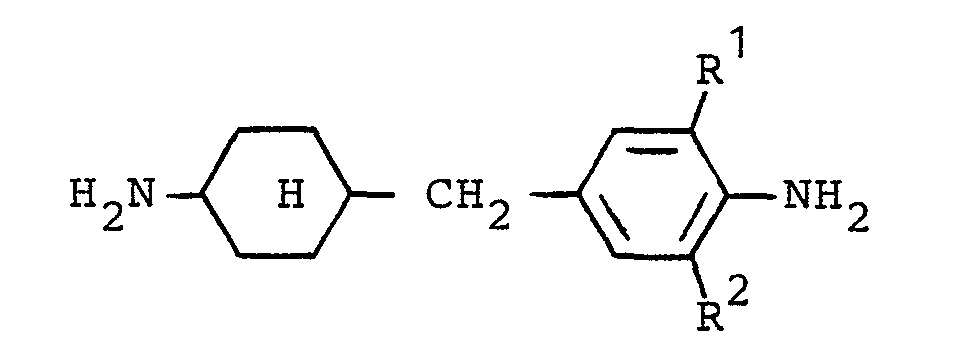
- Gegenstand der Erfindung sind, gegebenenfalls Isomerengemische darstellende und gegebenenfalls mit bis zu 35 Gew.-%, bezogen auf Gesamtgemisch, an den entsprechenden perhydrierten Diaminen und/oder gegebenenfalls im Gemisch mit bis zu 10 Gew.-%, bezogen auf Gesamtgemisch, an den entsprechenden unhydrierten aromatischen Diaminen vorliegende Diamine der Formel

- R 1 und R 2 für gleiche oder verschiedene Reste stehen und Wasserstoff oder gegebenenfalls verzweigte Alkylgruppen mit 1 bis 12 Kohlenstoffatomen bedeuten, mit der Maßgabe, daß mindestens einer der Reste für einen Alkylrest der genannten Art steht und
- m und n jeweils für 0 oder 1 stehen, mit der Maßgabe, daß die Summe m + n den Wert 1 ergibt, wobei im Falle von m oder n = 0 die freie Valenz durch Wasserstoff abgesättigt ist.
- Gegenstand der Erfindung ist auch ein Verfahren zur Herstellung dieser Diamine bzw. Diamingemische, welches dadurch gekennzeichnet ist, daß man, gegebenenfalls als Isomerengemische vorliegende, aromatische Diamine der Formel

- R 1,R 2, m und n die obengenannte Bedeutung haben,
- Die für das erfindungsgemäße Verfahren als Ausgangsmaterial geeigneten aromatischen Diamine der o.g. allgemeinen Formel können sowohl reine Substanzen als auch Isomerengemische darstellen. Besonders gut geeignet sind die dieser Formel entsprechenden Diamine, für welche entweder
- R 1 und R 2 jeweils für gleiche oder verschiedene Reste stehen und (gegebenenfalls verzweigte) Alkylreste mit 1 bis 4 Kohlenstoffatomen, insbesondere Methylgruppen, bedeuten, oder für welche
- R1 für einen Alkylrest mit 1 bis 4 Kohlenstoffatomen, insbesondere eine Methylgruppe, steht und
- R 2 für Wasserstoff steht.
- Beispiele für erfindungsgemäß als Ausgangsmaterial geeignete aromatische Diamine sind die der allgemeinen Eormel


- Bevorzugte beim erfindungsgemäßen Verfahren einzusetzende Ausgangsmaterialien sind
- 4,2'-Diamino-3,5-dimethyl-diphenylmethan,
- 4,2'-Diamino-3,5-diethyl-diphenylmethan,
- 4,2'-Diamino-3,5-diisopropyl-diphenylmethan,
- 4,2'-Diamino-3-ethyl-5-methyl-diphenylmethän, sowie diese Verbindungen als wesentliche Komponente enthaltende Isomerengemische,
- 4,4'-Diamino-3,5-dimethyl-diphenylmethan,
- 4,4'-Diamino-3,5-diethyl-diphenylmethan,
- 4,4'-Diamino-3,5-diisopropyl-diphenylmethan,
- 4,4'-Diamino-3-ethyl-5-methyl-diphenylmethan, sowie diese Verbindungen als wesentliche Komponente enthaltende Isomerengemische,
- 4,2'-Diamino-3-methyl-diphenylmethan,
- 4,2'-Diamino-3-ethyl-diphenylmethan,
- 4,2'-Diamino-3-isopropyl-diphenylmethan, sowie deren Gemische mit den entsprechenden
- 4,4'-Diamino-3-alkyl- bzw. 2,4'-Diamino-3-alkyl-di- phenylmethanen,
- 4,4'-Diamino-3-methyl-diphenylmethan,
- 4,4'-Diamino-3-ethyl-diphenylmethan,
- 4,4'-Diamino-3-isopropyl-diphenylmethan und deren Gemische mit anderen Stellungsisomeren wie z.B. den entsprechenden
- 4,2'-Diamino-3-alkyl-diphenylmethanen und/oder 2,4'-Diamino-3-alkyl-diphenylmethanen.
- Bei der Durchführung des erfindungsgemäßen Verfahrens werden die als Ausgangsmaterial einzusetzenden aromatischen Diamine unter Anlagerung von 3 Mol Wasserstoff pro Mol Diamin katalytisch hydriert. Dies bedeutet, daß die Hydrierungsreaktion vorzugsweise nach Verbrauch von 3 Mol Wasserstoff pro Mol an Ausgangsverbindung abgebrochen wird. Die Hydrierung erfolgt bei 20 bis 300°C, vorzugsweise 70 bis 300°C uns insbesondere 120 bis 250°C unter einem Druck von 20 bis 300 bar, vorzugsweise 70 bis 300 bar und insbesondere 120 bis 250 bar. Wie aus NMR-spektroskopischen Untersuchungen der Hydrierungsprodukte hervorgeht, bestehen die teilhydrierten "H6"-Diamine praktisch ausschließlich aus solchen Diaminen, deren Alkylsubstituenten am verbleibenden aromatischen Ring fixiert sind.
- Die erfindungsgemäße Hydrierungsreaktion erfolgt in Gegenwart von 0,1 bis 10 Gew.-%, vorzugsweise von 0,1 bis 1 Gew.-%, bezogen auf katalytisch wirksames Metall einerseits und Diaminoverbindung andererseits, eines Hydrierungskatalysators. Geeignete Katalysatoren sind beispielsweise, gegebenenfalls auf inerten Trägern wie Aktivkohle, Kieselgel und insbesondere Aluminiumoxid vorliegende Elemente der 8. Nebengruppe des Periodensystems der Elemente oder katalytisch wirksame anorganische Verbindungen dieser Elemente. Besonders gut geeignet sind z.B. Ruthenium-, Platin-, Rhodium-, Nickel-und/oder Kobaltkatalysatoren in elementarer oder chemisch gebundener Form. Besonders bevorzugt werden Ruthenium oder katalytisch wirksame Rutheniumverbindungen eingesetzt. Beispiele geeigneter Rutheniumverbindungen sind Rutheniumdioxid, Rutheniumtetroxid, Bariumperruthenit, Natrium-, Kalium-, Silber-, Calcium- oder Magnesiumruthenat, Natriumperruthenat, Rutheniumpentafluorid, Rutheniumtetrafluoridhydrat oder Rutheniumtrichlorid. Falls Trägersubstanzen für die Katalysatoren mitverwendet werden, beträgt der Metallgehalt des Trägerkatalysators im allgemeinen 1 bis 10 Gew.-%, vorzugsweise 1 bis 5 Gew.-%. Im übrigen ist selbstverständlich die Art und Menge des einzusetzenden Katalysators keineswegs erfindungswesentlich, da die Hydrierungsreaktion nach den an sich bekannten Methoden des Standes der Technik erfolgt.
- Es ist oft zweckmäßig, die erfindungsgemäße Hydrierungsreaktion in Gegenwart von Ammoniak durchzuführen, da Ammoniak unerwünschte Desaminierungsreaktionen und die Bildung von sekundären Aminen als Nebenprodukte unterdrückt. Falls Ammoniak mitverwendet wird, geschieht dies in Mengen von 0,1 bis 30 Gew.-%, vorzugsweise 5 bis 10 Gew.-%, bezogen auf zu hydrierende Ausgangsmaterialien.
- Das erfindungsgemäße Verfahren kann lösungsmittelfrei oder in Gegenwart inerter Lösungsmittel durchgeführt werden. Im allgemeinen werden niedrigschmelzende bzw. flüssige Diamine in Substanz, hochschmelzende Diamine dagegen in gelöster Form hydriert. Als Lösungsmittel eignen sich unter den Reaktionsbedingungen inerte organische Verbindungen mit niedrigem Siedepunkt, vorzugsweise Alkohole wie Methanol, Ethanol, n-Propanol, i-Propanol oder Ether wie z.B. Dioxan, Tetrahydrofuran oder Diethylether oder Kohlenwasserstoffe wie Cyclohexan. Die Durchführung des erfindungsgemäßen Verfahrens findet kontinuierlich in einem Reaktionsrohr, einer Druckkesselkaskade oder vorzugsweise diskontinuierlich in einem Rührautoklaven statt, indem man den Autoklaven mit Katalysator, der zu hydrierenden Substanz und gegebenenfalls einem Lösungsmittel beschickt, mehrmals mit Inertgas spült und gegebenenfalls Ammoniak zudosiert. Danach drückt man Wasserstoff auf, bringt das Gemisch auf Reaktionstemperatur und hydriert bis die theoretisch erforderliche Waserstoffmenge absorbiert ist. Nach Abkühlung des Reaktionsgemischs und Abtrennung des Katalysators kann das Verfahrensprodukt destillativ aufgearbeitet werden.
- Wie bereits oben ausgeführt ist der wesentliche Vorteil des erfindungsgemäßen Verfahrens gegenüber dem Verfahren der US-PS 2 511 028 darin zu sehen, daß die Teilhydrierung mit einer erhöhten Selektivität erfolgt, so daß wesentlich höhere Ausbeuten an, den eingesetzten Ausgangsmaterialien entsprechenden, Aminocyclohexyl- methyl-anilinen erhalten werden. Im allgemeinen liegen in dem, beim erfindungsgemäßen Verfahren anfallenden Reaktionsgemischen, bezogen auf die Gesamtmenge der Diamine, weniger als 35 Gew.-%, vorzugsweise weniger als 20 Gew.-%, an perhydrierten cycloaliphatischen Diaminen und weniger als 10 Gew.-%, vorzugsweise weniger als 5 Gew.-% an unhydrierten aromatischen Diaminen vor. Das Hauptprodukt besteht im allgemeinen aus dem angestrebten teilhydrierten, cycloaliphatischenaromatischen Diamin. Diese erfindungsgemäßen Diamine stellen im allgemeinen Isomerengemische dar und entsprechen bezüglich der Stellungsisomerie weitgehend den eingesetzten Ausgangsmaterialien. Außerdem liegen im allgemeinen stereoisomere Verbindungen im anfallenden Reaktionsgemisch vor. Eine Auftrennung in die einzelnen Stellungs- und Stereoisomeren ist im allgemeinen bezüglich der technischen Verwertbarkeit der erfindungsgemäßen Verfahrensprodukte nicht erforderlich, da es, insbesondere bei der bevorzugten Verwendung der erfindungsgemäßen Verfahrensprodukte als Kettenverlängerungsmittel in der Polyurethanchemie mit abgestufter Reaktivität keineswegs auf die Stellungs- bzw. Stereoisomerie, sondern ausschließlich darauf ankommt, daß die Hauptkomponente des Diamingemisches aus teilhydrierten Aminocyclohexyl-methylanilinen besteht.
- Die nachfolgenden Beispiele dienen der weiteren Erläuterung der Erfindung. Alle Prozentangaben beziehen sich, soweit nichts anderslautendes vermerkt, auf Gewichtsprozente.
- 250 g 4,4'-Diamino-3,5-dialkyl-diphenylmethan und 25 g Ruthenium Trägerkatalysator (5 % Ru auf A1203) werden in einem 0,7 1 Rührautoklaven vorgelegt und nach mehrmaligem Spülen mit Stickstoff und Wasserstoff werden 25 g Ammoniak zudosiert. Man erhitzt unter Rühren auf 140°C und hydriert bei 200 bar bis 3,5 Mol Wasserstoff absorbiert sind. Danach läßt man abkühlen, entspannt den Autoklaven und löst das Rohprodukt in Methanol auf. Der Katalysator wird abfiltriert, mit Methanol gewaschen und die organischen Lösungen vereinigt. Nach Abdampfen des Lösungsmittels wird das Produkt bei 100-190°C/0,1 mbar einer Flashdestillation unterworfen und gaschromatographisch analysiert.
- Folgende Ausbeuten wurden ermittelt (Tabelle 1):
-


- Man beschickt einen 1,3 1 Rührautoklaven mit 721,7 g (3,65 Mol) 4,4'-Diaminodiphenylmethan, 72,2 g Ruthenium-Katalysator (5 % Ru auf A1203), spült mehrmals mit Stickstoff und Wasserstoff und dosiert 72,2 g Ammoniak zu. Danach erhitzt man das Gemisch unter intensivem Rühren auf 125°C und hydriert bei 200 bar bis nach ca. 10 Stunden 10,95 Mol Wasserstoff absorbiert sind. Man läßt den Autoklaven abkühlen, entspannt und nimmt den Autoklaveninhalt mit Methanol auf. Der Katalysator wird abfiltriert, gewaschen und das Rohprodukt einer fraktionierten Destillation unterwcrden. Dabei gehen 332,6 g bei 120-135°C/0,1 mbar (Fraktion 1) und 380,6 g bei 135-150°C/0,1 mbar (Fraktion 2) über, während 20,6 g als Destillationsrückstand im Sumpf verbleiben. Laut gaschromatographischem Befund bestehen Fraktion 1 zu 72,4 % aus 4,4'-Diaminodicyclohexylmethan und zu 25,5 % aus 4-/
4 -Aminobenzyl/ -cyclohexylamin und Fraktion 2 zu 9,0 % aus 4,4'-Diaminodicyclohexylmethan und zu 86,3 % aus 4-/4 -Aminobenzyl/ cyclohexylamin, so daß die Gesamtausbeute aus gewünschtem halbhydrierten Diamin 55,6 % der Theorie beträgt. - Analog Beispiel 1 werden 250 g (1,18 Mol) 4,4'-Diamino-3-methyl-diphenylmethan 12,5 Stunden hydriert. Folgende Ausbeuten wurden gaschromatographisch ermittelt:
- 49,4 g (18,7 % der Theorie) 4,4'-Diamino-3-methyl-dicyclohexylmethan,
- 198,7 g (77,3 % der Theorie) 4-(4-Amino-3-methylbenzyl)-cyclohexylamin und
- 7,7 g (3,1 % der Theorie) 4,4'-Diamino-3-methyl-diphenylmethan.
- Als Destillationsrückstand verbleiben 2,1 g (0,8 % der Theorie) im Sumpf.
- In einem 0,7 1 Rührautoklaven werden 226 g (1 Mol) 4,2'-Diamino-3,5-dimethyldiphenylmethan und 22,6 g Ruthenium-Aluminiumoxid-Trägerkatalysator (5 % Ru) vorgelegt. Nach mehrmaligem Spülen mit Stickstoff und Wasserstoff werden 22,6 g Ammoniak zudosiert, das Gemisch auf 140°C erwärmt und unter Rühren bei 200 bar Wasserstoff hydriert, bis nach 4-stündiger Reaktionszeit 3 Mol Wasserstoff absorbiert sind. Man stoppt die Reaktion durch Abstellen des Rührers, läßt auf Raumtemperatur abkühlen, entspannt den Autoklaven und nimmt das Produkt in Methanol auf. Der Katalysator wird nun abfiltriert, mit Methanol gewaschen und die vereinigten Lösungen einer Flash-Destillation unterworfen. Bei einer Siedetemperatur von 114-152°C/0,015 mbar gehen 228,6 g Diamin über, das zu 93,0 % aus 2-(4-Amino-3,5-dimethylbenzyl)-cyclohexylamin, 6,3 % 4,2'-Diamino-3,5-dimethyldicyclohexylme- than und 0,6 % aus nicht-umgesetztem Ausgangsprodukt besteht.
- Man beschickt einen 0,7 1 Rührautoklaven mit 212 g (1 Mol) 4,2'-Diamino-3-methyldiphenylmethan und 21,2 g Ruthenium-Aluminiumoxid-Trägerkatalysator (Ru-Gehalt 5 %) und dosiert nach Spülen mit Stickstoff und Wasserstoff 21,2 g Ammoniak zu. Nun hydriert man unter Rühren bei einer Temperatur von 140°C und einem Druck von 200 bar bis 3 Mol Wasserstoff absorbiert sind. Dann läßt man den Autoklaven auf Raumtemperatur abkühlen, entspannt und nimmt das Rohprodukt in Methanol auf. Der Katalysator wird durch Filtration abgetrennt, mit Methanol gewaschen und das Produkt destillativ gereinigt. Bei einer Temperatur von 145-149°C/0,018 mbar destillieren 153,4 g 2-(4-Amino-3-methylbenzyl)-cyclohexylamin, das laut gaschromatographischem Befund eine Reinheit von 98,4 % aufweist.
unter Anlagerung von 3 Mol Wasserstoff pro Mol Diamin katalytisch hydriert.
Claims (8)



Applications Claiming Priority (2)
| Application Number | Priority Date | Filing Date | Title |
|---|---|---|---|
| DE19823231911 DE3231911A1 (de) | 1982-08-27 | 1982-08-27 | Diamine oder diamingemische, sowie ein verfahren zu ihrer herstellung |
| DE3231911 | 1982-08-27 |
Publications (2)
| Publication Number | Publication Date |
|---|---|
| EP0105146A1 true EP0105146A1 (de) | 1984-04-11 |
| EP0105146B1 EP0105146B1 (de) | 1985-12-18 |
Family
ID=6171853
Family Applications (1)
| Application Number | Title | Priority Date | Filing Date |
|---|---|---|---|
| EP83108026A Expired EP0105146B1 (de) | 1982-08-27 | 1983-08-13 | Verfahren zur Herstellung von Diaminen oder Diamingemischen |
Country Status (4)
| Country | Link |
|---|---|
| EP (1) | EP0105146B1 (de) |
| JP (1) | JPS5965048A (de) |
| CA (1) | CA1207341A (de) |
| DE (2) | DE3231911A1 (de) |
Cited By (5)
| Publication number | Priority date | Publication date | Assignee | Title |
|---|---|---|---|---|
| EP0154768A1 (de) * | 1984-01-19 | 1985-09-18 | Bayer Ag | Verfahren zur Herstellung von Polyurethanen, Polyurethane mit aromatischen Aminoendgruppen und ihre Verwendung |
| EP0158953A3 (en) * | 1984-04-19 | 1986-11-26 | Bayer Ag | Triamines, a process for their preparation and their use as cross-linking agents or hardeners for plastic materials or precursers having epoxy or isocyanate-groups |
| EP0158952A3 (en) * | 1984-04-19 | 1986-12-03 | Bayer Ag | Triamines, a process for their preparation and their use as cross-linking agents or hardeners for plastic materials or precursors having epoxy- or isocyanate-groups |
| EP0446781A1 (de) * | 1990-03-14 | 1991-09-18 | BASF Aktiengesellschaft | Verfahren zur Qualitätsverbesserung von rohen Diaminodiphenylmethan |
| EP2157079A1 (de) * | 2008-08-22 | 2010-02-24 | Air Products And Chemicals, Inc. | Alkyliertes 4-Aminobenzyl-4-aminocyclohexan |
Families Citing this family (2)
| Publication number | Priority date | Publication date | Assignee | Title |
|---|---|---|---|---|
| JPH07109337B2 (ja) * | 1992-02-26 | 1995-11-22 | 池永鉄工株式会社 | 氷削・砕氷兼用機 |
| IL112569A (en) * | 1994-02-10 | 1999-12-22 | Wyeth John & Brother Ltd | Pharmaceutical compositions comprising cyclohexylamine derivatives certain such novel compounds and their preparation |
Citations (3)
| Publication number | Priority date | Publication date | Assignee | Title |
|---|---|---|---|---|
| US2511028A (en) * | 1947-12-04 | 1950-06-13 | Du Pont | 4-[(para-aminophenyl) alkyl] cyclo-hexylamine |
| FR2359115A1 (fr) * | 1976-07-22 | 1978-02-17 | Bayer Ag | Derives tetraalkyles de bis-cyclohexylamines et leur preparation |
| EP0024665B1 (de) * | 1979-08-31 | 1982-05-05 | Bayer Ag | Neue Diisocyanate bzw. Diisocyanatgemische der Diphenylmethanreihe, Verfahren zu ihrer Herstellung, sowie ihre Verwendung als Aufbaukomponente bei der Herstellung von Polyurethankunststoffen nach dem Isocyanat-Polyadditionsverfahren |
-
1982
- 1982-08-27 DE DE19823231911 patent/DE3231911A1/de not_active Withdrawn
-
1983
- 1983-08-09 CA CA000434223A patent/CA1207341A/en not_active Expired
- 1983-08-13 DE DE8383108026T patent/DE3361566D1/de not_active Expired
- 1983-08-13 EP EP83108026A patent/EP0105146B1/de not_active Expired
- 1983-08-26 JP JP58155116A patent/JPS5965048A/ja active Pending
Patent Citations (3)
| Publication number | Priority date | Publication date | Assignee | Title |
|---|---|---|---|---|
| US2511028A (en) * | 1947-12-04 | 1950-06-13 | Du Pont | 4-[(para-aminophenyl) alkyl] cyclo-hexylamine |
| FR2359115A1 (fr) * | 1976-07-22 | 1978-02-17 | Bayer Ag | Derives tetraalkyles de bis-cyclohexylamines et leur preparation |
| EP0024665B1 (de) * | 1979-08-31 | 1982-05-05 | Bayer Ag | Neue Diisocyanate bzw. Diisocyanatgemische der Diphenylmethanreihe, Verfahren zu ihrer Herstellung, sowie ihre Verwendung als Aufbaukomponente bei der Herstellung von Polyurethankunststoffen nach dem Isocyanat-Polyadditionsverfahren |
Cited By (6)
| Publication number | Priority date | Publication date | Assignee | Title |
|---|---|---|---|---|
| EP0154768A1 (de) * | 1984-01-19 | 1985-09-18 | Bayer Ag | Verfahren zur Herstellung von Polyurethanen, Polyurethane mit aromatischen Aminoendgruppen und ihre Verwendung |
| US4574147A (en) * | 1984-01-19 | 1986-03-04 | Bayer Aktiengesellschaft | Process for the production of polyurethanes, polyurethanes containing terminal aromatic amino groups and their use |
| EP0158953A3 (en) * | 1984-04-19 | 1986-11-26 | Bayer Ag | Triamines, a process for their preparation and their use as cross-linking agents or hardeners for plastic materials or precursers having epoxy or isocyanate-groups |
| EP0158952A3 (en) * | 1984-04-19 | 1986-12-03 | Bayer Ag | Triamines, a process for their preparation and their use as cross-linking agents or hardeners for plastic materials or precursors having epoxy- or isocyanate-groups |
| EP0446781A1 (de) * | 1990-03-14 | 1991-09-18 | BASF Aktiengesellschaft | Verfahren zur Qualitätsverbesserung von rohen Diaminodiphenylmethan |
| EP2157079A1 (de) * | 2008-08-22 | 2010-02-24 | Air Products And Chemicals, Inc. | Alkyliertes 4-Aminobenzyl-4-aminocyclohexan |
Also Published As
| Publication number | Publication date |
|---|---|
| DE3231911A1 (de) | 1984-03-01 |
| EP0105146B1 (de) | 1985-12-18 |
| CA1207341A (en) | 1986-07-08 |
| DE3361566D1 (en) | 1986-01-30 |
| JPS5965048A (ja) | 1984-04-13 |
Similar Documents
| Publication | Publication Date | Title |
|---|---|---|
| EP0070397B1 (de) | Verfahren und Katalysator zur Herstellung von cyclischen Iminen | |
| DE69101337T2 (de) | Verfahren zur Herstellung von Anilin hoher Reinheit. | |
| EP0105146B1 (de) | Verfahren zur Herstellung von Diaminen oder Diamingemischen | |
| EP0104396B1 (de) | Verfahren zur Herstellung von Diaminen oder Diamingemischen | |
| EP0007520B1 (de) | Verfahren zur Herstellung von cis-2,6-dimethylmorpholin | |
| EP0113044B1 (de) | Diisocyanate oder Diisocyanat-Gemische, ein Verfahren zu ihrer Herstellung, sowie ihre Verwendung zur Herstellung von Polyurethankunststoffen | |
| DE2551055A1 (de) | Verfahren zur herstellung von 1,3- oder 1,4-bis-(aminomethyl)-cyclohexan | |
| EP0037548B1 (de) | Verfahren zur Herstellung von 2,2,6,6-Tetramethylpiperidon-4 | |
| EP0104531B1 (de) | Gegebenenfalls Isomerengemische darstellende cycloaliphatische Diisocyanate, ein Verfahren zu ihrer Herstellung, sowie ihre Verwendung als Ausgangsmaterialien bei der Herstellung von Polyurethankunststoffen | |
| EP0104551B1 (de) | Gegebenenfalls Isomerengemische darstellende cycloaliphatische Diisocyanate, ein Verfahren zu ihrer Herstellung, sowie ihre Verwendung als Ausgangsmaterialien bei der Herstellung von Polyurethankunststoffen | |
| EP0026367B1 (de) | Verfahren zur Herstellung von cis-2,6-Dimethylmorpholin | |
| EP0113043B1 (de) | Diisocyanate oder Diisocyanat-Gemische, Verfahren zu ihrer Herstellung, sowie ihre Verwendung zur Herstellung von Polyurethankunststoffen | |
| EP0158953B1 (de) | Neue Triamine, ein Verfahren zu ihrer Herstellung und ihre Verwendung als Vernetzer bzw. Härter für Epoxidgruppen oder Isocyanatgruppen aufweisende Kunststoffe bzw. Kunststoffvorläufer | |
| EP0422366B1 (de) | Verfahren zur Herstellung N-substituierter Pyrrolidin-2-one | |
| EP3512830B1 (de) | Verfahren zur hydrierung eines gemisches in gegenwart eines farblosen amins | |
| EP0162347A1 (de) | Neue cycloaliphatische Triisocyanate, ein Verfahren zu ihrer Herstellung und ihre Verwendung bei der Herstellung von Polyurethankunststoffen | |
| DE3883276T2 (de) | Verfahren zur Herstellung von fluorsubstituierten alicyclischen Diolen. | |
| WO2007033932A1 (de) | Verfahren zur herstellung von xylylendiamin | |
| WO1993013047A1 (de) | Verfahren zur herstellung von dibenzylamin | |
| EP2556045A1 (de) | Verfahren zur herstellung von unsymmetrischen sekundären tert.-butylaminen in der gasphase | |
| EP0158952B1 (de) | Neue Triamine, ein Verfahren zu ihrer Herstellung und ihre Verwendung als Vernetzer bzw. Härter für Epoxidgruppen oder Isocyanatgruppen aufweisende Kunststoffe bzw. Kunststoffvorläufer | |
| EP0027954A1 (de) | Verfahren zur Herstellung von Urethanen und ihre Verwendung zur Herstellung von Isocyanaten | |
| EP0589341B1 (de) | Verfahren zur Herstellung von endo/exo-8-N,N-Dialkylaminoexo-tricyclo(5.2.1.0 2,6) decan | |
| DD298382A5 (de) | Verfahren zur reinigung von n,n-dimethylcyclohexylamin |
Legal Events
| Date | Code | Title | Description |
|---|---|---|---|
| PUAI | Public reference made under article 153(3) epc to a published international application that has entered the european phase |
Free format text: ORIGINAL CODE: 0009012 |
|
| 17P | Request for examination filed |
Effective date: 19830813 |
|
| AK | Designated contracting states |
Designated state(s): BE CH DE FR GB IT LI |
|
| GRAA | (expected) grant |
Free format text: ORIGINAL CODE: 0009210 |
|
| AK | Designated contracting states |
Designated state(s): BE CH DE FR GB IT LI |
|
| REF | Corresponds to: |
Ref document number: 3361566 Country of ref document: DE Date of ref document: 19860130 |
|
| ET | Fr: translation filed | ||
| ITF | It: translation for a ep patent filed | ||
| PLBI | Opposition filed |
Free format text: ORIGINAL CODE: 0009260 |
|
| 26 | Opposition filed |
Opponent name: BASF AKTIENGESELLSCHAFT, LUDWIGSHAFEN Effective date: 19860909 |
|
| PLBM | Termination of opposition procedure: date of legal effect published |
Free format text: ORIGINAL CODE: 0009276 |
|
| STAA | Information on the status of an ep patent application or granted ep patent |
Free format text: STATUS: OPPOSITION PROCEDURE CLOSED |
|
| 27C | Opposition proceedings terminated |
Effective date: 19871130 |
|
| ITTA | It: last paid annual fee | ||
| PGFP | Annual fee paid to national office [announced via postgrant information from national office to epo] |
Ref country code: DE Payment date: 19910724 Year of fee payment: 9 |
|
| PGFP | Annual fee paid to national office [announced via postgrant information from national office to epo] |
Ref country code: GB Payment date: 19910805 Year of fee payment: 9 Ref country code: FR Payment date: 19910805 Year of fee payment: 9 |
|
| PGFP | Annual fee paid to national office [announced via postgrant information from national office to epo] |
Ref country code: CH Payment date: 19910806 Year of fee payment: 9 |
|
| PGFP | Annual fee paid to national office [announced via postgrant information from national office to epo] |
Ref country code: BE Payment date: 19910828 Year of fee payment: 9 |
|
| PG25 | Lapsed in a contracting state [announced via postgrant information from national office to epo] |
Ref country code: DE Effective date: 19920717 |
|
| PG25 | Lapsed in a contracting state [announced via postgrant information from national office to epo] |
Ref country code: GB Effective date: 19920813 |
|
| PG25 | Lapsed in a contracting state [announced via postgrant information from national office to epo] |
Ref country code: LI Effective date: 19920831 Ref country code: CH Effective date: 19920831 Ref country code: BE Effective date: 19920831 |
|
| BERE | Be: lapsed |
Owner name: BAYER A.G. Effective date: 19920831 |
|
| GBPC | Gb: european patent ceased through non-payment of renewal fee |
Effective date: 19920813 |
|
| PG25 | Lapsed in a contracting state [announced via postgrant information from national office to epo] |
Ref country code: FR Effective date: 19930430 |
|
| REG | Reference to a national code |
Ref country code: CH Ref legal event code: PL |
|
| REG | Reference to a national code |
Ref country code: FR Ref legal event code: ST |