EP0105754A2 - Rayonnage et procédé pour stocker des châssis de conteneurs, équipés de rouleaux - Google Patents
Rayonnage et procédé pour stocker des châssis de conteneurs, équipés de rouleaux Download PDFInfo
- Publication number
- EP0105754A2 EP0105754A2 EP83305966A EP83305966A EP0105754A2 EP 0105754 A2 EP0105754 A2 EP 0105754A2 EP 83305966 A EP83305966 A EP 83305966A EP 83305966 A EP83305966 A EP 83305966A EP 0105754 A2 EP0105754 A2 EP 0105754A2
- Authority
- EP
- European Patent Office
- Prior art keywords
- chassis
- rack
- support
- support means
- wheels
- Prior art date
- Legal status (The legal status is an assumption and is not a legal conclusion. Google has not performed a legal analysis and makes no representation as to the accuracy of the status listed.)
- Withdrawn
Links
Images

Classifications
-
- B—PERFORMING OPERATIONS; TRANSPORTING
- B65—CONVEYING; PACKING; STORING; HANDLING THIN OR FILAMENTARY MATERIAL
- B65G—TRANSPORT OR STORAGE DEVICES, e.g. CONVEYORS FOR LOADING OR TIPPING, SHOP CONVEYOR SYSTEMS OR PNEUMATIC TUBE CONVEYORS
- B65G1/00—Storing articles, individually or in orderly arrangement, in warehouses or magazines
- B65G1/02—Storage devices
- B65G1/14—Stack holders or separators
-
- B—PERFORMING OPERATIONS; TRANSPORTING
- B65—CONVEYING; PACKING; STORING; HANDLING THIN OR FILAMENTARY MATERIAL
- B65G—TRANSPORT OR STORAGE DEVICES, e.g. CONVEYORS FOR LOADING OR TIPPING, SHOP CONVEYOR SYSTEMS OR PNEUMATIC TUBE CONVEYORS
- B65G1/00—Storing articles, individually or in orderly arrangement, in warehouses or magazines
- B65G1/02—Storage devices
Definitions
- This invention relates generally to structures for supporting vehicles and more particularly to racks for storing wheeled container chassis.
- Container chassis are used to transport large truck-sized shipping containers. Such containers are used for packaging cargo for easy handling and transportation by ship, truck or rail.
- the containers are rectangular units which are typically 8 to 9.5 feet (2.4 to 2.9 m) high and from 20 to 45 feet (6 to 13.7m) in length.
- Mounted on the upper and lower corners of the containers are ISO (International Standards Organization) corner castings.
- the containers are handled by lift trucks provided with hoisting attachments including twistlock devices adapted to engage the corner castings at opposite ends of the containers. Exam- pies of such containers and lift trucks are disclosed on pages 9 and 17 in "Container News" of May 1981.
- the containers are positioned on a wheeled container chassis, examples of which are disclosed on page 10 of the aforementioned magazine.
- the container is held in place by twist lock devices which protrude upwardly from the top of the chassis to engage the corner castings.
- container chassis are very large, approximately 45 feet in length, their storage can be a problem. If much storage space is available, each chassis can be stored in a generally horizontal position with its wheels on the ground. However, this manner of storage is impractical in areas, such as seaports and railroad yards, where large numbers of the chassis accumulate and in which storage space is scarce.
- the container chassis are stacked horizontally one atop the other, with their wheels down.
- stacking in this manner is unstable, only three chassis can be placed safely in a single stack.
- another stacking method calls for turning every other chassis in the stack upside down. In this way, as many as five chassis can be stacked safely.
- conventional methods of flipping the chassis upside down frequently damage the chassis.
- both of the foregoing stacking methods cause uneven utilization of the stacked chassis. Because the first chassis in the stack is at the bottom of the stack and therefore less accessible, it is less likely to be used than the chassis at the top of the stack.
- Multi-Sort, Inc. devised a rack for stacking container chassis in an approximately vertical position.
- this rack has a generally U-shape with an opening at one end of the rack.
- a series of horizontally pivoting arms are mounted along one side of the rack and at the top thereof.
- a container chassis is positioned in the rack by hoisting it into a vertical position with a lift truck and moving it wheels first into the open end of the rack.
- the chassis is then placed in the rack with its rear end resting on the ground and the underside of its frame resting against the closed end of the rack.
- the first pivot arm is then swung across the rack and latched into position so that another container chassis can be leaned against it.
- This method of storage reduces the storage area required by the container chassis, but has several drawbacks.
- this rack provides a first in, last out.storage system, resulting in uneven utilization of the chassis.
- a third disadvantage of this rack is the difficulty in storing the container chassis on the ground.
- the rear end of the chassis frame is provided with rear taillights and other breakable parts. If the chassis is stood on its rear end on the ground, these parts are susceptible to damage.
- chassis wheels can be rested on wheel chocks, but the chocks must be removed from the empty storage positions in order to provide free access for the lift truck into the rack.
- efficient use of this rack requires two people, one to operate the lift truck and the other to manipulate the wheel chocks and horizontally-pivoting arms. Otherwise, the operator of the lift truck must get off the lift truck to perform these steps each time a chassis is placed in or removed from the rack.
- the stacking system should also require only one person to perform all steps in the storage process from the seat of a lift truck.
- U.S. Patent Nos. 1,280,512 to Macomber and 1,978,287 to Thomas disclose frame structures inclined at 20°-40° angles for supporting automobiles in a railroad car. To prevent rolling, the wheels of the automobiles are secured in a cradle by chains.
- U.S. Patent No. 3,677,193 to Pringle discloses a railroad car in which automobiles are stored on their side, supported along a wall by brackets connected to the underside of their chassis.
- 3,613,914 to Jaekle, et al.; 3,752,085 to Venditty and 3,872,983 to Chapman disclose railroad cars designed to support automobiles on end, supported on tiltable sidewalls of the freight cars by brackets connected to the underside of the chassis of the automobiles.
- none of the foregoing patents discloses means for solving the above-described problems connected with the storage of wheeled container chassis.
- none of these patents discloses a storage apparatus into which a container chassis could be loaded sideways.
- none of these patents disclose means for supporting a container chassis vertically above ground level without positive securement.
- the present invention provides for a side-loading rack for storing wheeled container chassis in a nearly vertical, slightly leaning position, the rack comprising structural or frame means defining plural vertical slots or stalls open on one or both sides for receiving a container chassis sideways in each slot.
- the present invention provides a chassis-storage rack having a frame means arranged to provide plural stalls, each stall comprising first support means for supporting rear wheels of the chassis above ground level and second support means for supporting the chassis frame forwardly of the wheels so as to maintain the chassis in a generally upright position.
- the present invention enables the provision of an improved storage arrangement for wheeled container chassis which allows container chassis to be stored in a vertical position above the ground without positive securement. Also, multiple container chassis may be stored so that they can be used in a first-in, first-out or any other desired sequence.
- the present invention enables a single person to store container chassis without assistance and without risk of damage to the container chassis and the area required for storage of container chassis may be minimized. Also, the present invention allows container chassis to be stored in a way that is compatible with the machinery customarily used for handling containers and container chassis.
- the second support means is provided by a fixed chassis support member extending front to rear along an upper side of each slot for supporting the chassis frame at a position above the rear wheels.
- the first support means is provided by a cradle-type wheel support means positioned on the frame means in a lower part of the slot so that a container chassis is supported therein with its wheels resting on the wheel sup- port means on one side of the slot.
- the wheel support means can provide the sole vertical component of force to support the chassis with its rear end spaced from the rack frame means.
- the upper side of the chassis frame leans against the chassis support member on the other side of the slot above the wheel support means, preferably at a small angle from vertical, the wheel support means providing a lateral component of force on,the rear wheels to support the chassis in a nearly upright position.
- the frame means includes a third support means in each slot for supporting the chassis frame below the rear wheels.
- the frame means is preferably angled inwardly in a downward direction from vertical on both sides of the slot so as to apply vertical and oppositely-directed lateral force components to the rear wheels and the rear end of the chassis frame as the chassis is lowered into the slot.
- the weight of the chassis is thereby vertically supported jointly by the first and third support means.
- the lateral force component provided by the third support means urges the wheels laterally against the first or wheel support means and, being positioned below th first support means, tends to tilt the chassis frame to a leaning position against the chassis support.
- the third support means is arranged so that the rear end of the chassis frame can rest on the frame means at or near the bottom of the slot without damage to taillights.
- the rack can be constructed for handling in the same manner as a container, using conventional container-handling apparatus to engage corner castings positioned at opposite ends of the rack.
- the frame means can be constructed -with an upper portion, including the chassis support arms, either removable from or collapsible into the lower portion of the frame means to form a more compact structure for easy handling.
- the base of the frame means can also include a lengthwise extension at one end of the rack for spacing the rack end to end from a second such rack to form an additional slot between the two racks.
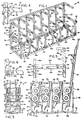
- a side-loading rack 10 for storing a number of wheeled container chassis 12 in narrow, relatively tall separate slots or stalls 14 comprises structural frame means defining a series of laterally spaced-apart dividers 16.
- the frame means is constructed of suitable structural members, such as steel square or rectangular tubular members, welded together at their joints.
- Each of the dividers has a lower portion 18 and an upper portion 20 joined by interconnection means 22.
- a wheel support means 24 for supporting a chassis by its rear wheels is mounted on the lower portion of each divider on one side of the slot at a position spaced above the ground 26.
- Pairs of ISO corner castings 28 are mounted on the upper corners of the lower portions of the dividers at each end of the rack.
- seven storage slots 14 are created in the ground space that would otherwise be occupied by a single container chassis in a horizontal position. Longer or shorter racks may be used. However, for convenience in handling with conventional container-handling equipment, a rack of seven slots is preferred.
- each divider 16 comprises parallel front and rear upright members 30, 32 interconnected at their upper ends by a horizontal member 34.
- the aforementioned corner castings are mounted along the outer ends of the rack at the corners formed by members 30, 34 and 32, 34 respectively.
- the upper portion of each divider is an inverted L-shaped member which comprises an upright member -36 connected by the interconnection means 22 as an upward extension of member 32 and supporting a cantilevered support arm 38 which extends forwardly above member 34 in spaced-apart parallel relationship.
- a pair of spaced-apart, parallel, horizontal foundation members 40, 42 extend along the front and rear sides of the rack to interconnect the lower ends of upright members 30, 32, respectively.
- a pair of end foundation members 44 interconnect the ends of the front and rear foundation members and the lower ends of upright members 30, 32 at each end of the rack.
- Two additional cross members 46 extend at intervals between the front and rear foundation members parallel to end members 44.
- Triangular gussets 48 are secured in the, corners between the various vertical and horizontal members to rigidify the rack and to support the cantilevered support arms 38.
- Horizontal cross members 50 interconnect the upper ends of upright members 36.
- Each wheel support 24 comprises a pair of generally triangular support members 52 connected to the upright members 30, 32 so as to protrude from left to right, as viewed in Figs. 1 and 2, part way into each slot.
- an elongated wheel support plate 54 Secured to the upper sides of triangular support members and extending horizontally therebetween, is an elongated wheel support plate 54. Its upper side is concavely curved about an axis extending from front to rear in the rack for cradling the rearmost wheels 56 of a container chassis resting thereon.
- the wheel supports 24 are positioned far enough above the ground so that container chassis with elongate -rear ends of varying lengths do not contact the ground. They are also spaced below and extend to the right of the horizontal members 34 to which they are connected so that wheels 56 abut such members along a horizontal line passing approximately through the axles of the wheels. The horizontal members thereby limit how far the wheels can roll toward the left.
- the upper surface of the container chassis frame 58 leans against the left side of the upper support arm 38.
- the upper support arm is positioned diagonally across the storage slot from the wheel support means so that frame 58 leans at a small angle 60 from the vertical.
- Angle 60 is preferably less than about 10° so that most of the weight of the chassis rests on the wheel support means, but great enough so that a leftward horizontal force component acting on wheel support 24 prevents wheels 56 from rolling off the support.
- connection means 22 is provided by a downward extension 62 of member 36 sized to slide inside member 32, which has a complementary opening 64 in its upper end.
- Upright members 32, 36 preferably have the same width. Accordingly, the lower end of member 36 forms a shoulder 66 which abuts the top of member 32 when extension 62 is inserted to its full length in member 32.
- a storage rack 10 dimensioned for storing up to seven container chassis of approximately 45 feet (13.7 m) in length, is 40 feet (12.2 m) long.
- the upper surfaces of the upper support arms 38 are 16 feet (4.9 m) off the ground.
- the upper surface of plate member 54 of the wheel support means are about 6 feet (1.8 m) off the ground and the upper surface of the horizontal members 34 is about 8 feet (2.4 m) off the ground.
- the width of each slot is approximately 5 feet (1.5 m). These dimensions yield a preferred angle 60 of about 8°.
- rack 10a has its connection means arranged so that the upper portions 20a of the dividers 16a telescope into the lower portions 18a.
- upper vertical member 36a is sized along its entire length to fit inside member 32a.
- a second upper vertical member 37a is connected to the front end of support arm 38a and is likewise sized to telescope into member 30a.
- the corner castings 28 are mounted within the corners between members 36a, 38a and 37a, 38a of the upper portion of the endmost dividers, rather than on the outer sides of the lower portion of the endmost dividers.
- Slots 68 are provided in the upper surface of each member 34a in position to allow the triangular gussets members 48 to extend downwardly inside members 34a when the upper portion of the dividers are lowered to rest on the lower portions.
- Pins 70 extend horizontally through the upper ends of members 30a, 32a and through complementary holes in members 36a, 37a at two alternative vertical locations.
- the uppermost holes 72 are located near the upper ends of members 36a, 37a so that pin 70 will extend therethrough when the upper portions of the dividers are lowered into the lower portions.
- the pins can thus lock the upper portions in a lowered position so that the entire rack can be picked up by a container-handling device engaging the corner castings.
- the lower holes (not shown) are positioned just above the lower ends of members 36a, 37a so that pins 70 can extend therethrough to secure the upper portions of the dividers in a vertically-extended position when the rack is to be used for storing container chassis.
- Racks 10, 10a are transported in a collapsed condition, that is, with the upper portions of the dividers either removed from or telescoped into the lower portions.
- the overall height of the collapsed rack should be less than 9.5 feet (2.9 m).
- each rack is moved around by conventional container-handling apparatus.
- the right end of the rack should be about 5 feet (1.5 m) away from any tall wall or building.
- multiple racks can be placed in end-to-end or back-to-back abutting relationship.
- Rack 10 is assembled by inserting the extensions 62 of members 36 into members 32.
- Rack 10a is assembled by removing pins 70, raising the upper portions 20a using the container handling apparatus, and reinserting the pins in the lower holes in members 36a, 37a.
- the chas- sis is lifted from the ground and rotated from horizontal to an approximately vertical position, with its rear wheels at least as high as the wheel support means 24. This operation is performed by a rotating attachment on a lift truck which grasps the chassis from one side.
- the container chassis is then moved sideways in a direction from front to rear in the rack into one of the empty storage slots.
- the chassis is gently lowered until its rearmost wheels rest on the wheel support plate 54.
- the chassis frame 58 is tilted backwards, pivoting on the rear wheels, to lean gently against the associated support arm 38.
- a second embodiment of the invention is realized in rack 110.
- Rack 110 is designed to provide slots or stalls 114 defined by dividers 116 which are relatively shorter in height than dividers 16 in rack 10, and which are accessible from both sides of the rack for loading and unloading container chassis 12.
- each of the dividers is identical in construction and the rack 110 is symmetrical about a longitudinal centerline 120, as best seen in Fig. 9.
- Each of the dividers comprises a pair of parallel, spaced-apart, horizontally opposed, upstanding angle members 130, 132 interconnected at their upper ends by a horizontal square tubular support arm 134.
- Angle members 130, 132 are mutually positioned in mirror image relationship with inner flanges 130a, 132a parallel to one another and extending in the same longitudinal direction and outer flanges 130b, 132b oppositely directed in the same plane normal to centerline 120.
- upright members 130, 132 of each divider are secured, respectively, to one of a pair of parallel, horizontal rectangular tubular base members 140, 142 extending lengthwise of the rack parallel to centerline 120 to interconnect the dividers at spaced intervals, for example, about 57" (1.45 m), to form the slots.
- Members 140, 142 are spaced apart a distance such that the treads on the tires of the inner rear wheels 56 of chassis 12 are aligned with and can ride along outer flanges 130b, 13ib of members 130, 132, with the inwardly facing sidewalls of such tires along the outside of and guided by flanges 130a, 132a.
- This spacing for example, 46" (1.57 m), between base members 140, 142, positions such members inwardly of the customary position of taillights on the rear end cross member 58a of chassis 12 so that the chassis can rest on such base members above ground level without damaging the taillights.
- Support arm 134 is secured to the upper ends of members 130, 132 along the outside faces of flanges 130b, 132b.
- Square tubular base cross members 144 extend horizontally between longitudinal base members 140, 142 in vertical alignment beneath cross members 134 and have extensions 146, 148 projecting laterally beyond the longitudinal base members to provide a base support for the lower ends of lateral brace members 136, 138.
- Brace members 136, 138 are affixed at their upper ends to support arms 134 inwardly of the upper ends of uprights 130, 132, to provide principally lateral bracing but also some longitudinal bracing for the uprights.
- Braces 136, 138 angle inwardly from their bases at an angle 150 (for example, about 19°) from vertical, as is best seen in Fig. 9.
- Upright members 130, 132 are inclined lengthwise of the rack at a slight angle 152 (for example, about 1.6°) from vertical toward support arm 134, as best. seen in Fig. 8.
- the slight angle between members 130, 132 and members 136, 138 provides some additional longitudinal bracing for the dividers. Additional longitudinal-bracing is provided by short flat bracing members 154 or triangular gussets (not shown) extending between upright members 130, 132 and base members 140, 142 and connected to the inner faces of the base members and the edges of flanges 130a, 132a.
- a pair of square tubular members 160, 162 extend at a small vertical angle 164 (for example, about 8°) between the outer flanges 130b, 132b of angle members - 130, 132 and longitudinal base members 140, 142 and are connected at their opposite ends to the latter members. Also, the lower ends of members 160, 162 are spaced lengthwise of the rack a sufficient dis- tance, for example, about 4" (10 cm), from members 136, 138 to avoid interference with twist locks 168 at the rear corners of the chassis frame 158 when resting on members 140, 142.
- Rack 110 requires no special assembly or disassembly for shipping or use. It is preferably positioned end to end with another rack 110a to form an extra slot 114c and not back to back with another rack, as with racks 10, 10a, to provide chassis loading and unloading access from both sides of the rack.
- Loading and unloading of chassis from rack 110 is performed in generally the same way as in racks 10, 10a. That is, a chassis is lifted up, rotated, moved sideways into a slot 114 and lowered into the slot until it is supported by the rack. However, in loading a chassis into a slot 114, the chassis should be centered in the rack with the inner flanges 130a, I 132a along the inner sidewalls of the chassis wheels 56. These flanges laterally stabilize the chassis to hold it upright. This feature is particularly important when the chassis frame has a short tail end 58b which does not rest on the foundation members 140, 142, as illustrated in slot 114a in Fig. 8.
- chassis When the chassis is lowered into the slot, it is guided by various elements of the structure of the slot into a position in which it is supposed by the rack.
- angled members 130, 132 urge the wheels and rear end portion of chassis 12 longitudinally of the rack, or laterally toward the opposite side of slot 114, as indicated by arrow 156.
- the tail end 58a of chassis frame 58 thereupon slidingly engages the oppositely-inclined members 160, 162 to urge such end laterally of the slot toward members 130, 132, as indicated by arrow 165 in Fig. 8.
- This action combines with the urging by flanges 130b, 132b of wheel 56 in the opposite direction 156 to tend to rotate the chassis frame about the axle of wheel 56 against support arm 134, as indicated by arrow 166, and to squeeze the wheels 56 against angle members 130, 132 to help support the chassis.
- the rear cross member 58a ultimately comes to rest on and is supported by the base members 140, 142.
Landscapes
- Engineering & Computer Science (AREA)
- Mechanical Engineering (AREA)
- Handcart (AREA)
Applications Claiming Priority (2)
| Application Number | Priority Date | Filing Date | Title |
|---|---|---|---|
| US06/429,039 US4493421A (en) | 1981-09-08 | 1982-09-30 | Side-loading container chassis storage rack |
| US429039 | 1999-10-29 |
Publications (2)
| Publication Number | Publication Date |
|---|---|
| EP0105754A2 true EP0105754A2 (fr) | 1984-04-18 |
| EP0105754A3 EP0105754A3 (fr) | 1984-07-11 |
Family
ID=23701515
Family Applications (1)
| Application Number | Title | Priority Date | Filing Date |
|---|---|---|---|
| EP83305966A Withdrawn EP0105754A3 (fr) | 1982-09-30 | 1983-09-30 | Rayonnage et procédé pour stocker des châssis de conteneurs, équipés de rouleaux |
Country Status (3)
| Country | Link |
|---|---|
| US (1) | US4493421A (fr) |
| EP (1) | EP0105754A3 (fr) |
| CA (1) | CA1180305A (fr) |
Families Citing this family (10)
| Publication number | Priority date | Publication date | Assignee | Title |
|---|---|---|---|---|
| US4952118A (en) * | 1988-09-08 | 1990-08-28 | Rnmac Services Inc. | System and apparatus for storage of wheeled trailer frames in horizontal stacks |
| US5141114A (en) * | 1990-08-16 | 1992-08-25 | Cate Metal Products, Inc. | Material handling method and apparatus |
| US5551831A (en) * | 1995-03-29 | 1996-09-03 | Chassis Systems, Inc. | Method and apparatus for elevating a cargo container chassis for storage |
| US6626304B1 (en) * | 2001-03-15 | 2003-09-30 | Chassis Systems, Inc. | Portable trailer frame storage |
| US20050220559A1 (en) * | 2004-04-06 | 2005-10-06 | Shulin Yang | Container used to ship semi-trailer chassis |
| FR2879576B1 (fr) * | 2004-12-16 | 2008-07-04 | Jean Philippe Tible | Systeme de stockage de remorques porte-bateau |
| US20060269379A1 (en) * | 2005-05-31 | 2006-11-30 | Greenfield Engineering, Inc. | Chassis shipping unit |
| US9011067B1 (en) * | 2013-01-09 | 2015-04-21 | The United States Of America As Represented By The Secretary Of The Army | System and method for vehicle deployment, extraction, and stowage |
| USD814275S1 (en) | 2016-08-09 | 2018-04-03 | Hendrickson Usa, L.L.C. | Axle support bracket system |
| US20250340381A1 (en) * | 2024-05-02 | 2025-11-06 | Terabase Energy, Inc. | Solar table rack with off-loader |
Family Cites Families (17)
| Publication number | Priority date | Publication date | Assignee | Title |
|---|---|---|---|---|
| DE466850C (de) * | 1928-10-13 | Eisenbau Maschf | Fahrradhaltevorrichtung | |
| US1280512A (en) * | 1917-12-10 | 1918-10-01 | Grant C Macomber | Method of loading automobiles in freight-cars and automobile-supporting-frame structures for use therein. |
| US1978287A (en) * | 1932-03-09 | 1934-10-23 | New York Central Railroad Co | Vehicle loading means for box cars |
| US2129950A (en) * | 1936-07-11 | 1938-09-13 | Gen Motors Corp | Loading automobile bodies for shipment |
| US2486125A (en) * | 1947-06-24 | 1949-10-25 | Midland Steel Prod Co | Spacing means for cargo units |
| US2449491A (en) * | 1947-10-01 | 1948-09-14 | Pennsylvania Railroad Co | Means to prevent shifting of lading in freight carriers |
| US2567328A (en) * | 1950-05-04 | 1951-09-11 | Fahland Frank | Load-carrying structure for vehicles |
| US3184207A (en) * | 1962-05-14 | 1965-05-18 | Singer Co | Underframe for sewing machine table |
| AT248332B (de) * | 1964-08-31 | 1966-07-25 | Franz Kerschbaumer | Gestell für den Transport und die Lagerung von tafelförmigem Material, insbesondere Tür- oder Fensterflügeln |
| US3613914A (en) * | 1969-08-15 | 1971-10-19 | William M Jaekle | Apparatus for opening and closing doors pivotally attached to a railway car |
| US3872983A (en) * | 1970-04-20 | 1975-03-25 | Evans Prod Co | Freight carrying device |
| US3677193A (en) * | 1970-08-21 | 1972-07-18 | Pullman Inc | Railway car |
| US3682523A (en) * | 1970-11-13 | 1972-08-08 | Park A Bike Corp | Vehicle storing means |
| US3752085A (en) * | 1971-07-08 | 1973-08-14 | Gen Motors Corp | Vehicle transporter |
| US4171077A (en) * | 1976-07-06 | 1979-10-16 | Richard J Berchman Jr | Bicycle carriers for buses and the like |
| US4319791A (en) * | 1979-06-04 | 1982-03-16 | Gibson Van A | Protective cage for excavation workers |
| JPS57195005A (en) * | 1981-05-28 | 1982-11-30 | Tokyu Car Corp | Storage device of trailer |
-
1982
- 1982-09-30 US US06/429,039 patent/US4493421A/en not_active Expired - Fee Related
-
1983
- 1983-09-29 CA CA000438030A patent/CA1180305A/fr not_active Expired
- 1983-09-30 EP EP83305966A patent/EP0105754A3/fr not_active Withdrawn
Also Published As
| Publication number | Publication date |
|---|---|
| CA1180305A (fr) | 1985-01-02 |
| US4493421A (en) | 1985-01-15 |
| EP0105754A3 (fr) | 1984-07-11 |
Similar Documents
| Publication | Publication Date | Title |
|---|---|---|
| US4863179A (en) | Dual function pallet carrier-platform truck for postal and package delivery systems | |
| US5213458A (en) | Method and apparatus for containerized shipment of automobiles | |
| CA2116515C (fr) | Remorque palettiseuse et conteneur de stockage | |
| US5078415A (en) | Mobile carrier for gas cylinders | |
| US6910591B2 (en) | Transportable rack | |
| US4934538A (en) | Nestable shipping rack | |
| CA2465979C (fr) | Bati de transport repliable et ses procedes d'utilisation | |
| US4799840A (en) | Drum-restraining device | |
| US4427117A (en) | Side-loading container chassis storage rack | |
| US4346906A (en) | Roll pallet | |
| US20100176076A1 (en) | Decking beam rack apparatus and method | |
| US6536607B1 (en) | Transportable rack | |
| US3966072A (en) | Collapsible container | |
| US7021461B1 (en) | Vehicle shipping rack and related methods | |
| MXPA00000668A (es) | Sistema de carreta de transporte y metodo para su fabricacion y operacion. | |
| US4493421A (en) | Side-loading container chassis storage rack | |
| US3178216A (en) | Cargo pallet construction | |
| US4545710A (en) | Apparatus for automated less-than-truck load shipments | |
| JPH0228423A (ja) | 自動車積載用ラックおよびコンテナ内へ自動車を積載する方法 | |
| US6241438B1 (en) | System for stacking of chassis | |
| JPS58170642A (ja) | 積荷保持装置 | |
| US3618796A (en) | Vehicle loading and transport system | |
| US11851266B2 (en) | A-frame rack systems for transporting glass sheets | |
| US8277164B2 (en) | Hoist suspension frame for flatbed trailers | |
| US5490753A (en) | Roll on roll off device |
Legal Events
| Date | Code | Title | Description |
|---|---|---|---|
| PUAI | Public reference made under article 153(3) epc to a published international application that has entered the european phase |
Free format text: ORIGINAL CODE: 0009012 |
|
| AK | Designated contracting states |
Designated state(s): DE FR GB NL SE |
|
| PUAL | Search report despatched |
Free format text: ORIGINAL CODE: 0009013 |
|
| AK | Designated contracting states |
Designated state(s): DE FR GB NL SE |
|
| RBV | Designated contracting states (corrected) |
Designated state(s): DE FR GB NL SE |
|
| STAA | Information on the status of an ep patent application or granted ep patent |
Free format text: STATUS: THE APPLICATION IS DEEMED TO BE WITHDRAWN |
|
| 18D | Application deemed to be withdrawn |
Effective date: 19850312 |
|
| RIN1 | Information on inventor provided before grant (corrected) |
Inventor name: BRUDI, RONALD A. Inventor name: BENEFIEL, EARL H. Inventor name: MATTHEWSON, RANDALL W. |