EP0106108A1 - Matériau métallique composite, renforçé par des fibres et comportant une matrice constituée d'un alliage d'aluminium contenant du magnésium - Google Patents
Matériau métallique composite, renforçé par des fibres et comportant une matrice constituée d'un alliage d'aluminium contenant du magnésium Download PDFInfo
- Publication number
- EP0106108A1 EP0106108A1 EP83108740A EP83108740A EP0106108A1 EP 0106108 A1 EP0106108 A1 EP 0106108A1 EP 83108740 A EP83108740 A EP 83108740A EP 83108740 A EP83108740 A EP 83108740A EP 0106108 A1 EP0106108 A1 EP 0106108A1
- Authority
- EP
- European Patent Office
- Prior art keywords
- matrix metal
- magnesium
- aluminum alloy
- composite material
- fibers
- Prior art date
- Legal status (The legal status is an assumption and is not a legal conclusion. Google has not performed a legal analysis and makes no representation as to the accuracy of the status listed.)
- Granted
Links
- 229910052751 metal Inorganic materials 0.000 title claims abstract description 131
- 239000002184 metal Substances 0.000 title claims abstract description 131
- 239000000835 fiber Substances 0.000 title claims abstract description 115
- 239000011159 matrix material Substances 0.000 title claims abstract description 100
- 239000002131 composite material Substances 0.000 title claims abstract description 73
- 239000011777 magnesium Substances 0.000 title claims abstract description 65
- FYYHWMGAXLPEAU-UHFFFAOYSA-N Magnesium Chemical compound [Mg] FYYHWMGAXLPEAU-UHFFFAOYSA-N 0.000 title claims abstract description 63
- 229910052749 magnesium Inorganic materials 0.000 title claims abstract description 63
- 229910052782 aluminium Inorganic materials 0.000 title claims abstract description 41
- XAGFODPZIPBFFR-UHFFFAOYSA-N aluminium Chemical compound [Al] XAGFODPZIPBFFR-UHFFFAOYSA-N 0.000 title claims abstract description 32
- 229910045601 alloy Inorganic materials 0.000 title claims abstract description 6
- 239000000956 alloy Substances 0.000 title claims abstract description 6
- 239000004411 aluminium Substances 0.000 title 1
- PNEYBMLMFCGWSK-UHFFFAOYSA-N aluminium oxide Inorganic materials [O-2].[O-2].[O-2].[Al+3].[Al+3] PNEYBMLMFCGWSK-UHFFFAOYSA-N 0.000 claims abstract description 45
- XUIMIQQOPSSXEZ-UHFFFAOYSA-N Silicon Chemical compound [Si] XUIMIQQOPSSXEZ-UHFFFAOYSA-N 0.000 claims abstract description 36
- 239000010703 silicon Substances 0.000 claims abstract description 36
- 229910052710 silicon Inorganic materials 0.000 claims abstract description 36
- 239000010949 copper Substances 0.000 claims abstract description 35
- RYGMFSIKBFXOCR-UHFFFAOYSA-N Copper Chemical compound [Cu] RYGMFSIKBFXOCR-UHFFFAOYSA-N 0.000 claims abstract description 33
- 229910052802 copper Inorganic materials 0.000 claims abstract description 33
- 229920000049 Carbon (fiber) Polymers 0.000 claims abstract description 31
- 239000004917 carbon fiber Substances 0.000 claims abstract description 31
- 239000012783 reinforcing fiber Substances 0.000 claims abstract description 27
- 239000000203 mixture Substances 0.000 claims abstract description 18
- XEEYBQQBJWHFJM-UHFFFAOYSA-N Iron Chemical compound [Fe] XEEYBQQBJWHFJM-UHFFFAOYSA-N 0.000 claims abstract description 8
- RTAQQCXQSZGOHL-UHFFFAOYSA-N Titanium Chemical compound [Ti] RTAQQCXQSZGOHL-UHFFFAOYSA-N 0.000 claims abstract description 4
- HCHKCACWOHOZIP-UHFFFAOYSA-N Zinc Chemical compound [Zn] HCHKCACWOHOZIP-UHFFFAOYSA-N 0.000 claims abstract description 4
- 229910052742 iron Inorganic materials 0.000 claims abstract description 4
- WPBNNNQJVZRUHP-UHFFFAOYSA-L manganese(2+);methyl n-[[2-(methoxycarbonylcarbamothioylamino)phenyl]carbamothioyl]carbamate;n-[2-(sulfidocarbothioylamino)ethyl]carbamodithioate Chemical compound [Mn+2].[S-]C(=S)NCCNC([S-])=S.COC(=O)NC(=S)NC1=CC=CC=C1NC(=S)NC(=O)OC WPBNNNQJVZRUHP-UHFFFAOYSA-L 0.000 claims abstract description 4
- 239000010936 titanium Substances 0.000 claims abstract description 4
- 229910052719 titanium Inorganic materials 0.000 claims abstract description 4
- 239000011701 zinc Substances 0.000 claims abstract description 4
- 229910052725 zinc Inorganic materials 0.000 claims abstract description 4
- 229910001092 metal group alloy Inorganic materials 0.000 claims description 4
- 229910000838 Al alloy Inorganic materials 0.000 description 121
- 238000012360 testing method Methods 0.000 description 99
- 238000005452 bending Methods 0.000 description 69
- 238000000034 method Methods 0.000 description 30
- 239000012779 reinforcing material Substances 0.000 description 30
- 238000004519 manufacturing process Methods 0.000 description 23
- 238000005266 casting Methods 0.000 description 22
- 239000000654 additive Substances 0.000 description 15
- 230000000996 additive effect Effects 0.000 description 15
- 238000002474 experimental method Methods 0.000 description 15
- 238000009661 fatigue test Methods 0.000 description 12
- 239000010935 stainless steel Substances 0.000 description 10
- 229910001220 stainless steel Inorganic materials 0.000 description 10
- -1 aluminum metals Chemical class 0.000 description 9
- 239000000463 material Substances 0.000 description 8
- 230000007423 decrease Effects 0.000 description 7
- WHXSMMKQMYFTQS-UHFFFAOYSA-N Lithium Chemical compound [Li] WHXSMMKQMYFTQS-UHFFFAOYSA-N 0.000 description 6
- 238000005470 impregnation Methods 0.000 description 6
- 229910052744 lithium Inorganic materials 0.000 description 6
- OKTJSMMVPCPJKN-UHFFFAOYSA-N Carbon Chemical compound [C] OKTJSMMVPCPJKN-UHFFFAOYSA-N 0.000 description 4
- PXHVJJICTQNCMI-UHFFFAOYSA-N Nickel Chemical compound [Ni] PXHVJJICTQNCMI-UHFFFAOYSA-N 0.000 description 4
- 229910052799 carbon Inorganic materials 0.000 description 4
- 230000000694 effects Effects 0.000 description 4
- 230000008018 melting Effects 0.000 description 4
- 238000002844 melting Methods 0.000 description 4
- 230000035515 penetration Effects 0.000 description 4
- 238000011160 research Methods 0.000 description 4
- 230000008901 benefit Effects 0.000 description 3
- 230000008020 evaporation Effects 0.000 description 3
- 238000001704 evaporation Methods 0.000 description 3
- 230000003014 reinforcing effect Effects 0.000 description 3
- 238000005096 rolling process Methods 0.000 description 3
- ZOXJGFHDIHLPTG-UHFFFAOYSA-N Boron Chemical compound [B] ZOXJGFHDIHLPTG-UHFFFAOYSA-N 0.000 description 2
- VYZAMTAEIAYCRO-UHFFFAOYSA-N Chromium Chemical compound [Cr] VYZAMTAEIAYCRO-UHFFFAOYSA-N 0.000 description 2
- 229910000831 Steel Inorganic materials 0.000 description 2
- 229910052796 boron Inorganic materials 0.000 description 2
- 229910052804 chromium Inorganic materials 0.000 description 2
- 239000011651 chromium Substances 0.000 description 2
- 230000007547 defect Effects 0.000 description 2
- 230000008021 deposition Effects 0.000 description 2
- 238000011156 evaluation Methods 0.000 description 2
- 230000006872 improvement Effects 0.000 description 2
- 238000011835 investigation Methods 0.000 description 2
- 238000003754 machining Methods 0.000 description 2
- 239000002905 metal composite material Substances 0.000 description 2
- 229910052759 nickel Inorganic materials 0.000 description 2
- 238000013001 point bending Methods 0.000 description 2
- 239000010959 steel Substances 0.000 description 2
- 238000009736 wetting Methods 0.000 description 2
- ZJIRFPOFCZNBAC-UHFFFAOYSA-N 4-amino-2-(2-amino-2-carboxyethyl)sulfanylbutanoic acid Chemical compound NCCC(C(O)=O)SCC(N)C(O)=O ZJIRFPOFCZNBAC-UHFFFAOYSA-N 0.000 description 1
- 108010020212 4-amino-2-(S-cysteinyl)butyric acid Proteins 0.000 description 1
- 229910000881 Cu alloy Inorganic materials 0.000 description 1
- 229910000861 Mg alloy Inorganic materials 0.000 description 1
- 229910000676 Si alloy Inorganic materials 0.000 description 1
- 238000002679 ablation Methods 0.000 description 1
- 230000004075 alteration Effects 0.000 description 1
- CSDREXVUYHZDNP-UHFFFAOYSA-N alumanylidynesilicon Chemical compound [Al].[Si] CSDREXVUYHZDNP-UHFFFAOYSA-N 0.000 description 1
- WPPDFTBPZNZZRP-UHFFFAOYSA-N aluminum copper Chemical compound [Al].[Cu] WPPDFTBPZNZZRP-UHFFFAOYSA-N 0.000 description 1
- SNAAJJQQZSMGQD-UHFFFAOYSA-N aluminum magnesium Chemical compound [Mg].[Al] SNAAJJQQZSMGQD-UHFFFAOYSA-N 0.000 description 1
- QVGXLLKOCUKJST-UHFFFAOYSA-N atomic oxygen Chemical compound [O] QVGXLLKOCUKJST-UHFFFAOYSA-N 0.000 description 1
- 230000009286 beneficial effect Effects 0.000 description 1
- 229910052790 beryllium Inorganic materials 0.000 description 1
- ATBAMAFKBVZNFJ-UHFFFAOYSA-N beryllium atom Chemical compound [Be] ATBAMAFKBVZNFJ-UHFFFAOYSA-N 0.000 description 1
- 239000000470 constituent Substances 0.000 description 1
- 238000010276 construction Methods 0.000 description 1
- 238000005336 cracking Methods 0.000 description 1
- 238000009792 diffusion process Methods 0.000 description 1
- 230000003292 diminished effect Effects 0.000 description 1
- 238000007598 dipping method Methods 0.000 description 1
- 239000003733 fiber-reinforced composite Substances 0.000 description 1
- 239000002657 fibrous material Substances 0.000 description 1
- 230000014509 gene expression Effects 0.000 description 1
- 239000012535 impurity Substances 0.000 description 1
- 150000002739 metals Chemical class 0.000 description 1
- VNWKTOKETHGBQD-UHFFFAOYSA-N methane Chemical compound C VNWKTOKETHGBQD-UHFFFAOYSA-N 0.000 description 1
- 238000012986 modification Methods 0.000 description 1
- 230000004048 modification Effects 0.000 description 1
- 238000007254 oxidation reaction Methods 0.000 description 1
- 229910052760 oxygen Inorganic materials 0.000 description 1
- 239000001301 oxygen Substances 0.000 description 1
- 238000004663 powder metallurgy Methods 0.000 description 1
- 238000002360 preparation method Methods 0.000 description 1
- 230000008569 process Effects 0.000 description 1
- 230000009467 reduction Effects 0.000 description 1
- 230000000284 resting effect Effects 0.000 description 1
- HBMJWWWQQXIZIP-UHFFFAOYSA-N silicon carbide Chemical compound [Si+]#[C-] HBMJWWWQQXIZIP-UHFFFAOYSA-N 0.000 description 1
- 229910010271 silicon carbide Inorganic materials 0.000 description 1
- 229910052709 silver Inorganic materials 0.000 description 1
- 239000004332 silver Substances 0.000 description 1
- 238000003892 spreading Methods 0.000 description 1
- 230000007480 spreading Effects 0.000 description 1
- 238000005728 strengthening Methods 0.000 description 1
- 239000000126 substance Substances 0.000 description 1
Images

Classifications
-
- C—CHEMISTRY; METALLURGY
- C22—METALLURGY; FERROUS OR NON-FERROUS ALLOYS; TREATMENT OF ALLOYS OR NON-FERROUS METALS
- C22C—ALLOYS
- C22C49/00—Alloys containing metallic or non-metallic fibres or filaments
- C22C49/02—Alloys containing metallic or non-metallic fibres or filaments characterised by the matrix material
- C22C49/04—Light metals
- C22C49/06—Aluminium
-
- B—PERFORMING OPERATIONS; TRANSPORTING
- B22—CASTING; POWDER METALLURGY
- B22D—CASTING OF METALS; CASTING OF OTHER SUBSTANCES BY THE SAME PROCESSES OR DEVICES
- B22D19/00—Casting in, on, or around objects which form part of the product
- B22D19/14—Casting in, on, or around objects which form part of the product the objects being filamentary or particulate in form
-
- C—CHEMISTRY; METALLURGY
- C22—METALLURGY; FERROUS OR NON-FERROUS ALLOYS; TREATMENT OF ALLOYS OR NON-FERROUS METALS
- C22C—ALLOYS
- C22C49/00—Alloys containing metallic or non-metallic fibres or filaments
- C22C49/14—Alloys containing metallic or non-metallic fibres or filaments characterised by the fibres or filaments
-
- Y—GENERAL TAGGING OF NEW TECHNOLOGICAL DEVELOPMENTS; GENERAL TAGGING OF CROSS-SECTIONAL TECHNOLOGIES SPANNING OVER SEVERAL SECTIONS OF THE IPC; TECHNICAL SUBJECTS COVERED BY FORMER USPC CROSS-REFERENCE ART COLLECTIONS [XRACs] AND DIGESTS
- Y10—TECHNICAL SUBJECTS COVERED BY FORMER USPC
- Y10T—TECHNICAL SUBJECTS COVERED BY FORMER US CLASSIFICATION
- Y10T428/00—Stock material or miscellaneous articles
- Y10T428/12—All metal or with adjacent metals
- Y10T428/12444—Embodying fibers interengaged or between layers [e.g., paper, etc.]
-
- Y—GENERAL TAGGING OF NEW TECHNOLOGICAL DEVELOPMENTS; GENERAL TAGGING OF CROSS-SECTIONAL TECHNOLOGIES SPANNING OVER SEVERAL SECTIONS OF THE IPC; TECHNICAL SUBJECTS COVERED BY FORMER USPC CROSS-REFERENCE ART COLLECTIONS [XRACs] AND DIGESTS
- Y10—TECHNICAL SUBJECTS COVERED BY FORMER USPC
- Y10T—TECHNICAL SUBJECTS COVERED BY FORMER US CLASSIFICATION
- Y10T428/00—Stock material or miscellaneous articles
- Y10T428/12—All metal or with adjacent metals
- Y10T428/12486—Laterally noncoextensive components [e.g., embedded, etc.]
Definitions
- the present invention relates to the field of fiber reinforced metal type composite materials, and more particularly relates to the field of such fiber reinforced metal type composite materials which include alumina or carbon fibers as reinforcing material, or mixtures thereof, and which utilize aluminum alloy as the matrix metal.
- the reinforcing material conventionally has been known as for example being alumina fibers, or carbon fibers, or a mixture thereof
- the matrix metal has been known as for example being various types of aluminum alloy; and various proposals have been made with regard to compositions for such fiber reinforced metal type composite materials, and with regard to methods of manufacture thereof.
- a brief discussion of these types of composite materials, and their methods of manufacture that have been developed by various companies, and of the related aluminum alloys that are used for the matrix metal thereof, will now be given.
- a mass of reinforcing fibers is placed in the mold cavity of a casting mold, and then a quantity of molten aluminum alloy is poured into the mold cavity.
- the molten aluminum alloy matrix metal is then pressurized to a high pressure such as approximately 1000 kg/cm 2 by a plunger or the like, which may be slidingly fitted into the mold. Thereby the molten matrix metal is intimately infiltrated into the interstices of the mass of reinforcing fibers, under the influence of this pressure. This pressurized state is maintained until the aluminum alloy matrix metal has completely solidified.
- this block is removed from the casting mold, and the surplus aluminum alloy around the reinforcing fibers is removed by machining, so that the composite material mass itself, consisting of the mass of reinforcing fibers impregnated with aluminum alloy matrix metal, is isolated.
- This high pressure casting method has the advantage of low cost, and it is possible thereby to manufacture an element of a relatively complicated shape with high efficiency.
- the reinforcing material fiber mass may be preheated to a substantially high temperature of at least the melting point of the aluminum alloy matrix metal, before the matrix metal is poured into the casting mold, in order to aid with the proper penetration into and proper impregnation of the reinforcing material fibers by the matrix metal.
- the reinforcing material fiber mass may be, before the casting process, charged into a case of which only one end is left open, an air chamber being left between the reinforcing material fiber mass and the closed end of the stainless steel case, and then the case with the reinforcing fiber mass therein may be placed into the mold cavity of the casting mold, and pressure casting as described above may be carried out.
- This concept of utilizing a case with an air chamber being left therein again serves to aid with the proper penetration into and proper impregnation of the reinforcing material fibers by the matrix metal, and more details will be found in the above identified Japanese patent application, if required.
- JIS Japanese Industrial Standard
- AC8A Japanese Industrial Standard
- JIS AC8B Japanese Industrial Standard
- JIS AC4C JIS AC4C
- This method is performed as follows. First, onto the surfaces of carbon fibers titanium and/or boron is applied by chemical evaporation deposition, and then these fibers are dipped into molten aluminum alloy, thus forming a preimpregnated mass, since the fibers are thus precoated with aluminum alloy. Next, a number of layers of this preimpregnated mass are sandwiched together and sintered.
- the production cost of this preimpregnation method for producing a composite material is high, as compared with the cost of the above described high pressure casting method, and there are other defects inherent therein, such as the fact that the volume ratio of the reinforcing fibers cannot be made very high, and also that it is not possible to manufacture elements of complicated shapes such as for example cylinders.
- a typical aluminum .alloy used is AA standard A201, which is approximately 0.1% silicon, 4.7% copper, 0.396 magnesium, 0.6% silver, and the . remainder aluminum.
- AA standard A356 which is approximately 7.0% silicon, 0.2% copper, 0.3% magnesium, and the remainder aluminum
- AA standard A6061 which is approximately 0.6% silicon, 0.25% copper, 1.0% magnesium, 0.2% chromium, and the remainder aluminum.
- Various other possibilities are also employed; these are all general purpose type aluminum alloys and rolling aluminum alloys.
- This method is performed as follows. First, onto the surfaces of carbon fibers aluminum alloy is deposited by physical evaporation deposition, thus forming a preimpregnated mass, since the fibers are thus precoated with aluminum alloy. Next, a number of layers of this preimpregnated mass are sandwiched together and hot pressed together.
- the production cost of this preimpregnation method for producing a composite material is also high, as compared with the cost of the above described high pressure casting method, and there are again other defects inherent therein, such as the fact that the volume ratio of the.reinforcing fibers cannot be made very high, and also that it is not possible to manufacture elements of complicated shapes such as for example cylinders.
- the aluminum alloy generally used is AA standard A5056, which is approximately 0.396 silicon, 0.1% copper, 4.5% to 5.6% magnesium, 0.4% iron, 0.05% to 0.296 manganese, 0.05% to 0.2% chromium, 0.1% zinc, and the remainder aluminum.
- This aluminum alloy is generally used because it has good wetting ability in conjunction with carbon fibers and is suitable for diffusion bonding.
- a mass of reinforcing material in the form of alumina fibers is fitted into a stainless steel case of tubular form which is open at both ends, and then one end of the case is dipped into molten aluminum alloy, while the pressure at the other end of the ease is reduced by sucking, so that the aluminum alloy is sucked up and is caused to impregnate between the alumina fibers.
- reuse of the stainless steel case is difficult, which increases the cost of production, and also in order to have good wetting ability of the alumina fibers by the molten aluminum alloy matrix metal it is necessary to add a certain amount of lithium to the molten aluminum alloy. Since such lithium is expensive, this further undesirably increases the production cost, thus resulting in a high cost fiber reinforced metal composite material product.
- the aluminum alloy generally used is an aluminum alloy containing about two to three percent lithium and the remainder aluminum; if the lithium content is greater than about three percent, then the alumina fibers deteriorate, whereas if the lithium content is less than about two percent the aluminum alloy does not well wet the alumina fibers and penetrate between them into their interstices to impregnate them. For these reasons, maintaining the lithium content of the aluminum alloy in this tight range is important, and this is difficult. This further increases the cost of the resulting composite material.
- the primary object of the present invention to provide a fiber reinforced metal type composite material, the reinforcing material of which is carbon fibers or alumina fibers or a mixture thereof and the matrix metal of which is aluminum alloy, which has superior mechanical characteristics, such as bending strength, tensile strength, and fatigue strength.
- a fiber reinforced metal type composite material composed essentially of a mass of reinforcing fibers selected from the group consisting of alumina fibers, carbon fibers, and mixtures thereof, intimately compounded with a matrix metal which is an alloy consisting essentially of between about 0.5% and about 4.5% magnesium, less than about 0.2% each of copper and titanium, less than about 0.5% each of silicon, zinc, iron, and manganese, and remainder aluminum.
- this constitution of the aluminum alloy means that it has superior mechanical characteristics, such as in particular good bending strength, good fatigue strength, good resistance to rotary bending, and good tensile strength.
- the composite material manufactured using the aluminum alloy of the type specified above has such good mechanical characteristics, such as bending strength, fatigue resistance, tensile strength, and so forth.
- the surface energy of the molten aluminum alloy is reduced by the addition of the magnesium contained therein, and since its flowability is improved, thereby the molten aluminum alloy penetrates better and more freely between the fibers of the reinforcing material, such as the alumina and/or carbon fibers.
- beta phase of the magnesium is separated out in the vicinity of the fibers of the reinforcing material, such as the alumina and/or carbon fibers, and therefore there is little concentration of stress around these alumina and/or carbon reinforcing fibers by the separating out of beta phase around them.
- the aluminum alloy used as matrix metal has good ductility.
- the amount of magnesium additive is at its maximum, according to the present invention, of around 4.5%, then as compared with the case wherein similar amounts of copper or silicon are added the reduction in ductility is small, and therefore the difference in thermal expansion between the aluminum alloy matrix metal and the reinforcing alumina and/or carbon fibers is easily and effectively absorbed.
- Another detailed advantage of the present invention is that by utilizing an aluminum alloy of the type specified above as the matrix metal, in addition to the above described superior wettability of the alumina and/or carbon reinforcing material fibers by this aluminum alloy matrix metal, also this aluminum alloy has a relatively low melting point, and also has superior flowability when in the molten state, so that the fiber reinforced composite material according to the present invention is very suitable for the manufacture of elements such as mechanical parts which are of relatively complicated shapes, by using the high pressure casting method. This allows for particularly efficient and low cost manufacture.
- these and other objects are more particularly and concretely accomplished by a fiber reinforced metal type composite material of the type described above, wherein the amount of magnesium in said matrix metal alloy is between about 0.7% and about 4.5%.
- the limits upon the content of magnesium in the aluminum alloy matrix metal are made more strict.
- the qualities of the resulting composite material made by observing this further limitation with regard to the amount of magnesium contained in the aluminum alloy matrix metal are further improved, as compared with the basic composition according to the present invention specified above.
- these and other objects are more particularly and concretely accomplished by a fiber reinforced metal type composite material of the type proximately described above, wherein the amount of magnesium in said matrix metal alloy is between about 1.0% and about 4.0%.
- the limits upon the content of magnesium in the aluminum alloy matrix metal are made still more strict.
- the qualities of the resulting composite material made by observing this yet further limitation with regard to the amount of magnesium contained in the aluminum alloy matrix metal are even better, than in the case of the basic composition according to the present invention specified above.
- the aluminum alloy matrix metal used in the composite material of the present invention may contain a small quantity, such as about 0.00496, of beryllium. This is very helpful for reducing the oxidization ablation of the magnesium, which is the important additive element in the aluminum alloy matrix metal.
- test sample 1 is substantially pure aluminum with low percentages of other non aluminum components
- test samples 2 through 7 define a group of aluminum - magnesium alloys, the percentage of magnesium increasing along with the test sample number, and with low percentages of other non aluminum components
- test samples 8 through 12 similarly define a group of aluminum - silicon alloys, with percentages of silicon increasing along with the test sample number and with low percentages of other non aluminum components
- test samples 13 through 16 similarly define a group of aluminum - copper alloys, with percentages of copper increasing along with the test sample number and with low percentages of other non aluminum components.
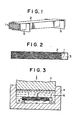
- each of these sixteen test samples was made as follows: first a mass 1 of alumina fibers of the type specified above was formed so as to be aligned substantially all in one direction and so as to have a volume ratio of about 5596 and a length of 100 mm.
- alumina fibers 1 was inserted into a case 2 made of stainless steel of JIS standard SUS-304 which was of cuboidal form with one end open, having a length of 130 mm, a height of 16 mm, and a width of 36 mm, and was so positioned in this case 2 as to leave an air chamber 3 of approximately 30 mm in length at the closed end thereof; thus, one end of the alumina fiber mass 1 lay substantially flush with the open end of the case 2, as shown in Figs. 1 and 2.
- Fig. 1 shows a perspective view of the case 2 with the alumina fiber mass 1 charged therein, together with a pair of supports 5, and Fig. 2 is a longitudinal sectional view thereof.
- the stainless steel ease 2 with the alumina fiber mass 1 charged therein was preheated to a temperature of approximately 800°C and was placed in the mold cavity of a casting mold 4, resting therein upon the supports 5-so as not directly to touch the wall of the mold cavity, the mold 4 being preheated to approximately 250°C.
- the molten aluminum alloy matrix metal was then pressurized to a pressure of approximately 1000 kg/cm 2 by a plunger 7, which was slidingly fitted into the mold 4, and which was preheated to approximately 200°C. This pressurized state was maintained until the aluminum alloy matrix metal had completely solidified.
- the stainless steel case 2 with the alumina fiber mass 1 charged therein was preheated to a substantially high temperature of at least the melting point of the aluminum alloy matrix metal, i.e. in this case a temperature of approximately 800 0 C, again in order to aid with the proper penetration into and proper impregnation of the reinforcing material fibers by the matrix metal.
- a first bending test sample was cut, having a length in the direction of orientation of the alumina fibers of 100 mm, a height of 2 mm, and a width of 10 mm, and for each of these first bending test samples a three point bending test was carried out for the fiber orientation 0° direction, with the distance between the supports being 40 mm.
- a second bending test sample was cut, having a length in the direction perpendicular to the direction of orientation of the alumina fibers of 36 mm, a height of 2 mm, and a width of 10 mm, and for each of these second bending test samples a three point bending test was carried out for the fiber orientation 90 0 direction, with the distance between the supports being 15 mm.
- the surface stress M/Z (where M is the bending moment at the instant of fracture, Z is the cross sectional coefficient of the bending test sample) was measured, and was taken as the bending strength of the bending test sample.
- Fig. 4 of the drawings is a graph showing bending strength of the various test samples along the vertical axis and percentage of the main non aluminum component of the matrix metal of the test sample along the horizontal axis, in which rough lines are drawn through the graph points relating to each group of test samples which utilzes one main non aluminum alloy component.
- the test sample number (1 through 16) in Table 2 corresponds to the material test sample number (1 through 16) in Table 1.
- results were obtained as given in Table 2 from several repetitions of the test for each type of sample, between four and six times each.
- the columns in Table 2 headed "average” show the average value obtained, for each of these types of test sample, of the results of said several repetitions of the bending tests.
- a rotary bending test sample was cut, having a length in the direction of orientation of the alumina fibers of 100 mm, a parallel portion length of 25 mm, a chuck portion diameter of 12 mm, and a parallel portion diameter of 8 mm, -and each of these rotary test samples was mounted in a Krause type rotary bending fatigue test machine, and a fatigue test was carried out by rotating the test sample with a constant bending load, applying so called rotary bending, and the fatigue strength in kg/mm 2 under which 10 7 repeated loads were withstood was measured.
- the results of these rotary bending fatigue tests are also given in Table 2.
- the optimum amount of magnesium to be included in the aluminum alloy matrix metal of the composite material is about 2.5% or so, and in any case not more than about 5%.
- test samples utilizing as matrix metal aluminum alloys using varying amounts of magnesium as additive and substantially no other significant quantities of non aluminum metals contained therein i.e. the first group of test samples defined by samples 2 through 7, these tests were only carried out upon test sample 1. (matrix metal-containing substantially no included magnesium) as a base for comparison and test sample 4 (matrix metal containing about 3.6% magnesium) as a representative, since it already had been determined from the tests regarding bending strength described above that this test sample 4 was the one which was the most promising for investigation.
- test samples 8 through 12 and test samples 13 through 16 respectively the second and third groups of test samples respectively defined by test samples 8 through 12 and test samples 13 through 16, again these rotary bending fatigue tests were only carried out upon test sample 11 (matrix metal containing about 7.6% silicon) and test sample 15 (matrix metal containing about 3.9% copper) as representatives, since it already had been determined from the tests regarding bending strength described above that magnesium was the most promising additive for the aluminum alloy, and it was surmised that the use of matrix metal composed ty the addition of silicon or copper to pure aluminum would actually deteriorate the result of the rotary bending fatigue test of the composite material made therefrom.
- the rotary bending strength of the test sample 11 was found to be only 36.5 kg/mm 2 , as compared with the result of 39.5 kg/mm 2 for the case of the composite material sample 1 utilizing pure aluminum as the matrix metal, and the rotary bending strength of the test sample 15 was found to be only 35.0 kg/mm 2. Therefore the addition to the aluminum alloy matrix metal of either copper or silicon in a few percent appeared to significantly deteriorate the rotary bending strength of the composite material.
- the amount of magnesium included as an additive to the pure aluminum for forming the aluminum alloy is at least 0.5% and less than 4.5%, preferably at least 0.7% and less than 4.5%, and more preferably at least 1.0% and less than 4.0%.
- the amount of included copper and silicon in the aluminum alloy matrix metal should be limited as far as possible, and should in any case be less than 0.2% and 0.5% respectively.
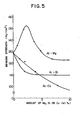
- Fig. 5 of the drawings is a graph similar to Fig. 4 showing, for this second set of experiments, bending strength of the various test samples along the vertical axis and percentage of the main non aluminum component of the matrix metal of the test sample along the horizontal axis, in which again rough lines are drawn through the graph points relating to each of the three groups of test samples which utilizes one main non aluminum alloy component.
- the test sample number (1 through 16) in Table 3 again corresponds to the material test sample number (1 through 16) in Table 1.
- the optimum amount of magnesium to be included in the aluminum alloy matrix metal of the composite material is about 2.3% or so, and in any case not more than about 5%.
- the amount of magnesium included as an additive to pure aluminum for forming an aluminum alloy for use as matrix metal with carbon fibers as the reinforcing material is at least 0.5% and less than 4.5%, preferably at least 0.796 and less than 4.5%, and more preferably at least 1.0% and less than 4.0%.
- the amount of included copper and silicon in the aluminum alloy matrix metal should be limited as far as possible, and should in any case be less than 0.2% and 0.5% respectively.
Landscapes
- Chemical & Material Sciences (AREA)
- Engineering & Computer Science (AREA)
- Mechanical Engineering (AREA)
- Materials Engineering (AREA)
- Metallurgy (AREA)
- Organic Chemistry (AREA)
- Manufacture Of Alloys Or Alloy Compounds (AREA)
- Laminated Bodies (AREA)
Applications Claiming Priority (2)
| Application Number | Priority Date | Filing Date | Title |
|---|---|---|---|
| JP57161397A JPS5950149A (ja) | 1982-09-14 | 1982-09-14 | 繊維強化金属複合材料 |
| JP161397/82 | 1982-09-14 |
Publications (2)
| Publication Number | Publication Date |
|---|---|
| EP0106108A1 true EP0106108A1 (fr) | 1984-04-25 |
| EP0106108B1 EP0106108B1 (fr) | 1986-11-12 |
Family
ID=15734311
Family Applications (1)
| Application Number | Title | Priority Date | Filing Date |
|---|---|---|---|
| EP83108740A Expired EP0106108B1 (fr) | 1982-09-14 | 1983-09-05 | Matériau métallique composite, renforçé par des fibres et comportant une matrice constituée d'un alliage d'aluminium contenant du magnésium |
Country Status (4)
| Country | Link |
|---|---|
| US (1) | US4450207A (fr) |
| EP (1) | EP0106108B1 (fr) |
| JP (1) | JPS5950149A (fr) |
| DE (1) | DE3367620D1 (fr) |
Cited By (6)
| Publication number | Priority date | Publication date | Assignee | Title |
|---|---|---|---|---|
| DE3725495A1 (de) * | 1986-07-31 | 1988-02-04 | Honda Motor Co Ltd | Brennkraftmaschine |
| EP0291441A1 (fr) * | 1987-05-13 | 1988-11-17 | Lanxide Technology Company, Lp. | Matériaux composites à matrice métallique |
| AU592094B2 (en) * | 1985-06-21 | 1990-01-04 | Saffil Limited | Fibre-reinforced metal matrix composites |
| EP0447701A1 (fr) * | 1988-11-14 | 1991-09-25 | Izumi Industries, Ltd. | Elément résistant à la chaleur renforcée et son procédé de préparation |
| CN103602932A (zh) * | 2013-12-10 | 2014-02-26 | 湖南健行康复器材科技发展有限公司 | 一种碳纤维增强铝基复合材料及其制备方法 |
| EP3892653A1 (fr) | 2020-04-09 | 2021-10-13 | Borealis AG | (co)polymérisation d'éthylène |
Families Citing this family (83)
| Publication number | Priority date | Publication date | Assignee | Title |
|---|---|---|---|---|
| JPS5635735A (en) * | 1979-08-29 | 1981-04-08 | Sumitomo Chem Co Ltd | Heat resistant spring |
| US4786467A (en) * | 1983-06-06 | 1988-11-22 | Dural Aluminum Composites Corp. | Process for preparation of composite materials containing nonmetallic particles in a metallic matrix, and composite materials made thereby |
| US4759995A (en) * | 1983-06-06 | 1988-07-26 | Dural Aluminum Composites Corp. | Process for production of metal matrix composites by casting and composite therefrom |
| JPS61166934A (ja) * | 1985-01-17 | 1986-07-28 | Toyota Motor Corp | 複合材料製造用短繊維成形体及びその製造方法 |
| US4587177A (en) * | 1985-04-04 | 1986-05-06 | Imperial Clevite Inc. | Cast metal composite article |
| US4597792A (en) * | 1985-06-10 | 1986-07-01 | Kaiser Aluminum & Chemical Corporation | Aluminum-based composite product of high strength and toughness |
| US4865806A (en) * | 1986-05-01 | 1989-09-12 | Dural Aluminum Composites Corp. | Process for preparation of composite materials containing nonmetallic particles in a metallic matrix |
| US4815940A (en) * | 1986-08-04 | 1989-03-28 | United Technologies Corporation | Fatigue strengthened composite article |
| US4753690A (en) * | 1986-08-13 | 1988-06-28 | Amax Inc. | Method for producing composite material having an aluminum alloy matrix with a silicon carbide reinforcement |
| US4939032A (en) * | 1987-06-25 | 1990-07-03 | Aluminum Company Of America | Composite materials having improved fracture toughness |
| US5041340A (en) * | 1987-09-03 | 1991-08-20 | Honda Giken Kogyo Kabushiki Kaisha | Fiber-reinforced light alloy member excellent in heat conductivity and sliding properties |
| US4935055A (en) * | 1988-01-07 | 1990-06-19 | Lanxide Technology Company, Lp | Method of making metal matrix composite with the use of a barrier |
| US5277989A (en) * | 1988-01-07 | 1994-01-11 | Lanxide Technology Company, Lp | Metal matrix composite which utilizes a barrier |
| US5141819A (en) * | 1988-01-07 | 1992-08-25 | Lanxide Technology Company, Lp | Metal matrix composite with a barrier |
| US5298339A (en) * | 1988-03-15 | 1994-03-29 | Lanxide Technology Company, Lp | Aluminum metal matrix composites |
| JPH01251956A (ja) * | 1988-03-31 | 1989-10-06 | Toshiba Corp | ファクシミリ蓄積交換装置 |
| US5106702A (en) * | 1988-08-04 | 1992-04-21 | Advanced Composite Materials Corporation | Reinforced aluminum matrix composite |
| US5172746A (en) * | 1988-10-17 | 1992-12-22 | Corwin John M | Method of producing reinforced composite materials |
| US5199481A (en) * | 1988-10-17 | 1993-04-06 | Chrysler Corp | Method of producing reinforced composite materials |
| US5119864A (en) * | 1988-11-10 | 1992-06-09 | Lanxide Technology Company, Lp | Method of forming a metal matrix composite through the use of a gating means |
| US5526867A (en) * | 1988-11-10 | 1996-06-18 | Lanxide Technology Company, Lp | Methods of forming electronic packages |
| US5007474A (en) * | 1988-11-10 | 1991-04-16 | Lanxide Technology Company, Lp | Method of providing a gating means, and products produced thereby |
| US5249621A (en) * | 1988-11-10 | 1993-10-05 | Lanxide Technology Company, Lp | Method of forming metal matrix composite bodies by a spontaneous infiltration process, and products produced therefrom |
| US5150747A (en) * | 1988-11-10 | 1992-09-29 | Lanxide Technology Company, Lp | Method of forming metal matrix composites by use of an immersion casting technique and product produced thereby |
| US5000247A (en) * | 1988-11-10 | 1991-03-19 | Lanxide Technology Company, Lp | Method for forming metal matrix composite bodies with a dispersion casting technique and products produced thereby |
| US5007476A (en) * | 1988-11-10 | 1991-04-16 | Lanxide Technology Company, Lp | Method of forming metal matrix composite bodies by utilizing a crushed polycrystalline oxidation reaction product as a filler, and products produced thereby |
| US5005631A (en) * | 1988-11-10 | 1991-04-09 | Lanxide Technology Company, Lp | Method for forming a metal matrix composite body by an outside-in spontaneous infiltration process, and products produced thereby |
| US5000245A (en) * | 1988-11-10 | 1991-03-19 | Lanxide Technology Company, Lp | Inverse shape replication method for forming metal matrix composite bodies and products produced therefrom |
| US5165463A (en) * | 1988-11-10 | 1992-11-24 | Lanxide Technology Company, Lp | Directional solidification of metal matrix composites |
| US5004035A (en) * | 1988-11-10 | 1991-04-02 | Lanxide Technology Company, Lp | Method of thermo-forming a novel metal matrix composite body and products produced therefrom |
| US5010945A (en) * | 1988-11-10 | 1991-04-30 | Lanxide Technology Company, Lp | Investment casting technique for the formation of metal matrix composite bodies and products produced thereby |
| US5004034A (en) * | 1988-11-10 | 1991-04-02 | Lanxide Technology Company, Lp | Method of surface bonding materials together by use of a metal matrix composite, and products produced thereby |
| US5238045A (en) * | 1988-11-10 | 1993-08-24 | Lanxide Technology Company, Lp | Method of surface bonding materials together by use of a metal matrix composite, and products produced thereby |
| US5518061A (en) * | 1988-11-10 | 1996-05-21 | Lanxide Technology Company, Lp | Method of modifying the properties of a metal matrix composite body |
| US5287911A (en) * | 1988-11-10 | 1994-02-22 | Lanxide Technology Company, Lp | Method for forming metal matrix composites having variable filler loadings and products produced thereby |
| US5000248A (en) * | 1988-11-10 | 1991-03-19 | Lanxide Technology Company, Lp | Method of modifying the properties of a metal matrix composite body |
| US5301738A (en) * | 1988-11-10 | 1994-04-12 | Lanxide Technology Company, Lp | Method of modifying the properties of a metal matrix composite body |
| US5267601A (en) * | 1988-11-10 | 1993-12-07 | Lanxide Technology Company, Lp | Method for forming a metal matrix composite body by an outside-in spontaneous infiltration process, and products produced thereby |
| US5016703A (en) * | 1988-11-10 | 1991-05-21 | Lanxide Technology Company, Lp | Method of forming a metal matrix composite body by a spontaneous infiltration technique |
| US5172747A (en) * | 1988-11-10 | 1992-12-22 | Lanxide Technology Company, Lp | Method of forming a metal matrix composite body by a spontaneous infiltration technique |
| US5040588A (en) * | 1988-11-10 | 1991-08-20 | Lanxide Technology Company, Lp | Methods for forming macrocomposite bodies and macrocomposite bodies produced thereby |
| US5303763A (en) * | 1988-11-10 | 1994-04-19 | Lanxide Technology Company, Lp | Directional solidification of metal matrix composites |
| US5020584A (en) * | 1988-11-10 | 1991-06-04 | Lanxide Technology Company, Lp | Method for forming metal matrix composites having variable filler loadings and products produced thereby |
| US5000246A (en) * | 1988-11-10 | 1991-03-19 | Lanxide Technology Company, Lp | Flotation process for the formation of metal matrix composite bodies |
| US5197528A (en) * | 1988-11-10 | 1993-03-30 | Lanxide Technology Company, Lp | Investment casting technique for the formation of metal matrix composite bodies and products produced thereby |
| US5222542A (en) * | 1988-11-10 | 1993-06-29 | Lanxide Technology Company, Lp | Method for forming metal matrix composite bodies with a dispersion casting technique |
| US5240062A (en) * | 1988-11-10 | 1993-08-31 | Lanxide Technology Company, Lp | Method of providing a gating means, and products thereby |
| US5000249A (en) * | 1988-11-10 | 1991-03-19 | Lanxide Technology Company, Lp | Method of forming metal matrix composites by use of an immersion casting technique and product produced thereby |
| US5020583A (en) * | 1988-11-10 | 1991-06-04 | Lanxide Technology Company, Lp | Directional solidification of metal matrix composites |
| US5007475A (en) * | 1988-11-10 | 1991-04-16 | Lanxide Technology Company, Lp | Method for forming metal matrix composite bodies containing three-dimensionally interconnected co-matrices and products produced thereby |
| US5163499A (en) * | 1988-11-10 | 1992-11-17 | Lanxide Technology Company, Lp | Method of forming electronic packages |
| US5004036A (en) * | 1988-11-10 | 1991-04-02 | Lanxide Technology Company, Lp | Method for making metal matrix composites by the use of a negative alloy mold and products produced thereby |
| JP2782966B2 (ja) * | 1990-02-27 | 1998-08-06 | ダイキン工業株式会社 | 摺動部材 |
| US5329984A (en) * | 1990-05-09 | 1994-07-19 | Lanxide Technology Company, Lp | Method of forming a filler material for use in various metal matrix composite body formation processes |
| US5851686A (en) * | 1990-05-09 | 1998-12-22 | Lanxide Technology Company, L.P. | Gating mean for metal matrix composite manufacture |
| US5487420A (en) * | 1990-05-09 | 1996-01-30 | Lanxide Technology Company, Lp | Method for forming metal matrix composite bodies by using a modified spontaneous infiltration process and products produced thereby |
| US5505248A (en) * | 1990-05-09 | 1996-04-09 | Lanxide Technology Company, Lp | Barrier materials for making metal matrix composites |
| ATE119510T1 (de) * | 1990-05-09 | 1995-03-15 | Lanxide Technology Co Ltd | Makro-verbundkörper und verfahren zu ihrer herstellung. |
| WO1991017280A1 (fr) * | 1990-05-09 | 1991-11-14 | Lanxide Technology Company, Lp | Composites minces a matrice metallique et leurs procedes de production |
| WO1991017278A1 (fr) * | 1990-05-09 | 1991-11-14 | Lanxide Technology Company, Lp | Materiaux de barrage servant a fabriquer des composites a matrice metallique |
| AU8305191A (en) * | 1990-05-09 | 1991-11-27 | Lanxide Technology Company, Lp | Rigidized filler materials for metal matrix composites |
| US5361824A (en) * | 1990-05-10 | 1994-11-08 | Lanxide Technology Company, Lp | Method for making internal shapes in a metal matrix composite body |
| US5083602A (en) * | 1990-07-26 | 1992-01-28 | Alcan Aluminum Corporation | Stepped alloying in the production of cast composite materials (aluminum matrix and silicon additions) |
| US5194202A (en) * | 1990-08-03 | 1993-03-16 | Aluminum Company Of America | Formation of ceramic-metal composite by pressure casting and oxidation sintering |
| JPH04304333A (ja) * | 1991-03-25 | 1992-10-27 | Aluminum Co Of America <Alcoa> | アルミニウムまたはアルミニウム合金をマトリクスとする複合材料およびその強化材とマトリクスとの濡れおよび結合を向上させる方法 |
| US5652723A (en) * | 1991-04-18 | 1997-07-29 | Mitsubishi Denki Kabushiki Kaisha | Semiconductor memory device |
| US5330629A (en) * | 1992-12-15 | 1994-07-19 | At&T Bell Laboratories | Method for depositing aluminum layers on insulating oxide substrates |
| US5848349A (en) * | 1993-06-25 | 1998-12-08 | Lanxide Technology Company, Lp | Method of modifying the properties of a metal matrix composite body |
| US5697421A (en) * | 1993-09-23 | 1997-12-16 | University Of Cincinnati | Infrared pressureless infiltration of composites |
| US6245425B1 (en) | 1995-06-21 | 2001-06-12 | 3M Innovative Properties Company | Fiber reinforced aluminum matrix composite wire |
| US6086688A (en) * | 1997-07-28 | 2000-07-11 | Alcan International Ltd. | Cast metal-matrix composite material and its use |
| US6723451B1 (en) | 2000-07-14 | 2004-04-20 | 3M Innovative Properties Company | Aluminum matrix composite wires, cables, and method |
| US7022629B2 (en) * | 2003-08-12 | 2006-04-04 | Raytheon Company | Print through elimination in fiber reinforced matrix composite mirrors and method of construction |
| RU2243289C1 (ru) * | 2003-11-26 | 2004-12-27 | Федеральное государственное унитарное предприятие "Всероссийский научно-исследовательский институт авиационных материалов" | Многослойный композиционный материал, способ получения многослойного композиционного материала и изделие, выполненное из него |
| US8052918B2 (en) * | 2004-07-21 | 2011-11-08 | Nissin Kogyo Co., Ltd. | Carbon-based material and method of producing the same, and composite material and method of producing the same |
| JP4293957B2 (ja) * | 2004-09-03 | 2009-07-08 | 日信工業株式会社 | 炭素系材料及びその製造方法、複合材料の製造方法 |
| JP4279220B2 (ja) * | 2004-09-09 | 2009-06-17 | 日信工業株式会社 | 複合材料及びその製造方法、複合金属材料及びその製造方法 |
| EP1931809A2 (fr) * | 2005-09-07 | 2008-06-18 | M Cubd Technologies, Inc. | Corps composites a matrice metallique et leurs methodes de fabrication |
| CN103556087A (zh) * | 2013-11-04 | 2014-02-05 | 倪生标 | 一种铝合金板材 |
| CN104213056B (zh) * | 2014-09-15 | 2016-04-13 | 河南科技大学 | 一种碳纤维增强铝镁合金复合材料及其制备方法 |
| CN110248785A (zh) | 2017-02-09 | 2019-09-17 | 东丽株式会社 | 预成型体部件、以及利用其的预成型体及其制造方法 |
| TWI830452B (zh) | 2022-10-21 | 2024-01-21 | 財團法人工業技術研究院 | 鋁合金材料與鋁合金物件及其形成方法 |
| US12435403B2 (en) | 2023-04-06 | 2025-10-07 | Spirit Aerosystems, Inc. | Method to produce low-cost metal matrix composites for industrial, sports, and commercial applications |
Citations (2)
| Publication number | Priority date | Publication date | Assignee | Title |
|---|---|---|---|---|
| FR2426520A1 (fr) * | 1978-05-26 | 1979-12-21 | Hepworth & Grandage Ltd | Procede de fabrication d'aluminium ou d'alliages d'aluminium renforces avec de l'alumine en fibres ou filaments |
| GB2081353A (en) * | 1980-07-30 | 1982-02-17 | Sumitomo Chemical Co | Fibre-reinforced metal composite material |
Family Cites Families (4)
| Publication number | Priority date | Publication date | Assignee | Title |
|---|---|---|---|---|
| US3469952A (en) * | 1967-03-14 | 1969-09-30 | Reynolds Metals Co | Composite metallic articles |
| US3547180A (en) * | 1968-08-26 | 1970-12-15 | Aluminum Co Of America | Production of reinforced composites |
| US3691623A (en) * | 1970-10-09 | 1972-09-19 | Trw Inc | Process for increasing the whisker and fiber content in a matrix |
| US3970136A (en) * | 1971-03-05 | 1976-07-20 | The Secretary Of State For Defence In Her Britannic Majesty's Government Of The United Kingdom Of Great Britain And Northern Ireland | Method of manufacturing composite materials |
-
1982
- 1982-09-14 JP JP57161397A patent/JPS5950149A/ja active Pending
-
1983
- 1983-08-24 US US06/525,899 patent/US4450207A/en not_active Expired - Fee Related
- 1983-09-05 EP EP83108740A patent/EP0106108B1/fr not_active Expired
- 1983-09-05 DE DE8383108740T patent/DE3367620D1/de not_active Expired
Patent Citations (2)
| Publication number | Priority date | Publication date | Assignee | Title |
|---|---|---|---|---|
| FR2426520A1 (fr) * | 1978-05-26 | 1979-12-21 | Hepworth & Grandage Ltd | Procede de fabrication d'aluminium ou d'alliages d'aluminium renforces avec de l'alumine en fibres ou filaments |
| GB2081353A (en) * | 1980-07-30 | 1982-02-17 | Sumitomo Chemical Co | Fibre-reinforced metal composite material |
Non-Patent Citations (1)
| Title |
|---|
| METALLURGICAL TRANSACTIONS, vol. 3, August 1972 * |
Cited By (10)
| Publication number | Priority date | Publication date | Assignee | Title |
|---|---|---|---|---|
| AU592094B2 (en) * | 1985-06-21 | 1990-01-04 | Saffil Limited | Fibre-reinforced metal matrix composites |
| DE3725495A1 (de) * | 1986-07-31 | 1988-02-04 | Honda Motor Co Ltd | Brennkraftmaschine |
| EP0291441A1 (fr) * | 1987-05-13 | 1988-11-17 | Lanxide Technology Company, Lp. | Matériaux composites à matrice métallique |
| US5395701A (en) * | 1987-05-13 | 1995-03-07 | Lanxide Technology Company, Lp | Metal matrix composites |
| US5856025A (en) * | 1987-05-13 | 1999-01-05 | Lanxide Technology Company, L.P. | Metal matrix composites |
| EP0447701A1 (fr) * | 1988-11-14 | 1991-09-25 | Izumi Industries, Ltd. | Elément résistant à la chaleur renforcée et son procédé de préparation |
| CN103602932A (zh) * | 2013-12-10 | 2014-02-26 | 湖南健行康复器材科技发展有限公司 | 一种碳纤维增强铝基复合材料及其制备方法 |
| CN103602932B (zh) * | 2013-12-10 | 2015-07-15 | 湖南健行康复器材科技发展有限公司 | 一种碳纤维增强铝基复合材料及其制备方法 |
| EP3892653A1 (fr) | 2020-04-09 | 2021-10-13 | Borealis AG | (co)polymérisation d'éthylène |
| WO2021204979A1 (fr) | 2020-04-09 | 2021-10-14 | Borealis Ag | (co)polymérisation d'éthylène |
Also Published As
| Publication number | Publication date |
|---|---|
| DE3367620D1 (en) | 1987-01-02 |
| US4450207A (en) | 1984-05-22 |
| EP0106108B1 (fr) | 1986-11-12 |
| JPS5950149A (ja) | 1984-03-23 |
Similar Documents
| Publication | Publication Date | Title |
|---|---|---|
| EP0106108B1 (fr) | Matériau métallique composite, renforçé par des fibres et comportant une matrice constituée d'un alliage d'aluminium contenant du magnésium | |
| CA1181264A (fr) | Ressort en materiau metallique composite arme de fibres resistant a la chaleur | |
| EP0539011B1 (fr) | Préforme en carbone revêtue de nickel | |
| US4216682A (en) | Fiber-reinforced light alloy cast article | |
| EP0235574B1 (fr) | Matériau composite comportant des fibres courtes alumine-silice comme matériau de renforcement et une matrice métallique d'un alliage d'aluminium avec des teneurs en cuivre et en magnésium peu élevées | |
| EP0241198B1 (fr) | Matériau composite avec une matrice métallique en alliage léger et un matériau de renforcement constitué d'un mélange de fibres courtes et de whiskers de titanate de potassium | |
| EP0182959B1 (fr) | Matériau composite renforcé par des fibres de silicates d'alumine comprenant de la mullite cristalline | |
| Coleman et al. | Corrosion behaviour of aluminium-based metal matrix composites | |
| NO321706B1 (no) | Fiberforsterkede aluminiumsgrunnmassekompositter | |
| US3037857A (en) | Aluminum-base alloy | |
| Nathan et al. | Evaluation of mechanical and metallurgical properties on aluminium hybrid metal matrix composites | |
| EP0213615B1 (fr) | Matériau composite contenant des fibres courtes de carbure de silicium et/ou de nitrure de silicium comme matériau de renforcement et un alliage d'aluminium avec cuivre et une quantité relativement petite de silicium comme matrice métallique | |
| Cratchley | Factors affecting the UTS of a metal/metal-fibre reinforced system | |
| EP1132490B1 (fr) | Piston avec un composite a matrice metallique | |
| EP0207314B1 (fr) | Matériau composite comportant des filaments courts de carbure de silicium comme matière de renforcement et d'un alliage d'aluminium avec cuivre et magnésium comme matrice métallique | |
| Grydin et al. | Twin‐Roll Casting of Carbon Fiber‐Reinforced and Glass Fiber‐Reinforced Aluminum Strips | |
| US5989729A (en) | Wear resistant metal composite | |
| EP0236729B1 (fr) | Matériau composite comportant des fibres courtes de nitrure de silicium, du type monocristallin sans dislocations, comme matériau de renforcement et une matrice métallique d'un alliage d'aluminium avec des teneurs en cuivre et en magnésium peu élevées | |
| EP0205084A1 (fr) | Matériau composite comportant des filaments courts de carbure de silicium comme matière de renforcement et un alliage d'aluminium-cuivre à teneur en magnésium relativement basse comme matrice métallique | |
| Cooper | The work-to-fracture of brittle-fibre ductile-matrix composites | |
| JPH10330866A (ja) | アルミ基複合材よりなるブレーキディスク | |
| US4357985A (en) | Method of isothermally forming a copper base alloy fiber reinforced composite | |
| EP0213528A2 (fr) | Matériau composite contenant des fibres courtes d'alumine-silice comme matériau de renforcement et avec une matrice en alliage d'aluminium contenant du cuivre avec une corrélation entre les différentes teneurs | |
| JPH0459938A (ja) | 炭素繊維強化複合材料 | |
| JPS61257440A (ja) | 繊維強化金属複合材料 |
Legal Events
| Date | Code | Title | Description |
|---|---|---|---|
| PUAI | Public reference made under article 153(3) epc to a published international application that has entered the european phase |
Free format text: ORIGINAL CODE: 0009012 |
|
| AK | Designated contracting states |
Designated state(s): DE FR GB |
|
| 17P | Request for examination filed |
Effective date: 19840503 |
|
| GRAA | (expected) grant |
Free format text: ORIGINAL CODE: 0009210 |
|
| AK | Designated contracting states |
Kind code of ref document: B1 Designated state(s): DE FR GB |
|
| REF | Corresponds to: |
Ref document number: 3367620 Country of ref document: DE Date of ref document: 19870102 |
|
| ET | Fr: translation filed | ||
| PLBI | Opposition filed |
Free format text: ORIGINAL CODE: 0009260 |
|
| 26 | Opposition filed |
Opponent name: VEREINIGTE ALUMINIUM-WERKE AG, BERLIN UND BONN Effective date: 19870808 |
|
| PGFP | Annual fee paid to national office [announced via postgrant information from national office to epo] |
Ref country code: GB Payment date: 19890831 Year of fee payment: 7 |
|
| PGFP | Annual fee paid to national office [announced via postgrant information from national office to epo] |
Ref country code: FR Payment date: 19890911 Year of fee payment: 7 |
|
| PGFP | Annual fee paid to national office [announced via postgrant information from national office to epo] |
Ref country code: DE Payment date: 19891002 Year of fee payment: 7 |
|
| RDAG | Patent revoked |
Free format text: ORIGINAL CODE: 0009271 |
|
| STAA | Information on the status of an ep patent application or granted ep patent |
Free format text: STATUS: PATENT REVOKED |
|
| 27W | Patent revoked |
Effective date: 19890925 |
|
| GBPR | Gb: patent revoked under art. 102 of the ep convention designating the uk as contracting state |