EP0106362A2 - Tiefgezogener, kunststoffbeschichteter Aluminiumbehälter - Google Patents
Tiefgezogener, kunststoffbeschichteter Aluminiumbehälter Download PDFInfo
- Publication number
- EP0106362A2 EP0106362A2 EP83110399A EP83110399A EP0106362A2 EP 0106362 A2 EP0106362 A2 EP 0106362A2 EP 83110399 A EP83110399 A EP 83110399A EP 83110399 A EP83110399 A EP 83110399A EP 0106362 A2 EP0106362 A2 EP 0106362A2
- Authority
- EP
- European Patent Office
- Prior art keywords
- polypropylene
- container
- aluminum
- deep
- drawn
- Prior art date
- Legal status (The legal status is an assumption and is not a legal conclusion. Google has not performed a legal analysis and makes no representation as to the accuracy of the status listed.)
- Granted
Links
Images
Classifications
-
- B—PERFORMING OPERATIONS; TRANSPORTING
- B32—LAYERED PRODUCTS
- B32B—LAYERED PRODUCTS, i.e. PRODUCTS BUILT-UP OF STRATA OF FLAT OR NON-FLAT, e.g. CELLULAR OR HONEYCOMB, FORM
- B32B38/00—Ancillary operations in connection with laminating processes
- B32B38/12—Deep-drawing
-
- B—PERFORMING OPERATIONS; TRANSPORTING
- B32—LAYERED PRODUCTS
- B32B—LAYERED PRODUCTS, i.e. PRODUCTS BUILT-UP OF STRATA OF FLAT OR NON-FLAT, e.g. CELLULAR OR HONEYCOMB, FORM
- B32B15/00—Layered products comprising a layer of metal
- B32B15/04—Layered products comprising a layer of metal comprising metal as the main or only constituent of a layer, which is next to another layer of the same or of a different material
- B32B15/08—Layered products comprising a layer of metal comprising metal as the main or only constituent of a layer, which is next to another layer of the same or of a different material of synthetic resin
-
- B—PERFORMING OPERATIONS; TRANSPORTING
- B32—LAYERED PRODUCTS
- B32B—LAYERED PRODUCTS, i.e. PRODUCTS BUILT-UP OF STRATA OF FLAT OR NON-FLAT, e.g. CELLULAR OR HONEYCOMB, FORM
- B32B15/00—Layered products comprising a layer of metal
- B32B15/04—Layered products comprising a layer of metal comprising metal as the main or only constituent of a layer, which is next to another layer of the same or of a different material
- B32B15/08—Layered products comprising a layer of metal comprising metal as the main or only constituent of a layer, which is next to another layer of the same or of a different material of synthetic resin
- B32B15/085—Layered products comprising a layer of metal comprising metal as the main or only constituent of a layer, which is next to another layer of the same or of a different material of synthetic resin comprising polyolefins
-
- B—PERFORMING OPERATIONS; TRANSPORTING
- B32—LAYERED PRODUCTS
- B32B—LAYERED PRODUCTS, i.e. PRODUCTS BUILT-UP OF STRATA OF FLAT OR NON-FLAT, e.g. CELLULAR OR HONEYCOMB, FORM
- B32B15/00—Layered products comprising a layer of metal
- B32B15/20—Layered products comprising a layer of metal comprising aluminium or copper
-
- B—PERFORMING OPERATIONS; TRANSPORTING
- B32—LAYERED PRODUCTS
- B32B—LAYERED PRODUCTS, i.e. PRODUCTS BUILT-UP OF STRATA OF FLAT OR NON-FLAT, e.g. CELLULAR OR HONEYCOMB, FORM
- B32B27/00—Layered products comprising a layer of synthetic resin
- B32B27/32—Layered products comprising a layer of synthetic resin comprising polyolefins
-
- B—PERFORMING OPERATIONS; TRANSPORTING
- B65—CONVEYING; PACKING; STORING; HANDLING THIN OR FILAMENTARY MATERIAL
- B65D—CONTAINERS FOR STORAGE OR TRANSPORT OF ARTICLES OR MATERIALS, e.g. BAGS, BARRELS, BOTTLES, BOXES, CANS, CARTONS, CRATES, DRUMS, JARS, TANKS, HOPPERS, FORWARDING CONTAINERS; ACCESSORIES, CLOSURES, OR FITTINGS THEREFOR; PACKAGING ELEMENTS; PACKAGES
- B65D1/00—Rigid or semi-rigid containers having bodies formed in one piece, e.g. by casting metallic material, by moulding plastics, by blowing vitreous material, by throwing ceramic material, by moulding pulped fibrous material or by deep-drawing operations performed on sheet material
- B65D1/22—Boxes or like containers with side walls of substantial depth for enclosing contents
- B65D1/26—Thin-walled containers, e.g. formed by deep-drawing operations
- B65D1/28—Thin-walled containers, e.g. formed by deep-drawing operations formed of laminated material
-
- B—PERFORMING OPERATIONS; TRANSPORTING
- B32—LAYERED PRODUCTS
- B32B—LAYERED PRODUCTS, i.e. PRODUCTS BUILT-UP OF STRATA OF FLAT OR NON-FLAT, e.g. CELLULAR OR HONEYCOMB, FORM
- B32B2323/00—Polyalkenes
- B32B2323/10—Polypropylene
-
- B—PERFORMING OPERATIONS; TRANSPORTING
- B32—LAYERED PRODUCTS
- B32B—LAYERED PRODUCTS, i.e. PRODUCTS BUILT-UP OF STRATA OF FLAT OR NON-FLAT, e.g. CELLULAR OR HONEYCOMB, FORM
- B32B2439/00—Containers; Receptacles
- B32B2439/70—Food packaging
Definitions
- the invention relates to a one-piece, deep-drawn, plastic-coated aluminum container for holding sterilizable foods or other light, oxygen or aroma-sensitive filling goods.
- Deep-drawn aluminum plastic containers are known and have been used as packaging containers for preservable foods such as fish, meat products, ready meals or ready meals for more than 15 years.
- These known containers consist of an aluminum-plastic laminate, in which an aluminum band on the side facing the container by means of so-called two-component adhesives, e.g. based on polyester or polyether urethane, with a plastic film, mainly a non-oriented polypropylene film.
- the disadvantage of these known containers is on the one hand. rin that the aluminum plastic laminate generally consists of 5 layers, which involves a complex work process in the manufacture of the laminate. These five layers are as follows for the container drawn from the laminate from the outer to the inner layer as follows: protective lacquer - aluminum tape - adhesion promoter - laminating adhesive - polypropylene film. Apart from the complex manufacturing process, it must be felt as a disadvantage that the known adhesive systems need a period of up to three weeks at normal temperature to achieve their optimal adhesion. This means that the manufacturer must consider long production times for the composite aluminum-polypropylene film.
- Adhesive systems contain aromatic isocyanates in their hardener component, which are not permitted in many non-European countries for the production of food packaging for canned goods. This means foreseeable delivery losses both for the laminate manufacturer and for the manufacturer of prefabricated containers or filled containers.
- a deep-drawn packaging container made of a metal-plastic composite material is known, the metal layer of which is laminated exclusively on its surface facing the container with a plastic film, the metal layer having a thickness of 0.04 to 0.3 mm and the plastic film is biaxially oriented and has a thickness of 0.008 to 0.025 mm.
- Prefabricated aluminum and polypropylene sheets are required to produce the composite, the plastic film and the metal layer being coated with a synthetic resin adhesive, e.g. is glued on the basis of polyurethane.
- the prior art also includes methods and materials for coating metal surfaces with plastic in accordance with DE-OS 28 38 503, 21 35 027, 26 39 290 and the multilayer packaging films described in DE-AS 18 03 977 and DE-OS 29 46 171 .
- None of the cited documents describe or derive a plastic-coated, deep-drawn, one-piece aluminum container.
- the invention has for its object to provide a deep-drawn, one-piece, plastic-coated aluminum container, which is easy to manufacture and suitable for holding sterilizable foods and other light, oxygen or aroma-sensitive goods and which can be closed with a lid with low seal seam strength is.
- the container according to the invention can consist of an aluminum strip 0.110 mm thick, which can be aluminum of normal purity or an aluminum alloy.
- the aluminum band is provided with a high-quality protective lacquer on the outside of the container, which fulfills the necessary properties such as deformability, heat resistance and sterilization resistance.
- On the inside of the container is the aluminum tape with z. B. 5 0 g / m 2 polypropylene extrusion coated.
- Polypropylene is unlike polyethylene in the e xtru- sion coating without an adhesion-promoting intermediate layer, called primer layer with aluminum to connect.
- a primer layer which contains polypropylene modified as a lacquer or dispersion has proven to be particularly favorable. Such a dispersion is known, for example, under the trade name "Moreprime".
- the adhesion-promoting intermediate layer or primer layer was applied to the container according to the invention with a dry weight of 1 to 2 g / m 2 .
- containers can be produced from the aluminum strip coated with polypropylene by means of extrusion by deep drawing. This is all the more surprising since the current state of the art assumes that the plastic should also be particularly easy to deform for the deep-drawing process, i.e. Must have lubricating or sliding properties. Such ease of sliding or deformation has previously only been required for plastic films. However, it was found that the tape extrusion-coated with polypropylene could be deep-drawn into a wide variety of container shapes, round, rectangular or square, containers with a capacity of up to 455 cc being produced.
- the deep-drawing was carried out on commercially available presses, on which the known aluminum-polypropylene film containers are manufactured, without the need to make fundamental changes to the tools. It was found that the pressure of the tools only had to be reduced slightly in order to obtain perfect deep-drawn containers.
- cover materials were selected: 1. A material combination consisted of the same structure as the container, ie aluminum tape 0.110 mm thick on the side facing the interior of the container was coated with 50 g / m 2 polypropylene by extrusion . 2. The lid consisted of aluminum tape, which had been laminated both against non-oriented polypropylene film 0.050 mm thick or against biaxially oriented polypropylene film 0.015 mm thick. 3. A heat-sealable lacquered aluminum band was used as another cover variant.
- Test solutions e.g. 1% lactic acid or 3% acetic acid + 1.5% NaCl or 0.5% tartaric acid showed no negative results either at room temperature or at elevated temperatures.
- the extrusion coating with polypropylene not only on aluminum tape with a thickness of 0.110 mm, but for deep-drawable containers depending on the alloy quality of tapes in the thickness range from 0.070 to 0.200 mm, i.e. on aluminum thicknesses, from which for the thermoformed commercially available , one-piece container can be produced.
- This also applies to the commercially available lid materials with an aluminum thickness of 0.050 to 0.110 mm.
- the layer weight of the polypropylene coating can range from 20 to 100 g / m 2 for both the container and the lid material.
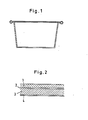
- FIG. 1 a cross section through the container
- Fig. 2 a cross section through the container wall.
- the deep-drawn container (FIG. 1) consists of the following four individual layers: on the inside of the container there is the polypropylene coating 1, which is connected to the aluminum strip 3 by means of the adhesion-promoting layer 2. The outside of the container is provided with a protective lacquer 4 (FIG. 2).
Landscapes
- Engineering & Computer Science (AREA)
- Ceramic Engineering (AREA)
- Mechanical Engineering (AREA)
- Laminated Bodies (AREA)
- Containers Having Bodies Formed In One Piece (AREA)
Abstract
Description
- Die Erfindung betrifft einen einteiligen tiefgezogenen, kunststoffbeschichteten Aluminiumbehälter zur Aufnahme sterilisierbarer Nahrungsmittel oder anderer licht-, sauerstoff-oder aromaempfindlicher Füllgüter.
- Tiefgezogene Aluminium-Kunststoffbehälter sind bekannt und werden seit mehr als 15 Jahren als Verpackungsbehälter für konservierbare Lebensmittel wie Fisch, Fleischwaren, Fertiggerichte oder Fertigmenüs eingesetzt. Diese bekannten Behälter bestehen aus einem Aluminium-Kunststofflaminat, bei welchem ein Aluminiumband auf der behältereinwärts gerichteten Seite mittels sogenannter Zweikomponentenklebstoffe, z.B. auf Basis Polyester- oder Polyätherurethan, mit einer Kunststoffolie, vorwiegend einer nichtorientierten Polypropylenfolie, verbunden ist.
- Der Nachteil dieser bekannten Behälter besteht zum einen da- . rin, daß das Aluminium-Kunststofflaminat in der Regel aus 5 Schichten besteht, was einen aufwendigen Arbeitsprozeß bei der Herstellung des Laminates beinhaltet. Diese fünf Schich- .ten stellen sich bei dem aus dem Laminat tiefgezogenen Behälter von der Außen- zur Innenlage wie folgt dar: Schutzlack - Aluminiumband - Haftvermittler - Kaschierkleber - Polypropylenfolie. Abgesehen von dem aufwendigen Fertigungsverfahren muß als Nachteil empfunden werden, daß die bekannten Klebstoffsysteme zum Erreichen ihres optimalen Haftvermtlgens einen Zeitraum von bis zu drei Wochen bei Normaltemperatur benötigen. Dies bedeutet, daß der Hersteller für den Verbund Aluminium-Polypropylenfolie lange Fertigungszeiten berücksichtigen muß. Zusätzlich muß erwähnt werden, daß die Klebstoffsysteme in ihrer Härterkomponente aromatische Isocynate enthalten, welche in vielen außereuropäischen Ländern nicht zur Herstellung von Lebensmittelverpackungen für Konserven zugelassen sind. Das bedeutet absehbare Liefereinbußen sowohl für den Laminathersteller als auch für den Hersteller vorgefertigter Behälter oder gefüllter Behälter.
- Aus der DE-AS 23 61 506 ist es bekannt, Propylenpolymerisate mit bestimmten Mischungsverhältnissen von kristallinen und amorphen Anteilen zum Heißbeschichten von Papier- und Metallfolien auf Walzenbeschichtungsmaschinen zu verwenden. Außerdem enthalten die Polypropylenmischungen Zusätze in Form von Kohlenwasserstoffwachsen und anderen Aditiven, welche diese Polypropylene nur für die Walzenbeschichtung verwendbar machen. Die Verarbeitungstemperaturen liegen hierbei weit unterhalb der bei Extrusionsbeschichtungen üblichen Temperaturen, was ermöglicht wird durch die vergleichsweise geringen Schmelzviskositäten.
- Ferner ist aus der DE-OS 26 14,660 ein tiefgezogener Verpakkungsbehälter aus einem Metall-Kunststoff-Verbundmaterial bekannt, dessen Metallschicht ausschließlich an ihrer behältereinwärts gerichteten Oberfläche mit einer Kunststoffolie kaschiert ist, wobei die Metallschicht eine Dicke von 0,04 bis 0,3 mm hat und die Kunststoffolie biaxial orientiert ist sowie eine Dicke von 0,008 bis 0,025 mm hat. Zur Herstellung des Verbundes werden vorgefertigte Aluminium und Polypropylenbahnen benötigt, wobei die Kunststoffolie und die Metallschicht mit einem Kunstharzkleber, z.B. auf der Basis Polyurethan verklebt ist.
- Zum Stand der Technik gehören auch Verfahren und Materialien zum Beschichten von Metalloberflächen mit Kunststoff gemäß DE-OS 28 38 503, 21 35 027, 26 39 290 sowie die in der DE-AS 18 03 977 und DE-OS 29 46 171 beschriebenen mehrschichtigen Verpackungsfolien. In keiner der zitierten Schriften wird jedoch ein mit Kunststoff beschichteter, tiefgezogener, einteiliger Aluminiumbehälter beschrieben oder ist daraus ableitbar. Der Erfindung liegt die Aufgabe zugrunde, einen tiefziehbaren, einteiligen, mit Kunststoff beschichteten Aluminiumbehälter zu schaffen, welcher in einfacher Weise herstellbar und zur Aufnahme sterilisierbarer Nahrungsmittel und anderer licht-, sauerstoff- oder aromaempfindlicher Füllgüter geeignet ist und der mit einem Deckel bei niedriger Siegelnahtfestigkeit verschließbar ist.
- Die Aufgabe wird erfindungsgemäß durch die in den Ansprüchen angegebenen Merkmale gelöst. Es hat sich gezeigt, daß die Extrusionsbeschichtung mit Polypropylen im Gegensatz zu den bisher verwendeten Polypropylenfolienkaschierungep einen einfachen und sicheren Arbeitsprozeß darstellt, der für die Massenfertigung von Aluminium-Kunststoffbehältern hervorragend geeignet ist. Die bei der Verwendung der bisher üblichen Klebstoffsysteme auftretenden nachteiligen Eigenschaften können vermieden werden. Ferner gestattet.die zwischen Behälter und Deckel wirksame niedrige Siegelnahtfestigkeit ein leichtes Aufreißen des Deckels.
- Im folgenden wird die Erfindung anhand mehrer Ausführungsbeispiele näher erläutert. Der erfindungsgemäße Behälter kann aus einem Aluminiumband von 0,110 mm Dicke bestehen, wobei es sich um Aluminium normaler Reinheit oder um eine Aluminiumlegierung handeln kann. Das Aluminiumband ist auf der Behälteraußenseite mit einem hochwertigen Schutzlack versehen, der die erforderlichen Eigenschaften, wie Verformbarkeit, Hitzefestigkeit und Sterilisationsbeständigkeit, erfüllt. Auf der Behälterinnenseite ist das Aluminiumband mit z.B. 50 g/m2 Polypropylen extrusionsbeschichtet.
- Polypropylen ist im Gegensatz zu Polyäthylen bei der Extru- sionsbeschichtung nicht ohne eine haftvermittelnde Zwischenschicht, sogenannte Primerschicht, mit Aluminium zu verbinden. Als besonders günstig erwies sich eine Primerschicht, welche als Lack oder 'Dispersion modifiziertes Polypropylen enthält. Eine derartige Dispersion ist z.B. unter dem Handelsnamen "Moreprime" bekannt.
- Die haftvermittelnde Zwischenschicht oder Primerschicht wurde bei dem erfindungsgemäßen Behälter mit einem Trockengewicht von 1 bis 2 g/m2 aufgetragen.
- Es wurde nun überraschend gefunden, daß sich aus dem mit Polypropylen mittels Extrusion beschichteten Aluminiumband durch Tiefziehen Behälter herstellen ließen. Dies ist umso erstaunlicher, da man bei dem derzeitigen Stand der Technik davon ausgeht, daß für den Tiefziehpiozeß auch der Kunststoff besonders verformungsfreudig sein soll, d.h. Schmier- bzw. Gleiteigenschaften aufweisen muß. Derartige Gleit- bzw. Verformungsfreudigkeit wurde bisher nur fir Kunststoffolien vorausgesetzt. Es zeigte sich jedoch, daß das mit-Polypropylen extrusionsbeschichtete Band zu den unterschiedlichsten Behälterformen, rund, rechteckig oder quadratisch tiefgezogen werden konnte, wobei Behälter bis zu einem Fassungsvermögen von 455 ccm Inhalt hergestellt wurden. Das Tiefziehen erfolgte auf handelsüblichen Pressen, auf weichen die bekannten Aluminium-Polypropylenfolienbehälter hergestellt werden, ohne daß grundlegende Veränderungen an den Werkzeugen vorgenommen werden mußten. Es zeigte sich, daß der Druck der Werkzeuge nur geringfügig reduziert werden mußte, um einwandfreie tiefgezogene Behälter zu erhalten.
- Zum Verschließen der Behälter durch Heißversiegelung im Wärmekontaktverfahren wurden Deckelmäterialien der unterschiedlichsten Ausführungen gewählt: 1. Eine Materialkombination bestand aus dem gleichen Aufbau wie der Behälter, d.h. Aluminiumband von 0,110 mm Dicke auf der dem Behälterinnern zugekehrten Seite mit 50 g/m2 Polypropylen durch Extrusion beschichtet. 2. Der Deckel bestand aus Aluminiumband, welches sowohl gegen nicht orientierte Polypropylenfolie von 0,050 mm Dicke oder gegen biaxial orientierte Polypropylenfolie von 0,015 mm Dicke laminiert worden war. 3. Als weitere Deckelvariante wurde ein heißsiegelfähig lackiertes Aluminiumband verwendet.
- Konstante Siegelbedingungen: Temperatur unteres Siegelwerkzeug 90°C Siegelzeit 1 sec. Druck 100 kp
- Deckelvariante 1: Aluminiumband 0,110 mm, extrusionsbeschichtet mit 50 g/m2 Polypropylen
- Deckelvarinate 2: Aluminiumband 0,090 mm, laminiert gegen 0,050 mm Polypropylenfolie
- Deckelvariante 3: Aluminiumband 0,050 mm, laminiert gegen 0,015 mm biaxial orientierte Polypropylenfolie
- Deckelvariante 4: Aluminiumband 0,050 mm, heißsiegelfähig lackiert (5 g/m2 Heißsiegellack)
-


- Bei der Überprüfung der Siegelnahtfestigkeiten wurde nun erstaunlicherweise gefunden, daß unabhängig von der Art des Deckelmaterials gleichbleibende niedrige Festigkeitswerte erhalten wurden, sehr zum Unterschied bei den laminierten Aluminium-Polypropylenfolienbehältern.
- Diese gleichmäßigen niedrigen Siegelnahtfestigkeitswerte gestatten erstmals eine leichte Aufreißmöglichkeit, welche von der Behälterform und -größe sowie vom Deckelmaterial unabhängig ist. Bei den bisher bekannten Behältern aus Aluminiumband und Polypropylenfolie wurde dies mit Deckelmaterialien erreicht, welche entweder eine biaxial orientierte Polyproylenfolie oder einen Heißsiegellack enthielten.
- Trotz der erstaunlich niedrigen Siegelnahtfestigkeiten wurden bei Abpackversuchen Verschlußsicherheiten erreicht, die in keiner Weise den bekannten Systemen nachstanden. Dies wurde an Behältern ermittelt, welche mit Fischfertiggerichten gefüllt waren und einem 2-jährigen Lagertest unterworfen wurden. Die Behälter wurden nach dem Füllen mittels der sog. Doppelsiegelung verschlossen und konventionell sterilisiert. Ständige Überprüfungen der gelagerten Behälter auf Verschlußsicherheit (Auftreten sog. Bombagen), Korrosionserscheinungen sowie Haftungsverhalten der Polypropylenbeschichtung zeigten keinerlei Beanstandungen. Zusätzliche Abfüllungen mit aggressiven. +) Temperatur oberes Siegelwerkzeug
- Testlösungen, z.B. 1% Milchsäure oder 3% Essigsäure + 1,5% NaCl-oder 0,5%.Weinsäure, zeigten weder bei Raumtemperatur noch bei erhöhten Temperaturen negative Ergebnisse.
- Bei allen Versuchen wurden die gleich guten Ergebnisse erzielt, wie sie von den bekannten, mit Polypropylenfolie laminierten Behältern bekannt sind.
- Selbstverständlich ist es möglich, die Extrusionsbeschichtung mit Polypropylen nicht nur auf Aluminiumband mit einer Dicke von 0,110 mm vorzunehmen, sondern für tiefziehbare Behälter je nach Legierungsqualität von Bändern im Dickenbereich von 0,070 bis 0,200 mm, auf Aluminiumdicken also, aus welchen für die im Handel üblichen tiefgezogenen, einteiligen Behälter hergestellt werden. Die gilt ebenso für die im Handel üblichen Deckelmateriälien von 0,050 bis 0,110 mm Aluminiumdicke. Das Schichtgewicht der Polypropylenbeschichtung kann sowohl für das Behälter- als auch Deckelmaterial von 20 bis 100 g/m2 reichen.
- Die beigefügte Zeichnung zeigt in Fig. 1 einen Querschnitt durch den Behälter, in Fig. 2 einen Querschnitt durch die Behälterwand.
- Bei dem Ausführungsbeispiel besteht der tiefgezogene Behälter (Fig. 1) aus folgenden vier Einzelschichten: auf der Behälterinnenseite befindet sich die Polypropylenbeschichtung 1, welche mittels der haftvermittelnden Schicht 2 mit den Aluminiumband 3 verbunden ist. Die Behälteraußenseite ist mit einem Schutzlack 4 versehen (Fig. 2).
Claims (3)
und daß zwischen Polypropylen und Aluminium als Haftvermittler ein Primer mit einem Schichtgewicht von 1 bis 2 g/m 2 liegt. ,
Priority Applications (1)
| Application Number | Priority Date | Filing Date | Title |
|---|---|---|---|
| AT83110399T ATE32448T1 (de) | 1982-10-20 | 1983-10-19 | Tiefgezogener, kunststoffbeschichteter aluminiumbehaelter. |
Applications Claiming Priority (4)
| Application Number | Priority Date | Filing Date | Title |
|---|---|---|---|
| DE3238755 | 1982-10-20 | ||
| DE3238755 | 1982-10-20 | ||
| DE19828233393 DE8233393U1 (de) | 1982-11-27 | 1982-11-27 | Tiefgezogener kunststoffbeschichteter Aluminiumbehaelter |
| DE8233393U | 1982-11-27 |
Publications (3)
| Publication Number | Publication Date |
|---|---|
| EP0106362A2 true EP0106362A2 (de) | 1984-04-25 |
| EP0106362A3 EP0106362A3 (en) | 1986-02-19 |
| EP0106362B1 EP0106362B1 (de) | 1988-02-10 |
Family
ID=25805200
Family Applications (1)
| Application Number | Title | Priority Date | Filing Date |
|---|---|---|---|
| EP83110399A Expired EP0106362B1 (de) | 1982-10-20 | 1983-10-19 | Tiefgezogener, kunststoffbeschichteter Aluminiumbehälter |
Country Status (2)
| Country | Link |
|---|---|
| EP (1) | EP0106362B1 (de) |
| DE (1) | DE3375657D1 (de) |
Cited By (8)
| Publication number | Priority date | Publication date | Assignee | Title |
|---|---|---|---|---|
| DE8701074U1 (de) * | 1987-01-23 | 1988-01-21 | Blechwarenfabriken Züchner GmbH & Co, 3370 Seesen | Menübehälter |
| DE4030646A1 (de) * | 1990-09-25 | 1992-04-02 | Effem Gmbh | Schalenpackung |
| EP0885671A3 (de) * | 1997-06-05 | 2002-05-22 | VAW aluminium AG | Verfahren und Vorrichtung zum Tiefziehen eines Behälterkörpers |
| EP1010641B1 (de) * | 1998-12-16 | 2002-09-04 | Alcan Technology & Management AG | Deckel zum Verschliessen von Behältern |
| EP1775121A1 (de) * | 2005-10-11 | 2007-04-18 | Alcan Technology & Management Ltd. | Deckelband für leicht aufreissbare Dosenverschlüsse |
| EP2374613A1 (de) * | 2010-04-07 | 2011-10-12 | Comvince GmbH | Verpackung für Fertiggerichte |
| WO2015022243A1 (en) * | 2013-08-12 | 2015-02-19 | Mars Incorporated | Tray |
| EP3446994A1 (de) * | 2017-08-23 | 2019-02-27 | Constantia Aloform GmbH | Tiefgezogener behälter und verfahren zur herstellung |
Family Cites Families (2)
| Publication number | Priority date | Publication date | Assignee | Title |
|---|---|---|---|---|
| US3616191A (en) * | 1967-11-29 | 1971-10-26 | Morton Int Inc | Low temperature extrusion primer |
| DE2757370A1 (de) * | 1977-12-22 | 1979-07-05 | Bayer Ag | Gasdichte kunststoff-aluminium-verbundfolien |
-
1983
- 1983-10-19 EP EP83110399A patent/EP0106362B1/de not_active Expired
- 1983-10-19 DE DE8383110399T patent/DE3375657D1/de not_active Expired
Cited By (13)
| Publication number | Priority date | Publication date | Assignee | Title |
|---|---|---|---|---|
| DE8701074U1 (de) * | 1987-01-23 | 1988-01-21 | Blechwarenfabriken Züchner GmbH & Co, 3370 Seesen | Menübehälter |
| DE4030646A1 (de) * | 1990-09-25 | 1992-04-02 | Effem Gmbh | Schalenpackung |
| EP0885671A3 (de) * | 1997-06-05 | 2002-05-22 | VAW aluminium AG | Verfahren und Vorrichtung zum Tiefziehen eines Behälterkörpers |
| EP1010641B1 (de) * | 1998-12-16 | 2002-09-04 | Alcan Technology & Management AG | Deckel zum Verschliessen von Behältern |
| EP1775121A1 (de) * | 2005-10-11 | 2007-04-18 | Alcan Technology & Management Ltd. | Deckelband für leicht aufreissbare Dosenverschlüsse |
| WO2007042172A1 (de) * | 2005-10-11 | 2007-04-19 | Alcan Technology & Management Ltd. | Deckelband für leicht aufreissbare dosenverschlüsse |
| EP2374613A1 (de) * | 2010-04-07 | 2011-10-12 | Comvince GmbH | Verpackung für Fertiggerichte |
| WO2015022243A1 (en) * | 2013-08-12 | 2015-02-19 | Mars Incorporated | Tray |
| CN105408106A (zh) * | 2013-08-12 | 2016-03-16 | 马斯公司 | 托盘 |
| US20160185479A1 (en) * | 2013-08-12 | 2016-06-30 | Mars, Incorporated | Tray |
| RU2680502C2 (ru) * | 2013-08-12 | 2019-02-21 | Марс, Инкорпорейтед | Лоток |
| AU2018203070B2 (en) * | 2013-08-12 | 2019-08-29 | Mars, Incorporated | Tray |
| EP3446994A1 (de) * | 2017-08-23 | 2019-02-27 | Constantia Aloform GmbH | Tiefgezogener behälter und verfahren zur herstellung |
Also Published As
| Publication number | Publication date |
|---|---|
| EP0106362B1 (de) | 1988-02-10 |
| EP0106362A3 (en) | 1986-02-19 |
| DE3375657D1 (en) | 1988-03-17 |
Similar Documents
| Publication | Publication Date | Title |
|---|---|---|
| EP0863812B1 (de) | Verwendung von bestimmten Verpackungsbehältern in einem Verfahren zum Gefriertrocknen von pharmazeutischen Formulierungen | |
| DE102008056123B4 (de) | Mehrschichtfolie und Blisterverpackung | |
| DE4130538C2 (de) | Behälter mit mehrschichtigem röhrenförmigen Körper | |
| EP1559658A2 (de) | Zweilagiges, deckelförmig ausgestanztes Verschlusselement | |
| DE69027928T2 (de) | Polymergemisch und laminierte strukturen daraus | |
| EP0046444B1 (de) | Metall-Kunststoffverbundfolie | |
| CH649263A5 (de) | Zusammendrueckbarer ausgabebehaelter. | |
| DE69520152T2 (de) | Verpackungsbehälter | |
| DE1694967B2 (de) | Verfahren zur Herstellung mehrschichtiger Gegenstände | |
| EP0106362B1 (de) | Tiefgezogener, kunststoffbeschichteter Aluminiumbehälter | |
| DE4410235C2 (de) | Siegelfähige, peelbare Kunststoffolie auf Polypropylen-Basis | |
| DE19610028A1 (de) | Folie zur Beschichtung von nachbearbeitbaren Substraten | |
| DE2153854B2 (de) | Sterilisierbare, gasdichte Kunststoffverbundfolien | |
| CH684069A5 (de) | Verpackungen aus Kunststoffolienverbunden. | |
| DE2148726C2 (de) | Verpackungsmaterial für freie Fettsäuren enthaltende Füllgüter | |
| DE2614660B2 (de) | Tiefgezogener Verpackungsbehälter aus einem Aluminium-Kunststoff-Verbundmaterial | |
| DE3009007C2 (de) | Verfahren und Deckelfolie zum Verschließen von Glas- und Kunststoffbehältern | |
| DE8233393U1 (de) | Tiefgezogener kunststoffbeschichteter Aluminiumbehaelter | |
| EP1787799A1 (de) | Verbundmaterial und daraus hergestellte Behälter und Deckel | |
| DE102017108403A1 (de) | Vorrichtung zum Applizieren einer mehrschichtigen Folie auf Basis eines thermoplastischen Polymermaterials mit einer Haftvermittlerschicht auf eine Oberfläche eines Stahlbands und Verfahren zum Beschichten eines Stahlbands | |
| DE8530324U1 (de) | Zusammengesetztes Tiefziehteil | |
| CH639312A5 (en) | Process for producing a closure lid film | |
| DE102015100106A1 (de) | Laminat, insbesondere zur Herstellung von Deckelmaterial, Verfahren zu dessen Herstellung sowie Deckelmaterial aus einem solchen Laminat | |
| EP0588276A2 (de) | Mehrschichtfolienverbund | |
| DE2015777B2 (de) | Verpackung für Nahrungsmittel |
Legal Events
| Date | Code | Title | Description |
|---|---|---|---|
| PUAI | Public reference made under article 153(3) epc to a published international application that has entered the european phase |
Free format text: ORIGINAL CODE: 0009012 |
|
| AK | Designated contracting states |
Designated state(s): AT CH DE FR GB LI NL SE |
|
| PUAL | Search report despatched |
Free format text: ORIGINAL CODE: 0009013 |
|
| AK | Designated contracting states |
Designated state(s): AT CH DE FR GB LI NL SE |
|
| 17P | Request for examination filed |
Effective date: 19860404 |
|
| 17Q | First examination report despatched |
Effective date: 19861001 |
|
| R17C | First examination report despatched (corrected) |
Effective date: 19870203 |
|
| GRAA | (expected) grant |
Free format text: ORIGINAL CODE: 0009210 |
|
| AK | Designated contracting states |
Kind code of ref document: B1 Designated state(s): AT CH DE FR GB LI NL SE |
|
| REF | Corresponds to: |
Ref document number: 32448 Country of ref document: AT Date of ref document: 19880215 Kind code of ref document: T |
|
| REF | Corresponds to: |
Ref document number: 3375657 Country of ref document: DE Date of ref document: 19880317 |
|
| ET | Fr: translation filed | ||
| GBT | Gb: translation of ep patent filed (gb section 77(6)(a)/1977) | ||
| PLBI | Opposition filed |
Free format text: ORIGINAL CODE: 0009260 |
|
| PLBI | Opposition filed |
Free format text: ORIGINAL CODE: 0009260 |
|
| 26 | Opposition filed |
Opponent name: ALCAN DEUTSCHLAND GMBH Effective date: 19880916 |
|
| 26 | Opposition filed |
Opponent name: SCHWEIZERISCHE ALUMINIUM AG Effective date: 19881110 Opponent name: PECHINEY S.A. PECHINEY-PIAD Effective date: 19881104 Opponent name: ALCAN DEUTSCHLAND GMBH Effective date: 19880916 |
|
| NLR1 | Nl: opposition has been filed with the epo |
Opponent name: ALCAN DEUTSCHLAND GMBH |
|
| NLR1 | Nl: opposition has been filed with the epo |
Opponent name: SCHWEIZERISCHE ALUMINIUM AG Opponent name: PECHINEY S.A. PECHINEY-PIAD |
|
| PLAB | Opposition data, opponent's data or that of the opponent's representative modified |
Free format text: ORIGINAL CODE: 0009299OPPO |
|
| R26 | Opposition filed (corrected) |
Opponent name: ALCAN DEUTSCHLAND GMBH * 881104 PECHINEY S.A. PECH Effective date: 19880916 |
|
| PLAB | Opposition data, opponent's data or that of the opponent's representative modified |
Free format text: ORIGINAL CODE: 0009299OPPO |
|
| PLAB | Opposition data, opponent's data or that of the opponent's representative modified |
Free format text: ORIGINAL CODE: 0009299OPPO |
|
| R26 | Opposition filed (corrected) |
Opponent name: ALCAN DEUTSCHLAND GMBH * 881104 PECHINEY S.A. PECH Effective date: 19880916 |
|
| R26 | Opposition filed (corrected) |
Opponent name: ALCAN DEUTSCHLAND GMBH * 881104 PECHINEY S.A. PECH Effective date: 19880916 |
|
| NLXE | Nl: other communications concerning ep-patents (part 3 heading xe) |
Free format text: IN PAT.BUL.05/89,CORR.:ALUSUISSE-LONZA HOLDING A.G. |
|
| PLAB | Opposition data, opponent's data or that of the opponent's representative modified |
Free format text: ORIGINAL CODE: 0009299OPPO |
|
| R26 | Opposition filed (corrected) |
Opponent name: ALCAN DEUTSCHLAND GMBH * 881104 PECHINEY S.A. PECH Effective date: 19880916 |
|
| NLXE | Nl: other communications concerning ep-patents (part 3 heading xe) |
Free format text: IN PAT.BUL.05/89,CORR.:ALUSUISSE-LONZA HOLDING A.G. |
|
| PLAB | Opposition data, opponent's data or that of the opponent's representative modified |
Free format text: ORIGINAL CODE: 0009299OPPO |
|
| R26 | Opposition filed (corrected) |
Opponent name: ALCAN DEUTSCHLAND GMBH * 881104 PECHINEY S.A. PECH Effective date: 19880916 |
|
| NLXE | Nl: other communications concerning ep-patents (part 3 heading xe) |
Free format text: IN PAT.BUL.05/89,CORR.:ALUSUISSE-LONZA SERVICE AG |
|
| PLAB | Opposition data, opponent's data or that of the opponent's representative modified |
Free format text: ORIGINAL CODE: 0009299OPPO |
|
| R26 | Opposition filed (corrected) |
Opponent name: ALCAN DEUTSCHLAND GMBH * 881104 PECHINEY S.A. PECH Effective date: 19880916 |
|
| PGFP | Annual fee paid to national office [announced via postgrant information from national office to epo] |
Ref country code: GB Payment date: 19941003 Year of fee payment: 12 |
|
| PGFP | Annual fee paid to national office [announced via postgrant information from national office to epo] |
Ref country code: FR Payment date: 19941017 Year of fee payment: 12 |
|
| PGFP | Annual fee paid to national office [announced via postgrant information from national office to epo] |
Ref country code: AT Payment date: 19941020 Year of fee payment: 12 |
|
| PGFP | Annual fee paid to national office [announced via postgrant information from national office to epo] |
Ref country code: NL Payment date: 19941031 Year of fee payment: 12 |
|
| PGFP | Annual fee paid to national office [announced via postgrant information from national office to epo] |
Ref country code: CH Payment date: 19941121 Year of fee payment: 12 |
|
| PGFP | Annual fee paid to national office [announced via postgrant information from national office to epo] |
Ref country code: DE Payment date: 19941221 Year of fee payment: 12 |
|
| EAL | Se: european patent in force in sweden |
Ref document number: 83110399.9 |
|
| RDAG | Patent revoked |
Free format text: ORIGINAL CODE: 0009271 |
|
| STAA | Information on the status of an ep patent application or granted ep patent |
Free format text: STATUS: PATENT REVOKED |
|
| PGFP | Annual fee paid to national office [announced via postgrant information from national office to epo] |
Ref country code: SE Payment date: 19951023 Year of fee payment: 13 |
|
| 27W | Patent revoked |
Effective date: 19950516 |
|
| GBPR | Gb: patent revoked under art. 102 of the ep convention designating the uk as contracting state |
Free format text: 950516 |
|
| NLR2 | Nl: decision of opposition | ||
| APAH | Appeal reference modified |
Free format text: ORIGINAL CODE: EPIDOSCREFNO |