EP0106471A2 - Procédé de sélection des matériaux optiques - Google Patents
Procédé de sélection des matériaux optiques Download PDFInfo
- Publication number
- EP0106471A2 EP0106471A2 EP83305024A EP83305024A EP0106471A2 EP 0106471 A2 EP0106471 A2 EP 0106471A2 EP 83305024 A EP83305024 A EP 83305024A EP 83305024 A EP83305024 A EP 83305024A EP 0106471 A2 EP0106471 A2 EP 0106471A2
- Authority
- EP
- European Patent Office
- Prior art keywords
- approximately
- focal length
- lens element
- lens
- optical
- Prior art date
- Legal status (The legal status is an assumption and is not a legal conclusion. Google has not performed a legal analysis and makes no representation as to the accuracy of the status listed.)
- Granted
Links
Images










Classifications
-
- G—PHYSICS
- G02—OPTICS
- G02B—OPTICAL ELEMENTS, SYSTEMS OR APPARATUS
- G02B13/00—Optical objectives specially designed for the purposes specified below
-
- G—PHYSICS
- G02—OPTICS
- G02B—OPTICAL ELEMENTS, SYSTEMS OR APPARATUS
- G02B1/00—Optical elements characterised by the material of which they are made; Optical coatings for optical elements
Definitions
- This invention relates generally to color-corrected optical systems. More particularly, this invention pertains to the selection of optical materials for designing optical systems that are color-corrected at more than two wavelengths.
- the optical region of the electromagnetic spectrum is generally understood to extend from the far ultraviolet wavelengths (about 0.36 ⁇ m) to the near infrared wavelengths (about 1.10 ⁇ m).
- the selection of optical glasses for designing lens systems that are color-corrected at more than two wavelengths in the optical reaion has been discussed by a number of investigators, including:
- An optical "multiplet” is an optical system comprising a number (designated generally herein by k) of refracting elements made of a number (desiqnated qenerally herein by q) of different optical materials, where each refractinq element is made entirely of a particular optical material, with the various refracting elements in combination providina color correction at a number (designated generally herein by n) of wavelengths.
- the refractinq elements could be confioured as lens elements, prism elements, or anamorphic elements, depending upon the nature of the optical system.
- color correction as used herein with respect to dioptric and catadioptric systems means correction of axial chromatic aberration.
- n wavelengths are brouaht to a common focus on the optic axis of the system.
- color correction means correction of chromatic dispersion from the total deviation angle of the system.
- a lens system comprisinq only two lens elements i.e., a doublet
- a lens doublet that is color-corrected at three or more wavelenaths would ordinarily be preferable to a higher-number lens multiplet color-corrected at the same number of wavelenqths.
- a computer-aided search to identify pairs of optical glasses suitable for designing lens doublets that are color-corrected at four wavelengths was made without success by R. R. WiDey, Jr., as reported in Appl. Opt. 1, 368 (1962). However, Willey did report that certain pairs of glasses can be used for designing lens doublets color-corrected at three wavelengths.
- U.S. Patent 3,674,330 disclosed particular pairs of alkali halide crystals from which lens doublets that are substantially achromatic over a broad spectrum of wavelengths in the far infrared region, i.e., at wavelengths longer than 1.5 ⁇ m can he designed.
- the index of refraction (also called the refractive index) of an isotropic homogeneous optical material such as a glass, a crystal or a plastic is a function of the wavelenath x of the optical energy passing through the material.
- Buchdahl introduced a change of variable from wavelenath ⁇ to a so-called color coordinate, or chromatic coordinate, ⁇ , which allowed the refractive index to be expressed in the form where N 0 is the value of the refractive index at a selected base wavelength ⁇ 0 , and where the color coordinate w is defined as
- the quantity ⁇ is defined as the change in wavelength relative to the base wavelength, i.e., and the term a is a "universal" constant that is substantially independent of the dispersion characteristics of the particular optical material.
- the coefficients v p are constants characteristic of the particular optical material, and in general vary from one type of optical material to another. P. J. Sands in J. Opt. Soc. Am. 61, 777 (1971), in which he developed the theory of homogeneous lenses, discussed the accuracy of Buchdahl's dispersion formula as given in equation (2).
- the color coordinate w introduced in equation (2) is a function of wavelength x, and is "universal" in the sense that it does not involve characteristics of the particular ootical material.
- the optical materials used for desianing lens systems are optical glasses.
- the analysis presented hereinafter usually refers to optical glasses.
- the analysis is valid for optical materials generally, and is, therefore, applicable regardless of whether the particular optical material under consideration is a glass or some other material such as, e.a., a crystal (e.g., fluorite or quartz), or a viscous liquid (e. g ., immersion oil).
- the dispersion aN of an optical material can be expressed by an equation in the form which will be referred to hereinafter as Buchdahl's dispersion equation.
- the dispersive properties of a particular type of optical glass are described in terms of the dispersive power D of the glass.
- the dispersive power D is a function of wavelength x according to the relationship where N 0 is the value of the refractive index N of the glass at the base wavelength ⁇ 0 .
- the base wavelenath x 0 may be arbitrarily selected, but is preferably the wavelength at which monochromatic aberrations are calculated for the optical system that is to be designed using the glass.
- the dispersion term 6 N in equation (6) is replaced by an nth-degree polynomial in the color coordinate ⁇ in accordance with Buchdahl's dispersion equation (5).
- the n -dispersion coefficients of equation (7) are constants of the particular type of glass and in general vary from one type of glass to another.
- D( ⁇ 1 , ⁇ 2 ) D( ⁇ 1 ) - D( ⁇ 2 ).
- D( ⁇ 1 , ⁇ 2 ) can be expressed in terms of the color coordinate w by the power series
- ⁇ 1 is the hydrogen F line (0.48613 ⁇ m)
- ⁇ 2 is the hydrogen C line (0.65627 ⁇ m)
- ⁇ 0 is the helium d line (0.58756 ⁇ m)
- equation (8) becomes a power series expansion in terms of the reciprocal of the Abbe number for the glass.
- Equations (6), (7) and (8) lead to an elegant expression for the total dioptric power of a lens system comprisinq a number of thin lens elements in contact.
- the dioptric power ⁇ is a function of wavelength according to the relationship where C 1 and C 2 are the two curvatures of the lens.
- K C 1 - C 2 that is characteristic of the configuration of the particular lens.
- ⁇ ( ⁇ ) [N( ⁇ ) - 1] K.
- equation (10) can be written in the form
- (12) 1 1 Since ⁇ ⁇ 0 as ⁇ ⁇ ⁇ 0 , it follows that ⁇ ( ⁇ ) ⁇ ⁇ ( ⁇ 0 ) as ⁇ ⁇ ⁇ 0 .
- the total dioptric power ⁇ of an optical system comprisina a number of thin lens elements in contact in air is equal to the sum of the dioptric powers of the individual thin lens elements comprisina the system.
- the total dioptric power of the system at the base wavelength ⁇ 0 is
- the total dioptric power ⁇ for any wavelength x is given by where ⁇ j is the dioptric power of the jth lens element in the system at ⁇ 0 , and D j ( ⁇ ) is the dispersive power of the particular type of qlass from which the jth lens element is made.
- the difference in the total dioptric power of the system at the wavelengths ⁇ 1 and ⁇ 2 is given by and the difference in the total dioptric power of the system at the wavelengths ⁇ 1 and ⁇ 2 is
- the set of equations (22) and (23). is equivalent to the set of equations commonly used for calculatira the dioptric powers of the individual lens elements of a two-glass lens doublet color-corrected at the two wavelenaths ⁇ 1 and ⁇ 2 , where the dioptric powers of the lens elements comprising the doublet are expressed in terms of the Abbe numbers for the glasses from which the lens elements are made.
- Equations (25) and (26) are, respectively, linear models of the dispersive power D( ⁇ ) and of the difference in the dispersive power D( ⁇ 1 , ⁇ 2 ) for the two-glass thin lens doublet over the wavelength range ⁇ 1 ⁇ x ⁇ ⁇ 2 .
- Equation (27) The left side of equation (27) is the reciprocal of the Abbe number. Since the factor [ ⁇ ( ⁇ F ) - ⁇ ( ⁇ C )] is a constant, equation (27) implies that the dispersion coefficient n 1 of an optical glass is directly proportional to the reciprocal of the Abbe number of the glass.
- the [N( ⁇ 0 ), n 1 ] glass parameter representation is analogous to the (N d , V d ) representation commonly used by optical glass manufacturers for uniquely representing an optical glass, where N d and V d are the refractive index and the Abbe number, respectively, for the class at the wavelength of the helium d line.
- the dioptric powers of the individual lens elements at the base wavelength x 0 can be expressed by equations in the form and where n 11 is called the primary dispersion coefficient for the first glass of the doublet, and n12 is called the primary dispersion coefficient for the second glass of the doublet.
- n 11 is called the primary dispersion coefficient for the first glass of the doublet
- n12 is called the primary dispersion coefficient for the second glass of the doublet.
- An extension of the foreooing analysis enables selection of compatible glasses for desianing a two-glass thin lens doublet that is corrected for axial chromatic aberration at three wavelengths, i.e., a so-called two-glass three-color doublet.
- Equation (30) in terms of the dispersion coefficients of the optical glasses from which the lens elements comprising the doublet are to be made, a quadratic approximation of the power series in Buchdahl's dispersion equation (5) is used to obtain axial color correction at three wavelengths. More generally, the power series in Buchdahl's dispersion equation (5) is approximated by an (n - 1)th degree polynomial in representina a two-glass lens doublet that is color-corrected at n wavelengths.
- each type of glass used in making the lens elements of the doublet is uniquely represented by the three parameters N 0 ( ⁇ ), n1 and n2 , which comprise the [N 0 ( ⁇ ), n 1 , n 2 ] glass parameter representation. Since n 1 and n 2 are proportional to ⁇ 1 and v2, respectively, a [N 0 ( ⁇ ), ⁇ 1 , v2] glass parameter representation in terms of the v-dispersion coefficients could also be used for uniquely representing each type of optical glass.
- each column vector of the matrix n are the dispersion coefficients of the glasses from which the lens elements of the two-glass three-color doublet are made.
- the matrix element n 11 is called the primary dispersion coefficient of the first glass of the doublet
- the matrix element n 21 is called the secondary dispersion coefficient of the first glass of the doublet.
- the matrix elements nl2 and n22 are called the primary and secondary dispersion coefficients, respectively, of the second glass of the doublet.
- Equation (33) The matrix n in equation (33) may be factored in the following form
- n Since n is nonsingular, it has a unique inverse. Hence, if equation (34) is multiplied by the inverse of n, a system of homogeneous equations is obtained in the powers of the constituent lens elements of the doublet, where the elements of the coefficient matrix n are the dispersion coefficients of the optical glasses comprising the doublet.
- equation (34) is multiplied by the inverse of n, a system of homogeneous equations is obtained in the powers of the constituent lens elements of the doublet, where the elements of the coefficient matrix n are the dispersion coefficients of the optical glasses comprising the doublet.
- a particular pair of optical glasses can be used for designing a two-glass three-color lens doublet, if and only if the ratios of the primary dispersion coefficient to the secondary dispersion coefficient for both glasses are substantially equal, i.e., if and only if
- equation (37) implies that the determinant of the matrix of the corresponding v-dispersion coefficients also vanishes, i.e., that
- the condition that must be satisfied by a pair of optical glasses in order for those glasses to be compatible with each other in a two-glass three-color lens doublet can be expressed in terms of the ratios of the primary to secondary v-dispersion coefficients as, viz.,
- Equation (36) indicates that the dioptric powers of the individual lens elements comprising the two-alass three-color lens doublet are functions of the dispersion coefficients of the glasses from which the lens elements comprising the doublet are made.
- the solution of equation (36) can be expressed in terms of the elements of either the first-row vector or the second-row vector of the n matrix. In terms of the elements of the first-row vector, and where k I is a proportionality factor.
- equations (41) and (42) are similar to equations (28i and (29).
- the values of the dispersion coefficients n ij obtained from the quadratic dispersion model for the three-color doublet are in general different from the values of the dispersion coefficients n i j obtained from the linear dispersion model for the two-color doublet.
- Equation (48) which represents a set of (n - 1) n homoaeneous equations that are linear in ⁇ 1 and ⁇ 2 , has a nontrivial solution if and only if the rank of the coefficient matrix D is less than 2.
- the rank of the coefficient matrix D can be determined by examining all possible determinants of order 2 that can be formed by fixing any two rows of the matrix D . If all possible determinants of order 2 vanish, the rank of D is less than 2 and a nontrivial solution of equation (48) exists.
- a necessary condition for the existence of a two-glass lens doublet color-corrected at four wavelengths is that the determinants of the submatrices A, B and C vanish identically, which implies that the relationships must be satisfied by the pair of optical glasses comprising the doublet.
- equation (52) To relate equation (52) to the n-dispersion coefficients of the glasses, a cubic model of the dispersion polynomial is used.
- equation (49) the submatrix A of equation (49) can be written in the form where and
- the elements of the first and second column vectors of the n matrix are the n -dispersion coefficients of the first and second optical glasses, respectively, comprisin q the doublet.
- the matrix elements n 11 , n 21 and n 31 are called the primary, secondary and tertiary dispersion coefficients, respectively, of the first glass of the doublet; and the matrix elements n 12 , n 22 and n 32 are called the primary, secondary and teritiary dispersion coefficients, respectively, of the second glass of the doublet.
- the submatrix A may be considered as the product of the factors ⁇ A and n .
- the rank of the submatrix A, written R(A) is related to the ranks of its factors ⁇ A and n by the expression
- the rank of A must be less than 2, i.e., R(A) ⁇ 2.
- the various optical glasses available to the designer can be represented as position vectors in n-space.
- the conditions of equations (56), (57) and (58), which must be satisfied in designing a two-glass lens doublet that is color-corrected at four wavelengths, require that the two classes G 1 and G 2 selected for making the lens elements of the doublet must satisfy the vector equation where G 1 and G 2 are the position vectors for the respective glasses, and a is a real scalar. Since the vectors G 1 and G 2 are collinear, the projections of G 1 and G 2 on the three orthogonal planes intersecting at the oriain of the coordinate system must also be collinear, which is the aeometric interpretation of the ratios given in equations (56), (57) and (58).
- a two-glass lens multiplet there may be any specified number of lens elements, but at least one of the lens elements is made of one type of glass and at least one other of the lens elements is made of another type of glass.
- a two-olass lens doublet is a special case of a two-alass lens multiplet in which there are only two lens elements.
- an (n - 1)th degree glass dispersion model is used, which is to say that the power series in Buchdahl's dispersion equation (5) is approximated by an (n - 1)th degree polynomial when axial color correction at n wavelengths is desired.
- each type of optical material available to the designer is represented as a unique glass point in an (n - 1)- dimensional vector space having the dispersion coefficients n 1 , n 2 , n 3 , ..., n n-1 as orthogonal axes. Any two optical materials whose class points are collinear with the oriain of the (n - 1)-dimensional vector space could in principle be used for designing a two-glass lens doublet that is color-corrected at n wavelengths.
- axial color correction of a lens multiplet is dependent upon the dispersion properties of the glasses from which the lens elements comprising the multiplet are made, and does not depend upon the desi q n form (i.e., the number, configuration and arranaement) of the individual lens elements, the technique described above for designing a two-glass n-color lens doublet can be extended for designina a two-glass n-color lens multiplet comprising more than two lens elements.
- a two-alass lens multiplet can be treated mathematically as a quasi-doublet, where all the individual lens elements made of one type of glass are considered collectively as the first lens element of the quasi-doublet, and where all the individual lens elements made of the other type of glass are considered collectively as the second lens'element of the quasi-doublet.
- Each of the two lens elements of the quasi-doublet is treated as having a dioptric power that is the sum of the dioptric powers of all the individual lens elements made of the same type of alass.
- At least one of the lens elements of the quasi-doublet actually comprises two or more individual lens elements made of the same type of glass.
- the total dioptric power of the quasi-doublet is the same as the total dioptric power obtained by summing the dioptric powers of the individual lens elements comprising the multiplet.
- correction for axial chromatic aberration does not depend upon the design form of an optical system, the degree of axial color correction that can be obtained for an optical system using a particular pair of optical glasses cannot be varied by changing the design form of the system.
- the same deqree of axial color correction can be obtained for anv lens multiplet using two given optical glasses, regardless of the number of lens elements comprisinq the multiplet, and regardless of the configurations and dispositions of the lens elements.
- the remaining optical aberrations, including lateral color, the monochromatic aberrations, and the chromatic variations of the monochromatic aberrations are sensitive to the design form of a lens system.
- the selection of'compatible optical materials is a necessary condition for designing an optical system that is color-corrected at a desired number of wavelengths. Hewever, it is not sufficient merely to select compatible optical materials. The designer, working with compatible optical materials, must further apply his craft with skill in order to determine a design form that will enable the optical system to meet its specified requirements.
- a desianer can select a compatible pair of optical materials from among all the various types of optical materials available to him for designing a two-qlass n-color lens multiplet by:
- the designer After identifying the various pairs of optical materials that are suitable in principle for designing the two-glass n-color lens multiplet, the designer then selects a preferred pair (or pairs) of optical materials to use in implementing the design. Ordinarily, it would be desirable for the dioptric powers of the individual lens elements comprisina the lens multiplet to be minimized, which occurs when the absolute value of the difference between corresponding primary dispersion coefficients of the two glasses from which the lens elements are made is a maximum. A further step in the glass selection process, therefore, would ordinarily be to calculate the value of n 12 - n 11 for each pair of glasses that could in principle be used for designing the lens multiplet.
- the preferred pair of glasses is a pair for which the difference
- a particular pair of optical classes selected according to the above-described procedure for desi q nin q a two-glass three-color lens doublet might also be found to provide color correction at more than three wavelengths. This result can occur, because the conditions for three-color correction comprise a subset of the conditions for color correction at more than three wavelengths.
- an algorithm has been developed for introducing lens thickness into the design of a two-glass lens multiplet whose "thin lens” elements are to be made from optical glasses selected according to the above-described procedure.
- the algorithm for lens thickening requires that the powers of the "thin lens” elements he unchanged durinq the introduction of lens thickness.
- the "thickened” multiplet in order for the "thickened” multiplet to have a total dioptric power (or focal length) that is identically equal to the total dioptric power (or focal length) of the idealized thin lens multiplet that it replaces, the second principal plane of any given lens element of the multiplet must coincide with the first principal plane of an adjacent lens element of the multiplet.
- Equation (69) and the equations for a 1 , a 2 and a3 can be solved simultaneously to yield an equation which is quadratic in P 21
- A a 2 b - a3
- B a 2 - a 1 + a3 ⁇ 1 - b ⁇ 2
- C a 1 ⁇ 1 - ⁇ 2
- b -t 1 /N 1 .
- the procedure used to calculate the dioptric powers ⁇ 1 and ⁇ 2 of the individual lens elements of the doublet is identical to the procedure used for the idealized case of two thin lenses in
- catadioptric systems i.e., systems involving both reflection and refraction of liaht
- dioptric systems involving only refraction of light The simplest form of catadioptric system comprises a meniscus lens with spherical surfaces, one surface of which is provided with a reflective coating to form a mirror.
- a "lens mirror” is commonly called a Manain mirror, after the French military officer who first proposed such imaaing systems.
- Mangin mirror which comprises only a negative singlet lens made of one optical material, is not corrected for primary chromatic aberration.
- a Mangin mirror In order for a Mangin mirror to be useful in imaging applications over a reasonable spectral range, it is necessary to provide color correction.
- the requirement for a color-corrected Mangin mirror led to the development of the so-called Mangin doublet mirror, which is a compound Manain mirror in which the classical negative meniscus lens is replaced by a doublet lens system in which the two lens elements are made of different types of glasses.
- Mangin doublet mirrors corrected for axial chromatic aberration at two wavelengths like ordinary achromatic lens doublets (i.e., two-glass lens doublets corrected at two wavelenghts), were known in the prior art. Designs for Mangin doublet mirrors color-corrected at two wavelengths were described by N.v.d.W. Lessing in Appl. Opt. 8, 979 (1969), and by S. Rosin and M. Amon in Appl. Opt. 6, 963 (1967) and in U.S. Patent 3,494,688. A method for selectinq pairs of optical glasses for designing cemented Man g in doublet mirrors that are color-corrected at two wavelenqths was described by N.v.d.W. Lessing in Appl.
- Algorithms developed in the prior art for selecting optical materials to be used for designing two-glass Mangin mirrors failed to identify any combinations of glasses or other optical materials that could be used for designing any kind of catadioptric system capable of bringing more than two wavelengths to a common focus.
- the unified theory leading to the present invention provides a method for selectina optical materials for designing Mangin mirrors that are color-corrected at more than two wavelengths.
- a thin cemented Mangin doublet mirror in air having total catadioptric power t at base wavelength ⁇ 0 , can be considered as a system comprising two thin lenses and a mirror in contact.
- the total catadioptric power ⁇ is therefore given by where ⁇ 1 and ⁇ 2 are the respective dioptric powers of the thin lens elements and ⁇ m is the catoptric power of the mirror element comprising the system.
- the total catadioptric power ⁇ of a Mangin doublet mirror in terms of the dispersive powers D 1 ( 1 ) and D 2 (x) of the respective thin lens elements, as defined by equation (7), is given by which after alqebraic simplification becomes
- Equation (77) is identical to equation (30), which expresses the conditions that must be satisfied for a two-glass doublet lens system to be color-corrected at three wavelengths.
- equations (31) to (38) in order for two particular optical materials to be suitable for designing a Manoin doublet mirror that is color-corrected at three wavelengths, it is necessary that the ratio of the primary dispersion coefficient to the secondary dispersion coefficient be substantially the same for both optical materials.
- the glass points for both optical materials in dispersion coefficient space must lie on a common line through the oriain of the two-dimensional coordinate system defining the dispersion coefficient space.
- Equations (78) and (79) are correspondingly similar to equations (41) and (42), respectively; although the proportionality factor K of equations (78) and (79) is in general different from the proportionality factor k 1 of equations (41) and (42).
- equation (73) becomes Substituting equations (78) and (79) into equation (80) yields which enables equations (78) and (79) to be written in the form and
- Equations (82) and (83) give the dioptric powers at ⁇ 0 of the lens elements of the Mangin doublet mirror as a function of the n -dispersion coefficients of the lens materials and the catoptric power of the mirror element.
- the catoptric power ⁇ m of the mirror element is independent of wavelenath variations, and can be set to a desired value by the optical desianer.
- the powers ⁇ 1 and 0 2 of the lens elements are inversely proportional to (n 12 - n 11 ).
- the glass pair used for designing the Mangin doublet mirror should be selected so that
- equations (82) and (83) become and indicating that the dioptric power distribution of the lens elements of a Mangin doublet mirror that is color-corrected at three wavelengths has a value of one-half the dioptric power distribution of the same lens elements used for a two-glass lens doublet that is color-corrected at three wavelengths.
- the dioptric power distribution of the lens elements of a Mangin doublet mirror that is color-corrected at three wavelengths is equal to the dioptric power distribution of the same lens elements used for a two-glass lens doublet that is color-corrected at three wavelengths.
- the procedure for selecting two different optical materials for designing a Man g in doublet mirror that is color-corrected at n wavelengths is the same as the procedure described above for selecting two different optical materials for designing a lens doublet that is color-corrected at n wavelengths.
- the procedure described above for designing a two-glass Mangin doublet mirror color-corrected at n wavelengths can be generalized for designing a two-qlass Manain multiplet mirror color-corrected at n wavelenaths.
- the two-glass Mangin multiplet mirror can be treated mathematically as a two-glass Manain quasi-doublet mirror, where all the individual lens elements made of one type of glass are considered collectively as the first lens element of the Mangin quasi-doublet mirror, and all the individual lens elements made of the other type of glass are considered collectively as the second lens element of the Mangin quasi-doublet mirror.
- the total dioptric power of the first lens element is the sum of the dioptric powers of all the individual lens elements made of one type of glass
- the total dioptric power of the other lens element is the sum of the dioptric powers of all the individual lens elements made of the other type of glass.
- the splittina of the powers of the lens elements of an optical system is a useful technique in optical design to reduce spherochromatism and the higher-order monochromatic aberrations.
- optical axis a principal axis
- the glass selection procedure of the present invention is generally applicable regardless of whether such symmetry exists, and hence is also applicable to anamorphic optical systems comprising, e.g., prisms.
- Equation (94) is similar to equation (30) for a two- q lass lens doublet color-corrected at three wavelenoths, and to equation (77) for a two-glass Man g in doublet mirror color-corrected at three wavelengths.
- equation (77) for a two-glass Man g in doublet mirror color-corrected at three wavelengths.
- equation (103) reduces to which indicates that in order for a two-glass prism system to be color-corrected at three wavelengths, the ratio of the apex angles of the individual prisms comprising the system must be inversely proportional to the ratio of the v-dispersion coefficients of the optical materials from which the prisms are made.
- Equations (101) and (102) were derived using equations for thin prisms, and hence yield only approximate values.
- the approximate values for a 1 and a 2 provided by thin lens theory can be adjusted hy exact ray-tracing based on Snell's law.
- the procedure for selectina optical materials for desianinq a two-qlass prism system that has zero chromatic dispersion at more than three wavelengths is the same as the procedure described above for selecting optical materials for designing a two-glass lens system or a two-glass catadioptric system that is color-corrected at more than three wavelengths.
- the glass selection procedure described above is of general validity, and can be used for desianina two-glass optical systems, e.g., lens systems, catadioptric svstems and prism systems, in which color correction at three or more wavelengths is required. Any color-corrected optical system desiqned using the glass selection procedure described above would therefore be within the scope of the present invention.
- each glass of the multiplet can be represented by the parameters N q ( ⁇ 0 ), n 1q , n 2q , ..., n (n-1)q , where N q ( ⁇ 0 ) is the refractive index of the qth glass at the base wavelength ⁇ 0 .
- the dispersive power Dq(x) for a particular optical glass q at any wavelength ⁇ can be calculated from usina data provided in the manufacturer's cataloo for that particular glass, it is possible to form a system of (n - 1) equations that are linear in the dispersion coefficients n ig derived from equations (105) and (107), where the (n - 1) equations correspond to (n - 1) different wavelen q ths that are all different from the base wavelength ⁇ 0 .
- this system of nonhomogeneous linear equations can be written in matrix form as where and
- the matrix ⁇ of the color coordinates w can be expressed as the product of two square matrices of order (n - 1), where one of the factors is a diagonal matrix and the other is a Vandermonde matrix. In factored form, the matrix ⁇ can be written where
- n is equal to the product of the determinants of its factors.
- II is the product symbol.
- the (n - 1)th degree polynomial as defined by equation (105) is equivalent to a polynomial fit of the dispersive power Dq(x) of the optical glasses for (n - 1) wavelengths ⁇ j relative to the base wavelength ⁇ 0 .
- the (n - 1) wavelengths ⁇ j can be selected to be the particular wavelenaths for which color correction is required, i.e., the wavelengths for which the multiplet is designed to have a common focus.
- This system of equations represented by the matrix equation (111) is different from the system of equations represented by the matrix equation (108) obtained using the first algorithm described above.
- the dispersion coefficients obtained from equation (111) have values that are sliqhtly different from the dispersion coefficients obtained from equation (108) for the same types of glasses.
- This second algorithm using equation (111) may be viewed as a polynomial fit of the dispersive power differences of the glasses in terms of (n - 1) wavelenqth pairs, rather than as a polynomial fit of the dispersive powers in terms of (n - . 1) wavelengths as in the first algorithm using equation (108).
- equations (113) and (114) can be represented as where and
- the dioptric powers p. can then readily be calculated by using Cramer's Rule, or any of a number of other methods for solving systems of linear equations.
- M i is the matrix obtained from G by replacing the ith column of G bythe unit column vector ê 1 .
- the matrix M i can be written as the product of two matrices where n i is the matrix obtained from the dispersion coefficients matrix n when the ith column of n is replaced by a null column vector. Since equation (120) becomes where the matrix is obtainable from by replacing the ith column of with the unit column vector ê 1 .
- n i (0) is a square matrix of order (n - 1), which is obtained from the rectanaular matrix n by deleting the ith column vector of n .
- Equation (128) and (129) are thus seen to be identical to equations (28) and (29) derived above for the case of a two-glass doublet whose total power is equal to unity at the base wavelength.
- Such a quadruplet was called a su p erachrnmatic quadruplet by N.v.d.W. Lessing in Appl. Opt. 9, 2390 (1970).
- Althouah various combinations of four different types of optical glasses suitable for designing such superachromatic quadruplets were reported in the prior art, a general technique for identifying all the optical materials that could be used for designing such superachromatic quadruplets was not developed until the present invention.
- n matrix in equation (117) assumes the form
- equation (116) becomes which is the matrix equation equivalent of equations (47) and (48) for a two-glass n-color lens doublet.
- the matrix D in equation (48) is an "(n - 1) x q" rectangular matrix in D q ( ⁇ j-1 . ⁇ j ).
- the conditions that must be satisfied by the individual qlasses are obtained in the same way as for the doublet case, i.e., by examining the rank of the matrix D.
- a set of q qlasses could be used for designing a lens multiplet that is color-corrected at n wavelengths, if and only if the rank of the matrix D for that set of glasses is less than q.
- Equation (136) is equivalent to the sets of equations and where and 0 is a null column vector of order q.
- the homoqeneous matrix equation (138) can be written as where ⁇ is defined as in equation (111),and n is the matrix of the dispersion coefficients as defined in equation (117). Both ⁇ and n are square matrices of order q. The matrix ⁇ is nonsingular, so that equation (139) reduces to
- equation (141) represents the condition that must be satisfied by the n -dispersion coefficients of the q different types of glasses used in designing the lens multiplet in order for the multiplet to be color-corrected at q + 1 waveaenqths.
- the set of equations (142) and. (143) enables the dioptric powers of the q different groups of lens elements corresponding to the q different types of qlasses used in making the lens multiplet to be determined, where the lens multiplet is color-corrected at q + 1 wavelengths.
- equation (141) reduces to equation (37), and equation (142) reduces to equations (41) and (42), which were derived above for the case of a two-glass lens doublet color-corrected at three wavelengths.
- the resulting lens multiplet is a three-glass triplet.
- the present invention provides a technique for identifying all possible glass combinations that could be used in designing such superachromatic lens triplets, and for selecting practical three-glass combinations in terms of dioptric power distributions.
- equation (141) reduces to and the dioptric powers of the individual lens elements, as given by equation (142), become where
- equations (145), (146) and (147) are identical to those in equations (131), (132) and (133) for the case of a three-qlass lens triplet color-corrected at three wavelenoths.
- a three-glass lens triplet color-corrected at four wavelengths must satisfy the additional conditions implied in equation (144).
- the conditions of equation (144) can be interpreted geometrically by considering each glass available to the desianer as a unique point in a three-dimensional glass space defined by the axes n 1 , n 2 and n 3 .
- Three glasses, represented by the points G 1 , G 2 and G 31 satisfy the conditions of equation (144), if and only if G 1 , G 2 and G 3 lie in a common plane that passes through the origin of the coordinate system.
- Equation (148) implies that when the various optical materials available to the desianer are plotted as points in the two-dimensional coordinate system with axes ⁇ 1 and ⁇ 2 , the glass points G 1 ( ⁇ 11 , ⁇ 21 ), G 2 ( ⁇ 12, ⁇ 22 ) and G 3 ( ⁇ 13 , ⁇ 23 ) are collinear.
- This two-dimensional oeometrical representation of the glasses in ( ⁇ 1 , ⁇ 2 ) space is more convenient than the three-dimensional representation in (n 1 ,n 2 ,n 3 ) space.
- Equation (149) expresses the conditions that must be satisfied by a set of four optical materials in order for those four optical materials to be compatible with each other for use in designing a five-color lens quadruplet.
- the dioptric powers of the optical materials selected for designing the five-color lens quadruplet can be calculated from equation (142).
- equation (149) implies that if each optical material available to the desioner is represented by a unique point in a four-dimensional n-dispersion coefficient space with rectangular coordinate axes n l , n 2 , n 3 and n 4 , the alass points G 1 , G 2 , G 3 and G 4 must lie in a common hyperplane that passes through the origin of the coordinate system.
- Equation (150) implies that if each optical material available to the designer is represented by a unique point in a three-dimensional rectangular coordinate system with axes ⁇ 1 , ⁇ 2 and ⁇ 3 , the four glasses with coordinates G 1 ( ⁇ 11 , ⁇ 21 , ⁇ 31 ), G2 ( ⁇ 12 , ⁇ 22 , ⁇ 32 ), G 3 ( ⁇ 13 , ⁇ 23 , ⁇ 33 ) and G 4 ( ⁇ 14 , ⁇ 24 , ⁇ 34 ) must be collinear in the three-dimensional ( ⁇ 1 , ⁇ 2 , ⁇ 3 )space in order to be suitable for designing a four-glass five-color lens quadruplet.
- the selection process starts with the choice of a particular optical material represented by glass point G 1 ( ⁇ 11 , ⁇ 21 ).
- the origin of the coordinate system defined by the axes ⁇ 1 and ⁇ 2 is then translated to G 1 , so that the "new" axes ⁇ l ' and ⁇ 2 ' (i.e., the axes after translation) are parallel to the original axes ⁇ 1 and ⁇ 2 , respectively.
- the coordinates of each optical material are then expressed in terms of the translated axes ⁇ 1 ' and ⁇ 2 ', so that G k ( ⁇ 1k , ⁇ 2k ) is expressed as G k '( ⁇ 1k ', ⁇ 2k '), where which are the equations for transformation of coordinates.
- a table is then made in which all available optical materials are sorted in ascendinq or descendinq order of the values of m'. Any pair of optical materials having substantially the same value of m' (or, equivalently, having substantially the same value of the arc tangent of m') as the oriainally chosen optical material, whose glass point G 1 is the ori q in of the translated axes, can be used in combination with that originally chosen optical material for designing a "three-glass" optical system that is color-corrected at four wavelengths.
- the selection process starts by choosing two optical materials represented by qlass points G 1 ( ⁇ 11 , ⁇ 21 , ⁇ 31 ) and G 2 ( ⁇ 12 , ⁇ 22 , ⁇ 32 ), respectively.
- the origin of the coordinate system defined by the orthogonal axes ⁇ 1 , ⁇ 2 and u 3 is then translated to G 1 , so that the translated axes ⁇ l ', ⁇ 2 ' and ⁇ 3 ' are parallel to the original axes ⁇ 1 , ⁇ 2 and ⁇ 3 , respectively.
- any values for ⁇ 1 , u 2 and ⁇ 3 satisfying any two of the equations (154) also, satisfy the third equation. Equations (154) also imply that where k is a constant different from zero. Therefore, the glass points G 2 '( ⁇ 12 ', ⁇ 22 ', ⁇ 32 '), G 3 '( ⁇ 13 ', ⁇ 23 ', ⁇ 33 ') and G 4 '( ⁇ 14 ', ⁇ 24 ', ⁇ 34 ') are collinear with the origin G 1 '(0,0,0), if and only if their corresponding coordinates are proportional to each other.
- Optical materials represented by glass points G 3 1 and G 4 1 can be selected from among those optical materials having coordinates that are substantially proportional to the corresponding coordinates of G 2 '.
- optical glasses Commercially available types of optical glasses are listed in catalogs published by various manufacturers.
- the latest edition (1980 Edition) of the Schott catalog lists 238 different types of optical glasses.
- the latest Ohara cataloa (distributed in 1981) lists 227 different types of optical glasses.
- the latest Hoya catalog (distributed in 1981) lists 206 different optical glass types.
- the latest Cornina-France catalog (1980 Edition) lists 80 different optical glass types.
- the latest Chance Pilkington catalog (1980 Edition) lists 62 different optical glass types.
- the initial problem in desiqninq an optical system that is to be color-corrected at more than two wavelenaths is to select a suitable combination of optical materials from among the various types of optical materials available to the desiqner.
- the present invention provides a unified procedure for selectina suitable combinations of optical materials for use in designing color-corrected optical systems.
- the procedure of the present invention can be conveniently illustrated in connection with the design of a two-glass lens doublet (i.e., a multiplet comprising two lens elements made from different types of glasses), which is color-corrected at n different wavelengths, where n > 2.
- the principles discussed herein apply as well to the selection of classes or other optical materials for designing color-corrected lens triplets and higher-number lens multiplets.
- This number which is independent of the order in which the glasses are selected, is 330,078.
- two optical materials G 1 and G 2 are represented by corresponding glass points G 1 [n 11 , n 21 , n 31' ..., n (n-1)1 ] and G 2 [n 12 , n 22 , n 32 , ..., n (n-1)2 ] in an (n - 1)-dimensional orthogonal coordinate system defining a so-called glass space.
- the coordinates of any particular optical material in the glass space are the n -dispersion coefficients of the optical material, as derived from a generalized (n - 1)th degree dispersion model.
- the glass points G 1 and G 2 must be substantially collinear with the origin of the coordinate system.
- n 2
- the dispersion model used to derive the n-dispersion coefficients is linear.
- a two-glass two-color optical system can be designed using any pair of optical glasses, because the glass points for all optical glasses necessarily lie on the same straight line in the one-dimensional n -dispersion coefficient space of the linear dispersion model.
- any two different optical glasses could in principle be used in combination with each other for designing an optical system that is color-corrected at two wavelengths, it would normally be desirable to use only those pairs of glasses for which the absolute value of the difference between their corresponding primary dispersion coefficients is as large as possible.
- the dispersion model used to derive the n -dispersion coefficients is quadratic.
- a two-qlass three-color optical system can be designed using a pair of optical glasses whose glass points are collinear with the origin of the coordinate system definina the two-dimensional n -dispersion coefficient space of the quadratic dispersion model.
- suitable pairs of classes that could in principle be used for designing an optical system that is color-corrected at three wavelengths can be ascertained by drawing straight lines from the origin of the coordinate system.
- Those glasses whose glass points are collinear with each other along any straight line through the origin of the coordinate system are in principle suitable candidates from which glass pairs can be selected for desiqninq the two-glass three-color optical system.
- any pair of glasses whose glass points are collinear with each other and with the origin of the coordinate system as shown in FIG. 3 could be used for designing a two-glass three-color optical system, it would ordinarily be desirable to select a pair of glasses from among those glasses satisfying the further condition that the absolute value of the difference between the corresponding primary dispersion coefficients is large.
- the particular design form of the optical system including a determination of the appropriate number of lens elements (e.g., doublet, triplet, or higher-number multiplet), is determined in accordance with the principles of geometrical optics.
- the dispersion model used to derive the n -dispersion coefficients is cubic.
- a two-glass four-color optical system can be designed using a pair of optical glasses whose glass points are collinear with the origin of the coordinate system defining the three-dimensional n -dispersion coefficient space of the cubic dispersion model.
- suitable pairs of glasses that could in principle he used for designing an optical system that is color-corrected at four wavelengths can be ascertained by drawing straight lines from the origin of the coordinate system.
- Those glasses whose qlass points are collinear with each other along any straiaht line through the oriain of the coordinate system are in principle suitable candidates from which glass pairs can be selected for designing the two-glass four-color optical system.
- a preferred pair of glasses would ordinarily comprise classes for which the absolute value of the difference between their corres D ondinq primary dispersion coefficients is as larqe as possible.
- the degree of the dispersion model used to derive the n -dispersion coefficients does not depend upon the number of glasses used in making the lens elements of the optical system. Therefore, the same three-dimensional plot of glass points shown in FIG. 4 in connection with the design of a four-color optical system comprisina two different types of glasses could also be used for designing a four-color optical system comprising three different types of glasses.
- a three-glass lens system must necessarily comprise at least three lens elements.
- the dispersion model used to derive the n -dispersion coefficients is cubic. As shown in FIG.
- three glasses G 1 , G 2 and G 3 are suitable for desiqning an optical system that is color-corrected at four or more wavelenaths, if the glass points representing those three glasses in three-dimensional n-dispersion coefficient space are coplanar with each other and with the origin of the coordinate system.
- the dispersion model used to derive the n -dispersion coefficients is an (n - 1)th deqree polynomial, where n is the number of wavelengths for which color-correction is desired.
- a two-glass five-color optical system could be desianed using any pair of glasses whose glass points lie on a common hyperline through the origin of an orthogonal coordinate system defining a four-dimensional hyperspace, where the axes of the coordinate system are the n-dispersion coefficients according to a fourth degree dispersion model.
- a three-glass five-color optical system could be designed using any three glasses whose glass points lie on a common hyperplane that passes through the origin of the coordinate system definina the same four-dimensional hyperspace.
- an (n - 1)th degree glass dispersion model is used to identify optical materials that are compatible with each other for designing an optical system color-corrected at n wavelenaths.
- Each of the optical glasses available to the designer is represented by a unique point in an (n - 1)-dimensional glass space, where the dispersion coefficients of the individual glasses are the coordinates of the glasses in the glass space.
- the seven wavelengths used were the solar emission lines 0.4047 ⁇ m, 0.4350 ⁇ m, 0.4861 ⁇ m, 0.5461 ⁇ m, 0 .58 76 ⁇ m, 0.6563 ⁇ m and 0.7065 um.
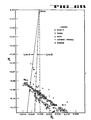
- the optical glasses whose glass point coordinates n 1 and n 2 are plotted araphically in FIG. 6A are also listed in TABLE I.
- the 813 glasses manufactured by the five leading optical glass manufacturers are identified in TABLE I by manufacturer's name, i.e., SCHOTT, OHARA, HOYA, Corning-France (abbreviated as CORN-F) and Chance Pilkington (abbreviated as CHANCE), and by catalog number.
- the arc tanaent of the ratio (n l /n 2 ) indicates the slope angle relative to the n 1 -axis, so that glasses having substantially the same arc tanaent of the ratio (n 1 /n 2 ) are substantially collinear, and are therefore candidates for selection in forming pairs of qlasses for designing optical systems that are color-corrected at three or more wavelengths.
- FIG. 6B provides an enlargement of a portion of the plot shown in FIG. 6A.
- the glass selection procedure in accordance with the present invention can be illustrated graphically with reference to FIGS. 6A and 5B.
- a designer In selecting a pair of glasses from among all the optical glasses whose glass points are plotted in FIG. 6A for designing a two-glass optical system that is color-corrected at three wavelengths, a designer first chooses one glass that is available to him and locates the glass point representing that one glass on the plot. The designer then draws a straight line extending through the glass point for that one glass and through the origin of the coordinate system.
- Other glasses that in principle are suitable for use in combination with that one glass for designing the desired two-glass three-color lens doublet lie substantially on that same straight line.
- a tabulation of the available optical glasses in terms of a convenient function of the slope anqle, e.q., the arc tangent of the ratio (n 1 /n 2 ), as provided in Table I, can be used by an optical designer with greater convenience and accuracy than the graphical technique described above. With such a tabulation, all that the designer Ineed do in selecting a pair of glasses for designing a two-glass three-color lens doublet is to choose a first glass, and then to identify other glasses whose tabulated values for the arc tangent of the ratio ( ⁇ 1 / ⁇ 2 ) are substantially the same as for the chosen first glass.
- a suitable pair of glasses can he selected from among the glasses having substantially the same value for the arc tanaent of the ratio ( ⁇ 1 / ⁇ 2 ) '
- Each of the olasses listed in TABLE I can be identified unambiguously by the manufacturer's cataloa number, which miaht be an alphanumeric designation or a purely numeric designation depending upon the manufacturer.
- the new type of glass is invariably given a new catalog number by the manufacturer.
- the new type of qlass is given a new cataloa number.
- the process of making any particular type of optical glass is ordinarily regarded by the manufacturer as proprietary information, and is ordinarily not known in detail by the optical designer who uses the glass. Accordingly, optical designers universally identify particular optical glasses by manufacturers' cataloa numbers.
- qlasses that could be paired with, for example, Hoya FCD10 glass for designing a two-glass optical system that is color-corrected at three wavelenaths.
- An examination of the cubic and quartic dispersion models for these two glasses in the same spectral region as covered by TABLE I for the quadratic dispersion model shows that this particular pair of optical glasses can yield 3 xial color correction at up to five wavelengths. This phenomenal compatibility of the Hoya FCD10 and Hoya FC3 glasses is discussed hereinafter in connection with a Mangin doublet mirror as illustrated in FIG. 21.
- Line A in FIG. 6B also shows several other glasses that could be combined with Hoya FCD10 qlass to form pairs of compatible glasses for desiqning optical systems that are color-corrected at at least three wavelengths.
- n 1 and n 2 for the optical glasses listed in TABLE I were calculated using a least-squares method for seven selected wavelenaths in the visible spectrum extending from a minimum wavelength of approximately 0.4 ⁇ m to a maximum wavelength of approximately 0.7 ⁇ m, with a base wavelength of 0.5740 ⁇ m. These wavelenoths provide a statistically good representation of the entire visible spectrum. However, in a particular application, the designer might find it preferable to calculate values of ⁇ 1 and ⁇ 2 for the optical materials of interest by a least-squares method, or indeed by any other mathematical procedure, usina different wavelengths.
- ⁇ 1 and n 2 are examples of values for ⁇ 1 and n 2 for several wavelengths in the infrared wavelength band or bands of interest. If the designer were interested in obtaining color-correction at a number of different wavelength bands, as might be appropriate in designing, e.g., a color-corrected astronomical instrument having a common focal plane for radiation in the infrared and ultraviolet portions of the spectrum, he could calculate a table of values for ⁇ 1 and ⁇ 2 using several wavelengths in each of the wavelength bands of interest.
- n 1 and n 2 depend upon th p wavelengths used in the quadratic dispersion model obtained from equation (7).
- the values for n1 and n2 would differ from those shown in TABLE I, if different wavelenoths were to be used in representing the spectral range (or the discontinuous spectral bands) of interest to the designer.
- the values listed in TABLE I are useful in illustrating the invention, and furthermore are of practical utility in selecting pairs of compatible glasses for designing optical systems that are substantially color-corrected at at least three wavelengths in the visible spectrum.
- the classes are sorted in TABLE II in ascending order of the ratios ( ⁇ 1 / ⁇ 2 ).
- the ten wavelengths used were the solar emission lines 0 .3650 ⁇ m, 0 . 4047 ⁇ m, 0 . 4350 ⁇ m, 0 . 4861 ⁇ m, 0.5461 ⁇ m, 0.5876 ⁇ m, 0.6563 ⁇ m, 0.7065 ⁇ m, 0.7682 ⁇ m and 1.014 ⁇ m.
- those optical glasses for which the corresponding ratios ( ⁇ 1 / ⁇ 2 ), ( ⁇ 2 / ⁇ 3 ) and ( ⁇ 1 / ⁇ 3 ) are substantially equal to each other, and for which the glass points are substantially collinear with each other and with the origin of the coordinate system, are candidates for selection in forming pairs of compatible glasses to use for designing optical systems that are color-corrected at four wavelenaths. It is sometimes more convenient to use the arc tangents of the ratios ( ⁇ 1 / ⁇ 2 ), ( ⁇ 2 / ⁇ 3 ) and ( ⁇ 1 / ⁇ 3 ) rather than the ratios themselves in selecting compatible pairs of glasses for designing optical systems that are color-corrected at at least four wavelengths.
- the selection of glass pairs for designing a two-glass three-color optical system could also be made from a plot of the glass points in v-dispersion coefficient space, or from a tabulation of the values for the arc tangents of the ratios ( ⁇ 1 / ⁇ 2 ), for the various optical glasses available to the designer.
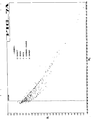
- FIG. 7A the glass points are plotted in v-dispersion coefficient space for the same 813 qlasses whose glass points in n-dispersion coefficient space are plotted in FIG. 6A.
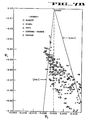
- An enlargement of a portion of the plot shown in FIG. 7A is shown in FIG. 7B.
- a straight line, Line C, drawn throuqh the origin of the coordinate system and the glass point for Schott FK51 glass indicates a number of other optical glasses whose glass points are substantially collinear with the origin and with the glass point for Schott FK51 glass.
- suitable glasses lying on Line C include Schott K51 glass and Hoya ADF1 alass. All such glasses, whose glass points are substantially collinear with each other and with the origin, are suitable candidates from which to select a pair of glasses for desianing an optical system having the required color correction at three wavelengths.
- Line D in FIG. 7B indicates that, e.g., Corninq-France 558525 glass and Schott BAF50 glass can be paired for desianing a two-glass three-color optical system.
- any pair of optical qlasses whose glass points lie substantially on the same straiqht line passing through the origin of the coordinate system can in principle be used for designing a two-glass three-color lens systems.
- optical glasses whose glass points do not lie substantially on the same straight line cannot be used for designing a two-glass lens system that is color-corrected at three wavelengths. From equations (41) to (46), the dioptric powers ⁇ 1 and ⁇ 2 of the individual lens elements of a two-glass three-color lens doublet are inversely proportional to the absolute value of the difference between the primary dispersion coefficients ⁇ 11 and n12 of the glasses used to make the lens elements of the doublet.
- be as large as possible in order to minimize the dioptric powers of the individual lens elements. If the dioptric powers of the lens elements were too large, the configurations of the lens elements might be so rounded (resembling toy marbles in an extreme case) that it would be impractical to use them in most optical systems. The requirement that
- those optical classes whose glass points are substantially collinear with each other and with the origin of the coordinate system are suitable candidates from which to select a pair of glasses for designing a two-glass optical system that is color-corrected at three or more wavelenqths.
- those glasses whose glass points are substantially collinear with the origin have ratios of primary to secondary dispersion coefficients that are substantially equal.
- those two glasses in combination are suitable for designing a two-qlass optical system that is color-corrected at three wavelenaths.
- This property can readily be exploited with a diqital computer by computing the slope of the line connectinq each glass point with the origin, and then sorting all the qlasses in ascending order of these "glass point" slopes.
- any two optical glasses can in principle be used in combination with each other for designing a lens doublet that is color-corrected at two wavelenqths.
- the two lens elements could be cemented together by any technique well-known in the art, as by using Canada balsam, optical cement or immersion oil.
- the suitability or non-suitability of any particular combination of optical materials for designing a color-corrected optical system can be readily determined by reference to tabulated data, such as by compairing tabulated values of the ratios ⁇ 1 / ⁇ 2 for a pair of optical materials being considered.
- the present invention eliminates the need for "cut-and-try" methods for determininq whether any particular pair of optical materials can provide color correction at more than two wavelengths.
- any two optical glasses are suitable in principle for designing a two-glass two-color lens doublet, there was no unified theory in the prior art for predicting whether any two particular optical glasses would have appropriate dioptric powers so that lens elements with practical confiaurations could be made from those particular alasses. It is a feature of the present invention, on the other hand, that the practicality or non-practicality of any two particular optical glasses for designing a lens doublet that is color-corrected at two or more wavelengths can be readily determined by reference to tabulated data.
- TABLE I it can be ascertained that the absolute value of the difference between corresponding values of n1 for Schott BK7 and Schott F2 glasses is quite large, i.e.,
- 0.063435, indicating that the distribution of dioptric powers for lens elements made from these two glasses would be desirably small.
- the present invention provides a method for determininq the practicality of using two particular glasses, e.g., Schott RK7 glass and Schott F2 glass, in combination for designing a two-olass two-color lens doublet.
- two particular glasses e.g., Schott RK7 glass and Schott F2 glass
- ⁇ 1j I
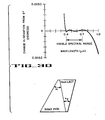
- FIG. 8 Also shown in FIG. 8 is a curve showing the relationship of paraxial marainal ray heiqht (conventionally designated PY in the drawina) to wavelenoth for the lens doublet comprising first and second lens elements made of Schott BK7 and Schott F2 glasses, respectively.
- a curve hereinafter called a "wavelength scan" for an optical system provides an indication of the quality of axial color correction obtainable with the optical system.
- the paraxial marginal ray heiaht for an optical system at any particular wavelength is a measure of the so-called secondary spectrum of the system at that wavelenath, i.e., a measure of the extent to which light at that particular wavelength is out-of-focus with respect to the common focus for which color-correction of the system is desired.
- Perfect color correction is achieved for those wavelengths at which the paraxial marginal ray height is zero, i.e., for those wavelengths at which the "wavelength scan" curve crosses the horizontal axis.
- the closeness of the "wavelength scan" curve to the horizontal axis provides a measure of the extent to which the optical system approaches perfect color correction.
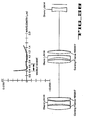
- FIG. 9 illustrates a particular example of a three-color cemented lens doublet in which the optical glasses from which the two lens elements of the doublet are made were selected in accordance with the present invention.
- the wavelength scan curve shown in FIG. 9 crosses the horizontal axis at three discrete wavelengths in the visible spectrum, and is close to the horizontal axis throughout the entire wavelength band extending over the visible spectrum.
- a lens doublet made from this particular pair of optical glasses can provide very effective (if not perfect) color correction over substantially the entire visible spectrum.
- the design form of the lens doublet shown in FIG. 9 is specified in tabular format as follows: where the various lens element surfaces of the doublet system are numbered, in accordance with conventional practice, from left to right.
- the "Radius” listed for each surface is the radius of curvature of the surface expressed as a multiple of the focal length f of the lens system at a relative aperture of f/10.
- the radius of curvature of an optical surface is said to be positive if the center of curvature of the surface lies to the right of the surface, and negative if the center of curvature of the surface lies to the left of the surface.
- the "Thickness” listed for a particular surface is the thickness of the lens element bounded on the left by the indicated surface, where the thickness is measured along the optical axis of the lens system.
- the thickness of each lens element is expressed as a multiple of the focal length f of the lens system.
- V is the Abbe number for the same lens element at the same base wavelength.
- “Material” refers to the type of optical material from which the lens element is made, where the type of optical material is identified by manufacturer and by manufacturer's catalog number.
- FIG. 10 illustrates a particular example of a four-color cemented lens doublet in which the optical glasses from which the two lens elements of the doublet are made were selected in accordance with the present invention.
- the glasses used in making the two lens elements of the doublet of FIG. 10 are Corning France 486817 and Ohara LAK14 glasses, which were chosen because their ratios ( ⁇ 1 / ⁇ 2 ) are substantially equal in the extended spectral region from 0.365 ⁇ m to 1.014 ⁇ m, and because the difference between corresponding values of n1 for the two glasses is large.
- the wavelength scan curve shown in FIG. 10 crosses the horizontal axis at four discrete wavelengths in the visible and near infrared spectrum, and is close to the horizontal axis throughout this spectral range.
- a lens doublet made from this particular pair of optical glasses can provide very effective color correction over a wide spectral range bridging the visible and infrared wavelengths, especially in the range extending from the blue wavelengths through the near infrared wavelengths beyond 1.0 ⁇ m.
- the design form of the lens doublet shown in FIG. 10 is specified in tabular format as follows: where the specified design parameters are as defined above in connection with FIG. 9.
- FIG. 11 illustrates a particular example of a four-color air-spaced lens doublet in which the two lens elements are made of the same types of optical glasses as for the cemented lens doublet shown in FIG. 10.
- the wavelength scan curve shown in FIG. 11 crosses the horizontal axis at four discrete wavelengths in the visible and near infrared spectrum, and is close to the horizontal axis throughout the same spectral range for which the lens doublet of FIG. 10 provides effective color correction.
- the degree of color correction obtainable using the glasses of the cemented lens doublet shown in FIG.
- the quality of axial (i.e., longitudinal) color correction obtainable with a two-glass lens doublet is determined by the choice of glasses used for making the lens elements, and is independent of the design form of the doublet.
- the quality of correction for lateral chromatic abberation, spherochromatism and the remaining aberrations depends upon the design form of the lens doublet.
- the design form of the lens doublet shown in FIG. 11 is specified in tabular format as follows:
- FIG. 12 illustrates a particular example of a five-color cemented lens doublet in which the optical glasses from which the two lens elements of the doublet are made were selected in accordance with the present invention.
- the glasses used in making the two lens elements of the cemented doublet of FIG. 12 are Schott PK51 and Hoya LAC7 glasses, which were chosen because the ratios of their primary to secondary n -dispersion coefficients are substantially equal, and because the absolute value of the difference between corresponding values of ⁇ 1 for the two glasses is large.
- the wavelength scan curve shown in FIG. 12 crosses the horizontal axis at five discrete wavelengths in the spectral range extending from the ultraviolet to the near infrared wavelengths. Furthermore, the wavelength scan curve is extremely close to the horizontal axis throughout the spectral range extending from the green wavelengths to about 0.8 ⁇ m in the near infrared region. Thus, a lens doublet made from this particular pair of optical glasses can provide very effective axial color correction throughout this region of the optical spectrum.
- the design form of the lens doublet shown in FIG. 12 is specified in tabular format as follows:
- FIG. 13 illustrates an example of a four-color cemented two-glass lens triplet in which the optical glasses from which the three lens elements of the triplet are made were selected in accordance with the present invention.
- the first and third lens elements of the lens triplet of FIG. 13 are made of Corning-France 486817 glass, and the second (i.e., middle) lens element is made of Corning-France 589612 glass. These glass types were chosen because the ratios of their primary to secondary n -dispersion coefficients are substantially equal, and because the absolute value of the difference between corresponding values of ⁇ 1 for the two glasses is large.
- the wavelength scan curve shown in FIG. 13 crqsses the horizontal axis at four discrete wavelengths in the spectral range extending from the blue to the near infrared wavelengths, and is close to the horizontal axis throughout this spectral range.
- a lens triplet made from this particular pair of optical glasses can provide very effective axial color correction throughout this region of the optical spectrum.
- the design form of the lens triplet of FIG. 13 is specified in terms of unit focal length for a relative aperture of f/10, as was done above for the lens doublets of FIGS. 8 - 12. It is noted, however, that the depiction in FIG. 13 shows a lens triplet whose focal length is 40 times that of the lens doublets shown in FIGS. 8 - 12. In terms of the focal length f, the design form of the lens triplet of FIG. 13 is specified in the tabular format as follows:
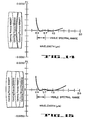
- FIG. 14 illustrates a particular example of a four-color two-glass lens triplet in which the three lens elements are made of the same types of optical glasses as for the cemented lens triplet shown in FIG. 13, with the first and second lens elements being cemented together, and with an air gap being provided between the second and third lens elements.
- the focal length of the lens triplet shown in FIG. 14 is the same as for the lens triplet shown in FIG. 13 for the same relative aperture of f/10.
- the wavelength scan curve shown in FIG. 14 likewise crosses the horizontal axis at four discrete wavelengths in the spectral range extending from the blue to the near infrared wavelengths, and is close to the horizontal axis throughout this spectral range.
- the degree of axial color correction obtainable using the pair of glasses of the cemented lens triplet shown in FIG. 13 is seen to be retained when an air space is provided between two of the lens elements.
- the wavelength scan thus indicates that, for a given pair of optical materials, the quality of axial color correction obtainable with a two-glass lens triplet is determined by the choice of glasses used to make the lens elements of the triplet, and is independent of the design form of the triplet.
- the quality of correction for lateral color aberration, spherochromatism and the higher-order monochromatic aberrations is dependent upon the design form of the lens triplet. 4
- the design form of the lens triplet of FIG. 14 is specified in tabular format as follows:
- the optical glasses from which the four lens elements of the quadruplet shown in FIG. 15 are made were selected in accordance with the present invention.
- the first and third lens elements are made of Corning-France 486817 glass, and the second and fourth lens elements are made of Corning-France 589612 glass. These glasses were chosen because the ratios of their primary to secondary n -dispersion coefficients are substantially equal, and because the absolute value of the difference between corresponding values of ⁇ 1 for the two glasses is large.
- the wavelength scan curve shown in FIG. 15 crosses the horizontal axis at four discrete wavelengths in the spectral range extending from the blue to the near infrared region of the optical spectrum.
- the wavelength scan curve is close to the horizontal axis throughout this spectral range, which indicates that a lens quadruplet made from this particular pair of glasses can provide effective axial color correction throughout this spectral range. .
- the design form of the lens quadruplet of FIG. 15 is specified in tabular format as follows:
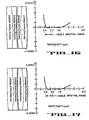
- FIG. 16 illustrates a particular example of a four-color two-glass lens quadruplet in which the four lens elements are made of the same types of optical glasses as for the cemented lens quadruplet shown in FIG. 15, with the first and second lens elements being cemented together, the third and fourth lens elements being cemented together, and an air gap being provided between the second and third lens elements.
- the focal length of the lens quadruplet shown in FIG. 16 is the same as for the lens quadruplet shown in FIG. 15 for the same relative aperture of f/10.
- the wavelength scan curve shown in FIG. 16 likewise crosses the horizontal axis at four discrete wavelengths in the spectral range extending from the blue to the near infrared region of the optical spectrum.
- the wavelength scan curve of FIG. 16 is likewise close to the horizontal axis throughout this spectral range.
- the degree of axial color correction obtainable using the pair of glasses of the cemented lens quadruplet of FIG. 15 is retained when an air space is provided between two of the lens elements.
- the design form of the lens quadruplet of FIG. 16 is specified in tabular format as follows:
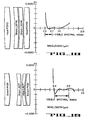
- FIG. 17 illustrates a particular example of a four-color two-glass lens quadruplet in which the four lens elements are made of the same types of optical glasses as for the lens quadruplets shown in FIGS. 15 and 16, except that the first and third lens elements are made of Corning-France 486817 glass and the second and fourth lens elements are made of Corning-France 589612 glass.
- the focal length of the lens quadruplet shown in FIG. 17 is the same as for the lens quadruplets shown in FIGS. 15 and 16 for the same relative aperture of f/10.
- the first and second lens elements of the lens quadruplet shown in FIG. 17 are cemented together, the third and fourth lens elements are cemented together, and an air gap is provided between the second and third lens elements.
- the wavelength scan curve shown in FIG. 17 likewise crosses the horizontal axis at four discrete wavelengths in the spectral range extending from the blue to the near infrared region of the optical spectrum.
- the wavelength scan curve of FIG. 16 is likewise close to the horizontal axis throughout this spectral range.
- the wavelength scan shown in FIG. 17 further indicates that the quality of axial color correction obtainable with a lens multiplet is determined by the choice of glasses used for designing the multiplet, and is independent of the design form of the multiplet.
- the design form of the lens quadruplet of FIG. 17 is specified in tabular format as follows:
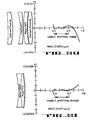
- FIG. 18 shows a four-color collimator comprising a two-glass lens quadruplet, which can be used for precise collimation of a beam of light having a spectral range from blue to near infrared.
- the collimator of FIG. 18 comprises a lens,quadruplet wherein the consecutive lens elements are all air-spaced.
- the first and fourth lens elements of the collimator are made of Hoya FCD10 glass, and the second and third lens elements are made of Ohara LAK14 glass.
- the wavelength scan curve shown in FIG. 18 crosses the horizontal axis at four discrete wavelengths, and is close to the horizontal axis throughout a wavelength band that bridges the visible and near infrared spectral regions.
- the wavelength scan curve of FIG. 18 substantially coincides with the horizontal axis throughout the near infrared spectral range, which illustrates the suitability of this particular combination of optical glasses for correcting paraxial chromatic aberration in the near infrared spectral range.
- the collimator shown in FIG. 18 in addition to being substantially color-corrected in the near infrared spectral range, is also well-corrected for the various monochromatic aberrations.
- the design form of the collimator of FIG. 18 is specified in detail in tabular format as follows:
- FIG. 19 shows a five-color collimator comprising a two-glass lens quadruplet.
- the first and fourth lens elements of the collimator of FIG. 19 are made of Schott PK51 glass, and the second and third lens elements are made of Hoya LAC7 qlass. These two optical glasses were selected because of the substantial collinearity of their respective glass points with the origin of the coordinate system in four-dimensional n -dispersion coefficient space, and also because the absolute value of the difference between their respective primary dispersion coefficients is large.
- the wavelength scan curve shown in FIG. 19 crosses the horizontal axis at five discrete wavelengths in the spectral range extending from about 0.38 ⁇ m to about 0.80 u m. These five wavelengths can therefore be precisely focussed using the collimator of FIG. 19. The other wavelengths in this spectral range can be focussed with a degree of precision indicated by the closeness with which the wavelength scan curve approaches the horizontal axis.
- the collimator shown in FIG. 19 is well-corrected for the various monochromatic aberrations, especially spherochromatism.
- the design form of the collimator of FIG. 19 is specified in tabular format as follows:
- the first and fourth lens elements of the collimator of FIG. 20 are made of calcium fluoride crystal, and the second and third lens elements are made of Hoya LAC7 glass.
- Use of calcium fluoride crystal as one of the optical materials enables a larger aperture (i.e., a lower f-number) to be used than would be possible if both optical materials were glasses.
- a light beam of large diameter can be collimated without significant error due to spherochromatism.
- the wavelength scan curve shown in FIG. 20 crosses the horizontal axis at five wavelengths, and therefore indicates that precise collimation can be obtained at five wavelengths, in the spectral range from ultraviolet to near infrared.
- the closeness of the wavelength scan curve to the horizontal axis throughout this spectral range indicates that a high degree of collimation can be obtained for the other wavelengths in this range.
- FIG. 21 illustratesa particular example of a cemented Mangin doublet mirror, which is color-corrected at five wavelengths.
- the outward facing surface of the second lens element is provided with a reflective coating, which could comprise a conventional reflecting material such as, e.g., silver or aluminum.
- the Hoya FCD10 and Hoya FC3 glasses, used in combination, provide color correction at five wavelengths.
- the design form of the particular Mangin doublet mirror shown in FIG. 21 is specified in tabular format as follows: where the negative values of thickness listed for the lens element after the third surface, as numbered in accordance with conventional practice from left to right in the drawing, indicate that reflection occurs at the third surface.
- the fourth surface is the same as the second surface
- the fifth surface is the same as the first surface.
- Light at a color-corrected wavelength passing consecutively through the first and second surfaces is reflected from the third surface back consecutively through the second (i.e., fourth) and first (i.e., fifth) surfaces to the focal plane of the Mangin doublet mirror.
- the wavelength scan for the Mangin doublet mirror shown in FIG. 21 indicates that precise color correction occurs at five discrete wavelengths in the optical spectrum, and that a high degree of axial color correction is achieved over a band of wavelengths extending from the far ultraviolet to the near infrared regions of the spectrum.
- dispersive effects can be substantially eliminated from Mangin mirrors by the proper choice of optical materials from which the lens elements are made.
- FIG. 22 illustrates another example of a cemented Mangin doublet mirror, which provides substantially complete axial color correction from the blue to the near infrared regions of the spectrum.
- the design form of the Mangin doublet mirror shown in FIG. 22 is specified in tabular format as follows:
- the wavelength scan for the Mangin doublet mirror of FIG. 22 shows that precise axial color correction (i.e., crossing of the horizontal axis) occurs at four discrete wavelengths, and that a high degree of axial color correction (i.e., only insignificant paraxial marginal ray height) occurs throughout the spectral range extending from the blue to beyond 0.8 ⁇ m in the near infrared regions of the spectrum.
- FIG. 23 illustrates an example of a cemented Mangin doublet mirror, which provides substantially complete color correction from the blue to well into the near infrared regions of the optical spectrum.
- the design form of the Mangin doublet mirror shown in FIG. 23 is specified in tabular format as follows:
- the wavelength scan for the Mangin doublet mirror of FIG. 23 shows that precise axial color correction occurs at four discrete wavelengths, and that a high degree of axial color correction occurs throughout the spectral range extending from the blue to beyond 1.0 ⁇ m in the near infrared region of the spectrum.
- FIG. 24 illustrates a particular example of an air-spaced Mangin doublet mirror, which is color-corrected at five wavelengths.
- the design form of the Mangin doublet mirror shown in FIG. 24 is specified in tabular format as follows:
- the wavelength scan for the Mangin doublet mirror of FIG. 24 indicates that precise color correction occurs at five discrete wavelengths, and that a high de ⁇ re e of axial color correction occurs throughout the spectral range extending from the violet to the near infrared regions of the optical spectrum.
- FIG. 25 illustrates an example of an air-spaced Mangin doublet mirror, which provides substantially complete axial color correction throughout the visible and into the near infrared portions of the optical spectrum.
- the design form of the Mangin doublet mirror shown in FIG. 25 is specified in tabular format as follows:
- the wavelength scan curve shown in FIG. 25 substantially coincides with the horizontal axis throuohout the visible portion of the optical spectrum, although a larger scale plot would show that the crossings of the horizontal axis actually occur at five discrete wavelengths.
- the Mangin doublet mirror of FIG. 25 is color-corrected at only fiye wavelengths.
- this Mangin doublet mirror can be considered to be substantially color-corrected throughout the visible wavelength band.
- FIG. 26 illustrates an example of an air-spaced Mangin doublet mirror, which provides substantially complete axial color correction from the green region of the visible spectrum to well into the infrared wavelengths.
- the design form of the Mangin doublet mirror shown in FIG. 26 is specified in tabular format as follows:
- the wavelength scan curve shown in FIG. 26 substantially coincides with the horizontal axis from the green wavelength region to beyond 1.0 u m in the near infrared wavelength region of the spectrum.
- a larger scale plot would show that crossings of the horizontal axis actually occur at only four discrete wavelengths.
- the Mangin doublet mirror of FIG. 26 is color-corrected at only four wavelengths.
- the Mangin doublet mirror of FIG. 26 can be considered to be substantially color-corrected throughout the wavelength band of interest.
- the designation "Petzval lens system” is generally applied to a lens system comprising two widely separated lens groups, each of which has a net positive dioptric power, followed by a negative lens element or a lens group having a net negative dioptric power.
- the positive lens groups in combination provide good resolution at high aperture for narrow to moderate fields of view.
- the negative lens element or lens group functions as a field flattener.
- a lens group is said to have positive dioptric power when it causes light rays passing through it to converge, and to have negative dioptric power when it causes light rays passing through it to diverge.
- each lens group of a Petzval lens system is a doublet.
- either one (or all) of the lens groups of a Petzval lens system could be a singlet, a triplet or a high-number multiplet.
- the spacing between the two positive lens groups of a Petzval lens system is large in comparison with the thicknesses of the individual lens elements comprising each lens group.
- the individual lens elements could be cemented or air-spaced.
- a negative lens element or lens group functioning as a field flattener it is usual for a negative lens element or lens group functioning as a field flattener to be positioned immediately in front of the image plane of the system to correct for field curvature.
- a Petzval lens system that includes a field flattener is called, appropriately, a flat-field Petzval lens system.
- Petzval lens systems were typically used only in short-focus applications, e.g., in projectors for 16 mm and 8 mm motion-picture films. For very long-focus applications (e.g., more than 200 mm), Petzval-type lens systems were not generally used because of the difficulty in designing high-aperature long-focus Petzval lens systems that are well-corrected.
- Petzval lens systems of the prior art were typically "achromats", i.e., doublets color-corrected at only two wavelengths. Furthermore, Petzval lens systems of the prior art were typically used only in relatively narrow field-angle applications. An example of a short-focus narrow field-angle Petzval lens system is described in U.S. patent 3,255,664.
- FIG. 27 shows a two-glass flat-field lens system of the Petzval type made of the same two types of optical glasses as used for the lens doublet shown in FIG. 12, i.e., Schott PK51 and Hoya LAC7 glasses.
- the last lens element 'in the system which is a biconcave lens made of Hoya LAC7 glass, functions as a field flattener.
- the Petzval lens system of FIG. ?7 is color-corrected at five wavelengths in the optical spectrum from .4 u m to .7 ⁇ m, and is also well-corrected for monochromatic aberrations in this spectral range.
- the wavelength scan for the Petzval lens system of FIG. 27 shows three crossings of the horizontal axis in the visible spectral range, as well as single crossings in the ultraviolet and infrared portions of the spectrum.
- the paraxial marginal ray height is insignificant, indicating that very substantial axial color correction occurs throughout that portion of the visible spectrum.
- the design form of this Petzval lens system also provides superb correction of the monochromatic aberrations, and the chromatic variation of spherical aberration and coma.
- This particular Petzval lens system is without precedent in enahling diffraction limited performance to be provided at such a large aperture and wide field of view.
- FIG. 28 shows a two-glass flat-field lens system of the Petzval type made of the same two types of optical glasses as used for the lens doublets shown in FIGS. 10 and 11, i.e., Corning-France 486817 and Ohara LAK14 glasses.
- the Petzval lens system of FIG. 28 is color-corrected at four wavelengths, two in the visible region and two in the infrared region. This system is also well-corrected for spherochromatism and the monochromatic aberrations.
- the wavelength scan for the Petzval lens system of FIG. 28 shows very substantial (if not perfect) color-correction throughout the spectral range extending from the blue wavelength region to beyond 1.0 ⁇ m in the near infrared region. It is remarkable that such color correction can be obtained for a Petzval lens system using only two different optical glasses.
- the design form of this Petzval lens system provides diffraction limited performance throughout the spectral range for which it is color-corrected.
- FIG. 29 shows another long-focus flat-field Petzval lens system whose lens elements are made of only two different types of optical glasses, viz., Schott FK51 and Schott LAKN14 glasses.
- This Petzval lens system is color-corrected at three wavelengths, two in the visible region and one in the infrared region. The system is also well-corrected for spherochromatism and the monochromatic aberrations, and provides diffraction limited performance throughout the spectral range for which it is color-corrected.
- the wavelength scan for the Petzval lens system of FIG. 29 shows that precise axial color-correction occurs at the wavelengths 0.527 ⁇ m, 0.640 ⁇ m, and 0.778 ⁇ m. In the range from 0.527 ⁇ m to 0.778 ⁇ m, the degree of color-correction obtainable is very high.
- the Petzval lens system of FIG. 29 has a focal length of 1000 mm, and a field angle of 4.2°.
- FIG. 30 illustrates a two-glass cemented doublet prism system having a deviation angle of 6° for which very substantial color correction (i.e., only insignificant dispersion) occurs throughout the visible spectrum.
- the deviation angle nf a prism is defined as the angle through which a ray changes direction after passing through the prism, i.e., the angle between the direction of the ray entering the system and the direction of the ray exiting from the system.
- the negative sign for a 2 is a convention indicating that the orientation of the apex of the second prism element is inverted with respect to the orientation of the apex of the first prism element.
- FIG. 30 Also shown in FIG. 30 is a plot of change in angular deviation (in degrees) versus wavelength (in micrometers) for this particular doublet prism system for a 6° total deviation angle.
- the curve in FIG. 30 crosses the horizontal axis at five discrete wavelengths, which indicates that chromatic dispersion from a total deviation angle of 6 0 is precisely zero at those discrete wavelengths. It is particularly noteworthy, however, that the curve in FIG. 30 is very close to the horizontal axis throughout the entire visible region extending well into the infrared region of the spectrum to about 0.8 ⁇ m. For those wavelengths at which the total deviation angle differs from 6°, the difference is approximately 0.0001 degree throughout this wavelength band.
- the prism system of FIG. 30 can be considered to be color-corrected (i.e., as having substantially zero dispersion) for a deviation angle of 6° throughout this rather wide wavelength band, which includes the entire visible region.
- the plot of change in angular deviation versus wavelength shown in FIG. 30 describes a "real" ray trace, not a paraxial ray trace as in the foregoing plots for dioptric and catadioptric systems.
- the plots shown in FIG. 30 and in the following examples of other prism systems were based upon data obtained from ray traces according to Snell's law.
- FIG. 31 illustrates a two-glass cemented quintuplet prism system, which provides a high degree of color correction throughout the visible spectrum for a total deviation angle of 30°.
- a l , a 2 , a3 and a4 have the same value, where the negative sign given for a 2 and a4 indicates that the orientations of the second and fourth prism elements are inverted with respect to the orientations of the first, third and fifth prism elements.
- a plot of change in angular deviation versus wavelength shown in FIG. 31 indicates that chromatic dispersion from a total deviation angle of 30 0 is precisely zero at five discrete wavelengths. It is to be noted that a total deviation angle of 30° is a large total deviation angle.
- the 30° deviation of a heam of light that is produced by the prism system of FIG. 31 is equivalent to the deviation produced by the marginal zone of a lens with a relative aperture of f/1.0.
- the plot of change in angular deviation versus wavelength in FIG. 31 indicates that the change in total angular deviation from 30° is only about 0.0005 degree for any wavelength in the spectral band that includes the entire visible region and a portion of the near infrared region extending to almost 0.8 ⁇ m.
- the change in total angular deviation from 30 o is in fact zero at five discrete wavelengths in this spectral band.
- FIG. 32 illustrates a two-glass cemented quintuplet prism system, which is designed using the same types of glasses as the quintuplet prism system of FIG. 31:
- the only difference between the prism system of FIG. 32 and the prism system of FIG. 31 is that the apex angles of the prism elements of the system shown in FIG. 32 have different values.
- the first prism element a 1 83.1964 0
- the second prism element a 2 -44.9553 0
- for the third prism element a3 40.8576 0
- for the fourth prism element a4 -46.9210°
- the fifth prism element a 5 37.5019°.
- the present invention provides the designer with the ability to design optical systems that are color-corrected at three or more wavelengths using only two different optical materials.
- complicated multiglass optical systems of the prior art can be replaced by simpler two-glass optical systems that provide comparable, or better, color correction.
- This ability to simplify complicated optical systems while improving performance is a major advantage inherent in the present invention.
- the method of the present invention for selecting more than two optical materials for desiqning color-corrected optical systems is of general interest in terms of demnnstrating the unified theory.
- a two-glass optical system is to be preferred to a system having the same capabilities but comprising more than two optical materials.
- optical systems comprising three or more different optical materials might be used to provide optimum color correction for specified operational requirements.
- FIG. 33 illustrates a particular example of a three-glass lens multiplet for which the lens elements comprising the multiplet were selected in accordance with the present invention.
- the five lens elements comprising'the lens quintuplet are described consecutively from left to right as shown in drawing.
- the design form of the lens quintuplet of FIG. 33 is specified in tabular format as follows:
- the wavelength scan for the three-glass multiplet shown in FIG. 33 indicates that a lens system can be designed using Ohara FK01, Ohara KZFS8 and Ohara FK01 glasses for bringing five wavelength from the ultraviolet through the visible to the near infrared regions of the spectrum to a common focus. Th p wavelength scan further indicates that substantially complete axial color correction can be provided by these three glasses in combination for wavelengths in the near infrared region up to at least 1.0 ⁇ m.
- FIG. 34 illustrates a particular example of a four-glass lens multiplet for which the lens elements comprising the multiplet were selected in accordance with the present invention.
- the design form of the lens quintuplet of FIG. 34 is specified in tabular format as follows:
- the wavelength scan for the four-glass multiplet shown in FIG. 34 indicates that a lens system can be designed using Schott PK51, Schott LAK20, Schott KZFSN4 and Schott KZFS6 glasses for bringing five wavelengths from the ultraviolet through the visible to the near infrared regions of the spectrum to a common focus.
- the wavelength scan further indicates that substantially complete color correction can be provided by these four glasses jn combination for wavelengths in the range from about 0.60 ⁇ m to 0.85 ⁇ m.
Landscapes
- Physics & Mathematics (AREA)
- General Physics & Mathematics (AREA)
- Optics & Photonics (AREA)
- Lenses (AREA)
Applications Claiming Priority (2)
| Application Number | Priority Date | Filing Date | Title |
|---|---|---|---|
| US41970582A | 1982-09-20 | 1982-09-20 | |
| US419705 | 1982-09-20 |
Publications (3)
| Publication Number | Publication Date |
|---|---|
| EP0106471A2 true EP0106471A2 (fr) | 1984-04-25 |
| EP0106471A3 EP0106471A3 (en) | 1985-07-31 |
| EP0106471B1 EP0106471B1 (fr) | 1990-02-28 |
Family
ID=23663402
Family Applications (1)
| Application Number | Title | Priority Date | Filing Date |
|---|---|---|---|
| EP19830305024 Expired EP0106471B1 (fr) | 1982-09-20 | 1983-08-31 | Procédé de sélection des matériaux optiques |
Country Status (4)
| Country | Link |
|---|---|
| EP (1) | EP0106471B1 (fr) |
| JP (1) | JPS5969711A (fr) |
| CA (1) | CA1247906A (fr) |
| DE (1) | DE3381257D1 (fr) |
Cited By (2)
| Publication number | Priority date | Publication date | Assignee | Title |
|---|---|---|---|---|
| EP0340647A3 (fr) * | 1988-05-02 | 1992-01-02 | Dainippon Screen Mfg. Co., Ltd. | Système optique apochromatique |
| EP1067420A3 (fr) * | 1999-07-09 | 2002-06-12 | Leica Microsystems Wetzlar GmbH | Objectif de microscope pour l'ultraviolet profond, à mise au point pour l'infrarouge parfocale |
Families Citing this family (7)
| Publication number | Priority date | Publication date | Assignee | Title |
|---|---|---|---|---|
| JP2580103B2 (ja) * | 1984-07-06 | 1997-02-12 | オリンパス光学工業株式会社 | 像伝達光学系 |
| JPS6246401U (fr) * | 1985-09-07 | 1987-03-20 | ||
| JPS62178916A (ja) * | 1986-02-03 | 1987-08-06 | Fuji Photo Optical Co Ltd | 近軸色収差補正用アタツチメントレンズ |
| JPH0279809A (ja) * | 1988-08-18 | 1990-03-20 | Gec Marconi Ltd | レンズシステム |
| CA2044571C (fr) * | 1990-07-16 | 1996-01-09 | Cesar A. Sepulveda | Lentille achromatique a bande ultra-large |
| JP2012103351A (ja) * | 2010-11-08 | 2012-05-31 | National Institute Of Information & Communication Technology | レーザ光結像用の色消しレンズ |
| JP7739301B2 (ja) * | 2020-08-24 | 2025-09-16 | パナソニックホールディングス株式会社 | 光学系および撮像装置、撮像システム |
Family Cites Families (3)
| Publication number | Priority date | Publication date | Assignee | Title |
|---|---|---|---|---|
| US3395962A (en) * | 1965-05-12 | 1968-08-06 | Eastman Kodak Co | Superachromatic objective |
| US3494688A (en) * | 1967-04-06 | 1970-02-10 | Kollsman Instr Corp | Color corrected mangin mirror |
| US3674330A (en) * | 1971-01-22 | 1972-07-04 | John D Strong | Achromatic doublet lens for infrared radiation |
-
1983
- 1983-08-31 DE DE8383305024T patent/DE3381257D1/de not_active Expired - Lifetime
- 1983-08-31 EP EP19830305024 patent/EP0106471B1/fr not_active Expired
- 1983-09-05 JP JP16210983A patent/JPS5969711A/ja active Granted
- 1983-09-12 CA CA000436534A patent/CA1247906A/fr not_active Expired
Cited By (2)
| Publication number | Priority date | Publication date | Assignee | Title |
|---|---|---|---|---|
| EP0340647A3 (fr) * | 1988-05-02 | 1992-01-02 | Dainippon Screen Mfg. Co., Ltd. | Système optique apochromatique |
| EP1067420A3 (fr) * | 1999-07-09 | 2002-06-12 | Leica Microsystems Wetzlar GmbH | Objectif de microscope pour l'ultraviolet profond, à mise au point pour l'infrarouge parfocale |
Also Published As
| Publication number | Publication date |
|---|---|
| EP0106471A3 (en) | 1985-07-31 |
| DE3381257D1 (de) | 1990-04-05 |
| CA1247906A (fr) | 1989-01-03 |
| JPS5969711A (ja) | 1984-04-20 |
| JPH0576008B2 (fr) | 1993-10-21 |
| EP0106471B1 (fr) | 1990-02-28 |
Similar Documents
| Publication | Publication Date | Title |
|---|---|---|
| US5210646A (en) | Color-corrected optical systems and method of selecting optical materials therefor | |
| US2380887A (en) | Optical system | |
| US4702569A (en) | Color-corrected Petzval lens systems | |
| EP0601873A1 (fr) | Prisme achromatique et apochromatique utilisant des prismes et des réseaux de diffraction | |
| US5204782A (en) | Color-corrected optical systems | |
| US4834515A (en) | Catadioptric imaging system with dioptric assembly of the petzval type | |
| US5020889A (en) | Color-corrected optical systems | |
| EP0106471A2 (fr) | Procédé de sélection des matériaux optiques | |
| Wynne | Monocentric telescopes for microlithography | |
| US4761064A (en) | Color-corrected lens systems | |
| EP0935772A1 (fr) | Objectif possedant une distance focale constante dans la gamme visible et infrarouge | |
| US4790637A (en) | Color-corrected catadioptric systems | |
| Baker | A family of flat-field cameras, equivalent in performance to the Schmidt camera | |
| US4765727A (en) | Color-corrected lens systems | |
| US3774991A (en) | Achromatic telephoto objective lens | |
| US4704008A (en) | Color-corrected prism systems | |
| US4768869A (en) | Catadioptric imaging system | |
| US3486805A (en) | Ultra-achromatic fluorite silica triplet lens system | |
| US4762404A (en) | Color-corrected lens systems | |
| US2327947A (en) | Optical objective | |
| JPH0380211A (ja) | 顕微鏡対物レンズ | |
| US2419151A (en) | Eyepiece unit for telescopic systems of the class including binoculars | |
| US4189214A (en) | Fourier transform lens system | |
| US3883230A (en) | Telephoto lens objective | |
| CN217504983U (zh) | 一种成像光谱仪分光系统 |
Legal Events
| Date | Code | Title | Description |
|---|---|---|---|
| PUAI | Public reference made under article 153(3) epc to a published international application that has entered the european phase |
Free format text: ORIGINAL CODE: 0009012 |
|
| AK | Designated contracting states |
Designated state(s): DE FR GB IT SE |
|
| PUAL | Search report despatched |
Free format text: ORIGINAL CODE: 0009013 |
|
| AK | Designated contracting states |
Designated state(s): DE FR GB IT SE |
|
| 17P | Request for examination filed |
Effective date: 19851008 |
|
| 17Q | First examination report despatched |
Effective date: 19861021 |
|
| GRAA | (expected) grant |
Free format text: ORIGINAL CODE: 0009210 |
|
| AK | Designated contracting states |
Kind code of ref document: B1 Designated state(s): DE FR GB IT SE |
|
| REF | Corresponds to: |
Ref document number: 3381257 Country of ref document: DE Date of ref document: 19900405 |
|
| ET | Fr: translation filed | ||
| ITF | It: translation for a ep patent filed | ||
| PLBI | Opposition filed |
Free format text: ORIGINAL CODE: 0009260 |
|
| 26 | Opposition filed |
Opponent name: OPTISCHE WERKE G. RODENSTOCK Effective date: 19901128 |
|
| PLBN | Opposition rejected |
Free format text: ORIGINAL CODE: 0009273 |
|
| STAA | Information on the status of an ep patent application or granted ep patent |
Free format text: STATUS: OPPOSITION REJECTED |
|
| 27O | Opposition rejected |
Effective date: 19920708 |
|
| ITTA | It: last paid annual fee | ||
| EAL | Se: european patent in force in sweden |
Ref document number: 83305024.8 |
|
| PGFP | Annual fee paid to national office [announced via postgrant information from national office to epo] |
Ref country code: GB Payment date: 19960710 Year of fee payment: 14 |
|
| PGFP | Annual fee paid to national office [announced via postgrant information from national office to epo] |
Ref country code: SE Payment date: 19960718 Year of fee payment: 14 |
|
| PGFP | Annual fee paid to national office [announced via postgrant information from national office to epo] |
Ref country code: FR Payment date: 19960816 Year of fee payment: 14 |
|
| PGFP | Annual fee paid to national office [announced via postgrant information from national office to epo] |
Ref country code: DE Payment date: 19960828 Year of fee payment: 14 |
|
| PG25 | Lapsed in a contracting state [announced via postgrant information from national office to epo] |
Ref country code: GB Free format text: LAPSE BECAUSE OF NON-PAYMENT OF DUE FEES Effective date: 19970831 |
|
| PG25 | Lapsed in a contracting state [announced via postgrant information from national office to epo] |
Ref country code: SE Free format text: LAPSE BECAUSE OF NON-PAYMENT OF DUE FEES Effective date: 19970901 |
|
| GBPC | Gb: european patent ceased through non-payment of renewal fee |
Effective date: 19970831 |
|
| PG25 | Lapsed in a contracting state [announced via postgrant information from national office to epo] |
Ref country code: FR Free format text: LAPSE BECAUSE OF NON-PAYMENT OF DUE FEES Effective date: 19980430 |
|
| PG25 | Lapsed in a contracting state [announced via postgrant information from national office to epo] |
Ref country code: DE Free format text: LAPSE BECAUSE OF NON-PAYMENT OF DUE FEES Effective date: 19980501 |
|
| REG | Reference to a national code |
Ref country code: FR Ref legal event code: ST |
|
| EUG | Se: european patent has lapsed |
Ref document number: 83305024.8 |