EP0106493A2 - Surveillance de la résistance de charge dans des lignes à courant alternatif en service - Google Patents
Surveillance de la résistance de charge dans des lignes à courant alternatif en service Download PDFInfo
- Publication number
- EP0106493A2 EP0106493A2 EP83305178A EP83305178A EP0106493A2 EP 0106493 A2 EP0106493 A2 EP 0106493A2 EP 83305178 A EP83305178 A EP 83305178A EP 83305178 A EP83305178 A EP 83305178A EP 0106493 A2 EP0106493 A2 EP 0106493A2
- Authority
- EP
- European Patent Office
- Prior art keywords
- current
- resistance
- potential
- instants
- zero
- Prior art date
- Legal status (The legal status is an assumption and is not a legal conclusion. Google has not performed a legal analysis and makes no representation as to the accuracy of the status listed.)
- Ceased
Links
Images



Classifications
-
- G—PHYSICS
- G01—MEASURING; TESTING
- G01R—MEASURING ELECTRIC VARIABLES; MEASURING MAGNETIC VARIABLES
- G01R27/00—Arrangements for measuring resistance, reactance, impedance, or electric characteristics derived therefrom
- G01R27/02—Measuring real or complex resistance, reactance, impedance, or other two-pole characteristics derived therefrom, e.g. time constant
- G01R27/20—Measuring earth resistance; Measuring contact resistance, e.g. of earth connections, e.g. plates
-
- G—PHYSICS
- G01—MEASURING; TESTING
- G01R—MEASURING ELECTRIC VARIABLES; MEASURING MAGNETIC VARIABLES
- G01R27/00—Arrangements for measuring resistance, reactance, impedance, or electric characteristics derived therefrom
- G01R27/02—Measuring real or complex resistance, reactance, impedance, or other two-pole characteristics derived therefrom, e.g. time constant
- G01R27/14—Measuring resistance by measuring current or voltage obtained from a reference source
Definitions
- the invention relates to the monitoring of in-service resistance characteristics of A.C. conductors.
- resistance is measured by null bridge methods for components which are electrically isolated or detached from their working network.
- in-service measurement these techniques are more complex since the existing currents must be suitably compensated for.
- An example of a case where in-service measurement is required is that of resistance spot welding where the resistance of the spot weld changes during the welding process and requires monitoring.
- the resistance of a conductor is directly given by the potential drop divided by the operating current. For very low resistances such as 0.1 m ⁇ the currents required to give a reasonable potential drop are high. From this point of view it is convenient to utilise alternating currents since high currents are readily obtained by stepdown transformers from the mains supply. However, potential drop measurements are then seriously complicated by the additional reactance drops caused by the alternating current. Such a situation occurs in resistance spot welding. This leads to a false determination of resistance.
- the instantaneous or cyclic resistance (i.e. the dynamic resistance) of the weld during current flow is used as an index of its size or development.
- the weld has been deemed satisfactory if the resistance falls by a finite percentage from its highest value occurring in the main welding period.
- the same approach has been used to terminate the welding current after such proportional change in resistance has taken place.
- Similar systems have utilised, instead of resistance of the weld zone, the potential drop across the weld since, with a nominally constant current, variations in resistance are reflected in corresponding variations of electrode potential.
- the electrode potential has been multiplied by a factor proportional to the reciprocal of the mains supply voltage in order to compensate for the effect of variations in the supply voltage on the electrode potential (due to the corresponding variations in overall working current).
- This particular source of disturbance or error does not occur where true resistanceis being derived from the electrode potential divided by the operating current.
- a method of monitoring the resistance characteristics of a circuit carrying an alternating current or a current having an alternating component comprises obtaining the integral or average of the potential drop for the period between instants when the instantaneous current has substantially the same value in a current loop.
- V potential drop along a conductor having resistance (R) and inductance (L) and carrying an instantaneous current (i) is given by:
- the current loop may comprise a half cycle although more than one half cycle may occur between successive instants especially for direct current having an alternating component.
- the average potential between the two instants is determined by dividing the potential integral by the time interval between the two instants. This eliminates the effects of any discrepencies between the time periods between separate pairs of instants.
- the method may further comprise dividing the integral or average potential by the corresponding integral or average of the current between the same instants.
- the instants occur at successive times in the current loop when the current is substantially zero. This is particularly suited to eliminating the potential distortion due to inductive voltages and due to induced pick-up voltages by ensuring that readings of potential, and when necessary current, are taken over a significant period, that is a half cycle so that the value of resistance is substantially averaged especially if it is subject to change during the half cycle.
- this method involving a significant time interval between the two instants is advantageous but,for a continuous alternating current wave, the instant of zero needs to be carefully determined.
- a standard current transformer can be used with a load comprising two semiconductors back to back and a parallel resistor.
- the load voltage on the transformer is some 1-2V with sharp polarity reversals over the period when the current is less than 1% of the nominal peak rating,
- the current zero can readily be detected within about 0.1% using conventional electronic comparators.
- This system is also suitable for current which has an alternating component with a significant current zero pause (as is commonly practiced for heat control in resistance welding) since the current zero levels are clearly apparent.
- the integral or integrals can be determined between successive instants each falling within the corresponding current zero period of a successive pair.
- the start of the integration periods can be nominally 20 milliseconds apart (for a 50 Hz waveform) and falling within the current zero periods of a chopped (phase delay controlled)current wave, while the integration is maintained (for 10 milliseconds) to embrace the current loop
- the integration period may commence at the start of a current loop and be maintained for a sufficient time e.g. 9 milliseconds for a 50 Hz supply to embrace the whole current loop to the next current zero pause.
- Another method for detecting the start of a current loop including current zero pauses between successive loops is to use the output of a toroid positioned about a current carrying portion of the circuit as is comnonly carried out in connection with resistance welding.
- the toroid gives a signal output proportional to the rate of change of current and this output is normally integrated in order to re-establish the true current waveform (and hence the values of peak current, rms current and so forth).
- the toroid output voltage is high both at the start and end of a current loop but zero during the current zero period. Thus the major discontinuities in toroid voltage clearly mark the zero current ends of the current loop.
- the toroid output signal can be used to open and close suitable electronic gates as the signal sharply deviates from and to zero, the electronic gates allowing the integration of the instantaneous potential and, where appropriate current, over the period concerned.
- the toroid output voltage also changes continuously and reverses in polarity during the current loop, care must be taken to ensure that the gating for the start of integration relates to the major discontinuity, and not to any other crossing of zero level.
- a logic discrimination can be used where the current must also be low or zero for the start of integration.
- the rate of change of the toroid signal can be used to select the appropriate start gate.
- the toroid output voltage can be half wave rectified and then differentiated so that only the fast transient rise from zero initiates the integration period to provide integral values once in every cycle.
- the toroid output voltage can be full wave (bridge) rectified and differentiated to provide integration (from the start of both positive and negative current loops) for nominally less than 10 milliseconds at 50 Hz mains supply.
- the instants occur at successive times in the current loop when the current value is substantially the same and non-zero.
- This value or level can be detected by directly monitoring the current in the current loop, suitable electronic gates being opened and closed as the current passes the given level.
- the current level in this example may be set as an absolute level or as a finite level below the peak or as a proportion of the peak current.
- a simple level detector can be used such that integration occurs over the period where the instantaneous current is greater than the threshold. This is suitable for threshold currents up to say 50% of the peak, but for higher thresholds, corresponding to shorter integration periods about the peak, it is preferable to set the threshold with respect to the peak current in a previous cycle. Fluctuations in overall current then have a lesser effect on the integration period. Equally the threshold can be defined as a fraction of the peak current where again the integration period is approximately constant for moderate fluctuations in overall current.
- a toroid can be used in a similar way to that outlined above. As the current approaches its peak value, the rate of change will approach zero. Thus, the output signal from the toroid, which represents rate of change of current, can be monitored and thresholds for this signal can be determined equivalent to the desired non-zero current values.
- the integration period can be initiated after a set time delay from the start of current flow, where the latter is given by the major discontinuity in toroid output or by a current transformer.
- the integration period is then maintained for twice as'long as the time taken for the toroid signal to reach zero.
- the time to reach aero toroid voltage can be represented by the charging of a capacitor which then is discharged at the same rate to give the corresponding further time interval.
- the interval between the instants is short and preferably lies in the range 1 to 3 milliseconds. This shortens the integration period allowing greater accuracy.
- the integration period is therefore preferably based on the above mentioned toroid signal.
- the toroid signal output changes from one polarity to the other as the instantaneous current approaches and recedes from its peak. Also the instant of zero toroid output corresponds exactly with the moment when the alternating current is stationary (zero rate of change) at its peak. This method is accurate since the peak toroid voltages during the rise and fall of high alternating currents are typically several volts or even several tens of volts.
- the integration period can be defined by the toroid signal output passing through zero between two equal and opposite threshold levels.
- a logic circuit detects that the current is also greater than zero or greater than a minimum level.
- a subsidiary integration of the toroid signal can be initiated when the toroid voltage falls below a given threshold. The integration of potential land corresponding current) is maintained until the subsidiary toroid voltage integrator reaches zero at which point the main integration is closed.
- the interval between the instants is less than 30Q microseconds.
- the toroid may be used, and the toroid output voltage can be amplified and compared with threshold gates of say ⁇ 1V to give short integration periods closely embracing the current peak. Integration periods (intervals between the instants) of less than 1 millisecond can conveniently be achieved down to about 0.1 milliseconds about the current peak.
- the instants are substantially coincident, the method comprising measuring the potential substantially at the current peak, then.,where required, dividing the measured potential by the peak current.
- the advantage of using instants close to or at current peak is that, for example in resistance welding, the current can be very rapidly modulated in response to the monitored resistance characteristics within a half cycle.
- the use of a toroid is particularly convenient in this case, the output of the toroid operating a gating system such that, when the toroid output is changing from positive to negative (or vice versa), the apparent potential drop is sampled at the instant the toroid voltage is at or close to zero.
- the integral of the toroid signal output can also be used to derive the operating current and hence the value of the current peak. The instantaneous resistance at current peak is then given by the sampledpotential divided by the peak current.
- the advantage of using the integral of potential and where required current is that the resistance is averaged over the period of the integration, rather than given by a single instantaneous value such as that derived by the ratio of potential to current at the instant of current peak, and the effect of spurious changes in resistance are minimised.
- in-service resistance characteristic monitoring is where flexible conductors are used to carry heavy currents, particularly where the flexible conductors are continually being moved about.
- Such mechanical movement as when the flexible conductors form part of a moving machinery or a robot installation, leads to fretting and damage of the flexible conductors.
- fretting leads to overheating due to reduction in effective cross section, which is a possible hazard to the flexible conductor and may also impair the current supply to the load.
- Such flexible cables can be monitored by monitoring their resistance characteristic in the manners described to see if it has increased significantly over that for newly installed or undamaged conductors.
- the invention is particularly applicable to where such conductors carry heavy alternating current, but is also applicable with heavy d.c.
- the methods can also be applied to other mobile systems such as moving crane and gantry systems where power supplies are provided via flexible cables to the power operated equipment.
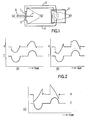
- Figure 1 illustrates schematically part of a resistance spot welding system comprising a pair of electrodes 1, 2, mounted in respective machine arms 3, 4.
- the machine arms 3, 4 are supported by a conventional housing 5.
- a pair of workpieces 6, 7 is positioned between the electrodes 1, 2 and an alternating electric current is applied to the circuit containing the electrodes 1, 2, causing the formation of a spot weld.
- it is conventional to monitor the variation in apparent resistance in the circuit carrying the alternating current.
- FIG. 2a A typical wave form of the potential difference (s6 called electrode voltage) between the points a is illustrated in Figure 2a.
- the current wave form (I) shows distinct zero pauses (corresponding to a low relative heat or large phase delay condition) in the sinusoidal form.
- the corresponding potential (V) has a similar sinusoidal form except for the clear discontinuities (at the beginning and end of the current loop) which are partly due to inductive components.
- the potential wave form shows considerably greater discontinuities in addition to the approximately sinusoidal form ( Figure 2b).
- the potential drop as sensed at the positionsc is severely disturbed such that the sinusoidal form is lost in comparison with the inductive distortion (Figure 2c).
- the peak voltage is that due to the inductive elements and is in no way related to the true resistive drop.
- the average potentialscorresponding to the current loop are for the three positions approximately 0.76V, 0.86V, and finally about 1.21V at the rear of the machine arms. (Note the average potential takes account of-the potential reversal in the given current loop).
- the potential drops corresponding to current peak are for the three positions approximately 1.2V, 1.35V and finally about 1.9V at the rear of the machine arms 3, 4 (compared with a maximum inductive spike of around 4V).
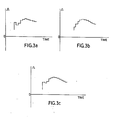
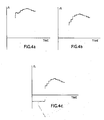
- the additional resistance represented by the machine arms 3, 4 can be offset as shown in Figure 4c such that the percentage rise and fall of the apparent resistance measured at a point remote from the electrode tips is substantially the same as that measured close to the electrode tips (see Figure 3b).
- Diagrams similar to Figures 4b and 4c, but exhibiting the effect of the initial extra resistance can be drawn for measurement over all of the current loop. However for measurement over part of the current loop, the initial resistance due to the interface is less obtrusive.
- the effect of the machine arms 3, 4 and the like can be readily eliminated by setting the degree of offset (or pre-biasing) in tests with a sheet of copper in place of steel between the electrode tips.
- Short circuit tests of this nature can also be used to determine whether the machine is overheating due say to inadequate water cooling under the conditions of use.
- the short circuit resistance increases significantly compared with that for the machine at substantially room temperature, if the machine is heating up.
- a similar test can also be conducted with respect to the primary of a resistance welding machine to determine whether the latter is being overheated under load.
- the true effective resistance of the work is given for each cycle of alternating current, either as the resistance determined at the instant of current peak, by sampling at that moment, or as the resistance determined throughout the current loop (by integrating the potential between zero current instants as previously described) or as the resistance over part of the current loop between corresponding levels.
- the resistance so determined can also serve as a monitor of the process. For example, with reduced current, the work is heated but a true weld is not developed between the sheets. Under these conditions the initial resistance shows a similar rise but without the fall to the correct equilibrium level.
- the running resistance under these conditions is some 25% (and more) greater than the equilibrium resistance for a properly developed seam weld with interface nugget fusion.
- This system can also be conveniently applied to gun welders and to resistance welding machines attached to robots and the like with the potential drop measurement taken from any convenient access point. Equally, the conductive quality or operating performance of sliding and rotary connections carrying heavy current can be monitored in situ, such as the connection bearings in seam welding machines.
- the operating current and hence the effective heating is controlled by introducing a degree of phase delay to the thyristor or ignitron controlling the primary.
- phase delay not only is the period of current flow in each half cycle reduced but the current peak is also diminished.
- the heating due to the square of current falls off,rapidly with increasing phase delay.
- the rate of change of current is also zero. Therefore it is sometimes necessary to ensure that the electrode or machine potential is registered near or at a true current peak where the instantaneous current is greater than zero together with low or zero rate of change.
- a logic gate is released only when current is flowing and for the short period while the rate of change of current is close to zero.
- a logic gate is closed only when current is flowing (or not zero) and over the period while the rate of change of current is substantially not zero.
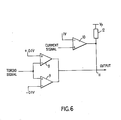
- Figure 6 illustrates a gating system for determining the time of occurrence of zero rate of change of current.
- This gating system is for use in the method in which the potential drop is determined at peak current i.e. zero rate of change of current.
- a toroid (not shown) is provided around one of the machine arms 3, 4, the output of which is fed to a pair of comparators 8, 9.
- a fixed voltage of 0.1 volts is applied to the positive input of the comparator 8 while a fixed voltage of -0.1 volts is applied to the negative input of the comparator 9.
- the current flowing in the circuit including the electrodes 1, 2 is applied to the positive input of a comparator 10.
- a fixed voltage of 1 volt is applied to the negative input of the comparator 10.
- the outputsof the comparator 10 and of the comparators 8, 9 are connected to a point 11 representing the output of the gating system.
- a fixed voltage V is applied to a resistor 12 which is connected to the point 11.
- the comparators 8, 9, 10 must all be off, i.e. open collector, for the output at the point 11 to rise to the level V . If the toroid signal is more positive than +0.1 volts or more negative than -0.1 volts, or if the integrated toroid signal, viz current is not greater than 1 volt then the comparator concerned draws current through the common resistance 12 and the output is held low.
- the output is ⁇ 2 V rms for a 50Hz, 1000A rms sine wave.
- the peak toroid output is 10/2 V.
- the rate of change of the toroid voltage is therefore 2 ⁇ f 1012 V/sec (for 10 kA) where f is the supply frequency, viz 50Hz.
- the time interval for the sampling pulse governed by the threshold voltages on the comparator gates 8 and 9 i.e. + 0.1V, is sec, or about 45 ⁇ sec which corresponds to less than one electrical degree about the ponds to less than one electrical degree about the current peak.
- a short sampling pulse at current peak as described is advantageous the system is not limited to such a short duration sample only.
- the sample pulse could correspond to say ⁇ 5° around the current peak, without introducing serious error, especially if the potential sensed (or resistance derived) during the sample is averaged over the sample period (i.e. about 1 ⁇ 2 ms), as already described.
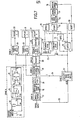
- FIG. 7 Apparatus for providing an output representative of resistance at current peak is illustrated in Figure 7.
- the sensed potential is fed along a line 13 to the switched range divider 14 the output of which is supplied to a switched range gain 15 the output of which is fed to a rectifier 16.
- These three components form zone A of the circuit which effectively scales the input potential and applies signal rectification.
- the ,.output from the toroid, representing rate of change of current, is fed to an integrator 17, the output of which is fed to a switched range gain unit 18 the output of which is fed to a rectifier 19.
- These three components represent zone B of the circuit which effectively scales and rectifies the current signal so that suitable signals are provided to a divider 20 comprising zone D, the output of which is proportional to the signal level from zone A divided by the signal level from zone B.
- Zone E comprises a gating system 22 similar to that shown in Figure 6.
- the toroid output is applied to the gating system 22 along a line 23 while the integrated and rectified toroid signal is applied to the gating system 22 along a line 24.
- the output from the gating system 22, which comprises a signal when the toroid output signal passes through zero is applied to a sample and hold unit 24 via a line 25.
- the output from the unit 24 is fed to a scaling unit 26 whose output is displayed by a conventional display means 27.
- the sample and hold unit 24 samples the output signal from the divider 20 when a signal is applied along the line 25 corresponding to a current peak.
- the signal on the line 25 is applied to sample and hold units 28, 29 which are similar to the unit 24 and sample the rectified potential output from zone A and the rectified current output from zone B at the instant of current peak.
- Conventional display means 30, 31, display the sampled potential and current respectively.
- the monitored resistance is used to control welding current as will be described later.
- the instant of potential sampling is given by a logic combination of both the rate of change of current close to or at zero together with a finite slope to the toroid signal from positive to negative or vice versa.
- the second differential of the instantaneous current must be finite at the instant that the first differential is zero.
- the instantaneous potential as derived by the unit 15 is conveniently displayed on an oscilloscope with one axis representing potential and the other representing toroid voltage.
- the magnitude then of the voltage on the potential axis at the instant of zero on the other axis is the true resistive drop.
- Figure 8a where the origin corresponds to the periods of zero current and zero potential in the chopped current wave (such as shown in Figure 2c) the ellipse describes the relation of potential to rate of change of current throughout a cycle of current.
- the magnitude on the potential axis is readily determined and, where necessary, compared with the potential drop under standard conditions, such as when monitoring for deterioration in a cable.
- the signal representing rate of change of current can be amplified so that the ellipse approximates to a line crossing the potential axis, Figure 8b.
- the potential signal to the oscilloscope can be offset by a finite amount and the oscilloscope deflection further amplified so that values of instantaneous potential at current peak can be readily determined to an accuracy of better than 1% or even 0.1% error.
- Figure 9 illustrates apparatus for deriving integral potential and integral current together with average resistance as opposed to the determination of potential at current peak which is achieved by the apparatus shown in Figure 7.
- the apparatus shown in Figure 9 comprises a switch range gain unit 32 to which the instantaneous potential V is fed, the output from which is fed to an integrator 33 which in turn feeds a rectifier 34.
- the rectifier 34 can be omitted if the appropriate polarity is obtained for the input signal V.
- a subsidiary circuit zone A' which comprises a peak sample and hold unit 35 connected to a display 36 ensures that the integrator 33 is not overloaded or saturated.
- the output of the rectifier 34 is fed to the peak sample and hold unit 35.
- a toroid (not shown) is provided around one of the machine arms 3, 4 the output signal of the toroid representing the rate of change of current in the electrical circuit.
- the toroid signal is applied to a switch range divider 37 the output of which is fed to an integrator 38.
- the output of the integrator 38 represents the magnitude of the current and this signal is fed to a switch range gain unit 39 the outputof which is fed to a further integrator 40 and from there to a rectifier 41.
- the rectifier 41 can be omitted if the signal polarity is correct.
- a subsidiary circuit zone B' is provided for detecting and displaying peak current.
- the output from the integrator 38 is fed to a rectifier 42 the output of which is fed to a peak sample and hold unit 43 whose output is displayed by display unit 44.
- the period of integration is determined by a threshold detector 45 forming zone E of the circuit, where, at the end of the integration period, the integral value is held as required.
- the current signal is fed directly to the threshold detector 45 whose output is fed to the integrator 33 and the integrator 40.
- the threshold can be set close to zero and the appropriate current signal suitably amplified.
- the secondary of a current transformer can be connected to a relatively high load such as 20n (which is shunted by diodes back to back) so that the current transition through zero is clearly shown by the voltage reversal across the load resistor.
- the integration is carried out over the period where the voltage across the load resistor is greater than the threshold values such as 0.1V.
- Zone C forms a sampling device which continuously registers the running integral value which is then held when the current signal falls below the threshold. Thereafter the stored values are held for a further short period such as O.lms before the sampling circuit zone C is released or reset.
- the outputs from the rectifiers 34, 41 are also fed to the sample and hold units 47, 48 whose outputs are fed to further sample and hold units 49, 50 which feed display means 51, 52. These comprise zone F and display the integral values of potential and current.
- the sampled integral potential and current values from zone C are applied to a divider 53 whose output represents average resistance, which in turn is also sampled by a sample and hold unit 54, scaled by a scaling unit 55 and displayed by display means 56.
- the sampled integral current output from the sample and hold unit 48 is provided with a minimum level clamp by a signal clamp unit 57 to avoid spurious reading when the integral current is low or zero.
- the integrators and peak sample and hold units require resetting to zero before each period of integration (giving controlled initial conditions for the integration). The reset should only be present when neither the enable signal nor the delay of zone C is operative.
- the sample and hold circuits 54, 49, and 50 are not reset to zero as they hold the value of average resistance between samples.
- one method is to detect when the rate of change of current has decreased below a threshold value. While the current is increasing towards its maximum and then decaying, the rate of change signal falls towards zero and increases again with the opposite polarity.
- the integrator 33 can be initiated when the rate of change of current falls below a finite level and similarly the integrator can be stopped when the rate of change of current (i.e. toroid) signal has reached an equal and opposite value.
- the integral of the instantaneous potential registered over this period is then an index of the average resistance occurring. If this integral potential is divided by the corresponding integral of current, the quotient is proportional to the average resistance for that period.
- the output from the toroid can be divided down to any convenient value to suit the threshold level detector which opens the gate to the integrator.
- a timer can also be started and stopped when the rate of change signal crosses the one threshold and subsequently crosses the equal and opposite threshold. The timer indicates the period over which the integration is taken, and the threshold levels and/or the fraction of the toroid voltage signal can be adjusted as desired to give integration over nominally say lms, up to say 3 ms, around the current peak.
- Figure 10a illustrates a circuit suitable for use as the integrator 33 or the integrator 40.
- the circuit comprises input resistances 57, 58 to which the output from the respective switch range gain unit 32, 39 is fed.
- the output from the resistance 58 is fed to the negative input of an operational amplifier 59 mounted in parallel with a capacitor 60.
- a switch 61 which may be a conventional transistor switch is connected between the resistances 57, 58 so that on closure of the switch 61, the input to the operational amplifier 59 is short circuited.
- a switch 62 which may also be a conventional transistor switch, is connected in series with an output resistance 63 to the output of the operational amplifier 59. Closure of the switch 62 causes the integrator to be reset by discharging the capacitor 60.
- Zone E comprises a pair of comparators 64, 65 to which the current signal (A) is applied.
- the form of the current signal (A) is'illustrated in Figure 11.
- the output from the comparators 64, 65 which will be a square wave (B) is fed to one input of a NAND gate 66 and to one input of a NAND gate 67.
- a fixed potential is applied to the other input of the NAND gate 66.
- the output signal (C) from the NAND gate 66 is fed to the delay circuit 46.
- the Q output signal (E) from the delay 46 is fed to the instantaneous sample and hold units.49, 50,54 while the signal (C) is fed to the integrators 33, 40 where the "low” portion of the signal (C) causes closure of the switch 61.
- the Q output signal ( D ) from the delay circuit 46 is fed to the NAND gate 67 the output of which is fed to one input of a NAND gate 68.
- the other input of the NAND gate 68 is a constant potential and the output signal (F) from the NAND gate 68 is fed to the tracking sample and hold circuits 47,48 and to the integrators 33, 40 where the "low” portion of the signal (F) causes closure of the switch 62.
- the sample and hold circuits shown in Figure 9 release the sample on receipt of the signal (F).
- the integration approach is theoretically exact only when the integration is taken over the time period for which the current level at start and stop is identical in the current loop concerned. Therefore for greater accuracy, instead of relying on symmetry in the rate of change of current signal, the rate of change signal itself can be integrated, starting from the instant the signal passes the threshold value. The integration is then maintained until the signal integral itself returns to zero, which signifies that the-starting and ending levels of current are the same. Again a timer can indicate the period of integration to confirm that it is over the nominal period desired.
- the time interval period can be used in a feedback loop such that the toroid signal is adjusted with respect to the threshold level until a preferred integration period, such as 2 ms about the current peak, is obtained.
- This automatic correction preferably operates over a long time constant, so that the toroid signal is not appreciably altered with respect to the threshold level from one current cycle to the next.
- the error in the feedback loop can be used to drive a motor which in turn alters a potentiometer resistor governing the threshold level and/or the fraction of the toroid signal which determines the instant of initiation of the integration period.
- the motorised potentiometer then acts as a memory store of the preferred setting from one test (or one weld) to the next while being able to make minor adjustments if, for example, the overall current is drifting slightly with time due to a change in the mains supply voltage.
- a suitable rate of correction is lms change in the effective integration period per second of continuous motor drive at its maximum rate, corresponding to a large error between the actual integration time and the preferred set time.
- a preferred integration period is then established in about 10-30 seconds overall of continuous current flow (or the corresponding time interval for the equivalent sum of a sequence of current flows) to within the limits of error detection in the feedback correction circuit, or within 0.2ms, whichever is the greater.
- the respective signal can be used for control purposes.
- an abnormally high potential reading indicates high interface resistance and in the extreme, where virtually no conductive contact is obtained, the value corresponds to a nominally open circuit condition, as with paint films or heavily contaminated surfaces.
- an abnormally low potential could indicate the absence of the work between the electrodes, that is to say where the electrodes have short-circuited together and missed the work to be welded, as can occur in unattended or robotic welding systems.
- the value of resistance can serve to distinguish between whether two or more sheets are being welded simultaneously. This change in potential or resistance level can thus be used to adapt the welding schedule to suit the number of sheets being welded in a mixed combination of two sheets, three and four sheets together, and so forth.
- Figure 7 illustrates schematically one method of utilising the measured resistance to control a resistance welding current.
- the signal representing resistance is fed along a line 69 to a pair of comparators 70, 71. These compare the signal on the line 69 with high and low references respectively and the output from each comparator is fed to a respective store 72, 73.
- the output signal from the gating system 22 is fed to a latch 74 and a NAND gate 75.
- the output from the NAND gate 75 is fed to the stores 72, 73 where it provides a clock signal input.
- the output from the stores 72 , 73 and from the latch 74 are fed to a logic drive selector circuit 76 whose output is fed to a signal drive unit 77 which in turn controls a controller 78 which modulates the welding current.
- the controller 78 is fed back to a reset circuit 79 whose output is fed to the stores72, 73 and to the latch 74.
- the stores.and latch are reset.
- this control circuitry There are three conditions which this control circuitry can act upon. Firstly, the resistance signal on the line 69 may be greater than the "high” reference applied to the comparator 70; secondly, the signal on the line 69 may be less than the ".high” reference but greater than the "low” reference input to the comparator 71; and thirdly the signal on the line 69 may be lower than the "low” reference input to the comparator 71.
- the logic drive selector 76 compares the latest received signal on the line 69 with the previous signal and if they are different, that is they represent different conditions as previously outlined, an appropriate adjustment signal is applied to the signal drive 77. In this case the latch 74 and associated gate is reset as often as desired, such as every 1 second, by the machine controller 78 and the reset 79. -If successive signals on the line 69 satisfy the same condition then no adjustment is made.
Landscapes
- Physics & Mathematics (AREA)
- General Physics & Mathematics (AREA)
- Measurement Of Resistance Or Impedance (AREA)
- Measurement Of Current Or Voltage (AREA)
Applications Claiming Priority (2)
| Application Number | Priority Date | Filing Date | Title |
|---|---|---|---|
| GB8225827 | 1982-09-10 | ||
| GB8225827 | 1982-09-10 |
Publications (2)
| Publication Number | Publication Date |
|---|---|
| EP0106493A2 true EP0106493A2 (fr) | 1984-04-25 |
| EP0106493A3 EP0106493A3 (fr) | 1986-02-05 |
Family
ID=10532825
Family Applications (1)
| Application Number | Title | Priority Date | Filing Date |
|---|---|---|---|
| EP83305178A Ceased EP0106493A3 (fr) | 1982-09-10 | 1983-09-06 | Surveillance de la résistance de charge dans des lignes à courant alternatif en service |
Country Status (3)
| Country | Link |
|---|---|
| US (1) | US4577086A (fr) |
| EP (1) | EP0106493A3 (fr) |
| JP (1) | JPS5966987A (fr) |
Families Citing this family (8)
| Publication number | Priority date | Publication date | Assignee | Title |
|---|---|---|---|---|
| IT1179830B (it) * | 1984-11-26 | 1987-09-16 | Fiat Auto Spa | Dispositivo di controllo per apparecchiature per saldatura elettrica a resistenza particolarmente per il controllo di apparecchiature per la saldatura di parti di carrozzerie di autoveicoli |
| JPS61189882A (ja) * | 1985-02-19 | 1986-08-23 | Dengensha Mfg Co Ltd | 抵抗溶接機用制御装置の二次導体監視装置 |
| CA1221416A (fr) * | 1985-06-25 | 1987-05-05 | Hydro-Quebec | Ohmmetre pour la mesure de tres faibles resistances electriques |
| JPH10323767A (ja) * | 1997-05-27 | 1998-12-08 | Miyachi Technos Corp | 抵抗溶接用電流検出装置 |
| JP3540127B2 (ja) * | 1997-06-12 | 2004-07-07 | 矢崎総業株式会社 | 抵抗溶接方法及び該方法に用いる装置 |
| US9285402B1 (en) * | 2006-04-20 | 2016-03-15 | Jack S. Emery | Apparatus and methods for estimating impedance in conductive medium |
| JP5127788B2 (ja) * | 2009-08-01 | 2013-01-23 | 株式会社豊田中央研究所 | 抵抗溶接方法、抵抗溶接部材、抵抗溶接機、抵抗溶接機の制御方法とその制御プログラムおよびその制御装置並びに抵抗溶接の評価方法とその評価プログラムおよびその評価装置 |
| US9219406B1 (en) | 2013-02-15 | 2015-12-22 | Ideal Power Inc. | Systems and methods for assessing current in a resonant circuit |
Family Cites Families (12)
| Publication number | Priority date | Publication date | Assignee | Title |
|---|---|---|---|---|
| US2508330A (en) * | 1948-03-20 | 1950-05-16 | Budd Co | Weld control circuit with inductive voltage elimination |
| GB1177987A (en) * | 1967-04-11 | 1970-01-14 | Solartron Electronic Group | Improvements in and relating to Resistance Welding COntrol Systems |
| US3573421A (en) * | 1967-07-03 | 1971-04-06 | Robotron Corp | Quotient circuit |
| GB1384871A (en) * | 1971-01-26 | 1975-02-26 | Pressed Steel Fisher Ltd | Method of and means for monitoring changes in the electrical resistance of resistance welds during welding |
| DE2219284C3 (de) * | 1972-04-20 | 1975-10-23 | Messer Griesheim Gmbh, 6000 Frankfurt | Verfahren und Einrichtung zum Messen des Widerstandes, insbesondere des Gesamtwiderstandes beim Widerstandspunktschweißen |
| JPS5141655A (ja) * | 1974-10-04 | 1976-04-08 | Idec Izumi Corp | Yosetsuhinshitsukanshisochi |
| US4079226A (en) * | 1975-02-25 | 1978-03-14 | The Welding Institute | Resistance welding |
| JPS5428250A (en) * | 1977-08-04 | 1979-03-02 | Koyo Seiko Co | Apparatus for inspecting welded products in resistance butting welding |
| JPS5940550B2 (ja) * | 1980-02-01 | 1984-10-01 | トヨタ車体株式会社 | スポット溶接の溶接強度監視装置 |
| JPS6015434B2 (ja) * | 1980-04-02 | 1985-04-19 | 松下電器産業株式会社 | 溶接電極間電圧検出装置 |
| US4302653A (en) * | 1980-04-02 | 1981-11-24 | Weltronic Company | Method and apparatus for monitoring and controlling a resistance welding operation |
| US4456810A (en) * | 1982-03-29 | 1984-06-26 | Ford Motor Company | Adaptive schedule selective weld control |
-
1983
- 1983-09-06 EP EP83305178A patent/EP0106493A3/fr not_active Ceased
- 1983-09-09 US US06/530,657 patent/US4577086A/en not_active Expired - Fee Related
- 1983-09-10 JP JP58165894A patent/JPS5966987A/ja active Pending
Also Published As
| Publication number | Publication date |
|---|---|
| JPS5966987A (ja) | 1984-04-16 |
| EP0106493A3 (fr) | 1986-02-05 |
| US4577086A (en) | 1986-03-18 |
Similar Documents
| Publication | Publication Date | Title |
|---|---|---|
| US5343016A (en) | Microprocessor controlled welding apparatus | |
| US6596970B2 (en) | Method of determining cable impedance | |
| JPH051107B2 (fr) | ||
| US5691628A (en) | Regulation of current or voltage with PWM controller | |
| EP0669182A2 (fr) | Procédé de contrôle de soudage par résistance utilisant la logique floue | |
| US4577086A (en) | Monitoring in-service resistance of AC conductors | |
| US5325047A (en) | Voltage monitoring apparatus, as for monitoring cathodic protection voltage on an underground pipeline | |
| US4459457A (en) | Feedback welder control system | |
| US5015815A (en) | Process and device for regulation of resistance or arc welding processes | |
| CA1250357A (fr) | Controleur a trois bornes pour douille a fibres optiques | |
| KR100650611B1 (ko) | 저항용접제어방법 및 장치 | |
| US4449028A (en) | Monitoring circuits for electrical welding apparatus | |
| US4084075A (en) | Energy monitor for flash welders | |
| US3149221A (en) | Resistance monitor | |
| US4254323A (en) | Apparatus for monitoring and controlling a welding phenomenon in an electric resistance welding | |
| US3558849A (en) | Welding control | |
| JPS61147981A (ja) | 電気抵抗溶接制御装置、特に、自動車本体部品溶接制御装置 | |
| JPS60190252A (ja) | 粉末塗装方法およびその装置 | |
| US4061960A (en) | Apparatus for providing regulated direct current to magnetizing coils for non-destructive magnetic testing | |
| US3575572A (en) | Welding control | |
| JPH0644542Y2 (ja) | インバータ式抵抗溶接機の制御又は測定装置 | |
| US4273948A (en) | Electrode height control in electro-slag remelting processes | |
| US4079226A (en) | Resistance welding | |
| JP3259013B2 (ja) | インバータ式抵抗溶接電源装置 | |
| JP2510138Y2 (ja) | 短絡検出器 |
Legal Events
| Date | Code | Title | Description |
|---|---|---|---|
| PUAI | Public reference made under article 153(3) epc to a published international application that has entered the european phase |
Free format text: ORIGINAL CODE: 0009012 |
|
| AK | Designated contracting states |
Designated state(s): BE DE FR GB IT NL SE |
|
| PUAL | Search report despatched |
Free format text: ORIGINAL CODE: 0009013 |
|
| AK | Designated contracting states |
Designated state(s): BE DE FR GB IT NL SE |
|
| 17P | Request for examination filed |
Effective date: 19860708 |
|
| 17Q | First examination report despatched |
Effective date: 19880419 |
|
| STAA | Information on the status of an ep patent application or granted ep patent |
Free format text: STATUS: THE APPLICATION HAS BEEN REFUSED |
|
| 18R | Application refused |
Effective date: 19911114 |
|
| RIN1 | Information on inventor provided before grant (corrected) |
Inventor name: RIVETT, ROBERT MICHAEL Inventor name: NEEDHAM, JAMES CHRISTOPHER Inventor name: PERRYMAN, RAYMOND ANDREW GEORGE |