EP0107214A2 - Pharmaceutical compositions containing benzoyl-phenyl ureas with anti-tumour activity - Google Patents
Pharmaceutical compositions containing benzoyl-phenyl ureas with anti-tumour activity Download PDFInfo
- Publication number
- EP0107214A2 EP0107214A2 EP83201263A EP83201263A EP0107214A2 EP 0107214 A2 EP0107214 A2 EP 0107214A2 EP 83201263 A EP83201263 A EP 83201263A EP 83201263 A EP83201263 A EP 83201263A EP 0107214 A2 EP0107214 A2 EP 0107214A2
- Authority
- EP
- European Patent Office
- Prior art keywords
- urea
- difluorobenzoyl
- chlorobenzoyl
- trifluoromethylphenyl
- phenyl
- Prior art date
- Legal status (The legal status is an assumption and is not a legal conclusion. Google has not performed a legal analysis and makes no representation as to the accuracy of the status listed.)
- Withdrawn
Links
- 230000000259 anti-tumor effect Effects 0.000 title claims description 13
- 235000013877 carbamide Nutrition 0.000 title abstract description 9
- 230000000694 effects Effects 0.000 title description 22
- 239000008194 pharmaceutical composition Substances 0.000 title description 2
- -1 benzoyl-phenyl ureas Chemical class 0.000 title 1
- 206010028980 Neoplasm Diseases 0.000 claims abstract description 33
- 150000001875 compounds Chemical class 0.000 claims abstract description 26
- 239000002207 metabolite Substances 0.000 claims abstract description 5
- 238000000034 method Methods 0.000 claims abstract description 5
- 241000124008 Mammalia Species 0.000 claims abstract description 3
- 239000003937 drug carrier Substances 0.000 claims abstract 3
- QQQYTWIFVNKMRW-UHFFFAOYSA-N diflubenzuron Chemical compound FC1=CC=CC(F)=C1C(=O)NC(=O)NC1=CC=C(Cl)C=C1 QQQYTWIFVNKMRW-UHFFFAOYSA-N 0.000 claims description 32
- JTHMHWAHAKLCKT-UHFFFAOYSA-N 2,6-difluoro-n-[[4-(trifluoromethyl)phenyl]carbamoyl]benzamide Chemical compound FC1=CC=CC(F)=C1C(=O)NC(=O)NC1=CC=C(C(F)(F)F)C=C1 JTHMHWAHAKLCKT-UHFFFAOYSA-N 0.000 claims description 14
- XSQUKJJJFZCRTK-UHFFFAOYSA-N Urea Chemical compound NC(N)=O XSQUKJJJFZCRTK-UHFFFAOYSA-N 0.000 claims description 8
- 239000004202 carbamide Substances 0.000 claims description 8
- BTYQXKURSPAXLT-UHFFFAOYSA-N 2,6-dichloro-n-[(4-chlorophenyl)carbamoyl]benzamide Chemical compound C1=CC(Cl)=CC=C1NC(=O)NC(=O)C1=C(Cl)C=CC=C1Cl BTYQXKURSPAXLT-UHFFFAOYSA-N 0.000 claims description 4
- XRFJRBAHPTZBOI-UHFFFAOYSA-N 2,6-dichloro-n-[[4-(trifluoromethyl)phenyl]carbamoyl]benzamide Chemical compound C1=CC(C(F)(F)F)=CC=C1NC(=O)NC(=O)C1=C(Cl)C=CC=C1Cl XRFJRBAHPTZBOI-UHFFFAOYSA-N 0.000 claims description 4
- DSJINNVAUCRKQF-UHFFFAOYSA-N 2,6-difluoro-n-[[2-hydroxy-4-(trifluoromethyl)phenyl]carbamoyl]benzamide Chemical compound OC1=CC(C(F)(F)F)=CC=C1NC(=O)NC(=O)C1=C(F)C=CC=C1F DSJINNVAUCRKQF-UHFFFAOYSA-N 0.000 claims description 4
- VCSTVIUXWRHGRU-UHFFFAOYSA-N 2-chloro-n-[[2-hydroxy-4-(trifluoromethoxy)phenyl]carbamoyl]benzamide Chemical compound OC1=CC(OC(F)(F)F)=CC=C1NC(=O)NC(=O)C1=CC=CC=C1Cl VCSTVIUXWRHGRU-UHFFFAOYSA-N 0.000 claims description 4
- ALDITXXHXOPLDO-UHFFFAOYSA-N 2-chloro-n-[[2-hydroxy-4-(trifluoromethyl)phenyl]carbamoyl]benzamide Chemical compound OC1=CC(C(F)(F)F)=CC=C1NC(=O)NC(=O)C1=CC=CC=C1Cl ALDITXXHXOPLDO-UHFFFAOYSA-N 0.000 claims description 4
- OGDKFNDFPQSPOW-UHFFFAOYSA-N 2-chloro-n-[[4-(trifluoromethyl)phenyl]carbamoyl]benzamide Chemical compound C1=CC(C(F)(F)F)=CC=C1NC(=O)NC(=O)C1=CC=CC=C1Cl OGDKFNDFPQSPOW-UHFFFAOYSA-N 0.000 claims description 4
- UISUNVFOGSJSKD-UHFFFAOYSA-N chlorfluazuron Chemical compound FC1=CC=CC(F)=C1C(=O)NC(=O)NC(C=C1Cl)=CC(Cl)=C1OC1=NC=C(C(F)(F)F)C=C1Cl UISUNVFOGSJSKD-UHFFFAOYSA-N 0.000 claims description 4
- UYMXPTOPIXEVBD-UHFFFAOYSA-N n-[(4-chloro-3-hydroxyphenyl)carbamoyl]-2,6-difluorobenzamide Chemical compound C1=C(Cl)C(O)=CC(NC(=O)NC(=O)C=2C(=CC=CC=2F)F)=C1 UYMXPTOPIXEVBD-UHFFFAOYSA-N 0.000 claims description 4
- MQYMKWNLXXZZBH-UHFFFAOYSA-N n-[(4-chlorophenyl)carbamoyl]benzamide Chemical compound C1=CC(Cl)=CC=C1NC(=O)NC(=O)C1=CC=CC=C1 MQYMKWNLXXZZBH-UHFFFAOYSA-N 0.000 claims description 4
- TXZCJLMBVJZJPX-UHFFFAOYSA-N 2,6-difluoro-n-[[4-(trifluoromethoxy)phenyl]carbamoyl]benzamide Chemical compound FC1=CC=CC(F)=C1C(=O)NC(=O)NC1=CC=C(OC(F)(F)F)C=C1 TXZCJLMBVJZJPX-UHFFFAOYSA-N 0.000 claims description 3
- BNVZZAOYMJQJAH-UHFFFAOYSA-N n-[(3,4-dichlorophenyl)carbamoyl]-2,6-difluorobenzamide Chemical compound FC1=CC=CC(F)=C1C(=O)NC(=O)NC1=CC=C(Cl)C(Cl)=C1 BNVZZAOYMJQJAH-UHFFFAOYSA-N 0.000 claims description 3
- RKAOXPMSYKCERI-UHFFFAOYSA-N n-[[3-chloro-4-(4-chlorophenoxy)phenyl]carbamoyl]-2,6-difluorobenzamide Chemical compound FC1=CC=CC(F)=C1C(=O)NC(=O)NC(C=C1Cl)=CC=C1OC1=CC=C(Cl)C=C1 RKAOXPMSYKCERI-UHFFFAOYSA-N 0.000 claims description 3
- YPSCQJTUAKNUNF-UHFFFAOYSA-N 2-chloro-n-[(4-chlorophenyl)carbamoyl]benzamide Chemical compound C1=CC(Cl)=CC=C1NC(=O)NC(=O)C1=CC=CC=C1Cl YPSCQJTUAKNUNF-UHFFFAOYSA-N 0.000 claims description 2
- 125000001997 phenyl group Chemical group [H]C1=C([H])C([H])=C(*)C([H])=C1[H] 0.000 claims 4
- WVZKBVDRPBIKII-UHFFFAOYSA-N n-[(4-cyanophenyl)carbamoyl]-2,6-difluorobenzamide Chemical compound FC1=CC=CC(F)=C1C(=O)NC(=O)NC1=CC=C(C#N)C=C1 WVZKBVDRPBIKII-UHFFFAOYSA-N 0.000 claims 3
- BLDOIQCQNGKQFS-UHFFFAOYSA-N n-[(4-cyclohexylphenyl)carbamoyl]-2,6-difluorobenzamide Chemical compound FC1=CC=CC(F)=C1C(=O)NC(=O)NC1=CC=C(C2CCCCC2)C=C1 BLDOIQCQNGKQFS-UHFFFAOYSA-N 0.000 claims 3
- ZWYSLPOHOBPSLC-UHFFFAOYSA-N n-benzoyl-n'-phenylurea Chemical compound C=1C=CC=CC=1NC(=O)NC(=O)C1=CC=CC=C1 ZWYSLPOHOBPSLC-UHFFFAOYSA-N 0.000 claims 3
- XAIPTRIXGHTTNT-UHFFFAOYSA-N triflumuron Chemical compound C1=CC(OC(F)(F)F)=CC=C1NC(=O)NC(=O)C1=CC=CC=C1Cl XAIPTRIXGHTTNT-UHFFFAOYSA-N 0.000 claims 3
- DKEQANWYKDHQOT-UHFFFAOYSA-N 2,6-difluoro-n-[(4-hydroxyphenyl)carbamoyl]benzamide Chemical compound C1=CC(O)=CC=C1NC(=O)NC(=O)C1=C(F)C=CC=C1F DKEQANWYKDHQOT-UHFFFAOYSA-N 0.000 claims 1
- 239000005893 Diflubenzuron Substances 0.000 description 29
- 229940019503 diflubenzuron Drugs 0.000 description 29
- 239000007924 injection Substances 0.000 description 25
- 238000002347 injection Methods 0.000 description 25
- 201000001441 melanoma Diseases 0.000 description 17
- 238000002474 experimental method Methods 0.000 description 14
- 230000004614 tumor growth Effects 0.000 description 13
- 241000699670 Mus sp. Species 0.000 description 11
- 238000012360 testing method Methods 0.000 description 11
- 210000004027 cell Anatomy 0.000 description 10
- PPQNQXQZIWHJRB-UHFFFAOYSA-N Methylcholanthrene Chemical compound C1=CC=C2C3=CC4=CC=C(C)C(CC5)=C4C5=C3C=CC2=C1 PPQNQXQZIWHJRB-UHFFFAOYSA-N 0.000 description 9
- 208000035250 cutaneous malignant susceptibility to 1 melanoma Diseases 0.000 description 8
- 230000002829 reductive effect Effects 0.000 description 8
- 239000000411 inducer Substances 0.000 description 7
- 230000002503 metabolic effect Effects 0.000 description 7
- DDBREPKUVSBGFI-UHFFFAOYSA-N phenobarbital Chemical compound C=1C=CC=CC=1C1(CC)C(=O)NC(=O)NC1=O DDBREPKUVSBGFI-UHFFFAOYSA-N 0.000 description 6
- 229960002695 phenobarbital Drugs 0.000 description 6
- 239000000725 suspension Substances 0.000 description 6
- 230000012010 growth Effects 0.000 description 5
- 238000011640 AKR mouse Methods 0.000 description 4
- LFQSCWFLJHTTHZ-UHFFFAOYSA-N Ethanol Chemical compound CCO LFQSCWFLJHTTHZ-UHFFFAOYSA-N 0.000 description 4
- 108010074633 Mixed Function Oxygenases Proteins 0.000 description 4
- 102000008109 Mixed Function Oxygenases Human genes 0.000 description 4
- 230000002255 enzymatic effect Effects 0.000 description 4
- 238000005805 hydroxylation reaction Methods 0.000 description 4
- 239000003112 inhibitor Substances 0.000 description 4
- GVPFVAHMJGGAJG-UHFFFAOYSA-L cobalt dichloride Chemical compound [Cl-].[Cl-].[Co+2] GVPFVAHMJGGAJG-UHFFFAOYSA-L 0.000 description 3
- 229940097267 cobaltous chloride Drugs 0.000 description 3
- 230000002401 inhibitory effect Effects 0.000 description 3
- 210000001853 liver microsome Anatomy 0.000 description 3
- 239000002609 medium Substances 0.000 description 3
- 206010061289 metastatic neoplasm Diseases 0.000 description 3
- 230000002476 tumorcidal effect Effects 0.000 description 3
- 238000011740 C57BL/6 mouse Methods 0.000 description 2
- 229920002101 Chitin Polymers 0.000 description 2
- 241001465754 Metazoa Species 0.000 description 2
- 230000009471 action Effects 0.000 description 2
- 239000007864 aqueous solution Substances 0.000 description 2
- 230000008901 benefit Effects 0.000 description 2
- 230000015572 biosynthetic process Effects 0.000 description 2
- 108010059035 biphenyl-4-hydroxylase Proteins 0.000 description 2
- 238000004113 cell culture Methods 0.000 description 2
- 230000003247 decreasing effect Effects 0.000 description 2
- 239000001963 growth medium Substances 0.000 description 2
- 238000001727 in vivo Methods 0.000 description 2
- 238000011534 incubation Methods 0.000 description 2
- 230000000977 initiatory effect Effects 0.000 description 2
- 231100000225 lethality Toxicity 0.000 description 2
- 229920000036 polyvinylpyrrolidone Polymers 0.000 description 2
- 239000001267 polyvinylpyrrolidone Substances 0.000 description 2
- 235000013855 polyvinylpyrrolidone Nutrition 0.000 description 2
- 230000009467 reduction Effects 0.000 description 2
- 201000000849 skin cancer Diseases 0.000 description 2
- 201000008261 skin carcinoma Diseases 0.000 description 2
- 238000011272 standard treatment Methods 0.000 description 2
- 208000001382 Experimental Melanoma Diseases 0.000 description 1
- 241000238631 Hexapoda Species 0.000 description 1
- 241000699666 Mus <mouse, genus> Species 0.000 description 1
- 206010029098 Neoplasm skin Diseases 0.000 description 1
- 108090000854 Oxidoreductases Proteins 0.000 description 1
- 102000004316 Oxidoreductases Human genes 0.000 description 1
- 208000000453 Skin Neoplasms Diseases 0.000 description 1
- 238000010171 animal model Methods 0.000 description 1
- 239000002246 antineoplastic agent Substances 0.000 description 1
- 150000001491 aromatic compounds Chemical class 0.000 description 1
- 230000010261 cell growth Effects 0.000 description 1
- 230000008859 change Effects 0.000 description 1
- 239000003795 chemical substances by application Substances 0.000 description 1
- 210000000349 chromosome Anatomy 0.000 description 1
- 229940125782 compound 2 Drugs 0.000 description 1
- 239000000824 cytostatic agent Substances 0.000 description 1
- 230000001085 cytostatic effect Effects 0.000 description 1
- 230000001419 dependent effect Effects 0.000 description 1
- 239000003814 drug Substances 0.000 description 1
- 229940079593 drug Drugs 0.000 description 1
- 230000000857 drug effect Effects 0.000 description 1
- 230000010224 hepatic metabolism Effects 0.000 description 1
- 230000002962 histologic effect Effects 0.000 description 1
- 230000033444 hydroxylation Effects 0.000 description 1
- 238000000338 in vitro Methods 0.000 description 1
- 230000005764 inhibitory process Effects 0.000 description 1
- 230000000749 insecticidal effect Effects 0.000 description 1
- 239000007928 intraperitoneal injection Substances 0.000 description 1
- 210000004185 liver Anatomy 0.000 description 1
- 230000003211 malignant effect Effects 0.000 description 1
- 238000005259 measurement Methods 0.000 description 1
- 230000007246 mechanism Effects 0.000 description 1
- 230000007102 metabolic function Effects 0.000 description 1
- 230000004060 metabolic process Effects 0.000 description 1
- 230000003228 microsomal effect Effects 0.000 description 1
- 231100001160 nonlethal Toxicity 0.000 description 1
- 230000000683 nonmetastatic effect Effects 0.000 description 1
- 201000008968 osteosarcoma Diseases 0.000 description 1
- 230000003647 oxidation Effects 0.000 description 1
- 238000007254 oxidation reaction Methods 0.000 description 1
- 230000002035 prolonged effect Effects 0.000 description 1
- 239000002356 single layer Substances 0.000 description 1
- 230000003068 static effect Effects 0.000 description 1
- 239000000126 substance Substances 0.000 description 1
- 210000001519 tissue Anatomy 0.000 description 1
- 210000004881 tumor cell Anatomy 0.000 description 1
Classifications
-
- A—HUMAN NECESSITIES
- A61—MEDICAL OR VETERINARY SCIENCE; HYGIENE
- A61K—PREPARATIONS FOR MEDICAL, DENTAL OR TOILETRY PURPOSES
- A61K31/00—Medicinal preparations containing organic active ingredients
- A61K31/33—Heterocyclic compounds
- A61K31/395—Heterocyclic compounds having nitrogen as a ring hetero atom, e.g. guanethidine or rifamycins
- A61K31/435—Heterocyclic compounds having nitrogen as a ring hetero atom, e.g. guanethidine or rifamycins having six-membered rings with one nitrogen as the only ring hetero atom
- A61K31/44—Non condensed pyridines; Hydrogenated derivatives thereof
-
- A—HUMAN NECESSITIES
- A61—MEDICAL OR VETERINARY SCIENCE; HYGIENE
- A61K—PREPARATIONS FOR MEDICAL, DENTAL OR TOILETRY PURPOSES
- A61K31/00—Medicinal preparations containing organic active ingredients
- A61K31/16—Amides, e.g. hydroxamic acids
- A61K31/17—Amides, e.g. hydroxamic acids having the group >N—C(O)—N< or >N—C(S)—N<, e.g. urea, thiourea, carmustine
-
- A—HUMAN NECESSITIES
- A61—MEDICAL OR VETERINARY SCIENCE; HYGIENE
- A61K—PREPARATIONS FOR MEDICAL, DENTAL OR TOILETRY PURPOSES
- A61K31/00—Medicinal preparations containing organic active ingredients
- A61K31/275—Nitriles; Isonitriles
Definitions
- the present invention relates to novel pharmaceutical compositions having antitumor activity, and to a method of treating tumors in mammals.
- United States Patent No. 3.748.356 discloses that I-benzoyl-3-phenyl ureas have insecticidal activity. This activity is based on a mechanism that is not fully understood at this time. It has been found that the insects are killed by these compounds because these I-benzoyl-3-phenyl ureas influence, i.e., inhibit, chitin formation.
- the compounds were tested by intraperitoneal injections of suspensions of the compounds in an aqueous solution of polyvinyl pyrrolidone. Doses and schedules of injection were varied, but no optimal dose-schedule has as yet been determined for either compound.
- the lethality of the compounds wth the exception of PH 60-44 was extremely low. Injection of the compound was essentially non-lethal even in massive doses of 100 mg/mouse.
- mice with malignant melanomas were injected with 20 mg or 40 mg diflubenzuron in suspension or with the suspension medium (blank).
- an initial injection of 20 mg of diflubenzuron resulted in an 11.7% and a 13.4% reduction in tumor size within 24 hours of treatment, as compared to a 60.7% and a 34% increase, respectively, in tumor size for blank-treated controls (Table I).
- This effect is also emphasized by a large increase in doubling time (i.e., mean time in days for the tumors to double in mass calculated on the basis of the change within 48 hours after treatment) from 1.9 days for the blank-treated control to 10.4 days for diflubenzuron--treated animals (Table I).
- Injection of 40 mg resulted in a greater effect (initial decrease by 22% and a negative doubling time).
- the compound PH 60-44 was also tested in this model. Mice were treated with 5 mg each in suspension or 0.05 ml of medium on days 0, 1, 2, 3 and 4 or with 10 mg in suspension or 0.1 ml of medium on days 0, 1 and 5.
- PH 60-44 has a moderate effect on malignant melanoma tumors in that the tumors fail to grow for 24 hours after a single injection. However, PH 60-44 produced a strong a prolonged effect in Ca 1025 skin tumors.
- mice of the C57BL/6 strain were injected with 1 x 10 5 malignant melanoma tumor cells, and tumors of approximately 50 - 500 mg developed in the mice at the sites of injection in about 14 days. Animals with growing tumors were treated with 100 mg of diflubenzuron alone (suspended in an aqueous solution of polyvinylpyrrolidone) or in combination with a metabolic inhibitor or a metabolic inducer according to the schedule given in Table XI.
- Cobaltous chloride was used as a metabolic inhibitor. This compound inhibits the monooxygenase activity in liver microsomes.
- Phenobarbital is a general mixed function oxidase inducer and increases the metabolism of a wide variety of substances. It causes a large increase in biphenyl 4-hydroxylase activity, but only a small increase in 2-hydroxylase activity.
- 3-Methylcholanthrene is an inducer of microsomal mixed function oxidase activity. This is mainly responsible for hydroxylation (oxidation) of aromatic compounds. 3-Methylcholanthrene induces 2-hyaroxylase activity but not 4-hydroxylation.
- the tumors of the experimental groups were measured and growth rates were compared.
- Phenobarbital was used to enhance liver metabolism, and consequently to increase the enzymatic activity of liver microsomes. Phenobarbital was injected into tumor bearing mice prior to the standard treatment with diflubenzuron.
- 3-MC was given to tumor-bearing mice before the standard treatment with 100 mg diflubenzuron. 3-MC enhances 2-hydroxylase activity but not 4-hydroxylase activity. As a further control a small group of tumor-bearing mice was given 3-MC alone. 3-MC enhanced the antitumor effects of diflubenzuron throughout the five-day measurement period (Table XIV).
- mice were given 100 mg of diflubenzuron, 100 mg of the 3-hydroxy metabolite, or 100 mg of the 2-hydroxy metabolite, respectively, 20 mg each on day 0, 1, 2, 3 and 4.
- the 2-hydroxy metabolite was more effective, for the first 48 hours after treatment, than the parent compound diflubenzuron (Table XV). Moreover, the 3-hydroxy metabolite was not active at all.
- test compounds were sonicated and then incubated without cells for 3 hours at 37°C.
- the compound to be tested was administered to the plates with melanoma B-16 cells in the desired quantity (each test was done in triplicate). Thereafter the plates were incubated in a C0 2 -incubator for 20 hours at 37°C. Then the incubation was stopped by removing the culture medium containing the test compound, the cells were washed twice, and fresh culture medium was added.
- Ethanol itself has no effect on the growth of melanoma B-16 cells.
Landscapes
- Health & Medical Sciences (AREA)
- Chemical & Material Sciences (AREA)
- Medicinal Chemistry (AREA)
- Pharmacology & Pharmacy (AREA)
- Epidemiology (AREA)
- Life Sciences & Earth Sciences (AREA)
- Animal Behavior & Ethology (AREA)
- General Health & Medical Sciences (AREA)
- Public Health (AREA)
- Veterinary Medicine (AREA)
- Acyclic And Carbocyclic Compounds In Medicinal Compositions (AREA)
- Pharmaceuticals Containing Other Organic And Inorganic Compounds (AREA)
Abstract
Description
- The present invention relates to novel pharmaceutical compositions having antitumor activity, and to a method of treating tumors in mammals.
- United States Patent No. 3.748.356 discloses that I-benzoyl-3-phenyl ureas have insecticidal activity. This activity is based on a mechanism that is not fully understood at this time. It has been found that the insects are killed by these compounds because these I-benzoyl-3-phenyl ureas influence, i.e., inhibit, chitin formation.
- Furthermore, European Patent Application No. 0.025.363 mentions that N-benzoyl-N'-pyridyloxy phenyl ureas have antitumor effects.
- It has now been found that 1-benzoyl-3-phenyl ureas known per se with the exception of the compounds having antitumor activity known from European patent application No. 0.025.363, Japanese patent application No. 185.451 (publication No. 57.109.721) and Japanese patent application No. 104765 (publication No. 57.031.664), which have inhibitory activity on chitin formation and known metabolites thereof, have a very interesting cytostatic or tumoricidal effect on mammalian tumors.
- More specifically, it was found that
- 1) 1-(2,6-difluorobenzoyl)-3-(4-chlorophenyl)urea (known as diflubenzuron);
- 2) 1-(2,6-difluorobenzoyl)-3-[3,5-dichloro-4-(3-chloro-5--trifluoromethyl-2-pyridyloxy)phenyl]urea;
- 3) 1-(2,6-difluorobenzoyl)-3-[3-chloro-4-(4-chlorophenoxy) phenyl]urea;
- 4) 1-(2,6-difluorobenzoyl)-3-(4-trifluoromethylphenyl)urea (known as PH 60-44);
- 5) 1-(2-chlorobenzoyl)-3-(4-chlorophenyl)urea;
- 6) l-(2-chlorobenzoyl)-3-(4-trifluoromethoxyphenyl)urea;
- 7) 1-(2,6-difluorobenzoyl)-3-(4-chloro-2-hydroxyphenyl urea;
- 8) 1-(2,6-difluorobenzoyl)-3-(4-chloro-3-hydroxyphenyl)urea
- 9) 1-(2-chlorobenzoyl)-3-(2-hydroxy-4-trifluoromethoxyphenyl)urea
- 10) l-(2,6-difluorobenzoyl)-3-(4-cyanophenyl)urea;
- 11) 1-(2,6-difluorobenzoyl)-3-[4-(1,1,2,3,3,3-hexafluoropro- poxy)phenylJurea;
- 12) 1-(2,6-difluorobenzoyl)-3-(4 :aydroxyphenyl)urea;
- 13) l-(2,6-difluorobenzoyl)-3-(4-cyclohexylphenyl)urea;
- 14) 1-(2,6-difluorobenzoyl)-3-(4-trifluoromethoxyphenyl)urea
- 15) 1-(2,6-difluorobenzoyl)-3-(3,4-dichlorophenyl)urea;
- 16) 1-(2-chlorobenzoyl)-3-(4-trifluoromethylphenyl)urea;
- 17) 1-(2,6-dichlorobenzoyl)-3-(4-chlorophenyl)urea;
- 18) 1-(2,6-dichlorobenzoyl)-3-(4-trifluoromethylphenyl)urea
- 19) 1-benzoyl-3-(4-chlorophenyl)urea;
- 20) 1-(2,6-difluorobenzoyl)-3-(2-hydroxy-4-trifluoromethylphenyl)urea;
- 21) 1-(2-chlorobenzoyl)-3-(2-hydroxy-4-trifluoromethylphenyl)urea; inhibit tumor growth in several test models.
- To determine the inhibitory activity of the compounds in vivo, three test models have been used:
- I. B-16 malignant melanoma in C57BL/6 mice. To study the effect of drugs or other agents on growth of tumors in vivo, a metastatic tumor such as B-16 melanoma has the advantage of providing both a primary site and microscopic foci of metastatic tumors.
- II. Ridgeway Osteogenic Sarcoma (ROS) in AKR mice. The advantage of the use of such a localized, non-metastatic tumor for studies on drug effects is that pertuba- tions of tumor growth and longevity of the mice are attributable to a direct effect on the primary tumor.
- III. Skin carcinoma (Ca 1025) in AKR mice. This tumor represents a second histologic cell type arising from skin and is less malignant than malignant melanoma.
- The compounds were tested by intraperitoneal injections of suspensions of the compounds in an aqueous solution of polyvinyl pyrrolidone. Doses and schedules of injection were varied, but no optimal dose-schedule has as yet been determined for either compound.
- The lethality of the compounds wth the exception of PH 60-44 was extremely low. Injection of the compound was essentially non-lethal even in massive doses of 100 mg/mouse.
- Lethality for PH 60-44 was observed at a much lower dose. Multiple injections for a total dose of 25-30 mg during a five day period resulted in 10-15% mortality. Therefore, the experiments included injections of 10 mg each for 3 injections or 5 mg each for 5 injections.
- The compounds were tested according to the following procedures:
- Mice with malignant melanomas were injected with 20 mg or 40 mg diflubenzuron in suspension or with the suspension medium (blank). In two of the experiments an initial injection of 20 mg of diflubenzuron resulted in an 11.7% and a 13.4% reduction in tumor size within 24 hours of treatment, as compared to a 60.7% and a 34% increase, respectively, in tumor size for blank-treated controls (Table I). This effect is also emphasized by a large increase in doubling time (i.e., mean time in days for the tumors to double in mass calculated on the basis of the change within 48 hours after treatment) from 1.9 days for the blank-treated control to 10.4 days for diflubenzuron--treated animals (Table I). Injection of 40 mg resulted in a greater effect (initial decrease by 22% and a negative doubling time).

- In a further experiment injections of 20 mg each on day 0 and day 2 or 4 resulted in a further delay of tumor growth (Table II). After a single injection the tumors remained reduced for about 2 days. However, a repeat injection of 20 mg on day 2 or 4 resulted in reduced rate of growth through about the 6th day.


- Similar experiments as were done with diflubenzuron were carried out with PH 60-44.
- The initial injection of PH 60-44 on day 0 into mice with malignant melanomas caused stasis in tumor growth for about 24 hours (Table IV). Second and third injections, on days one and five, respectively, however, had little or no effect on subsequent tumor growth (Table IV). Tumor growth at 5 days or later was unaltered as evidenced by percent increase in tumor mass.

- Also similar experiments have been carried out with the above identified compounds 2), 3), 5), 6) and 10) to 19).
- Comparisons were made between treated tumors and control tumors with a similar mean mass.
- The compounds 3), 5), 6) 10), 11), 12), 15) and 19) were given in doses of 20 mg each on days 0, 1, 2, 3 and 4. Compounds 13), 14), 16), 17) and 18) were given in doses of only 10 mg each on days 0, 1, 2, 3 and 4. Finally compound 2) was given in doses of 20 mg each on days 0, 1 and 2.
- The results are summarized in table V.

- Doses of diflubenzuron of 20 mg on day 0 (Table VI), 20 mg each on days 0 and 3; and 20 mg each on days 0, 1, 2, 5 and 6 (Table VII) were used in this test model. As with the malignant melanoma model, a reduced rate of growth was observed 24-48 hours after an initial injection of diflubenzuron (Table VI) but tumor size did not decrease.

- Repeated injections reduced the rate of tumor growth, but not beyond the approximate times of treatment (Table VII).

- The effects were less (or the treatment was not as effective) in this tumor model than in the malignant melanoma model.
- A single dose of PH 60-44 resulted in reduced rate of tumor growth at 24 hours (Table VIII). This table shows the results obtained in two experiments in which 30 mg total of PH 60-44 was injected into AKR mice with ROS. However, the schedules of injections were days 0, 1 and 2 for the first one, and days 0, 3 and 5 for the second one. Tumors of the first experiment responded very well resulting in tumor stasis or only a slight increase at 1 and 2 days, and reduced percentage increase through 11 days. On the other hand, the protracted schedule (days 0, 3 and 5) was not effective beyond the initial injection.
- The initial effect of treatment with PH 60-44 for both experiments in this model was slightly greater than the initial effect of diflubenzuron in the same model.

- A single injection of diflubenzuron in this model resulted in a decrease in tumor mass at 24 hours and a decreased rate of growth at 48 hours (Table IX).

- However, multiple doses did not alter tumor growth significantly beyond the initial injection.
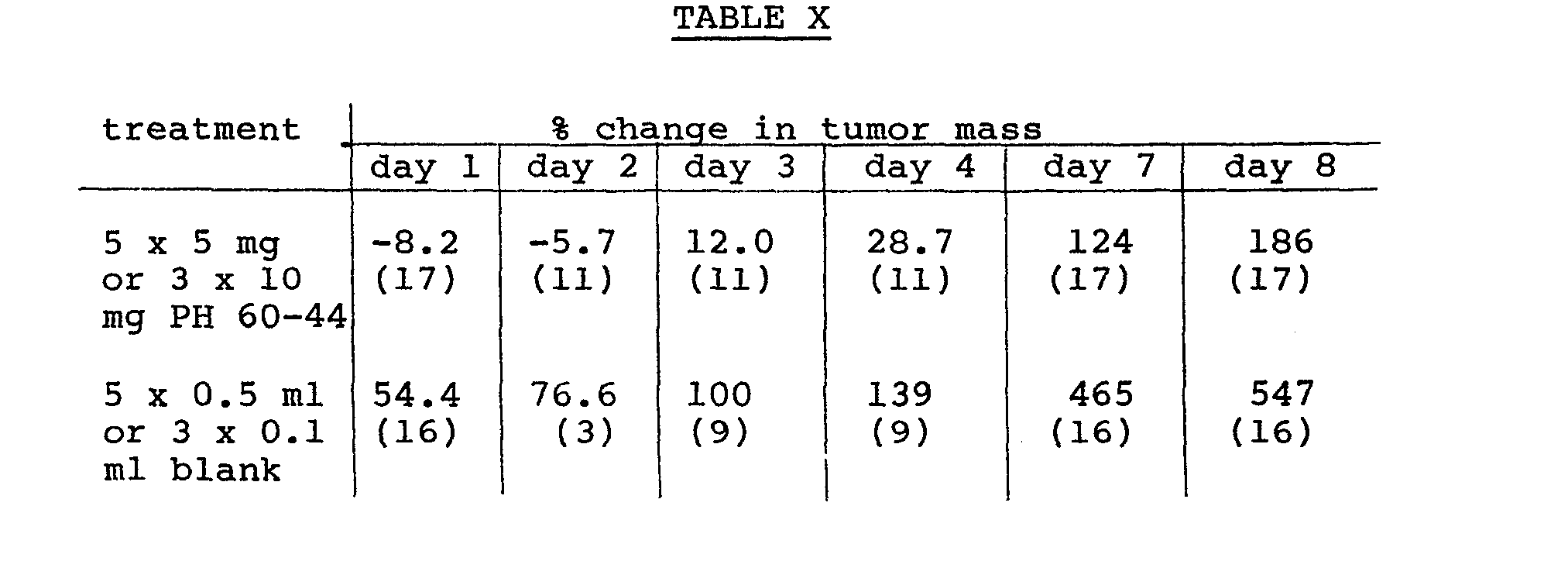
- The compound PH 60-44 was also tested in this model. Mice were treated with 5 mg each in suspension or 0.05 ml of medium on days 0, 1, 2, 3 and 4 or with 10 mg in suspension or 0.1 ml of medium on days 0, 1 and 5.
- An initial injection of 5 or 10 mg resulted in an 8.2% decrease in tumor mass on day 1 and a second injection on day 1 resulted in a 5.7% decrease by day 2, whereas blank-treated controls increased by 54.4% on day 1 and 76.6% by day 2 (Table X).
- Multiple injections during the first 5 days after the initial injection resulted in reduced tumor growth throughout the 21-day testing period.

- it appears rrom the resurts or the above test models that the tumoricidal effect of diflubenzuron is probably dose-schedule dependent. Increased doses and protracted doses of diflubenzuron in the malignant melanoma model enhances and prolongs tumor inhibition.
- PH 60-44 has a moderate effect on malignant melanoma tumors in that the tumors fail to grow for 24 hours after a single injection. However, PH 60-44 produced a strong a prolonged effect in Ca 1025 skin tumors.
- To test the possibility that one or more of the known metabolites of known insecticidally active 1-benzoyl-3-phenyl ureas have an antitumor activity, a series of experiments were carried out to determine the effects of metabolic function inhibitors and inducers on the action of diflubenzuron in the animal model with malignant melanoma tumors.
- Mice of the C57BL/6 strain were injected with 1 x 10⁵ malignant melanoma tumor cells, and tumors of approximately 50 - 500 mg developed in the mice at the sites of injection in about 14 days. Animals with growing tumors were treated with 100 mg of diflubenzuron alone (suspended in an aqueous solution of polyvinylpyrrolidone) or in combination with a metabolic inhibitor or a metabolic inducer according to the schedule given in Table XI.
- Cobaltous chloride was used as a metabolic inhibitor. This compound inhibits the monooxygenase activity in liver microsomes.
- As metabolic inducers phenobarbital and 3-methylcholanthrene were used.
- Phenobarbital is a general mixed function oxidase inducer and increases the metabolism of a wide variety of substances. It causes a large increase in biphenyl 4-hydroxylase activity, but only a small increase in 2-hydroxylase activity.
- 3-Methylcholanthrene is an inducer of microsomal mixed function oxidase activity. This is mainly responsible for hydroxylation (oxidation) of aromatic compounds. 3-Methylcholanthrene induces 2-hyaroxylase activity but not 4-hydroxylation.
-

- The tumors of the experimental groups were measured and growth rates were compared.
- D. Cobaltous chloride as a metabolic inhibitor.
- Treatment with diflubenzuron alone gave a reduction in tumor mass on days 1-3. However, when cobaltous chloride was given before administration of diflubenzuron the inhibitory effect of diflubenzuron Was decreased (Table XII).
- It can be concluded from this experiment that an action to reduce monooxygenase activity of liver microsomes also reduces the antitumor activity of diflubenzuron. These data support the concept that enzymatic activity in liver chromosomes results in a metabolic product of diflubenzuron that is a more active anti-tumor agent than the parent compound.

- If, indeed, effects of diflubenzuron are directly related to enzymatic activity, an enhanced enzymatic activity obtained by administration of an oxidase inducer could increase the antitumor activity of diflubenzuron.
- In a first experiment phenobarbital was used to enhance liver metabolism, and consequently to increase the enzymatic activity of liver microsomes. Phenobarbital was injected into tumor bearing mice prior to the standard treatment with diflubenzuron.
- As shown in Table XIII phenobarbital, which causes a large increase in biphenyl 4-hydroxylase activity, but only a small increase in 2-hydroxylation, did not enhance the antitumor activity of diflubenzuron.

- To determine whether increase of 2-hydroxylation of diflubenzuron enhances the antitumor activity of diflubenzuron, 3-MC was given to tumor-bearing mice before the standard treatment with 100 mg diflubenzuron. 3-MC enhances 2-hydroxylase activity but not 4-hydroxylase activity. As a further control a small group of tumor-bearing mice was given 3-MC alone. 3-MC enhanced the antitumor effects of diflubenzuron throughout the five-day measurement period (Table XIV).


- As a further experiment to verify the results of the tests described under A and B, groups of tumor-bearing mice were given 100 mg of diflubenzuron, 100 mg of the 3-hydroxy metabolite, or 100 mg of the 2-hydroxy metabolite, respectively, 20 mg each on day 0, 1, 2, 3 and 4.
- The 2-hydroxy metabolite was more effective, for the first 48 hours after treatment, than the parent compound diflubenzuron (Table XV). Moreover, the 3-hydroxy metabolite was not active at all.

- These results support the previous data which indicate that the 2-hydroxy metabolite of diflubenzuron is more tumoricidal than diflubenzuron itself.
- Cells of malignant melanomas B-16 grow as a monolayer. The doubling time of this type of cells in a cell--culture is 12 to 16 hours. For this experiment 6 multi- well tissue culture plates having a flat bottom with a surface area of 6 cm2 appeared to be suitable and have been used.
- On day 0 a quantity of melanoma B-16 cells were brought on the cell-culture plates.
- The test compounds were sonicated and then incubated without cells for 3 hours at 37°C.
- Then the compound to be tested was administered to the plates with melanoma B-16 cells in the desired quantity (each test was done in triplicate). Thereafter the plates were incubated in a C02-incubator for 20 hours at 37°C. Then the incubation was stopped by removing the culture medium containing the test compound, the cells were washed twice, and fresh culture medium was added.
- 48 Hours after starting the incubation step the number of cells on each plate was measured by means of a microcell Coulter Counter. The results so obtained have been expressed as "percentage of controll cell growth". The results are summarized in Table XVI.
-

- Therefore a number of compounds has been dissolved in ethanol. The results so obtained in the same test as described above, i.e. against melanoma B-16 cells are summarized in Table XVII.

- Ethanol itself has no effect on the growth of melanoma B-16 cells.
Claims (6)
Applications Claiming Priority (4)
| Application Number | Priority Date | Filing Date | Title |
|---|---|---|---|
| US41403882A | 1982-09-02 | 1982-09-02 | |
| US41403782A | 1982-09-02 | 1982-09-02 | |
| US414037 | 1982-09-02 | ||
| US414038 | 1982-09-02 |
Publications (2)
| Publication Number | Publication Date |
|---|---|
| EP0107214A2 true EP0107214A2 (en) | 1984-05-02 |
| EP0107214A3 EP0107214A3 (en) | 1984-09-05 |
Family
ID=27022395
Family Applications (1)
| Application Number | Title | Priority Date | Filing Date |
|---|---|---|---|
| EP83201263A Withdrawn EP0107214A3 (en) | 1982-09-02 | 1983-09-02 | Pharmaceutical compositions containing benzoyl-phenyl ureas with anti-tumour activity |
Country Status (3)
| Country | Link |
|---|---|
| EP (1) | EP0107214A3 (en) |
| AU (1) | AU1862083A (en) |
| IL (1) | IL69621A0 (en) |
Cited By (26)
| Publication number | Priority date | Publication date | Assignee | Title |
|---|---|---|---|---|
| EP0136745A3 (en) * | 1983-09-01 | 1986-01-22 | Duphar International Research B.V | Benzoyl urea derivatives having anti-tumor activity |
| WO1986003941A1 (en) * | 1984-12-28 | 1986-07-17 | Union Carbide Corporation | Use of acyl urea compounds for controlling endoparasites and ectoparasites of warm-blooded animals |
| EP0233559A1 (en) * | 1986-02-08 | 1987-08-26 | Ishihara Sangyo Kaisha, Ltd. | Readily absorbable pharmaceutical composition |
| EP0193249A3 (en) * | 1985-03-01 | 1988-03-16 | Duphar International Research B.V | Benzoyl urea derivatives having ati-tumor activity |
| EP0324521A3 (en) * | 1988-01-11 | 1991-11-27 | Duphar International Research B.V | Method of treating haematologic diseases and pharmaceutical compositions to be used therefor |
| EP0475506A1 (en) * | 1990-09-10 | 1992-03-18 | Duphar International Research B.V | Pharmaceutical formulation containing a benzoyl urea derivative |
| US5116874A (en) * | 1985-09-23 | 1992-05-26 | Eli Lilly And Company | Anti-tumor method and compounds |
| US5155135A (en) * | 1988-12-21 | 1992-10-13 | Shell Internationale Research Maatschappij, B.V. | Benzamide compounds, their preparation and their use as pesticides |
| US5166180A (en) * | 1988-01-11 | 1992-11-24 | Duphar International Research B.V. | Method of treating hematologic diseases and pharmaceutical composition to be used therefor |
| US5169860A (en) * | 1992-03-13 | 1992-12-08 | Eli Lilly And Company | Antitumor compositions and methods of treatment |
| US5210100A (en) * | 1984-08-31 | 1993-05-11 | Ciba-Geigy Corporation | Phenylbenzoylureas |
| US5216026A (en) * | 1990-07-17 | 1993-06-01 | Eli Lilly And Company | Antitumor compositions and methods of treatment |
| US5234955A (en) * | 1991-12-20 | 1993-08-10 | Eli Lilly And Company | Antitumor compositions and methods of treatment |
| US5254582A (en) * | 1992-02-05 | 1993-10-19 | Eli Lilly And Company | Antitumor compositions and methods |
| US5258406A (en) * | 1991-12-20 | 1993-11-02 | Eli Lilly And Company | Sulfonimidamides |
| US5262440A (en) * | 1991-12-10 | 1993-11-16 | Eli Lilly And Company | Antitumor compositions and methods of treatment |
| US5270329A (en) * | 1992-12-10 | 1993-12-14 | Eli Lilly And Company | Antitumor compositions and methods of treatment |
| US5302724A (en) * | 1990-07-17 | 1994-04-12 | Eli Lilly And Company | Antitumor compositions and methods of treatment |
| US5565494A (en) * | 1992-12-10 | 1996-10-15 | Eli Lilly And Company | Antitumor compositions and methods of treatment |
| US7678811B2 (en) | 2002-02-11 | 2010-03-16 | Bayer Healthcare Llc | Pyridine, quinoline, and isoquinoline N-oxides as kinase inhibitors |
| US7838541B2 (en) | 2002-02-11 | 2010-11-23 | Bayer Healthcare, Llc | Aryl ureas with angiogenesis inhibiting activity |
| US7897623B2 (en) | 1999-01-13 | 2011-03-01 | Bayer Healthcare Llc | ω-carboxyl aryl substituted diphenyl ureas as p38 kinase inhibitors |
| US8110587B2 (en) | 2002-02-11 | 2012-02-07 | Bayer Healthcare Llc | Aryl ureas as kinase inhibitors |
| US8124630B2 (en) | 1999-01-13 | 2012-02-28 | Bayer Healthcare Llc | ω-carboxyaryl substituted diphenyl ureas as raf kinase inhibitors |
| US8637553B2 (en) | 2003-07-23 | 2014-01-28 | Bayer Healthcare Llc | Fluoro substituted omega-carboxyaryl diphenyl urea for the treatment and prevention of diseases and conditions |
| US8796250B2 (en) | 2003-05-20 | 2014-08-05 | Bayer Healthcare Llc | Diaryl ureas for diseases mediated by PDGFR |
Families Citing this family (2)
| Publication number | Priority date | Publication date | Assignee | Title |
|---|---|---|---|---|
| ATE40111T1 (en) * | 1984-07-05 | 1989-02-15 | Duphar Int Res | BENZOYL UREA COMPOUNDS AND INSECTICIDES AND ACARICIDES COMPOSITIONS CONTAINING SUCH. |
| US7557129B2 (en) | 2003-02-28 | 2009-07-07 | Bayer Healthcare Llc | Cyanopyridine derivatives useful in the treatment of cancer and other disorders |
Family Cites Families (5)
| Publication number | Priority date | Publication date | Assignee | Title |
|---|---|---|---|---|
| GB669016A (en) * | 1949-07-12 | 1952-03-26 | Roche Products Ltd | N-benzhydryl-n-acyl-ureas and process for the manufacture of same |
| GB1050198A (en) * | 1963-12-03 | |||
| TR19459A (en) * | 1976-08-25 | 1979-05-01 | Bayer Ag | SUEBSTITUEYE BENZOLIUEREIDODYHENYL ETHERS, PROCEDURES FOR THEIR PREPARATION AND THEIR USE AS INSECTIVES |
| ES472295A1 (en) * | 1978-08-02 | 1979-02-16 | Invest Tecnica Aplicada | New acylureas with pharmaceutical activity, the process for their preparation, and pharmaceutical compositions which contain them. |
| JPS5640667A (en) * | 1979-09-11 | 1981-04-16 | Ishihara Sangyo Kaisha Ltd | Urea derivative |
-
1983
- 1983-09-01 IL IL69621A patent/IL69621A0/en unknown
- 1983-09-01 AU AU18620/83A patent/AU1862083A/en not_active Abandoned
- 1983-09-02 EP EP83201263A patent/EP0107214A3/en not_active Withdrawn
Cited By (37)
| Publication number | Priority date | Publication date | Assignee | Title |
|---|---|---|---|---|
| EP0136745A3 (en) * | 1983-09-01 | 1986-01-22 | Duphar International Research B.V | Benzoyl urea derivatives having anti-tumor activity |
| US5210100A (en) * | 1984-08-31 | 1993-05-11 | Ciba-Geigy Corporation | Phenylbenzoylureas |
| WO1986003941A1 (en) * | 1984-12-28 | 1986-07-17 | Union Carbide Corporation | Use of acyl urea compounds for controlling endoparasites and ectoparasites of warm-blooded animals |
| US5135953A (en) * | 1984-12-28 | 1992-08-04 | Ciba-Geigy | Use of acyl urea compounds for controlling endoparasites and ectoparasites of warm-blooded animals |
| EP0193249A3 (en) * | 1985-03-01 | 1988-03-16 | Duphar International Research B.V | Benzoyl urea derivatives having ati-tumor activity |
| US5594028A (en) * | 1985-09-23 | 1997-01-14 | Eli Lilly And Company | Anti-tumor method and compounds |
| US5116874A (en) * | 1985-09-23 | 1992-05-26 | Eli Lilly And Company | Anti-tumor method and compounds |
| EP0233559A1 (en) * | 1986-02-08 | 1987-08-26 | Ishihara Sangyo Kaisha, Ltd. | Readily absorbable pharmaceutical composition |
| US5002952A (en) * | 1986-02-08 | 1991-03-26 | Ishihara Sangyo Kaisha Ltd. | Readily absorbed pharmaceutical composition |
| US5166180A (en) * | 1988-01-11 | 1992-11-24 | Duphar International Research B.V. | Method of treating hematologic diseases and pharmaceutical composition to be used therefor |
| EP0324521A3 (en) * | 1988-01-11 | 1991-11-27 | Duphar International Research B.V | Method of treating haematologic diseases and pharmaceutical compositions to be used therefor |
| US5155135A (en) * | 1988-12-21 | 1992-10-13 | Shell Internationale Research Maatschappij, B.V. | Benzamide compounds, their preparation and their use as pesticides |
| US5302724A (en) * | 1990-07-17 | 1994-04-12 | Eli Lilly And Company | Antitumor compositions and methods of treatment |
| US5216026A (en) * | 1990-07-17 | 1993-06-01 | Eli Lilly And Company | Antitumor compositions and methods of treatment |
| US6147115A (en) * | 1990-07-17 | 2000-11-14 | Eli Lilly And Company | Antitumor compositions and methods of treatment |
| EP0475506A1 (en) * | 1990-09-10 | 1992-03-18 | Duphar International Research B.V | Pharmaceutical formulation containing a benzoyl urea derivative |
| US5262440A (en) * | 1991-12-10 | 1993-11-16 | Eli Lilly And Company | Antitumor compositions and methods of treatment |
| US5234955A (en) * | 1991-12-20 | 1993-08-10 | Eli Lilly And Company | Antitumor compositions and methods of treatment |
| US5258406A (en) * | 1991-12-20 | 1993-11-02 | Eli Lilly And Company | Sulfonimidamides |
| US5354778A (en) * | 1991-12-20 | 1994-10-11 | Eli Lilly And Company | Antitumor compositions and methods of treatment |
| US5254582A (en) * | 1992-02-05 | 1993-10-19 | Eli Lilly And Company | Antitumor compositions and methods |
| SG79181A1 (en) * | 1992-02-05 | 2001-03-20 | Lilly Co Eli | Antitumor compositions and methods of treatment |
| US5169860A (en) * | 1992-03-13 | 1992-12-08 | Eli Lilly And Company | Antitumor compositions and methods of treatment |
| US5270329A (en) * | 1992-12-10 | 1993-12-14 | Eli Lilly And Company | Antitumor compositions and methods of treatment |
| US5565494A (en) * | 1992-12-10 | 1996-10-15 | Eli Lilly And Company | Antitumor compositions and methods of treatment |
| US8124630B2 (en) | 1999-01-13 | 2012-02-28 | Bayer Healthcare Llc | ω-carboxyaryl substituted diphenyl ureas as raf kinase inhibitors |
| US7897623B2 (en) | 1999-01-13 | 2011-03-01 | Bayer Healthcare Llc | ω-carboxyl aryl substituted diphenyl ureas as p38 kinase inhibitors |
| US8841330B2 (en) | 1999-01-13 | 2014-09-23 | Bayer Healthcare Llc | Omega-carboxyaryl substituted diphenyl ureas as raf kinase inhibitors |
| US7838541B2 (en) | 2002-02-11 | 2010-11-23 | Bayer Healthcare, Llc | Aryl ureas with angiogenesis inhibiting activity |
| US8071616B2 (en) | 2002-02-11 | 2011-12-06 | Bayer Healthcare Llc | Pyridine, quinoline, and isoquinoline N-oxides as kinase inhibitors |
| US8110587B2 (en) | 2002-02-11 | 2012-02-07 | Bayer Healthcare Llc | Aryl ureas as kinase inhibitors |
| US7678811B2 (en) | 2002-02-11 | 2010-03-16 | Bayer Healthcare Llc | Pyridine, quinoline, and isoquinoline N-oxides as kinase inhibitors |
| US8242147B2 (en) | 2002-02-11 | 2012-08-14 | Bayer Healthcare Llc | Aryl ureas with angiogenisis inhibiting activity |
| US8618141B2 (en) | 2002-02-11 | 2013-12-31 | Bayer Healthcare Llc | Aryl ureas with angiogenesis inhibiting activity |
| US9181188B2 (en) | 2002-02-11 | 2015-11-10 | Bayer Healthcare Llc | Aryl ureas as kinase inhibitors |
| US8796250B2 (en) | 2003-05-20 | 2014-08-05 | Bayer Healthcare Llc | Diaryl ureas for diseases mediated by PDGFR |
| US8637553B2 (en) | 2003-07-23 | 2014-01-28 | Bayer Healthcare Llc | Fluoro substituted omega-carboxyaryl diphenyl urea for the treatment and prevention of diseases and conditions |
Also Published As
| Publication number | Publication date |
|---|---|
| EP0107214A3 (en) | 1984-09-05 |
| IL69621A0 (en) | 1983-12-30 |
| AU1862083A (en) | 1984-03-08 |
Similar Documents
| Publication | Publication Date | Title |
|---|---|---|
| EP0107214A2 (en) | Pharmaceutical compositions containing benzoyl-phenyl ureas with anti-tumour activity | |
| Dusting | Nitric oxide in cardiovascular disorders | |
| Baxter et al. | Elevation of γ-aminobutyric acid in brain: selective inhibition of γ-aminobutyric-α-ketoglutaric acid transaminase | |
| Spector et al. | Biochemical and pharmacological effects of the monoamine oxidase inhibitors, iproniazid, 1-phenyl-2-hydrazinopropane (JB 516) and 1-phenyl-3-hydrazinobutane (JB 835) | |
| US5028627A (en) | Method of using arginine derivatives to inhibit systemic hypotension associated with nitric oxide production or endothelial derived relaxing factor | |
| Spector | F. Inhibitors of endogenous catecholamine biosynthesis | |
| Lane | Some effects of cyclophosphamide (Cytoxan) on normal mice and mice with L1210 leukemia | |
| Chick et al. | Curative action of nicotinic acid on pigs suffering from the effects of a diet consisting largely of maize | |
| US4925835A (en) | Aziridinyl putrescine containing compositions and their uses in treating prostate cancer | |
| JPH01254623A (en) | Cancer treatment drug containing an inhibitor of glycosphingolipid metabolism as an active ingredient | |
| ATE84045T1 (en) | INHIBITING SUBSTANCES ENKEPHALINASE-B THEIR PREPARATION AND THEIR PHARMACEUTICAL COMPOSITIONS. | |
| GB1392889A (en) | Methods and compositions for the feed intake of meat producing animals | |
| Connors et al. | The pharmacology and tumour growth inhibitory activity of 1-aminocyclopentane-1-carboxylic acid and related compounds | |
| US6365578B1 (en) | Drug cominbations containing AZT | |
| Kingsnorth et al. | Effects of α-difluoromethylornithine on the growth of experimental Wilms' tumor and renal adenocarcinoma | |
| Dairman | Catecholamine concentrations and the activity of tyrosine hydroxylase after an increase in the concentration of tyrosine in rat tissues | |
| EP0919244A2 (en) | Combinations for the treatment of tumours | |
| Warrington et al. | Histidinol-mediated Improvement in the Specificity of 1-β-d-Arabinofuranosylcytosine and 5-Fluorouracil in L1210 Leukemia-bearing Mice | |
| RU2421720C2 (en) | Method of determining efficacy of haemostimulators in cytostatic myelosuppression | |
| Brown et al. | Modulation of in vivo 3-deoxyglucosone levels | |
| Bardos et al. | Combination of chemotherapy with dual antagonists and radiotherapy in the treatment of neoplastic disease | |
| Kalechman et al. | Use and mechanism of action of AS101 in protecting bone marrow colony forming units-granulocyte-macrophage following purging with ASTA-Z 7557 | |
| EP0460232B1 (en) | Tumor cell growth inhibitor | |
| JPS62263127A (en) | Remedy for tumor by self-derived lak cell, interleukin-2 andornithine decarboxylase inhibitor | |
| JPS5959617A (en) | Anticancer medicine composition |
Legal Events
| Date | Code | Title | Description |
|---|---|---|---|
| PUAI | Public reference made under article 153(3) epc to a published international application that has entered the european phase |
Free format text: ORIGINAL CODE: 0009012 |
|
| AK | Designated contracting states |
Designated state(s): AT BE CH DE FR GB IT LI NL SE |
|
| PUAL | Search report despatched |
Free format text: ORIGINAL CODE: 0009013 |
|
| AK | Designated contracting states |
Designated state(s): AT BE CH DE FR GB IT LI NL SE |
|
| 17P | Request for examination filed |
Effective date: 19850219 |
|
| 17Q | First examination report despatched |
Effective date: 19860127 |
|
| D17Q | First examination report despatched (deleted) | ||
| STAA | Information on the status of an ep patent application or granted ep patent |
Free format text: STATUS: THE APPLICATION IS DEEMED TO BE WITHDRAWN |
|
| 18D | Application deemed to be withdrawn |
Effective date: 19880331 |
|
| RIN1 | Information on inventor provided before grant (corrected) |
Inventor name: MAYER, RICHARD T. Inventor name: JENKINS, VERNON K. |