EP0107388A2 - Transmission à éléments coniques - Google Patents
Transmission à éléments coniques Download PDFInfo
- Publication number
- EP0107388A2 EP0107388A2 EP83305844A EP83305844A EP0107388A2 EP 0107388 A2 EP0107388 A2 EP 0107388A2 EP 83305844 A EP83305844 A EP 83305844A EP 83305844 A EP83305844 A EP 83305844A EP 0107388 A2 EP0107388 A2 EP 0107388A2
- Authority
- EP
- European Patent Office
- Prior art keywords
- axis
- shaft
- speed
- conical
- respect
- Prior art date
- Legal status (The legal status is an assumption and is not a legal conclusion. Google has not performed a legal analysis and makes no representation as to the accuracy of the status listed.)
- Withdrawn
Links
- 230000007246 mechanism Effects 0.000 claims description 38
- 230000005540 biological transmission Effects 0.000 claims description 33
- 230000009467 reduction Effects 0.000 claims description 28
- 230000002441 reversible effect Effects 0.000 claims description 10
- 230000033001 locomotion Effects 0.000 claims description 9
- 230000000750 progressive effect Effects 0.000 claims description 5
- 238000005096 rolling process Methods 0.000 claims description 5
- 230000008878 coupling Effects 0.000 claims description 2
- 238000010168 coupling process Methods 0.000 claims description 2
- 238000005859 coupling reaction Methods 0.000 claims description 2
- 238000013459 approach Methods 0.000 claims 1
- 239000002131 composite material Substances 0.000 abstract description 29
- 230000003213 activating effect Effects 0.000 description 5
- 238000005461 lubrication Methods 0.000 description 5
- 238000004519 manufacturing process Methods 0.000 description 4
- 230000007935 neutral effect Effects 0.000 description 4
- 230000007423 decrease Effects 0.000 description 3
- 239000012530 fluid Substances 0.000 description 2
- 125000006850 spacer group Chemical group 0.000 description 2
- 230000009471 action Effects 0.000 description 1
- 239000003638 chemical reducing agent Substances 0.000 description 1
- 230000000694 effects Effects 0.000 description 1
- 239000012208 gear oil Substances 0.000 description 1
- 230000007794 irritation Effects 0.000 description 1
- 239000000314 lubricant Substances 0.000 description 1
- 238000003754 machining Methods 0.000 description 1
- 230000004044 response Effects 0.000 description 1
- 230000003068 static effect Effects 0.000 description 1
- 239000010913 used oil Substances 0.000 description 1
Images




Classifications
-
- F—MECHANICAL ENGINEERING; LIGHTING; HEATING; WEAPONS; BLASTING
- F16—ENGINEERING ELEMENTS AND UNITS; GENERAL MEASURES FOR PRODUCING AND MAINTAINING EFFECTIVE FUNCTIONING OF MACHINES OR INSTALLATIONS; THERMAL INSULATION IN GENERAL
- F16H—GEARING
- F16H15/00—Gearings for conveying rotary motion with variable gear ratio, or for reversing rotary motion, by friction between rotary members
- F16H15/48—Gearings for conveying rotary motion with variable gear ratio, or for reversing rotary motion, by friction between rotary members with members having orbital motion
- F16H15/56—Gearings providing a discontinuous or stepped range of gear ratios
-
- F—MECHANICAL ENGINEERING; LIGHTING; HEATING; WEAPONS; BLASTING
- F16—ENGINEERING ELEMENTS AND UNITS; GENERAL MEASURES FOR PRODUCING AND MAINTAINING EFFECTIVE FUNCTIONING OF MACHINES OR INSTALLATIONS; THERMAL INSULATION IN GENERAL
- F16H—GEARING
- F16H13/00—Gearing for conveying rotary motion with constant gear ratio by friction between rotary members
- F16H13/06—Gearing for conveying rotary motion with constant gear ratio by friction between rotary members with members having orbital motion
-
- Y—GENERAL TAGGING OF NEW TECHNOLOGICAL DEVELOPMENTS; GENERAL TAGGING OF CROSS-SECTIONAL TECHNOLOGIES SPANNING OVER SEVERAL SECTIONS OF THE IPC; TECHNICAL SUBJECTS COVERED BY FORMER USPC CROSS-REFERENCE ART COLLECTIONS [XRACs] AND DIGESTS
- Y10—TECHNICAL SUBJECTS COVERED BY FORMER USPC
- Y10S—TECHNICAL SUBJECTS COVERED BY FORMER USPC CROSS-REFERENCE ART COLLECTIONS [XRACs] AND DIGESTS
- Y10S475/00—Planetary gear transmission systems or components
- Y10S475/904—Particular mathematical equation
Definitions
- the aforedescribed multi-speed drive provides positive speed reductions and negative speed reductions. In addition, it provides 'overdrive', direct drive, 'park' and neutral modes of operation.
- a single-speed, speed-reducing and torque-transmitting mechanism includes a planar surface which is perpendicular to an axis and a cone which rolls on the planar surface and which revolves around the axis.
- the cone is attached to an input shaft aligned with the axis by a crank and is connected by a constant- velocity joint to an output shaft, which output shaft is also aligned with the axis.
- the instant invention relates to multi-speed drives utilizing conical surfaces. More particularly, the instant invention relates to multi-speed drives utilizing opposed conical surfaces which are selectively engaged to vary output torque, output speed and output direction.
- gear drives necessarily involve sliding motion and therefore require lubrication.
- gear drives are noisy.
- precision gears are relatively expensive to manufacture and engineer due to their complex shape and due to the machining necessary for production. If a gear drive is utilized in a situation where it is desirable to limit torque, then a torque-limiting coupling or clutch must be used in combination with the drive.
- Chain and sprocket transmissions are perhaps a bit more predictable than belt trans-i missions; however, chain and sprocket transmissions require lubrication and are relatively noisy. Since they are not inherently torque-limiting, other mechanisms must be utilized if a torque-limiting feature is desired. Moreover, chain and sprocket mechanisms are relatively expensive to manufacture and are relatively inefficient.
- cone drives generally experience slippage which reduces their efficiency.
- Exemplary of a drive which utilizes conical surfaces is the drive of U.S. Patent 4,161,890 in which a cone rotates on a stationary surface.
- the stationary surface is generally parallel to the axis of the cone, instead of being oriented at an angle thereto. Consequently, no appreciable torque escalation is accomplished.
- the drive is essentially a friction drive with all of the drawbacks that usually accompany friction drives.
- the instant invention contemplates a new and improved multi-speed drive which utilizes a new and improved torque transmission and speed reduction mechanism. Moreover, the instant invention further contemplates a torque transmission and speed reduction mechanism which may have a single output speed, torque and direction for a particular input speed, torque and direction.
- Such a torque transmission mechanism includes an input shaft which is mounted in a frame for rotation about a first axis.
- a first member is disposed around the first axis in the frame and has a first conical surface generated around the first axis.
- the first conical surface has an apex which is coincident with the first axis.
- a second member is disposed within the frame for rotation and revolution therein.
- the second member has a second conical surface in engagement with the first conical surface along a line of contact which intersects the first axis at a point that is coincident with the apex of both the first conical surface and second conical surface.
- the second member rotates about a second axis which is oblique with respect to the first axis and is also coincident with the apexes of the first and second conical surfaces and the point of intersection of the apexes and first axis.
- An output shaft is rotatably mounted in the frame to rotate about the first axis and is connected to the second member by a constant velocity joint, which is attached to the output shaft at a point coincident with the first axis and is attached to the second member at a point coincident with the second axis.
- the torque, speed and direction of rotation of the output shaft varies with respect to the torque, speed and direction of rotation of the input shaft in accordance with the angle that the line of contact between the conical surfaces makes with the first and second axes. Accordingly, the output shaft can rotate in the opposite direction of the input shaft, in the same direction, or, not rotate at all with respect to the input shaft.
- the output torque may be increased drastically with respect to the input torque with a concurrent decrease in output speed, or the output torque and speed may be substantially equal to the input torque or speed. If desired, an "overdrive" situation may be achieved wherein the output speed is in excess of the input speed with a concurrent decrease in output torque with respect to input torque.
- the first member may be configured as a composite cone having a plurality of conical surfaces in an annular arrangement about the second member.
- the apexes of the conical surfaces are coincident, and the point of coincidence lies on the first axis.
- the second member has a plurality of conical surfaces which engage the conical surfaces of the first member along lines of contact which, when extended, also intersect the apexes of the first conical surfaces and the first axis.
- the instant invention further contemplates utilizing non-rotatable, axially-shiftable first members in lieu of rotatable first members wherein the axially-shiftable members are individually brought into engagement with the corresponding surface on the composite cone in order to select a desired output speed.
- the aforedescribed multi-speed drive is particularly suitable as a transmission in automotive vehicles due to its high efficiency (approximately 98%), its minimal weight and size, and its relatively low cost.
- the output torque, speed and direction may be selected manually or automatically, depending on whether the input power is first passed through a manual clutch or torque converter.
- the instant invention further contemplates a new and improved single-speed reduction mechanism which includes a first shaft which rotates about a first axis normal to a planar surface on which planar surface a cone rotates in line contact therewith.
- the cone is mounted on a crank which has its input aligned with the first shaft and which journals the cone to rotate about an axis which intersects the planar surface at the same point that the axis of the first shaft intersects the planar surface.
- a constant velocity joint is connected to the cone at a point aligned with the apex of the cone and an output shaft is connected to the universal joint.
- the output shaft rotates at a speed less than the input shaft upon rotating the input shaft but with a higher torque than that applied to the input shaft.
- the instant invention further contemplates adjusting the force with which the conical surface is urged against the planar surface so that torque in excess of a predetermined torque will not be passed through the mechanism from the first shaft to the second shaft due to slippage between the conical surface and the planar surface upon the application of torque.
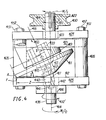
- the multi-speed drive 10 includes a frame or housing, designated generally by the numeral 11, which comprises a first end plate 12, which is joined to a second end plate 13 by a plurality of bolts 14 which pass through a cylindrical member 15. Nuts 16 are threaded on the bolts 14 to hold the frame or housing 11 assembled. A compressable member 17 is disposed between the cylindrical member 15 and first end plate 12.
- the first end plate 12 has a bearing 20 therein in which an input shaft 21 is journalled.
- the second end plate 13 has a bearing 22 in which an output shaft 23 is journalled.
- the input shaft 21 and the output shaft 23 are aligned with one another to rotate about the same longitudinal axis 24.
- the input shaft 21 is coupled to the output shaft 23 by a cone drive, designated generally by the numeral 25, which determines the speed, torque and direction of the output shaft 23 with respect to the speed, torque and direction of the input shaft 21.
- the cone drive comprises a first annular member 30 which includes an annular conical surface 31.
- the first annular member 30 is mounted for rotation on inner wall 29 of the cylindrical member 15 and on the inside surface of the second end plate 13 by roller bearings 33, disposed between the first member and wall, and by thrust bearings 34, disposed between the inside surface of the second end plate and the first annular member.
- the first annular member can be selectively fixed or grounded with respect to the frame or housing 11 by some type of stop or braking device.
- the braking device is a pin 40 which extends through a bore 41 in the cylindrical member 15 and into a bore 42 in the first annular member 30.
- the first annular member 30 determines the output speed of the output shaft 23.
- the first annular member 30 has no effect on the speed of the output shaft 23.
- first annular plate 45 which has a "conical” surface 46 thereon, which conical surface 46 may be, for all practical purposes, "flat” and is, therefore, a special case for a conical surface wherein the angle of the conical surface with respect to the "base” of the cone is 0.
- This conical surface corresponds to the flat surface in co-pending Application Serial Number 426,875 filed September 29, 1982, which application is herein incorporated by reference.
- the first annular plate 45 is free to rotate on thrust bearings 50 disposed between the second end plate 13 and the second annular member.
- a stop pin 51 mounted in bore 52 of the second end plate 13 may be projected into a bore 53 in the second annular plate 45, thus preventing its rotation.
- the first annular member 30 must be free to rotate in order to have the output torque and speed on the output shaft 23 determined by the first annular plate 45.
- a composite conical member, also referred to as the second member, 60 is mounted within the housing 11 on a crank arm 61 which crank arm is fixed to the input shaft 21.
- a bearing 62 journals the composite conical member 60 on a shaft 63 fixed to the crank arm.
- the shaft 63 is aligned with a second longitudinal axis 65 which intersects the first longitudinal axis 24 at a point 66.
- the composite conical member 60 is, therefore, rotatable about the second axis 65 as the conical member revolves about the first axis 24.
- a thrust bearing 67 is disposed between the composite conical member 60 and the crank arm 61.
- the conical member 60 has a conical surface 70 thereon which engages the conical surface 31 of the first annular member 30 in line contact along line 72.
- Line 72 when extended, intersects point 66, so that the apexes of the conical surfaces 31 and 70 are both coincident at the point 66 which is also coincident with first axis 24 and second axis 65.
- the composite conical member 60 has another conical surface 76 thereon which engages surface 46 on the annular member 45 on a line contact along line 78.
- the line 78 also passes through point 66 when extended so that it is coincident with the apexes of conical surfaces 31 and 72 and with the point of intersection of the first axis 24 and second axis 65.
- the conical member 60 will rotate at one speed with respect to the crank 61 and crank pin 63 when it is rolling on conical surface 31"and at another, slower, speed when it is rolling on conical surface 46.
- a constant velocity joint designated generally by the numeral 80, is connected to the conical member 60 and the output shaft 23 by pins 81 and 82, respectively.
- the pin 81 intersects the second axis 65, while the pin 82 intersects the first axis 24.
- the point of coincidence 66 lies within the constant velocity joint 80, and the constant velocity joint 80 revolves around the point 66. Since the output shaft 23 is restrained to purely rotational motion by bearing 22, the wobbling motion in the constant velocity joint 80 is converted to pure rotation by the output shaft 23.
- the cone drive 25 converts input rotation and torque on the input shaft 21 (exemplified by the arrow 85) to output rotation and torque on output shaft 23 (exemplified by the arrow 86).
- the cone drive 25 both reverses the direction of rotation and increases the output torque on output shaft 23 with respect to the input on shaft 21, while reducing the speed on output shaft with respect to input shaft. This is so for the speed determined by surface 31 on annular member 30 and the speed determined by surface 46 on the annular member 45.
- the crank 61 is supported against the first end plate 12 by thrust bearings 87.
- the force with which the crank 61 is urged against the bearings 87 can be selected by tightening or loosening the nuts 16 on the bolts 14. Consequently, the multi-speed drive 10 also serves as a torque-limiting device which will protect both a driving mechanism (not shown) connected to input shaft 21 and a driven mechanism (not shown) connected to output shaft 23.
- an input shaft 100 and an output shaft 101 are aligned with and rotate about a first axis 102.
- a first conical member 103 is disposed around the axis 102 and is fixed with respect to the axis 102 and output shaft 101.
- the first conical member 103 has a conical surface 104 thereon having an apex which intersects the first axis 102 at a point 105.
- the input shaft 100 has a crank arm 108 fixed thereto to rotate therewith.
- the crank arm 108 has a second conical member 110 journalled to rotate with respect thereto about a second axis 111 which intersects the point 105.
- the second conical member 110 has a conical surface 112 thereon which is concave with respect to an imaginary baseline 113, whereas the conical surface 104 on the first and sixth conical member 103 is convex with respect to its imaginary baseline 114.
- the concave surface 112 also has an apex which is coincident with point 105.
- an output shaft 120 is fixed or locked with respect to "ground” as the input shaft 121 rotates. This results in a condition in which the transmission is in a "park” configuration.
- the output shaft 120 and input shaft 121 are again aligned with respect to a first axis 123.
- a fixed first member 125 having a first conical surface 126 thereon is disposed about the first axis 123.
- a crank arm 127 is fixed to the input arm 121 to rotate therewith.
- a second conical member 130 is journalled on the crank arm 127 to rotate about a second axis 131 which intersects the first axis 123 at a point 135.
- the point 135 is also the apex of conical surface 126.
- the second conical member 130 has a conical surface 137 thereon which engages the conical surface 126 in line contact along line 138. Both the line 138 and the apexes of the conical surface 137 are coincident at point 135.
- a multi-speed drive designated generally by the numeral 200, which embodies the concepts illustrated in Figures 1, 2 and 3 in a single unit.
- the multi-speed drive 200 is illustrative of a multi-speed drive or transmission particularly suitable for an automotive vehicle in that the multi-speed drive has a direct drive, an overdrive, two reduced speeds, a park, a neutral, and a reduced reverse speed.
- the transmission includes a housing, designated generally by the numeral 201, which functions as a supporting frame or "ground" for the moving components in the transmission.
- the housing 201 has an end plate 202 which is secured thereto by a plurality of bolts 203. By tightening or loosening the bolts 203, the torque limit of the drive may be selected.
- a compressable member 204 is disposed between housing 201 and end plate 202.
- the housing 201 has an interior surface 210 which includes stepped lands 211, 212, 213, 214, 215, and 216.
- First annular members 217, 218, 219, 220, 221 and 222 are supported on the lands 211, 212, 213, 214, 215 and 216, respectively.
- Each of the annular members 217-222 are mounted for rotation on their respective lands 211-216 by thrust bearings 225, which are disposed between the annular members and lands, and by roller bearings 226, which are disposed between the first annular members and side wall 210 of the housing 201.
- the annular members 217-222 are coaxial with respect to a first axis 230 which extends longitudinally through the variable speed drive 200.
- the annular members 217-222 have conical surfaces 231-236 disposed thereon, each of which has an apex which is coincident at a point 240, which point intersects the first axis or longitudinal axis 230 of the multi-speed drive 200.
- the first annular members 217-222 are selectively braked by prony brakes 241-246 in order to select the desired output speed, as will be explained hereinafter.
- the prony brakes 241-246 are split to accomodate the bearings 226 and have one end grounded to the housing as shown in Figure 5.
- the other end of each of the prony brakes 241-246 is secured to a hydraulic actuator 248 which, when pressurized, tightens the brake about its respective first annular member (217-222).
- a hydraulic actuator 248 which, when pressurized, tightens the brake about its respective first annular member (217-222).
- An input shaft 250 is journalled by a bearing 251 in the end plate 202 of the housing 201, while an output shaft 253 is journalled in the opposite end 255 of the housing by a bearing 256.
- the input shaft 250 and output shaft 253 are both aligned with the longitudinal axis 230 of the multi-speed drive 200.
- the input shaft 250 is driven by an engine or motor (not shown) through a clutch or torque converter 258 and is fixed to a wobble arm or crank arm 260 within the housing 201.
- the wobble arm or crank arm 260 has an end surface 261 which rolls on thrust bearings 262 disposed between the top surface 261 and the end plate 202.
- a shaft 264 projects from the crank arm 260.along a second axis 265, which is oblique to the first axis 230, and intersects the first axis 230 at the point of intersection 240, which is also the coincident point for the apexes of conical surfaces 231-236 of the first annular members 217-222.
- a second member in the form of a composite cone 270 is journalled on the shaft 264 by bearing 271 for rotation about the second axis 265 at an angle " ⁇ " with respect to the first axis 230, which is the longitudinal axis of the variable speed drive 200.
- a counterweight 273 is mounted on the crank arm 260 at a position displaced approximately 180° from the shaft 264.
- the composite cone 270 has a constant velocity joint 275 secured at the other end thereof at a point in alignment with the second axis 265.
- the constant velocity joint 275 includes a link 276 which is secured to the output shaft 253.
- the point of coincidence 240 falls within the link 276, and the link 276 revolves about the point of coincidence as input shaft 250 rotates the crank arm 260 and revolves with the composite cone 270.
- the constant velocity joint 275 As the constant velocity joint 275 is rotated and revolves, it, in turn, drives the output shaft 253 to rotate about the first axis 230.
- the composite cone 270 In order for torque to be transmitted through the composite cone 270, the composite cone 270 must be made to rotate about the second axis 265 as it revolves about the first axis 230. This is accomplished by providing teh composite cone 270 with a plurality of second conical surfaces 281-286 which engage the conical surfaces 231-236 on the rings 217-222 with straight-line contact along lines of contact 291-296.
- the lines 291-296 lie within the first conical surfaces 231-236 and the second conical surfaces 281-286 and are, therefore, also coincident at point 240, which is also the point of intersection of the second axis 265 with the first axis 230.
- the speed at which composite cone 270 rotates and its direction are determined by selecting one of the second conical surfaces 281-286, then rolling the composite cone 270 on that surface. This selection is accomplished by selecting the appropriate one of the first conical surfaces 231-236 and grounding or locking that surface against rotation with respect to the housing 201 by activating the appropriate and normally disengaged prony brake 241-246.
- overdrive is selected by locking the annular member 217 with respect to the housing by activating brake 241 so that the first conical surface 231 is grounded with respect to the housing, and the composite cone 270 rolls second conical surface 281 on first conical surface 231.
- the output shaft 253 rotates in the opposite direction and at a higher speed, but with lower torque than the input shaft 250.
- the other prony brakes 242-246 are disengaged so that the remaining annular members 218-222 are free to rotate on the bearings 225 and 226.
- annular member 221 is locked against rotation by activating brake 245, with all other annular members being free to rotate.
- the composite member 270 does not revolve around the axis 230 because it is rotating about the second axis 265 at the same speed that the input shaft 250 is rotating about the first axis 230.
- the output axis 253 is, therefore, locked against rotation with respect to the housing 201. It is seen that the slope of surface 235 is negative with respect to planes perpendicular to first axis 230.
- the output shaft 253 can be turned in either direction or not turned at all, since its motion is now virtually independent of the input shaft's rotation.
- multi-speed drive 200 is particularly suitable for automotive vehicles, it should be kept in mind that the multi-speed drive 200 may be utilized for any other suitable purpose, such as driving pumps, marine craft, machine tools, etc.
- a designer first selects the desired speed reduction and then selects various values for ⁇ which will give him the desired speed reduction for a selected angle r .
- design considerations may suggest that the angle should be 15°. ( ⁇ can be whatever you want, but for purposes of illustration, 15° has been selected.)
- a multi-speed transmission 200 might have the following speed reduction ratios which are achieved by inserting the following values in the aforementioned equation:
- the desired speed reduction is positive for all of the forward speeds and is negative for the reverse condition or reverse speed.
- the desired speed reduction is infinity for the park situation and is one-to-one (1:1) for the direct drive situation.
- the park condition always occurs when ⁇ equals minus one-half . In the illustrated situation, ⁇ is -7.5° and ⁇ is 15°.
- a speed-reducing mechanism designated generally by the numeral 310, having a single speed and which is also a torque- transmitting mechanism.
- a cone designated generally by the numeral 411, has a conical surface 413 which rolls on a planar surface 412.
- a first axis 414 extends perpendicular to the planar surface 412 and defines an axis about which the cone 411 revolves as the conical surface 413 rolls on the planar surface.
- the cone 411 rolls it rotates about its axis 416 which intersects the first axis 414 at a point 417 which point is the point that both axes intersect the plane of the planar surface 412.
- the cone 411 is mounted in a wobble arm 419 via roller bearings 420 so as to rotate about the axis 416.
- the wobble arm 419 is rigidly fixed to a disk 421 at an oblique angle.
- a drive shaft 422 is rigidly connected to the disk 421 to form a crank.
- the drive shaft 422 is journaled by bearings 423 to rotate in a first plate 424 about the first axis 414.
- the plate 424 extends perpendicular to the axis 414 and is connected to a second plate 425 (on which the planar surface 412 is defined) by rigid spacers 426 which spacers maintain a parallel relationship between the plates 424 and 425.
- the drive shaft 422 has a driving pulley or perhaps a gear, 430, keyed thereto which transmits torque to the shaft 422.
- the cone 411 rotates in the opposite direction, i.e., the direction of arrow 432, about the axis 416.
- the cone 11 revolves around the axis 414 as it rolls with progressive line contact over the planar surface 412 due to rotation about the axis 416. Since the conical surface 413 rolls on the planar surface 412, there is only line contact therebetween and the friction between the surfaces is purely rolling friction. Accordingly, none of the components slide relative to one another which negates the need for lubrication.
- An output shaft 435 is aligned with the input shaft 422 and the first axis 414.
- the output shaft 435 is journaled in bearings 436 so as to be held perpendicular to the plate 424 and aligned with the first axis 414.
- a constant velocity joint 440 is connected to the output shaft 435 by a first pin 441 and passes through an opening 442 in the plate 424.
- the constant velocity joint 440 is connected to the cone 411 by a second pin 445.
- the constant velocity joint 440 revolves about the point 417 as the cone 411 rolls on surface 412 to transmit torque directly through to the output shaft 435.
- a double Cardin universal joint is utilized. In order to accomodate the wobbling movement of the universal joint 440, the cone 411 is truncated and a cylindrical cavity 447 is provided therein through which the constant velocity joint passes.
- the cone 11 rotates about axis 416 at a rate which is substantially slower than the rate of rotation of the drive shaft 422.
- the speed reduction ratio is determined by the following relationship wherein R is the radius of the cone 411 with respect to the axis 416 about which the cone 411 rotates; Z is the radius of the conical surface 413 taken perpendicularly with respect to the first axis 414 and ⁇ is the angle of inclination of the cone.
- the mechanism is also a torque limiting device since torque in excess of the input torque TO will cause the cone 411 to slip on the surface 412.
- bearings 450 may be disposed between the disk 421 and the plate 424.
- the plate 424 compresses with greater force against the disk 421 through the bearings 450 and increases the force "F" with which the surface 413 of cone 411 engages surface 412 of plate 424.
- the torque limiting capability is adjustable.
Landscapes
- Engineering & Computer Science (AREA)
- General Engineering & Computer Science (AREA)
- Mechanical Engineering (AREA)
- Friction Gearing (AREA)
Applications Claiming Priority (4)
| Application Number | Priority Date | Filing Date | Title |
|---|---|---|---|
| US06/426,875 US4599910A (en) | 1982-09-29 | 1982-09-29 | Speed reducing and torque transmitting mechanism |
| US426875 | 1982-09-29 | ||
| US06/480,144 US4515028A (en) | 1982-09-29 | 1983-03-29 | Multi-speed drive |
| US480144 | 1983-03-29 |
Publications (2)
| Publication Number | Publication Date |
|---|---|
| EP0107388A2 true EP0107388A2 (fr) | 1984-05-02 |
| EP0107388A3 EP0107388A3 (fr) | 1984-09-05 |
Family
ID=27027213
Family Applications (1)
| Application Number | Title | Priority Date | Filing Date |
|---|---|---|---|
| EP83305844A Withdrawn EP0107388A3 (fr) | 1982-09-29 | 1983-09-28 | Transmission à éléments coniques |
Country Status (2)
| Country | Link |
|---|---|
| US (1) | US4515028A (fr) |
| EP (1) | EP0107388A3 (fr) |
Cited By (4)
| Publication number | Priority date | Publication date | Assignee | Title |
|---|---|---|---|---|
| US4599910A (en) * | 1982-09-29 | 1986-07-15 | Frederick Manufacturing Company | Speed reducing and torque transmitting mechanism |
| US4644810A (en) * | 1985-01-16 | 1987-02-24 | Frederick Manufacturing Company | Conical drive |
| EP0263201A1 (fr) * | 1986-10-03 | 1988-04-13 | T R & R ASSOCIATES | Transmission conique |
| WO2022025782A1 (fr) * | 2020-07-27 | 2022-02-03 | Milutin Smiljanic | Transmission par précession |
Families Citing this family (8)
| Publication number | Priority date | Publication date | Assignee | Title |
|---|---|---|---|---|
| US4603595A (en) * | 1984-11-23 | 1986-08-05 | Lew Hyok S | Common apex double cone variable speed mechanical transmission |
| US4682517A (en) * | 1985-01-16 | 1987-07-28 | Frederick Manufacturing Company, Inc. | Variable speed drive--apparatus and method of fabricating the apparatus |
| NL8503140A (nl) * | 1985-11-15 | 1987-06-01 | Philips Nv | Wrijvingsschijf-overbrenging met kantelbare schijf. |
| US5582556A (en) * | 1995-05-03 | 1996-12-10 | Phung; Viet | Variable ratio transmission |
| US6113511A (en) * | 1999-02-01 | 2000-09-05 | Kenneth Baker | Gearless transmission for speed reduction through rolling motion induced by wobbling motion |
| US20090090201A1 (en) * | 2007-10-05 | 2009-04-09 | Tyco Healthcare Group Lp | Nutating Gear Drive Mechanism for Surgical Devices |
| AU2008229795B2 (en) | 2007-10-05 | 2014-02-13 | Covidien Lp | Surgical stapler having an articulation mechanism |
| CN111855238B (zh) * | 2020-07-20 | 2022-04-12 | 宁波雷奥自动化设备有限公司 | 一种摆动测试机构及其工作方法 |
Family Cites Families (16)
| Publication number | Priority date | Publication date | Assignee | Title |
|---|---|---|---|---|
| DE220789C (fr) * | ||||
| US20461A (en) * | 1858-06-01 | Horse-power | ||
| US37165A (en) * | 1862-12-16 | 1862-12-16 | Improvement in gearing for machinery | |
| US738814A (en) * | 1902-12-20 | 1903-09-15 | George F Swain | Variable-speed device. |
| US840202A (en) * | 1906-08-23 | 1907-01-01 | John P Davis | Variable-speed gear. |
| FR435736A (fr) * | 1911-01-05 | 1912-03-08 | Charles Garbe | Transmission à vitesses multiples pour voitures automobiles et autres applications |
| US2168956A (en) * | 1936-12-07 | 1939-08-08 | P K Drive Corp | Change speed gear for power vehicles |
| US2842001A (en) * | 1954-10-26 | 1958-07-08 | Hunting Colin Alfred | Variable speed transmission device |
| FR1227486A (fr) * | 1959-03-31 | 1960-08-22 | Perfectionnements apportés aux systèmes de transmission et conversion de vitesse par double révolution | |
| US3388607A (en) * | 1965-09-11 | 1968-06-18 | Stober Paul | Friction wheel transmission |
| US3640154A (en) * | 1970-09-11 | 1972-02-08 | Philip E Massie | Axial gear train |
| SU464733A1 (ru) * | 1972-07-19 | 1975-03-25 | Предприятие П/Я Р-6273 | Планетарный фрикционный вариатор скорости |
| FR2254736B1 (fr) * | 1973-07-13 | 1978-10-13 | Vadetec Sa | |
| US4293050A (en) * | 1978-02-27 | 1981-10-06 | Caterpillar Tractor Co. | Transmission-differential combination |
| DE2844414A1 (de) * | 1978-10-12 | 1980-04-30 | Stoeber Geb | Stufenlos verstellbares reibkegelgetriebe mit verschiebbar angeflanschtem motor |
| GB2076081B (en) * | 1980-05-13 | 1984-04-26 | Bennion Roger | Power transmission system |
-
1983
- 1983-03-29 US US06/480,144 patent/US4515028A/en not_active Expired - Fee Related
- 1983-09-28 EP EP83305844A patent/EP0107388A3/fr not_active Withdrawn
Cited By (4)
| Publication number | Priority date | Publication date | Assignee | Title |
|---|---|---|---|---|
| US4599910A (en) * | 1982-09-29 | 1986-07-15 | Frederick Manufacturing Company | Speed reducing and torque transmitting mechanism |
| US4644810A (en) * | 1985-01-16 | 1987-02-24 | Frederick Manufacturing Company | Conical drive |
| EP0263201A1 (fr) * | 1986-10-03 | 1988-04-13 | T R & R ASSOCIATES | Transmission conique |
| WO2022025782A1 (fr) * | 2020-07-27 | 2022-02-03 | Milutin Smiljanic | Transmission par précession |
Also Published As
| Publication number | Publication date |
|---|---|
| US4515028A (en) | 1985-05-07 |
| EP0107388A3 (fr) | 1984-09-05 |
Similar Documents
| Publication | Publication Date | Title |
|---|---|---|
| US4183253A (en) | Dual surface angular power transfer wheel traction nipping device | |
| US4693134A (en) | High-powered vehicle drive train | |
| US4553450A (en) | Transmission between a power input and an output shaft suitable for an automobile vehicle | |
| US4344336A (en) | Differential traction drive with extreme overall torque ratios for use in a gas turbine engine driveline | |
| US4856371A (en) | Traction drive transmission system | |
| JP2717659B2 (ja) | トランスミッション | |
| US20040097325A1 (en) | Planet gear and use thereof | |
| EP0107388A2 (fr) | Transmission à éléments coniques | |
| US4549447A (en) | Belt drive continuously-variable speed automatic transmission | |
| US5507702A (en) | Limited slip differential incorporating bevel pinions | |
| US4458559A (en) | Infinitely variable belt-drive transmission | |
| US4885955A (en) | Multimode infinitely variable transmission | |
| US5800302A (en) | Planetary gear drive assembly | |
| GB1592180A (en) | Skidsteering apparatus | |
| EP0039937B1 (fr) | Transmission du type "transaxle" à quatre vitesses avec vitesse surmultipliée | |
| US4393731A (en) | Infinitely variable belt-drive transmission | |
| US3823613A (en) | Variable ratio traction drive | |
| US6213907B1 (en) | Co-axial single mode geared neutral traction transmission | |
| EP1486700A2 (fr) | Rouleau et ensemble palier pour une transmission à variation continue à rouleaux de traction | |
| US3792628A (en) | Torque proportioning and spin limiting differential | |
| US5456640A (en) | Automatic transmission with torque-dividing gearing | |
| GB2159591A (en) | Continuously-variable-ratio transmissions | |
| US5950488A (en) | Positive engagement continuously variable transmission | |
| GB2160598A (en) | Self regulating transmission | |
| EP0009343B1 (fr) | Transmission à variation de vitesse continue |
Legal Events
| Date | Code | Title | Description |
|---|---|---|---|
| PUAI | Public reference made under article 153(3) epc to a published international application that has entered the european phase |
Free format text: ORIGINAL CODE: 0009012 |
|
| AK | Designated contracting states |
Designated state(s): AT BE CH DE FR GB IT LI LU NL SE |
|
| PUAL | Search report despatched |
Free format text: ORIGINAL CODE: 0009013 |
|
| AK | Designated contracting states |
Designated state(s): AT BE CH DE FR GB IT LI LU NL SE |
|
| 17P | Request for examination filed |
Effective date: 19850301 |
|
| 17Q | First examination report despatched |
Effective date: 19860707 |
|
| R17C | First examination report despatched (corrected) |
Effective date: 19870506 |
|
| STAA | Information on the status of an ep patent application or granted ep patent |
Free format text: STATUS: THE APPLICATION IS DEEMED TO BE WITHDRAWN |
|
| 18D | Application deemed to be withdrawn |
Effective date: 19870917 |
|
| RIN1 | Information on inventor provided before grant (corrected) |
Inventor name: FRANCIS, JOHN H. Inventor name: VANDERLINDEN, ROY E. |