EP0107390A1 - Système de sécurité sans fil contrôlé - Google Patents
Système de sécurité sans fil contrôlé Download PDFInfo
- Publication number
- EP0107390A1 EP0107390A1 EP83305865A EP83305865A EP0107390A1 EP 0107390 A1 EP0107390 A1 EP 0107390A1 EP 83305865 A EP83305865 A EP 83305865A EP 83305865 A EP83305865 A EP 83305865A EP 0107390 A1 EP0107390 A1 EP 0107390A1
- Authority
- EP
- European Patent Office
- Prior art keywords
- frequency
- transmitter
- sensor
- message
- receiver
- Prior art date
- Legal status (The legal status is an assumption and is not a legal conclusion. Google has not performed a legal analysis and makes no representation as to the accuracy of the status listed.)
- Withdrawn
Links
Images



Classifications
-
- G—PHYSICS
- G08—SIGNALLING
- G08B—SIGNALLING SYSTEMS, e.g. PERSONAL CALLING SYSTEMS; ORDER TELEGRAPHS; ALARM SYSTEMS
- G08B25/00—Alarm systems in which the location of the alarm condition is signalled to a central station, e.g. fire or police telegraphic systems
- G08B25/01—Alarm systems in which the location of the alarm condition is signalled to a central station, e.g. fire or police telegraphic systems characterised by the transmission medium
- G08B25/10—Alarm systems in which the location of the alarm condition is signalled to a central station, e.g. fire or police telegraphic systems characterised by the transmission medium using wireless transmission systems
-
- G—PHYSICS
- G08—SIGNALLING
- G08B—SIGNALLING SYSTEMS, e.g. PERSONAL CALLING SYSTEMS; ORDER TELEGRAPHS; ALARM SYSTEMS
- G08B25/00—Alarm systems in which the location of the alarm condition is signalled to a central station, e.g. fire or police telegraphic systems
- G08B25/007—Details of data content structure of message packets; data protocols
Definitions
- the present invention relates to a security alarm system incorporating a radio communication link between remote sensors and a central security monitoring device.
- Radio-linked security alarm system which is low in cost, provides an extended period of operability without maintenance, whose transmitters are small enough for convenient installation, in which frequent reassurance of the op - erability of each transmitter is provided, and wherein positive identification of the location of an intrusion is provided automatically by the transmitter unit.
- the aforementioned disadvantages of previously known wireless alarm systems are overcome by the present invention, which provides a low cost wireless alarm system and a method for communicating a dependable supervised one-way flow of information from remote sensors using a single transmission pathway to provide frequent, individually identifiable indications of the status of each of a plurality of sensor devices, as well as the status of the transmitter associated with each sensor device.
- the invention provides transmitters which are of small size, require a very small average current, and are operable for long periods of time without the necessity for maintenance.
- the wireless alarm system of the invention incorporates a supervisory technique and apparatus by which it becomes apparent within a predetermined time when one or more of the transmitters requires maintenance, and by which the identity of a particular transmitter unit requiring maintenance is made known.
- a receiver-decoder and a plurality of encoder- equipped transmitter units are presettable to establish digitally encoded system and channel addresses, and a receiver-decoder of that system rejects signals from transmitters of similar systems operating nearby enough for reception by the receiver-decoder.
- the decoder section of the receiver-decoder accepts those messages received by the receiver portion only if the messages contain the correct digitally encoded system address, rejecting all other messages.
- Each message accepted by the decoder is checked for validity and only if valid is the message routed according to its digitally encoded channel address to a corresponding channel within the receiver-decoder.
- each channel address code is assigned to only one transmitter unit, and each message acceptable to the receiver-decoder is thus identifiable by its channel address code as having originated from that particular transmitter unit and its associated sensor.
- Each message includes, in addition to the system and channel address codes, an indication of the output of the sensor associated with the particular transmitter which has sent the message, for example a door-operated switch which indicates whether a door is open or closed, a fire or smoke detector, or a manually operable portable switch for medical alert purposes.
- the particular channel receives, decodes, and provides an indication of the digitally encoded status data relating to the condition detected by the particular sensor.
- Receipt of a valid message regardless of the sensor data included in the message, resets a timer which relates to that particular channel in a maintenance warning portion of the receiver-decoder. Failure to receive a message allows a preset time to elapse, after which a maintenance requirement warning indication is provided. In this manner periodic transmission from each transmitter gives frequent reassurance of the operability of each individual transmitter.
- each transmitter broadcasts a very brief message which includes system address, channel address, and sensor data, all in coded form.
- each coded message includes address and sensor data sent twice in sucoes- sion, the duplication permitting the decoder portion of the system to validate the message received.
- the duty cycle ratio of each individual transmitter is so low, and the inter-transmission period is sufficiently different among the individual transmitters, that it effectively precludes statistically significant mutual interference among the transmitters of such a system.
- the length of each individual message is short enough so that the individual transmitters each transmit a report frequently enough to be substantially equivalent to fully continuous "supervision" of the individual transmitters.
- the low duty cycle also extends the life of the batteries of the transmitter units, and thereby extends the time during which the system will operate without maintenance, as well as reducing the size of the batteries required, and thereby reducing the overall size of each transmitter unit.
- FM radio communication is used in the alarm system of the present invention in order to obtain a high signal/ noise ratio, while reducing transmitter and receiver complexity.
- An added feature protects the communication link against frequency drift which may afflict components which operate over a long period of time.
- FIG. 1 shows security alarm systems 10 and 12, which embody the present invention, in block diagram form.
- Sensors such as a door switch 14, a window switch loop circuit 16, a personal portable switch 18, and a fire sensor 20 are associated respectively with transmitters 22-28.
- the door switch 30 is associated with a transmitter 32 in the alarm system 12.
- the alarm systems 10 and 12 include respective receiver-decoders 34 and 36, each of which includes indicators such as the audible alarm 38, the visual alarm display 40, and the maintenance warning indicators 42.
- An automatic telephone dialer 44 may also be connected to the receiver-decoder 34.
- each of the transmitters 22-28 and 32 are of identical construction and transmit on the same nominal transmitter frequency.
- the receiver-decoders 34 and 36 are tuned to receive transmissions in that same frequency band.
- the transmitter 22 may be seen to comprise a voltage controlled variable frequency oscillator 50.
- An encoder 54 which may be an integrated circuit, and a lock-on pulse generator circuit 56 provide controlling voltages to the voltage controlled variable frequency oscillator 50 by way of a low-pass filter (LPF) 52.
- a power supply such as a battery BT provides power through a power supply switch circuit 58 to the variable frequency oscillator 50, and through a voltage doubler 59 to another part of encoder 54 and to a lock-on pulse circuit 56 to initiate transmission of a message each time an appropriate signal is provided to the power supply switch circuit 58 by either a timer circuit 60 or a sensor switch circuit 62.
- the signal from the power supply switch circuit 58 is also provided to a transmit enable circuit 64 which signals the encoder 54 to initiate transmission of a message.
- the encoder 54 in response, provides an information-carrying sequence of voltage pulses to the voltage controlled variable frequency oscillator 50, by way of the low-pass filter 52, and, for the duration of each transmission, provides a signal, through a hold-on circuit 66, to the power supply switch circuit 58, retaining the power supply switch circuit 58 in its .”on" condition.
- An alarm switch 67 responds to the state of the sensor switch circuit 62, providing an input voltage enabling the encoder 54 to generate a data character reporting the status of the sensor switch as a part of each transmitted message.
- a battery power supply BTl, BT2 comprises a pair of "AAA" 1.5-volt alkaline cells connected in series, at least theoretically capable of powering the transmitter 22 for as long as several years.
- the timer circuit 60 is a multi-vibrator circuit including transistors Ql, Q2, which provides an enabling pulse to the turn-on switch circuit 58 through capacitor C3 and resistor R5, at intervals of approximately 35 seconds. This pulse provides a voltage across resistor R6, turning on transistor Q3 in the turn-on switch circuit 58.
- transistor Q3 When transistor Q3 turns on, the voltage at its collector rises to the voltage of the battery.
- the collector voltage of transistor Q3 is supplied across the transmit enable circuit 64 with current through the resistors R9 and R10 turning on transistor Q4 and presenting a ground potential or low voltage signal at a - transmission enabling terminal TE of integrated circuit Ul of encoder circuit 54, during the time required to charge the capacitor C5.
- the encoder 54 comprises an integrated circuit Ul, for example integrated circuit MC145026PD manufactured by Motorola Semiconductor Products, Inc., and switch SW1, for example a double in-line package switch having twelve single pole, single throw (SPST) switches, which may be preset to control the output of the encoder.
- SPST single pole, single throw
- Each set of poles of the switch SW1 associated with a respective terminal A l -A4 has a possibility of three different settings, providing a total of 81 separate trinary encoded combinations, known as address codes.
- An address code serves to identify a particular alarm system.
- the SW1 poles associated with terminals D 5 -D 8 may each be set in an open or closed position to provide sixteen separate binary combinations known as channel codes. A separate channel code is assigned to each transmitter in a particular alarm system.
- the integrated circuit Ul is an encoder which will produce a nine-cell data word in serial format.
- Ul provides two successive, identical data words out of terminal D ou t.
- the cells of each data word correspond to the input terminals A l -A4 and D 5 -D 9 according to the following relationship, beginning with the first cell:
- Data word AlA2A3A4D5D6D7D8D9
- Each cell contains one digital character selected from the set characterized as containing the characters "open,” "one,” and "zero.” The character is selected by the state of the device connected to the corresponding input terminal.
- terminals A 1 -A4, as shown in FIG. 3 are set, respectively, to produce characters zero, one, open, and open.
- Terminals D 5 -Dg as shown, are set, respectively, to produce 25 characters zero, open, zero, and open.
- the transmit enable terminal TE in the encoder integrated circuit Ul accepts pulses from the transmission-enabling circuit 64.
- Input terminal D9 accepts information from the sensor switch circuit 62 to provide a character for the 9th cell in each data word of the message format of the encoder 54.
- Terminals R tc , C tc , and R s are interconnected by a network including resistor R15, capacitor C9, and resistor R16 to set the frequency of an internal clock of the integrated circuit Ul, which is established as 75 Kilohertz in the embodiment shown.
- Terminal D out of the integrated circuit Ul produces, in a serial stream, the two-word output assembled according to the format described above, in voltage pulse, digital signal form. This output is provided through R14 to the low pass filter network 52.
- the voltage doubler circuit 59 includes a high potential side having a resistor R7 connected between the positive terminal of the power supply and the side of capacitor C4 opposite the collector of transistor Q3.
- the size of capacitor C4 is chosen to maintain the voltage across capacitor C4 nearly constant for the duration of each transmission.
- the combination of transistor Q3, resistor R7 and capacitor C4 thus provides approximately six volts between terminals Vdd and Vss of integrated circuit Ul.
- a transistor Q7 whose base is connected to ground through a resistor R12 in series with a capacitor C7.
- a resistor R13 is connected between the base of transistor Q7 and its emitter, which is connected to the positive side of capacitor C4.
- the collector of transistor Q7 is connected, through resistor R18, to the low-pass filter network 52.
- the sensor switch circuit 62 includes switch SW31, which provides an electrical response to an actual sensed condition, such as whether a door is open.
- the condition of switch SW31 is communicated to the alarm bit switch 67, which in this embodiment comprises a transistor Q5 connected to provide an appropriate electrical signal to terminal D9 of the encoder Ul.
- Switch SW31 connects the base of the transsistor Q5 through resistor Rll alternatively to a ground potential through resistor R32, or power supply voltage, through resistors R6, R31, and R32.
- a capacitor C31 is charged when switch SW31 is in a normal, or "door closed" position, one side of capacitor C31 being connected to resistor R31 and the other side to a junction between resistors R32 and Rll. Also connected to the junction between resistors R32 and Rll is one side of a capacitor C32, whose other side is connected to ground.
- transistor Q3 when transistor Q3 is turned on, the voltage on capacitor C4 and at terminal V dd of integrated circuit Ul, rises to approximately six volts.
- the current through transistor Q3 charges C5, turning on transistor Q4, and a transmission-enabling low pulse is provided from the transmission-enabling circuit 64 to the terminal TE of integrated circuit Ul, activating the encoder circuit 54.
- the encoder circuit 54 Once the encoder circuit 54 is activated it proceeds through its programmed routine, and then shuts down. During this time the hold-on circuit 66 keeps transistor Q3 turned on to provide power to the encoder circuit 54 and the variable frequency oscillator 50.
- the hold-on circuit 66 includes transistor Q6, whose base is connected through resistor R17 to terminal C tc of integrated circuit Ul, and whose collector is connected through resistor R8 to the base of transistor Q3 of the power supply switch circuit 58.
- Transistor Q6 is turned on by the voltage across R17 with each positive excursion of the internal clock output terminal C tc of Ul. This action discharges C8, thus supplying a substantially constant current through R8 to the base of Q3 for the period of time utilized by Ul to generate its two-word output message, after which the internal clock is disabled.
- Variable frequency voltage controlled oscillator circuit 50 comprises, preferably, a series tuned Colpitts type radio frequency oscillator, chosen because of its simplicity and stability.
- the instantaneous actual oscillator frequency is determined by the complex reactance of the network comprising RF coil Ll, capacitors C13, C14, C15, and the junction capacitance of diode D20.
- This frequency is modulated by application of control voltage pulses from the collector of transistor Q7 and from the D out terminal of integrated circuit Ul, through the low-pass filter 52, to the voltage-controlled variable capacitance diode D20 whose junction capacitance changes with changes in its junction voltage. This change in capacitance in turn modulates the reactance, and, thus, the frequency of oscillation of the oscillator 50.
- the nominal center frequency of the preferred embodiment is 314 MHz, which may vary slightly with variations in element characteristics: the frequency deviation of the transmitter of the preferred embodiment is +2.5 MHz.
- the voltage-controlled diode D20 is connected to ground and in series with the low-pass filter 52.
- the low-pass filter includes a resistor R18 whose high voltage side is connected to the collector of transistor Q7 of the lock-on pulse generator circuit 56 and, through resistor R14, to the terminal D out of the integrated circuit Ul.
- a capacitor C10 is also connected, in parallel with the resistor R18 and diode D20, between Q7 and ground.
- the capacitor C14 has one side connected to a point between resistor R18 and diode D20, while its other side is connected to the emmitter of transsistor Q8 of the oscillator 50.
- the effect of the low-pass filter 52 is to slow the rise and fall times of the output voltage of the D ou t terminal of the encoder Ul to about 2 microseconds each, a rate producing a frequency change in the oscillator's output which can be tracked by a receiver including a suitable automatic frequency tracking circuit.
- the RF output of the voltage-controlled oscillator circuit 50 is allowed to radiate from the circuit elements, unaided by an antenna. This helps reduce the size of the transmitter 22. It is understood, however, that an antenna may be employed with the transmitter 22 to radiate the RF output.
- FIG. 4 illustrates the frequency output of oscillator 50 with time.
- Q3 is activated by the timing circuit 60
- oscillator 50 turns on and lock-on circuit 56 provides the "lock-on" pulse through diode Dl in the manner described above which causes the frequency of the oscillator 50 to vary accordingly.
- the TE terminal of the integrated circuit Ul is pulsed by transmit enable circuit 64.
- M145026PD which comprises Ul in the preferred embodiment
- a preliminary period equivalent in time to two data characters, passes before the first data word is output from terminal D ou t of Ul.
- the Motorola device then provides as an output from terminal D out two successive, identical data words, with a three-character time space separating the pair.
- this output which swings between ground and the voltage at terminal V dd , is provided through the diode D20 to the oscillator 50, the effect on the frequency oscillator 50 output is clearly shown in FIG. 4.
- integrated circuit Ul automatically shuts off itself and, through hold-on circuit 66, the rest of the transmitter 22 as described hereinabove.
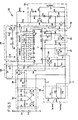
- FIG. 3A depicts a switch circuit which can be substituted for the sensor switch circuit 62 of the FIG. 3 circuit by connecting each circuit point X, Y, BT and ground to its identically designated corresponding point in the FIG. 3 circuit.
- a switch, SW61 which can comprise, for example, a push-button mechanism in a hand-held transmitter serving as a personal emergency alarm, is depressed, which discharges capacitor C61 through R63. This turns on transistor Q61, activating a timing circuit which includes transistors Q62 and Q63.
- the values of the timing circuit elements are selected to cause the circuit to oscillate with a period considerably less than the period of timer circuit 60.
- the values of resistors R65-68 and capacitors C62 and C63 are selected to cause Q3 and the rest of transmitter 22, through circuit connection X, to be switched on every 0.16 seconds. This oscillation will be maintained until switch SW61 is opened, and after that, for the period of time, determined by the values of R61, R62, and C61, required to charge up C61. While switch SW61 is closed, and thereafter for the period of time required to charge C61, the collector voltage of transistor Q61, through circuit connection Y, activates the alarm bit switch 67 and causes the alarm status encoded at terminal D9 of integrated circuit Ul to be set. Thus, closing switch SW61 will increase the rate of transmission and cause each transmission occurrance in the speeded - up sequence to carry an alarm indication.
- FIG. 3B depicts a circuit for sensing the state of a switch series loop L40 connected between terminals T 41 and T 42 .
- the switch loop L40 can comprise, for example, a circuit connecting in series the window and door sensor switches in a single room or group of rooms.
- the circuit of FIG. 3B is connected at points X, Y, BT, and ground, respectively, to the identically-designated points in the circuit shown in FIG. 3.
- the loop opens and capacitor C41 is charged toward the potential of BT through resistor R41.
- the current through R41 turns transistor Q41 on.
- Q41 turns on, its collector goes to ground which turns off the transistor pair Q42 and Q44, which have kept point Y at ground and Q5, the alarm bit switch of FIG.
- transistor Q41 turns on, transistor Q43 turns on quickly through resistor R47 and capacitor C42 because the value R42 is several orders of magnitude less than that of resistor R46. After C42 is charged, base current for Q43 is supplied through R46. The speed of Q43's switch into operation causes circuit point Y to 1 1 e quickly driven positive. This quick excursion is fed buck to transistor Q41 through resistor R53, which speeds up the operation of Q41. The shift into operation of transistor Q43 causes capacitor C44 to discharge and capacitor C45 to charge, which causes current to flow through circuit point X, creating a voltage drop across resistor R6 of FIG. 3. The R6 voltage drop activates transistor Q3 and, with it, transmitter 22.
- circuit point Y is driven positive which causes the alarm bit switch transistor Q5 to turn on, providing an alarm indication to integrated circuit U1.
- the switch circuit of FIG. 3B turns on the transmitter 22 and causes it to transmit an alarm indication.
- the alarm indication will remain set because transistor Q5 of the transmitter 22 will remain on through the operation of transistors Q41 and Q43 of the FIG. 3B circuit.
- Table I shows the values and types of components of the exemplary transmitter 22 shown in FIG. 3 and switch circuits shown in FIGS. 3A and 3B.
- the receiver-decoder 34 is shown in block diagram form in FIG. 5 and schematically in FIGS. 6 and 7.
- the receiver 68 portion may be seen to comprise a receiver antenna 70, a 10 MHz bandwidth band-pass filter 71 tuned to a 314 MHz center frequency, a wide-band radio frequency (RF) mixer 72, a narrow-band intermediate frequency (IF) band-pass filter 73 with a 2 MHz bandwidth, an IF amplifier 74, and an IF FM detector circuit 76.
- a frequency signal representing the difference between the voltage-controlled oscillator frequency and the received signal frequency, is passed through the IF band pass filter 73 from the wide-band RF mixer 72 for amplification in the narrow-band IF amplifier 74.
- a frequency feedback output voltage from the FM detector circuit 76 a voltage which is higher with a higher received signal frequency and lower with a lower received signal frequency, is provided through a dc-coupled amplifier 78 to modulate the output frequency of a voltage-controlled variable frequency local oscillator 80.
- the frequency feedback voltage corresponding to any change in the frequency of the RF signal, thus controls the difference frequency output by the RF mixer 72, allowing the receiver 68 to follow the RF signal of the transmitter 22 even though its frequency varies over a range greater than the IF section bandwidth.
- the amplified signal detected in the detector 76 is also provided to the decoder 82 by way of a dc level restorer amplifier 81.
- the frequency variations transmitted by the transmitter 22 amount to serially encoded digital data characters forming a message consisting of two 9-cell words.
- the decoder circuit reads and remembers the first word, compares the second word to the first word, and if the two words are identical converts the last five characters of data in the word, corresponding to the states of terminals D5-9 of the transmitter encoder integrated circuit Ul, from serial to parallel form.
- the fifth through eighth characters of data in each word provide a channel address in binary coded form, allowing a choice of sixteen separate channel addresses.
- the final character of each word is the sensor status data character which indicates whether the switch SW1 is in the "normal" or "alarm" position.
- a signal is provided to the proper one of the sixteen parallel channels of both a matinenance warning circuit 84 and an alarm indicator circuit 86. Receipt of such a signal in any particular channel resets a timer circuit in the respective channel of the maintenance warning circuit 84, preventing a matinenance warning from being produced by the receiver-decoder 34.
- FIG. 6 shows schematically a receiver circuit 88 which is tunable to a nominal radio frequency of 314 Megahertz, compatible with the transmitter circuit 22 shown in FIG. 3.
- the RF signal received through the antenna 70 is filtered and mixed with a signal produced in the local voltage-controlled variable frequency oscillator 80, the difference between the two frequencies being passed through a tuned band-pass coupling transformer filter 73 into the intermediate frequency amplifier 74 comprising a pair of integrated circuits U2, U3 and thence into the detector 76.
- the band-pass filter 73 is tuned to 20 MHz, with a bandwidth of 2 MHz, allowing only RF signals whose frequency is very close to the actual instantaneous frequency of the transmitter 22 to be amplified and detected.
- An output signal from the IF detector 76 is amplified and provided as a feedback to modulate the frequency of the local oscillator 80.
- the signal is also amplified in the dc level restorer amplifier 78 and provided at the data output terminal 90.
- the dc level restorer centers the amplified output of the detector on the input transfer characteristic of transistor Q13 which acts as a slicing amplifier to provide a voltage pulse digital signal which can be handled by the decoder 82.
- Table II lists exemplary components of the receiver circuit 68 of FIG. 6.
- the data provided by the receiver 68 as its output is processed in the decoder 82 to determine whether the signal received is relevant to the alarm system 23, whether it contains a valid message, and to determine what sensor status has been reported in the message.
- the decoder circuit 82 shown schematically in FIG. 7, includes an integrated circuit U4.
- the circuit U4 is a Motorola MC145027, modified by the manufacturer to provide four address terminals A l -A4 and five data terminals D 5 -D 9 for the purposes disclosed herein.
- a presettable address encoding switch SW3 is connected to address data terminals A 1 -A 4 of integrated circuit U4.
- any received message which contains the proper combination of data characters matching the selected settings of the address encoding switch SW3 is processed by reading and storing the additional five characters of data in the first word. If the second word is identical to the first word received, the integrated circuit U4 passes on the combination of characters from its data output terminals D l -D 4 to provide the identification of the particular channel, within the alarm system 12, .whose transmitter has sent a message. This channel identification information is transmitted through a gate circuit U5 to two pairs of integrated circuits, included respectively in the maintenance warning circuit 84 and the alarm indicator circuit 86. Each time a valid message is received for a particular channel the integrated circuits U6 and U7 provide a resetting pulse to the appropriate one-shot timer circuit 92, of which one is provided for each channel. The timer circuits 92 count down at a frequency established by the integrated circuit U10. So long as a valid signal is received on each channel, resetting the associated circuit 92 within a predetermined time, the maintenance warning circuit 84 interprets the situation as being normal.
- the resepctive timer circuit 92 switches on, providing power to the appropriate maintenance warning light emitting diode 94. This causes the respective diode 94 to light, indicating which of the sixteen channels is experiencing a malfunction, and also turns on transistor Q15 whose output is connected to provide an optional audible warning that maintenance is required in the system.
- a switch SW4 for each channel permits that channel's one-shot timer 92 to be disconnected from the associated LED 94 and from the transistor Q15.
- the four channel-identifying data characters are also provided to the pair of integrated circuits U8 and U9, which similarly read the combination of characters provided from terminals D1-D4 of the integrated circuit U4 and provide an output to the appropriate channel's alarm circuit. Also provided to each of the integrated circuits U8 and U9 is the final character of each nine-cell word received, providing an indication of the sensor status reported. So long as the sensor status is normal, corresponding to a "normal" position of switch SW1 in the particular transmitter 22 which has sent the message received and decoded, no output will be provided to any of the channels from the integrated circuits U8 and U9.
- the output on that particular channel goes high and latches there until reset by a "normal” message or by a manual indicator reset switch SW6.
- the channel outputs of U8 and U9 can also be reset by a manual alarm reset switch SW5 connected with terminals of U8 and U9.
- the high output on an output channel of U8 or U9 lights an associated light emitting diode 96 and turns on an associated transistor Q16, Q17, Q18, or Q19, whose collector current then actuates an appropriate one of the relays 98, 100, 102, or 104 to initiate a predetermined course of action, such as actuating an automatic telephone dialer 44 or an audible fire or burglar alarm 38.
- Table III lists exemplary components of the decoder of FIG. 7.
- each system address code provides a choice of up to 81 systems such as the alarm systems 10 and 12, each containing 16 channels, which may be selected using the settings of contacts 9-12 of transmitter switch SW1 to provide channel identification in the message transmitted by each transmitter 22, with each transmitter 22 being capable of reporting a normal or alarm condition using the final data character of the nine-cell word automatically transmitted by the encoder Ul.
- the internal clock frequency of the integrated circuit Ul determined by the combination of R15, C9, and R16 is preferably at least 75 KHz, and the entire message is transmitted in a period of approximately 0.0025 seconds or less. A transmission is followed by a non-transmitting period of approximately 35 seconds established by the timer circuit 60, giving an operating duty cycle ratio of no more than about one in 14,000 for any one transmitter. Because of the random difference between the transmission periods initiated by the timer circuits of different transmitters 22, the result is a very low likelihood of interference between any two transmitters 22 in any one system 10 or 12 even though all of the transmitters 22 are operating on the same nominal radio frequency, unless more than one transmitter 22 is assigned the same channel address code.
- the duty cycle may be substantially higher than this figure and may be changed, for example, to as high as one in 100 by speeding up the timer circuit 60 and changing the internal clock rate of the integrated circuit Ul.
- each transmitter adjusted to provide a relatively high duty cycle of one in 100, as by scheduling a 0.1 second transmission every 10 seconds, there is only one chance in 12.5 that the first transmission of any one transmitter will be blocked, and one in 156 that the second scheduled transmission 10 seconds later would overlap the transmission of another transmitter.
- the intermediate frequency amplifier is tuned to receive signals within a much narrower frequency bandwidth of only 2.0 Megahertz, less than 50% of the full 5 Megahertz frequency shift due to the +2.5 MHz frequency deviation.
- the lock-on pulse generated at the beginning of each trans mission from each transmitter includes a sweep of the actual instantaneous oscillator frequency passing relatively slowly through the nominal frequency to which the receiver is tuned, to give the receiver an opportunity to detect the transmitted signal and begin tracking the variations of transmission frequency which contain the system address, channel address, and status data in frequency modulated digitally encoded format.
- the range of the initial frequency ramp provided by the transmitter extends from approximately 2.5 Megahertz (0.8%) above the inherent actual center frequency of the oscillator to 2.5 Megahertz (0.8%) below the inherent actual center frequency of the oscillator.
- the frequency ramp ensures that the frequency of the transmission will pass through the tuned nominal frequency of the receiver, even though the transmitter oscillator's actual frequency may shift by as much as 0.8% as a result of temperature shifts, supply voltage variations, or changes of the characteristics of its electronic components during its lifetime.
- the present invention teaches, then, avoiding interference among a plurality of transmitter units in a wireless security alarm system and avoiding interference among a plurality of similar systems, all operating in a single radio frequency channel, by periodically transmitting from each transmitter a message whose length is as short as practicable, but certainly less than 1/10 of a second, and thereafter waiting for a period of at least 10 seconds as required by government regulations.
- This method avoids interference between transmitters by the use of an extremely low duty cycle ratio while still transmitting frequently enough to provide assurance of transmitter operability, to reduce the likelihood of transmission by more than one transmitter in the reception area during the same time to a statistically insignificant value.
- the invention comprises transmission of information using a digitally encoded frequency modulation keyed message format, receiving each transmission by the use of a receiver which has an intermediate frequency section whose bandwidth is narrower than the received signal frequency deviation, and which locks onto the tracks the changing frequency of the transmitted signal.
- the present invention teaches a method of continually verifying that each transmitter of a wireless alarm system according to the invention remains operable, by providing a maintenance warning whenever the time since the last valid signal from any single transmitter unit of the system exceeds a predetermined value and by using digitally encoded system address and channel address information to identify specifically which transmitter has sent a particular message or has failed to send any message.
Landscapes
- Engineering & Computer Science (AREA)
- Computer Networks & Wireless Communication (AREA)
- Business, Economics & Management (AREA)
- Emergency Management (AREA)
- Physics & Mathematics (AREA)
- General Physics & Mathematics (AREA)
- Alarm Systems (AREA)
Applications Claiming Priority (2)
| Application Number | Priority Date | Filing Date | Title |
|---|---|---|---|
| US06/429,116 US4523184A (en) | 1982-09-30 | 1982-09-30 | Supervised wireless security system |
| US429116 | 2003-05-02 |
Publications (1)
| Publication Number | Publication Date |
|---|---|
| EP0107390A1 true EP0107390A1 (fr) | 1984-05-02 |
Family
ID=23701878
Family Applications (1)
| Application Number | Title | Priority Date | Filing Date |
|---|---|---|---|
| EP83305865A Withdrawn EP0107390A1 (fr) | 1982-09-30 | 1983-09-29 | Système de sécurité sans fil contrôlé |
Country Status (2)
| Country | Link |
|---|---|
| US (1) | US4523184A (fr) |
| EP (1) | EP0107390A1 (fr) |
Cited By (6)
| Publication number | Priority date | Publication date | Assignee | Title |
|---|---|---|---|---|
| WO1987003726A1 (fr) * | 1985-12-06 | 1987-06-18 | Albert Soblet | Systeme d'appel pour interventions coordonnees |
| EP0293627A1 (fr) * | 1987-05-19 | 1988-12-07 | Ascom Radiocom AG | Méthode de transmission radio |
| CH673184A5 (en) * | 1987-05-19 | 1990-02-15 | Bbc Brown Boveri & Cie | Mobile radio communication system - has each mobile station switched in synchronism with interrogation by central station |
| EP0402539A1 (fr) * | 1987-12-02 | 1990-12-19 | Morris Maram | Détecteurs d'intrusion |
| FR2649266A1 (fr) * | 1989-06-28 | 1991-01-04 | Crde | Systeme emetteur-recepteur haute frequence pour telealarme |
| EP0407776A3 (en) * | 1989-07-14 | 1991-09-18 | Collmer Semiconductor, Inc. | Radio telemetry monitoring system |
Families Citing this family (51)
| Publication number | Priority date | Publication date | Assignee | Title |
|---|---|---|---|---|
| US4647914A (en) * | 1984-07-20 | 1987-03-03 | Mitsubishi Electric America, Inc. | Security apparatus and system |
| US4670739A (en) * | 1984-12-14 | 1987-06-02 | Kelly Jr Lawrence R | Communication system especially useful as an incident location reporting security system |
| US4630035A (en) * | 1985-01-04 | 1986-12-16 | Motorola, Inc. | Alarm system having alarm transmitter indentification codes and acoustic ranging |
| US4641127A (en) * | 1985-01-30 | 1987-02-03 | Hogan Dennis R | Security and fire protection system |
| US5245314A (en) * | 1985-09-18 | 1993-09-14 | Kah Jr Carl L C | Location monitoring system |
| US4734680A (en) * | 1986-02-06 | 1988-03-29 | Emhart Industries, Inc. | Detection system with randomized transmissions |
| CA1287114C (fr) * | 1986-04-23 | 1991-07-30 | Dennis L. Vories | Systeme de telesurveillance et d'alarme utilisant plusieurs mots codes numeriquement |
| CA1257657A (fr) * | 1986-11-20 | 1989-07-18 | Leroy Bradshaw | Systeme d'alarme electronique |
| US4868859A (en) * | 1987-06-12 | 1989-09-19 | Bt Telecom, Inc. | Supervised, interactive alarm reporting system |
| US5027383A (en) * | 1987-06-12 | 1991-06-25 | Versus Technology, Inc. | Supervised, interactive alarm reporting system |
| EP0345337A4 (en) * | 1987-12-07 | 1991-12-18 | Bt Telecom, Inc. | System for interfacing an alarm reporting device with a cellular radio transceiver |
| US4951029A (en) * | 1988-02-16 | 1990-08-21 | Interactive Technologies, Inc. | Micro-programmable security system |
| US4941424A (en) * | 1988-10-17 | 1990-07-17 | Herbert Hanft | Door alarm |
| US5235320A (en) * | 1989-06-12 | 1993-08-10 | Ralph Romano | Alarm system |
| US5004999A (en) * | 1989-12-21 | 1991-04-02 | Honeywell, Inc. | Extended RF range alarm system |
| US5543778A (en) * | 1993-04-19 | 1996-08-06 | Code-Alarm, Inc. | Security system |
| US5416466A (en) * | 1994-02-18 | 1995-05-16 | Detection Systems, Inc. | Personal security system with fixed testing transmitters |
| US5757305A (en) * | 1994-07-29 | 1998-05-26 | Dimango Products | Transmitter for wireless audible indication system |
| US5680102A (en) * | 1994-07-29 | 1997-10-21 | Dimango Products | RF data communication link for wireless audible indication system |
| US5757267A (en) * | 1994-07-29 | 1998-05-26 | Dimango Products | Battery-operated receiver for wireless audible indication system |
| US5680112A (en) * | 1994-07-29 | 1997-10-21 | Dimango Products Corporation | Wireless audible indication system with battery status indicator |
| US5612666A (en) * | 1994-07-29 | 1997-03-18 | Dimango Products Inc. | Wireless audible indications system |
| US5568122A (en) * | 1994-10-21 | 1996-10-22 | Dimango Products | Wireless audible indication system with low power signal processing |
| US5646593A (en) * | 1995-02-02 | 1997-07-08 | Hewlett Electronics | Child proximity detector |
| US5596313A (en) * | 1995-05-16 | 1997-01-21 | Personal Security & Safety Systems, Inc. | Dual power security location system |
| US5734963A (en) * | 1995-06-06 | 1998-03-31 | Flash Comm, Inc. | Remote initiated messaging apparatus and method in a two way wireless data communications network |
| US5589844A (en) * | 1995-06-06 | 1996-12-31 | Flash Comm, Inc. | Automatic antenna tuner for low-cost mobile radio |
| US5765112A (en) * | 1995-06-06 | 1998-06-09 | Flash Comm. Inc. | Low cost wide area network for data communication using outbound message specifying inbound message time and frequency |
| WO1996039781A1 (fr) * | 1995-06-06 | 1996-12-12 | Flash Comm, Inc. | Determination des conditions de propagation et de disponibilite des frequences dans un reseau de transmission de donnees sans fil |
| US5748083A (en) * | 1996-03-11 | 1998-05-05 | Security Solutions Plus | Computer asset protection apparatus and method |
| US5828300A (en) * | 1996-05-20 | 1998-10-27 | Pittway Corporation | Alarm system with supervision controlled receiver parameter modification |
| US5748079A (en) * | 1996-05-20 | 1998-05-05 | Pittway Corporation | Alarm communications system with independent supervision signal analysis |
| US5801626A (en) * | 1996-05-20 | 1998-09-01 | Pittway Corporation | Alarm communications system with supervision signal RSSI analysis |
| US6150936A (en) * | 1996-05-20 | 2000-11-21 | Pittway Corporation | Method and system for analyzing received signal strength |
| US6459704B1 (en) | 1997-08-12 | 2002-10-01 | Spectrum Tracking Systems, Inc. | Method and system for radio-location determination |
| US7027416B1 (en) | 1997-10-01 | 2006-04-11 | Honeywell, Inc. | Multi tier wireless communication system |
| US6296808B1 (en) | 1999-03-30 | 2001-10-02 | Honeywell International Inc. | Method and apparatus for protecting building personnel during chemical or biological attack |
| DE19924017A1 (de) * | 1999-05-26 | 2000-12-07 | Siemens Ag | Verfahren und Vorrichtung zur Simplex-Datenübertragung |
| US6822565B2 (en) * | 1999-07-20 | 2004-11-23 | Keith A. Thomas | Wireless gauge alert |
| US6428680B1 (en) | 1999-07-23 | 2002-08-06 | Honeywell International Inc. | Method of providing safe haven within buildings during chemical or biological attack |
| US6542724B1 (en) * | 1999-08-02 | 2003-04-01 | Nortel Networks Limited | Method and apparatus for performing image signal rejection |
| US6380860B1 (en) | 1999-12-14 | 2002-04-30 | Joseph R. Goetz | Portable wireless cellular fire alarm system apparatus and method |
| NO312796B1 (no) * | 2000-10-26 | 2002-07-01 | Nordan As | Alarmbrikke |
| US6701772B2 (en) | 2000-12-22 | 2004-03-09 | Honeywell International Inc. | Chemical or biological attack detection and mitigation system |
| US6688968B2 (en) | 2001-01-22 | 2004-02-10 | Honeywell International Inc. | Method and apparatus for protecting buildings from contamination during chemical or biological attack |
| US7330122B2 (en) | 2005-08-10 | 2008-02-12 | Remotemdx, Inc. | Remote tracking and communication device |
| US7936262B2 (en) | 2006-07-14 | 2011-05-03 | Securealert, Inc. | Remote tracking system with a dedicated monitoring center |
| US7737841B2 (en) | 2006-07-14 | 2010-06-15 | Remotemdx | Alarm and alarm management system for remote tracking devices |
| US8797210B2 (en) | 2006-07-14 | 2014-08-05 | Securealert, Inc. | Remote tracking device and a system and method for two-way voice communication between the device and a monitoring center |
| WO2009111702A2 (fr) | 2008-03-07 | 2009-09-11 | Remotemdx | Système et procédé destinés à la surveillance d’individus grâce à une balise et à un dispositif de localisation à distance intelligent |
| US8514070B2 (en) | 2010-04-07 | 2013-08-20 | Securealert, Inc. | Tracking device incorporating enhanced security mounting strap |
Citations (3)
| Publication number | Priority date | Publication date | Assignee | Title |
|---|---|---|---|---|
| US3792455A (en) * | 1972-09-15 | 1974-02-12 | Ward O | Security alarm system with frequency sweeping |
| FR2283493A1 (fr) * | 1974-08-30 | 1976-03-26 | Thomson Csf | Dispositif de telesurveillance par radio |
| US4207524A (en) * | 1977-12-23 | 1980-06-10 | Purchase Francis J | Radio coupled device for detecting and analyzing weak transmissions |
Family Cites Families (13)
| Publication number | Priority date | Publication date | Assignee | Title |
|---|---|---|---|---|
| US3848231A (en) * | 1970-12-31 | 1974-11-12 | Baldwin Electronics Inc | Alarm system utilizing pulse position modulation and dual conductor sensor |
| US3902478A (en) * | 1971-01-07 | 1975-09-02 | Francis Konopasek | Disaster alarm |
| US3713125A (en) * | 1971-07-06 | 1973-01-23 | C Miller | Alarm system utilizing a digital radio link |
| AU498573B2 (en) * | 1974-06-18 | 1979-03-15 | Aboyne Pty. Ltd. | Information transmission system |
| US3928849A (en) * | 1974-12-17 | 1975-12-23 | Us Energy | Intrusion detector self-test system |
| US4095211A (en) * | 1975-07-31 | 1978-06-13 | The Stanley Works | Coded electronic security system |
| US4027276A (en) * | 1975-07-31 | 1977-05-31 | The Stanley Works | Transmitter for a coded electronic security system |
| US4109239A (en) * | 1975-09-30 | 1978-08-22 | Scientific-Atlanta, Inc. | Radio frequency alarm system including transmitting, coding and decoding circuitry |
| US4020477A (en) * | 1975-11-10 | 1977-04-26 | American District Telegraph Company | Radio central station alarm system |
| US4056815A (en) * | 1976-02-03 | 1977-11-01 | Westinghouse Electric Corporation | Battery operated transmitter circuit |
| US4163968A (en) * | 1978-03-09 | 1979-08-07 | Transcience Industries, Inc. | Supervised loop alarm radio transmitter system |
| US4191948A (en) * | 1978-10-23 | 1980-03-04 | Napco Security System Inc. | Digital transmission apparatus particularly adapted for security systems |
| US4232308A (en) * | 1979-06-21 | 1980-11-04 | The Scott & Fetzer Company | Wireless alarm system |
-
1982
- 1982-09-30 US US06/429,116 patent/US4523184A/en not_active Expired - Fee Related
-
1983
- 1983-09-29 EP EP83305865A patent/EP0107390A1/fr not_active Withdrawn
Patent Citations (3)
| Publication number | Priority date | Publication date | Assignee | Title |
|---|---|---|---|---|
| US3792455A (en) * | 1972-09-15 | 1974-02-12 | Ward O | Security alarm system with frequency sweeping |
| FR2283493A1 (fr) * | 1974-08-30 | 1976-03-26 | Thomson Csf | Dispositif de telesurveillance par radio |
| US4207524A (en) * | 1977-12-23 | 1980-06-10 | Purchase Francis J | Radio coupled device for detecting and analyzing weak transmissions |
Non-Patent Citations (1)
| Title |
|---|
| PROCEEDINGS OF THE CARNAHAN CONFERENCE ON CRIME COUNTERMEASURES, 6th-8th April 1977, pages 217-220, Kentucky, US * |
Cited By (7)
| Publication number | Priority date | Publication date | Assignee | Title |
|---|---|---|---|---|
| WO1987003726A1 (fr) * | 1985-12-06 | 1987-06-18 | Albert Soblet | Systeme d'appel pour interventions coordonnees |
| EP0293627A1 (fr) * | 1987-05-19 | 1988-12-07 | Ascom Radiocom AG | Méthode de transmission radio |
| CH673184A5 (en) * | 1987-05-19 | 1990-02-15 | Bbc Brown Boveri & Cie | Mobile radio communication system - has each mobile station switched in synchronism with interrogation by central station |
| EP0402539A1 (fr) * | 1987-12-02 | 1990-12-19 | Morris Maram | Détecteurs d'intrusion |
| US5019803A (en) * | 1987-12-02 | 1991-05-28 | Morris Maram | Detector units |
| FR2649266A1 (fr) * | 1989-06-28 | 1991-01-04 | Crde | Systeme emetteur-recepteur haute frequence pour telealarme |
| EP0407776A3 (en) * | 1989-07-14 | 1991-09-18 | Collmer Semiconductor, Inc. | Radio telemetry monitoring system |
Also Published As
| Publication number | Publication date |
|---|---|
| US4523184A (en) | 1985-06-11 |
Similar Documents
| Publication | Publication Date | Title |
|---|---|---|
| US4523184A (en) | Supervised wireless security system | |
| US4661804A (en) | Supervised wireless security system | |
| US4056815A (en) | Battery operated transmitter circuit | |
| US4462022A (en) | Security system with radio frequency coupled remote sensors | |
| CA2346638C (fr) | Systeme prive d'alarme de securite et d'incendie | |
| US6359558B1 (en) | Low power audible alarm relay device for a rolling code security system | |
| US6243000B1 (en) | Wireless rolling code security system | |
| US4924211A (en) | Personnel monitoring system | |
| US4101872A (en) | Fire detection system | |
| US5070329A (en) | On-site communication system with rf shielding having pager identification capability | |
| US4550312A (en) | Remote sensing systems | |
| US7079831B2 (en) | Method and apparatus for two-way communications amongst a plurality of communications devices | |
| US4731810A (en) | Neighborhood home security system | |
| EP0827616B1 (fr) | Initialisation d'un systeme de securite sans fil | |
| US4091366A (en) | Sonic monitoring method and apparatus | |
| US5500639A (en) | Satellite unit identification system | |
| US4603325A (en) | Evaluation apparatus | |
| US4876710A (en) | Method and apparatus for cordless microphone communication system | |
| US3864674A (en) | Emergency Radio Warning System | |
| US4748685A (en) | Mobile radio communications system | |
| US3852740A (en) | Alarm system with radio alarm link and equipment-activating power line link | |
| US4095211A (en) | Coded electronic security system | |
| CA1171514A (fr) | Systeme de securite sans fil | |
| US2899674A (en) | Sierer | |
| US20010030607A1 (en) | Child safety device |
Legal Events
| Date | Code | Title | Description |
|---|---|---|---|
| PUAI | Public reference made under article 153(3) epc to a published international application that has entered the european phase |
Free format text: ORIGINAL CODE: 0009012 |
|
| AK | Designated contracting states |
Designated state(s): AT BE CH DE FR GB IT LI LU NL SE |
|
| 17P | Request for examination filed |
Effective date: 19841004 |
|
| STAA | Information on the status of an ep patent application or granted ep patent |
Free format text: STATUS: THE APPLICATION IS DEEMED TO BE WITHDRAWN |
|
| 18D | Application deemed to be withdrawn |
Effective date: 19860930 |
|
| RIN1 | Information on inventor provided before grant (corrected) |
Inventor name: ABEL, WILLIAM E. |