EP0107425A2 - Dispositif pour détecter un changement d'un modèle de radiation - Google Patents
Dispositif pour détecter un changement d'un modèle de radiation Download PDFInfo
- Publication number
- EP0107425A2 EP0107425A2 EP83306065A EP83306065A EP0107425A2 EP 0107425 A2 EP0107425 A2 EP 0107425A2 EP 83306065 A EP83306065 A EP 83306065A EP 83306065 A EP83306065 A EP 83306065A EP 0107425 A2 EP0107425 A2 EP 0107425A2
- Authority
- EP
- European Patent Office
- Prior art keywords
- radiation
- change
- pattern
- sensitive
- sensing means
- Prior art date
- Legal status (The legal status is an assumption and is not a legal conclusion. Google has not performed a legal analysis and makes no representation as to the accuracy of the status listed.)
- Withdrawn
Links
Images


Classifications
-
- G—PHYSICS
- G08—SIGNALLING
- G08B—SIGNALLING SYSTEMS, e.g. PERSONAL CALLING SYSTEMS; ORDER TELEGRAPHS; ALARM SYSTEMS
- G08B13/00—Burglar, theft or intruder alarms
- G08B13/18—Actuation by interference with heat, light, or radiation of shorter wavelength; Actuation by intruding sources of heat, light, or radiation of shorter wavelength
- G08B13/189—Actuation by interference with heat, light, or radiation of shorter wavelength; Actuation by intruding sources of heat, light, or radiation of shorter wavelength using passive radiation detection systems
- G08B13/194—Actuation by interference with heat, light, or radiation of shorter wavelength; Actuation by intruding sources of heat, light, or radiation of shorter wavelength using passive radiation detection systems using image scanning and comparing systems
- G08B13/196—Actuation by interference with heat, light, or radiation of shorter wavelength; Actuation by intruding sources of heat, light, or radiation of shorter wavelength using passive radiation detection systems using image scanning and comparing systems using television cameras
- G08B13/19602—Image analysis to detect motion of the intruder, e.g. by frame subtraction
-
- G—PHYSICS
- G08—SIGNALLING
- G08B—SIGNALLING SYSTEMS, e.g. PERSONAL CALLING SYSTEMS; ORDER TELEGRAPHS; ALARM SYSTEMS
- G08B13/00—Burglar, theft or intruder alarms
- G08B13/18—Actuation by interference with heat, light, or radiation of shorter wavelength; Actuation by intruding sources of heat, light, or radiation of shorter wavelength
- G08B13/189—Actuation by interference with heat, light, or radiation of shorter wavelength; Actuation by intruding sources of heat, light, or radiation of shorter wavelength using passive radiation detection systems
- G08B13/19—Actuation by interference with heat, light, or radiation of shorter wavelength; Actuation by intruding sources of heat, light, or radiation of shorter wavelength using passive radiation detection systems using infrared-radiation detection systems
- G08B13/191—Actuation by interference with heat, light, or radiation of shorter wavelength; Actuation by intruding sources of heat, light, or radiation of shorter wavelength using passive radiation detection systems using infrared-radiation detection systems using pyroelectric sensor means
-
- G—PHYSICS
- G08—SIGNALLING
- G08B—SIGNALLING SYSTEMS, e.g. PERSONAL CALLING SYSTEMS; ORDER TELEGRAPHS; ALARM SYSTEMS
- G08B13/00—Burglar, theft or intruder alarms
- G08B13/18—Actuation by interference with heat, light, or radiation of shorter wavelength; Actuation by intruding sources of heat, light, or radiation of shorter wavelength
- G08B13/189—Actuation by interference with heat, light, or radiation of shorter wavelength; Actuation by intruding sources of heat, light, or radiation of shorter wavelength using passive radiation detection systems
- G08B13/194—Actuation by interference with heat, light, or radiation of shorter wavelength; Actuation by intruding sources of heat, light, or radiation of shorter wavelength using passive radiation detection systems using image scanning and comparing systems
- G08B13/196—Actuation by interference with heat, light, or radiation of shorter wavelength; Actuation by intruding sources of heat, light, or radiation of shorter wavelength using passive radiation detection systems using image scanning and comparing systems using television cameras
- G08B13/19634—Electrical details of the system, e.g. component blocks for carrying out specific functions
Definitions
- This invention relates to the detection of a change in a pattern of radiation and is concerned especially, though not exclusively, with the detection of such a change as a result of the movement of an object and/or of its shadow and/or of an image of an object, such as, for example, a television picture thereof.
- radiation throughout this specification is to be taken to include ultra-violet radiation, visible light and infra- red radiation.
- the invention has for its aim the provision of an improved apparatus and method for the security, in the sense of protection from theft or improper handling, of works of art in general and pictures in particular.
- insurers of high value works of art do not favour having any devices in direct contact with a picture or, for that matter, its frame or mounting.
- An obvious and frequently used method of protection as aforesaid is to use "space” or “volume” detectors capable of indicating the intrusion of an object or person into a defined area, a signal being obtained by noting a change from steady state conditions such as, for example, the movement of the intruding object.
- infra-red radiation as one or more beams interrupted or modified in intensity by a moving object.
- passive system the thermal radiation from a human or animal body is detected.
- the present invention provides a technique of space or volume surveillance using optical methods depending on the illumination of a scene with, for example, visible and/or near infra-red radiation be this daylight or radiation from an artificial light. source, using inexpensive optical components and being capable of overcoming many of the difficulties referred to above.
- apparatus for detecting a change in a pattern of radiation incident on the apparatus, wherein lens means, a first sens- . ing means sensitive to said incident radiation and adapted to give a first output signal characteristic of said pattern, and a second such sensing means, adapted to give a second such output signal, said sensing means having different configurations and/or orientations of radiation-sensitive areas and said lens means together with said sensing means constituting an optical system, are arranged for incidence on said sensing means through said lens means of said radiation, and connected to comparator means in such a way that the latter receives said output signals, the arrangement being such that any change in said pattern of radiation causes a first consequent change in said first output signal and a second consequent change in said second output signal, said second consequent change being different from said first consequent change by virtue of said different configurations and/or orientations of radiation-sensitive areas, and said comparator means being arranged to supply a signal which is a function of the said differing output signals and hence indicative of a change in said pattern of radiation.
- the said sensing means may each comprise a combination of a radiation sensitive cell and a mask, the mask being interposed between the source of radiation and the cell and including alternate areas opaque to and transparent to the radiation.
- each sensing means may be a radiation sensitive cell having at least one radiation sensitive area formed in a pre-determined pattern.
- the apparatus can be arranged to survey a specified area and to operate at short or long range as determined by the configuration of the optical system employed. Large optical apertures can be used so as to achieve a low light capability without the performance of the apparatus being seriously affected by the consequent restriction in the depth of field.
- the apparatus can operate with substantially constant sensitivity from a very high illumination level down to a low and eventually a minimum level, and may be adapted to initiate an alarm at such a minimum illumination level.
- no focusing of the optical system is needed in, for example, a range of 2 metres to 100 metres.
- This embodiment at a high sensitivity setting can detect a walking child at a distance of 100 metres.
- optical system parameters By choice of optical system parameters the ability to detect a very small object and/or a very rapidly moving object can be so reduced as to lessen the possibility of a false alarm.
- the apparatus is substantially unaffected by air movements, by ambient temperature changes or by slow changes in ambient illumination.
- the apparatus responds equally well to light reflected from a moving object or to a "silhouette" of such an object. This means that shadows passing over a scene are detecting as moving objects.
- incandescent, gas discharge or flourescent lighting operating on normal alternating current supply (50Hz) or direct current supply is satisfactory and movement detection in a scene reproduced on a television screen or screens is possible in spite of the nature of the scanning process.
- the minimum speed of movement of an object to be detected can be set at such a low value that it becomes effectively impracticable to introduce or to remove an object from the field of view of the apparatus without detection. Further, the absence of lateral or vertical movement of an object will not avoid detection as movement towards or away from the apparatus will also yield a movement signal.
- the low power consumption of the apparatus permits the use of self contained batteries, thus avoiding any external connections.
- the alarm signal may, for example, be given either by a light signal or acoustically or both.
- the output signal from the comparator means produced by movement observed by the apparatus may be used or processed in accordance with any of the established techniques well known to those skilled in the art.
- a method of detecting a change in a pattern of radiation emanating, for example, from an article such as a work of art or from a scene under surveillance comprises causing the said radiation to form or to be so refracted that in the absence of obstruction or of further refraction it would form two essentially identical but spatially displaced images, causing predetermined zones of the radiation which forms or which would form one of the images to impinge on the radiation sensitive member of a first radiation sensitive device and predetermined but different zones of the radiation which forms or which would form the other image to impinge on the radiation sensitive member of a second radiation sensitive device, the sizes and dispositions of the said zones being such that when the article or scene under surveillance and hence the pattern of radiation emanating therefrom is undisturbed, the output signals from each of the radiation sensitive devices remain in a predetermined relationship with each other, but that when there is any change in the pattern of radiation forming the images, the resulting change or changes in the pattern of radiation incident on each of the said radiation sensitive devices will be different for each of the said devices and will cause one or
- the resulting change or changes may be used to activate an indicating device or an alarm.
- the radiation-sensitive devices may be light-sensitive cells, such as cadmium sulphide cells and preferably, the signal outputs from each of the radiation-sensitive devices are substantially equal when an article or scene, for example, under surveillance is undisturbed.
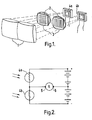
- the apparatus comprises twin optical systems in close juxtaposition, each consisting of lens means 1 arranged to produce an image of the scene under surveillance in an image plane 2.
- the images so produced will have the same information content and will be of the same brightness.
- Light passing through the image plane is gathered by means of a lens system 3 and the emerging light falls upon first and second devices 4a, 4b, the said devices being sensitive to the light.
- the devices 4a, 4b are opto-electronic transducers, such as light dependent resistors, for example, cadium sulphide cells.
- the optical arrangement is preferably one which gives no movement of the illumination on the cells when movement takes place in the scene and consequently at the image plane.
- the resistance of each device 4a, 4b gives a measure of the mean brightness of its related optical image.
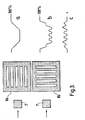
- the two devices 4a, 4b are of equal sensitivity and are connected in an electrical bridge circuit such as that shown in Figure 2, the potential difference between output terminals 5 and 6 of the bridge circuit will remain zero at all times when the average illumination of each device is equal. Under these circumstances no potential difference will appear if there is a brightness change of the original scene.
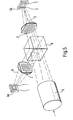
- the longitudinal axes of the bars of one of the two optical systems is at an angle of, say, 90 degrees to the longitudinal axes of the bars of the other optical system.
- the devices 4a 4b together with their associated bar gratings 8a 8b define respectively a first and a second sensing means having different configurations of radiation-sensitive areas. For the unobstructed white scene, the mean value of optical flux reaching each of the devices 4a 4b is reduced by 50%.
- the output from the bridge circuit will represent the difference of the output signals from the devices. This is illustrated by curve c.
- curve c there will be a generally diagonal path of movement of the rectangle image 7 in relation to the bar gratings 8a, 8b, which will yield a zero output from the-bridge circuit. In fact, this is extremely unlikely to happen because regular geometric shapes and the uniform illumination of the field under surveillance rarely occur in practice. Further, the fact that the shadow of an object generally fails to follow a path identical to that of the object itself would introduce a further complication.
- the bars of the gratings 8a, 8b need not be straight and the slots need not be of uniform width along their lengths, provided that the obscuration is the same for both-of the sensing means.
- the output signals from the bridge circuit or other suitable comparator means may be amplified by low frequency alternating current amplifiers, and processed in any of the ways well understood by those skilled in the art.
- the initial stages of electrical amplification should preferably include, or perform as, a "low pass" filter such that frequency components above a chosen frequency shall not be appreciably amplified.
- a typical choice for the cut-off frequency is for example about 15Hz to 20Hz.thus permitting the use of light sources operating from an alternating current supply, which, in consequence, have some brightness modulation. This modulation will normally be at twice the supply frequency but may have components at the fundamental frequency.
- Such low pass filtering can be arranged to permit the apparatus to be used for viewing a television raster or rasters without disturbance from frame flicker frequencies.
- moulded optical components offer the possibility of constructing the complete optical assembly as a single moulding comprising lenses, masks and cell mounting, thus improving rigidity and reducing manufacturing and assembly costs.
- the devices 4a, 4b typically cadmium sulphide cells, although other types can of course be employed, could with advantage be manufactured as a single, three- electrode device having two radiation sensitive areas which could be made to have closely matching characteristics.
- the radiation sensitive devices may be made with the radiation sensitive areas in the form of strips separated by non-sensitive areas, thus eliminating the need for separate gratings 8a, 8b and the associated lenses 3. Such a form of apparatus is illustrated in Figure 6.
- FIG. 5 A further form of optical system is shown in Figure 5.
- a single imaging lens 1 is employed in conjunction with one of the various forms of "beam splitter" 9 such that two separate and identical images are formed and these are then used in the same manner as for the apparatus described with reference to Figures 1 to 3.
- a disadvantage of this system is that there is a reduction of about 50% in the intensity of the light or other radiation incident on each of the devices 4a and 4b. Further, the cost is higher due to the use of the beam splitter 9. The use of such an arrangement may, however, be justified when it is desired to view a scene with a more specialized and expensive optical system, such as for example a long range telephoto lens.
- the simplified diagram of the electrical circuit ( Figure 4) of the apparatus shows not only the devices 4a, 4b, the bridge circuit of Figure 2, the aforesaid low pass filter, an amplifier and a signal rectifier (all of conventional design and well understood by those skilled in the art), said rectifier yielding a positive going voltage when movement occurs in the scene under surveillance, but also a single comparator amplifier stage arranged to produce an alarm signal when the mean illumination on the devices 4a, 4b falls below an operationally acceptable minimum.
- the two devices 4a, 4b connected in series will draw current through a resistor 10, dependent on the incident illumination and the lower the illumination the higher the total resistance of the devices and, consequently the lower the current flowing through the resistor 10.
- a capacitor 11 is added to the circuit providing a resistance capacity time constant RC of suitably chosen magnitude.
- the radiation incident on the apparatus may be at a wavelength other than that of light, e.g. of infra-red or ultraviolet, and the change in the pattern of radiation need not necessarily be caused by the movement of an object, but may, as previously indicated, be due to the movement of, or some other change in, an image of such an object.
Landscapes
- Physics & Mathematics (AREA)
- General Physics & Mathematics (AREA)
- Engineering & Computer Science (AREA)
- Computer Vision & Pattern Recognition (AREA)
- Burglar Alarm Systems (AREA)
- Photometry And Measurement Of Optical Pulse Characteristics (AREA)
- Geophysics And Detection Of Objects (AREA)
Applications Claiming Priority (2)
| Application Number | Priority Date | Filing Date | Title |
|---|---|---|---|
| GB8230062 | 1982-10-21 | ||
| GB8230062 | 1982-10-21 |
Publications (2)
| Publication Number | Publication Date |
|---|---|
| EP0107425A2 true EP0107425A2 (fr) | 1984-05-02 |
| EP0107425A3 EP0107425A3 (fr) | 1984-11-14 |
Family
ID=10533745
Family Applications (1)
| Application Number | Title | Priority Date | Filing Date |
|---|---|---|---|
| EP83306065A Withdrawn EP0107425A3 (fr) | 1982-10-21 | 1983-10-06 | Dispositif pour détecter un changement d'un modèle de radiation |
Country Status (2)
| Country | Link |
|---|---|
| EP (1) | EP0107425A3 (fr) |
| JP (1) | JPS5999278A (fr) |
Cited By (4)
| Publication number | Priority date | Publication date | Assignee | Title |
|---|---|---|---|---|
| US7354574B2 (en) | 2002-11-07 | 2008-04-08 | Advanced Ocular Systems Limited | Treatment of ocular disease |
| WO2011158138A1 (fr) * | 2010-06-14 | 2011-12-22 | Sony Ericsson Mobile Communications Ab | Détection spatiale sur un dispositif électronique à l'aide d'un codage optique |
| CN107886666A (zh) * | 2017-12-14 | 2018-04-06 | 太仓鼎诚电子科技有限公司 | 一种智能无线防盗报警系统 |
| CN110197563A (zh) * | 2018-02-27 | 2019-09-03 | 河北金锁安防工程股份有限公司 | 立体式自动休眠型防盗抢系统 |
Families Citing this family (1)
| Publication number | Priority date | Publication date | Assignee | Title |
|---|---|---|---|---|
| JP6182323B2 (ja) * | 2013-02-12 | 2017-08-16 | 株式会社メガチップス | センサ装置およびセンサ応用機器 |
Family Cites Families (3)
| Publication number | Priority date | Publication date | Assignee | Title |
|---|---|---|---|---|
| US3928843A (en) * | 1974-06-24 | 1975-12-23 | Optical Coating Laboratory Inc | Dual channel infrared intrusion alarm system |
| GB1551541A (en) * | 1977-09-13 | 1979-08-30 | Bloice J A | Infrared intrusion detector system |
| DE2820304A1 (de) * | 1978-05-10 | 1979-11-22 | Joachim Kuhbier | Infrarot-warnanlage |
-
1983
- 1983-10-06 EP EP83306065A patent/EP0107425A3/fr not_active Withdrawn
- 1983-10-21 JP JP58198185A patent/JPS5999278A/ja active Pending
Cited By (4)
| Publication number | Priority date | Publication date | Assignee | Title |
|---|---|---|---|---|
| US7354574B2 (en) | 2002-11-07 | 2008-04-08 | Advanced Ocular Systems Limited | Treatment of ocular disease |
| WO2011158138A1 (fr) * | 2010-06-14 | 2011-12-22 | Sony Ericsson Mobile Communications Ab | Détection spatiale sur un dispositif électronique à l'aide d'un codage optique |
| CN107886666A (zh) * | 2017-12-14 | 2018-04-06 | 太仓鼎诚电子科技有限公司 | 一种智能无线防盗报警系统 |
| CN110197563A (zh) * | 2018-02-27 | 2019-09-03 | 河北金锁安防工程股份有限公司 | 立体式自动休眠型防盗抢系统 |
Also Published As
| Publication number | Publication date |
|---|---|
| JPS5999278A (ja) | 1984-06-07 |
| EP0107425A3 (fr) | 1984-11-14 |
Similar Documents
| Publication | Publication Date | Title |
|---|---|---|
| US4734585A (en) | Passive infra-red sensor | |
| US4523095A (en) | Radiation detector with asymmetrical pattern | |
| US4342987A (en) | Intruder detection system | |
| US4364030A (en) | Intruder detection system | |
| KR100298473B1 (ko) | 수동형적외선검지장치 | |
| US4318089A (en) | Infrared detector system | |
| US4321594A (en) | Passive infrared detector | |
| CA1205158A (fr) | Detecteur a infrarouges pour reseau anti-effraction | |
| US3829693A (en) | Dual field of view intrusion detector | |
| US5486810A (en) | Infrared detector for detecting motion and fire and an alarm system including the same | |
| JPH0358050B2 (fr) | ||
| ATE166737T1 (de) | Intrusionsmelder | |
| JP2001500967A (ja) | 受動赤外線検出器 | |
| US5063288A (en) | Apparatus for securing a confined space with a laser emission | |
| GB2141228A (en) | Infra-red intrusion detector | |
| US5420567A (en) | Combination fire/intrusion alarm detectors using active infared elements | |
| US5818337A (en) | Masked passive infrared intrusion detection device and method of operation therefore | |
| US4535240A (en) | Intruder detection | |
| US3544988A (en) | Picture motion detection system | |
| EP0107425A2 (fr) | Dispositif pour détecter un changement d'un modèle de radiation | |
| US3803572A (en) | Intrusion detecting apparatus | |
| EP0448803A3 (en) | Video control system | |
| JP2000213985A (ja) | 受動型赤外線感知器 | |
| GB2411470A (en) | Passive infrared sensor | |
| JPS6120827A (ja) | エリヤモニタ用の報知装置 |
Legal Events
| Date | Code | Title | Description |
|---|---|---|---|
| PUAI | Public reference made under article 153(3) epc to a published international application that has entered the european phase |
Free format text: ORIGINAL CODE: 0009012 |
|
| AK | Designated contracting states |
Designated state(s): DE FR GB IT |
|
| PUAL | Search report despatched |
Free format text: ORIGINAL CODE: 0009013 |
|
| AK | Designated contracting states |
Designated state(s): DE FR GB IT |
|
| STAA | Information on the status of an ep patent application or granted ep patent |
Free format text: STATUS: THE APPLICATION IS DEEMED TO BE WITHDRAWN |
|
| 18D | Application deemed to be withdrawn |
Effective date: 19850715 |
|
| RIN1 | Information on inventor provided before grant (corrected) |
Inventor name: WALTER, DEREK OSCAR |