EP0107945A1 - Einrichtung zur Sprachsynthese - Google Patents
Einrichtung zur Sprachsynthese Download PDFInfo
- Publication number
- EP0107945A1 EP0107945A1 EP83306228A EP83306228A EP0107945A1 EP 0107945 A1 EP0107945 A1 EP 0107945A1 EP 83306228 A EP83306228 A EP 83306228A EP 83306228 A EP83306228 A EP 83306228A EP 0107945 A1 EP0107945 A1 EP 0107945A1
- Authority
- EP
- European Patent Office
- Prior art keywords
- data
- vowel
- consonant
- parameter data
- speech
- Prior art date
- Legal status (The legal status is an assumption and is not a legal conclusion. Google has not performed a legal analysis and makes no representation as to the accuracy of the status listed.)
- Granted
Links
- 230000002194 synthesizing effect Effects 0.000 title claims abstract description 47
- 230000001052 transient effect Effects 0.000 claims abstract description 6
- 230000015572 biosynthetic process Effects 0.000 claims description 6
- 230000004044 response Effects 0.000 claims description 6
- 238000003786 synthesis reaction Methods 0.000 claims description 6
- 238000001228 spectrum Methods 0.000 description 35
- 238000010586 diagram Methods 0.000 description 4
- 238000006243 chemical reaction Methods 0.000 description 1
- 230000008878 coupling Effects 0.000 description 1
- 238000010168 coupling process Methods 0.000 description 1
- 238000005859 coupling reaction Methods 0.000 description 1
- 238000000034 method Methods 0.000 description 1
Images



Classifications
-
- G—PHYSICS
- G10—MUSICAL INSTRUMENTS; ACOUSTICS
- G10L—SPEECH ANALYSIS TECHNIQUES OR SPEECH SYNTHESIS; SPEECH RECOGNITION; SPEECH OR VOICE PROCESSING TECHNIQUES; SPEECH OR AUDIO CODING OR DECODING
- G10L13/00—Speech synthesis; Text to speech systems
- G10L13/08—Text analysis or generation of parameters for speech synthesis out of text, e.g. grapheme to phoneme translation, prosody generation or stress or intonation determination
Definitions
- This invention relates to a speech synthesizing apparatus for synthesizing speech in accordance with input character strings.
- various speech synthesizing apparatuses for synthesizing speech on the basis of the sentence data to be applied as character strings are known.
- various speech segments of predetermined units are preliminarily registered as a format of acoustic parameter in a speech segment file, and the corresponding acoustic parameter data is selectively read out from this speech segment file in accordance with the input phoneme data string.
- the speech data is synthesized on the basis of this acoustic parameter data read out in accordance with a predetermined synthesizing rule.
- a desired sentence can be generated at a desired speaking speed since the speech is synthesized in accordance with a predetermined synthesizing rule.
- This apparatus for synthesizing speech by rule is mainly divided, for example, into a V-C-V synthesizing apparatus using a chain consisting of vowel, consonant and vowel as a speech segment of one unit, and a C-V synthesizing apparatus using a monosyllable consisting of consonant and vowel as a speech segment of one unit in dependence upon the format of the speech segment to be registered in the speech segment file.
- Reference characters V and C used herein represent'a vowel segment and a consonant segment, respectively.
- Fig. 1 is a schematic block diagram of a conventional speech synthesizing apparatus.
- This speech synthesizing apparatus includes a phoneme converting circuit 2 for converting input character code string into phoneme data string including accent information in accordance with predetermined phoneme conversion rule and accent rule, a speech segment file 4 in which a plurality of speech segments in the form of monosyllable have been stored, an interpolating circuit 6 which sequentially reads out the speech characteristic parameter data of the corresponding speech segment from the speech segment file 4 in accordance with the phoneme data string from the phoneme converting circuit 2 and then interpolates these speech characteristic-parameter data, and a speech synthesizer circuit 8 for generating speech data by filter-processing the parameter data from this interpolating circuit 6.
- phoneme In the apparatus for synthesizing speech data by rule of this kind, phoneme must be of course converted with high accuracy to obtain more natural speech with high quality, but it is also required to obtain speech characteristic parameters which represent, with a high fidelity, the characteristics of the speech generated by a human being. For example, when speeches were continuously generated, there may be a case where a certain monosyllable in these speeches is coarticulated by monosyllables before and after the above-mentioned monosyllable.
- the acoustic energy pattern (speech characteristic parameter) of the speech segment of this monosyllable exhibits the inherent characteristics of the consonant C l and the vowel Vl with high fidelity as schematically shown in Fig. 2.
- the acoustic energy pattern (speech characteristic parameter) of the speech segment of the Cl-V1 monosyllable will be changed as shown in Figs.
- this monosyllable is coarticulated by the subsequent C2-V2 monosyllable and is changed to a Cll-Vll monosyllable, or it is coarticulated by the subsequent C3-V3 monosyllable and is changed to a C12-V12 monosyllable. Therefore, in order to generate the speech which is more natural and has high quality and is as similar as possible to the speech that is actually generated by a human being, it is required to generate the speech in consideration of the coarticulation between the successive speech segments. However, with a conventional speech synthesizing apparatus, only unnatural speeches are obtained because it generates speeches by simply coupling the phonemes regardless of the influence due to the coarticulation.
- a speech synthesizing apparatus comprising a data generation circuit for , generating phoneme string data; a consonant segment file in which a plurality of consonant characteristic parameter data respectively representing a plurality of consonant segments each of which has a consonant portion and a transient segment are stored; a vowel segment file in which a plurality of vowel characteristic parameter data respectively representing a plurality of steady-state and coarticulated vowel segments are stored; a control circuit for supplying consonant and vowel segment address data to the consonant and vowel segment files in accordance with the phoneme string data from the data generation circuit to read out the corresponding consonant and vowel characteristic parameter data from these consonant and vowel segment files; a parameter data series generation circuit for generating series of consonant and vowel characteristic parameter data on the basis of the consonant and vowel charac-' teristic parameter data read out from the consonant and vowel segment files; and a synthesis unit
- each consonant characteristic parameter data stored in the consonant segment file represents the consonant segment including a consonant portion and a transient segment to the vowel segment; therefore, it is possible to easily obtain the interpolated characteristic parameter data between-this consonant characteristic parameter data and the succeeding vowel characteristic parameter data read out from the vowel segment file, thereby making it possible to clearly and naturally synthesize a speech even for a coarticulated monosyllable.
- consonant segments each including a consonant portion and a transient segment which changes from this consonant portion to a vowel segment are registered as a consonant segment C in the consonant segment file
- vowel segments including steady-state and coarticulated vowel segments are registered as a vowel segment V in the vowel segment file.
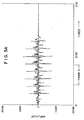
- Figs. 5A and 5B shows waveforms of a second [a]-sound of speech [hakata] and an [a]-sound of speech [kiai].
- Fig. 6A shows a power spectrum in the frame A of [a]-sound shown in Fig. 5A.
- Fig. 6B shows a power spectrum in the frame B of [a]-sound shown in Fig. 5B.
- the power spectrum of [a]-sound of [kiai] which is strongly affected due to the coarticulation is different from the power spectrum of the second [a]-sound of speech [hakata] which is not so affected due to the coarticu- ' lation.
- the speech characteristic parameters representative of the power spectra of different kinds of [a]-sounds are registered in the vowel segment file in dependence upon the degree of the influence due to the coarticulation.
- Figs. 7A to 7C show a speech signal, power spectrum and power sequence of a monosyllable "go" when it was generated.
- Fig. 7D indicates similarity between the power spectrum having the maximum power in the power sequence shown in Fig. 7C and other power spectra.
- time point tl is determined as a boundary point between consonant and vowel, that is, in this example, the time point tl is determined as a time point at which the similarity becomes smaller than a predetermined value when the similarity between the power spectrum having the maximum power and the power spectra which sequentially appear toward the direction in which a consonant was generated is sequentially calculated.
- the speech characteristic parameter data representing the power spectra generated during the period from the time when the consonant had been generated to the time point tl, in this example, the power spectra of three frames, is registered as a consonant segment data in the consonant segment file.
- the speech characteristic parameter data representing the power spectrum of one frame generated after a predetermined number of frames from the time point tl, preferably indicative of the power spectrum having the maximum power is registered as a vowel segment data in the vowel segment file.
- the formats of the speech characteristic parameters to be registered in the consonant and vowel segment files are determined in accordance with the speech synthesizing apparatus to be used.
- the speech characteristic parameter is determined by the Formant frequency, its band width and voiced-unvoiced information.
- the speech characterisic parameter is determined by the linear prediction coefficient and voiced-unvoiced information.
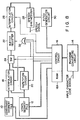
- F ig. 8 shows a block diagram of a speech synthesizing apparatus for synthesizing speech by rule as one embodiment according to the present invention.
- This speech synthesizing apparatus includes a consonant segment file 10, a vowel segment file 12, a phoneme converting circuit 14, and a control circuit 16 for generating output data such as consonant segment address data, vowel segment address data, pitch data, etc. in response to the output data from the phoneme converting circuit 14.
- a plurality of speech characteristic parameter data respectively representing a plurality of consonant segments each of which has a consonant portion and a transient segment are stored in the consonant segment file 10.
- a plurallity of speech characteristic parameter data respectively representing a plurality of steady-state vowel and coarticulated vowels are stored in the vowel segment file 12.
- the phoneme converting circuit 14 reads out the correspondong phoneme string data and accent data from a phoneme dictionary and an accent dictionary (not shown) on the basis of the character code string corresponding to word,-clause or sentence, and then supplies to the control circuit 16.
- This phoneme converting circuit 14 is introduced in, for example, "Letter-to-Sound Rules for Automatic Translation of English Text to Phonetics" by Honey S. Elovitz et al. from Naval Research Lab.
- the control circuit 16 serves to supply the consonant segment address data and vowel segment address data to the consonant segment file 10 and the vowel segment file 12, respectively, in accordance with the phoneme string data from the phoneme converting circuit 14. At the same time, the control circuit 16 writes the time data corresponding to the time duration of a -vowel to be generated and the accent data from the phoneme converting circuit 14 into a random access memory (RAM) 16A.
- RAM random access memory
- the segment address data are determined in accordance with not only the phoneme data indicative of the monosyllable, but also the phoneme data representing a succeeding monosyllable from the phoneme converting circuit 14, for example.
- the speech characteristic parameter data from the consonant segment file 10 is supplied to a first input port of an interpolation circuit 18, while the speech characteristic parameter data from the vowel segment file 12 is supplied to a second input port of the interpolation circuit 18 and to a repetition circuit 20.
- the interpolation circuit 18 calculates a predetermined number of speech characteristic parameter data on the basis of the speech characteristic parameter data indicative of the consonant segment which is constituted by the power spectrum of three frames from the consonant segment file 10 and the speech characteristic parameter data indicative of the vowel segment of the power spectrum of one frame from the vowel segment file 12.
- the calculated speech parameter data respectively represent a corresponding number of vowel segments each having the spectrum of one frame and interpolated between the input consonant and vowel segments.
- the repetition circuit 20 repeatedly fetches from the vowel segment file 12 the speech characteristic parameter data by the number of frames corresponding to the vowel time duration data stored in the RAM 16A.
- the speech characteristic parameter data from the interpolation circuit 18 and repetition circuit 20 are supplied through a switch 24 to a buffer register 22 in this order.
- the speech characteristic parameter data from this buffer register 22 is supplied to an interpolation circuit 26.
- This interplation circuit 26 interpolates a predetermined number of speech characteristic parameter data between these two speech characteristic parameter data on the basis of the speech characteristic parameter data of the successive two frames from the buffer register 22.
- the speech characteristic parameter data from this interpolation circuit 26 are sequentially supplied to a speech synthesizer 28.
- This speech synthesizer 28 sequentially filter- processes the speech characteristic parameter data from the interpolation circuit 26 ' according to the pitch period data generated from a pitch generation circuit 30 in accordance with the accent data of the RAM 16A, and then generates a speech signal.
- the phoneme converting circuit 14 supplies the phoneme string data and accent data to the control circuit 16 in accordance with the input character code series.
- This control circuit 16 writes the time length data representing the time duration of a vowel to be generated and the pitch data regarding a speech generating pitch in the RAM 16A on the basis of the phoneme data and accent data from the phoneme converting circuit 14, respectively.
- the control circuit 16 supplies the consonant segment address data and vowel segment address data corresponding to the phoneme string data from the phoneme converting circuit 14 to . the consonant segment file 10 and the vowel segment file 12, respectively.
- the control circuit.16 simultaneously generates the switch control signal to set the switch 24 into the first switching position.
- the control circuit 16 supplies the consonant and vowel segment address data corresponding to consonant segment [g] and vowel segment [o] to the consonant and vowel segment files 10 and 12, respectively, on the basis of the phoneme data corresponding to the two successive monosyllables of [goma] generated from the phoneme converting circuit 14. Due to this, the first to third speech characteristic parameter data corresponding to the power spectra of three frames indicative of consonant segment [g] in Fig. 9 are read out from the consonant segment file 10.
- the fourth speech characteristic parameter data corresponding to the power spectrum of one frame indicative of vowel [o] is read out from the vowel segment file 12.
- the interpolation circuit 18 calculates the fifth to eighth speech characteristic parameter data indicative of the power spectrum of a predetermined number of frames, in this example, four frames between consonant segment [g] and vowel segment [o] shown .in Fig. 9, on the basis of the third speech characteristic parameter data read out from the consonant segment file 10 and the fourth speech characteristic parameter data read out from the vowel segment file 12.
- this interpolation circuit 18 supplies the lst to 3rd speech characteristic parameter data from the consonant segment file 10, the 5th to 8th speech characteristic parameter data thus calculated, and the 4th speech characteristic parameter data from the vowel segment file 12 to the buffer register 22 through the switch 24 in this order in response to the interpolation control signal from the control circuit 16.
- the switch 24 is set into the second switching position by the switching control signal from the control circuit 16.
- the control circuit 16 then supplies the control pulses of the number corresponding to the vowel time duration data stored in the RAM 16A to "the repetition circuit 20 and through an OR gate 32 to the buffer register 22.
- the repetition circuit 20 fetches the speech characteristic parameter data from the vowel segment file 12 a corresponding number of times in response to the-control pulse from the control circuit 16, and sequentially supplies to the buffer register 22.
- the speech characteristic parameter data representing the power spectra similar to the power spectra shown in Fig. 7B is stored in the buffer register 22.
- Fig. 9 the speech characteristic parameter data representing the power spectra similar to the power spectra shown in Fig. 7B is stored in the buffer register 22.
- the power spectra shown by the solid lines indicate the power spectra corresponding to the speech characteristic parameter data read out from the consonant and vowel segment files 10 and 12, and the power spectra shown by the broken lines represent the power spectra calculated by the interpolation circuit 18 and the power spectra generated from the repetition circuit 20.
- the control circuit 16 supplies the interpolation control signal through the OR gate 32 to the buffer register 22 and also supplies the interpolation control signal to the interpolation circuit 26, thereby allowing the speech characteristic parameter data in the buffer register 22 to be sequentially sent to the interpolation circuit 26.
- the interpolation circuit 26 then creates a predetermined number of interpolated speech characteristic parameter data on the basis of the speech characteristic parameter data of the successive two frames sent from the buffer register 22 and sequentially supplies to the speech synthesizer 28.
- the control circuit 16 simultaneously reads out the accent data stored in the RAM 16A and supplies to the pitch generation circuit 30, thereby allowing this pitch generation circuit 30 to generate the pitch period data.
- the speech synthesizer 28 synthesizes the speech signal including the pitch information in accordance with the speech characteristic parameter data from the interpolation circuit 26 and the pitch period data from ' the pitch generation circuit 30 and then generates the . synthesized speech signal.
- the repetition circuit 20 is constituted in such a manner that it fetches the vowel characteristic parameter data from the vowel segment file 12 in response to the control pulses from the control circuit 16.
- this repetition circuit 20 may be modified such that a high-level signal is generated from the control circuit 16 over the period of time corresponding to the time length data, and that the repetition circuit 20 fetches the vowel characteristic parameter data at a fixed interval from the vowel segment file 12 in response to this high-level signal.
- the vowel characteristic parameter data each of which represents one frame power spectrum have been stored in the vowel segment file 12
- the vowel characteristic parameter data each of which represents a plurality of power spectra can be stored in this vowel segment file.
Landscapes
- Engineering & Computer Science (AREA)
- Computational Linguistics (AREA)
- Health & Medical Sciences (AREA)
- Audiology, Speech & Language Pathology (AREA)
- Human Computer Interaction (AREA)
- Physics & Mathematics (AREA)
- Acoustics & Sound (AREA)
- Multimedia (AREA)
- Machine Translation (AREA)
- Stereophonic System (AREA)
- Fats And Perfumes (AREA)
- Feedback Control In General (AREA)
- Telephone Function (AREA)
Applications Claiming Priority (2)
| Application Number | Priority Date | Filing Date | Title |
|---|---|---|---|
| JP57183410A JPS5972494A (ja) | 1982-10-19 | 1982-10-19 | 規則合成方式 |
| JP183410/82 | 1982-10-19 |
Publications (2)
| Publication Number | Publication Date |
|---|---|
| EP0107945A1 true EP0107945A1 (de) | 1984-05-09 |
| EP0107945B1 EP0107945B1 (de) | 1987-03-18 |
Family
ID=16135290
Family Applications (1)
| Application Number | Title | Priority Date | Filing Date |
|---|---|---|---|
| EP83306228A Expired EP0107945B1 (de) | 1982-10-19 | 1983-10-14 | Einrichtung zur Sprachsynthese |
Country Status (3)
| Country | Link |
|---|---|
| EP (1) | EP0107945B1 (de) |
| JP (1) | JPS5972494A (de) |
| DE (1) | DE3370390D1 (de) |
Cited By (4)
| Publication number | Priority date | Publication date | Assignee | Title |
|---|---|---|---|---|
| EP0144731A3 (en) * | 1983-11-01 | 1985-07-03 | Nec Corporation | Speech synthesizer |
| GB2185370A (en) * | 1986-01-09 | 1987-07-15 | Toshiba Kk | Speech synthesis system of rule-synthesis type |
| WO1996027870A1 (en) * | 1995-03-07 | 1996-09-12 | British Telecommunications Public Limited Company | Speech synthesis |
| US5884260A (en) * | 1993-04-22 | 1999-03-16 | Leonhard; Frank Uldall | Method and system for detecting and generating transient conditions in auditory signals |
Families Citing this family (2)
| Publication number | Priority date | Publication date | Assignee | Title |
|---|---|---|---|---|
| JPH0756598B2 (ja) * | 1984-07-25 | 1995-06-14 | 株式会社日立製作所 | 音声合成装置の音声合成方式 |
| JP2577372B2 (ja) * | 1987-02-24 | 1997-01-29 | 株式会社東芝 | 音声合成装置および方法 |
Citations (3)
| Publication number | Priority date | Publication date | Assignee | Title |
|---|---|---|---|---|
| US3975587A (en) * | 1974-09-13 | 1976-08-17 | International Telephone And Telegraph Corporation | Digital vocoder |
| DE2531006A1 (de) * | 1975-07-11 | 1977-01-27 | Deutsche Bundespost | System zur synthese von sprache im zeitbereich aus doppellauten und lautelementen |
| EP0058130A2 (de) * | 1981-02-11 | 1982-08-18 | Eberhard Dr.-Ing. Grossmann | Verfahren zur Synthese von Sprache mit unbegrenztem Wortschatz und Schaltungsanordnung zur Durchführung des Verfahrens |
-
1982
- 1982-10-19 JP JP57183410A patent/JPS5972494A/ja active Pending
-
1983
- 1983-10-14 DE DE8383306228T patent/DE3370390D1/de not_active Expired
- 1983-10-14 EP EP83306228A patent/EP0107945B1/de not_active Expired
Patent Citations (3)
| Publication number | Priority date | Publication date | Assignee | Title |
|---|---|---|---|---|
| US3975587A (en) * | 1974-09-13 | 1976-08-17 | International Telephone And Telegraph Corporation | Digital vocoder |
| DE2531006A1 (de) * | 1975-07-11 | 1977-01-27 | Deutsche Bundespost | System zur synthese von sprache im zeitbereich aus doppellauten und lautelementen |
| EP0058130A2 (de) * | 1981-02-11 | 1982-08-18 | Eberhard Dr.-Ing. Grossmann | Verfahren zur Synthese von Sprache mit unbegrenztem Wortschatz und Schaltungsanordnung zur Durchführung des Verfahrens |
Non-Patent Citations (3)
| Title |
|---|
| 1978 IEEE INTERNATIONAL CONFERENCE ON ACOUSTICS, SPEECH & SIGNAL PROCESSING, 10th-12th April 1978, Tulsa, Oklahoma, pages 577-580, IEEE, New York, USA * |
| ICASSP 81 (IEEE INTERNATIONAL CONFERENCE ON ACOUSTICS, SPEECH AND SIGNAL PROCESSING), 30th,31st March, 1st April 1981, Atlanta, vol. 1, pages 110-113, IEEE, New York, USA * |
| ICC '79 CONFERENCE RECORD (INTERNATIONAL CONFERENCE ON COMMUNICATIONS), vol. 3, 10th-14th June 1979, Boston, pages 39.4.1-39.4.5, New York, USA * |
Cited By (7)
| Publication number | Priority date | Publication date | Assignee | Title |
|---|---|---|---|---|
| EP0144731A3 (en) * | 1983-11-01 | 1985-07-03 | Nec Corporation | Speech synthesizer |
| GB2185370A (en) * | 1986-01-09 | 1987-07-15 | Toshiba Kk | Speech synthesis system of rule-synthesis type |
| GB2185370B (en) * | 1986-01-09 | 1989-10-25 | Toshiba Kk | Speech synthesis system of rule-synthesis type |
| US5884260A (en) * | 1993-04-22 | 1999-03-16 | Leonhard; Frank Uldall | Method and system for detecting and generating transient conditions in auditory signals |
| WO1996027870A1 (en) * | 1995-03-07 | 1996-09-12 | British Telecommunications Public Limited Company | Speech synthesis |
| AU699837B2 (en) * | 1995-03-07 | 1998-12-17 | British Telecommunications Public Limited Company | Speech synthesis |
| US5978764A (en) * | 1995-03-07 | 1999-11-02 | British Telecommunications Public Limited Company | Speech synthesis |
Also Published As
| Publication number | Publication date |
|---|---|
| EP0107945B1 (de) | 1987-03-18 |
| JPS5972494A (ja) | 1984-04-24 |
| DE3370390D1 (en) | 1987-04-23 |
Similar Documents
| Publication | Publication Date | Title |
|---|---|---|
| KR900009170B1 (ko) | 규칙합성형 음성합성시스템 | |
| US5524172A (en) | Processing device for speech synthesis by addition of overlapping wave forms | |
| EP0886853B1 (de) | Auf mikrosegmenten basierendes sprachsyntheseverfahren | |
| US4692941A (en) | Real-time text-to-speech conversion system | |
| JP3361066B2 (ja) | 音声合成方法および装置 | |
| IE80875B1 (en) | Speech synthesis | |
| US6212501B1 (en) | Speech synthesis apparatus and method | |
| EP0239394B1 (de) | Sprachsynthesesystem | |
| US5633984A (en) | Method and apparatus for speech processing | |
| US5463715A (en) | Method and apparatus for speech generation from phonetic codes | |
| US6970819B1 (en) | Speech synthesis device | |
| EP0107945B1 (de) | Einrichtung zur Sprachsynthese | |
| EP0144731B1 (de) | Sprachsynthesizer | |
| JP2600384B2 (ja) | 音声合成方法 | |
| van Rijnsoever | A multilingual text-to-speech system | |
| JP2001034284A (ja) | 音声合成方法及び装置、並びに文音声変換プログラムを記録した記録媒体 | |
| JP3771565B2 (ja) | 基本周波数パタン生成装置、基本周波数パタン生成方法、及びプログラム記録媒体 | |
| JPH0944191A (ja) | 音声合成装置 | |
| JPH0594199A (ja) | 残差駆動型音声合成装置 | |
| JP2703253B2 (ja) | 音声合成装置 | |
| JPS5914752B2 (ja) | 音声合成方式 | |
| KR100202539B1 (ko) | 음성합성방법 | |
| JP2573586B2 (ja) | 規則型音声合成装置 | |
| JPH0518120B2 (de) | ||
| JPH0258640B2 (de) |
Legal Events
| Date | Code | Title | Description |
|---|---|---|---|
| PUAI | Public reference made under article 153(3) epc to a published international application that has entered the european phase |
Free format text: ORIGINAL CODE: 0009012 |
|
| 17P | Request for examination filed |
Effective date: 19831024 |
|
| AK | Designated contracting states |
Designated state(s): DE FR GB NL |
|
| RAP1 | Party data changed (applicant data changed or rights of an application transferred) |
Owner name: KABUSHIKI KAISHA TOSHIBA |
|
| GRAA | (expected) grant |
Free format text: ORIGINAL CODE: 0009210 |
|
| AK | Designated contracting states |
Kind code of ref document: B1 Designated state(s): DE FR GB NL |
|
| REF | Corresponds to: |
Ref document number: 3370390 Country of ref document: DE Date of ref document: 19870423 |
|
| ET | Fr: translation filed | ||
| PLBE | No opposition filed within time limit |
Free format text: ORIGINAL CODE: 0009261 |
|
| STAA | Information on the status of an ep patent application or granted ep patent |
Free format text: STATUS: NO OPPOSITION FILED WITHIN TIME LIMIT |
|
| 26N | No opposition filed | ||
| REG | Reference to a national code |
Ref country code: GB Ref legal event code: 746 Effective date: 19980909 |
|
| PGFP | Annual fee paid to national office [announced via postgrant information from national office to epo] |
Ref country code: FR Payment date: 19981009 Year of fee payment: 16 |
|
| PGFP | Annual fee paid to national office [announced via postgrant information from national office to epo] |
Ref country code: GB Payment date: 19981016 Year of fee payment: 16 |
|
| PGFP | Annual fee paid to national office [announced via postgrant information from national office to epo] |
Ref country code: DE Payment date: 19981023 Year of fee payment: 16 |
|
| PGFP | Annual fee paid to national office [announced via postgrant information from national office to epo] |
Ref country code: NL Payment date: 19981028 Year of fee payment: 16 |
|
| REG | Reference to a national code |
Ref country code: FR Ref legal event code: D6 |
|
| PG25 | Lapsed in a contracting state [announced via postgrant information from national office to epo] |
Ref country code: GB Free format text: LAPSE BECAUSE OF NON-PAYMENT OF DUE FEES Effective date: 19991014 |
|
| PG25 | Lapsed in a contracting state [announced via postgrant information from national office to epo] |
Ref country code: NL Free format text: LAPSE BECAUSE OF NON-PAYMENT OF DUE FEES Effective date: 20000501 |
|
| GBPC | Gb: european patent ceased through non-payment of renewal fee |
Effective date: 19991014 |
|
| PG25 | Lapsed in a contracting state [announced via postgrant information from national office to epo] |
Ref country code: FR Free format text: LAPSE BECAUSE OF NON-PAYMENT OF DUE FEES Effective date: 20000630 |
|
| NLV4 | Nl: lapsed or anulled due to non-payment of the annual fee |
Effective date: 20000501 |
|
| PG25 | Lapsed in a contracting state [announced via postgrant information from national office to epo] |
Ref country code: DE Free format text: LAPSE BECAUSE OF NON-PAYMENT OF DUE FEES Effective date: 20000801 |
|
| REG | Reference to a national code |
Ref country code: FR Ref legal event code: ST |