EP0108652A1 - Tennisschlägerrahmen und dazugehöriges Herstellungsverfahren - Google Patents
Tennisschlägerrahmen und dazugehöriges Herstellungsverfahren Download PDFInfo
- Publication number
- EP0108652A1 EP0108652A1 EP83401206A EP83401206A EP0108652A1 EP 0108652 A1 EP0108652 A1 EP 0108652A1 EP 83401206 A EP83401206 A EP 83401206A EP 83401206 A EP83401206 A EP 83401206A EP 0108652 A1 EP0108652 A1 EP 0108652A1
- Authority
- EP
- European Patent Office
- Prior art keywords
- racket
- fibers
- profile
- mixture
- frame according
- Prior art date
- Legal status (The legal status is an assumption and is not a legal conclusion. Google has not performed a legal analysis and makes no representation as to the accuracy of the status listed.)
- Granted
Links
Images


Classifications
-
- A—HUMAN NECESSITIES
- A63—SPORTS; GAMES; AMUSEMENTS
- A63B—APPARATUS FOR PHYSICAL TRAINING, GYMNASTICS, SWIMMING, CLIMBING, OR FENCING; BALL GAMES; TRAINING EQUIPMENT
- A63B49/00—Stringed rackets, e.g. for tennis
- A63B49/02—Frames
- A63B49/10—Frames made of non-metallic materials, other than wood
-
- A—HUMAN NECESSITIES
- A63—SPORTS; GAMES; AMUSEMENTS
- A63B—APPARATUS FOR PHYSICAL TRAINING, GYMNASTICS, SWIMMING, CLIMBING, OR FENCING; BALL GAMES; TRAINING EQUIPMENT
- A63B60/00—Details or accessories of golf clubs, bats, rackets or the like
-
- A—HUMAN NECESSITIES
- A63—SPORTS; GAMES; AMUSEMENTS
- A63B—APPARATUS FOR PHYSICAL TRAINING, GYMNASTICS, SWIMMING, CLIMBING, OR FENCING; BALL GAMES; TRAINING EQUIPMENT
- A63B60/00—Details or accessories of golf clubs, bats, rackets or the like
- A63B60/06—Handles
- A63B60/08—Handles characterised by the material
-
- B—PERFORMING OPERATIONS; TRANSPORTING
- B29—WORKING OF PLASTICS; WORKING OF SUBSTANCES IN A PLASTIC STATE IN GENERAL
- B29B—PREPARATION OR PRETREATMENT OF THE MATERIAL TO BE SHAPED; MAKING GRANULES OR PREFORMS; RECOVERY OF PLASTICS OR OTHER CONSTITUENTS OF WASTE MATERIAL CONTAINING PLASTICS
- B29B13/00—Conditioning or physical treatment of the material to be shaped
- B29B13/02—Conditioning or physical treatment of the material to be shaped by heating
- B29B13/023—Half-products, e.g. films, plates
-
- B—PERFORMING OPERATIONS; TRANSPORTING
- B29—WORKING OF PLASTICS; WORKING OF SUBSTANCES IN A PLASTIC STATE IN GENERAL
- B29B—PREPARATION OR PRETREATMENT OF THE MATERIAL TO BE SHAPED; MAKING GRANULES OR PREFORMS; RECOVERY OF PLASTICS OR OTHER CONSTITUENTS OF WASTE MATERIAL CONTAINING PLASTICS
- B29B13/00—Conditioning or physical treatment of the material to be shaped
- B29B13/02—Conditioning or physical treatment of the material to be shaped by heating
- B29B13/023—Half-products, e.g. films, plates
- B29B13/024—Hollow bodies, e.g. tubes or profiles
-
- B—PERFORMING OPERATIONS; TRANSPORTING
- B29—WORKING OF PLASTICS; WORKING OF SUBSTANCES IN A PLASTIC STATE IN GENERAL
- B29C—SHAPING OR JOINING OF PLASTICS; SHAPING OF MATERIAL IN A PLASTIC STATE, NOT OTHERWISE PROVIDED FOR; AFTER-TREATMENT OF THE SHAPED PRODUCTS, e.g. REPAIRING
- B29C48/00—Extrusion moulding, i.e. expressing the moulding material through a die or nozzle which imparts the desired form; Apparatus therefor
- B29C48/15—Extrusion moulding, i.e. expressing the moulding material through a die or nozzle which imparts the desired form; Apparatus therefor incorporating preformed parts or layers, e.g. extrusion moulding around inserts
- B29C48/156—Coating two or more articles simultaneously
-
- B—PERFORMING OPERATIONS; TRANSPORTING
- B29—WORKING OF PLASTICS; WORKING OF SUBSTANCES IN A PLASTIC STATE IN GENERAL
- B29C—SHAPING OR JOINING OF PLASTICS; SHAPING OF MATERIAL IN A PLASTIC STATE, NOT OTHERWISE PROVIDED FOR; AFTER-TREATMENT OF THE SHAPED PRODUCTS, e.g. REPAIRING
- B29C53/00—Shaping by bending, folding, twisting, straightening or flattening; Apparatus therefor
- B29C53/02—Bending or folding
- B29C53/08—Bending or folding of tubes or other profiled members
- B29C53/083—Bending or folding of tubes or other profiled members bending longitudinally, i.e. modifying the curvature of the tube axis
-
- B—PERFORMING OPERATIONS; TRANSPORTING
- B29—WORKING OF PLASTICS; WORKING OF SUBSTANCES IN A PLASTIC STATE IN GENERAL
- B29C—SHAPING OR JOINING OF PLASTICS; SHAPING OF MATERIAL IN A PLASTIC STATE, NOT OTHERWISE PROVIDED FOR; AFTER-TREATMENT OF THE SHAPED PRODUCTS, e.g. REPAIRING
- B29C70/00—Shaping composites, i.e. plastics material comprising reinforcements, fillers or preformed parts, e.g. inserts
- B29C70/68—Shaping composites, i.e. plastics material comprising reinforcements, fillers or preformed parts, e.g. inserts by incorporating or moulding on preformed parts, e.g. inserts or layers, e.g. foam blocks
- B29C70/86—Incorporated in coherent impregnated reinforcing layers, e.g. by winding
- B29C70/865—Incorporated in coherent impregnated reinforcing layers, e.g. by winding completely encapsulated
-
- A—HUMAN NECESSITIES
- A63—SPORTS; GAMES; AMUSEMENTS
- A63B—APPARATUS FOR PHYSICAL TRAINING, GYMNASTICS, SWIMMING, CLIMBING, OR FENCING; BALL GAMES; TRAINING EQUIPMENT
- A63B49/00—Stringed rackets, e.g. for tennis
- A63B49/02—Frames
- A63B49/10—Frames made of non-metallic materials, other than wood
- A63B2049/103—Frames made of non-metallic materials, other than wood string holes produced during moulding process
-
- A—HUMAN NECESSITIES
- A63—SPORTS; GAMES; AMUSEMENTS
- A63B—APPARATUS FOR PHYSICAL TRAINING, GYMNASTICS, SWIMMING, CLIMBING, OR FENCING; BALL GAMES; TRAINING EQUIPMENT
- A63B2209/00—Characteristics of used materials
- A63B2209/02—Characteristics of used materials with reinforcing fibres, e.g. carbon, polyamide fibres
- A63B2209/026—Ratio fibres-total material
-
- A—HUMAN NECESSITIES
- A63—SPORTS; GAMES; AMUSEMENTS
- A63B—APPARATUS FOR PHYSICAL TRAINING, GYMNASTICS, SWIMMING, CLIMBING, OR FENCING; BALL GAMES; TRAINING EQUIPMENT
- A63B49/00—Stringed rackets, e.g. for tennis
- A63B49/02—Frames
- A63B49/10—Frames made of non-metallic materials, other than wood
- A63B49/11—Frames made of non-metallic materials, other than wood with inflatable tubes, e.g. inflatable during fabrication
-
- A—HUMAN NECESSITIES
- A63—SPORTS; GAMES; AMUSEMENTS
- A63B—APPARATUS FOR PHYSICAL TRAINING, GYMNASTICS, SWIMMING, CLIMBING, OR FENCING; BALL GAMES; TRAINING EQUIPMENT
- A63B60/00—Details or accessories of golf clubs, bats, rackets or the like
- A63B60/54—Details or accessories of golf clubs, bats, rackets or the like with means for damping vibrations
-
- B—PERFORMING OPERATIONS; TRANSPORTING
- B29—WORKING OF PLASTICS; WORKING OF SUBSTANCES IN A PLASTIC STATE IN GENERAL
- B29C—SHAPING OR JOINING OF PLASTICS; SHAPING OF MATERIAL IN A PLASTIC STATE, NOT OTHERWISE PROVIDED FOR; AFTER-TREATMENT OF THE SHAPED PRODUCTS, e.g. REPAIRING
- B29C35/00—Heating, cooling or curing, e.g. crosslinking or vulcanising; Apparatus therefor
- B29C35/02—Heating or curing, e.g. crosslinking or vulcanizing during moulding, e.g. in a mould
- B29C35/04—Heating or curing, e.g. crosslinking or vulcanizing during moulding, e.g. in a mould using liquids, gas or steam
- B29C35/041—Heating or curing, e.g. crosslinking or vulcanizing during moulding, e.g. in a mould using liquids, gas or steam using liquids
- B29C2035/042—Heating or curing, e.g. crosslinking or vulcanizing during moulding, e.g. in a mould using liquids, gas or steam using liquids other than water
- B29C2035/043—Heating or curing, e.g. crosslinking or vulcanizing during moulding, e.g. in a mould using liquids, gas or steam using liquids other than water oil
-
- B—PERFORMING OPERATIONS; TRANSPORTING
- B29—WORKING OF PLASTICS; WORKING OF SUBSTANCES IN A PLASTIC STATE IN GENERAL
- B29C—SHAPING OR JOINING OF PLASTICS; SHAPING OF MATERIAL IN A PLASTIC STATE, NOT OTHERWISE PROVIDED FOR; AFTER-TREATMENT OF THE SHAPED PRODUCTS, e.g. REPAIRING
- B29C48/00—Extrusion moulding, i.e. expressing the moulding material through a die or nozzle which imparts the desired form; Apparatus therefor
- B29C48/03—Extrusion moulding, i.e. expressing the moulding material through a die or nozzle which imparts the desired form; Apparatus therefor characterised by the shape of the extruded material at extrusion
- B29C48/05—Filamentary, e.g. strands
-
- B—PERFORMING OPERATIONS; TRANSPORTING
- B29—WORKING OF PLASTICS; WORKING OF SUBSTANCES IN A PLASTIC STATE IN GENERAL
- B29C—SHAPING OR JOINING OF PLASTICS; SHAPING OF MATERIAL IN A PLASTIC STATE, NOT OTHERWISE PROVIDED FOR; AFTER-TREATMENT OF THE SHAPED PRODUCTS, e.g. REPAIRING
- B29C48/00—Extrusion moulding, i.e. expressing the moulding material through a die or nozzle which imparts the desired form; Apparatus therefor
- B29C48/03—Extrusion moulding, i.e. expressing the moulding material through a die or nozzle which imparts the desired form; Apparatus therefor characterised by the shape of the extruded material at extrusion
- B29C48/06—Rod-shaped
-
- B—PERFORMING OPERATIONS; TRANSPORTING
- B29—WORKING OF PLASTICS; WORKING OF SUBSTANCES IN A PLASTIC STATE IN GENERAL
- B29C—SHAPING OR JOINING OF PLASTICS; SHAPING OF MATERIAL IN A PLASTIC STATE, NOT OTHERWISE PROVIDED FOR; AFTER-TREATMENT OF THE SHAPED PRODUCTS, e.g. REPAIRING
- B29C53/00—Shaping by bending, folding, twisting, straightening or flattening; Apparatus therefor
- B29C53/80—Component parts, details or accessories; Auxiliary operations
- B29C53/84—Heating or cooling
-
- B—PERFORMING OPERATIONS; TRANSPORTING
- B29—WORKING OF PLASTICS; WORKING OF SUBSTANCES IN A PLASTIC STATE IN GENERAL
- B29K—INDEXING SCHEME ASSOCIATED WITH SUBCLASSES B29B, B29C OR B29D, RELATING TO MOULDING MATERIALS OR TO MATERIALS FOR MOULDS, REINFORCEMENTS, FILLERS OR PREFORMED PARTS, e.g. INSERTS
- B29K2077/00—Use of PA, i.e. polyamides, e.g. polyesteramides or derivatives thereof, as moulding material
-
- B—PERFORMING OPERATIONS; TRANSPORTING
- B29—WORKING OF PLASTICS; WORKING OF SUBSTANCES IN A PLASTIC STATE IN GENERAL
- B29K—INDEXING SCHEME ASSOCIATED WITH SUBCLASSES B29B, B29C OR B29D, RELATING TO MOULDING MATERIALS OR TO MATERIALS FOR MOULDS, REINFORCEMENTS, FILLERS OR PREFORMED PARTS, e.g. INSERTS
- B29K2105/00—Condition, form or state of moulded material or of the material to be shaped
- B29K2105/06—Condition, form or state of moulded material or of the material to be shaped containing reinforcements, fillers or inserts
- B29K2105/08—Condition, form or state of moulded material or of the material to be shaped containing reinforcements, fillers or inserts of continuous length, e.g. cords, rovings, mats, fabrics, strands or yarns
-
- B—PERFORMING OPERATIONS; TRANSPORTING
- B29—WORKING OF PLASTICS; WORKING OF SUBSTANCES IN A PLASTIC STATE IN GENERAL
- B29K—INDEXING SCHEME ASSOCIATED WITH SUBCLASSES B29B, B29C OR B29D, RELATING TO MOULDING MATERIALS OR TO MATERIALS FOR MOULDS, REINFORCEMENTS, FILLERS OR PREFORMED PARTS, e.g. INSERTS
- B29K2105/00—Condition, form or state of moulded material or of the material to be shaped
- B29K2105/06—Condition, form or state of moulded material or of the material to be shaped containing reinforcements, fillers or inserts
- B29K2105/12—Condition, form or state of moulded material or of the material to be shaped containing reinforcements, fillers or inserts of short lengths, e.g. chopped filaments, staple fibres or bristles
-
- B—PERFORMING OPERATIONS; TRANSPORTING
- B29—WORKING OF PLASTICS; WORKING OF SUBSTANCES IN A PLASTIC STATE IN GENERAL
- B29L—INDEXING SCHEME ASSOCIATED WITH SUBCLASS B29C, RELATING TO PARTICULAR ARTICLES
- B29L2031/00—Other particular articles
- B29L2031/52—Sports equipment ; Games; Articles for amusement; Toys
- B29L2031/5245—Rackets
Definitions
- the present invention relates to a tennis racket frame or similar game and its manufacturing process.
- Sandwich structures coated parallel to the plane of the rope used on a plastic neutral fiber or to reinforce a wooden structure work in shear due to the static or dynamic constraints of the rope. They improve the flexural strength of the frames but pose problems of bonding.
- the cutting of impregnated fabrics does not allow the proper orientation of the fibers to be obtained and results in prohibitive material losses.
- the possible improvement of coatings cannot eliminate shear problems.
- Metal or laminate reinforcements perpendicular to the stringing plane are illusory because of the drilling and their positioning, which is too often central.
- the injection supposes a limit on the rate of carbon mixed in the compound which does not allow to exploit all the characteristics of the material.
- a thermoplastic sheath in contact with the mold changes the distribution of the fibers and the characteristics of the compound.
- the injection pressure and the paths through small sections cause a break in the fibers such that their residual length does not allow the conservation of theoretical characteristics.
- the shape and dimensions of a frame require the welding of material flow and, at the head of the racket, a local loss of resistance also observed between the holes.
- the tennis racket or other frame is characterized in that it is constituted by a profile of thermoplastic material, shaped by hot bending, the core and the handle being over-injected.
- the aforementioned profile has longitudinal compartments which are filled, after extrusion, by a more or less dense polyurethane foam which makes it possible to obtain the desired weight for the frame and protects the profile against being crushed during bending.
- the profile is preferably formed by the extrusion of a thermoplastic compound such as polyamide 11,12 or 6,12 with low water absorption, polyurethane, an acetal resin, in which are incorporated carbon fibers whose length is greater than 1 mm and advantageously of the order of 5 to 6 mm, of the high resistance type.
- a thermoplastic compound such as polyamide 11,12 or 6,12 with low water absorption, polyurethane, an acetal resin, in which are incorporated carbon fibers whose length is greater than 1 mm and advantageously of the order of 5 to 6 mm, of the high resistance type.
- the extrusion operation unlike injection, makes it possible to maintain a uniform length and distribution of the fibers inside the frame and, thereby, to exploit all their qualities.
- the frame 1 has the general shape of an oval, symmetrical with respect to its longitudinal axis, but asymmetrical with respect to its transverse axis. It consists of a folded and curved profile so as to present two branches 5 and 6 joined at their lower part by spacers 2,3, and by a weld 4.
- the upper spacer 2 will be called the heart of the racket by the after.
- Below the weld 4 there remains a slot 8 which is subsequently filled with palyurethane, the two ends of the branches 5 and 6 being trapped in an injected handle 7.
- the spacers 2,3 and 4 are formed by injection of a polyamide 11,12 or 6-12, a polyurethane or an acetal resin, similar to that of the frame profile, but which can be a polyamide 6-6.
- the material injected to form the spacers extends in a layer 9 on either side of the frame and passes through holes 10 so as to constitute plastic rivets, the injection being carried out at through the holes 10.
- the two branches 5 and 6 are very joined together and there is no risk of separation even under the most violent efforts, the torsional strength being maximum.
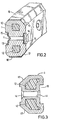
- Fig.2 is a section along line II-II of Fig.1 and it shows the structure of a profile 1.
- This profile is composed of a compound of polyamide 11,12 or 6-12 and fibers of carbon. It is also possible, in order to obtain a density of the order of 0.9 for the entire frame, to introduce into the compound hollow glass microbeads such as those which are known by the name of "filite" (Trademark).
- filite Trademark
- two longitudinal cavities 12 are formed inside the profile. These two cavities are subsequently filled with a polyurethane hane foam, the density of which is chosen as a function of the final weight of the racket. This foam also prevents the profile from being crushed during bending.
- a hole 11 allows the passage of a rope (not shown).
- the holes 11 for passage of the strings are seventy in number for a racket with a medium sieve and a single string passes through a hole. This allows, although at the cost of a slight increase in the number of holes (70 against 64) to reduce the diameter and, consequently, to increase the overall resistance of the racket.
- the edges of the holes 10 are chamfered at 13 on the outside and at 14 on the inside of the frame so that the strings do not bear on sharp angles which would damage them. Note that when the frame is made of polyamide, it is not necessary to provide special protection for the strings.
- the frame has, on the inside, a cutaway 17. It has in fact been observed that this part of the frame does not intervene in any way in the bending and torsional forces of the racket after stringing and the total weight can thus be lightened by a few grams.
- Fig.3 shows another embodiment of the profile which is a section along line III-III of Fig.1.
- the same references designate the same elements as in Fig. 2. Abstraction has been made of any strips or bars.
- Figs. 4 to 9 schematically represent the different stages of a method of manufacturing a racket frame according to the invention.
- an extruder 19 of the conventional type inside which a polyamide-carbon fiber compound is introduced and melted, pushes through a die a section 1 of the type shown in section in Figs. 2 and 3.
- the profile is then cut by a saw 20 into frame lengths.
- the sections are then drilled flat (Fig.5) and the polyurethane foam is introduced into the grooves 12 where it expands, by a press 21 (Fig.6).
- a press 21 Fig.6
- the next operation is the bending shown diagrammatically in Fig. 8.
- the profile is introduced into a bender made up of two branches 23 and 24, substantially in the extension of one another but articulated one on the other around an axis 25 located near a conformation core 22 which reproduces the internal outline of the frame.
- the branches 23 and 24 are folded around the core 22.
- the drills 28 (Fig.5) are spaced so that, after bending, the holes 10 are regularly distributed at the periphery of the frame.
- the first one injection aims to form the heart of the racket by parallel spacers 2,3 and 4 (Fig.1).
- the heart is overmolded between the branches 5 and 6 by injection, into a mold 27, of a polyamide resin such as a polyamide 6-6, for example.
- This polyamide has a higher melting point than polyamide 11 or 12 or 6-12 used to form the profile.
- the injection of this polya.mide therefore causes a fusion or a surface softening of the branches 5 and 6 which is very favorable for good attachment.
- the connection is completed by the formation of plastic rivets through the holes 10 which are injected during the same operation and which have, on the screws currently used, the advantage of not dissociating from the parts which they join.
- the branches 5 and 6 are also secured, at their lower end, by an insert performed by over-injection, between the branches, of a polyurethane foam.
- the handle 7 is produced by injection of direct skin polyurethane foam. The two branches are thus joined by gluing which avoids vibrations and increases torsional rigidity.
- the carbon fibers of the "high resistance" type are cut to lengths of 5 to 6 mm, and sized to 5% of the basic thermoplastic.
- the compounding and extrusion operations are such that the residual length of the fibers is greater than f millimeter.
- Carbon fibers are preferably used for their high modulus of elasticity. For less efficient rackets, it is also possible to use a mixture of carbon fibers and glass fibers, at a rate of more than 15%, by weight.
- the components of the compound are intimately mixed in an extruder which delivers granules. It is these granules which are again extruded to give a profile.
- the profile is preferably directly extruded, that is to say that polyamide or any other suitable thermoplastic material is introduced into the extruder.
- polyamide or any other suitable thermoplastic material is introduced into the extruder.
- polyamide or any other suitable thermoplastic material such as certain qualities of polyurethanes, polycarbonates or polyacetals, provided however that their strengths under stress are sufficient, as well as carbon and / or glass fibers.
- Compounding is then carried out directly in the extruder, in a single operation.
- the carbon fibers can thus retain a greater length.
- the preferred choice of polyamides 11 or 12 or 6-12 results from the criterion of low water absorption.
- the other thermoplastic materials however have the advantage of having wider softening ranges than those of the polyamides mentioned.
- FIG. 10 Another manufacturing process is shown in Fig. 10. It is based on the idea that it is possible to directly shape the frame at the exit of the extruder, while the profile is still in a pasty state. To this end, a mold having a groove 26 of cross section equal to that of the frame is disposed at the outlet of the extruder die 29. This groove guides the profile as it leaves the extruder. ' The disadvantage of this second process however comes from the need to drill the holes, after cooling, while the frame has taken its final shape. After bending the profile, a second plate is brought in front of the extruder and a new extrusion-bending occurs. Of course, the groove 26 can be heated and lubricated.
- the present invention makes it possible to obtain tennis racket frames whose elasticity module is of the order of 15,000.
- the total weight after stringing can vary from ten grams to ten grams from 365 to 395 grams, the weight of the profile alone being approximately 270 grams.
- this weight can vary depending on requirements either by introducing hollow glass or aluminum silicate microballoons into the compound, or by acting on the density of the polyurethane foam introduced into the grooves 12, or again by an appropriate choice of density and strip dimensions 15, 16 or 18.
- the profile is obtained by extrusion of a compound, this characteristic is not at all necessary.
- the invention aims to keep the length of the carbon fibers as long as possible.
- the profile can therefore also be obtained by injection, this injection being followed by hot bending.
- the injection of a frame length of a profile does not have the drawback of causing the fibers to break, nor the formation of heterogeneous concentrations of these fibers, as occurs when injecting directly into a mold.
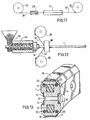
- the wicks 28 of carbon fibers or any other material having ana characteristics logues and capable of being impregnated are unwound from a reel 33 and pass through a bath 29 containing a solution of a polyamide resin or more generally of a thermoplastic material, such as polyurethane.
- a polyamide resin or more generally of a thermoplastic material, such as polyurethane.
- the choice of this material results from the characteristics of the material of the compound.
- the solvents are evaporated in a steamer 31 and the wicks of impregnated fibers 32 are wound, for example on a take-up reel 30 of sufficient radius not to break the fibers.
- an extruder 19 has been shown diagrammatically including a drive screw 35 forcing the compound in the molten state in a die 34.
- the compound is introduced in the form of granules into the extruder 19 where it is melted and directed onto a die 34. While the extruded material is still in the pasty state, two impregnated braids 32, or more, are introduced, at the same time as the extruded profile, in a second heating die 36.
- the material for impregnating the carbon fibers undergoes, as a result of heating, a slight melting which allows it to integrate perfectly into the compound.
- the compound + fibers assembly undergoes pultrusion as described in French patent n ° 82.10292 which ensures perfect positioning of the wicks 32.
- Fig.13 there is a section of a frame obtained after bending similar to that of Fig.2. However, we note at the four corners of the section, four wicks 32 of carbon fibers or the like which extend over the entire length of the frame.
Landscapes
- Engineering & Computer Science (AREA)
- Mechanical Engineering (AREA)
- Health & Medical Sciences (AREA)
- Chemical & Material Sciences (AREA)
- General Health & Medical Sciences (AREA)
- Physical Education & Sports Medicine (AREA)
- Physics & Mathematics (AREA)
- Thermal Sciences (AREA)
- Materials Engineering (AREA)
- Composite Materials (AREA)
- Injection Moulding Of Plastics Or The Like (AREA)
- Laminated Bodies (AREA)
- Moulding By Coating Moulds (AREA)
- Molding Of Porous Articles (AREA)
Priority Applications (1)
| Application Number | Priority Date | Filing Date | Title |
|---|---|---|---|
| AT83401206T ATE29841T1 (de) | 1982-06-14 | 1983-06-13 | Tennisschlaegerrahmen und dazugehoeriges herstellungsverfahren. |
Applications Claiming Priority (4)
| Application Number | Priority Date | Filing Date | Title |
|---|---|---|---|
| FR8210292A FR2528318A1 (fr) | 1982-06-14 | 1982-06-14 | Cadre de raquette de tennis et son procede de fabrication |
| FR8210292 | 1982-06-14 | ||
| FR8306724 | 1983-04-25 | ||
| FR8306724 | 1983-04-25 |
Publications (2)
| Publication Number | Publication Date |
|---|---|
| EP0108652A1 true EP0108652A1 (de) | 1984-05-16 |
| EP0108652B1 EP0108652B1 (de) | 1987-09-23 |
Family
ID=26222949
Family Applications (1)
| Application Number | Title | Priority Date | Filing Date |
|---|---|---|---|
| EP83401206A Expired EP0108652B1 (de) | 1982-06-14 | 1983-06-13 | Tennisschlägerrahmen und dazugehöriges Herstellungsverfahren |
Country Status (6)
| Country | Link |
|---|---|
| US (1) | US4643857A (de) |
| EP (1) | EP0108652B1 (de) |
| AU (1) | AU1575283A (de) |
| DE (1) | DE3373783D1 (de) |
| ES (1) | ES8402723A1 (de) |
| IN (1) | IN159325B (de) |
Cited By (3)
| Publication number | Priority date | Publication date | Assignee | Title |
|---|---|---|---|---|
| EP0556495A1 (de) * | 1992-02-21 | 1993-08-25 | Tsai Chen Soong | Durchlochter Rahmen für Sportschläger |
| WO2007118643A1 (de) * | 2006-04-15 | 2007-10-25 | Boerger Herbert | Verfahren zur herstellung eines formkörpers |
| WO2009046795A1 (de) | 2007-10-01 | 2009-04-16 | Thermoplast Composite Gmbh | Verfahren zur herstellung eines formkörpers aus kunststoff |
Families Citing this family (22)
| Publication number | Priority date | Publication date | Assignee | Title |
|---|---|---|---|---|
| JPH0687903B2 (ja) * | 1989-12-05 | 1994-11-09 | 住友ゴム工業株式会社 | テニスラケットフレーム |
| DE4031180A1 (de) * | 1990-10-03 | 1992-04-09 | Matthias S Bothe | Schlaeger, insbesondere tennis-, squash-, badminton- oder racketballschlaeger |
| US5176868A (en) * | 1991-01-24 | 1993-01-05 | Prince Manufacturing, Inc. | Long fiber reinforced thermoplastic frame especially for a tennis racquet |
| GB2258158A (en) * | 1991-08-02 | 1993-02-03 | Kuni Tseng | Seamless racket. |
| AU625048B3 (en) * | 1992-01-13 | 1992-04-29 | Shen-Ching Wang | Racquet |
| US5498381A (en) * | 1994-12-21 | 1996-03-12 | Milsco Manufacturing Company | Method of forming and piercing a thermoplastic strip in one step |
| US5876641A (en) * | 1995-07-31 | 1999-03-02 | Andersen Corporation | In-line process for injection of foam material into a composite profile |
| CA2216508A1 (en) * | 1997-02-13 | 1998-08-13 | Lisco, Inc. | Sporting equipment constructed with composite materials having composite rods interspersed with bias plies |
| US5922255A (en) * | 1997-04-04 | 1999-07-13 | Highlander Sports, Llc | Method of manufacturing a racket frame and throat |
| GB2344292B (en) * | 1998-12-03 | 2003-01-22 | Dunlop Slazenger Group Ltd | Hybrid composite racket frame |
| US7297080B2 (en) * | 2001-05-04 | 2007-11-20 | Wilson Sporting Goods Co. | Game racquet with separate head and handle portions for reducing vibration |
| US6684554B2 (en) * | 2001-09-27 | 2004-02-03 | Kuo-Pin Yu | Hand net frame |
| US20030213189A1 (en) * | 2002-05-16 | 2003-11-20 | Goldman Arthur S. | Thermoplastic polymer extrusion bending |
| US7491141B1 (en) * | 2004-01-09 | 2009-02-17 | Stx, Llc | Lacrosse head having a skeletal member |
| US8740733B2 (en) | 2011-11-11 | 2014-06-03 | Dennis F. Reese | Racquet putter apparatus |
| US9399155B2 (en) | 2012-11-27 | 2016-07-26 | Wilson Sporting Goods Co. | Optimized thermoplastic racquet |
| US9199135B2 (en) | 2012-11-27 | 2015-12-01 | Wilson Sporting Goods Co. | Optimized thermoplastic racquet |
| US9192822B2 (en) | 2012-11-27 | 2015-11-24 | Wilson Sporting Goods Co. | Optimized thermoplastic racquet |
| US10751581B2 (en) | 2018-03-12 | 2020-08-25 | Wilson Sporting Goods Co. | Racquet configured with increased flexibility in multiple directions with respect to a longitudinal axis |
| AU2019396247A1 (en) * | 2018-11-30 | 2021-06-10 | Arris Composites Inc. | Compression-molded fiber-composite parts and methods of fabrication |
| US20220203188A1 (en) * | 2020-12-29 | 2022-06-30 | East Coast Dyes, Inc. | Clear lacrosse head |
| US12491413B2 (en) | 2022-08-13 | 2025-12-09 | Wilson Sporting Goods Co. | Racquet configured with increased lateral flexibility with respect to a longitudinal axis |
Citations (6)
| Publication number | Priority date | Publication date | Assignee | Title |
|---|---|---|---|---|
| GB1122895A (en) * | 1966-02-21 | 1968-08-07 | R L Paul Peillex & Co Sa | Tennis racket |
| FR2102585A5 (de) * | 1970-08-11 | 1972-04-07 | Martel Rene | |
| FR2126488A5 (en) * | 1971-02-08 | 1972-10-06 | Carpano & Pons | Tennis racquet frame - of stiff lightweight resin lined metal tubing |
| DE2153172A1 (de) * | 1971-10-26 | 1973-05-03 | Engelbert Klais | Verfahren und vorrichtung zur herstellung eines tennisschlaegerrahmens |
| GB1362116A (en) * | 1971-04-27 | 1974-07-30 | Callenelle Usines | Sports rackets |
| FR2352562A1 (fr) * | 1976-05-27 | 1977-12-23 | Nippon Musical Instruments Mfg | Raquette perfectionnee |
Family Cites Families (14)
| Publication number | Priority date | Publication date | Assignee | Title |
|---|---|---|---|---|
| US3732345A (en) * | 1970-04-16 | 1973-05-08 | Dow Chemical Co | Method for the incorporation of filamentary material in a resinous matrix |
| US3719737A (en) * | 1970-12-09 | 1973-03-06 | Bard Inc C R | Method of making a preformed curved epidural catheter |
| US3917267A (en) * | 1973-03-23 | 1975-11-04 | Charles A Mcgrath | Tennis racket |
| US3981504A (en) * | 1974-03-18 | 1976-09-21 | Ppg Industries, Inc. | Glass-carbon reinforced foamed resin tennis racket frame |
| US3986716A (en) * | 1974-09-23 | 1976-10-19 | Arundale Manufacturers, Inc. | Composite racquet structure |
| JPS5221934A (en) * | 1975-08-12 | 1977-02-18 | Toray Ind Inc | Tennis racket frame |
| JPS5236168A (en) * | 1975-09-18 | 1977-03-19 | Komatsu Kasei Kk | Method of executing bent pipe made of synthetic resin |
| US4297308A (en) * | 1978-03-07 | 1981-10-27 | Dunlop Limited | Method of manufacturing games rackets |
| ATE1844T1 (de) * | 1979-08-24 | 1982-12-15 | Dunlop Limited | Verfahren zur herstellung eines schlaegerrahmens. |
| DE3062290D1 (en) * | 1979-08-24 | 1983-04-14 | Dunlop Ltd | Games racket frame |
| NL190305C (nl) * | 1979-08-30 | 1994-01-17 | Int Chem Eng Ets | Inrichting voor het krommen van een slang uit gestrekt kunststofmateriaal. |
| EP0039377B1 (de) * | 1980-05-07 | 1984-07-25 | Peter Robert Mitchell | Warmformen rohrförmiger Gegenstände |
| EP0040551B1 (de) * | 1980-05-20 | 1985-03-06 | Elite Sports International Limited | Schläger |
| DK155983C (da) * | 1981-01-26 | 1989-10-16 | Wirsbo Pex Gmbh | Fremgangsmaade til formgivning af roer af formstof |
-
1983
- 1983-06-13 EP EP83401206A patent/EP0108652B1/de not_active Expired
- 1983-06-13 DE DE8383401206T patent/DE3373783D1/de not_active Expired
- 1983-06-13 US US06/503,906 patent/US4643857A/en not_active Expired - Fee Related
- 1983-06-14 ES ES523252A patent/ES8402723A1/es not_active Expired
- 1983-06-14 AU AU15752/83A patent/AU1575283A/en not_active Abandoned
- 1983-06-15 IN IN755/CAL/83A patent/IN159325B/en unknown
Patent Citations (6)
| Publication number | Priority date | Publication date | Assignee | Title |
|---|---|---|---|---|
| GB1122895A (en) * | 1966-02-21 | 1968-08-07 | R L Paul Peillex & Co Sa | Tennis racket |
| FR2102585A5 (de) * | 1970-08-11 | 1972-04-07 | Martel Rene | |
| FR2126488A5 (en) * | 1971-02-08 | 1972-10-06 | Carpano & Pons | Tennis racquet frame - of stiff lightweight resin lined metal tubing |
| GB1362116A (en) * | 1971-04-27 | 1974-07-30 | Callenelle Usines | Sports rackets |
| DE2153172A1 (de) * | 1971-10-26 | 1973-05-03 | Engelbert Klais | Verfahren und vorrichtung zur herstellung eines tennisschlaegerrahmens |
| FR2352562A1 (fr) * | 1976-05-27 | 1977-12-23 | Nippon Musical Instruments Mfg | Raquette perfectionnee |
Cited By (5)
| Publication number | Priority date | Publication date | Assignee | Title |
|---|---|---|---|---|
| EP0556495A1 (de) * | 1992-02-21 | 1993-08-25 | Tsai Chen Soong | Durchlochter Rahmen für Sportschläger |
| WO2007118643A1 (de) * | 2006-04-15 | 2007-10-25 | Boerger Herbert | Verfahren zur herstellung eines formkörpers |
| WO2009046795A1 (de) | 2007-10-01 | 2009-04-16 | Thermoplast Composite Gmbh | Verfahren zur herstellung eines formkörpers aus kunststoff |
| CN101835593B (zh) * | 2007-10-01 | 2013-03-06 | 热塑性复合材料有限公司 | 用于由塑料制造模制品的方法 |
| US8695202B2 (en) | 2007-10-01 | 2014-04-15 | Thermoplast Composite Gmbh | Method for the production of a moulded part from plastic material |
Also Published As
| Publication number | Publication date |
|---|---|
| US4643857A (en) | 1987-02-17 |
| EP0108652B1 (de) | 1987-09-23 |
| ES523252A0 (es) | 1984-03-16 |
| ES8402723A1 (es) | 1984-03-16 |
| AU1575283A (en) | 1983-12-22 |
| DE3373783D1 (en) | 1987-10-29 |
| IN159325B (de) | 1987-05-02 |
Similar Documents
| Publication | Publication Date | Title |
|---|---|---|
| EP0108652B1 (de) | Tennisschlägerrahmen und dazugehöriges Herstellungsverfahren | |
| EP0597166B1 (de) | Hockeyschläger | |
| EP0230839B1 (de) | Fahrradgabel oder gleichartiger Artikel aus mit Textilstruktur verstärktem Kunstharz als Hauptbestandteil und Verfahren zu seiner Herstellung | |
| EP0235087B1 (de) | Verstärkungselement vorgesehen, um in eine Harzmasse eingebettet zu werden und Anwendung dieses Elementes | |
| CA1277687C (fr) | Raquette de tennis en materiau stratifie | |
| FR2716377A1 (fr) | Cadre pour raquette de jeu en matière thermoplastique renforcée de fibres, enroulée en filament. | |
| FR2699498A1 (fr) | Pale en composite thermoplastique, notamment pour rotor arrière caréné d'hélicoptère, et son procédé de fabrication. | |
| FR2641979A1 (fr) | Manche de club de golf | |
| FR2616409A1 (fr) | Pale en materiaux composites et son procede de fabrication | |
| FR2638368A1 (fr) | Crosse de hockey en materiaux composites et son procede de fabrication | |
| FR2654645A1 (fr) | Procede de realisation d'un ski par injection, et structure de ski obtenue par ce procede. | |
| FR2673572A1 (fr) | Element de monture de lunettes en resine synthetique et procede de fabrication. | |
| FR2528318A1 (fr) | Cadre de raquette de tennis et son procede de fabrication | |
| EP0125953B1 (de) | Verfahren zum Herstellen einer Saite aus mehreren Komponenten | |
| EP0665034B1 (de) | Ski mit "in situ" injiziertem Kern | |
| FR2558411A1 (fr) | Procede de faconnage d'un article moule en forme de barre continue, et appareillage pour le faconnage de cet article | |
| EP1015301A1 (de) | Fahrradgabel | |
| FR2645070A3 (fr) | Elements de structure en materiau composite a pieces extremes de fixation, en metal et son procede de fabrication | |
| FR2594871A1 (fr) | Procede permettant de renforcer des structures ou elements de structure, notamment en beton, beton arme, beton precontraint a l'aide d'armatures souples, dispositif de mise en place des armatures, et armatures mises en oeuvre dans ledit procede | |
| FR2487208A1 (fr) | Crosse de hockey | |
| EP1798429A1 (de) | Rohrförmige Pleuelstange aus einem Verbundmaterial und ein entsprechendes Herstellungsverfahren | |
| EP0478477A1 (de) | Verfahren und Einrichtung zur Herstellung einer Saite zur Bespannung von Tennisschlägern oder ähnlichem und Saite, die daraus resultiert | |
| FR2598115A1 (fr) | Elements tubulaires composites et procedes pour leur fabrication | |
| FR2687925A1 (fr) | Procede de fabrication d'un ski et ski obtenu par ce procede. | |
| EP0049196A1 (de) | Saiten aus Kunststoffen für Tennisschläger |
Legal Events
| Date | Code | Title | Description |
|---|---|---|---|
| PUAI | Public reference made under article 153(3) epc to a published international application that has entered the european phase |
Free format text: ORIGINAL CODE: 0009012 |
|
| AK | Designated contracting states |
Designated state(s): AT BE CH DE FR GB IT LI LU NL SE |
|
| 17P | Request for examination filed |
Effective date: 19841109 |
|
| GRAA | (expected) grant |
Free format text: ORIGINAL CODE: 0009210 |
|
| AK | Designated contracting states |
Kind code of ref document: B1 Designated state(s): AT BE CH DE FR GB IT LI LU NL SE |
|
| PG25 | Lapsed in a contracting state [announced via postgrant information from national office to epo] |
Ref country code: NL Effective date: 19870923 Ref country code: IT Free format text: LAPSE BECAUSE OF FAILURE TO SUBMIT A TRANSLATION OF THE DESCRIPTION OR TO PAY THE FEE WITHIN THE PRESCRIBED TIME-LIMIT;WARNING: LAPSES OF ITALIAN PATENTS WITH EFFECTIVE DATE BEFORE 2007 MAY HAVE OCCURRED AT ANY TIME BEFORE 2007. THE CORRECT EFFECTIVE DATE MAY BE DIFFERENT FROM THE ONE RECORDED. Effective date: 19870923 Ref country code: AT Effective date: 19870923 |
|
| REF | Corresponds to: |
Ref document number: 29841 Country of ref document: AT Date of ref document: 19871015 Kind code of ref document: T |
|
| PG25 | Lapsed in a contracting state [announced via postgrant information from national office to epo] |
Ref country code: SE Effective date: 19870930 |
|
| REF | Corresponds to: |
Ref document number: 3373783 Country of ref document: DE Date of ref document: 19871029 |
|
| NLV1 | Nl: lapsed or annulled due to failure to fulfill the requirements of art. 29p and 29m of the patents act | ||
| GBV | Gb: ep patent (uk) treated as always having been void in accordance with gb section 77(7)/1977 [no translation filed] | ||
| PG25 | Lapsed in a contracting state [announced via postgrant information from national office to epo] |
Ref country code: LU Free format text: LAPSE BECAUSE OF NON-PAYMENT OF DUE FEES Effective date: 19880630 Ref country code: LI Effective date: 19880630 Ref country code: CH Effective date: 19880630 |
|
| PLBE | No opposition filed within time limit |
Free format text: ORIGINAL CODE: 0009261 |
|
| STAA | Information on the status of an ep patent application or granted ep patent |
Free format text: STATUS: NO OPPOSITION FILED WITHIN TIME LIMIT |
|
| 26N | No opposition filed | ||
| PG25 | Lapsed in a contracting state [announced via postgrant information from national office to epo] |
Ref country code: GB Free format text: LAPSE BECAUSE OF NON-PAYMENT OF DUE FEES Effective date: 19881122 |
|
| BERE | Be: lapsed |
Owner name: ROBIN JACQUES ANDRE Effective date: 19880630 Owner name: COUSIN FRERES S.A. Effective date: 19880630 |
|
| REG | Reference to a national code |
Ref country code: CH Ref legal event code: PL |
|
| PG25 | Lapsed in a contracting state [announced via postgrant information from national office to epo] |
Ref country code: BE Effective date: 19890630 |
|
| PG25 | Lapsed in a contracting state [announced via postgrant information from national office to epo] |
Ref country code: FR Free format text: LAPSE BECAUSE OF NON-PAYMENT OF DUE FEES Effective date: 19900228 |
|
| PG25 | Lapsed in a contracting state [announced via postgrant information from national office to epo] |
Ref country code: DE Effective date: 19900301 |
|
| REG | Reference to a national code |
Ref country code: FR Ref legal event code: ST |