EP0109017A2 - Agencement d'effacement de textes - Google Patents
Agencement d'effacement de textes Download PDFInfo
- Publication number
- EP0109017A2 EP0109017A2 EP83111040A EP83111040A EP0109017A2 EP 0109017 A2 EP0109017 A2 EP 0109017A2 EP 83111040 A EP83111040 A EP 83111040A EP 83111040 A EP83111040 A EP 83111040A EP 0109017 A2 EP0109017 A2 EP 0109017A2
- Authority
- EP
- European Patent Office
- Prior art keywords
- character
- deleted
- word
- delete
- writing
- Prior art date
- Legal status (The legal status is an assumption and is not a legal conclusion. Google has not performed a legal analysis and makes no representation as to the accuracy of the status listed.)
- Granted
Links
Images

Classifications
-
- G—PHYSICS
- G06—COMPUTING OR CALCULATING; COUNTING
- G06F—ELECTRIC DIGITAL DATA PROCESSING
- G06F40/00—Handling natural language data
- G06F40/10—Text processing
- G06F40/166—Editing, e.g. inserting or deleting
Definitions
- the invention relates to an arrangement for deleting texts in accordance with the preamble of patent claim 1.
- a text station for example a teletype machine.
- the texts are displayed on an output unit.
- This output unit can either be a screen of a display device, a single or multi-line display unit or a printing unit.
- the deletion is carried out by deleting the corresponding characters, and when displaying using the printing unit, the characters are overwritten with a special character, for example the letter "X".
- the characters are usually deleted using one or more delete keys. If only one delete key is provided, one character of the text is often deleted after a brief actuation of this delete key. In the case of a continuous operation, several consecutive characters are automatically deleted, the number of which corresponds to the duration of the actuation of the delete key. In this way, not only characters but also words, lines, paragraphs or entire pages can be deleted using the delete key.
- delete keys for example in addition to the delete key “delete characters” additional delete keys “delete word”, “delete line” or “delete page”. After pressing the corresponding delete key, either one or more characters, words, lines or pages are deleted.
- the invention is therefore based on the object of specifying an arrangement for deleting texts in which, in addition to a delete key “delete characters”, no further delete key is required in order to delete individual words in the texts.
- the object is achieved in the arrangement of the type mentioned by the features specified in the characterizing part of claim 1.
- the arrangement according to the invention has the advantage that it requires little effort, since no additional keys are required on the keyboard and the function of word-by-word deletion can nevertheless be carried out. Furthermore, the arrangement has the advantage that, using a single delete key, it is possible to delete characters one character at a time and to continuously delete characters as well as to delete them word by word. If the delete key "delete word" is accidentally pressed for a short time during normal use, the complete word is deleted in any case. In contrast, in the arrangement according to the invention, the deletion is ended immediately as soon as the delete key is released. If the delete key continues to be pressed after a word has been deleted, the next word will be deleted automatically after a short delay.
- the word boundaries are recognized in a simple manner in that the deletion process is ended when a "space" character is recognized.
- the erasing process can take place in the opposite direction of the writing direction or in the writing direction.
- a writing mark indicating the respective writing point can move along in accordance with the deletion process or the texts to be deleted can move in the direction of a fixed writing mark. If the deletion takes place in the opposite direction to the writing direction, it is advantageous if the remaining characters of at least the same line are traced automatically.
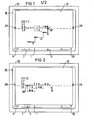
- the display device SG shown in FIG. 1 which is part of a teleprinter or another text station, contains a screen BS, on the writing field SF of which stored text is shown.
- the text is made up of the letters A to P.
- the text represents a message that is to be transmitted, for example, from the teleprinter to a remote subscriber.
- the message is stored in a message store on the teleprinter.
- the message number N is shown in a predetermined display area on the screen BS.
- a line ruler Z is shown there, on which tab marks T and a writing point display S can be displayed. The clerks at show S is moved simultaneously with a cursor SM in the horizontal direction.
- This cursive mark SM identifies the positions at which a character in the write field SF can be changed.
- the writing mark SM moves in each case in a writing line which is identified by two line marks ZM on both sides of the writing field SF.
- a still free memory area SB is also shown in the specified display area in order to show the operator the number of pages to be written on a peripheral memory.
- the text following the letters GH should be deleted using a delete key.
- Deletion takes place in the opposite direction to the writing direction and the writing mark S is first positioned to the letter N, at the end of the word formed from the letters L to N.
- the letters can be deleted character by character by briefly pressing a delete key. If the delete key is pressed continuously, the letters are continuously deleted and if the word boundary is recognized by the "space" character, the deletion process is ended first and the cursor SM remains, according to the schematic representation at a, at the previous position of the letter L. If the delete key is pressed continuously, the deletion process is continued after a short dwell time of, for example, 300 ms, and the subsequent word formed from the letters I to K is deleted in a corresponding manner.
- deletion process is terminated when the "space" character is recognized at the word boundary, which is represented schematically by b. If you press the delete key again or if you press the delete key again, the deletion process is started again and the subsequent characters "space" are deleted to the extent that only the character "space” adjacent to the letter H is deleted. remains as it is shown at c. Now press the delete key because the desired deletion has been carried out completely.
- the deletion process can be interrupted at any time within each word.
- word-by-word deletion immediately changes to character-by-character deletion, so that parts of words can also be deleted in a simple manner.
- the deletion takes place in the writing direction.
- the cursor SM is not moved during the deletion process and remains at the position that indicates the beginning of the area that is to be deleted.
- the delete process is ended when the limit of the following word is recognized.
- the letter I is, as shown schematically at a, at the position identified by the cursor SM.
- the delete key is pressed again or is pressed continuously, the word formed from the letters I to K and a "space" character is then deleted and the letter L of the following word is now, as shown at b, at the point identified by the cursor SM.
- the delete key After pressing the delete key again, the following word and the associated character "space" are also deleted.
- FIGS. 1 and 2 show the text as it is shown on the screen BS after the deletion process shown in FIGS. 1 and 2.
- the cursor SM is in any case after the character "space" following the letter H, so that the entry of a new word can begin immediately.
- the cursor SM can also be represented in a different way.
- the deletion processes take place accordingly.
- the text is displayed on a recording medium, for example using a printing unit, the characters are deleted in the opposite way to the writing direction or in the writing direction by overwriting the corresponding characters with a special character, for example the letter "X", in accordance with the process shown in FIG. 1. You can then move the record . a new text can be written immediately above or below the deleted text.
- a keyboard TA, a punched tape reader LE and a receiver EM connected to a long-distance line FL are provided as input units on a data bus DB.
- a punched tape punch LO, a printer DR, the viewing device SG and a transmitter SE also connected to the long-distance line FL are provided as output units.
- a message memory NS and a control unit ST are connected to the data bus DB.
- the message memory NS is designed as a semiconductor memory, magnetic bubble memory or as a floppy disk memory.
- the control unit ST controls the chronological sequence of functions of the teleprinter and expediently contains a microcomputer MR provided with a program memory.
- the microcomputer MR also controls the Deletion. If the delete key L is actuated on the keyboard TA, a character-by-character individual or continuous deletion of the corresponding text parts takes place in a manner known per se. However, if the microcomputer MR detects a text boundary, the deletion process is terminated in the arrangement and only continues again after the dwell time of 300 ms.
- a comparator V is shown schematically in the microcomputer MR, which checks the text shown for the presence of a “space” character and ends the deletion process when a single character is recognized.
- the comparator V can also be designed such that it only ends the deletion process if a character "space” is followed by a printable character, so that a plurality of characters "space” is treated according to a word and is deleted word by word.
Landscapes
- Engineering & Computer Science (AREA)
- Theoretical Computer Science (AREA)
- Audiology, Speech & Language Pathology (AREA)
- Health & Medical Sciences (AREA)
- Computational Linguistics (AREA)
- General Health & Medical Sciences (AREA)
- Physics & Mathematics (AREA)
- General Engineering & Computer Science (AREA)
- General Physics & Mathematics (AREA)
- Artificial Intelligence (AREA)
- Document Processing Apparatus (AREA)
- Record Information Processing For Printing (AREA)
- Input From Keyboards Or The Like (AREA)
Applications Claiming Priority (2)
| Application Number | Priority Date | Filing Date | Title |
|---|---|---|---|
| DE3241170 | 1982-11-08 | ||
| DE19823241170 DE3241170A1 (de) | 1982-11-08 | 1982-11-08 | Anordnung zum loeschen von texten |
Publications (3)
| Publication Number | Publication Date |
|---|---|
| EP0109017A2 true EP0109017A2 (fr) | 1984-05-23 |
| EP0109017A3 EP0109017A3 (en) | 1985-01-09 |
| EP0109017B1 EP0109017B1 (fr) | 1987-03-11 |
Family
ID=6177564
Family Applications (1)
| Application Number | Title | Priority Date | Filing Date |
|---|---|---|---|
| EP83111040A Expired EP0109017B1 (fr) | 1982-11-08 | 1983-11-04 | Agencement d'effacement de textes |
Country Status (3)
| Country | Link |
|---|---|
| EP (1) | EP0109017B1 (fr) |
| JP (1) | JPS5998241A (fr) |
| DE (2) | DE3241170A1 (fr) |
Cited By (2)
| Publication number | Priority date | Publication date | Assignee | Title |
|---|---|---|---|---|
| GB2156559A (en) * | 1984-03-09 | 1985-10-09 | Scm Corp | Automatic word correcting system |
| EP0345035A3 (fr) * | 1988-05-31 | 1991-10-02 | Brother Kogyo Kabushiki Kaisha | Appareil pour le traitement de textes avec fonction pour la modification de caractères |
Family Cites Families (1)
| Publication number | Priority date | Publication date | Assignee | Title |
|---|---|---|---|---|
| GB1533499A (en) * | 1977-07-07 | 1978-11-29 | Ibm | Text processing apparatus |
-
1982
- 1982-11-08 DE DE19823241170 patent/DE3241170A1/de not_active Ceased
-
1983
- 1983-11-04 DE DE8383111040T patent/DE3370215D1/de not_active Expired
- 1983-11-04 EP EP83111040A patent/EP0109017B1/fr not_active Expired
- 1983-11-08 JP JP58208416A patent/JPS5998241A/ja active Pending
Cited By (2)
| Publication number | Priority date | Publication date | Assignee | Title |
|---|---|---|---|---|
| GB2156559A (en) * | 1984-03-09 | 1985-10-09 | Scm Corp | Automatic word correcting system |
| EP0345035A3 (fr) * | 1988-05-31 | 1991-10-02 | Brother Kogyo Kabushiki Kaisha | Appareil pour le traitement de textes avec fonction pour la modification de caractères |
Also Published As
| Publication number | Publication date |
|---|---|
| JPS5998241A (ja) | 1984-06-06 |
| DE3241170A1 (de) | 1984-05-10 |
| DE3370215D1 (en) | 1987-04-16 |
| EP0109017A3 (en) | 1985-01-09 |
| EP0109017B1 (fr) | 1987-03-11 |
Similar Documents
| Publication | Publication Date | Title |
|---|---|---|
| DE2835320C2 (de) | Schaltungsanordnung für die Einstellung des linken Randes bei einem Textverarbeitungsgerät | |
| DE1436446B2 (de) | Vorrichtung zum beliebigen zeilenweisen Abteilen und Ausschließen eines Drucktextes | |
| DE2711413A1 (de) | Formatsteuerung fuer textautomaten | |
| DE1961173B2 (de) | Steuereinrichtung zum Festlegen bzw. Verändern der Textaufteilung einer Textdatenfolge mit Hilfe eines Bildanzeigegerätes | |
| DE2818974A1 (de) | Datenstation fuer datenverarbeitungsanlagen | |
| DE2541090A1 (de) | Vorrichtung zur codierung und/oder vorzugsweise gleichzeitiger anzeige einer grafik | |
| DE1925031A1 (de) | Schreibautomaten | |
| DE2652362C2 (de) | Einrichtung zum Versetzen von Tabulatorenmarken in Datenausgabegeräten | |
| DE2906883C2 (fr) | ||
| DE3209187C2 (de) | Verfahren zur Darstellung eines Textes auf einer einzeiligen Anzeigevorrichtung eines Texterstellungsgerätes | |
| DE2416921B2 (de) | Drucker | |
| DE2825519A1 (de) | Elektronisches ausgabegeraet fuer mehrzeilige textwiedergabe | |
| DE3151357C2 (de) | Einrichtung zum Steuern der Bewegung eines Cursors | |
| DE3046037A1 (de) | Textbearbeitungsgeraet | |
| EP0109017B1 (fr) | Agencement d'effacement de textes | |
| EP0158718B1 (fr) | Procédé de commande de la position d'impression dans une machine à écrire ou similaire pour le soulignement automatique d'un passage de texte | |
| DE3781971T2 (de) | Dokumentverarbeitungsapparat. | |
| DE2920563A1 (de) | Verfahren zum rueckstellen des typentraegers in schreibmaschinen | |
| EP0109574B1 (fr) | Agencement de représentation de textes | |
| EP0262548B1 (fr) | Méthode et dispositif d'affichage de textes munis de codes de commande y appartenant | |
| EP0116867A2 (fr) | Méthode et dispositif d'affichage de textes sur l'écran d'un terminal de traitement de textes | |
| DE3403306A1 (de) | Verfahren und anordnung zum auswaehlen von geraetefunktionen in einer textstation | |
| EP0027558A2 (fr) | Dispositif pour visualiser des caractères | |
| DE3010430C2 (fr) | ||
| DE3122500A1 (de) | Anordnung zum darstellen eines verfuegbaren speicherbereichs in einem nachrichtenspeicher einer textstation |
Legal Events
| Date | Code | Title | Description |
|---|---|---|---|
| PUAI | Public reference made under article 153(3) epc to a published international application that has entered the european phase |
Free format text: ORIGINAL CODE: 0009012 |
|
| AK | Designated contracting states |
Designated state(s): CH DE FR GB IT LI SE |
|
| PUAL | Search report despatched |
Free format text: ORIGINAL CODE: 0009013 |
|
| AK | Designated contracting states |
Designated state(s): CH DE FR GB IT LI SE |
|
| 17P | Request for examination filed |
Effective date: 19841217 |
|
| 17Q | First examination report despatched |
Effective date: 19860407 |
|
| GRAA | (expected) grant |
Free format text: ORIGINAL CODE: 0009210 |
|
| AK | Designated contracting states |
Kind code of ref document: B1 Designated state(s): CH DE FR GB IT LI SE |
|
| REF | Corresponds to: |
Ref document number: 3370215 Country of ref document: DE Date of ref document: 19870416 |
|
| ET | Fr: translation filed | ||
| ITF | It: translation for a ep patent filed | ||
| PG25 | Lapsed in a contracting state [announced via postgrant information from national office to epo] |
Ref country code: SE Effective date: 19871105 |
|
| PG25 | Lapsed in a contracting state [announced via postgrant information from national office to epo] |
Ref country code: LI Effective date: 19871130 Ref country code: CH Effective date: 19871130 |
|
| PLBE | No opposition filed within time limit |
Free format text: ORIGINAL CODE: 0009261 |
|
| STAA | Information on the status of an ep patent application or granted ep patent |
Free format text: STATUS: NO OPPOSITION FILED WITHIN TIME LIMIT |
|
| 26N | No opposition filed | ||
| PG25 | Lapsed in a contracting state [announced via postgrant information from national office to epo] |
Ref country code: FR Free format text: LAPSE BECAUSE OF NON-PAYMENT OF DUE FEES Effective date: 19880729 |
|
| REG | Reference to a national code |
Ref country code: CH Ref legal event code: PL |
|
| REG | Reference to a national code |
Ref country code: FR Ref legal event code: ST |
|
| PG25 | Lapsed in a contracting state [announced via postgrant information from national office to epo] |
Ref country code: GB Effective date: 19881104 |
|
| GBPC | Gb: european patent ceased through non-payment of renewal fee | ||
| PG25 | Lapsed in a contracting state [announced via postgrant information from national office to epo] |
Ref country code: DE Effective date: 19890801 |
|
| EUG | Se: european patent has lapsed |
Ref document number: 83111040.8 Effective date: 19880913 |