EP0109157A2 - Automatisiertes Kontrollsystem für Sandmühlen - Google Patents
Automatisiertes Kontrollsystem für Sandmühlen Download PDFInfo
- Publication number
- EP0109157A2 EP0109157A2 EP83305786A EP83305786A EP0109157A2 EP 0109157 A2 EP0109157 A2 EP 0109157A2 EP 83305786 A EP83305786 A EP 83305786A EP 83305786 A EP83305786 A EP 83305786A EP 0109157 A2 EP0109157 A2 EP 0109157A2
- Authority
- EP
- European Patent Office
- Prior art keywords
- slurry
- vessel
- sensing
- pressure
- speed
- Prior art date
- Legal status (The legal status is an assumption and is not a legal conclusion. Google has not performed a legal analysis and makes no representation as to the accuracy of the status listed.)
- Withdrawn
Links
- 239000002002 slurry Substances 0.000 claims description 86
- 238000003801 milling Methods 0.000 claims description 62
- 238000000034 method Methods 0.000 claims description 37
- 238000012545 processing Methods 0.000 claims description 35
- 239000011230 binding agent Substances 0.000 claims description 34
- 239000007788 liquid Substances 0.000 claims description 34
- 239000002826 coolant Substances 0.000 claims description 32
- 239000002245 particle Substances 0.000 claims description 27
- 239000007787 solid Substances 0.000 claims description 18
- 238000005086 pumping Methods 0.000 claims description 13
- 238000000227 grinding Methods 0.000 claims description 12
- 239000000314 lubricant Substances 0.000 claims description 11
- 238000000576 coating method Methods 0.000 claims description 9
- 239000011248 coating agent Substances 0.000 claims description 8
- 238000001816 cooling Methods 0.000 claims description 8
- 239000012530 fluid Substances 0.000 claims description 8
- 238000004519 manufacturing process Methods 0.000 claims description 7
- 239000006249 magnetic particle Substances 0.000 claims description 6
- 239000000470 constituent Substances 0.000 claims description 4
- 238000012544 monitoring process Methods 0.000 claims description 3
- 230000000977 initiatory effect Effects 0.000 claims description 2
- 238000002360 preparation method Methods 0.000 claims 1
- 239000000047 product Substances 0.000 description 48
- 239000004576 sand Substances 0.000 description 48
- 230000014509 gene expression Effects 0.000 description 21
- 230000008569 process Effects 0.000 description 19
- 239000000463 material Substances 0.000 description 13
- 239000000498 cooling water Substances 0.000 description 9
- 238000010586 diagram Methods 0.000 description 9
- XLYOFNOQVPJJNP-UHFFFAOYSA-N water Substances O XLYOFNOQVPJJNP-UHFFFAOYSA-N 0.000 description 6
- 239000003245 coal Substances 0.000 description 5
- 238000003860 storage Methods 0.000 description 5
- 230000009471 action Effects 0.000 description 3
- 230000008901 benefit Effects 0.000 description 3
- 239000000446 fuel Substances 0.000 description 3
- 230000006870 function Effects 0.000 description 3
- 239000000203 mixture Substances 0.000 description 3
- 239000003973 paint Substances 0.000 description 3
- 229910000831 Steel Inorganic materials 0.000 description 2
- 238000013459 approach Methods 0.000 description 2
- 239000007795 chemical reaction product Substances 0.000 description 2
- 230000003247 decreasing effect Effects 0.000 description 2
- 238000009826 distribution Methods 0.000 description 2
- 238000002156 mixing Methods 0.000 description 2
- 238000013021 overheating Methods 0.000 description 2
- 239000000049 pigment Substances 0.000 description 2
- 238000004886 process control Methods 0.000 description 2
- 239000010959 steel Substances 0.000 description 2
- 238000012360 testing method Methods 0.000 description 2
- 238000013019 agitation Methods 0.000 description 1
- 238000004364 calculation method Methods 0.000 description 1
- 239000000919 ceramic Substances 0.000 description 1
- 230000008859 change Effects 0.000 description 1
- 238000013461 design Methods 0.000 description 1
- 239000000975 dye Substances 0.000 description 1
- 230000000694 effects Effects 0.000 description 1
- 239000012467 final product Substances 0.000 description 1
- 239000011521 glass Substances 0.000 description 1
- 230000006872 improvement Effects 0.000 description 1
- 230000003993 interaction Effects 0.000 description 1
- 238000005304 joining Methods 0.000 description 1
- 238000012423 maintenance Methods 0.000 description 1
- 230000007257 malfunction Effects 0.000 description 1
- 238000010338 mechanical breakdown Methods 0.000 description 1
- 230000007246 mechanism Effects 0.000 description 1
- 238000010951 particle size reduction Methods 0.000 description 1
- 239000002904 solvent Substances 0.000 description 1
- 239000000725 suspension Substances 0.000 description 1
- 230000007704 transition Effects 0.000 description 1
Images




Classifications
-
- B—PERFORMING OPERATIONS; TRANSPORTING
- B02—CRUSHING, PULVERISING, OR DISINTEGRATING; PREPARATORY TREATMENT OF GRAIN FOR MILLING
- B02C—CRUSHING, PULVERISING, OR DISINTEGRATING IN GENERAL; MILLING GRAIN
- B02C17/00—Disintegrating by tumbling mills, i.e. mills having a container charged with the material to be disintegrated with or without special disintegrating members such as pebbles or balls
- B02C17/16—Mills in which a fixed container houses stirring means tumbling the charge
-
- B—PERFORMING OPERATIONS; TRANSPORTING
- B02—CRUSHING, PULVERISING, OR DISINTEGRATING; PREPARATORY TREATMENT OF GRAIN FOR MILLING
- B02C—CRUSHING, PULVERISING, OR DISINTEGRATING IN GENERAL; MILLING GRAIN
- B02C25/00—Control arrangements specially adapted for crushing or disintegrating
Definitions
- This invention relates to the processing or grinding of solids within liquids, and more particularly to that process commonly referred to as sand milling.
- the invention also relates, to a lesser extent, to related processes wherein solids are reduced in particle size or more uniformly dispersed within liquids.
- Sand milling refers to that process wherein a liquid having solid particles therein is pumped through a vessel containing a grinding media, which is agitated by a series of rotor disks as the product passes through the vessel.
- a liquid having solid particles therein is pumped through a vessel containing a grinding media, which is agitated by a series of rotor disks as the product passes through the vessel.
- sand was used as the grinding media, which gave the process its name.
- manufactured small diameter spheres made of various materials such as steel, glass, or ceramic is typically used now.
- the process has been used for a wide variety of materials such as paint and related products, dyes, foodstuffs, magnetic coatings and other such materials.
- the process has been used for combining coal with oil or water in providing fuels.
- the size of the solid particles entering the sand mill can vary significantly from relatively large chunks to rather small particles. During the milling process, these solids can be greatly reduced in size to the desired level, down to and including micron or submicron size. With mixtures or slurries having relatively large particle sizes, it is common to first pass the product through a high speed dispersing operation wherein the particles are fairly uniformly dispersed within the liquid and decreased in particle size, usually to some minor extent and deaglomerated.
- the physical characteristics of the product introduced to the sand mill vary tremendously, with variables including in addition to the particle size, the uniformity of particle sizes, the qualities of the particles that determine their resistance to being broken into smaller particles, the density, and the liquid viscosity. Further, these characteristics vary significantly within a particular type of product. For example, there are hundreds of paint pigments, and many different types and categories of coal and-oil. Then of course there are the additional variables introduced by the temperature both of the incoming product and throughout the processing operation.
- variable speed rotors for sand mills are known, the mechanisms used have been slow responding mechanical arrangements limited to adjustments within certain ranges. More importantly, the bulk of the apparatus being utilized has a fixed speed for the rotor, which is determined by the characteristics of the electric motor commonly employed to drive the rotor, rather than by the characteristics of the product. Since sand mills are made with rotors of different diameters, this of course means that the rotor tip speed varies considerably between sizes, and yet this is an important consideration in determining the effectiveness of the grinding operation. Fixed speed rotors also introduce start-up problems because of the significant loads usually involved.
- the most common method for varying the quality of the product output has been to control the length of time that the product is subjected to processing, this in turn is basically a function of the rate at which the product is pumped through the vessel, although in more recent years the product might be run through the same vessel more than once or run through a series of vessels.
- this variable is determined through trial and error, such as by taking a sample of the product output and having it analyzed to determine particle size and distribution. If the desired product is not being obtained, adjustments are usually made in the length of time of processing the product.
- Such analyzing would of course primarily only apply with respect to the given sample taken, and variations of the product being introduced in variations and characteristics because of temperature, etc. were basically being ignored.
- a sand milling system in which a multitude of variables of a sand milling operation are sensed and fed to a microprocessor-based control unit, which, in turn, is connected to cause the control of various paramaters of the operation by other controllers.
- a microprocessor-based control unit which controls the speed of the rotor within the sand mill.
- the control unit likewise controls the flow rate of the product through the sand mill. If the product is to pass through one or more sand mills the control unit controls the flow to provide the desired particle size and distribution.
- the temperatures and pressures of the product are also sensed and fed to the control unit which displays this data and programs other independent controllers to make any necessary adjustments to control the operation of the sand mill to obtain the desired result.
- the various control parameters are preferably displayed on an operator's console at the control unit having the desired dials, gauges, digital readouts or cathode ray tube displays.
- the operator can remotely make the necessary adjustments of the parameters to obtain the desired output product based upon tests of the output product quality.
- the control unit continues to monitor and adjust the process to continue to provide this desired output product automatically.
- a record is maintained of all of the products processed by the apparatus, together with the processing variables used to manufacture a product having those characteristics.
- the proper processing parameters may be simply recalled from the control unit memory or storage medium and used to control that particular operation.
- human readable record can be obtained of all aspects of the processing information.
- This procedure can be followed for a multitude of products which are processed by sandmills.
- magnetic particles within a coating are applied to the tape.
- a sandmill is employed wherein the particles are ground to an extremely small and uniform size to obtain proper performance from the tape.
- large particles of coal may be ground in oil or water wherein not only particular sizes are desired, to produce a desirable combustible product and to help maintain the particles in suspension within the liquid during long storage periods.
- the control unit can again provide the necessary control once the desired parameters have been established.
- the system of the invention greatly modifies and improves present methods of dispersing and milling solids within liquids to provide precise specific controls over operations that have heretofore been incompletely controlled, or controlled through inconsistent trial and error methods.
- higher reliability and ease of repeatability of results is achieved through more complete sensing and control of process parameters by use of real time automated process control techniques.
- each of the milling machines includes a vessel 16 having liquid inlet and outlet connections for pumping, by pump 18, a slurry through the vessels.
- each of the machines includes a rotor 20 driven by an electric motor 22, and each of the vessels is partially filled with a grinding media 24.
- the media is preferably a small diameter steel shot, although a variety of grinding media may employed.
- the motors employed are variable speed electric motors, and, referring back to Figure 1, the motors are electrically connected to an inverter 26 or other electrical controller means for varying the speed of the electric motors.
- the inverter 26 is controlled by a master control unit 28 which receives manual input instructions, monitors parameters of the milling process, provides displays of the desired parameters, as well as the sensed parameters and provides output instructions to the inverter 26 and other parameter controllers.
- the control unit 28 in addition to including several microprocessor-based hardware modules and some standard software modules, includes a manually operable keyboard 30 for inputting instructions to the control unit, a cathode ray tube display screen 32 and a panel 34 of analog and digital readouts and guages. Permanent copy of any of the displays or readouts may be obtained by way of the printer 36 associated with the control unit 28.
- Various programmable control units 28 are available.
- One such unit is manufactured by the Industrial Instrumentation Division of Robert Shaw Controls Company of Anaheim, California for controlling the instrumentation of various industrial processes and is designated the DCS-1000/1500".
- Robert Shaw Controls Company has developed a general purpose program for process control purposes, identified by that company as the Digital Supervisory Module DSM-1000.
- the Digital Supervisory Module contains 4 standard "virtual control modules”. Suitable instructions or configurations are then provided to configure the standard modules to the particular process described herein.
- each sandmill is designed to have the slurry under pressure within the vessel during operation.
- a suitable schematically illustrated seal 38 is provided to prevent product from escaping the vessel at the locations where the rotor drive shaft leaves the vessel.
- the pressure within the vessel is exposed to one side of the seal 38.
- Higher pressure of a lubricant coolant is applied on the other side of the seal sufficient to prevent leakage past the seal out of the vessel.
- a cooling jacket 42 surrounds the vessel and a suitable coolant, usually water, is pumped therethrough.
- the pump 18 is shown receiving the slurry in a line 44 from a liquid input supply 46 and a solid particle input supply 48.
- the slurry fed to the pump 18 is pumped through a conduit 50 to the inlet at the lower end of the vessel 16 for the milling machine M1.
- the four milling machines are arranged with their vessels 16 serially connected. That is, the output from the vessel of mill M1 is ducted by conduit 51 to the lower end of the vessel for the mill M2; the outlet at the upper end of the mill 2 is ducted by conduit 52 to the lower end of vessel in mill M2.
- output from the vessel of mill M3 is connected to the inlet at the lower end of vessel for mill M4.
- the slurry being. processed through the milling machines may consist of a large variety of different materials, as mentioned above. In many of these processes, the only product input is directly into the first milling machine. In some situations however it is desireable to introduce additional constituents of the product at a point downstream from the first milling machine.
- an additional liquid is introduced from two supply tanks 54 and 56 to a conduit 58 leading to a pump 60, which in turn has its output line 62 joining the slurry line 53 to be fed into the lower end of the fourth milling machine M4.
- This additional constituent is dispersed within the fourth milling machine and the resulting product flows out the upper end of the vessel in milling machine M4 through the conduit 64.
- the system shown in Figure 3 was designed for the production of coating for use in connection with the manufacturer of magnetic tape.
- magnetic particles in a suitable solvent are provided through the slurry input tank 36 and combined with a suitable liquid carrier from the tank 48.
- the magnetic particle are finely milled as the slurry is pumped through the milling machines.
- the liquid from the pump 60 is a suitable binder material.
- the sand mill vessels are operated with the slurry under pressure and with lubricant pressurizing the vessel seals.
- This is illustrated in Figure 3 wherein lubricant from a supply 66 is pumped by pump 68 through lines 70 to the seals in the vessels.
- each mill is provided with a cooling jacket 42 through which is circulated a suitable coolant such as water.
- a suitable coolant such as water
- coolant conduit 72 leading to each of the jackets 42. While all of the details of the cooling water system are not shown, it should be understood that the coolant may flow one time through the system or coolant may be suitably cooled through a heat exchanger and re-circulated through the jacket 42.
- a control valve 74 is positioned in each of the branch lines leading to the respective cooling jackets so that individualized control of the coolant flow is provided for each of the vessels.
- the electric motors 22 are for convenience shown located below the mill vessels in Fig. 3, although the motors are actually located above the vessels.
- each of the electric motors for driving the rotors is of the variable speed type and is electrically connected to the speed control 26 and the control unit 28.
- Each motor has a speed sensor S1-S4 which senses the speed of the motor and transmits the information to independent speed controllers within the control unit 28.
- Each electric motor has an overload sensing device 21 which monitors the current flowing in the motor and which trips if the current becomes too high.
- Such device for Mill M1 is shown in Figure 3 for convenience but are actually located in the speed control 26 or elsewhere as desired.
- Each overload device can be read by the control unit 28 to determine if the overload device is in a tripped state indicating an overload has occurred.
- the actual electrical connections for this purpose are only schematically illustrated in Figure 3 by the lines leading from the speed control 26 and the control unit 28 to the milling apparatus 10 and between the units 26 and 28.
- the product input pumps 18 and 60 also include suitable variable speed electric motors which are connected to the control unit 28 and the speed control 26.
- the oil seal pump 68 may also be connected to the speed control however that pump does not have to be variable speed.
- the cooling water pump (not shown) could also be connected to the speed control, although it is not necessary that the motor for that pump be of the variable speed type, since coolant flow control is obtained by the valves 74.
- a variety of suitable inverters are available. One type that is acceptable is that manufactured by Reliance Electric of Cleveland, Ohio.
- a suitable flow meter F1 positioned in the output line 50 of the slurry pump 18.
- a flowmeter F2 is also positioned in the flowline 62 of the binder pump 60, and a similar flowmeter F3 is positioned in the product line 64 leading from the milling machine M4. It is also desirable to measure the flow of cooling water, which is accomplished by a suitable flowmeter F4 positioned in the cooling water input line 72.
- the speed of the motors for mills M1, M2, M3, and M4 be sensed and monitored by sensors schematically illustrated as S1, S2, S3 and S4 adjacent the motors 22.
- Various transducers may be utilized for this purpose, one satisfactory approach being a magnetic pick-up device mounted on the motor output shaft which senses the revolutions of the motor.
- the .diameter of the rotor is utilized to convert revolutions per minute into rim speed in feet per second in the individual controller in the control unit 28.
- Another variable to be sensed is the liquid pressure at various points in the system.
- a suitable sensor P1 in the slurry input line 50 leading to the first mill M1.
- Similar sensors P2, P3, and P4 are positioned in the slurry input lines leading to mills M2, M3 and M4 respectively.
- Pressure sensor P11 is positioned in the lubricant line 70 leading to the seals for the mills.
- pressure sensor P12 is located in the binder flow line 62 leading to milling machine M4.
- thermosensor T1, T2, T3 and T4 respectively appropriately located on the sand mills.
- the information from the various sensors is fed to the control unit 28 through suitable electrical connections (not shown).
- the control unit is programmed to cause the mill to follow this specified sequence. Since it is critical that the slurry not escape from the seals of the mill vessels, and the vessels are to be operated under pressure, the first step in the sequence is to energize the lubricant pump 68. Energizing the pump 68 causes an indicator light to be energized on the gage panel 34 as well as a light on the pump 68 itself shown on the display screen 32, if that particular display has been called for by the operator. This is the logical display for initiating operation. Shortly after energizing the pump 68, a pressure sensed by the sensor P11 should rise and an indication of this transmitted to the control unit 28 indicating that the next step may be initiated. This pressure may be visually observed by the operator on the gage panel 34.
- the slurry pump 18 With the seal lubricant pressure at a safe minimum level, the slurry pump 18 is energized to commence pumping slurry to the first milling machine M1. When the slurry pressure in the line 50, as sensed by the sensor P1, reaches a pre-determined level, the electric motor 42 for mill Ml is energized. Because the start-up load on the motor 22 and the rotor 20 as well as the shafts connecting them, is substantial due to the heavy grinding media plus whatever residual slurry may be in the vessel 16, the motor 22 is actually placed in operation by a jogging sequence wherein power is supplied and interrupted repeatedly so as to jog the motor into movement before continuous power is supplied. This approach reduces the liklihood of mechanical breakdown and lengthens the overall life of the apparatus.
- the temperatures within the vessels in each of the mills increases due to the heat of the milling operation.
- the temperature is continually monitored and controlled by sensors Tl, T2, T3 and T4.
- the set points for this control are established by the control unit 28. If the temperature is outside of a pre-determined range, coolant flow is initiated and the appropriate valve 74 is automatically opened or closed as the case may be by a suitable signal from the control unit 28.
- the coolant flow may be initiated anywhere within the start-up sequence or where desired.
- an appropriate sequence is also automatically followed as controlled by the control unit 28 after receiving a suitable signal from the operator.
- the product slurry pump 18 and the binder pump 60 are de-energized to stop product flow through the mills and the electrical motors for the mills are then de-energized.
- the lubricant oil pump 68 is the last component to be de-energized, except that the cooling water through the mill jackets will continue to flow if there should be any temperature buildup in any of the vessels.
- a major advantage of the system is the complete and continuous automatic control of the operation under the supervision of the control unit 28. This results in more cost effective operation since a single operator could run several machines making different products without constant attendance at any of them and with little time needed to establish the parameters if that particular product had been manufactured in the process before and the value of the parameters stored. If it is determined that the final product flowing from the mill M4 does not have the solid particles reduced to a desired level, the operator can make the desired adjustment, such as increasing the rim speed of the mill rotors. Or, the flow through the system can be reduced by adjusting the output of the slurry pump 18, and by appropriately adjusting the output of the binder 60.
- the desired ratio of the output of the two pumps may, of course, be initially established so that the proper adjustment of the two is simultaneously made.
- the actual values of the various parameters being sensed can be displayed directly on the diagram illustrated in Figure 3 adjacent the various sensors.
- Figure 3 is essentially a replica of one of the displays, with the exception that the values being sensed at a given time are not shown in Figure 3.
- Another useful display summarizes the various parameters being sensed by category of parameter. That is the flow rates F1, F2, F3 and F4 are grouped and the pressures P1, P2, P3, P4, P11 and P12 are grouped, as are the temperatures T1, T2, T3 and T4.
- the actual values of these parameters as sensed during 'the operation are also continuously and instantaneously available.
- this display is very convenient for .this purpose.
- a separate display is provided.
- the motor speed, the product pressure and the coolant water temperature for each mill are conveniently displayed by mill.
- the fluid flow rates through the system are also summarized. The actual values sensed during operation of a system are continuously indicated on this display for purposes of quickly checking them.
- FIG. 4 Another useful display is to isolate a particular sand mill, v.isually showing the various inputs and outputs to the sand mill, together with the actual values of the parameters being sensed.
- Figure 4 a display of mill M1.
- the actual rotor rim speed is shown at a given instant together with the desired rim speed which has been set for that mill.
- the square in the center of the motor is a light which indicates whether the motor is energized.
- the bottom figure in the box indicating motor speed is a percentage of the actual speed in relation to the maximum speed attainable. This is valuable information in that it tells the operator what capacity that mill has for increasing speed to increase the particle size reduction obtained by that mill.
- the temperature of the cooling water is displayed in that manner. That is, the actual temperature sensed is shown, together with the set temperature and a percentage of capacity of the coolant flow is indicated by an arrow pointing to the flow valve 70.
- This information is, of course, related to the rotor speed information. For example, if the operator would like to increase the motor speed and the motor actually has additional capacity for this, he would expect that the temperature within that mill would rise, thus requiring a greater flow of coolant through the cooling jacket. If, however, the capacity of coolant flow is already approaching 100%, the operator may decide that increasing the rotor speed is not appropriate, or he may realize that there is some malfunction in the cooling system.
- Another temperature control that may also be displayed is the trend or rate of change of temperature. If the temperature is increasing at a certain rate, it is known that it will be difficult to prevent exceeding a specified limit. Thus, the control unit will call for more coolant if the specified rate is exceeded, or the system may provide some other action if it is known that the coolant will not be able to handle the heat buildup.
- the coolant control feature is particularly important because of a wide variety of materials that may be processed by the milling machines. Some materials can tolerate only relatively low temperatures, and yet other materials can be milled better at considerably higher temperatures.
- Figure 5 shows a similar display for mill M4 showing the input from the binder supply as well as the other parameters shown for mill M1 in Figure 4.
- Another significant advantage of this system is that once a successful operation for a particular product is obtained, the actual settings for the various parameters for that particular product can be stored in the memory or in the permanent storage medium of the system that is readily accessible by the control unit 28 so that the information can be recalled as desired for future use for processing the same product at a later time.
- This information may also be obtained from the printer, indicating not only the settings for the various parameters but also the actual product being prepared at what time, for what customer, together with whatever additional information is desired and fed into the control unit 28.
- any of the various displays referred to above may be obtained in printed form for whatever use is desired.
- the system also has the great advantage of remote controlled operation wherein the control unit 28 need not necessarily be positioned near the sand mills, but instead be at very remote locations. Similarly, recorded control information may be sent to another location for use on a different processing unit.
- the accuracy and repeatability of the system is particularly important in processing products having precise parameters. For example, with prior art methods of processing magnetic particle coating for magnetic tape, only about 70% of the coated tape has been acceptable for high performance applications. Increasing this percentage is of great value because of the cost of the poor quality tape. Also, flaws in the tape can produce failure of expensive apparatus used with or controlled by the tape.
- the milling system may be utilized in producing fuel composed of coal and oil. It is useful to know the power consumption of production so that it may be compared to the electrical power that can be produced from the fuel which is being processed.
- Another related cost and supply problem is that of the cooling water.
- a complete record of such is available to permit someone to analyze the data to determine cost of the product as well as when to consider alternate cooling systems with recirculated coolants.
- the controls of the above system may be modified to fit other similar systems.
- the system discussed above adds a binder material into the fourth milling machine.
- Many operations require only the initial slurry be processed through the various mills.
- the system may be utilized for controlling the operation of any number of mills, varying from one to the desired number. In other operations, it is desireable to add additional process equipment or other related apparatus.
- Figure 6 there is schematically illustrated the use of a high-speed disperser blending solid particles into a liquid carrier to form the slurry to be directed to the series of sand mills.
- control unit 28 may be incorporated into an integrated system completely controlled by the control unit 28.
- FIG. 7 there is shown a schematic diagram of the hardware-software control and sensing apparatus for the seal oil pump 68 in Figure 3.
- the seal oil pump 68 is controlled by a hardware switch logic module 67 which, in the preferred embodiment is a DFM-1500-A3 manufactured by the Robert Shaw Controls Company of Anaheim, California. All model numbers mentioned hereinafter are Robert Shaw Controls Company model numbers.
- the hardware logic module 67 interfaces with a software interlock module 69 which is one of the four standard Virtual Control Modules within the Digital Supervisory Module DSM-1000 software sold by the Robert Shaw Controls Company as part of the control unit 28 model DSC-1000/1500.
- the software interlock module 69 implements the Boolean expression in Table I on the I116 row.
- the variable A and B in the expression refer to the logical results of two other loops C120 and I122. These other loops themselves implement the Boolean expressions listed for them on the corresponding rows of Table I.
- the variables in the expressions for the loops C120 and I122 are themselves other loops or are pressure, temperature or other transducers or various overload or switch devices. When all the variables are combined, the result of each loop is a logic 1 or logic 0 which may or may not become a variable in another expression.
- the result as a logic 1 or 0 is coupled to the hardware switch module 67 which either applies or disconnects power to the seal oil pump motor 68.
- the output seal oil pressure on the line 70 is sensed by a pressure indicator hardware module P13 which, in the preferred embodiment, is a model AFM-1500-A3.
- the control unit 28 can read the seal oil pressure on the tine 70 through the pressure indicating module P13.
- FIG 8 there is shown a schematic diagram of the hardware-software control and sensing apparatus for the slurry and binder pumps 18 and 60 in Figure 3.
- the power to the slurry pump 18 is controlled by a model DFM-1500-A3 hardware switch module 19 and the software interlock module 21.
- the software interlock module 21 implements the Boolean expression for the I117 row in Table I.
- the pressure output of slurry pump 18 in the conduit 50 is monitored by the pressure indicating module P1 which is a model AFM-1500-A3.
- the amount of slurry in the line 50 in terms of volume of flow is indicated by the flow indicating controller module F1 which, in the preferred embodiment, is a DCM-1500-A2-A2.
- the flow indicating controller F1 also controls the speed of the slurry pump motor 18 and has its own microprocessor.
- the F 1 module is programmed initially with a set point from the supervisory microprocessor in the control unit 28. After the set point is supplied, F1 independently controls the speed of the slurry pump motor through signals to the inverter 26 to maintain the desired flow rate without further interaction by the control unit 28 supervisory microprocessor.
- the supervisory microprocessor will hereinafter be referred to as the control unit or controller, although the control unit also contains numerous other microprocessors in the individual hardware control modules for the motors and valves in the system.
- control unit 28 can read the model AFM-1500-A3 pressure indicating device P1 to determine the pressure in the line 50, and can read the flow indicating controller F1 to determine the volume of flow in the line 50. Further, the controller unit 28 can control the speed of the slurry pump 18 by changing the set point of F1.
- the control circuitry for the binder pump 60 is coupled to the output line 50 of the slurry pump 18 by a model DCM-150-D2-A4 flow ratio controller F2.
- the flow ratio controller F2 is programmed with a. set point by the controller 28 to control the speed of the binder pump 60 so as to control the amount of flow in the output line 62 from the binder pump 60 in accordance with the amount of flow sensed by the flow ratio controller F2 in the output line 50 of the slurry pump 18. That is, the flow ratio controller F2 controls the speed of the binder pump 60, thereby controlling its output volume to be a specific percentage of the flow in the output line 50 from the slurry pump 18.
- This flow controller F2 can be addressed by the control unit 28 and can store data from the control unit 28 which establishes the percentage mixture of binder to slurry.
- the output pressure in the line 62 from the binder pump can be sensed by a model AFM-1500-A3 pressure indicating hardware module P12.
- This pressure indicating module P12 can be read by the control unit 28 to determine the output pressure in the line 62.
- Two interlock software modules 63 and 65 which implement the Boolean expressions for loops I121 and I122 in Table I use the P12 pressure as a variable.
- the software logic module 63 is an interlock that controls the emergency stop function which will be described in connection with a discussion of Figure 14.
- the software interlock 63 implements a Boolean equation of seven terms, five of which are pressures, one of which is the overload sensor 21 which, in reality, are a single overload sensor, and the last of which is a manual emergency stop button located on the operator's console of the control unit 28.
- the five pressures sensed are from the pressure indicating modules P1 through P4 and P12 in Figure 3.
- the interlock module 63 will shut down the machine if any one of these terms indicates a fault condition.
- the interlock software module 65 checks the pressures from the sensors P1 through P4 and P12, which are its logic terms A through E, and implements the Boolean expression /A + /B + /C + /D + /E.
- the purpose of the interlock module 65 is to ensure that proper pressures exist in the binder and slurry system.
- the software module 65 is used by the control unit 28 in determining whether the proper slurry and binder pressures exist.
- Power to the binder pump 60 is controlled by the hardware module 67 and the software interlock module 69.
- the hardware switch module 67 is a model DFM-1500-A3.
- the software interlock module 69 implements the expression for 1118 in Table I.
- FIG. 10 is the control for mill M4 and differs from the control and sensing apparatus of the sand mills M1 - M3 in that M4 has two additional sensing units on its output line 64 which are not found on the output lines of sand mills M1, M2 or M3. These additional sensing units are pressure indicating unit hardware module P11 and flow indicating hardware module F3. Both P11 and F3 are of the AFM-1500-A3 model type. Both P11 1 and F3 serve as logic terms for the software interlock. modules 123 and 117. The Boolean expressions for these software interlock modules 123 and 117 are given in Table I below for the I123 and I117 loops.
- the rotor speed in the sand mill M4 is controlled by the speed of the motor 29 in Figure 3 which is controlled by the speed control hardware module 31 and the software modules 218 and 219.
- the speed indicator software module 220 represents the computation module within the digital supervisory module DSM-1000. It has a digital input on the line 395 from the speed indicating control hardware module S4 which is mechanically coupled to the shaft of the motor 29 to sense its speed and electrically coupled by the line 392 to control the motor speed.
- the hardware module 31 is a DCM-1500-A2-A2.
- the speed indicating control module 31 controls the speed of the motor 29 in conjunction with the ramp generator software module 218, which is part of the digital supervisory module DSM-1000.
- the purpose of the software module 218 is to enable the control unit 28 in Figure 3 to cause the speed of the motor 29 to be increased or decreased gradually by changing the set point of the speed indicating controller 31 under certain conditions, which are controlled by the software interlock module 219.
- the software interlock module 219 implements the Boolean expression in Table I and controls when the ramp generator 218 is controlling the set point of the speed indicating controller S4.
- the interlock software 1219 causes the ramp generator 218 to come into effect during the mill startup and shutdown sequences.
- the motor 29 is interlocked with other parameters in the system through a model DFM-1500-A3 hardware switch module 108 and the software interlock module 216.
- the software module 216 implements the Boolean expression given in Table I below and controls power to the motor 29 through the hardware interface module 108.
- the binder material comes into the input conduit 62 through the binder conduit 71, while the seal oil enters the seal through the conduit 70.
- Pressure indicating unit P4 is an AFM-1500-A3 model and senses the input pressure in the line 62.
- the flow of the cooling water through the pipe 72 and the cooling jacket surrounding the sand mill M4 is controlled by the electrically operated valve 79.
- the valve 79 is controlled by a temperature indicating control unit 81 which is a model DCM-1500-A2-A2. This unit can be programmed with a set point by the control unit 28 and thereafter independently controls the temperature by controlling the amount of cooling water flowing through the valve 79.
- the temperature indicating and control unit 81 also has alarm limits which set flags indicating whether the temperature is outside the acceptable range.
- the temperature control hardware module 81 communicates with the software interlock module 119 which implements a Boolean logic expression given in Table I below for 1119.
- the temperature indicating control hardware module 81 can be read by the control unit 28 to determine the temperature of the slurry in the sand mill.
- the software interlock module 119 communicates with the temperature indicating unit 81 as part of the sand mill temperature check routine which is continuously executed during operation of the sand mill, as will be described with reference to Figure 12.
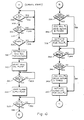
- the normal start routine starts on Figure 10 at point A.
- the digital supervisory module performs a normal start routine which commences with the three decision blocks 300, 302 and 304.
- the decision block 300 determines whether the emergency stop button on the operator's console has been pushed. If it has, the software loops back to point A by the path 306. If it has not, program execution proceeds to decision block 302 via the path 308.
- the control unit determines if the temperature in any of the sand mills exceeds the upper temperature limit by reading the temperature indicating controllers such as 81 in Figure 10.
- the interlock module 119 in Figure 9 is represented by the decision block 302 in Figure 10 and will cause processing control to proceed along a path 310 if the temperature in any of the sand mills is too high.
- the digital supervisory module proceeds along the path 312 to determine whether the start button has been pushed as represented by the decision block 304. If the start button has not been pushed, program control transfers back to the point A on the path 314.
- the system parameters are the set points and alarm limits for the various controllers in the system. For example, there will be a set point for the speed indicating controller 31 and the temperature indicating controller 81 in Figure 9 and for the flow indicating controllers F1 and F2 in Figure 8. Each sand mill has a set point for the corresponding speed and temperature controllers associated with it.
- Each of the controllers in the system has its own microprocessor which uses the set point as the target for controlling the speed of the motor associated with the controller.
- the controllers operate independently of the digital supervisory module in the control unit after the control unit 28 has established the set point for each controller. After these set points are established, the control unit 28 need only monitor the system parameters and display them.
- Each of the controllers and other indicating device systems generate analog signals which can be read by the control unit 28 and converted to digital data for purposes of display to the operator of the various pressures, .temperatures and flow rates in the system.
- the various controllers and other indicating hardware modules in the system previously discussed in connection with Figures 7, 8 and 9, also have alarm limits to establish acceptable ranges for flow, pressure and temperature. Each alarm limit has a flag associated with it which can be read by the control unit 28 to determine whether the particular parameter in question is outside acceptable limits. These limits can be established by the control unit 28.
- the system parameters can be established in the block 316 in either of two ways.
- the system set points and alarm limits can be established manually by the operator from the console on the control unit 28.
- the system parameters and alarm limits can be brought in from bulk storage, such as a disk, used for keeping archival records for previous runs which have proved satisfactory for the production of certain products.
- These archival records may be stored by the operator after he has experimented with the system parameters by a trial and error method of examininq the output product versus the desired end product and adjusting the parameters accordingly to alter the output product.
- Once the operator is satisfied with the system parameters and alarm limits he can store the parameters on the archival disk or tape which is symbolically illustrated by the block 318 on Figure 11.
- the control unit 28 is ready to begin the start-up sequence which begins with the block 320 in Figure 10.
- the start- up sequence requires that seal oil pressure be established on the outside seal to balance the pressure on the other side of the seal within the sand mill vessel.
- the first step in the start-up sequence is to start the seal oil pump which is represented by the block 320.
- the seal oil pump 68 is started when the Boolean conditions implemented by the interlock module 69 are satisfied.
- the Boolean conditions are specified in Table I below.
- the hardware module 67 applies power to the seal oil pump 68 and seal oil pressure on the line 70 begins to rise.
- the seal oil pressure in the line 70 is sensed to determine whether the seal oil pressure is within the established limit. This action is represented by the block 322 in Figure 10, and physically involves a reading operation by the control unit 28 to determine the condition of the lower limit flag at the pressure indicator P13 in Figure 7, to determine if the seal oil pressure is above the established lower limit.
- the pressure indicating unit P13 is continuously read until the pressure has reached the acceptable level, as represented by the processing path 324.
- the control unit starts the slurry supply pump 18 in Figure 8, represented by the block 326. With reference to Figure 8 and Table I, slurry pump 18 is started when the Boolean equation for the software interlock module 21, i.e.
- the logic 1 causes the hardware switch module 19 to apply power to the slurry pump motor 18. After the power is applied to the slurry pump 18, the flow indicating controller F1 will automatically regulate the speed of the slurry pump 18 in accordance with the set point established by the operator or brouqht in from the archival store.
- the pressure in the outlet line 50 is checked by the control unit by reading the pressure indicating hardware module P1 in Figure 8. This step is represented symbolically in Figure 10 by the decision block 328.
- the control unit 28 will wait until the slurry input pressure to the sand mill M1 on the line 50 has reached an acceptable level, as represented by the processing control path 330.
- Block 334 is the first step in the portion of the start-up sequence having to do with establishing the rotor tip speeds for the four sand mills. Because the sand mills sometimes become difficult to start after a long period of being shut down, a motor jogging sequence is used if the amount of time that a particular mill has been shut down exceeds a predetermined amount of time. The purpose of the block 334 in Figure 10 is to determine whether the shutdown time has been exceeded. If not, the processing transfers to a block 336 via a path 338 to initiate the speed control for the motor 22 driving sand mill M1 in Figure 3. Block 336 represents the operations of establishing the set point in the speed indicating controller 31 in Figure 9.
- the mill M1 drive motor must be jogged three times to break it loose. This is represented by the block 340 in Figure 10. After the motor has been jogged three times, processing proceeds to the previously-described block 336.
- processing proceeds to the decision block 346 to determine whether the shutdown time for mill M2 has exceeded the maximum permissible time. Processing then continues in a similar fashion as for mill M1 to start the motor 25 for mill M2. This processing is symbolized by the blocks 346, 348, 350 and the path 352.
- the output pressure for mill M2 is checked by reading the pressure indicating device P3 in Figure 3. This step is symbolized by the block 354 on Figure 11. Once the output pressure from mill M2 has risen to an acceptable level, the control unit 28 begins the process of starting the motor for mill M3.
- the processing steps are the same as for mills M1 and M2 and are represented by the blocks 356, 358, 360 and the path 362 in Figure 11.
- the speed controller for the motor automatically controls the speed of the mill M3 at its set point through the speed transmitter S3 and the inverter 26 until the set point is changed.
- the input slurry pressure on the line 71 must be checked by reading the pressure from pressure indicating hardware module P4 in Figure 3. This step is symbolized by the decision block 364 in Figure 12.
- processing proceeds to the block 366 where the controller unit 28 starts the binder supply pump 60 in Figure 3.
- the binder supply pump 60 is started when the Boolean expression implemented by the interlock software module 69 is satisfied. Referring to the I116 in Table 1, the Boolean expression for the software module 69 is given.
- the hardware switching module 67 will apply power to the binder pump 60 and binder material will be pumped into the input line for mill M4 in the line 62.
- the speed of the binder pump 60 will be controlled by the flow ratio indicating controller F2 in Figure 9 which has been programmed by the control unit 28 with its set point to determine the desired percentage mix of binder to slurry.
- the shutdown time for mill M4 is compared to the time limit as represented in the block 368. Processing then continues to start the mill M4 motor in a similar fashion as was done for mills M1 through M3. These steps are represented by the blocks 368, 370, 372, and the path 374 in Figure 11.
- system parameters include the motor speed set points for the mills M1 through M4, the ramp profiles for starting and stopping the motors in terms of the RPM of the starting and ending points and the time interval during which the transition is made, the temperature set points and the pressure alarm limits for the slurry, binder and seal oil as well as all other variables in the system involved in the Boolean expressions typified in Table I.
- This optional storing operation is represented by the block 376 in Figure 11.
- the control unit 28 determines if any of the sand mills is overheating. This scanning process is symbolized by the block 378 in Figure 11. If any of the mills is overheating, an emergency stop routine is entered as symbolized by the path 379.
- the control unit 28 can also read the temperature indicating controllers T1-T4 to determine the percentage of total coolant capacity flow rate which remains to be used.
- control unit 28 During the operation of the sand mill, all the system parameters are monitored and displayed by the control unit 28. This operation is symbolized by the block 380 in Figure 11.
- the control unit can also display the rotor speed in relation to the maximum rotor speed available from the system.
- the accumulated system parameter data can be displayed in one of several optional formats.
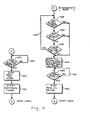
- the sand mills continue to operate until the operator orders a manual stop symbolized by the block 382 or until an emergency stop condition has occurred in the system which is symbolized by the block 384. If the operator has pushed the manual stop button, processing control transfers to a normal stop routine depicted on Figure 12 starting at E and symbolized by the path 386 in Figure 11. If an emergency stop condition has occurred, processing control transfers to an emergency stop routine starting at F on Figure 13 as symbolized by the path 387 in Figure 11. If neither an emergency stop nor a manually-ordered stop has occurred, processing control returns to the point I in Figure 11.
- the normal stop routine implements -a shut-down sequence to stop the motors in the system in the proper order.
- the first step is to stop the binder supply pump 60 in Figure 3. This step is symbolized by the block 388 in Figure 12.
- the slurry supply pump is stopped as symbolized by the block 390.
- the motors for mills M1 through M4 are ramped down to zero RPM by the ramp generator software modules and interlock software such as 218 and 219 in Figure 9.
- the ramp generator 218 controls the set point of the speed indicating controller hardware module 31.
- the speed control module 31 then controls the armature current for the motor 29 via the line 392 which symbolizes the control of the motor current through the inverter 26 in Figure 3.
- the speed indicating controller 31 also sends a digital signal representing the rim speed to the speed indicating computational software module 220 which is a computational Virtual Control Module forming part of the Digital Supervisory Module DSM-1000.
- the software module 220 computes the motor shaft speed from the rim speed signal on the line 395 and makes this computational result available for display by the control unit 28.
- the ramp-down sequence starts with the motor for mill M4 and proceeds backward to mill M1 as indicated by the blocks 394, 396, 398 and 400 in Figure 12.
- the control unit 28 then reads the speed indicating software module 220 in Figure 9 to determine whether mill M4 has stopped as represented by the block 402 in Figure 12. If it has not stopped, the control unit waits for it to stop as represented by the processing control line 404. After it has stopped, the control unit 28 turns off the mill M4 drive control hardware module 108 in Figure 9 through the interlock software module 216 as represented by the block 406 in Figure 12.
- the control unit then tests the speed indicating unit for mill M3 to determine whether the mill M3 motor has stopped. This is represented by the block 408 in Figure 12. When it is satisfied that the mill M3 motor has stopped, the control unit turns off the mill M3 drive control, thereby removing the power from the motor 27 in Figure 3. This is represented by the block 410 in Figure 12. This process is repeated until all motors have their power cut off.
- the normal stop routine continues on Figure 13 at H.
- the control unit 28 After the control unit 28 is satisfied that mill M1 has stopped and has shut off the power to mill M1's motor, the control unit reads all the pressure indicating hardware modules in the system except for the seal oil pressure indicating module P13, to determine whether all pressures are below the low alarm limits. If they are not, the control unit waits until all pressure indicating units indicate pressures below their lower alarm limits as symbolized by the block 420 in Figure 13 and the control path 422. After all pressure levels are below the low alarm limits, control is transferred to a block 424 wherein the control unit stops the seal oil pump 68 in Figure 3. Thereafter, the shutdown timer is started as symbolized by the block 426 in Figure 13.
- the emergency stop routine starts at F on Figure 13.
- the first steps are to determine the cause of the emergency stop, and the control unit 28 looks in three places to determine the cause.
- the first cause could be that the supply pressures are low. Accordingly, the control unit 28 reads various supply pressures in the system and compares them in accordance with the Boolean expression implemented by the interlock module I123 in Table 1 as depicted on Figures 8 and 9 as software interlock modules 63, 123 and 121.
- the next possible cause is an overload in the mill drive motors 22, 25, 27 and 29. Accordingly, the control unit 28 reads the overload circuit 21 associated with the motors which is shown typically only for the motor for mill M1.
- the third possible cause would be that the manually- operated emergency stop button has been pushed.
- the scanning sequence embodied in the emergency stop routine is symbolized by the blocks 428, 430 and 432 in Figure 13 and is expressed in Boolean form in the logic expressions associated with software interlock modules I121, I123 and 1122 in Table 1. If none of the three causes show up, the scan is continued until one of the causes does show up as symbolized by the path 434. Once the cause is determined, a message regarding the cause is printed on the printer 36 in Figure 1 and processing control transfers to the block 436 in Figure 13 which symbolizes the operation of stopping all pumps and mill drives except the seal oil pump.
- Processing control then transfers to the block 438 which symbolizes the steps taken by the control unit 28 to determine whether all supply pressures have dropped below the lower alarm limits.
- the control unit 28 waits until all supply pressures drop below the lower alarm limits as symbolized by the path 440. Once this low pressure condition is satisfied, processing control transfers to the block 442 which symbolizes the operation of stopping the seal oil pump. Thereafter, the control unit returns to the point A on Figure 10 and waits for a normal start sequence to begin.
- FIGS 10 through 13 taken together with the Boolean expressions of Table 1, together describe the custom portion of the algorithm used in the system described in Figure 1. All other hardware and software in the control unit 28 is available commercially from the Robert Shaw Controls Company in the model designations given herein. A listing of the object code of the custom portion of the software for the control unit 28 is attached hereto as Appendix A.
Landscapes
- Engineering & Computer Science (AREA)
- Food Science & Technology (AREA)
- Crushing And Grinding (AREA)
- Soil Working Implements (AREA)
- Road Paving Machines (AREA)
- Disintegrating Or Milling (AREA)
Applications Claiming Priority (2)
| Application Number | Priority Date | Filing Date | Title |
|---|---|---|---|
| US43458982A | 1982-10-15 | 1982-10-15 | |
| US434589 | 1982-10-15 |
Publications (2)
| Publication Number | Publication Date |
|---|---|
| EP0109157A2 true EP0109157A2 (de) | 1984-05-23 |
| EP0109157A3 EP0109157A3 (de) | 1986-03-05 |
Family
ID=23724846
Family Applications (1)
| Application Number | Title | Priority Date | Filing Date |
|---|---|---|---|
| EP83305786A Withdrawn EP0109157A3 (de) | 1982-10-15 | 1983-09-27 | Automatisiertes Kontrollsystem für Sandmühlen |
Country Status (2)
| Country | Link |
|---|---|
| EP (1) | EP0109157A3 (de) |
| JP (1) | JPS5992039A (de) |
Cited By (9)
| Publication number | Priority date | Publication date | Assignee | Title |
|---|---|---|---|---|
| EP0243682A3 (en) * | 1986-05-02 | 1988-08-17 | Draiswerke Gmbh | Control of an agitator mill |
| WO1989001825A1 (en) * | 1987-08-24 | 1989-03-09 | Hagy John T | Comminuting apparatus |
| CH684615GA3 (de) * | 1992-03-10 | 1994-11-15 | Buehler Ag | Rührwerksmühle. |
| ITBO20090605A1 (it) * | 2009-09-23 | 2011-03-24 | Samia S P A | Perfezionamenti in un molino centrifugo per la raffinazione di impasti, in particolare contenenti pigmenti adatti all'uso nell'industria conciaria |
| CN107861379A (zh) * | 2017-12-15 | 2018-03-30 | 中国恩菲工程技术有限公司 | 一种加压釜的紧急停车系统及其停车方法 |
| CN116273425A (zh) * | 2023-03-21 | 2023-06-23 | 郑州水工机械有限公司 | 一种制砂楼的控制方法及控制系统 |
| CN116441004A (zh) * | 2023-05-04 | 2023-07-18 | 杭州英希捷科技有限责任公司 | 一种纳米材料生产用研磨装置 |
| CN117244678A (zh) * | 2023-10-11 | 2023-12-19 | 浙江艾领创矿业科技有限公司 | 砂磨机智能监测控制系统及方法 |
| CN118788447A (zh) * | 2024-09-14 | 2024-10-18 | 深圳市叁星飞荣机械有限公司 | 一种基于聚类算法的砂磨机实时动态仿真方法 |
Families Citing this family (2)
| Publication number | Priority date | Publication date | Assignee | Title |
|---|---|---|---|---|
| JPS61114757A (ja) * | 1984-11-09 | 1986-06-02 | 三菱重工業株式会社 | 高濃度石炭水スラリの粒度分布調整方法 |
| CN116747961A (zh) * | 2022-09-16 | 2023-09-15 | 江苏道金智能制造科技股份有限公司 | 磷酸铁锂砂磨单机台生产工艺自动化设备 |
Family Cites Families (2)
| Publication number | Priority date | Publication date | Assignee | Title |
|---|---|---|---|---|
| US3984055A (en) * | 1974-12-04 | 1976-10-05 | Morehouse Industries, Inc. | Sandmill control system |
| US3960331A (en) * | 1974-12-04 | 1976-06-01 | Morehouse, Industries, Inc. | Sandmill |
-
1983
- 1983-09-27 EP EP83305786A patent/EP0109157A3/de not_active Withdrawn
- 1983-10-14 JP JP58193334A patent/JPS5992039A/ja active Pending
Cited By (15)
| Publication number | Priority date | Publication date | Assignee | Title |
|---|---|---|---|---|
| EP0243682A3 (en) * | 1986-05-02 | 1988-08-17 | Draiswerke Gmbh | Control of an agitator mill |
| US4848676A (en) * | 1986-05-02 | 1989-07-18 | Draiswerke Gmbh | Means of regulating an agitator mill |
| DE3614980C1 (de) * | 1986-05-02 | 1993-05-27 | Draiswerke Gmbh | Regelungseinrichtung fuer eine Ruehrwerksmuehle |
| WO1989001825A1 (en) * | 1987-08-24 | 1989-03-09 | Hagy John T | Comminuting apparatus |
| CH684615GA3 (de) * | 1992-03-10 | 1994-11-15 | Buehler Ag | Rührwerksmühle. |
| ITBO20090605A1 (it) * | 2009-09-23 | 2011-03-24 | Samia S P A | Perfezionamenti in un molino centrifugo per la raffinazione di impasti, in particolare contenenti pigmenti adatti all'uso nell'industria conciaria |
| CN107861379A (zh) * | 2017-12-15 | 2018-03-30 | 中国恩菲工程技术有限公司 | 一种加压釜的紧急停车系统及其停车方法 |
| CN116273425A (zh) * | 2023-03-21 | 2023-06-23 | 郑州水工机械有限公司 | 一种制砂楼的控制方法及控制系统 |
| CN116273425B (zh) * | 2023-03-21 | 2024-06-04 | 郑州水工机械有限公司 | 一种制砂楼的控制方法及控制系统 |
| CN116441004A (zh) * | 2023-05-04 | 2023-07-18 | 杭州英希捷科技有限责任公司 | 一种纳米材料生产用研磨装置 |
| CN116441004B (zh) * | 2023-05-04 | 2023-12-12 | 杭州英希捷科技有限责任公司 | 一种纳米材料生产用研磨装置 |
| CN117244678A (zh) * | 2023-10-11 | 2023-12-19 | 浙江艾领创矿业科技有限公司 | 砂磨机智能监测控制系统及方法 |
| CN117244678B (zh) * | 2023-10-11 | 2024-03-12 | 浙江艾领创矿业科技有限公司 | 砂磨机智能监测控制系统及方法 |
| CN118788447A (zh) * | 2024-09-14 | 2024-10-18 | 深圳市叁星飞荣机械有限公司 | 一种基于聚类算法的砂磨机实时动态仿真方法 |
| CN118788447B (zh) * | 2024-09-14 | 2024-12-17 | 深圳市叁星飞荣机械有限公司 | 一种基于聚类算法的砂磨机实时动态仿真方法 |
Also Published As
| Publication number | Publication date |
|---|---|
| EP0109157A3 (de) | 1986-03-05 |
| JPS5992039A (ja) | 1984-05-28 |
Similar Documents
| Publication | Publication Date | Title |
|---|---|---|
| US4303205A (en) | Agitator mill and method of controlling the same | |
| EP0244121B1 (de) | Regelung von Innenmischern | |
| US4798086A (en) | Test bench for testing hydraulic pumps and motors | |
| US20230054112A1 (en) | Shaft driven devices with feedback | |
| JPS5992039A (ja) | 液体内の固形粒子を摩砕および分散するためのシステムおよび方法 | |
| US4848676A (en) | Means of regulating an agitator mill | |
| US6259222B1 (en) | Device and method for regulating maximum loading on an electric motor in an aggregate feed replenishing system | |
| CN115400845B (zh) | 磷酸铁锂砂磨单机台生产工艺自动化方法及系统 | |
| EP1256375A1 (de) | Vorrichtung und verfahren zur kontinuierlichen hochdruckbehandlung | |
| US3984055A (en) | Sandmill control system | |
| CN119491107B (zh) | 一种黄金浸出罐永磁电机直驱搅拌系统 | |
| CN212819453U (zh) | 搅拌装置 | |
| US3960331A (en) | Sandmill | |
| JP2023508923A (ja) | 動作用の動作制御機器、分散機及び分散機を備える分散機システムの動作を制御するための方法、並びにコンピュータープログラム製品 | |
| CN118624332A (zh) | 一种双锥镜向混合分样系统及其控制方法 | |
| US20220395960A1 (en) | Method of Operating a Blasting System | |
| RU2107277C1 (ru) | Установка для испытания материалов на износ | |
| CN221277982U (zh) | 一种水泵综合测试台及系统 | |
| CN220170547U (zh) | 一种测试试验台 | |
| CN224228889U (zh) | 一种渣浆泵叶轮磨损模拟实验台 | |
| CA1090752A (en) | Sandmill control system | |
| FI128700B (en) | Method and arrangement for adapting the operation of a mechanical pulp production equipment | |
| CN212942492U (zh) | 一种用于过硫酸铵的搅拌装置 | |
| CN108731957A (zh) | 变桨系统试验装置及方案 | |
| JPH10211445A (ja) | 粉粒体の性状制御方法 |
Legal Events
| Date | Code | Title | Description |
|---|---|---|---|
| PUAI | Public reference made under article 153(3) epc to a published international application that has entered the european phase |
Free format text: ORIGINAL CODE: 0009012 |
|
| AK | Designated contracting states |
Designated state(s): BE DE FR GB |
|
| PUAL | Search report despatched |
Free format text: ORIGINAL CODE: 0009013 |
|
| AK | Designated contracting states |
Kind code of ref document: A3 Designated state(s): BE DE FR GB |
|
| STAA | Information on the status of an ep patent application or granted ep patent |
Free format text: STATUS: THE APPLICATION IS DEEMED TO BE WITHDRAWN |
|
| 18D | Application deemed to be withdrawn |
Effective date: 19860402 |
|
| RIN1 | Information on inventor provided before grant (corrected) |
Inventor name: SZKARADEK, EDWARD J. |