EP0109323A1 - Verfahren für ein Planetenwalzwerk - Google Patents
Verfahren für ein Planetenwalzwerk Download PDFInfo
- Publication number
- EP0109323A1 EP0109323A1 EP19830402081 EP83402081A EP0109323A1 EP 0109323 A1 EP0109323 A1 EP 0109323A1 EP 19830402081 EP19830402081 EP 19830402081 EP 83402081 A EP83402081 A EP 83402081A EP 0109323 A1 EP0109323 A1 EP 0109323A1
- Authority
- EP
- European Patent Office
- Prior art keywords
- product
- cylinder
- orbit
- laminated
- contact
- Prior art date
- Legal status (The legal status is an assumption and is not a legal conclusion. Google has not performed a legal analysis and makes no representation as to the accuracy of the status listed.)
- Granted
Links
Images
Classifications
-
- B—PERFORMING OPERATIONS; TRANSPORTING
- B21—MECHANICAL METAL-WORKING WITHOUT ESSENTIALLY REMOVING MATERIAL; PUNCHING METAL
- B21B—ROLLING OF METAL
- B21B1/00—Metal-rolling methods or mills for making semi-finished products of solid or profiled cross-section; Sequence of operations in milling trains; Layout of rolling-mill plant, e.g. grouping of stands; Succession of passes or of sectional pass alternations
- B21B1/42—Metal-rolling methods or mills for making semi-finished products of solid or profiled cross-section; Sequence of operations in milling trains; Layout of rolling-mill plant, e.g. grouping of stands; Succession of passes or of sectional pass alternations for step-by-step or planetary rolling
-
- B—PERFORMING OPERATIONS; TRANSPORTING
- B21—MECHANICAL METAL-WORKING WITHOUT ESSENTIALLY REMOVING MATERIAL; PUNCHING METAL
- B21B—ROLLING OF METAL
- B21B13/00—Metal-rolling stands, i.e. an assembly composed of a stand frame, rolls, and accessories
- B21B13/18—Metal-rolling stands, i.e. an assembly composed of a stand frame, rolls, and accessories for step-by-step or planetary rolling; pendulum mills
Definitions
- the present invention relates to a family of rolling methods in which the working rolls are movable in space and come into contact with the product periodically, over all or part of their trajectory.
- Laminating plants built according to this principle are today well known under the name “planetary rolling mill” and have a particular design from a series of small horizontal working rolls, arranged in a “squirrel cage” rotating at great speed. speed around support rollers mounted in "duo" on both sides of the product.
- the object of the present invention is to solve the problem of these repetitive shocks from the noise disturbances specific to the planetary rolling mill by means of a solution which does not have the drawbacks of known methods.
- the subject of the invention is a method for operating a planetary rolling mill according to which the working cylinder traverses an orbit over a portion of which at least it comes into contact with the product to be laminated, a method characterized in that the direction of rolling of the product being assumed to be horizontal, the movement of the cylinder is imparted on said portion of the orbit, a trajectory in the form of a "5" horizontally and limited by two points where the tangents to the orbit are parallel to each other and to the rolling direction of the product.
- the invention also relates to a device for implementing the method, characterized in that it consists of a combination of eccentrics and connecting rods which impart a displacement in space along the axis of the rolling cylinder according to an orbit comprising a portion of trajectory in the form of an "S" to the horizontal limited by two points where the tangents to said orbit are parallel to each other and to the direction of movement of the product to be laminated.
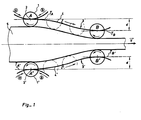
- the portion 4 of this orbit the portion along which the cylinder 1 is in contact with the product 5, has a trajectory in the form of an "S" horizontally limited by two extreme points A and B where the tangents T A , T B at orbit 3 carried at these points are mutually parallel and parallel to the rolling direction of the product 5, indicated by the arrow V in the figure and which, in practice, can generally be considered as perfectly horizontal.
- the trajectory 4 advantageously has an inflection point 1 to ensure a regular displacement of the cylinder 1 between the extreme points A and B.
- an opposing system A'I'B ' is arranged symmetrically with the first system A.I.B. compared to the product to be laminated 5.
- This opposing system A'I'R the same elements and arrangements, as in the system A.I.B. identified by references which are differentiated only by the sign "prime".
- the axes 2, 2 'of the working rolls 1, l' are horizontal and perpendicular to the plane of the figure. It can therefore be seen that the thickness of the rolled product 5 is thus reduced by the quantity 2d (d being the distance separating the tangents T A and T B - respectively T A I and T B '-), when the cylinders 1 and the cross their respective arc AB and A'B '.
- the trajectory of the cylinder 1 tangentially connects the surface of the product to be laminated 5 and there can therefore be no shock.
- the cylinder is printed, when it comes into contact with the product, a speed of rotation equal to, or in any case close to, that which corresponds to the conditions of rolling of the cylinder on the product to be laminated (this being defined, therefore predeterminable as we know and as we know how to calculate it, from the speed of the product to be laminated, and the value and direction of the speed of the cylinder on its orbit upon contact with the product).
- the working cylinder is rotated about its axis 2 under the effect of cissions which arise on contact with the rolled product.
- Energy is supplied by the motors controlling the system which generates the movement of the cylinder in its orbit.
- the shape of the horizontal "S" of the contact arc AB is such that this thrust force is minimal when the contact of the cylinder with the product 5 is established, which has the effect of minimizing the stresses on the thrust member imposing the law of advance of the product to be laminated.
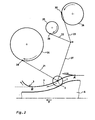
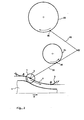
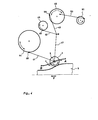
- the device ensuring the displacement of the working rolls in an orbit 3 according to the invention is produced by combination of eccentrics and connecting rods, three different embodiments of which are shown in FIGS. 2, 3 and 4 respectively.
- Figures 2 and 3 each illustrate a device designed to allow the working cylinder 1 to travel in its orbit 3 entirely in the same direction (direction indicated by the arrows).
- the device represented in FIG. 2 essentially consists, as can be seen, of three connecting rods 21, 22 and 23, of three eccentrics 24, 25 and 26 and of a connecting rod 27.
- Each connecting rod is articulated at one of its ends (respectively 28, 29, 30) to an eccentric (24, 25, 26).
- the connecting rod 21 is fixed at its other end to the axis 2 of the working cylinder 1.
- the other two connecting rods 22, 23 form at their other end a rotary torque M and the rod 27 connects this movable point M to the axis 2
- the trees of the three eccentrics rotate in the direction indicated by the arrows.
- the rotational speeds are equal in absolute value, their ratios being kept fixed, for example by means of gears not shown in the figure.
- One of the eccentrics is driven by a motor also not shown.
- the axis 2 of the working cylinder traverses the contact arc AB from A to B by making contact with the product at A, this point constituting a cusp point (type b variant).
- the device shown in Figure 3 comprises only two connecting rods 31, 32 and two eccentrics 33, 34.
- the connecting rod 31 is connected to the axis 2 of the working cylinder and is extended beyond its point articulation 35 on the eccentric 34 to a movable point N forming a couple with the connecting rod 32 at its end opposite to that of its attachment 36 on the eccentric 33.
- the two eccentrics rotate in opposite directions, as indicate the arrows, the rest being unchanged compared to the device described with reference to FIG. 3.
- the axis 2 of the cylinder 1 traverses the working arc AB of A yers B by contacting the product at A, this point constituting an inflection point (type 0 variant).
- the device shown in Figure 4 is similar to that of Figure 2. There are, according to the same organization, a set of three connecting rods 41, 42, 43 and three eccentrics 44, 45, 46, a connecting rod 47 and the joints 48, 49, 50 between the eccentrics and the connecting rods, as well as the mobile point M connecting the connecting rods 42, 43 and the rod 47 in a common torque.
- one of the eccentrics in this case the eccentric 46 in the example shown, is driven in an alternating rotational movement less than one revolution, by a fourth eccentric 51 using an additional connecting rod 52, the eccentric shaft 53 being driven in continuous rotation by a motor.
- the axis 2 of the working cylinder 1 traverses the working arc AB alternately from A to B then from B to A (rolling by "going up” in the latter case) and the cylinder therefore remains permanently in contact of the product to be laminated 5.
Landscapes
- Engineering & Computer Science (AREA)
- Mechanical Engineering (AREA)
- Metal Rolling (AREA)
Applications Claiming Priority (2)
| Application Number | Priority Date | Filing Date | Title |
|---|---|---|---|
| FR8218840A FR2535628B1 (fr) | 1982-11-08 | 1982-11-08 | Procede de conduite d'un laminoir planetaire et dispositif de mise en oeuvre |
| FR8218840 | 1982-11-08 |
Publications (2)
| Publication Number | Publication Date |
|---|---|
| EP0109323A1 true EP0109323A1 (de) | 1984-05-23 |
| EP0109323B1 EP0109323B1 (de) | 1988-05-04 |
Family
ID=9279062
Family Applications (1)
| Application Number | Title | Priority Date | Filing Date |
|---|---|---|---|
| EP19830402081 Expired EP0109323B1 (de) | 1982-11-08 | 1983-10-26 | Verfahren für ein Planetenwalzwerk |
Country Status (4)
| Country | Link |
|---|---|
| EP (1) | EP0109323B1 (de) |
| JP (1) | JPS5997704A (de) |
| DE (1) | DE3376470D1 (de) |
| FR (1) | FR2535628B1 (de) |
Citations (3)
| Publication number | Priority date | Publication date | Assignee | Title |
|---|---|---|---|---|
| US2978933A (en) * | 1958-03-05 | 1961-04-11 | Sendzimir Tadeusz | Beambacked planetary rolling mill |
| FR1562565A (de) * | 1967-06-23 | 1969-04-04 | ||
| FR2252141A1 (de) * | 1973-11-13 | 1975-06-20 | Pk I |
-
1982
- 1982-11-08 FR FR8218840A patent/FR2535628B1/fr not_active Expired
-
1983
- 1983-10-26 DE DE8383402081T patent/DE3376470D1/de not_active Expired
- 1983-10-26 EP EP19830402081 patent/EP0109323B1/de not_active Expired
- 1983-11-08 JP JP20976583A patent/JPS5997704A/ja active Pending
Patent Citations (3)
| Publication number | Priority date | Publication date | Assignee | Title |
|---|---|---|---|---|
| US2978933A (en) * | 1958-03-05 | 1961-04-11 | Sendzimir Tadeusz | Beambacked planetary rolling mill |
| FR1562565A (de) * | 1967-06-23 | 1969-04-04 | ||
| FR2252141A1 (de) * | 1973-11-13 | 1975-06-20 | Pk I |
Also Published As
| Publication number | Publication date |
|---|---|
| FR2535628B1 (fr) | 1985-06-21 |
| FR2535628A1 (fr) | 1984-05-11 |
| EP0109323B1 (de) | 1988-05-04 |
| DE3376470D1 (en) | 1988-06-09 |
| JPS5997704A (ja) | 1984-06-05 |
Similar Documents
| Publication | Publication Date | Title |
|---|---|---|
| EP0143820B1 (de) | Zahnradgetriebe mit zwei schnecken | |
| MC1115A1 (fr) | Transmission planetaire | |
| EP0488919B1 (de) | Vorrichtung mit gelenkartigem Metallband, insbesondere zum Verschieben von schweren Lasten | |
| WO2018122524A1 (fr) | Dispositif de transfert de produits | |
| EP0092093A1 (de) | Verfahren und Vorrichtung zur Beförderung von ineinanderfügbaren Gusseisernen Rohren um diese Kopf bei Fuss zu drehen | |
| EP0638496A1 (de) | Vorrichtung und Verfahren zum Einführen von blattformigem Material in eine Maschine | |
| EP0742170B1 (de) | Vorrichtung zum Zuführen einer kontinuierlich ankommenden Bahn in einer Station, die sie in angehaltenem Zustand bearbeitet | |
| EP0337891A1 (de) | Stauförderer mit Neigung für einen durch Endlosketten angetriebenen Lastenträger | |
| EP0109323B1 (de) | Verfahren für ein Planetenwalzwerk | |
| FR2551166A1 (fr) | Dispositif de transmission d'entrainement flexible | |
| FR2476290A1 (fr) | Four tunnel a rouleaux pour la cuisson de produits ceramiques, notamment de carreaux de revetement de sol | |
| FR2703626A1 (fr) | Agencement et procédé pour éliminer les tâches du cylindre porte-plaque dans une presse lithographique. | |
| FR2527990A1 (fr) | Procede et installation de positionnement de cylindres et rouleaux sur machines a imprimer | |
| EP2484511A1 (de) | Ultraschall-Schweißvorrichtung | |
| EP0528728B1 (de) | Vorrichtung zum Antreiben der Spindeln eines Schleiftrommel | |
| EP1867232B1 (de) | Vorrichtung zum Formen von Teiglingen. | |
| EP1419100B1 (de) | Motorangetriebene winde | |
| CH670466A5 (de) | ||
| FR2478517A1 (fr) | Procede et dispositif pour commander les mouvements d'avance et de degagement, notamment dans les trancheuses a bois | |
| CA1285793C (fr) | Dispositif d'entrainement en rotation des galets de travail d'une installation de laminoir planetaire de produits longs | |
| EP0156151A1 (de) | Universal-Planetenwalzwerk für Langprodukte | |
| FR2504507A1 (fr) | Dispositif d'entrainement, en un mouvement progressif, d'un organe guide sur des rails rectilignes, tout particulierement adapte a l'entrainement des fourches telescopiques de chariots de manutention | |
| EP3328735B1 (de) | Auswerferführungsvorrichtung | |
| EP0920957A1 (de) | Lapp- und Polierkopf für Steinplatte | |
| EP0059800A1 (de) | Vorrichtung zum Erneuern von Gleisanlagen, die einen Pflug umfasst |
Legal Events
| Date | Code | Title | Description |
|---|---|---|---|
| PUAI | Public reference made under article 153(3) epc to a published international application that has entered the european phase |
Free format text: ORIGINAL CODE: 0009012 |
|
| AK | Designated contracting states |
Designated state(s): CH DE GB IT LI SE |
|
| 17P | Request for examination filed |
Effective date: 19841109 |
|
| GRAA | (expected) grant |
Free format text: ORIGINAL CODE: 0009210 |
|
| AK | Designated contracting states |
Kind code of ref document: B1 Designated state(s): CH DE GB IT LI SE |
|
| REF | Corresponds to: |
Ref document number: 3376470 Country of ref document: DE Date of ref document: 19880609 |
|
| ITF | It: translation for a ep patent filed | ||
| GBT | Gb: translation of ep patent filed (gb section 77(6)(a)/1977) | ||
| PLBE | No opposition filed within time limit |
Free format text: ORIGINAL CODE: 0009261 |
|
| STAA | Information on the status of an ep patent application or granted ep patent |
Free format text: STATUS: NO OPPOSITION FILED WITHIN TIME LIMIT |
|
| 26N | No opposition filed | ||
| PGFP | Annual fee paid to national office [announced via postgrant information from national office to epo] |
Ref country code: GB Payment date: 19910823 Year of fee payment: 9 |
|
| PGFP | Annual fee paid to national office [announced via postgrant information from national office to epo] |
Ref country code: CH Payment date: 19910918 Year of fee payment: 9 |
|
| PGFP | Annual fee paid to national office [announced via postgrant information from national office to epo] |
Ref country code: SE Payment date: 19910919 Year of fee payment: 9 |
|
| PGFP | Annual fee paid to national office [announced via postgrant information from national office to epo] |
Ref country code: DE Payment date: 19911017 Year of fee payment: 9 |
|
| ITTA | It: last paid annual fee | ||
| PG25 | Lapsed in a contracting state [announced via postgrant information from national office to epo] |
Ref country code: GB Effective date: 19921026 |
|
| PG25 | Lapsed in a contracting state [announced via postgrant information from national office to epo] |
Ref country code: SE Effective date: 19921027 |
|
| PG25 | Lapsed in a contracting state [announced via postgrant information from national office to epo] |
Ref country code: LI Effective date: 19921031 Ref country code: CH Effective date: 19921031 |
|
| GBPC | Gb: european patent ceased through non-payment of renewal fee |
Effective date: 19921026 |
|
| REG | Reference to a national code |
Ref country code: CH Ref legal event code: PL |
|
| PG25 | Lapsed in a contracting state [announced via postgrant information from national office to epo] |
Ref country code: DE Effective date: 19930701 |
|
| EUG | Se: european patent has lapsed |
Ref document number: 83402081.0 Effective date: 19930510 |