EP0109615A2 - Méthode pour transformer un premier formulaire éditable, préparé par un système de traitement différé de texte, en un second formulaire éditable, utilisable par un système de traitement interactif ou différé de texte - Google Patents
Méthode pour transformer un premier formulaire éditable, préparé par un système de traitement différé de texte, en un second formulaire éditable, utilisable par un système de traitement interactif ou différé de texte Download PDFInfo
- Publication number
- EP0109615A2 EP0109615A2 EP83111222A EP83111222A EP0109615A2 EP 0109615 A2 EP0109615 A2 EP 0109615A2 EP 83111222 A EP83111222 A EP 83111222A EP 83111222 A EP83111222 A EP 83111222A EP 0109615 A2 EP0109615 A2 EP 0109615A2
- Authority
- EP
- European Patent Office
- Prior art keywords
- sequence
- items
- controls
- dcf
- transformation
- Prior art date
- Legal status (The legal status is an assumption and is not a legal conclusion. Google has not performed a legal analysis and makes no representation as to the accuracy of the status listed.)
- Granted
Links
Images














Classifications
-
- G—PHYSICS
- G06—COMPUTING OR CALCULATING; COUNTING
- G06F—ELECTRIC DIGITAL DATA PROCESSING
- G06F40/00—Handling natural language data
- G06F40/10—Text processing
- G06F40/12—Use of codes for handling textual entities
- G06F40/151—Transformation
Definitions
- rhis invention is concerned with a methodology for transforming editable iocuments cast in a first form by and for use in a batch text processing system into a second editable form for use in and by another text processing system, either of the interactive or batch type, in which said first form is otherwise incompatible. More particularly, this invention is directed to achieving the requisite transformation between dissimilar forms of an editable document by utilizing methodology that effects the transform of a.sequence of input items from the batch source form to an explicit set of output items for the editable target document form based on suitably selected state variables representing the sequence of input items.
- Displaywriter is a word processor, capable of and primarily intended for stand-alone operation, manufactured and sold by International Business Machines Corporation (IBM Corporation). It is a type of text processor commonly known as a "what you see is what you get" or interactive system.
- the 5520 is a shared logic, multi-station text processing and office communication system that is also sold by IBM Corporation.
- the 3790 classifiable as a minicomputer, is an intelligent text processing system.
- the 8100 which is also classifiable as a minicomputer, is adapted using DOSF, a text processing package, and DPCX, a special operating system, as a text processing system. Both the 3790 and 8100 are manufactured and sold by IBM Corporation.
- Document Composition Facility (DCF) or SCRIPT/VS is a text processing program product sold by IBM Corporation.
- the Professional Office .System or PROFS is a menu driven program product sold by IBM Corporation that is designed and particularly suitable for handling and managing a wide spectrum of office related tasks. It includes text processing capabilities that utilize the DCF form of editable text representation.
- the operator imbeds textual matter in the document that is subsequently interpreted as one or more formatting commands and is retained in the editable document form as textual matter.
- This document form when subsequently interpreted, is formatted as a whole document or batch processed.
- DIF Document Interchange Facility
- This IBM Corporation program product is provided to convert "Two-Baker” form editable files into DCF form files by using uniquely defined SCRIPT macros. These macros essentially invoke a block of information for each of the "Two-Baker” commands encountered, but the substitued material is not an equivalent DCF command. Hhile it does permit a final formatted version of the original "Two-Baker” document to be produced by a DCF based text processing system, using the translated file containing these macros, this DIF converted data stream cannot be easily edited or effectively manipulated because that data stream is atypical, it is not a normal DCF file.
- This approach permits the formatting of a document cast in a first editable form in a text processor designed for documents of a second form, but does not allow for editing of the "transformed" document at any point prior thereto.
- the term "transform mechanism” refers to a collection of software and hardware which in its entirety represents a state machine that takes its input from a source document form and transforms that input in accordance with predefined state transition diagrams and tables into an explicit target document form. Both the source and target document forms are fully editable, although incompatible, hence the need for tranformation.
- the phrases "DCF document form” and “L3 document form” are intended to be and are used herein as descriptors for two data streams that represent editable forms or versions of a particular document as it exists on a user's disk or in transfer between two text processing systems.
- An input item in a source document indicates either a text character or a control item.
- a large and increasing number ot principals use data processing terminals, such as those of the IBM Corporation's 3270 family, for many tasks, particularly word processing.
- a concomitant number of secretaries use Displaywriters (DWs) for word processing.
- DWs Displaywriters
- Connecting DWs to host data processing systems allows principals and secretaries to cooperate in the creation, editing, and distribution of text documents.
- Such a connection must include a capability to effect a transformation between the form in which data processing systems represent documents and the form in which DW represents documents. This transformation is exceedingly difficult to effect, as shall hereinafter be explained, because it cannot be performed one item at a time.
- OIIA L3, or Office Interchange Architecture Level 3 an IBM Corporation designation, a document data stream form that was previously mentioned, is the form used in IBM Corporation's Displaywriter (DW). It shall hereinafter be referred to as L3.
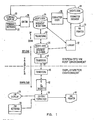
- a principal is provided with a terminal display 20 and keyboard 22 that are coupled to the host processor.
- the principal is also provided with other system capabilities, such as a disk 24, an editor 26 and, in this instance, a DCF (SCRIPT/VS) based formatter 28.
- Hard copy can be produced by spooling files to the system printer 30.
- the principal can access the system library 32 and download any appropriate file therefrom to the user disk 24.
- the library 32 is also available to the principal for archival storage purposes. The principal would create or edit a document by interacting with terminal 20 and keyboard 22, using any additional tools as needed.
- the secretary employs a Displaywriter to create and edit textual matter or documents.
- DW provides its own display 34 and keyboard 36. It is very easy to use because you see on the display screen what you will get on the printer.
- the DCF to L3 transform capability allows both secretaries and professionals to utilize their respective text processing and editing capabilities in a fully cooperative manner. It allows a secretary to view and edit documents entered or edited by their principal.
- a related L3 to DCF transform which uses very different methods, and a facility for host control of the DW diskette files permits the principal to view and edit documents entered or edited by the secretary.
- UP will be used herein to indicate a transform from L3 to DCF
- DOWN will be used to indicate a transform from DCF to L3.
- upload will be used to signify that the direction of information transfer is-from DW to the host.
- download will be employed to signify that the direction of information transfer is from the host to DW.
- Both L3 and DCF represent editable forms of documents. However, their similarity ends at about that point. Both can represent roughly the same , important text concepts, such as specifying the end of a line, the end of a paragraph, an amount of indentation, the end of an indentation, the end of a page, the beginning or end of double spacing, or the beginning or end of formatting. However, there is no case in which a control that represents any given set of one or more of these concepts in the DCF form matches a control that represents the same set of concepts in the L3 form.
- the "break" control in DCF ends a paragraph. That is, it prevents the DCF formatter from concatenating following text with preceding text to fill out a line.
- a "Required Carrier Return” or RCR control in L3, appearing as the unprintable hexadecimal value '06' in the L3 data stream also ends a paragraph by breaking concatenation.
- RCR does other things as well.
- An RCR also ends indentation, resets the temporary left margin back to the permanent left margin. It then moves the current position to that permanent position on the next line. For example, four RCRs between two strings of text leaves three blank lines between the lines of text, whereas four ".BRs" between two strings of text leaves no blank lines at all.
- the "tab" control in DCF written “.TB a b c ", sets tabulator stops at the specified character positions a, b, c, etc.
- the normal method of setting tabs in L3 employs the four "multi-byte” controls “begin line format change”, “set line parameters”, “set tabs", and “end line format change”. Each has its own unprintable hexadecimal representation in the L3 data stream. None can be present in the data stream without the other three.
- the four multi-byte controls in the "set line paramaters” sequence total over 30 bytes and must contain such other information as the font width, left and right margins, line spacing, adjust state, and alignment state. No defaults are possible and there is no way to say “leave the existing value unchanged" for any of this information.
- the DCF control ".IN h" can specify indentation to any horizontal character position "h", which can be to the left or to the right of the previous indentation position.
- all indentations are to tab stop settings.
- the only way to increase the indentation is to use the indent tab (IT) control to move the temporary left margin rightward one more tab setting.
- the only way to decrease the indentation is to first use one of the several available controls, such as Required Carrier Return, that resets the temporary left margin all the way left to the permanent left margin. Therefore, transforming DCF to L3 is difficult because the two forms represent the same information in such different ways. The difficulty of this transformation is compounded by a more fundamental reason.
- a DCF item cannot be transformed to one or more L3 items in a vacuum, that is by itself, without considering the other DCF items around it.
- EOR End Of Record
- CRE Carrier Return
- RCR Required Carrier Return
- the triad consisting of an EOR, a ".IN 0" control, and a ".PA” control, which ends a page, must be transformed into the Page End (PE) control and also into zero or more Indent Tab (IT) controls to reestablish the previous indent level.
- the pair of DCF controls ".PA” and “.IN 0" together, in either order, both end the page and reset the indent Level. Therefore, they can both be transformed into the single L3 item Required Page End (RPE). It would be an error to transform the ".PA” into a RPE and some ITs, then try to transform the ".IN 0" into someting that resets the indent level. There is nothing in L3 that can reset the indent level without leaving an incorrect blank line.
- a Line Format Change (LFC) sequence of multi-byte controls in L3 can perform the function of at least four DCF controls such as the following ones: It would be possible to transform a sequence of four such DCF controls into four separate LFC sequences. It is far preferable to collect the four DCF controls into a group and transform the entire group into a single LFC sequence.
- LFC Line Format Change
- transforming a DCF document into an equivalent L3 document requires recognition of patterns in the DCF document.
- the number of possi - ble patterns is astronomical.
- the number of sequences containing each of the 17 most common DCF controls i.e., the number of permutations of X things taken X at a time, exceeds the number of seconds in the age of the universe by a factor of about 5,000.
- Not all sequences have a length of only 17, and nothing says that a given DCF control may occur only once in a sequence, so the total number of possible sequences is even larger than the minimum number comprehended.
- Just recognizing each possible sequence is a task that does not permit a brute-force solution. Defining a suitable transformation into L3 for each sequence requires more subtlety.
- the transformation methodology disclosed here has three main parts.
- the first part involves reading a sequence of DCF controls, setting appropriate state bits and values for each control that is encountered, testing for text, which always ends a sequence, and testing for certain control combinations that also must end a sequence.
- the key to the transformation of DCF form to L3 form lies in the second part of the methodology according to the present invention. That key is the recognition that an ordering can be defined on the set of possible L3 items that may need to be written out as the transformation of any DCF sequence. If an L3 item must be written out as part of the transformation of any sequence of DCF controls, no matter in what order the DCF controls appeared, then that L3 item may be written out at a particular place with respect to other L3 items that may have to be written out.
- the third part of the method involves using the state bits and values that represent what was encountered in an ended sequence and writing out the appropriate L3 items that are the transformation of that sequence. Decisions as to whether or not to write out each possible item are made in the order determined by the second aspect of the transformation methodology. Therefore, the third part of the transformation consists of using a large set of decision tables in a carefully selected, but fixed, order. Each decision table determines whether or not to write out a particular L3 item.
- the ensuing description of the preferred embodiment of the present invention gives the details of the three main aspects of the transformation methodology disclosed herein.
- the first portion of this description sets forth the details of the processing that is done while reading the DCF controls that constitute a particular sequence. It involves setting the appropriate state bits and variables.
- the second portion of this description gives the ordering of the L3 items that may have to be written out as the transformation of any sequence of DCF controls. The ordering is independent of what controls were in the sequence.
- the third and last portion of this description details the nature of the processing that is done after reaching the end of a particular sequence. It involves deciding whether or not to write out each of the possible L3 items as the transformation of that particular sequence, based on the state bits and variables that were set while reading the sequence.
- PE precedes TUFC and MP, but either TUFC or MP implies a need for PE.
- TUFC precedes MP, but MP implies a need for TUFC.
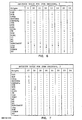
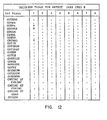
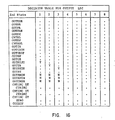
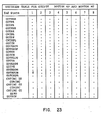
- the decision tables shown in Figs. 9 through 31 and their accompanying explanations tell, for each possible state of the variables set while reading a sequence of DCF controls, whether or not to write out the possible L3 items. Each table tells whether or not to write the corresponding item.
- Each column of a table is a "rule", i.e., a condition under which the relevant item is to be written out. In general, none, one, some, or even all of the rules may be true at the end of reading a particular sequence of DCF controls.
- the item is to be written out if any one or more of the rules in its decision table are "satisfied". A rule is satisfied if each of the variables marked with a "Y" in that column is nonzero and each variable marked with a "N" in that column is zero.
- the rest of the transformation method consists of applying decision tables in a fixed sequence to decide whether or not to write out each of the possible L3 items.
- Each decision table applies to one L3 item. That L3 item is to be written out if any rule (column) of its decision table is satisfied, i.e. it has "Y"s and "N”s that agree with the current values of the variables.
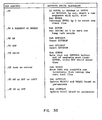
- the decision table for CRE is shown in Fig. 9A and 9B.
- the Carrier REturn or CRE serves to move the current position of the next character to be printed to the temporary left margin of the next line.
- the hierarchy of such DCF items is as follows:
- Rules 7, 8 and 9 treat DCF input items .RH, .RF and CM DRAWER by transforming them to CRE PE TUP TUFC, maybe MP MT, and BT.
- rule 10 says that EOF transforms to CRE PE EU, that is, to CRE PE EUP CRE and PE.
- a Required Carrier Return or RCR is used to unindent, that is, to move the temporary left margin back to the permanent left margin, in two cases.
- the first case occurs when the last .IN h control in a sequence has h equal to zero, which specifies an unindent, that is, when CNTINC is zero.
- the second case occurs when the last .IN h control in the sequence has h less than the current temporary left margin, that is, when CNTINC is less than, abbreviated "LT", CURINC.
- the latter case is a necessary preliminary step in transforming a DCF control that moves the temporary left margin to the left but does not move the temporary left margin all the way back to the permanent left margin.
- the preliminary RCR moves it all the way back and then one or more Indent Tabs move it to the desired position.
- L3 has no Unindent Tab control so the sequence RCR ITs is used instead.
- the first case is a subset of the second case. Therefore the condition CNTINC LT CURINC implies a need to unindent for either case.
- an RCR is not the only control item that unindents.
- the others are: IRT, which is equivalent to RCR and which DOWN never writes; RPE, which DOWN writes in response to a .PA control; LFC, which DOWN sometimes writes in response to .FO, .JU, .SS, .DS, or .TB; RMLF, APM, AAM, and RTMF, which DOWN never writes because that would require complex pattern recognition; and TUFC, which DOWN writes in response to handle .FO, .JU, .SS, .DS, or .TB. '
- DOWN does not write an RCR when it is transforming a sequence of DCF controls that requires generation of either a LFC or a TUFC.
- writing a RCR instead of the single CRE at the start, would be merely redundant, not incorrect.
- the one viable rule in the decision table for RCR see Fig. 10, says that DOWN writes an RCR if a sequence of DCF controls says to move the temporary left margin to the left and does not say to do any other things that happen to unindent.
- S R Es means one or more Carrier Return single-byte controls used to transform the .SK v control in DCF into blank lines in L3.
- the decision table for this DCF input item is given in Fig. 11.
- the number of CREs is CNTBL, which is the total of the parameters (v) in all of the .SK v controls in the sequence that has just ended. If CNTBL is zero, the number of CRE controls to be written out is zero and the above decision table is not satisfied. That is the meaning of "Y" in the row containing the name of a state variable. Note that just a .SK 0 control leaves no blank lines, but does cause a break. Moreover, if it follows a .PA NOSTART control, a .SK 0 control does start a new page. This is because of other bits that are set when .SK is encountered in a sequence. The CNTBL variable must be reset to zero by the end of processing the sequence of controls.
- the DCF sequence transforms into L3 as TEXT1 CRE CRE CRE RPE TEXT2, where all three CREs come from the .SK 3.
- the first CRE merely ends the line consisting of TEXT1.
- the next two CREs leave blank lines.
- the RPE leaves the third blank line.
- DOWN ignores null DCF records, that is, successive EORs. DOWN does not detect a null record and increment the count of blank lines.
- (RSP CRE)s means one or more pairs of Required Space and Carrier Return used to transform .SP v controls into required blank lines that can not be deleted at the top or bottom of a page. Contrast this with the "conditional" blank lines specified by the .SK v control.
- the number of RSP CRE pairs is CNTRBL, which is the total of the parameters (v) in all of the .SP v controls in the sequence that has just ended. If this is zero, no pairs are written, but the other functions of .SP 0 are performed as described for CREs.
- the CNTRBL transient state variable must be reset to zero by the end of processing of the sequence of DCF controls to L3.
- CRE RSP means the same sort of pairs of controls as the previous output, but in the opposite order.
- the decision table for these DCF input items is depicted in Fig. 13.
- the first RSP would go at the end of a text line rather than at the start of a blank line.
- the DCF sequence would transform into L3 as TEXT1 RSP CRE RSP CRE RSP CRE RPE TEXT2 which misses a blank line and extends a text line.
- DOWN writes a Required Page End or RPE single-byte control as part of the transformation to L3 of any DCF sequence that contains a .PA control. See Fig. 15 for the RPE decision table. Depending on whether this control does or does not contain the NOBREAK parameter, its presence can be signified by either GOTPA or GOTPAN. It is never necessary to write more than one RPE single-byte control when transforming a sequence of DCF controls to L3. A second .PA control always starts a new sequence.
- the Line Format Change sequence of multi-byte controls namely the multi-byte controls BLFC, SLP, STAB, and ELFC, is written into the L3 data stream as part of the transformation of a sequence of DCF controls that contains any of the controls that can transform into either a LFC or a FUFC, namely but does not contain any of the DCF controls that can transform only into a TUFC, namely
- a TUFC can contain any information that a LFC can contain, so it is never necessary to write both an LFC and a TUFC. See the decision table for LFC shown in Fig. 16.
- L3 items are very easy for DOWN to write once a decision table has told DOWN whether or not to write them.
- a LFC is not so easy. It has parameters that depend on information gleaned from DCF controls in the sequence that just ended or unchanged information held over from the previous state. In particular, it must use information in VALADJ, VALAL, VALTP and VALSSDS. Moreover, DOWN must set the new values into the corresponding persistent state variables CURADJ, CURAL, CURTP, and CURSSDS.
- DOWN writes a Zero Index Carrier Return single-byte control for two > purposes.
- rule 1 after a CRE, a ZICR ends a paragraph without unindenting. This pair is the transformation of DCF's BREAK.
- rules 2, 3 and 4 after a LFC, a ZICR insures that the changes specified by the LFC take effect immediately. For each purpose, the ZICR is written after a line ending control. Therefore, it does not move the current position at ) all. Its function is one of convention, not one of motion, when it follows a line ender.
- the ZICR decision table is illustrated in Fig. 17.
- the first purpose for which ZICR is written by DOWN does not apply to all sequences that include a BREAK, that is, either a .BR control or any of the other 51 controls that cause a BREAK in the concatenation of lines.
- the L3 concept "end of paragraph" corresponds to the DCF concept of BREAK.
- a sequence of DCF controls can contain other controls that transform into L3 items that end a paragraph.
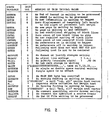
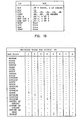
- the L3 items that end a paragraph, and the DCF controls that DOWN transforms into these L3 items, are summarized in the table shown in Fig. 18.
- DOWN need not write a ZICR to end a paragraph, when DOWN is transforming a sequence of DCF controls that includes any control on the right side of Fig. 18, because the corresponding L3 item itself will end the paragraph.
- Each supported DCF control that causes a break is in the above table except for .BR itself.
- the first purpose of ZICR applies only to transformation of .BR and of unsupported controls that cause a break.
- any of about 8 single-byte controls in L3 ends a paragraph if, and only if, it follows a CRE or a PE.
- DOWN makes no attempt to look ahead of a sequence of DCF controls to see if the next line starts with one of these single byte controls, such as SP, RSP, BS, or even IT.
- DOWN occasionally writes a ZICR that is not strictly necessary. The extra ZICR does no harm and it insures that a break continues to take effect even if subsequent editing removes the subsequent single-byte control that made ZICR unnecessary.
- CRE and ZICR interact with each other and with other input items that DOWN may have to write into the L3 data stream, in a fairly complex way, relative to ending a paragraph.
- Rule 2 for CRE says that either of GOTPA, which signifies that a .PA control is present in the sequence and will transform to a RPE, or CNTINC LT CURINC, which signifies need for a RCR to move the temporary left margin to the left, overrides writing out a CRE even though a paragraph end is required.
- Rule 1 for ZICR says that these two things, and many more as well, inhibit writing out a ZICR.
- DOWN can have three purposes for writing a PAGE END single-byte control; see Fig. 19 for the decision table.
- a sequence of DCF controls may contain a PE byte put there by UP to preserve pagination when an L3 document was transformed to DCF.
- rules 2, 3 and 4 a sequence may contain one of the DCF controls that transforms into a TUFC which, in turn, must follow a PE and a TUP.
- rule 5 a sequence may contain an EOF which transforms into an End Unit which, in turn, must follow a PE.
- a given sequence can contain both margin text definition and an EOF.
- An early draft of a DCF document can end with margin text intended to apply to text that is to be added later. Such text may be added after the DCF document is transformed DOWN to L3.
- a Text Unit Prefix (TUP) first level vector is necessary if the sequence of DCF controls requires ending the previous Text Unit and also requires starting another Text Unit. See Fig. 20 for the TUP decision table.
- Rule 1 considers the presence of a PE byte in the sequence to require DOWN to end the previous Text Unit. However, it requires DOWN to also start a new Text Unit only if the sequence contained no End Of File. Rules, 2, 3, and 4 work in the following manner. The presence in a DCF sequence of any DCF Control which requires a TUFC, in turn, requires DOWN to end the previous Text Unit and also to start a new Text Unit. This is independent of whether the sequence contained an EOF or not.
- An EOF means there is no more real body text, but another Text Unit is necessary to contain the TUFC and perhaps the MP and MT.
- the DCF controls that require a TUFC, and hence require a new Text Unit, whether or not the sequence contained an EOF, are any of .CM DRAWER, which itself transforms into a TUFC, and .RH and .RF, which transform to MP and MT which, in turn, must follow a TUFC.
- Rules 5, 6, and 7 cover a unique situation that can occur in the last sequence of a document, that is, in the sequence that contains the document's End Of File.
- This unique situation involves the fact that some DCF controls transform to L3 controls that are written before a PE is written while other DCF controls transform to L3 controls that are written after a PE is written.
- an EOF and any of the latter type of controls both appear in the same sequence of controls, we write a PE and then write other L3 controls that must follow the last PE.
- the DCF controls that can cause this unique situation to arise are .IN, .US ON and .CE.
- the .HW control would also be included in this grouping if it caused anything to be written into the L3 data stream before any text is written, but it does not.
- the problem comes up because an EOF in a sequence requires siting a PE.
- writing a PE ends the current Body Text vector and Text Unit. This leaves no Body Text vector for DOWN to place the transforms of .IN, .US ON, and .CE into.
- These transforms are ITs, BUS, and SPs ATF, respectively. It would be very difficult to move these controls ahead of PE in the output ordering, just for the unique situation where the DCF controls that require them appear in the last sequence. Therefore, the unique situation is handled by starting a new Text Unit, with a TUP, to hold any necessary ITs, BUS, or SPs ATF.
- This treatment of the unique situation corresponds to the treatment of .RH, .RF, or .CM DRAWER, in the last sequence. Either starts a new Text Unit to hold the transforms of a few controls that cannot go in the last Text Unit that actually contains text.
- a document that makes full use of this treatment has its last sequence as follows.
- DOWN writes a Text Unit Format Change (TUFC) in response to one or more of the .RH, .RF, or .CM DRAWER controls in a DCF sequence.
- the latter actually puts new information into the TUFC's parameters that specify a printer's source drawer.
- the .RH and .RF controls define margin text that can be transformed to L3 only after a TUFC. Fortunately, the TUFC's other parameters can contain new information specified by other DCF controls, if there are any in the same sequence.
- TUFC is nontrivial to write, even after a decision table, see Fig. 21, has told DOWN whether or not to write it.
- TUFC has parameters that depend on information gleaned from DCF controls in the sequence that just ended or unchanged information held over from the previous state. In particular, it must use information in VALADJ, VALAL, VALTP, VALSSDS and VALCMDR.
- DOWN must set the new values into the corresponding persistent state variables CURADJ, CURAL, CURTP, CURSSDS, and CURCMDR.
- top margin text Processing of top margin text at the end of a sequence of DCF controls is simple because the MP and MT vectors were prepared in response to the .RH ON etc., while the DCF sequence was being read. They are in the buffer named Top Margin Text (TMT).
- TMT Top Margin Text
- the GOTRHON state bit is one if and only if there is something in TMT that needs to be written out into the L3 data stream at this point.
- the MP and MT decision table is shown in Fig. 22.
- Bottom Margin Parameters and Bottom Margin Text are similar to the ) definition of Top MP and Top MT. See the decision table set forth in Fig. 23. DOWN writes the definition into buffer BMT in response to DCF input
- DOWN writes a new Body Text (BT) vector's header at this point in the transformation of a sequence of DCF controls to L3 if, and only if, DOWN previously wrote a Text Unit Prefix.
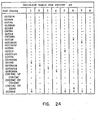
- Each Text Unit begins with a TUP and ends with a BT. Therefore, the decision tables for these two L3 items are identical.
- Fig. 24 shows the details thereof. Note that the BT vector is begun, but not ended here.
- DOWN transforms text interspersed with many sequences of DCF controls into L3 and writes L3 into this Body Text vector. DOWN only ends the BT vector when something transforms to a Page End single-byte control.
- Is Indent Tab controls
- Two item occurrences in a sequence of DCF controls require DOWN to write ITs into the L3 that is the transform of that sequence of DCF controls.
- an indent control, .IN h can specify a new temporary left margin.
- some other control in the DCF sequence can require DOWN to restore a pre-existing temporary left margin.
- the first use of IT moves the temporary left margin either from its old position to its newly specified position or from the permanent left margin to the specified new position.
- this first use of ITs has two sub- cases.
- the new temporary left margin is to the right 3 f the permanent left margin and no other control in the same sequence transforms to an L3 item that resets the temporary left margin back to the permanent left margin.
- DOWN writes only enough ITs to move the temporary left margin from its old position to its new position.
- either the new temporary left margin is to the left of the old temporary left margin, which can be transformed to L3 only by resetting the temporary left margin back to the permanent left margin and using ITs to move to the right from there, or else some other DCF control in the sequence transforms to an L3 item that happens to reset the temporary left margin back to the permanent left margin, which again requires enough ITs to move from the permanent left margin to the specified new temporary left margin.
- the second major use of ITs is to reestablish a temporary left margin that existed before the current sequence of DCF controls began and that is not changed by anything in the current sequence of controls. For example, a sequence that contains only the control .F0 OFF does not change the temporary left margin.
- the .FO OFF control must transform into a Line Format Change (LFC) sequence of multi-byte controls in L3.
- LFC Line Format Change
- a LFC resets the temporary left margin back to the permanent left margin.
- the sequence consisting of just .FO OFF must transform into an LFC followed by zero or more ITs to reestablish whatever temporary left margin is in effect.
- a .TB control transforms into either a LFC or a TUFC.
- Either a LFC or a TUFC resets the temporay left margin, so it requires DOWN to reestablish the temporary left margin or to establish a specified new temporary left margin, in the first use.
- the number of ITs required to reestablish, or establish, the temporary left margin depends on the settings in the new tab rack. It is not necessary to know how many ITs were in effect before the rab rack changed. It is sufficient to know the character position of the desired temporary left margin, whether or not that has changed.
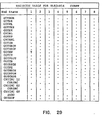
- the L3 items that reset the temporary left margin, and the DCF controls that transform into those L3 items are compared in the table illustrated in Fig. 27.
- the first item in the table requires a comment. It is not important whether any .IN h control had h less that CURINC. What is important is whether the last .IN h control in the sequence had h less than CURINC.- Therefore, the condition that DOWN tests is CNTINC LT CURINC.
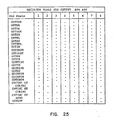
- Rule 1 of the Fig. 26 table dictates that if the sequence that just ended contains none of these controls, and no EOF, then DOWN writes one or more ITs if, and only if, CNTINC is greater than CURINC.
- the number of ITs it writes is one more than the number of tab settings whose character positions are strictly greater than CURINC and strictly less than CNTINC.
- Rules 2 through 9 hold that if the sequence that just ended contains any one or more of these controls, and does not contain an EOF, then DOWN writes one or more ITs if and only if CNTINC is greater than zero.
- the number of ITs it writes is one more than the number of tab settings whose character positions are strictly less than CNTINC.
- Rules 1 through 9 specify that ITs will not be written if the sequence contains an EOF.
- DOWN write ITs in the transformation of the last sequence of DCF controls i.e., the sequence that includes an EOF. See rule 6 of the decision table for TUP (Fig. 20).
- Rule 10 for left margin temporary reset is derived from this condition. This is the case where DOWN has begun a new Text Unit to hold ITs and/or a few other L3 items that can end an in-process document and that apply to text to be added later. This is the case where there was an actual .IN h control in the last sequence with h greater than zero.
- DOWN sets the character position of the new temporary left margin into both CNTINC and CURINC.
- This state is absolutely necessary for correct processing of the next sequence of DCF controls. Note particularly that this can involve increasing the value of CNTINC.
- the value of CNTINC was the value of h in the last .IN h control that appeared in the sequence of DCF controls that just ended. If this value does not match any tab setting on the current tab rack, then the final value of both CNTINC and CURINC is the character position of the new higher tab setting, i.e., the true temporary left margin's resultant value.
- DOWN writes a Begin UnderScore (BUS) multi-byte control as part of the transformation of a sequence of DCF controls if, and only if, that sequence of controls contained .US ON. Its decision table is shown in Fig. 28.
- BUS Begin UnderScore
- DOWN sets the persistent status bit CURHW, as part of processing the end of a sequence of DCF controls if,- and only if, that sequence contained a .HW control.
- Setting CURHW tells-the program to replace any hyphen character in the following word by the L3 single-byte control Syllable HYphen.
- the .HW control has no more immediate effect on the L3 data stream.
- the CURHW decision table is depicted in Fig. 29.
- a special PE ends a Text Unit and its Body Text vector without having written any real text into it.
- DOWN has a unique situation, detailed as a part of the TUP decision table's description, when a document's last sequence contains controls intended to apply to text added later. See the special PE decision table in Fig. 30.
- TUP's rules 2, 3, and 4 can be satisfied whether or not the sequence contains an EOF. If the sequence does contain an EOF, and one of these rules is satisfied, then DOWN begins a Text Unit, and, thereafter, a Body Text vector, that must be brought to a graceful termination even though no text is ever written into either of them.
- the same-numbered rules apply here only if the sequence does contain an EOF, because only in this case does DOWN need special action to end the Text Unit and Body Text vector these rules began.
- TUP's rules 5, 6, and 7 apply only when the sequence being transformed is the last sequence in a document. Therefore, identical rules with_the same numbers appear here to tell DOWN when to end the Text Unit and Body Text vector they began. Rule 1 is left blank here to correspond to the appropriate rules in the output decision tables for TUP and BT.
- EU End Unit
- GOTEOF End Of File
Landscapes
- Engineering & Computer Science (AREA)
- Theoretical Computer Science (AREA)
- Health & Medical Sciences (AREA)
- Artificial Intelligence (AREA)
- Audiology, Speech & Language Pathology (AREA)
- Computational Linguistics (AREA)
- General Health & Medical Sciences (AREA)
- Physics & Mathematics (AREA)
- General Engineering & Computer Science (AREA)
- General Physics & Mathematics (AREA)
- Document Processing Apparatus (AREA)
- Information Retrieval, Db Structures And Fs Structures Therefor (AREA)
Applications Claiming Priority (2)
| Application Number | Priority Date | Filing Date | Title |
|---|---|---|---|
| US06/442,927 US4498147A (en) | 1982-11-18 | 1982-11-18 | Methodology for transforming a first editable document form prepared with a batch text processing system to a second editable document form usable by an interactive or batch text processing system |
| US442927 | 1995-05-17 |
Publications (3)
| Publication Number | Publication Date |
|---|---|
| EP0109615A2 true EP0109615A2 (fr) | 1984-05-30 |
| EP0109615A3 EP0109615A3 (en) | 1986-11-20 |
| EP0109615B1 EP0109615B1 (fr) | 1994-06-01 |
Family
ID=23758723
Family Applications (1)
| Application Number | Title | Priority Date | Filing Date |
|---|---|---|---|
| EP83111222A Expired - Lifetime EP0109615B1 (fr) | 1982-11-18 | 1983-11-10 | Méthode pour transformer un premier formulaire éditable, préparé par un système de traitement différé de texte, en un second formulaire éditable, utilisable par un système de traitement interactif ou différé de texte |
Country Status (4)
| Country | Link |
|---|---|
| US (1) | US4498147A (fr) |
| EP (1) | EP0109615B1 (fr) |
| JP (1) | JPS59100963A (fr) |
| DE (1) | DE3382752T2 (fr) |
Cited By (6)
| Publication number | Priority date | Publication date | Assignee | Title |
|---|---|---|---|---|
| WO1986005294A3 (fr) * | 1985-03-01 | 1986-11-06 | Vickers Shipbuilding & Eng | Traitement de textes electronique |
| GB2254460A (en) * | 1991-04-04 | 1992-10-07 | Lasertype Dev Limited | A publishing apparatus |
| EP0466626A3 (en) * | 1990-06-07 | 1993-09-15 | International Business Machines Corporation | Method for document type transformation in a data processing system |
| FR2692383A1 (fr) * | 1992-06-15 | 1993-12-17 | Bull Sa | Procédé de conversion de documents structurés du format SODA au format RTF. |
| EP0314597B1 (fr) * | 1987-10-28 | 1995-11-22 | International Business Machines Corporation | Support d'imprimante dans un système bureautique pour ordinateurs personnels |
| US6684789B2 (en) | 2000-05-17 | 2004-02-03 | Ccp Systems Ag | Method and system for the transformation of digital print data streams and corresponding printer and printer server |
Families Citing this family (70)
| Publication number | Priority date | Publication date | Assignee | Title |
|---|---|---|---|---|
| JPS60181823A (ja) * | 1984-02-29 | 1985-09-17 | Canon Inc | 文書処理装置 |
| US4751740A (en) * | 1984-12-10 | 1988-06-14 | Wang Laboratories, Inc. | Apparatus, method, and structure for translating a document having one structure into a document having another structure |
| JPH0719249B2 (ja) * | 1985-01-25 | 1995-03-06 | シャープ株式会社 | 文章処理装置 |
| JPS63288357A (ja) * | 1987-05-20 | 1988-11-25 | Hitachi Ltd | デ−タ編集方式 |
| CN1009591B (zh) * | 1987-09-23 | 1990-09-12 | 北京市海淀区四通新技术研究所 | 计算机编辑排版系统及其方法 |
| US5091878A (en) * | 1987-11-09 | 1992-02-25 | Sharp Kabushiki Kaisha | Word processing apparatus |
| JPH01195568A (ja) * | 1988-01-29 | 1989-08-07 | Hitachi Ltd | 電子化文書編集制御方式 |
| JPH0650489B2 (ja) * | 1988-02-05 | 1994-06-29 | 日本電気株式会社 | Asn.1情報データ化方式 |
| EP0462914A3 (en) * | 1990-06-21 | 1993-06-02 | International Business Machines Corporation | A method of creating documents using existing documents |
| US5255389A (en) * | 1990-06-21 | 1993-10-19 | International Business Machines Corporation | Document interchange replace option via a copy command |
| JP3083314B2 (ja) * | 1990-10-12 | 2000-09-04 | キヤノン株式会社 | 文書処理方法及び装置 |
| US5421001A (en) * | 1992-05-01 | 1995-05-30 | Wang Laboratories, Inc. | Computer method and apparatus for a table driven file interface |
| US6832352B1 (en) * | 1998-11-12 | 2004-12-14 | Ncr Corporation | Preserving pagination of a document converted between different page sizes |
| US6538673B1 (en) * | 1999-08-23 | 2003-03-25 | Divine Technology Ventures | Method for extracting digests, reformatting, and automatic monitoring of structured online documents based on visual programming of document tree navigation and transformation |
| US7191394B1 (en) | 2000-06-21 | 2007-03-13 | Microsoft Corporation | Authoring arbitrary XML documents using DHTML and XSLT |
| JP4522650B2 (ja) | 2000-06-21 | 2010-08-11 | マイクロソフト コーポレーション | スプレッドシートとワードプロセッシングの表を統合するシステムと方法 |
| US6948135B1 (en) | 2000-06-21 | 2005-09-20 | Microsoft Corporation | Method and systems of providing information to computer users |
| US7624356B1 (en) | 2000-06-21 | 2009-11-24 | Microsoft Corporation | Task-sensitive methods and systems for displaying command sets |
| US6874143B1 (en) | 2000-06-21 | 2005-03-29 | Microsoft Corporation | Architectures for and methods of providing network-based software extensions |
| US6883168B1 (en) | 2000-06-21 | 2005-04-19 | Microsoft Corporation | Methods, systems, architectures and data structures for delivering software via a network |
| US7346848B1 (en) | 2000-06-21 | 2008-03-18 | Microsoft Corporation | Single window navigation methods and systems |
| US7000230B1 (en) * | 2000-06-21 | 2006-02-14 | Microsoft Corporation | Network-based software extensions |
| US7155667B1 (en) * | 2000-06-21 | 2006-12-26 | Microsoft Corporation | User interface for integrated spreadsheets and word processing tables |
| US8788931B1 (en) | 2000-11-28 | 2014-07-22 | International Business Machines Corporation | Creating mapping rules from meta data for data transformation utilizing visual editing |
| WO2003014965A2 (fr) * | 2001-08-03 | 2003-02-20 | Koninklijke Philips Electronics N.V. | Procede et systeme de mise a jour d'un document |
| US7275216B2 (en) * | 2003-03-24 | 2007-09-25 | Microsoft Corporation | System and method for designing electronic forms and hierarchical schemas |
| US7415672B1 (en) | 2003-03-24 | 2008-08-19 | Microsoft Corporation | System and method for designing electronic forms |
| US7370066B1 (en) | 2003-03-24 | 2008-05-06 | Microsoft Corporation | System and method for offline editing of data files |
| US7913159B2 (en) * | 2003-03-28 | 2011-03-22 | Microsoft Corporation | System and method for real-time validation of structured data files |
| US7296017B2 (en) | 2003-03-28 | 2007-11-13 | Microsoft Corporation | Validation of XML data files |
| US7516145B2 (en) * | 2003-03-31 | 2009-04-07 | Microsoft Corporation | System and method for incrementally transforming and rendering hierarchical data files |
| JP4240293B2 (ja) * | 2003-05-27 | 2009-03-18 | 株式会社ソニー・コンピュータエンタテインメント | マルチメディア再生装置およびマルチメディア再生方法 |
| US20040268229A1 (en) * | 2003-06-27 | 2004-12-30 | Microsoft Corporation | Markup language editing with an electronic form |
| US7451392B1 (en) * | 2003-06-30 | 2008-11-11 | Microsoft Corporation | Rendering an HTML electronic form by applying XSLT to XML using a solution |
| US7406660B1 (en) | 2003-08-01 | 2008-07-29 | Microsoft Corporation | Mapping between structured data and a visual surface |
| US7581177B1 (en) | 2003-08-01 | 2009-08-25 | Microsoft Corporation | Conversion of structured documents |
| US7334187B1 (en) | 2003-08-06 | 2008-02-19 | Microsoft Corporation | Electronic form aggregation |
| US8819072B1 (en) | 2004-02-02 | 2014-08-26 | Microsoft Corporation | Promoting data from structured data files |
| US7430711B2 (en) * | 2004-02-17 | 2008-09-30 | Microsoft Corporation | Systems and methods for editing XML documents |
| US7318063B2 (en) * | 2004-02-19 | 2008-01-08 | Microsoft Corporation | Managing XML documents containing hierarchical database information |
| US7496837B1 (en) * | 2004-04-29 | 2009-02-24 | Microsoft Corporation | Structural editing with schema awareness |
| US7568101B1 (en) | 2004-05-13 | 2009-07-28 | Microsoft Corporation | Digital signatures with an embedded view |
| US7281018B1 (en) | 2004-05-26 | 2007-10-09 | Microsoft Corporation | Form template data source change |
| US7774620B1 (en) | 2004-05-27 | 2010-08-10 | Microsoft Corporation | Executing applications at appropriate trust levels |
| US7692636B2 (en) * | 2004-09-30 | 2010-04-06 | Microsoft Corporation | Systems and methods for handwriting to a screen |
| US7516399B2 (en) | 2004-09-30 | 2009-04-07 | Microsoft Corporation | Structured-document path-language expression methods and systems |
| US20060074933A1 (en) * | 2004-09-30 | 2006-04-06 | Microsoft Corporation | Workflow interaction |
| US8487879B2 (en) * | 2004-10-29 | 2013-07-16 | Microsoft Corporation | Systems and methods for interacting with a computer through handwriting to a screen |
| US7584417B2 (en) * | 2004-11-15 | 2009-09-01 | Microsoft Corporation | Role-dependent action for an electronic form |
| US7712022B2 (en) | 2004-11-15 | 2010-05-04 | Microsoft Corporation | Mutually exclusive options in electronic forms |
| US20060107224A1 (en) * | 2004-11-15 | 2006-05-18 | Microsoft Corporation | Building a dynamic action for an electronic form |
| US7509353B2 (en) | 2004-11-16 | 2009-03-24 | Microsoft Corporation | Methods and systems for exchanging and rendering forms |
| US7721190B2 (en) | 2004-11-16 | 2010-05-18 | Microsoft Corporation | Methods and systems for server side form processing |
| US7904801B2 (en) * | 2004-12-15 | 2011-03-08 | Microsoft Corporation | Recursive sections in electronic forms |
| US7437376B2 (en) * | 2004-12-20 | 2008-10-14 | Microsoft Corporation | Scalable object model |
| US7937651B2 (en) * | 2005-01-14 | 2011-05-03 | Microsoft Corporation | Structural editing operations for network forms |
| US7725834B2 (en) | 2005-03-04 | 2010-05-25 | Microsoft Corporation | Designer-created aspect for an electronic form template |
| US20060206500A1 (en) * | 2005-03-10 | 2006-09-14 | Kabushiki Kaisha Toshiba | Document managing system |
| US7673228B2 (en) * | 2005-03-30 | 2010-03-02 | Microsoft Corporation | Data-driven actions for network forms |
| US8010515B2 (en) | 2005-04-15 | 2011-08-30 | Microsoft Corporation | Query to an electronic form |
| US20070011665A1 (en) * | 2005-06-21 | 2007-01-11 | Microsoft Corporation | Content syndication platform |
| US7543228B2 (en) * | 2005-06-27 | 2009-06-02 | Microsoft Corporation | Template for rendering an electronic form |
| US8200975B2 (en) | 2005-06-29 | 2012-06-12 | Microsoft Corporation | Digital signatures for network forms |
| US7613996B2 (en) * | 2005-08-15 | 2009-11-03 | Microsoft Corporation | Enabling selection of an inferred schema part |
| US7484173B2 (en) * | 2005-10-18 | 2009-01-27 | International Business Machines Corporation | Alternative key pad layout for enhanced security |
| US8001459B2 (en) * | 2005-12-05 | 2011-08-16 | Microsoft Corporation | Enabling electronic documents for limited-capability computing devices |
| US20090083616A1 (en) * | 2007-09-25 | 2009-03-26 | Microsoft Corporation | Ubiquitous electronic forms |
| US8265606B2 (en) * | 2008-10-09 | 2012-09-11 | Microsoft Corporation | Targeted advertisements to social contacts |
| US8205153B2 (en) * | 2009-08-25 | 2012-06-19 | International Business Machines Corporation | Information extraction combining spatial and textual layout cues |
| US8176412B2 (en) * | 2009-08-25 | 2012-05-08 | International Business Machines Corporation | Generating formatted documents |
Family Cites Families (6)
| Publication number | Priority date | Publication date | Assignee | Title |
|---|---|---|---|---|
| GB1537429A (en) * | 1976-10-04 | 1978-12-29 | Ibm | Text processing system |
| US4357680A (en) * | 1978-03-06 | 1982-11-02 | International Business Machines Corporation | Selective formatting of blocks of text codes in a memory of a word processing system |
| EP0042895B1 (fr) * | 1980-06-30 | 1984-11-28 | International Business Machines Corporation | Terminal automatisé pour transactions bancaires ou analogues et document négociable à utiliser avec un tel appareil |
| JPS6017114B2 (ja) * | 1980-12-30 | 1985-05-01 | 富士通株式会社 | ディスプレイ装置の画面復旧方式 |
| DE3174925D1 (en) * | 1981-04-08 | 1986-08-21 | Ibm | Text processing apparatus with two-stage formatting of text |
| US4425629A (en) * | 1981-06-16 | 1984-01-10 | International Business Machines Corporation | Display support of indefinite page |
-
1982
- 1982-11-18 US US06/442,927 patent/US4498147A/en not_active Expired - Lifetime
-
1983
- 1983-09-20 JP JP58172355A patent/JPS59100963A/ja active Granted
- 1983-11-10 EP EP83111222A patent/EP0109615B1/fr not_active Expired - Lifetime
- 1983-11-10 DE DE3382752T patent/DE3382752T2/de not_active Expired - Fee Related
Non-Patent Citations (1)
| Title |
|---|
| None |
Cited By (8)
| Publication number | Priority date | Publication date | Assignee | Title |
|---|---|---|---|---|
| WO1986005294A3 (fr) * | 1985-03-01 | 1986-11-06 | Vickers Shipbuilding & Eng | Traitement de textes electronique |
| EP0314597B1 (fr) * | 1987-10-28 | 1995-11-22 | International Business Machines Corporation | Support d'imprimante dans un système bureautique pour ordinateurs personnels |
| EP0466626A3 (en) * | 1990-06-07 | 1993-09-15 | International Business Machines Corporation | Method for document type transformation in a data processing system |
| GB2254460A (en) * | 1991-04-04 | 1992-10-07 | Lasertype Dev Limited | A publishing apparatus |
| GB2254460B (en) * | 1991-04-04 | 1994-07-27 | Lasertype Dev Limited | A publishing apparatus |
| FR2692383A1 (fr) * | 1992-06-15 | 1993-12-17 | Bull Sa | Procédé de conversion de documents structurés du format SODA au format RTF. |
| EP0575236A1 (fr) * | 1992-06-15 | 1993-12-22 | Bull S.A. | Procédé de conversion de documents structurés du format ODA/ODIF au format RTF |
| US6684789B2 (en) | 2000-05-17 | 2004-02-03 | Ccp Systems Ag | Method and system for the transformation of digital print data streams and corresponding printer and printer server |
Also Published As
| Publication number | Publication date |
|---|---|
| JPS59100963A (ja) | 1984-06-11 |
| DE3382752T2 (de) | 1994-12-08 |
| EP0109615A3 (en) | 1986-11-20 |
| DE3382752D1 (de) | 1994-07-07 |
| US4498147A (en) | 1985-02-05 |
| EP0109615B1 (fr) | 1994-06-01 |
| JPH0363770B2 (fr) | 1991-10-02 |
Similar Documents
| Publication | Publication Date | Title |
|---|---|---|
| US4498147A (en) | Methodology for transforming a first editable document form prepared with a batch text processing system to a second editable document form usable by an interactive or batch text processing system | |
| EP0447157B1 (fr) | Conversion du format des données | |
| EP0109614B1 (fr) | Méthode pour transformer un premier formulaire éditable, préparé par un système interactif processeur de texte, en un second formulaire éditable, utilisable par un système de traitement interactif ou différé de texte | |
| US7831908B2 (en) | Method and apparatus for layout of text and image documents | |
| US5459827A (en) | Layout method for structured documents | |
| EP0186007A2 (fr) | Appareil, méthode et structure pour traduire un document ayant une certaine structure en un document ayant une autre structure | |
| EP1847923A1 (fr) | Traduction de ressources non structurées | |
| US7716574B2 (en) | Methods and systems for providing direct style sheet editing | |
| JPH01205260A (ja) | 文書整形装置 | |
| JPS6170660A (ja) | 機械翻訳システムにおける多義表示・選択方法 | |
| US6668355B1 (en) | Text editing system | |
| EP1730653A2 (fr) | Systemes et procedes permettant d'identifier un texte complexe dans un flux de donnees de presentation | |
| CN119849448A (zh) | 文档处理方法、装置、电子设备及存储介质 | |
| Pignalberi et al. | Introduction to LATEX and to some of its tools | |
| JPS593546A (ja) | 異形式文書間複写処理方式 | |
| JP2008026943A (ja) | 編集処理装置、編集処理装置の制御方法、プログラムおよび記録媒体 | |
| US20040205666A1 (en) | System and method for anticipated file editing | |
| CN110196965A (zh) | XML文件转换Word文件的方法及装置 | |
| JP2003006559A (ja) | プリントパラメタ帳票出力システム | |
| JPH02255978A (ja) | 文書データ変換方式 | |
| JPH03188556A (ja) | 文書自動作成システム | |
| JPH1021240A (ja) | 機械翻訳装置及び機械翻訳方法 | |
| CN113935282A (zh) | 一种文档编辑方法、装置、存储介质以及设备 | |
| KR20220048688A (ko) | Pdf 문서로부터 복사된 텍스트에 대한 전자 문서로의 자연스러운 붙여넣기를 지원하는 전자 장치 및 그 동작 방법 | |
| Bennett | T-EDIT, A Collection of Editing Macros for TEX |
Legal Events
| Date | Code | Title | Description |
|---|---|---|---|
| PUAI | Public reference made under article 153(3) epc to a published international application that has entered the european phase |
Free format text: ORIGINAL CODE: 0009012 |
|
| AK | Designated contracting states |
Designated state(s): DE FR GB IT |
|
| 17P | Request for examination filed |
Effective date: 19840921 |
|
| PUAL | Search report despatched |
Free format text: ORIGINAL CODE: 0009013 |
|
| AK | Designated contracting states |
Kind code of ref document: A3 Designated state(s): DE FR GB IT |
|
| 17Q | First examination report despatched |
Effective date: 19871022 |
|
| GRAA | (expected) grant |
Free format text: ORIGINAL CODE: 0009210 |
|
| AK | Designated contracting states |
Kind code of ref document: B1 Designated state(s): DE FR GB IT |
|
| PG25 | Lapsed in a contracting state [announced via postgrant information from national office to epo] |
Ref country code: IT Free format text: LAPSE BECAUSE OF FAILURE TO SUBMIT A TRANSLATION OF THE DESCRIPTION OR TO PAY THE FEE WITHIN THE PRESCRIBED TIME-LIMIT;WARNING: LAPSES OF ITALIAN PATENTS WITH EFFECTIVE DATE BEFORE 2007 MAY HAVE OCCURRED AT ANY TIME BEFORE 2007. THE CORRECT EFFECTIVE DATE MAY BE DIFFERENT FROM THE ONE RECORDED. Effective date: 19940601 |
|
| REF | Corresponds to: |
Ref document number: 3382752 Country of ref document: DE Date of ref document: 19940707 |
|
| ET | Fr: translation filed | ||
| PLBE | No opposition filed within time limit |
Free format text: ORIGINAL CODE: 0009261 |
|
| STAA | Information on the status of an ep patent application or granted ep patent |
Free format text: STATUS: NO OPPOSITION FILED WITHIN TIME LIMIT |
|
| 26N | No opposition filed | ||
| PGFP | Annual fee paid to national office [announced via postgrant information from national office to epo] |
Ref country code: FR Payment date: 19951107 Year of fee payment: 13 |
|
| PG25 | Lapsed in a contracting state [announced via postgrant information from national office to epo] |
Ref country code: FR Effective date: 19970731 |
|
| REG | Reference to a national code |
Ref country code: FR Ref legal event code: ST |
|
| PGFP | Annual fee paid to national office [announced via postgrant information from national office to epo] |
Ref country code: DE Payment date: 20001120 Year of fee payment: 18 |
|
| PGFP | Annual fee paid to national office [announced via postgrant information from national office to epo] |
Ref country code: GB Payment date: 20011105 Year of fee payment: 19 |
|
| REG | Reference to a national code |
Ref country code: GB Ref legal event code: IF02 |
|
| PG25 | Lapsed in a contracting state [announced via postgrant information from national office to epo] |
Ref country code: DE Free format text: LAPSE BECAUSE OF NON-PAYMENT OF DUE FEES Effective date: 20020702 |
|
| PG25 | Lapsed in a contracting state [announced via postgrant information from national office to epo] |
Ref country code: GB Free format text: LAPSE BECAUSE OF NON-PAYMENT OF DUE FEES Effective date: 20021110 |
|
| GBPC | Gb: european patent ceased through non-payment of renewal fee | ||
| APAH | Appeal reference modified |
Free format text: ORIGINAL CODE: EPIDOSCREFNO |