EP0110026A2 - Procédé pour la fabrication d'une matière composite - Google Patents
Procédé pour la fabrication d'une matière composite Download PDFInfo
- Publication number
- EP0110026A2 EP0110026A2 EP83108723A EP83108723A EP0110026A2 EP 0110026 A2 EP0110026 A2 EP 0110026A2 EP 83108723 A EP83108723 A EP 83108723A EP 83108723 A EP83108723 A EP 83108723A EP 0110026 A2 EP0110026 A2 EP 0110026A2
- Authority
- EP
- European Patent Office
- Prior art keywords
- layers
- composite material
- fiber
- fibers
- material according
- Prior art date
- Legal status (The legal status is an assumption and is not a legal conclusion. Google has not performed a legal analysis and makes no representation as to the accuracy of the status listed.)
- Granted
Links
- 238000000034 method Methods 0.000 title claims description 15
- 239000000835 fiber Substances 0.000 claims abstract description 36
- 239000002131 composite material Substances 0.000 claims abstract description 19
- 229920001169 thermoplastic Polymers 0.000 claims abstract description 11
- 239000004416 thermosoftening plastic Substances 0.000 claims abstract description 9
- 238000007731 hot pressing Methods 0.000 claims abstract description 6
- 239000011265 semifinished product Substances 0.000 claims abstract description 5
- 238000004519 manufacturing process Methods 0.000 claims description 10
- 239000011521 glass Substances 0.000 claims description 5
- 239000000203 mixture Substances 0.000 claims description 2
- OKTJSMMVPCPJKN-UHFFFAOYSA-N Carbon Chemical compound [C] OKTJSMMVPCPJKN-UHFFFAOYSA-N 0.000 claims 1
- 229910052799 carbon Inorganic materials 0.000 claims 1
- 239000000919 ceramic Substances 0.000 claims 1
- 239000002184 metal Substances 0.000 claims 1
- 239000000126 substance Substances 0.000 claims 1
- 229920005989 resin Polymers 0.000 description 19
- 239000011347 resin Substances 0.000 description 19
- 239000004744 fabric Substances 0.000 description 9
- 229920005992 thermoplastic resin Polymers 0.000 description 9
- YMWUJEATGCHHMB-UHFFFAOYSA-N Dichloromethane Chemical compound ClCCl YMWUJEATGCHHMB-UHFFFAOYSA-N 0.000 description 8
- 239000000243 solution Substances 0.000 description 8
- 239000002904 solvent Substances 0.000 description 8
- 229920002492 poly(sulfone) Polymers 0.000 description 7
- 239000000463 material Substances 0.000 description 6
- 238000003825 pressing Methods 0.000 description 6
- 239000011159 matrix material Substances 0.000 description 5
- 239000000047 product Substances 0.000 description 5
- -1 lyanates Substances 0.000 description 4
- 239000004952 Polyamide Substances 0.000 description 3
- 239000002657 fibrous material Substances 0.000 description 3
- 230000009477 glass transition Effects 0.000 description 3
- 238000010438 heat treatment Methods 0.000 description 3
- 238000005470 impregnation Methods 0.000 description 3
- 238000002844 melting Methods 0.000 description 3
- 230000008018 melting Effects 0.000 description 3
- 238000000465 moulding Methods 0.000 description 3
- 229920002647 polyamide Polymers 0.000 description 3
- 229920000728 polyester Polymers 0.000 description 3
- 229920003002 synthetic resin Polymers 0.000 description 3
- 239000000057 synthetic resin Substances 0.000 description 3
- 229920000049 Carbon (fiber) Polymers 0.000 description 2
- 239000004962 Polyamide-imide Substances 0.000 description 2
- 239000004693 Polybenzimidazole Substances 0.000 description 2
- 239000004917 carbon fiber Substances 0.000 description 2
- 239000011888 foil Substances 0.000 description 2
- 239000003365 glass fiber Substances 0.000 description 2
- 230000001788 irregular Effects 0.000 description 2
- 239000004745 nonwoven fabric Substances 0.000 description 2
- 239000003960 organic solvent Substances 0.000 description 2
- 229920003055 poly(ester-imide) Polymers 0.000 description 2
- 229920002312 polyamide-imide Polymers 0.000 description 2
- 229920002480 polybenzimidazole Polymers 0.000 description 2
- 229920002577 polybenzoxazole Polymers 0.000 description 2
- 239000004417 polycarbonate Substances 0.000 description 2
- 229920000515 polycarbonate Polymers 0.000 description 2
- 229920000647 polyepoxide Polymers 0.000 description 2
- 229920000098 polyolefin Polymers 0.000 description 2
- XSCHRSMBECNVNS-UHFFFAOYSA-N quinoxaline Chemical compound N1=CC=NC2=CC=CC=C21 XSCHRSMBECNVNS-UHFFFAOYSA-N 0.000 description 2
- 229920001187 thermosetting polymer Polymers 0.000 description 2
- 210000001170 unmyelinated nerve fiber Anatomy 0.000 description 2
- QTWJRLJHJPIABL-UHFFFAOYSA-N 2-methylphenol;3-methylphenol;4-methylphenol Chemical compound CC1=CC=C(O)C=C1.CC1=CC=CC(O)=C1.CC1=CC=CC=C1O QTWJRLJHJPIABL-UHFFFAOYSA-N 0.000 description 1
- LMWMTSCFTPQVCJ-UHFFFAOYSA-N 2-methylphenol;phenol Chemical compound OC1=CC=CC=C1.CC1=CC=CC=C1O LMWMTSCFTPQVCJ-UHFFFAOYSA-N 0.000 description 1
- ZOXJGFHDIHLPTG-UHFFFAOYSA-N Boron Chemical compound [B] ZOXJGFHDIHLPTG-UHFFFAOYSA-N 0.000 description 1
- 239000004593 Epoxy Substances 0.000 description 1
- 229920002430 Fibre-reinforced plastic Polymers 0.000 description 1
- ISWSIDIOOBJBQZ-UHFFFAOYSA-N Phenol Chemical compound OC1=CC=CC=C1 ISWSIDIOOBJBQZ-UHFFFAOYSA-N 0.000 description 1
- 239000004695 Polyether sulfone Substances 0.000 description 1
- 230000002411 adverse Effects 0.000 description 1
- XAGFODPZIPBFFR-UHFFFAOYSA-N aluminium Chemical compound [Al] XAGFODPZIPBFFR-UHFFFAOYSA-N 0.000 description 1
- 229910052782 aluminium Inorganic materials 0.000 description 1
- 229920003235 aromatic polyamide Polymers 0.000 description 1
- 125000003118 aryl group Chemical group 0.000 description 1
- 239000011230 binding agent Substances 0.000 description 1
- 229910052796 boron Inorganic materials 0.000 description 1
- 229930003836 cresol Natural products 0.000 description 1
- 238000001035 drying Methods 0.000 description 1
- 229920001971 elastomer Polymers 0.000 description 1
- 125000003700 epoxy group Chemical group 0.000 description 1
- 239000003822 epoxy resin Substances 0.000 description 1
- 239000011151 fibre-reinforced plastic Substances 0.000 description 1
- 239000012765 fibrous filler Substances 0.000 description 1
- 230000009969 flowable effect Effects 0.000 description 1
- LNEPOXFFQSENCJ-UHFFFAOYSA-N haloperidol Chemical compound C1CC(O)(C=2C=CC(Cl)=CC=2)CCN1CCCC(=O)C1=CC=C(F)C=C1 LNEPOXFFQSENCJ-UHFFFAOYSA-N 0.000 description 1
- 150000003949 imides Chemical class 0.000 description 1
- 238000002347 injection Methods 0.000 description 1
- 239000007924 injection Substances 0.000 description 1
- 239000012948 isocyanate Substances 0.000 description 1
- 150000002513 isocyanates Chemical class 0.000 description 1
- 239000004922 lacquer Substances 0.000 description 1
- VNWKTOKETHGBQD-UHFFFAOYSA-N methane Chemical compound C VNWKTOKETHGBQD-UHFFFAOYSA-N 0.000 description 1
- 239000004033 plastic Substances 0.000 description 1
- 229920003023 plastic Polymers 0.000 description 1
- 229920001225 polyester resin Polymers 0.000 description 1
- 239000004645 polyester resin Substances 0.000 description 1
- 229920006393 polyether sulfone Polymers 0.000 description 1
- 229920000642 polymer Polymers 0.000 description 1
- 229920006389 polyphenyl polymer Polymers 0.000 description 1
- 230000008092 positive effect Effects 0.000 description 1
- 239000000843 powder Substances 0.000 description 1
- 230000009257 reactivity Effects 0.000 description 1
- 239000012508 resin bead Substances 0.000 description 1
- 239000005060 rubber Substances 0.000 description 1
- 238000007789 sealing Methods 0.000 description 1
- 239000002966 varnish Substances 0.000 description 1
- 239000002759 woven fabric Substances 0.000 description 1
Images
Classifications
-
- B—PERFORMING OPERATIONS; TRANSPORTING
- B29—WORKING OF PLASTICS; WORKING OF SUBSTANCES IN A PLASTIC STATE IN GENERAL
- B29C—SHAPING OR JOINING OF PLASTICS; SHAPING OF MATERIAL IN A PLASTIC STATE, NOT OTHERWISE PROVIDED FOR; AFTER-TREATMENT OF THE SHAPED PRODUCTS, e.g. REPAIRING
- B29C70/00—Shaping composites, i.e. plastics material comprising reinforcements, fillers or preformed parts, e.g. inserts
- B29C70/04—Shaping composites, i.e. plastics material comprising reinforcements, fillers or preformed parts, e.g. inserts comprising reinforcements only, e.g. self-reinforcing plastics
- B29C70/06—Fibrous reinforcements only
- B29C70/10—Fibrous reinforcements only characterised by the structure of fibrous reinforcements, e.g. hollow fibres
- B29C70/12—Fibrous reinforcements only characterised by the structure of fibrous reinforcements, e.g. hollow fibres using fibres of short length, e.g. in the form of a mat
- B29C70/14—Fibrous reinforcements only characterised by the structure of fibrous reinforcements, e.g. hollow fibres using fibres of short length, e.g. in the form of a mat oriented
-
- B—PERFORMING OPERATIONS; TRANSPORTING
- B29—WORKING OF PLASTICS; WORKING OF SUBSTANCES IN A PLASTIC STATE IN GENERAL
- B29C—SHAPING OR JOINING OF PLASTICS; SHAPING OF MATERIAL IN A PLASTIC STATE, NOT OTHERWISE PROVIDED FOR; AFTER-TREATMENT OF THE SHAPED PRODUCTS, e.g. REPAIRING
- B29C70/00—Shaping composites, i.e. plastics material comprising reinforcements, fillers or preformed parts, e.g. inserts
- B29C70/04—Shaping composites, i.e. plastics material comprising reinforcements, fillers or preformed parts, e.g. inserts comprising reinforcements only, e.g. self-reinforcing plastics
- B29C70/28—Shaping operations therefor
- B29C70/40—Shaping or impregnating by compression not applied
- B29C70/42—Shaping or impregnating by compression not applied for producing articles of definite length, i.e. discrete articles
- B29C70/44—Shaping or impregnating by compression not applied for producing articles of definite length, i.e. discrete articles using isostatic pressure, e.g. pressure difference-moulding, vacuum bag-moulding, autoclave-moulding or expanding rubber-moulding
-
- B—PERFORMING OPERATIONS; TRANSPORTING
- B29—WORKING OF PLASTICS; WORKING OF SUBSTANCES IN A PLASTIC STATE IN GENERAL
- B29C—SHAPING OR JOINING OF PLASTICS; SHAPING OF MATERIAL IN A PLASTIC STATE, NOT OTHERWISE PROVIDED FOR; AFTER-TREATMENT OF THE SHAPED PRODUCTS, e.g. REPAIRING
- B29C43/00—Compression moulding, i.e. applying external pressure to flow the moulding material; Apparatus therefor
- B29C43/02—Compression moulding, i.e. applying external pressure to flow the moulding material; Apparatus therefor of articles of definite length, i.e. discrete articles
- B29C43/10—Isostatic pressing, i.e. using non-rigid pressure-exerting members against rigid parts or dies
- B29C43/12—Isostatic pressing, i.e. using non-rigid pressure-exerting members against rigid parts or dies using bags surrounding the moulding material or using membranes contacting the moulding material
-
- B—PERFORMING OPERATIONS; TRANSPORTING
- B29—WORKING OF PLASTICS; WORKING OF SUBSTANCES IN A PLASTIC STATE IN GENERAL
- B29K—INDEXING SCHEME ASSOCIATED WITH SUBCLASSES B29B, B29C OR B29D, RELATING TO MOULDING MATERIALS OR TO MATERIALS FOR MOULDS, REINFORCEMENTS, FILLERS OR PREFORMED PARTS, e.g. INSERTS
- B29K2081/00—Use of polymers having sulfur, with or without nitrogen, oxygen or carbon only, in the main chain, as moulding material
-
- B—PERFORMING OPERATIONS; TRANSPORTING
- B29—WORKING OF PLASTICS; WORKING OF SUBSTANCES IN A PLASTIC STATE IN GENERAL
- B29K—INDEXING SCHEME ASSOCIATED WITH SUBCLASSES B29B, B29C OR B29D, RELATING TO MOULDING MATERIALS OR TO MATERIALS FOR MOULDS, REINFORCEMENTS, FILLERS OR PREFORMED PARTS, e.g. INSERTS
- B29K2105/00—Condition, form or state of moulded material or of the material to be shaped
- B29K2105/06—Condition, form or state of moulded material or of the material to be shaped containing reinforcements, fillers or inserts
- B29K2105/12—Condition, form or state of moulded material or of the material to be shaped containing reinforcements, fillers or inserts of short lengths, e.g. chopped filaments, staple fibres or bristles
- B29K2105/14—Condition, form or state of moulded material or of the material to be shaped containing reinforcements, fillers or inserts of short lengths, e.g. chopped filaments, staple fibres or bristles oriented
-
- B—PERFORMING OPERATIONS; TRANSPORTING
- B29—WORKING OF PLASTICS; WORKING OF SUBSTANCES IN A PLASTIC STATE IN GENERAL
- B29K—INDEXING SCHEME ASSOCIATED WITH SUBCLASSES B29B, B29C OR B29D, RELATING TO MOULDING MATERIALS OR TO MATERIALS FOR MOULDS, REINFORCEMENTS, FILLERS OR PREFORMED PARTS, e.g. INSERTS
- B29K2503/00—Use of resin-bonded materials as filler
-
- B—PERFORMING OPERATIONS; TRANSPORTING
- B29—WORKING OF PLASTICS; WORKING OF SUBSTANCES IN A PLASTIC STATE IN GENERAL
- B29L—INDEXING SCHEME ASSOCIATED WITH SUBCLASS B29C, RELATING TO PARTICULAR ARTICLES
- B29L2009/00—Layered products
-
- Y—GENERAL TAGGING OF NEW TECHNOLOGICAL DEVELOPMENTS; GENERAL TAGGING OF CROSS-SECTIONAL TECHNOLOGIES SPANNING OVER SEVERAL SECTIONS OF THE IPC; TECHNICAL SUBJECTS COVERED BY FORMER USPC CROSS-REFERENCE ART COLLECTIONS [XRACs] AND DIGESTS
- Y10—TECHNICAL SUBJECTS COVERED BY FORMER USPC
- Y10S—TECHNICAL SUBJECTS COVERED BY FORMER USPC CROSS-REFERENCE ART COLLECTIONS [XRACs] AND DIGESTS
- Y10S428/00—Stock material or miscellaneous articles
- Y10S428/91—Product with molecular orientation
-
- Y—GENERAL TAGGING OF NEW TECHNOLOGICAL DEVELOPMENTS; GENERAL TAGGING OF CROSS-SECTIONAL TECHNOLOGIES SPANNING OVER SEVERAL SECTIONS OF THE IPC; TECHNICAL SUBJECTS COVERED BY FORMER USPC CROSS-REFERENCE ART COLLECTIONS [XRACs] AND DIGESTS
- Y10—TECHNICAL SUBJECTS COVERED BY FORMER USPC
- Y10T—TECHNICAL SUBJECTS COVERED BY FORMER US CLASSIFICATION
- Y10T428/00—Stock material or miscellaneous articles
- Y10T428/24—Structurally defined web or sheet [e.g., overall dimension, etc.]
- Y10T428/24058—Structurally defined web or sheet [e.g., overall dimension, etc.] including grain, strips, or filamentary elements in respective layers or components in angular relation
- Y10T428/24124—Fibers
Definitions
- the invention relates to a prefabricated plate-shaped composite material as a semifinished product, consisting of individual thermoplastic layers reinforced with fibers arranged in the composite in or partially in different orientations.
- high-strength and thermally resilient composite materials can be produced using temperature-resistant resins or polymers by dissolving impregnating resin in a solvent to form an impregnating varnish and thus fibrous materials such as carbon fibers, glass fibers, boron fibers or organic high-modulus fibers from aromatic Impregnated polyamides (so-called aramids) in the form of nonwovens, woven fabrics or knitted fabrics and then the solvent is evaporated off.
- aramids aromatic Impregnated polyamides
- prepreg Pre-impregnated fiber material
- impregnation resins are both thermosetting reactive resins, such as polyesters, epoxies, lyanates, isocyanates and imides, and thermoplastic polymers, such as polysulfones, polyhydantoin, polycarbonate, polyamide, polyamide-imide, polyester, polyesterimide, polymide, polyphenyl, quinoxaline, or polybenzimidazole or Polybenzoxazole can be used.
- the pre-products are produced either using the solvent process described above, for which it is necessary that the matrix resin can be dissolved in customary suitable organic solvents to give an impregnating lacquer, or using a solvent-free resin melt.
- Prepregs fabrics, unidirectional fabrics, etc.
- Prepregs can be processed either by pressing processes to produce flat, flat laminates or by low-pressure autoclave processes.
- Spherically curved flat laminates can practically only be produced using low-pressure autoclave processes, preferably using readily flowable thermosetting resins.
- DE-AS 12 90 708 for producing layered film material from a fibrous carrier film and an overlying layer of fine-pored sintered plastic material, in which a uniform layer of a granular, thermoplastic resin is distributed on the carrier film and heated together with the carrier film and in which a cover layer is applied to the resin layer during the treatment, the cover layer consisting of elastic, compressible fibrous material is applied to the resin bead layer before heating.
- the structure consisting of the carrier film, the resin grains and the covering layer is passed between heated plates, the spacing of which at the entry point essentially corresponds to the thickness of the layer material and is considerably reduced towards the exit side.
- a disadvantage of this process is that, due to the reactivity of the resins, long pressing times and usually also higher temperatures are necessary for curing, which adversely affect the manufacturing costs of the products, the pressing time being an important factor.
- thermoplastic resins pressed into shaped bodies and filled with short fibers Another disadvantage is that in the case of thermoplastic resins pressed into shaped bodies and filled with short fibers, the achievable strength and stiffness in the material are low due to the irregular fiber orientation and the low fiber content.
- the fiber content can be due to the irregular moderate fiber orientation and the flow properties of the resin can not be increased arbitrarily.
- the advantage of the invention consists in the fact that prefabricated, oriented flat fibers reinforced, flat, flat thermoplastics or sheets can be deformed into complex flat or spherically curved products by means of a hot pressing and / or hot molding process. This is done as a matrix resin.
- medium molecular weight thermoplastic resin used e.g. a polysulfone, polyamide, polycarbonate, polyamide-imide, polyhydantoin, polyesterimide, polymide, polyphenylquinoxaline, polybenzimidazole or polybenzoxazole or a polyester.
- thermoplastics can be used for deep drawing even with comparable high fiber contents and products can be produced with complex geometry, which both enable cost-effective production as a result of short pressing times and also have high strength and rigidity due to the oriented short fibers and high fiber content.
- thermoformable thermoplastics reinforced with short fibers are produced in such a way that a fiber mat made of unidirectionally oriented short fibers is impregnated with a solution of a thermoplastic resin and the solvent is then evaporated, leaving a mat impregnated with resin. Blanks of such resin mats are layered in accordance with the desired fiber direction and compacted in a heatable plate press at the melting point of the thermoplastic resin and, after a dwell time of a few minutes, cooled to a temperature below the glass point of the thermoplastic resin and then removed from the mold.
- a resin content of between 35 and 70 percent by weight is preferably produced for the deep-drawing of the sheets or “organic sheets” thus produced, a correspondingly concentrated solution of the resin being used to impregnate the sheets or mats.
- the orientation directions of the fibers in the individual layers of the plates or mats are largely determined by the desired strengths determined in a component.
- the number of individual fiber layers or layers in the "organic sheet” can be multiplied in almost any way.
- the composite is made by hot pressing, e.g. Stamp or roller, can be produced as a plate-shaped or endless semi-finished product.
- Resin impregnation of such an "organic sheet” is also possible by the so-called film stacking method, in which oriented short fiber fabrics and foils of the thermoplastic resins are alternately layered in a vacuum bag, then slowly heated to the melting temperature of the thermoplastic under vacuum and pressure and then cooled under vacuum and pressure to a temperature below the glass point of the thermoplastic and removed from the mold.
- the film stacking method is mainly used when the thermoplastic matrix is insoluble in suitable organic solvents. Hot-pressing and / or hot-forming processes are suitable for the further processing of sheets produced in this way and filled with oriented short fibers.
- Unidirectional short-fiber fabrics are impregnated with a solution of a polyethersulfone with a glass transition temperature of 210 C in methylene chloride as a solvent by evenly applying the solution to the short-fiber fabric just placed. After the solvent has dried, the "prepregs" thus produced are cut into, for example, 15 x 15 cm pieces and layered symmetrically in the orientation 0 +, 45, -45, -90 degrees of angle and in a heatable plate press at 250 to 300 ° C. under pressure to a dense flat laminate pressed.
- the glass transition point of 210 0 C of the thermoplastic resin is fed under pressure to a temperature substantially below the glass transition temperature of the polysulfone, preferably to 120 ° C, cooled, before the composite material is removed from the mold.
- the "organic sheet" produced in this way can then be deformed under pressure to form components of complex geometry.
- Unidirectional, uncompacted prepregs are cut into, for example, 15 x 15 cm pieces and layered in the orientation 90, 0, O, 90 degrees and compacted between aluminum foils in a plate press.
- the plate press is preheated to 330 ° C and the prepreg fabric is placed between the heated plates of the press under contact pressure. After sufficient pressure heating of the prepreg stack, the press is closed and the fabric compacted at 40 Kp / cm 2 . After 5 minutes, the mixture is cooled to 100 ° C. under pressure and removed from the mold. A 0.75 mm thick, dense plate is obtained, which has a weight per unit area of 1000-70 g / m 2 .
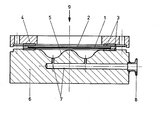
- a C-fiber polysulfone plate (organic sheet) is together with a vacuum-tight rubber blanket 2 acting as a pressure stamp and upper and lower sealing rings 3 by means of a tension acting from above ring 4 clamped on a contour tool 5 provided with a mold 6.
- the molding tool is provided with channels 7 and a vacuum connection 8.
- the molding tool 6 is heated together with the workpiece, the C-fiber polysulfone plate 1, in an autoclave, not shown in the sketch, to the deformation temperature of approximately 220 ° C., with the help of the vacuum generated in the contour shape 5 and a pressure 9 of approx. 100 N / cm 2 acting on the clamping ring 4 and the workpiece or the plate 1 is deformed.
Landscapes
- Engineering & Computer Science (AREA)
- Chemical & Material Sciences (AREA)
- Composite Materials (AREA)
- Mechanical Engineering (AREA)
- Textile Engineering (AREA)
- Reinforced Plastic Materials (AREA)
- Laminated Bodies (AREA)
- Casting Or Compression Moulding Of Plastics Or The Like (AREA)
Applications Claiming Priority (2)
| Application Number | Priority Date | Filing Date | Title |
|---|---|---|---|
| DE3243021 | 1982-11-20 | ||
| DE3243021A DE3243021C2 (de) | 1982-11-20 | 1982-11-20 | Verbundwerkstoff und dessen Verwendung |
Publications (3)
| Publication Number | Publication Date |
|---|---|
| EP0110026A2 true EP0110026A2 (fr) | 1984-06-13 |
| EP0110026A3 EP0110026A3 (en) | 1986-09-17 |
| EP0110026B1 EP0110026B1 (fr) | 1990-12-27 |
Family
ID=6178628
Family Applications (1)
| Application Number | Title | Priority Date | Filing Date |
|---|---|---|---|
| EP83108723A Expired - Lifetime EP0110026B1 (fr) | 1982-11-20 | 1983-09-05 | Procédé pour la fabrication d'une matière composite |
Country Status (4)
| Country | Link |
|---|---|
| US (1) | US4555426A (fr) |
| EP (1) | EP0110026B1 (fr) |
| JP (1) | JPS5996951A (fr) |
| DE (1) | DE3243021C2 (fr) |
Cited By (2)
| Publication number | Priority date | Publication date | Assignee | Title |
|---|---|---|---|---|
| EP0195561A3 (en) * | 1985-03-21 | 1989-01-18 | Imperial Chemical Industries Plc | Method of producing shaped articles from reinforced composites |
| EP2165821A2 (fr) | 2008-09-22 | 2010-03-24 | Universität Bremen | Procédé et dispositif pour la fabrication d'un matériau composite renforcé par des fibres. |
Families Citing this family (12)
| Publication number | Priority date | Publication date | Assignee | Title |
|---|---|---|---|---|
| GB8618727D0 (en) * | 1986-07-31 | 1986-09-10 | Wiggins Teape Group Ltd | Thermoplastic sheets |
| GB8618726D0 (en) * | 1986-07-31 | 1986-09-10 | Wiggins Teape Group Ltd | Thermoplastics material |
| DE3727926A1 (de) * | 1986-08-27 | 1988-03-10 | Dornier Gmbh | Verfahren zur herstellung von formteilen |
| DE3702936A1 (de) * | 1987-01-31 | 1988-08-11 | Dornier Gmbh | Faserverbundwerkstoff |
| US5242749A (en) * | 1987-03-13 | 1993-09-07 | The Wiggins Teape Group Limited | Fibre reinforced plastics structures |
| EP0330960A3 (fr) * | 1988-03-04 | 1990-07-11 | General Electric Company | Procédé de formation d'articles thermoplastiques renforcés avec des fibres |
| JPH0725142B2 (ja) * | 1989-11-06 | 1995-03-22 | ソマール株式会社 | 自己カール性繊維強化熱可塑性樹脂シートと、それを原料とする樹脂管及び樹脂管の製造方法 |
| WO1994025256A1 (fr) * | 1993-04-30 | 1994-11-10 | The Dow Chemical Company | Structures polybenzazoliques tridimensionnelles |
| DE4423194A1 (de) * | 1994-07-01 | 1996-01-04 | Triumph International Ag | Verfahren zur Herstellung von Ausformungen in Flächengebilden aus aromatischen Polyamiden |
| US8466151B2 (en) | 2007-12-26 | 2013-06-18 | Critical Outcome Technologies, Inc. | Compounds and method for treatment of cancer |
| EP3023426A1 (fr) | 2008-07-17 | 2016-05-25 | Critical Outcome Technologies, Inc. | Composés inhibiteurs à base de thiosemicarbazone et procédés de traitement du cancer |
| WO2011120153A1 (fr) | 2010-04-01 | 2011-10-06 | Critical Outcome Technologies Inc. | Composés et méthodes pour le traitement du vih |
Family Cites Families (6)
| Publication number | Priority date | Publication date | Assignee | Title |
|---|---|---|---|---|
| GB1249291A (en) * | 1967-03-29 | 1971-10-13 | Nat Res Dev | Improvements in or relating to composite materials |
| US3578544A (en) * | 1968-01-18 | 1971-05-11 | Phillips Petroleum Co | Reinforced microporous laminates |
| DE2312816C3 (de) * | 1973-03-15 | 1983-02-03 | Basf Ag, 6700 Ludwigshafen | Verfahren zur kontinuierlichen Herstellung von Halbzeug aus glasfaserverstärkten thermoplastischen Kunststoffen |
| GB1529226A (en) * | 1975-06-05 | 1978-10-18 | Bekaert Sa Nv | Steelcord reinforced plastic materials |
| DE2647821A1 (de) * | 1976-10-22 | 1978-04-27 | Dornier System Gmbh | Verfahren zur herstellung von faserverstaerkten polyolefinen mit hohem faservolumenanteil |
| FR2497839A1 (fr) * | 1981-01-12 | 1982-07-16 | Brochier Fils J | Tissu tridimensionnel pour le renforcement de materiaux stratifies et elements en forme obtenus a partir d'un tel tissu |
-
1982
- 1982-11-20 DE DE3243021A patent/DE3243021C2/de not_active Expired
-
1983
- 1983-09-05 EP EP83108723A patent/EP0110026B1/fr not_active Expired - Lifetime
- 1983-09-12 JP JP58166835A patent/JPS5996951A/ja active Granted
- 1983-10-19 US US06/543,365 patent/US4555426A/en not_active Expired - Fee Related
Cited By (3)
| Publication number | Priority date | Publication date | Assignee | Title |
|---|---|---|---|---|
| EP0195561A3 (en) * | 1985-03-21 | 1989-01-18 | Imperial Chemical Industries Plc | Method of producing shaped articles from reinforced composites |
| EP2165821A2 (fr) | 2008-09-22 | 2010-03-24 | Universität Bremen | Procédé et dispositif pour la fabrication d'un matériau composite renforcé par des fibres. |
| EP2165821A3 (fr) * | 2008-09-22 | 2010-11-17 | Universität Bremen | Procédé et dispositif pour la fabrication d'un matériau composite renforcé par des fibres. |
Also Published As
| Publication number | Publication date |
|---|---|
| EP0110026A3 (en) | 1986-09-17 |
| DE3243021A1 (de) | 1984-05-24 |
| JPS5996951A (ja) | 1984-06-04 |
| JPH0558894B2 (fr) | 1993-08-27 |
| DE3243021C2 (de) | 1985-09-26 |
| EP0110026B1 (fr) | 1990-12-27 |
| US4555426A (en) | 1985-11-26 |
Similar Documents
| Publication | Publication Date | Title |
|---|---|---|
| DE69926527T3 (de) | Formmassen | |
| DE69426759T2 (de) | Verfahren zur Herstellung eines Verbundwerkstoffelementes und Platte aus Verbundwerkstoff | |
| EP0993937B1 (fr) | Panneau composite multicouche avec une âme en mousse et contenant des fibres naturelles ainsi que méthode et appareil pour sa fabrication | |
| DE3243021C2 (de) | Verbundwerkstoff und dessen Verwendung | |
| DE3687008T2 (de) | Verfahren zur herstellung geformter gegenstaende aus verstaerkten verbundmaterialien. | |
| DE69838168T2 (de) | Rohlinge für formverfahren und harze dafür | |
| DE102008039869B4 (de) | Verfahren zum Herstellen von Leichtbauteilen | |
| EP3365158B1 (fr) | Procédé pour la fabrication d'un élément en matériau composite à base de fibres | |
| DE69221172T2 (de) | Verstärkte Harze und Verbundstoffe | |
| EP3261813B1 (fr) | Procédé de fabrication de composants ou demi-produits renforcés de fibres | |
| EP2716435B1 (fr) | Procédé destiné à la fabrication d'une pièce de formage composite, notamment d'une pièce de formage composite en fibre et pièce de formage composite, notamment pièce de formage composite en fibre | |
| DE68918186T2 (de) | Form und Verfahren zum Formpressen von faserverstärkten Kunststoffteilen. | |
| DE69828386T2 (de) | Verbesserungen in oder hinsichtlich formverfahren | |
| US20030157309A1 (en) | Moulding materials | |
| DE2046432A1 (de) | Verfahren zur Herstellung faserver starkter Bauteile | |
| DE112016004611T5 (de) | Umspritzte Kohlefaserstrukturen mit angepasstem Hohlraumgehalt und Verwendungen davon | |
| DE3117280A1 (de) | Gegenstaende aus thermoplastischen polymeren, welche mit glasfasern verstaerkt sind | |
| DE102011011387B4 (de) | Verfahren zur Herstellung eines mehrschichtigen Faserkunststoffverbundhalbzeugs | |
| EP3081368A1 (fr) | Semi-produit composite en plastique/fibres et procede de production | |
| DE69130111T2 (de) | Verfahren zur herstellung eines verbundwerkstoffes sowie verbundwerkstoff | |
| DE102014001132B4 (de) | Verfahren zur Herstellung thermoplastischer Faser-Metall-Laminat-Bauteile mittels Umformverfahren sowie entsprechend hergestellte Faser-Metall-Laminat-Bauteile | |
| DE102011006372A1 (de) | Verfahren zur Herstellung eines Prepregs und eines daraus erhältlichen Organoblechs | |
| DE102006023865B4 (de) | Verfahren zur Herstellung eines faserverstärkten Bauteils | |
| EP2851182B1 (fr) | Système mono-composant, produits à fabriquer à partir de celui-ci et procédé de fabrication de demi-produits et composants en matériau composite renforcé par des fibres doté du système mono-composant | |
| DE2647821A1 (de) | Verfahren zur herstellung von faserverstaerkten polyolefinen mit hohem faservolumenanteil |
Legal Events
| Date | Code | Title | Description |
|---|---|---|---|
| PUAI | Public reference made under article 153(3) epc to a published international application that has entered the european phase |
Free format text: ORIGINAL CODE: 0009012 |
|
| AK | Designated contracting states |
Designated state(s): FR GB IT |
|
| 17P | Request for examination filed |
Effective date: 19840614 |
|
| PUAL | Search report despatched |
Free format text: ORIGINAL CODE: 0009013 |
|
| RHK1 | Main classification (correction) |
Ipc: B29C 67/14 |
|
| AK | Designated contracting states |
Kind code of ref document: A3 Designated state(s): FR GB IT |
|
| 17Q | First examination report despatched |
Effective date: 19871204 |
|
| GRAA | (expected) grant |
Free format text: ORIGINAL CODE: 0009210 |
|
| AK | Designated contracting states |
Kind code of ref document: B1 Designated state(s): FR GB IT |
|
| GBT | Gb: translation of ep patent filed (gb section 77(6)(a)/1977) | ||
| ET | Fr: translation filed | ||
| ITF | It: translation for a ep patent filed | ||
| PG25 | Lapsed in a contracting state [announced via postgrant information from national office to epo] |
Ref country code: GB Effective date: 19910905 |
|
| PLBE | No opposition filed within time limit |
Free format text: ORIGINAL CODE: 0009261 |
|
| STAA | Information on the status of an ep patent application or granted ep patent |
Free format text: STATUS: NO OPPOSITION FILED WITHIN TIME LIMIT |
|
| 26N | No opposition filed | ||
| GBPC | Gb: european patent ceased through non-payment of renewal fee | ||
| PG25 | Lapsed in a contracting state [announced via postgrant information from national office to epo] |
Ref country code: FR Effective date: 19920529 |
|
| REG | Reference to a national code |
Ref country code: FR Ref legal event code: ST |