EP0110118A2 - Verfahren zur Verbesserung der Oberflächeneigenschaften von Kohlenstoffasern - Google Patents
Verfahren zur Verbesserung der Oberflächeneigenschaften von Kohlenstoffasern Download PDFInfo
- Publication number
- EP0110118A2 EP0110118A2 EP83110618A EP83110618A EP0110118A2 EP 0110118 A2 EP0110118 A2 EP 0110118A2 EP 83110618 A EP83110618 A EP 83110618A EP 83110618 A EP83110618 A EP 83110618A EP 0110118 A2 EP0110118 A2 EP 0110118A2
- Authority
- EP
- European Patent Office
- Prior art keywords
- carbon fibers
- electrode
- electrodes
- power
- discharge
- Prior art date
- Legal status (The legal status is an assumption and is not a legal conclusion. Google has not performed a legal analysis and makes no representation as to the accuracy of the status listed.)
- Granted
Links
- 229920000049 Carbon (fiber) Polymers 0.000 title claims abstract description 50
- 239000004917 carbon fiber Substances 0.000 title claims abstract description 50
- 238000000034 method Methods 0.000 title claims abstract description 27
- 229910001872 inorganic gas Inorganic materials 0.000 claims abstract description 13
- QVGXLLKOCUKJST-UHFFFAOYSA-N atomic oxygen Chemical compound [O] QVGXLLKOCUKJST-UHFFFAOYSA-N 0.000 claims abstract description 11
- 239000001301 oxygen Substances 0.000 claims abstract description 11
- 229910052760 oxygen Inorganic materials 0.000 claims abstract description 11
- 229920003002 synthetic resin Polymers 0.000 claims abstract description 10
- 239000000057 synthetic resin Substances 0.000 claims abstract description 10
- 239000008246 gaseous mixture Substances 0.000 claims abstract description 5
- 239000002131 composite material Substances 0.000 claims description 19
- 239000011159 matrix material Substances 0.000 claims description 9
- VNWKTOKETHGBQD-UHFFFAOYSA-N methane Chemical compound C VNWKTOKETHGBQD-UHFFFAOYSA-N 0.000 claims description 6
- 239000012777 electrically insulating material Substances 0.000 claims 1
- 238000010348 incorporation Methods 0.000 claims 1
- 239000007789 gas Substances 0.000 abstract description 8
- 239000000463 material Substances 0.000 abstract description 6
- MYMOFIZGZYHOMD-UHFFFAOYSA-N Dioxygen Chemical compound O=O MYMOFIZGZYHOMD-UHFFFAOYSA-N 0.000 abstract description 5
- 229910001882 dioxygen Inorganic materials 0.000 abstract description 5
- 239000000805 composite resin Substances 0.000 abstract description 2
- 239000000203 mixture Substances 0.000 abstract description 2
- 238000009832 plasma treatment Methods 0.000 description 18
- 238000004026 adhesive bonding Methods 0.000 description 13
- OKTJSMMVPCPJKN-UHFFFAOYSA-N Carbon Chemical compound [C] OKTJSMMVPCPJKN-UHFFFAOYSA-N 0.000 description 10
- 229910052799 carbon Inorganic materials 0.000 description 10
- 239000012779 reinforcing material Substances 0.000 description 10
- 229920005989 resin Polymers 0.000 description 8
- 239000011347 resin Substances 0.000 description 8
- IJGRMHOSHXDMSA-UHFFFAOYSA-N Atomic nitrogen Chemical compound N#N IJGRMHOSHXDMSA-UHFFFAOYSA-N 0.000 description 7
- 230000000694 effects Effects 0.000 description 7
- 239000004744 fabric Substances 0.000 description 7
- XKRFYHLGVUSROY-UHFFFAOYSA-N Argon Chemical compound [Ar] XKRFYHLGVUSROY-UHFFFAOYSA-N 0.000 description 4
- XEEYBQQBJWHFJM-UHFFFAOYSA-N Iron Chemical compound [Fe] XEEYBQQBJWHFJM-UHFFFAOYSA-N 0.000 description 4
- 239000011248 coating agent Substances 0.000 description 3
- 238000000576 coating method Methods 0.000 description 3
- 239000003822 epoxy resin Substances 0.000 description 3
- 229910052751 metal Inorganic materials 0.000 description 3
- 239000002184 metal Substances 0.000 description 3
- 229910052757 nitrogen Inorganic materials 0.000 description 3
- 229920002239 polyacrylonitrile Polymers 0.000 description 3
- 229920000647 polyepoxide Polymers 0.000 description 3
- 230000002441 reversible effect Effects 0.000 description 3
- 239000000523 sample Substances 0.000 description 3
- CURLTUGMZLYLDI-UHFFFAOYSA-N Carbon dioxide Chemical compound O=C=O CURLTUGMZLYLDI-UHFFFAOYSA-N 0.000 description 2
- MWUXSHHQAYIFBG-UHFFFAOYSA-N Nitric oxide Chemical compound O=[N] MWUXSHHQAYIFBG-UHFFFAOYSA-N 0.000 description 2
- GQPLMRYTRLFLPF-UHFFFAOYSA-N Nitrous Oxide Chemical compound [O-][N+]#N GQPLMRYTRLFLPF-UHFFFAOYSA-N 0.000 description 2
- 229920002302 Nylon 6,6 Polymers 0.000 description 2
- RAHZWNYVWXNFOC-UHFFFAOYSA-N Sulphur dioxide Chemical compound O=S=O RAHZWNYVWXNFOC-UHFFFAOYSA-N 0.000 description 2
- 230000002411 adverse Effects 0.000 description 2
- 229910052782 aluminium Inorganic materials 0.000 description 2
- XAGFODPZIPBFFR-UHFFFAOYSA-N aluminium Chemical compound [Al] XAGFODPZIPBFFR-UHFFFAOYSA-N 0.000 description 2
- 229910052786 argon Inorganic materials 0.000 description 2
- 238000010000 carbonizing Methods 0.000 description 2
- 230000008878 coupling Effects 0.000 description 2
- 238000010168 coupling process Methods 0.000 description 2
- 238000005859 coupling reaction Methods 0.000 description 2
- 239000000835 fiber Substances 0.000 description 2
- 239000003733 fiber-reinforced composite Substances 0.000 description 2
- 238000011835 investigation Methods 0.000 description 2
- 229910052742 iron Inorganic materials 0.000 description 2
- 239000008188 pellet Substances 0.000 description 2
- 229910001220 stainless steel Inorganic materials 0.000 description 2
- 239000010935 stainless steel Substances 0.000 description 2
- 238000004381 surface treatment Methods 0.000 description 2
- MGWGWNFMUOTEHG-UHFFFAOYSA-N 4-(3,5-dimethylphenyl)-1,3-thiazol-2-amine Chemical compound CC1=CC(C)=CC(C=2N=C(N)SC=2)=C1 MGWGWNFMUOTEHG-UHFFFAOYSA-N 0.000 description 1
- UGFAIRIUMAVXCW-UHFFFAOYSA-N Carbon monoxide Chemical compound [O+]#[C-] UGFAIRIUMAVXCW-UHFFFAOYSA-N 0.000 description 1
- RYGMFSIKBFXOCR-UHFFFAOYSA-N Copper Chemical compound [Cu] RYGMFSIKBFXOCR-UHFFFAOYSA-N 0.000 description 1
- XZMCDFZZKTWFGF-UHFFFAOYSA-N Cyanamide Chemical compound NC#N XZMCDFZZKTWFGF-UHFFFAOYSA-N 0.000 description 1
- RWSOTUBLDIXVET-UHFFFAOYSA-N Dihydrogen sulfide Chemical compound S RWSOTUBLDIXVET-UHFFFAOYSA-N 0.000 description 1
- 101100400378 Mus musculus Marveld2 gene Proteins 0.000 description 1
- 239000003570 air Substances 0.000 description 1
- 229910002092 carbon dioxide Inorganic materials 0.000 description 1
- 239000001569 carbon dioxide Substances 0.000 description 1
- 229910002091 carbon monoxide Inorganic materials 0.000 description 1
- 239000000919 ceramic Substances 0.000 description 1
- 238000010276 construction Methods 0.000 description 1
- 238000007796 conventional method Methods 0.000 description 1
- 239000002826 coolant Substances 0.000 description 1
- 229910052802 copper Inorganic materials 0.000 description 1
- 239000010949 copper Substances 0.000 description 1
- 238000005260 corrosion Methods 0.000 description 1
- 230000007797 corrosion Effects 0.000 description 1
- ATDGTVJJHBUTRL-UHFFFAOYSA-N cyanogen bromide Chemical compound BrC#N ATDGTVJJHBUTRL-UHFFFAOYSA-N 0.000 description 1
- 229910001873 dinitrogen Inorganic materials 0.000 description 1
- 238000006073 displacement reaction Methods 0.000 description 1
- 239000011521 glass Substances 0.000 description 1
- 238000009787 hand lay-up Methods 0.000 description 1
- 238000010438 heat treatment Methods 0.000 description 1
- 239000001307 helium Substances 0.000 description 1
- 229910052734 helium Inorganic materials 0.000 description 1
- SWQJXJOGLNCZEY-UHFFFAOYSA-N helium atom Chemical compound [He] SWQJXJOGLNCZEY-UHFFFAOYSA-N 0.000 description 1
- 229910000037 hydrogen sulfide Inorganic materials 0.000 description 1
- 238000001746 injection moulding Methods 0.000 description 1
- 238000009413 insulation Methods 0.000 description 1
- 238000005259 measurement Methods 0.000 description 1
- 238000012986 modification Methods 0.000 description 1
- 230000004048 modification Effects 0.000 description 1
- 238000000465 moulding Methods 0.000 description 1
- 229910052754 neon Inorganic materials 0.000 description 1
- GKAOGPIIYCISHV-UHFFFAOYSA-N neon atom Chemical compound [Ne] GKAOGPIIYCISHV-UHFFFAOYSA-N 0.000 description 1
- JCXJVPUVTGWSNB-UHFFFAOYSA-N nitrogen dioxide Inorganic materials O=[N]=O JCXJVPUVTGWSNB-UHFFFAOYSA-N 0.000 description 1
- 239000001272 nitrous oxide Substances 0.000 description 1
- 230000000149 penetrating effect Effects 0.000 description 1
- 230000037452 priming Effects 0.000 description 1
- 230000002035 prolonged effect Effects 0.000 description 1
- 230000002787 reinforcement Effects 0.000 description 1
- 230000035945 sensitivity Effects 0.000 description 1
- 238000010008 shearing Methods 0.000 description 1
- 239000000243 solution Substances 0.000 description 1
- 239000007858 starting material Substances 0.000 description 1
- 239000000037 vitreous enamel Substances 0.000 description 1
Images
Classifications
-
- C—CHEMISTRY; METALLURGY
- C08—ORGANIC MACROMOLECULAR COMPOUNDS; THEIR PREPARATION OR CHEMICAL WORKING-UP; COMPOSITIONS BASED THEREON
- C08J—WORKING-UP; GENERAL PROCESSES OF COMPOUNDING; AFTER-TREATMENT NOT COVERED BY SUBCLASSES C08B, C08C, C08F, C08G or C08H
- C08J5/00—Manufacture of articles or shaped materials containing macromolecular substances
- C08J5/04—Reinforcing macromolecular compounds with loose or coherent fibrous material
- C08J5/06—Reinforcing macromolecular compounds with loose or coherent fibrous material using pretreated fibrous materials
-
- D—TEXTILES; PAPER
- D01—NATURAL OR MAN-MADE THREADS OR FIBRES; SPINNING
- D01F—CHEMICAL FEATURES IN THE MANUFACTURE OF ARTIFICIAL FILAMENTS, THREADS, FIBRES, BRISTLES OR RIBBONS; APPARATUS SPECIALLY ADAPTED FOR THE MANUFACTURE OF CARBON FILAMENTS
- D01F11/00—Chemical after-treatment of artificial filaments or the like during manufacture
- D01F11/10—Chemical after-treatment of artificial filaments or the like during manufacture of carbon
- D01F11/16—Chemical after-treatment of artificial filaments or the like during manufacture of carbon by physicochemical methods
Definitions
- the present invention relates to a method for imparting improved surface properties to carbon fibers or, more particularly, to a method for imparting improved susceptibility to adhesive bonding with other materials such as synthetic resins to the surface of carbon fibers.
- carbon fibers are widely used in various fields by virtue of their excellent mechanical strengths, high elastic modulus, heat resistance, corrosion resistance, elec - tric conductivity, lightness and other properties as a material for construction of aircrafts and automobiles, electric and electronic parts, sporting goods and the like.
- carbon fibers are characteristically useful as a reinforcing material in various kinds of so-called composite materials as combined with a synthetic resin as the matrix.
- One of the problems in such an application of carbon fibers is the poor adhesive bonding between the surface of the carbon fiber and the matrix resin depending on the types of the resin.
- a solution for such a problem has been obtained by the treatment of priming or pre-coating of the carbon fibers with another synthetic resin capable of being strongly bonded to both of the carbon fibers and the matrix resin although the results obtained by such a pretreatment is not always satisfactory so that it has long been desired to develop a novel and efficient method for imparting improved surface properties or, in particular, susceptibility to adhesive bonding to the surface of carbon fibers.
- the mechanical strengths, electric properties and other propertise of composite materials composed of a synthetic resin as the matrix and a reinforcing material such as carbon fibers depend largely on the strength of adhesive bonding between the matrix resin and the surface of the reinforcing material so that the improvement of carbon fibers in connection with the susceptibility to adhesive bonding on the surface has been a matter of great conern in the fields of industries where the performance of reinfore- ed composite materials is a key factor. Accordingly, the inventors have conducted extensive investigations to develop a novel and improved method therefor and arrived at a discovery leading to the completion of the present invention described below.
- An object of the present invention is therefore to provide a novel and improved method for imparting improved surface properties or, in particular, improved susceptibility to adhesive bonding to the surface of carbon fibers.
- the method of the present invention established as a result of the extensive investigations undertaken by the inventors with the above object comprises subjecting the surface of carbon fibers to exposure to the atmosphere of low temperature plasma of an inorganic gas, preferably oxygen or an oxygen-containing gas, of reduced pressure generated by the glow discharge with application of an electric voltage between the electrodes, the discharge voltage between the electrodes being at least 4000 volts.
- an inorganic gas preferably oxygen or an oxygen-containing gas
- carbon fibers are imparted with greatly modified and improved surface properties in respect of the strength of adhesive bonding with synthetic resins so that the use of such treated carbon fibers in the form of filaments, yarns, mats, woven cloths and the like as a reinforcing material in a synthetic resin-based composite material has advantages that the mechanical and electrical properties of the composite material can be remarkably improved in comparison with conventional composite materials formed with untreated carbon fiber materials for reinforcement.
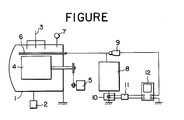
- the figure is a schematic illustration of an apparatus used in the inventive method.
- the carbon fibers applicable to the treatment according to the invention are not particularly limitative in respect of the starting material from which the carbon fibers have been prepared including polyacrylonitrile-based and pitch- or bituminous material-based carbon fibers.
- the form of the carbon fibers is under no limitation including single filaments, multi-filament yarns, chopped strands, mats, woven cloths or any other forms.
- the inventive method for imparting carbon fibers with improved surface properties is performed by-subjecting the surface of the carbon fibers to exposure to an atmosphere of low temperature plasma of an inorganic gas under reduced pressure generated in a space through which the inorganic gas is flowing.
- the inorganic gases suitable in the inventive method include helium, neon, argon, nitrogen, oxygen, air, nitrous oxide, nitrogen monoxide, nitrogen dioxide, carbon monoxide, carbon dioxide, bromine cyanide, sulfur dioxide, hydrogen sulfide and the like. These inorganic gases may be used either alone or as a mixture of two kinds or more according to need.
- the inorganic gas constituting the plasma atmosphere is oxygen or a gaseous mixture containing at least 10 % by volume of oxygen in view of the higher effectiveness of the plasma treatment.
- Organic gases may be contained in the plasma atmosphere although the concentration thereof should be limited.
- the pressure of the inorganic gas in the plasma atmosphere should be in the range from 0.001 to 10 Torr or, preferably, from 0.01 to 1 Torr.
- an electric power of 10 watts to 100 kilowatts at a high frequency of 10 kHz to 100 MHz is supplied to the electrodes installed in the space kept under the above mentioned reduced pressure, electric discharge readily takes place within the space to form an atmosphere of low temperature plasma.
- the frequency band of the electric power is not particularly limited to the above mentioned high frequency range but may be direct current or low frequency to microwave range although the high frequency range is preferred.
- the arrangement of the discharge electrodes is not particularly limitative in the apparatus for the plasma treatment although it is preferable that the electrodes are installed inside the plasma chamber.
- the electrodes may be installed outside the plasma chamber or a single coiled electrode may be provided surrounding the plasma chamber.
- the electrodes are connected to the power source, e.g. high frequency generator, either by capacitance coupling or by inductance coupling and one or a set of the electrodes, when two or more of electrodes are provided for each polarity, should usually be grounded, the other electrode or the other set of electrodes being a power electrode or a set of power electrodes.
- the forms of the electrodes are also not particularly limitative including plate-like, ringwise, rod-like and cylindrical forms and the grounded and power electrodes may have the same form or different forms each from the other.
- a convenient disposition of the electrodes is that the walls of the plasma chamber are made of a metal to serve as the grounded electrode and a metal-made electrode of rod-like or other form held inside the plasma chamber serves as the power electrode.
- the low temperature plasma to which the shaped article is exposed in the inventive method can be readily generated by the glow discharge within the space kept under a reduced pressure of an inorganic gas by applying a suitable discharge voltage between the discharge electrodes. It has been unexpectedly discovered that the value of this discharge voltage is very significant and should be at least 4000 volts so that the carbon fibers in the form of a single filament, multiple- filament yarn, chopped strand, mat or woven cloth having been exposed to the low temperature plasma can be imparted with remarkably improved susceptibility to adhesive bonding.
- the effectiveness of the plasma treatment is further increased when the discharge voltage is increased from 4,000 volts to 10,000 volts or higher correspondingly while the effectiveness may be insufficient, if not ineffective, with a discharge voltage lower than 4,000 volts unless the treatment is unduly prolonged to cause economical disadvantages.
- the discharge voltage has no particular upper limit although it should be taken into consideration that an excessively high discharge voltage necessarily is accompanied by the problems of heat evolution which may adversely affect the properties of the carbon fibers under treatment if not to mention the economical disadvantage due to the increased energy loss.
- the power electrode in order to increase the discharge voltage to 4,000 volts or higher, the power electrode should be provided with an insulating coating with sufficient dielectric strength since application of a high voltage between the electrodes with the metal, e.g. copper, iron or aluminum, surfaces exposed bare may lead to the predominance of the discharge current limiting the discharge voltage to about 1,000 volts at the highest. In such a condition of the electrode insulation, the desired effect of the improvement in the adhesive bonding can of course be hardly expected for the carbon fibers.
- the metal e.g. copper, iron or aluminum
- the material for the insulating coating on the surface of the electrode made of a metal, e.g..copper, iron and aluminum, should preferably be a porcelain enamel, glass or ceramic from the standpoint of heat resistance and the dielectric strength thereof should preferably be 10,000 volts/mm or higher as measured with D.C. voltage application.
- the discharge voltage as high as desired can hardly be maintained so that the effect of improving adhesive bonding may be insufficient.
- the distance between the grounded and power electrodes is smaller than 1 cm, the carbon fibers under treatment sometimes suffer the adverse effect of the heat evolved on the surface of the electrodes while an excessively large distance between the electrodes over 20 cm is undesirable due to the disadvantages caused by the large size of the apparatus as well as the increased power consumption with unduly large energy loss.
- the effect of the treatment with low temperature plasma generated by the glow discharge is limited to the very surface of the shaped article as an inherent characteristic so that, despite the profound improvement or modification in the surface properties, the carbon fibers can retain advantageous properties of the bulk body inherent to them.
- the carbon fibers are imparted with greatly improved susceptibility to adhesive bonding without decrease in the mechanical strengths so that a composite material made of the plasma-treated carbon fibers as the reinforcing material in the forms of single filaments, yarns, chopped strands and cloths may have remarkably improved mechanical and electrical properties by virtue of the improvement in the adhesive bonding between the matrix resin and the reinforcing material.
- the shearing strength of the composite material manufactured of the plasma-treated reinforcing material may be increased by almost 200 % over that of the similar composite material manufactured of the same reinforcing material but not treated by the low temperature plasma.
- the drum-wise plasma chamber 1 is made of a stainless steel and can be evacuated by means of the vacuum pump 2 connected thereto to a vacuum of 0.001 Torr or below of the pressure.
- the plasma chamber 1 is also connected to a gas inlet 3 opening inside the chamber 1. It is optional according to need that the end of the gas inlet 3 is divided in manifold (in three branches in the figure) with an object to ensure uniformity of the atmospheric conditions inside the plasma chamber 1.
- a rotatable cylindrical electrode 4 made also of a stainless steel is provided as supported vacuum- tightly in a cantilever manner by a shaft penetrating the face plate of the plasma chamber 1 in such a manner that this cylindrical electrode can be rotated by means of the electric motor 5 approximately coaxially with the drum-wise plasma chamber 1 at a controllable velocity of rotation.
- This cylindrical electrode 4 is electrically grounded through the wall of the plasma chamber 1.
- a heating or cooling medium can be passed through inside of this rotatable cylindrical electrode 4.
- a rod-like electrode 6, which serves as the power electrode, is provided inside the plasma chamber 1 in parallel with the axis of rotation of the cylindrical electrode 4 to form a gap of uniform width therebetween as electrically insulated from the plasma chamber 1 or the cylindrical electrode 4.
- the pressure inside the plasma chamber 1 is measured with a Pirani gauge 7 connected to the chamber 1.
- the power electrode 6 is connected to the power output terminal of a high frequency generator 8, the other terminal thereof being grounded, to apply a high frequency voltage between the grounded electrode 4 and the power electrode 6.
- the discharge voltage between the grounded and power electrodes 4,6 can be determined by means of a high-voltage probe 9 connected to a two-channel synchroscope 12 which also serves to determine the discharge current between the electrodes 4,6 by means of a current probe 10 connected thereto through a termination 11.
- the peak-to-peak value of the discharge voltage (V p-p ) is readily determined from the voltage shown by the amplitude of the image for the corresponding channel on the screen of the synchroscope 12 and multiplied by the reciprocal of the attenuation ratio in the high-voltage probe 9 while the discharge current is determined from the amplitude of the image for the second channel on the screen of the synchroscope 12 as multiplied by the sensitivity of the termination 11.
- the phase difference between the discharge voltage and the discharge current can be determined from the displacement between the wave forms for the voltage and current shown on the screen of the two-channel synchroscope 12.
- a multi-filament yarn with untreated surface formed of high-strength carbon fibers prepared by carbonizing polyacrylonitrile fibers and having a diameter of 7 ⁇ m, tensile strength of 280 kg/mm 2 and elastic modulus of 23,000 kg/mm 2 was wound around the rotatable cylindrical electrode 4 of the above described apparatus for the low temperature plasma treatment and the plasma chamber 1 was evacuated by means of the vacuum pump 2.
- the pressure inside the chamber 1 had reached 0.001 Torr, continuous introduction of oxygen gas was started through the gas inlet 3 at a rate of 300 N ml/minute so that the pressure inside the chamber 1 was kept constant at 0.1 Torr by the balance of the continuous evacuation and introduction of the oxygen gas.
- the value of the peak-to-peak discharge voltage in each of the runs was varied in the range from 2,000 to 10,000 volts as read on the synchroscope by controlling the power input in the range from 1.2 to 14.4 kilowatts as shown in Table 1 below. Since the electrode had an effective surface area for discharge of 500 cm 2 , the density of the discharge power per unit area was in the range from 2.4 to 28.8 watts/ cm 2 as shown in Table 2. With the above described conditions for the discharge, the duration of the plasma treatment was varied so that the integrated overall energy output per unit area of the discharge surface of the electrode was 40, 80, 160 or 320 watts ⁇ seconds/cm 2 .
- the carbon filament yarn was unwound and rewound on the cylindrical electrode to expose the reverse side and the procedure of the low temperature plasma treatment of the second side of the yarn was repeated in just the same manner as described above for the first side.
- the carbon filament yarns thus twice treated on both sides with low temperature plasma were then woven into a plain-woven cloth, which was processed into a carbon fiber-reinforced composite sheet with an epoxy resin (American Cyan- amid BP-907) as-the matrix by the techniques of hand lay-up molding followed by curing of the epoxy resin at room temperature.
- the content of the carbon fibers in this composite sheet was 60 % by volume.
- the above prepared carbon fiber-reinforced composite sheet was subjected to the measurement of the tensile strength according to the procedure specified in JIS K 7113 to give the results shown in Table 1 to follow. Meanwhile, the tensile strength of the composite sheet prepared in the same manner as above but by use of the carbon fiber yarns before low temperature plasma treatment was 55 kg/mm 2 .
- the tensile strength of the composite material prepared of the plasma-treated carbon fibers as the reinforcing material is greatly superior to that of the similar composite sheet prepared of the untreated carbon fibers, presumably, due to the improvement in the adhesive bonding between the carbon fibers and the matrix resin.
- the effect of plasma treatment is less remarkable when the peak-to-peak value of the discharge voltage is 3,000 volts or below than with a discharge voltage' of 4,000 volts or higher even when the length of the treatment time is controlled to give the same overall discharge power consumption.
- the efficiency of the plasma treatment can be greatly improved by increasing the peak-to-peak value of the discharge voltage to 4,000 volts or higher.
- High-strength carbon fibers having a diameter of 7 ⁇ m, tensile strength of 280 kg/mm 2 and elastic modulus of 23,000 kg/mm 2 prepared by carbonizing polyacrylonitrile fibers without surface treatment were wound around the cylindrical electrode of the same plasma treatment apparatus as used in the preceding example and the plasma chamber was evacuated.
- the pressure inside the chamber had reached 0.001 Torr, continuous introduction of argon gas and oxygen gas was started each at a rate of 300 N ml/minute so that the pressure inside the chamber was kept 'constant at 0.4 Torr.
- a high frequency electric power at a frequency of 13.56 MHz was applied between the cylindrical grounded electrode and power electrode held to form a uniform gap of 3 cm width so as to generate low temperature plasma inside the chamber.
- the peak-to-peak value of the dischargre voltage between the electrodes was varied in the range from 2,000 to 10,000 volts by controlling the power output of the high frequency generator.
- the power input in this case was in the range from 1.0 to 11.6 kilowatts corresponding to the power density on the electrode surface of 2.0 to 23.2 watts/em 2 with the surface area of the electrode being equal to 500 cm 2 .
- the length of the treatment time was varied to give the same overall power consumption per unit area of 160 watts ⁇ seconds/cm 2 throughout the runs.
- the carbon filament yarn thus twice treated on both sides with the low temperature plasma was chopped in 3 to 6 mm length and the chopped yarns were blended with a nylon 66 resin in an extruder machine and extruded therefrom to be pellet--ized.
- the content of the carbon fibers in the pellets was 30 % by weight.
- the pellets were molded by a conventional technique of injection molding into a rod-like body of which the tensile strength was measured according to the procedure specified in JIS K 7113 to give the results shown in Table 2 below together with the peak-to-peak values of the discharge voltage between the electrodes, the input powers and the densities of the discharge power per unit area of the electrode. Meanwhile, the tensile strength of the rod-like body prepared in the same manner but by use of the untreated carbon filament yarn was 2,100 k g/ cm 2 .
- the composite body of the nylon 66 resin reinforced with the plasma-treated carbon fibers had a much larger tensile strength than that of the rod prepared by use of the untreated carbon fibers and the effect is much more remarkable when the peak-to-peak value of the discharge voltage is 4,000 volts or higher.
- Example 2 The same multi-filament yarn of carbon fibers without surface treatment as used in Example 1 was woven into a plain-woven cloth which was wound around the cylindrical grounded electrode of the same plasma treatment apparatus and the plasma chamber was evacuated.
- the pressure inside the chamber had reached 0.001 Torr, continuous introduction of either pure nitrogen gas or oxygen gas alone or a gaseous mixture of nitrogen and oxygen into the chamber was started each at a rate of 100 N ml/minute so that the pressure inside the chamber was kept constant at 0.1 Torr.
- the mixing ratio of the nitrogen and oxygen in the gaseous mixture was varied as shown in Table 3 below.
- a high frequency electric power at a frequency of 110 kHz was applied between the grounded and power electrodes held to form a uniform gap of 4 cm width for a length of 40 seconds to give a peak-to-peak discharge voltage of 7,000 volts in each of the runs.
- the thus plasma-treated cloth was unwound and rewound around the cylindrical electrode to expose the reverse side and the second plasma treatment was conducted in just the same manner as above.
- the carbon yarn cloth thus twice treated on both sides with the low temperature plasma was processed into an epoxy resin-based composite sheet in the same manner as in Example 1 and the tensile strength of the composite sheet was measured according to the procedure specified in JIS K 7113 to give the results shown in Table 3.
- the content of the carbon fibers in the composite sheet was 60 % by volume. Meanwhile, the tensile strength of the composite sheet prepared of the carbon yarn cloth before the low temperature plasma treatment was 50 k g/ mm 2 .
Landscapes
- Chemical & Material Sciences (AREA)
- Engineering & Computer Science (AREA)
- Materials Engineering (AREA)
- Chemical Kinetics & Catalysis (AREA)
- Manufacturing & Machinery (AREA)
- Health & Medical Sciences (AREA)
- Medicinal Chemistry (AREA)
- Polymers & Plastics (AREA)
- Organic Chemistry (AREA)
- General Chemical & Material Sciences (AREA)
- Textile Engineering (AREA)
- Chemical Or Physical Treatment Of Fibers (AREA)
Applications Claiming Priority (2)
| Application Number | Priority Date | Filing Date | Title |
|---|---|---|---|
| JP57188526A JPS5982466A (ja) | 1982-10-27 | 1982-10-27 | カ−ボン繊維の表面改質方法 |
| JP188526/82 | 1982-10-27 |
Publications (3)
| Publication Number | Publication Date |
|---|---|
| EP0110118A2 true EP0110118A2 (de) | 1984-06-13 |
| EP0110118A3 EP0110118A3 (en) | 1985-12-11 |
| EP0110118B1 EP0110118B1 (de) | 1988-12-28 |
Family
ID=16225248
Family Applications (1)
| Application Number | Title | Priority Date | Filing Date |
|---|---|---|---|
| EP83110618A Expired EP0110118B1 (de) | 1982-10-27 | 1983-10-25 | Verfahren zur Verbesserung der Oberflächeneigenschaften von Kohlenstoffasern |
Country Status (4)
| Country | Link |
|---|---|
| US (1) | US4487880A (de) |
| EP (1) | EP0110118B1 (de) |
| JP (1) | JPS5982466A (de) |
| DE (1) | DE3378770D1 (de) |
Cited By (3)
| Publication number | Priority date | Publication date | Assignee | Title |
|---|---|---|---|---|
| EP0170921A1 (de) * | 1984-07-21 | 1986-02-12 | Bayer Ag | Faserverstärktes bzw. gefülltes Polyphenylensulfid |
| EP0928345A4 (de) * | 1996-09-17 | 1999-08-11 | ||
| KR100321804B1 (ko) * | 1995-10-19 | 2002-06-20 | 구광시 | 디프코드지의제조방법 |
Families Citing this family (21)
| Publication number | Priority date | Publication date | Assignee | Title |
|---|---|---|---|---|
| EP0158181B1 (de) * | 1984-04-09 | 1987-09-16 | Siemens Aktiengesellschaft | Verfahren zum Herstellen von rissfreien, grossflächigen Siliziumkristallkörpern für Solarzellen |
| US4603157A (en) * | 1984-05-23 | 1986-07-29 | Mitsubishi Rayon Co., Ltd. | Intermediate for composite material |
| JP2667525B2 (ja) * | 1989-07-07 | 1997-10-27 | 日機装株式会社 | 気相成長炭素繊維の改質法 |
| DE4113085A1 (de) * | 1991-04-22 | 1992-10-29 | Philips Patentverwaltung | Verfahren zur herstellung eines gluehkathodenelements |
| JPH05202483A (ja) * | 1991-04-25 | 1993-08-10 | Shipley Co Inc | 無電解金属化方法と組成物 |
| US5648201A (en) * | 1991-04-25 | 1997-07-15 | The United Sates Of America As Represented By The Secretary Of The Navy | Efficient chemistry for selective modification and metallization of substrates |
| CH684831A5 (de) * | 1991-12-11 | 1995-01-13 | Alusuisse Lonza Services Ag | Vorrichtung zur Herstellung von extrusionsbeschichteten Laminaten. |
| EP1073091A3 (de) * | 1999-07-27 | 2004-10-06 | Matsushita Electric Works, Ltd. | Elektrode für Plasmaerzeugung, Anwendung dieser Elektrode in einem Plasmabehandlungsgerät, und Plasmabehandlung mittels dieses Gerätes |
| DE10331608A1 (de) * | 2003-07-12 | 2005-01-27 | Hew-Kabel/Cdt Gmbh & Co. Kg | Verfahren zum Beschichten und/oder partiellen Umspritzen von flexiblem langgestrecktem Gut |
| CN102345228B (zh) * | 2010-08-05 | 2013-07-03 | 中国石油天然气股份有限公司 | 一种碳纤维表面处理方法 |
| US9184323B2 (en) * | 2010-10-15 | 2015-11-10 | Cyprian Emeka Uzoh | Method and substrates for making photovoltaic cells |
| KR101888586B1 (ko) * | 2011-04-12 | 2018-08-14 | (주)엘지하우시스 | 연속섬유의 표면개질방법 및 이를 이용한 열가소성 플라스틱-연속섬유 혼성 복합체의 제조방법 |
| US20140127424A1 (en) * | 2012-11-08 | 2014-05-08 | Ford Global Technologies, Llc | Method and Apparatus for Bonding Functional Groups to the Surface of a Substrate |
| US20170044709A1 (en) * | 2014-04-30 | 2017-02-16 | 3M Innovative Properties Company | Methods for treating reinforcing fiber and treated reinforcing fibers |
| DE102016220682A1 (de) * | 2016-10-21 | 2018-04-26 | Tesa Se | Physikalische Vorbehandlung zur Filamenteinbindung |
| CA3037050A1 (en) * | 2016-11-30 | 2018-06-07 | Continental Structural Plastics, Inc. | Dispersed fiber mat formation |
| US20180179464A1 (en) * | 2016-12-23 | 2018-06-28 | Uht Unitech Co., Ltd | Carbon fiber surface oiling agent changing metod |
| GB201718387D0 (en) | 2017-11-07 | 2017-12-20 | Univ College Dublin Nat Univ Ireland Dublin | Surface preparation |
| CN115142255A (zh) * | 2022-06-24 | 2022-10-04 | 青岛华世洁环保科技有限公司 | 碳纤维表面处理装置及对碳纤维进行表面处理的方法 |
| CN115847949A (zh) * | 2023-01-20 | 2023-03-28 | 太原科技大学 | 一种采用不锈钢极薄带与碳纤维钎焊制备层合板的方法 |
| CN116854978A (zh) * | 2023-07-20 | 2023-10-10 | 连云港神鹰碳纤维自行车有限公司 | 一种低损伤的碳纤维复合材料制品表面处理工艺 |
Family Cites Families (4)
| Publication number | Priority date | Publication date | Assignee | Title |
|---|---|---|---|---|
| BE577912A (fr) * | 1958-04-30 | 1959-08-17 | Inst Textile De France | Procédé pour l'amelioration des propriétés des matériaux textiles. |
| US3634220A (en) * | 1968-09-19 | 1972-01-11 | Us Navy | Method for improving graphite fibers for plastic reinforcement and products thereof |
| DE1965003A1 (de) * | 1969-12-27 | 1971-07-01 | Bayer Ag | Verfahren zur kontinuierlichen Graphitisierung von Kohlefaeden,Kohlefaser-Baendern,Kohlegarnen |
| JPS5786275A (en) * | 1980-11-14 | 1982-05-29 | Eisai Co Ltd | Bag-shaped container |
-
1982
- 1982-10-27 JP JP57188526A patent/JPS5982466A/ja active Pending
-
1983
- 1983-10-20 US US06/543,891 patent/US4487880A/en not_active Expired - Fee Related
- 1983-10-25 DE DE8383110618T patent/DE3378770D1/de not_active Expired
- 1983-10-25 EP EP83110618A patent/EP0110118B1/de not_active Expired
Cited By (6)
| Publication number | Priority date | Publication date | Assignee | Title |
|---|---|---|---|---|
| EP0170921A1 (de) * | 1984-07-21 | 1986-02-12 | Bayer Ag | Faserverstärktes bzw. gefülltes Polyphenylensulfid |
| US4657945A (en) * | 1984-07-21 | 1987-04-14 | Bayer Aktiengesellschaft | Fibre-reinforced or filled polyphenylene sulphide |
| KR100321804B1 (ko) * | 1995-10-19 | 2002-06-20 | 구광시 | 디프코드지의제조방법 |
| EP0928345A4 (de) * | 1996-09-17 | 1999-08-11 | ||
| EP1484435A3 (de) * | 1996-09-17 | 2004-12-29 | Hyperion Catalysis International, Inc. | Plasma-behandelte Kohlenstoffibrillen und Herstellungsverfahren |
| US7498013B2 (en) | 1996-09-17 | 2009-03-03 | Hyperion Catalysis International, Inc. | Plasma-treated carbon fibrils and method of making same |
Also Published As
| Publication number | Publication date |
|---|---|
| JPS5982466A (ja) | 1984-05-12 |
| US4487880A (en) | 1984-12-11 |
| EP0110118B1 (de) | 1988-12-28 |
| EP0110118A3 (en) | 1985-12-11 |
| DE3378770D1 (en) | 1989-02-02 |
Similar Documents
| Publication | Publication Date | Title |
|---|---|---|
| US4487880A (en) | Method for imparting improved surface properties to carbon fibers and composite | |
| US4504349A (en) | Method for imparting improved surface properties to a polymeric shaped article | |
| US3762941A (en) | Modification of carbon fiber surface characteristics | |
| US3745104A (en) | Surface modification of carbon fibers | |
| US4664936A (en) | Aromatic polyamide fiber-based composite prepreg | |
| EP0109334A2 (de) | Verfahren um einem geformten Kunststoffkörper verbesserte Oberflächeneigenschaften zu verleihen | |
| EP0006275B1 (de) | Verfahren zum Behandeln von zur Verwendung in Baumaterialien und Kautschuk geeigneten aromatischen Polyamidfasern sowie die so behandelten Fasern und die mit diesen Fasern verstärkten Gebilde | |
| US6372192B1 (en) | Carbon fiber manufacturing via plasma technology | |
| KR102461416B1 (ko) | 표면 처리 탄소 섬유, 표면 처리 탄소 섬유 스트랜드 및 이들의 제조 방법 | |
| CN101580594B (zh) | 介质阻挡放电等离子体技术改性芳纶复合材料界面的方法 | |
| EP0272648B1 (de) | Verfahren zur Herstellung eines kohlenstoffaserverstärkten thermoplastischen Harzgegenstandes | |
| EP0171239A1 (de) | Vorrichtung und Verfahren zur Oberflächenbehandlung | |
| US4606930A (en) | Method for treating fibers | |
| EP0172057A1 (de) | Mit Geweben verstärkte Gummigegenstände | |
| US3853600A (en) | Improved carbon fiber reinforced composite article | |
| US3627571A (en) | Heat treatment of graphite fibers | |
| JPH07119021A (ja) | 放電処理装置および放電処理方法 | |
| Weisweiler et al. | Surface modification of carbon fibres by plasma polymerization | |
| Pinchin et al. | Pyrolytic surface treatment of graphite fibres | |
| JPH0417214B2 (de) | ||
| Nishijima et al. | Effects of surface treatment with plasma on adhesive strengths at cryogenic temperature | |
| CA1269637A (en) | Producing substrates coated with inorganic films by plasma enhanced chemical vapor deposition | |
| Kaneko et al. | Continuous Surface Modification of Carbon Fiber with DC Glow Discharge Plasma | |
| Weisweiler et al. | Surface modification of carbon fibres by plasma polymerization | |
| JPH0577239A (ja) | 炭素繊維構造物の表面改質方法 |
Legal Events
| Date | Code | Title | Description |
|---|---|---|---|
| PUAI | Public reference made under article 153(3) epc to a published international application that has entered the european phase |
Free format text: ORIGINAL CODE: 0009012 |
|
| AK | Designated contracting states |
Designated state(s): DE FR GB |
|
| PUAL | Search report despatched |
Free format text: ORIGINAL CODE: 0009013 |
|
| AK | Designated contracting states |
Designated state(s): DE FR GB |
|
| 17P | Request for examination filed |
Effective date: 19860120 |
|
| 17Q | First examination report despatched |
Effective date: 19861031 |
|
| GRAA | (expected) grant |
Free format text: ORIGINAL CODE: 0009210 |
|
| AK | Designated contracting states |
Kind code of ref document: B1 Designated state(s): DE FR GB |
|
| REF | Corresponds to: |
Ref document number: 3378770 Country of ref document: DE Date of ref document: 19890202 |
|
| ET | Fr: translation filed | ||
| PGFP | Annual fee paid to national office [announced via postgrant information from national office to epo] |
Ref country code: FR Payment date: 19891010 Year of fee payment: 8 |
|
| PGFP | Annual fee paid to national office [announced via postgrant information from national office to epo] |
Ref country code: GB Payment date: 19891031 Year of fee payment: 7 |
|
| PLBE | No opposition filed within time limit |
Free format text: ORIGINAL CODE: 0009261 |
|
| STAA | Information on the status of an ep patent application or granted ep patent |
Free format text: STATUS: NO OPPOSITION FILED WITHIN TIME LIMIT |
|
| PGFP | Annual fee paid to national office [announced via postgrant information from national office to epo] |
Ref country code: DE Payment date: 19891130 Year of fee payment: 7 |
|
| 26N | No opposition filed | ||
| PG25 | Lapsed in a contracting state [announced via postgrant information from national office to epo] |
Ref country code: FR Effective date: 19900629 |
|
| REG | Reference to a national code |
Ref country code: FR Ref legal event code: ST |
|
| PG25 | Lapsed in a contracting state [announced via postgrant information from national office to epo] |
Ref country code: GB Effective date: 19901025 |
|
| GBPC | Gb: european patent ceased through non-payment of renewal fee | ||
| PG25 | Lapsed in a contracting state [announced via postgrant information from national office to epo] |
Ref country code: DE Effective date: 19910702 |