EP0110128A2 - Procédé continu pour la récupération de gypse utilisable dans l'industrie, à partir de déchets de gypse industriels - Google Patents
Procédé continu pour la récupération de gypse utilisable dans l'industrie, à partir de déchets de gypse industriels Download PDFInfo
- Publication number
- EP0110128A2 EP0110128A2 EP83110689A EP83110689A EP0110128A2 EP 0110128 A2 EP0110128 A2 EP 0110128A2 EP 83110689 A EP83110689 A EP 83110689A EP 83110689 A EP83110689 A EP 83110689A EP 0110128 A2 EP0110128 A2 EP 0110128A2
- Authority
- EP
- European Patent Office
- Prior art keywords
- gypsum
- suspension
- reactor
- filter
- hemihydrate
- Prior art date
- Legal status (The legal status is an assumption and is not a legal conclusion. Google has not performed a legal analysis and makes no representation as to the accuracy of the status listed.)
- Granted
Links
Images
Classifications
-
- C—CHEMISTRY; METALLURGY
- C04—CEMENTS; CONCRETE; ARTIFICIAL STONE; CERAMICS; REFRACTORIES
- C04B—LIME, MAGNESIA; SLAG; CEMENTS; COMPOSITIONS THEREOF, e.g. MORTARS, CONCRETE OR LIKE BUILDING MATERIALS; ARTIFICIAL STONE; CERAMICS; REFRACTORIES; TREATMENT OF NATURAL STONE
- C04B11/00—Calcium sulfate cements
- C04B11/02—Methods and apparatus for dehydrating gypsum
Definitions
- Industrial gypsum gypsum usually occurs as a very fine, thixotropic filter cake with high residual moisture (e.g. phosphoric acid, citric acid, flue gas desulfurization gypsum) and contains both adherent (interparticular) and enclosed (intraparticulate) contaminants.
- a thixotropic filter cake with high residual moisture (e.g. phosphoric acid, citric acid, flue gas desulfurization gypsum) and contains both adherent (interparticular) and enclosed (intraparticulate) contaminants.
- a thixotropic medium With such a thixotropic medium, removal of the adhering impurities, for example by washing, is difficult and requires considerable amounts of water. The included impurities can only be removed by recrystallization.
- waste gypsum e.g. flue gas gypsum
- flue gas gypsum e.g. flue gas gypsum
- the gypsum processing industry In general, not only being able to adjust to the recycling of waste gypsum, it is forced to build its operations in such a way that waste gypsum and natural gypsum can be processed on the same plants either alone or as a mixture.
- the waste gypsum should therefore be obtained in a structure that requires handling (transport, conveying, dosing and grinding) similar to that of the broken natural gypsum.
- the aim of the invention is now to provide a continuous, one-step process which enables the conversion of industrial gypsum gypsum into a pure, dust-free calcium sulfate dihydrate granulate with little design effort and multi-step energy utilization and also the production of pure with little variation of the plant Calcium sulfate alpha hemihydrate allowed.
- the superheated steam is injected directly in cocurrent and the gypsum suspension, at flow speeds of 5 to 20 m / min, is led at least once vertically upwards and immediately thereafter from top to bottom.
- the degree of conversion to calcium sulfate ⁇ -hemihydrate is controlled by adjusting the temperature in the range from 3 to 20 min.
- the growing crystals in the vertical tubular reactor cannot sink onto the reactor wall and bake there. If you connect the vertical branches to each other at the top and bottom, almost any dwell time can be set within a circuit.
- the superheated steam is expediently entered into the first branch from bottom to top.
- the gypsum suspension has a concentration of 10-55% by weight, preferably 40-50% by weight at the beginning of the process. It is preheated in the manner shown in claim 3 using the waste heat of the process and recrystallized and worked up with comparatively little energy expenditure.
- the pieces leaving the conveyor belt can be mixed with natural gypsum without problems and can be ground together with it and further processed. At the same time, a significant increase in the quality of the gypsum itself can be observed.
- a further improvement in the heat and water balance can be achieved in that the hot filtrate formed in the calcium sulfate hemihydrate filtration is suctioned off and returned to the filtration stage for the waste gypsum for washing and in that the washing filtrate leaving the band filter passes the hemihydrate stage to the mash Control of part of the filtrate or fresh water additive.
- the most favorable process parameters are contained in combination in claim 6.
- the waste gypsum thrown off the filter and prewashed to recover the reaction products (eg phosphoric acid, citric acid) is slurried with water and then fed into the tubular reactor according to the invention; co-current steam is introduced at the entrance to the reactor.
- a special mixing device is not required.
- the temperature and residence time are set so that, after leaving the flow tube, about 60-80% of the dihydrate used is converted to hemihydrate; For example, only a few minutes are required at temperatures ⁇ 140 ° C because the direct heat exchange (steam) means that the heating to the desired temperature occurs spontaneously.
- the suspension After leaving the flow tube and relaxing to atmospheric pressure, the suspension is filtered off and washed to the desired purity if necessary.
- Filtration and washing performance are very good because of the more uniform particle size distribution compared to the prior art.
- the filter cake will open dropped a conveyor belt; it is already so stable that a desired piece size can be set using the filter ejection mechanism. Surprisingly, additional granulation is not necessary, and there is also no need for a comminution step. After a dwell time of approx. 5-20 min. On the conveyor belt, the pieces are hardened to such an extent that they partially cure the hemihydrate so that they can be stored in this form without further caking.
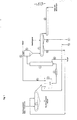
- the method according to the invention is shown schematically in FIG.
- the numerical values given below are to be understood as an example of a preferred driving style and not as a restriction of the scope of the method according to the invention.
- the stated dry matter values (TS) are% by weight calcium sulfate dihydrate.
- the reaction product-gypsum suspension coming from the sulfuric acid conversion (e.g. phosphoric acid, citric acid) is filtered off 1 and washed with the hot filtrate 7a.
- the gypsum cake preheated in this way with a dry matter of about 50-75% is thrown into a mash 2, where it is suspended with the washing filtrate 7b and preheated to about 95 ° C. by direct steam injection 6a.
- the hot suspension is introduced into the reaction tube 4 via a high-pressure pump 3, where the recrystallization in the temperature range of 140-150 ° C, at pressures of 5-7 bar and residence times of about 2-7 min. takes place.
- the required thermal energy is entered via direct steam injection 3a.
- the suspension produced in this way the TS of which consists of approximately 60-80% calcium sulfate hemihydrate, is relaxed in the expansion vessel 5 and passed to filter 7 at a temperature of approximately 95 ° C. With this expansion, apart from radiation and throttling losses, the heat energy supplied to the reaction tube at the inlet is recovered as steam. These vapors are compressed by a steam injector 6 and returned to the mash 2 for heating the feed suspension. The amount of live steam fed into the injector 6 is such that the feed suspension is heated to 95 ° C.
- the hot filtrate 7a sucked off during the calcium sulfate hemihydrate filtration is returned to the washing for filtration 1, the washing filtrate for mashing the filter cake from 1 is returned to the mash 2, with part of the washing filtrate being controlled 7c depending on the required washing out and the desired concentration of the mashing or fresh water is added 7d.
- the filter cake of FIG. 7 is dropped onto a conveyor belt 8, where the fragments, the size of which are controlled by the discharge mechanisms can, with a dwell time of approx. 5-20 min. harden to the extent that they form stable, transportable or storable pieces that have a dry matter of approx. 85-95%.
- the pipe system To avoid one-sided deposits on the pipe wall, the pipe system must be installed vertically.
- the flow rate must be chosen so high that there is no blockage due to the re-sedimentation of coarser particles.
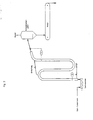
- FIG. 2 shows a three-pass tube reactor as a preferred embodiment.
- the method according to the invention is also suitable for producing pure calcium sulfate- ⁇ -hemihydrate from industrial waste gypsum.
- the desired structures and qualities depend, among other things, on the residence time, the temperature and the flow rate.
- the flow rate can then be set independently of one another via the circulation pump and the mean residence time via the feed pump.
- crystal formers can also be introduced into the circulatory system.
- the calcium sulfate hemihydrate suspension produced in this way can be filtered off, the filter cake washed if necessary and either immediately dried or mashed and processed into molds or used as a self-leveling screed with the addition of setting retarders.
- the dry matter (as calcium sulfate) of the filter cake leaving the conveyor belt was determined by annealing the cake at 500 ° C.
- the citric acid content of the gypsum was determined enzymatically.
- Example 1 Production of pure, stable calcium sulfate dihydrate chunks
- Waste gypsum from citric acid production with approx. 1% citric acid on caS04 was mashed with water to a 45% gypsum suspension and heated to approx. 95 ° C ..
- the reaction suspension was depressurized and filtered off at about 95 ° C on a band filter, with about 45% water. washed on CaS0 4 and the resulting cake dropped on a conveyor belt. After a dwell time of approx. 12 minutes on the conveyor belt, the chunks had hardened to such an extent that they were stable in storage; Even after storage in containers for several days, they were not baked together, but were still mixable and meterable. They still contained 0.99 crystal water, which corresponds to a 67% conversion of the gypsum to the ⁇ -hemihydrate; their TS was 91%, calculated as dihydrate.
- the citric acid content, based on CaSo 4 was 0.09%.
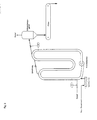
- Example 1 The reactor described in Example 1, as shown in Fig. 3, was expanded to a circulation reactor. The addition of the return branch resulted in a pipe length of 56 m. The same suspension as described in Example 1 was used as feed and likewise heated to 95 ° C.
Landscapes
- Chemical & Material Sciences (AREA)
- Engineering & Computer Science (AREA)
- Ceramic Engineering (AREA)
- Materials Engineering (AREA)
- Structural Engineering (AREA)
- Organic Chemistry (AREA)
- Compounds Of Alkaline-Earth Elements, Aluminum Or Rare-Earth Metals (AREA)
Priority Applications (1)
| Application Number | Priority Date | Filing Date | Title |
|---|---|---|---|
| AT83110689T ATE25236T1 (de) | 1982-10-27 | 1983-10-26 | Kontinuierliches verfahren zur gewinnung von industriell verwertbarem gips aus industrieabfallgips. |
Applications Claiming Priority (2)
| Application Number | Priority Date | Filing Date | Title |
|---|---|---|---|
| DE3239669 | 1982-10-27 | ||
| DE19823239669 DE3239669A1 (de) | 1982-10-27 | 1982-10-27 | Kontinuierliches verfahren zur gewinnung von industriell verwertbarem gips aus industrie-abfallgips |
Publications (3)
| Publication Number | Publication Date |
|---|---|
| EP0110128A2 true EP0110128A2 (fr) | 1984-06-13 |
| EP0110128A3 EP0110128A3 (en) | 1985-07-10 |
| EP0110128B1 EP0110128B1 (fr) | 1987-01-28 |
Family
ID=6176659
Family Applications (1)
| Application Number | Title | Priority Date | Filing Date |
|---|---|---|---|
| EP83110689A Expired EP0110128B1 (fr) | 1982-10-27 | 1983-10-26 | Procédé continu pour la récupération de gypse utilisable dans l'industrie, à partir de déchets de gypse industriels |
Country Status (3)
| Country | Link |
|---|---|
| EP (1) | EP0110128B1 (fr) |
| AT (1) | ATE25236T1 (fr) |
| DE (2) | DE3239669A1 (fr) |
Cited By (5)
| Publication number | Priority date | Publication date | Assignee | Title |
|---|---|---|---|---|
| EP0244722A3 (en) * | 1986-05-09 | 1988-09-28 | Joh. A. Benckiser Gmbh | Continuous process and apparatus for the preparation of gypsum for industrial use from residual gypsum |
| FR2613346A1 (fr) * | 1987-04-04 | 1988-10-07 | Rwk Rhein Westfael Kalkwerke | Procede pour la fabrication de semi-hydrate de sulfate de calcium, semi-hydrate de sulfate de calcium fabrique par la mise en oeuvre de ce procede et melange de mortier contenant un tel semi-hydrate |
| EP0244726A3 (en) * | 1986-05-09 | 1989-10-18 | Biochemie Ladenburg Gmbh | Process for the hydrothermal conversion of gypsum from flue-gas desulphurization into alpha semihydrate calcium sulphate |
| EP0416089A4 (en) * | 1989-03-16 | 1991-08-07 | United States Gypsum Company | Process and apparatus for producing calcium sulfate microfibers |
| EP2418184B1 (fr) | 2010-08-12 | 2016-02-10 | Lindner GFT GmbH | Procédé de fabrication de sulfate de calcium semi-hydraté alpha |
Families Citing this family (3)
| Publication number | Priority date | Publication date | Assignee | Title |
|---|---|---|---|---|
| DE19908776C2 (de) * | 1999-02-19 | 2002-05-23 | Ver Energiewerke Ag | Verfahren und Anordnung zur Herstellung von hochreinem alpha-Calciumsulfat-Halbhydrat |
| CN100425560C (zh) * | 2006-09-14 | 2008-10-15 | 山西北方石膏工业有限公司 | α型半水石膏的连续式生产方法及装置 |
| JP7713341B2 (ja) * | 2021-09-02 | 2025-07-25 | 株式会社トクヤマ | 石膏の晶析方法 |
Family Cites Families (2)
| Publication number | Priority date | Publication date | Assignee | Title |
|---|---|---|---|---|
| JPS56145116A (en) * | 1980-04-14 | 1981-11-11 | Idemitsu Kosan Co Ltd | Continuous preparation of light gypsum |
| EP0085382A1 (fr) * | 1982-02-01 | 1983-08-10 | Quante, Heinrich | Installation pour la préparation de alpha-sulfate de calcium demihydrate |
-
1982
- 1982-10-27 DE DE19823239669 patent/DE3239669A1/de not_active Withdrawn
-
1983
- 1983-10-26 DE DE8383110689T patent/DE3369503D1/de not_active Expired
- 1983-10-26 AT AT83110689T patent/ATE25236T1/de not_active IP Right Cessation
- 1983-10-26 EP EP83110689A patent/EP0110128B1/fr not_active Expired
Cited By (7)
| Publication number | Priority date | Publication date | Assignee | Title |
|---|---|---|---|---|
| EP0244722A3 (en) * | 1986-05-09 | 1988-09-28 | Joh. A. Benckiser Gmbh | Continuous process and apparatus for the preparation of gypsum for industrial use from residual gypsum |
| EP0244726A3 (en) * | 1986-05-09 | 1989-10-18 | Biochemie Ladenburg Gmbh | Process for the hydrothermal conversion of gypsum from flue-gas desulphurization into alpha semihydrate calcium sulphate |
| FR2613346A1 (fr) * | 1987-04-04 | 1988-10-07 | Rwk Rhein Westfael Kalkwerke | Procede pour la fabrication de semi-hydrate de sulfate de calcium, semi-hydrate de sulfate de calcium fabrique par la mise en oeuvre de ce procede et melange de mortier contenant un tel semi-hydrate |
| BE1002661A3 (fr) * | 1987-04-04 | 1991-04-30 | Rwk Rhein Westfael Kalkwerke | Procede pour la fabrication de semi-hydrate de sulfate de calcium. |
| EP0416089A4 (en) * | 1989-03-16 | 1991-08-07 | United States Gypsum Company | Process and apparatus for producing calcium sulfate microfibers |
| EP2418184B1 (fr) | 2010-08-12 | 2016-02-10 | Lindner GFT GmbH | Procédé de fabrication de sulfate de calcium semi-hydraté alpha |
| EP2418184B2 (fr) † | 2010-08-12 | 2021-02-17 | Lindner GFT GmbH | Procédé de fabrication de sulfate de calcium semi-hydraté alpha |
Also Published As
| Publication number | Publication date |
|---|---|
| DE3239669A1 (de) | 1984-05-03 |
| EP0110128B1 (fr) | 1987-01-28 |
| DE3369503D1 (en) | 1987-03-05 |
| EP0110128A3 (en) | 1985-07-10 |
| ATE25236T1 (de) | 1987-02-15 |
Similar Documents
| Publication | Publication Date | Title |
|---|---|---|
| DE3419558C2 (de) | Verfahren und Anlage zur Herstellung von Gipsfaserplatten | |
| CH529583A (de) | Vorrichtung für den kontinuierlichen Gas-Flüssigkeits-Kontakt und Verwendung derselben in einem Verfahren zur Reinigung roher Terephthalsäure | |
| DE2622994A1 (de) | Verfahren und vorrichtung zum brennen von gips | |
| EP2340237B1 (fr) | Procédé et installation de production de gypse dur | |
| DE3730585A1 (de) | Verfahren und vorrichtung zum herstellen von gipsfaserplatten | |
| EP2150504B1 (fr) | Procédé destiné à produire un semi-hydrate de sulfate d'alpha calcium à partir de dihydrate de sulfate de calcium | |
| EP0110128B1 (fr) | Procédé continu pour la récupération de gypse utilisable dans l'industrie, à partir de déchets de gypse industriels | |
| DE69325008T2 (de) | Verfahren zur Entfernung von Schwefeldioxid aus Gasströmen unter Herstellung von Alpha-Hemihydrat-Gips | |
| EP0044005B1 (fr) | Préparation de gypse hémihydraté par usage de chaleur d'échappement, d'acide sulfurique aqueux et de sels sulfuriques | |
| EP1183216B1 (fr) | PROCEDE ET DISPOSITIF POUR LA PRODUCTION D'$g(a)-SULFATE DE CALCIUM-SEMIHYDRATE AU MOYEN DE LA SUSPENSION DE GYPSE PRODUITE LORS DE LA DESULFURATION DE GAZ DE FUMEES PAR VOIE HUMIDE DANS UNE CENTRALE THERMIQUE A COMBUSTIBLE FOSSILE | |
| DE4409219C2 (de) | Verfahren zur kontinuierlichen Herstellung von alpha-Calciumsulfat-Halbhydrat aus Calciumsulfat-Dihydrat | |
| DE3114363C2 (de) | Verfahren zur Herstellung von faserartigem, zumindest teilweise zu sphärischen Teilchen geformten Calciumsulfat-Hemihydrat vom α-Typ | |
| DE2903289A1 (de) | Verfahren zum granulieren der aus ammoniumverbindungen durch substitution mit erdalkaliverbindungen entstandenen faellungsprodukte | |
| DE2320645A1 (de) | Verfahren zur reinigung von abfallcalciumsulfat | |
| DE1454843B2 (de) | Verfahren zum kontinuierlichen trocknen von koernern aus polyaethylenterephthalat | |
| EP0244722B1 (fr) | Procédé continu et appareillage pour l'obtention de gypse industriellement utilisable à partir de gypse résiduaire | |
| DE1929956B2 (de) | Verfahren zur kontinuierlichen reinigung von rohem synthetischem gips | |
| DE3039012C2 (de) | Verfahren zum Trocknen von organischen Feststoffen,z.B. Braunkohle | |
| DE69417264T2 (de) | Verfahren und vorrichtung zur herstellung von entwässertem gips durch kalzinieren in direktem kontakt mit heissen trägergasen | |
| DE3615717C2 (fr) | ||
| EP0052093B1 (fr) | Procédé de fabrication de magnésie frittée | |
| EP0255946B1 (fr) | Produits comprimés de gypse des gaz de fumée séché et procédé de sa production | |
| DE202007007401U1 (de) | Vorrichtung zur Herstellung von Alpha-Calciumsulfat-Halbhydrat aus Calciumsulfat-Dihydrat | |
| DE2401716C3 (de) | Verfahren zur Herstellung einer abbindefähigen, unmittelbar zur Verpressung geeigneten Baustoffmischung | |
| DE2151411B2 (de) | Verfahren zur herstellung von abbindefaehigen calciumsulfaten aus feinteiligen calciumsulfaten |
Legal Events
| Date | Code | Title | Description |
|---|---|---|---|
| PUAI | Public reference made under article 153(3) epc to a published international application that has entered the european phase |
Free format text: ORIGINAL CODE: 0009012 |
|
| AK | Designated contracting states |
Designated state(s): AT BE CH DE FR GB IT LI NL |
|
| RAP1 | Party data changed (applicant data changed or rights of an application transferred) |
Owner name: JOH.A. BENCKISER PRODUKTIONS- UND VERTRIEBS-GMBH |
|
| PUAL | Search report despatched |
Free format text: ORIGINAL CODE: 0009013 |
|
| RAP1 | Party data changed (applicant data changed or rights of an application transferred) |
Owner name: JOH. A. BENCKISER GMBH |
|
| AK | Designated contracting states |
Designated state(s): AT BE CH DE FR GB IT LI NL |
|
| 17P | Request for examination filed |
Effective date: 19850703 |
|
| 17Q | First examination report despatched |
Effective date: 19860314 |
|
| GRAA | (expected) grant |
Free format text: ORIGINAL CODE: 0009210 |
|
| AK | Designated contracting states |
Kind code of ref document: B1 Designated state(s): AT BE CH DE FR GB IT LI NL |
|
| REF | Corresponds to: |
Ref document number: 25236 Country of ref document: AT Date of ref document: 19870215 Kind code of ref document: T |
|
| ITF | It: translation for a ep patent filed | ||
| REF | Corresponds to: |
Ref document number: 3369503 Country of ref document: DE Date of ref document: 19870305 |
|
| ET | Fr: translation filed | ||
| PLBE | No opposition filed within time limit |
Free format text: ORIGINAL CODE: 0009261 |
|
| STAA | Information on the status of an ep patent application or granted ep patent |
Free format text: STATUS: NO OPPOSITION FILED WITHIN TIME LIMIT |
|
| 26N | No opposition filed | ||
| REG | Reference to a national code |
Ref country code: CH Ref legal event code: PUE Owner name: BIOCHEMIE LADENBURG GMBH |
|
| REG | Reference to a national code |
Ref country code: GB Ref legal event code: 732 |
|
| ITPR | It: changes in ownership of a european patent |
Owner name: CESSIONE;JOH A.BENCKISER PRODUKTIONS UND VERTRIEBS |
|
| ITPR | It: changes in ownership of a european patent |
Owner name: CESSIONE;BIOCHEMIE LADENBURG GMBH |
|
| NLS | Nl: assignments of ep-patents |
Owner name: BIOCHEMIE LADENBURG GMBH TE LADENBURG, BONDSREPUBL |
|
| REG | Reference to a national code |
Ref country code: FR Ref legal event code: TP |
|
| REG | Reference to a national code |
Ref country code: FR Ref legal event code: CD Ref country code: FR Ref legal event code: CA |
|
| ITTA | It: last paid annual fee | ||
| PGFP | Annual fee paid to national office [announced via postgrant information from national office to epo] |
Ref country code: FR Payment date: 19950817 Year of fee payment: 13 |
|
| PGFP | Annual fee paid to national office [announced via postgrant information from national office to epo] |
Ref country code: GB Payment date: 19951009 Year of fee payment: 13 |
|
| PGFP | Annual fee paid to national office [announced via postgrant information from national office to epo] |
Ref country code: CH Payment date: 19951019 Year of fee payment: 13 |
|
| PGFP | Annual fee paid to national office [announced via postgrant information from national office to epo] |
Ref country code: NL Payment date: 19951020 Year of fee payment: 13 Ref country code: AT Payment date: 19951020 Year of fee payment: 13 |
|
| PGFP | Annual fee paid to national office [announced via postgrant information from national office to epo] |
Ref country code: BE Payment date: 19951110 Year of fee payment: 13 |
|
| PGFP | Annual fee paid to national office [announced via postgrant information from national office to epo] |
Ref country code: DE Payment date: 19951221 Year of fee payment: 13 |
|
| PG25 | Lapsed in a contracting state [announced via postgrant information from national office to epo] |
Ref country code: GB Effective date: 19961026 Ref country code: AT Effective date: 19961026 |
|
| PG25 | Lapsed in a contracting state [announced via postgrant information from national office to epo] |
Ref country code: LI Effective date: 19961031 Ref country code: CH Effective date: 19961031 Ref country code: BE Effective date: 19961031 |
|
| BERE | Be: lapsed |
Owner name: BIOCHEMIE LADENBURG G.M.B.H. Effective date: 19961031 |
|
| PG25 | Lapsed in a contracting state [announced via postgrant information from national office to epo] |
Ref country code: NL Effective date: 19970501 |
|
| REG | Reference to a national code |
Ref country code: CH Ref legal event code: PL |
|
| GBPC | Gb: european patent ceased through non-payment of renewal fee |
Effective date: 19961026 |
|
| PG25 | Lapsed in a contracting state [announced via postgrant information from national office to epo] |
Ref country code: FR Effective date: 19970630 |
|
| NLV4 | Nl: lapsed or anulled due to non-payment of the annual fee |
Effective date: 19970501 |
|
| PG25 | Lapsed in a contracting state [announced via postgrant information from national office to epo] |
Ref country code: DE Effective date: 19970701 |
|
| REG | Reference to a national code |
Ref country code: FR Ref legal event code: ST |