EP0111073A1 - Verfahren zur Herstellung von 2-Imidazolinen - Google Patents
Verfahren zur Herstellung von 2-Imidazolinen Download PDFInfo
- Publication number
- EP0111073A1 EP0111073A1 EP83109426A EP83109426A EP0111073A1 EP 0111073 A1 EP0111073 A1 EP 0111073A1 EP 83109426 A EP83109426 A EP 83109426A EP 83109426 A EP83109426 A EP 83109426A EP 0111073 A1 EP0111073 A1 EP 0111073A1
- Authority
- EP
- European Patent Office
- Prior art keywords
- parts
- formula
- carbon atoms
- copper
- phenyl
- Prior art date
- Legal status (The legal status is an assumption and is not a legal conclusion. Google has not performed a legal analysis and makes no representation as to the accuracy of the status listed.)
- Granted
Links
- 238000000034 method Methods 0.000 title claims abstract description 10
- MTNDZQHUAFNZQY-UHFFFAOYSA-N imidazoline Chemical class C1CN=CN1 MTNDZQHUAFNZQY-UHFFFAOYSA-N 0.000 title claims abstract description 8
- 238000002360 preparation method Methods 0.000 title claims abstract description 5
- 150000002825 nitriles Chemical class 0.000 claims abstract description 9
- 150000001879 copper Chemical class 0.000 claims abstract description 7
- 125000004435 hydrogen atom Chemical class [H]* 0.000 claims abstract description 3
- 125000001931 aliphatic group Chemical group 0.000 claims description 5
- 125000004432 carbon atom Chemical group C* 0.000 abstract description 10
- 238000006243 chemical reaction Methods 0.000 abstract description 9
- 125000000217 alkyl group Chemical group 0.000 abstract description 5
- 150000004985 diamines Chemical class 0.000 abstract description 4
- 125000003710 aryl alkyl group Chemical group 0.000 abstract description 3
- 125000000113 cyclohexyl group Chemical group [H]C1([H])C([H])([H])C([H])([H])C([H])(*)C([H])([H])C1([H])[H] 0.000 abstract description 3
- 125000001511 cyclopentyl group Chemical group [H]C1([H])C([H])([H])C([H])([H])C([H])(*)C1([H])[H] 0.000 abstract description 3
- 125000001624 naphthyl group Chemical group 0.000 abstract description 3
- 125000001997 phenyl group Chemical group [H]C1=C([H])C([H])=C(*)C([H])=C1[H] 0.000 abstract description 3
- 125000003545 alkoxy group Chemical group 0.000 abstract description 2
- 125000002947 alkylene group Chemical group 0.000 abstract 1
- 229910052799 carbon Inorganic materials 0.000 abstract 1
- 229910052739 hydrogen Inorganic materials 0.000 abstract 1
- 239000001257 hydrogen Substances 0.000 abstract 1
- 239000007791 liquid phase Substances 0.000 abstract 1
- OPQARKPSCNTWTJ-UHFFFAOYSA-L copper(ii) acetate Chemical compound [Cu+2].CC([O-])=O.CC([O-])=O OPQARKPSCNTWTJ-UHFFFAOYSA-L 0.000 description 24
- -1 2-cyclohexyl Chemical group 0.000 description 19
- JFDZBHWFFUWGJE-UHFFFAOYSA-N benzonitrile Chemical compound N#CC1=CC=CC=C1 JFDZBHWFFUWGJE-UHFFFAOYSA-N 0.000 description 19
- 238000010992 reflux Methods 0.000 description 14
- WEVYAHXRMPXWCK-UHFFFAOYSA-N Acetonitrile Chemical compound CC#N WEVYAHXRMPXWCK-UHFFFAOYSA-N 0.000 description 9
- PIICEJLVQHRZGT-UHFFFAOYSA-N Ethylenediamine Chemical class NCCN PIICEJLVQHRZGT-UHFFFAOYSA-N 0.000 description 8
- 239000011541 reaction mixture Substances 0.000 description 7
- 239000007795 chemical reaction product Substances 0.000 description 6
- 239000007858 starting material Substances 0.000 description 6
- OCIDXARMXNJACB-UHFFFAOYSA-N n'-phenylethane-1,2-diamine Chemical compound NCCNC1=CC=CC=C1 OCIDXARMXNJACB-UHFFFAOYSA-N 0.000 description 5
- AOHJOMMDDJHIJH-UHFFFAOYSA-N propylenediamine Chemical compound CC(N)CN AOHJOMMDDJHIJH-UHFFFAOYSA-N 0.000 description 5
- CSCPPACGZOOCGX-UHFFFAOYSA-N Acetone Chemical compound CC(C)=O CSCPPACGZOOCGX-UHFFFAOYSA-N 0.000 description 4
- 239000003054 catalyst Substances 0.000 description 4
- ZXTHWIZHGLNEPG-UHFFFAOYSA-N 2-phenyl-4,5-dihydro-1,3-oxazole Chemical compound O1CCN=C1C1=CC=CC=C1 ZXTHWIZHGLNEPG-UHFFFAOYSA-N 0.000 description 3
- UHOVQNZJYSORNB-UHFFFAOYSA-N Benzene Chemical compound C1=CC=CC=C1 UHOVQNZJYSORNB-UHFFFAOYSA-N 0.000 description 3
- YXFVVABEGXRONW-UHFFFAOYSA-N Toluene Chemical compound CC1=CC=CC=C1 YXFVVABEGXRONW-UHFFFAOYSA-N 0.000 description 3
- BTGRAWJCKBQKAO-UHFFFAOYSA-N adiponitrile Chemical compound N#CCCCCC#N BTGRAWJCKBQKAO-UHFFFAOYSA-N 0.000 description 3
- 238000009835 boiling Methods 0.000 description 3
- 238000004821 distillation Methods 0.000 description 3
- 238000004817 gas chromatography Methods 0.000 description 3
- 239000000203 mixture Substances 0.000 description 3
- SHYARJUKNREDGB-UHFFFAOYSA-N 2-ethyl-5-methyl-4,5-dihydro-1h-imidazole Chemical compound CCC1=NCC(C)N1 SHYARJUKNREDGB-UHFFFAOYSA-N 0.000 description 2
- BKCCAYLNRIRKDJ-UHFFFAOYSA-N 2-phenyl-4,5-dihydro-1h-imidazole Chemical compound N1CCN=C1C1=CC=CC=C1 BKCCAYLNRIRKDJ-UHFFFAOYSA-N 0.000 description 2
- OWISXYQFTOYGRO-UHFFFAOYSA-N 3,4-dimethylbenzonitrile Chemical compound CC1=CC=C(C#N)C=C1C OWISXYQFTOYGRO-UHFFFAOYSA-N 0.000 description 2
- QGZKDVFQNNGYKY-UHFFFAOYSA-N Ammonia Chemical compound N QGZKDVFQNNGYKY-UHFFFAOYSA-N 0.000 description 2
- RTZKZFJDLAIYFH-UHFFFAOYSA-N Diethyl ether Chemical compound CCOCC RTZKZFJDLAIYFH-UHFFFAOYSA-N 0.000 description 2
- RWSOTUBLDIXVET-UHFFFAOYSA-N Dihydrogen sulfide Chemical compound S RWSOTUBLDIXVET-UHFFFAOYSA-N 0.000 description 2
- XLOMVQKBTHCTTD-UHFFFAOYSA-N Zinc monoxide Chemical compound [Zn]=O XLOMVQKBTHCTTD-UHFFFAOYSA-N 0.000 description 2
- 238000001816 cooling Methods 0.000 description 2
- ORTQZVOHEJQUHG-UHFFFAOYSA-L copper(II) chloride Chemical compound Cl[Cu]Cl ORTQZVOHEJQUHG-UHFFFAOYSA-L 0.000 description 2
- VBWIZSYFQSOUFQ-UHFFFAOYSA-N cyclohexanecarbonitrile Chemical compound N#CC1CCCCC1 VBWIZSYFQSOUFQ-UHFFFAOYSA-N 0.000 description 2
- 239000007789 gas Substances 0.000 description 2
- 229910000037 hydrogen sulfide Inorganic materials 0.000 description 2
- 238000002844 melting Methods 0.000 description 2
- 230000008018 melting Effects 0.000 description 2
- 239000000047 product Substances 0.000 description 2
- FVSKHRXBFJPNKK-UHFFFAOYSA-N propionitrile Chemical compound CCC#N FVSKHRXBFJPNKK-UHFFFAOYSA-N 0.000 description 2
- GDEDNTAWALZMGR-UHFFFAOYSA-N 1,2-diphenyl-4,5-dihydroimidazole Chemical compound N=1CCN(C=2C=CC=CC=2)C=1C1=CC=CC=C1 GDEDNTAWALZMGR-UHFFFAOYSA-N 0.000 description 1
- VANWWUYFZARRCV-UHFFFAOYSA-N 1-(2,5-dimethylphenyl)-2-phenyl-4,5-dihydroimidazole Chemical compound CC1=CC=C(C)C(N2C(=NCC2)C=2C=CC=CC=2)=C1 VANWWUYFZARRCV-UHFFFAOYSA-N 0.000 description 1
- TVIRYCQOSWAKEM-UHFFFAOYSA-N 1-(4-ethylphenyl)ethane-1,2-diamine Chemical compound CCC1=CC=C(C(N)CN)C=C1 TVIRYCQOSWAKEM-UHFFFAOYSA-N 0.000 description 1
- XZRHNAFEYMSXRG-UHFFFAOYSA-N 2,5-Dimethylbenzoic acid Natural products CC1=CC=C(C)C(C(O)=O)=C1 XZRHNAFEYMSXRG-UHFFFAOYSA-N 0.000 description 1
- NRGAFNCDTLQUBU-UHFFFAOYSA-N 2-(3,4-dimethylphenyl)-1-phenyl-4,5-dihydroimidazole Chemical compound C1=C(C)C(C)=CC=C1C1=NCCN1C1=CC=CC=C1 NRGAFNCDTLQUBU-UHFFFAOYSA-N 0.000 description 1
- VELXYQHHVVYJNX-UHFFFAOYSA-N 2-(4-methylphenyl)-1-phenyl-4,5-dihydroimidazole Chemical compound C1=CC(C)=CC=C1C1=NCCN1C1=CC=CC=C1 VELXYQHHVVYJNX-UHFFFAOYSA-N 0.000 description 1
- DRXTZPHVOHTDTB-UHFFFAOYSA-N 2-cyclohexyl-1-(2-methoxyphenyl)-4,5-dihydroimidazole Chemical compound COC1=CC=CC=C1N1C(C2CCCCC2)=NCC1 DRXTZPHVOHTDTB-UHFFFAOYSA-N 0.000 description 1
- PIPIHMRPTUCSRN-UHFFFAOYSA-N 2-cyclohexyl-1-phenyl-4,5-dihydroimidazole Chemical compound N=1CCN(C=2C=CC=CC=2)C=1C1CCCCC1 PIPIHMRPTUCSRN-UHFFFAOYSA-N 0.000 description 1
- NCVGSSQICKMAIA-UHFFFAOYSA-N 2-heptadecyl-4,5-dihydro-1h-imidazole Chemical compound CCCCCCCCCCCCCCCCCC1=NCCN1 NCVGSSQICKMAIA-UHFFFAOYSA-N 0.000 description 1
- YFOBDZBTELLEQE-UHFFFAOYSA-N 2-methyl-1-phenyl-4,5-dihydroimidazole Chemical compound CC1=NCCN1C1=CC=CC=C1 YFOBDZBTELLEQE-UHFFFAOYSA-N 0.000 description 1
- VWSLLSXLURJCDF-UHFFFAOYSA-N 2-methyl-4,5-dihydro-1h-imidazole Chemical compound CC1=NCCN1 VWSLLSXLURJCDF-UHFFFAOYSA-N 0.000 description 1
- 125000004172 4-methoxyphenyl group Chemical group [H]C1=C([H])C(OC([H])([H])[H])=C([H])C([H])=C1* 0.000 description 1
- VCZNNAKNUVJVGX-UHFFFAOYSA-N 4-methylbenzonitrile Chemical compound CC1=CC=C(C#N)C=C1 VCZNNAKNUVJVGX-UHFFFAOYSA-N 0.000 description 1
- JJUVAPMVTXLLFR-UHFFFAOYSA-N 5-methyl-2-phenyl-4,5-dihydro-1h-imidazole Chemical compound N1C(C)CN=C1C1=CC=CC=C1 JJUVAPMVTXLLFR-UHFFFAOYSA-N 0.000 description 1
- QTBSBXVTEAMEQO-UHFFFAOYSA-M Acetate Chemical compound CC([O-])=O QTBSBXVTEAMEQO-UHFFFAOYSA-M 0.000 description 1
- 229910021592 Copper(II) chloride Inorganic materials 0.000 description 1
- CTQNGGLPUBDAKN-UHFFFAOYSA-N O-Xylene Chemical compound CC1=CC=CC=C1C CTQNGGLPUBDAKN-UHFFFAOYSA-N 0.000 description 1
- RFFFKMOABOFIDF-UHFFFAOYSA-N Pentanenitrile Chemical compound CCCCC#N RFFFKMOABOFIDF-UHFFFAOYSA-N 0.000 description 1
- NINIDFKCEFEMDL-UHFFFAOYSA-N Sulfur Chemical compound [S] NINIDFKCEFEMDL-UHFFFAOYSA-N 0.000 description 1
- 238000005882 aldol condensation reaction Methods 0.000 description 1
- 150000001338 aliphatic hydrocarbons Chemical class 0.000 description 1
- XAGFODPZIPBFFR-UHFFFAOYSA-N aluminium Chemical compound [Al] XAGFODPZIPBFFR-UHFFFAOYSA-N 0.000 description 1
- 229910052782 aluminium Inorganic materials 0.000 description 1
- 229910021529 ammonia Inorganic materials 0.000 description 1
- 150000004945 aromatic hydrocarbons Chemical class 0.000 description 1
- WLJVXDMOQOGPHL-UHFFFAOYSA-N benzyl-alpha-carboxylic acid Natural products OC(=O)CC1=CC=CC=C1 WLJVXDMOQOGPHL-UHFFFAOYSA-N 0.000 description 1
- 230000015572 biosynthetic process Effects 0.000 description 1
- 239000001273 butane Substances 0.000 description 1
- ULEAQRIQMIQDPJ-UHFFFAOYSA-N butane-1,2-diamine Chemical compound CCC(N)CN ULEAQRIQMIQDPJ-UHFFFAOYSA-N 0.000 description 1
- 238000009833 condensation Methods 0.000 description 1
- 230000005494 condensation Effects 0.000 description 1
- 239000012043 crude product Substances 0.000 description 1
- 229940076286 cupric acetate Drugs 0.000 description 1
- JBDSSBMEKXHSJF-UHFFFAOYSA-N cyclopentane carboxylic acid Natural products OC(=O)C1CCCC1 JBDSSBMEKXHSJF-UHFFFAOYSA-N 0.000 description 1
- 230000006378 damage Effects 0.000 description 1
- 230000018044 dehydration Effects 0.000 description 1
- 238000006297 dehydration reaction Methods 0.000 description 1
- 239000003814 drug Substances 0.000 description 1
- 239000000975 dye Substances 0.000 description 1
- 238000000605 extraction Methods 0.000 description 1
- 239000011521 glass Substances 0.000 description 1
- ZTOMUSMDRMJOTH-UHFFFAOYSA-N glutaronitrile Chemical compound N#CCCCC#N ZTOMUSMDRMJOTH-UHFFFAOYSA-N 0.000 description 1
- 150000002460 imidazoles Chemical class 0.000 description 1
- LRDFRRGEGBBSRN-UHFFFAOYSA-N isobutyronitrile Chemical compound CC(C)C#N LRDFRRGEGBBSRN-UHFFFAOYSA-N 0.000 description 1
- 239000007788 liquid Substances 0.000 description 1
- GPSDUZXPYCFOSQ-UHFFFAOYSA-N m-toluenecarboxylic acid Natural products CC1=CC=CC(C(O)=O)=C1 GPSDUZXPYCFOSQ-UHFFFAOYSA-N 0.000 description 1
- CUONGYYJJVDODC-UHFFFAOYSA-N malononitrile Chemical compound N#CCC#N CUONGYYJJVDODC-UHFFFAOYSA-N 0.000 description 1
- 238000004519 manufacturing process Methods 0.000 description 1
- 150000007522 mineralic acids Chemical class 0.000 description 1
- YBZIXENRCUDMOR-UHFFFAOYSA-N n'-(2,5-dimethylphenyl)ethane-1,2-diamine Chemical compound CC1=CC=C(C)C(NCCN)=C1 YBZIXENRCUDMOR-UHFFFAOYSA-N 0.000 description 1
- SKSRPFFCDXAYBW-UHFFFAOYSA-N n'-(2-methoxyphenyl)ethane-1,2-diamine Chemical compound COC1=CC=CC=C1NCCN SKSRPFFCDXAYBW-UHFFFAOYSA-N 0.000 description 1
- IJDNQMDRQITEOD-UHFFFAOYSA-N n-butane Chemical compound CCCC IJDNQMDRQITEOD-UHFFFAOYSA-N 0.000 description 1
- OFBQJSOFQDEBGM-UHFFFAOYSA-N n-pentane Natural products CCCCC OFBQJSOFQDEBGM-UHFFFAOYSA-N 0.000 description 1
- 150000007524 organic acids Chemical class 0.000 description 1
- 239000003960 organic solvent Substances 0.000 description 1
- LPGZAWSMGCIBOF-UHFFFAOYSA-N pentane-1,2-diamine Chemical compound CCCC(N)CN LPGZAWSMGCIBOF-UHFFFAOYSA-N 0.000 description 1
- 239000003208 petroleum Substances 0.000 description 1
- 229960003424 phenylacetic acid Drugs 0.000 description 1
- 239000003279 phenylacetic acid Substances 0.000 description 1
- 229920000642 polymer Polymers 0.000 description 1
- 238000006116 polymerization reaction Methods 0.000 description 1
- 239000011814 protection agent Substances 0.000 description 1
- 238000001953 recrystallisation Methods 0.000 description 1
- 150000003839 salts Chemical class 0.000 description 1
- 239000007787 solid Substances 0.000 description 1
- RHSBIGNQEIPSCT-UHFFFAOYSA-N stearonitrile Chemical compound CCCCCCCCCCCCCCCCCC#N RHSBIGNQEIPSCT-UHFFFAOYSA-N 0.000 description 1
- 125000001424 substituent group Chemical group 0.000 description 1
- IAHFWCOBPZCAEA-UHFFFAOYSA-N succinonitrile Chemical compound N#CCCC#N IAHFWCOBPZCAEA-UHFFFAOYSA-N 0.000 description 1
- 229910052717 sulfur Inorganic materials 0.000 description 1
- 239000011593 sulfur Substances 0.000 description 1
- 231100000331 toxic Toxicity 0.000 description 1
- 230000002588 toxic effect Effects 0.000 description 1
- 239000008096 xylene Substances 0.000 description 1
- 239000011787 zinc oxide Substances 0.000 description 1
Classifications
-
- C—CHEMISTRY; METALLURGY
- C07—ORGANIC CHEMISTRY
- C07D—HETEROCYCLIC COMPOUNDS
- C07D233/00—Heterocyclic compounds containing 1,3-diazole or hydrogenated 1,3-diazole rings, not condensed with other rings
- C07D233/04—Heterocyclic compounds containing 1,3-diazole or hydrogenated 1,3-diazole rings, not condensed with other rings having one double bond between ring members or between a ring member and a non-ring member
- C07D233/06—Heterocyclic compounds containing 1,3-diazole or hydrogenated 1,3-diazole rings, not condensed with other rings having one double bond between ring members or between a ring member and a non-ring member with only hydrogen atoms or radicals containing only hydrogen and carbon atoms, directly attached to ring carbon atoms
Definitions
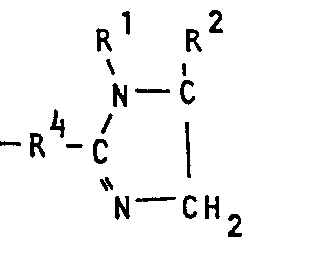
- the invention relates to a new process for the preparation of 2-imidazolines by reacting 1,2-diamines with nitriles in the presence of copper salts as catalysts.
- 2-Imidazolines substituted in the 2-position can be e.g. according to the in J. Chem. Soc. (1947), pages 497 to 505 produce the process by reacting salts of ethylenediamine with nitriles at 100 to 260 ° C. The yields are unsatisfactory in this process.
- Japanese patent publication 24 965/1964 states that the condensation of 1,2-diamine with nitriles can be catalyzed with sulfur. The formation of hydrogen sulfide is a considerable disadvantage in this process. It requires complex devices and measures for the extraction and destruction of the toxic and odorous hydrogen sulfide.
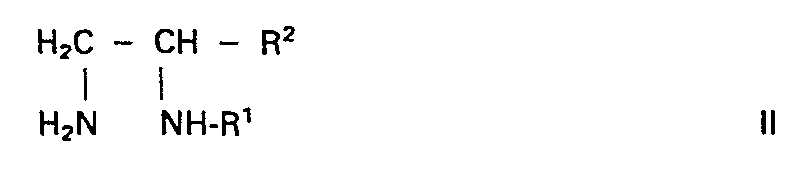
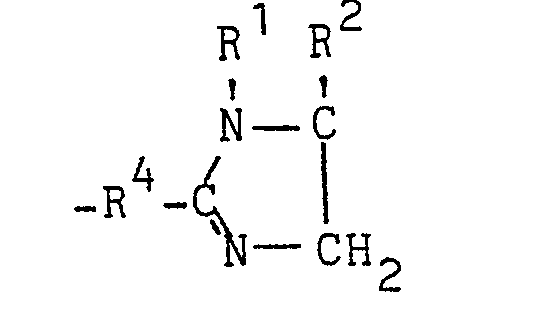
- R 3 is an aliphatic, cycloaliphatic, araliphatic or aromatic radical or a radical of the formula and R4 is an aliphatic radical, by reacting 1,2-diamines of the formula with nitriles of the formula in which R 5 has the meaning given for R 3 or stands for the radical -R 4 -CN, can be produced considerably more advantageously if the reaction is carried out in the presence of copper salts.
- the reaction can be represented by the following formulas:
- the process according to the invention surprisingly provides 2-imidazolines in a higher yield and purity in a simpler and more economical way.
- the substituents R 1 , R 2 and R 3 can contain aliphatic radicals, such as alkyl groups having 1 to 18, preferably 1 to 7, carbon atoms, cycloaliphatic radicals, such as cyclohexyl or cyclopentyl groups, araliphatic radicals, such as aralkyl groups having 7 to 12 C atoms or aromatic radicals, such as phenyl or naphthyl groups.
- R 4 is an aliphatic radical, such as an alkylene radical with 1 to 4 carbon atoms.
- the aliphatic, cycloaliphatic, araliphatic and aromatic radicals mentioned can also be substituted by groups which are inert under the reaction conditions, such as alkyl groups or alkoxy groups each having 1 to 4 carbon atoms.
- Suitable diamines of the formula II are: ethylenediamine, 1,2-propylenediamine, 1,2-butylenediamine, 1,2-pentylenediamine, 1,2-n-hexylenediamine, 1,2-n-heptylenediamine, 1,2- -n-octylenediamine, 1,2-n-nonylenediamine, 1,2-n-decylenediamine; 2-cyclohexyl, 2-cyclopentyl, 2-benzyl, 2-phenyl, o-methoxyphenyl, m-methoxyphenyl, p-methoxyphenyl, 2,5-dimethylphenyl, 2,6-dimethylphenyl, 2,4-dimethylphenyl, 2,3-dimethylphenyl, 2-o-tolyl, 2-m-toluyl, 2-p-tolyl, 2-o-ethylphenyl, 2-m-ethylphenyl or 2 -p -
- nitriles of the formula III are: Stearin Textrenitril, Palmitinklarenitril, Essigklarenitril, Pröpion Aciditril, Butter Acidklarenitril, isobutyronitrile, Pentancarbon Acidklarenitril, 2-Ethylhexancarbon Acidklarenitril, Capryl Aciditril, Trimethylessigkladrenitril, succinonitrile, malononitrile, Isovalerian Textrenitril, valeronitrile, glutaronitrile, adiponitrile, 2,3-Dimethylbenzoeklarenitril, 2,4-Dimethylbenzoeklarenitril, 2 , 5-dimethylbenzoic acid nitrile, 2,6-dimethylbenzoic acid nitrile, benzoic acid nitrile, phenylpropionic acid nitrile, cyclopentane carboxylic acid nitrile, cyclohexanoi
- Copper salts of organic or inorganic acids such as copper-I-chloride, copper-II-chloride or copper-II-acetate, are used as catalysts. They are advantageously used in amounts of 0.1 to 5 parts by weight, based on 100 parts by weight of diamine.
- the diamines are reacted with the nitriles in the presence of the copper salts, for example at temperatures from 110 to 300.degree. C., preferably 150 to 200.degree. C., without pressure or under pressure, continuously or batchwise.
- the reaction mixture also serves as a solution medium.
- organic solvents which are inert under the reaction conditions, such as aliphatic or aromatic hydrocarbons, for example benzene, toluene, xylene; Use petroleum ether or ligroin.
- the starting materials are preferably together in a stoichiometric amount or in excess of one or the other starting material in a ratio of 1 to 1.1 moles of starting material II per mole of starting material III.
- the reaction is e.g. carried out by holding a mixture of 1,2-diamine, nitrile and the copper salt at the reaction temperature for 2 to 4 hours, the reaction proceeding with vigorous evolution of ammonia.
- the reaction product precipitated as a solid can be used in a conventional manner, e.g. by distillation or recrystallization.
- the 2-imidazolines of the formula I which can be prepared by the process of the invention are valuable starting materials for the production of dyes, crop protection agents, pharmaceuticals and polymers. They are also used as catalysts for polymerization reactions and aldol condensation. By dehydration on aluminum / zinc oxide catalysts, they provide the corresponding imidazoles.
Landscapes
- Chemical & Material Sciences (AREA)
- Organic Chemistry (AREA)
- Organic Low-Molecular-Weight Compounds And Preparation Thereof (AREA)
- Low-Molecular Organic Synthesis Reactions Using Catalysts (AREA)
Abstract


Description
- Die Erfindung betrifft ein neues Verfahren zur Herstellung von 2-Imidazolinen durch Umsetzung von 1,2-Diaminen mit Nitrilen in Gegenwart von Kupfersalzen als Katalysatoren.
- In 2-Stellung substituierte 2-Imidazoline lassen sich z.B. nach dem in J. Chem. Soc. (1947), Seiten 497 bis 505 beschriebenen Verfahren dadurch herstellen, daß man Salze des Ethylendiamins mit Nitrilen bei 100 bis 260°C umsetzt. -Bei diesem Verfahren sind die Ausbeuten unbefriedigend. In der japanischen Patentveröffentlichung 24 965/1964 ist angegeben, daß man die Kondensation von 1,2-Diamin mit Nitrilen mit Schwefel katalysieren kann. Bei diesem Verfahren ist die Schwefelwasserstoffbildung von erheblichem Nachteil. Sie erfordert aufwendige Vorrichtungen und Maßnahmen für eine Absaugung und Vernichtung des giftigen und geruchsbelästigenden Schwefelwasserstoffs.
- Es wurde nun gefunden, daß man bei der Herstellung von 2-Imidazolinen der Formel



- Die Umsetzung kann für den Fall der Verwendung von Ethylendiamin und Acetonitril bzw. Adipinsäuredinitril durch die folgenden Formeln wiedergegeben werden:


- In den Ausgangsstoffen können die Substituenten R1, R2 und R3 aliphatische Reste, wie Alkylgruppen mit 1 bis 18, vorzugsweise 1 bis 7 C-Atomen, cycloaliphatische Reste, wie Cyclohexyl- oder Cyclopentylgruppen, araliphatische Reste, wie Aralkylgruppen mit 7 bis 12 C-Atomen oder aromatische Reste, wie Phenyl- oder Naphthylgruppen bedeuten. R4 ist ein aliphatischer Rest, wie ein Alkylenrest mit 1 bis 4 C--Atomen. Dabei können die genannten aliphatischen, cycloaliphatischen, araliphatischen und aromatischen Reste noch durch unter den Reaktionsbedingungen inerte Gruppen, wie Alkylgruppen oder Alkoxygruppen mit jeweils 1 bis 4 Kohlenstoffatomen, substituiert sein.
- Als Diamine der Formel II kommen z.B. in Frage: Ethylendiamin, 1,2-Propylendiamin, 1,2-Butylendiamin, 1,2-Pentylendiamin, 1,2-n-Hexylendiamin, 1,2-n-Heptylendiamin, 1,2--n-Octylendiamin, 1,2-n-Nonylendiamin, 1,2-n-Decylendiamin; 2-Cyclohexyl-, 2-Cyclopentyl-, 2-Benzyl-, 2-Phenyl-, o-Methoxyphenyl-, m-Methoxyphenyl-, p-Methoxyphenyl-, 2,5--Dimethylphenyl-, 2,6-Dimethylphenyl-, 2,4-Dimethylphenyl-, 2,3-Dimethylphenyl-, 2-o-Toluyl-,.2-m-Toluyl-, 2-p-Toluyl-, 2-o-Ethylphenyl-, 2-m-Ethylphenyl oder 2-p--Ethylphenyl-l,2-ethylendiamin; N-Cyclohexyl-, N-Cyclopentyl-, N-Benzyl-, N-Phenyl-, N-o-Methoxyphenyl-, N-m-Methoxyphenyl-, N-p-Methoxyphenyl-, N-2,5-Dimethylphenyl-, N-2,6-Dimethylphenyl-, N-2,4-Dimethylphenyl-, N-2,3-Dimethylphenyl-, N-o-Toluyl-, N-m-Toluyl-, N-p-Toluyl-, N-o--Ethylphenyl-, N-m-Ethylphenyl- oder N-p-Ethylphenyl-1,2--ethylendiamin; N,2-Dicyclohexyl-, N,2-Dicyclopentyl-, N,2-Dibenzyl-, N,2-Diphenyl-, N-2-Di-(o-methoxyphenyl)-, N,2-Di-(m-methoxyphenyl)-, N,2-Di-(p-methoxyphenyl)-, N,2--Di-(2,5-dimethylphenyl)-, N,2-Di-(2,6-dimethylphenyl)-, N,2-Di-(2,4-dimethylphenyl)-, N,2-Di-(2,3-dimethylphenyl)-, N,2-Di-(o-toluyl)-, N,2-Di-(m-toluyl)-, N,2-(p-tolu- 'yl)-, N,2-Di-(o-ethylphenyl)-, N,2-Di-(m-ethylphenyl)-oder N,2-Di-p-ethylphenyl)-1,2-ethylendiamin.
- Als Nitrile der Formel III kommen z.B. in Betracht: Stearinsäurenitril, Palmitinsäurenitril, Essigsäurenitril, Pröpionsäurenitril, Buttersäurenitril, Isobuttersäurenitril, Pentancarbonsäurenitril, 2-Ethylhexancarbonsäurenitril, Caprylsäurenitril, Trimethylessigsäurenitril, Bernsteinsäurenitril, Malonsäuredinitril, Isovaleriansäurenitril, Valeriansäurenitril, Glutarsäuredinitril, Adipinsäuredinitril, 2,3-Dimethylbenzoesäurenitril, 2,4-Dimethylbenzoesäurenitril, 2,5-Dimethylbenzoesäurenitril, 2,6-Dimethylbenzoesäurenitril, Benzoesäurenitril, Phenylpropionsäurenitril, Cyclopentancarbonsäurenitril, Cyclohexansäurenitril, Phenylessigsäurenitril, o-Toluylsäurenitril, m-Toluylsäurenitril, o-Toluylsäurenitril.
- Als Katalysatoren verwendet man Kupfersalze organischer oder anorganischer Säuren, wie Kupfer-I-chlorld, Kupfer-II--chlorid oder Kupfer-II-acetat. Man verwendet sie zweckmäßigerweise in Mengen von 0,1 bis 5 Gew.-Teilen, bezogen auf 100 Gew.-Teile Diamin.
- Man nimmt die Umsetzung der Diamine mit den Nitrilen in Gegenwart der Kupfersalze z.B. bei Temperaturen von 110 bis 300°C, vorzugsweise 150 bis 200°C, drucklos oder unter Druck, kontinuierlich oder diskontinuierlich vor. In der Regel dient das Reaktionsgemisch auch als Lösungsmedium. Man kann aber auch unter den Reaktionsbedingungen inerte organische Lösungsmittel, wie aliphatische oder aromatische Kohlenwasserstoffe, z.B. Benzol, Toluol, Xylol; Petrolether oder Ligroin verwenden. Die Ausgangsstoffe werden miteinander in stöchiometrischer Menge oder im Überschuß des einen oder anderen Ausgangsstoffs, vorzugsweise in einem Verhältnis von 1 bis 1,1 Mol Ausgangsstoff II je Mol Ausgangsstoff III, umgesetzt.
- Die Reaktion wird z.B. durchgeführt, indem man ein Gemisch aus 1,2-Diamin, Nitril und dem Kupfersalz 2 bis 4 Stunden auf der Reaktionstemperatur hält, wobei die Reaktion unter lebhafter Ammoniakentwicklung abläuft. Das als Feststoff ausgeschiedene Reaktionsprodukt kann in üblicher Weise, z.B. durch Destillation oder Umkristallisation, isoliert werden.
- Die nach dem Verfahren der Erfindung herstellbaren 2-Imidazoline der Formel I sind wertvolle Ausgangsstoffe für die Herstellung von Farbstoffen, Pflanzenschutzmitteln, Pharmazeutika und Polymeren. Sie werden auch als Katalysatoren für Polymerisationsreaktionen und Aldolkondensationen eingesetzt. Durch Dehydrierung an Alumlnium/Zinkoxidkatalysatoren liefern sie die entsprechenden Imidazole.
- Die in den folgenden Beispielen aufgeführten Teile bedeuten Gewichtsteile.
- 120 Teile Ethylendiamin werden mit 82 Teilen Acetonitril und 2,2 Teilen Cu-II-acetat . H20 in einem 0,6 1-V2A-Autoklaven auf 200°C erhitzt. Man hält die Temperatur 2 h auf 200°C, wobei sich im Autoklaven ein Druck von 45 bar einstellt. Nach dem Erkalten wird das NH -Gas über eine Abgasleitung entspannt. Das kristalline Reaktionsprodukt (= 129 Teile) wird aus 250 Teilen Aceton umkristallisiert. Man erhält 118 Teile 2-Methylimidazolin mit einem Schmelzpunkt von 102,5 bis 103,2°C, entsprechend einer Ausbeute von 70,2 % d.Th. Das Produkt hat nach der GC-Analyse eine Reinheit von 99,5 %.
- 148 Teile '1,2-Diaminopropan und 110 Teile Propionitril werden mit 2,2 Teilen Kupfer-II-acetat . H20 in einem 0,6 1--V2A-Autoklaven 2 h auf 200°C erhitzt. Der Druck steigt auf 52 bar an. Nach dem Erkalten (Enddruck = 25 bar) wird das NH3-Gas über eine Abgasleitung entspannt und das Reaktionsprodukt unter Vakuum destilliert. Bei 1 mbar und 98 bis 110°C erhält man 215 Teile 2-Ethyl-4-methylimidazolin, entsprechend einer Ausbeute von 96,0 % d.Th.
- 446 Teile 1,2-Diaminopropan, 618 Teile Benzonitril und 4 Teile Kupfer-II-acetat . H20 werden an einer Destillationskolonne (0 25 mm, Länge 100 mm mit 2 mm Glasringen gefüllt) 11 h am Rückfluß erhitzt bis die NH3-Entwicklung beendet ist. Die Sumpftemperatur erreicht 192°C. Die Reaktionsmischung wird anschließend unter Vakuum destilliert. Als Hauptlauf (Kp 139 bis 142°C) erhält man 935 Teile 2-Phenyl-4(5)-methylimidazolin, entsprechend einer Ausbeute von 96,6 % d.Th. Das Produkt hat nach der GC-Analyse eine Reinheit von 99,6 %.
- 515 Teile Benzonitril werden in einem Rührkolben, der mit Thermometer, Rückflußkühler und Tropftrichter ausgerüstet ist, mit 9 Teilen Kupfer-II-acetat . H20 auf 180°C (Rückfluß) erhitzt. 300 Teile Ethylendiamin werden in 4 Stunden so zugetropft, daß die Temperatur im Rührkolben nicht unter 180°C abfällt. Man kocht weitere 4 h unter Rückfluß bis die Sumpftemperatur auf 265°C gestiegen ist. Die Reaktionsmischung wird unter Vakuum destilliert. Man erhält bei 0,5 bis 1 mbar und 160 bis 180°C 695 Teile 2-Phenylimidazolin, entsprechend einer Ausbeute von 95,2 % d.Th.
- Es werden, wie in Beispiel 4 beschrieben, 515 Teile Benzonitril mit 10 Teilen Kupfer-II-chlorid unter Rückfluß gekocht. Innerhalb von 6 h werden 300 Teile Ethylendiamin zugetropft. Nach weiteren 2 h wird eine Sumpftemperatur von 265°C erreicht. Die Destillation des Rohprodukts ergibt als Hauptlauf 680 Teile 2-Phenylimidazolin mit einer Reinheit von 97,8 % (GC-Analyse).
- Eine Mischung aus 120 Teilen Ethylendiamin, 108 Teilen Adipinsäuredinitril und 1 Teil Kupfer-II-acetat wird entsprechend Beispiel 3 umgesetzt. Der Endstoff wird aus Aceton umkristallisiert. Man erhält 162 Teile 1,4-Di-(imida- zolinyl-2)-butan vom Schmelzpunkt 218°C, entsprechend einer Ausbeute von 83,5 % d.Th.
- 265 Teile Stearinsäurenitril, 60 Teile Ethylendiamin und 1 Teil Kupfer-I-chlorid werden 4 Stunden am Rückfluß erhitzt. Die Temperatur steigt von 130°C auf 200°C am Ende der Reaktion an. Das Reaktionsgemisch wird unter Vakuum destilliert. Man erhält 287 Teile 2-Heptadecylimidazolin vom Siedepunkt Kp 198 bis 215°C, entsprechend einer Ausbeute von 93,2 % d.Th.
- 136 Teile-N-Phenylethylendiamin, 41 Teile Acetonitril und' 1 Teil Kupfer-II-acetat werden 4 h am Rückfluß erhitzt, dann wird das Reaktionsgemisch unter Vakuum destilliert. Man erhält 125 Teile 1-Phenyl-2-methylimidazolin vom Kp 100 bis 102°C, entsprechend einer Ausbeute von 78,1 % d.Th.
- 136 Teile N-Phenylethylendiamin, 103 Teile Benzonitril und 1 Teil Kupfer-II-acetat werden entsprechend Beispiel 6 4 h am Rückfluß erhitzt und unter Vakuum destilliert. Man erhält 160 Teile 1,2-Diphenylimidazolin vom Kp2 170 bis 172°C (Fp = 73°C), entsprechend einer Ausbeute von 72,1 % d.Th.
- 136 Teile N-Phenylethylendiamin, 109 Teile Hexahydrobenzonitril und 1 Teil Kupfer-II-acetat werden 4 h am Rückfluß erhitzt. Dann wird unter Vakuum destilliert. Man erhält 198 Teile 1-Phenyl-2-cyclohexylimidazolin als hellgelbe Flüssigkeit vom Kp1 143 bis 145°C, entsprechend einer Ausbeute von 86,8 % d.Th.
- 136 Teile N-Phenylethylendiamin, 117 Teile p-Tolunitril und 1 Teil Kupfer-II-acetat werden 4 h am Rückfluß erhitzt. Dann wird unter Vakuum destilliert. Man erhält 182 Teile 1-Phenyl-2-p-tolylimidazolin vom Kp1 173 bis 175°C (Fp = 52°C) entsprechend einer Ausbeute von 77,1 % d.Th.
- 55 Teile N-(2-Methoxyphenyl)-ethylendiamin, 36 Teile Hexahydrobenzonitril und 0,3 Teile Kupfer-II-acetat werden 2 h am Rückfluß erhitzt. Dann wird unter Vakuum destilliert. Man erhält 53 Teile 1-(2-Methoxyphenyl)-2-cyclohexylimida- zolin vom Kp1 170°C (Fp = 75°C), entsprechend einer Ausbeute von 68,5 % d.Th.
- 136 Teile N-Phenylethylendiamin, 131 Teile 3,4-Dimethylbenzonitril und 1 Teil Kupfer-II-acetat werden 4 h am Rück fluß erhitzt. Dann wird das Reaktionsgemisch unter Vakuum destilliert. Man erhält 208 Teile 1-Phenyl-2-(3,4-dimethyl phenyl)-imidazolin vom Kp1 178 bis 180°C (Fp = 90°C), entsprechend einer Ausbeute von 83,2 % d.Th.
- 55 Teile N-(2,5-Dimethylphenyl)-ethylendiamin, 34 Teile Benzonitril und 0,3 Teile Kupfer-II-acetat werden 4 h am Rückfluß erhitzt. Dann wird das Reaktionsgemisch destilliert. Man erhält 60 Teile 1-(2,5-Dimethylphenyl)-2-phenyl imidazolin vom Kp3 185°C (Fp = 90°C), entsprechend einer Ausbeute von 72,2 % d.Th.
- 74 Teile 1,2-Diaminopropan, 41 Teile Propionitril und 0,5 Teile Kupfer-II-acetat werden 4 h am Rückfluß erhitzt. Dann wird das Reaktionsprodukt unter Vakuum destilliert. Man erhält 80 Teile 2-Ethyl-5-methylimidazolin vom Kp15 110 bis 112°C, entsprechend einer Ausbeute von 81,6 d.Th.
- 74 Teile 1,2-Diaminopropan, 103 Teile Benzonitril und 1 Teil Kupfer-II-acetat werden 4 h am Rückfluß erhitzt. Man destilliert das Reaktionsprodukt unter Vakuum und erhält 108 Teile 2-Phenyl-5-methylimidazolin vom Kp15 180 bis 183°C, entsprechend einer Ausbeute von 67,5 % d.Th.
Claims (1)
- Verfahren'zur Herstellung von 2-Imidazolinen der Formel


Applications Claiming Priority (2)
| Application Number | Priority Date | Filing Date | Title |
|---|---|---|---|
| DE19823236598 DE3236598A1 (de) | 1982-10-02 | 1982-10-02 | Verfahren zur herstellung von 2-imidazolinen |
| DE3236598 | 1982-10-02 |
Publications (2)
| Publication Number | Publication Date |
|---|---|
| EP0111073A1 true EP0111073A1 (de) | 1984-06-20 |
| EP0111073B1 EP0111073B1 (de) | 1987-02-25 |
Family
ID=6174823
Family Applications (1)
| Application Number | Title | Priority Date | Filing Date |
|---|---|---|---|
| EP83109426A Expired EP0111073B1 (de) | 1982-10-02 | 1983-09-22 | Verfahren zur Herstellung von 2-Imidazolinen |
Country Status (3)
| Country | Link |
|---|---|
| EP (1) | EP0111073B1 (de) |
| JP (1) | JPS5984873A (de) |
| DE (2) | DE3236598A1 (de) |
Families Citing this family (2)
| Publication number | Priority date | Publication date | Assignee | Title |
|---|---|---|---|---|
| DE19831987A1 (de) | 1998-07-16 | 2000-01-20 | Bayer Ag | Diphenylimidazoline |
| RU2599989C1 (ru) * | 2015-10-08 | 2016-10-20 | Федеральное государственное бюджетное образовательное учреждение высшего профессионального образования "Волгоградский государственный технический университет" (ВолгГТУ) | Способ получения 2-алкил-2-имидазолинов |
Citations (5)
| Publication number | Priority date | Publication date | Assignee | Title |
|---|---|---|---|---|
| CH435301A (de) * | 1961-07-18 | 1967-05-15 | Toho Rayon Kk | Verfahren zur Herstellung von Imidazolinen und Polyimidazolinen |
| FR2121106A5 (de) * | 1970-12-30 | 1972-08-18 | Ajinomoto Kk | |
| DE2512513A1 (de) * | 1975-03-21 | 1976-10-07 | Basf Ag | Verfahren zur herstellung von 2-imidazolinen |
| EP0012371A1 (de) * | 1978-12-16 | 1980-06-25 | BASF Aktiengesellschaft | Verfahren zur Herstellung von 2-Imidazolinen |
| EP0036521A1 (de) * | 1980-03-13 | 1981-09-30 | BASF Aktiengesellschaft | Verfahren zur Herstellung von 2-Imidazolinen |
-
1982
- 1982-10-02 DE DE19823236598 patent/DE3236598A1/de not_active Withdrawn
-
1983
- 1983-09-22 DE DE8383109426T patent/DE3369844D1/de not_active Expired
- 1983-09-22 EP EP83109426A patent/EP0111073B1/de not_active Expired
- 1983-10-03 JP JP58183241A patent/JPS5984873A/ja active Pending
Patent Citations (5)
| Publication number | Priority date | Publication date | Assignee | Title |
|---|---|---|---|---|
| CH435301A (de) * | 1961-07-18 | 1967-05-15 | Toho Rayon Kk | Verfahren zur Herstellung von Imidazolinen und Polyimidazolinen |
| FR2121106A5 (de) * | 1970-12-30 | 1972-08-18 | Ajinomoto Kk | |
| DE2512513A1 (de) * | 1975-03-21 | 1976-10-07 | Basf Ag | Verfahren zur herstellung von 2-imidazolinen |
| EP0012371A1 (de) * | 1978-12-16 | 1980-06-25 | BASF Aktiengesellschaft | Verfahren zur Herstellung von 2-Imidazolinen |
| EP0036521A1 (de) * | 1980-03-13 | 1981-09-30 | BASF Aktiengesellschaft | Verfahren zur Herstellung von 2-Imidazolinen |
Also Published As
| Publication number | Publication date |
|---|---|
| DE3236598A1 (de) | 1984-04-05 |
| EP0111073B1 (de) | 1987-02-25 |
| DE3369844D1 (en) | 1987-04-02 |
| JPS5984873A (ja) | 1984-05-16 |
Similar Documents
| Publication | Publication Date | Title |
|---|---|---|
| US3366639A (en) | Synthesis of amides from nitriles | |
| DE1445761A1 (de) | Verfahren zur Herstellung von 2-Thioketo-4-keto-3,4-dihydrobenzoxazinen-(1,3) | |
| US2527861A (en) | Mono alkyl sulfamides | |
| DE69125629T2 (de) | Verfahren zur Herstellung von Methoxyminoacetamidverbindungen | |
| EP0089011A1 (de) | Verfahren zur Herstellung von 3-Oxonitrilen | |
| EP0111073B1 (de) | Verfahren zur Herstellung von 2-Imidazolinen | |
| DE2701372A1 (de) | Verfahren zur herstellung cyclischer amidine | |
| DE2321054A1 (de) | Verfahren zur herstellung von 2(omega-aminoalkyl)-1,3-heterocyclen | |
| US2700668A (en) | Preparation of ketopiperazines | |
| EP0123123A2 (de) | Verfahren zur Herstellung von 2-Isopropenyloxazolinen | |
| EP0306868A1 (de) | Verfahren zur Herstellung von 1-Alkylimidazolen | |
| US3852287A (en) | Preparation of thionamides | |
| US2982781A (en) | Process for producing beta-aminonitriles and- beta-aminoesters | |
| US3746704A (en) | Imidazolidinones | |
| DE2827796C2 (de) | Verfahren zur Herstellung von 1-(2- Acylaminoäthyl)-5-nitroimidazolen | |
| US3225060A (en) | Bis-hydantoins and a method for the preparation thereof | |
| AT314530B (de) | Verfahren zur Herstellung von neuen 5- bzw. 4-Nitroimidazolderivaten und ihren Salzen | |
| US3068268A (en) | Preparation of vinyl esters of phosphorus acids useful as insecticides | |
| US3723454A (en) | N,n{40 -bis-{8 (1{40 -formamido-2{40 ,2{40 ,2{40 -trichloro)-ethyl{9 -imidazolidines | |
| EP0036441B1 (de) | Verfahren zur Herstellung von Carbonsäurecyaniden | |
| DE1670356B2 (de) | Verfahren zur herstellung von 2-nitroalkyloxazolinen oder -imidazolinen | |
| Dickerman et al. | Addition of Ethylenediamine to Methyl Methacrylate and to Acrylonitrile. Reactions of the Adducts | |
| DE1670356C3 (de) | Verfahren zur Herstellung von 2-NHroalkyloxazolinen oder -imidazolinen | |
| US3536704A (en) | Schiff bases of 4-amino-2,2,5,5-tetrakis (fluoroalkyl)-3-imidazolines | |
| DD147241A1 (de) | Verfahren zur herstellung von furanderivaten |
Legal Events
| Date | Code | Title | Description |
|---|---|---|---|
| PUAI | Public reference made under article 153(3) epc to a published international application that has entered the european phase |
Free format text: ORIGINAL CODE: 0009012 |
|
| 17P | Request for examination filed |
Effective date: 19840405 |
|
| AK | Designated contracting states |
Designated state(s): CH DE FR GB IT LI |
|
| GRAA | (expected) grant |
Free format text: ORIGINAL CODE: 0009210 |
|
| AK | Designated contracting states |
Kind code of ref document: B1 Designated state(s): CH DE FR GB IT LI |
|
| ITF | It: translation for a ep patent filed | ||
| REF | Corresponds to: |
Ref document number: 3369844 Country of ref document: DE Date of ref document: 19870402 |
|
| ET | Fr: translation filed | ||
| PLBE | No opposition filed within time limit |
Free format text: ORIGINAL CODE: 0009261 |
|
| STAA | Information on the status of an ep patent application or granted ep patent |
Free format text: STATUS: NO OPPOSITION FILED WITHIN TIME LIMIT |
|
| 26N | No opposition filed | ||
| ITTA | It: last paid annual fee | ||
| PGFP | Annual fee paid to national office [announced via postgrant information from national office to epo] |
Ref country code: FR Payment date: 20000811 Year of fee payment: 18 |
|
| PGFP | Annual fee paid to national office [announced via postgrant information from national office to epo] |
Ref country code: CH Payment date: 20000901 Year of fee payment: 18 |
|
| PGFP | Annual fee paid to national office [announced via postgrant information from national office to epo] |
Ref country code: GB Payment date: 20000918 Year of fee payment: 18 Ref country code: DE Payment date: 20000918 Year of fee payment: 18 |
|
| PG25 | Lapsed in a contracting state [announced via postgrant information from national office to epo] |
Ref country code: DE Free format text: LAPSE BECAUSE OF THE APPLICANT RENOUNCES Effective date: 20010915 |
|
| PG25 | Lapsed in a contracting state [announced via postgrant information from national office to epo] |
Ref country code: GB Free format text: LAPSE BECAUSE OF NON-PAYMENT OF DUE FEES Effective date: 20010922 |
|
| PG25 | Lapsed in a contracting state [announced via postgrant information from national office to epo] |
Ref country code: LI Free format text: LAPSE BECAUSE OF NON-PAYMENT OF DUE FEES Effective date: 20010930 Ref country code: CH Free format text: LAPSE BECAUSE OF NON-PAYMENT OF DUE FEES Effective date: 20010930 |
|
| REG | Reference to a national code |
Ref country code: GB Ref legal event code: IF02 |
|
| GBPC | Gb: european patent ceased through non-payment of renewal fee |
Effective date: 20010922 |
|
| REG | Reference to a national code |
Ref country code: CH Ref legal event code: PL |
|
| PG25 | Lapsed in a contracting state [announced via postgrant information from national office to epo] |
Ref country code: FR Free format text: LAPSE BECAUSE OF NON-PAYMENT OF DUE FEES Effective date: 20020531 |
|
| REG | Reference to a national code |
Ref country code: FR Ref legal event code: ST |