EP0111075A2 - Verfahren und Vorrichtung zur Steuerung des Ausganges eines Systems - Google Patents
Verfahren und Vorrichtung zur Steuerung des Ausganges eines Systems Download PDFInfo
- Publication number
- EP0111075A2 EP0111075A2 EP83109473A EP83109473A EP0111075A2 EP 0111075 A2 EP0111075 A2 EP 0111075A2 EP 83109473 A EP83109473 A EP 83109473A EP 83109473 A EP83109473 A EP 83109473A EP 0111075 A2 EP0111075 A2 EP 0111075A2
- Authority
- EP
- European Patent Office
- Prior art keywords
- value
- signal
- output signal
- time
- supplying
- Prior art date
- Legal status (The legal status is an assumption and is not a legal conclusion. Google has not performed a legal analysis and makes no representation as to the accuracy of the status listed.)
- Withdrawn
Links
Images


Classifications
-
- G—PHYSICS
- G05—CONTROLLING; REGULATING
- G05B—CONTROL OR REGULATING SYSTEMS IN GENERAL; FUNCTIONAL ELEMENTS OF SUCH SYSTEMS; MONITORING OR TESTING ARRANGEMENTS FOR SUCH SYSTEMS OR ELEMENTS
- G05B11/00—Automatic controllers
- G05B11/01—Automatic controllers electric
- G05B11/26—Automatic controllers electric in which the output signal is a pulse-train
- G05B11/28—Automatic controllers electric in which the output signal is a pulse-train using pulse-height modulation; using pulse-width modulation
-
- G—PHYSICS
- G03—PHOTOGRAPHY; CINEMATOGRAPHY; ANALOGOUS TECHNIQUES USING WAVES OTHER THAN OPTICAL WAVES; ELECTROGRAPHY; HOLOGRAPHY
- G03G—ELECTROGRAPHY; ELECTROPHOTOGRAPHY; MAGNETOGRAPHY
- G03G15/00—Apparatus for electrographic processes using a charge pattern
- G03G15/20—Apparatus for electrographic processes using a charge pattern for fixing, e.g. by using heat
- G03G15/2003—Apparatus for electrographic processes using a charge pattern for fixing, e.g. by using heat using heat
- G03G15/2014—Apparatus for electrographic processes using a charge pattern for fixing, e.g. by using heat using heat using contact heat
- G03G15/2039—Apparatus for electrographic processes using a charge pattern for fixing, e.g. by using heat using heat using contact heat with means for controlling the fixing temperature
-
- G—PHYSICS
- G05—CONTROLLING; REGULATING
- G05D—SYSTEMS FOR CONTROLLING OR REGULATING NON-ELECTRIC VARIABLES
- G05D23/00—Control of temperature
- G05D23/19—Control of temperature characterised by the use of electric means
- G05D23/1917—Control of temperature characterised by the use of electric means using digital means
-
- G—PHYSICS
- G05—CONTROLLING; REGULATING
- G05D—SYSTEMS FOR CONTROLLING OR REGULATING NON-ELECTRIC VARIABLES
- G05D23/00—Control of temperature
- G05D23/19—Control of temperature characterised by the use of electric means
- G05D23/20—Control of temperature characterised by the use of electric means with sensing elements having variation of electric or magnetic properties with change of temperature
- G05D23/24—Control of temperature characterised by the use of electric means with sensing elements having variation of electric or magnetic properties with change of temperature the sensing element having a resistance varying with temperature, e.g. a thermistor
Definitions
- This invention relates to feedback type controllers, and particularly, to feedback controllers employing input saturation with proportional output.
- the invention is useful in many other situations which require close control of system outputs and in which the feedback sensing element, used for generating the error input signal to the controller, produces a saturated signal.
- the latter condition is typical of temperature control systems.
- the usual approach to temperature control is to sense the temperature relative to a set value. When the temperature is less than the set value, heat is applied to the system from a heat source. The heat is applied until the temperature rises above the set value, at which point the heat source is removed and the temperature begins to drop. There is a maximum and minimum resulting temperature. No matter how small the temperature range, i.e., the difference between the maximum and the minimum temperatures, there is always some variation in temperature at the sensor. There must be a temperature change to activate the sensor, else it would be always on or always off. The smaller the range, the more the system cycles, i.e., the more on- and off-switching of the source is performed per unit time. This can be wasteful of energy, especially in systems where start-up or shutdown require large surges of additional power. For example, fast start-up requirements may use large full power output levels.
- the heat control problem is further complicated by the fact that heat leakage is proportional to the temperature. At higher temperatures, the heat loss increases and wastes more fuel. This is another reason it is desirable to limit the range of temperature variation.
- a controller of the present type is defined in optimal control theory as one operating in accordance with the control law under saturation constraints in which every control variable takes its maximum or minimum allowed value according to whether the sign of its coefficient is positive or negative.
- the state-space representation of a-single-input, single-output system is
- the value of f(t) would take on its maximum or minimum values according to its sign.
- a system is the common thermostatically-controlled heating system found in most homes.
- the input values would be represented by 1 or 0, depending on whether the temperature were lower or higher, respectively, than the value set on the thermostat.
- the input value f(t) is 1, represented by a switch closure, which turns on the furnace.
- the switch opens representing f(t) as 0 and causing the furnace to shut off.
- a small magnet is used to hold the thermostat's bi-metal switch closed until the temperature rises several degrees above the temperature setting. This prevents the system from excessive "hunting," i.e., short-period cycling around the set value.
- the thermostatically-controlled furnace is also an example of a feedback control system having a first-order lag term. This term represents the time delay between the turning on of the thermostat switch and the rise in temperature resulting from the consequence of turning on the furnace.
- This term represents the time delay between the turning on of the thermostat switch and the rise in temperature resulting from the consequence of turning on the furnace.
- Nonlinear design techniques include modeling or graphic procedures, or both.
- the controller is usually represented graphically by trajectories that are caused, by manipulation of the system parameters, to approach as fast as possible some optimal point, e.g., the origin of the complex plane.
- Linear control systems contain controllers that are classed as proportional, integral, or derivative, or any combination of the three. These are well known in the art as are the advantages and disadvantages of each for particular applications.
- An advantage of integral control systems is that they produce a signal that is proportional to the time integral of the input of the controller. In terms of transfer functions, it is equivalent to the addition of a zero on the negative real axis and a pole at the origin of the complex s-plane. It increases the order of the proportional system by one and reduces a constant steady-state error to zero, if the system is stable. On the other hand, it can make a higher-order system unstable if the point on the negative negative real axis of the complex s-plane of the added zero is not chosen correctly.
- Proportional output controllers are also well known in the art.
- U.S. Patent No. 3,878,358 shows an output that is varied proportional to the instantaneous error in the desired output temperature. (It does not, however, measure the time duration of the temperature oscillation which is an important feature in the invention being disclosed.
- Proportional output can be performed by varying the duty cycle of an output pulse train or by varying the number of total pulses (or cycles) in a fixed time frame.
- a time base measurement which is compared to one of two provided limit values.
- the time measurement is made between threshold crossings of a controlled variable in a control system. If the crossing results in an overshoot, a proportional count is incremented if the period of undershoot, represented by the time base measurement, is greater than the provided lower limit. The proportional count is decremented if the crossing results in an undershoot and the time base measurement is greater than the upper limit. The proportional count is then used to control the system output in a proportional manner during the undershoot period.
- control system is very simple at the same time as it approaches the precise control associated with proportional eutput systems.
- the invention is particularly useful in small copiers, especially if controlled by a programmed microprocessor, for keeping the fuser temperature closely controlled. This results in consistently good copy quality.
- the combination also results in an adaptive-like controller.
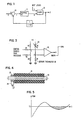
- FIG. 1 The standard configuration of a feedback control system is shown in FIG. 1.
- the controlled device is depicted as a fuser hot roll 14 of the type used in an electrophotostatic copier.
- a controller 11 supplies control signals to the fuser to control its temperature, represented as the output variable y.
- the controller transfer function is shown as Kl, which is well known to be usually a function of s, depicted in the complex s-plane.
- the input signal to the controller 11 is an error signal, e, from an adder/subtracter 10.
- the error signal is derived from a set-point signal, x, sometimes known as the reference input, and a signal derived from the output variable, y.
- the derivation can provide unity feedback, i.e., the output signal y itself.
- the feedback is shown as y(l/(l+sT)) where the sT value indicates that there is a first-order time lag between the output signal y and the signal fed back to the adder/subtracter 10.
- Heat losses can also be accounted for in the system of FI G. 1 and are depicted as an input variable z to the fuser.
- the other input to the fuser 14 is the signal w which represents the heat supplied by the controller 11.
- FIG. 2 A system according to the invention is shown in FIG. 2.
- the operation of the system of FIG. 2 can be generally considered to control the on-off period of a triac 29 which in turn controls the supply of AC power to a fuser heater 32.
- the basic idea is to provide upper and lower time limit values, and the time period between successive threshold crossings of the controlled variable, in this case, the temperature of the fuser hot roll, is measured.
- Crossing is defined herein to mean when the value of the controlled variable changes in such a manner that, if it were previously lower than the threshold value, it becomes higher than the threshold value, or that if the value of the controlled variable were previously higher than the threshold value, that it changes such that it is lower than the threshold value.
- a crossing occurs when the sign of the result changes. If the time period that the temperature is lower than the threshold value is greater than a predetermined limit (T-under), then a K-count value is incremented. If the time period that the temperature is greater than the threshold value is greater than a predetermined limit (T-over), then the K-count value is decremented.
- the input variable, or set-point x is the threshold value and that the sensed temperature is the controlled variable, y.
- the resulting error signal, e is one of two possible values, indicating whether the value of the controlled variable (temperature) is greater or less than the input variable (threshold value).
- the output signal is a proportional signal that integrates the system performance over a period of time, i.e., an integral controller.
- AC power is applied to the fuser hot roll heater 32 when the triac 29 is triggered.
- a sensor 34 detects the temperature of the fuser hot roll to supply a feedback signal to the control system.
- the hot roll is basically a flexible material forming the roller portion 31.
- a heating element 32 is disposed on the inside of the roll portion 31 to impart heat thereto.
- a metal sleeve 33 is affixed to the roller and thermally coupled thereto.
- a follower 34 made typically from carbon, graphite, or similar material, is arranged so as to rub on the metal block 33 while the roller 31 is rotating. Encased in the follower 34 is a heat sensing device such as a thermistor. As a result of this arrangement, a signal representing the temperature of the hot roll 31 can be supplied while the roller 31 is rotating.
- the sensor 34 supplies an analog signal representing the sensed temperature of the fuser hot roll to an analog comparator 20.
- the other input to the analog comparator 20 is a signal representing a predetermined threshold value, which may be stored in a register 21.
- a circuit suitable for the analog comparator 20 is shown in detail in FIG. 3.
- An operational (high-gain, high input impedance) amplifier 30 is coupled to receive an inverting input and a noninverting input.
- the y input voltage originates from a voltage divider comprising two resistances 35 and 36.
- the resistance 36 can be a thermistor or similar device for sensing the temperature of the fuser hot roll as described above.
- the other resistance 35 is commonly made variable to permit adjustment of the'operatihg point of the comparator.
- the x input is typically a reference voltage. As shown in FIG. 3, it can be a voltage divider having control inputs to permit changes-to be made to the x, or threshold, voltage. If, for example, the control signals are supplied as either +V or ground and the values of the resistors R1, R2, R3, and R4 are equal, the threshold voltage, x, can be varied to equal V/4, V/2, or 3V/4 by selectively supplying the control input voltages.
- the inverting and noninverting amplifier inputs are connected so that when the temperature of the fuser hot roll is below the desired, threshold value, the output signal from comparator 20 is at a high value, and when the temperature is above the desired threshold value, the output signal from the comparator 20 is at a low value.
- the output signal from the comparator 20 is converted to a pulse by a pulser circuit comprising an Exclusive-OR gate (XOR) 58 and a delay circuit 59.
- XOR Exclusive-OR gate
- the XOR 58 produces an output signal for a time period equal to the delay constant of the delay circuit 59, at which time the XOR input terminal coupled to the delay receives the same polarity signal as its other input terminal.
- the time counter 55 is periodically incremented by the output signal from a clock circuit 54.
- the clock frequency and the number of bits in the time counter 55 are chosen, as is well known in the art, depending on the precision and maximum time period desired.
- the counter value provides the time base for the operation of the system.
- the XOR output signal primes two AND gates 56 and 57 and resets a time counter 55.
- the time counter reset signal is delayed by a delay circuit 53 so that the output signals from the AND gates 56 and 57 will not be adversely affected by a premature resetting of the time counter 55.
- Two sources of time limit values 71-and 72 supply binary over and under time limit values, respectively. Over and under refer to maximum desired times for the temperature overshoot and undershoot, respectively.
- the bits of each value are coupled as an input signal to one of a pair of binary comparators 73 and 74.
- Each comparator produces an output signal if the value of the time counter 55, the bits from which are coupled as the other input signals to the comparators 73 and 74, exceeds the value in the associated over or under limit source.
- the output signal from the analog comparator 20 primes the AND gate 56 and the complement of the output signal is supplied by an inverter 52 to prime the AND gate 57.
- the output signals from the AND gates 56 and 57 decrement or increment, respectively, a K-counter 75 via OR gates 22 and 23.
- the value in the K -counter 75 determines the proportion of the output signal from the system, i.e.,K/N , as will be explained below.
- the K-count is incremented at a threshold crossing from a lower level by the sensed temperature of the fuser hot roll, if the timer period indicated by the value from the time counter 55, is greater than -(or equal to) the predetermined under limit value 72.
- the increment of the K-count is performed by the output signal from the AND gate 57 when the temperature crossing occurs (output signal from XOR 58), when the comparator 20 output signal indicates that the fuser hot roll was less than the threshold (output signal from the inverter 52), and when the comparator 74 is producing an output signal.
- the K-count is decremented in a similar manner when the output signal from the comparator 20 indicates that the sensed temperature was greater than the threshold temperature. (For.proper operation, it is important to note that, after the crossing, the output signal from the comparator 20 indicates the sensed temperature relation existing after the crossing.)
- the value in the K-counter 75 is transferred to a counter 80-to control the proportion of the AC power signal supplied to the heater during successive n cycles.
- the counter 80 has its output signals decoded by an OR network 81 to produce an output signal that indicates that the contents of the counter 80 are not zero.
- the nonzero output signal from the OR network 81 operates a trigger circuit 82 to turn on triac 29 for each half-cycle of the applied AC power as long as the counter 80 contains a nonzero value.
- An AND-gate 101 permits the triac circuit to be turned on only while the fuser hot roll temperature is below the threshold value.
- a zero-crossing detector 83 produces an output signal for each half-cycle of the AC power input.
- a divide-by-two counter 84 produces an output signal for each cycle of the input power, and these output signals from the divider 84 are used to decrement the contents of the counter 80.
- the AND gate 86 is disabled so that the counter 80 does not count through its zero value.
- the OR network 81 is no longer activated and turns off the trigger circuit 82, turning off the triac 29 so that no further AC power is supplied to the heater 32.
- the above description of the circuit of FIG. 2 shows the control logic for providing a proportional output signal adjusted according to the time periods that the sensed temperature is over and under a threshold value.
- an overlimit detection logic circuit is provided.
- An overlimit value (T-long) 93 is provided which is added into an adder-accumulator circuit 94. Since the accumulator's contents are initially zero, the initial value in the accumulator 94 will be the T-long value. Its value is compared to the value in the time counter 55 and, when the time counter value exceeds the T- long value, a pulse is produced by the signal from the comparator 95 via the pulser circuit comprising the delay 96 and the XOR 97. The pulse, via an AND gate 91 or 92, decrements or increments the K-count, respectively, depending on whether the temperature is over or under the threshold value. The same signal, labelled ADDC, activates the OR gate 90 to cause the adder 94 to add another T.
- ADDC activates the OR gate 90 to cause the adder 94 to add another T.
- the K- count will again be adjusted. This activates the value K when the sensed temperature is so far from the threshold as to cause a long delay between crossings, i.e., prevents the system from excessively long periods without a threshold crossing.
- the output pulse from the XOR 58 supplies an INH signal, which, through the OR gate 90, causes the r-long value to be added once again into the accumulator but, via an AND gate 91, the accumulator value is not supplied to the adder.
- the accumulator is set to the T-long value.
- N, T-long, T-over, and T-under depend on the parameters of the particular system in which the invention is to be used. They can, however, be empirically determined. In one constructed embodiment, the values of T-over and T- under were chosen so that the time of excursion under the threshold was 17 seconds, over the threshold, 4 seconds. The T-long value was chosen to equal 34 seconds of time. The value of N was 16. The resulting temperature curve is shown in FIG. 5.
- a preferred embodiment of the invention uses a microcomputer suitably programmed to perform the functions of the components in the system of FIG. 2.
- a flowchart showing the program logic is illustrated in FIG. 6.
- the program is depicted as a continuous looping program whereas in actual implementation, it would probably be a subroutine.
- An example of a suitable subroutine written in TYPICAL is provided below.
- the variables used in the program are:
- TL, TU, TO, and N are predetermined according to the system parameters. Their values are set as an initial step in the program or can be permanently encoded in a read-only memory.
- a clock circuit provides a binary or decimal count, representing elapsed time.
- the "read clock” statement makes this value available to the program as . the variable C.
- the interrupt signal over line 5 is received from the zero-crossing detector 83 shown in FIG. 2. Since the interrupt occurs every half-cycle, the values of K and N can be doubled to eliminate the need for a divide-by-two counter.
- a suitable INT subroutine is:
- the "write ON” statement causes the microcomputer 4 to supply a signal over the data line 99 to turn on the triac as shown in FIG. 2.
- the "write OFF” removes the signal.
- the threshold control lines 7 and 8 can be used by another part of a control program to set the threshold for fast warm-up at power-on time or for other special requirements which need not be discussed in detail for an understanding of the invention.
- Lower case letters are usually used for reserved words having a predetermined function.
- a test statement is the equivalent of a decision block in a flowchart and can be either a logical test or a comparative test.
- a test statement is identified by a following question mark an parentheses enclosing an identifier of the step to which a branch is to be taken depending on the results of the specified test.
- a logical test is expressed as a single logical variable or as an expression using any combination of arithmetical, logical, and relational operations.
- the parentheses following the question mark after the test indicates the step number or label to which a branch is to be taken if the test result is true. If the parentheses are followed by a NOT operator ('), the branch is taken if the test result is false. If the branch is not to be taken based on the test results, then the next statement in sequence is executed.
- a comparative test is indicated by a colon separating a left-hand and a right-hand expression.
- the parentheses after the following question mark enclose three step numbers or labels separated by commas, being the branch destinations if the value of the left-hand expression is less than, equal to, or greater than the value of the right-hand expression, respectively.
- Arrays are declared by name followed by the dimensions in parentheses.
- the initial and final index values, separated by a comma, are specified as a pair for each dimension, each pair being separated by a semicolon.
- An element of an array i.e., a subscripted variable, is specified by the array name followed by the indices of the element in parentheses and separated by semicolons.
- sl, s2, ..., sn, sm represent statements or sequences of statements.
- the special conditional statements are the IF-THEN and the CASE statements.
- the statement sl is executed if the condition is true, and statement s2 is executed if the condition is false.
- the condition can be a single logical variable or a logical expression which is evaluated using the existing values of the variables.
- the ELSE is optional and, if omitted, a false condition will cause the next statement in sequence following FIN to be executed.
- FIN is used to terminate the statement since sl or s2 can include more than one statement.
- the ELSE is optional. If none of the conditions is found to be true, the statement associated with ELSE is executed. If ELSE is omitted, the absence of any true condition causes the statement following the period, which terminates the CASE statement, to be executed. Commas are used to delimit the statements associated with each of the conditions.
- the special looping statements are the WHILE-LOOP, REPEAT-UNTIL, and FOR-NEXT statements.
- condition is evaluated and if true, the statement sl, terminated by the key word LOOP, is executed. This continues until the condition is false, at which time the statement following the key word LOOP is executed.
- the statement sl is executed and the condition tested. If the condition is false, then the statement sl is again executed. When the condition is true, the statement following the condition, which is delimited by colons, is executed.
- variable (v) is set to an initial value (i). It is then compared to the final value (f). If the absolute value of (v) is not greater than that of the final value (f), the statements sl are executed. The incremental value (d) is then added to the variable (v) and the comparison repeated. When the absolute value of (v) exceeds (f), the program continues with the statements following the terminating key word NEXT. (Absolute values are used in the calculations so that negative numbers can be specified.) The variable (v) is available for program use, e.g., as an index, but its value should not be altered.
- the BY is optional. If not specified, the value of +1 is used for (d).
- the key words of the special statements should be written on separate lines if the.entire special statement cannot be written on a single line. Two key words should not otherwise be written on the same line. If a key word is not followed by an executable statement, then the line is not numbered.
- Indentations may be used to improve readability of the program but too many indented spaces become a problem, especially when labels are used.
- the readability of programs can be improved by writing after the terminal key words, viz., FIN, LOOP, NEXT, and REPEAT, the step number of the initial related key-word.
- the terninal key word NEXT can be followed by the applicable variable name.
- the function name in an expression is replaced by the value calculated from the argument which can be a constant, a variable, an array, or an expression. If an array, each element of the argument array produces an element in a result array unless otherwise noted for the function. An argument written as an expression is evaluated to produce the argument.
Landscapes
- Physics & Mathematics (AREA)
- General Physics & Mathematics (AREA)
- Engineering & Computer Science (AREA)
- Automation & Control Theory (AREA)
- Control Of Temperature (AREA)
- Feedback Control In General (AREA)
- Fixing For Electrophotography (AREA)
Applications Claiming Priority (2)
| Application Number | Priority Date | Filing Date | Title |
|---|---|---|---|
| US448661 | 1982-12-10 | ||
| US06/448,661 US4496829A (en) | 1982-12-10 | 1982-12-10 | Bang-bang dual-mode integral controller with proportional control output useful for temperature control |
Publications (2)
| Publication Number | Publication Date |
|---|---|
| EP0111075A2 true EP0111075A2 (de) | 1984-06-20 |
| EP0111075A3 EP0111075A3 (de) | 1984-07-18 |
Family
ID=23781157
Family Applications (1)
| Application Number | Title | Priority Date | Filing Date |
|---|---|---|---|
| EP83109473A Withdrawn EP0111075A3 (de) | 1982-12-10 | 1983-09-23 | Verfahren und Vorrichtung zur Steuerung des Ausganges eines Systems |
Country Status (3)
| Country | Link |
|---|---|
| US (1) | US4496829A (de) |
| EP (1) | EP0111075A3 (de) |
| JP (1) | JPS59106003A (de) |
Cited By (8)
| Publication number | Priority date | Publication date | Assignee | Title |
|---|---|---|---|---|
| EP0206165A1 (de) * | 1985-06-17 | 1986-12-30 | Honeywell Inc. | Uhrenthermostat |
| EP0208256A3 (en) * | 1985-07-06 | 1988-11-02 | Honeywell B.V. | Space temperature regulation device |
| EP0263653A3 (de) * | 1986-10-06 | 1989-07-19 | Xerox Corporation | Steuerung für eine Schmelzfixiervorrichtung eines Kopiergerätes |
| US4897692A (en) * | 1988-04-08 | 1990-01-30 | Xerox Corporation | Fail safe fuser lamp control |
| WO1991005400A1 (de) * | 1989-09-29 | 1991-04-18 | Siemens Nixdorf Informationssysteme Aktiengesellschaft | Schaltungsanordnung zum betrieb von ohmschen leistungsverbrauchern hoher leistung |
| CN109518193A (zh) * | 2018-11-02 | 2019-03-26 | 海南大学 | 一种含钼酸钠的防锈液及其制备方法 |
| WO2021126238A1 (en) * | 2019-12-20 | 2021-06-24 | Hewlett-Packard Development Company, L.P. | Increasing set temperature of fuser of dry electrophotographic printing device |
| CN114527808A (zh) * | 2020-11-05 | 2022-05-24 | 安讯士有限公司 | 用于控制数据存储装置温度的方法和系统 |
Families Citing this family (18)
| Publication number | Priority date | Publication date | Assignee | Title |
|---|---|---|---|---|
| US4551007A (en) * | 1984-05-11 | 1985-11-05 | Xerox Corporation | Controller for a fusing device of an electrophotographic printing machine |
| JPS61290465A (ja) * | 1985-06-18 | 1986-12-20 | Minolta Camera Co Ltd | 定着装置の温度制御装置 |
| US5006695A (en) * | 1989-09-07 | 1991-04-09 | Elliott Robert C | Process controller including power level control and method of operation |
| DE69121120T2 (de) * | 1990-02-20 | 1997-01-02 | Canon Kk | Bilderzeugungsgerät mit Fehlererkennungsdetektor für die Fixiermittel |
| JP3036028B2 (ja) * | 1990-09-10 | 2000-04-24 | ブラザー工業株式会社 | 熱定着装置 |
| JPH04250483A (ja) * | 1991-01-10 | 1992-09-07 | Minolta Camera Co Ltd | 作像装置における定着装置 |
| JP3170857B2 (ja) * | 1992-03-27 | 2001-05-28 | キヤノン株式会社 | 加熱装置 |
| US5532922A (en) * | 1994-09-30 | 1996-07-02 | Honeywell Inc. | Non-linear control system for a single input single output process |
| US6753511B2 (en) * | 2002-09-26 | 2004-06-22 | General Electric Company | System and method for thermal limiting of the temperature of a cooktop without using a temperature sensor |
| US7358463B2 (en) * | 2005-08-12 | 2008-04-15 | Kabushiki Kaisha Toyota Jidoshokki | Switching power supply and method for stopping supply of electricity when electricity of switching power supply exceeds rated electricity |
| US7312420B2 (en) * | 2005-09-20 | 2007-12-25 | Lexmark International, Inc. | Switching device and system |
| JP5479025B2 (ja) * | 2009-10-27 | 2014-04-23 | キヤノン株式会社 | 像加熱装置及び画像形成装置 |
| US8870453B2 (en) * | 2010-11-09 | 2014-10-28 | Shockwatch, Inc. | System, method and computer program product for monitoring temperature |
| EP2974521A4 (de) * | 2013-03-14 | 2017-02-22 | Weiss Controls, Inc. | Bipolare triac-kurzschlusserkennung und sicherheitsschaltung sowie verfahren |
| WO2017077309A1 (en) * | 2015-11-06 | 2017-05-11 | Bae Systems Plc | Aircraft environmental control system |
| US9784279B2 (en) * | 2016-02-17 | 2017-10-10 | National Instruments Corporation | Zero ripple fan noise suppression |
| CN115023594A (zh) | 2020-01-14 | 2022-09-06 | 肖克沃奇股份有限公司 | 温度指示器 |
| WO2022026986A1 (en) | 2020-07-25 | 2022-02-03 | Shockwatch, Inc. | Temperature indicator |
Family Cites Families (4)
| Publication number | Priority date | Publication date | Assignee | Title |
|---|---|---|---|---|
| US3878358A (en) * | 1972-11-16 | 1975-04-15 | Xerox Corp | Digital power control |
| US3924170A (en) * | 1973-07-31 | 1975-12-02 | Int Computers Ltd | Bang-bang servo system |
| DE2429956C3 (de) * | 1974-06-21 | 1979-11-22 | Siemens Ag, 1000 Berlin Und 8000 Muenchen | Regeleinrichtung mit einem Regler und einem Stellantrieb mit mindestens zwei konstanten Stellgeschwindigkeiten |
| US4300037A (en) * | 1979-09-04 | 1981-11-10 | Oxy Dental Prod. Inc. | Electronic control system for a radiant furnace |
-
1982
- 1982-12-10 US US06/448,661 patent/US4496829A/en not_active Expired - Fee Related
-
1983
- 1983-09-23 EP EP83109473A patent/EP0111075A3/de not_active Withdrawn
- 1983-10-11 JP JP58188593A patent/JPS59106003A/ja active Granted
Cited By (10)
| Publication number | Priority date | Publication date | Assignee | Title |
|---|---|---|---|---|
| EP0206165A1 (de) * | 1985-06-17 | 1986-12-30 | Honeywell Inc. | Uhrenthermostat |
| EP0208256A3 (en) * | 1985-07-06 | 1988-11-02 | Honeywell B.V. | Space temperature regulation device |
| EP0263653A3 (de) * | 1986-10-06 | 1989-07-19 | Xerox Corporation | Steuerung für eine Schmelzfixiervorrichtung eines Kopiergerätes |
| US4897692A (en) * | 1988-04-08 | 1990-01-30 | Xerox Corporation | Fail safe fuser lamp control |
| WO1991005400A1 (de) * | 1989-09-29 | 1991-04-18 | Siemens Nixdorf Informationssysteme Aktiengesellschaft | Schaltungsanordnung zum betrieb von ohmschen leistungsverbrauchern hoher leistung |
| CN109518193A (zh) * | 2018-11-02 | 2019-03-26 | 海南大学 | 一种含钼酸钠的防锈液及其制备方法 |
| CN109518193B (zh) * | 2018-11-02 | 2020-12-15 | 海南大学 | 一种含钼酸钠的防锈液及其制备方法 |
| WO2021126238A1 (en) * | 2019-12-20 | 2021-06-24 | Hewlett-Packard Development Company, L.P. | Increasing set temperature of fuser of dry electrophotographic printing device |
| CN114527808A (zh) * | 2020-11-05 | 2022-05-24 | 安讯士有限公司 | 用于控制数据存储装置温度的方法和系统 |
| CN114527808B (zh) * | 2020-11-05 | 2024-01-09 | 安讯士有限公司 | 用于控制数据存储装置温度的方法和系统 |
Also Published As
| Publication number | Publication date |
|---|---|
| JPH0136122B2 (de) | 1989-07-28 |
| EP0111075A3 (de) | 1984-07-18 |
| JPS59106003A (ja) | 1984-06-19 |
| US4496829A (en) | 1985-01-29 |
Similar Documents
| Publication | Publication Date | Title |
|---|---|---|
| US4496829A (en) | Bang-bang dual-mode integral controller with proportional control output useful for temperature control | |
| US3878358A (en) | Digital power control | |
| US4206872A (en) | Electronic thermostat | |
| KR870000629A (ko) | 클록 온도 조절장치 | |
| US4374321A (en) | Automatic temperature controller for an electrophotographic apparatus fuser and method therefor | |
| CA1116273A (en) | Expanded time constant condition control system | |
| Sonnekalb et al. | Smart hot water control with learned human behavior for minimal energy consumption | |
| CA1103336A (en) | Plural load power controller with time shared processor | |
| JPS5576371A (en) | Failure detecting method in heat fixing device of electrophotographic copier | |
| JPS5589879A (en) | Temperature control system of fixing device | |
| US4186315A (en) | Expanded time constant condition control system using a unidirectional counter with multiple channels | |
| US2838644A (en) | Electronic thermoregulator | |
| Schaedel | A new method of direct PID controller design based on the principle of cascaded damping ratios | |
| EP0030372B1 (de) | Elktrophotographisches Kopiergerät | |
| SU1582181A1 (ru) | Стабилизатор переменного напр жени | |
| JPS6112262B2 (de) | ||
| JP2835391B2 (ja) | 温度制御装置 | |
| Liang et al. | Bias-Restrained Prefix Representation Finetuning for Mathematical Reasoning | |
| JPH04113378A (ja) | 定着部温度制御装置 | |
| Minkin et al. | Temperature measurement using thermistor with pulsed operation of circuit containing thermistor and linear resistor | |
| Islam et al. | Microprocessor based temperature monitoring and control system using fuzzy logic controller | |
| SU947842A1 (ru) | Устройство дл регулировани температуры | |
| JPS6122210A (ja) | 流量検出方法 | |
| Chulkov et al. | Temperature control of drying chambers with fuzzy logic algorithm for common microcontroller systems | |
| CS204831B1 (en) | Digital adaptive control unit for mixing valves of central heating |
Legal Events
| Date | Code | Title | Description |
|---|---|---|---|
| PUAI | Public reference made under article 153(3) epc to a published international application that has entered the european phase |
Free format text: ORIGINAL CODE: 0009012 |
|
| PUAL | Search report despatched |
Free format text: ORIGINAL CODE: 0009013 |
|
| AK | Designated contracting states |
Designated state(s): DE FR GB |
|
| AK | Designated contracting states |
Designated state(s): DE FR GB |
|
| 17P | Request for examination filed |
Effective date: 19841029 |
|
| 17Q | First examination report despatched |
Effective date: 19860807 |
|
| R17C | First examination report despatched (corrected) |
Effective date: 19870203 |
|
| STAA | Information on the status of an ep patent application or granted ep patent |
Free format text: STATUS: THE APPLICATION IS DEEMED TO BE WITHDRAWN |
|
| 18D | Application deemed to be withdrawn |
Effective date: 19870514 |
|
| RIN1 | Information on inventor provided before grant (corrected) |
Inventor name: BLACK, ARTHUR GEIGER Inventor name: ERNST, LARRY MASON Inventor name: DODGE, JOHN HAROLD |