EP0111105B1 - Amides insaturées aromatiques comme pesticides - Google Patents
Amides insaturées aromatiques comme pesticides Download PDFInfo
- Publication number
- EP0111105B1 EP0111105B1 EP83110267A EP83110267A EP0111105B1 EP 0111105 B1 EP0111105 B1 EP 0111105B1 EP 83110267 A EP83110267 A EP 83110267A EP 83110267 A EP83110267 A EP 83110267A EP 0111105 B1 EP0111105 B1 EP 0111105B1
- Authority
- EP
- European Patent Office
- Prior art keywords
- alkyl
- compound
- phenyl
- isobutyl
- formula
- Prior art date
- Legal status (The legal status is an assumption and is not a legal conclusion. Google has not performed a legal analysis and makes no representation as to the accuracy of the status listed.)
- Expired
Links
- 0 CCC(*)C*[N+](C)[O-] Chemical compound CCC(*)C*[N+](C)[O-] 0.000 description 8
Classifications
-
- C—CHEMISTRY; METALLURGY
- C07—ORGANIC CHEMISTRY
- C07D—HETEROCYCLIC COMPOUNDS
- C07D295/00—Heterocyclic compounds containing polymethylene-imine rings with at least five ring members, 3-azabicyclo [3.2.2] nonane, piperazine, morpholine or thiomorpholine rings, having only hydrogen atoms directly attached to the ring carbon atoms
- C07D295/16—Heterocyclic compounds containing polymethylene-imine rings with at least five ring members, 3-azabicyclo [3.2.2] nonane, piperazine, morpholine or thiomorpholine rings, having only hydrogen atoms directly attached to the ring carbon atoms acylated on ring nitrogen atoms
- C07D295/18—Heterocyclic compounds containing polymethylene-imine rings with at least five ring members, 3-azabicyclo [3.2.2] nonane, piperazine, morpholine or thiomorpholine rings, having only hydrogen atoms directly attached to the ring carbon atoms acylated on ring nitrogen atoms by radicals derived from carboxylic acids, or sulfur or nitrogen analogues thereof
- C07D295/182—Radicals derived from carboxylic acids
- C07D295/185—Radicals derived from carboxylic acids from aliphatic carboxylic acids
-
- C—CHEMISTRY; METALLURGY
- C07—ORGANIC CHEMISTRY
- C07C—ACYCLIC OR CARBOCYCLIC COMPOUNDS
- C07C17/00—Preparation of halogenated hydrocarbons
- C07C17/361—Preparation of halogenated hydrocarbons by reactions involving a decrease in the number of carbon atoms
- C07C17/363—Preparation of halogenated hydrocarbons by reactions involving a decrease in the number of carbon atoms by elimination of carboxyl groups
-
- C—CHEMISTRY; METALLURGY
- C07—ORGANIC CHEMISTRY
- C07C—ACYCLIC OR CARBOCYCLIC COMPOUNDS
- C07C233/00—Carboxylic acid amides
- C07C233/01—Carboxylic acid amides having carbon atoms of carboxamide groups bound to hydrogen atoms or to acyclic carbon atoms
- C07C233/02—Carboxylic acid amides having carbon atoms of carboxamide groups bound to hydrogen atoms or to acyclic carbon atoms having nitrogen atoms of carboxamide groups bound to hydrogen atoms or to carbon atoms of unsubstituted hydrocarbon radicals
- C07C233/09—Carboxylic acid amides having carbon atoms of carboxamide groups bound to hydrogen atoms or to acyclic carbon atoms having nitrogen atoms of carboxamide groups bound to hydrogen atoms or to carbon atoms of unsubstituted hydrocarbon radicals with carbon atoms of carboxamide groups bound to carbon atoms of an acyclic unsaturated carbon skeleton
-
- C—CHEMISTRY; METALLURGY
- C07—ORGANIC CHEMISTRY
- C07C—ACYCLIC OR CARBOCYCLIC COMPOUNDS
- C07C45/00—Preparation of compounds having >C = O groups bound only to carbon or hydrogen atoms; Preparation of chelates of such compounds
- C07C45/27—Preparation of compounds having >C = O groups bound only to carbon or hydrogen atoms; Preparation of chelates of such compounds by oxidation
- C07C45/30—Preparation of compounds having >C = O groups bound only to carbon or hydrogen atoms; Preparation of chelates of such compounds by oxidation with halogen containing compounds, e.g. hypohalogenation
- C07C45/305—Preparation of compounds having >C = O groups bound only to carbon or hydrogen atoms; Preparation of chelates of such compounds by oxidation with halogen containing compounds, e.g. hypohalogenation with halogenochromate reagents, e.g. pyridinium chlorochromate
-
- C—CHEMISTRY; METALLURGY
- C07—ORGANIC CHEMISTRY
- C07C—ACYCLIC OR CARBOCYCLIC COMPOUNDS
- C07C45/00—Preparation of compounds having >C = O groups bound only to carbon or hydrogen atoms; Preparation of chelates of such compounds
- C07C45/56—Preparation of compounds having >C = O groups bound only to carbon or hydrogen atoms; Preparation of chelates of such compounds from heterocyclic compounds
- C07C45/57—Preparation of compounds having >C = O groups bound only to carbon or hydrogen atoms; Preparation of chelates of such compounds from heterocyclic compounds with oxygen as the only heteroatom
- C07C45/59—Preparation of compounds having >C = O groups bound only to carbon or hydrogen atoms; Preparation of chelates of such compounds from heterocyclic compounds with oxygen as the only heteroatom in five-membered rings
-
- C—CHEMISTRY; METALLURGY
- C07—ORGANIC CHEMISTRY
- C07C—ACYCLIC OR CARBOCYCLIC COMPOUNDS
- C07C45/00—Preparation of compounds having >C = O groups bound only to carbon or hydrogen atoms; Preparation of chelates of such compounds
- C07C45/61—Preparation of compounds having >C = O groups bound only to carbon or hydrogen atoms; Preparation of chelates of such compounds by reactions not involving the formation of >C = O groups
- C07C45/67—Preparation of compounds having >C = O groups bound only to carbon or hydrogen atoms; Preparation of chelates of such compounds by reactions not involving the formation of >C = O groups by isomerisation; by change of size of the carbon skeleton
- C07C45/68—Preparation of compounds having >C = O groups bound only to carbon or hydrogen atoms; Preparation of chelates of such compounds by reactions not involving the formation of >C = O groups by isomerisation; by change of size of the carbon skeleton by increase in the number of carbon atoms
- C07C45/72—Preparation of compounds having >C = O groups bound only to carbon or hydrogen atoms; Preparation of chelates of such compounds by reactions not involving the formation of >C = O groups by isomerisation; by change of size of the carbon skeleton by increase in the number of carbon atoms by reaction of compounds containing >C = O groups with the same or other compounds containing >C = O groups
-
- C—CHEMISTRY; METALLURGY
- C07—ORGANIC CHEMISTRY
- C07C—ACYCLIC OR CARBOCYCLIC COMPOUNDS
- C07C57/00—Unsaturated compounds having carboxyl groups bound to acyclic carbon atoms
- C07C57/30—Unsaturated compounds having carboxyl groups bound to acyclic carbon atoms containing six-membered aromatic rings
- C07C57/42—Unsaturated compounds having carboxyl groups bound to acyclic carbon atoms containing six-membered aromatic rings having unsaturation outside the rings
-
- C—CHEMISTRY; METALLURGY
- C07—ORGANIC CHEMISTRY
- C07C—ACYCLIC OR CARBOCYCLIC COMPOUNDS
- C07C57/00—Unsaturated compounds having carboxyl groups bound to acyclic carbon atoms
- C07C57/64—Acyl halides
- C07C57/72—Acyl halides containing six-membered aromatic rings
-
- C—CHEMISTRY; METALLURGY
- C07—ORGANIC CHEMISTRY
- C07D—HETEROCYCLIC COMPOUNDS
- C07D307/00—Heterocyclic compounds containing five-membered rings having one oxygen atom as the only ring hetero atom
- C07D307/02—Heterocyclic compounds containing five-membered rings having one oxygen atom as the only ring hetero atom not condensed with other rings
- C07D307/04—Heterocyclic compounds containing five-membered rings having one oxygen atom as the only ring hetero atom not condensed with other rings having no double bonds between ring members or between ring members and non-ring members
- C07D307/10—Heterocyclic compounds containing five-membered rings having one oxygen atom as the only ring hetero atom not condensed with other rings having no double bonds between ring members or between ring members and non-ring members with substituted hydrocarbon radicals attached to ring carbon atoms
-
- C—CHEMISTRY; METALLURGY
- C07—ORGANIC CHEMISTRY
- C07D—HETEROCYCLIC COMPOUNDS
- C07D309/00—Heterocyclic compounds containing six-membered rings having one oxygen atom as the only ring hetero atom, not condensed with other rings
- C07D309/02—Heterocyclic compounds containing six-membered rings having one oxygen atom as the only ring hetero atom, not condensed with other rings having no double bonds between ring members or between ring members and non-ring members
- C07D309/08—Heterocyclic compounds containing six-membered rings having one oxygen atom as the only ring hetero atom, not condensed with other rings having no double bonds between ring members or between ring members and non-ring members with hetero atoms or with carbon atoms having three bonds to hetero atoms with at the most one bond to halogen, e.g. ester or nitrile radicals, directly attached to ring carbon atoms
- C07D309/10—Oxygen atoms
- C07D309/12—Oxygen atoms only hydrogen atoms and one oxygen atom directly attached to ring carbon atoms, e.g. tetrahydropyranyl ethers
-
- C—CHEMISTRY; METALLURGY
- C07—ORGANIC CHEMISTRY
- C07D—HETEROCYCLIC COMPOUNDS
- C07D317/00—Heterocyclic compounds containing five-membered rings having two oxygen atoms as the only ring hetero atoms
- C07D317/08—Heterocyclic compounds containing five-membered rings having two oxygen atoms as the only ring hetero atoms having the hetero atoms in positions 1 and 3
- C07D317/10—Heterocyclic compounds containing five-membered rings having two oxygen atoms as the only ring hetero atoms having the hetero atoms in positions 1 and 3 not condensed with other rings
- C07D317/14—Heterocyclic compounds containing five-membered rings having two oxygen atoms as the only ring hetero atoms having the hetero atoms in positions 1 and 3 not condensed with other rings with substituted hydrocarbon radicals attached to ring carbon atoms
- C07D317/18—Radicals substituted by singly bound oxygen or sulfur atoms
- C07D317/20—Free hydroxyl or mercaptan
-
- C—CHEMISTRY; METALLURGY
- C07—ORGANIC CHEMISTRY
- C07D—HETEROCYCLIC COMPOUNDS
- C07D317/00—Heterocyclic compounds containing five-membered rings having two oxygen atoms as the only ring hetero atoms
- C07D317/08—Heterocyclic compounds containing five-membered rings having two oxygen atoms as the only ring hetero atoms having the hetero atoms in positions 1 and 3
- C07D317/10—Heterocyclic compounds containing five-membered rings having two oxygen atoms as the only ring hetero atoms having the hetero atoms in positions 1 and 3 not condensed with other rings
- C07D317/14—Heterocyclic compounds containing five-membered rings having two oxygen atoms as the only ring hetero atoms having the hetero atoms in positions 1 and 3 not condensed with other rings with substituted hydrocarbon radicals attached to ring carbon atoms
- C07D317/26—Radicals substituted by doubly bound oxygen or sulfur atoms or by two such atoms singly bound to the same carbon atom
-
- C—CHEMISTRY; METALLURGY
- C07—ORGANIC CHEMISTRY
- C07D—HETEROCYCLIC COMPOUNDS
- C07D317/00—Heterocyclic compounds containing five-membered rings having two oxygen atoms as the only ring hetero atoms
- C07D317/08—Heterocyclic compounds containing five-membered rings having two oxygen atoms as the only ring hetero atoms having the hetero atoms in positions 1 and 3
- C07D317/10—Heterocyclic compounds containing five-membered rings having two oxygen atoms as the only ring hetero atoms having the hetero atoms in positions 1 and 3 not condensed with other rings
- C07D317/14—Heterocyclic compounds containing five-membered rings having two oxygen atoms as the only ring hetero atoms having the hetero atoms in positions 1 and 3 not condensed with other rings with substituted hydrocarbon radicals attached to ring carbon atoms
- C07D317/30—Radicals substituted by carbon atoms having three bonds to hetero atoms with at the most one bond to halogen, e.g. ester or nitrile radicals
Definitions
- This invention relates to a method of controlling pests of the order Acarina, novel compounds having activity against acarine pests, processes for their preparation and formulations containing them.
- Certain amides of straight-chain w-(3,4-methylenedioxyphenyl)-alkenoic acids are constituents of oil extracted from the seeds of plants of the genus Piper, and some of these are known to possess insecticidal activity (Agric. Biol. Chem., 43(7) 1609-1611, 1979). A number of other compounds having a 3,4-methylenedioxyphenyl substituent have found use in the control of insects.
- FR-A-2 137 808 (equivalent to ZA-A-72/3242) (Ciba-Geigy, 1972) discloses certain 5-arylpent-2-enoic acid derivatives as being analogues of juvenile hormone and insecticidal. Most of the compounds which are specifically disclosed are not amides, and all of those which are amides are tertiary amides. No acaricidal activity was ascribed to these known compounds. We have now found that acaricidal activity is also found with some of the compounds within the scope of FR-A-2 137 808.
- novel w-aryl-alkenoic and -alkynoic acid amides also possess activity against insects and other arthropods, although they are without the 3,4-methylenedioxy substituent of the compounds described above. These novel compounds may be prepared by synthetic methods.
- this invention provides a method of controlling pests of the Order Acarina by application to the pest or its environment a composition comprising a pesticidally effective amount of a compound of formula (I) in combination with one or more carriers, synergists or the like: wherein:
- a particularly preferred group of compounds of the invention are those of Formula (IA), which compounds per se also form a second aspect of the invention: wherein:
- Preferred compounds of Formula (IA) include those having one or more of the following features:
- the compounds of Formula (IA) may be prepared by methods analogous to those used for the preparation of compounds having the same functional groups. These methods include:
- Process (a) is normally carried out in an aprotic solvent, such as ether or benzene, optionally in the presence of a tertiary amine, such as triethylamine, but in the absence of water.
- an aprotic solvent such as ether or benzene
- a tertiary amine such as triethylamine
- Processes (b) and (d) are carried out in a dry solvent, optionally in the presence of a base, and preferably in the absence of oxygen, e.g. under a nitrogen atmosphere.
- a catalyst poison is present to prevent further hydrogenation of the olefinic functions.
- Process (c) may comprise the reation of two alcohols in the presence of a dehydrating agent; or R 9 and R'° may be OH or SH and halo, a base preferably being present; or other standard methods for the formation of ethers and thioethers, such as those described in "Compendium of Organic Synthetic Methods", Harrison and Harrison, Wiley Interscience, (New York) 1971.
- Process (e) will preferably use standard oxidising agents used in the oxidation of sulphides to sulphoxides and sulphones, such as per-acids, e.g. perbenzoic acid, manganese dioxide, chromium trioxide, and the like.
- per-acids e.g. perbenzoic acid, manganese dioxide, chromium trioxide, and the like.
- the intermediates of formulae (II)-(X) may be prepared by standard methods.
- the compounds of formula (IV) and (VIII) may be prepared by the reaction of an appropriate phosphine, phosphonate or phosphite with an w-halo amide.
- Compounds of Formula (III) may be prepared by hydrolysis of a ketal ring.
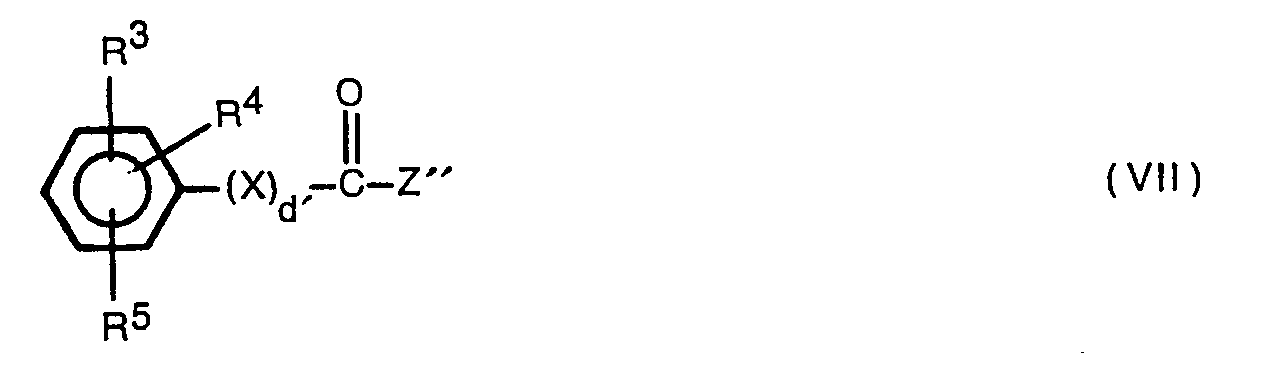
- the carbonyl-containing compounds (III) and (VII) may be prepared by oxidation of the corresponding alcohol, for example using pyridinium chlorochromate.
- the acid function in formula (II) may be prepared by hydrolysis of an ester, the ester being prepared by a conventional Wittig reation, using e.g. an aldehyde and ethoxycarbonylmethylene triphenylphosphorane.
- the alcohol from which compounds (III), (VII) and (V) are prepared may be synthesised by the reaction of an O-protected w-halo alcohol with a phenylacetylene, phenylbutadiyne or phenylbutenyne. Suitable protecting groups include the tetrahydro- pyranol group, which may be removed after the reaction of the alcohol with dihydropyran in the presence of an acid catalyst.
- the alcohol from which the compounds of formulae (III) and (VII) are prepared may be synthesised by reaction of a compound of formula (XV): where L is a leaving group (preferably iodo or bromo), with a compound of formula (XVI), the reaction being preferably catalysed by a palladium catalyst.
- L is a leaving group (preferably iodo or bromo)
- the compounds of formula (I) may be used for such purposes by application of the compounds themselves or in diluted form in known fashion as a dip, spray, lacquer, foam, dust, powder, aqueous ' suspension, paste, gel, shampoo, grease, combustible solid, vapourising mat, wettable powder, granule, aerosol, emulsifiable concentrate, oil suspensions, oil solutions, pressure-pack, impregnated article or pour-on formulation.
- Dip concentrates are not applied per se, but diluted with water and the animals immersed in a dipping bath containing the dip wash. Sprays may be applied by hand or by means of a spray race or arch.
- the animal may be saturated with the spray by means of high volume application or superficially coated with the spray by means of light or ultra low volume application.
- Aqueous suspensions may be applied to the animal in the same manner as sprays or dips. Dusts may be distributed over the animals by means of a powder applicator or incorporated in perforated bags attached to trees or rubbing bars.
- Pastes, shampoos and greases may be applied manually or distributed over the surface of an inert material against which animals rub and transfer the material to their skins.
- Pour-on formulations are dispensed as a unit or liquid of small volume on to the backs of animals such that all or most of the liquid is retained on the animals.
- the compounds of formula (I) or acid addition salts thereof may be formulated either as formulations ready for use on the animals or as formulations requiring dilution prior to application, but both types of formulation comprise a compound of formula (I) in intimate admixture with one or more carriers or diluents.
- the carriers may be liquid, solid or gaseous or comprise mixtures of such substances, and the compound of formula (I) may be present in a concentration of from 0.025 to 99% w/v depending upon whether the formulation requires further dilution.
- Dusts, powders and granules comprise the compound of formula (I) in intimate admixture with a powdered solid inert carrier for example suitable clays, kaolin, talc, mica, chalk, gypsum, vegetable carriers, starch and diatomaceous earths.
- a powdered solid inert carrier for example suitable clays, kaolin, talc, mica, chalk, gypsum, vegetable carriers, starch and diatomaceous earths.
- Sprays of a compound of formula (I) may comprise a solution in an organic solvent (e.g. those listed below) or an emulsion in water (dip wash or spray wash) prepared in the field from an emulsifiable concentrate (otherwise known as a water miscible oil) which may also be used for dipping purposes.
- the concentrate preferably comprises a mixture of the active ingredient, with or without an organic solvent and one or more emulsifiers.
- Solvents may be present within wide limits but preferably in an amount of from 0 to 90% w/v of the composition and may be selected from kerosene, ketones, alcohols, xylene, aromatic naphtha, and other solvents known in the formulating art.
- the concentration of emulsifiers may be varied within wide limits but is preferably in the range of 5 to 25% w/v and the emulsifiers are conveniently nonionic surface active agents include polyoxyalkylene esters of alkyl phenols and polyoxyethylene derivatives of hexitol anhydrides and anionic surface active agents including Na lauryl sulphate, fatty alcohol ether sulphates, Na and Ca salts of alkyl aryl sulphonates and alkyl sulphosuccinates.
- Wettable powders comprise an inert solid carrier, one or more surface active agents, and optionally stabilisers and/or anti-oxidants.
- Emulsifiable concentrates comprise emulsifying agents, and often an organic solvent, such as kerosene, ketones, alcohols, xylenes, aromatic naphtha, and other solvents known in the art.
- organic solvent such as kerosene, ketones, alcohols, xylenes, aromatic naphtha, and other solvents known in the art.
- Wettable powders and emulsifiable concentrates will normally contain from 5 to 95% by weight of the active ingredient, and are diluted, for example with water, before use.
- Lacquers comprise a solution of the active ingredient in an organic solvent, together with a resin, and optionally a plasticiser.
- Dip washes may be prepared not only from emulsifiable concentrates but also from wettable powders, soap based dips and aqueous suspensions comprising a compound of formula (I) in intimate admixture with a dispersing agent and one or more surface active agents.
- Aqueous suspensions of a compound of formula (I) may comprise a suspension in water together with suspending, stabilizing or other agents.
- Aqueous solutions may also be formed from acid addition salts of a compound of the formula (I). The suspensions or solutions may be applied per se or in a diluted form in known fashion.
- Greases may be prepared from vegetable oils, synthetic esters of fatty acids or wool fat together with an inert base such as soft paraffin. A compound of formula (I) is preferably distributed uniformly through the mixture in solution or suspension. Greases may also be made from emulsifiable concentrates by diluting them with an ointment base.
- Pastes and shampoos are also semi-solid preparations in which a compound of formula (I) may be present as a uniform dispersion in a suitable base such as soft or liquid paraffin or made on a non-greasy basis with glycerin, mucilage or a suitable soap.
- a suitable base such as soft or liquid paraffin or made on a non-greasy basis with glycerin, mucilage or a suitable soap.
- greases shampoos and pastes are usually applied without further dilution they should contain the appropriate percentage of the compound of formula (I) required for treatment.
- Aerosol sprays may be prepared as a simple solution of the active ingredient in the aerosol propellant and co-solvent such as halogenated alkanes and the solvents referred to above, respectively.
- Pour-on formulations may be made as a solution or suspension of a compound of formula (I) in a liquid medium which also contains a viscous oil to minimise spreading of the formulation on the surface of the animals.
- An avian or mammal host may also be protected against infestation of Acarine ectoparasites by means of carrying a suitably-moulded, shaped plastics article impregnated with a compound of formula (I).
- Such articles include impregnated collars, tags, bands, sheets and strips suitably attached to appropriate parts of the body.
- the concentration of the compound of formula (I) to be applied to an animal will vary according to the compound chosen, the interval between treatments, the nature of the formulation and the likely infestation, but in general 0.001 to 20.0% w/v and preferably 0.01 to 10% of the compound should be present in the applied formulation.
- the amount of the compound deposited deposited on an animal will vary according to the method of application, size of the animal, concentration of the compound in the applied formulation, factor by which the formulation is diluted and the nature of the formulation but in general will lie in the range of from 0.0001 % to 0.5% except for undiluted formulations such as pour-on formulations which in general will be deposited at a concentration in the range from 0.1 to 20.0% and preferably 0.1 to 10%.
- Dusts, greases, pastes and aerosol formulations are usually applied at random fashion as described above and concentration of 0.001 to 20% w/v of a compound of formula (I) in the applied formulation may be used.
- Insect pests include members of the orders Coleoptera (e.g. Anobium, Tribolium, Sitophilus, Anthonomus or Anthrenus spp.), Lepidoptera (e.g. Ephestia, Heliothis, Spodoptera or Tineola spp.), Diptera (e.g. Musca, Aedes, Culex, Glossina, Stomoxys, Haematobia, Tabanus, Hydrotaea, Lucilia, Chrysomia, Callitroga, Dermatobia, Hypoderma and Melophagus spp.), Phthiapteria (Malophaga e.g. Damaline spp. and Anoplura e.g.
- Coleoptera e.g. Anobium, Tribolium, Sitophilus, Anthonomus or Anthrenus spp.
- Lepidoptera e.g. Ephestia, Heliothis, Spodoptera or Tineola spp.
- Linognathus and Haematopinus spp may be Hemiptara (e.g. Aphis or Cimex spp.), Orthoptera (e.g. Schistocerca or Acheta spp.), Dictyoptera (e.g. Blatella, Periplaneta or Blatta spp.), Hymenoptera (e.g. Solenopsis or Monomorium spp.), Isoptera (e.g. Recticulitermes spp.), Siphonaptera (e.g. Ctenocephalides or Pulex spp.), Thysanura (e.g. Lepisma spp.), Dermaptera (e.g. Horticula spp.) ana Pscoptera (e.g. Peripsocus spp.).
- Hemiptara e.g. Aphis or Cimex spp.
- Orthoptera e.g. Schistocer
- Acarine pests include ticks, e.g. members of the genera Boophilus, Rhipicephalus; Amblyomma, Hyalomma, Ixodes, Haemaphysalis, Dermocentor and Anoncentor, and mites and manges such as Tetranychus, Psoroptes, Psorergates, Chorioptes and Demodex spp.
- the compounds exhibit killing and/or knockdown activity against arthropod pests, and can be used to control larval pests as well as adult pests.
- Compounds of the invention may be combined with one or more other active ingredients (for example pyrethroids, carbamates and organophosphates) and/or with attractants and the like. Furthermore, it has been found that the activity of the compounds of the invention may be enhanced by the addition of a synergist or potentiator, for example: one of the oxidase inhibitor class of synergists, such as piperonyl butoxide or NIA 16388 (a phosphonic acid, phenyl-, propyl- 2-propynyl ester); a second compound of the invention; or a pyrethroid pesticidal compound.
- a synergist or potentiator for example: one of the oxidase inhibitor class of synergists, such as piperonyl butoxide or NIA 16388 (a phosphonic acid, phenyl-, propyl- 2-propynyl ester); a second compound of the invention; or a pyreth
- the ratio of synergist to compound of formula (I) will be in the range 25:1 ⁇ 1:25 e.g. about 10: 1.
- Stabilisers for preventing any chemical degradation which may occur with the compounds of the invention include for example, antioxidants (such as tocopherols, butylhydroxyanisole and butylhydroxytoluene) and scavengers (such as epichlorhydrin).
- temperatures are in degrees Celsius
- ether means diethylether
- pb means piperonyl butoxide
- N-lsobutyl-7-phenylhept-2-en-6-ynamide (100 mg) and 5% Pd/BaS0 4 (17 ml) in dry methanol (3 ml) at 20°C was treated with hydrogen until hydrogen uptake was 85% of theoretical.
- the mixture was diluted with methanol, filtered and the solvent was removed from the filtrate. The residue was treated with ether and the solvent removed in a stream of nitrogen.
- Example 1 The product of Example 1 (100 mg) was dissolved in dry methanol (3 ml), 5% Pd/C (25 mg) was added, and the mixture was hydrogenated at atmospheric pressure and room temperature. The reaction mixture was diluted with methanol and filtered. The solvent was removed in vacuo, and ether was added then removed in a stream of nitrogen. The last traces of solvent were removed in vacuo to yield N-isobutyl-7-phenylhept-2E-enamide (68 mg). Refractive index 1.39.
- Thin layer chromatography (tic): silica gel F254 plates/ether, R f 0.39 (lined tank).
- High pressure liquid chromatography (hplc): C 8 -reverse phase/3:1 methanol:water at 10 ml min -1 at 2200 psi (15 170 kPa), retention time 76 mins.
- Nuclear magnetic resonance spectrum (NMR): 7.26, 6H, m, aromatic, NH; 6.57, 2H, m, H7, 3; 5.75, 1H, m, H6; 3.18, 2H, d of d, isobutyl; 2.51, 4H, m, H4, 5; 1.80, 1H, m, isobutyl; 0.95, 6H, d, isobutyl.
- 5-(4'-phenylphenyl)-4-pentyl-1-ol was prepared from 4-pentyn-1-ol and 4'-bromobiphenyl as in Example 15, and converted into 5-14'-phenylphenyl)-4-pentyn-1-al by the method of Example 9.
- N-isobutyl 7-(4'-phenylphenyl)-(2E)-hepten-6-ynamide was then prepared from 5-(4'-phenylphenyl)-4-pentyn-1-al and N-isobutylacetamidotriphenylphosphonium chloride as in Example 9 and semi-hydrogated as an Example 9 to give N-isobutyl 7-(4'-phenylphenyl)(2E,6Z)-heptadienamide.
- N-isobutyl 7-(3'-propenylphenyl)-(2E)-hepten-6-ynamide was prepared from 5-(3'-propenylphenyl)-4-pentyn-1-al and N-isobutyl acetamidotriphenylphosphonium chloride as in Example 9 and semi- hydrogenated as in Example 9 to give N-isobutyl 7-(3'-propenylphenyl)-(2E,6Z)-heptadienamide.
- Nuclear magnetic resonance spectrum (NMR): 7.17, 5H, m, aromatic; 6.65, 2H, m, H3, 3'; 5.95, 3H, m, NH, H2, 2'; 4.25, 4H, m, H4, 1'; 3.15, 2H, d of d, isobutyl; 1.77, 1H, m, isbutyl; 0.91, 6H, d, isobutyl.
- Nuclear magnetic resonance spectrum (NMR): 7.22, 5H, m, aromatic; 6.73, 1H, m, H3; 6.33, 1H, t, H7; 5.85, 2H, m, NH, H2; 3.15, 2H, d of d, isobutyl; 2.35, 4H, m, H4, 5; 1.87, 3H, t, Me; 1.75, 1H, m, isobutyl; 0.94, 6H, d, isobutyl.
- Nuclear magnetic resonance spectrum (NMR): 7.16, 5H, m, aromatic; 6.68, 1H, m, H3; 6.33, 2H, m, H2, 7; 5.58, 1H, m, H6; 3.44, 4H, m, NCH 2 ; 2.31, 4H, m, H4, 5; 1.53, 6H, m, ring.
- Nuclear magnetic resonance spectrum (NMR): 7.19, 5H, m, aromatic; 6.71, 3H, m, aromatic; 6.58, 1H, m, H3; 6.32, 1H, m, H7; 5.77, 1H, d, H2; 3.82, 6H, s, OMe; 3.52, 2H, m, NH, CH 2 ; 2.78, 2H, m, benzyl; 2.33, 4H, m, H4,5.
- Nuclear magnetic resonance spectrum (NMR): 7.17, 5H, m, aromatic; 1H, NH; 6.67, 1H, m, H3; 6:33, 1H, m, H7; 5.80,1 H, d, H2; 5.52, 1 H, m, H6; 2.30, 4H, m, H4, 5; 0.74, 1 H, m, cyclopropyl; 0.58, 4H, m, cyclopropyl.
- Nuclear magnetic resonance spectrum (NMR): 7.19, 5H, m, aromatic; 6.69, 1H, m, H3; 6.46, 2H, m, H7, NH; 5.83, 1H, d, H2; 5.50, 1 H, m, H6; 4.61, 1H, m, NH CH; 3.67, 3H, s, OMe; 2.34, 4H, m, H4, H5; 1.74, 1H, m, CH; 0.93, 6H, d, 2Me.
- Nuclear magnetic resonance spectrum (NMR): 7.20, 5H, m, aromatic; 6.7, 2H, m, H3': CH 2 ; 6.44, 1H, m, H7; 6.23, 1H, NH; 5.78, 3H, m, H2, 6; CH 2 ; 4.10, 2H, d, NH, CH 2 ; 2.33, 4H, m, H4, 5.
- Phenyl N-phenylphosphoramido chloridate (0.6 g, 2.23 mmol) was added to a stirred solution of 9-phenylnona-2(E),8(E)-en-6-ynoic acid (0.5 g, 2.21 mmol) in dry dichloromethane (20 ml) containing dry triethylamine (0.5 ml) under nitrogen. After stirring for 1 hour, hexamethyleneimine (0.22 g, 2.22 mmol) in dry dichloromethane (20 ml) containing dry triethylamine (0.5 ml) was added and the mixture stirred for 18 hours.
- Nuclear magnetic resonance spectrum (NMR): 7.32, 5H, m, aromatic; 6.77, 1 H, m, H3; 5.97, 3H, m, H2, H8NH; 3.15, 2H, d of d, isobutyl; 2.53, 4H, m, H4, H5; 1.76, 1H, m, isobutyl; 0.96, 6H, d, isobutyl.
- the activity of compounds of the invention against mosquito larvae was demonstrated by the exposure of third instar larvae of Aedes aegyptito an aqueous suspension of the compound under test and synergist (piperonyl butoxide) in a 1:5 ratio. Mortality was assessed after 18 hours.
- the activity of a compound of the invention against adult mosquitoes was demonstrated by application to female Aedes aegypti of a solution of the compound under test and a synergist (piperonyl butoxide). Knockdown was assessed after 1 hour and mortality after 24 hours.
- the compound was supplied as a 50 mg/litre solution in DMSO:Acetone (1:1). Administration of the compound was by means of a microapplicator which was preset to deliver 0.2 ⁇ l of solution. The compound in solution was injected into fully engorged female Boophilus microplus, susceptible strain, at a site just lateral to the mouthparts at the rate of 10 pg/tick. Reducing the concentration reduced the dose delivered.
- the compound was supplied as a 100 mg/litre solution in Esso 200/wetters. Dilution with water gave the required concentrations.
- Groups of 20 fully engorged female B.microplus susceptible strain were placed in a mesh basket which was immersed in the test dilution for 10 minutes. After immersion the ticks were removed, dried and then fixed to double-sided adhesive tape which was itself affixed to white plastic boards. The boards holding the ticks were held at 24°C and 85% RH for 14 days.
- Female houseflies (Musca domestica) were treated with solutions of compounds of Formula I and a potential synergist both dissolved in butanone, the flies having been treated one hour earlier with 6 pg piperonyl butoxide (PB).
- PB piperonyl butoxide
- the dose required to prevent flight of half the flies 10 minutes after application of the compound was determined and the factor of potentiation (FOP) was calculated by the Equation of the Harmonic Mean for mixtures of the compounds.
- GABA gamma-aminobutyric acid
- 3,4-methylenedioxy compounds are related to certain natural compounds known to be insecticidal, for example piperine (Agric. Biol. Chem. 43(7) 1609-1611, 1979).
Landscapes
- Chemical & Material Sciences (AREA)
- Organic Chemistry (AREA)
- Chemical Kinetics & Catalysis (AREA)
- Agricultural Chemicals And Associated Chemicals (AREA)
- Organic Low-Molecular-Weight Compounds And Preparation Thereof (AREA)
Claims (17)




Priority Applications (1)
| Application Number | Priority Date | Filing Date | Title |
|---|---|---|---|
| AT83110267T ATE58895T1 (de) | 1982-10-15 | 1983-10-14 | Ungesaettigte aromatische amide als schaedlingsbekaempfungsmittel. |
Applications Claiming Priority (6)
| Application Number | Priority Date | Filing Date | Title |
|---|---|---|---|
| GB8229550 | 1982-10-15 | ||
| GB8229550 | 1982-10-15 | ||
| GB8236346 | 1982-12-21 | ||
| GB8236346 | 1982-12-21 | ||
| GB838315566A GB8315566D0 (en) | 1982-10-15 | 1983-06-07 | Pesticides |
| GB8315566 | 1983-06-07 |
Publications (3)
| Publication Number | Publication Date |
|---|---|
| EP0111105A2 EP0111105A2 (fr) | 1984-06-20 |
| EP0111105A3 EP0111105A3 (en) | 1984-10-31 |
| EP0111105B1 true EP0111105B1 (fr) | 1990-12-05 |
Family
ID=27261797
Family Applications (1)
| Application Number | Title | Priority Date | Filing Date |
|---|---|---|---|
| EP83110267A Expired EP0111105B1 (fr) | 1982-10-15 | 1983-10-14 | Amides insaturées aromatiques comme pesticides |
Country Status (8)
| Country | Link |
|---|---|
| US (2) | US4855086A (fr) |
| EP (1) | EP0111105B1 (fr) |
| AU (1) | AU560016B2 (fr) |
| CA (1) | CA1235123A (fr) |
| DE (1) | DE3382048D1 (fr) |
| DK (1) | DK474883A (fr) |
| NZ (1) | NZ205972A (fr) |
| PH (1) | PH21182A (fr) |
Families Citing this family (27)
| Publication number | Priority date | Publication date | Assignee | Title |
|---|---|---|---|---|
| EP0143593B1 (fr) * | 1983-11-21 | 1992-01-02 | National Research Development Corporation | Amides d'acides aryl(oxy))alcadiénoiques, leurs intermédiaires et compositions pesticides les contenants |
| US4713200A (en) * | 1984-04-03 | 1987-12-15 | Burroughs Wellcome Co. | Pesticidal compounds |
| BR8600661A (pt) * | 1985-02-18 | 1986-10-29 | Wellcome Found | Processo para preparar um composto quimico,composicao pesticida e processo para combater pragas |
| GB8504097D0 (en) * | 1985-02-18 | 1985-03-20 | Wellcome Found | Pesticidal compounds |
| GB2178031B (en) * | 1985-06-10 | 1989-07-26 | Procter & Gamble | Phenylacetic acid amides having anti-inflammatory and analgesic activity |
| GB8516607D0 (en) * | 1985-07-01 | 1985-08-07 | Wellcome Found | Pesticidal compounds |
| GB8531072D0 (en) * | 1985-12-17 | 1986-01-29 | Wellcome Found | Pesticidal compounds |
| US5162367A (en) * | 1986-05-21 | 1992-11-10 | The Wellcome Foundation Limited | Pesticidal compounds |
| GB8628467D0 (en) * | 1986-11-28 | 1987-01-07 | Wellcome Found | Pesticidal compounds |
| US5380732A (en) * | 1986-11-28 | 1995-01-10 | Roussel-Uclaf | Pesticidal compounds |
| GB8726735D0 (en) * | 1987-11-14 | 1987-12-16 | Wellcome Found | Pesticidal compounds |
| DE68924199T2 (de) * | 1988-06-09 | 1996-02-08 | Roussel Uclaf | Arylfluoralkenamide und ihre Verwendung als Schädlingsbekämpfungsmittel. |
| US5229424A (en) * | 1988-11-16 | 1993-07-20 | The Wellcome Foundation Limited | Pesticidal cyclopropyl 2,4-dieneamides |
| US5202356A (en) * | 1988-11-16 | 1993-04-13 | The Wellcome Foundation Limited | Pesticidal cyclopropyl-2,4-dieneamides |
| GB8826760D0 (en) * | 1988-11-16 | 1988-12-21 | Wellcome Found | Pesticides |
| US5091420A (en) * | 1989-03-07 | 1992-02-25 | Burroughs Wellcome Co. | Method of combatting pests using N-(cyclo)alkyl-5-substituted-2,4-thiopentadienamide compounds |
| JP3116364B2 (ja) * | 1989-10-02 | 2000-12-11 | 萬有製薬株式会社 | エンイン誘導体の製造法 |
| JPH07103001B2 (ja) * | 1989-10-19 | 1995-11-08 | 高砂香料工業株式会社 | ダニ駆除剤 |
| US8026280B2 (en) * | 2001-03-27 | 2011-09-27 | Errant Gene Therapeutics, Llc | Histone deacetylase inhibitors |
| US7312247B2 (en) | 2001-03-27 | 2007-12-25 | Errant Gene Therapeutics, Llc | Histone deacetylase inhibitors |
| EP2243539A3 (fr) * | 2002-04-05 | 2011-06-01 | University Of South Alabama | Liquides ioniques fonctionnalisés et leurs procédés d'utilisation |
| AU2005256799B2 (en) * | 2004-06-23 | 2007-05-31 | Ye Olde Upton Delicatessen | Method and trap for controlling insect pests |
| GB2415380B (en) * | 2004-06-23 | 2006-05-17 | Alan James Julier | Method and trap for controlling insect pests |
| PT2231633E (pt) | 2007-12-20 | 2014-01-20 | Pharma Mar Sa | Compostos antitumorais |
| US20150005348A1 (en) * | 2012-02-10 | 2015-01-01 | Sumitomo Chemical Company, Limited | Amide compound and use thereof for pest control |
| US20150045409A1 (en) * | 2012-02-10 | 2015-02-12 | Sumitomo Chemical Company, Limited | Amide compound and use thereof for pest control |
| HRP20231233T1 (hr) | 2017-04-27 | 2024-01-19 | Pharma Mar, S.A. | Antitumorski spojevi |
Family Cites Families (7)
| Publication number | Priority date | Publication date | Assignee | Title |
|---|---|---|---|---|
| US2484295A (en) * | 1945-04-27 | 1949-10-11 | Lowell B Kilgore | Nu-substituted oxyacetamide compounds and insect control compositions |
| FR1080265A (fr) * | 1952-07-01 | 1954-12-08 | Nouvelles amides et insectifuges, et procédé pour leur préparation | |
| SE377113B (fr) * | 1971-05-15 | 1975-06-23 | Ciba Geigy Ag | |
| SU681044A1 (ru) * | 1975-09-04 | 1979-08-25 | Институт медицинской паразитологии и тропической медицины им.Е.И.Марциновского | Эфиры или амиды 3-метил-3-(4-метилпентен-3-ил)-фенилпропен-2-овой кислоты как инсектициды с ювенильной активностью |
| JPS5712222A (en) * | 1980-06-30 | 1982-01-22 | Mitsubishi Electric Corp | Cooker |
| JPS57106651A (en) * | 1980-12-23 | 1982-07-02 | Ono Pharmaceut Co Ltd | 1,4-disubstituted benzene compound, its preparation, and inhibitor against leukotriene biosynthesis comprising it as active ingredient |
| JPS57212150A (en) * | 1981-06-24 | 1982-12-27 | Sumitomo Chem Co Ltd | Diolefin amides, their preparations, insecticides and acaricides containing them |
-
1983
- 1983-10-11 US US06/540,801 patent/US4855086A/en not_active Expired - Fee Related
- 1983-10-14 DK DK474883A patent/DK474883A/da not_active Application Discontinuation
- 1983-10-14 CA CA000438998A patent/CA1235123A/fr not_active Expired
- 1983-10-14 DE DE8383110267T patent/DE3382048D1/de not_active Expired - Fee Related
- 1983-10-14 EP EP83110267A patent/EP0111105B1/fr not_active Expired
- 1983-10-14 PH PH29699A patent/PH21182A/en unknown
- 1983-10-14 NZ NZ205972A patent/NZ205972A/en unknown
- 1983-10-14 AU AU20202/83A patent/AU560016B2/en not_active Ceased
-
1988
- 1988-06-08 US US07/205,572 patent/US4931469A/en not_active Expired - Fee Related
Also Published As
| Publication number | Publication date |
|---|---|
| US4855086A (en) | 1989-08-08 |
| DK474883D0 (da) | 1983-10-14 |
| PH21182A (en) | 1987-08-12 |
| EP0111105A2 (fr) | 1984-06-20 |
| AU560016B2 (en) | 1987-03-26 |
| AU2020283A (en) | 1984-04-19 |
| CA1235123A (fr) | 1988-04-12 |
| US4931469A (en) | 1990-06-05 |
| DK474883A (da) | 1984-04-16 |
| NZ205972A (en) | 1986-07-11 |
| DE3382048D1 (de) | 1991-01-17 |
| EP0111105A3 (en) | 1984-10-31 |
Similar Documents
| Publication | Publication Date | Title |
|---|---|---|
| EP0111105B1 (fr) | Amides insaturées aromatiques comme pesticides | |
| DE3139976C2 (fr) | ||
| SU1442067A3 (ru) | Способ получени производных 2-арилпропилового эфира или тиоэфира | |
| SE463455B (sv) | Aromatiska alkanderivat, foerfarande foer deras framstaellning samt insekticid eller akaricid innehaallande dem | |
| EP0211598B1 (fr) | Composés pesticides | |
| EP0194764B1 (fr) | Composés pesticides | |
| IL32834A (en) | Substituted chrysanthemumates and pesticides containing them | |
| EP0228222B1 (fr) | Dihalovinylalkenylamides pesticides | |
| US4713200A (en) | Pesticidal compounds | |
| KR0140890B1 (ko) | 살충제 | |
| US4942173A (en) | Pesticidal compounds | |
| US4123526A (en) | Thionophosphate insecticide activators | |
| US4985582A (en) | Pesticidal compounds | |
| EP0043187A1 (fr) | Compositions contenant un ester d'acide cyclobutane-carboxylique ayant des propriétés pesticides | |
| EP0279698A2 (fr) | Composés pesticides | |
| EP0251472B1 (fr) | Amides lipides non-saturés avec activité pesticide | |
| DD275604A5 (de) | Insektizide oder akarizide zusammensetzung | |
| EP0225011A1 (fr) | Amides pesticides d'acides (1'-naphtyloxy)-alcène (ou -alcydiène)-carboxyliques | |
| EP0209289B1 (fr) | Amides thiocarboxyliques insaturées comme pesticides | |
| AU596794B2 (en) | Pesticidal compounds | |
| AP66A (en) | Pestcidal compounds. | |
| CA1257282A (fr) | Produits intermediaires pour la preparation de pesticides | |
| JPH0439460B2 (fr) | ||
| AU595030B2 (en) | Pesticidal compositions | |
| US3655654A (en) | Diphenylethylene derivatives |
Legal Events
| Date | Code | Title | Description |
|---|---|---|---|
| PUAI | Public reference made under article 153(3) epc to a published international application that has entered the european phase |
Free format text: ORIGINAL CODE: 0009012 |
|
| AK | Designated contracting states |
Designated state(s): AT BE CH DE FR GB IT LI LU NL SE |
|
| PUAL | Search report despatched |
Free format text: ORIGINAL CODE: 0009013 |
|
| AK | Designated contracting states |
Designated state(s): AT BE CH DE FR GB IT LI LU NL SE |
|
| 17P | Request for examination filed |
Effective date: 19841128 |
|
| ITF | It: translation for a ep patent filed | ||
| RAP3 | Party data changed (applicant data changed or rights of an application transferred) |
Owner name: THE WELLCOME FOUNDATION LIMITED |
|
| GRAA | (expected) grant |
Free format text: ORIGINAL CODE: 0009210 |
|
| AK | Designated contracting states |
Kind code of ref document: B1 Designated state(s): AT BE CH DE FR GB IT LI LU NL SE |
|
| PG25 | Lapsed in a contracting state [announced via postgrant information from national office to epo] |
Ref country code: SE Free format text: THE PATENT HAS BEEN ANNULLED BY A DECISION OF A NATIONAL AUTHORITY Effective date: 19901205 Ref country code: NL Effective date: 19901205 Ref country code: FR Effective date: 19901205 Ref country code: AT Effective date: 19901205 |
|
| REF | Corresponds to: |
Ref document number: 58895 Country of ref document: AT Date of ref document: 19901215 Kind code of ref document: T |
|
| REF | Corresponds to: |
Ref document number: 3382048 Country of ref document: DE Date of ref document: 19910117 |
|
| EN | Fr: translation not filed | ||
| NLV1 | Nl: lapsed or annulled due to failure to fulfill the requirements of art. 29p and 29m of the patents act | ||
| PLBE | No opposition filed within time limit |
Free format text: ORIGINAL CODE: 0009261 |
|
| STAA | Information on the status of an ep patent application or granted ep patent |
Free format text: STATUS: NO OPPOSITION FILED WITHIN TIME LIMIT |
|
| PG25 | Lapsed in a contracting state [announced via postgrant information from national office to epo] |
Ref country code: GB Effective date: 19911014 |
|
| PG25 | Lapsed in a contracting state [announced via postgrant information from national office to epo] |
Ref country code: LU Free format text: LAPSE BECAUSE OF NON-PAYMENT OF DUE FEES Effective date: 19911031 Ref country code: LI Effective date: 19911031 Ref country code: CH Effective date: 19911031 Ref country code: BE Effective date: 19911031 |
|
| 26N | No opposition filed | ||
| BERE | Be: lapsed |
Owner name: THE WELLCOME FOUNDATION LTD Effective date: 19911031 |
|
| GBPC | Gb: european patent ceased through non-payment of renewal fee | ||
| REG | Reference to a national code |
Ref country code: CH Ref legal event code: PL |
|
| PG25 | Lapsed in a contracting state [announced via postgrant information from national office to epo] |
Ref country code: DE Effective date: 19920701 |