EP0111298A2 - Düngemittelsprays - Google Patents
Düngemittelsprays Download PDFInfo
- Publication number
- EP0111298A2 EP0111298A2 EP83112279A EP83112279A EP0111298A2 EP 0111298 A2 EP0111298 A2 EP 0111298A2 EP 83112279 A EP83112279 A EP 83112279A EP 83112279 A EP83112279 A EP 83112279A EP 0111298 A2 EP0111298 A2 EP 0111298A2
- Authority
- EP
- European Patent Office
- Prior art keywords
- fertilizer
- weight
- contain
- fertilizer according
- blowing agent
- Prior art date
- Legal status (The legal status is an assumption and is not a legal conclusion. Google has not performed a legal analysis and makes no representation as to the accuracy of the status listed.)
- Granted
Links
Classifications
-
- C—CHEMISTRY; METALLURGY
- C05—FERTILISERS; MANUFACTURE THEREOF
- C05G—MIXTURES OF FERTILISERS COVERED INDIVIDUALLY BY DIFFERENT SUBCLASSES OF CLASS C05; MIXTURES OF ONE OR MORE FERTILISERS WITH MATERIALS NOT HAVING A SPECIFIC FERTILISING ACTIVITY, e.g. PESTICIDES, SOIL-CONDITIONERS, WETTING AGENTS; FERTILISERS CHARACTERISED BY THEIR FORM
- C05G5/00—Fertilisers characterised by their form
- C05G5/20—Liquid fertilisers
- C05G5/27—Dispersions, e.g. suspensions or emulsions
Definitions
- Fertilizer sprays are suitable for the direct foliar fertilization of plants.
- the direct nutrient supply via the leaves creates a particularly vigorous growth and gives the plant a fresh, lively appearance. There are therefore advantages, particularly when used for fertilizing ornamental plants, since the external appearance of the plant plays a special role here.
- Fertilizer sprays are already known from the Australian patent 515 436. However, these have disadvantages in use: in particular, the fertilizer formulations mentioned there have low stabilities.
- the present invention therefore relates to fertilizers for spraying in the form of aerosols or sprays consisting of an aqueous phase containing the plant nutrients, an organic phase which does not contain phytotoxic organic solvents, and a propellant, characterized in that they contain one or more (C Contain 2 -C 12 ) alkane polyols and one or more surface-active substances and swellable aluminum silicates.
- a defoamer for example a silicone-based defoamer such as the defoamer SE 2 from Wacker Chemie, can be added.
- the fertilizer according to the invention can be present as an oil-in-water or water-in-oil emulsion.
- Particularly suitable (C 2 -C 12 ) alkane polyols are (C 2 -C 3 ) alkane diols or (C3-C5) alkane triols, preferably ethylene glycol and glycerol. These have a high plant tolerance and cause an additional leaf gloss effect.
- the surface-active substances to be used according to the invention are poly (C 2 -C 3 ) alkylene glycols, poly (C 2 -C 3 ) alkylene glycol mono (C 1 -C 10 ) alkyl ethers such as polypropylene glycol monobutyl ether, optionally ethoxylated (C 8 -C 12 ) -alkylphenols, condensation products from optionally alkylated phenols, such as phenol, cresol with formaldehyde and / or bisulfite salts, such as sodium or potassium bisulfite, (C 6 -C 18 ) alkyl sulfonic acids, ethoxylated oleic acids, such as ethoxylated castor oil, in particular the products of (R.
- Emulsogen E L series from Hoechst AG optionally ethoxylated sorbitan monooleates such as the (R) Tween and (R) Span types from Atlas Chemie, in particular (R) Tween 80 (polyethoxylated sorbitan monooleate) and (R) Span 80 (sorbitan monooleate) or mixtures of anionic surfactants with nonionic surfactants such as the (R) Atlas types from Atlas-Chemie, in particular (R) Atlas 4856.
- ethoxylated sorbitan monooleates such as the (R) Tween and (R) Span types from Atlas Chemie, in particular (R) Tween 80 (polyethoxylated sorbitan monooleate) and (R) Span 80 (sorbitan monooleate) or mixtures of anionic surfactants with nonionic surfactants such as the (R) Atlas types from Atlas-Chemie, in particular (R) Atlas 4856.
- polyethylene glycols poly. propylene glycol monobutyl ether, the optionally ethoxylated sorbitan monooleates and mixtures of anionic surfactants with nonionic surfactants.
- the organic solvents (C 10 -C 14 ) are paraffins, high-boiling petroleum fractions with a low aromatic content, such as (R) BP-n paraffin, Isopar G (bp: 155 ° -173 ° C), Isopar H (bp: 173-190 ° C) or Essobayol 90 (bp: 255 ° -380 ° C) and also vegetable oils such as castor oil, sunflower oil, cottonseed oil or peanut oil.
- Swellable minerals of the bentonite type such as the commercial products (R) Bentone 34, (R) Bentone 27 or (R) Baragel from Kronos-Titan GmbH are used as aluminum silicates. These are organic and / or. added inorganic phase and give the fertilizer according to the invention a particular stability.
- all conventional water-soluble fertilizers of organic or inorganic nature can be used as plant nutrients.
- the specific combination of nutrients can be varied depending on the purpose of the fertilizer spray to be used.
- fertilizers based on special trace elements such as iron, manganese, copper, zinc, boron, molybdenum can be used.
- Commercially available finished fertilizer solutions can be used, such as those from the (R) Complesal fluid series from Hoechst AG.
- such solutions contain salts of the elements nitrogen, phosphorus, potassium and the trace elements iron, copper, zinc, magnesium, molybdenum, manganese, cobalt and boron with a nitrogen content of 3 to 26% by weight, a phosphorus content of 2 to 12% by weight. -% and a potassium content of 4 to 10 wt .-%.
- the usual agents such as propane-butane mixtures, fluorocarbons, dimethyl ether and nitrogen can be used as blowing agents, but in particular propane-butane mixtures are used, the ratio of propane to butane being in the range from 5:95 to 25:75 lies.
- the spray can internal pressure can be between 0.1 and 12 bar.
- the agents according to the invention are further characterized in that they contain 20 to 40% by weight, in particular 25 to 35% by weight, particularly preferably 33 to 37% by weight of water, 2 to 20% by weight, in particular 2-10 wt .-% solvent, 30-60 wt .-%, in particular 35-47 G ew .-% blowing agent, from 0.1 to 15 wt .-%, especially 0.2 to 11 E ew .-% surfactants + ( C2-C12) alkane polyol, 0.001 to 5% by weight, in particular 0.01 to 3% by weight, particularly preferably 0.05 to 0.5% by weight of aluminum silicate and 0.05 to 8% by weight % Contain plant nutrients.
- the present invention also relates to a process for the preparation of the fertilizer described above, characterized in that the aqueous phase with the organic phase with the addition of aluminum silicates using high shear forces in the range from 10 to 7000 sec -1, in particular in the range stirred from 50-2000 sec -1 and then adds the blowing agent.
- a high-speed turbulence stirrer is expediently used for stirring.
- the organic phase is advantageously first mixed with the aluminum silicate and then the aqueous phase is added with vigorous stirring. The mixture is stirred until a clearly visible phase reversal of the oil-in-water emulsion to a water-in-oil emulsion occurs. The mass is transferred from a low-viscosity to a higher-viscosity, creamy state.
- the alkane polyols and surface-active substances according to the invention can be added to the aqueous and / or organic phase before the mixing process described. The resulting water-in-oil emulsion has excellent stability.
- the fertilizer formulation thus produced is filled into commercially available spray cans with internal lacquer.
- Commercially available valve systems are used, preferably those in which the propellant gas can be filled into the spray can via the valve head.
- the valve system (R) Aguasol from Deutsche Rezisions-Ventil GmbH is particularly suitable.
- the fertilizer formulations according to the invention thus produced have surprisingly high storage stabilities in the temperature range from 0 ° to + 50 ° C.
- the fact that there is no phase separation during storage is of great technical advantage; this ensures, among other things, a very even distribution of the fertilizer on the leaf surface.
- composition of the fertilizer formulation according to the invention can be atomized particularly finely. This ensures a very good distribution of the fertilizer on the surface of the plant. The effect of the fertilizer occurs very quickly because the fertilizer penetrates the plant very easily. No residues can be observed on the plant surface.
- Organic additives such as leaf gloss, antioxidants, fragrances or pesticides can be added to the agents according to the invention without their advantageous properties being lost.
- compositions of agents according to the invention given below by way of example, serve to explain the invention without restricting it.
- a mixture of surface-active substance (approx. Half of the total amount) aluminum silicate and the organic solvent was homogenized in a vessel by stirring.
- the mixture (organic phase) was stirred for a further 15 minutes.
- the aqueous phase was prepared in a second container by successively stirring in surface-active substance (approx. Half of the total amount), (C 2 -C 12 ) aluminum polyol, (R) complesal fluid nutrient and defoamer into the corresponding amount of water.
- the organic phase was added to the aqueous phase with gentle stirring.
- the two phases were then mixed vigorously with one another using a turbulent stirrer until a water-in-oil emulsion resulted from the oil-in-water emulsion. Once the K ontrollprobe no phase separation showed on standing, the stirring was terminated.
- the concentrate obtained was placed in spray cans and the blowing agent was introduced.
- the defoamer can also be substituted by water without the properties essential to the invention being lost.
- the percentages are percentages by weight.
Landscapes
- Chemical & Material Sciences (AREA)
- Dispersion Chemistry (AREA)
- Life Sciences & Earth Sciences (AREA)
- Pest Control & Pesticides (AREA)
- Organic Chemistry (AREA)
- Fertilizers (AREA)
- Agricultural Chemicals And Associated Chemicals (AREA)
Abstract
Description
- Düngemittelsprays sind zur direkten Blattdüngung von Pflanzen geeignet. Die direkte Nährstoffversorgung über die Blätter erzeugt ein besonders kräftiges Wachstum und bewirkt ein frisches lebhaftes, Aussehen der Pflanze. Es ergeben sich somit insbesondere bei der Anwendung zur Düngung von Zierpflanzen Vorteile, da die äußere Erscheinung der Pflanze hier eine besondere Rolle spielt.
- Düngemittelsprays sind bereits aus der australischen Patentschrift 515 436 bekannt. Diese besitzen jedoch Nachteile bei der Anwendung: insbesondere besitzen diese dort angeführten Düngemittelformulierungen niedrige Stabilitäten.
- Gegenstand der vorliegenden Erfindung sind daher Düngemittel zum Versprühen in Form von Aerosolen bzw. Sprays bestehend aus einer wäßrigen, die Pflanzennährstoffe enthaltenden Phase, einer organischen, nicht phytotoxische organische Lösungsmittel enthaltenden Phase, und einem Treibmittel, dadurch gekennzeichnet, daß sie ein oder mehrere (C2-C12)-Alkanpolyole sowie ein oder mehrere oberflächenaktive Substanzen und quellfähige Aluminium-Silikate enthalten.. Zusätzlich kann noch ein Entschäumer beispielsweise ein Entschäumer auf Silikonbasis wie der Entschäumer SE 2 der Firma Wacker Chemie zugegeben werden.
- Das erfindungsgemäße Düngemittel kann hierbei als öl-in-Wasser oder Wasser-in-öl-Emalsion vorliegen.
- Als (C2-C12)-Alkanpolyole kommen insbesondere (C2-C3)-Alkandiole oder (C3-C5)Alkantriole in Betracht, bevorzugt Äthylenglykol und Glycerin. Diese besitzen eine hohe Pflanzenverträglichkeit und bewirken einen zusätzlichen Blattglanzeffekt.
- Die erfindungsgemäß einzusetzenden oberflächenaktiven Substanzen sind Poly(C2-C3)alkylenglykole, Poly(C2-C3)-alkylenglykol-mono(C1-C10)alkyl - ether wie Polypropylenglykol-monobutylether, gegebenenfalls ethoxylierte (C8-C12)-Alkylphenole, Kondensationsprodukte aus gegebenenfalls alkylierten Phenolen, wie Phenol, Kresol mit Formaldehyd und/oder Bisulfitsalzen, wie Natrium- oder Kaliümbisulfit, (C6-C18)Alkylsulfonsäuren, ethoxylierte ölsäuren, wie ethoxyliertes Ricinusöl, insbesondere die Produkte der (R)Emulsogen EL-Reihe der Firma Hoechst AG, ggf. ethoxylierte Sorbitan-Monooleate wie die (R)Tween und (R)Span-Typen der Firma Atlas Chemie, insbesondere (R)Tween 80 (polyethoxyliertes Sorbitan Monooleat) und (R) Span 80 (Sorbitan Monooleat) oder Gemische von anionaktiven Tensiden mit nichtionogenen Tensiden wie die (R) Atlas-Typen der Atlas-Chemie, insbesondere (R)Atlas 4856.
- Bevorzugt unter diesen sind Polyethylenglykole, Poly- . propylenglykolmonobutylether, die ggf. ethoxylierten Sorbitan Monooleate und Mischungen von anionaktiven Tensiden mit nichtionogenen Tensiden.
- Für die organische Phase finden als organische Lösungsmittel (C10-C14)Paraffine, hochsiedende Petroleumfraktionen mit niedrigem Aromatengehalt, wie (R)BP-n Paraffin, Isopar G (Kp: 155°-173°C), Isopar H (Kp: 173-190°C) oder Essobayol 90 (Kp: 255°-380°C) und auch pflanzliche Öle wie Ricinusöl, Sonnenblumenöl, Baumwollsaatöl oder Erdnußöl Verwendung.
- Als Aluminium-Silikate werden quellfähige Mineralien vom Bentonit-Typ wie die Handelsprodukte (R) Bentone 34, (R) Bentone 27 oder (R) Baragel der Firma Kronos-Titan GmbH eingesetzt. Diese werden der organischen und/oder. anorganischen Phase zugegeben und verleihen dem erfindungsgemäßen Düngemittel eine.besondere Stabilität.
- Als Pflanzennährstoffe können prinzipiell alle herkömmlichen wasserlöslichen Düngemittel organischer oder anorganischer Natur eingesetzt werden. Die spezifische Kombination an Nährstoffen kann je nach dem Zweck des zu verwendenden Düngemittelsprays variiert werden. So können beispielsweise Düngemittel auf Basis spezieller Spurenelemente wie Eisen, Mangan, Kupfer, Zink, Bor, Molybdän eingesetzt werden. Es können handelsübliche fertige Düngemittellösungen verwendet werden wie solche der (R) Complesal fluid-Reihe der Firma Hoechst AG. Beispielsweise enthalten solche Zösungen Salze der Elemente Stickstoff, Phosphor, Kalium und der Spurenelemente Eisen, Kupfer, Zink, Magnesium, Molybdän, Mangan, Kobalt und Bor bei einem Stickstoffgehalt von 3 bis 26 Gew.-%, einem Phosphorgehalt von 2 bis 12 Gew.-% und einem von Kaliumgehalt von 4 bis 10 Gew.-%.
- Als Treibmittel können prinzipiell die üblichen Mittel verwendet werden wie bspw. Propan-Butan-Gemische, Fluorkohlenwasserstoffe, Dimethylether und Stickstoff, insbesondere jedoch werden Propan-Butan-Gemische benutzt, wobei das Verhältnis Propan zu Butan im Bereich von 5:95 bis 25:75 liegt.
- Der Spraydoseninnendruck kann zwischen 0,1 und 12 bar betragen.
- Die erfindungsgemäßen Mittel sind weiterhin dadurch gekennzeichnet, daß sie 20 bis 40 Gew.-%, insbesondere 25 bis 35 Gew.-%, besonders bevorzugt 33 bis 37 Gew.-% Wasser, 2 bis 20 Gew.-%, insbesondere 2 - 10 Gew.-% Lösungsmittel, 30-60 Gew.-%,insbesondere 35-47 Gew.-% Treibmittel, 0,1 bis 15 Gew.-%, insbesondere 0,2 bis 11 Gew.-% oberflächenaktive Substanzen + (C2-C12)Alkanpolyol, 0,001 bis 5 Gew.-%, insbesondere 0,01 bis 3 Gew.-%, besonders bevorzugt 0,05 bis 0,5 Gew.-% Aluminium-Silikat und 0,05 bis 8 Gew.-% Pflanzennährstoffe enthalten.
- Gegenstand der vorliegenden Erfindung ist auch ein Verfahren zur Herstellung des oben beschriebenen Düngemittels, dadurch gekennzeichnet, daß man die wäßrige Phase mit der organischen Phase unter Zusatz von Aluminium-Silikaten unter Aufwendung von hohen Scherkräften im Bereich von 10 bis 7000 sec-1 insbesondere im Bereich von 50-2000 sec-1 verrührt und anschließend das Treibmittel hinzugibt.
- Zum Verrühren verwendet man zweckmäßigerweise einen hochtourigen Turbulenzrührer. Vorteilhaft wird die organische Phase zuerst mit dem Aluminium-Silikat vermischt und anschließend unter heftigem Rühren die wäßrige Phase zugegeben. Es wird solange gerührt bis eine deutlich sichtbare Phasenumkehr der Emulsion öl-in-Wasser zu einer Emulsion Wasser-in-öl eintritt. Die Masse wird hierbei aus einem niederviskosen in einen höherviskosen, cremigen Zustand überführt. Die erfindungsgemäßen Alkanpolyole und oberflächenaktive Substanzen können vor dem beschriebenen Mischungsprozeß der wäßrigen und/oder organischen Phase zugegeben werden. Die entstandene Wasser-in-öl-Emulsion besitzt eine hervorragende Stabilität.
- Nach kurzem Nachrühren wird die so hergestellte Düngerformulierung in handelsübliche innenlackierte Sprühdosen abgefüllt. Es werden handelsübliche Ventilesysteme verwendet, vorzugsweise solche, bei denen das Treibgas über den Ventilkopf in die Sprühdose eingefüllt werden kann. Besonders geeignet ist das Ventilsystem (R)Aguasol der Deutschen Präzisions-Ventil GmbH.
- Die so hergestellten erfindungsgemäßen Düngemittelformulierungen weisen überraschend hohe Lagerstabilitäten im Temperaturbereich von 0° bis +50°C auf. Die Tatsache, daß bei der Lagerung keine Phasentrennung auftritt, ist von großem anwendungstechnischem Vorteil; hierdurch wird u.a. eine sehr gleichmäßige Verteilung des Düngemittels auf der Blattoberfläche gewährleistet.
- Die erfindungsgemäße Zusammensetzung der Düngemittelformulierung läßt sich besonders fein zerstäuben. Somit wird eine sehr gute Verteilung des Düngers auf der Oberfläche der Pflanze erreicht. Die Düngemittelwirkung tritt sehr rasch ein, da der Dünger sehr leicht in die Pflanze eindringt. Rückstände auf der Pflanzenoberfläche sind nicht zu beobachten.
- Den erfindungsgemäßen Mitteln können organische Zusatzstoffe wie Blattglanzmittel, Antioxidantien, Duftstoffe oder auch Pestizide hinzugegeben werden, ohne daß deren vorteilhafte Eigenschaften verloren gehen.
- Die nachstehend beispielhaft angeführten Züsammensetzungen erfindungsgemäßer Mittel dienen zur Erläuterung der Erfindung, ohne diese einzuschränken.
- Ein Gemisch aus oberflächenaktiver Substanz (ca. Hälfte der Gesamtmenge) Aluminium-Silikat und dem organischen Lösungsmittel, wurde in einem Gefäß durch Rühren homogenisiert. Das Gemisch (organische Phase) wurde noch ca. 15 Minuten nachgerührt.
- In einem zweiten Behälter wurde durch aufeinanderfolgendes Einrühren von oberflächenaktiver Substanz (ca. Hälfte der Gesamtmenge) , (C2-C12)Alhanpolyol, (R) Complesal-fluid-Nährstoff und Entschäumer in die entsprechende Menge Wasser die wäßrige Phase hergestellt.
- Die organische Phase wurde der wäßrigen Phase unter mäßigem Rühren zugesetzt. Anschließend wurden beide Phasen mit einem Turbülenzrührer so heftig miteinander vermischt, bis aus der öl-in-Wasser Emulsion eine Wasser-in-Öl-Emulsion entstand. Sobald die Kontrollprobe keine Phasentrennung mehr beim Stehenlassen zeigte, wurde der Rührvorgang beendet.
- Das erhaltene Konzentrat wurde in Spraydosen gegeben und das Treibmittel eingefüllt.
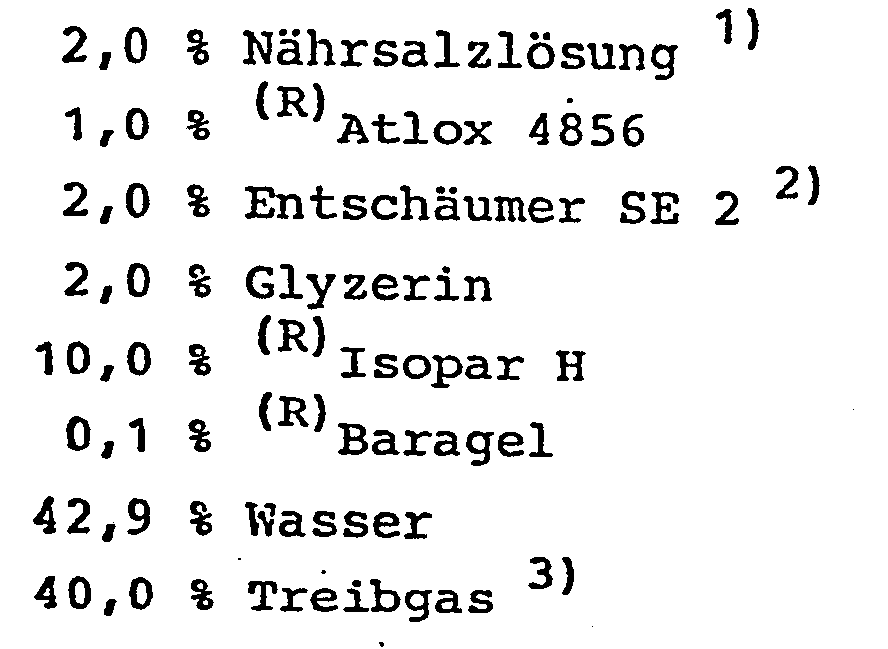
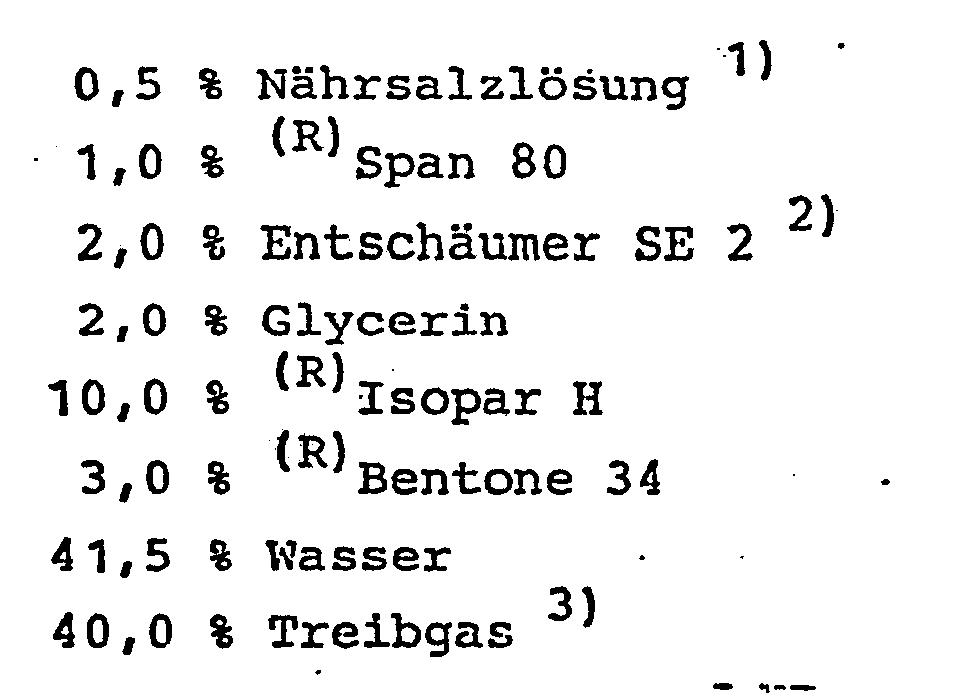
- Die einzelnen Komponenten und ihre Mengenverhältnisse sind nachstehend aufgeführt.
-

-
-

-


-

-

-

-

-
-

-
- 1) Als Nährsalzlösung wurde alternativ eines der folgenden Handelsprodukte eingesetzt, wobei die Ziffern den N-P-K-%-Gehalt wiedergeben:
- (R) Complesal-fluid 12-4-6, (R) Complesal fluid 8-8-6,
- (R) Complesal fluid 11-8-5, (R) Complesal fluid 6-12-6,
- (R)Complesal fluid 5-8-10, (R)Complesal fluid N-34.
- 2) Entschäumer auf Silkon-Basis der Firma Wacker
- 3) Butan-Propan Gemisch Gew.-Verhältnis 85:15.
- In den Rezepturen der Beispiele 1-10 kann der Entschäumer auch durch Wasser substituiert werden, ohne daß die erfindungswesentlichen Eigenschaften verloren gehen.
- Die Prozentangaben sind Gewichtsprozente.
Claims (9)
Priority Applications (1)
| Application Number | Priority Date | Filing Date | Title |
|---|---|---|---|
| AT83112279T ATE19506T1 (de) | 1982-12-10 | 1983-12-07 | Duengemittelsprays. |
Applications Claiming Priority (2)
| Application Number | Priority Date | Filing Date | Title |
|---|---|---|---|
| DE19823245735 DE3245735A1 (de) | 1982-12-10 | 1982-12-10 | Duengemittelsprays |
| DE3245735 | 1982-12-10 |
Publications (3)
| Publication Number | Publication Date |
|---|---|
| EP0111298A2 true EP0111298A2 (de) | 1984-06-20 |
| EP0111298A3 EP0111298A3 (en) | 1984-09-05 |
| EP0111298B1 EP0111298B1 (de) | 1986-04-30 |
Family
ID=6180322
Family Applications (1)
| Application Number | Title | Priority Date | Filing Date |
|---|---|---|---|
| EP83112279A Expired EP0111298B1 (de) | 1982-12-10 | 1983-12-07 | Düngemittelsprays |
Country Status (3)
| Country | Link |
|---|---|
| EP (1) | EP0111298B1 (de) |
| AT (1) | ATE19506T1 (de) |
| DE (2) | DE3245735A1 (de) |
Cited By (1)
| Publication number | Priority date | Publication date | Assignee | Title |
|---|---|---|---|---|
| EP0125370B1 (de) * | 1983-04-19 | 1986-05-28 | NICO-PYROTECHNIK Hanns-Jürgen Diederichs GmbH & Co. KG | Verfahren zur Behandlung geschädigter Vegetation und Vorrichtung dazu |
Family Cites Families (1)
| Publication number | Priority date | Publication date | Assignee | Title |
|---|---|---|---|---|
| AU515436B2 (en) * | 1979-07-27 | 1981-04-02 | Arthur Yates & Co. Limited | Aerosol plant nutrient composition |
-
1982
- 1982-12-10 DE DE19823245735 patent/DE3245735A1/de not_active Withdrawn
-
1983
- 1983-12-07 DE DE8383112279T patent/DE3363302D1/de not_active Expired
- 1983-12-07 AT AT83112279T patent/ATE19506T1/de not_active IP Right Cessation
- 1983-12-07 EP EP83112279A patent/EP0111298B1/de not_active Expired
Cited By (1)
| Publication number | Priority date | Publication date | Assignee | Title |
|---|---|---|---|---|
| EP0125370B1 (de) * | 1983-04-19 | 1986-05-28 | NICO-PYROTECHNIK Hanns-Jürgen Diederichs GmbH & Co. KG | Verfahren zur Behandlung geschädigter Vegetation und Vorrichtung dazu |
Also Published As
| Publication number | Publication date |
|---|---|
| ATE19506T1 (de) | 1986-05-15 |
| EP0111298B1 (de) | 1986-04-30 |
| DE3245735A1 (de) | 1984-06-14 |
| DE3363302D1 (en) | 1986-06-05 |
| EP0111298A3 (en) | 1984-09-05 |
Similar Documents
| Publication | Publication Date | Title |
|---|---|---|
| EP0967864B1 (de) | Schaumarme tensidkonzentrate für den einsatz im bereich der förderung des pflanzenwachstums | |
| DE2724239C2 (de) | ||
| DE2422173C2 (de) | Wäßriges Blattdüngemittel | |
| DE1543970B2 (de) | Verfahren zur herstellung stabiler, fluessiger, polyfunktioneller detergentien- mischungen | |
| DE2918047A1 (de) | Biologisch abbaubare und schwachschaeumende tenside, verfahren zu ihrer herstellung und ihre verwendung in reinigungsmitteln | |
| DE3039393A1 (de) | Frei fliessende, waessrige antischaummittelzusammensetzung und verfahren zu deren anwendung | |
| DE3238864C2 (de) | Wäßrige Harzmasse | |
| EP0047396A1 (de) | Lagerstabile, konzentrierte Emulsion von herbizid wirkenden Phenoxyalkancarbonsäureestern und ein Verfahren zu deren Herstellung | |
| DE69828566T2 (de) | Verringerung der Oberflächenspannung in wässrigen Systemen | |
| DE3829840A1 (de) | Verdickungsmittel | |
| CH667234A5 (de) | Holzschutzanstrichmittel. | |
| EP0133672A2 (de) | Klebestift und Verfahren zu seiner Herstellung | |
| DE3400014A1 (de) | Entschaeumer fuer waessrige dispersionen und loesungen von kunstharzen | |
| EP0111298B1 (de) | Düngemittelsprays | |
| DE69824411T2 (de) | Antikorrosive pigmente | |
| DE2734621C2 (de) | Verfahren zur Herstellung von mit einem Ton verdickten Schmierfetten | |
| DE4307186A1 (de) | Wäßrige Textilweichmacher-Zusammensetzung | |
| DE4436764A1 (de) | Verwendung von Guanidiniumsalzen ungesättigter Fettsäuren als Korrosionsschutzwirkstoff | |
| DE2214120A1 (de) | ||
| AT221278B (de) | Verfahren zur Herstellung von oberflächenaktiven Mitteln auf Basis von Derivaten von Polyalkylenglykolen | |
| CH393734A (de) | Verfahren zur Herstellung wasserlöslicher Kunstharzmassen aus wasserlöslichen Äthern von Melamin-Formaldehyd-Kondensaten und Alkydharzen sowie Anwendung derselben | |
| DE2501982C2 (de) | Konzentrierte wäßrige Einstellungen von Mischungen aus Alkylsulfonaten und Polyglykoläthern | |
| DE497790C (de) | Verfahren zur Herstellung benzol- und oelloeslicher synthetischer Harze aus Phenolenund Aldehyden | |
| CH636267A5 (en) | Clear stable aqueous or aqueous/alcoholic solution of fat-soluble perfume oils | |
| DE68902045T2 (de) | Aerosollack. |
Legal Events
| Date | Code | Title | Description |
|---|---|---|---|
| PUAI | Public reference made under article 153(3) epc to a published international application that has entered the european phase |
Free format text: ORIGINAL CODE: 0009012 |
|
| AK | Designated contracting states |
Designated state(s): AT BE CH DE FR GB IT LI NL SE |
|
| PUAL | Search report despatched |
Free format text: ORIGINAL CODE: 0009013 |
|
| AK | Designated contracting states |
Designated state(s): AT BE CH DE FR GB IT LI NL SE |
|
| 17P | Request for examination filed |
Effective date: 19841204 |
|
| GRAA | (expected) grant |
Free format text: ORIGINAL CODE: 0009210 |
|
| AK | Designated contracting states |
Kind code of ref document: B1 Designated state(s): AT BE CH DE FR GB IT LI NL SE |
|
| REF | Corresponds to: |
Ref document number: 19506 Country of ref document: AT Date of ref document: 19860515 Kind code of ref document: T |
|
| ITF | It: translation for a ep patent filed | ||
| REF | Corresponds to: |
Ref document number: 3363302 Country of ref document: DE Date of ref document: 19860605 |
|
| ET | Fr: translation filed | ||
| PLBE | No opposition filed within time limit |
Free format text: ORIGINAL CODE: 0009261 |
|
| STAA | Information on the status of an ep patent application or granted ep patent |
Free format text: STATUS: NO OPPOSITION FILED WITHIN TIME LIMIT |
|
| 26N | No opposition filed | ||
| PGFP | Annual fee paid to national office [announced via postgrant information from national office to epo] |
Ref country code: FR Payment date: 19901119 Year of fee payment: 8 |
|
| PGFP | Annual fee paid to national office [announced via postgrant information from national office to epo] |
Ref country code: SE Payment date: 19901121 Year of fee payment: 8 Ref country code: GB Payment date: 19901121 Year of fee payment: 8 |
|
| PGFP | Annual fee paid to national office [announced via postgrant information from national office to epo] |
Ref country code: AT Payment date: 19901123 Year of fee payment: 8 |
|
| PGFP | Annual fee paid to national office [announced via postgrant information from national office to epo] |
Ref country code: BE Payment date: 19901204 Year of fee payment: 8 |
|
| ITTA | It: last paid annual fee | ||
| PGFP | Annual fee paid to national office [announced via postgrant information from national office to epo] |
Ref country code: NL Payment date: 19901231 Year of fee payment: 8 |
|
| PGFP | Annual fee paid to national office [announced via postgrant information from national office to epo] |
Ref country code: DE Payment date: 19910213 Year of fee payment: 8 |
|
| PGFP | Annual fee paid to national office [announced via postgrant information from national office to epo] |
Ref country code: CH Payment date: 19910215 Year of fee payment: 8 |
|
| PG25 | Lapsed in a contracting state [announced via postgrant information from national office to epo] |
Ref country code: GB Effective date: 19911207 Ref country code: AT Effective date: 19911207 |
|
| PG25 | Lapsed in a contracting state [announced via postgrant information from national office to epo] |
Ref country code: SE Effective date: 19911208 |
|
| PG25 | Lapsed in a contracting state [announced via postgrant information from national office to epo] |
Ref country code: LI Effective date: 19911231 Ref country code: CH Effective date: 19911231 Ref country code: BE Effective date: 19911231 |
|
| BERE | Be: lapsed |
Owner name: HOECHST A.G. Effective date: 19911231 |
|
| PG25 | Lapsed in a contracting state [announced via postgrant information from national office to epo] |
Ref country code: NL Effective date: 19920701 |
|
| GBPC | Gb: european patent ceased through non-payment of renewal fee | ||
| NLV4 | Nl: lapsed or anulled due to non-payment of the annual fee | ||
| PG25 | Lapsed in a contracting state [announced via postgrant information from national office to epo] |
Ref country code: FR Effective date: 19920831 |
|
| REG | Reference to a national code |
Ref country code: CH Ref legal event code: PL |
|
| PG25 | Lapsed in a contracting state [announced via postgrant information from national office to epo] |
Ref country code: DE Effective date: 19920901 |
|
| REG | Reference to a national code |
Ref country code: FR Ref legal event code: ST |
|
| EUG | Se: european patent has lapsed |
Ref document number: 83112279.1 Effective date: 19920704 |