EP0111375A2 - Verfahren zum Entcoffeinieren von Rohkaffeebohnen mit Aktivkohle - Google Patents
Verfahren zum Entcoffeinieren von Rohkaffeebohnen mit Aktivkohle Download PDFInfo
- Publication number
- EP0111375A2 EP0111375A2 EP83201745A EP83201745A EP0111375A2 EP 0111375 A2 EP0111375 A2 EP 0111375A2 EP 83201745 A EP83201745 A EP 83201745A EP 83201745 A EP83201745 A EP 83201745A EP 0111375 A2 EP0111375 A2 EP 0111375A2
- Authority
- EP
- European Patent Office
- Prior art keywords
- extract
- caffeine
- beans
- active carbon
- extraction
- Prior art date
- Legal status (The legal status is an assumption and is not a legal conclusion. Google has not performed a legal analysis and makes no representation as to the accuracy of the status listed.)
- Granted
Links
- 229910052799 carbon Inorganic materials 0.000 title claims abstract description 55
- OKTJSMMVPCPJKN-UHFFFAOYSA-N Carbon Chemical compound [C] OKTJSMMVPCPJKN-UHFFFAOYSA-N 0.000 title claims abstract description 54
- 238000000034 method Methods 0.000 title claims abstract description 40
- 241000533293 Sesbania emerus Species 0.000 title claims abstract description 9
- RYYVLZVUVIJVGH-UHFFFAOYSA-N caffeine Chemical compound CN1C(=O)N(C)C(=O)C2=C1N=CN2C RYYVLZVUVIJVGH-UHFFFAOYSA-N 0.000 claims abstract description 107
- 239000000284 extract Substances 0.000 claims abstract description 57
- LPHGQDQBBGAPDZ-UHFFFAOYSA-N Isocaffeine Natural products CN1C(=O)N(C)C(=O)C2=C1N(C)C=N2 LPHGQDQBBGAPDZ-UHFFFAOYSA-N 0.000 claims abstract description 54
- 229960001948 caffeine Drugs 0.000 claims abstract description 54
- VJEONQKOZGKCAK-UHFFFAOYSA-N caffeine Natural products CN1C(=O)N(C)C(=O)C2=C1C=CN2C VJEONQKOZGKCAK-UHFFFAOYSA-N 0.000 claims abstract description 54
- XLYOFNOQVPJJNP-UHFFFAOYSA-N water Substances O XLYOFNOQVPJJNP-UHFFFAOYSA-N 0.000 claims abstract description 30
- 238000000605 extraction Methods 0.000 claims abstract description 28
- 238000001179 sorption measurement Methods 0.000 claims abstract description 25
- 239000007787 solid Substances 0.000 claims abstract description 20
- 229940069765 bean extract Drugs 0.000 claims abstract description 10
- 239000006286 aqueous extract Substances 0.000 claims abstract description 9
- 239000003463 adsorbent Substances 0.000 claims abstract description 5
- 235000010627 Phaseolus vulgaris Nutrition 0.000 claims description 54
- 244000046052 Phaseolus vulgaris Species 0.000 claims description 54
- 238000010521 absorption reaction Methods 0.000 claims description 5
- 239000007788 liquid Substances 0.000 description 9
- 239000002002 slurry Substances 0.000 description 9
- 238000005406 washing Methods 0.000 description 8
- 239000002245 particle Substances 0.000 description 6
- 238000010924 continuous production Methods 0.000 description 5
- 239000000243 solution Substances 0.000 description 5
- 240000007154 Coffea arabica Species 0.000 description 4
- 150000008280 chlorinated hydrocarbons Chemical class 0.000 description 4
- 235000016213 coffee Nutrition 0.000 description 4
- 235000013353 coffee beverage Nutrition 0.000 description 4
- 239000000126 substance Substances 0.000 description 4
- 244000013123 dwarf bean Species 0.000 description 3
- 230000002349 favourable effect Effects 0.000 description 3
- 235000021331 green beans Nutrition 0.000 description 3
- 238000004438 BET method Methods 0.000 description 2
- 239000007864 aqueous solution Substances 0.000 description 2
- 235000013305 food Nutrition 0.000 description 2
- 230000007062 hydrolysis Effects 0.000 description 2
- 238000006460 hydrolysis reaction Methods 0.000 description 2
- 239000003960 organic solvent Substances 0.000 description 2
- 238000004064 recycling Methods 0.000 description 2
- 229920006395 saturated elastomer Polymers 0.000 description 2
- 230000008961 swelling Effects 0.000 description 2
- RBTBFTRPCNLSDE-UHFFFAOYSA-N 3,7-bis(dimethylamino)phenothiazin-5-ium Chemical compound C1=CC(N(C)C)=CC2=[S+]C3=CC(N(C)C)=CC=C3N=C21 RBTBFTRPCNLSDE-UHFFFAOYSA-N 0.000 description 1
- ZCYVEMRRCGMTRW-UHFFFAOYSA-N 7553-56-2 Chemical compound [I] ZCYVEMRRCGMTRW-UHFFFAOYSA-N 0.000 description 1
- 230000006978 adaptation Effects 0.000 description 1
- 238000004380 ashing Methods 0.000 description 1
- 238000009835 boiling Methods 0.000 description 1
- 238000004364 calculation method Methods 0.000 description 1
- 239000000470 constituent Substances 0.000 description 1
- 230000002596 correlated effect Effects 0.000 description 1
- 230000000875 corresponding effect Effects 0.000 description 1
- 238000006073 displacement reaction Methods 0.000 description 1
- 238000005516 engineering process Methods 0.000 description 1
- 238000002474 experimental method Methods 0.000 description 1
- 239000010419 fine particle Substances 0.000 description 1
- 235000021539 instant coffee Nutrition 0.000 description 1
- 229910052740 iodine Inorganic materials 0.000 description 1
- 239000011630 iodine Substances 0.000 description 1
- 238000004519 manufacturing process Methods 0.000 description 1
- 239000000463 material Substances 0.000 description 1
- 229960000907 methylthioninium chloride Drugs 0.000 description 1
- 239000000203 mixture Substances 0.000 description 1
- 238000005457 optimization Methods 0.000 description 1
- 239000000843 powder Substances 0.000 description 1
- 238000002203 pretreatment Methods 0.000 description 1
- 230000002035 prolonged effect Effects 0.000 description 1
- 239000002904 solvent Substances 0.000 description 1
- 238000010025 steaming Methods 0.000 description 1
Images
Classifications
-
- A—HUMAN NECESSITIES
- A23—FOODS OR FOODSTUFFS; TREATMENT THEREOF, NOT COVERED BY OTHER CLASSES
- A23F—COFFEE; TEA; THEIR SUBSTITUTES; MANUFACTURE, PREPARATION, OR INFUSION THEREOF
- A23F5/00—Coffee; Coffee substitutes; Preparations thereof
- A23F5/20—Reducing or removing alkaloid content; Preparations produced thereby; Extracts or infusions thereof
- A23F5/22—Reducing or removing alkaloid content from coffee extract
- A23F5/223—Reducing or removing alkaloid content from coffee extract using flocculating, precipitating, adsorbing or complex-forming agents, or ion-exchangers
-
- A—HUMAN NECESSITIES
- A23—FOODS OR FOODSTUFFS; TREATMENT THEREOF, NOT COVERED BY OTHER CLASSES
- A23F—COFFEE; TEA; THEIR SUBSTITUTES; MANUFACTURE, PREPARATION, OR INFUSION THEREOF
- A23F5/00—Coffee; Coffee substitutes; Preparations thereof
- A23F5/20—Reducing or removing alkaloid content; Preparations produced thereby; Extracts or infusions thereof
- A23F5/208—Reducing or removing alkaloid content; Preparations produced thereby; Extracts or infusions thereof by extraction of the beans with water, aqueous solutions without organic or inorganic solvents or aqueous coffee extract
Definitions
- This invention relates to the decaffeination of green coffee beans by means of active carbon.
- Processes hitherto used on a commercial scale for the decaffeination of green coffee beans have employed chlorinated hydrocarbons.
- the green coffee beans are moistened, i.e., saturated with water by a steam treatment, whereafter the moistened beans are extracted with the organic solvents referred to.Klapproth (British patent 314,059) suggested first making an aqueous extract of the green beans, and treating this aqueous extract, rather than the beans themselves, with chlorinated hydrocarbons.
- the extract contains, in addition to caffeine, the directly soluble solids, i.e., the components which are soluble in water without hydrolysis of the beans.
- the ratio of the caffeine content of the extract after complete extraction to the content of dissolved non-caffeine solids is then the same as in the dry beans.
- the caffeine content varies in different coffees from approximately 0.89 to.approximately 3.0%, and the content of soluble solids from approximately 20 to approximately 30%.
- Klapproth the resulting aqueous extract is treated with a water-immiscible organic solvent having a selective absorption capacity for caffeine.
- the decaffeinated extract is recycled,and the extraction-absorption cycle is repeated until the beans are sufficiently decaffeinated.
- the beans are then discharged, and the extract is replenished with an amount of water corresponding to the amount of water absorbed by the beans discharged.
- the resulting solution is used for subjecting a second portion of beans to an extraction-absorption cycle. This is repeated for a third portion of beans, etc.
- chlorinated hydrocarbons are used in all cases, has to do with the fact that these liquids are little soluble in water and exhibit a high absorption selectivity relative to the system of caffeine-non-caffeine components. For health considerations, however, these substances are not considered harmless. At any rate, minute residues of these solvents for caffeine must be carefully removed from the decaffeinated beans. This is effected by prolonged steaming, which is not favourable to the organoleptic quality of the roasted beans produced from these beans.
- the active carbon is subjected to such a pre-treatment that the active carbon particles are covered with a thin layer of a water-immiscible liquid having a selective adsorption capacity for caffeine.
- the degrees to which the active carbon thus treated can be loaded, however, .are very low.
- a second new insight concerns the fact that, at least in some active carbons, selectivity increases with the concentration of the extract from the green beans. That this is surprising appears from the following.
- Per unit of active carbon a specific number of "active places" is present. For example, if we have a relatively low concentration, in which 16 g of caffeine and 220 g of non-caffeine.solublesare present per liter of extract, the "excess" of molecules of non-caffeine solids which compete for the active places of the active carbon relative to the caffeine molecules is 204 g/1.
- a fourth new insight of the applicants is that in the commercially available carbons, there are large differences as regards the ratio between selectivity for caffeine and total adsorption capacity for caffeine, i.e., there are carbons which have a high adsorption capacity relative to a pure caffeine solution, but a low selectivity in the system of water - caffeine - non-caffeine extract solids. The same is true the other way round.
- a carbon should be selected with a positive correlation between this adsorption capacity and this selectivity, i.e., as high a selectivity as possible and at the same.time as high an adsorption capacity as possible. This can in part be effected emperically for which, as we have found, a search can be made among carbons characterized by the following standard properties.
- the present invention provides a process for decaffeinating green coffee beans by extraction with water, and treatment of the aqueous extract with active carbon, characterized in that the active carbon has a specific adsorption capacity for caffeine of at least 100 g/kg carbon, a specific selectivity of at least 0.200 and a positive correlation between, on the one hand, the concentration of the bean extract, and on the other hand, the load ratio of caffeine/non-caffeine extract solids in the adsorbent when in equilibrium with that bean extract.
- an active carbon having a specific adsorption capacity for caffeine higher than 300 g/kg carbon and a specific selectivity higher than 0.4. Particularly good results are obtained with a specific adsorption capacity higher than 450 g/kg carbon and a specific selectivity higher than 0.6.
- active carbon can be applied to otherwise known processes, such as those described in the above literature. More specifically, however, it can be applied to a novel process we have developed, in which counter-current extraction of the beans is combined with counter-current selective adsorption of caffeine from the resulting aqueous extract by active carbon, and recycling the extract thus produced to the counter-current extraction stage.
- this process is characterized by the following co-acting process stages:
- the beans are supplied to process stage a in the air-dry state.
- Preferred temperatures range between 60° and 95°C. Highly suitable is a temperature around 80°C.
- bean equilibrium extract means an extract which, as regards exchange of solids, is in equilibrium with beans to which just so much water has been added as corresponds to the maximum quantity absorbed by them with swelling.
- This bean equilibrium extract mostly has a concentration of about.21 % by weight of total solid. All substances in the beans which are directly soluble (i.e. without hydrolysis) are then in the dissolved condition within the beans. When the beans are supplied.in the dry state, they withdraw water from the extract. Accordingly, when the extract is recycled, its concentration will be increased. In principle, this can continue by selecting particular process conditions until the extract is in equilibrium with the extract solids in the dry state in the dry beans, i.e., that the extract is fully saturated as far as these extract substances are concerned.
- the percentage p will in practice depend on the statutory regulations existing in the various countries. In most countries it will have to be less than 0.1%.
- the specific adsorption capacity is given by the number of grams of caffeine adsorbed by 1 kg of the active carbon when, at 80°C, it is in equilibrium with an aqueous caffeine solution having a concentration of 20 g caffeine per liter.
- the specific selectivity of the active carbon is defined as the load ratio of caffeine/non-caffeine extract solids in the active carbon, determined with a bean equilibrium extract in equilibrium with the laden active carbon at a temperature of 80°C.
- process stage a is carried out in accordance with the "droplet-extraction” method ("trickle flow").
- the interspace between the particles is not filled with extract liquid.
- the liquid is sprayed onto a bed of beans and subsequently percolates through it. Normally, the collected liquid is immediately recycled for a major part.
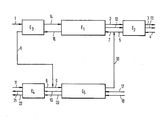
- a suitable embodiment is that in which the beans are supplied on. a conveyor belt divided into extraction sections, as will be illustrated hereinafter in and by an example and with reference to the accompanying drawing.
- One advantage of "droplet extraction” is that the amount of liquid which circulates in the system at a given moment is much less than in the case of "full flow", in which the interspaces between the beans are fully filled with extraction liquid.
- a great advantage of this continuous process is that the beans only have to be dried once.
- the beans have to be dried a first time, then enabled to absorb extract, and subsequently dried for a second time.
- an additional step is required for concentrating the extract. (see, for example, European patent applications 40,712 and 8,398).
- the drawing shows a flow sheet of the process according to the invention in case both the extraction of the beans and the adsorption of the caffeine from the aqueous solution produced during the extraction are effected counter-currently.
- E 3 , E1 and E 2 will represent departments of, for example, one and the same conveyor belt extractor, or one and the same extraction battery system. The same applies to E 4 and E 5 .
- the air-dry beans are supplied to E 3 .
- Stream (14) represents the beans in fully moistened condition (i.e., the state of maximum swelling).
- the beans then arrive in E 1 , in which the caffeine is extracted from the beans to the extent necessary.
- the beans leaving E 1 are separated from the extract,resulting in stream of beans (2).
- the appending extract is indicated by the stream-(12).
- E 2 a washing process takes place, during which the appendant extract is exchanged against water. This results in stream of beans (3) with appendant water (23).
- clean washing water is supplied.
- the washing water exits from E 2 , enriched with the extract solids present in stream (12).
- Stream (5) is combined with stream (10) from the adsorption section.
- the carbon may first be subjected to partial vacuum before water is added. Also, boiling with water leads to the desired result.
- the dry carbon is indicated by stream (18), the water by (17).
- E 5 is preferably a battery system (as conventional, for example, in the extraction of roasted coffee for preparing a coffee extract, processed to produce instant coffee powder).
- the slurry exits from E 5 as a slurry consisting of laden active carbon, designated (20), and extract. designated (19).
- the stream of extract (19) has the same composition as (9).
- the slurry (19 + 20) enters the washing unit E 4 for washing the carbon.
- the stream of clean washing water (11) enters. In practice this can be effected, for example, by first causing the slurry to enter a unit, as also used in the battery system E 5 , and then causing the extract between the carbon particles to be displaced by clean washing water supplied from above.
- This displaced extract is designated by (8) and after being mixed with (6) is passed as stream (9) to E 5 , as indicated. After the displacement of the extract (8) the slurry comprising laden carbon (22) and water (21) is discharged from E 4 .
- the exiting stream of beans (3) is dried and roasted in the conventional manner.
- the laden carbon (22) is dried and, if the carbon lends itself thereto, regenerated by burning the adsorbed substances. This is standard technology and results in regenerated active carbon which, possibly after replenishment, can be re-used in the process.
- E 3 - E 1 - E 2 form a conveyor belt system, e.g., a de S met - extractor as described in Australian patent 402,344.
- the total volume of beans present in the system at a given moment is 72 m 3 .
- the conveyor belt has the following dimensions: length 18 m, width 2 m and thickness of layer of beans 2 m.
- the velocity of the conveyor belt is controlled so that the total residence time of the beans is 15 hours, which comes down to a production of 1.8 tons of decaffeinated (air-dry) coffeeper.hour.
- E 4 - E 5 is a battery system of eight columns, of which six form part of E 5 , one is used for ashing (E 4 ), and one is used for putting the slurry of fresh carbon in readiness.
- the dimensions of each column are: diameter 80 cm and height 4 m. Every four hours, the column put in readiness with 480 kg of fresh carbon slurry on one side is taken on-stream, and the column with slurry of laden carbon at the other side is taken off-stream and emptied.
- the carbon used herein has the following characteristics: Coffee produced in this manner is practically fully decaffeinated.
Landscapes
- Life Sciences & Earth Sciences (AREA)
- Chemical & Material Sciences (AREA)
- Engineering & Computer Science (AREA)
- Food Science & Technology (AREA)
- Polymers & Plastics (AREA)
- Tea And Coffee (AREA)
- Carbon And Carbon Compounds (AREA)
- Addition Polymer Or Copolymer, Post-Treatments, Or Chemical Modifications (AREA)
- Organic Low-Molecular-Weight Compounds And Preparation Thereof (AREA)
Priority Applications (1)
| Application Number | Priority Date | Filing Date | Title |
|---|---|---|---|
| AT83201745T ATE22523T1 (de) | 1982-12-10 | 1983-12-09 | Verfahren zum entcoffeinieren von rohkaffeebohnen mit aktivkohle. |
Applications Claiming Priority (2)
| Application Number | Priority Date | Filing Date | Title |
|---|---|---|---|
| NLAANVRAGE8204803,A NL188074C (nl) | 1982-12-10 | 1982-12-10 | Werkwijze voor het decaffeineren van groene koffiebonen met actieve kool. |
| NL8204803 | 1982-12-10 |
Publications (3)
| Publication Number | Publication Date |
|---|---|
| EP0111375A2 true EP0111375A2 (de) | 1984-06-20 |
| EP0111375A3 EP0111375A3 (en) | 1984-07-25 |
| EP0111375B1 EP0111375B1 (de) | 1986-10-01 |
Family
ID=19840734
Family Applications (1)
| Application Number | Title | Priority Date | Filing Date |
|---|---|---|---|
| EP83201745A Expired EP0111375B1 (de) | 1982-12-10 | 1983-12-09 | Verfahren zum Entcoffeinieren von Rohkaffeebohnen mit Aktivkohle |
Country Status (7)
| Country | Link |
|---|---|
| EP (1) | EP0111375B1 (de) |
| AT (1) | ATE22523T1 (de) |
| CA (1) | CA1227689A (de) |
| DE (1) | DE3366645D1 (de) |
| DK (1) | DK162687C (de) |
| ES (1) | ES8600014A1 (de) |
| NL (1) | NL188074C (de) |
Cited By (5)
| Publication number | Priority date | Publication date | Assignee | Title |
|---|---|---|---|---|
| EP0248482A1 (de) * | 1986-05-30 | 1987-12-09 | Douwe Egberts Koninklijke Tabaksfabriek- Koffiebranderijen-Theehandel N.V. | Verfahren zum entkoffeinieren von Rohkaffee |
| US4816275A (en) * | 1983-03-28 | 1989-03-28 | Chock Full O'nuts Corp. | Decaffeination of aqueous extracts |
| US4877631A (en) * | 1986-05-30 | 1989-10-31 | Douwe Egberts Koninklijke Tabaksfabriek-Koffiebranderijen-Theehandel N.V. | Process for recovering caffeine absorbed in activated carbon, and a process for decaffeinating coffee |
| EP0312863A3 (de) * | 1987-10-21 | 1991-01-16 | Kraft Jacobs Suchard SA | Vorrichtung zum kontinuierlichen Entcoffeinieren von Rohkaffee |
| EP0666033A1 (de) * | 1994-02-03 | 1995-08-09 | Kraft Foods, Inc. | Verfahren zum Entcoffeinieren von Wasserhaltigen, Coffein enthaltenden Extrakten |
Citations (6)
| Publication number | Priority date | Publication date | Assignee | Title |
|---|---|---|---|---|
| GB314059A (en) | 1928-06-22 | 1930-03-06 | Wilhelm Klapproth | Improved process for the extraction of caffeine from coffee beans |
| US2309902A (en) | 1941-09-02 | 1943-02-02 | Robert S Allyn | Fish lure |
| AU402344B2 (en) | 1964-03-11 | 1965-09-16 | Extraction De Smet | Diffusion installation for sugar works |
| EP0008398A1 (de) | 1978-08-22 | 1980-03-05 | C O F F E X Ag | Verfahren zum Entcoffeinieren von Rohkaffee |
| EP0040712A1 (de) | 1980-05-28 | 1981-12-02 | Societe Des Produits Nestle S.A. | Verfahren zum Entcoffeinieren von Rohkaffee und Verfahren zur Gewinnung von Coffein |
| EP0042294A1 (de) | 1980-06-16 | 1981-12-23 | General Foods Corporation | Adsorptions-Entkoffeinierung |
Family Cites Families (2)
| Publication number | Priority date | Publication date | Assignee | Title |
|---|---|---|---|---|
| US4118341A (en) * | 1974-05-27 | 1978-10-03 | Agency Of Industrial Science & Technology | Activated carbon |
| NL7807214A (nl) * | 1977-08-06 | 1979-02-08 | D E J Int Research | Werkwijze voor de selectieve extractie van een oplos- bare component uit een vast korrelvormig materiaal, dat een aantal oplosbare componenten bevat. |
-
1982
- 1982-12-10 NL NLAANVRAGE8204803,A patent/NL188074C/xx not_active IP Right Cessation
-
1983
- 1983-12-07 CA CA000442737A patent/CA1227689A/en not_active Expired
- 1983-12-09 EP EP83201745A patent/EP0111375B1/de not_active Expired
- 1983-12-09 DE DE8383201745T patent/DE3366645D1/de not_active Expired
- 1983-12-09 AT AT83201745T patent/ATE22523T1/de not_active IP Right Cessation
- 1983-12-09 DK DK568283A patent/DK162687C/da not_active IP Right Cessation
- 1983-12-09 ES ES527929A patent/ES8600014A1/es not_active Expired
Patent Citations (6)
| Publication number | Priority date | Publication date | Assignee | Title |
|---|---|---|---|---|
| GB314059A (en) | 1928-06-22 | 1930-03-06 | Wilhelm Klapproth | Improved process for the extraction of caffeine from coffee beans |
| US2309902A (en) | 1941-09-02 | 1943-02-02 | Robert S Allyn | Fish lure |
| AU402344B2 (en) | 1964-03-11 | 1965-09-16 | Extraction De Smet | Diffusion installation for sugar works |
| EP0008398A1 (de) | 1978-08-22 | 1980-03-05 | C O F F E X Ag | Verfahren zum Entcoffeinieren von Rohkaffee |
| EP0040712A1 (de) | 1980-05-28 | 1981-12-02 | Societe Des Produits Nestle S.A. | Verfahren zum Entcoffeinieren von Rohkaffee und Verfahren zur Gewinnung von Coffein |
| EP0042294A1 (de) | 1980-06-16 | 1981-12-23 | General Foods Corporation | Adsorptions-Entkoffeinierung |
Cited By (7)
| Publication number | Priority date | Publication date | Assignee | Title |
|---|---|---|---|---|
| US4816275A (en) * | 1983-03-28 | 1989-03-28 | Chock Full O'nuts Corp. | Decaffeination of aqueous extracts |
| EP0248482A1 (de) * | 1986-05-30 | 1987-12-09 | Douwe Egberts Koninklijke Tabaksfabriek- Koffiebranderijen-Theehandel N.V. | Verfahren zum entkoffeinieren von Rohkaffee |
| US4877631A (en) * | 1986-05-30 | 1989-10-31 | Douwe Egberts Koninklijke Tabaksfabriek-Koffiebranderijen-Theehandel N.V. | Process for recovering caffeine absorbed in activated carbon, and a process for decaffeinating coffee |
| US4885181A (en) * | 1986-05-30 | 1989-12-05 | Douwe Egberts Koninklijke Tabaksfabriek-Koffiebranderijen-Theehandel, N.V. | Process for decaffeinating green coffee |
| EP0312863A3 (de) * | 1987-10-21 | 1991-01-16 | Kraft Jacobs Suchard SA | Vorrichtung zum kontinuierlichen Entcoffeinieren von Rohkaffee |
| US5147674A (en) * | 1987-10-21 | 1992-09-15 | Jacobs Suchard Ag | Method for continuously decaffeinating raw coffee |
| EP0666033A1 (de) * | 1994-02-03 | 1995-08-09 | Kraft Foods, Inc. | Verfahren zum Entcoffeinieren von Wasserhaltigen, Coffein enthaltenden Extrakten |
Also Published As
| Publication number | Publication date |
|---|---|
| NL8204803A (nl) | 1984-07-02 |
| ES527929A0 (es) | 1985-10-01 |
| ES8600014A1 (es) | 1985-10-01 |
| DK162687B (da) | 1991-12-02 |
| EP0111375A3 (en) | 1984-07-25 |
| DE3366645D1 (en) | 1986-11-06 |
| EP0111375B1 (de) | 1986-10-01 |
| ATE22523T1 (de) | 1986-10-15 |
| DK568283D0 (da) | 1983-12-09 |
| NL188074C (nl) | 1992-04-01 |
| CA1227689A (en) | 1987-10-06 |
| NL188074B (nl) | 1991-11-01 |
| DK162687C (da) | 1992-04-21 |
| DK568283A (da) | 1984-06-11 |
Similar Documents
| Publication | Publication Date | Title |
|---|---|---|
| US5497792A (en) | Process and apparatus for the semicontinuous extraction of nicotine from tobacco | |
| US4031251A (en) | Decaffeination of vegetable material | |
| US4168324A (en) | Process of extracting stimulants from coffee | |
| US3532506A (en) | Process for preparing freeze dried extract of coffee,tea or chicory and product produced thereby | |
| US4348422A (en) | Process for the direct decaffeination of aqueous coffee extract solutions | |
| JPS5939097B2 (ja) | コ−ヒ−の脱カフエイン方法 | |
| CA1171727A (en) | Adsorption decaffeination | |
| SU1056875A3 (ru) | Способ извлечени кофеина | |
| GB1584199A (en) | Process for separating caffeine from supercritical solutions | |
| GB1596364A (en) | Process for the selective exraction of caffeine from plant materials | |
| US4352829A (en) | Coffee extraction process | |
| US5208056A (en) | Process for decaffeinating raw coffee | |
| EP0111375B1 (de) | Verfahren zum Entcoffeinieren von Rohkaffeebohnen mit Aktivkohle | |
| DE3640333C2 (de) | ||
| JPH053258B2 (de) | ||
| Katz | Decaffeination of coffee | |
| EP0066700A1 (de) | Rückgewinnung von Xanthinreizmitteln aus wässerigen Lösungen | |
| US4486453A (en) | Desolventizing process | |
| KR930002563B1 (ko) | 원료커피를 온화하게 탈카페인하는 방법 및 장치 | |
| JP3030099B2 (ja) | 培炒粉砕コーヒーの抽出方法 | |
| CA1049318A (en) | Decaffeination of green coffee | |
| US5266342A (en) | Method for decaffeinating coffee materials including a reverse osmosis permeate recycle | |
| US4562083A (en) | Decaffeination of green coffee with n-butyl acetate | |
| EP0101135B1 (de) | Verfahren zur Entkoffeinierung von Rohkaffee | |
| CA1177314A (en) | Decaffeination process |
Legal Events
| Date | Code | Title | Description |
|---|---|---|---|
| PUAI | Public reference made under article 153(3) epc to a published international application that has entered the european phase |
Free format text: ORIGINAL CODE: 0009012 |
|
| PUAL | Search report despatched |
Free format text: ORIGINAL CODE: 0009013 |
|
| AK | Designated contracting states |
Designated state(s): AT BE CH DE FR GB IT LI LU |
|
| AK | Designated contracting states |
Designated state(s): AT BE CH DE FR GB IT LI LU |
|
| 17P | Request for examination filed |
Effective date: 19841004 |
|
| GRAA | (expected) grant |
Free format text: ORIGINAL CODE: 0009210 |
|
| AK | Designated contracting states |
Kind code of ref document: B1 Designated state(s): AT BE CH DE FR GB IT LI LU |
|
| REF | Corresponds to: |
Ref document number: 22523 Country of ref document: AT Date of ref document: 19861015 Kind code of ref document: T |
|
| ITF | It: translation for a ep patent filed | ||
| REF | Corresponds to: |
Ref document number: 3366645 Country of ref document: DE Date of ref document: 19861106 |
|
| ET | Fr: translation filed | ||
| PLBI | Opposition filed |
Free format text: ORIGINAL CODE: 0009260 |
|
| 26 | Opposition filed |
Opponent name: JACOBS SUCHARD GMBH Effective date: 19870630 |
|
| PLAB | Opposition data, opponent's data or that of the opponent's representative modified |
Free format text: ORIGINAL CODE: 0009299OPPO |
|
| R26 | Opposition filed (corrected) |
Opponent name: JACOBS SUCHARD GMBH Effective date: 19870630 |
|
| PLBN | Opposition rejected |
Free format text: ORIGINAL CODE: 0009273 |
|
| STAA | Information on the status of an ep patent application or granted ep patent |
Free format text: STATUS: OPPOSITION REJECTED |
|
| 27O | Opposition rejected |
Effective date: 19891203 |
|
| ITTA | It: last paid annual fee | ||
| PGFP | Annual fee paid to national office [announced via postgrant information from national office to epo] |
Ref country code: GB Payment date: 19931130 Year of fee payment: 11 |
|
| PGFP | Annual fee paid to national office [announced via postgrant information from national office to epo] |
Ref country code: LU Payment date: 19931216 Year of fee payment: 11 |
|
| PGFP | Annual fee paid to national office [announced via postgrant information from national office to epo] |
Ref country code: AT Payment date: 19931227 Year of fee payment: 11 |
|
| EPTA | Lu: last paid annual fee | ||
| PG25 | Lapsed in a contracting state [announced via postgrant information from national office to epo] |
Ref country code: LU Free format text: LAPSE BECAUSE OF NON-PAYMENT OF DUE FEES Effective date: 19941209 Ref country code: GB Effective date: 19941209 Ref country code: AT Effective date: 19941209 |
|
| GBPC | Gb: european patent ceased through non-payment of renewal fee |
Effective date: 19941209 |
|
| PGFP | Annual fee paid to national office [announced via postgrant information from national office to epo] |
Ref country code: CH Payment date: 19951229 Year of fee payment: 13 |
|
| PG25 | Lapsed in a contracting state [announced via postgrant information from national office to epo] |
Ref country code: LI Effective date: 19961231 Ref country code: CH Effective date: 19961231 |
|
| REG | Reference to a national code |
Ref country code: CH Ref legal event code: PL |
|
| PGFP | Annual fee paid to national office [announced via postgrant information from national office to epo] |
Ref country code: BE Payment date: 20011219 Year of fee payment: 19 |
|
| PGFP | Annual fee paid to national office [announced via postgrant information from national office to epo] |
Ref country code: DE Payment date: 20011220 Year of fee payment: 19 |
|
| PGFP | Annual fee paid to national office [announced via postgrant information from national office to epo] |
Ref country code: FR Payment date: 20011221 Year of fee payment: 19 |
|
| PG25 | Lapsed in a contracting state [announced via postgrant information from national office to epo] |
Ref country code: BE Free format text: LAPSE BECAUSE OF NON-PAYMENT OF DUE FEES Effective date: 20021231 |
|
| BERE | Be: lapsed |
Owner name: *DOUWE EGBERTS KONINKLIJKE TABAKSFABRIEK- KOFFIEBR Effective date: 20021231 |
|
| PG25 | Lapsed in a contracting state [announced via postgrant information from national office to epo] |
Ref country code: DE Free format text: LAPSE BECAUSE OF NON-PAYMENT OF DUE FEES Effective date: 20030701 |
|
| PG25 | Lapsed in a contracting state [announced via postgrant information from national office to epo] |
Ref country code: FR Free format text: LAPSE BECAUSE OF NON-PAYMENT OF DUE FEES Effective date: 20030901 |
|
| REG | Reference to a national code |
Ref country code: FR Ref legal event code: ST |
|
| PLAB | Opposition data, opponent's data or that of the opponent's representative modified |
Free format text: ORIGINAL CODE: 0009299OPPO |