EP0111711A2 - Heterocyclisch substituierte Hydroxyalkyl-azolyl-Derivate - Google Patents
Heterocyclisch substituierte Hydroxyalkyl-azolyl-Derivate Download PDFInfo
- Publication number
- EP0111711A2 EP0111711A2 EP83110995A EP83110995A EP0111711A2 EP 0111711 A2 EP0111711 A2 EP 0111711A2 EP 83110995 A EP83110995 A EP 83110995A EP 83110995 A EP83110995 A EP 83110995A EP 0111711 A2 EP0111711 A2 EP 0111711A2
- Authority
- EP
- European Patent Office
- Prior art keywords
- optionally substituted
- methyl
- carbon atoms
- formula
- alkyl
- Prior art date
- Legal status (The legal status is an assumption and is not a legal conclusion. Google has not performed a legal analysis and makes no representation as to the accuracy of the status listed.)
- Granted
Links
- 0 CC(C)(C1OCCO1)C(*I)(c(cc1)ccc1Cl)O Chemical compound CC(C)(C1OCCO1)C(*I)(c(cc1)ccc1Cl)O 0.000 description 3
Classifications
-
- C—CHEMISTRY; METALLURGY
- C07—ORGANIC CHEMISTRY
- C07D—HETEROCYCLIC COMPOUNDS
- C07D405/00—Heterocyclic compounds containing both one or more hetero rings having oxygen atoms as the only ring hetero atoms, and one or more rings having nitrogen as the only ring hetero atom
- C07D405/02—Heterocyclic compounds containing both one or more hetero rings having oxygen atoms as the only ring hetero atoms, and one or more rings having nitrogen as the only ring hetero atom containing two hetero rings
- C07D405/06—Heterocyclic compounds containing both one or more hetero rings having oxygen atoms as the only ring hetero atoms, and one or more rings having nitrogen as the only ring hetero atom containing two hetero rings linked by a carbon chain containing only aliphatic carbon atoms
-
- C—CHEMISTRY; METALLURGY
- C07—ORGANIC CHEMISTRY
- C07D—HETEROCYCLIC COMPOUNDS
- C07D231/00—Heterocyclic compounds containing 1,2-diazole or hydrogenated 1,2-diazole rings
- C07D231/02—Heterocyclic compounds containing 1,2-diazole or hydrogenated 1,2-diazole rings not condensed with other rings
- C07D231/10—Heterocyclic compounds containing 1,2-diazole or hydrogenated 1,2-diazole rings not condensed with other rings having two or three double bonds between ring members or between ring members and non-ring members
- C07D231/12—Heterocyclic compounds containing 1,2-diazole or hydrogenated 1,2-diazole rings not condensed with other rings having two or three double bonds between ring members or between ring members and non-ring members with only hydrogen atoms, hydrocarbon or substituted hydrocarbon radicals, directly attached to ring carbon atoms
-
- A—HUMAN NECESSITIES
- A01—AGRICULTURE; FORESTRY; ANIMAL HUSBANDRY; HUNTING; TRAPPING; FISHING
- A01N—PRESERVATION OF BODIES OF HUMANS OR ANIMALS OR PLANTS OR PARTS THEREOF; BIOCIDES, e.g. AS DISINFECTANTS, AS PESTICIDES OR AS HERBICIDES; PEST REPELLANTS OR ATTRACTANTS; PLANT GROWTH REGULATORS
- A01N43/00—Biocides, pest repellants or attractants, or plant growth regulators containing heterocyclic compounds
- A01N43/48—Biocides, pest repellants or attractants, or plant growth regulators containing heterocyclic compounds having rings with two nitrogen atoms as the only ring hetero atoms
- A01N43/50—1,3-Diazoles; Hydrogenated 1,3-diazoles
-
- A—HUMAN NECESSITIES
- A01—AGRICULTURE; FORESTRY; ANIMAL HUSBANDRY; HUNTING; TRAPPING; FISHING
- A01N—PRESERVATION OF BODIES OF HUMANS OR ANIMALS OR PLANTS OR PARTS THEREOF; BIOCIDES, e.g. AS DISINFECTANTS, AS PESTICIDES OR AS HERBICIDES; PEST REPELLANTS OR ATTRACTANTS; PLANT GROWTH REGULATORS
- A01N43/00—Biocides, pest repellants or attractants, or plant growth regulators containing heterocyclic compounds
- A01N43/64—Biocides, pest repellants or attractants, or plant growth regulators containing heterocyclic compounds having rings with three nitrogen atoms as the only ring hetero atoms
- A01N43/647—Triazoles; Hydrogenated triazoles
- A01N43/653—1,2,4-Triazoles; Hydrogenated 1,2,4-triazoles
-
- C—CHEMISTRY; METALLURGY
- C07—ORGANIC CHEMISTRY
- C07C—ACYCLIC OR CARBOCYCLIC COMPOUNDS
- C07C45/00—Preparation of compounds having >C = O groups bound only to carbon or hydrogen atoms; Preparation of chelates of such compounds
- C07C45/56—Preparation of compounds having >C = O groups bound only to carbon or hydrogen atoms; Preparation of chelates of such compounds from heterocyclic compounds
-
- C—CHEMISTRY; METALLURGY
- C07—ORGANIC CHEMISTRY
- C07C—ACYCLIC OR CARBOCYCLIC COMPOUNDS
- C07C49/00—Ketones; Ketenes; Dimeric ketenes; Ketonic chelates
- C07C49/04—Saturated compounds containing keto groups bound to acyclic carbon atoms
- C07C49/185—Saturated compounds containing keto groups bound to acyclic carbon atoms containing —CHO groups
-
- C—CHEMISTRY; METALLURGY
- C07—ORGANIC CHEMISTRY
- C07D—HETEROCYCLIC COMPOUNDS
- C07D233/00—Heterocyclic compounds containing 1,3-diazole or hydrogenated 1,3-diazole rings, not condensed with other rings
- C07D233/54—Heterocyclic compounds containing 1,3-diazole or hydrogenated 1,3-diazole rings, not condensed with other rings having two double bonds between ring members or between ring members and non-ring members
- C07D233/56—Heterocyclic compounds containing 1,3-diazole or hydrogenated 1,3-diazole rings, not condensed with other rings having two double bonds between ring members or between ring members and non-ring members with only hydrogen atoms or radicals containing only hydrogen and carbon atoms, attached to ring carbon atoms
-
- C—CHEMISTRY; METALLURGY
- C07—ORGANIC CHEMISTRY
- C07D—HETEROCYCLIC COMPOUNDS
- C07D249/00—Heterocyclic compounds containing five-membered rings having three nitrogen atoms as the only ring hetero atoms
- C07D249/02—Heterocyclic compounds containing five-membered rings having three nitrogen atoms as the only ring hetero atoms not condensed with other rings
- C07D249/08—1,2,4-Triazoles; Hydrogenated 1,2,4-triazoles
-
- C—CHEMISTRY; METALLURGY
- C07—ORGANIC CHEMISTRY
- C07D—HETEROCYCLIC COMPOUNDS
- C07D317/00—Heterocyclic compounds containing five-membered rings having two oxygen atoms as the only ring hetero atoms
- C07D317/08—Heterocyclic compounds containing five-membered rings having two oxygen atoms as the only ring hetero atoms having the hetero atoms in positions 1 and 3
- C07D317/10—Heterocyclic compounds containing five-membered rings having two oxygen atoms as the only ring hetero atoms having the hetero atoms in positions 1 and 3 not condensed with other rings
- C07D317/14—Heterocyclic compounds containing five-membered rings having two oxygen atoms as the only ring hetero atoms having the hetero atoms in positions 1 and 3 not condensed with other rings with substituted hydrocarbon radicals attached to ring carbon atoms
- C07D317/26—Radicals substituted by doubly bound oxygen or sulfur atoms or by two such atoms singly bound to the same carbon atom
-
- C—CHEMISTRY; METALLURGY
- C07—ORGANIC CHEMISTRY
- C07D—HETEROCYCLIC COMPOUNDS
- C07D319/00—Heterocyclic compounds containing six-membered rings having two oxygen atoms as the only ring hetero atoms
- C07D319/04—1,3-Dioxanes; Hydrogenated 1,3-dioxanes
- C07D319/06—1,3-Dioxanes; Hydrogenated 1,3-dioxanes not condensed with other rings
-
- C—CHEMISTRY; METALLURGY
- C07—ORGANIC CHEMISTRY
- C07D—HETEROCYCLIC COMPOUNDS
- C07D407/00—Heterocyclic compounds containing two or more hetero rings, at least one ring having oxygen atoms as the only ring hetero atoms, not provided for by group C07D405/00
- C07D407/02—Heterocyclic compounds containing two or more hetero rings, at least one ring having oxygen atoms as the only ring hetero atoms, not provided for by group C07D405/00 containing two hetero rings
- C07D407/04—Heterocyclic compounds containing two or more hetero rings, at least one ring having oxygen atoms as the only ring hetero atoms, not provided for by group C07D405/00 containing two hetero rings directly linked by a ring-member-to-ring-member bond
-
- C—CHEMISTRY; METALLURGY
- C07—ORGANIC CHEMISTRY
- C07D—HETEROCYCLIC COMPOUNDS
- C07D407/00—Heterocyclic compounds containing two or more hetero rings, at least one ring having oxygen atoms as the only ring hetero atoms, not provided for by group C07D405/00
- C07D407/02—Heterocyclic compounds containing two or more hetero rings, at least one ring having oxygen atoms as the only ring hetero atoms, not provided for by group C07D405/00 containing two hetero rings
- C07D407/06—Heterocyclic compounds containing two or more hetero rings, at least one ring having oxygen atoms as the only ring hetero atoms, not provided for by group C07D405/00 containing two hetero rings linked by a carbon chain containing only aliphatic carbon atoms
Definitions
- the present invention relates to new heterocyclically substituted hydroxyalkyl azolyl derivatives, several processes for their preparation and their use as fungicides.
- the compounds of formula (I) may have an asymmetric carbon atom and can therefore occur in the two optical isomer forms.
- the new, - heterocyclically substituted hydroxyalkyl-azolyl derivatives of the formula (I) have strong fungicidal properties.
- the compounds according to the invention show a higher activity than the hydroxyethyl azolyl derivatives known from the prior art, 3,3-dimethyl-1-phenoxy-2-1,2,4-triazol-1-yl-methyl) 2-butanol or 1- (2-chloro-4-fluorophenoxy) -3,3-dimethyl-2-C1,2,4-triazol-1-yl-methyl) -2-butanol or 1- (4-chlorine - phenoxy) -2- (2,4-dichlorophenyl) -3- (imidazol-1-yl) -2-propanol, which are constitutionally and functionally obvious compounds.
- the substances according to the invention thus represent an enrichment of the technology.
- Preferred compounds according to the invention are also addition products of acids and those heterocyclically substituted hydroxyalkyt-azolyl derivatives of the formula (I) in which the substituents Az, H et, R and R 'and the index n have the meanings which are already preferred for these substituents and called the index.
- the acids that can be added preferably include hydrohalic acids, e.g. the hydrochloric acid and the hydrobromic acid, especially the hydrochloric acid, also phosphoric acid, nitric acid, mono- and bifunctional carboxylic acids and hydroxycarboxylic acids, such as e.g. Acetic acid, maleic acid, succinic acid, fumaric acid, tartaric acid, citric acid, salicylic acid, sorbic acid and lactic acid, as well as sulfonic acids, e.g. p-ToLuoLsuLfonic acid and 1,5-NaphthaLindisuLfonkla.
- hydrohalic acids e.g. the hydrochloric acid and the hydrobromic acid, especially the hydrochloric acid, also phosphoric acid, nitric acid, mono- and bifunctional carboxylic acids and hydroxycarboxylic acids, such as e.g. Acetic acid, maleic acid, succinic acid, fumaric acid, tarta
- compositions according to the invention are addition products from salts of metals of the II. To IV. Main group and of I. and II. As well as IV. To VIII. Subgroup and those heterocyclically substituted hydroxyalkyl-azolyl derivatives of the formula (I) in which the substituents Het, R and R 'and the index n have the meanings which have preferably already been mentioned for these substituents and the index.
- Salts of copper, zinc, manganese, magnesium, tin, iron and nickel are particularly preferred.
- Anions of these salts are those which are derived from acids which lead to physiologically tolerable addition products.
- Particularly preferred acids of this type are the hydrohalic acids, such as, for example, the chlorine acid and the hydrobromic acid, and also phosphoric acid, nitric acid and sulfuric acid.
- the oxiranes to be used as starting materials for carrying out process (a) according to the invention are generally defined by formula (II).
- Het, R and the index n preferably have the meanings which have already been mentioned in connection with the description of the substances of the form (I) according to the invention, preferably for these substituents or for the index n.
- dimethyloxosulfonium methylide of form (IX) required in process variant ( ⁇ ) is known (see also J-Amer. Chem. Soc. 87, 1363-1364 (1965)). It is processed in the freshly prepared state in the above reaction by producing it in situ by reacting trimethyloxosulfonium iodide with sodium hydride or sodium amide or potassium tert-butoxide in the presence of a diluent.
- trimethylsulfonium methylsulfate of formula (X) required for process variant ( ⁇ ) is also known (see Heterocycles 8, 397 (1977)). It is also used in the freshly prepared state in the above reaction by generating it in situ by reacting dimethylsulfide with dimethylsulfate.
- dimethyl sulfoxide is preferably used as the diluent.
- reaction temperatures can be varied within a relatively wide range. In general, temperatures between 20 ° C and 80 ° C.
- acetonitrile is preferably considered as the inert organic solvent.
- reaction temperatures can be varied within a certain range. In general, temperatures between 0 ° C and 60 ° C, preferably at room temperature.
- the oxiranes of form (II) can be further reacted directly in the process according to the invention, if appropriate, without isolation.
- Formula (III) provides a general definition of the azoles also to be used as starting materials for process (a) according to the invention.
- Az preferably represents the meanings which have already been mentioned in the definition of the invention for these substituents.
- M preferably represents hydrogen, sodium or potassium.
- the AzoLe of formula (III) are generally known compounds of organic chemistry.
- the Azoloketones to be used in carrying out process (b) as starting materials are generally defined by the form (IV).
- Az, Het and the index n preferably have the meanings which have already been mentioned in connection with the description of the substances of the form (I) according to the invention, preferably for these substituents or for the index n.
- Formula (V) provides a general definition of the magnesium-organic compounds which are also to be used for process (b) as starting materials according to the invention.
- R preferably represents the meanings which have already been mentioned for this substituent in connection with the description of the substances of the form (I) according to the invention.
- the organomagnesium compounds of the formula (V) are generally known compounds of organic chemistry (so-called "Grignard compounds”) or are obtained in a generally known manner.
- Formula (VI) provides a general definition of the azo looxiranes to be used as starting materials when carrying out process (c) according to the invention.
- Az, Het and the index n preferably have the meanings which have already been mentioned in connection with the description of the substances of the formula (I) according to the invention, preferably for these substituents or for the index n.
- azolooxiranes of the formula (VI) are not yet known; however, they can be obtained in a generally known manner by epoxidizing azoloketones of the formula (IV) in accordance with the process variants ( ⁇ ) and ( ⁇ ) given above.
- organometallic compounds which are also to be used for process (c) as starting materials according to the invention are generally defined by formula (VII).
- R preferably represents the meanings which have already been mentioned for these substituents in connection with the description of the substances of the formula (I) according to the invention.
- Me is preferably lithium, sodium, potassium and the grouping -Mg-X, where X is chlorine, bromine or iodine.
- the phenols and thiophenols and the organometallic compounds of the formula (VII) are generally known compounds of organic chemistry.
- Suitable diluents for process (a) according to the invention are organic solvents which are inert under the reaction conditions. These preferably include alcohols, e.g. EthanoL, MethoxyethanoL or PropanoL; Ketones, e.g. 2-butanone; Nitriles, e.g. Acetonitrile; Esters, e.g. Ethyl acetate; Ethers such as Dioxane; aromatic hydrocarbons, e.g. BenzoL and ToLuoL; or amides, e.g. DimethyLformamide.
- alcohols e.g. EthanoL, MethoxyethanoL or PropanoL
- Ketones e.g. 2-butanone
- Nitriles e.g. Acetonitrile
- Esters e.g. Ethyl acetate
- Ethers such as Dioxane
- aromatic hydrocarbons e.g. BenzoL
- Suitable bases for process (a) according to the invention are all inorganic and organic bases which can normally be used. These preferably include ALkaLicarbonate, e.g. Sodium and potassium carbonate; Alkali hydroxides, e.g. Sodium hydroxide; ALkaLiaLkohoLate, such as Sodium and potassium methylate and ethylate; ALkaLihydrides such as sodium hydride; as well as lower tertiary alkyl amines, CycLoaLkyLamine and AraLkyLamine, such as in particular triethylamine.
- ALkaLicarbonate e.g. Sodium and potassium carbonate
- Alkali hydroxides e.g. Sodium hydroxide
- ALkaLiaLkohoLate such as Sodium and potassium methylate and ethylate
- ALkaLihydrides such as sodium hydride
- CycLoaLkyLamine and AraLkyLamine such as in
- reaction temperatures can be varied within a substantial range when carrying out process (a) according to the invention. In general, temperatures between 0 ° C and 200 ° C, preferably between 60 ° C and 150 ° C.
- Suitable diluents for process (b) according to the invention are all solvents customary for a Grignard reaction. These preferably include ethers, such as DriethyLether or tetrahydrofuran, and mixtures with other organic solvents, such as BenzoL.
- reaction temperatures can be varied within a substantial range when carrying out process (b) according to the invention. Generally one works between about 20 ° C to 120 ° C, preferably between about 30 ° C to about 80 ° C.
- an excess of 3 to 5 mol of an organometallic compound of the formula (V) is preferably used on 1 mol of azo locoketone of the formula (IV).
- the end products are isolated in a generally customary manner.
- Suitable diluents for process (c) according to the invention are organic solvents which are inert under the reaction conditions. These preferably include alcohols, such as: ethanol, methoxyethanol or propanoL; Ketones, e.g. 2-butanone; Nitriles, e.g. Acetonitrile; Esters, e.g. Ethyl acetate; Ethers such as Dioxane; aromatic hydrocarbons, e.g. Benzene and ToLuoL; or amides, e.g. Dimethylformamide.
- alcohols such as: ethanol, methoxyethanol or propanoL
- Ketones e.g. 2-butanone
- Nitriles e.g. Acetonitrile
- Esters e.g. Ethyl acetate
- Ethers such as Dioxane
- aromatic hydrocarbons e.g. Benzene and ToLuoL
- amides e.g. Di
- Suitable bases for process (c) according to the invention are all inorganic and organic bases which can usually be used. These preferably include the compounds already mentioned in process (a).
- reaction temperatures can be varied within a substantial range when carrying out process (c) according to the invention.
- the temperature is between 0 ° C and 200 ° C, preferably between 60 ° C and 150 ° C.
- the procedure is expediently such that compounds of the formula (I) are converted into the alkali metal alcoholate in a suitable inert organic solvent by means of alkali metal hydride or amide and this is immediately reacted without isolation with a corresponding halide, such as, in particular, an alkyl halide in the temperature range between 0 and 80 ° C., the ethers of the compounds of the formula (I) being obtained in one operation with the escape of alkali halide.
- a corresponding halide such as, in particular, an alkyl halide in the temperature range between 0 and 80 ° C.
- the production of the alcohols and their further reaction with a halide in a two-phase system are advantageously carried out with the addition of 0.01 to 1 mol of a phase transfer catalyst, such as For example, ammonium or phosphonium compounds are carried out, the alcoholates being formed in the organic phase or at the interface and being reacted with the halides present in the organic phase.
- a phase transfer catalyst such as For example, ammonium or phosphonium compounds are carried out, the alcoholates being formed in the organic phase or at the interface and being reacted with the halides present in the organic phase.
- the compounds of formula (I) can also be converted into acid addition salts or metal salt complexes.
- the acid addition salts of the compounds of formula (I) can be obtained in a simple manner by conventional salt formation methods, e.g. by dissolving a compound of formula (I) in a suitable inert solvent and adding the acid, e.g. Chlorohydric acid can be obtained and in a known manner, e.g. by filtration, isolated and, if necessary, cleaned by washing with an inert organic solvent.
- the metal complexes of compounds of FormeL (I) can be obtained in a simple manner by customary processes, for example by dissolving the MetaLLsalt in ALkohoL, for example EthanoL and adding them to the compound of the formula (I).
- Metal salt complexes can be cleaned in a known manner, for example by filtering off, isolating and, if appropriate, by recrystallization.
- the active compounds according to the invention have a strong microbicidal action and can be used practically to combat unwanted microorganisms.
- the active ingredients are suitable for use as pesticides.
- Fungicidal agents in crop protection are used to control Plasmodiophoromycetes, Domycetes, Chytridiomycetes, Zygomycetes, Ascomycetes, Basidiomycetes, Deuteromycetes.
- the active compounds according to the invention can be used with particularly good success to combat Puccinia species, such as against the brown rust causative agent on wheat (Puccinia recondita), and Botrytis species, such as against gray mold (Botrytis cinerea), and also to combat mildew , Leptosphaeria nodorum, Cochliobolus sativus and Pyrenophora teres on cereals and against PyricuLaria and Pellicularia on rice.
- Puccinia species such as against the brown rust causative agent on wheat (Puccinia recondita)
- Botrytis species such as against gray mold (Botrytis cinerea)
- mildew Leptosphaeria nodorum
- Cochliobolus sativus and Pyrenophora teres on cereals and against PyricuLaria and Pellicularia on rice.
- the substances according to the invention When applied in appropriate amounts, the substances according to the invention also show a growth-regulating effect.
- the active compounds can be converted into the customary formulations, such as solutions, emulsions, suspensions, powders, foams, pastes, granules, aerosols, Active ingredient-impregnated natural and synthetic substances, very fine encapsulation in polymeric substances and in coating compositions for seeds, also in formulations with fuel sets, such as smoking cartridges, cans, spirals, etc., as well as ULV cold and warm fog formulations.
- customary formulations such as solutions, emulsions, suspensions, powders, foams, pastes, granules, aerosols, Active ingredient-impregnated natural and synthetic substances, very fine encapsulation in polymeric substances and in coating compositions for seeds, also in formulations with fuel sets, such as smoking cartridges, cans, spirals, etc., as well as ULV cold and warm fog formulations.
- formulations are prepared in a known manner, for example by mixing the active ingredients with extenders, that is to say liquid solvents, pressurized liquefied gases and / or solid carriers, optionally using surface-active agents, that is to say emulsifiers and / or dispersants and / or foam-generating agents. If water is used as an extender, organic solvents can, for example, also be used as auxiliary solvents.
- extenders that is to say liquid solvents, pressurized liquefied gases and / or solid carriers, optionally using surface-active agents, that is to say emulsifiers and / or dispersants and / or foam-generating agents.
- surface-active agents that is to say emulsifiers and / or dispersants and / or foam-generating agents.
- organic solvents can, for example, also be used as auxiliary solvents.
- liquid solvents aromatics, such as xylene, toluene, or alkylnaphthalene, chlorinated aromatics or chlorinated aliphatic hydrocarbons, such as chlorobenzenes, chloroethylene or methylene chloride, aliphatic hydrocarbons, such as cyclohexane or paraffins, for example petroleum fractions, alcohols, such as butanol or glycol as well as their ethers and esters, ketones, such as acetone, methyl ethyl ketone, methyl isobutyl ketone or cyclohexanone, strongly polar solvents such as dimethylformamide and dimethyl sulfoxide, and water;
- Liquefied gaseous extenders or carriers mean those liquids which are gaseous at normal temperature and under normal pressure, for example aerosol propellant, such as halogenated hydrocarbons and butane, propane, nitrogen and carbon dioxide;
- Solid carrier materials are suitable: for example natural rock powder, such as hal
- Adhesives such as carboxymethyl cellulose, natural and synthetic powdery, granular and latex-shaped polymers, such as gum arabic, polyvinyl alcohol and polyvinyl acetate, can be used in the formulations.
- Dyes such as inorganic pigments, e.g. Iron oxide, titanium oxide, ferrocyan blue and organic dyes such as alizarin, azo, metal phthalocyanine dyes and trace nutrients such as salts of iron, manganese, boron, copper, cobalt, molybdenum and zinc can be used.
- the formulations generally contain between 0.1 and 95 percent by weight of active compound, preferably between 0.5 and 90%.
- the active compounds according to the invention can be present in the formulations or in the various use forms in admixture with other known active compounds, such as fungicides, bactericides, insecticides, acaricides, nematicides, herbicides, bird repellants, growth agents, plant nutrients and agents which improve soil structure.
- active compounds such as fungicides, bactericides, insecticides, acaricides, nematicides, herbicides, bird repellants, growth agents, plant nutrients and agents which improve soil structure.
- the active compounds can be used as such, in the form of their formulations or in the use forms prepared therefrom by further dilution, such as ready-to-use solutions, emulsions, suspensions, powders, fasting and granules. They are used in the usual way, e.g. by pouring, dipping, spraying, spraying, atomizing, evaporating, injecting, slurrying, spreading, dusting, scattering, dry pickling, wet pickling, wet pickling, slurry pickling or incrusting.
- the active compound concentrations in the use forms can be varied within a substantial range. They are generally between 1 and 0.0001% by weight, preferably between 0.5 and 0.001%.
- amounts of active ingredient of 0.001 to 50 g per kilogram of seed, preferably 0.01 to 10 g, are generally required.
- active ingredient concentrations of 0.00001 to 0.1% by weight, preferably 0.0001 to 0.02%, are required at the site of action.
- the filtrate is concentrated and the residue is first taken up with 350 ml of acetone and then mixed with 8 g of 1,5-naphthalenedisulfonic acid in 30 ml of acetone. The mixture is stirred at 0 ° C. for 6 hours, the solid is filtered off with suction and mixed with saturated, aqueous sodium hydrogen carbonate / methylene chloride solution. The organic phase is separated off, dried over sodium sulfate and concentrated.
- the reaction mixture is left to stir for 3 hours and another 5.6 g of sodium methylate are added in 2 portions within 30 minutes.
- the mixture is left to stir overnight and the reaction mixture is poured onto 700 ml of ice water.
- the organic phase is separated off and the aqueous phase is shaken out with 200 ml of ToLuoL.
- the combined organic phases are washed twice with 1000 ml of water each time Dried sodium sulfate and concentrated. The oily residue is degassed in vacuo.
- the mixture is left to stir for three hours, 10.8 g (0.2 MoL) of sodium methylate are added again and the mixture is stirred overnight.
- the reaction mixture is mixed with 250 ml of water, the ToLuoLphase separated and the aqueous phase extracted twice with 150 ml ToLuoL.
- the combined ToLuoLohasen are washed three times with 700 ml of water, dried over sodium sulfate and concentrated. The oily residue is degassed in vacuo.
- the MethyLenchLoridphase is separated, washed twice with 1500 ml of water, dried over sodium sulfate and concentrated.
- the oily residue is taken up in 400 ml of acetone and 14.4 g of 1,5-naphthalenedisulfonic acid in 40 ml of acetone are added at 0.degree. The mixture is left to stir for 5 hours and the resulting precipitate is filtered off with suction.
- active compound To produce a suitable preparation of active compound, it is mixed. 1 part by weight of active ingredient with the stated amounts of solvent and emulsifier and dilute the concentrate with water to the desired concentration.
- the plants are placed in a greenhouse at a temperature of approx. 20 ° C and a relative humidity of approx. 80% in order to promote the development of rust pustules.
- Evaluation is carried out 10 days after the inoculation.
- Botrytis test (bean) / protective
- Solvent 4.7 parts by weight.
- Acetone emulsifier 0.3 part by weight of alkylaryl polyglycol ether
- active compound 1 part by weight of active compound is mixed with the stated amounts of solvent and emulsifier and the concentrate is diluted with water to the desired concentration.
Landscapes
- Organic Chemistry (AREA)
- Chemical & Material Sciences (AREA)
- Life Sciences & Earth Sciences (AREA)
- Environmental Sciences (AREA)
- Agronomy & Crop Science (AREA)
- Engineering & Computer Science (AREA)
- Dentistry (AREA)
- General Health & Medical Sciences (AREA)
- Wood Science & Technology (AREA)
- Zoology (AREA)
- Plant Pathology (AREA)
- Pest Control & Pesticides (AREA)
- Health & Medical Sciences (AREA)
- Plural Heterocyclic Compounds (AREA)
- Organic Low-Molecular-Weight Compounds And Preparation Thereof (AREA)
- Agricultural Chemicals And Associated Chemicals (AREA)
- Pyrrole Compounds (AREA)
- Polymerization Catalysts (AREA)
- Peptides Or Proteins (AREA)
- Steroid Compounds (AREA)
- Detergent Compositions (AREA)
- Heterocyclic Carbon Compounds Containing A Hetero Ring Having Nitrogen And Oxygen As The Only Ring Hetero Atoms (AREA)
Abstract

- Az, Het, R, R' und n die in der Beschreibung angegebene Bedeutung besitzen,
- können auf mehreren Wegen erhalten werden. So kann man z.B. Oxirane mit den entsprechenden Azolen in Gegenwart eines Verdünnungsmittels und gegebenenfalls in Gegenwart einer Base umsetzen.
Description
- Die vorliegende Erfindung betrifft neue heterocyclisch substituierte Hydroxyalkyl-azolyl-Derivate, mehrere Verfahren zu ihrer HersteLLung und ihre Verwendung aLs Fungizide.
- Es ist bereits bekannt geworden, daß bestimmte Hydroxyethyl-azolyl-Derivate, wie beispielsweise 3,3-Dimethyl-1-phenoxy-2-(1,2,4-triazol-1-yl-methyl)-2-butanol bzw. 1-(2-ChLor-4-fLuorphenoxy)-3,3-dimethyl-1-C1,2,4-triazol-1-yl-methyl)-2-butanol oder 1-(4-Chlor- phenoxy)-2-(2,4-dichLorphenyL)-3-(imidazoL-1-yL)-2-propanoL, fungizide Eigenschaften aufweisen (vgl. DE-OS 30 18 866 [LeA 20 330]). Die Wirksamkeit dieser Verbindungen ist jedoch; insbesondere bei niedrigen Aufwandmengen und -konzentrationen, nicht immer ganz befriedigend.
- Es wurden neue, heterocyclisch substituierte Hydroxyalkyl-azolyl-Derivate der allgemeinen Formel

- Az für 1,2,4-Triazol-1-yl, 1,2,4-Triazol-4-yl oder Imidazol-1-yl steht,
- Het für gegebenenfalls substituiertes Dioxolanyl oder 1,3-Dioxanyl steht,
- R für ALkyL, gegebenenfalls substituiertes PhenyL, gegebenenfalls substituiertes PhenyLakLyL, gegebenenfalls substituiertes Phenoxyalkyl, gegebenenfalls substituiertes PhenyLthioalkyl, gegebenenfalls substituiertes CycloaLkyl, gegebenenfaLLs substituiertes Cycloalkylalkyl, Alkenyl, gegebenenfalls substituiertes Phenylalkenyl, gegebenenfalls substituiertes CyeLohexylalkenyl, Furyl, Naphthyloxymethyl oder Azolylalkyl steht,
- -R' für Wasserstoff, gegebenenfalls substituiertes Alkyl oder Alkenyl steht, und
- n für die Zahlen 0 oder 1 steht,
- Die Verbindungen der FormeL (I) besitzen gegebenenfaLLs ein asymmetrisches KohLenstoffatom und können deshalb in den beiden optischen Isomerenformen anfaLLen.
- Weiterhin wurde gefunden, daß man die heterocyclisch substituierten Hydroxyalkyl-ezolyl-Derivate der Formel (I) erhätt, wenn man
- a) Oxirane der FormeL (II)

- Het, R und n die oben angegebene Bedeutung haben, mit AzoLen der FormeL (III)

- Az die oben angegebene Bedeutung hat, und
- M für Wasserstoff oder ein ALkaLimetaLLsaLz steht,
in Gegenwart eines Verdünnungsmittels und gegebenenfaLLs in Gegenwart einer Base umsetzt,
oder - Het, R und n die oben angegebene Bedeutung haben, mit AzoLen der FormeL (III)
- b) Azoloketone der FormeL (IV)

- Az, Het und n die oben angegebene Bedeutung haben, mit einer magnesium-organischen Verbindung der Formel (V)

- R die oben angegebene Bedeutung hat und
- X für ChLor, Brom oder Jod steht,
in Gegenwart eines VerdünnungsmitteLs wasetzt,
oder - Az, Het und n die oben angegebene Bedeutung haben, mit einer magnesium-organischen Verbindung der Formel (V)
- - c) AzoLooxi rane der FormeL (VI)

- Az, Het und n die oben angegebene Bedeutung haben, mit gegebenenfalls substituierten Phenoten-und Thiophenolen sowie mit metatlorganischen Verbindungen der FormeL (VII)

- R die oben angegebene Bedeutung hat und
- Me für ein Alka imetall oder -Mg-X steht, wobei X die oben angegebene Bedeutung hat,
in Gegenwart eines Verdünnungsmittels und gegebenenfalls in Gegenwart einer Base umsetzt,
und gegebenenfalls noch - Az, Het und n die oben angegebene Bedeutung haben, mit gegebenenfalls substituierten Phenoten-und Thiophenolen sowie mit metatlorganischen Verbindungen der FormeL (VII)
- d) die nach Verfahren a), b) oder c) erhaltenen Hydroxy-Verbindungen (wobei R' in Formel (I) für Wasserstoff steht) in Gegenwart eines Verdünnungsmittels in das Alkalimetall-alkoholat überführt und dieses mit einem Halogenid zu den ensprechenden Ether-Derivaten (wobei R' in Formel (I) für eine gegebenenfalls substituierte Alkyl-oder eine Alkenyl-Gruppe steht) umsetzt.
- An die so erhaltenen Verbindungen der Formel (I) können gegebenenfalls anschließend eine Säure oder ein Metallsalz addiert werden.
- Die neuen,- heterocyclisch substituierten Hydroxyalkyl-azolyl-Derivate der Formel (I) weisen starke fungizide Eigenschaften auf. Dabei zeigen überraschenderweise die erfindungsgemäßen Verbindungen eine höhere Wirkung als die aus dem Stand der Technik bekannten Hydroxyethyl-azolyl-Derivate,3,3-Dimethyt-1-phenoxy-2-1,2,4-triazol-1-yl-methyl)-2-butanol bzw. 1-(2-Chlor-4-fluorphenoxy)-3,3-dimethyl-2-C1,2,4-triazol-1-yl-methyl)-2-butanol oder 1-(4-ChLor- phenoxy)-2-(2,4-dichlorphenyl)-3-(imidazol-1-yl)-2-propanol, welche konstitutionell und wirkungsmäßig naheliegende Verbindungen sind. Die erfindungsgemäßen Stoffe stellen somit eine Bereicherung der Technik dar.
- Die erfindungsgemäßen heterocyclisch substituierten Hydroxyalkyl-azolyl-Derivate sind durch die FormeL (I) aLLgemein definiert. In dieser Formel stehen vorzugsweise
- Az für 1,2,4-Triazol-1-yl, 1,2,4-TriazoL-4-yl oder Imidazol-1-yL:
- Het für jeweils gegebenenfalls einfach oder mehrfach, gLeich oder verschieden substituiertes Dioxolan-2-yl oder 1,3-Dioxanyl, wobei als Substituenten beispielsweise genannt seien : ALkyL mit 1 bis 4 KohLenstoffatomen sowie jeweils gegebenenfaLLs einfach oder mehrfach, gleich oder verschieden substituiertes PhenyL und PhenoxyaLkyL mit 1 bis 4 Kohlenstoffatomen im ALkyLteiL, wobei als Phenylsubstituenten beispielsweise genannt seien : HaLogen, ALkyL mit 1 bis 4 KohLenstoffatomen, Alkoxy und Alkylthio mit jeweils 1 bis 2 Kohlenstoffatomen sowie HaLogenaLkyL, Halogenalkoxy und Halogenalkylthio mit jeweils 1 bis 2 KohLenstoffatomen und 1 bis 5 gleichen oder verschiedenen Halogenatomen, wie vorzugsweise FLuor- und ChLoratomen;
- R für geradkettiges oder verzweigtes ALkyL mit 1 bis 7 Kohtenstoffatomen, ferner für jeweils gegebenenfalls einfach oder mehrfach, gleich oder verschieden substituiertes Phenyl, Phenylalkyl mit 1 bis 4 Kohlenstoffatomen im ALkyLteit, Phenoxy- und Phenylthioalkyl mit jeweils 1 bis 4 Kohlenstoffatomen im Alkylteil sowie für Phenylethenyl, wobei als Substituenten an den Phenyl-Gruppen beispielsweise genannt seien: Halogen, Alkyl mit 1 bis 4 Kohlenstoffatomen, Alkoxy und Alkylthio mit jeweils 1 bis 2 Kohlenstoffatomen, Nitro, Halogenalkyl und Halogenalkoxy sowie Halogenalkylthio mit jeweils 1 bis 2 Kohlenstoffatomen und 1 bis 5-gleichen oder verschiedenen Halogenatomen, wie vorzugsweise Fluor-und Chloratomen, Hydroximinoalkyl mit 1 bis 4 Kohltnstoffatomen, Alkoximinoalkyl mit 1 bis 4 KohLenstoffatomen in jedem ALkyLteiL, sowie jeweils gegebenanfalls durch Halogen und ALkyL mit 1 bis 2 KohLenstoffatomen substituiertes PhenyL, Phenoxy, Benzyl und Benxyloxy; R steht weiterhin vorzugsweise für jeweils gegebenenfalls einfach oder mehrfach, gleich oder verschieden durch Alkyl mit 1 bis 4 Kohlenstoffatomen substituiertes Cycloalkyl mit 5 bis 7 KohLenstoffatomen, für Cycloalkylmethyl oder -ethyl mit 5 bis 7 KohLenstoffatomen im Cycloalkytteil und Cyclohexyltthenyl; R steht außerdem vorzugsweise für Alkenyl mit 2 bis 6 Kohlenstoffatomen, für 2-Furyl, für Naphthyloxymethyl, für 1,2,4-Triazol-1-yl-methyl, 1,2,4-Triazol-4-yl-methyl, Imidazol-1-yl-methyl und Pyrazol-1-ylmethyl;
- R' für Wasserstoff, für gegebenenfalls durch Phenyl substituiertes Alkyl mit 1 bis 4 Kohlenstoffatomen wobei der Phenylrest durch die bei R genannten Phenylsubstituenten substituiert sein kann, sowie für Alkenyl mit 2-bis 4. Kohlenstoffatomen; und der Index
- n für die Zahlen 0 oder 1.
- Besonders-bevor:ugt sind diejenigen Verbindungen der FormeL (I), in denen
- Az für 1,2,4-Tritzat-1-yl, 1,2,4-Triazol-4-yl oder ImidazoL-1-yl steht;
- Het für jeweils gegebenenfalls einfach bis dreifach, gleich oder verschieden substituiertes Dioxoplan-2-yl, 1,3-Dioxan-5-yl oder 1,3-Dioxan-2-yl steht, wobei als Substituenten beispielsweise genannt seien : Methyl, EthyL, n-propyl, Isopropyl sowie jeweils gegebenenfalls einfach bis dreifach, gleich oder verschieden durch Fluor, ChLor, MethyL, Trifluormethyl oder Trifluormethoxy substituiertes PhenyL und Phenoxymethyl;
- R für tert.-ButyL, Trimethyl-propyl, Tetramethyl-propyl sowie für jeweils gegebenenfaLLs einfach bis dreifach, gleich oder verschieden substituiertes Phenyl, Benzyl, Phenethyl, PhenoxymethyL, Phenylthiomethyl oder PhenethenyL steht, wobei aLs PhenyLsubstituenten beispielsweise genannt seien : Fluor, ChLor, MethyL, Trifluormethyl, Trifluormethoxy, Trifluormethylthio, Hydroximinomethyl, 1-Hydroximinoethyl, Methoximinotnethyl. und 1-Methoximinoethyl sowie jeweils gegebenenfalls durch ChLor und/oder MethyL substituiertes PhenyL, Phenoxy, BenzyL und Benzyloxy; R ferner für jeweils gegebenenfaLLs einfach bis zweifach, gleich oder verschieden durch Methyl, Ethyl oder Isopropyl substituiertes Cyclohexyl, Cyclohexylmethyl,-CycLo hexylethyl oder CycLohexyLethenyl steht; R weiterhin für Allyl, Dimethylpropenyl, 2-Furyl, Naphthyloxymethyl, 1,2,4 Triazöl-1-methyl, 1,2,4-Triazol-4-yl-methyl, Imidazol-1-yl-nethyl oder Pyrazol-1-yl-methyl steht;
- R' für Wasserstoff, Methyl, 4-Chlorbenzyl oder Allyl -steht; und der Index
- n für die Zahlen 0 oder 1 steht.
- Bevorzugte erfindungsgemäße Verbindungen sind auch Additionsprodukte aus Säuren und denjenigen heterocyclisch substituierten Hydroxyalkyt-azolyl-Derivaten der FormeL (I), in denen die Substituenten Az, Het, R und R' und der Index n die Bedeutungen haben, die bereits vorzugsweise für diese Substituenten und den Index genannt wurden.
- Zu den Säuren, die addiert werden können, gehören vorzugsweise HaLogenwasserstoffsäuren, wie z.B. die ChLorwasserstoffsäure und die Bromwasserstoffsäure, insbesondere die Chlorwasserstoffsäure, ferner Phosphorsäure, SaLpetersäure, mono- und bifuktioneLLe Carbonsäuren und Hydroxycarbonsäuren, wie z.B. Essigsäure, MaLeinsäure, Bernsteinsäure, Fumarsäure, Weinsäure, Zitronensäure,Salizylsäure, Sorbinsäure und MiLchsäure, sowie Sulfonsäuren, wie z.B. p-ToLuoLsuLfonsäure und 1,5-NaphthaLindisuLfonsäure.
- Außeedem-bevorzugte erfindungsgemäße Verbindungen sind Additionsprodukte aus SaLzen von MetaLLen der II. bis IV. Haupt- und der I. und II. sowie IV. bis VIII. Nebengruppe und denjenigen heterocyclisch substituierten Hydroxyalkyl-azolyl-Denvaten der FormeL (I) , in denen die Substituenten Het, R und R' und der Index n die Bedeutungen haben, die bereits vorzugsweise für diese Substituenten und den Index genannt wurden.
- Hierbei sind Salze des-Kupfers, Zinks, Mangans, Magnesiums, Zinns, Eisens und des NickeLs besonders bevorzugt. Als Anionen dieser Salze kommen solche in Betracht, die sich von solchen Säuren ableiten, die zu physiologisch verträglichen Additionsprodukten führen. Besonders bevorzugte derartige Säuren sind in diesem Zusammenhang die HaLogenwasserstoffsäuren, wie z.B. die ChLorwasserstoffsäure und die Bromwassersto-f-fsäure, ferner Phosphorsäure, Salpetersäure und SchwefeLsäure.
- Im einzelnen seien außer den bei den HersteLLungsbeispieLen genannten Verbindungen die folgenden Verbindungen der FormeL (Ia) genannt :


- Verwendet man beispielsweise 2-[2-(1,3-Dioxolan-2-yl);prop-2-yl]-2-(4-fluorphenoxymethyl)-oxiran und 1,2,4-Triazol als Ausgangsstoffe, so kann der AbLauf des erfindungsgemäßen Verfahrens (a) durch das folgende FormeLschema wiedergegeben werden :

- Verwendet man beispielsweise 2-(1,3-Dioxolan-2-yl)-prop-2-yl-(1,2,4-triazoL-1-yL-methyL)-keton und 4-Chlorbenzylmagnesiumchlorid als Ausgangsstoffe, so kann der AbLauf des erfindungsge- mäßen Verfahrens (b) durch das folgende Formelschema wiedergegeben werden :

- Verwendet man beispielsweise 2-[2-(1,3-Dioxolan-2-yl)-prop-2-yl]-2-(1,2,4-triazoL-1-yL-methyL)-oxiran und 4-FLuorphenoL aLs Ausgangsstoffe, so kann der AbLauf des erfindungsgemäßen Verfahrens (c) durch das folgende FormeLschema wiedergegeben werden :

- Die für die Durchführung des erfindungsgemäßen Verfahrens (a) als Ausgangstoffe zu verwendenden Oxirane sind durch die FormeL (II) allgemein definiert. In dieser FormeL haben Het, R und der Index n vorzugsweise die Bedeutungen, die bereits im Zusammenhang mit der Beschreibung der erfindungsgemäßen Stoffe der FormeL (I) vorzugsweise für diese Substituenten bzw. für den Index n genannt wurden.
- Die Oxirane der FormeL (II) sind noch nicht bekannt. Sie können jedoch in allgemein bekannter Art und Weise erhalten werden, indem man Ketone der Formel (VIII)

- Het, R und n die oben angegebene Bedeutung haben, entweder
- α) mit Dimethyloxosulfanium-methylid der FormeL (IX)

- ß) mit Ttimethylsulfonium-methylsulfat der Formel (X)

- α) mit Dimethyloxosulfanium-methylid der FormeL (IX)
- Die bei der HersteLLung der Oxirane der Formel (II) als Ausgangsstoffe benötigten Ketone der Formel (VIII) mit n = 1 sind teilweise bekannt (vgl. z.B. J.Org.Chem. 32, 404 (1967)) bzw. sind sie Ge· genstand eigener älterer PatentanmeLdungen, die noch nicht ver- öffentlicht sind (vgl. die deutschen PatentanmeLdungen P 32 24 130 vom 29.6.1982 [LeA 21 767] und P 32 24 129 vom 29.6.1982 [LeA 21 717]) bzw. können sie in bekannter Art und weise erhalten werden, indem man 1-(N-Morpholino)-isobuten der FormeL (XI)


- R die oben angegebene Bedeutung hat, in Gegenwart eines LösungsmitteLs, wie beispielsweise DiethyLether, bei Temperaturen zwischen 20°C und 120°C umsetzt und die so erhaltenen Keto-Derivate der FormeL (XIII)

- R die oben angegebene Bedeutung hat,
- Die bei der Hersteltung der Oxirane der FormeL (II) als Ausgangsstoffe benötigten Ketone der FormeL (VIII) mit n = 0 sind teilweise bekannt (vgt.. z.B. EP-OS 0 043 923) bzw. können sie in bekannter Art und Weise erhaLten werden, indem man ALdehydketone (vgl. beispielsweise Houben-WeyL, Methoden der organischen Chemie, Band 7/1. S. 185) der Formel:(XIV)

- R die oben angegebene Bedeutung hat,
- Ketone der FormeL (VIII) mit R = gegebenenfaLLs substituiertes PhenethenyL oder CycLohexyLethenyL können auch erhaLten werden, indem man entsprechende BenzaLdehyde oder Cyclohexylcarbaldehyde mit entsprechenden Methylketonen in üblicher Weise einer Aldolkondensation unterwirft. Die dabei entstehenden Ketone der FormeL (VIII) mit R = gegebenenfalls substituiertes Phenethenyl oder Cyclohexylethenyl können gegebenenfalls in üblicher Weise zu Ketonen der Formel (VIII) mit R = gegebenenfalls substituiertes Phenethyl oder CyclohexyLethyl hydriert werden (vgL. auch die Herstellungsbeispiele).
- Das bei der Verfahrensvariante (α) benötigte Dimethyloxosulfoniummethylid der FormeL (IX) ist bekannt (vgL. J-Amer.Chem.Soc. 87, 1363-1364 (1965)). Es wird bei der obigen Umsetzung in frisch zubereitetem Zustand verarbeitet, indem man es in situ durch Umsetzung von Trimethyloxosulfoniumjodid mit Natriumhydrid bzw. Natriumamid oder Kalium-tert.-Butylat in Gegenwart eines Verdünnungsmittels erzeugt.
- Das bei der Verfahrensvariante (ß) benötigte Trimethylsulfoniummethylsulfat der FormeL (X) ist ebenfaLLs bekannt (vgL. Heterocycles 8, 397 (1977)). Es wird bei der obigen Umsetzung ebenfalls in frisch hergestelltem Zustand eingesetzt, indem man es durch Reaktion von DimethyLsuLfid mit DimethyLsuLfat in situ erzeugt.
- Bei der Variante (α) des Verfahrens zur HersteLLung der Oxirane der FormeL (II) kommt aLs Verdünnungsmittel vorzugsweise Dimethylsulfoxid infrage.
- Die Reaktionstemperaturen können bei der oben beschriebenen Verfahrensvariante (α) innerhalb eines größeren Bereiches variiert werden. Im allgemeinen arbeitet man bei Temperaturen zwischen 20°C und 80°C.
- Die Durchführung des Verfahrens zur HersteLLung der Oxirane der FormeL (II) nach der Variante (α) und die Aufarbeitung des bei dieser Synthese anfallenden Reaktionsgemisches erfolgen nach üblichen Methoden (vgL. J.Amer.Chem.Soc. 87, 1363-1364 (1965)).
- Bei der Variante (ß) zur HersteLLung der Oxirane der Formel (II) kommt als inertes organisches LösungsmitteL vorzugsweise Acetonitril in Betracht.
- Als Basen können bei der Verfahrensvariante (ß) starke anorganische oder organische Basen verwendet werden. Vorzugsweise infrage kommt NatriummethyLat.
- Die Reaktionstemperaturen können bei der oben beschriebenen Verfahrensvariante (ß) innerhalb eines bestimmten Bereiches variiert werden. Im aLLgemeinen arbeitet man bei Temperaturen zwischen 0°C und 60°C, vorzugsweise bei-Raumtemperatur.
- Die Durchführung des Verfahrens zur HersteLLung der Oxirane der FormeL (II) nach der Variante (ß) und die Aufarbeitung des bei dieser Synthese anfallenden Reaktionsproduktes erfolgen nach üblichen Methoden (vgL. Heterocycles 8, 397 (1977)).
- Die Oxirane der FormeL (II) können bei dem erfindungsgemäßen Verfahren gegebenenfalls ohne IsoLierung direkt weiter umgesetzt werden.
- Die außerdem für das erfindungsgemäße Verfahren (a) als Ausgangsstoffe zu verwendenden Azole sind durch die Formel (III) allgemein definiert. In dieser Formel steht Az vorzugsweise für die Bedeutungen, die bereits in der Erfindungsdefinition für diesen Substituenten genannt wurden. M steht vorzugsweise für Wasserstoff, Natrium oder KaLium.
- Die AzoLe der Formel (III) sind allgemein bekannte Verbindungen der organischen Chemie.
- Die bei der Durchführung des erfindungsgemäßen Verfahrens (b) aLs Ausgangsstoffe zu verwendenden Azoloketone sind durch die FormeL (IV) allgemein definiert. In dieser FormeL haben Az, Het und der Index n vorzugsweise die Bedeutungen, die bereits im Zusammenhang mit der Beschreibung der erfindungsgemäßen Stoffe der FormeL (I) vorzugsweise für diese Substituenten bzw. für den Index n genannt wurden.
- Die Azoloketone der Formel (IV) sind teilweise bekannt (vgl. beispielsweise EP-OS 00 43 923), teilweise sind sie jedoch Gegenstand einer eigenen älteren Patentanmeldung, die noch nicht veröffentLicht ist (vgL. die deutsche PatentanmeLdung P 32 24 129 vom 29.6.1982 CLeA 21 717]). Die AzoLoketone der FormeL (IV) können in allgemein bekannter Art und Weise erhalten werden, indem man HalogenmethyL-Ketone der Formel (XV)

- Het und n die oben angegebene Bedeutung haben und
- Hal für ChLor oder Brom steht,
- Die bei der HersteLLung der AzoLoketone der FormeL (IV) als Ausgangsstoffe benötigten HaLogenmethyL-Ketone der FormeL (XV) mit n =1 sind noch nicht bekannt; auch sie sind Gegenstand der eigenen älteren PatentanmeLdung, die noch nicht veröffentlicht ist (vgl. die deutsche PatentanmeLdung P 32 24 129 vom 29.6.1982 CLeA 21 717]). Sie können gemäß der oben beschriebenen HersteLLung der Ketone der Formel (VIII) mit n = 1 erhalten werden.
- Die bei der HersteLLung der Azoloketone der FormeL (IV) als-Ausgangsstoffe benötigten HaLogenmethyL-Ketone der FormeL (XV) mit n = 0 sind teilweise bekannt (vgL. z.B. die EP-OS 0 043 923); sie können in bekannter Art und Weise durch HaLogenierung, wie beispielsweise mit N-Bromsuccinimid, entsprechender Ketone der FormeL (VIII) erhalten werden.
- Die außerdem für das erfindungsgemäße Verfahren (b) aLs Ausgangsstoffe zu verwendenden magnesium-organischen Verbindungen sind durch die Formel (V) allgemein definiert. In dieser Formel steht R vorzugsweise für die Bedeutungen, die bereits im Zusammenhang mit der Beschreibung der erfindungsgemäßen Stoffe der FormeL (I) für diesen Substituenten genannt wurden.
- Die magnesium-organischen Verbindungen der Formel (V) sind allgemein bekannte Verbindungen der organischen Chemie (sogenannte "Grignard-Verhindungen); bzw. werden sie in allgemein bekannter Art und Weise erhalten.
- Die bei der Durchführung des erfindungsgemäßen Verfahrens (c) als Ausgangsstoffe zu verwendenden AzoLooxirane sind durch die Formel (VI) allgemein definiert. In dieser Formel haben Az,Het und der Index n vorzugsweise die Bedeutungen, die bereits im Zusammenhang mit der Beschreibung der erfindungsgemäßen Stoffe der Formel (I) vorzugsweise für diese Substituenten bzw. für den Index n genannt wurden.
- Die Azolooxirane der Formel (VI) sind noch nicht bekannt; sie können jeodch in aLLgemein bekannter Art und Weise erhalten werden, indem man Azoloketone der Formel (IV) entsprechend den oben angegebenen Verfahrensvarianten (α) und (ß) epoxidiert.
- Die außerdem für das erfindungsgemäße Verfahren (c) aLs Ausgangsstoffe infrage kommenden Phenole und Thiophenole ergeben sich aus der vorzugsweisen Definition des Restes R bei den erfindungsgemäßen Stoffen der FormeL (I).
- Die weiterhin für das erfindungsgemäße Verfahren (c) aLs Ausgangsstoffe zu verwendenden metallorganischen Verbindungen sind durch die FormeL (VII) allgemein definiert. In dieser Formel steht R vorzugsweise für die Bedeutungen, die bereits im Zusammenhang mit der Beschreibung der erfindungsgemäßen Stoffe der Formel (I) für diesen Substituenten genannt wurden. Me steht vorzugsweise für Lithium, Natrium, Kalium und die Gruppierung -Mg-X, wobei X für ChLor, Brom oder Jod steht.
- Die PhenoLe und ThiophenoLe sowie die metallorganischen Verbindungen'der FormeL (VII) sind allgemein bekannte Verbindungen der organischen Chemie.
- ALs Verdünnungsmittel kommen für das erfindungsgemäße Verfahren (a) unter den Reaktionsbedingungen inerte organische LösungsmitteL infrage. Hierzu gehören vorzugsweise Alkohole, wie z.B. EthanoL, MethoxyethanoL oder PropanoL; Ketone, wie z.B. 2-Butanon; NitriLe, wie z.B. AcetonitriL; Ester, wie z.B. Essigester; Ether, wie z.B. Dioxan; aromatische KohLenwasserstoffe, wie z.B. BenzoL und ToLuoL; oder Amide, wie z.B. DimethyLformamid.
- ALs Basen kommen für das erfindungsgemäße Verfahren (a) alle übLicherweise verwendbaren anorganischen und organischen Basen in Betracht. Hierzu gehören vorzugsweise ALkaLicarbonate, wie z.B. Natrium- und KaLiumcarbonat; Alkatihydroxide, wie z.B. Natriumhydroxid; ALkaLiaLkohoLate, wie z.B. Natrium- und KaLium-methyLat und -ethyLat; ALkaLihydride, wie z.B.Natriumhydrid; sowie niedere tertiäreAlkylamine, CycLoaLkyLamine und AraLkyLamine, wie insbesondere Triethylamin.
- Die Reaktionstemperaturen können bei der Durchführung des erfindungsgemäßen Verfahrens (a) in einem größeren Bereich variiert werden. Im aLLgemeinen arbeitet man bei Temperaturen zwischen 0°C und 200°C, vorzugsweise zwischen 60°C und 150°C.
- Bei der Durchführung des erfindungsgemäßen Verfahrens (a) setzt man vorzugsweise auf 1 MoL Oxiran der FormeL (II) 1 bis 2 MoL AzoL und gegebenenfaLLs 1 bis 2 Mol Base ein. Die IsoLierung der Endprodukte erfolgt in aLLgemein üblicher Weise.
- Als Verdünnungsmittel kommen für das erfindungsgemäße Verfahren (b) alle für eine Grignard-Reaktion üblichen LösungsmitteL infrage. Hierzu gehören vorzugsweise Ether, wie DriethyLether oder Tetrahydrofuran, sowie Gemische mit anderen organischen Solventien, wie beispielsweise BenzoL.
- Die Reaktionstemperaturen können bei der Durchführung des erfindungsgemäßen Verfahrens (b) in einem größeren Bereich variiert werden. Im allgemeinen arbeitet man zwischen etwa 20°C bis 120°C, vorzugsweise zwischen etwa 30°C bis etwa 80°C.
- Bei der Durchführung des Verfahrens (b) setzt man auf 1 Mol AzoLoketon der Formel (IV) vorzuqsweise einen Ueberschuß von 3 bis 5 Mol einer metall-organischen Verbindung der Formel (V) ein. Die Isolierung der Endprodukte erfolgt in allgemein üblicher Weise.
- Als Verdünnungsmittel kommen für das erfindungsgemäße Verfahren (c) unter den Reaktionsbedingungen inerte organische Lösungsmittel infrage. Hierzu gehören vorzugsweise ALkohoLe, wie z.B: Ethanol, Methoxyethanol oder PropanoL; Ketone, wie z.B. 2-Butanon; Nitrile, wie z.B. Acetonitril; Ester, wie z.B. Essigester; Ether, wie z.B. Dioxan; aromatische Kohlenwasserstoffe, wie z.B. Benzol und ToLuoL; oder Amide, wie z.B. Dimethylformamid.
- ALs Basen kommen für das erfindungsgemäße Verfahren (c) alle üblicherweise verwendbaren anorganischen und organischen Basen in Betracht. Hierzu gehören vorzugsweise die beim Verfahren (a) bereits genannten Verbindungen.
- Die Reaktionstemperaturen können bei der Durchführung des erfindungsgemäßen Verfahrens (c) in einem größeren Bereich variiert werden. Im aLLgemeinen arbeitet man bei Temperaturer/zwischen 0°C und 200°C, vorzugsweise zwischen 60°C und 150°C.
- Bei der Durchführung des erfindungsgemäßen Verfahrens (c) setzt man vorzugsweise auf 1 MoL AzoLooxiran der FormeL (VI) 1 bis 2 Mol (Thio)PhenoL und gegebenenfaLLs 1 bis 2 Mol Base bzw. 1. bis 3 Mol der metallorganischen Verbindungen der Formel (VII) ein. Die Isolierung der Endprodukte erfolgt jeweils in allgemein üblicher Weise.
- Zur Herstellung der Ether-Verbindungen der Formel (I) nach dem erfindungsgemäßen Verfahren d) wird zweckmäßigerweise so vorgegangen, daß man Verbindungen der Formel (I) in einem geeigneten inerten organischen Lösungsmittel mittels Alkalimetall-hydrid oder -amid in das Alkalimetall-alkoholat überführt und dieses ohne Isolierung sofort mit einem entsprechenden Halogenid, wie insbesondere einen Alkylhalogenid im Temperaturbereich zwischen 0 und 80°C umsetzt, wobei unter Austritt von Alkalihalogenid die Ether der Verbindungen der Formel (I) in einem Arbeitsgang erhalten werden.
- In einer bevorzugten Ausführungsform werden zweckmäßigerweise die HersteLLung der ALkohoLate sowie deren weitere Umsetzung mit einem HaLogenid in einem Zweiphasensystem, wie beispielsweise wässrige Natron- oder KaLiLauge/ToLuoL oder MethyLenchLorid, unter Zusatz von 0,01 bis 1 Mol eines Phasen-Transfer-KataLysators, wie beispielsweise Ammonium- oder Phosphonium -Verbindungen, durchgeführt, wobei in der organischen Phase oder an der Grenzläche die AlkohoLate entstehen und mit den in der organischen Phase befindLichen HaLogeniden umgesetzt werden.
- Die nach den erfindungsgemäßen Verfahren a), b) und c) erhältlichen Hydroxy-Verbindungen (wobei in Formel (I) R' für Wasserstoff steht) können auch in die entsprechenden Ester überführt werden.
- Die Verbindungen stellen somit interessante Zwischenprodukte dar.
- Zur Herstellung der Ester wird zweckmäßigerweise so verfahren, daß man die Hydroxy-Verbindungen z.B. mit Säurehalogeniden in Gegenwart eines inerten organischen Lö- sungsmittels, wie beispielsweise Essigester, bei Temepraturen zwischen 0°C und 100°C umsetzt; oder mit Säureanhydriden in Gegenwart eines inerten organischen Lösungsmittels, wie beispielsweise Methylenchlorid oder Ueberschuß an Säureanhydrid, und in Gegenwart eines Katalysators, wie beispielsweise Natriumacetat, bei Temperaturen-zwischen 0°C und 150°C umsetzt.
- Die Verbindungen der Formel (I) können auch in Säureadditions-Salze bzw. Metallsalz-Komplexe überführt werden.
- Die Säureadditions-Salze der Verbindungen der FormeL (I) können in 5 einfacher Weise nach üblichen SaLzbiLdungsmethoden, z.B. durch Lösung einer Verbindung der FormeL (I) in einem geeigneten inerten LösungsmitteL und Hinzufügen der Säure, z.B. Chloruasserstoffsäure, erhalten werden und in bekannter Weise, z.B. durch Abfiltrieren, isoliert und gegebenenfalls durch Waschen mit einem inerten organischen LösungsmitteL gereinigt werden.
- Die Metall-Komplexe von Verbindungen der FormeL (I) können in einfacher Weise nach üblichen Verfahren erhalten werden, so z.B. durch Lösen des MetaLLsaLzes in ALkohoL, z.B. EthanoL und Hinzufügen zur Verbindung der Formel (I). Man kann Metallsalz-Komplexe in bekann-5 ter Weise, z.B. durch Abfiltrieren, Isolieren und gegebenenfalls durch UmkristaLLisieren reinigen.
- Die erfindungsgemäßen Wirkstoffe weisen eine starke mikrobizide Wirkung auf und können zur Bekämpfung von unerwünschten Mikroorganismen praktisch eingesetzt werden. Die Wirkstoffe sind für den Gebrauch als Pflanzenschutzmittel geeignet.
- Fungizide Mittel im Pflanzenschutz werden eingesetzt zur Bekämpfung von Plasmodiophoromycetes, Domycetes, Chytridiomycetes, Zygomycetes, Ascomycetes, Basidiomycetes, Deuteromycetes.
- Die gute Pflanzenverträglichkeit der Wirkstoffe in den zur Bekämpfung von Pflanzenkrankheiten notwendigen Konzentrationen erlaubt eine Behandlung von oberirdischen Pflanzenteilen, von Pflanz- und Saatgut, und des Bodens.
- Als PfLanzenschutzmitteL können die erfindungsgemäßen Wirkstoffe mit besonders gutem Erfolg zur Bekämpfung von Puccinia-Arten, wie gegen den Erreger des Braunrostes am Weizen (Puccinia recondita), und von Botrytis-Arten, wie gegen den Grauschimmel (Botrytis cinerea) sowie auch zur Bekämpfung von MehLtau, Leptosphaeria nodorum, Cochliobolus sativus und Pyrenophora teres an Getreide und gegen PyricuLaria und Pellicularia an Reis eingesetzt werden.
- In entsprechenden Aufwandmengen zeigen die erfindungsgemäßen Stoffe auch eine wachstumsregulierende Wirkung.
- Die Wirkstoffe können in die üblichen Formulierungen übergeführt werden, wie Lösungen, Emulsionen, Suspensionen, Pulver, Schäume, Pasten, Granulate, Aerosole, Wirkstoff-imprägnierte Natur- und synthetische Stoffe, Feinstverkapselungen in polymeren Stoffen und in Hüllmassen für Saatgut, ferner in Formulierungen mit Brennsätzen, wie Räucherpatrcnen, -dosen, -spiralen u.ä., sowie ULV-Kalt- und Warmnebel-Formulierungen.
- Diese Formulierungen werden in bekannter Weise hergestellt, z.B. durch Vermischen der Wirkstoffe mit Streckmitteln, also flüssigen Lösungsmitteln, unter Druck stehenden verflüssigten Gasen und/oder festen Trägerstoffen, gegebenenfalls unter Verwendung von oberflächenaktiven Mitteln, also Emulgiermitteln und/oder Dispergiermitteln und/oder schaumerzeugenden Mitteln. Im Falle der Benutzung von Wasser als Streckmittel können z.B. auch organische Lösurgsmittel als Hilfslösungsmittel verwendet werden. Als flüssige Lösungsmittel kommen im wesentlichen in Frage: Aromaten, wie Xylol, Toluol, oder Alkylnaphthalinc, chlorierte Aromaten oder chlorierte aliphatische Kohlenwasserstoffe, wie Chlorbenzole, Chloräthylene oder Methylenchlorid, aliphatische Kohlenwasserstcffe, wie Cyclohexan oder Paraffine, z.B. Erdölfraktionen, Alkohole, wie Butanol oder Glycol sowie deren Äther und Ester, Ketone, wie Aceton, Methyläthylketon, Methylisobutylketon oder Cyclohexanon, stark polare Lösungsmittel, wie Dimethylformamid und Dimethylsulfoxid, sowie Wasser; mit verflüssigten gasförmigen Streckmitteln oder Trägerstoffen sind solche Flüssigkeiten gemeint, welche bei normaler Temperatur und unter Normaldruck gasförmig sind, z.B. Aerosol-Treibgas, wie Halogenkohlenwasserstoffe sowie Butan, Propan, Stickstoff und Kohlendioxid; als feste Trägerstoffe kommen in Frage: z.B. natürliche Gesteinsmehle, wie Kaoline, Tonerden, Talkum, Kreide, Quarz, Attapulgit, Montmorillonit oder Diatomeenerde und synthetische Gesteinsmehle, wie hochdisperse Kieselsäure, Aluminiumoxid und Silikate; als feste Trägerstoffe für Granulate kommen in Frage: z.B. gebrochene und fraktionierte natürliche Gesteine wie Calcit, Marmor, Bims, Sepiolith, Dolomit sowie synthetische Granulate aus anorganischen und organischen Mehlen sowie Granulate aus organischem Material wie Sägemehl, Kokosnußschalen, Maiskolben und Tabakstengel; als Emulgier-und/oder schaumerzeugende Mittel kommen in Frage: z.B. nichtionogene und anionische Emulgatoren, wie Polyoxyäthylen-Fettsäure-Ester, Polyoxyäthylen-Fettalkohol- Äther, z.B. alkylarylpolyglykol-äther, Alkylsulfonate, Alkylsulfate, Arylsulfonate sowie EiweiBhydrolysate; als Dispergiermittel kommen in Frage: z.B. Lignin-Sulfitablaugen und Methylcellulose.
- Es können in den Formulierungen Haftmittel wie Carboxymethylcellulose, natürliche ubd synthetische pulverige, körnige und latexförmige Polymere verwendet werden, wie Gummiarabicum, Polyvinylalkohol, Polyvinylacetat.
- Es können Farbstoffe wie anorganische Pigmente, z.B. Eisenoxid, Titanoxid, Ferrocyanblau und organische Farbstoffe, wie Alizarin-, Azo-, Metallphthalocyaninfarbstoffe und Spurennährstoffe wie Salze von Eisen, Mangan, Bor, Kupfer, Kobalt, Molybdän und Zink verwendet werden.
- Die Formulierungen enthalten im allgemeinen zwischen 0,1 und 95 Gewichtsprozent Wirkstoff, vorzugsweise zwischen 0,5 und 90%.
- Die erfindungsgemäßen Wirkstoffe können in den Formulierungen oder in den verschiedenen Anwendungsformen in yischung mit anderen bekannten Wirkstoffen vorliegen, wie Fungiziden, Bakteriziden, Insektiziden, Akariziden, Nematiziden, Herbiziden, Schutzstoffen gegen Vogelfraß, Wuchsstoffen, Pflanzennährstoffen und Bodenstrukturverbesserungsmitteln.
- Die Wirkstoffe können als solche, in Form ihrer Formulierungen oder der daraus durch weiteres Verdünnen bereiteten Anwendungsformen, wie gebrauchsfertige Lösungen, Emulsionen, Suspensionen, Pulver, Fasten und Granulate angewendet werden. Die Anwendung geschieht in üblicher Weise, z.B. durch Gießen, Tauchen, Spritzen, Sprühen, Vernebeln, Verdampfen, Injizieren, Verschlämmen, Verstreichen, Stäuben, Streuen, Trockenbeizen, Feuchtbeizen, Naßbeizen, Schlämmbeizen oder Inkrustieren.
- Bei der Behandlung von Pflanzenteilen können die Wirkstoffkonzentrationen in den Anwendungsformen in einem größeren Bereich variiert werden. Sie liegen in allgemeinen zwischen 1 und 0,0001 Gew.-%, vorzugsweise zwischen 0,5 und 0,001 %.
- Bei der Saatgutbehandlung werden im allgemeinen Wirkstoffmengen von 0,001 bis 50 g je Kilogramm Saatgut, vorzugsweise 0,01 bis 10 g, benötigt.
- Bei Behandlung des Bodens sind Wirkstoffkonzentrationen von 0,00001 bis 0,1 Gew.-%, vorzugsweise von 0,0001 bis 0,02 %, am Wirkungsort erforderlich.
-

- Eine Lösung von 17,6 g (0,0623 Mol) 2-[2-(1,3-Dioxolan-2-yl)-prop-2-yL]-2-(4-fluorphenoxymethyl)-oxiran in 30 ml n-Propanol werden bei Raumtemperatur zu einer Lösung von 4,93 g (0,0715 MoL) 1,2,4-Triazol und 0,36 g (0,0065 Mol) KaLiumhydroxid in 30 mL n-Propanol getropft. Das Reaktionsgemisch wird 2 Tage unter Rückfluß erhitzt und anschließend eingeengt. Der Rückstand wird in Essigester aufgenommen, zweimal mit Wasser und einmaL mit gesättigter KochsaLzLösung gewaschen, über NatriumsuLfat getrocknet und eingeengt. Der Rückstand wird säulenchromatographisch gereinigt (Dichlormethan/Essigester = 3 : 1) und aus wenig Ether umkristalLisiert.
- Man erhält 10,2 g (47 % der Theorie) 3-(1,3-DioxoLan-2-yL)-1-(4- fluorphenoxy)-3-methyl-2-(1,2,4-triazol-1-yl-methyl)-2-butanol vom SchmeLzpunkt 102°C bis 104°C.
-

- Eine Suspension von 16,47 g (0,0748 Mol) TrimethyLsuLfoxoniumiodid in 20 ml absolutem DimethyLsuLfoxid wird bei Raumtemperatur mit 8,4 g (0,0748 Mol) KaLium-tert.-butyLat versetzt. Man läßt 30 Minuten nachrühren udn tropft dann eine Lösung von 3-(1,3-DioxoLan-2-yL)-1-(4-fluorohenoxy)-3-methyl-2-butanon in 20 mL absolutem ToLuoL zu. Das Reaktionsgemisch wird über Nacht bei Raumtemperatur gerührt, danach 2 Stunden auf 50°C erhitzt, abgekühlt und mit Wasser und ToLuoL versetzt. Die ToLuoLphase wird abgetrennt, zweimal mit Wasser und einmal mit gesättigter Natriumchloridlösung gewaschen, über NatriumsuLfat getrocknet und eingeengt.
- Man erhält 17,6 g (91 % der Theorie) 2-[2-(1,3-Dioxolan-2-yl)-prop-2-yl]-2-(4-fluorphenoxymethyl)-axiran als 0eL, das direkt weiter umgesetzt wird.

- Ein Gemisch aus 16,7 g (0,15 Mol) 4-Fluorphenol, 29 g (0,15 Mol) 1-Chlor-3-(1,3-dioxolan-2-yl)-3-methyl-2-butanon und 23,4 g (0,17 MoL) gepulvertem KaLiumcarbonat in 300 ml Methylethylketon wird 16 Stunden unter Rückfluß erhitzt. Man läßt abkühlen und filtriert. Das Filtrat wird eingeengt, der Rückstand mit DichLormethan aufgenommen, einmal mit 5 X-iger NatronLauge und einmal mit Wasser gewaschen, über NatriumsuLfat getrocknet, eingeengt und destilliert. Man erhält 29 g (72 X der Theorie) 3-(1,3-Dioxolan-2-yl)-1-(4-fluorphenoxy)-3-methyl-2-butanon vom Siedepunkt 143°C bis 145°C/0,1 mbar.

- 204-g (1, 38 Mol) 4-Chlor-2,2-dimethyl-3-keto-butanal werden mit 93 g (1.5 mol) EthyLengLykoL und 0,7 g p-Toluolsul fonsäure in 400 ml MethyLenchLorid während 3 Stunden am Wasserabscheider erhitzt. Die organische Phase wird mit 150 mL 5 %-iger NatronLauge und danach mit 400 ml Wasser extrahiert. Das LösungsmitteL wird abdestiLLiert und der Rückstand im WasserstrahLvakuum destiLLiert.
- Man erhält 211 g (79,8 % der Theorie) 1-Chlor-3-(dioxolan-2-yl)-3-methyl-2-butanon vom Siedepunkt 127°C bis 128°C/14 mbar.
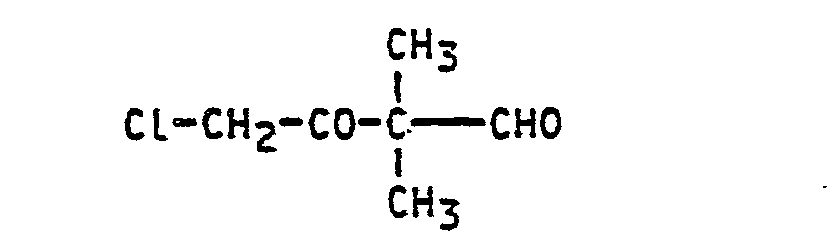
- 210 g (1,5 MoL) 1-(N-Morpholino)-isobuten werden innerhalb einer Stunde zu 169 g (1,5 Mol) ChLoracetyLchLorid, gelöst in 350 ml DiethyLether, bei 5°C zugetropft. Nach beendeter Zugabe rührt man weitere 3 Stunden unter RückfLußkühLung. Die Lösung wird auf 100 g Eis gegossen, mit wässriger NatriumhydrogencarbonatLösung auf pH 5 gebracht und die Etherphase abgetrennt. Die Wasserphase wird mit 100 ml Diethylether extrahiert, die organischen Phasen werden vereinigt, über Natriumsul fat getrocknet, das Lösungsmittel abdestilliert und der Bückstand im Wasserstrahlvakuum destilliert.
- Man erhält 136,4 g (61% der Theorie) 4-Chlor- 2,2-dimethyl-3-keto- butanal vom Siedeounkt 95°C bis 98°C/14 mbar.
-

- Eine Lösung von 26,8g (0,1 Mol) 2-(4-Chlorphenyl) -2-[2-(1,3-di- oxolan-2-yl)-prop-2-yl]-oxiran, 7,6g (0,11 Mol) 1,2,4-Triazol und 0,5 g Kal iumhudroxid in 200 mL absolutem Butanol wird 18 Stunden unter Rückfluß erhitzt. Man läßt auf Raumtemperatur abKühlen und versetzt mit 800 ml Wasser. Die ische Phase wird abgetrennt, über Natriumsulfat getrocknet und eingeengt. Der Rückstand wird mit 200 mL Isopropylether/Essigester (10 :1) verrührt.
- Der ausfallende Feststoff wird abfiltriert und get rocknet. Man erhält 4,5 g (13,3% der Theorie) 3-(1,3-Dioxolan-2-yl)-2-(4- chlorphenyl)-3-methyl-1-(1,2,4-triazol-4-yl)-2-butanol (Beispiel 2) vom Schmelzpunkt 180°C bis 182°C.
- Das FiLtrat wird eingeengt und der Rückstand zunächst mit 350 ml Aceton aufgenommen und dann mit 8 g 1,5-Naphthalindisulfonsäure in 30 mL Aceton versetzt. Man Läßt 6 Stunden bei 0°C rühren, saugt den Feststoff ab und versetzt mit gesättiger, wässriger Natriumhydrogencarbonat/Methylenchlorid-Lösung. Die organische Phase wird abgetrennt, über Natriumsulfat getrocknet und eingeengt.
- Man erhält 19 g (56,2 % der Theorie) 3-(1,3-Dioxolan-2-yl)-2-(4- chlorphenyl)-3-methyl-1-(1,2,4-triazol-1-yl)-2-butanol (BeispieL 3) als Oel.
-

- Man erhält 26,8 g 2-(4-Chlorphenyl)-2-[2-(1,3-dioxolan-2-yl)-prop-2-yl]-oxiran als Oel, das direkt weiter umgesetzt wird.
-

- 13,6 g (0,2 Mol) Imidazol werden portionsweise zu 6 g (80 %-ig 0,2 Mol) Natriumhydrid in 200 ml absolutem Dimethylformamid gegeben, wobei die Temperatur auf ca. 45°C ansteigt. Man läßt 30 Minuten nachrühren und gibt dann 34 g (0,108 Mol) 2-(2,4-Dichlor- phenethenyl)-2-(5-methyl-1,3-dioxan-5-yl)-oxiran in 50 mL absolutem Dimethylformamid zu. Das Reaktionsgemiseh wird 4 Stunden bei 80°C gerühnt. Man läßt abkühlenund gibt auf 800 ml Eiswasser/ 600 ml Methylenchlorid. Man läßt 45 Minutennachrühren, trennt die Methylenchloridphase ab, wäscht zweimal mit Wasser, trocknet über NatriumsuLfat und engt ein. Der Rückstand wird aus Ether umkristallisiert.
- Man erhält 10,5 g (25,4: % der Theorie) 1-(2,4-Dichlorphenyl)-4- (imidazol-1-yl)-3-(5-methyl-1,3-dioxan-5-yl)-1-buten-3-ol vom- Schmelzpunkt 142° bis 144°C.
-

- 56,8 g (0,4 Mol) Methyljodid werden zu 26,4 g (0,425 Mol) DimethyLsuLfid in 180 ml absolutem DimethyLsuLfoxid und 175 ml absolutem Tetrahydrofuran getropft, wobei die Temperatur auf ca. 35°C steigt. Man Läßt 16 Stunden nachrühren und versetzt dann mit einer Lösung von 75,2 g (0,25 Mol) 2,4-Dichlorphenethenyl-(5-methyl-1,3-dioxan-5-yL)-keton in 200 mL absolutem ToLuoL. Bei 0°C werden 17,4 g (0,3 Mol) NatriummethyLat portionsweise eingetragen. Man Läßt drei Stunden nachrühren, versetzt nochmals mit 10,8 g (0,2 MoL) NatriummethyL-at-und Läßt über Nacht rühren. Das Reaktionsgemisch wird mit 250 ml Wasser versetzt, die ToLuoLphase abgetrennt und die wässrige Phase zweimal mit je 150 ml ToLuoL extrahiert. Die vereinigten ToLuoLohasen werden dreimal mit je 700 ml Wasser gewaschen, über NatriumsuLfat getrocknet und eingeengt. Der ölige Rückstand wird im Vakuum entgast.
- Man erhält 69 g 2-(2,4-Dichlorphenethenyl)-2-(5-methyl-1,3-dioxan 5-yl)-oxiran als Oel, das direkt weiter umgesetzt wird.

- 70 g (0,4 MoL) 2,4-Dichlorbenzaldehyd und 57,5 g (85 X-ig, 0,4 MoL) Methyl-(5-methyl-1,3-dioxan-5-yl)-keton in 140 ml EthanoL und 50 ml Wasser werden tropfenweise mit 35 ml 10 X-iger NatronLauge versetzt. Man läßt die Reaktionsmischung 8 Stunden bei Raumtemperatur nachrühren und gibt anschließend auf 400 ml Methylenchlorid. Die organische Phase wird abgetrennt, mit Wasser gewaschen, über Natriumsulfat getrocknet und eingeengt. Der ölige Rückstand kristallisiert nach Verreiben mit Ether.
- Man erhält 80 g 2,4-Dichlorphenethenyl-(5-methyl-1,3-dioxan-5-yl)-keton vom Schmelzpunkt 100°C bis 102°C.

- 360 g (5 MoL) Methylethylketon und 225 g (2,5 Mol) Trioxan werden in 1000 ml ChLoroform unter Zugabe von 40 ml konzentrierter SchwefeLsäure 2 Stunden unter RückfLuß erhitzt. Man Läßt abkühlen, versetzt mit 2 l Wasser und Läßt 10 Minuten nachrühren. Die organische Phase wird abgetrennt, in gesättigte, wässrige Natriumhydrogencarbonatlösung eingerührt und das Gemisch erneut während 10 Minuten nachgerührt. Die organische Phase wird abgetrennt, über Natriumsulfat getrocknet und eingeengt. Der Rückstand wird im Vakuum destilliert.
- Man erhält 199 g Methyl-(5-methyl-1,3-dioxan-5-yl)-keton vom Siedepunkt 50°C bis 52°C/0,08 mbar.
-

- 13,8 g (0,2 MoL) 1,2,4-TriazoL werden portionsweise zu einer Suspension von 6 g (80 %-ig, 0,2 Mol) Natriumhydrid in 330 ml absolutem Dimethylformamid gegeben. Man läßt-30 Min. nachrühren und versetzt dann mit 45g (0,136 Mol) 2-(2,4-Dichlorphenylethyl)-2-[2(1,3-dioxolan-2-yl)-prop-2-yl]-oxiran in 80 mL Dimethylformamid. Das Reaktionsgemisch wird 4 Stunden bei 80°C gerührt. Danach Läßt man abkühlen und gibt auf 600 ml Eiswasser/800 ml MethyLenchLorid. Die MethyLenchLoridphase wird abgetrennt, zweimal mit je 1500 ml Wasser gewaschen, über Natriumsulfat getrocknet und eingeengt. Der ölige Rückstand wird in 400 ml Aceton aufgenommen und bei 0°C mit 14,4 g 1,5-Naphthalindisulfonsäure in 40 mL Aceton versetzt. Man Läßt 5 Stunden nachrühren und saugt den entstandenen NiederschLag ab.
- Man erhält 43,1 g (29,1 % der Theorie) 1-(2,4-Dichlorphenyt)-4-(1,3-dioxoLan-2-yL)-4-methyL-3-(1,2,4-triazoL-1-yL-methyL)-3-pentanoL- naphthalindisulfonat -(1,5) vom SchmeLzpunkt 183°C.
-

- Gemäß Beispiel 3 erhätt man durch Umsetzung von 83 g (0,262 Mol) 2,4-Dichlorphenylethyl-2-(1,3-dioxolan-2-yl)-prop-2-yl-Keton mit 28,2 g (0,455 Mol) Dimethylsulfid/60 g MethyLjodid 90 g 2-(2,4-Di- chlorphenylethyl)-2-[2-(1,3-dioxolan-2-yl)-prop-2-yl]-oxiran als Oel, das direkt weiter umgesetzt wird.

- 100 g 2,4-Dichlorphenylethenyl-2-(1,3-dioxolan-2-yl)-pro-2-yl)-keton werden mit 10 g Raney-Nickel in 600 mL Tetrahydrofuran 25 Minuten bei einem Druck von 55 bar auf 25°C erhitzt. Das Reaktionsgemisch wird anschLießend eingeengt und der Rückstand im Vakuum destilliert.
- Man erhält 83 g 2,4-Dichlorphenylethyl-2-(1,3-dioxolan-2-yl)-prop-2-yl-keton vom Siedepunkt 148°C/0,1 mbar.

- 196 g (1,12 MoL) 2,4-DichLorbenzaLdehyd und 178 g (1,125 Mol) Methyl-2-(1,3-dioxolan-2-yl)-prop-2-yl-keton in 400 ml EthanoL und 140mL Wasser werden tropfenweise mit 95 mL 10 %-iger NatronLauge versetzt. Man Läßt das Reaktionsgemisch 10 Stunden nach- , rühren, saugt den entstandenen Feststoff ab und wäscht ihn mit EthanoL.
- Man erhält 309 g 2,4-Dichlorphenylethenyl-2-(1,3-dioxotan-2-yl)-prop-2-yL-keton vom SchmeLzpunkt 92°C bis 93°C.
-

- Zu 18 g (0,045 MoL) 1-(2,4-Dichlorphenyl)-4-(1,3-dioxan-2-yl)-4-methyl-3-(1,2,4-triazol-1-yl-methyl)-3-pentanol in 150 mL absolutem Dioxan werden 1,4 g (0,046 Mol) Natriumhydrid zugegeben. Man Läßt 5 Stunden bei Raumtemperatur nachrühren und versetzt mit 7,1 g (0,05 Mol) MethyLjodid. Danach wird über Nacht nachgerührt und erneut mit 0,7 g (0,023 Mol) Natriumhydrid und 3,5 g (0,025 MoL) Methyljodid versetzt. Nach nochmaligem Nachrühren wird von den anorganischen SaLzen abgesaugt. Das FiLtrat wird eingeengt, der ölige Rückstand in MethyLenchLorid aufgenommen,zweimal mit je 600 ml Wasser nachgewaschen, über Natriumsulfat getrocknet und eingeengt. Der Rückstand wird aus Isopropylether ümkristallisiert.
- Man erhält 12 g (64,4 X der Theorie) 1-(2,4-.DichlorphenyL)-4-(1,3-dioxan-2-yl)-3-methoxy-4-methyl-3-(1,2,4-triazol-1-yl-methyl)-pentan vom SchmeLzpunkt 130°C bis 132°C.
- In analoger Weise und entsprechend den erfindungsgemäßen Verfahrensangaben werden die nachfolgenden Verbindungen der allgemeinen Formel (Ia) erhalten:


- In. den nachfolgenden VerwendungsbeispieLen werden die nachstehend angegebenen Substanzen als Vergleichsverbindungen eingesetzt :


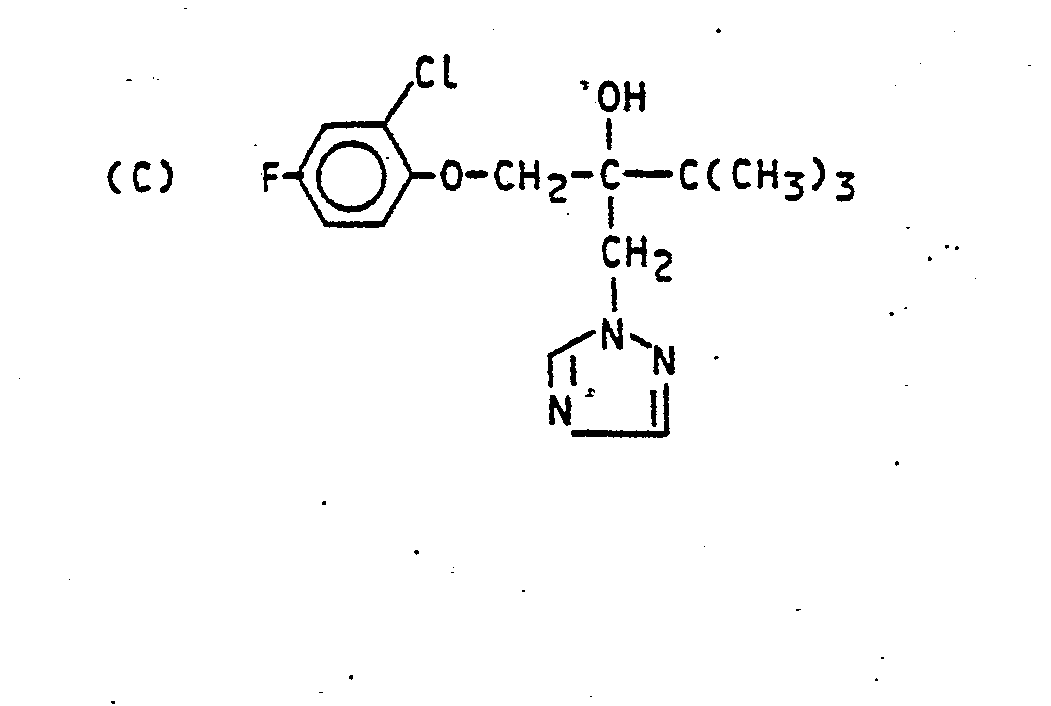
- Puccinia-Test (Weizen) / protektiv
- Lösungsmittel: 100 Gewichtsteile DimethyLformamid Emulgator: 0,25 Gewichtsteile ALkyLaryLpoLygLykoLether
- Zur Herstellung einer zweckmäßigen Wirkstoffzubereitung vermischt man. 1 Gewichtsteil Wirkstoff mit den angegebenen Mengen Lösungsmittel und Emulgator und verdünnt das Konzentrat mit Wasser auf die gewünschte Konzentration.
- Zur Prüfung auf protektive Wirksamkeit werden junge Pflanzen mit einer Sporensuspension von Puccinia recondita in einer 0,1 %igen wäßrigen Agarlösung inokuliert. Nach Antrocknen besprüht man die Pflanzen mit der Wirkstoffzubereitung taufeucht. Die Pflanzen verbleiben 24 Stunden bei 20°C und 100 % rel. Luftfeuchtigkeit in einer Inkubationskabine.
- Die Pflanzen werden in einem Gewächshaus bei einer Temperatur von ca. 20°C und einer relativen Luftfeuchtigkeit von ca. 80 % aufgestellt, um die Entwicklung von Rostpusteln zu begünstigen.
- 10 Tage nach der Inokulation erfolgt die Auswertung.
- Eine deutliche überlegenheit in der Wirksamkeit gegenüber dem Stand der Technik zeigen bei diesem Test z. B. die Verbindungen gemäß folgender Herstellungsbeispiele: 12,13,25,10,23,8,11,21,24,7,19,9,22,5,20 und 14.
- Botrytis-Test ( Bohne )/protektiv
- Lösungsmittel: 4,7 Gewichtsteile . Aceton Emulgator: 0,3 Gewichtsteile Alkylarylpolyglykolether
- Zur Herstellung einer zweckmäßigen Wirkstoffzubereitung vermischt man 1 Gewichtsteil Wirkstoff mit den angegebenen Mengen Lösungsmittel und Emulgator und verdünnt das Konzentrat mit Wasser auf die gewünschte Konzentration.
- Zur Prüfung auf protektive Wirksamkeit bespritzt man junge Pflanzen mit der Wirkstoffzubereitung bis zur Tropfnässe. Nach Antrocknen des Spritzbelages werden auf jedes Blatt 2 kleine mit Botrytis cinerea bewachsene Agarstückchen aufgelegt. Die inokulierten Pflanzen werden in einer abgedunkelten, feuchten Kammer bei 20°C aufgestellt. 3 Tage nach der Inokulation wird die Größe der Befallsflecken auf den Blättern ausgewertet.
- Eine deutliche Überlegenheit in'der Wirksamkeit gegenüber dem Stand der Technik zeigen in diesem Test z.B. die Verbindungen gemäß folgender Herstellungsbeispiele:
11,21,24,7,19 und 5.
und deren Säureadditions-Salze und Metallsalz-Komplexe gefunden.
in üblicher Weise an der Aldehydgruppe mit entsprechenden DioLen in Gegenwart eines inerten organischen LösungsmitteLs, wie beispielsweise ToLuoL, und in Gegenwart einer starken Säure als Katalysator, wie beispielsweise p-Toluofsulfonsäure, bei Temperaturen zwischen 80°C und 110°C derivatisiert.
oder deren AcetaLe bzw. deren Ketale der Formel R-C(OCH3)2-CHO (zur HersteLLung vgL. BuLL.Soc.Chim.France, 1971, S. 2598) in üblicher Weise an der Aldehydgruppe mit entsprechenden DioLen in Gegenwart eines inerten organischen Lösungsmittels, wie beispieLsweise ToLuoL, und in Gegenwart einer starken Säure, wie beispielsweise p-Totuolsulfonsäure, bei Temperaturen zwischen 40°C und 110°C umsetzt.
in üblicher Weise mit 1,2,4-TriazoL oder Imidazol in Gegenwart eines inerten organischen Lösungsmittels, wie beispielsweise Aceton, und in Gegenwart eines Säurebindemittels, wie beispielsweise Kaliumcarbonat, bei Temperaturen zwischen 20°C und 150°C umsetzt.
Claims (9)

und deren Säureadditions-Salze und Metallsalz-Komplexe.

dadurch gekennzeichnet, daß man

mit Azolen der Formel (III)

in Gegenwart eines Verdünnungsmittels und gegebenenfalls in Gegenwart einer Base umsetzt, oder

mit einer magnesium-organischen Verbindung der Formel (V)

in Gegenwart eines Verdünnungsmittels umsetzt, oder


in Gegenwart eines Verdünnungsmittels und gegebenenfalls in Gegenwart einer Base umsetzt,
und gegebenenfalls noch
und gegebenenfalls noch an die so erhaltenen Verbindungen der Formel (I) anschließend eine Säure oder ein Metallsalz addiert.
Priority Applications (1)
| Application Number | Priority Date | Filing Date | Title |
|---|---|---|---|
| AT83110995T ATE25978T1 (de) | 1982-11-15 | 1983-11-04 | Heterocyclisch substituierte hydroxyalkyl-azolyl- derivate. |
Applications Claiming Priority (2)
| Application Number | Priority Date | Filing Date | Title |
|---|---|---|---|
| DE3242252 | 1982-11-15 | ||
| DE19823242252 DE3242252A1 (de) | 1982-11-15 | 1982-11-15 | Heterocyclisch substituierte hydroxyalkyl-azolyl-derivate |
Related Child Applications (1)
| Application Number | Title | Priority Date | Filing Date |
|---|---|---|---|
| EP85113427.0 Division-Into | 1985-10-23 |
Publications (3)
| Publication Number | Publication Date |
|---|---|
| EP0111711A2 true EP0111711A2 (de) | 1984-06-27 |
| EP0111711A3 EP0111711A3 (en) | 1984-10-03 |
| EP0111711B1 EP0111711B1 (de) | 1987-03-18 |
Family
ID=6178198
Family Applications (2)
| Application Number | Title | Priority Date | Filing Date |
|---|---|---|---|
| EP85113427A Expired - Lifetime EP0193642B1 (de) | 1982-11-15 | 1983-11-04 | Heterocyclisch substituierte Hydroxyalkyl-azolyl-Derivate |
| EP83110995A Expired EP0111711B1 (de) | 1982-11-15 | 1983-11-04 | Heterocyclisch substituierte Hydroxyalkyl-azolyl-Derivate |
Family Applications Before (1)
| Application Number | Title | Priority Date | Filing Date |
|---|---|---|---|
| EP85113427A Expired - Lifetime EP0193642B1 (de) | 1982-11-15 | 1983-11-04 | Heterocyclisch substituierte Hydroxyalkyl-azolyl-Derivate |
Country Status (21)
| Country | Link |
|---|---|
| US (1) | US4639462A (de) |
| EP (2) | EP0193642B1 (de) |
| JP (1) | JPS59104380A (de) |
| KR (1) | KR900003302B1 (de) |
| AT (2) | ATE25978T1 (de) |
| AU (2) | AU565099B2 (de) |
| BR (1) | BR8306240A (de) |
| CA (1) | CA1212951A (de) |
| DD (1) | DD215462A5 (de) |
| DE (3) | DE3242252A1 (de) |
| DK (1) | DK520683A (de) |
| ES (1) | ES527258A0 (de) |
| GR (1) | GR79069B (de) |
| HU (1) | HU194483B (de) |
| IE (1) | IE56307B1 (de) |
| IL (1) | IL70197A (de) |
| NZ (1) | NZ206251A (de) |
| PH (1) | PH19094A (de) |
| PT (1) | PT77619B (de) |
| TR (1) | TR22215A (de) |
| ZA (1) | ZA838468B (de) |
Cited By (3)
| Publication number | Priority date | Publication date | Assignee | Title |
|---|---|---|---|---|
| EP0176998A3 (en) * | 1984-10-05 | 1986-11-26 | Bayer Ag | Antimycotic agent |
| EP0357241A1 (de) * | 1988-08-13 | 1990-03-07 | Pfizer Limited | Triazole als schimmelhemmende Mittel |
| US5773443A (en) * | 1990-02-02 | 1998-06-30 | Pfizer Inc. | Triazole antifungal agents |
Families Citing this family (21)
| Publication number | Priority date | Publication date | Assignee | Title |
|---|---|---|---|---|
| DE3426906A1 (de) * | 1984-07-20 | 1986-01-30 | Bayer Ag, 5090 Leverkusen | Verfahren und zwischenprodukte zur synthese diastereomerer verbindungen |
| DE3515309A1 (de) * | 1985-04-27 | 1986-10-30 | Basf Ag, 6700 Ludwigshafen | 1,3-dioxan-5-yl-alkyltriazole, ihre herstellung, ihre verwendung zur regulierung des pflanzenwachstums und mittel dafuer |
| DE3813841A1 (de) * | 1987-06-03 | 1988-12-15 | Bayer Ag | Heterocyclische hydroxyethylazole |
| DE3827134A1 (de) * | 1988-08-10 | 1990-03-15 | Bayer Ag | Substituierte triazolyl- bzw. imidazolyl-hydroxyalkyldioxolane, verfahren zu ihrer herstellung und ihre verwendung als mikrobizide, oxiranyldioxolane, dioxolanylketone, oxiranylketone und (alpha)-halogenketone als zwischenprodukte und verfahren zu deren herstellung |
| US6777217B1 (en) | 1996-03-26 | 2004-08-17 | President And Fellows Of Harvard College | Histone deacetylases, and uses related thereto |
| US20030129724A1 (en) | 2000-03-03 | 2003-07-10 | Grozinger Christina M. | Class II human histone deacetylases, and uses related thereto |
| WO2002089782A2 (en) * | 2001-05-09 | 2002-11-14 | President And Fellows Of Harvard College | Dioxanes and uses thereof |
| US7244853B2 (en) | 2001-05-09 | 2007-07-17 | President And Fellows Of Harvard College | Dioxanes and uses thereof |
| US8999289B2 (en) | 2005-03-22 | 2015-04-07 | President And Fellows Of Harvard College | Treatment of protein degradation disorders |
| US8222423B2 (en) | 2006-02-14 | 2012-07-17 | Dana-Farber Cancer Institute, Inc. | Bifunctional histone deacetylase inhibitors |
| WO2007095584A2 (en) | 2006-02-14 | 2007-08-23 | The President And Fellows Of Harvard College | Histone Deacetylase Inhibitors |
| US8304451B2 (en) | 2006-05-03 | 2012-11-06 | President And Fellows Of Harvard College | Histone deacetylase and tubulin deacetylase inhibitors |
| AU2009274549B2 (en) | 2008-07-23 | 2014-05-01 | Dana-Farber Cancer Institute, Inc. | Deacetylase inhibitors and uses thereof |
| WO2011019393A2 (en) | 2009-08-11 | 2011-02-17 | President And Fellows Of Harvard College | Class- and isoform-specific hdac inhibitors and uses thereof |
| US8822679B2 (en) * | 2011-06-24 | 2014-09-02 | California Institute Of Technology | Quaternary heteroatom containing compounds |
| US20130267699A1 (en) | 2011-06-24 | 2013-10-10 | California Institute Of Technology | Quaternary heteroatom containing compounds |
| US10421696B2 (en) | 2014-12-18 | 2019-09-24 | California Institute Of Technology | Enantioselective synthesis of α-quaternary mannich adducts by palladium-catalyzed allylic alkylation |
| WO2017156239A1 (en) | 2016-03-11 | 2017-09-14 | California Institute Of Technology | Compositions and methods for acylating lactams |
| EP3480190B1 (de) | 2017-11-01 | 2023-01-04 | California Institute of Technology | Verfahren zur enantioselektiven allylalkylierung von estern, lactonen und lactamen mit nicht aktivierten allylalkoholen |
| US11214568B2 (en) | 2018-10-18 | 2022-01-04 | California Institute Of Technology | Gem-disubstituted pyrrolidines, piperazines, and diazepanes, and compositions and methods of making the same |
| EP4130094B1 (de) * | 2020-03-31 | 2024-11-27 | Namics Corporation | Härtungskatalysator, harzzusammensetzung, dichtungsmaterial, klebstoff und gehärtetes produkt |
Family Cites Families (11)
| Publication number | Priority date | Publication date | Assignee | Title |
|---|---|---|---|---|
| DE3018866A1 (de) * | 1980-05-16 | 1981-11-26 | Bayer Ag, 5090 Leverkusen | 1-hydroxyethyl-azol-derivate, verfahren zu ihrer herstellung sowie ihre verwendung als pflanzenwachstumsregulatoren und fungizide |
| DE3025879A1 (de) * | 1980-07-09 | 1982-02-11 | Basf Ag, 6700 Ludwigshafen | 1,3-dioxan-5-yl-alkyltriazole, ihre herstellung, ihre verwendung zur regulierung des pflanzenwachstums und mittel dafuer |
| AU7341381A (en) * | 1980-08-20 | 1982-02-25 | Imperial Chemical Industries Ltd. | Azoles |
| AU553482B2 (en) * | 1980-08-28 | 1986-07-17 | Imperial Chemical Industries Plc | Pharmaceutical compositions of fungicidal triazole derivatives |
| ZA817473B (en) * | 1980-11-19 | 1982-10-27 | Ici Plc | Triazole and imidazole compounds |
| DE3113628A1 (de) * | 1981-04-04 | 1982-10-21 | Basf Ag, 6700 Ludwigshafen | Fungizide mittel, enthaltend triazolylderivate und verfahren zur bekaempfung von pilzen mit ihnen |
| DE3275088D1 (en) * | 1981-08-19 | 1987-02-19 | Ici Plc | Triazole derivatives, processes for preparing them, compositions containing them and processes for combating fungi and regulating plant growth |
| DE3202601A1 (de) * | 1982-01-27 | 1983-08-04 | Bayer Ag, 5090 Leverkusen | Substituierte 1 -hydroxyalkyl-azolyl-derivate, verfahren zu ihrer herstellung sowie ihrer verwendung als fungizide und pflanzenwachstumsregulatoren |
| DE3202604A1 (de) * | 1982-01-27 | 1983-08-04 | Bayer Ag, 5090 Leverkusen | Ether-derivate von substituierten 1-hydroxyalkyl-azolen, verfahren zu ihrer herstellung sowie ihre verwendung als fungizide und pflanzenwachstumsregulatoren |
| DE3242236A1 (de) * | 1982-11-15 | 1984-05-17 | Bayer Ag, 5090 Leverkusen | "antimykotische mittel" |
| DE3242222A1 (de) * | 1982-11-15 | 1984-05-17 | Bayer Ag, 5090 Leverkusen | Hydroxyalkinyl-azolyl-derivate |
-
1982
- 1982-11-15 DE DE19823242252 patent/DE3242252A1/de not_active Withdrawn
-
1983
- 1983-10-21 PH PH29738A patent/PH19094A/en unknown
- 1983-11-01 US US06/547,807 patent/US4639462A/en not_active Expired - Fee Related
- 1983-11-04 EP EP85113427A patent/EP0193642B1/de not_active Expired - Lifetime
- 1983-11-04 AT AT83110995T patent/ATE25978T1/de active
- 1983-11-04 AT AT85113427T patent/ATE50994T1/de active
- 1983-11-04 DE DE8383110995T patent/DE3370329D1/de not_active Expired
- 1983-11-04 EP EP83110995A patent/EP0111711B1/de not_active Expired
- 1983-11-04 DE DE8585113427T patent/DE3381314D1/de not_active Expired - Lifetime
- 1983-11-07 AU AU21036/83A patent/AU565099B2/en not_active Ceased
- 1983-11-07 PT PT77619A patent/PT77619B/pt not_active IP Right Cessation
- 1983-11-11 IL IL70197A patent/IL70197A/xx unknown
- 1983-11-11 JP JP58211118A patent/JPS59104380A/ja active Pending
- 1983-11-14 DD DD83256667A patent/DD215462A5/de not_active IP Right Cessation
- 1983-11-14 CA CA000441096A patent/CA1212951A/en not_active Expired
- 1983-11-14 HU HU833904A patent/HU194483B/hu not_active IP Right Cessation
- 1983-11-14 IE IE2650/83A patent/IE56307B1/xx unknown
- 1983-11-14 GR GR72965A patent/GR79069B/el unknown
- 1983-11-14 ZA ZA838468A patent/ZA838468B/xx unknown
- 1983-11-14 DK DK520683A patent/DK520683A/da not_active Application Discontinuation
- 1983-11-14 BR BR8306240A patent/BR8306240A/pt unknown
- 1983-11-14 ES ES527258A patent/ES527258A0/es active Granted
- 1983-11-14 NZ NZ206251A patent/NZ206251A/en unknown
- 1983-11-15 KR KR1019830005409A patent/KR900003302B1/ko not_active Expired
- 1983-11-15 TR TR22215A patent/TR22215A/xx unknown
-
1987
- 1987-03-23 AU AU70527/87A patent/AU593337B2/en not_active Expired - Fee Related
Cited By (3)
| Publication number | Priority date | Publication date | Assignee | Title |
|---|---|---|---|---|
| EP0176998A3 (en) * | 1984-10-05 | 1986-11-26 | Bayer Ag | Antimycotic agent |
| EP0357241A1 (de) * | 1988-08-13 | 1990-03-07 | Pfizer Limited | Triazole als schimmelhemmende Mittel |
| US5773443A (en) * | 1990-02-02 | 1998-06-30 | Pfizer Inc. | Triazole antifungal agents |
Also Published As
Similar Documents
| Publication | Publication Date | Title |
|---|---|---|
| EP0111711B1 (de) | Heterocyclisch substituierte Hydroxyalkyl-azolyl-Derivate | |
| EP0110048B1 (de) | Substituierte 1-Hydroxyethyl-triazolyl-Derivate | |
| EP0192055B1 (de) | Hydroxyalkinyl-azolyl-Derivate, Verfahren zu ihrer Herstellung sowie ihre Verwendung als Fungizide | |
| EP0019189B1 (de) | Fungizide Mittel, Verfahren zu ihrer Herstellung sowie ihre Verwendung als Fungizide | |
| EP0054865A1 (de) | Substituierte 1-Azolyl-butan-2-one, Verfahren zu ihrer Herstellung und ihre Verwendung als Fungizide sowie als Zwischenprodukte | |
| EP0121171B1 (de) | Fungizide Mittel, Verfahren zu ihrer Herstellung und deren Verwendung | |
| EP0111234B1 (de) | Fungizide Mittel, deren Herstellung und Verwendung | |
| EP0104549B1 (de) | Azolylbutanole | |
| EP0121888B1 (de) | 1-Azolyl-3-pyrazolyl-2-propanol-Derivate, Verfahren zu ihrer Herstellung und ihre Verwendung als Fungizide | |
| EP0019131A1 (de) | Fluorierte 1-Triazolyl-butan-Derivate, Verfahren zu ihrer Herstellung und ihre Verwendung als Fungizide | |
| EP0131845A2 (de) | Verwendung von substituierten Diazolyl-alkyl-carbinolen zur Bekämpfung von Pilzen im Pflanzenschutz | |
| EP0076370B1 (de) | Substituierte Azolyl-phenoxy-Derivate, Verfahren zu ihrer Herstellung und ihre Verwendung als Fungizide | |
| EP0047405A2 (de) | Azolylalkyl-Derivate, Verfahren zu ihrer Herstellung und ihre Verwendung als Fungizide | |
| EP0141205B1 (de) | Hydroxyethylazolyl-oxim-Derivate | |
| EP0118069B1 (de) | Fungizide Mittel 1,3-Diazolyl-propanole enthaltend | |
| EP0042980A2 (de) | 4-Substituierte 1-Azolyl-l-phenoxy-3,3-dimethyl-butan-2-one und -ole, Verfahren zu ihrer Herstellung und ihre Verwendung als Fungizide | |
| EP0057864B1 (de) | 2-Azolylmethyl-1,3-dioxolan- und -dioxan-Derivate, Verfahren zu ihrer Herstellung und ihre Verwendung als Fungizide | |
| EP0141204B1 (de) | Hydroxyethyl-azol-Derivate | |
| EP0102591B1 (de) | Substituierte Azolylether-ketone und -carbinole | |
| EP0019190B1 (de) | Verwendung von Hydroxyalkyl-imidazolen als Fungizide | |
| EP0182188A2 (de) | Triazolylmethylcarbinol-arylacetale | |
| EP0073331B1 (de) | 5-Aryloxy-5-azolyl-3,3-dimethyl-1-penten-4-one und -ole, Verfahren zu ihrer Herstellung sowie ihre Verwendung als Fungizide | |
| EP0129115A2 (de) | Azolylmethyl-thienyl-carbinol-Derivate | |
| EP0065204B1 (de) | 3-Substituierte 1-Azolyl-3-methyl-1-phenoxy-butan-2-one und -ole, Verfahren zu ihrer Herstellung und ihre Verwendung als Fungizide | |
| EP0045016A1 (de) | Substituierte Triazolylalkyl-pyridyl-ether, Verfahren zu ihrer Herstellung sowie ihre Verwendung als Fungizide |
Legal Events
| Date | Code | Title | Description |
|---|---|---|---|
| PUAI | Public reference made under article 153(3) epc to a published international application that has entered the european phase |
Free format text: ORIGINAL CODE: 0009012 |
|
| 17P | Request for examination filed |
Effective date: 19831104 |
|
| AK | Designated contracting states |
Designated state(s): AT BE CH DE FR GB IT LI NL SE |
|
| PUAL | Search report despatched |
Free format text: ORIGINAL CODE: 0009013 |
|
| AK | Designated contracting states |
Designated state(s): AT BE CH DE FR GB IT LI NL SE |
|
| GRAA | (expected) grant |
Free format text: ORIGINAL CODE: 0009210 |
|
| AK | Designated contracting states |
Kind code of ref document: B1 Designated state(s): AT BE CH DE FR GB IT LI NL SE |
|
| REF | Corresponds to: |
Ref document number: 25978 Country of ref document: AT Date of ref document: 19870415 Kind code of ref document: T |
|
| ITF | It: translation for a ep patent filed | ||
| REF | Corresponds to: |
Ref document number: 3370329 Country of ref document: DE Date of ref document: 19870423 |
|
| ET | Fr: translation filed | ||
| PLBE | No opposition filed within time limit |
Free format text: ORIGINAL CODE: 0009261 |
|
| STAA | Information on the status of an ep patent application or granted ep patent |
Free format text: STATUS: NO OPPOSITION FILED WITHIN TIME LIMIT |
|
| 26N | No opposition filed | ||
| PGFP | Annual fee paid to national office [announced via postgrant information from national office to epo] |
Ref country code: AT Payment date: 19891113 Year of fee payment: 7 |
|
| PGFP | Annual fee paid to national office [announced via postgrant information from national office to epo] |
Ref country code: SE Payment date: 19891116 Year of fee payment: 7 |
|
| PG25 | Lapsed in a contracting state [announced via postgrant information from national office to epo] |
Ref country code: AT Effective date: 19901104 |
|
| PG25 | Lapsed in a contracting state [announced via postgrant information from national office to epo] |
Ref country code: SE Effective date: 19901105 |
|
| PGFP | Annual fee paid to national office [announced via postgrant information from national office to epo] |
Ref country code: DE Payment date: 19911024 Year of fee payment: 9 |
|
| PGFP | Annual fee paid to national office [announced via postgrant information from national office to epo] |
Ref country code: GB Payment date: 19911025 Year of fee payment: 9 |
|
| PGFP | Annual fee paid to national office [announced via postgrant information from national office to epo] |
Ref country code: FR Payment date: 19911030 Year of fee payment: 9 |
|
| PGFP | Annual fee paid to national office [announced via postgrant information from national office to epo] |
Ref country code: CH Payment date: 19911105 Year of fee payment: 9 |
|
| PGFP | Annual fee paid to national office [announced via postgrant information from national office to epo] |
Ref country code: BE Payment date: 19911127 Year of fee payment: 9 |
|
| ITTA | It: last paid annual fee | ||
| PGFP | Annual fee paid to national office [announced via postgrant information from national office to epo] |
Ref country code: NL Payment date: 19911130 Year of fee payment: 9 |
|
| PG25 | Lapsed in a contracting state [announced via postgrant information from national office to epo] |
Ref country code: GB Effective date: 19921104 |
|
| PG25 | Lapsed in a contracting state [announced via postgrant information from national office to epo] |
Ref country code: LI Effective date: 19921130 Ref country code: CH Effective date: 19921130 Ref country code: BE Effective date: 19921130 |
|
| BERE | Be: lapsed |
Owner name: BAYER A.G. Effective date: 19921130 |
|
| PG25 | Lapsed in a contracting state [announced via postgrant information from national office to epo] |
Ref country code: NL Effective date: 19930601 |
|
| GBPC | Gb: european patent ceased through non-payment of renewal fee |
Effective date: 19921104 |
|
| NLV4 | Nl: lapsed or anulled due to non-payment of the annual fee | ||
| PG25 | Lapsed in a contracting state [announced via postgrant information from national office to epo] |
Ref country code: FR Effective date: 19930730 |
|
| REG | Reference to a national code |
Ref country code: CH Ref legal event code: PL |
|
| PG25 | Lapsed in a contracting state [announced via postgrant information from national office to epo] |
Ref country code: DE Effective date: 19930803 |
|
| REG | Reference to a national code |
Ref country code: FR Ref legal event code: ST |
|
| EUG | Se: european patent has lapsed |
Ref document number: 83110995.4 Effective date: 19910705 |