EP0111905A2 - Installation de conditionnement d'air - Google Patents
Installation de conditionnement d'air Download PDFInfo
- Publication number
- EP0111905A2 EP0111905A2 EP83112647A EP83112647A EP0111905A2 EP 0111905 A2 EP0111905 A2 EP 0111905A2 EP 83112647 A EP83112647 A EP 83112647A EP 83112647 A EP83112647 A EP 83112647A EP 0111905 A2 EP0111905 A2 EP 0111905A2
- Authority
- EP
- European Patent Office
- Prior art keywords
- coolant
- absorbent
- absorber
- evaporator
- temperature
- Prior art date
- Legal status (The legal status is an assumption and is not a legal conclusion. Google has not performed a legal analysis and makes no representation as to the accuracy of the status listed.)
- Withdrawn
Links
Images
Classifications
-
- C—CHEMISTRY; METALLURGY
- C09—DYES; PAINTS; POLISHES; NATURAL RESINS; ADHESIVES; COMPOSITIONS NOT OTHERWISE PROVIDED FOR; APPLICATIONS OF MATERIALS NOT OTHERWISE PROVIDED FOR
- C09K—MATERIALS FOR MISCELLANEOUS APPLICATIONS, NOT PROVIDED FOR ELSEWHERE
- C09K5/00—Heat-transfer, heat-exchange or heat-storage materials, e.g. refrigerants; Materials for the production of heat or cold by chemical reactions other than by combustion
- C09K5/02—Materials undergoing a change of physical state when used
- C09K5/04—Materials undergoing a change of physical state when used the change of state being from liquid to vapour or vice versa
- C09K5/047—Materials undergoing a change of physical state when used the change of state being from liquid to vapour or vice versa for absorption-type refrigeration systems
-
- F—MECHANICAL ENGINEERING; LIGHTING; HEATING; WEAPONS; BLASTING
- F25—REFRIGERATION OR COOLING; COMBINED HEATING AND REFRIGERATION SYSTEMS; HEAT PUMP SYSTEMS; MANUFACTURE OR STORAGE OF ICE; LIQUEFACTION SOLIDIFICATION OF GASES
- F25B—REFRIGERATION MACHINES, PLANTS OR SYSTEMS; COMBINED HEATING AND REFRIGERATION SYSTEMS; HEAT PUMP SYSTEMS
- F25B15/00—Sorption machines, plants or systems, operating continuously, e.g. absorption type
- F25B15/02—Sorption machines, plants or systems, operating continuously, e.g. absorption type without inert gas
- F25B15/06—Sorption machines, plants or systems, operating continuously, e.g. absorption type without inert gas the refrigerant being water vapour evaporated from a salt solution, e.g. lithium bromide
-
- Y—GENERAL TAGGING OF NEW TECHNOLOGICAL DEVELOPMENTS; GENERAL TAGGING OF CROSS-SECTIONAL TECHNOLOGIES SPANNING OVER SEVERAL SECTIONS OF THE IPC; TECHNICAL SUBJECTS COVERED BY FORMER USPC CROSS-REFERENCE ART COLLECTIONS [XRACs] AND DIGESTS
- Y02—TECHNOLOGIES OR APPLICATIONS FOR MITIGATION OR ADAPTATION AGAINST CLIMATE CHANGE
- Y02A—TECHNOLOGIES FOR ADAPTATION TO CLIMATE CHANGE
- Y02A30/00—Adapting or protecting infrastructure or their operation
- Y02A30/27—Relating to heating, ventilation or air conditioning [HVAC] technologies
-
- Y—GENERAL TAGGING OF NEW TECHNOLOGICAL DEVELOPMENTS; GENERAL TAGGING OF CROSS-SECTIONAL TECHNOLOGIES SPANNING OVER SEVERAL SECTIONS OF THE IPC; TECHNICAL SUBJECTS COVERED BY FORMER USPC CROSS-REFERENCE ART COLLECTIONS [XRACs] AND DIGESTS
- Y02—TECHNOLOGIES OR APPLICATIONS FOR MITIGATION OR ADAPTATION AGAINST CLIMATE CHANGE
- Y02B—CLIMATE CHANGE MITIGATION TECHNOLOGIES RELATED TO BUILDINGS, e.g. HOUSING, HOUSE APPLIANCES OR RELATED END-USER APPLICATIONS
- Y02B30/00—Energy efficient heating, ventilation or air conditioning [HVAC]
- Y02B30/62—Absorption based systems
-
- Y—GENERAL TAGGING OF NEW TECHNOLOGICAL DEVELOPMENTS; GENERAL TAGGING OF CROSS-SECTIONAL TECHNOLOGIES SPANNING OVER SEVERAL SECTIONS OF THE IPC; TECHNICAL SUBJECTS COVERED BY FORMER USPC CROSS-REFERENCE ART COLLECTIONS [XRACs] AND DIGESTS
- Y02—TECHNOLOGIES OR APPLICATIONS FOR MITIGATION OR ADAPTATION AGAINST CLIMATE CHANGE
- Y02P—CLIMATE CHANGE MITIGATION TECHNOLOGIES IN THE PRODUCTION OR PROCESSING OF GOODS
- Y02P20/00—Technologies relating to chemical industry
- Y02P20/10—Process efficiency
Definitions
- the invention relates to an air conditioning apparatus, and more particularly to an air conditioning apparatus which has an absorption type heat pump functioning as an essential part thereof.
- the invention aims at solution of the aforementioned problems.
- a primary object of the invention is therefore to provide an air conditioning apparatus having an absorption type heat pump incorporated therein and adapted for air heating even at a lower outdoor temperature and an evaporator temperature below 0 C.
- Another object of the invention is to provide an air conditioning apparatus having an absorption type heat pump comprising an evaporator for evaporation of a coolant, an absorber containing a solution of an absorbent dissolved in the coolant, the solution absorbing coolant vapor flowing into the absorber from the evaporator, a regenerator for boiling and concentrating the absorbent solution diluted in the absorber, and a condenser adapted to condense coolant vapor flowing thereinto from the regenerator wherein the absorbent"solution is recirculated into the absorber after condensed by said regenerator, characterized in that the absorbent is a mixture of lithium bromide and zinc chloride and that the coolant is a mixed solvent composed of water and methanol.
- the mixed solvent has a ratio by weight of methanol to water, the ratio falling in a range between about 0.1 and about 0.3, said ratio being that measured on the absorbent solution in the evaporator.
- a temperature within the evaporator can be set at some degrees below 0°C even when the outdoor temperature is remarkably low.
- the heat pump in the invention can now be operated for air heating at such a low outdoor temperature that the known coolant, i.e. water, would otherwise freeze in known apparatuses.
- an air cooling capacity of the heat pump is not affected very much but maintained at a sufficiently high level by the abovedescribedccompositions of the absorbent and the coolant.
- a temperature within the absorber can also be set, without any crystallization problem, at a higher temperature than in a known system utilizing only lithium bromide as the absorbent. Said higher temperature of the absorber affords a higher temperature in air heating.
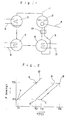
- the heat pump 1 is in operation for air heating and comprises a regenerator 2 to which fuel of a kind such as town gas is supplied through a pipe 4. Combustion heat of the fuel gas is a heat source for driving the heat pump.
- the heat causes a coolant to evaporate within said regenerator 2. Vapor of the coolant is introduced into a condenser 5 so as to condense therein giving an amount of condensation heat to cooling water flowing through a coiled tube 6.
- the coolant thus liquefied will then be delivered to an evaporator 7 which is kept at a pressure lower than that in the condenser.
- the coolant evaporates under this pressure thereby taking an amount of evaporation heat from water which is flowing through another coiled tube 8.
- the water thus cooled in said tube 8 is then subjected to a heat exchange process between atmosphere and cold water by means of an outdoor unit, or may be utilized for air cooling.
- vapor of the coolant flows from the evaporator 7 into an absorber 9 so as to be absorbed therein by an absorbent solution which has been concentrated in the regenerator 2 and is flowing into said absorber through a pipe 3.
- a considerable amount of absorption heat will be liberated and given to water which is flowing through a further coiled tube 11.
- the heated water within said tube 11 is subjected to a further heat exchange process between the room air and said heated water by means of an indoor unit not shown. Air heating is thus effected by the indoor unit.
- the condensation heat liberated in the condenser 5 can also be made use of for air heating.
- the absorbent solution which has absorbed the coolant vapor flows then into the aforementioned regenerator 2 via a heat exchanger 10. This cycle will be continued for air heating.
- temperature of the evaporator 7 should be set at some degrees below 0°C.
- the coolant i.e. water
- a novel air cooling and heating apparatus comprises an improved heat pump of . absorption type in which a coolant is composed of methanol dissolved in water and a mixture of lithium bromide and zinc chloride is used as an absorbent. Freezing point of the coolant descends to a certain degree by dissolving methanol into water whereby the coolant can be prevented from freezing even at some degrees below 0°C. The mixing of methanol into water has proved to be of no bad influence on the system from a practical point of view. When a weight ratio CI of methanol to water is 0.1, 0.2 or 0.3, the freezing point of the coolant is -5.7°C, -14.5 0 C or -25.9°C, respectively.
- the evaporator temperature can be set at about -5 C to -25 0 C if the coolant contains methanol at the weight ratio CI of about 0.1 to 0.3, the ratio being measured on the absorbent solution in the evaporator. It is possible with such a coolant to effectively operate the heat pump even when the outdoor temperature is considerably low in winter. Contrary to this, the coolant would have a freezing point above -6°C when its CI value were smaller than 0.1, this resulting in a possible evaporator temperature higher than -6°C which cannot permit the heat pump to be operated at a considerably low outdoor temperature. Though the freezing point of the coolant becomes lower than -26°C with its CI value greater than 0.3, it would be scarcely necessary to adopt such a low evaporator temperature in most countries of the temperate zone and the subarctic zone.
- a mixture of lithium bromide and zinc chloride is employed as the absorbent in the invention so that crystallization temperature at which the absorbent begins to crystallize is lower than that in case of using lithium bromide only.
- This lower crystallization temperature makes it possible to increase a concentration of the absorbent and consequently to raise the temperatures within the absorber and of air heating.
- the lowest crystallization temperature will be obtained when a weight ratio CII of zinc chloride to lithium bromide is 1, thus providing a possibility to employ the highest absorber temperature. If the value CII is smaller than 0.8 or greater than 1.2, the extent to which the crystallization temperature descends would be not sufficient for a desired high temperature in the absorber.
- Fig. 2 is a diagram illustrating an operation condition of the apparatus in the invention.
- the value CII of the absorbent is set at 1 with the value CI of the coolant set at 0.1.
- the temperatures T°C of said absorbent solution and coolant are indicated on the transversal axis of abscissa of the diagram whereas the pressures P mmHg thereof are indicated on the vertical axis of abscissa.
- the line 12 shows a vapor pressure curve of the coolant, i.e. mixture of methanol and water.
- the temperature T 2 shall be set at 53 C for the condenser 5 and an outlet of the absorber 9 in accordance with a given temperature which is to be maintained in a room or rooms by air heating.
- the pressures P 2 within the condenser 5 and the regenerator 2 are thus 156 mmHg as read from the line 12.
- the temperature within the evaporator 7 is set at for example -2°C which is lower than the outdoor temperature and has been impossible in the known apparatuses
- the pressures P 1 within the evaporator 7 and the absorber 9 will be 7 mmHg as read also from the line 12.
- the temperature T 3 at an inlet of the absorber 9 is set at for instance 58°C at which the absorbent does not crystallize.
- a circulation cycle of the absorbent solution is illustrated by a loop line passing through points A, B, C, and D wherein a line AB shows a concentration process effected between an inlet into and an outlet from the regenerator 2.
- Another line CD shows an absorption process effected within the absorber 9 to absorb the coolant vapor into the absorbent solution.
- a point E indicates a state of the coolant during a condensation process effected in the condenser 5 whereas another point F indicates a state of the coolant during a vaporization process effected in the evaporator 7.
- a concentration of the absorbent in said absorbent solution measured on the points D and A can be estimated to be 77% by means of the temperature T 2 at the outlet of the absorber 9 and the pressure P I within said absorber 9.
- Another concentration of the absorbent on the points B and C will be 80% as similarly estimated from the temperature T 3 at the inlet of said absorber 9 and the pressure P 1 .
- a temperature T 4 at the outlet of the regenerator 2 can be estimated to be 135°C from the pressure P 2 and the concentration 80%.
- Another cycle AEFD in Fig. 2 represents a thermodynamic change in state of the coolant wherein a line AE shows the vaporization in the regenerator and another line FD shows the absorption in the absorber.
- the heat pump in the invention can be successfully operated, as is in the above example, even if the evaoprator temperature T 1 is set at two degrees below 0°C which temperature has been impossible to be adopted in the known apparatuses.
- Such an air heating operation is effected with the outlet temperature T 2 of the absorber at 53 C.
- the invention can be embodied not only into a seconde kind or class of absorption type heat pump but also into a heat pump of multistage absorption type.
- the invention can be applied also to an air cooling apparatus or to an air heating and/or cooling apparatus adapted to supply hot water.
Landscapes
- Engineering & Computer Science (AREA)
- Chemical & Material Sciences (AREA)
- Physics & Mathematics (AREA)
- Thermal Sciences (AREA)
- Materials Engineering (AREA)
- Chemical Kinetics & Catalysis (AREA)
- Combustion & Propulsion (AREA)
- Organic Chemistry (AREA)
- Mechanical Engineering (AREA)
- General Engineering & Computer Science (AREA)
- Sorption Type Refrigeration Machines (AREA)
- Drying Of Gases (AREA)
Applications Claiming Priority (2)
| Application Number | Priority Date | Filing Date | Title |
|---|---|---|---|
| JP222592/82 | 1982-12-17 | ||
| JP57222592A JPS59112168A (ja) | 1982-12-17 | 1982-12-17 | 冷暖房装置 |
Publications (2)
| Publication Number | Publication Date |
|---|---|
| EP0111905A2 true EP0111905A2 (fr) | 1984-06-27 |
| EP0111905A3 EP0111905A3 (fr) | 1985-09-04 |
Family
ID=16784879
Family Applications (1)
| Application Number | Title | Priority Date | Filing Date |
|---|---|---|---|
| EP83112647A Withdrawn EP0111905A3 (fr) | 1982-12-17 | 1983-12-15 | Installation de conditionnement d'air |
Country Status (3)
| Country | Link |
|---|---|
| US (1) | US4509336A (fr) |
| EP (1) | EP0111905A3 (fr) |
| JP (1) | JPS59112168A (fr) |
Cited By (2)
| Publication number | Priority date | Publication date | Assignee | Title |
|---|---|---|---|---|
| GB2167848A (en) * | 1984-11-24 | 1986-06-04 | Hitachi Shipbuilding Eng Co | Absorption type heat pump |
| CN102305494A (zh) * | 2011-07-14 | 2012-01-04 | 清华大学 | 一种含结晶的吸收式化学蓄能装置 |
Families Citing this family (4)
| Publication number | Priority date | Publication date | Assignee | Title |
|---|---|---|---|---|
| JP2503752B2 (ja) * | 1990-10-08 | 1996-06-05 | ダイキン工業株式会社 | 吸着式冷凍装置 |
| US5383341A (en) * | 1991-07-23 | 1995-01-24 | Uri Rapoport | Refrigeration, heating and air conditioning system for vehicles |
| RU2294796C2 (ru) * | 2005-03-28 | 2007-03-10 | Институт Катализа Им. Г.К. Борескова Сибирского Отделения Российской Академии Наук | Сорбент паров метанола и способ получения холода с помощью адсорбционного холодильного устройства |
| CN101532748A (zh) * | 2009-04-14 | 2009-09-16 | 李华玉 | 一种提高热泵供热温度的方法与高温第二类吸收式热泵 |
Family Cites Families (4)
| Publication number | Priority date | Publication date | Assignee | Title |
|---|---|---|---|---|
| US2041741A (en) * | 1929-09-07 | 1936-05-26 | Gen Motors Corp | Absorbent for refrigerants |
| US3478530A (en) * | 1967-12-15 | 1969-11-18 | Worthington Corp | Absorption refrigeration system |
| US4019992A (en) * | 1975-11-03 | 1977-04-26 | Borg-Warner Corporation | Corrosion inhibitors for absorption refrigeration systems |
| IT1165786B (it) * | 1981-05-18 | 1987-04-29 | Osaka Gas Co Ltd | Composizione assorbente per condizionatori d'aria o fornitori di acqua calda |
-
1982
- 1982-12-17 JP JP57222592A patent/JPS59112168A/ja active Pending
-
1983
- 1983-12-12 US US06/560,483 patent/US4509336A/en not_active Expired - Fee Related
- 1983-12-15 EP EP83112647A patent/EP0111905A3/fr not_active Withdrawn
Cited By (3)
| Publication number | Priority date | Publication date | Assignee | Title |
|---|---|---|---|---|
| GB2167848A (en) * | 1984-11-24 | 1986-06-04 | Hitachi Shipbuilding Eng Co | Absorption type heat pump |
| GB2167848B (en) * | 1984-11-24 | 1989-07-05 | Hitachi Shipbuilding Eng Co | Absorption type heat pump |
| CN102305494A (zh) * | 2011-07-14 | 2012-01-04 | 清华大学 | 一种含结晶的吸收式化学蓄能装置 |
Also Published As
| Publication number | Publication date |
|---|---|
| EP0111905A3 (fr) | 1985-09-04 |
| JPS59112168A (ja) | 1984-06-28 |
| US4509336A (en) | 1985-04-09 |
Similar Documents
| Publication | Publication Date | Title |
|---|---|---|
| JP2592625B2 (ja) | 熱吸収装置および方法 | |
| US6314744B1 (en) | Air-conditioning system and operation control method thereof | |
| US3478530A (en) | Absorption refrigeration system | |
| US3491545A (en) | Absorption refrigeration system | |
| US4509336A (en) | Air conditioning apparatus | |
| US3316728A (en) | Absorption refrigeration systems | |
| US6581405B2 (en) | Airconditioning system utilizing absorption chiller cell | |
| US3556200A (en) | Heating and cooling system | |
| JPS5815701B2 (ja) | 太陽熱吸収式冷暖房給湯装置 | |
| US11466189B2 (en) | Absorption cycle apparatus and related method | |
| JP3145215B2 (ja) | 吸収式冷凍機における蒸発及び吸収装置 | |
| US3555839A (en) | Variable vapor pressure absorption refrigeration systems | |
| JP3399663B2 (ja) | 吸収式冷凍機を用いた空調装置 | |
| US3695052A (en) | Concentration control for multiple stage absorption refrigeration systems | |
| JP2580275B2 (ja) | 吸収式冷凍機を用いた空気調和システム | |
| US3528489A (en) | Absorption heating and cooling systems | |
| US3555840A (en) | Refrigerant condensate dilution in absorption refrigeration systems | |
| JP3488953B2 (ja) | 吸収式冷温水同時供給型ヒートポンプ | |
| JP3118124B2 (ja) | 吸収式冷凍機を用いた空調装置 | |
| JPH0810090B2 (ja) | 二重効用空冷吸収式冷温水機 | |
| JPH0253702B2 (fr) | ||
| JP3142998B2 (ja) | 吸収式冷凍機を用いた空調装置 | |
| JPH0297855A (ja) | 吸収式冷凍機 | |
| KR0136205Y1 (ko) | 흡수식 냉난방기 | |
| KR100381373B1 (ko) | 흡수식 냉난방기용 흡수용액 조성물 |
Legal Events
| Date | Code | Title | Description |
|---|---|---|---|
| PUAI | Public reference made under article 153(3) epc to a published international application that has entered the european phase |
Free format text: ORIGINAL CODE: 0009012 |
|
| 17P | Request for examination filed |
Effective date: 19831221 |
|
| AK | Designated contracting states |
Designated state(s): DE FR GB |
|
| PUAL | Search report despatched |
Free format text: ORIGINAL CODE: 0009013 |
|
| AK | Designated contracting states |
Designated state(s): DE FR GB |
|
| 17Q | First examination report despatched |
Effective date: 19860130 |
|
| STAA | Information on the status of an ep patent application or granted ep patent |
Free format text: STATUS: THE APPLICATION IS DEEMED TO BE WITHDRAWN |
|
| 18D | Application deemed to be withdrawn |
Effective date: 19860809 |
|
| RIN1 | Information on inventor provided before grant (corrected) |
Inventor name: OUCHI, YASUMASA Inventor name: OTOSHI, SHOJI |