EP0111984B1 - Ethoxylierte Aminpolymere mit Fleckenentfernungs- und Antiwiederabsetzeigenschaften, verwendbar in Detergenszusammensetzungen - Google Patents
Ethoxylierte Aminpolymere mit Fleckenentfernungs- und Antiwiederabsetzeigenschaften, verwendbar in Detergenszusammensetzungen Download PDFInfo
- Publication number
- EP0111984B1 EP0111984B1 EP19830201809 EP83201809A EP0111984B1 EP 0111984 B1 EP0111984 B1 EP 0111984B1 EP 19830201809 EP19830201809 EP 19830201809 EP 83201809 A EP83201809 A EP 83201809A EP 0111984 B1 EP0111984 B1 EP 0111984B1
- Authority
- EP
- European Patent Office
- Prior art keywords
- moiety
- groups
- alkylene
- alkyl
- polymer
- Prior art date
- Legal status (The legal status is an assumption and is not a legal conclusion. Google has not performed a legal analysis and makes no representation as to the accuracy of the status listed.)
- Expired
Links
- 0 CC([C@](C)C(CC(C)C1)C1=*)OC Chemical compound CC([C@](C)C(CC(C)C1)C1=*)OC 0.000 description 5
Classifications
-
- C—CHEMISTRY; METALLURGY
- C11—ANIMAL OR VEGETABLE OILS, FATS, FATTY SUBSTANCES OR WAXES; FATTY ACIDS THEREFROM; DETERGENTS; CANDLES
- C11D—DETERGENT COMPOSITIONS; USE OF SINGLE SUBSTANCES AS DETERGENTS; SOAP OR SOAP-MAKING; RESIN SOAPS; RECOVERY OF GLYCEROL
- C11D3/00—Other compounding ingredients of detergent compositions covered in group C11D1/00
- C11D3/16—Organic compounds
- C11D3/37—Polymers
- C11D3/3703—Macromolecular compounds obtained otherwise than by reactions only involving carbon-to-carbon unsaturated bonds
- C11D3/3726—Polyurethanes
-
- C—CHEMISTRY; METALLURGY
- C08—ORGANIC MACROMOLECULAR COMPOUNDS; THEIR PREPARATION OR CHEMICAL WORKING-UP; COMPOSITIONS BASED THEREON
- C08G—MACROMOLECULAR COMPOUNDS OBTAINED OTHERWISE THAN BY REACTIONS ONLY INVOLVING UNSATURATED CARBON-TO-CARBON BONDS
- C08G65/00—Macromolecular compounds obtained by reactions forming an ether link in the main chain of the macromolecule
- C08G65/02—Macromolecular compounds obtained by reactions forming an ether link in the main chain of the macromolecule from cyclic ethers by opening of the heterocyclic ring
- C08G65/04—Macromolecular compounds obtained by reactions forming an ether link in the main chain of the macromolecule from cyclic ethers by opening of the heterocyclic ring from cyclic ethers only
-
- C—CHEMISTRY; METALLURGY
- C11—ANIMAL OR VEGETABLE OILS, FATS, FATTY SUBSTANCES OR WAXES; FATTY ACIDS THEREFROM; DETERGENTS; CANDLES
- C11D—DETERGENT COMPOSITIONS; USE OF SINGLE SUBSTANCES AS DETERGENTS; SOAP OR SOAP-MAKING; RESIN SOAPS; RECOVERY OF GLYCEROL
- C11D3/00—Other compounding ingredients of detergent compositions covered in group C11D1/00
- C11D3/0005—Other compounding ingredients characterised by their effect
- C11D3/0036—Soil deposition preventing compositions; Antiredeposition agents
-
- C—CHEMISTRY; METALLURGY
- C11—ANIMAL OR VEGETABLE OILS, FATS, FATTY SUBSTANCES OR WAXES; FATTY ACIDS THEREFROM; DETERGENTS; CANDLES
- C11D—DETERGENT COMPOSITIONS; USE OF SINGLE SUBSTANCES AS DETERGENTS; SOAP OR SOAP-MAKING; RESIN SOAPS; RECOVERY OF GLYCEROL
- C11D3/00—Other compounding ingredients of detergent compositions covered in group C11D1/00
- C11D3/16—Organic compounds
- C11D3/37—Polymers
- C11D3/3703—Macromolecular compounds obtained otherwise than by reactions only involving carbon-to-carbon unsaturated bonds
-
- C—CHEMISTRY; METALLURGY
- C11—ANIMAL OR VEGETABLE OILS, FATS, FATTY SUBSTANCES OR WAXES; FATTY ACIDS THEREFROM; DETERGENTS; CANDLES
- C11D—DETERGENT COMPOSITIONS; USE OF SINGLE SUBSTANCES AS DETERGENTS; SOAP OR SOAP-MAKING; RESIN SOAPS; RECOVERY OF GLYCEROL
- C11D3/00—Other compounding ingredients of detergent compositions covered in group C11D1/00
- C11D3/16—Organic compounds
- C11D3/37—Polymers
- C11D3/3703—Macromolecular compounds obtained otherwise than by reactions only involving carbon-to-carbon unsaturated bonds
- C11D3/3723—Polyamines or polyalkyleneimines
-
- C—CHEMISTRY; METALLURGY
- C11—ANIMAL OR VEGETABLE OILS, FATS, FATTY SUBSTANCES OR WAXES; FATTY ACIDS THEREFROM; DETERGENTS; CANDLES
- C11D—DETERGENT COMPOSITIONS; USE OF SINGLE SUBSTANCES AS DETERGENTS; SOAP OR SOAP-MAKING; RESIN SOAPS; RECOVERY OF GLYCEROL
- C11D3/00—Other compounding ingredients of detergent compositions covered in group C11D1/00
- C11D3/16—Organic compounds
- C11D3/37—Polymers
- C11D3/3746—Macromolecular compounds obtained by reactions only involving carbon-to-carbon unsaturated bonds
- C11D3/3753—Polyvinylalcohol; Ethers or esters thereof
-
- C—CHEMISTRY; METALLURGY
- C11—ANIMAL OR VEGETABLE OILS, FATS, FATTY SUBSTANCES OR WAXES; FATTY ACIDS THEREFROM; DETERGENTS; CANDLES
- C11D—DETERGENT COMPOSITIONS; USE OF SINGLE SUBSTANCES AS DETERGENTS; SOAP OR SOAP-MAKING; RESIN SOAPS; RECOVERY OF GLYCEROL
- C11D3/00—Other compounding ingredients of detergent compositions covered in group C11D1/00
- C11D3/16—Organic compounds
- C11D3/37—Polymers
- C11D3/3746—Macromolecular compounds obtained by reactions only involving carbon-to-carbon unsaturated bonds
- C11D3/3769—(Co)polymerised monomers containing nitrogen, e.g. carbonamides, nitriles or amines
-
- C—CHEMISTRY; METALLURGY
- C11—ANIMAL OR VEGETABLE OILS, FATS, FATTY SUBSTANCES OR WAXES; FATTY ACIDS THEREFROM; DETERGENTS; CANDLES
- C11D—DETERGENT COMPOSITIONS; USE OF SINGLE SUBSTANCES AS DETERGENTS; SOAP OR SOAP-MAKING; RESIN SOAPS; RECOVERY OF GLYCEROL
- C11D3/00—Other compounding ingredients of detergent compositions covered in group C11D1/00
- C11D3/16—Organic compounds
- C11D3/37—Polymers
- C11D3/3746—Macromolecular compounds obtained by reactions only involving carbon-to-carbon unsaturated bonds
- C11D3/3769—(Co)polymerised monomers containing nitrogen, e.g. carbonamides, nitriles or amines
- C11D3/3773—(Co)polymerised monomers containing nitrogen, e.g. carbonamides, nitriles or amines in liquid compositions
-
- C—CHEMISTRY; METALLURGY
- C11—ANIMAL OR VEGETABLE OILS, FATS, FATTY SUBSTANCES OR WAXES; FATTY ACIDS THEREFROM; DETERGENTS; CANDLES
- C11D—DETERGENT COMPOSITIONS; USE OF SINGLE SUBSTANCES AS DETERGENTS; SOAP OR SOAP-MAKING; RESIN SOAPS; RECOVERY OF GLYCEROL
- C11D3/00—Other compounding ingredients of detergent compositions covered in group C11D1/00
- C11D3/16—Organic compounds
- C11D3/37—Polymers
- C11D3/3746—Macromolecular compounds obtained by reactions only involving carbon-to-carbon unsaturated bonds
- C11D3/3769—(Co)polymerised monomers containing nitrogen, e.g. carbonamides, nitriles or amines
- C11D3/3776—Heterocyclic compounds, e.g. lactam
Definitions
- the present application relates to ethoxylated amine polymers having clay-soil removal/anti-redeposition properties when used in detergent compositions.
- Clay soil particles generally comprise negatively charged layers of aluminosilicates and positively charged cations (e.g. calcium) which are positioned between and hold together the negatively charged layers.
- a variety of models can be proposed for compounds which would have clay soil removal properties.
- One model requires that the compound have two distinct characteristics. The first is the ability of the compound to adsorb onto the negatively charged layers of the clay particle. The second is the ability of the compound, once adsorbed, to push apart (swell) the negatively charged layers so that the clay particle loses its cohesive force and can be removed in the wash water.
- Patent 3,925,262 to Laughlin et al., issued December 9, 1975 detergent composition containing polyethoxy zwitterionic surfactants with detergent builders
- U.S. Patent 4,157,277 to Gosselink et al., issued June 26, 1979 C 4 polyoxyalkylene zwitterionic surfactants useful in detergent compositions
- U.S. Patent 4,165,334 to Gosselink et al., issued August 21, 1979 sulfonium-type polyethoxy zwitterionic surfactants).
- polyethoxy zwitterionic surfactants are generally compatible with other detergent surfactants - such as the nonionic, zwitterionic and ampholytic types.
- detergent surfactants such as the nonionic, zwitterionic and ampholytic types.
- anionic surfactants interfere with the particulate soil removal performance of these compounds; anionic soils such as fatty acids likewise interfere.
- anionic detergent surfactants form the most important class of such materials for use in detergent compositions, the lack of compatibility between these polyethoxy zwitterionic surfactants and anionic surfactants poses a significant handicap where particulate (clay) soil removal is desired.
- anti-redeposition or whiteness maintenance agents can be included in the detergent composition.
- polyethoxy zwitterionic surfactants there are a variety of other compounds which can be used as anti-redeposition agents.
- One class of agents are the water-soluble copolymers of acrylic or methacrylic acid with acrylic or methacrylic acid-ethylene oxide condensates disclosed in U.S. Patent 3,719,647 to Hardy et al., issued March 6, 1973.
- Another class of anti-redeposition agents are the cellulose and carboxymethylcellulose derivatives disclosed in U.S.
- Patent 3,597,416 to Diehl, issued August 3, 1971 ionic combination of dodecyltrimethyl phosphonium chloride and sodium carboxymethylcellulose
- U.S. Patent 3,523,088 to Dean et al., issued August 4, 1970 combination of alkali metal carboxymethylcellulose and hydroxypropylcellulose.
- a mixture of compounds has also been used to provide not only anti-redeposition, but also clay soil removal properties. See U.S.
- Patent 4,228,044 to Cambre issued October 14, 1980, which discloses detergent compositions having anti-redeposition and clay soil removal properties which can comprise a nonionic alkyl polyethoxy surfactant, a polyethoxy alkyl quaternary cationic surfactant and a fatty amide surfactant.
- anti-redeposition agents do have a number of significant handicaps. While effective to keep soil suspended, these compounds may lack additional clay soil removal properties. Moreover, as disclosed in the Diehl and Dean et al. patents, mixtures of compounds can be required to achieve the anti-redeposition benefit. To the extent that there are combined anti-redeposition/clay soil removal benefits as disclosed in the Cambre patent, mixtures of compounds are also required.
- PEls polyethyleneimines
- the alkylene oxide e.g. ethylene oxide
- the polyalkyleneimine in a mole ratio of from 1:1 to 1000:1, and preferably in a ratio of from 1:1 to 200:1.
- PEI degree of ethoxylation calculates out to about 4.5 and about 8 ethoxy groups per reactive site, respectively. See also Examples 27-0 5 and 27-0 6 which disclose ethoxylated polyporopyleneiminies (M.W. 500) which have about 4 and about 8 ethoxy units per reactive site, respectively.
- M.W. 500 ethoxylated polyporopyleneiminies
- Preferred uses disclosed by this patent are. as chelating agents, lubricating oil additives, emulsifying agents, and cutting oils.
- TEPA oxyalkylated tetraethylene pentaamines
- patent 2,792,370 to dickson issued May 14,1957 teaches a process for breaking petroleum emulsions with oxyalkylated triethylene tetramines (TETAs) including those having about 5.5 (Example 3aa), about 7.5 (Example 4aa), about 9 (Example 5a) and about 16.5 (Example Bc) ethoxy units per reactive site.
- TETAs oxyalkylated triethylene tetramines
- the amine can have the formula: "4 wherein R 1 is C 1 ⁇ C 16 alkyl; R 2 is H or C 1 -C 16 alkyl; R 1 + R 2 have 6-20 carbon atoms; R 4 is H or methyl; m, n, and o, are each 0 to 3 and A is bridging group such as wherein R 3 is H or methyl; x is 2 to 6; y is 1 to 3; and p is 0 to 3; the sum of m to p being 1 to 5.5, and preferably 1 to 2.
- U.S. Patent 3,838,057 to Barnes et al. discloses toilet bars containing ethoxylated quaternary ammonium compounds, including ethoxylated, quaternized PEls taught to be useful in the detergent, textile, and polymer industries, as anti-static and softening agents.
- ethoxylated quaternized PEls have the formula: wherein R 1 is a compatible quaternary nitrogen substituent; n is at least 2; x is from 3 to 40; and X is a compatible anion.
- Preferred compounds are those where R 1 is a CS-C22 alkyl group or the group: where R' is a C S -C 22 alkyl grop and y is from 3 to 40.
- R 1 is a CS-C22 alkyl group or the group: where R' is a C S -C 22 alkyl grop and y is from 3 to 40.
- R' is a C S -C 22 alkyl grop and y is from 3 to 40.
- the present invention relates to water-soluble ethoxylated amine polymers having clay soil removal/ anti-redeposition properties useful in detergent compositions.
- These polymers comprise a polymer backbone other than a polyalkyleneamine backbone, at least 2 M groups and at least one L-X group, wherein M is a tertiary amine group attached to or integral with the backbone; X is a nonionic group, anionic group or mixture thereof; and L is a hydrophilic chain connecting groups M and X or connecting X to the backbone.
- L also contains the polyoxyalkylene moiety ⁇ [(R'O) m (CH 2 CH 2 O)n] ⁇ , wherein R' is C 3 -C 4 alkylene or hydroxyalkylene, m and n are numbers such that the moiety -(CH2CH20)n- comprises at least 50% by weight of said polyoxyalkylene moiety, and n is at least 3, except when the polymer backbone is a polyethyleneimine backbone, and n is at least 12 when the polymer backbone is a polyethyleneimine backbone.
- the ethoxylated amine polymers of the present invention provide clay soil removal benefits while being anionic detergent surfactant compatible. At most wash pHs, it is believed nitrogen atoms of the polymer are protonated to form positively charged centers which, together with the remaining polar nitrogen atoms, cause adsorption of the polymer onto the negatively charged layers of the clay particle. It is also believed that the hydrophilic ethoxy units attached to the polymer backbone swell the clay particle so that it loses its cohesive character and is swept away in the wash water.
- the anti-redeposition benefits provided by these ethoxylated amine polymers are also believed to be due to the positively charged centers which, together with the remaining polar nitrogen atoms, cause it to be absorbed onto soil suspended in the wash water. As more and more of these polymers adsorb onto the suspended soil, it becomes encased within a hydrophilic layer provided by the attached ethoxy units. As such, the hydrophilically encased soil is prevented from redepositing on fabrics, in particular hydrophobic fabrics such as polyester, during the laundering cycle.
- the water-soluble ethoxylated amine polymers of the present invention comprise a polymer backbone other than a polyalkyleneamine backbone, and at least 2 M groups and at least one L-X group, wherein M is a tertiary amine group attached to or integral with the backbone; X is a nonionic group, an anionic group or mixture thereof; and L is a hydrophilic chain connecting groups M and X, or connecting X to the polymer backbone.
- polymer backbone refers to the polymeric moiety to which groups M and L-X are attached to or integral with. Included within this term are oligomer backbones (2 to 4 units), and true polymer backbones (5 or more units).
- attachment to means that the group is pendent from the polymer backbone, examples of which are represented by the following general structures A and B:
- integral with means that the group forms part of the polymer backbone, examples of which are represented by the following general structures C and D:
- Any polymer backbone (other than a polyalkyleneamine backbone) can be used as long as the ethoxylated amine polymer formed is water-soluble and has clay soil removai/anti-redeposition properties.
- Suitable polymer backbones can be derived from the polyurethanes, the polyesters, the polyethers, the polyamides, the polyimides, the polyacrylates, the polyacrylamides, the polyvinylethers, the polyethylenes, the polypropylenes and like polyalkylenes, the polystyrenes, the polyalkyleneimines, the polyvinylamines, the polyallylamines, the polydiallylamines, the polyvinylpyridines, the polyaminotriazoles, polyvinyl alcohol, the aminopolyureylenes and mixtures thereof.
- polyalkyleneamine backbone refers to polymer backbones having the . following general formula: wherein R 1 is C 2 -C 12 alkylene, hydroxyalkylene, alkenylene, arylene or alkarylene, or a C2-C3 oxyalkylene moiety having from 2 to about 20 oxyalkylene units provided that no 0-N or 0-0 bonds are formed; w is 1 or 0; x + y + z is from 2 to 9; and y + z is from 2 to 9.
- PDAs polyethyleneamines
- PEAs can be obtained by reactions involving ammonia and ethylene dichloride, followed by fractional distillation.
- the common PEAs obtained are triethylenetetramine (TETA) and tetraethylenepentamine (TEPA).
- TETA triethylenetetramine
- TEPA tetraethylenepentamine
- the cogenerically derived mixture does not appear to separate by distillation and can include other materials such as cyclic amines and particularly piperazines.
- cyclic amines with side chains in which nitrogen atoms appear See U.S. Patent 2,792,372 to Dickson, issued May 14, 1957, which describes the preparation of PEAs.
- polyalkyleneimine backbone refers to a polymer backbone having the following general formula: wherein R 1 is defined as above; x + y + z is at least 10.
- M can be any compatible tertiary amine group.
- the tertiary amine group can be represented by the following general structures E and F: Particularly preferred M groups are those represented by general structure E.
- the tertiary amine group M is also preferably positioned close to or integral with the polymer backbone.
- X can be any compatible nonionic group, anionic group or mixture thereof.
- Suitable nonionic groups include C 1 ⁇ C 4 alkyl or hydroxyalkyl, ester or ether groups, preferably acetate or methyl ether, respectively; hydrogen (H); or mixtures thereof.
- the particularly preferred nonionic group is H.
- anionic groups PO 3 -2 and S0 3 - are suitable.
- the particularly preferred anionic group is SO 3 - . It has been found that the relative percentage of anionic groups to nonionic groups can be important to the clay soil removal/anti-redeposition properties provided by the ethoxylated amine polymer. A mixture of from 0 to 30% anionic groups and from 70 to 100% nonionic groups provides preferred properties.
- a mixture of from 5 to 10% anionic groups and from 90 to 95% nonionic groups provides the most preferred properties.
- a mixture of from 0 to 80% anionic groups and from 20 to 100% nonionic groups provides suitable clay soil removal/anti-redeposition properties.
- the ethoxylated amine polymers of the present invention normally have a ratio of groups M to groups X of 1:1.
- the ratio of cationic groups M to groups X can be varied.
- the ratio of groups M to groups X can usually range from 2:1 to 1:10. In preferred polymers, the ratio is from 1:1 to 1:5.
- the polymers formed from such copolymerization are typically random, i.e. the tertiary amine, anionic (nonionic), or mixed tertiary amine/anionic (nonionic) monomers copolymerize in a nonrepeating sequence.
- the units which contain groups M and groups L-X most preferably comprise 100% of the ethoxylated amine polymers of the present invention.
- inclusion of other units (preferably nonionic) in the polymers is also permissible.
- other units include the acrylamides and the vinylethers. These other units can comprise from 0 to 90% of the polymer (from 10 to 100% of the polymer being units containing M and L-X groups). Typically, these other units comprise from 0 to 50% of the polymer (from 50 to 100% of the polymer being units containing M and L-X groups).
- the number of groups M and L-X usually ranges from 2 to 200. Typically, the number of groups M and L-X is from 3 to 100. Preferably, the number of groups M and L-X is from 3 to 40.
- hydrophilic chain L usually consists entirely of the polyoxyalkylene molety ⁇ [(R'O) n , ⁇ (CH 2 CH 2 On] ⁇ .
- the moieties ⁇ (R'O) m ⁇ and -(CH2CH20)n- of the polyoxyalkylene moiety can be mixed together or preferably form blocks of-(R'O) m - and ⁇ (CH 2 CH 2 O) n ⁇ moieties.
- R' is preferably C 3 C 6 (propylene);
- m is preferably from 0 to 5, and most preferably 0, i.e.
- the polyoxyalkylene moiety consists entirely of the moiety ⁇ (CH 2 CH 2 On ⁇ .
- the moiety ⁇ (CH 2 CH 2 O)n ⁇ preferably comprises at least 85% by weight of the polyoxyalkylene moiety, and most preferably 100% by weight (m is 0).
- m is 0
- a plurality (2 or more) of moieties -L-X can also be hooked together and attached to group M or to the polymer backbone, examples of which are represented by the following general structures G and H:
- Structures G and H can be formed, for example, by reacting glycidol with group M or the polymer backbone, and then ethoxylating the subsequently formed hydroxy groups.
- the level at which the ethoxylated amine polymers of the present invention can be present in the detergent compositions can vary widely depending upon the polymer used, the type of detergent formulation (liquid, granular), and the benefits desired. These compositions can be used as laundry detergents, laundry additives, or laundry pretreatments. Generally, these polymers can be included in an amount of from 0.05 to 95% by weight of the composition, with a usual range of from 0.1 to 10% by weight for laundry detergents. Preferred detergent compositions comprise from 0.5 to 5% by weight of the polymer of the present invention. For these preferred compositions, the polymer is typically present at from 1 to 3% by weight.
- the polymer is normally present at a level that provides from 2 ppm to 200 ppm, preferably from 10 ppm to 100 ppm, of the polymer in the wash solution at recommended U.S. usage levels, and normally from 30 ppm to 1000 ppm, preferably from 50 ppm to 500 ppm for European usage levels.
- ethoxylated amine polymers of the present invention are as follows:
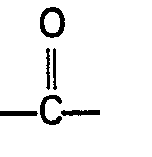
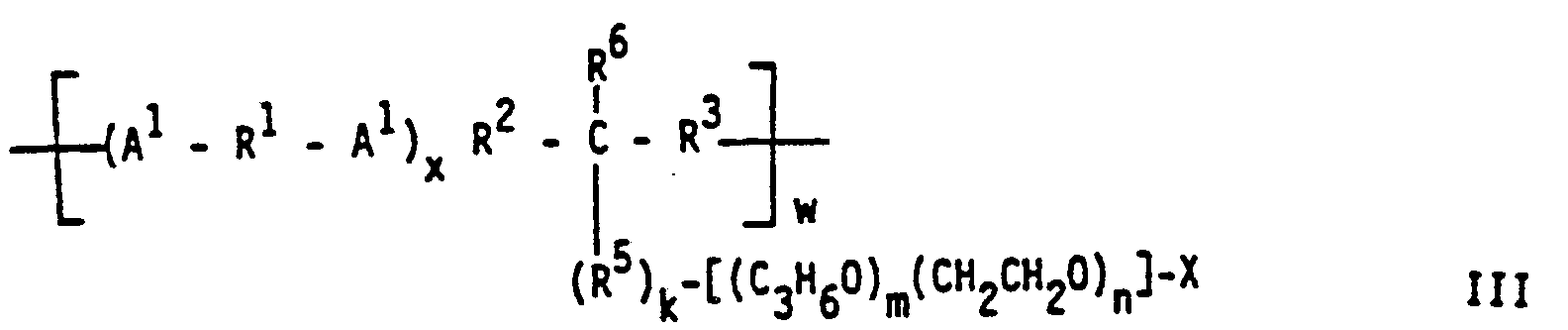
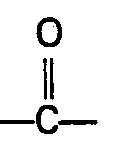
- ethoxylated amine polymers are derived from polyurethanes, polyesters, polyethers or polyamides. These polymers comprise units selected from those having formulas I, and III: wherein A 1 is
- a 1 is preferably A 2 is preferably ⁇ O ⁇ ; x is preferably 1; and R is preferably H.
- R 1 can be linear or branched (e.g. alkylene, hydroxyalkylene, alkenylene, cycloalkenylene, alkarylene or oxyalkylene; when R 1 is a C 2 ⁇ C 3 oxyalkylene moiety, the number of oxyalkylene units is preferably from 2 to 12; R 1 is preferably C 2 ⁇ C 6 alkylene or phenylene, and most preferably C 2 -C 6 alkylene (ethylene, propylene, hexamethylene).
- R 2 is preferably ⁇ OR 5 ⁇ or ⁇ (OR 7 ) y ;
- R 3 is preferably ⁇ R 5 O ⁇ or ⁇ (R 7 O) y ⁇ ;
- R 4 is preferably methyl.
- R 1 can be linear or branched, and is preferably C 2 ⁇ C 3 alkylene;
- R 6 is preferably H or C 1 ⁇ C 3 alkyl;
- R 7 is preferably ethylene;
- X is preferably H or methyl;
- k is preferably 0;
- y is preferably from 2 to 12.
- n is preferably at least 6 when the number of N and X groups are each 2 or 3; n is most preferably at least 12, with a typical range of from 12 to 42 for all ranges of u + v + w.
- u is preferably from 3 to 40, and is most preferably from 3 to 20.
- v and w are each preferably from 3 to 40.
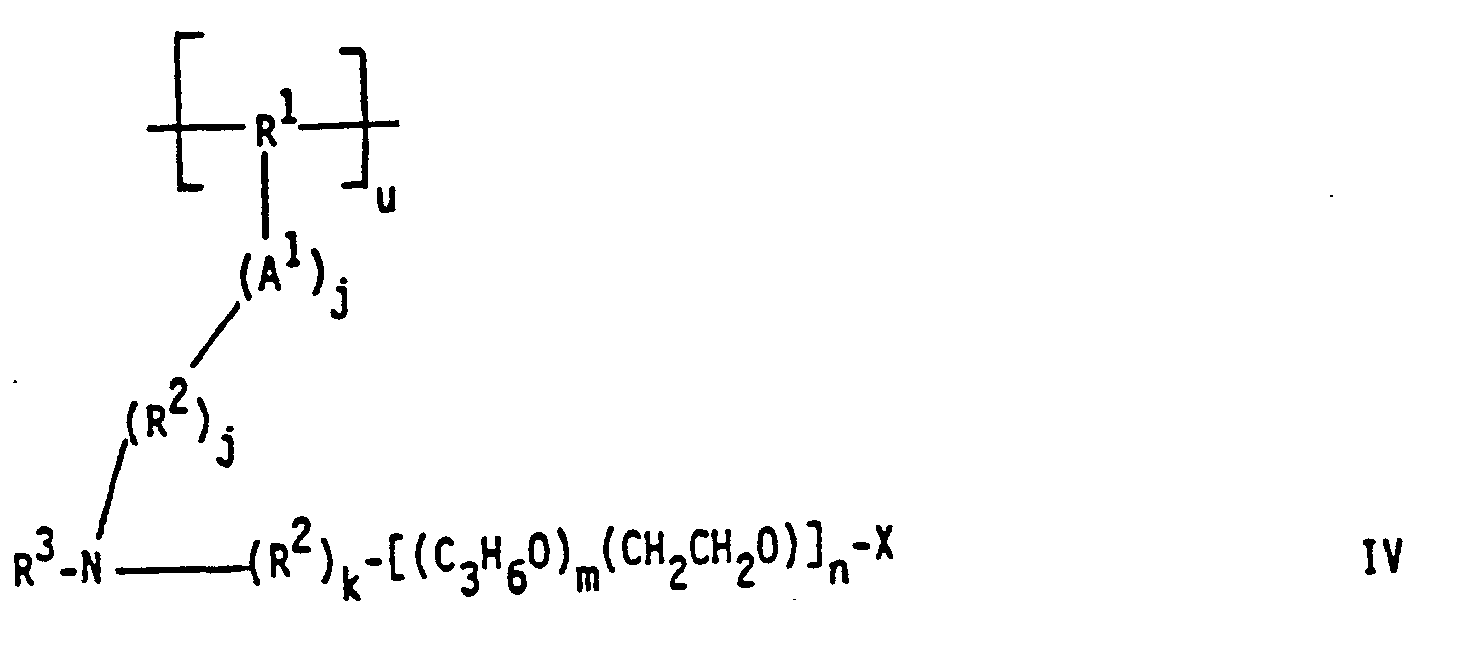
- ethoxylated amine polymers are derived from polyacrylates, polyacrylamides or polyvinylethers. These polymers comprise units selected from those having formulas IV, V and VI.
- a 1 is R is H or C 1 ⁇ C 4 alkyl or hydroxyalkyl;
- R' is substituted C 2 ⁇ C 12 alkylene, hydroxyalkylene, alkenylene, arylene, or alkarylene or C 2 -C 3 oxyalkylene;
- each R 2 is C 1 ⁇ C 12 alkylene, hydroxyalkylene, alkenylene, arylene or alkarylene;
- R 3 is C 1 -C 4 alkyl or hydroxyalkyl, or the moiety ⁇ (R 2 ) k ⁇ [C 3 H 6 O) m (CH 2 CH 2 O)n] ⁇ X;
- each R 4 is C 1 -C 4 alkyl or hydroxyalkyl, or together form the moiety ⁇ (CH 2 )r ⁇ A 2
- a 1 is preferably or ⁇ O ⁇ ; A 2 is preferably ⁇ 0 ⁇ , R is preferably H.
- R 1 can be linear (e.g. substituted alkylene, hydroxyalkylene, alkenylene, alkarylene or oxyalkylene; R 1 is preferably C 2 -C 6 alkylene and most preferably Each R 2 is preferably C 2 -C 3 alkylene, R 3 is preferably methyl; each R 4 is preferably methyl; X is preferably H or methyl; j is preferably 1; k is preferably 0; m is preferably 0; r and s are each preferably 2.
- n, u, v and w can be varied according to the n, u, v and w for the polyurethane.
- R 1 is C 2 -C 12 alkylene, hydroxyalkylene, alkenylene, cycloalkylene, arylene or alkarylene, or a C 2 -C 3 polyoxyalkylene moiety having from 2 to 20 oxyalkylene units; each R 2 is C 1 ⁇ C 4 alkyl or hydroxyalkyl, the moiety ⁇ (R 3 ) k ⁇ [(C 3 H 6 O) m (CH 2 CH 2 O)n] ⁇ X, or two R 2 together form the moiety ⁇ (CH 2 ) r ⁇ A ⁇ (CH 2 ) s ⁇ , wherein A is ⁇ O ⁇ or ⁇ CH 2 ⁇ ; R 3 is C 1 ⁇ C 12 alkylene, hydroxyalkylene, alkenylene, arylene or alkarylene; X is H, SO 3 -, or mixture thereof; k
- A is preferably -0-; R 1 can be varied like R 1 of the polyurethane; R 2 is preferably methyl or the moiety ⁇ (R 3 )k ⁇ [(C 3 H 6 O) m (CH 2 CH 2 O)n] ⁇ X; each R 3 is preferably C 2 -C 3 alkylene; X is preferably H; k is preferably 0; m is preferably 0; r and s are each preferably 2.
- n has a typical range of from 12 to 42 for all ranges of y + z.
- Preferred ethoxylated amine polymers of this class are the ethoxylated C Z -C 3 polyalkyleneimines.
- Particularly preferred ethoxylated polyalkyleneimines are the ethoxylated ethyleneimines (PEls). These preferred polymers have the general formula: wherein X, x, y, z and n are defined as before.
- the PEls used in preparing the polymers of the present invention have a molecular weight of at least 440 prior to ethoxylation, which represents at least 10 units.
- Preferred PEls used in preparing these compounds have a molecular weight of from 600 to 1800.
- the polymer backbone of these PEls can be represented by the general formula: wherein the sum of x, y and z represents a number of sufficient magnitude to yield a polymer having the molecular weights previously specified. Although linear polymer backbones are possible, branch chains can also occur.
- the relative proportions of primary, secondary and tertiary amine groups present in the polymer can vary, depending on the manner of preparation.
- Each hydrogen atom attached to each nitrogen atom of the PEI represents an active site for subsequent ethoxylation.
- These PEls can be prepared, for example by polymerizing ethyleneimine in the presence of a catalyst such as carbon dioxide, sodium bisulfite, sulfuric acid, hydrogen peroxide, hydrochloric acid or acetic acid.
- a catalyst such as carbon dioxide, sodium bisulfite, sulfuric acid, hydrogen peroxide, hydrochloric acid or acetic acid.
- Specific methods for preparing PEls are disclosed in U.S. Patent 2,182,306 to Ulrich et aI., issued December 5, 1939; U.S. Patent 3,033,746 to Mayle et al., issued May 8, 1962; U.S. Patent 2,208,095 to Esselmann et al., issued July 16,1940; U.S. Patent 2,806,839 to Crowther, issued September 17, 1957; and U.S. Patent 2,553,696 to Wilson, issued May 21, 1951.
- n is at least 12 for the ethoxylated PEls.
- the minimum degree of the ethoxylation required for suitable clay soil removal/anti-redeposition performance can increase as the molecular weight of the PEl increases, especially much beyond 1800.
- the degree of ethoxylation for preferred compounds increases as the molecular weight of the PEI increases.
- n is preferably at least 12, with a typical range of from 12 to 42.
- n is preferably at least 24, with a typical range of from 24 to 42.
- ethoxylated amine polymers are those derived from the diallylamines. These polymers comprise units selected from those having formulas IX and X: wherein R 1 is C 1 -C 4 alkyl or hydroxyalkyl; R 2 is C 1 ⁇ C 12 alkylene, hydroxyalkylene, alkylene, arylene or alkarylene; X is H, SO 3 - , or mixture thereof; k is 1 or 0; m is from 0 to 5; n is at least 3; m and n are numbers such that the moiety ⁇ (CH 2 CH 2 O)n ⁇ comprises at least 85% by weight of the moiety ⁇ [(C 3 H 6 O) m (CH 2 CH 2 O), ⁇ ]; x is 1 or 0; y is 1 when x is 0 and 0 when x is 1; the number of u and v is such that there are at least 2 N groups and at least 2 X groups.
- R 1 is preferably methyl; each R 2 is preferably C 2 ⁇ C 3 alkylene; X is preferably H; k is preferably 0; m is preferably 0.
- n is preferably at least 6 when the number of N and X groups are each 2 or 3; n is most preferably at least 12, with a typical range of from 12 to 42 for all ranges of u + v.
- v is 0, and u is from 3 to 40.
- polyurethane versions of the present invention can be prepared according to the following general scheme:
- the ethoxylated compound from step 1 is dissolved in 1000 ml of acetonitrile and then cooled to 10°C. To this solution is added 2.6 moles of tosyl chloride dissolved in 500 ml of acetonitrile and cooled to 10°C and then 2.9 moles of triethylamine is added. After the reaction is complete, H 2 0 is added to decompose the remaining tosyl chloride.
- step 3 To the reaction mixture from step 3 is added 3.4 moles of diethanolamine. After heating for 18 h at 80°C, the reaction mixture is cooled and carefully acidified with HCI, keeping the pH just above 7, and then extracted with ether. The aqueous phase is then extracted with a mixture of ether:acetonitrile (ratio of 5:2) twice. The aqueous phase is separated and then made basic with 50% NaOH. This aqueous phase is extracted with dichloromethane (2000 ml). The lower layer is separated and then extracted 3 times with 2000 ml portions of saturated NaCl solution while adding enough 50% NaOH to make the aqueous phase strongly basic (pH of 11). The lower organic layer is stripped to give the desired aminated compound. Toluene (200 ml) is added and the mixture stripped again to give the desired aminated monomer.
- the aminated monomer from step 3 is dissolved in chloroform free of ethanol stabilizer.
- the monomer is previously evacuated in a Kugelrohr at 80°-90°C under a vacuum (pressure of 133.3 Pa (1 mmHg) for at least 18 hours.
- the monomer in the chloroform is then dried overnight with 0.3 nm (3A) molecular sieves and then transferred to a dry flask (equipped with mechanical stirrer) under argon.
- dibutyltin dilaurate catalyst 0.058 mole equiv.
- the random copolymer versions of the present invention can be prepared according to the following general scheme:
- Decaethyleneglycol monomethacrylate monomer (0.008 moles) and N-(3-dimethylaminopropyl)-methacrylamide monomer (0.011 moles) are dissolved in 40 ml of acetonitrile.
- the reaction mixture is purged of oxygen by bubbling argon through it.
- a 0.23 g portion of benzoyl peroxide is separately dissolved in acetonitrile and similarly purged.
- the reaction mixture is heated to reflux and the benzoyl peroxide solution then added dropwise over 0.5 hours.
- 0.28 g of azobisisobutyronitrile in 5 ml of acetonitrile is added to the reaction mixture and heating continued overnight.
- the desired random copolymer is isolated by stripping off the solvent.
- the ethoxylated PEls of the present invention can be prepared by standard methods for ethoxylating amines. There is preferably an initial step of condensing sufficient ethylene oxide to provide 2-hydroxyethyl groups at each reactive site. The appropriate amount of ethylene oxide is then condensed with these 2-hydroxyethylamines using an alkali metal (e.g., sodium, potassium) hydride of hydroxide as the catalyst to provide the respective ethoxylated amines.
- an alkali metal e.g., sodium, potassium
- the total degree of ethoxylation per reactive site (n) can be determined according to the following formula: wherein E is the total number of moles of ethylene oxide condensed (including hydroxyethylation), A is the number of moles of the starting PEI, and R is the number of reactive sites (typically 3 + y + z) for the starting PEI.
- a representative synthesis of an ethoxylated PEI of the present invention is as follows:
- Dried PEI (M.W. 600, 14.19 g, 0.0236 moles) was hydroxyethylated with ethylene oxide at 130°-140°C for 3 hours with stirring. 0.5 g (0.0125 moles) of 60% sodium hydride in mineral oil was then added and the reaction mixture swept with argon.
- Diallylamine polymer versions of the present invention can be prepared according to the following general scheme. The synthesis of one such polymer is described as follows:
- Diallylamine (1.7'motes) is dissolved in methanol (160 ml) under argon and then heated to 45°C. Ethylene oxide is then added for 2.5 hours. Methanol is then removed by heating the reaction mixture to 100°C in vacuo. To the residue is added sodium hydride (0.17 moles) with stirring until the evolution of hydrogen ceased. Ethylene oxide is then added until the degree of ethoxylation (n) is 7.
- a portion of the ethoxylated monomer from step 1 (25 g) is mixed with D 2 0 (20 ml) and heated to 95°C under argon for 1 hour.
- Tertbutylhydroperoxide (0.5 ml) is then added dropwise and the reaction continued at 90°C for 18 hours. Then additional hydroperoxide (0.5 ml) is added dropwise. After heating 3 more days, water is then removed in vacuo (50°-60°C at pressure of 133.3 Pa (0.1 mmHg)) to yield the crude polymer.
- Clay soil removal comparisons were conducted in a standard 1 liter Tergotometer employing water of 7 grain hardness (3:1 Ca”:Mg") and a temperature of 37.8°C (100°F). Soiled swatches were washed in the Tergotometerfor 10 minutes and rinsed twice with water (7 grain hardness) at 23.9°C (70°F) for 2 minutes.
- the swatches were 12.7 cm by 12.7 cm (5 inches by 5 inches) in size and were soiled by dipping in an aqueous slurry of local clay and subsequently baked to remove the water. The dipping and backing was repeated 5 times.
- One wash employed 2000 ppm of a control liquid detergent composition containing the following surfactants:
- a second wash used the same detergent composition but also containing an ethoxylated amine polymer at 20 ppm. Neither composition contained optical brighteners.
- the product washes approximated a conventional home use laundry situation. After laundering, the swatches were dried in a mini-dryer.
- the clay soil removal performance of each detergent composition was determined by finding the difference in whiteness (AW) before and after washing as:
- the improvement in clay soil removal performance of the composition containing the ethoxylated amine polymer was measured as the difference in AW values ( ⁇ 2 W) relative to the control composition.
- Anti-redeposition comparisons were conducted in a 5 pot Automatic Miniwasher (AMW) employing 7 grain hardness water and temperature of 29.4°C (95°F). Test swatches were washed for 10 minutes and rinsed twice with water (7 grain hardness) at 23.9°C (75°F) for 2 minutes.
- AMW Automatic Miniwasher
- the detergent composition to be tested (control or containing 20 ppm ethoxylated amine polymer as in clay soil removal test) was added and agitated for 2 minutes.
- a background soil mixture 200 ppm artificial body soil, 100 ppm vacuum cleaner soil and 200 ppm clay soil was then added and agitated for an additional 3 minutes.
- Three 12.7 cm (5 inch) square test swatches (50% polyester/50% cotton T-shirt material) were then added, along with two 80% cotton/20% polyester terry clothes and two 27.9 cm (11 inch) square swatches of 100% polyester knit fabric. The 10 minute wash cycle commenced at this point.
- test swatches were dried in a mini-dryer. Gardner Whiteness meter readings (L, a and b) were then determined for the three test swatches. Anti-redeposition performance (ARD) was then calculated according to the following equation.
- the ARD values for the three test swatches were then averaged.
- the improvement in anti-redeposition performance of the composition containing the ethoxylated amine was measured as the difference in ARD values (AARD) relative to the control composition.
- PEG 6000 polyethylene glycol having M.W. of 6000
- ⁇ 2 W value 4.9
- AARD value 8.9.
- the amount of detergent surfactant included in the detergent compositions of the present invention can vary from 1 to 75% by weight of the composition depending upon the detergent surfactant(s) used, the type of composition to be formulated (e.g. granular, liquid) and the effects desired.
- the detergent surfactant(s) comprises from 10 to 50% by weight of the composition.
- the detergent surfactant can be nonionic, anionic, ampholytic, zwitterionic, cationic, or a mixture thereof:
- Suitable nonionic surfactants for use in detergent compositions of the present invention are generally disclosed in U.S. Patent 3,929,678 to LaughJin et al., issued December 30, 1975 at column 13, line 14 through column 16, line 6. Classes of nonionic surfactants included are:
- Preferred amides are C 8 ⁇ C 20 ammonia amides, monoethanolamides, diethanolamides, and isopropanol amides.
- Anionic surfactants suitable in detergent compositions of the present invnetion are generally disclosed in U.S. Patent 3,929,678 to Laughlin et al., issued December 30, 1975 at column 23, line 58 through column 29, line 23.
- Classes of anionic surfactants included are:
- anionic surfactants are the sodium and potassium alkyl sulfates, especially those obtained by sulfating the higher alcohols (C 8 ⁇ C 18 carbon atoms) such as those produced by reducing the glycerides of tallow or coconut oil; and the sodium and potassium alkylbenzene sulfonates in which the alkyl group contains from 9 to 15 carbon atoms, in straight chain or branched chain configuration, e.g., those of the type described in U.S. Patents 2,220,099 and 2,477,383. Especially valuable are linear straight chain alkylbenzene sulfonates in which the average number of carbon atoms in the alkyl group is from 11 to 13, abbreviated as C 11 ⁇ C 13 LAS.
- Preferred anionic surfactants of this type are the alkyl polyethoxylate sulfates, particularly those in which the alkyl group contains from 10 to 22, preferably from 12 to 18 carbon atoms, and wherein the polyethoxylate chain contains from 1 to 15 ethoxylate moieties preferably from 1 to 3 ethoxylate moieties. These anionic detergent surfactants are particularly desirable for formulating heavy-duty liquid laundry detergent compositions.
- anionic surfactants of this type include sodium alkyl glyceryl ether sulfonates, especially those ethers of higher alcohols derived from tallow and coconut oil; sodium coconut oil fatty acid monoglyceride sulfonates and sulfates; sodium or potassium salts of alkyl phenol ethylene oxide ether sulfates containing from 1 to 10 units of ethylene oxide per molecule and wherein the alkyl groups contain from 8 to 12 carbon atoms; and sodium or potassium salts of alkyl ethylene oxide ether sulfates containing 1 to 10 units of ethylene oxide per molecule and wherein the alkyl group contains from 10 to 20 carbon atoms.
- water-soluble salts of esters of alpha-sulfonated fatty acids containing from 6 to 20 carbon atoms in the fatty acid group and from 1 to 10 carbon atoms in the ester group; water-soluble salts of 2-acyloxy-alkane-1-sulfonic acids containing from 2 to 9 carbon atoms in the acyl group and from 9 to 23 carbon atoms in the alkane moiety; alkyl ether sulfates containing from 10 to 20 carbon atoms in the alkyl group and from 1 to 30 moles of ethylene oxide; water-soluble salts of olefin sulfonates containing from 12 to 24 carbon atoms; and beta-alkyloxy alkane sulfonates containing from 1 to 3 carbon atoms in the alkyl group and from 8 to 20 carbon atoms in the alkane moiety.
- Ampholytic surfactants can be broadly described as aliphatic derivatives of secondary or tertiary amines, or aliphatic derivatives of heterocyclic secondary and tertiary amines in which the aliphatic radical can be straight chain or branched and wherein one of the aliphatic substituents contains from 8 to 18 carbon atoms and at least one contains an anionic water-solubilizing group, e.g. carboxy, sulfonate, sulfate. See U.S. Patent 3,929,678 to Laughlin et al., issued December 30, 1975 at column 19, lines 18-35 for examples of ampholytic surfactants.
- Zwitterionic surfactants can be broadly described as derivatives of secondary and tertiary amines, or derivatives of heterocyclic secondary and tertiary amines, or derivatives of quaternary ammonium, quaternary phosphonium or tertiary sulfonium compounds. See U.S. Patent 3,929,678 to Laughlin et al., issued December 30, 1975 at column 19, line 38 through column 22, line 48 for examples of zwitterionic surfactants.
- Cationic surfactants can also be included in detergent compositions of the present invention.
- Suitable cationic surfactants include the quaternary ammonium surfactants having the formula: wherein R 2 is an alkyl or alkyl benzyl group having from 8 to 18 carbon atoms in the alkyl chain; each R 3 is selected from the group consisting of -CH 2 CH 2 -, ⁇ CH 2 CH(CH 3 ) ⁇ , -CH 2 CH(CH 2 0H)-, ⁇ CH 2 CH 2 CH 2 - ⁇ , and mixtures thereof; each R 4 is selected from the group consisting of C l -C 4 alkyl, C 1 -C 4 hydroxyalkyl, benzyl, ring structures formed by joining the two R 4 groups, ⁇ CH 2 CHOHCHOHCOR 6 CHOHCH 2 OH wherein R 6 is any hexose or hexose polymer having a molecular weight less than 1000, and hydrogen when y is not 0; R 5 is
- alkyl quaternary ammonium surfactants especially the mono-long chain alkyl surfactants described in the above formula when R 5 is selected from the same groups as R 4 .
- the most preferred quaternary ammonium surfactants are the chloride, bromide and methylsulfate C 8 ⁇ C 16 alkyl trimethylammonium salts, C 8 ⁇ C 16 alkyl di(hydroxyethyl)methylammonium salts, the C 8 ⁇ C 16 alkyl hydroxyethyldimethylammonium salts, and C 8 ⁇ C 16 alkyloxypropyl trimethylammonium salts.
- decyl trimethylammonium methylsulfate lauryl trimethylammonium chloride, myristyl trimethylammonium bromide and coconut trimethylammonium chloride and methylsulfate are particularly preferred.
- Detergent compositions of the present invention can optionally comprise inorganic or organic detergent builders to assist in mineral hardness control. These builders can comprise from 0 to 80% by weight of the composition. When included, these builders typically comprise up to 60% by weight of the detergent composition. Built liquid formulations preferably comprise from 10 to 25% detergent builder while built granular formulations preferably comprise from 10 to 50% by weight detergent builder.
- Suitable detergent builders include crystalline aluminosilicate ion exchange materials having the formula: wherein z and y are at least 6, the mole ratio of z to y is from 1.0 to 0.5; and x is from 10 to 264.
- Amorphous hydrated aluminosilicate materials useful herein have the empirical formula wherein M is sodium, potassium, ammonium or substituted ammonium, z is from 0.5 to 2; and y is 1; this material having a magnesium ion exchange capacity of at least 50 milligram equivalents of CaCO 3 hardness per gram of anhydrous aluminosilicate.
- the aluminosilicate ion exchange builder materials are in hydrated form and contain from 10% to 28% of water by weight if crystalline, and potentially even higher amounts of water if amorphous. Highly preferred crystalline aluminosilicate ion exchange materials contain from 18% to 22% water in their crystal matrix.
- the preferred crystalline aluminosilicate ion exchange materials are further characterized by a particle size diameter of from 0.1 ⁇ m to 10 ⁇ m. Amorphous materials are often smaller, e.g., down to less than 0.01 pm. More preferred ion exchange materials have a particle size diameter of from 0.2 pm to 4 ⁇ m.
- particle size diameter represents the average particle size diameter of a given ion exchange material as determined by conventional analytical techniques such as, for example, microscopic determination utilizing a scanning electron microscope.
- the crystalline aluminosilicate ion exchange materials are usually further characterized by their calcium ion exchange capacity, which is at least 200 mg equivalent of CaC0 3 water hardness/g of aluminosilicate, calculated on an anhydrous basis, and which generally is in the range of from 300 mg eq./g to 352 mg eq./g.
- the aluminosilicate ion exchange materials are still further characterized by their calcium ion exchange rate which is at least 2 grains C"/3.785 I (gallon)/minute/gram/3.785 I (gallon) of aluminosilicate (anhydrous basis), and generally lies within the range of from 2 grains/3.785 (gallon)/minute/gram/3.785 l (gallon) to 6 grains/3.785 l (gallon)/minute/gram/ 3.785 I (gallon), based on calcium ion hardness.
- Optimum aluminosilicates for builder purposes exhibit a calcium ion exchange rate of at least 4 grains/3.785 I (gallon)/minute/gram/3.785 I (gallon).
- the amorphous aluminosilicate ion exchange materials usually have a Mg ++ exchange capacity of at least 50 mg eq. CaC0 3 /g (12 mg Mg ++ /g) and a Mg ++ exchange rate of at least 1 grain/3.785 I (gallon)/ minute/gram/3.785 I (gallon). Amorphous materials do not exhibit an observable diffraction pattern when examined by Cu radiation 0.154 nm (1.54 Angstrom Units).
- aluminosilicate ion exchange materials are commercially available. These aluminosilicates can be crystalline or amorphous in structure and can be naturally-occurring aluminosilicates or synthetically derived. A method for producing aluminosilicate ion exchange materials is disclosed in U.S. Patent 3,985,669 to Krummel, et al. issued October 12, 1976. Preferred synthetic crystalline aluminosilicate ion exchange materials useful herein are available under the designations Zeolite A, Zeolite P (B), and Zeolite X. In an especially preferred embodiment, the crystalline aluminosilicate ion exchange material has the formula wherein x is from 20 to 30, especially 27.
- detergency builders include the various water-soluble, alkali metal, ammonium or substituted ammonium phosphates, polyphosphates, phosphonates, polyphosphonates, carbonates, silicates, borates, polyhydroxysulfonates, polyacetates, carboxylates, and polycarboxylates.
- alkali metal especially sodium, salts of the above.
- inorganic phosphate builders are sodium and potassium tripolyphosphate, pyrophosphate, polymeric metaphate having a degree of polymerization of from 6 to 21, and orthophosphate.
- polyphosphonate builders are the sodium and potassium salts of ethylene-1,1-diphosphonic acid, the sodium and potassium salts of ethane 1-hydroxy-1,1-diphosphonic acid and the sodium and potassium salts of ethane, 1,1,2-triphosphonic acid.
- Other phosphorus builder compounds are disclosed in U.S. Patents 3,159,581; 3,213,030; 3,422,021; 3,422,137; 3,400,176 and 3,400,148.
- nonphosphorus, inorganic builders are sodium and potassium carbonate, bicarbonate, sesquicarbonate, tetraborate decahydrate, and silicate having a mole ratio of Si0 2 to alkali metal oxide of from 0.5 to 4.0, preferably from 1.0 to 2.4.
- Useful water-soluble, nonphosphorus organic builders include the various alkali metal, ammonium and substituted ammonium polyacetates, carboxylates, polycarboxylates and polyhydroxysulfonates.
- polyacetate and polycarboxylate builders are the sodium, potassium lithium, ammonium and substituted ammonium salts of ethylenediamine tetracetic acid, nitrilotriacetic acid, oxydisuccinic acid, mellitic acid, benzene polycarboxylic acids, and citric acid.
- Other useful builders are sodium and potassium carboxymethyloxymalonate, carboxymethyloxy- succinate, cis-cyclohexanehexacarboxylate, cis-cyclopentanetetracarboxylate phloroglucinol trisulfonate, water-soluble polyacrylates (having molecular weights of from 2,000 to 200,000 for example), and the copolymers of maleic anhydride with vinyl methyl ether or ethylene.
- polyacetal carboxylates are the polyacetal carboxylates disclosed in U.S. Patent 4,144,226, to Crutchfield et al. issued March 13, 1979, and U.S. Patent 4,246,495, to Crutchfield et al., issued March 27, 1979.
- These polyacetal carboxylates can be prepared by bringing together under polymerization conditions an ester of glyoxylic acid and a polymerization initiator. The resulting polyacetal carboxylate ester is then attached to chemically stable end groups to stabilize the polyacetal carboxylate against rapid depolymerization in alkaline solution, converted to the corresponding salt, and added to a surfactant.
- Other useful detergency builder materials are the "seeded builder" compositions disclosed in Belgian Patent No. 798,856, issued October 29,1973. Specific examples of such seeded builder mixtures are: 3:1 wt. mixtures of sodium carbonate and calcium carbonate having 5 ⁇ m particle diameter; 2.7:1 wt. mixtures of sodium sesquicarbonate and calcium carbonate having a particle diameter of 0.5 pm; 20:1 wt. mixtures of sodium sesquicarbonate and calcium hydroxide having a particle diameter of 0.01 pm; and a 3:3:1 wt. mixture of sodium carbonate, sodium aluminate and calcium oxide having a particle diameter of 5 pm.
- detergent compositions of the present invention include solvents, bleaching agents, bleach activators, soil-suspending agents, corrosion inhibitors, dyes, fillers, optical brighteners, germicides, pH adjusting agents (monoethanolamine, sodium carbonate or sodium hydroxide), enzymes, enzyme-stabilizing agents, perfumes, fabric softening components or static control agents.
- Granular formulations embodying the detergent compositions of the present invention can be formed by conventional techniques, i.e., by slurrying the individual components in water and then atomizing and spray-drying the resultant mixture, or by pan or drum granulation of the ingredients.
- Granular formulations preferably comprise from 10 to 30% detergent surfactant, usually anionic.
- Liquid formulations embodying the detergent compositions can be built or unbuilt. If unbuilt, these compositions conventionally contain 15 to 50% total surfactant, from 0 to 10% of an organic base such as a mono-, di-, or tri-alkanol amine, a neutralization system such as an alkali metal hydroxide and a lower primary alcohol such as ethanol or isopropanol, and 20 to 80% water.
- Such compositions are normally homogeneous single phase liquids of low viscosity (100 to 150 mPa.s at 23.9°C (centipoise at 75°F)).
- Built liquid detergent compositions can be in the form of single phase liquids provided that the builder is solubilized in the mixture at its level of use. Such liquids conventionally contain 10 to 25% total surfactant, 10 to 25% builder which can be organic or inorganic, 3 to 10% of a hydrotrope system and 40 to 77% water. Liquids of this type also have a low viscosity (100 to 150 mPa.s at 23.9°C (centipoise at 75°F)).
- Built liquid detergents incorporating components that form heterogeneous mixtures (or levels of builder that cannot be completely dissolved) can also comprise detergent compositions of the present'invention. Such liquids conventionally employ viscosity modifiers to produce systems having plastic shear characteristics to maintain stable dispersions and to prevent phase separation or solid settlement.
- the detergent compositions of the present invention are operative within a wide range of wash pHs (e.g. from 5 to 12), they are particularly suitable when formulated to provide a near neutral wash pH, i.e. an initial pH of from 6.0 to 8.5 at a concentration of from about 0.1 to 2% by weight in water at 20°C.
- Near neutral wash pH formulations are better for enzyme stability and for preventing stains from setting.
- the wash pH is preferably from 7.0 to 8.5, and more preferably from 7.5 to 8.0.
- Preferred near neutral wash pH detergent formulations are disclosed in EP-A-0095205 (European Patent Application No. 83200688.6), filed on May 16, 1983, J. H. M. Wertz and P. C. E. Goffinet. These preferred formulations comprise:
- compositions also preferably contain from 3 to 15% by weight of an ethoxylated alcohol or ethoxylated alkyl phenol (nonionic surfactants) as previously defined.
- Highly preferred compositions of this type also preferably contain from 2 to 10% by weight of citric acid and minor amounts (e.g., less than 20% by weight) of neutralizing agents, buffering agents, phase regulants, hydrotropes, enzymes, enzyme stabilizing agents, polyacids, suds regulants, opacifiers, antioxidants, bactericides, dyes, perfumes and brighteners, such as those described in U.S. Patent 4,285,841 to Barrat et al., issued August 25, 1981.
- a granular detergent composition is as follows:
- the components are added together with continuous mixing to form an aqueous slurry which is then spray dried to form the composition.
- the random copolymer of Example 2 the PEI of Example 3 or the diallylamine polymer of Example 4 can be substituted therefor.
- a liquid detergent composition is as follows:
- the components are added together with continuous mixing to form the composition.
- the polyurethane of Example 1 the PEI of Example 3 or the diallylamine polymer of Example 4 can be substituted therefor.
- Liquid detergent compositions are as follows:
- Embodiment IV is prepared by adding the components together with continuous mixing, in the following order to produce a clear liquid: a paste premix of the the alkylbenzene sulfonic acid, 0.9 parts of the sodium hydroxide, propylene glycol, and 2.3 parts of the ethanol; a paste premix of the alkylpolyethoxysulfuric acid, 1.1 parts of the sodium hydroxide and 3.1 parts of the ethanol; alcohol polyethoxylate; premix of monoethanolamine, triethanolamine and brighteners, 1.5 parts potassium hydroxide; balance of the ethanol; citric acid; formate; 1.4 parts potassium hydroxide; fatty acid; pentaacetic acid; alkyl trimethylammonium chloride; adjust pH to 8.4 with potassium hydroxide, water or citric acid; enzymes; PEI (50% aqueous solution); and perfume.
- Embodiment III can be prepared in a similar manner.
- a liquid detergent composition is formulated as follows:
- the components are added together with continuous mixing to form the composition.
- the polyurethane of Example 1 the random copolymer of Example 2, or the diallylamine polymer of Example 4 can be substituted therefor.
Landscapes
- Chemical & Material Sciences (AREA)
- Chemical Kinetics & Catalysis (AREA)
- Organic Chemistry (AREA)
- Life Sciences & Earth Sciences (AREA)
- Engineering & Computer Science (AREA)
- Oil, Petroleum & Natural Gas (AREA)
- Wood Science & Technology (AREA)
- Health & Medical Sciences (AREA)
- Medicinal Chemistry (AREA)
- Polymers & Plastics (AREA)
- Detergent Compositions (AREA)
Claims (45)










Priority Applications (1)
| Application Number | Priority Date | Filing Date | Title |
|---|---|---|---|
| AT83201809T ATE45180T1 (de) | 1982-12-23 | 1983-12-17 | Ethoxylierte aminpolymere mit fleckenentfernungs- und antiwiederabsetzeigenschaften, verwendbar in detergenszusammensetzungen. |
Applications Claiming Priority (4)
| Application Number | Priority Date | Filing Date | Title |
|---|---|---|---|
| US45264582A | 1982-12-23 | 1982-12-23 | |
| US452645 | 1982-12-23 | ||
| US452463 | 1982-12-23 | ||
| US06/452,463 US4676921A (en) | 1982-12-23 | 1982-12-23 | Detergent compositions containing ethoxylated amine polymers having clay soil removal/anti-redeposition properties |
Publications (3)
| Publication Number | Publication Date |
|---|---|
| EP0111984A2 EP0111984A2 (de) | 1984-06-27 |
| EP0111984A3 EP0111984A3 (en) | 1987-09-09 |
| EP0111984B1 true EP0111984B1 (de) | 1989-08-02 |
Family
ID=27036779
Family Applications (1)
| Application Number | Title | Priority Date | Filing Date |
|---|---|---|---|
| EP19830201809 Expired EP0111984B1 (de) | 1982-12-23 | 1983-12-17 | Ethoxylierte Aminpolymere mit Fleckenentfernungs- und Antiwiederabsetzeigenschaften, verwendbar in Detergenszusammensetzungen |
Country Status (2)
| Country | Link |
|---|---|
| EP (1) | EP0111984B1 (de) |
| DE (1) | DE3380307D1 (de) |
Cited By (2)
| Publication number | Priority date | Publication date | Assignee | Title |
|---|---|---|---|---|
| US6953587B2 (en) | 2000-09-13 | 2005-10-11 | Proacter & Gamble Company | Process for making a water-soluble foam component |
| US11624156B2 (en) | 2013-12-09 | 2023-04-11 | The Procter & Gamble Company | Fibrous structures including an active agent and having a graphic printed thereon |
Families Citing this family (99)
| Publication number | Priority date | Publication date | Assignee | Title |
|---|---|---|---|---|
| DE3469036D1 (en) * | 1983-08-11 | 1988-03-03 | Procter & Gamble | Fabric cleaning compositions for clay-based stains |
| GB8512638D0 (en) * | 1985-05-18 | 1985-06-19 | Procter & Gamble | Laundry detergent compositions |
| GB8919669D0 (en) * | 1989-08-31 | 1989-10-11 | Unilever Plc | Fabric-softening compositions |
| DE4422404C2 (de) * | 1994-06-27 | 2001-06-07 | Cognis Deutschland Gmbh | Verwendung von kosmetischen Zusammensetzungen für Haarspülungen und Haarkuren |
| EP0693549A1 (de) | 1994-07-19 | 1996-01-24 | The Procter & Gamble Company | Feste Bleichaktivatorzusammensetzungen |
| GB2297978A (en) | 1995-02-15 | 1996-08-21 | Procter & Gamble | Detergent compositions containing amylase |
| DE69514691T2 (de) * | 1995-06-20 | 2000-08-10 | The Procter & Gamble Company, Cincinnati | Nichtwässerige waschmittelzusammensetzungen enthaltend polymere für die entfernung von tonschmutz |
| EP0778342A1 (de) | 1995-12-06 | 1997-06-11 | The Procter & Gamble Company | Waschmittelzusammensetzungen |
| AU5725996A (en) | 1996-05-03 | 1997-11-26 | Procter & Gamble Company, The | Detergent compositions comprising polyamine polymers with improved soil dispersancy |
| US6083899A (en) * | 1996-09-19 | 2000-07-04 | The Procter & Gamble Company | Fabric softeners having increased performance |
| WO1998012295A1 (en) * | 1996-09-19 | 1998-03-26 | The Procter & Gamble Company | Color care compositions |
| DE69625362T2 (de) * | 1996-10-31 | 2003-10-30 | The Procter & Gamble Company, Cincinnati | Flüssige wässerige Bleichmittelzusammensetzungen und Vorbehandlungsverfahren |
| WO1998020098A1 (en) * | 1996-11-01 | 1998-05-14 | The Procter & Gamble Company | Color care compositions |
| WO1998029527A1 (en) | 1996-12-31 | 1998-07-09 | The Procter & Gamble Company | Thickened, highly aqueous liquid detergent compositions |
| US6075000A (en) * | 1997-07-02 | 2000-06-13 | The Procter & Gamble Company | Bleach compatible alkoxylated polyalkyleneimines |
| KR100629028B1 (ko) | 1998-10-16 | 2006-09-26 | 글락소스미스클라인 바이오로지칼즈 에스.에이. | 애쥬번트 시스템 및 백신 |
| WO2001076729A2 (en) * | 2000-04-06 | 2001-10-18 | Huntsman Petrochemical Corporation | Defoamer compositions and uses therefor |
| DE10029027A1 (de) | 2000-06-13 | 2001-12-20 | Basf Ag | Verwendung alkoxilierter Polyvinylamine zur Modifizierung von Oberflächen |
| US7879790B2 (en) | 2008-01-22 | 2011-02-01 | Stepan Company | Mixed salts of sulfonated estolides and other derivatives of fatty acids, and methods of making them |
| US7666828B2 (en) | 2008-01-22 | 2010-02-23 | Stepan Company | Sulfonated estolides and other derivatives of fatty acids, methods of making them, and compositions and processes employing them |
| US7998920B2 (en) | 2008-01-22 | 2011-08-16 | Stepan Company | Sulfonated estolide compositions containing magnesium sulfate and processes employing them |
| US20090253612A1 (en) | 2008-04-02 | 2009-10-08 | Symrise Gmbh & Co Kg | Particles having a high load of fragrance or flavor oil |
| US8058223B2 (en) | 2009-01-21 | 2011-11-15 | Stepan Company | Automatic or machine dishwashing compositions of sulfonated estolides and other derivatives of fatty acids and uses thereof |
| US8124577B2 (en) | 2009-01-21 | 2012-02-28 | Stepan Company | Personal care compositions of sulfonated estolides and other derivatives of fatty acids and uses thereof |
| US7884064B2 (en) | 2009-01-21 | 2011-02-08 | Stepan Company | Light duty liquid detergent compositions of sulfonated estolides and other derivatives of fatty acids |
| US8119588B2 (en) | 2009-01-21 | 2012-02-21 | Stepan Company | Hard surface cleaner compositions of sulfonated estolides and other derivatives of fatty acids and uses thereof |
| EP2277860B1 (de) | 2009-07-22 | 2015-08-19 | Stepan Company | Zusammensetzungen, die sulfonierte Estolide und Alkylestersulfonate umfassen, Verfahren zu deren Herstellung und Zusammensetzungen und Verfahren, die diese Zusammensetzungen einsetzen |
| CN102597200A (zh) | 2009-09-11 | 2012-07-18 | 斯特潘公司 | 含有磺基-交内酯以及烷基酯磺酸盐的液体清洗组合物 |
| US20110166370A1 (en) | 2010-01-12 | 2011-07-07 | Charles Winston Saunders | Scattered Branched-Chain Fatty Acids And Biological Production Thereof |
| KR101802988B1 (ko) | 2010-05-14 | 2017-12-14 | 헨켈 아이피 앤드 홀딩 게엠베하 | 중합체 함유 세정 조성물, 이의 제조 방법 및 용도 |
| BR112013000101A2 (pt) | 2010-07-02 | 2016-05-17 | Procter & Gamble | filamentos compreendendo mantas de não tecido com agente ativo e métodos de fabricação dos mesmos |
| EP2588652B1 (de) | 2010-07-02 | 2019-06-12 | The Procter and Gamble Company | Verfahren zur behandlung eines textilerzeugnisses |
| BR112013000104A2 (pt) | 2010-07-02 | 2016-05-17 | Procter & Gamble | produto detergente |
| EP2588655B1 (de) | 2010-07-02 | 2017-11-15 | The Procter and Gamble Company | Verfahren für die freisetzung eines wirkstoffes |
| PL2588288T3 (pl) | 2010-07-02 | 2016-04-29 | Procter & Gamble | Proces wytwarzania powłok z siatek włókninowych |
| WO2012009523A2 (en) | 2010-07-15 | 2012-01-19 | The Procter & Gamble Company | A personal care composition comprising a near-terminal branched compound |
| US20120172281A1 (en) | 2010-07-15 | 2012-07-05 | Jeffrey John Scheibel | Detergent compositions comprising microbially produced fatty alcohols and derivatives thereof |
| CN103380107B (zh) | 2011-02-17 | 2015-06-10 | 宝洁公司 | 生物基直链烷基苯基磺酸盐 |
| WO2012138423A1 (en) | 2011-02-17 | 2012-10-11 | The Procter & Gamble Company | Compositions comprising mixtures of c10-c13 alkylphenyl sulfonates |
| US20140141126A1 (en) | 2011-06-29 | 2014-05-22 | Solae Llc | Baked food compositions comprising soy whey proteins that have been isolated from processing streams |
| WO2013043852A2 (en) | 2011-09-20 | 2013-03-28 | The Procter & Gamble Company | Easy-rinse detergent compositions comprising isoprenoid-based surfactants |
| JP2014526604A (ja) | 2011-09-20 | 2014-10-06 | ザ プロクター アンド ギャンブル カンパニー | イソプレノイド由来界面活性剤を含む持続可能な界面活性剤系を含む洗剤組成物 |
| MX2014003278A (es) | 2011-09-20 | 2014-05-21 | Procter & Gamble | Composiciones detergentes que comprenden sistemas surfactantes primarios que comprenden surfactantes con base de isoprenoide altamente ramificados y otros surfactantes. |
| JP2014534279A (ja) | 2011-09-20 | 2014-12-18 | ザ プロクター アンド ギャンブルカンパニー | 特定のブレンド比のイソプレノイド系界面活性剤を含む洗剤組成物 |
| WO2013043855A2 (en) | 2011-09-20 | 2013-03-28 | The Procter & Gamble Company | High suds detergent compositions comprising isoprenoid-based surfactants |
| CA2853487C (en) | 2011-11-11 | 2016-08-02 | Sherri Lynn Randall | Surface treatment compositions including shielding salts |
| WO2013103629A1 (en) | 2012-01-04 | 2013-07-11 | The Procter & Gamble Company | Active containing fibrous structures with multiple regions |
| CN106906573B (zh) | 2012-01-04 | 2019-08-27 | 宝洁公司 | 具有不同密度的多个区域的含活性物质纤维结构 |
| US8853142B2 (en) | 2012-02-27 | 2014-10-07 | The Procter & Gamble Company | Methods for producing liquid detergent products |
| WO2014018309A1 (en) | 2012-07-26 | 2014-01-30 | The Procter & Gamble Company | Low ph liquid cleaning compositions with enzymes |
| US20150210964A1 (en) | 2014-01-24 | 2015-07-30 | The Procter & Gamble Company | Consumer Product Compositions |
| CN106574209B (zh) | 2014-06-09 | 2020-02-14 | 斯泰潘公司 | 用于冷水清洗的洗涤剂 |
| EP2963100B1 (de) | 2014-07-04 | 2018-09-19 | Kolb Distribution Ltd. | Flüssige Klarspülmittel |
| EP2979682B1 (de) | 2014-07-30 | 2018-09-05 | Symrise AG | Parfümzubereitung |
| CN107406805A (zh) | 2015-01-08 | 2017-11-28 | 斯泰潘公司 | 冷水衣物洗涤剂 |
| WO2016160407A1 (en) | 2015-03-31 | 2016-10-06 | Stepan Company | Detergents based on alpha-sulfonated fatty ester surfactants |
| WO2016196555A1 (en) | 2015-06-02 | 2016-12-08 | Stepan Company | Cold-water cleaning method |
| WO2016200440A1 (en) | 2015-06-11 | 2016-12-15 | The Procter & Gamble Company | Device and methods for applying compositions to surfaces |
| CN107922882A (zh) | 2015-09-08 | 2018-04-17 | 西姆莱斯股份公司 | 香料混合物 |
| EP3367994B1 (de) | 2015-10-28 | 2021-05-12 | Symrise AG | Verfahren zur unterdrückung oder maskierung von fischgerüchen |
| WO2017097434A1 (en) | 2015-12-06 | 2017-06-15 | Symrise Ag | A fragrance composition |
| WO2017100051A2 (en) | 2015-12-07 | 2017-06-15 | Stepan Comapny | Cold-water cleaning compositions and methods |
| JP6591033B2 (ja) * | 2016-02-16 | 2019-10-16 | ライオン株式会社 | 洗浄剤組成物 |
| CN109642188A (zh) | 2016-05-20 | 2019-04-16 | 斯特潘公司 | 用于衣物洗涤剂的聚醚胺组合物 |
| US11400035B2 (en) | 2016-08-20 | 2022-08-02 | Symrise Ag | Preservative mixture |
| EP3664772B1 (de) | 2017-08-09 | 2024-03-20 | Symrise AG | 1,2-alkandiole und verfahren zu ihrer herstellung |
| DE202017007679U1 (de) | 2017-08-09 | 2024-03-15 | Symrise Ag | 1,2-Alkandiole |
| EP3679116B1 (de) * | 2017-09-04 | 2023-12-27 | Dow Global Technologies LLC | Waschverfahren unter verwendung einer waschmittelformulierung in pulverform |
| US12264299B2 (en) | 2018-07-18 | 2025-04-01 | Symrise Ag | Detergent composition |
| US12403076B2 (en) | 2018-09-20 | 2025-09-02 | Symrise Ag | Compositions comprising odorless 1,2-pentanediol |
| EP3877494A1 (de) | 2018-11-08 | 2021-09-15 | Symrise AG | Antimikrobielle tensidbasierte zusammensetzung |
| CN109452268B (zh) * | 2018-11-22 | 2020-01-17 | 江苏擎宇化工科技有限公司 | 一种提高农药雾滴分散界面性能的表面活性剂及制备方法 |
| EP3938054A1 (de) | 2019-03-11 | 2022-01-19 | Symrise AG | Verfahren zur verbesserung der leistung eines duftstoffes oder eines duftstoffgemisches |
| WO2021043585A1 (en) | 2019-09-04 | 2021-03-11 | Symrise Ag | A perfume oil mixture |
| EP4045179A1 (de) | 2019-10-16 | 2022-08-24 | Symrise AG | Polyharnstoffmikrokapseln und diese enthaltende flüssige tensidsysteme |
| CA3154440A1 (en) | 2019-11-27 | 2021-06-03 | Phillip Kyle Vinson | Improved alkylbenzenesulfonate surfactants |
| WO2021228352A1 (en) | 2020-05-11 | 2021-11-18 | Symrise Ag | A fragrance composition |
| US20240050337A1 (en) | 2020-12-09 | 2024-02-15 | Symrise Ag | A mixture comprising 1,2-alkanediols |
| JP2024510569A (ja) | 2021-03-03 | 2024-03-08 | シムライズ アーゲー | 香り変化を有するトイレリムブロック |
| WO2022199790A1 (en) | 2021-03-22 | 2022-09-29 | Symrise Ag | A liquid detergent composition |
| EP4083050A1 (de) | 2021-05-01 | 2022-11-02 | Analyticon Discovery GmbH | Mikrobielle glykolipide |
| EP4433565A1 (de) | 2021-11-17 | 2024-09-25 | Symrise AG | Duftstoff- und duftstoffmischungen |
| WO2023147874A1 (en) | 2022-02-04 | 2023-08-10 | Symrise Ag | A fragrance mixture |
| WO2023160805A1 (en) | 2022-02-25 | 2023-08-31 | Symrise Ag | Fragrances with methoxy acetate structure |
| CN119317695A (zh) | 2022-05-04 | 2025-01-14 | 西姆莱斯股份公司 | 香料混合物(v) |
| WO2023232242A1 (en) | 2022-06-01 | 2023-12-07 | Symrise Ag | Fragrance mixture |
| WO2023232243A1 (en) | 2022-06-01 | 2023-12-07 | Symrise Ag | A fragrance mixture (v) |
| US20250326984A1 (en) | 2022-06-01 | 2025-10-23 | Symrise Ag | Fragrances with cyclopropyl structure |
| WO2024027922A1 (en) | 2022-08-05 | 2024-02-08 | Symrise Ag | A fragrance mixture (ii) |
| WO2024037712A1 (en) | 2022-08-17 | 2024-02-22 | Symrise Ag | 1-cyclooctylpropan-2-one as a fragrance |
| EP4331564A1 (de) | 2022-08-29 | 2024-03-06 | Analyticon Discovery GmbH | Antioxidative zusammensetzung |
| CN119790128A (zh) | 2022-09-06 | 2025-04-08 | 西姆莱斯股份公司 | 香料混合物(iii) |
| EP4602141A1 (de) | 2022-10-10 | 2025-08-20 | Symrise AG | Duftstoffmischung (vi) |
| WO2024088520A1 (en) | 2022-10-25 | 2024-05-02 | Symrise Ag | Liquid detergents and cleaning compositions with improved hydrotrope power |
| EP4608945A1 (de) | 2022-10-25 | 2025-09-03 | Symrise AG | Wasch- und reinigungsmittel mit verbesserten vergrauungsschutzeigenschaften |
| US20260071144A1 (en) | 2022-10-25 | 2026-03-12 | Symrise Ag | Detergents with improved dye transfer inhibition |
| WO2024156331A1 (en) | 2023-01-23 | 2024-08-02 | Symrise Ag | A fragrance composition |
| WO2025051371A1 (en) | 2023-09-07 | 2025-03-13 | Symrise Ag | A fragrance pastille |
| EP4732825A1 (de) | 2024-10-25 | 2026-04-29 | BRAIN Biotech AG | Antioxidant-zusammensetzung enthaltend ein zimtsäurederivat |
Family Cites Families (4)
| Publication number | Priority date | Publication date | Assignee | Title |
|---|---|---|---|---|
| DE2226871A1 (de) * | 1972-06-02 | 1973-12-20 | Henkel & Cie Gmbh | Waschmittel mit einem gehalt an vergrauungsverhuetenden zusaetzen |
| NL7700444A (nl) * | 1976-02-06 | 1977-08-09 | Henkel & Cie Gmbh | Wasmiddelen met een gehalte aan hydroxyalkyl- aminen. |
| US4075130A (en) * | 1976-08-30 | 1978-02-21 | Texaco Development Corporation | Polyoxypropylene polyamine derivatives as defoamers |
| DE3165042D1 (en) * | 1980-06-17 | 1984-08-30 | Procter & Gamble | Detergent composition containing low level of substituted polyamines |
-
1983
- 1983-12-17 EP EP19830201809 patent/EP0111984B1/de not_active Expired
- 1983-12-17 DE DE8383201809T patent/DE3380307D1/de not_active Expired
Cited By (4)
| Publication number | Priority date | Publication date | Assignee | Title |
|---|---|---|---|---|
| US6953587B2 (en) | 2000-09-13 | 2005-10-11 | Proacter & Gamble Company | Process for making a water-soluble foam component |
| US11624156B2 (en) | 2013-12-09 | 2023-04-11 | The Procter & Gamble Company | Fibrous structures including an active agent and having a graphic printed thereon |
| US11795622B2 (en) | 2013-12-09 | 2023-10-24 | The Procter & Gamble Company | Fibrous structures including an active agent and having a graphic printed thereon |
| US11970821B2 (en) | 2013-12-09 | 2024-04-30 | The Procter & Gamble Company | Fibrous structures including an active agent and having a graphic printed thereon |
Also Published As
| Publication number | Publication date |
|---|---|
| EP0111984A3 (en) | 1987-09-09 |
| EP0111984A2 (de) | 1984-06-27 |
| DE3380307D1 (en) | 1989-09-07 |
Similar Documents
| Publication | Publication Date | Title |
|---|---|---|
| EP0111984B1 (de) | Ethoxylierte Aminpolymere mit Fleckenentfernungs- und Antiwiederabsetzeigenschaften, verwendbar in Detergenszusammensetzungen | |
| EP0111965B1 (de) | Detergenszusammensetzungen, kationische Verbindungen mit Fleckenentfernungs- und Antiwiederabsetz-Eigenschaften enthaltend | |
| US4664848A (en) | Detergent compositions containing cationic compounds having clay soil removal/anti-redeposition properties | |
| EP0112593B1 (de) | Detergenszusammensetzungen ethoxylierte Amine mit Fleckenentfernungs- und Anti-Wiederabsetz-Eigenschaften enthaltend | |
| US4891160A (en) | Detergent compositions containing ethoxylated amines having clay soil removal/anti-redeposition properties | |
| US4597898A (en) | Detergent compositions containing ethoxylated amines having clay soil removal/anti-redeposition properties | |
| US4659802A (en) | Cationic compounds having clay soil removal/anti-redeposition properties useful in detergent compositions | |
| US4676921A (en) | Detergent compositions containing ethoxylated amine polymers having clay soil removal/anti-redeposition properties | |
| EP0112592B1 (de) | Zwitterionische Polymere mit Fleckenentfernungs- und Anti-Wiederabsetz-Eeigenschaften, verwendbar in Detergenszusammensetzungen | |
| EP0135217B1 (de) | Ethoxilierte Aminoxide mit Schmutzentfernungs- und Antiwiederablagerungseigenschaften, verwendbar in Detergenszusammensetzungen | |
| US4622378A (en) | Zwitterionic polymers having clay soil removal/anti-redeposition properties useful in detergent compositions | |
| US4661288A (en) | Zwitterionic compounds having clay soil removal/anti/redeposition properties useful in detergent compositions | |
| US4551506A (en) | Cationic polymers having clay soil removal/anti-redeposition properties useful in detergent compositions | |
| US6379394B1 (en) | Soil-repellent agent and process for the treatment of articles based on woven cotton | |
| EP0111976B1 (de) | Zwitterionische Verbindungen mit Fleckenentfernungs- und Antiwiederabsetzeigenschaften, verwendbar in Detergenszusammensetzungen | |
| CA1210009A (en) | Ethoxylated amine polymers having clay soil removal/anti-redeposition properties useful in detergent compositions | |
| KR910005991B1 (ko) | 세제 조성물 | |
| KR920001796B1 (ko) | 양이온성 화합물을 함유하는 세제조성물 |
Legal Events
| Date | Code | Title | Description |
|---|---|---|---|
| PUAI | Public reference made under article 153(3) epc to a published international application that has entered the european phase |
Free format text: ORIGINAL CODE: 0009012 |
|
| AK | Designated contracting states |
Designated state(s): AT BE CH DE FR GB IT LI NL |
|
| PUAL | Search report despatched |
Free format text: ORIGINAL CODE: 0009013 |
|
| AK | Designated contracting states |
Kind code of ref document: A3 Designated state(s): AT BE CH DE FR GB IT LI NL |
|
| RHK1 | Main classification (correction) |
Ipc: C11D 3/00 |
|
| 17P | Request for examination filed |
Effective date: 19880226 |
|
| 17Q | First examination report despatched |
Effective date: 19880916 |
|
| GRAA | (expected) grant |
Free format text: ORIGINAL CODE: 0009210 |
|
| AK | Designated contracting states |
Kind code of ref document: B1 Designated state(s): AT BE CH DE FR GB IT LI NL |
|
| REF | Corresponds to: |
Ref document number: 45180 Country of ref document: AT Date of ref document: 19890815 Kind code of ref document: T |
|
| REF | Corresponds to: |
Ref document number: 3380307 Country of ref document: DE Date of ref document: 19890907 |
|
| ITF | It: translation for a ep patent filed | ||
| ET | Fr: translation filed | ||
| PLBE | No opposition filed within time limit |
Free format text: ORIGINAL CODE: 0009261 |
|
| STAA | Information on the status of an ep patent application or granted ep patent |
Free format text: STATUS: NO OPPOSITION FILED WITHIN TIME LIMIT |
|
| 26N | No opposition filed | ||
| ITTA | It: last paid annual fee | ||
| PGFP | Annual fee paid to national office [announced via postgrant information from national office to epo] |
Ref country code: NL Payment date: 19990921 Year of fee payment: 17 |
|
| PGFP | Annual fee paid to national office [announced via postgrant information from national office to epo] |
Ref country code: AT Payment date: 19991103 Year of fee payment: 17 |
|
| PGFP | Annual fee paid to national office [announced via postgrant information from national office to epo] |
Ref country code: GB Payment date: 19991112 Year of fee payment: 17 |
|
| PGFP | Annual fee paid to national office [announced via postgrant information from national office to epo] |
Ref country code: FR Payment date: 19991202 Year of fee payment: 17 |
|
| PGFP | Annual fee paid to national office [announced via postgrant information from national office to epo] |
Ref country code: CH Payment date: 19991220 Year of fee payment: 17 |
|
| PGFP | Annual fee paid to national office [announced via postgrant information from national office to epo] |
Ref country code: DE Payment date: 19991222 Year of fee payment: 17 |
|
| PGFP | Annual fee paid to national office [announced via postgrant information from national office to epo] |
Ref country code: BE Payment date: 20000105 Year of fee payment: 17 |
|
| PG25 | Lapsed in a contracting state [announced via postgrant information from national office to epo] |
Ref country code: GB Free format text: LAPSE BECAUSE OF NON-PAYMENT OF DUE FEES Effective date: 20001217 Ref country code: AT Free format text: LAPSE BECAUSE OF NON-PAYMENT OF DUE FEES Effective date: 20001217 |
|
| PG25 | Lapsed in a contracting state [announced via postgrant information from national office to epo] |
Ref country code: LI Free format text: LAPSE BECAUSE OF NON-PAYMENT OF DUE FEES Effective date: 20001231 Ref country code: CH Free format text: LAPSE BECAUSE OF NON-PAYMENT OF DUE FEES Effective date: 20001231 Ref country code: BE Free format text: LAPSE BECAUSE OF NON-PAYMENT OF DUE FEES Effective date: 20001231 |
|
| BERE | Be: lapsed |
Owner name: THE PROCTER & GAMBLE CY Effective date: 20001231 |
|
| PG25 | Lapsed in a contracting state [announced via postgrant information from national office to epo] |
Ref country code: NL Free format text: LAPSE BECAUSE OF NON-PAYMENT OF DUE FEES Effective date: 20010701 |
|
| GBPC | Gb: european patent ceased through non-payment of renewal fee |
Effective date: 20001217 |
|
| REG | Reference to a national code |
Ref country code: CH Ref legal event code: PL |
|
| PG25 | Lapsed in a contracting state [announced via postgrant information from national office to epo] |
Ref country code: FR Free format text: LAPSE BECAUSE OF NON-PAYMENT OF DUE FEES Effective date: 20010831 |
|
| NLV4 | Nl: lapsed or anulled due to non-payment of the annual fee |
Effective date: 20010701 |
|
| REG | Reference to a national code |
Ref country code: FR Ref legal event code: ST |
|
| PG25 | Lapsed in a contracting state [announced via postgrant information from national office to epo] |
Ref country code: DE Free format text: LAPSE BECAUSE OF NON-PAYMENT OF DUE FEES Effective date: 20011002 |