EP0112708A2 - Filmbildendes Latex aus olefinisch ungesättigtem Nitrilpolymer und Herstellungsverfahren - Google Patents
Filmbildendes Latex aus olefinisch ungesättigtem Nitrilpolymer und Herstellungsverfahren Download PDFInfo
- Publication number
- EP0112708A2 EP0112708A2 EP83307723A EP83307723A EP0112708A2 EP 0112708 A2 EP0112708 A2 EP 0112708A2 EP 83307723 A EP83307723 A EP 83307723A EP 83307723 A EP83307723 A EP 83307723A EP 0112708 A2 EP0112708 A2 EP 0112708A2
- Authority
- EP
- European Patent Office
- Prior art keywords
- weight
- percent
- polymerized
- monomer
- latex
- Prior art date
- Legal status (The legal status is an assumption and is not a legal conclusion. Google has not performed a legal analysis and makes no representation as to the accuracy of the status listed.)
- Withdrawn
Links
Images

Classifications
-
- C—CHEMISTRY; METALLURGY
- C08—ORGANIC MACROMOLECULAR COMPOUNDS; THEIR PREPARATION OR CHEMICAL WORKING-UP; COMPOSITIONS BASED THEREON
- C08F—MACROMOLECULAR COMPOUNDS OBTAINED BY REACTIONS ONLY INVOLVING CARBON-TO-CARBON UNSATURATED BONDS
- C08F265/00—Macromolecular compounds obtained by polymerising monomers on to polymers of unsaturated monocarboxylic acids or derivatives thereof as defined in group C08F20/00
- C08F265/08—Macromolecular compounds obtained by polymerising monomers on to polymers of unsaturated monocarboxylic acids or derivatives thereof as defined in group C08F20/00 on to polymers of nitriles
-
- C—CHEMISTRY; METALLURGY
- C08—ORGANIC MACROMOLECULAR COMPOUNDS; THEIR PREPARATION OR CHEMICAL WORKING-UP; COMPOSITIONS BASED THEREON
- C08F—MACROMOLECULAR COMPOUNDS OBTAINED BY REACTIONS ONLY INVOLVING CARBON-TO-CARBON UNSATURATED BONDS
- C08F285/00—Macromolecular compounds obtained by polymerising monomers on to preformed graft polymers
-
- Y—GENERAL TAGGING OF NEW TECHNOLOGICAL DEVELOPMENTS; GENERAL TAGGING OF CROSS-SECTIONAL TECHNOLOGIES SPANNING OVER SEVERAL SECTIONS OF THE IPC; TECHNICAL SUBJECTS COVERED BY FORMER USPC CROSS-REFERENCE ART COLLECTIONS [XRACs] AND DIGESTS
- Y10—TECHNICAL SUBJECTS COVERED BY FORMER USPC
- Y10S—TECHNICAL SUBJECTS COVERED BY FORMER USPC CROSS-REFERENCE ART COLLECTIONS [XRACs] AND DIGESTS
- Y10S525/00—Synthetic resins or natural rubbers -- part of the class 520 series
- Y10S525/902—Core-shell
Definitions
- This invention relates to certain novel film-forming nitrile-acrylate ester copolymers, and more particularly to aqueous latices of nitrile-acrylate ester copolymers and to a method of preparing said copolymers, films and latices.
- Synthetic copolymers and interpolymers of monomer mixtures comprising acrylonitrile and acrylate esters are well known and some of them have well-established commercial utility. Particularly useful are the high acrylonitrile copolymers containing 80% by weight or more of acrylonitrile and the low acrylonitrile copolymers containing 20% by weight or less of acrylonitrile.
- the high acrylonitrile copolymers and interpolymers are most generally used in the manufacture of synthetic fibers and the low acrylonitrile copolymers and interpolymers are useful as elastomers. More details concerning the state of the art of the aforementioned acrylonitrile interpolymers may be found, for instance, in U.S. Patents Nos.
- U.S. Patents 3,236,798 and 3,351,602 describe latices having a minimum film-forming temperature no greater than 25°C which comprise a copolymer containing from about 40 to 60 percent by weight of polymerized acrylonitrile.
- a copolymer is composed of a main polymer backbone or core of from about 70 to 95 percent by weight of polymerized acrylonitrile and from about 30 to 5 percent by weight of at least one other olefinically unsaturated monomer such as an acrylate ester which is copolymerizable with acrylonitrile, and said main polymer backbone or core is over polymerized with a major proportion of at least one acrylate ester such as, for example, ethyl acrylate.
- the latices described in these two patents exhibit a minimum film-forming temperature no greater than 25°C, and the process for preparing such latices described in the two patents is a two-step process.
- film-forming nitrile-acrylate ester polymers are prepared which contain at least about 40 percent by weight of the nitrile, and more preferably, more than 60 percent by weight of the nitrile. More particularly, the present invention provides a method for preparing a stable latex of a film-forming polymer containing at least 40 percent by weight of polymerized olefinically unsaturated nitrile comprising the steps of
- the latex compositions are useful in forming protective coatings at low temperatures, and the minimum film-forming temperature can be controlled by selection of the components used to form the latex and in the relative amounts of said components.
- latex compositions useful as protective coatings can be prepared containing at least 40 percent by weight of polymerized olefinically unsaturated nitriles, and more preferably more than 60 percent by weight of polymerized olefinically unsaturated nitriles, and the compositions can be designed to have low minimum film-forming temperatures as well as other desirable properties such as the ability to form a continuous film when cast at low temperatures such as below about 60°C.
- Latices having the desired nitrile content are prepared by a process which comprises the steps of
- the olefinically unsaturated nitriles used in the present invention include the alpha, beta olefinically unsaturated mononitrile having the structure: wherein R 2 is hydrogen, a lower alkyl group having from 1 to 4 carbon atoms or a halogen .
- Such compounds include acrylonitrile, alpha-chloro acrylonitrile, alpha-fluoro acrylonitrile, methacrylonitrile, ethyacrylonitrile and the like.
- the most preferred olefinically unsaturated nitriles useful in the present invention are acrylonitrile, methacrylonitrile and mixtures thereof.
- the other olefinically unsaturated monomer utilized in step (a) may be any such monomer which is copolymerizable with the nitrile.
- Such useful monomers include one or more of the esters of olefinically unsaturated carboxylic acids, vinyl esters, vinyl ethers, vinyl ketones, alpha-olefins, vinyl aromatic monomers and others.
- esters of olefinically unsaturated carboxylic acids include the acrylate esters having the structure: wherein R l is hydrogen, an alkyl group having from 1 to 8 carbon atoms or a halogen and R is an alkyl group having from about 1 to 30 carbon atoms and preferably 1 to 4 carbon atoms.
- Compounds of this type include methyl acrylate, ethyl acrylate, the propyl acrylates, the butyl acrylates, the amyl acrylates, the hexyl acrylates, 2-ethyl hexylacrylate, glycidyl acrylate, methyl methacrylate, ethyl methacrylate, the propyl methacrylates, the butyl methacrylates, the amyl methacrylates, the hexyl methacrylates, glycidyl methacrylate, methyl alpha-chloro acrylates, ethyl alpha-chloro acrylates and the like.
- Most preferred are the lower acrylates such as methyl acrylate and ethyl acrylate.
- the weight ratio of nitrile to other monomer utilized in step (a) can be varied over a wide range depending upon the desired result and upon the composition of the olefinic monomer constituent utilized in step (b).
- the monomer mixture utilized in step (a) will comprise from about 40 to 100 percent by weight of the olefinically unsaturated nitrile and from about 0 to 60 percent by weight of at least one other olefinically unsaturated monomer which is copolymerizable with the nitrile. More preferably, the monomer mixture in step (a) comprises from about 60 to 95 percent by weight of the nitrile and from about 40 to 5 percent by weight of the other monomer which is preferably at least one acrylate ester of the type described above.
- step (a) the polymer core of the latex particles is prepared conveniently in an aqueous medium in the presence of a suitable polymerization catalyst in the range of from about 15 to 60 percent of total solids and preferably at high conversion of monomers to polymer. Generally, a conversion of 90 percent or higher is desired.
- the aqueous medium may contain an emulsifier.
- Suitable emulsifiers include fatty acid soaps such as sodium laurate; organic sulfates and sulfonates such as sodium lauryl sulfate, the alkali metal salts of sulfonated petroleum or paraffinic oils, the sodium salts of aromatic sulfonic acids such as the sodium salts of naphthalene sulfonic acids, the sodium salts of dodecane-l-sulfonic acid, octadecane-l-sulfonic acid, etc.; aralkyl sulfonates such as sodium isopropyl benzene sulfonate, sodium isobutyl naphthalene sulfonate, and alkali metal salts of polymerized alkyl naphthalene sulfonic acids; alkali metal and ammonium salts of sulfonated dicarboxylic acid esters and amides such as sodium dodecyl sulf
- Patent No. 2,853,471 the so-called cationic emulsifiers such as the salts of strong inorganic acids and organic bases containing long carbon chains, for instance, lauryl amine hydrochloride, the hydrochloride of diethylaminoethyl decylamine, trimethyl cetyl ammonium bromide, dodecyl trimethyl ammonium bromide, the diethyl cyclohexylamine salt of cetyl sulfonic ester and others may be used.
- lauryl amine hydrochloride the hydrochloride of diethylaminoethyl decylamine, trimethyl cetyl ammonium bromide, dodecyl trimethyl ammonium bromide, the diethyl cyclohexylamine salt of cetyl sulfonic ester and others may be used.
- nonionic emulsifiers such as the polyether alcohols prepared by condensing ethylene or propylene oxide with higher alcohols, the fatty alkylamine condensates, the diglycol esters of lauric, oleic and stearic acids, and others. It is often desirable to add post-polymerization emulsifiers to the latices embodied herein for improved stability.
- the catalyst may be any of those commonly employed for the polymerization of nitrile or acrylate esters including the various pcroxygen compounds such as hydrogen peroxide, benzoyl peroxide, pelnrgonyl peroxide, cumcne hydroperoxide, tertiary butyl hydroperoxide, tertiary butyl diperphthalate, tertiary butyl perbenzoate, sodium, potassium and ammonium persulfate and others, such as those disclosed in U.S. Patents Nos. 2,471,959 and 2,4.91,471.
- polymerization initiators are the water-soluble peroxygen compounds such as hydrogen peroxide, and the sodium, potassium and ammonium persulfates, the water-soluble oxidation- reduction or "redox" types of catalysts and the heavy metal activated, water-soluble peroxygen and redox catalysts.
- water-soluble peroxygen compounds such as hydrogen peroxide, and the sodium, potassium and ammonium persulfates
- redox water-soluble oxidation- reduction or "redox” types of catalysts
- heavy metal activated, water-soluble peroxygen and redox catalysts are particularly preferred as polymerization initiators.
- water-soluble persulfates include the combination of one of the water-soluble peroxygen compounds such as potassium persulfate with a reducing substance such as a polyhydroxy phenol, an oxidizable sulphur compound such as sodium bisulfite, sodium sulfite and the like; the combination of a water-soluble peroxygen compound such as potassium persulfate and dimethylaminopropionitrile; the combination of a water-soluble peroxygen compound with a reducing sugar or with a combination of a dimercapto compound and a water-soluble ferricyanide compound and others.
- a reducing substance such as a polyhydroxy phenol, an oxidizable sulphur compound such as sodium bisulfite, sodium sulfite and the like
- a water-soluble peroxygen compound such as potassium persulfate and dimethylaminopropionitrile
- Heavy metal ions which greatly activate potassium persulfate and the redox catalyzed polymerizations include those of silver, copper, iron, cobalt, nickel and others.
- the preferred range of catalyst as above defined, is from about 0.01 to 5 parts by weight per one-hundred parts by weight of monomers.
- the rate of reaction is ordinarily faster in the absence of oxygen and hence, polymerization in an evacuated vessel, at reflux, or under an inert atmosphere such as nitrogen or C0 2 is preferred.
- the temperatures at which the polymerization is carried out is not critical, and the temperature may be varied widely from -30°C to 100°C or higher, though best results are generally obtained at a temperature of from about 0°C to about 70°C.
- the pH of the polymerization system is not critical, it is preferred that a pH of about 6 be employed during the polymerization reaction.
- the polymer latex may be adjusted to any desired pH.
- the polymerization may be a batch polymerization or one or more of the components, i.e., monomers, catalyst, activator, emulsifier, water, etc. may be added incremently or continuously during the polymerization reaction.
- Still other substances which desirably may be incorporated into the reaction medium include mercaptan modifiers, buffers, electrolyte salts (see “Synthetic Rubber,” G. S. Whitby, John Wiley and Sons, Inc., New York, 1954, pp. 226 and 227), carbon black and other pigments and fillers in a manner well understood in the art.
- the properties of the latices of the present invention can be .modified by conducting the polymerization reaction of the first step in the presence of a latex a preformed diene elastomer.
- the diene rubber prepared by conventional technique may be a homopolymer of a conjugated diene or a copolymer of a major proportion of a conjugated diene and a minor proportion of an olefinically unsaturated co-monomer.
- the elastomer will contain from 50 to 90%, and preferably 60 to 80% of the diene.
- the conjugated diene monomers useful in the present invention generally contain from 4 to 6 carbon atoms such as butadiene-1,3, isoprene, chloroprene, bromoprene, cyanoprene, 2,3-dimethyl-butadiene-l,3, 2-ethyl- butadiene-1,3, 2,3-diethyl-butadiene-l,3 and the like and others.
- Most preferred for the purpose of this invention are butadiene and isoprene because of their ready availability and their excellent copolymerization properties.
- the co-monomers useful in preparing the elastomers are preferably unsaturated nitriles, vinyl aromatic compounds and acrylic compounds.
- nitriles examples include acrylonitrile, methacrylonitrile, etc.
- vinyl aromatic compounds include the styrene and substituted styrenes such as alpha-methyl styrene, alpha-ethyl styrene, the vinyl toluenes, the vinyl xylenes, etc.
- the acrylic compounds may be any of the acrylic compounds described above as one of the monomers copolymerizable with the nitrile in the first step. Examples include methyl acrylate, ethyl acrylate, methyl methacrylate, etc.
- diene latices useful in this invention are described in the art.
- latices of 1,3-butadiene-acrylonitrile copolymers are described in U.S. 3,763,278 and 3,426,102
- latices of dicncs with styrene are described in U.S. 3,763,278.
- the following examples illustrate typical preparations of an elastomer latex useful in the invention.
- An acrylonitrile-butadiene copolymer elastomer latex is prepared using the following ingredients:
- the polymerization is carried out with continuous agitation at 50°C in the substantial absence of oxygen for 15 hours.
- the final latex has a total solids of 30.3 percent by weight.
- a rubber latex is prepared at 45°C in the substantial absence of oxygen for a period of 5-1/2 hours employing a mixture of the following ingredients:
- the amount of the preformed diene elastomer incorporated into the first step of the process and into the main polymer core can vary over a wide range depending on the properties desired in the final latex.
- the amount of diene elastomer in the step (a) mixture may be as high as 40 parts by weight on a solid basis based on 100 parts of monomer, but is generally below 20 parts by weight per 100 parts of monomer.
- the amount of diene elastomer in the final latex may be as high as 30 to 40 parts by weight on a solids basis and is generally below 20 parts by weight.
- step (b) the polymer formed in step (a) is admixed with an olefinic monomer constituent which comprises a major proportion of at least one acrylate monomer having the structure wherein R is an alkyl group having from 1 to 30 carbon atoms and R l is hydrogen, an alkyl group having from 1 to 8 carbon atoms or a halogen, and from about 1 to 40 percent by weight of an olefinically unsaturated nitrile.
- R l is hydrogen and R contains from 1 to 4 carbon atoms.
- the olefinic monomer constituent utilized in step (b) may contain from 0 to 40 percent by weight of the olefinically unsaturated nitrile.
- the monomer constituent utilized in step (b) will contain at least some of the nitrile and preferably from about 5 to 30 percent of the nitrile.
- the olefinically unsaturated nitrile which may be included in the monomer constituent of step (b) may be any of the olefinically unsaturated nitriles which may be included in step (a).
- the nitrile utilized in step (b) will be the same as the nitrile used in step (a).
- the acrylate monomers which are included in the monomer constituent utilized in step (b) may be any of the acrylate monomers discussed above in respect to step (a). Generally, however, the acrylate monomer will be methyl acrylate, ethyl acrylate or mixtures thereof.
- the monomer constituent utilized in step (b) will comprise a major proportion of at least one acrylate monomer and from about 0 to about 40 percent by weight of an olefinically unsaturated nitrile.
- the monomer constituent used in step (b) also may contain other vinyl monomers in minor proportions, but preferably not greater than about 15 percent by weight relative to the essential nitrile and acrylate ester monomers.
- the vinyl monomers which may optionally be included in step (b) may be any of the vinyl monomers described above with respect to the monomer mixture utilized in step (a).
- the olefinic monomer constituent utilized in step (b) contains a mixture of an acrylate and a nitrile, and the amount of nitrile present in this mixture may range from about 10 to about 40 percent by weight or more.
- the step (b) part of the present process may be carried out by emulsifying the olefinic monomer constituent in water, adding the resulting emulsion to the step (a) latex and then conducting a further polymerization of the acrylate-nitrile constituent.
- This polymerization step may be carried out by any of the procedures described above for the step (a) polymerization.
- the step (b) polymerization is carried out under conditions such that a stable dispersion is maintained after the addition of the final monomer component. It is preferred that the polymerization of the final monomer component in step (b) is made to occur only after the polymerization of the first step (step (a)) polymer is substantially complete but while the polymer prepared by step (a) is still reactive.
- an excess of polymerization initiator is included in step (a), and this excess is available to effect the step (b) polymerization.
- a polymerization initiator may be included in the above emulsion of olefinic monomer constituents which is added to the polymer obtained in step (a).
- the step (b) polymerization may be a batch polymerization, or one or more of the components, namely, monomers, catalysts, activator, emulsifier, water, etc., may be added incremently or continuously during a polymerization reaction.
- an emulsion of all of the components used in step (b) can be prepared and slowly added in a continuous manner to the reaction mixture. In this manner, the exothermic nature of the reaction can be controlled, and, generally; a more uniform product can be obtained.
- the polymers obtained by the process of the present invention can be prepared containing high concentrations of nitrile monomers while exhibiting desirable properties which are generally difficult to obtain with relatively hard nitrile polymers.
- latices may be prepared which exhibit minimum film-forming temperatures of from ambient temperature or below to 60°C or higher while maintaining the overall nitrile content of at least about 40 percent by weight and more generally, over 60 percent and preferably 65 percent or higher.
- the major portion of the nitrile monomer is polymerized in the first step, and a smaller amount of the nitrile monomer is copolymerized in the second stage for improved compatibility with the particles formed in the first step.
- variation of the nitrile monomer in the second step provides a means for controlling the relative hardness or softness of the final polymer particles.
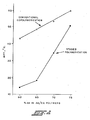
- the minimum film-forming temperature may be controlled by the composition of the second step polymerization. This will be illustrated below with reference to Fig. L
- step (a) polymerization is a main polymer chain or core.
- step (b) the olefinic monomer constituent of step (b) is added and polymerized.
- the polymerization of the second step forms a shell or over-polymer around the main core.
- the polymers resulting from the process of this invention are quite different from interpolymers or copolymers of the same compositions or from blends of homopolymers and copolymers derived from similar compositions.
- the process of the present invention results in the formation of the polymeric products which differ in kind from, and are in other respects superior to, those of similar chemical compositions which have been described previously.
- the film-forming latices and polymers of this invention are useful as such or in conjunction with other materials such as pigments, fillers, coloring agents and the like for coating, binding and impregnating a variety of materials.
- Minimum film-forming temperatures are determined using a 30-inch long bar constructed of brass with chrome plated surface having a heating means at one end, and a cooling means at the other. The latex is cast upon the bar and the temperature at the various parts along the bar is continuously determined by means of thermocouples. The temperature (minimum) at which an integral film formed is recorded as the MFT.
- minimum filming temperature testing See "Journal of Applied Polymer Science", Vol. 4, pages 81-85 (1960). Descriptions of film properties in general are based on observations of a 2.5-3 mil film cast on a glass plate from latex drawn down with a calibrated draw bar and dried.
- the GAFAC RE-610 emulsifier and the DAXAD 11 are dissolved in 133 parts of water.
- the pH of the emulsifier solution is adjusted to 6.0 with dilute ammonium hydroxide, and the solution then is charged to the reactor.
- a mixture of 61 parts of acrylonitrile and 9.8 parts of ethyl acrylate is prepared and added to the reactor with agitation.
- the reaction mixture is heated to 35°C and the total charge of 0.168 parts of potassium persulfate is added as an aqueous solution.
- the sodium bisulfite (0.035 parts) is dissolved in 25 ml of water, and 4 ml of this solution is added to the reactor for initiation. Additional increments are added during polymerization to maintain a desirable reaction rate.
- the conversion of monomer to polymer is about 95 percent, and the second step ingredients are then added as follows.
- the remaining DAXAD 11 (0.051 parts) is dissolved in 62 parts of water and added to the reactor followed by four parts of acrylonitrile and 25.2 parts of ethyl acrylate.
- the reaction is continued by adding further increments of the bisulfite solution as needed to maintain a good reaction rate.
- the overall conversion of monomer to polymer reaches about 96 percent after about 1.5 hours, and the reaction was cooled to room temperature to yield the desired product.
- the ratio of monomers in the first step is 86 parts acrylonitrile to 14 parts ethyl acrylate.
- the ratio is 14 parts of acrylonitrile to 86 parts of ethyl acrylate.
- the overall monomer composition of the product of this example is 65 parts of acrylonitrile to 35 parts of ethyl acrylate.
- the minimum film-forming temperature (MFT) of the latex obtained in this example is measured on a temperature gradient bar and found to be 18°C. When spread on a glass plate at room temperature (approximately 25°C), the latex forms a smooth continuous transparent film with a slight haze. The film is easily stripped from the glass and is quite flexible.
- a conventional copolymer which has the same overall monomeric composition namely, 65 parts of acrylonitrile to 35 parts of ethyl acrylate is made in a similar recipe by charging all of the monomers initially and completing the copolymerization in a single step.
- the latex obtained in this manner has a minimum film-forming temperature of 48°C and will not form a film at room temperature.
- Example 1 the procedure of Example 1 is followed, and the amounts of acrylonitrile and ethyl acrylate utilized in the examples is as shown in the following Table I.
- the ratio of acrylonitrile to acrylate in the first step polymerization is maintained at 86 parts acrylonitrile/14 parts ethyl acrylate, and the ratio of acrylonitrile to ethyl acrylate in the second step polymerization is varied.
- Table I within a given overall composition, the minimum film-forming temperature of the latex can be further varied by changing the monomer ratio in the second step of the polymerization.
- AN represents acrylonitrile
- EA represents ethyl acrylate
- l ⁇ IA represents methyl acrylate.
- the minimum film-forming temperature can be controlled or adjusted by varying the amount of acrylonitrile in the second step.
- the results obtained in Examples 2-9 indicate that the MFT increases with an increase in the amount of acrylonitrile in the monomer constituent of the second step.
- Example 2 The general procedure described for Example 1 is repeated except that the monomer ratio in step 1 is 86 parts of acrylonitrile and 14 parts of methyl acrylate, and the monomer ratio in the second step is 14 parts of acrylonitrile and 86 parts of ethyl acrylate.
- 71 percent of the total monomer is polymerized in the first step, and 29 percent of the total monomer is polymerized in the second step.
- the overall . composition of the latex prepared in this manner is 65 parts acrylonitrile/10 parts methyl acrylate/25 ethyl acrylate.
- the minimum film-forming temperature of this latex is 15°C.
- Example 2 The general procedure for Example 1 is repeated except that the monomer ratio in the first step is 86 parts of acrylonitrile and 14 parts of methyl acrylate, and the monomer ratio in the second step is 14 parts of acrylonitrile, 17 parts of methyl acrylate and 69 parts of ethyl acrylate.
- 71 percent of the total monomer is polymerized in the first step or 29 percent of the total monomer is polymerized in the second step.
- the overall composition of this latex is 65 parts acrylonitrile/15 parts methyl acrylate/20 parts ethyl acrylate, and the minimum film-forming temperature of the latex is 15°C. '
- Example 2 The general procedure of Example 1 is repeated except that the monomer ratio in step 1 is 86. parts of acrylonitrile and 14 parts of ethyl acrylate, and the monomer ratio in the second step is 14 parts of acrylonitrile, 51 parts of methyl acrylate and 36 parts of ethyl acrylate.
- 71 percent of the total monomer is polymerized in the first step, and 29 percent of the total monomer is polymerized in the second step.
- the overall composition of the latex prepared in this manner is 65 parts of acrylonitrile, 15 parts of methyl acrylate and 20 parts of ethyl acrylate.
- the minimum film-forming temperature of this latex is 30°C.
- Example 2 The general procedure of Example 1 is repeated except that the monomer ratio in step 1 is 86 parts of acrylonitrile and 14 parts of methyl acrylate, and the monomer ratio in step 2 is 14 parts of acrylonitrile, 35 parts of methyl acrylate and 51 parts of ethyl acrylate.
- 71 percent of the total monomer is polymerized in the first step, and 29 percent of the total monomer is polymerized in the second step.
- the latex obtained in this manner has an overall composition of 65 parts of acrylonitrile, 20 parts of methyl acrylate and 15 parts of ethyl acrylate.
- the minimum film-forming temperature of the latex is 24°C.
- Example 2 The general procedure of Example 1 is repeated except that the monomer ratio in the first step is 86 parts of acrylonitrile and 14 parts of ethyl acrylate, and the monomer ratio in step 2 is 14 parts of acrylonitrile, 36 parts of ethyl acrylate and 50 parts of n-butyl acrylate.
- 71 percent of the total monomer is polymerized in the first step, and 29 percent of the total monomer is polymerized in the second step.
- the overall composition of the latex prepared in this manner is 65 parts of acrylonitrile/20.5 parts of ethyl acrylate and 14.5 parts of n-butyl acrylate.
- the minimum film-forming temperature of this latex is 14°C.
- Example 2 The general procedure of Example 1 is repeated except that the monomer ratio in step 1 comprises 80 parts of acrylonitrile and 20 parts of ethyl acrylate, and the monomer ratio in step 2 comprises 15 parts of acrylonitrile and 85 parts of ethyl acrylate.
- the monomer ratio in step 1 comprises 80 parts of acrylonitrile and 20 parts of ethyl acrylate
- the monomer ratio in step 2 comprises 15 parts of acrylonitrile and 85 parts of ethyl acrylate.
- 54% of the total monomer is polymerized in the first step, and 46% of the total monomer is polymerized in the second step.
- the latex obtained in this manner has an overall composition of 50 parts of acrylonitrile and 50 parts of ethyl acrylate.
- Example 2 The general procedure of Example 1 is repeated except that the monomer ratio in step 1 is 80 parts of acrylonitrile and 20 parts of ethyl acrylate, and the monomer used in step 2 is ethyl acrylate. In this experiment, 85% of the total monomer is polymerized in the first step and 15% is polymerized in the second step.
- the latex obtained in this manner has an overall composition of 68 parts of acrylonitrile and 32 parts of ethyl acrylate.
- Example 2 The general procedure of Example 1 is repeated except that methyl acrylate is used in lieu of ethyl acrylate.
- the monomer ratio in step 1 is 86 parts of acrylonitrile and 14 parts of methyl acrylate and the monomer ratio in step 2 is 14 parts of acrylonitrile and 86 parts of methyl acrylate.
- 64% of the total monomer is polymerized in the first step and 36% in the second step.
- the latex obtained in this manner has an overall composition of 60 parts of acrylonitrile and 40 parts of methyl acrylate, and an MFT of 32°C.
- Example 17 The procedure of Example 17 is repeated except that the methyl acrylate is replaced by equivalent amounts of ethyl acrylate.
- the MFT of the latex prepared in this manner is 14°C.
- Example 18 The general procedure of Example 18 is repeated with the exception that 52 parts of a latex containing an elastomer of the composition of 70 parts of 1,3-butadiene and 30 parts of acrylonitrile (similar to the latex of Example A) is added to the reactor containing the solution of the emulsifier and DAXAD ll in water prior to the addition of the first step monomer mixture.
- the final overall polymer composition prepared in this manner is 60 parts of acrylonitrile, 40 parts of ethyl acrylate and 10 parts of elastomer (solids basis).
- the minimum film-forming temperature of this latex determined on a temperature gradient bar is less than 18°C, and a film dried at room temperature on a glass plate is transparent with a slight haze. The film strips readily from the glass plate, is very flexible, and has a greater resistance to tearing than the comparable non-rubber-containing film.
- This example illustrates the two-step process of the present invention utilizing a continuous addition of monomer in the second step.
- the overall polymeric composition of the latex prepared in this example is 65 parts of acrylonitrile and 35 parts of ethyl acrylate, and the recipe is otherwise the same as used in Example 1 with the exception that only 0.1 part of the potassium persulfate is used and water is reduced to 150 parts per 100 parts of monomer.
- the reactor contents are cooled to room temperature whereupon distilled water and DAXAD 11 are added. Of the total monomer mixture to be polymerized in the second step, 15 percent of that amount is added, the reactor contents are stirred for 15 minutes, and then the reactor contents are heated to a reaction temperature of 35°C.
- the remaining monomer mixture is continuously pumped into the reactor over a 90-minute period, and increments of an aqueous solution of sodium bisulfite (0.00168 parts per 100 parts of monomer per increment) are injected into the reactor at 15-minute intervals during the addition period. After the last initiator injection, the reaction is continued for 20 minutes, and the reactor contents are cooled to room temperature.
- the latex obtained in this manner had a total solids content of 39.8 percent corresponding to an overall conversion of monomer to polymer of 98 percent.
- the monomer ratio in the first step is 86 parts acrylonitrile/14 parts ethyl acrylate, and in the second step, 28 parts of acrylonitrile/72 parts of ethyl acrylate. Of the total monomer mixture, 64 percent is polymerized in the first step and 36 percent in the second step to provide an overall composition of 65 parts acrylonitrile/35 parts ethyl acrylate.
- the latex obtained in this manner shows a minimum film-forming temperature of 25°C when spread on a temperature gradient bar.
- the reaction exotherm is minimized, temperature extremes are avoided and an overall smoother, more consistent reaction is achieved.
- the process of this example provides a stable latex at an increased solids level.
- the latices of the present invention form good uniform films on heated bars which can be stripped readily from the bar whereas the films prepared from the prior art latices or blends may form spotty, non-uniform, partly coalesced films which often cannot be lifted from the bar without powdering.
- Latex particle size measurements have been made by transmission electron microscopy of the particles obtained in each step of the two-step polymerization process of this invention.
- Table III summarizes the results of this investigation on the products obtained in several of the above examples.
- the results summarized in the table demonstrate particle growth as a result of the second polymerization reaction as evidenced by the increase in average size, and the narrowing of the particle-size distribution as shown by dispersity values.
- the latices prepared in accordance with the two-step polymerization process of this invention exhibit excellent shelf life and are stable for prolong periods with minimum change in the viscosity of the latices.
- Films obtained from the latices of the invention exhibit desirable oxygen barrier levels and excellent oil-resistance.
Landscapes
- Chemical & Material Sciences (AREA)
- Health & Medical Sciences (AREA)
- Chemical Kinetics & Catalysis (AREA)
- Medicinal Chemistry (AREA)
- Polymers & Plastics (AREA)
- Organic Chemistry (AREA)
- Addition Polymer Or Copolymer, Post-Treatments, Or Chemical Modifications (AREA)
- Polymerisation Methods In General (AREA)
- Graft Or Block Polymers (AREA)
- Paints Or Removers (AREA)
Applications Claiming Priority (2)
| Application Number | Priority Date | Filing Date | Title |
|---|---|---|---|
| US451036 | 1982-12-20 | ||
| US06/451,036 US4504605A (en) | 1982-12-20 | 1982-12-20 | Film-forming olefinic nitrile polymer latex and method of preparing same |
Publications (2)
| Publication Number | Publication Date |
|---|---|
| EP0112708A2 true EP0112708A2 (de) | 1984-07-04 |
| EP0112708A3 EP0112708A3 (de) | 1985-01-30 |
Family
ID=23790554
Family Applications (1)
| Application Number | Title | Priority Date | Filing Date |
|---|---|---|---|
| EP83307723A Withdrawn EP0112708A3 (de) | 1982-12-20 | 1983-12-19 | Filmbildendes Latex aus olefinisch ungesättigtem Nitrilpolymer und Herstellungsverfahren |
Country Status (3)
| Country | Link |
|---|---|
| US (1) | US4504605A (de) |
| EP (1) | EP0112708A3 (de) |
| JP (1) | JPS59166517A (de) |
Cited By (4)
| Publication number | Priority date | Publication date | Assignee | Title |
|---|---|---|---|---|
| EP0191244A1 (de) * | 1985-01-07 | 1986-08-20 | The Standard Oil Company | 100 % Feststoffe im Endzustand und ein Lösungsmittel am Anfang enthaltende vernetzbare Überzugszusammensetzungen und Verfahren zu deren Herstellung |
| GB2194543A (en) * | 1986-07-14 | 1988-03-09 | Rohm & Haas | Sequentially-produced polymer particles, aqueous dispersions thereof, processes for preparing them, and uses thereof |
| EP0256500A3 (de) * | 1986-08-20 | 1990-01-24 | The Glidden Company | Acrylonitril oder Vinylidenchlorid enthaltende Emulsionspolymere |
| EP0437623A4 (en) * | 1989-07-10 | 1992-05-20 | Mitsui Toatsu Chemicals Inc. | Aqueous emulsion |
Families Citing this family (6)
| Publication number | Priority date | Publication date | Assignee | Title |
|---|---|---|---|---|
| US4675376A (en) * | 1983-11-18 | 1987-06-23 | General Electric Company | Process for the preparation of n-alkylphthalimide and copolymer derived therefrom |
| US4612361A (en) * | 1985-09-23 | 1986-09-16 | General Electric Company | Poly(etherimides) and compositions containing the same |
| DE3842539A1 (de) * | 1988-06-08 | 1989-12-21 | Bayer Ag | Perfluoralkylgruppen enthaltende copolymerisate |
| US5278234A (en) * | 1989-11-27 | 1994-01-11 | Kanebo, Ltd. | High-nitrile polymer composition, molded article thereof, and process for producing said composition |
| US5700852A (en) * | 1994-04-06 | 1997-12-23 | Japan Synthetic Rubber Co., Ltd. | Paper coating composition |
| JP4588248B2 (ja) * | 2001-05-01 | 2010-11-24 | 三井化学株式会社 | 高ニトリル系重合体ラテックス、高ニトリル系重合体、及び基材−高ニトリル系重合体積層体 |
Family Cites Families (9)
| Publication number | Priority date | Publication date | Assignee | Title |
|---|---|---|---|---|
| CA514899A (en) * | 1955-07-19 | Shell Development Company | Process for copolymerizing unsaturated monomers and products produced thereby | |
| US3236798A (en) * | 1962-10-15 | 1966-02-22 | Standard Oil Co | Film-forming acrylonitrile polyer latex and method for preparing same |
| US3296176A (en) * | 1965-03-03 | 1967-01-03 | Monsanto Co | Interpolymer latices |
| US3351602A (en) * | 1965-08-19 | 1967-11-07 | Standard Oil Co | Film-forming acrylonitrile polymer and latex thereof |
| DE2049267A1 (de) * | 1970-10-07 | 1972-04-13 | Roehm Gmbh | Schlagzähe Formmassen auf Acrylatbasis mit verbesserter Alterungsbeständigkeit |
| US4038344A (en) * | 1970-12-21 | 1977-07-26 | Ethyl Corporation | Graft copolymers of olefinic nitriles and olefinic esters on diene rubbers |
| JPS4999386A (de) * | 1973-01-23 | 1974-09-19 | ||
| US4026970A (en) * | 1975-11-05 | 1977-05-31 | The B. F. Goodrich Company | Overpolymer rubbers as tougheners for thermoset and thermoplastic molding compounds and compositions thereof |
| JPS5265595A (en) * | 1975-11-27 | 1977-05-31 | Kureha Chem Ind Co Ltd | Preparation of graft copolymers |
-
1982
- 1982-12-20 US US06/451,036 patent/US4504605A/en not_active Expired - Fee Related
-
1983
- 1983-12-19 EP EP83307723A patent/EP0112708A3/de not_active Withdrawn
- 1983-12-20 JP JP58240801A patent/JPS59166517A/ja active Pending
Cited By (6)
| Publication number | Priority date | Publication date | Assignee | Title |
|---|---|---|---|---|
| EP0191244A1 (de) * | 1985-01-07 | 1986-08-20 | The Standard Oil Company | 100 % Feststoffe im Endzustand und ein Lösungsmittel am Anfang enthaltende vernetzbare Überzugszusammensetzungen und Verfahren zu deren Herstellung |
| GB2194543A (en) * | 1986-07-14 | 1988-03-09 | Rohm & Haas | Sequentially-produced polymer particles, aqueous dispersions thereof, processes for preparing them, and uses thereof |
| GB2194543B (en) * | 1986-07-14 | 1990-03-21 | Rohm & Haas | Sequentially-produced polymer particles, aqueous dispersions thereof, processes for preparing them, and uses thereof |
| EP0256500A3 (de) * | 1986-08-20 | 1990-01-24 | The Glidden Company | Acrylonitril oder Vinylidenchlorid enthaltende Emulsionspolymere |
| EP0437623A4 (en) * | 1989-07-10 | 1992-05-20 | Mitsui Toatsu Chemicals Inc. | Aqueous emulsion |
| US5246981A (en) * | 1989-07-10 | 1993-09-21 | Mitsui Toatsu Chemicals, Inc. | Aqueous emulsion |
Also Published As
| Publication number | Publication date |
|---|---|
| US4504605A (en) | 1985-03-12 |
| EP0112708A3 (de) | 1985-01-30 |
| JPS59166517A (ja) | 1984-09-19 |
Similar Documents
| Publication | Publication Date | Title |
|---|---|---|
| US3498942A (en) | Emulsion polymerization of unsaturated monomers utilizing alkyl sulfide terminated oligomers as emulsifiers and resulting product | |
| US5750618A (en) | Process for the production of latices based on conjugated dienes by emulsion polymerisation | |
| US2857360A (en) | Thermoplastic compositions formed by polymerizing methacrylic acid ester and butadiene styrene latices | |
| US4690995A (en) | Copolymers containing high concentrations of phenol antioxidant units | |
| US3742092A (en) | Methacrylonitrile polymerization process | |
| US4504605A (en) | Film-forming olefinic nitrile polymer latex and method of preparing same | |
| US3359345A (en) | Butadiene-styrene block copolymers reacted with monomeric mixtures | |
| EP0118252B1 (de) | Aus Gemischen von Nitrilpolymerlatex hergestellte Zusammensetzungen für die Herstellung von Filmen | |
| CA1091392A (en) | Mercaptan activation by acid in the copolymerization of acrylonitrile | |
| US3110702A (en) | Molecular weight control in polymerization of vinylidene monomers | |
| US2698318A (en) | Rubbery interpolymers of butadiene-1, 3 hydrocarbons with polyunsaturated carboxylic acids | |
| JPS581683B2 (ja) | 耐衝撃性樹脂の製造方法 | |
| CA1193047A (en) | Continuous polymerization of chloroprene | |
| EP0076162B1 (de) | Verfahren zur Herstellung von thermoplastischen Harzen und diese enthaltende Harzzusammensetzungen | |
| EP0051875B1 (de) | Thermoplastische Harzzusammensetzung mit grosser Zähigkeit und Hitzeverformungsbeständigkeit | |
| US3732336A (en) | Methacrylonitrile polymerization process | |
| US3236798A (en) | Film-forming acrylonitrile polyer latex and method for preparing same | |
| US3234302A (en) | Polymerization of butadiene, styrene and acrylonitrile with butadienestyrene copolymer | |
| US2662876A (en) | Method of terminating the polymerization of monomeric materials in aqueous emulsion and a nonstaing, nondiscoloring composition for use therein | |
| US3351602A (en) | Film-forming acrylonitrile polymer and latex thereof | |
| US3629370A (en) | Process for the production of thermoplastic-elastic moulding compositions of high impact and notched impact strength | |
| US4079101A (en) | Diolefin polymerization process in the presence of seed polymers | |
| US2385258A (en) | Substituted acrylonitrile polymers | |
| US3751526A (en) | Process for producing impact resistant thermoplastic resins | |
| US3265677A (en) | Process for regulating molecular weight in polymerization of vinylidene monomers using 1-methylcyclohexene-1 as regulator |
Legal Events
| Date | Code | Title | Description |
|---|---|---|---|
| PUAI | Public reference made under article 153(3) epc to a published international application that has entered the european phase |
Free format text: ORIGINAL CODE: 0009012 |
|
| AK | Designated contracting states |
Designated state(s): BE CH DE FR GB IT LI LU NL SE |
|
| PUAL | Search report despatched |
Free format text: ORIGINAL CODE: 0009013 |
|
| AK | Designated contracting states |
Designated state(s): BE CH DE FR GB IT LI LU NL SE |
|
| 17P | Request for examination filed |
Effective date: 19850606 |
|
| 17Q | First examination report despatched |
Effective date: 19860529 |
|
| STAA | Information on the status of an ep patent application or granted ep patent |
Free format text: STATUS: THE APPLICATION HAS BEEN WITHDRAWN |
|
| 18W | Application withdrawn |
Withdrawal date: 19860716 |
|
| RIN1 | Information on inventor provided before grant (corrected) |
Inventor name: PREM, DOROTHY CLAIR Inventor name: MAZEKE, HERBERT FRANKLIN Inventor name: DUKE, JUNE TEMPLE |