EP0112802B1 - Matériel d'enregistrement photographique couleur - Google Patents
Matériel d'enregistrement photographique couleur Download PDFInfo
- Publication number
- EP0112802B1 EP0112802B1 EP83810583A EP83810583A EP0112802B1 EP 0112802 B1 EP0112802 B1 EP 0112802B1 EP 83810583 A EP83810583 A EP 83810583A EP 83810583 A EP83810583 A EP 83810583A EP 0112802 B1 EP0112802 B1 EP 0112802B1
- Authority
- EP
- European Patent Office
- Prior art keywords
- formula
- alkyl
- group
- hydrogen
- colour
- Prior art date
- Legal status (The legal status is an assumption and is not a legal conclusion. Google has not performed a legal analysis and makes no representation as to the accuracy of the status listed.)
- Expired
Links
- 0 CC(*)(*N)I1=CC(C)(C)C(*I)=CC(*)=C1 Chemical compound CC(*)(*N)I1=CC(C)(C)C(*I)=CC(*)=C1 0.000 description 10
Classifications
-
- C—CHEMISTRY; METALLURGY
- C07—ORGANIC CHEMISTRY
- C07D—HETEROCYCLIC COMPOUNDS
- C07D493/00—Heterocyclic compounds containing oxygen atoms as the only ring hetero atoms in the condensed system
- C07D493/02—Heterocyclic compounds containing oxygen atoms as the only ring hetero atoms in the condensed system in which the condensed system contains two hetero rings
- C07D493/10—Spiro-condensed systems
-
- C—CHEMISTRY; METALLURGY
- C07—ORGANIC CHEMISTRY
- C07D—HETEROCYCLIC COMPOUNDS
- C07D211/00—Heterocyclic compounds containing hydrogenated pyridine rings, not condensed with other rings
- C07D211/04—Heterocyclic compounds containing hydrogenated pyridine rings, not condensed with other rings with only hydrogen or carbon atoms directly attached to the ring nitrogen atom
- C07D211/06—Heterocyclic compounds containing hydrogenated pyridine rings, not condensed with other rings with only hydrogen or carbon atoms directly attached to the ring nitrogen atom having no double bonds between ring members or between ring members and non-ring members
- C07D211/36—Heterocyclic compounds containing hydrogenated pyridine rings, not condensed with other rings with only hydrogen or carbon atoms directly attached to the ring nitrogen atom having no double bonds between ring members or between ring members and non-ring members with hetero atoms or with carbon atoms having three bonds to hetero atoms with at the most one bond to halogen, e.g. ester or nitrile radicals, directly attached to ring carbon atoms
- C07D211/40—Oxygen atoms
- C07D211/44—Oxygen atoms attached in position 4
- C07D211/46—Oxygen atoms attached in position 4 having a hydrogen atom as the second substituent in position 4
-
- G—PHYSICS
- G03—PHOTOGRAPHY; CINEMATOGRAPHY; ANALOGOUS TECHNIQUES USING WAVES OTHER THAN OPTICAL WAVES; ELECTROGRAPHY; HOLOGRAPHY
- G03C—PHOTOSENSITIVE MATERIALS FOR PHOTOGRAPHIC PURPOSES; PHOTOGRAPHIC PROCESSES, e.g. CINE, X-RAY, COLOUR, STEREO-PHOTOGRAPHIC PROCESSES; AUXILIARY PROCESSES IN PHOTOGRAPHY
- G03C7/00—Multicolour photographic processes or agents therefor; Regeneration of such processing agents; Photosensitive materials for multicolour processes
- G03C7/30—Colour processes using colour-coupling substances; Materials therefor; Preparing or processing such materials
- G03C7/392—Additives
- G03C7/39208—Organic compounds
- G03C7/3924—Heterocyclic
- G03C7/39244—Heterocyclic the nucleus containing only nitrogen as hetero atoms
- G03C7/39248—Heterocyclic the nucleus containing only nitrogen as hetero atoms one nitrogen atom
-
- Y—GENERAL TAGGING OF NEW TECHNOLOGICAL DEVELOPMENTS; GENERAL TAGGING OF CROSS-SECTIONAL TECHNOLOGIES SPANNING OVER SEVERAL SECTIONS OF THE IPC; TECHNICAL SUBJECTS COVERED BY FORMER USPC CROSS-REFERENCE ART COLLECTIONS [XRACs] AND DIGESTS
- Y10—TECHNICAL SUBJECTS COVERED BY FORMER USPC
- Y10S—TECHNICAL SUBJECTS COVERED BY FORMER USPC CROSS-REFERENCE ART COLLECTIONS [XRACs] AND DIGESTS
- Y10S430/00—Radiation imagery chemistry: process, composition, or product thereof
- Y10S430/132—Anti-ultraviolet fading
-
- Y—GENERAL TAGGING OF NEW TECHNOLOGICAL DEVELOPMENTS; GENERAL TAGGING OF CROSS-SECTIONAL TECHNOLOGIES SPANNING OVER SEVERAL SECTIONS OF THE IPC; TECHNICAL SUBJECTS COVERED BY FORMER USPC CROSS-REFERENCE ART COLLECTIONS [XRACs] AND DIGESTS
- Y10—TECHNICAL SUBJECTS COVERED BY FORMER USPC
- Y10S—TECHNICAL SUBJECTS COVERED BY FORMER USPC CROSS-REFERENCE ART COLLECTIONS [XRACs] AND DIGESTS
- Y10S430/00—Radiation imagery chemistry: process, composition, or product thereof
- Y10S430/162—Protective or antiabrasion layer
Definitions
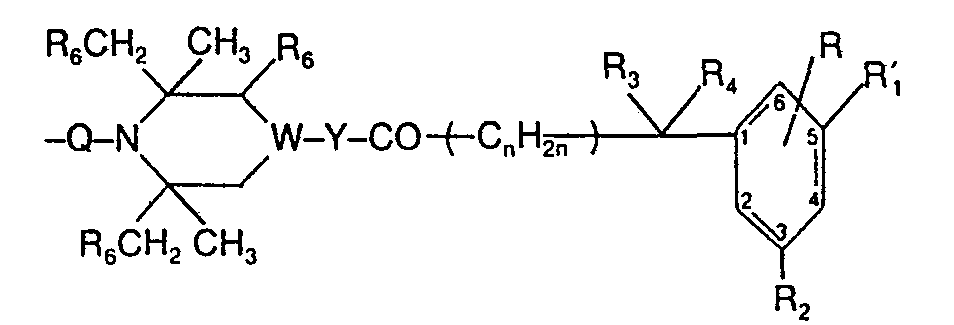
- the present application relates to a color photographic recording material which contains a specific polyalkylpiperidine compound as a stabilizer in at least one light-sensitive silver halide emulsion layer and / or at least one of the customary auxiliary layers.
- polyalkylpiperidines are generally known as light stabilizers for organic materials, in particular for polymers. It has also been proposed in DE-OS 2126954 to use such polyalkylpiperidines as agents against the fading of color photographs. It was further proposed in EP-A 11051 to use certain polyalkylpiperidine derivatives containing at least one phenol group as light stabilizers for color photographs. These are polyalkylpiperidine esters of hydroxylbenzylmalonic acids.
- polyalkylpiperidine compounds which contain sterically hindered phenol linked via a carboxyalkylidene or carbaminoalkylidene group have a surprisingly better stabilizing effect.
- Any halogen substituents it is z. B. bromine, iodine and especially chlorine.
- Color photographic recording materials which contain at least one compound of the formula I or of the formula V or of the formula IX as a stabilizer, in which the radical R is in the 2- or in the 4- or in the 6-position, are furthermore preferred.
- the sterically hindered phenol derivatives used as starting materials are new. These are phenols of the formula XI where p is the numbers 1, 2 or 3 and q is the numbers 0, 1 or 2, with the condition that p + q ⁇ 3, R 31 is a group of the formula XII in which R 3 , R 4 , A, m and n have the meaning given above and Y 'is -OR' or -N (R s ) H, where R 'is hydrogen, methyl or ethyl and R 5 is the one given above Has meaning, and R 32 C I -C 4 alkyl or one of the groups which is in the 2-, 4- or 6-position to the OH group, in which M and R 31 have the meaning given above, R 23 is C 1 -C 4 alkyl, s is the numbers 0, 1 or 2 and t the numbers mean 0 or 1, provided that s + t ⁇ 2; whereby the condition always applies that m must be 2 when n is 1 or 2 and when R
- the phenols of formula XI can by reacting a phenol of formula XV wherein R 32 and q have the meaning given above and with the condition that a group of the formula XIII or XIV may not appear more than once in the formula XV, in the 2-, 4- or 6-position to the OH group with a functional alkylating agent (XXI) capable of introducing a group of formula XII in the presence of a suitable catalyst.
- a functional alkylating agent XXI
- Suitable catalysts are Bronsted acids, active earths or metal salts. Brönsted acids are organic or inorganic acids or their partial salts. It can e.g. B. a mineral acid such as hydrochloric, sulfuric, perchloric or orthophosphoric acid, an alkyl, aryl or alkaryl substituted inorganic acid such as methane, ethane, benzene, p-toluenesulfonic acid or methanephosphonic acid or an organic acid such as dichloro - Act, trichloric or trifluoroacetic acid.
- Suitable active earths are e.g. Fulmont 237® or Fulcat 22 @, while aluminum phenoxide can be used as the metal salt. The active earths are preferred.
- the reaction can be carried out with or without a solvent.
- Suitable solvents are e.g. Methanol / sulfuric acid or water / sulfuric acid. These solvents also act as catalysts.
- the compounds of formula XI are obtained from compounds of formula XV by reaction with 0.1 to 4.0 moles of the alkylating agent (XXI), depending on the meaning of p and q.
- the stabilizers of the formula I can be incorporated into a photographic material alone or together with other compounds in a known manner.
- the stabilizers alone or together with other compounds, in particular with color couplers, are incorporated into the photographic material in the form of a dispersion, this dispersion either containing no solvent or high or low-boiling solvent or a mixture of such solvents.
- Another suitable form of incorporation is that the stabilizers are incorporated into the photographic material alone or together with other compounds together with a polymer in the form of a latex.
- the dispersions are then used to produce the layers of color photographic recording materials.
- These layers can e.g. Intermediate or protective layers, but in particular light-sensitive (blue, green and red-sensitive) silver halide emulsion layers, in which the cyan (cyan), magenta (magenta) and yellow dyes are formed during the development of the exposed recording material from the corresponding color couplers.
- the silver halide layers can contain any color couplers, in particular cyan, purple and yellow couplers, which are used to form the dyes mentioned and thus the color images.
- substrates which, together with these stabilizers, give the materials to be stabilized as good a resistance as possible.
- the stabilizers of the formula I are incorporated in layers which additionally contain a silver halide dispersion which has been prepared and sensitized by customary methods. However, they can also be present in layers adjacent to layers containing silver halide.
- the photographic materials according to the invention have a conventional structure and usual components. However, preference is given to a structure and components which enhance the effectiveness of the stabilizers of the formula I or at least do not adversely affect them.
- the stabilizers according to formula 1 can, in addition to the color couplers, also be combined with ultraviolet absorbers or other light stabilizers in the same layer.
- the stabilizer can also be incorporated in a receiving layer.
- the color photographic materials according to the invention can be processed in a known manner. Furthermore, they can be treated in the course or after processing in a manner which further increases their stability, for example by treatment in a stabilizer bath or the application of a protective coating.
- the stabilizers to be used according to the invention are also suitable for protecting color-photographic layers in which the dyes are incorporated directly into the emulsion and the image is produced by selective bleaching.
- the amount of stabilizer or stabilizers can vary within wide limits and is approximately in the range from 1 to 2000 mg, preferably 100 to 800 and in particular 200-500 mg per m 2 of the layer into which it is (are) being incorporated. .
- the photographic material contains an UV radiation absorbing agent, this can be present together with the stabilizer in one layer or in an adjacent layer.
- the amount of the UV absorber or UV absorbers can vary within wide limits and is approximately in the range from 200 to 2,000 mg, preferably 400 to 1,000 mg per m 2 of the layer in which it is (are) incorporated ).
- Examples of ultraviolet absorbers are compounds of the benzophenone, acrylonitrile, thiazolidone, benzotriazole, oxazole, thiazole and imidazole type.
- the color images obtained by exposure and development with the recording material according to the invention show very good light fastness to visible and ultraviolet light.
- the compounds of the formula I are practically colorless, so that there is no discoloration of the images; in addition, they are well compatible with the usual photographic additives present in the individual layers. Because of their good effectiveness, their use amount can be reduced and thus their precipitation or crystallization can be avoided if they are incorporated as an organic solution in the aqueous binder emulsions used for the production of photographic layers.
- the individual processing steps required to produce the color images after exposure of the photographic marking material are not adversely affected by the stabilizers of the formula. Furthermore, the so-called pressure fog formation that frequently occurs with blue-sensitive emulsions can be largely suppressed. This can e.g.
- Example 1 If the procedure described in Example 1 is carried out under the conditions given in Table VII below, the sterically hindered phenols listed in Table VII are obtained.
- 0.087 g of the yellow coupler of the formula and 0.026 g of one of the light stabilizers listed in the tables below are dissolved in 2.0 ml of a mixture of tricresyl phosphate / ethyl acetate (1.5 g in 100 ml).
- a mixture of tricresyl phosphate / ethyl acetate 1.5 g in 100 ml.
- To this lion solution is added 7.0 ml of a 6% gelatin solution, 0.5 ml of an 8% solution of the wetting agent of the formula in isopropanol / water (3: 4) and 0.5 ml of water and emulsified with ultrasound at a power of 100 watts for 5 minutes.
- drying is carried out in a drying cabinet with circulating air at room temperature.
- the yellow wedges obtained in this way are irradiated in an Atlas Weather-Ometer with a 2500 W xenon lamp with a total of 42 kJoules / cm 2 (a comparative sample contains no light stabilizer).
- the loss of color density that occurs is determined by measuring the color density at ⁇ max. with a Densitometer® TR 924A from Macbeth.
Landscapes
- Chemical & Material Sciences (AREA)
- Organic Chemistry (AREA)
- Physics & Mathematics (AREA)
- Spectroscopy & Molecular Physics (AREA)
- General Physics & Mathematics (AREA)
- Plural Heterocyclic Compounds (AREA)
- Hydrogenated Pyridines (AREA)
- Silver Salt Photography Or Processing Solution Therefor (AREA)
Claims (24)






Applications Claiming Priority (2)
| Application Number | Priority Date | Filing Date | Title |
|---|---|---|---|
| CH731582 | 1982-12-16 | ||
| CH7315/82 | 1982-12-16 |
Publications (3)
| Publication Number | Publication Date |
|---|---|
| EP0112802A2 EP0112802A2 (fr) | 1984-07-04 |
| EP0112802A3 EP0112802A3 (en) | 1985-12-11 |
| EP0112802B1 true EP0112802B1 (fr) | 1988-01-07 |
Family
ID=4323204
Family Applications (1)
| Application Number | Title | Priority Date | Filing Date |
|---|---|---|---|
| EP83810583A Expired EP0112802B1 (fr) | 1982-12-16 | 1983-12-12 | Matériel d'enregistrement photographique couleur |
Country Status (5)
| Country | Link |
|---|---|
| US (1) | US4496649A (fr) |
| EP (1) | EP0112802B1 (fr) |
| JP (1) | JPS59133543A (fr) |
| CA (1) | CA1214353A (fr) |
| DE (1) | DE3375231D1 (fr) |
Families Citing this family (10)
| Publication number | Priority date | Publication date | Assignee | Title |
|---|---|---|---|---|
| EP0111448B1 (fr) * | 1982-12-08 | 1988-01-13 | Ciba-Geigy Ag | Matériel d'enregistrement photographique couleur |
| DE3511924A1 (de) * | 1984-04-13 | 1985-10-24 | Sandoz-Patent-GmbH, 7850 Lörrach | 2,2,6,6-tetraalkylpiperidin-stabilisatoren |
| ATE82962T1 (de) * | 1986-07-16 | 1992-12-15 | Goodrich Co B F | N-(substituiertes-cyclisches-alkylenimin)-alpha (3,5-dialkyl-4-hydroxyphenyl)-alpha, alphadialkylacetamide. |
| EP0258598B1 (fr) * | 1986-07-21 | 1994-09-07 | The B.F. Goodrich Company | Alpha-(3,5-dialkyl-4-hydroxyphényl)-alpha,alpha-dialkylacétamides N-substitués par pipérazine substituée |
| US5202458A (en) * | 1987-09-28 | 1993-04-13 | Ciba-Geigy Ag | Stabilizers for color photographic recording materials |
| EP0309957B1 (fr) * | 1987-09-28 | 1992-05-27 | Ciba-Geigy Ag | Stabilisateurs pour matériaux de reproduction photographique couleur |
| JPH02217845A (ja) * | 1989-02-20 | 1990-08-30 | Fuji Photo Film Co Ltd | ハロゲン化銀カラー写真感光材料 |
| IT1241082B (it) * | 1990-03-23 | 1993-12-29 | Enichem Sintesi | Metodo per la stabilizzazione di lacche e vernici e composizioni stabilizzate cosi' ottenute |
| JPH11125889A (ja) * | 1997-08-22 | 1999-05-11 | Fuji Photo Film Co Ltd | 画像の光堅牢性向上方法および画像形成材料 |
| US6465645B1 (en) | 2001-04-17 | 2002-10-15 | Ciba Specialty Chemicals Corporation | Long chain hindered amines and compositions stabilized therewith |
Family Cites Families (7)
| Publication number | Priority date | Publication date | Assignee | Title |
|---|---|---|---|---|
| JPS4920974B1 (fr) * | 1970-06-01 | 1974-05-29 | ||
| CH589056A5 (fr) * | 1973-12-10 | 1977-06-30 | Ciba Geigy Ag | |
| DE2661090C2 (fr) * | 1975-11-07 | 1990-02-08 | Ciba-Geigy Ag, Basel, Ch | |
| CH601232A5 (fr) * | 1975-12-08 | 1978-06-30 | Ciba Geigy Ag | |
| DE2656769A1 (de) * | 1975-12-29 | 1977-07-14 | Ciba Geigy Ag | Neue phenol-stabilisatoren |
| DE2963689D1 (en) * | 1978-11-06 | 1982-11-04 | Ciba Geigy Ag | Colour-photographic recording material, process for its stabilisation and production of colour-photographic images |
| EP0082817B1 (fr) * | 1981-12-17 | 1987-03-04 | Ciba-Geigy Ag | Matériel d'enregistrement photographique couleur |
-
1983
- 1983-12-12 DE DE8383810583T patent/DE3375231D1/de not_active Expired
- 1983-12-12 EP EP83810583A patent/EP0112802B1/fr not_active Expired
- 1983-12-14 CA CA000443243A patent/CA1214353A/fr not_active Expired
- 1983-12-15 US US06/562,189 patent/US4496649A/en not_active Expired - Lifetime
- 1983-12-15 JP JP58235226A patent/JPS59133543A/ja active Pending
Also Published As
| Publication number | Publication date |
|---|---|
| CA1214353A (fr) | 1986-11-25 |
| EP0112802A2 (fr) | 1984-07-04 |
| EP0112802A3 (en) | 1985-12-11 |
| US4496649A (en) | 1985-01-29 |
| DE3375231D1 (en) | 1988-02-11 |
| JPS59133543A (ja) | 1984-07-31 |
Similar Documents
| Publication | Publication Date | Title |
|---|---|---|
| EP0082817B1 (fr) | Matériel d'enregistrement photographique couleur | |
| EP0521823B1 (fr) | Phénylthiophényl-cétones | |
| EP0223739A1 (fr) | Dibenzoxaphosphorine | |
| DE2126954A1 (de) | Mittel gegen das Ausbleichen von Farbfotografien | |
| EP0057160A1 (fr) | 2-(Hydroxyphényl)-benzotriazoles, leur application comme agents d'absorption des ultraviolets et leur préparation | |
| EP0112802B1 (fr) | Matériel d'enregistrement photographique couleur | |
| EP0114028B1 (fr) | Matériel d'enregistrement photographique couleur | |
| EP0011051A2 (fr) | Matériel d'enregistrement photographique en couleurs, procédé pour sa stabilisation et préparation d'images photographiques en couleurs | |
| DE3119252A1 (de) | Lichtempfindliches farbphotographisches silberhalogenidmaterial | |
| EP0104146B1 (fr) | Matériau d'enregistrement photographique couleur | |
| DE2541267A1 (de) | Photographisches aufzeichnungsmaterial | |
| EP0114029B1 (fr) | Matériel d'enregistrement photographique couleur | |
| EP0103540A1 (fr) | Matériel d'enregistrement photographique en couleurs | |
| DE3038053A1 (de) | Farbphotographisches, lichtempfindliches material | |
| EP0111448B1 (fr) | Matériel d'enregistrement photographique couleur | |
| EP0111447B1 (fr) | Matériel d'enregistrement photographique couleur | |
| DE2532224A1 (de) | Photochromatische verbindungen und verfahren zu ihrer herstellung | |
| EP0110828B1 (fr) | Matériel d'enregistrement photographique couleur | |
| EP0069068A1 (fr) | Hydrochinones et leur préparation | |
| EP0181289B1 (fr) | Procédé pour stabiliser un matériau photographique contenant un coupleur magenta | |
| DE2818326A1 (de) | Lichtempfindliches photographisches silberhalogenidmaterial | |
| EP0109937B1 (fr) | Matériel d'enregistrement photographique couleur | |
| DE2757734C2 (de) | Farbphotographisches Aufzeichnungsmaterial | |
| DE2647850A1 (de) | Photochromatische verbindungen und verfahren zu ihrer herstellung | |
| DE4008785A1 (de) | Stabilisatoren fuer farbphotographische aufzeichnungsmaterialien |
Legal Events
| Date | Code | Title | Description |
|---|---|---|---|
| PUAI | Public reference made under article 153(3) epc to a published international application that has entered the european phase |
Free format text: ORIGINAL CODE: 0009012 |
|
| 17P | Request for examination filed |
Effective date: 19831214 |
|
| AK | Designated contracting states |
Designated state(s): BE DE FR GB IT |
|
| PUAL | Search report despatched |
Free format text: ORIGINAL CODE: 0009013 |
|
| AK | Designated contracting states |
Designated state(s): BE DE FR GB IT |
|
| 17Q | First examination report despatched |
Effective date: 19861031 |
|
| GRAA | (expected) grant |
Free format text: ORIGINAL CODE: 0009210 |
|
| AK | Designated contracting states |
Kind code of ref document: B1 Designated state(s): BE DE FR GB IT |
|
| REF | Corresponds to: |
Ref document number: 3375231 Country of ref document: DE Date of ref document: 19880211 |
|
| ET | Fr: translation filed | ||
| ITF | It: translation for a ep patent filed | ||
| GBT | Gb: translation of ep patent filed (gb section 77(6)(a)/1977) | ||
| PLBE | No opposition filed within time limit |
Free format text: ORIGINAL CODE: 0009261 |
|
| STAA | Information on the status of an ep patent application or granted ep patent |
Free format text: STATUS: NO OPPOSITION FILED WITHIN TIME LIMIT |
|
| 26N | No opposition filed | ||
| PGFP | Annual fee paid to national office [announced via postgrant information from national office to epo] |
Ref country code: FR Payment date: 19901026 Year of fee payment: 8 |
|
| PGFP | Annual fee paid to national office [announced via postgrant information from national office to epo] |
Ref country code: DE Payment date: 19901108 Year of fee payment: 8 |
|
| PGFP | Annual fee paid to national office [announced via postgrant information from national office to epo] |
Ref country code: GB Payment date: 19901121 Year of fee payment: 8 |
|
| PGFP | Annual fee paid to national office [announced via postgrant information from national office to epo] |
Ref country code: BE Payment date: 19901228 Year of fee payment: 8 |
|
| ITTA | It: last paid annual fee | ||
| PG25 | Lapsed in a contracting state [announced via postgrant information from national office to epo] |
Ref country code: GB Effective date: 19911212 |
|
| PG25 | Lapsed in a contracting state [announced via postgrant information from national office to epo] |
Ref country code: BE Effective date: 19911231 |
|
| BERE | Be: lapsed |
Owner name: CIBA-GEIGY A.G. Effective date: 19911231 |
|
| GBPC | Gb: european patent ceased through non-payment of renewal fee | ||
| PG25 | Lapsed in a contracting state [announced via postgrant information from national office to epo] |
Ref country code: FR Effective date: 19920831 |
|
| PG25 | Lapsed in a contracting state [announced via postgrant information from national office to epo] |
Ref country code: DE Effective date: 19920901 |
|
| REG | Reference to a national code |
Ref country code: FR Ref legal event code: ST |