EP0113500A2 - Procédé pour fabriquer des articles métalliques et pour enlever une couche d'oxyde de ces articles - Google Patents
Procédé pour fabriquer des articles métalliques et pour enlever une couche d'oxyde de ces articles Download PDFInfo
- Publication number
- EP0113500A2 EP0113500A2 EP83306051A EP83306051A EP0113500A2 EP 0113500 A2 EP0113500 A2 EP 0113500A2 EP 83306051 A EP83306051 A EP 83306051A EP 83306051 A EP83306051 A EP 83306051A EP 0113500 A2 EP0113500 A2 EP 0113500A2
- Authority
- EP
- European Patent Office
- Prior art keywords
- article
- electrolyte
- scale
- process according
- oxide scale
- Prior art date
- Legal status (The legal status is an assumption and is not a legal conclusion. Google has not performed a legal analysis and makes no representation as to the accuracy of the status listed.)
- Granted
Links
Images
Classifications
-
- C—CHEMISTRY; METALLURGY
- C25—ELECTROLYTIC OR ELECTROPHORETIC PROCESSES; APPARATUS THEREFOR
- C25F—PROCESSES FOR THE ELECTROLYTIC REMOVAL OF MATERIALS FROM OBJECTS; APPARATUS THEREFOR
- C25F1/00—Electrolytic cleaning, degreasing, pickling or descaling
- C25F1/02—Pickling; Descaling
- C25F1/04—Pickling; Descaling in solution
-
- C—CHEMISTRY; METALLURGY
- C21—METALLURGY OF IRON
- C21D—MODIFYING THE PHYSICAL STRUCTURE OF FERROUS METALS; GENERAL DEVICES FOR HEAT TREATMENT OF FERROUS OR NON-FERROUS METALS OR ALLOYS; MAKING METAL MALLEABLE, e.g. BY DECARBURISATION OR TEMPERING
- C21D1/00—General methods or devices for heat treatment, e.g. annealing, hardening, quenching or tempering
- C21D1/74—Methods of treatment in inert gas, controlled atmosphere, vacuum or pulverulent material
- C21D1/76—Adjusting the composition of the atmosphere
-
- C—CHEMISTRY; METALLURGY
- C25—ELECTROLYTIC OR ELECTROPHORETIC PROCESSES; APPARATUS THEREFOR
- C25F—PROCESSES FOR THE ELECTROLYTIC REMOVAL OF MATERIALS FROM OBJECTS; APPARATUS THEREFOR
- C25F1/00—Electrolytic cleaning, degreasing, pickling or descaling
- C25F1/02—Pickling; Descaling
- C25F1/04—Pickling; Descaling in solution
- C25F1/06—Iron or steel
Definitions
- This invention relates to a process for manufacturing metal articles and for removing oxide scale therefrom. More particularly, the invention relates to a process for controlling oxide scale formation and descaling thereof from metal articles.
- such processing frequently includes thermal treatments including heating or annealing in oxidizing furnace atmospheres to temperatures at which oxide scale readily forms on the article surface of various metal alloys including stainless steel alloys.
- thermal treatments including heating or annealing in oxidizing furnace atmospheres to temperatures at which oxide scale readily forms on the article surface of various metal alloys including stainless steel alloys.
- a scale removing bath must be of sufficient strength to remove the scale as rapidly as the strip emerges from the furnace.
- the scale removal process must quickly and efficiently condition and loosen the scale to facilitate removal.
- there are three different descaling processes which may be used: (1) a shot blasting plus an acid pickling; (2) a molten oxidizing salt or electrolytic scale conditioning followed by an acid pickling; and (3) a straight acid pickling process.
- U.S. Patent 3,043,758, issued July 10, 1962 discloses an electrolytic descaling and pickling process for stainless steel wherein the article to be descaled is subjected as an anode in an aqueous electrolyte of at least one neutral salt selected from a group consisting of chloride, sulfate and nitrate of an alkali metal including ammonium and thereafter dipping the article in a solution of mineral acid selected from the group consisting of sulfuric, nitric, hydrofluoric acid and mixtures of nitric and hydrofluoric acids.
- the electrolyte of the process is maintained at a pH of 1-7, and preferably 3.5-7 and nominally 5.5, and at a temperature ranging from 167-194° (75-90°C) and subjected to an electric current for 10-60 seconds at a current density of 6-10 2 A/ dm (.38-.64 2 A/in ).
- the second electrolyte has a pH ranging from 1-7 at a temperature of 120-200°F (48.9 to 93.3 0 C) and be subjected to an electric current for more than four seconds having a current density greater than 0.1 A/in 2 (1.55 A/dm 2 ).
- the first electrolyte is a molten oxidizing salt maintained from 400 to 450°F (204.4 to 232.2°C) and presents the numerous problems associated with such salts as described above.
- a one-step high current density descaling process can be used to remove oxide scale with no pre- or post-treatment and no acid pickling.
- the process includes using a 15-25% sodium sulfate electrolyte maintained at a temperature of at least 150°F (65.6°C) and passing an electric current through the body in the electrolyte at a current density of at least 3 A/in 2 (46.5 A/dm 2 ) for at least ten seconds and following with a water rinse.
- Such a high current density process is particularly suited for small items such as tubing, wherein the anode lengths may be 4 to 6 feet (1.22 to 1.83 metres) and the total number of amperes required for a descaling process are relatively low.
- an anode may approach 40 feet (12.19 metres) in length. In such a descaling process, the total number of amperes used for descaling is far greater and the attending cost of such a high current density process may be practically prohibitive.
- An electrolytic process sould be a low current density process suitable for descaling continuous strip products.
- a process that controls the scale formation on the metal articles during manufacturing processes may provide a scale that is more easily removed.
- a process which optimizes current descaling processes such as a sodium sulfate electrolyte process followed by minimal acid concentration pickling, and which provides more efficient and less costly descaling in the manufacture of a more uniform product is also desirable.
- a process for the manufacture of metal articles comprising hot forming, cold forming and subsequently thermally treating in an oxidizing atmosphere wherein the process further comprises providing an oxygen content of the atmosphere of at least 3.0%, by volume, to control the oxide scale formed on the metal article.
- the scale is then subsequently removed by immersing the article in an electrolyte of an aqueous solution of at least one neutral salt of the chloride, sulfate or nitrate of an alkali metal or ammonium, the pH of the electrolyte being adjusted to and maintained at from 2.0 to 3.5, passing a low densty electric current through the article in the electrolyte to condition the scale for removal and removing the article from the electrolyte.
- the method may include immersing the article in a mild acid solution of sulfuric, nitric or hydrofluric acid or a mixture of nitric and hydrofluoric acids to substantially remove the scale.
- Also provided is a process for removing an oxide scale from the surface of a metal article including immersing the article in an electrolyte of an aqueous solution of at least one neutral salt of the chloride, sulfate or nitrate of an alkali metal or ammonium, the pH of the electrolyte being adjusted to and maintained at from 2.0 to 3.5, and the article having an oxide scale substantially equivalent to an oxide scale formed at least in part in an oxidizing atmosphere of at least 3.0% oxygen, by volume.
- the process includes passing a low density electric current through the article in the electrolyte to condition the scale for removal and removing the article from the electrolyte.
- the process may include immersing the article in a mild acid solution of sulfuric,nitric or hydrofluoric acid or a mixture of nitric and hydrofluoric acids to substantially remove the scale.
- the oxidizing atmosphere may have an oxygen content ranging from 3-11% and the electrolyte may be maintained at a temperature of 150-185°F (65.6 to 85°C).
- a current density of from 0.1-1.0 A/ in 2 (1.55-15.5 A/ dm 2 ) may be used.
- the mild acid solution may contain less than 10% concentration of an acid.
- the present invention relates to a process for the manufacture of metal articles which controls the oxide scale formation and includes a process for descaling the oxide from the articles through a unique combination of variable controls of the oxygen content of the oxidizing atmosphere used in the thermal treatments and the control of the pH of the elecrolyte in the descaling process for the removal of scales from the metal articles which eliminate or minimize the need for acid pickling.
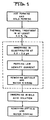
- a flow diagram illustrates typical steps in the process for manufacture of a metal article including a process for descaling (shown in the dotted line box) of the present invention.
- the descaling process includes the step of immersing the article in an electrolyte of an aqueous solution of at least one neutral salt of the chloride, sulfate or nitrate of an alkali metal or ammonium.
- the electrolyte is an aqueous solution of sodium sulfate.
- the sodium sulfate electrolyte may have a solution concentration of sodium sulfate ranging from 7-25% by weight and more preferably 15-20% by weight. It is within the scope of the present invention that a process may include one or more additional electrlytic oxide scale conditioning and descaling steps which facilitate the objectives of eliminating or minimizing an acid pickling step.
- a low density electric current is passed through the metal article which is immersed in the electrolyte to condition the scale for removal.
- the current density may range from 0.1 up to 1.0 A/ in 2 (1.55 to 15.5 A/dm 2 ) and preferably may range from 0.2-0.5 A/in 2 (3.10 to 7.75 A/dm 2 ).
- the current flux may range from -1.0-25.0 amp-secs/in 2 and preferably may range from 2.5-12.0 amp-secs/in 2 .
- chromium-nickel and chromium-nickel-manganese alloys require slightly higher current desities and current flux than does a straight-chromium alloy.
- immersion times are dependent upon the size of the body being descaled, as well as the type and thickness of the scale,and the temperature of the electrolyte.
- Electrolyte temperatures are usually in the range of 120 to 200°F (48.9 to 93.3°C), however, for the present invention, it is preferred that the temperature range from 150 to 185°F (65.6 to 85°C) and even more preferably 160-180°C (71.1 to 82.2°C).
- the article After the article is removed from the electrolyte, it may be water rinsed and immersed in a mild acid solution to substantially remove the scale.
- the acid is sulfuric, nitric or hydrofluoric acid or a mixture of nitric and hydrofluoric acids. As is conventional, it is preferred to use mixtures of nitric and hydrofluoric acids. Preferably, those acids and mixtures thereof have a solution concentration of less than 10%, by weight, and more preferably less than 8%, by weight.
- the acid temperatures may range from 100 to 160°F (37.8 to 71.1°C) and preferably 130 to 150°F (54.4 to 65.6°C). Such an acid pickling step is necessary if no other electrolytic or non-acid or subsequent descaling treatments are used.
- the article is water rinsed after the acid pickling.
- the acidity of the salt electrolyte is critical to the efficiency of the descaling process.
- the pH may range from 2.0 to 3.5, and more preferably from 2.0 to 3.0. Adjusting to and maintaining such lower pH's have been found to improve the scale conditioning processes, particularly in electrolytic sodium sulfate processes.
- the electrolyte may be acidified, such as by adding some acids, such as sulfuric acid, in relatively minor amounts to adjust the pH value.
- alloy steels presently appear to constitute the most significant embodiment thereof.
- stainless steels such as Types 201, 304, 316, 409 and 413, appear particularly suited to the process of the present ivnention.
- Samples of mill-annealed Type 304 stainless steel strip having been conventionally hot formed and cold formed were annealed in a gas-fired furnace having an atmosphere containing 7.4% oxygen.
- the samples were treated individually as an anode in a 20% sodium sulfate solution (Na 2 S0 4 ) at about 170°F (76.7°C) for times ranging from 15 to 90 seconds and at current densities of 0.25 and 0.50 A/in 2 (3.875 and 7.75 A/dm 2 ).
- the results of the tests are shown in Table 1 for a pH of the sulfate electrolyte adjusted to and maintained at 2.5 in one series of tests and at 5.5 pH in a second series of tests.
- the descaling process can be enhanced if the scale formation is controlled during the heat treating or annealing steps in an oxidizing atmosphere. It has unexpectedly been found that the oxygen content of the oxidizing atmosphere is critical in that it affects the scale formed such that if the oxygen content of the atmosphere is controlled and the pH of the electrolyte is controlled, a manufacturing process can be provided which minimizes the pickling step in acid.
- the present invention relates to a process for manufacturing a metal article which includes providing an oxygen content of the oxidizing atmosphere during thermal treatments of at least 3.0%, by volume, to control the oxide scale formed on the metal article.
- the oxygen content of the atmosphere may range from 3 up to 11%. It is intended that the oxide scale formed on the article should be substantially equivalent to an oxide scale formed at least in part in an oxidizing atmosphere of at least 3.0% oxygen, by volume.
- Samples of mill-annealed stainless steel strip of various alloys following conventional hot forming and cold forming were annealed in a gas-fired furnace having oxygen contents ranging from 2.0 to 10.8% oxygen, by volume.
- the samples were treated individually as anodes in 20% sodium sulfate solution electrolyte maintained at 170°F (76.7°C) and adjusted to and maintained at a pH of 2.5 for times ranging from 20 to 44 seconds and at current densities of 0.25 and 0.5 A/in 2 (3.875 and 7.75 A/ dm 2 ).
Landscapes
- Chemical & Material Sciences (AREA)
- Engineering & Computer Science (AREA)
- Materials Engineering (AREA)
- Metallurgy (AREA)
- Organic Chemistry (AREA)
- Chemical Kinetics & Catalysis (AREA)
- Electrochemistry (AREA)
- Physics & Mathematics (AREA)
- Thermal Sciences (AREA)
- Crystallography & Structural Chemistry (AREA)
- Mechanical Engineering (AREA)
- Cleaning And De-Greasing Of Metallic Materials By Chemical Methods (AREA)
Applications Claiming Priority (2)
| Application Number | Priority Date | Filing Date | Title |
|---|---|---|---|
| US06/444,128 US4415415A (en) | 1982-11-24 | 1982-11-24 | Method of controlling oxide scale formation and descaling thereof from metal articles |
| US444128 | 1982-11-24 |
Publications (3)
| Publication Number | Publication Date |
|---|---|
| EP0113500A2 true EP0113500A2 (fr) | 1984-07-18 |
| EP0113500A3 EP0113500A3 (en) | 1987-01-07 |
| EP0113500B1 EP0113500B1 (fr) | 1990-06-13 |
Family
ID=23763620
Family Applications (1)
| Application Number | Title | Priority Date | Filing Date |
|---|---|---|---|
| EP83306051A Expired EP0113500B1 (fr) | 1982-11-24 | 1983-10-06 | Procédé pour fabriquer des articles métalliques et pour enlever une couche d'oxyde de ces articles |
Country Status (9)
| Country | Link |
|---|---|
| US (1) | US4415415A (fr) |
| EP (1) | EP0113500B1 (fr) |
| JP (1) | JPS5996300A (fr) |
| KR (1) | KR890001379B1 (fr) |
| AT (1) | AT381121B (fr) |
| BR (1) | BR8306015A (fr) |
| CA (1) | CA1217451A (fr) |
| DE (1) | DE3381642D1 (fr) |
| ES (2) | ES8604660A1 (fr) |
Cited By (1)
| Publication number | Priority date | Publication date | Assignee | Title |
|---|---|---|---|---|
| EP0471662A3 (en) * | 1990-07-27 | 1992-05-20 | Andritz-Patentverwaltungs-Gesellschaft M.B.H. | Process for pickling stainless steel |
Families Citing this family (13)
| Publication number | Priority date | Publication date | Assignee | Title |
|---|---|---|---|---|
| AT387406B (de) * | 1987-05-07 | 1989-01-25 | Andritz Ag Maschf | Verfahren zum elektrolytischen beizen von chromhaeltigem edelstahl |
| US5175026A (en) * | 1991-07-16 | 1992-12-29 | Wheeling-Nisshin, Inc. | Method for hot-dip coating chromium-bearing steel |
| AT402737B (de) * | 1992-04-29 | 1997-08-25 | Andritz Patentverwaltung | Verfahren zum diskontinuierlichen beizen von metallischen platten, insbesondere aus edelstahl |
| CN1055510C (zh) * | 1993-06-25 | 2000-08-16 | 川崎制铁株式会社 | 高张力钢板的热浸镀锌方法 |
| US5490908A (en) * | 1994-07-11 | 1996-02-13 | Allegheny Ludlum Corporation | Annealing and descaling method for stainless steel |
| US5830291C1 (en) * | 1996-04-19 | 2001-05-22 | J & L Specialty Steel Inc | Method for producing bright stainless steel |
| DE19618899A1 (de) * | 1996-05-10 | 1997-11-13 | Metallgesellschaft Ag | Verfahren zum Entfernen von mit Seifen behafteten Konversionsschichten von metallischen Werkstücken |
| AT406486B (de) * | 1998-12-22 | 2000-05-25 | Andritz Patentverwaltung | Verfahren zum beizen von edelstahl |
| EP1072695B1 (fr) * | 1999-01-26 | 2012-12-19 | Nippon Steel Corporation | Procede pour enlever des ecailles et pour prevenir la formation des ecailles d'un corps metallique et un tel dispositif |
| CA2444399C (fr) * | 2001-04-26 | 2010-08-24 | L'air Liquide Societe Anonyme A Directoire Et Conseil De Surveillance Po Our L'etude Et L'exploitation Des Procedes Georges Claude | Procede pour ameliorer la qualite metallurgique de produits traites dans un four |
| KR101304602B1 (ko) * | 2011-12-21 | 2013-09-05 | 주식회사 포스코 | 스케일의 박리성을 향상시키는 방법 |
| DE102014111779A1 (de) * | 2014-08-18 | 2016-02-18 | Iva Industrieöfen Gmbh | Verfahren zur Herstellung einer Retorte für einen Nitrierofen sowie Retorte |
| CN117512306A (zh) * | 2023-11-30 | 2024-02-06 | 甘肃酒钢集团宏兴钢铁股份有限公司 | 一种高效254SMo冷轧卷板退火酸洗方法 |
Family Cites Families (10)
| Publication number | Priority date | Publication date | Assignee | Title |
|---|---|---|---|---|
| FR1226856A (fr) * | 1958-12-23 | 1960-08-16 | Procédé de décapage des aciers alliés | |
| US3254011A (en) * | 1963-09-20 | 1966-05-31 | Allegheny Ludlum Steel | Electrolytic potassium hydroxide descaling |
| US3260619A (en) * | 1965-02-04 | 1966-07-12 | Kolene Corp | Methods and compositions for cleaning metal |
| US4012299A (en) * | 1976-04-01 | 1977-03-15 | Allegheny Ludlum Industries, Inc. | Metallic descaling system |
| US4026777A (en) * | 1976-04-01 | 1977-05-31 | Allegheny Ludlum Industries, Inc. | Metallic descaling system |
| US4066521A (en) * | 1977-02-09 | 1978-01-03 | Allegheny Ludlum Industries, Inc. | Metallic descaling system |
| DE2808399A1 (de) * | 1978-02-27 | 1979-09-06 | Uss Eng & Consult | Verfahren zur oberflaechenkonditionierung von rostfreiem stahl |
| DE3008314C2 (de) * | 1980-03-04 | 1982-09-16 | MTU Motoren- und Turbinen-Union München GmbH, 8000 München | Verfahren zur Aktivierung von Titanoberflächen |
| US4363709A (en) * | 1981-02-27 | 1982-12-14 | Allegheny Ludlum Steel Corporation | High current density, acid-free electrolytic descaling process |
| JPS6047918B2 (ja) * | 1981-03-29 | 1985-10-24 | 住友金属工業株式会社 | 鋼線材の電解脱スケ−ルにおける酸性電解法 |
-
1982
- 1982-11-24 US US06/444,128 patent/US4415415A/en not_active Expired - Lifetime
-
1983
- 1983-09-30 AT AT0347983A patent/AT381121B/de not_active IP Right Cessation
- 1983-10-05 ES ES526242A patent/ES8604660A1/es not_active Expired
- 1983-10-06 EP EP83306051A patent/EP0113500B1/fr not_active Expired
- 1983-10-06 JP JP58187676A patent/JPS5996300A/ja active Granted
- 1983-10-06 DE DE8383306051T patent/DE3381642D1/de not_active Expired - Fee Related
- 1983-10-18 KR KR1019830004926A patent/KR890001379B1/ko not_active Expired
- 1983-10-21 CA CA000439442A patent/CA1217451A/fr not_active Expired
- 1983-10-31 BR BR8306015A patent/BR8306015A/pt not_active IP Right Cessation
-
1985
- 1985-05-16 ES ES543218A patent/ES8608064A1/es not_active Expired
Cited By (1)
| Publication number | Priority date | Publication date | Assignee | Title |
|---|---|---|---|---|
| EP0471662A3 (en) * | 1990-07-27 | 1992-05-20 | Andritz-Patentverwaltungs-Gesellschaft M.B.H. | Process for pickling stainless steel |
Also Published As
| Publication number | Publication date |
|---|---|
| US4415415A (en) | 1983-11-15 |
| KR890001379B1 (ko) | 1989-05-02 |
| JPS5996300A (ja) | 1984-06-02 |
| ES8604660A1 (es) | 1986-02-01 |
| KR840006832A (ko) | 1984-12-03 |
| ES8608064A1 (es) | 1986-06-01 |
| ATA347983A (de) | 1986-01-15 |
| ES526242A0 (es) | 1986-02-01 |
| BR8306015A (pt) | 1984-07-10 |
| CA1217451A (fr) | 1987-02-03 |
| EP0113500B1 (fr) | 1990-06-13 |
| DE3381642D1 (de) | 1990-07-19 |
| JPH0314920B2 (fr) | 1991-02-27 |
| AT381121B (de) | 1986-08-25 |
| ES543218A0 (es) | 1986-06-01 |
| EP0113500A3 (en) | 1987-01-07 |
Similar Documents
| Publication | Publication Date | Title |
|---|---|---|
| EP0113500B1 (fr) | Procédé pour fabriquer des articles métalliques et pour enlever une couche d'oxyde de ces articles | |
| AU2002252617B2 (en) | Hydrogen peroxide pickling scheme for stainless steel grades | |
| JP2655770B2 (ja) | 硝酸を使用しないでステンレス鋼を酸洗いし、不動態化する方法 | |
| US5490908A (en) | Annealing and descaling method for stainless steel | |
| EP0059527B1 (fr) | Procédé de décapage électrolytique sans acide à haute densité de courant | |
| AU2002252617A1 (en) | Hydrogen peroxide pickling scheme for stainless steel grades | |
| US20070181230A1 (en) | Method for producing mat-surfaced austenitic stainless steel strips | |
| US3010854A (en) | Pickling solution and method | |
| US3753815A (en) | Method and bath for treating titanium | |
| US3429792A (en) | Method of electrolytically descaling and pickling steel | |
| US4824536A (en) | Method for processing cold-rolled stainless-steel sheet and strip | |
| US4026777A (en) | Metallic descaling system | |
| JP3216571B2 (ja) | 高Crステンレス鋼の脱スケール用アルカリ溶融塩浴 | |
| RU2085616C1 (ru) | Способ травления высококачественной стали | |
| US4012299A (en) | Metallic descaling system | |
| US2295204A (en) | Resurfacing of metals | |
| US4612095A (en) | Method for improving corrosion resistance of bright annealed stainless steel | |
| US4066521A (en) | Metallic descaling system | |
| JPS6261672B2 (fr) | ||
| JPS63111189A (ja) | ステンレス冷延鋼帯の脱スケ−ル方法 | |
| JPS5920752B2 (ja) | オ−ステナイト系ステンレス鋼板の酸洗方法 | |
| Michaut | The Descaling of Stainless Steel | |
| JPH0192389A (ja) | ステンレス鋼線材の酸洗肌荒れ防止方法 | |
| JPS5939518B2 (ja) | 金属のスケ−ルを除去する方法 | |
| JPH0472914B2 (fr) |
Legal Events
| Date | Code | Title | Description |
|---|---|---|---|
| PUAI | Public reference made under article 153(3) epc to a published international application that has entered the european phase |
Free format text: ORIGINAL CODE: 0009012 |
|
| AK | Designated contracting states |
Designated state(s): DE FR GB IT SE |
|
| PUAL | Search report despatched |
Free format text: ORIGINAL CODE: 0009013 |
|
| AK | Designated contracting states |
Kind code of ref document: A3 Designated state(s): DE FR GB IT SE |
|
| 17P | Request for examination filed |
Effective date: 19870429 |
|
| 17Q | First examination report despatched |
Effective date: 19880314 |
|
| ITF | It: translation for a ep patent filed | ||
| GRAA | (expected) grant |
Free format text: ORIGINAL CODE: 0009210 |
|
| AK | Designated contracting states |
Kind code of ref document: B1 Designated state(s): DE FR GB IT SE |
|
| REF | Corresponds to: |
Ref document number: 3381642 Country of ref document: DE Date of ref document: 19900719 |
|
| ET | Fr: translation filed | ||
| PLBE | No opposition filed within time limit |
Free format text: ORIGINAL CODE: 0009261 |
|
| STAA | Information on the status of an ep patent application or granted ep patent |
Free format text: STATUS: NO OPPOSITION FILED WITHIN TIME LIMIT |
|
| 26N | No opposition filed | ||
| ITPR | It: changes in ownership of a european patent |
Owner name: CAMBIO RAGIONE SOCIALE;ALLEGHENY LUDLUM CORPORATIO |
|
| ITTA | It: last paid annual fee | ||
| EAL | Se: european patent in force in sweden |
Ref document number: 83306051.0 |
|
| PGFP | Annual fee paid to national office [announced via postgrant information from national office to epo] |
Ref country code: FR Payment date: 19980917 Year of fee payment: 16 |
|
| PGFP | Annual fee paid to national office [announced via postgrant information from national office to epo] |
Ref country code: SE Payment date: 19980918 Year of fee payment: 16 |
|
| PGFP | Annual fee paid to national office [announced via postgrant information from national office to epo] |
Ref country code: DE Payment date: 19980921 Year of fee payment: 16 |
|
| PGFP | Annual fee paid to national office [announced via postgrant information from national office to epo] |
Ref country code: GB Payment date: 19981008 Year of fee payment: 16 |
|
| PG25 | Lapsed in a contracting state [announced via postgrant information from national office to epo] |
Ref country code: GB Free format text: LAPSE BECAUSE OF NON-PAYMENT OF DUE FEES Effective date: 19991006 |
|
| PG25 | Lapsed in a contracting state [announced via postgrant information from national office to epo] |
Ref country code: SE Free format text: THE PATENT HAS BEEN ANNULLED BY A DECISION OF A NATIONAL AUTHORITY Effective date: 19991030 |
|
| GBPC | Gb: european patent ceased through non-payment of renewal fee |
Effective date: 19991006 |
|
| EUG | Se: european patent has lapsed |
Ref document number: 83306051.0 |
|
| PG25 | Lapsed in a contracting state [announced via postgrant information from national office to epo] |
Ref country code: FR Free format text: LAPSE BECAUSE OF NON-PAYMENT OF DUE FEES Effective date: 20000630 |
|
| PG25 | Lapsed in a contracting state [announced via postgrant information from national office to epo] |
Ref country code: DE Free format text: LAPSE BECAUSE OF NON-PAYMENT OF DUE FEES Effective date: 20000801 |
|
| REG | Reference to a national code |
Ref country code: FR Ref legal event code: ST |