EP0113700A2 - Element for electrophoresis - Google Patents
Element for electrophoresis Download PDFInfo
- Publication number
- EP0113700A2 EP0113700A2 EP84300120A EP84300120A EP0113700A2 EP 0113700 A2 EP0113700 A2 EP 0113700A2 EP 84300120 A EP84300120 A EP 84300120A EP 84300120 A EP84300120 A EP 84300120A EP 0113700 A2 EP0113700 A2 EP 0113700A2
- Authority
- EP
- European Patent Office
- Prior art keywords
- electrophoresis
- cover sheet
- medium
- support
- membrane
- Prior art date
- Legal status (The legal status is an assumption and is not a legal conclusion. Google has not performed a legal analysis and makes no representation as to the accuracy of the status listed.)
- Withdrawn
Links
- 238000001962 electrophoresis Methods 0.000 title claims abstract description 58
- 239000012528 membrane Substances 0.000 claims abstract description 51
- 125000006850 spacer group Chemical group 0.000 claims description 13
- 238000000926 separation method Methods 0.000 claims description 8
- 238000001879 gelation Methods 0.000 claims description 5
- 239000000463 material Substances 0.000 claims description 4
- 230000005660 hydrophilic surface Effects 0.000 claims 1
- 238000000034 method Methods 0.000 description 30
- 239000000499 gel Substances 0.000 description 27
- 239000011521 glass Substances 0.000 description 12
- -1 poly(methyl methacrylate) Polymers 0.000 description 10
- 239000000243 solution Substances 0.000 description 8
- 238000000376 autoradiography Methods 0.000 description 5
- 238000003776 cleavage reaction Methods 0.000 description 4
- 239000005020 polyethylene terephthalate Substances 0.000 description 4
- 238000012545 processing Methods 0.000 description 4
- 230000007017 scission Effects 0.000 description 4
- 230000015572 biosynthetic process Effects 0.000 description 3
- 229920000139 polyethylene terephthalate Polymers 0.000 description 3
- 239000000126 substance Substances 0.000 description 3
- ROOXNKNUYICQNP-UHFFFAOYSA-N ammonium persulfate Chemical compound [NH4+].[NH4+].[O-]S(=O)(=O)OOS([O-])(=O)=O ROOXNKNUYICQNP-UHFFFAOYSA-N 0.000 description 2
- IISBACLAFKSPIT-UHFFFAOYSA-N bisphenol A Chemical compound C=1C=C(O)C=CC=1C(C)(C)C1=CC=C(O)C=C1 IISBACLAFKSPIT-UHFFFAOYSA-N 0.000 description 2
- 229920002301 cellulose acetate Polymers 0.000 description 2
- 230000002349 favourable effect Effects 0.000 description 2
- 229920003023 plastic Polymers 0.000 description 2
- 239000004033 plastic Substances 0.000 description 2
- 229920003229 poly(methyl methacrylate) Polymers 0.000 description 2
- 229920002401 polyacrylamide Polymers 0.000 description 2
- 229920000642 polymer Polymers 0.000 description 2
- 239000004926 polymethyl methacrylate Substances 0.000 description 2
- 230000005855 radiation Effects 0.000 description 2
- HRPVXLWXLXDGHG-UHFFFAOYSA-N Acrylamide Chemical compound NC(=O)C=C HRPVXLWXLXDGHG-UHFFFAOYSA-N 0.000 description 1
- 229920001817 Agar Polymers 0.000 description 1
- 229920000936 Agarose Polymers 0.000 description 1
- 241000588724 Escherichia coli Species 0.000 description 1
- 206010073306 Exposure to radiation Diseases 0.000 description 1
- 208000028782 Hereditary disease Diseases 0.000 description 1
- 208000026350 Inborn Genetic disease Diseases 0.000 description 1
- 208000024556 Mendelian disease Diseases 0.000 description 1
- KWYHDKDOAIKMQN-UHFFFAOYSA-N N,N,N',N'-tetramethylethylenediamine Chemical compound CN(C)CCN(C)C KWYHDKDOAIKMQN-UHFFFAOYSA-N 0.000 description 1
- 239000004677 Nylon Substances 0.000 description 1
- 239000004952 Polyamide Substances 0.000 description 1
- 239000004698 Polyethylene Substances 0.000 description 1
- 239000004793 Polystyrene Substances 0.000 description 1
- 229920002472 Starch Polymers 0.000 description 1
- 239000007983 Tris buffer Substances 0.000 description 1
- 229920001986 Vinylidene chloride-vinyl chloride copolymer Polymers 0.000 description 1
- 239000011543 agarose gel Substances 0.000 description 1
- 229910001870 ammonium persulfate Inorganic materials 0.000 description 1
- 238000004458 analytical method Methods 0.000 description 1
- 239000004327 boric acid Substances 0.000 description 1
- 239000007853 buffer solution Substances 0.000 description 1
- 238000005266 casting Methods 0.000 description 1
- 238000003486 chemical etching Methods 0.000 description 1
- 239000011248 coating agent Substances 0.000 description 1
- 238000000576 coating method Methods 0.000 description 1
- 229920001577 copolymer Polymers 0.000 description 1
- 238000000866 electrolytic etching Methods 0.000 description 1
- 238000010894 electron beam technology Methods 0.000 description 1
- 238000001704 evaporation Methods 0.000 description 1
- 230000008020 evaporation Effects 0.000 description 1
- 239000006260 foam Substances 0.000 description 1
- 238000010353 genetic engineering Methods 0.000 description 1
- 238000010438 heat treatment Methods 0.000 description 1
- 239000003999 initiator Substances 0.000 description 1
- 238000010030 laminating Methods 0.000 description 1
- 230000005012 migration Effects 0.000 description 1
- 238000013508 migration Methods 0.000 description 1
- 239000000203 mixture Substances 0.000 description 1
- 239000000178 monomer Substances 0.000 description 1
- 238000000465 moulding Methods 0.000 description 1
- ZIUHHBKFKCYYJD-UHFFFAOYSA-N n,n'-methylenebisacrylamide Chemical compound C=CC(=O)NCNC(=O)C=C ZIUHHBKFKCYYJD-UHFFFAOYSA-N 0.000 description 1
- 102000039446 nucleic acids Human genes 0.000 description 1
- 108020004707 nucleic acids Proteins 0.000 description 1
- 150000007523 nucleic acids Chemical class 0.000 description 1
- 229920001778 nylon Polymers 0.000 description 1
- 239000013612 plasmid Substances 0.000 description 1
- 229920002647 polyamide Polymers 0.000 description 1
- 239000004417 polycarbonate Substances 0.000 description 1
- 229920000515 polycarbonate Polymers 0.000 description 1
- 229920000728 polyester Polymers 0.000 description 1
- 229920000573 polyethylene Polymers 0.000 description 1
- 229920002223 polystyrene Polymers 0.000 description 1
- 229920000915 polyvinyl chloride Polymers 0.000 description 1
- 239000004800 polyvinyl chloride Substances 0.000 description 1
- 239000011148 porous material Substances 0.000 description 1
- 238000002360 preparation method Methods 0.000 description 1
- 102000004169 proteins and genes Human genes 0.000 description 1
- 108090000623 proteins and genes Proteins 0.000 description 1
- 238000004904 shortening Methods 0.000 description 1
- 239000008107 starch Substances 0.000 description 1
- 235000019698 starch Nutrition 0.000 description 1
- 238000003860 storage Methods 0.000 description 1
- XLYOFNOQVPJJNP-UHFFFAOYSA-N water Substances O XLYOFNOQVPJJNP-UHFFFAOYSA-N 0.000 description 1
Images


Classifications
-
- G—PHYSICS
- G01—MEASURING; TESTING
- G01N—INVESTIGATING OR ANALYSING MATERIALS BY DETERMINING THEIR CHEMICAL OR PHYSICAL PROPERTIES
- G01N27/00—Investigating or analysing materials by the use of electric, electrochemical, or magnetic means
- G01N27/26—Investigating or analysing materials by the use of electric, electrochemical, or magnetic means by investigating electrochemical variables; by using electrolysis or electrophoresis
- G01N27/416—Systems
- G01N27/447—Systems using electrophoresis
- G01N27/44704—Details; Accessories
- G01N27/44747—Composition of gel or of carrier mixture
Definitions
- This invention relates to an element for electrophoresis and particularly to a flat-type (i.e., sheet- type) element for electrophoresis comprising a membrane medium for separation between two sheets.
- the element for electrophoresis of the invention is easily handled and of value for performing autoradiography.
- the electrophoretic analysis using the flat-type element is based on the fact that mobility of substance in an electroconductive flat membrane medium under an applied electric voltage varies with kind of the substance, and is of value in biochemical and medical fields for separation and analysis of a human body- originating substance such as protein or nucleic acid.
- the electrophoretic analysis using the flat-type element is of great value'in the study on genetic engineering or hereditary disease, because the process for determination of base sequence of DNA generally utilized in said study requires comparison of migration distances among four kinds of base specific cleavege products.
- the flat-type element for electrophoresis has been heretofore so constituted that a non-self-supporting gel of polymer such as agarose or polyacrylamide is prepared in the form of membrane (layer) on a single support or between two supports.
- a non-self-supporting gel of polymer such as agarose or polyacrylamide
- the procedure utilizing the gel membrane formed on a single support requires careful and skillful operations, because the gel membrane is easily broken in the course of formation of the gel membrane, setting of the element in an electrophoresis apparatus, storage thereof, or introduction of a sample into the element.
- the procedure utilizing the gel membrane sandwitched between two supports likewise requires highly skilled operations, because formation of gel membrane between a vertically arranged mold (constituted with two glass plates, etc.) and a vertical electrophoresis encounter difficulty in the procedure for constituting the mold with uniform thickness and in the introduction of a gel forming solution into a narrow space of the mold before the gelation takes place.
- the gel membrane medium for performing the determination of base sequence of DNA is preferably long so that a single gel membrane medium enables to analyze the cleavage products as many as possible.
- such long gel membrane medium is difficult to produce, or the handling thereof is not easy.
- the glass plates are easily broken.
- an image of separated products is generally visualized through autoradiography after electrophoretic separation of the radioisotopically labeled products.
- the electrophoretic membrane medium carrying the radioisotopically labeled products thereon and a radiographic film are combined in layers in a dark place to imagewise expose the film.
- the radiographic film is necessarily covered with a water-impermeable thin sheet such as a plastic wrapping sheet so as to keep the film dry.
- the imagewise exposing procedure should be performed after removing one glass plate and covering the exposed surface of the medium with the thin sheet, because the glass plate absorbs not a little amount of the radiation emitted by the isotope bound to the cleavage products on the medium, whereby the amount of radiation received by the film is extremely reduced.
- the gel is liable to be broken, for instance, due to inadvertent handling or through adhesion of a portion of the gel medium to the plate under removal. For this reason, the removal of glass plate requires a trained skill.
- the procedure of covering with a thin sheet such as a plastic wrapping sheet is liable to introduce foams between the gel surface and the sheet or to crease or destroyitself. Therefore, the contact between the gel medium and the film is made uneven to give an obscure autoradiographic image, and then the resolution is made lower.
- a primary object of the present invention is to provide a flat-type element for electrophoresis which is easily handled and free from the above-described drawbacks.
- Another object of the invention is to provide a flat-type element for electrophoresis substantially free from breakage of the membrane medium in the electrophoretic operation.
- a further object of the invention is to provide a flat-type element for electrophoresis which is easily handled in a recording procedure of the electrophoretic pattern, particulraly, in the procedure for exposure to radiation.
- the present invention provides an element for electrophoresis comprising a membrane medium for electrophoresis between a cover sheet and a support, comprising an improvement in which the cover sheet has a thickness of not more than 50 ⁇ m.
- the element for electrophoresis according to the present invention has advantageous features, that is, the handling is easy and substantially no breakage of the membrane medium takes place in the course of the electrophoretic process. These advantageous features are particularly favorable in the use of gel membrane as the membrane medium, but are still favorable in the use of a self-supporting membrane medium such as a microporous cellulose acetate membrane containing continuous pore phase, or a filter paper.
- cover sheet 2: membrane medium for electrophoresis
- 3 support
- 4 slot for introduction or spotting of sample
- 5a, 5b spacer
- 6a, 6b sealed portion
- 7 groove for introduction or spotting sample
- D 1 thickness of cover sheet
- D 2 thickness of membrane medium for electrophoresis
- D 3 thickness of support
- L1 width of membrane medium for electrophoresis
- L2 width of spacer
- L3 width of sealed portion
- L4 length of membrane medium for electrophoresis.
- One embodiment of the invention comprises a membrane medium for electrophoresis 2 provided between two sheets 1, 3.
- the upper sheet 1 (referred to herein as cover sheet) has a thickness (D 1 ) as less as possible, so that the autoradiographic exposure through the cover sheet can be efficiently done.
- the thickness of the cover sheet is not more than approx. 50 ⁇ m, more preferably approx. 3 - 50 ⁇ m, particularly preferably approx. 5 - 40 um.
- the thickness (D 3 ) of the lower sheet 3 (referred to herein as support) may be the same as or different from that of the cover sheet and generally ranges from approx. 5 ⁇ m to approx. 5 mm, preferably from approx. 8 ⁇ m to approx. 3 mm.
- the support is preferable to be thicker and stiffer than the cover sheet.
- the material of either of the cover sheet 1 and support 3 there is no specific limitation on the material of either of the cover sheet 1 and support 3, as far as the it is a non-electroconductive and substantially water-impermeable sheet with smooth surface.
- the material include a polyester such as polyethylenetere- phthalate or polycarbonate of bisphenol A, a vinyl-type polymer such as poly(methyl methacrylate), polyethylene, polystyrene or poly(vinyl chloride), a polyamide such as nylon, and copolymers of these monomers such as vinylidene chloride - vinyl chloride copolymer.
- the material of the cover sheet 1 may be the same as or different from that of the support 3.
- the membrane medium for electrophoresis 2 there is no specific limitation on the membrane medium for electrophoresis 2, as far as it can be employed for electrophoretic separation.
- the medium include aqueous polyacrylamide gel, agarose gel, starch gel, agar gel, porous cellulose acetate membrane, and filter paper.
- the thickness (D 2 ) of the membrane medium can-be chosen depending upon the purpose of the separation, and generally ranges from approx. 50 ⁇ m to approx. 10 mm.
- the gel membrane medium preferably ranges from approx. 200 ⁇ m to approx. 5 mm, while the porous membrane and filter paper preferably ranges from approx. 70 ⁇ m to approx. 1 mm.
- the size of the membrane medium (L 1 x L 4 ) as shown in Fig. 2 may be optionally chosen.
- L 1 and L 4 preferably are in the ranges of 20 - 40 cm and 30 - 60 cm, respectively.
- the support 3 and cover sheet 1 are preferably sealed at both side ends (6a, 6b).
- Ls no specific limitation on the width of the sealed portion (L 3 ), as far as both are at least combined by the sealed portion.
- L 3 is in the range of 2 - 20 mm.
- the support and cover sheet can 3 e combined under adhesion via a spacer mentioned hereinafter.
- Other two side ends of the support and cover sheet can be sealed or allowed open.
- spacers On outer sides of both side ends of the membrane nedium are preferably provided spacers (5a, 5b) for keeping the thickness of the medium, as well as for protecting the medium.
- the spacers are preferably fixed under adhesion to the support or molded with the support in one piece.
- a mold processing can be utilized to produce the one-piece product of the support and spacers.
- the thickness of the spacer does not exceed the thickness of the membrane medium 2 (D 2 ) and the width of the spacer (L 2 ) preferably in the range of 5 - 20 mm.
- a slot 4 for introduction or spotting of a sample in the vertical electrophoresis (shown in Fig. 2) or a groove 7 for introduction or spotting of a sample in the horizontal electrophoresis (shown in Fig. 3 to Fig. 5) is preferably provided.
- all portion of the slot 4 may be covered with the cover sheet. Otherwise, only a portion nearer to the electrophoretic separation area (namely, right side of the slot in Fig. 2) may be covered with the cover sheet 1 for keeping an introduced sample therein, while other portion may be allowed exposed.
- the groove 7 may be covered with the cover sheet 1 (shown in Fig.
- the groove is preferably not covered with the cover sheet, as shown in Fig. 4 and Fig. 5. Otherwise, the groove preferably is so covered with a portion of the cover sheet that said portion can be removed to expose the groove.
- the element for electrophoresis as described above referring to the embodiments are substantially free from breakage of the membrane medium caused by contact with other articles or direct handling of the membrane medium as such, because the cover sheet covers the membrane medium all the time from the formation of the medium until the autoradiographic process. Accordingly, the element for electrophoresis of the invention is handled more easily than the conventional element for electrophoresis. Moreover, the element of the invention is advantageous in that a sample inadvertently dropped on an area other than the slot or groove in the procedure for introduction of a sample can be easily wiped off.
- the element for electrophoresis according to the invention is also advantageous in that the element can be combined in layers with a radiographic film without removal of the cover sheet after electrophoreis for' performing the autoradiographic process.
- the. autoradiography utilizing the element of the invention is free from one complicated procedure of removing the cover sheet, which is necessary in the conventional autoradiography. This means that the autoradiographic process can be performed with less failure.
- the autoradiographic exposing process needs a long period of time. If one autoradiographic process is not performed successfully due to the above-described troubles, the subsequent another trial needs a longer period due to decay of the radioisotope.
- the element for electrophoresis of the invention serves for shortening the period for the autoradiographic process through the simplification of the procedure.
- the. element of the invention is advantageous in that the element is in the form of a sheet, whereby requiring no large space and being able to be piled up.
- the preparation of the element for electrophoresis of the invention can be done, for instance, by placing a gel forming solution on a horizontally held support by a known method such as coating or casting and laminating a cover sheet over the solution layer before or after gelation by means of a roller or spatula.
- the surface of either the cover sheet and support is preferably processed to make hydrophilic by a known process such as ultraviolet ray irradiation, glow discharge processing, corona discharge processing, electron beam irradiation, flame processing, chemical etching, electrolytic etching, etc.
- the element of the invention can be prepared by introducing a gel forming solution into a mold made of two glass plates, each carrying the sheet on the inner surface thereof, so as to causing gelation therein.
- the element of the invention can be sealed by heating at appropriate portions along the periphery of the gel membrane medium so as to prevent evaporation of water contained in the medium.
- the element for electrophoresis is preferably kept in an envelop of vapor- impermeable sheet.
- Three spacers of poly(methyl methacrylate) in the form of strips were placed on three side ends of polyethylene terephthalate film (support; thickness 100 um; the surface being made hydrophilic by applying thereto high freequency discharge) spread on a horizontally installed plate.
- the remaining end was provided with a space by placing thereon a slot former (the thickness was the same as that of the spacer) having a crenellated side.
- aqueous gel forming solution a tris - boric acid buffer solution containing 12.5 % of acrylamide in which 5 % of methylenebisacrylamide was contained
- initiator ammonium persulfate and tetramethylethylenediamine
- a glass plate carrying polyethylene terephthalate film (cover sheet; thickness 20 um) thereon under adhesion was placed under pressure on the gel forming solution layer to remove an excessive solution.
- the glass plate was kept thereon under pressure for performing gelation, and only the glass plate.was removed to prepare an element for electrophoresis comprising a membrane medium between the two polyethylene terephthalate sheets.
- Plasmid PBR 322 of E. coli labeled with 32P was decomposed according to Maxam-Gilbert method (MG method) to prepare base specific cleavage products.
- MG method Maxam-Gilbert method
- the cleavage products were subjected to electrophoresis by means of an element of gel membrane medium prepared in the conventional molding method using glass plates or the element of the invention as prepared above. Subsequently, the autoradiographic process was applied to these elements to give a visualized autoradiograph for each.
Landscapes
- Chemical & Material Sciences (AREA)
- Health & Medical Sciences (AREA)
- Life Sciences & Earth Sciences (AREA)
- Molecular Biology (AREA)
- Analytical Chemistry (AREA)
- Chemical Kinetics & Catalysis (AREA)
- Electrochemistry (AREA)
- Physics & Mathematics (AREA)
- Dispersion Chemistry (AREA)
- Biochemistry (AREA)
- General Health & Medical Sciences (AREA)
- General Physics & Mathematics (AREA)
- Immunology (AREA)
- Pathology (AREA)
- Investigating Or Analysing Biological Materials (AREA)
- Peptides Or Proteins (AREA)
- Manufacture Of Macromolecular Shaped Articles (AREA)
Abstract
Description
- This invention relates to an element for electrophoresis and particularly to a flat-type (i.e., sheet- type) element for electrophoresis comprising a membrane medium for separation between two sheets. The element for electrophoresis of the invention is easily handled and of value for performing autoradiography.
- The electrophoretic analysis using the flat-type element is based on the fact that mobility of substance in an electroconductive flat membrane medium under an applied electric voltage varies with kind of the substance, and is of value in biochemical and medical fields for separation and analysis of a human body- originating substance such as protein or nucleic acid. Especially, the electrophoretic analysis using the flat-type element is of great value'in the study on genetic engineering or hereditary disease, because the process for determination of base sequence of DNA generally utilized in said study requires comparison of migration distances among four kinds of base specific cleavege products.
- The flat-type element for electrophoresis has been heretofore so constituted that a non-self-supporting gel of polymer such as agarose or polyacrylamide is prepared in the form of membrane (layer) on a single support or between two supports. However, the procedure utilizing the gel membrane formed on a single support requires careful and skillful operations, because the gel membrane is easily broken in the course of formation of the gel membrane, setting of the element in an electrophoresis apparatus, storage thereof, or introduction of a sample into the element. The procedure utilizing the gel membrane sandwitched between two supports likewise requires highly skilled operations, because formation of gel membrane between a vertically arranged mold (constituted with two glass plates, etc.) and a vertical electrophoresis encounter difficulty in the procedure for constituting the mold with uniform thickness and in the introduction of a gel forming solution into a narrow space of the mold before the gelation takes place. Particularly, the gel membrane medium for performing the determination of base sequence of DNA is preferably long so that a single gel membrane medium enables to analyze the cleavage products as many as possible. However, such long gel membrane medium is difficult to produce, or the handling thereof is not easy. Moreover, the glass plates are easily broken.
- In the procedure utilizing electrophoresis, an image of separated products is generally visualized through autoradiography after electrophoretic separation of the radioisotopically labeled products. In the autoradiography, the electrophoretic membrane medium carrying the radioisotopically labeled products thereon and a radiographic film are combined in layers in a dark place to imagewise expose the film. In this procedure, the radiographic film is necessarily covered with a water-impermeable thin sheet such as a plastic wrapping sheet so as to keep the film dry. In the case of utilizing a gel medium produced between two glass plates, the imagewise exposing procedure should be performed after removing one glass plate and covering the exposed surface of the medium with the thin sheet, because the glass plate absorbs not a little amount of the radiation emitted by the isotope bound to the cleavage products on the medium, whereby the amount of radiation received by the film is extremely reduced. In the course of performing this procedure, the gel is liable to be broken, for instance, due to inadvertent handling or through adhesion of a portion of the gel medium to the plate under removal. For this reason, the removal of glass plate requires a trained skill.
- Moreover, the procedure of covering with a thin sheet such as a plastic wrapping sheet is liable to introduce foams between the gel surface and the sheet or to crease or destroyitself. Therefore, the contact between the gel medium and the film is made uneven to give an obscure autoradiographic image, and then the resolution is made lower.
- A primary object of the present invention is to provide a flat-type element for electrophoresis which is easily handled and free from the above-described drawbacks.
- Another object of the invention is to provide a flat-type element for electrophoresis substantially free from breakage of the membrane medium in the electrophoretic operation.
- A further object of the invention is to provide a flat-type element for electrophoresis which is easily handled in a recording procedure of the electrophoretic pattern, particulraly, in the procedure for exposure to radiation.
- The present invention provides an element for electrophoresis comprising a membrane medium for electrophoresis between a cover sheet and a support, comprising an improvement in which the cover sheet has a thickness of not more than 50 µm.
- The element for electrophoresis according to the present invention has advantageous features, that is, the handling is easy and substantially no breakage of the membrane medium takes place in the course of the electrophoretic process. These advantageous features are particularly favorable in the use of gel membrane as the membrane medium, but are still favorable in the use of a self-supporting membrane medium such as a microporous cellulose acetate membrane containing continuous pore phase, or a filter paper.
-
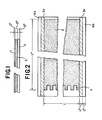
- Fig. 1 is a schematic section view of an element for electrophoresis of an embodiment of the present invention.
- Fig. 2 is a schematic plane view of another element for electrophoresis of an embodiment of the invention.
- Fig. 3 is a schematic planq view of a further element for electrophoresis of an embodiment of the invention, in combination with a schematic section view thereof.
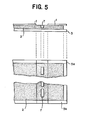
- Fig. 4 and Fig. 5 are schematic plane views of still further elements for electrophoresis of embodiments of the invention, in combination with respective schematic plane views.
- 1: cover sheet, 2: membrane medium for electrophoresis, 3: support, 4: slot for introduction or spotting of sample, 5a, 5b: spacer, 6a, 6b: sealed portion, 7: groove for introduction or spotting sample, D1. thickness of cover sheet, D2: thickness of membrane medium for electrophoresis, D3: thickness of support, L1: width of membrane medium for electrophoresis, L2: width of spacer, L3: width of sealed portion, L4: length of membrane medium for electrophoresis.
- The present invention will be described in more detail by referring to preferable embodiments thereof, but these embodiments are by no means understood to restrict the invention.
- Five embodiments of the element for electrophoresis are illustrated in Fig. 1 to Fig. 5.
- One embodiment of the invention comprises a membrane medium for
electrophoresis 2 provided between twosheets 1, 3. The upper sheet 1 (referred to herein as cover sheet) has a thickness (D1) as less as possible, so that the autoradiographic exposure through the cover sheet can be efficiently done. According to the present invention, the thickness of the cover sheet is not more than approx. 50 µm, more preferably approx. 3 - 50 µm, particularly preferably approx. 5 - 40 um. The thickness (D3) of the lower sheet 3 (referred to herein as support) may be the same as or different from that of the cover sheet and generally ranges from approx. 5 µm to approx. 5 mm, preferably from approx. 8 µm to approx. 3 mm. The support is preferable to be thicker and stiffer than the cover sheet. - There is no specific limitation on the material of either of the cover sheet 1 and
support 3, as far as the it is a non-electroconductive and substantially water-impermeable sheet with smooth surface. Examples of the material include a polyester such as polyethylenetere- phthalate or polycarbonate of bisphenol A, a vinyl-type polymer such as poly(methyl methacrylate), polyethylene, polystyrene or poly(vinyl chloride), a polyamide such as nylon, and copolymers of these monomers such as vinylidene chloride - vinyl chloride copolymer. The material of the cover sheet 1 may be the same as or different from that of thesupport 3. - There is no specific limitation on the membrane medium for
electrophoresis 2, as far as it can be employed for electrophoretic separation. Examples of the medium include aqueous polyacrylamide gel, agarose gel, starch gel, agar gel, porous cellulose acetate membrane, and filter paper. - The thickness (D2) of the membrane medium can-be chosen depending upon the purpose of the separation, and generally ranges from approx. 50 µm to approx. 10 mm. The gel membrane medium preferably ranges from approx. 200 µm to approx. 5 mm, while the porous membrane and filter paper preferably ranges from approx. 70 µm to approx. 1 mm. The size of the membrane medium (L1 x L4) as shown in Fig. 2 may be optionally chosen. In the gel membrane medium for determination of base sequence of DNA, L1 and L4 preferably are in the ranges of 20 - 40 cm and 30 - 60 cm, respectively.
- As shown in Fig. 2, the
support 3 and cover sheet 1 are preferably sealed at both side ends (6a, 6b). There Ls no specific limitation on the width of the sealed portion (L3), as far as both are at least combined by the sealed portion. Generally, L3 is in the range of 2 - 20 mm. Alternatively, the support and cover sheet can 3e combined under adhesion via a spacer mentioned hereinafter. Other two side ends of the support and cover sheet can be sealed or allowed open. - On outer sides of both side ends of the membrane nedium are preferably provided spacers (5a, 5b) for keeping the thickness of the medium, as well as for protecting the medium. The spacers are preferably fixed under adhesion to the support or molded with the support in one piece. A mold processing can be utilized to produce the one-piece product of the support and spacers. The thickness of the spacer does not exceed the thickness of the membrane medium 2 (D2) and the width of the spacer (L2) preferably in the range of 5 - 20 mm.
- In one end portion of the membrane medium, a
slot 4 for introduction or spotting of a sample in the vertical electrophoresis (shown in Fig. 2) or agroove 7 for introduction or spotting of a sample in the horizontal electrophoresis (shown in Fig. 3 to Fig. 5) is preferably provided. In the membrane medium provided with theslot 4, all portion of theslot 4 may be covered with the cover sheet. Otherwise, only a portion nearer to the electrophoretic separation area (namely, right side of the slot in Fig. 2) may be covered with the cover sheet 1 for keeping an introduced sample therein, while other portion may be allowed exposed. In the membrane medium provided with thegroove 7, thegroove 7 may be covered with the cover sheet 1 (shown in Fig. 3) or allowed open (shown in Fig. 4 and Fig. 5). The groove is preferably not covered with the cover sheet, as shown in Fig. 4 and Fig. 5. Otherwise, the groove preferably is so covered with a portion of the cover sheet that said portion can be removed to expose the groove. - The element for electrophoresis as described above referring to the embodiments are substantially free from breakage of the membrane medium caused by contact with other articles or direct handling of the membrane medium as such, because the cover sheet covers the membrane medium all the time from the formation of the medium until the autoradiographic process. Accordingly, the element for electrophoresis of the invention is handled more easily than the conventional element for electrophoresis. Moreover, the element of the invention is advantageous in that a sample inadvertently dropped on an area other than the slot or groove in the procedure for introduction of a sample can be easily wiped off.
- The element for electrophoresis according to the invention is also advantageous in that the element can be combined in layers with a radiographic film without removal of the cover sheet after electrophoreis for' performing the autoradiographic process. Thus, the. autoradiography utilizing the element of the invention is free from one complicated procedure of removing the cover sheet, which is necessary in the conventional autoradiography. This means that the autoradiographic process can be performed with less failure. The autoradiographic exposing process needs a long period of time. If one autoradiographic process is not performed successfully due to the above-described troubles, the subsequent another trial needs a longer period due to decay of the radioisotope.
- For the reasons as described above, the element for electrophoresis of the invention serves for shortening the period for the autoradiographic process through the simplification of the procedure. Moreover, the. element of the invention is advantageous in that the element is in the form of a sheet, whereby requiring no large space and being able to be piled up.
- The preparation of the element for electrophoresis of the invention can be done, for instance, by placing a gel forming solution on a horizontally held support by a known method such as coating or casting and laminating a cover sheet over the solution layer before or after gelation by means of a roller or spatula. The surface of either the cover sheet and support is preferably processed to make hydrophilic by a known process such as ultraviolet ray irradiation, glow discharge processing, corona discharge processing, electron beam irradiation, flame processing, chemical etching, electrolytic etching, etc.
- Otherwise, the element of the invention can be prepared by introducing a gel forming solution into a mold made of two glass plates, each carrying the sheet on the inner surface thereof, so as to causing gelation therein.
- The element of the invention can be sealed by heating at appropriate portions along the periphery of the gel membrane medium so as to prevent evaporation of water contained in the medium. The element for electrophoresis is preferably kept in an envelop of vapor- impermeable sheet.
- The present invention is further illutstrated by the following examples, but these examples are by no means understood to restrict the invention.
- Three spacers of poly(methyl methacrylate) in the form of strips (thickness: 0.5 mm) were placed on three side ends of polyethylene terephthalate film (support; thickness 100 um; the surface being made hydrophilic by applying thereto high freequency discharge) spread on a horizontally installed plate. The remaining end was provided with a space by placing thereon a slot former (the thickness was the same as that of the spacer) having a crenellated side. Into the space, a mixture of an aqueous gel forming solution (a tris - boric acid buffer solution containing 12.5 % of acrylamide in which 5 % of methylenebisacrylamide was contained) and an appropriate amount of initiator (ammonium persulfate and tetramethylethylenediamine) was poured.
- A glass plate carrying polyethylene terephthalate film (cover sheet; thickness 20 um) thereon under adhesion was placed under pressure on the gel forming solution layer to remove an excessive solution. The glass plate was kept thereon under pressure for performing gelation, and only the glass plate.was removed to prepare an element for electrophoresis comprising a membrane medium between the two polyethylene terephthalate sheets.
- Plasmid PBR 322 of E. coli labeled with 32P was decomposed according to Maxam-Gilbert method (MG method) to prepare base specific cleavage products.
- The cleavage products were subjected to electrophoresis by means of an element of gel membrane medium prepared in the conventional molding method using glass plates or the element of the invention as prepared above. Subsequently, the autoradiographic process was applied to these elements to give a visualized autoradiograph for each.
- Both autoradiographs indicated almost same resolution. However, the time required since the termination of electrophoretic separation until the imagewise exposing procedure including the procedure for wiping off the electrolitic solution on the end of the gel membrane medium was approx. 2 min. for the element of the invention. In contrast, the time required for the same procedure in the case of using the conventional element including removal of the glass plate and covering the medium with a wrapping sheet for combining with a radiographic film was as long as 30 min. Further, the latter case required careful handling.
Claims (17)
the improvement in which the cover sheet has a thickness of not more than 50 µm.
Applications Claiming Priority (2)
| Application Number | Priority Date | Filing Date | Title |
|---|---|---|---|
| JP58001324A JPS59126237A (en) | 1983-01-08 | 1983-01-08 | Material for electrophoretic analysis |
| JP1324/83 | 1983-01-08 |
Publications (2)
| Publication Number | Publication Date |
|---|---|
| EP0113700A2 true EP0113700A2 (en) | 1984-07-18 |
| EP0113700A3 EP0113700A3 (en) | 1985-11-21 |
Family
ID=11498311
Family Applications (1)
| Application Number | Title | Priority Date | Filing Date |
|---|---|---|---|
| EP84300120A Withdrawn EP0113700A3 (en) | 1983-01-08 | 1984-01-09 | Element for electrophoresis |
Country Status (2)
| Country | Link |
|---|---|
| EP (1) | EP0113700A3 (en) |
| JP (1) | JPS59126237A (en) |
Cited By (11)
| Publication number | Priority date | Publication date | Assignee | Title |
|---|---|---|---|---|
| EP0159830A1 (en) * | 1984-03-29 | 1985-10-30 | Director of the Finance Division Minister's Secretariat Science and Technology Agency | Process of manufacturing element for electrophoresis and apparatus therefor |
| WO1987005230A1 (en) * | 1986-03-05 | 1987-09-11 | Automated Microbiology Systems Limited | Electrophoresis gel and method of production |
| US4715942A (en) * | 1986-02-07 | 1987-12-29 | Fuji Photo Film Co., Ltd. | Electrophoresis apparatus |
| EP0224194A3 (en) * | 1985-11-29 | 1988-01-07 | Daiichi Pure Chemicals Co. Ltd. | Vertical slab type electrophoresis apparatus |
| US4718998A (en) * | 1986-05-20 | 1988-01-12 | Fuji Photo Film Co., Ltd. | Element for electrophoresis |
| EP0246751A3 (en) * | 1986-04-19 | 1988-06-08 | Fuji Photo Film Co., Ltd. | Medium for electrophoresis medium for electrophoresis |
| EP0285394A3 (en) * | 1987-03-30 | 1989-10-18 | Fuji Photo Film Co., Ltd. | Electrophoresis device |
| US4915811A (en) * | 1987-06-19 | 1990-04-10 | Fuji Photo Film Co., Ltd. | Electrophoresis apparatus |
| EP0534135A1 (en) * | 1991-09-13 | 1993-03-31 | Oxford Glycosystems Ltd. | Gel electrophoresis cassette |
| US5290411A (en) * | 1992-07-14 | 1994-03-01 | California Institute Of Technology | Acrylic polymer electrophoresis support media |
| WO2003012442A3 (en) * | 2001-07-25 | 2003-07-24 | Michel Flor-Henry | Improvements in handling of samples used in molecular biology and biochemistry |
Families Citing this family (2)
| Publication number | Priority date | Publication date | Assignee | Title |
|---|---|---|---|---|
| JPS61296255A (en) * | 1985-06-25 | 1986-12-27 | Science & Tech Agency | Material for electrophoretic analysis |
| JPH0743349B2 (en) * | 1986-06-02 | 1995-05-15 | 富士写真フイルム株式会社 | Gel sheet for electrophoresis |
Family Cites Families (4)
| Publication number | Priority date | Publication date | Assignee | Title |
|---|---|---|---|---|
| US3888759A (en) * | 1973-05-25 | 1975-06-10 | Yeda Res & Dev | Flat plate electrophoresis |
| US4337131A (en) * | 1978-11-13 | 1982-06-29 | C. Desaga Gmbh Nachf. Erich Fecht | Process for electrophoresis |
| US4314897A (en) * | 1980-07-01 | 1982-02-09 | Beckman Instruments, Inc. | Electrophoretic gel container |
| US4417967A (en) * | 1981-11-24 | 1983-11-29 | Georgetown University | Grooved gel |
-
1983
- 1983-01-08 JP JP58001324A patent/JPS59126237A/en active Pending
-
1984
- 1984-01-09 EP EP84300120A patent/EP0113700A3/en not_active Withdrawn
Cited By (14)
| Publication number | Priority date | Publication date | Assignee | Title |
|---|---|---|---|---|
| EP0159830A1 (en) * | 1984-03-29 | 1985-10-30 | Director of the Finance Division Minister's Secretariat Science and Technology Agency | Process of manufacturing element for electrophoresis and apparatus therefor |
| US4772373A (en) * | 1985-11-19 | 1988-09-20 | Daiichi Pure Chemicals Co., Ltd. | Vertical slab type electrophoresis apparatus |
| EP0224194A3 (en) * | 1985-11-29 | 1988-01-07 | Daiichi Pure Chemicals Co. Ltd. | Vertical slab type electrophoresis apparatus |
| US4715942A (en) * | 1986-02-07 | 1987-12-29 | Fuji Photo Film Co., Ltd. | Electrophoresis apparatus |
| WO1987005230A1 (en) * | 1986-03-05 | 1987-09-11 | Automated Microbiology Systems Limited | Electrophoresis gel and method of production |
| EP0246751A3 (en) * | 1986-04-19 | 1988-06-08 | Fuji Photo Film Co., Ltd. | Medium for electrophoresis medium for electrophoresis |
| US4718998A (en) * | 1986-05-20 | 1988-01-12 | Fuji Photo Film Co., Ltd. | Element for electrophoresis |
| EP0246873A3 (en) * | 1986-05-20 | 1989-08-16 | Fuji Photo Film Co., Ltd. | Element for electrophoresis |
| EP0285394A3 (en) * | 1987-03-30 | 1989-10-18 | Fuji Photo Film Co., Ltd. | Electrophoresis device |
| US4915811A (en) * | 1987-06-19 | 1990-04-10 | Fuji Photo Film Co., Ltd. | Electrophoresis apparatus |
| EP0534135A1 (en) * | 1991-09-13 | 1993-03-31 | Oxford Glycosystems Ltd. | Gel electrophoresis cassette |
| US5290411A (en) * | 1992-07-14 | 1994-03-01 | California Institute Of Technology | Acrylic polymer electrophoresis support media |
| US5397449A (en) * | 1992-07-14 | 1995-03-14 | California Institute Of Technology | Acrylic polymer electrophoresis support media |
| WO2003012442A3 (en) * | 2001-07-25 | 2003-07-24 | Michel Flor-Henry | Improvements in handling of samples used in molecular biology and biochemistry |
Also Published As
| Publication number | Publication date |
|---|---|
| EP0113700A3 (en) | 1985-11-21 |
| JPS59126237A (en) | 1984-07-20 |
Similar Documents
| Publication | Publication Date | Title |
|---|---|---|
| EP0113700A2 (en) | Element for electrophoresis | |
| US5972188A (en) | Membrane loader for gel electrophoresis | |
| EP0313293B1 (en) | Method and apparatus for use in biological testing | |
| EP0334615B1 (en) | Electrophoresis apparatus | |
| DE3703687C2 (en) | ||
| US4915811A (en) | Electrophoresis apparatus | |
| GB1577712A (en) | Apparatus for electrophoresis separation | |
| US4699680A (en) | Process and apparatus for manufacturing element for electrophoresis | |
| US4622124A (en) | Device for horizontal electroblotting | |
| US4391688A (en) | Electrophoresis system for multiple agarose slab gels | |
| EP0155833A2 (en) | Element for electrophoresis | |
| US6569306B1 (en) | Cassette for gel electrophoresis having solid buffer reservoirs | |
| US4883577A (en) | Electrophoresis device with shark-toothed comb having a thickness determined by the thickness of the gel | |
| JP2550801Y2 (en) | Electrophoresis device | |
| US4750506A (en) | Apparatus for processing a slab gel | |
| US4849078A (en) | Process for conducting electrophoresis and transfer | |
| EP0871870A1 (en) | Membrane loader for gel electrophoresis | |
| US4650556A (en) | Means for electrophoresis showing reduced smiling effect | |
| JPS6347648A (en) | Material for electrophoretic analysis | |
| US4810341A (en) | Method of making electrophoresis sheet | |
| JPH043824B2 (en) | ||
| CA1181034A (en) | Electrophoresis system for multiple agarose slab gels | |
| US4640759A (en) | Supported medium for electrophoresis and supports therefor | |
| JPS55154453A (en) | Electrochemical analytical apparatus | |
| JPH043823B2 (en) |
Legal Events
| Date | Code | Title | Description |
|---|---|---|---|
| PUAI | Public reference made under article 153(3) epc to a published international application that has entered the european phase |
Free format text: ORIGINAL CODE: 0009012 |
|
| AK | Designated contracting states |
Designated state(s): CH DE FR GB LI SE |
|
| PUAL | Search report despatched |
Free format text: ORIGINAL CODE: 0009013 |
|
| RAP1 | Party data changed (applicant data changed or rights of an application transferred) |
Owner name: DIRECTOR OF THE FINANCE DIVISION MINISTER'S SECRET |
|
| AK | Designated contracting states |
Kind code of ref document: A3 Designated state(s): CH DE FR GB LI SE |
|
| 17P | Request for examination filed |
Effective date: 19851227 |
|
| 17Q | First examination report despatched |
Effective date: 19870402 |
|
| STAA | Information on the status of an ep patent application or granted ep patent |
Free format text: STATUS: THE APPLICATION IS DEEMED TO BE WITHDRAWN |
|
| 18D | Application deemed to be withdrawn |
Effective date: 19880503 |
|
| RIN1 | Information on inventor provided before grant (corrected) |
Inventor name: SHIRAISHI, HISASHI Inventor name: OGAWA, MASASHI |