EP0114019A2 - Appareil pour favoriser la prolifération des micro-organismes nécessaires au développement des végétaux - Google Patents
Appareil pour favoriser la prolifération des micro-organismes nécessaires au développement des végétaux Download PDFInfo
- Publication number
- EP0114019A2 EP0114019A2 EP83420189A EP83420189A EP0114019A2 EP 0114019 A2 EP0114019 A2 EP 0114019A2 EP 83420189 A EP83420189 A EP 83420189A EP 83420189 A EP83420189 A EP 83420189A EP 0114019 A2 EP0114019 A2 EP 0114019A2
- Authority
- EP
- European Patent Office
- Prior art keywords
- collar
- skirt
- plants
- plant
- roots
- Prior art date
- Legal status (The legal status is an assumption and is not a legal conclusion. Google has not performed a legal analysis and makes no representation as to the accuracy of the status listed.)
- Granted
Links
- 244000005700 microbiome Species 0.000 title claims abstract description 8
- 230000001737 promoting effect Effects 0.000 title claims abstract description 4
- 230000035755 proliferation Effects 0.000 title claims 2
- 239000002689 soil Substances 0.000 claims abstract description 9
- 239000000463 material Substances 0.000 claims description 5
- 241000196324 Embryophyta Species 0.000 abstract description 39
- XLYOFNOQVPJJNP-UHFFFAOYSA-N water Substances O XLYOFNOQVPJJNP-UHFFFAOYSA-N 0.000 abstract description 17
- 238000004064 recycling Methods 0.000 abstract description 5
- 230000035558 fertility Effects 0.000 abstract 1
- 238000009833 condensation Methods 0.000 description 4
- 230000005494 condensation Effects 0.000 description 4
- 238000002513 implantation Methods 0.000 description 4
- 244000025254 Cannabis sativa Species 0.000 description 3
- 241000209504 Poaceae Species 0.000 description 2
- 238000001704 evaporation Methods 0.000 description 2
- 230000008020 evaporation Effects 0.000 description 2
- 239000003337 fertilizer Substances 0.000 description 2
- 230000001681 protective effect Effects 0.000 description 2
- 241001133184 Colletotrichum agaves Species 0.000 description 1
- 241000218631 Coniferophyta Species 0.000 description 1
- 238000009825 accumulation Methods 0.000 description 1
- 238000005273 aeration Methods 0.000 description 1
- 230000006378 damage Effects 0.000 description 1
- 230000001934 delay Effects 0.000 description 1
- 238000001035 drying Methods 0.000 description 1
- 230000002349 favourable effect Effects 0.000 description 1
- 238000002955 isolation Methods 0.000 description 1
- 238000012986 modification Methods 0.000 description 1
- 230000004048 modification Effects 0.000 description 1
- 230000003071 parasitic effect Effects 0.000 description 1
- 239000011148 porous material Substances 0.000 description 1
- 230000000750 progressive effect Effects 0.000 description 1
- 238000011084 recovery Methods 0.000 description 1
- 230000000630 rising effect Effects 0.000 description 1
- 229920006395 saturated elastomer Polymers 0.000 description 1
Images

Classifications
-
- A—HUMAN NECESSITIES
- A01—AGRICULTURE; FORESTRY; ANIMAL HUSBANDRY; HUNTING; TRAPPING; FISHING
- A01G—HORTICULTURE; CULTIVATION OF VEGETABLES, FLOWERS, RICE, FRUIT, VINES, HOPS OR SEAWEED; FORESTRY; WATERING
- A01G13/00—Protection of plants
- A01G13/30—Ground coverings
- A01G13/31—Ground coverings for individual plants
-
- A—HUMAN NECESSITIES
- A01—AGRICULTURE; FORESTRY; ANIMAL HUSBANDRY; HUNTING; TRAPPING; FISHING
- A01G—HORTICULTURE; CULTIVATION OF VEGETABLES, FLOWERS, RICE, FRUIT, VINES, HOPS OR SEAWEED; FORESTRY; WATERING
- A01G13/00—Protection of plants
- A01G13/20—Protective coverings for plants
- A01G13/27—Protective coverings for plants protecting specific parts of plants, e.g. roots, trunks or fruits
Definitions
- the invention relates to an apparatus capable of promoting the development of soil microorganisms essential to plants by recycling water and circulating air.
- the apparatus in question consists of a very flared tapered skirt intended to cover the roots of the shrub or of the tree in the ground and surmounted by a collar emerging from the ground and surrounding the trunk, the skirt and the collar being provided with gutters hollowed out on their internal face and along the generatrices.
- patent FR-A-2 484 773 describes a protective bell for vine stock, made of plastic material, having a single central opening for growth, a guiding zone attached thereto and having a slightly curved wall in the direction of the opening and a laying area in the shape of a cone trunk.
- the protection provided is aerial, only part of the base of the bell can be partially or completely buried. If this device prevents the soil from drying out, it has the disadvantage of collecting all the rainwater and therefore can cause an excess of water leading to decay.
- the bell in question is visible.
- the flange provided for a vocation of guiding the shoot.
- a saucer which allows the protection and the improvement of the culture of various small plants; this saucer is made in two parts joining together face-to-face around a plant base, reserving in the center a circular surface with a central hole for the passage of the plant base and having two circular surfaces, one central rising from the center of the saucer to the edge, the second circular surface extending around the first but directed downwards.
- This device is only used for small plants. The two face-to-face parts conserve humidity, part of the device is on the surface. The attachment of the two parts is fixed, therefore is not susceptible to extension during the development of the plant.
- Patent FR-A-2 129 266 describes an improvement to pots for nurserymen constituted by a flexible material disc pierced in its center and split along a radius to allow overlapping of the edges of the disc and to form a sort of funnel. This device is placed on the surface of the pot and converges the water for plant watering towards the central hole.
- Patent FR-A-1 357 381 describes a cup for protecting plants against weeds, drought, heat or cold. Its bowl shape makes it possible to recover runoff water, but can lead to oversaturation of moisture harmful to the development of plants, although it is provided in porous material.
- the devices thus described protect the plants but are not capable of controlling the accumulation of water or fertilizers, which can cause the plants to rot or their destruction by an excess of fertilizers.
- these devices are arranged on the surface or have only the end of their base in the ground. They consist of one or two previously assembled parts. Their shape, bell, cup or cup or bowl is responsible for the aforementioned drawbacks.
- the device imagined has a different vocation, it an environment particularly favorable to the development of microorganisms from soil and root exchanges by a constantly satisfactory moisture and aeration ade ⁇ quate essential to plants.
- a first object of the invention is to provide an apparatus for receiving a little rain water or watering and capable of moving the overflow away from the roots of the plant, so as to promote the establishment and extension of said roots of the tree or plant in the soil.
- Another object of the invention is to constitute a confined air reserve conducive to the good development of the life of the microorganisms necessary for the plant and for root exchanges.
- Another aim of the ivention is to allow condensation internally, near the roots, ensuring a water supply to the plant in warm times of the year, when she needs it most, or the hot and dry regions, or when planting without watering.
- Another object of the invention is to cause continuous recycling of the water at the roots while preventing its evaporation.
- Another object of the invention is to provide a regulation of the temperature of the root implantation area.
- Another object of the invention is to protect the roots of parasitic grasses which cannot penetrate into the vital zone (the collar of the tree), nor into the zone of the roots especially at the start of recovery after planting, while allowing the implantation of grass near the tree due to the isolation by the frustoconical skirt of the two root systems.
- the frustoconical skirt is made of plastic, in two parts partially overlapping, the flanges being held by an elastic link allowing the plant or the tree to spread them apart in function the natural enlargement of the trunk and the volume of the roots.
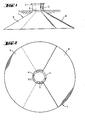
- Figures 1 to 4 show that the device consists of two identical parts A and B which are placed opposite and the edges of which are made to penetrate one into the interior volume of the other to form a frustoconical skirt 1, the flanges 2 partially overlapping as well as the flared parts of the skirt to form an assembly connected, in the zone of the flange, by an elastic link 3.
- Each of the parts A, B representing a fraction higher than half a truncated cone.
- the top of the collar 2 has a small protruding rim 4 from which gutters 5 hollowed out in the internal face of the collar 2 and of the skirt 1, according to the generators, which are more particularly illustrated in FIGS. 2 and 3 .
- the tapered skirt formed by the association of the two parts A and B, is intended to be buried; it has an inclination corresponding to the plunging of the roots 7 into the ground. It is therefore placed on the roots of the plant which have been previously lightly covered with soil. Only the collar 2 slightly exceeds the level of the ground and surrounds the collar 6 of the shrub or the plant.
- the device is made of plastic or other material composed for example of several layers having the characteristics necessary for good condensation while being if necessary bio-degradable or capable of being used in whole or in part as food for the plant.
- runoff and / or sprinkling water is done at the rim 4 of the flange 2 by the gutters 5 which originate there.
- the water follows each of them, and is distributed towards the roots, which favors their implantation and their extension in the soil.
- gutters 5 are not saturated with water, they make it possible to constitute, between the frustoconical skirt and the roots, a confined air store necessary for the good development of the life of the microorganisms essential to the plant and to root exchanges. , and constantly renewed.
- the tapered skirt 1 is made of fairly thick and waterproof material which allows condensation at its level, near the roots, which constitutes a supply of water to the plant.
- the flange 2 and the frustoconical skirt 1 ensure a metering of rainwater and / or sprinkling water, due to their combined structure and the phenomenon of condensation which occurs leads to a continuous recycling of water at the level of the roots, while preventing its evaporation.
- the recycling of the water and the small circulation of air allow a natural regulation of the temperature at the level of the roots.
- the elasticity of the link 3 which keeps the two parts A and B of the device in the partial covering position, allows the reduction of said covering as the plant develops both at the trunk 6 and at the roots 7.
- the frustoconical skirt 1 plays a protective role against the grasses which would tend to compete with the plant cultivated in this vital area for it and determined by said skirt, the apparatus not prohibiting the implantation of grass with the protected plant.
- the device also protects the plant
- the device can be used for many years, as long as
- the device can be used for all plants, in all environments, during planting or after planting.
Landscapes
- Health & Medical Sciences (AREA)
- General Health & Medical Sciences (AREA)
- Toxicology (AREA)
- Life Sciences & Earth Sciences (AREA)
- Environmental Sciences (AREA)
- Cultivation Receptacles Or Flower-Pots, Or Pots For Seedlings (AREA)
- Micro-Organisms Or Cultivation Processes Thereof (AREA)
- Cultivation Of Plants (AREA)
- Catching Or Destruction (AREA)
Abstract
Description
- Actuellement, on observe fréquemment des retards dans le développement des arbustes, arbres, conifères, végétaux de toutes sortes, même des dépérissements progressifs desdits végétaux, ceci aussi bien en jardins d'agrément qu'en zone de terres compactées ou couvertes d'herbe, de prairie ou de gazon.
- La cause principale de ces échecs réside dans le fait que les condition.s ne sont pas réunies pour avoir un développement satisfaisant des micro-organismes du sol et des échanges radiculaires indispensables au bon développement des végétaux.
- L'invention concerne un appareil susceptible de favoriser le développement des micro-organismes du sol indispensables aux végétaux par un recyclage de l'eau et une circulation d'air.
- A cet effet, l'appareil dont il s'agit consiste en une jupe tronconique très évasée destinée à coiffer les racines de l'arbuste ou de l'arbre dans le sol et surmontée d'une collerette émergeant du sol et entourant le tronc, la jupe et la collerette étant pourvues de gouttières creusées sur leur face interne et le long des génératrices.
- On connaît déjà des appareils destinés à protéger les végétaux. Notamment le brevet FR-A- 2 484 773 décrit une cloche de protection pour pied de vigne, constituée en matière plastique, présentant une seule ouverture centrale pour la pousse, une zone de guidage s'y rattachant et présentant une paroi légèrement courbée dans la direction de l'ouverture et une zone de pose ayant la forme d'un tronc de c6ne.La protection assurée est aérienne, seule une partie de la base de la cloche peut être partiellement ou totalement enterrée. Si ce dispositif évite le dessèchement du sol, il présente l'inconvénient de collecter toute l'eau de pluie et de ce fait peut provoquer un excédent d'eau entraînant une pourriture. La cloche dont il s'agit est apparente. La collerette prévue à une vocation de guidage de la pousse.
- Par le brevet FR-A-2 433 291, on connaît une soucoupe permettant la protection et l'amélioration de la culture de petites plantes diverses ; cette soucoupe est réalisée en deux parties s'assemblant jointives face-à-face autour d'un pied de plante, réservant au centre une surface circulaire à trou central pour le passage du pied de la plante et présentant deux surfaces circulaires, l'une centrale s'élevant du centre de la soucoupe vers le bord, la seconde surface circulaire s'étendant autour de la première mais dirigée vers le bas. Cet appareil n'est utilisé que pour de petites plantes. Les deux parties face-à-face conservent l'humidité, une partie de l'appareil est en surface. L'accrochage des deux parties est fixe, donc n'est pas susceptible d'extension au cours du développement de la plante.
- Le brevet FR-A- 2 129 266 décrit un perfectionnement aux pots pour pépiniéristes constitué par un disque en matière souple percésen son centre et fendu suivant un rayon pour permettre un recouvrement des bords du disque et former une sorte d'entonnoir. Ce dispositif est placé à la surface du pot et fait converger vers le trou central l'eau d'arrosage des plantes.
- Le brevet FR-A- 1 357 381 décrit une coupelle de protection des végétaux contre les mauvaises herbes, la sécheresse, la chaleur ou le froid. Sa forme en cuvette permet de récupérer les eaux de ruissellement, mais peut conduire à une sursaturation d'humidité néfaste au développement des végétaux, bien qu'elle soit prévue en matière poreuse.
- Les appareils ainsi décrits protègent les végétaux mais ne sont pas susceptibles de doser l'accumulation d'eau ou d'engrais, ce qui peut provoquer la pourriture des végétaux ou leur destruction par un surplus d'engrais. D'autre part ces appareils sont disposés en surface ou n'ont que l'extrémité de leur base dans le sol. Ils sont constitués par une ou deux pièces prélablement assemblées. Leur forme, cloche, coupe ou coupelle ou cuvette est responsable des inconvénients susmentionnés.
- L'appareil imaginé est de vocation différente, il engendre un milieu particulièrement propice au développement des micro-organismes du sol et des échanges radiculaires par une humidité constamment satisfaisante et une aération ade~ quate indispensables aux végétaux.
- Un premier but de l'invention est de fournir un appareil récepteur d'un peu d'eau de pluie ou d'arrosage et susceptible d'éloigner le trop plein des racines de la plante, de manière à favoriser l'implantation et l'extension desdites racines de l'arbre ou du végétal dans le sol.
- Un autre but de l'invention est de constituer une réserve d'air confiné propice au bon développement de la vie des micro-organismes nécessaires à la plante et aux échanges radiculaires.
- Un autre but de llivention est de permettre une condensation au niveau interne, près des racines, ce qui assure un apport d'eau à la plante aux moments chauds de l'année, quand elle en a le plus besoin, ou dans les régions chaudes et sèches, ou lors de plantations sans arrosage.
- Un autre but de l'invention est de provoquer un recyclage continuel de l'eau au niveau des racines tout en empêchant son évaporation.
- Un autre but de l'invention est de fournir une régulation de la température de la zone d'implantation des racines.
- Enfin, un autre but de..l'invention est de protéger les racines des herbes parasites qui ne peuvent pas pénétrer dans la zone vitale (le collet de l'arbre), ni dans la zone des racines surtout au début de la reprise après la plantation, tout en autorisant l'implantation de gazon près de l'arbre du fait de l'isolement par la jupe tronconique des deux systèmes radiculaires.
- Sous une forme d'exécution préférentielle de l'invention, la jupe tronconique est réalisée en matière plastique, en deux parties se recouvrant partiellement,les collerettes étant maintenues par un lien élastique permettant à la plante ou à l'arbre de les écarter en fonction du grossissement naturel du tronc et du volume des racines.
- Dans ce qui suit, l'invention est exposée plus en détail à l'aide de dessins représentant seulement un mode d'exécution :
- - La figure 1 est une vue en élévation de l'appareil ;
- - La figure 2 en est une vue en plan par-dessus;
- - La figure 3 est une vue de face d'une des parties de l'appareil montrant les gouttières qui la creusent ;
- - La figure 4 est une vue en perspective à petite échelle montrant l'appareil coiffant les racines d'un végétal.
- Les figures 1 à 4 permettent de voir que l'appareil est constitué de deux parties identiques A et B que l'on place en vis-à-vis et dont on fait pénétrer les bords de l'une dans le volume intérieur de l'autre pour former une jupe tronconique 1, les collerettes 2 se recouvrant partiellement ainsi que les parties évasées de la jupe pour former un ensemble relié, dans la zone de la collerette, par un lien élastique 3. Chacune des parties A,B représentant une fraction supérieu- rue à la moitié d'un tronc de cône. Le haut de la collerette 2 est assorti d'un petit rebord saillant 4 d'où partent des gouttières 5 creusées dans la face interne de la collerette 2 et de la jupe 1, suivant les génératrices, ce qutillustrent plus particulièrement les figures 2 et 3.
- La jupe tronconique, formée par l'association des deux parties A et B, est destinée à être enterrée ; elle a une inclinaison correspondant à la plongée des racines 7 dans le sol. Elle est donc posée sur les racines du végétal qui ont été préalablement légèrement recouvertes de terre. Seule la collerette 2 dépasse un peu le niveau du sol et entoure le collet 6 de l'arbuste ou du végétal.
- L'appareil est réalisé en matière plastique ou autre matière composée par exemple de plusieurs couches présentant les caractéristiques nécessaires à une bonne condensation tout en étant le cas échéant bio-dégradable ou susceptible de servir en tout ou partie d'aliment pour la plante.
- L'entrée d'eau de ruissellement et/ou d'arrosage se fait au niveau du rebord 4 de la collerette 2 par les gouttières 5 qui y prennent naissance. L'eau suit chacune d'entre, elleset se répartit vers les racines,ce qui favorise leur implantation et leur extension dans le sol.
- En cas de surabondance d'eau, le trop plein est éloigné des racines 7 par ruissellement à la surface de l'appareil.
- Entre temps, lorsque les gouttières 5 ne sont pas saturées d'eau elles permettent de constituer entre la jupe tronconique et les racines un magasin d'air confiné nécessaire au bon développement de la vie des micro-organismes indispensables à la plante et aux échanges radiculaires,et constamment renouvelé.
- La jupe tronconique 1 est en matière assez épaisse et imperméable ce qui permet une condensation à son niveau, près des racines, ce qui constitue un apport d'eau à la plante. La collerette 2 et la jupe tronconique 1 assurent un dosage des eaux de pluie et/ou d'arrosage, du fait même de leur structure combinée et le phénomène de condensation qui se produit entraine un recyclage continuel de l'eau au niveau des racines, tout en empêchant son évaporation . Le recyclage de l'eau et la petite circulation d'air permettent une régulation naturelle de la température au niveau des racines.
- L'élasticité du lien 3 qui maintient les deux parties A et B de l'appareil en position de recouvrement partiel, autorise la diminution dudit recouvrement au fur et à mesure du développement du végétal tant au niveau du tronc 6 qu'au niveau des racines 7.
- La jupe tronconique 1 joue un rôle protecteur contre les herbes qui tendraient à concurrencer le végétal cultivé dans cette zone vitale pour lui et déterminée par ladite jupe, l'appareil n'interdisant pas l'implantation de gazon auprès du végétal protégé. L'appareil protège en outre le végétal
- de l'action des petits outils aratoires. L'appareil peut servir de nombreuses années, autant que
- la vie du végétal ou de l'arbre se perpétue , ou plusieurs fois s'il s'agit de végétaux à vie courte; L'appareil peut être utilisé pour tous végétaux, dans tous milieux, à la plantation ou après la plantation.
- Il va de soi que des modifications peuvent être apportées au dispositif qui vient d'être décrit, notamment pour amélio - rer la stabilité ou la protection du pied de l'abre par exemple, par une légère augmentation de la hauteur de la collerette sans pour autant sortir du cadre de la présente invention.
Claims (7)
Priority Applications (1)
| Application Number | Priority Date | Filing Date | Title |
|---|---|---|---|
| AT83420189T ATE33087T1 (de) | 1982-12-20 | 1983-12-19 | Vorrichtung zum beguenstigen der vermehrung von mikroorganismen erforderlich fuer die entwicklung von pflanzen. |
Applications Claiming Priority (2)
| Application Number | Priority Date | Filing Date | Title |
|---|---|---|---|
| FR8221605A FR2537833B1 (fr) | 1982-12-20 | 1982-12-20 | Appareil pour favoriser la proliferation des micro-organismes necessaires au developpement des vegetaux |
| FR8221605 | 1982-12-20 |
Publications (3)
| Publication Number | Publication Date |
|---|---|
| EP0114019A2 true EP0114019A2 (fr) | 1984-07-25 |
| EP0114019A3 EP0114019A3 (en) | 1984-08-08 |
| EP0114019B1 EP0114019B1 (fr) | 1988-03-23 |
Family
ID=9280415
Family Applications (1)
| Application Number | Title | Priority Date | Filing Date |
|---|---|---|---|
| EP83420189A Expired EP0114019B1 (fr) | 1982-12-20 | 1983-12-19 | Appareil pour favoriser la prolifération des micro-organismes nécessaires au développement des végétaux |
Country Status (5)
| Country | Link |
|---|---|
| US (1) | US4584789A (fr) |
| EP (1) | EP0114019B1 (fr) |
| AT (1) | ATE33087T1 (fr) |
| DE (1) | DE3376050D1 (fr) |
| FR (1) | FR2537833B1 (fr) |
Cited By (2)
| Publication number | Priority date | Publication date | Assignee | Title |
|---|---|---|---|---|
| GB2164534A (en) * | 1984-09-21 | 1986-03-26 | Robin Templar Williams | Protection of plants |
| GB2168582A (en) * | 1984-12-20 | 1986-06-25 | Rolinx Ltd | A shelter for trees |
Families Citing this family (23)
| Publication number | Priority date | Publication date | Assignee | Title |
|---|---|---|---|---|
| US4986025A (en) * | 1990-01-25 | 1991-01-22 | Imp William A | Landscape apparatus |
| DE9102705U1 (de) * | 1991-03-07 | 1991-07-04 | Schneider, Friedhelm, 5226 Reichshof | Baumschutzmanschette |
| DE4107233A1 (de) * | 1991-03-07 | 1992-09-10 | Friedhelm Schneider | Baumschutzmanschette |
| US5367822A (en) * | 1993-02-11 | 1994-11-29 | Beckham; James | Tree edging border |
| CA2174047A1 (fr) * | 1996-04-12 | 1997-10-13 | Emil Albert Cornelius Pattyn | Dispositif de protection d'arbre |
| FI2657U1 (fi) * | 1996-06-14 | 1996-11-29 | Tapio Hynninen | Taimisuojus |
| JP2748000B1 (ja) * | 1997-07-04 | 1998-05-06 | 株式会社ミナミ | 草止め板 |
| GB2343827A (en) * | 1998-11-20 | 2000-05-24 | Lin Pac Mouldings | Tree root deflector. |
| US20040200143A1 (en) * | 2003-02-24 | 2004-10-14 | Elizabeth Stanley | Plant collar and support system |
| US20060130399A1 (en) * | 2004-10-12 | 2006-06-22 | Mcdonald Thomas G | Pole base |
| US20140020288A1 (en) * | 2012-07-18 | 2014-01-23 | George Sikes | Root Ball Container |
| CN104521664B (zh) * | 2014-12-08 | 2017-06-20 | 中山大学 | 华南森林有害植物的生态控制方法 |
| US9890536B2 (en) * | 2015-03-27 | 2018-02-13 | Thomas W. Lolio, JR. | Silicone rubber universal fit flexible tree trunk guard |
| US10561074B2 (en) * | 2016-02-16 | 2020-02-18 | Doreen J. Emory | Plant skirt and method for use thereof |
| US10813299B2 (en) | 2016-07-27 | 2020-10-27 | Kent Stover | Plant edging |
| IT201700002070A1 (it) * | 2017-01-10 | 2018-07-10 | Luigi Fumagalli | Dispositivo di protezione per piante |
| USD884442S1 (en) * | 2017-05-16 | 2020-05-19 | Martin W. Taylor | Impermeable sectional apparatus for soil moisture retention |
| US10993384B2 (en) | 2018-01-09 | 2021-05-04 | Thomas R. Carter | Mower path assistance system |
| US10767385B2 (en) | 2018-09-17 | 2020-09-08 | Simon David Gray Wehr | Portable holder |
| CN109819815B (zh) * | 2019-02-26 | 2023-10-20 | 南京林业大学 | 避免路面被乔木根系拱坏的种植圈 |
| CN109832060B (zh) * | 2019-04-03 | 2024-05-31 | 梅州市梅县区农业科学研究所 | 果树林下抵御不良气候的装置 |
| US12329072B2 (en) * | 2022-11-30 | 2025-06-17 | Mitchell Nellis | Adjustable tree trunk guard |
| USD1052447S1 (en) * | 2023-04-18 | 2024-11-26 | Ningbo Flying-Horse International Trade Co., Ltd | Tree skirt |
Family Cites Families (14)
| Publication number | Priority date | Publication date | Assignee | Title |
|---|---|---|---|---|
| US283837A (en) * | 1883-08-28 | Guard for plants and trees | ||
| US219987A (en) * | 1879-09-23 | Improvement in tree-protectors | ||
| US635397A (en) * | 1899-06-16 | 1899-10-24 | Jacob Schlaefer | Tree-protector. |
| US1674118A (en) * | 1927-04-19 | 1928-06-19 | Samuel W Merrick | Tree collar |
| GB769696A (en) * | 1954-01-28 | 1957-03-13 | Charles Tierney | Protector of brassica crops and other plants |
| US2978837A (en) * | 1959-05-20 | 1961-04-11 | Daniels Neale James | Grass guard for trees |
| FR1357381A (fr) * | 1963-05-18 | 1964-04-03 | Coupelle de protection pour végétaux | |
| DE1782101A1 (de) * | 1968-07-18 | 1971-07-08 | Wuertt Allplastik | Schutzmanschette fuer Pflanzenteile |
| FR2129266A5 (fr) * | 1971-03-19 | 1972-10-27 | Laguerre Maxime | |
| FR2356361A1 (fr) * | 1976-06-28 | 1978-01-27 | Heschung Robert | Dispositif de protection et de maintien pour troncs d'arbres |
| CH623721A5 (en) * | 1978-03-24 | 1981-06-30 | Paul Faeh | Device for keeping seedlings moist, especially at the beginning of their growth, intended to be immersed in sandy soils, in particular in deserts |
| FR2433291A1 (fr) * | 1978-08-16 | 1980-03-14 | Devaux Roger | Soucoupe en deux parties permettant la protection et l'amelioration de la culture de petites plantes diverses |
| DE3023252A1 (de) * | 1980-06-21 | 1982-01-14 | Geiger Plastic Gmbh & Co Kg, 8100 Garmisch-Partenkirchen | Rebenhaube |
| US4366646A (en) * | 1981-08-13 | 1983-01-04 | International Plant Research Institute | Evaporative cooling chamber for growth of plantlets produced from in vitro cultures |
-
1982
- 1982-12-20 FR FR8221605A patent/FR2537833B1/fr not_active Expired
-
1983
- 1983-12-19 DE DE8383420189T patent/DE3376050D1/de not_active Expired
- 1983-12-19 EP EP83420189A patent/EP0114019B1/fr not_active Expired
- 1983-12-19 AT AT83420189T patent/ATE33087T1/de active
- 1983-12-20 US US06/563,529 patent/US4584789A/en not_active Expired - Fee Related
Cited By (2)
| Publication number | Priority date | Publication date | Assignee | Title |
|---|---|---|---|---|
| GB2164534A (en) * | 1984-09-21 | 1986-03-26 | Robin Templar Williams | Protection of plants |
| GB2168582A (en) * | 1984-12-20 | 1986-06-25 | Rolinx Ltd | A shelter for trees |
Also Published As
| Publication number | Publication date |
|---|---|
| DE3376050D1 (en) | 1988-04-28 |
| EP0114019A3 (en) | 1984-08-08 |
| EP0114019B1 (fr) | 1988-03-23 |
| US4584789A (en) | 1986-04-29 |
| FR2537833B1 (fr) | 1985-06-21 |
| FR2537833A1 (fr) | 1984-06-22 |
| ATE33087T1 (de) | 1988-04-15 |
Similar Documents
| Publication | Publication Date | Title |
|---|---|---|
| EP0114019B1 (fr) | Appareil pour favoriser la prolifération des micro-organismes nécessaires au développement des végétaux | |
| US6976334B1 (en) | Outdoor planter system | |
| US5918411A (en) | Plant protector | |
| US3755965A (en) | Plant cistern | |
| US20250160546A1 (en) | Plant Grow Ring | |
| FR2707451A1 (fr) | Conteneur agricole pour le semis/bouturage et plantation des arbres. | |
| US4286408A (en) | Self-watering seed planter | |
| WO2002100161A1 (fr) | Pot de culture anti-chignon | |
| WO2001015516A1 (fr) | Dispositif pour remplacer les arbres, arbustes, fleurs et les entretenir | |
| FR2687282A1 (fr) | Mini tunnel de forcage pour le jardinage et l'horticulture. | |
| KR102050582B1 (ko) | 멀칭 고정용 집게 | |
| CN101084731B (zh) | 眼袋式坡地植树法 | |
| FR3024325A1 (fr) | Dispositif pour la culture de plantes | |
| CN108738954A (zh) | 一种三银黑两透明多功能复合地膜及其制造方法 | |
| FR2530410A1 (fr) | Cloche en matiere plastique, a dessus perfore, pour l'horticulture et le jardinage | |
| US6389750B1 (en) | Apparatus for watering plants | |
| FR2676613A1 (fr) | Couvre-sol de culture. | |
| JP2685733B2 (ja) | 苗防護筒 | |
| RU2236779C2 (ru) | Устройство для выращивания культурных растений | |
| GB2591517A (en) | Increased irrigation reduced weeding farming apparatus | |
| Barton | Growing Rice in Thailand | |
| WO2025053784A1 (fr) | Système de drainage d'eau et de protection dans des jardins et plantations | |
| EP1188365A1 (fr) | Dispositif accumulateur d'eau avec guidage des racines à mettre sur le fond de pots de plantes | |
| Jenson et al. | EC64-1206 Roses | |
| Campbell et al. | Evergreen windbreaks for Iowa farmsteads |
Legal Events
| Date | Code | Title | Description |
|---|---|---|---|
| PUAI | Public reference made under article 153(3) epc to a published international application that has entered the european phase |
Free format text: ORIGINAL CODE: 0009012 |
|
| PUAL | Search report despatched |
Free format text: ORIGINAL CODE: 0009013 |
|
| AK | Designated contracting states |
Designated state(s): AT BE CH DE GB IT LI LU NL SE |
|
| AK | Designated contracting states |
Designated state(s): AT BE CH DE GB IT LI LU NL SE |
|
| 17P | Request for examination filed |
Effective date: 19841106 |
|
| 17Q | First examination report despatched |
Effective date: 19860120 |
|
| GRAA | (expected) grant |
Free format text: ORIGINAL CODE: 0009210 |
|
| ITF | It: translation for a ep patent filed | ||
| AK | Designated contracting states |
Kind code of ref document: B1 Designated state(s): AT BE CH DE GB IT LI LU NL SE |
|
| PG25 | Lapsed in a contracting state [announced via postgrant information from national office to epo] |
Ref country code: AT Effective date: 19880323 |
|
| REF | Corresponds to: |
Ref document number: 33087 Country of ref document: AT Date of ref document: 19880415 Kind code of ref document: T |
|
| PG25 | Lapsed in a contracting state [announced via postgrant information from national office to epo] |
Ref country code: SE Effective date: 19880331 |
|
| REF | Corresponds to: |
Ref document number: 3376050 Country of ref document: DE Date of ref document: 19880428 |
|
| GBT | Gb: translation of ep patent filed (gb section 77(6)(a)/1977) | ||
| PG25 | Lapsed in a contracting state [announced via postgrant information from national office to epo] |
Ref country code: LU Free format text: LAPSE BECAUSE OF NON-PAYMENT OF DUE FEES Effective date: 19881231 |
|
| PLBE | No opposition filed within time limit |
Free format text: ORIGINAL CODE: 0009261 |
|
| STAA | Information on the status of an ep patent application or granted ep patent |
Free format text: STATUS: NO OPPOSITION FILED WITHIN TIME LIMIT |
|
| 26N | No opposition filed | ||
| ITTA | It: last paid annual fee | ||
| PGFP | Annual fee paid to national office [announced via postgrant information from national office to epo] |
Ref country code: GB Payment date: 19911213 Year of fee payment: 9 |
|
| PGFP | Annual fee paid to national office [announced via postgrant information from national office to epo] |
Ref country code: DE Payment date: 19911220 Year of fee payment: 9 |
|
| PGFP | Annual fee paid to national office [announced via postgrant information from national office to epo] |
Ref country code: NL Payment date: 19911231 Year of fee payment: 9 Ref country code: BE Payment date: 19911231 Year of fee payment: 9 |
|
| PGFP | Annual fee paid to national office [announced via postgrant information from national office to epo] |
Ref country code: CH Payment date: 19920110 Year of fee payment: 9 |
|
| PG25 | Lapsed in a contracting state [announced via postgrant information from national office to epo] |
Ref country code: GB Effective date: 19921219 |
|
| PG25 | Lapsed in a contracting state [announced via postgrant information from national office to epo] |
Ref country code: LI Effective date: 19921231 Ref country code: CH Effective date: 19921231 Ref country code: BE Effective date: 19921231 |
|
| BERE | Be: lapsed |
Owner name: JEAN MAURICE Effective date: 19921231 Owner name: JEAN GILBERT Effective date: 19921231 |
|
| PG25 | Lapsed in a contracting state [announced via postgrant information from national office to epo] |
Ref country code: NL Effective date: 19930701 |
|
| NLV4 | Nl: lapsed or anulled due to non-payment of the annual fee | ||
| GBPC | Gb: european patent ceased through non-payment of renewal fee |
Effective date: 19921219 |
|
| REG | Reference to a national code |
Ref country code: CH Ref legal event code: PL |
|
| PG25 | Lapsed in a contracting state [announced via postgrant information from national office to epo] |
Ref country code: DE Effective date: 19930901 |