EP0114028A2 - Farbphotographisches Aufzeichnungsmaterial - Google Patents
Farbphotographisches Aufzeichnungsmaterial Download PDFInfo
- Publication number
- EP0114028A2 EP0114028A2 EP83810582A EP83810582A EP0114028A2 EP 0114028 A2 EP0114028 A2 EP 0114028A2 EP 83810582 A EP83810582 A EP 83810582A EP 83810582 A EP83810582 A EP 83810582A EP 0114028 A2 EP0114028 A2 EP 0114028A2
- Authority
- EP
- European Patent Office
- Prior art keywords
- alkyl
- tert
- butyl
- formula
- group
- Prior art date
- Legal status (The legal status is an assumption and is not a legal conclusion. Google has not performed a legal analysis and makes no representation as to the accuracy of the status listed.)
- Granted
Links
Classifications
-
- G—PHYSICS
- G03—PHOTOGRAPHY; CINEMATOGRAPHY; ANALOGOUS TECHNIQUES USING WAVES OTHER THAN OPTICAL WAVES; ELECTROGRAPHY; HOLOGRAPHY
- G03C—PHOTOSENSITIVE MATERIALS FOR PHOTOGRAPHIC PURPOSES; PHOTOGRAPHIC PROCESSES, e.g. CINE, X-RAY, COLOUR, STEREO-PHOTOGRAPHIC PROCESSES; AUXILIARY PROCESSES IN PHOTOGRAPHY
- G03C7/00—Multicolour photographic processes or agents therefor; Regeneration of such processing agents; Photosensitive materials for multicolour processes
- G03C7/30—Colour processes using colour-coupling substances; Materials therefor; Preparing or processing such materials
- G03C7/392—Additives
- G03C7/39296—Combination of additives
-
- G—PHYSICS
- G03—PHOTOGRAPHY; CINEMATOGRAPHY; ANALOGOUS TECHNIQUES USING WAVES OTHER THAN OPTICAL WAVES; ELECTROGRAPHY; HOLOGRAPHY
- G03C—PHOTOSENSITIVE MATERIALS FOR PHOTOGRAPHIC PURPOSES; PHOTOGRAPHIC PROCESSES, e.g. CINE, X-RAY, COLOUR, STEREO-PHOTOGRAPHIC PROCESSES; AUXILIARY PROCESSES IN PHOTOGRAPHY
- G03C7/00—Multicolour photographic processes or agents therefor; Regeneration of such processing agents; Photosensitive materials for multicolour processes
- G03C7/30—Colour processes using colour-coupling substances; Materials therefor; Preparing or processing such materials
- G03C7/392—Additives
- G03C7/39208—Organic compounds
- G03C7/39212—Carbocyclic
- G03C7/39216—Carbocyclic with OH groups
-
- G—PHYSICS
- G03—PHOTOGRAPHY; CINEMATOGRAPHY; ANALOGOUS TECHNIQUES USING WAVES OTHER THAN OPTICAL WAVES; ELECTROGRAPHY; HOLOGRAPHY
- G03C—PHOTOSENSITIVE MATERIALS FOR PHOTOGRAPHIC PURPOSES; PHOTOGRAPHIC PROCESSES, e.g. CINE, X-RAY, COLOUR, STEREO-PHOTOGRAPHIC PROCESSES; AUXILIARY PROCESSES IN PHOTOGRAPHY
- G03C7/00—Multicolour photographic processes or agents therefor; Regeneration of such processing agents; Photosensitive materials for multicolour processes
- G03C7/30—Colour processes using colour-coupling substances; Materials therefor; Preparing or processing such materials
- G03C7/392—Additives
- G03C7/39208—Organic compounds
- G03C7/3924—Heterocyclic
- G03C7/39244—Heterocyclic the nucleus containing only nitrogen as hetero atoms
- G03C7/39248—Heterocyclic the nucleus containing only nitrogen as hetero atoms one nitrogen atom
-
- G—PHYSICS
- G03—PHOTOGRAPHY; CINEMATOGRAPHY; ANALOGOUS TECHNIQUES USING WAVES OTHER THAN OPTICAL WAVES; ELECTROGRAPHY; HOLOGRAPHY
- G03C—PHOTOSENSITIVE MATERIALS FOR PHOTOGRAPHIC PURPOSES; PHOTOGRAPHIC PROCESSES, e.g. CINE, X-RAY, COLOUR, STEREO-PHOTOGRAPHIC PROCESSES; AUXILIARY PROCESSES IN PHOTOGRAPHY
- G03C7/00—Multicolour photographic processes or agents therefor; Regeneration of such processing agents; Photosensitive materials for multicolour processes
- G03C7/30—Colour processes using colour-coupling substances; Materials therefor; Preparing or processing such materials
- G03C7/392—Additives
- G03C7/39208—Organic compounds
- G03C7/3924—Heterocyclic
- G03C7/39244—Heterocyclic the nucleus containing only nitrogen as hetero atoms
- G03C7/39256—Heterocyclic the nucleus containing only nitrogen as hetero atoms three nitrogen atoms
-
- G—PHYSICS
- G03—PHOTOGRAPHY; CINEMATOGRAPHY; ANALOGOUS TECHNIQUES USING WAVES OTHER THAN OPTICAL WAVES; ELECTROGRAPHY; HOLOGRAPHY
- G03C—PHOTOSENSITIVE MATERIALS FOR PHOTOGRAPHIC PURPOSES; PHOTOGRAPHIC PROCESSES, e.g. CINE, X-RAY, COLOUR, STEREO-PHOTOGRAPHIC PROCESSES; AUXILIARY PROCESSES IN PHOTOGRAPHY
- G03C7/00—Multicolour photographic processes or agents therefor; Regeneration of such processing agents; Photosensitive materials for multicolour processes
- G03C7/30—Colour processes using colour-coupling substances; Materials therefor; Preparing or processing such materials
- G03C7/392—Additives
- G03C7/39208—Organic compounds
- G03C7/3928—Spiro-condensed
-
- Y—GENERAL TAGGING OF NEW TECHNOLOGICAL DEVELOPMENTS; GENERAL TAGGING OF CROSS-SECTIONAL TECHNOLOGIES SPANNING OVER SEVERAL SECTIONS OF THE IPC; TECHNICAL SUBJECTS COVERED BY FORMER USPC CROSS-REFERENCE ART COLLECTIONS [XRACs] AND DIGESTS
- Y10—TECHNICAL SUBJECTS COVERED BY FORMER USPC
- Y10S—TECHNICAL SUBJECTS COVERED BY FORMER USPC CROSS-REFERENCE ART COLLECTIONS [XRACs] AND DIGESTS
- Y10S430/00—Radiation imagery chemistry: process, composition, or product thereof
- Y10S430/132—Anti-ultraviolet fading
-
- Y—GENERAL TAGGING OF NEW TECHNOLOGICAL DEVELOPMENTS; GENERAL TAGGING OF CROSS-SECTIONAL TECHNOLOGIES SPANNING OVER SEVERAL SECTIONS OF THE IPC; TECHNICAL SUBJECTS COVERED BY FORMER USPC CROSS-REFERENCE ART COLLECTIONS [XRACs] AND DIGESTS
- Y10—TECHNICAL SUBJECTS COVERED BY FORMER USPC
- Y10S—TECHNICAL SUBJECTS COVERED BY FORMER USPC CROSS-REFERENCE ART COLLECTIONS [XRACs] AND DIGESTS
- Y10S430/00—Radiation imagery chemistry: process, composition, or product thereof
- Y10S430/162—Protective or antiabrasion layer
Definitions
- the present application relates to a color photographic recording material which contains, in at least one light-sensitive silver halide emulsion layer and / or in at least one of the customary auxiliary layers for stabilization, a mixture of a polyalkylpiperidine light stabilizer specifically substituted on the piperidine nitrogen and a phenolic antioxidant.
- polyalkylpiperidine light stabilizer specifically substituted on the piperidine nitrogen and a phenolic antioxidant.
- polyalkylpiperidines are generally known as light stabilizers for organic materials, in particular for polymers. It has also already been proposed in DE-OS 2 126 954 to use such polyalkylpiperidines as agents against the fading of color photographs. It was further proposed in EP-A 11051 to use certain polyalkylpiperidine derivatives containing at least one phenol group as light stabilizers for color photographs. These are polyalkylpiperidine esters of hydroxylbenzylmalonic acids.
- polyalkylpiperidine compounds to be used according to the invention as component i) include in particular the following classes of compounds
- any substituents are alkyl, they are straight-chain or branched alkyl groups. If they are C 1 -C 4 alkyl, then it is methyl, ethyl, n-propyl, isopropyl, n-butyl, sec-butyl or tert-butyl. If they are C 1 -C 8 alkyl, n-pentyl, 2,2-dimethylpropyl, n-hexyl, 2,3-dimethylbutyl, n-octyl or 1,1,3,3-tetramethylbutyl are also suitable.
- R 23 R 3 and R 4 are C 1 -C 3 alkyl, methyl, ethyl, n-propyl and isopropyl. Methyl is preferred.
- R 10 as C 5 -C 8 cycloalkyl, for example cyclopentyl, cyclohexyl, Cycloheptyl, a-methylcyclohexyl, cyclooctyl or dimethylcyclohexyl. Cyclohexyl is preferred.
- R 10 is as C 2 -C 6 alkenyl, for example vinyl, allyl, methallyl, dimethylallyl or 2-hexenyl. Vinyl is preferred.
- R 10 is C 7 -C 14 aralkyl, it is, for example, benzyl, phenylethyl, phenylpropyl, phenylbutyl or naphthylmethyl. Benzyl is preferred.
- R 10 as C 7 -C 10 alkylphenyl is, for example, tolyl, xylyl, isopropylphenyl, tert-butylphenyl or diethylphenyl.
- R 11 is as C2-C13 alkoxymethyl, for example methoxy, ethoxy, propoxy, isopropoxy, butoxy, pentyloxy, hexyloxy, octyloxy, decyloxy or dodecyloxymethyl.
- R 13 as C 7 -C 14 alkaryl is, for example, phenyl substituted by C 1 -C 4 alkyl, such as p-tolyl, 2,4-dimethylphenyl, 2,6-dimethylphenyl, 2,4-diethylphenyl, 2,6-diethylphenyl, 4-tert-butylphenyl, 2,4-di-tert-butylphenyl or 2,6-di-tert-butylphenyl. 2,4-Di-tert-butylphenyl, 2,4-dimethylphenyl and p-tolyl are preferred.
- R 14 can be as C 2 -C 12 alkylene, for example ethylene, propylene, 2,2-dimethylpropylene, tetramethylene, hexamethylene, octamethylene, decamethylene or dodecamethylene.
- R 14 means, for example, 2-butenylene-1,4.
- R 14 is a monovalent radical of a carboxylic acid, it represents, for example, an acetic acid, stearic acid, salicylic acid, methacrylic acid, benzoic or ⁇ - (3,5-di-tert-butyl-4-hydroxyphenyl) propionic acid radical .
- R 14 is a divalent radical of a dicarboxylic acid, it is, for example, a maleic, adipic, suberic, sebacic, phthalic, dibutylmalonic, dibenzylmalonic or butyl (3,5-di-tert-butyl-4-) hydroxybenzyl) malonic acid residue.
- R 14 represents a trivalent carboxylic acid residue, it means, for example, a pyromellitic acid residue.
- R 14 is a divalent radical of a dicarbamic acid, it represents, for example, a hexamethylene-dicarbamic acid or a 2,4-tolylene-dicarbamic acid radical.
- any substituents are C 1 -C 12 alkyl, C 5 -C 8 cycloalkyl or C 2 -C 12 alkylene, they have the meaning already given under a).
- R 15 is in particular phenylethyl or especially benzyl.
- R 15 as C 2 -C 18 alkanoyl is, for example, propionyl, butyryl, octanoyl, dodecanoyl, hexadecanoyl, octadecanoyl but preferably acetyl and as C 3 -C 5 alkenoyl especially acryloyl.
- R 16 is a C 2 -C 8 alkenyl optionally substituted with a cyano, carbonyl or carbamide group, then it is, for example, 1-propenyl, allyl, methallyl, 2-butenyl, 2-pentenyl, 2-hexenyl, 2- Octenyl, 2,2-dicyanovinyl, 1-methyl-2-cyano-2-methoxycarbonyl-vinyl, 2,2-diacetylaminovinyl.
- Any C 6 -C 15 arylene substituents are, for example, o-, m- or p-phenylene, 1,4-naphthylene or 4,4'-diphenylene.
- X is in particular cyclohexylene.
- polyalkylpiperidine compounds of this class are listed in Table II below.
- polyalkylpiperidine compounds of this class are listed in Table III below:
- R 25 means, for example, cyclopentylene, cyclohexylene, cyclooctylene, cyclodecylene or cyclododecylene. Cyclohexylene is preferred.
- Y is C 1 -C 18 alkyl, for example methyl, ethyl, propyl, isopropyl, n-butyl, sec-butyl, tert-butyl, n-pentyl, 2,2-dimethylpropyl, n-hexyl, 2,3- Dimethylbutyl, n-octyl, 1,1,3,3-tetramethylbutyl, nonyl, decyl, dodecyl, hexadecyl or octadecyl.
- Y is C2-C12 alkanoyl, it is, for example, propionyl, butyryl, octanoyl, dodecanoyl, but preferably acetyl.
- polyalkylpiperidine compounds of this class are the following compounds 18 and 19
- R 28 is a group of the formula means in which R and R have the meaning given for formula I, Q is -0- or -N (R 31 ) -, AC 2 -C 6 alkylene and m are the numbers 0 or 1,
- R 31 is hydrogen, C 1 -C 12 alkyl, allyl, cyclohexyl, benzyl or C 1 - C 4 hydroxyalkyl or a group of the formula R 32 is C 1 -C 12 alkyl, allyl, cyclohexyl, benzyl, C 1 -C 4 hydroxyalkyl or
- R 31 and R 32 are C 1 -C 4 hydroxyalkyl, they are, for example, 2-hydroxyethyl, 2-hydroxypropyl, 3-hydroxypropyl, 2-hydroxybutyl or 4-hydroxybutyl.
- a or DC is 2 -C 6 alkylene, they are, for example, ethylene, propylene, 2,2-dimethylpropylene, tetramethylene or hexamethylene.
- R 31 and R 32 together represent C 4 -C 5 alkylene or oxaalkylene, this means, for example, tetramethylene, pentamethylene or 3-oxapentamethylene.
- polyalkylpiperidine compounds of this class are listed in Table IV below:
- any substituents are C 1 -C 12 alkyl, they represent, for example, methyl, ethyl, n-propyl, n-butyl, sec-butyl, tert-butyl, n-hexyl, n-octyl, 2-ethyl-hexyl, n-nonyl, n-decyl, n-undecyl or n-dodecyl.
- Any substituents which are C 1 -C 18 alkyl can represent, for example, the groups mentioned above and, for example, n-tridecyl, n-tetradecyl, n-hexadecyl or n-octadecyl.
- any groups are C 2 -C 10 alkylene, they mean, for example, ethylene, propylene, 2,2-dimethyl-propylene, tetramethylene, hexamethylene, octamethylene or decamethylene.
- R 35 as C 4 -C 18 alkyl means, for example, n-butyl, sec-butyl, tert-butyl, n-hexyl, n-octyl, 2-ethyl-hexyl, n-nonyl, n-decyl, n-dodecyl , n-tridecyl, n-tetradecyl, n-hexadecyl or n-octadecyl:
- R 35 is a C 1 -C 4 alkyl substituted by -CN, it is, for example, cyanomethyl, cyanoethyl, 3-cyano-n-propyl, 4-cyano-n-butyl.
- R 35 is C 4 -C 12 alkylene, it is, for example, 2,2-dimethylpropylene, tetramethylene, hexamethylene, octamethylene, decamethylene or dodecamethylene.
- R 35 is C 7 -C 12 aralkyl, it means in particular phenylethyl, p-methyl-benzyl or especially benzyl.
- R 36 as C 2 -C 4 alkenyl means, for example, vinyl, 1-propenyl, allyl, methallyl, 2-butenyl.
- R 38 means, for example, the groups mentioned for R 36 as alkenyl and, for example, crotyl, 2-hexenyl, 2-octenyl or 2-decenyl.
- R 38 is C 6 -C 10 aryl, it means, for example, phenyl which is unsubstituted or substituted in the o- or p-position by methyl, ethyl, isopropyl, n-butyl or tert-butyl.
- polymeric compounds selected from the group consisting of polyester, polyether, polyamides, polyamines, polyurethanes, polyureas, polyaminotriazines, poly (meth) acrylates, poly (meth) acrylamides and their copolymers, the recurring structural units of which contain a group of the formula I or above a bivalent group according to formula (I), in which R is a free valence, are connected, where R and R 1 have the meaning given for formula I.
- polyalkylpiperidine compounds of this class are the compounds of the following formulas, where m denotes the numbers 2 to about 200.
- R 41 is a radical of formula IX and wherein j is 1 or 2 and the radicals R 1 and R have the meaning defined for formula I.
- Examples of polyalkylpiperidine compounds of the formula VIII are listed in Table V below.
- polyalkylpiperidine compounds to be used as component i) according to the invention are generally known.
- the stabilizer mixture according to the invention can be incorporated into a photographic material alone or together with other compounds in a known manner.
- the mixing ratio of the polyalkylpiperidine light stabilizer i) to the phenolic antioxidant ii) varies, for example, between 90:10 and 10:90, preferably between 70:30 and 30:70.
- the stabilizer mixture is incorporated into the photographic material in the form of a dispersion, this dispersion either not containing any solvent or high or low-boiling solvent or a mixture of such solvents.
- Another suitable form of incorporation is that the stabilizers are incorporated into the photographic material alone or together with other compounds together with a polymer in the form of a latex.
- the dispersions are then used to produce the layers of color photographic recording materials.
- These layers can e.g. Intermediate or protective layers, but in particular light-sensitive (blue, green and red-sensitive) silver halide emulsion layers, in which the cyan (cyan), purple (magenta) and yellow dyes are formed during the development of the exposed recording material from the corresponding color couplers .
- the silver halide layers can contain any color couplers, in particular cyan, magenta and yellow couplers, which are used to form the dyes mentioned and thus the color formers.
- substrates solvents, polymers
- solvents, polymers are preferred which, together with the stabilizers, give the materials to be stabilized as good a resistance as possible.
- the stabilizer mixtures are incorporated in layers which additionally contain a silver halide dispersion which has been prepared and sensitized by customary methods. However, they can also be present in layers adjacent to layers containing silver halide.
- the photographic materials according to the invention have a customary structure and components which enhance or at least do not adversely affect the effectiveness of the stabilizer mixtures.
- the stabilizer mixtures containing components i) and ii) can also be combined with ultraviolet absorbers or other light stabilizers in the same layer in addition to the color couplers.
- the stabilizer mixture can also be incorporated into a receiving layer.
- the color photographic materials according to the invention can be processed in a known manner. Furthermore, they can be treated in the course or after processing in a manner which further increases their stability, for example by treatment in a stabilizer bath or the application of a protective coating.
- the invention further relates to a process for the production of color photographic images by imagewise exposure and color development of a color photographic recording material containing a stabilizer mixture with components i) and ii).
- the invention further relates to the photographic color images obtained by this process.
- the stabilizer mixtures to be used according to the invention are also suitable for protecting color-photographic layers in which the dyes are incorporated directly into the emulsion and the image is created by selective bleaching.
- the amount of stabilizer mixture can vary within wide limits and is approximately in the range from 1 to 2000 mg, preferably 100 to 800 and in particular 200 to 500 mg per m 2 of the layer into which it is incorporated.
- the photographic material contains one or more UV absorbers, this can be present together with the stabilizer mixture in one layer or in an adjacent layer.
- the amount of UV absorber can vary within wide limits and is approximately in the range of 200-2000 mg, preferably 400-1000 mg per m 2 of the layer.
- suitable UV absorbers are those of the benzophenone, acrylonitrile, thiazolidone, benzotriazole, oxazole, thiazole and imidazole type.
- the color images obtained by exposure and development with the recording material according to the invention show very good light fastness to visible and ultraviolet light.
- the stabilizer mixtures i) + ii) are practically colorless, so that there is no discoloration of the images; in addition, they are well compatible with the usual photographic additives present in the individual layers. Because of their good effectiveness, their use amount can be reduced and their precipitation or crystallization can be avoided if they are incorporated as an organic solution in the aqueous binder emulsions used for the production of photographic layers.
- the individual processing steps required to produce the color images after exposure of the photographic recording material are not adversely affected by the stabilizer mixtures i) + ii).
- drying is carried out in a drying cabinet with circulating air at room temperature.
- samples cut to 35 x 180 mm are exposed with 3000 lux ⁇ s behind a step wedge and then processed in the Ektaprint 2® process from Kodak.
- the yellow wedges obtained in this way are irradiated in an Atlas Weather-Ometer with a 2500 W xenon lamp with a total of 42 kJoules / cm 2 (a comparative sample contains no light stabilizer).
- Table 1 shows the percentage decreases in yellow density with an original reflectance density of 1.0 in blue.
- Samples are prepared and irradiated as described in Example 1, but the sterically hindered phenol and the piperidine are added in molar proportions based on the yellow coupler.
- Table 2 contains the corresponding density decreases.
- Table 3 contains the percentage density decreases obtained at the maximum with an initial reflectance density of 1.0.
Landscapes
- Physics & Mathematics (AREA)
- General Physics & Mathematics (AREA)
- Hydrogenated Pyridines (AREA)
- Silver Salt Photography Or Processing Solution Therefor (AREA)
Abstract
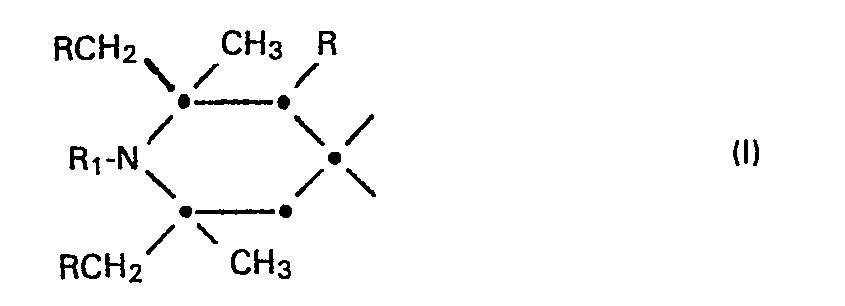
- i) eine Verbindung mit mindestens einer Gruppe der Formel
- ii) ein phenolisches Antioxiidans enthält.
Description
- Die vorliegende Anmeldung betrifft ein farbphotographisches Aufzeichnungsmaterial, das in mindestens einer lichtempfindlichen Silberhalogenidemusionsschicht und/oder in mindestens einer der üblichen Hilfsschichten zur Stabilisierung ein Gemisch aus einem spezifisch am Piperidinstickstoff substituierten Polyalkylpiperidin-Lichtschutzmittel und einem phenolischen Antioxidans enthält. Polyalkylpiperidine sind als sterisch gehinderte Amine allgemein als Lichtschutzmittel für organische Materialien, insbesondere für Polymere, bekannt. Es wurde auch bereits in der DE-OS 2 126 954 vorgeschlagen, solche Polyalkylpiperidine als Mittel gegen das Ausbleichen von Farbphotographien zu verwenden. Es wurde weiterhin in der EP-A 11051 vorgeschlagen, als Lichtschutzmittel für Farbphotographien bestimmte Polyalkylpiperidinderivate zu verwenden, die mindestens eine Phenolgruppe enthalten. Es handelt sich dabei um Polyalkylpiperidinester von Hydroxylbenzylmalonsäuren.
- Es ist nun gefunden worden, dass Gemische aus spezifisch am Piperidinstickstoff substituierten Polyalkylpiperidin-Lichtschutzmitteln und phenolischen Antioxidantien eine überraschend bessere stabilisierende Wirkung ausüben.
- Gegenstand der vorliegenden Erfindung ist daher ein farbphotographisches Aufzeichnungsmaterial, das in mindestens einer lichtempfindlichen Silberhalogenidemulsionsschicht, einer Zwischenschicht und/oder einer Schutzschicht ein Stabilisatorgemisch enthaltend
- i) eine Verbindung, die mindestens eine Gruppe der Formel I


- R2, R3 und R4 unabhängig voneinander Wasserstoff oder C1-C3 Alkyl,
- R5 Wasserstoff oder Methyl,
- R 6 C1-C4 Alkyl,
- R 7 C1-C12 Alkyl, Allyl, Benzyl oder Cyclohexyl,
- R8 C1-C12 Alkyl, Allyl, Cyclohexyl, Benzyl oder Phenyl,
- R9 Wasserstoff, C1-C12 Alkyl, Allyl bedeuten oder
- R8 und R zusammen mit dem N-Atom an das sie gebunden sind einen 5-oder 6-gliedrigen heterocyclischen Ring bilden und
- R10 Wasserstoff, C4-C12 Alkyl, C2-C6 Alkenyl, Chlormethyl, C5-C8 Cycloalkyl, C7-C14 Aralkyl, C7-C10 Alkylphenyl,
- R 11 Wasserstoff, C1-C4 Alkyl, C2-C13 Alkoxymethyl, Phenyl oder Phenoxymethyl,
- R12 Wasserstoff, C1-C12 Alkyl, -COR10 oder -CON(R8)(R9), wobei R8, R9 und R10 die oben angegebene Bedeutung haben, und
- R 13 C1-C12 Alkyl, Phenyl oder C7-C14 Alkaryl bedeuten, und
- ii) ein phenolisches Antioxidans enthält.
- Als Komponente i) bevorzugte Polyalkylpiperidinverbindungen sind solche, bei denen in der Gruppe der Formel I
- R1 Allyl, Benzyl, eine Gruppe


- b eine der Zahlen 0, 1 oder 2,
- R 7 C1-C4 Alkyl, Allyl oder Benzyl,
- R 8 C1-C4 Alkyl, Allyl oder Cyclohexyl,
- R9 C1-C12 Alkyl oder Allyl bedeuten oder
- R8 und R9 zusammen mit dem N-Atom an das sie gebunden sind einen Morpholin-oder Piperidinrest bilden und
- R10 C1-C12 Alkyl, Vinyl, Cyclohexyl, Benzyl oder Phenyl,
- R11 Wasserstoff, Methyl oder Phenyl und
- R12 Wasserstoff, Methyl oder eine Gruppe -CON(R8)(R9) wobei R8 und R9 die in dieser Bevorzugung bereits gegebene Bedeutung haben, bedeuten.
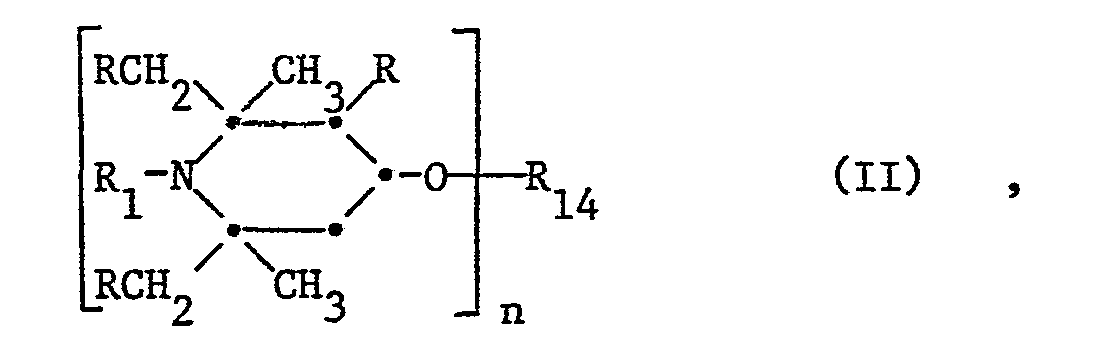
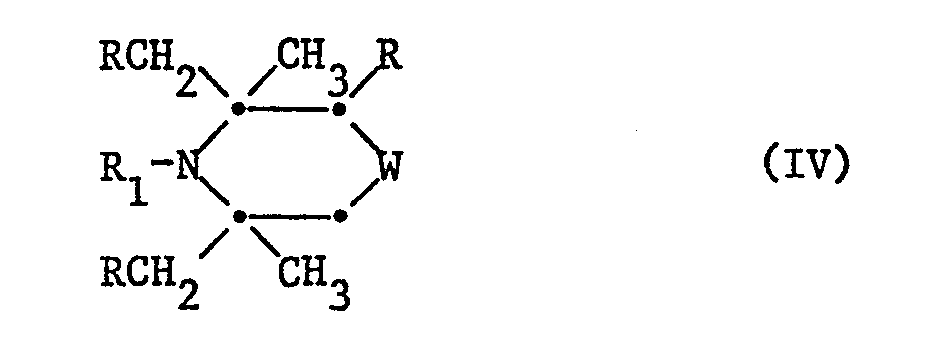
- Zu den erfindungsgemäss als Komponente i) zu verwendenden Polyalkylpiperidinverbindungen gehören insbesondere folgende Verbindungsklassen
-
- Bedeuten etwaige Substituenten Alkyl, so handelt es sich um geradkettige oder verzweigte Alkylgruppen. Bedeuten sie C1-C4 Alkyl, dann handelt es sich um Methyl, Ethyl, n-Propyl, Isopropyl, n-Butyl, sec.-Butyl oder tert.-Butyl. Bedeuten sie C1-C8 Alkyl, so kommen zusätzlich z.B. n-Pentyl, 2,2-Dimethylpropyl, n-Hexyl, 2,3-Dimethylbutyl, n-Octyl oder 1,1,3,3-Tetramethylbutyl in Frage. Bedeuten sie C1-C12 Alkyl, so können sie zusätzlich auch z.B. Nonyl, Decyl, Undecyl und Dodecyl sein. R23 R3 und R4 bedeuten als C1-C3 Alkyl, Methyl, Ethyl, n-Propyl und Isopropyl. Bevorzugt ist Methyl..
- R10 bedeutet als C5-C8 Cycloalkyl z.B. Cyclopentyl, Cyclohexyl, Cycloheptyl, a-Methylcyclohexyl, Cyclooctyl oder Dimethylcyclohexyl. Bevorzugt ist Cyclohexyl.
- R10 ist als C2-C6 Alkenyl z.B. Vinyl, Allyl, Methallyl, Dimethylallyl oder 2-Hexenyl. Bevorzugt ist Vinyl.
- Bedeutet R10 C7-C14 Aralkyl, so handelt es sich z.B. um Benzyl, Phenylethyl, Phenylpropyl, Phenylbutyl oder Naphthylmethyl. Bevorzugt ist Benzyl.
- R10 ist als C7-C10 Alkylphenyl beispielsweise Tolyl, Xylyl, Isopropylphenyl, tert.-Butylphenyl oder Diethylphenyl.
- R 11 ist als C2-C13 Alkoxymethyl z.B. Methoxy-, Ethoxy-, Propoxy-, Isopropoxy-, Butoxy-, Pentyloxy-, Hexyloxy-, Octyloxy-, Decyloxy oder Dodecyloxymethyl.
- R13 bedeutet als C7-C14 Alkaryl beispielsweise durch C1-C4 Alkyl substituiertes Phenyl, wie p-Tolyl, 2,4-Dimethylphenyl, 2,6-Dimethylphenyl, 2,4-Diethylphenyl, 2,6-Diethylphenyl, 4-tert.-Butylphenyl, 2,4-Di-tert.-butylphenyl oder 2,6-Di-tert.-butylphenyl. Bevorzugt sind 2,4-Di-tert.-butylphenyl, 2,4-Dimethylphenyl und p-Tolyl.
- R 14 kann als C2-C12 Alkylen z.B. Ethylen, Propylen, 2,2-Dimethyl- propylen, Tetramethylen, Hexamethylen, Octamethylen, Decamethylen oder Dodecamethylen sein.
- Als C4-C8 Alkenylen bedeutet R14 z.B. 2-Butenylen-1,4.
- Bedeutet R14 einen einwertigen Rest einer Carbonsäure, so stellt es beispielsweise einen Essigsäure-, Stearinsäure-, Salicylsäure-, Methacrylsäure-, Benzoe- oder β-(3,5-Di-tert.-butyl-4-hydroxyphenyl)-propionsäurerest dar.
- Bedeutet R14 einen zweiwertigen Rest einer Dicarbonsäure, so stellt es beispielsweise einen Maleinsäure-, Adipinsäure-, Suberinsäure-, Sebacinsäure-, Phthalsäure-, Dibutylmalonsäure-, Dibenzylmalonsäure oder Butyl-(3,5-di-tert.-butyl-4-hydroxybenzyl)-malonsäurerest dar.
- Stellt R14 einen dreiwertigen Rest einer Tricarbonsäure dar, so bedeutet es z.B. einen Pyromellithsäurerest.
- Bedeutet R14 einen zweiwertigen Rest einer Dicarbaminsäure, so stellt es beispielsweise einen Hexamethylen-dicarbaminsäure- oder einen 2,4-Toluylen-dicarbaminsäurerest dar.
- Besonders interessant sind Verbindungen der Formel II, worin n die Zahlen 1 oder 2 bedeutet und R14 wenn n = 1 einen Rest einer aliphatischen Carbonsäure mit 2 - 18 C-Atomen, einer cycloaliphatischen Carbonsäure mit 5-12 C-Atomen oder einer aromatischen Carbonsäure mit 7-15 C-Atomen, wenn n = 2 einen Rest einer aliphatischen Dicarbonsäure mit 2-12 C-Atomen, einer cycloaliphatischen oder aromatischen Dicarbonsäure mit 8-14 C-Atomen, einer aliphatischen, cycloaliphatischen oder aromatischen Dicarbaminsäure mit 8-14 C-Atomen bedeutet.
- Beispiele für Polyalkylpiperidinverbindungen dieser Klasse sind in der nachfolgenden Tablle I aufgeführt

- Weitere Beispiele für Verbindungen dieser Klasse, nämlich von Verbindungen der Formel II, worin n = 4 ist, sind die folgenden Verbindungen 5 und 6

-

- Stellen etwaige Substituenten C1-C12 Alkyl, C5-C8 Cycloalkyl oder C2-C12 Alkylen dar, so haben sie die bereits unter a) angegebene Bedeutung.
- Als C7-C8 Aralkyl ist R15 insbesondere Phenylethyl oder vor allem Benzyl.
- R15 ist als C2-C18 Alkanoyl beispielsweise Propionyl, Butyryl, Octanoyl, Dodecanoyl, Hexadecanoyl, Octadecanoyl aber bevorzugt Acetyl und als C3-C5 Alkenoyl insbesondere Acryloyl.
- Bedeutet R16 ein gegebenenfalls mit einer Cyano-, Carbonyl- oder Carbamidgruppe substituiertes C2-C8 Alkenyl, dann handelt es sich z.B. um 1-Propenyl, Allyl, Methallyl, 2-Butenyl, 2-Pentenyl, 2-Hexenyl, 2-Octenyl, 2,2-Dicyanovinyl, 1-Methyl-2-cyano-2-methoxycarbonyl-vinyl, 2,2-Diacetylaminovinyl.
- Bedeuten etwaige Substituenten C6-C15 Arylen, so stellen sie z.B. o-, m- oder p-Phenylen, 1,4-Naphthylen oder 4,4'-Diphenylen dar.
- Als C6-C12 Cycloalkylen ist X insbesondere Cyclohexylen.
- Beispiele für Polyalkylpiperidinverbindungen dieser Klasse sind in der nachfolgenden Tabelle II aufgeführt.

-


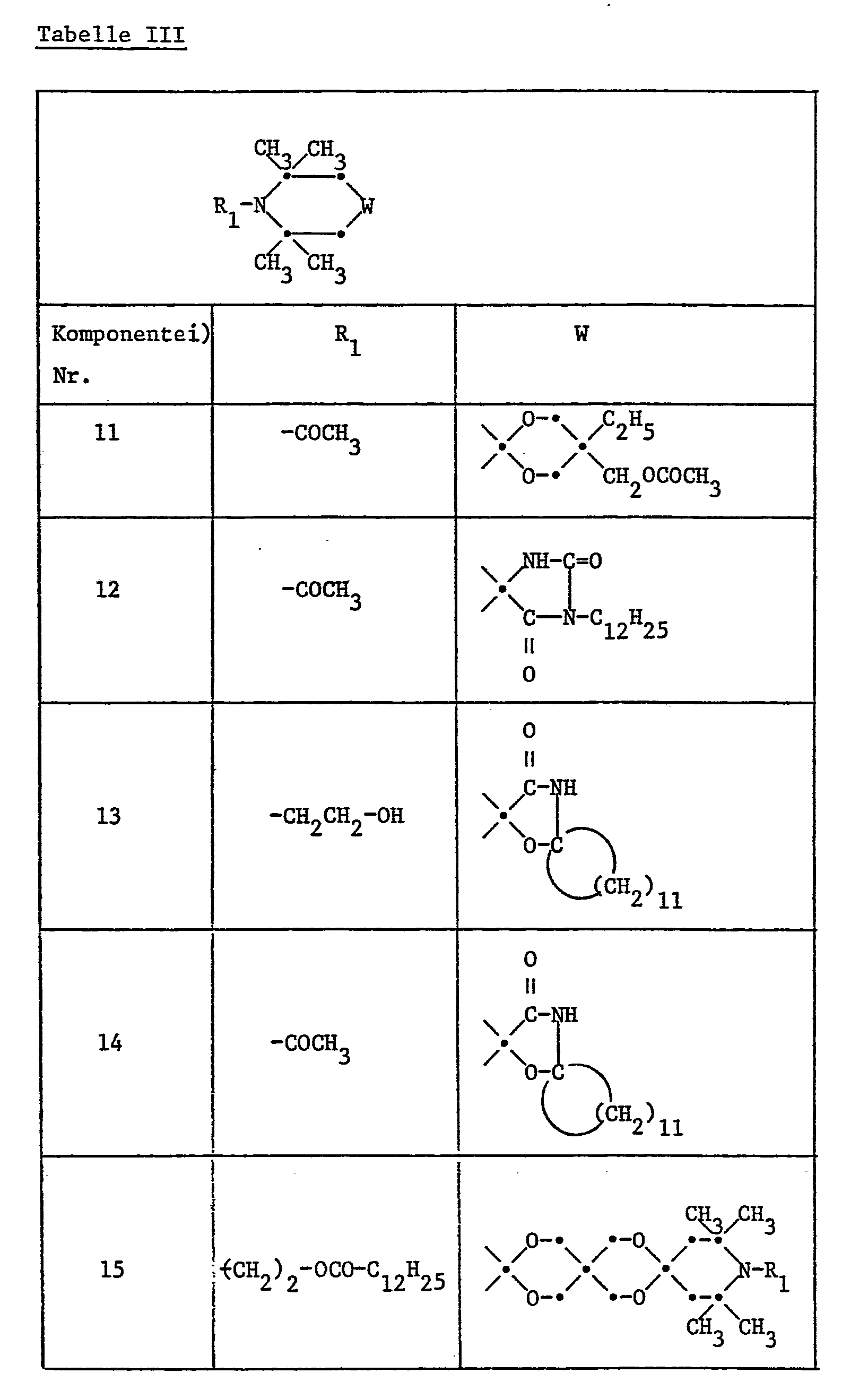
- R17 Wasserstoff, C1-C12 Alkyl, eine Gruppe -CH2-OCOR22 ist, worin R 22 Wasserstoff, C1-C4 Alkyl, C2-C6 Alkenyl, Cyclohexyl, Phenyl, Benzyl oder Chlormethyl ist,eine Gruppe -CH2O-S(O)qR23, worin R 23 C1-C4 Alkyl, p-Tolyl oder Phenyl ist und q die Zahlen 1 oder 2 bedeutet, wo R17 eine Gruppe -CH2OCO-NHR24 bedeutet, worin R24 Wasserstoff oder C1-C4-Alkyl ist,
- R18 Wasserstoff oder C1-C4 Alkyl bedeutet,
- R19 Wasserstoff, C1-C12 Alkyl, C3-C4 Alkoxyalkyl, C5-C8 Cycloalkyl, Allyl oder Benzyl bedeutet,
- R20 Wasserstoff, C1-C12 Alkyl, C5-C8 Cycloalkyl oder Benzyl,
- R 21 C1-C12 Alkyl, C5-C8 Cycloalkyl oder Phenyl sind oder R20 und R21 zusammen mit dem C-Atom an das sie gebunden sind einen C5-C12 Cycloalkan oder Alkylcycloalkanring bilden, und
- W zusätzlich auch eine der Gruppen der Formeln


- Stellen etwaige Substituenten C1-C4 oder C1-C12 Alkyl oder C5-C8 Cycloalkyl dar, so haben sie die bereits unter a) angegebene Bedeutung.
- R19 bedeutet als C3-C4 Alkoxyalkyl z.B. Ethoxymethyl, 2-Methoxyethyl oder 2-Ethoxyethyl.
- R22 ist als C2-C6 Alkenyl z.B. Vinyl, Allyl, Methallyl, Dimethylallyl oder 2-Hexenyl.
- Beispiele für Polyalkylpiperidinverbindungen dieser Klasse sind in der nachstehenden Tabelle III aufgeführt:
- Ebenfalls typische Vertreter dieser Klasse von Verbindungen sind die Verbindungen 16 und 17:


-

- R und R die für Formel I angegebene Bedeutung haben,
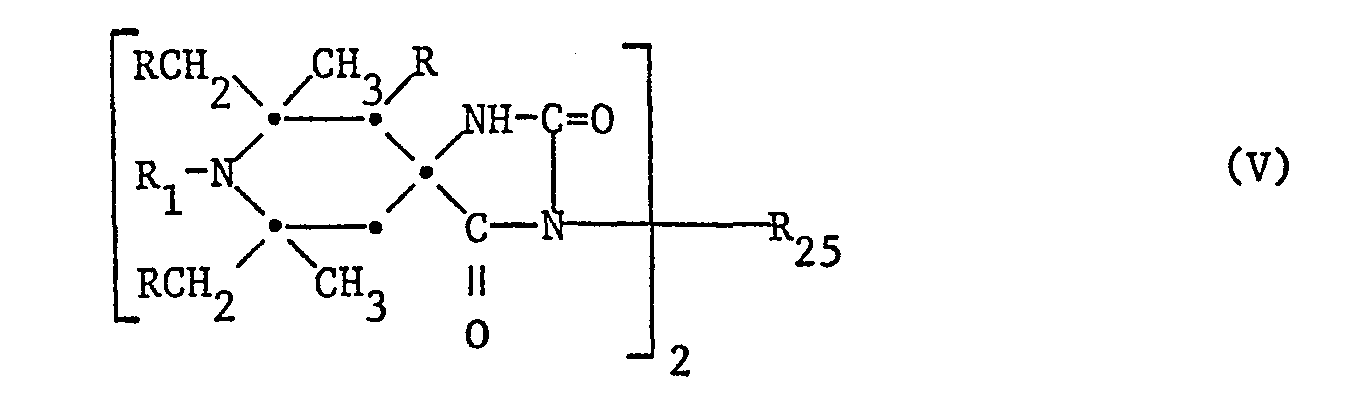
- R25 eine Gruppe CrH2r ist, in welcher r eine Zahl 2 bis 12 bedeutet, oder C4-C8 Alkenylen, C4-C8 Alkinylen, Phenylen, Xylylen, Bitolylen, C5-C12 Cycloalkylen oder eine Gruppe -CH2CH(OY)CH2-(OCH2-CH(OY)CH2)2- ist, worin Y Wasserstoff, C1-C18 Alkyl, Allyl, Benzyl, C2-C12 Alkanoyl oder Benzoyl ist oder R25 eine Gruppe -CONH-B-NHCO- ist, worin B eine Gruppe CrH2r, Phenylen, Naphthylen, Tolylen oder eine Gruppe der Formeln


- R25 bedeutet als C4-C8 Alkenylen z.B. 2-Butenylen-1,4.
- R25 bedeutet als C4-C8 Alkinylen z.B. 2-Butinylen-1,4.
- Als C5-C12 Cycloalkylen bedeutet R25 z.B. Cyclopentylen,Cyclohexylen, Cyclooctylen, Cyclodecylen oder Cyclododecylen. Bevorzugt ist Cyclohexylen.
- Y Bedeutet als C1-C18 Alkyl z.B. Methyl, Ethyl, Propyl, Isopropyl, n-Butyl, sec.-Butyl, tert.-Butyl, n-Pentyl, 2,2-Dimethylpropyl, n-Hexyl, 2,3-Dimethylbutyl, n-Octyl, 1,1,3,3-Tetramethylbutyl, Nonyl, Decyl, Dodecyl, Hexadecyl oder Octadecyl.
- Bedeutet Y C2-C12 Alkanoyl, so stellt es beispielsweise Propionyl, Butyryl, Octanoyl, Dodecanoyl, aber bevorzugt Acetyl dar.
- Beispiele für Polyalkylpiperidinverbindungen dieser Klasse sind die folgenden Verbindungen 18 und 19


-


- Stellen etwaige Substituenten C1-C12 Alkyl dar, so haben sie die bereits unter a) angegebene Bedeutung.
- Bedeuten R31 und R 32 C1-C4 Hydroxyalkyl, so stellen sie z.B. 2-Hydroxyethyl, 2-Hydroxypropyl, 3-Hydroxypropyl, 2-Hydroxybutyl oder 4-Hydroxybutyl dar.
- Bedeuten A oder D C2-C6 Alkylen, so stellen sie beispielsweise Ethylen, Propylen, 2,2-Dimethylpropylen, Tetramethylen oder Hexamethylen dar.
- Stellen R31 und R32 zusammen C4-C5 Alkylen oder Oxaalkylen dar, so bedeutet dies z.B. Tetramethylen, Pentamethylen oder 3-Oxa-pentamethylen.
- Beispiele für Polyalkylpiperidinverbindungen dieser Klasse sind in der nachstehenden Tabelle IV aufgeführt:

- Ein weiteres Beispiel für Verbindungen dieser Klasse ist folgende Verbindung 23

-


- Bedeuten etwaige Substituenten C1-C12 Alkyl, so stellen sie z.B. Methyl, Ethyl, n-Propyl, n-Butyl, sek.-Butyl, tert.-Butyl, n-Hexyl, n-Octyl, 2-Ethyl-hexyl, n-Nonyl, n-Decyl, n-Undecyl oder n-Dodecyl dar.
- Etwaige Substituenten, die C1-C18 Alkyl bedeuten, können z.B. die oben angeführten Gruppen und dazu noch beispielsweise n-Tridecyl, n-Tetradecyl, n-Hexadecyl oder n-Octadecyl darstellen.
- Stellen etwaige Gruppen C2-C10 Alkylen dar, so bedeuten sie beispielsweise Ethylen, Propylen, 2,2-Dimethyl-propylen, Tetramethylen, Hexamethylen, Octamethylen oder Decamethylen.
- R 35 bedeutet als C4-C18 Alkyl z.B. n-Butyl, sek.-Butyl, tert.-Butyl, n-Hexyl, n-Octyl, 2-Ethyl-hexyl, n-Nonyl, n-Decyl, n-Dodecyl, n-Tridecyl, n-Tetradecyl, n-Hexadecyl oder n-Octadecyl:
- Bedeutet R35 ein durch -CN substituiertes C1-C4 Alkyl, so stellt es beispielsweise Cyanomethyl, Cyanoethyl, 3-Cyano-n-propyl, 4-Cyano-n-butyl dar.
- Bedeutet R35 C4-C12 Alkylen, so handelt es sich z.B. um 2,2-Dimethyl- propylen, Tetramethylen, Hexamethylen, Octamethylen, Decamethylen oder Dodecamethylen.
- Stellt R35 C7-C12 Aralkyl dar, so bedeutet es insbesondere Phenylethyl, p-Methyl-benzyl oder vor allem Benzyl.
- R36 bedeutet als C2-C4 Alkenyl beispielsweise Vinyl, 1-Propenyl, Allyl, Methallyl, 2-Butenyl.
- R38 bedeutet als C2-C10 Alkenyl z.B. die für R36 in der Bedeutung Alkenyl angeführten Gruppen und dazu noch beispielsweise Crotyl, 2-Hexenyl, 2-Octenyl oder 2-Decenyl.
- Stellt R38 C6-C10 Aryl dar, so bedeutet es beispielsweise unsub- stituiertes oder in o- oder p-Stellung durch Methyl, Ethyl, Isopropyl, n-Butyl oder tert.-Butyl substituiertes Phenyl.
- Beispiele für Polyalkylpiperidinverbindungen dieser Klasse sind folgende Verbindungen:
- 24) Bis-[2-(2,2,6,6-tetramethylpiperidino)-ethyl]-sebacat
- 25) 1-Octoxycarbonyl-methyl-2,2,6,6-tetramethylpiperidin
- 26) 1,4-Bis-(2,2,6,6-tetramethylpiperidino)-2-buten.
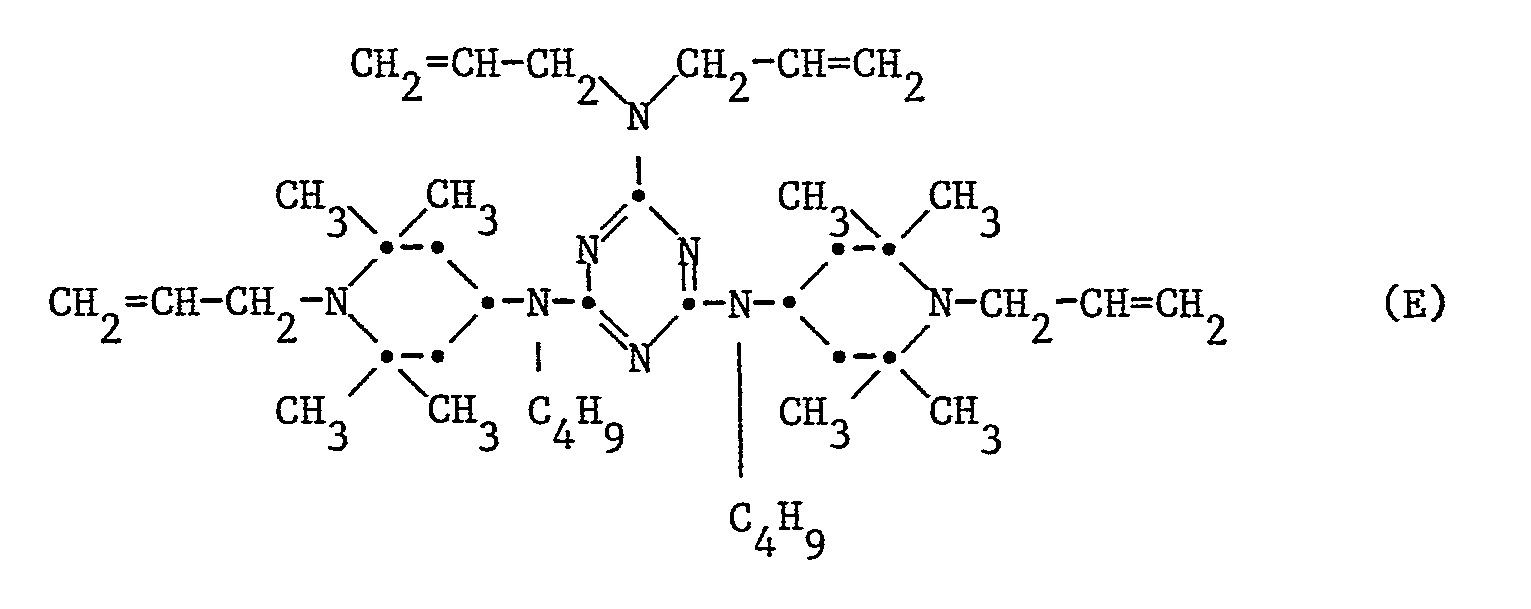
- g) Polymere Verbindungen ausgewählt aus der Gruppe bestehend aus Polyester, Polyether, Polyamide, Polyamine, Polyurethane, Polyharnstoffe, Polyaminotriazine, Poly(meth)acrylate, Poly(meth)acrylamide und deren Copolymeren, deren wiederkehrende Struktureinheiten eine Gruppe der Formel I enthalten oder über eine bivalente Gruppe entsprechend der Formel (I), worin R eine freie Valenz bedeutet, verbunden sind, wobei im übrigen R und R1 die für Formel I angegebene Bedeutung haben.
- Beispiele für Polyalkylpiperidinverbindungen dieser Klasse sind die Verbindungen der folgenden Formeln, wobei m die Zahlen 2 bis etwa 200 bedeutet.


-


- Die als Komponente i) erfindungsgemäss einzusetzenden Polyalkylpiperidinverbindungen sind allgemein bekannt.
- Die als Komponente ii) geeigneten phenolischen Antioxidantien sind allgemein bekannt. Es können z.B. folgende genannt werden:
- 1. Alkylierte Monophenole
- 2,6-Di-tert.-butyl-4-methylphenol
- 2-Tert.-butyl-4,6-dimethylphenol
- 2,6-Di-tert.-butyl-4-ethylphenol
- 2,6-Di-tert.-butyl-4-n-butylphenol
- 2,6-Di-tert.-butyl-4-i-butylphenol
- 2,6-Di-cyclopentyl-4-methylphenol
- 2-(cr-Methylcyclohexyl)-4,6-dimethylphenol
- 2,6-Di-octadecyl-4-methylphenol
- 2,4,6-Tri-cyclohexylphenol
- 2,6-Di-tert.-butyl-4-methoxymethylphenol
- 2. Alkylierte Hydrochinone .
- 2,6-Di-tert.-butyl-4-methoxyphenol
- 2,5-Di-tert.-butyl-hydrochinon
- 2,5-Di-tert.-amyl-hydrochinon
- 2,6-Diphenyl-4-octadecyloxyphenol
- 3. Alkyliden-Bisphenole
- 2,2'-Methylen-bis-(6-tert.-butyl-4-methylphenol)
- 2,2'-Methylen-bis-(6-tert.-butyl-4-ethylphenol)
- 2,2'-Methylen-bis-[4-methyl-6-(α-methylcyclohexyl)-phenol]
- 2,2'-Methylen-bis-(4-methyl-6-cyclohexylphenol)
- 2,2'-Methylen-bis-(6-nonyl-4-methylphenol)
- 2,2'-Methylen-bis-(4,6-di-tert.-butylphenol)
- 2,2'-Ethyliden-bis-(4,6-di-tert.-butylphenol)
- 2,2'-Ethyliden-bis-(6-tert.-butyl-4-isobutylphenol)
- 4,4'-Methylen-bis-(2,6-di-tert.-butylphenol)
- 4,4'-Methylen-bis-(6-tert.-butyl-2-methylphenol)
- 1,1-Bis-(5-tert.-butyl-4-hydroxy-2-methylphenyl)-butan
- 2,6-Di-(3-tert.-butyl-5-methyl-2-hydroxybenzyl)-4-methylphenol
- 1,1,3-Tris-(5-tert.-butyl-4-hydroxy-2-methylphenyl)-butan
- 1,1-Bis-(5-tert.-butyl-4-hydroxy-2-methylphenyl)-3-n-dodecylmercapto- butan
- Ethylenglycol-bis-[3,3-bis-(3'-tert.-butyl-4'-hydroxyphenyl)-butyrat]
- Di-(3-tert.-butyl-4-hydroxy-5-methylphenyl)-dicyclopentadien
- Di-[2-(3'-tert.-butyl-2'-hydroxy-5'-methyl-benzyl)-6-tert.-butyl-4-methyl-phenyl]-terephthalat.
- 4. Benzylverbindungen
- 1,3,5-Tri-(3,5-di-tert.-butyl-4-hydroxybenzyl)-2,4,6-trimethylbenzol Di-(3,5-di-tert.-butyl-4-hydroxybenzyl)-sulfid
- 3,5-Di-tert.-butyl-4-hydroxybenzyl-mercaptoessigsäure-isooctylester
- Bis-(4-tert.-butyl-3-hydroxy-2,6-dimethylhenzyl)-dithiol-terephthalat
- 1,3,5-Tris-(3,5-di-tert.-butyl-4-hydroxybenzyl)-isocyanuarat
- 1,3,5-Tris-(4-tert.-butyl-3-hydroxy-2,6-dimethylbenzyl)-isocyanurat
- 3,5-Di-tert.-butyl-4-hydroxybenzyl-phosphonsäure-dioctadecylester
- 3,5-Di-tert.-butyl-4-hydroxybenzyl-phosphonsäure-monoethylester, Calciumsalz.
- 5. Acylaminophenole
- 4-Hydroxy-laurinsäureanilid
- 4-Hydroxy-stearinsäureanilid
- 2,4-Bis-octylmercapto-6-(3,5-di-tert.-butyl-4-hydroxyanilino)-s-triazin
- 6. Ester der ß-(3,5-Di-tert.-butyl-4-hydroxyphenyl)-propionsäure mit ein- oder mehrwertigen Alkoholen, wie z.B. mit

- 7. Ester der 3,5-Di-tert.butyl-4-hydroxyphenylbenzoesäure
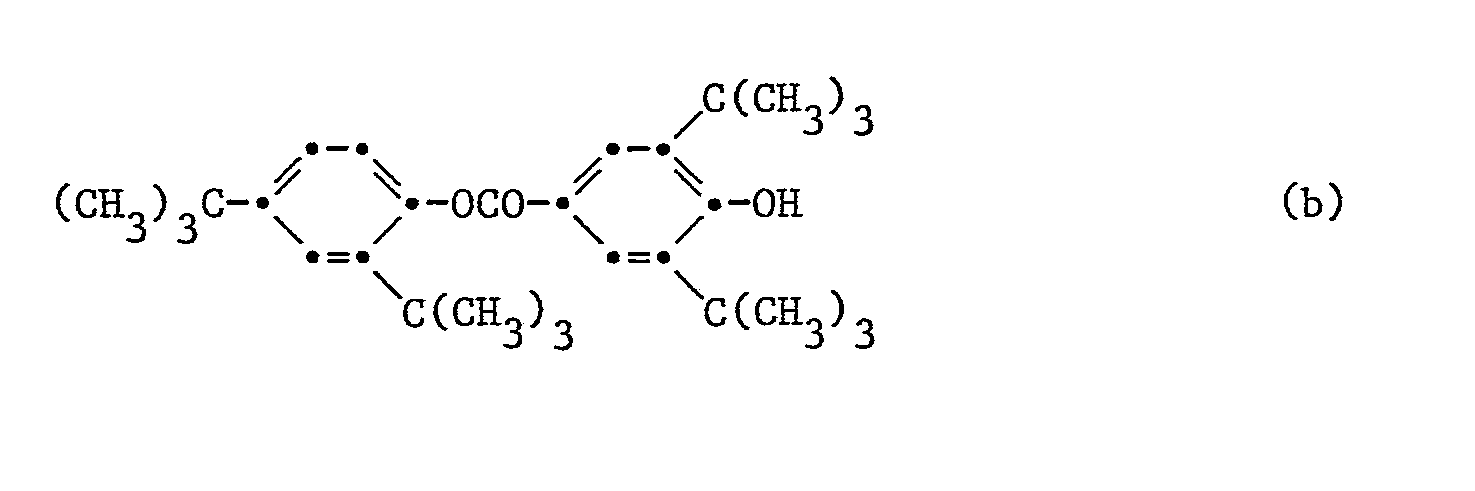
- Pentaerythritol-tetrakis-(3,5-di-tert.butyl-4-hydroxybenzoat) 2,4-Di-tert.butylphenyl-(3,5-di-tert.butyl-4-hydroxybenzoat)
- 8. Ester der ß-(5-tert.-Butyl-4-hydroxy-3-methylphenyl)-propionsäure mit ein- oder mehrwertigen Alkoholen, wie z.B. mit

- 9. Amide der ß-(3,5-Di-tert.-butyl-4-hydroxyphenyl)-propionsäure, wie z.B.
- N,N'-Di-(3,5-di-tert.-butyl-4-hydroxyphenylpropionyl)-hexamethylendiamin
- N,N'-Di-(3,5-di-tert.-butyl-4-hydroxyphenylpropionyl)-trimethylen- diamin
- N,N'-Di-(3,5-di-tert.-butyl-4-hydroxyphenylpropionyl)-hydrazin.
- 10. Triazinphenole, wie beispielsweise die Verbindung der Formel X

- 1) 2,6-Di-tert.-butyl-4-methylphenol,
- 2) 2,2'-Methylen-bis-(6-tert.-butyl-4-methylphenol),
- 3) 2,2'-Methylen-bis-(6-tert.-butyl-4-ethylphenol),
- 4) 4,4'-Methylen-bis-(2,6-di-tert.-butylphenol),
- 5) 2,2-Bis-(2,6-di-tert.-butyl-4-hydroxyphenyl)-propan,
- 6) 2,2'-Methylen-bis-[4-methyl-6-(a-methylcyclohexyl)-phenol],
- 7) 1,1-Bis-(5-tert.-butyl-4-hydroxy-2-methylphenyl)-butan,
- 8) 1,1,3-Tris-(5-tert.-butyl-4-hydroxy-2-methylphenyl)-butan,
- 9) Ethylenglycol-bis-[3,3-bis-(3-tert.-butyl-4-hydroxyphenyl)-butyratl,
- 10) 4,4'-Thio-bis-(6-tert.-butyl-3-methylphenol),
- 11) 1,3,5-Tri-(3,5-di-tert.-butyl-4-hydroxybenzyl)-2,4,6-trimethylbenzol,
- 12) Triethylenglycol-bis-(3-methyl-5-tert.-butyl-4-hydroxyphenyl)-propionat,
- 13) 1,3,5-Tris-(3,5-di-tert:.-butyl-4-hydroxybenzyl)-isocyanurat,
- 14) 3,5-Di-tert.-butyl-4-hydroxybenzyl-phosphonsäure-diethylester,
- 15) N,N'-Di-(3,5-di-tert.-butyl-4-hydroxyphenyl-propionyl)-hexamethylendiamin,
- 16) 3-Thia-1,5-pentandiol-bis-[3-(3,5-di-tert.-butyl-4-hydroxyphenyl)-propionat],
- 17) 1,6-Hexandiol-bis-[3-(3,5-di-tert.-butyl-4-hydroxyphenyl)-propionat],
- 18) Pentaerythritol-tetrakis-[3-(3,5-di-tert.-butyl-4-hydroxyphenyl)-propionat],
- 19) pentaerythritol-tetrakis-(3,5-di-tert.-butyl-4-hydroxybenzoat),
- 20) Octadecyl-3-(3,5-di-tert.-butyl-4-hydroxyphenyl)-propionat,
- 21) 2-(3,5-Di-tert.-butyl-4-hydroxyanilino)-4,6-di-(octylthio)-triazin
- 22) 2,4-Di-tert.-butylphenyl-(3,5-di-tert.-butyl-4-hydroxybenzoat),
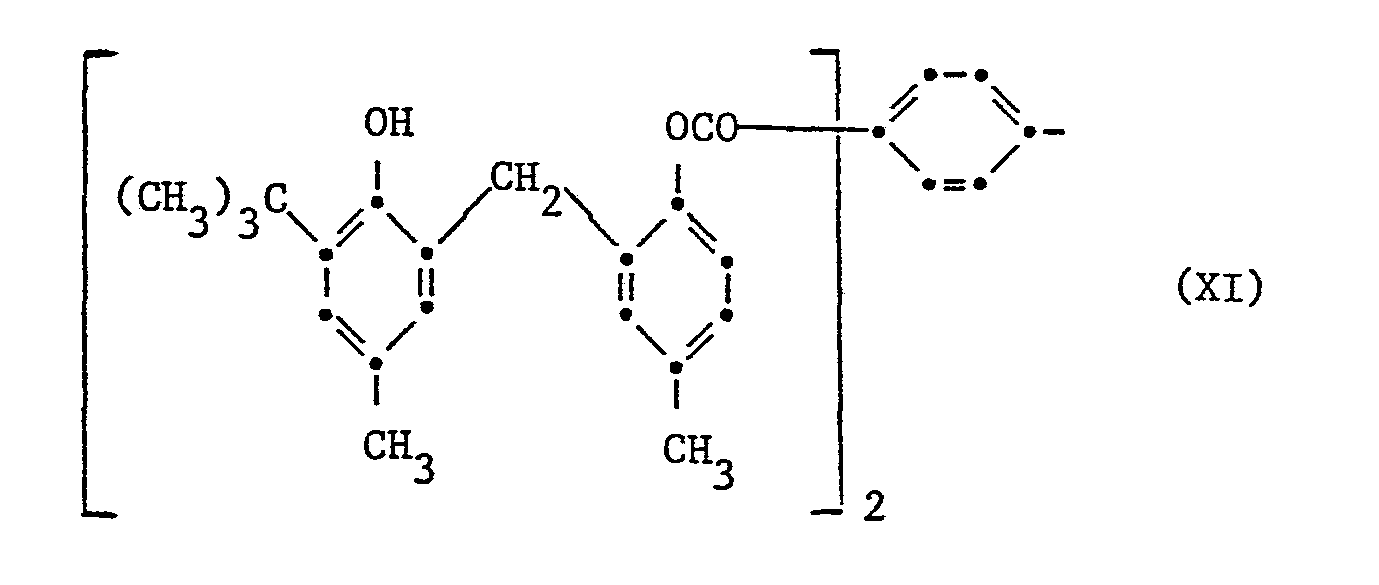
- 23) das Phenol der Formel XI

- 24) das Phenol der Formel X

- Das erfindungsgemässe Stabilisatorgemisch kann allein oder zusammen mit anderen Verbindungen in bekannter Weise in ein photographisches Material eingearbeitet werden.
- Das Mischungsverhältnis von dem Polyalkylpiperidin-Lichtschutzmittel i) zum phenolischen Antioxidans ii) variiert beispielsweise zwischen 90:10 und 10:90, bevorzugt zwischen 70:30 und 30:70.
- In der Regel wird das Stabilisatorgemisch allein oder zusammen mit anderen Verbindungen, insbesondere mit den Farbkupplern', in Form einer Dispersion in das photographische Material eingearbeitet, wobei diese Dispersion entweder kein Lösungsmittel oder hoch- oder tiefsiedende Lösungsmittel oder ein Gemisch solcher Lösungsmittel enthält. Eine weitere geeignete Einarbeitungsform besteht darin, dass man die Stabilisatoren allein oder zusammen mit weiteren Verbindungen zusammen mit einem Polymer in Form eines Latex in das photographische Material einarbeitet.
- Die Dispersionen werden dann zur Herstellung der Schichten von farbphotographischen Aufzeichnungsmaterialien verwendet. Diese Schichten können z.B. Zwischen- oder Schutzschichten, insbesondere jedoch lichtempfindliche (blau-, grün und rot-empfindliche) Silberhalogenidemulsionsschichten sein, in denen bei der Entwicklung des belichteten Aufzeichnungsmaterials aus den entsprechenden Farbkupplern, die Blaugrün (Cyan)-, Purpur (Magenta)- und Gelbfarbstoffe gebildet werden.
- Die Silberhalogenidschichten können beliebige Farbkuppler, insbesondere Blaugrün-, Purpur- und Gelb-Kuppler, die zur Bildung der genannten Farbstoffe und damit der Farbbildner verwendet werden, enthalten.
- Da das Substrat die Wirkung und Stabilität der Stabilisatorgemische beeinflusst, werden Substrate (Lösungsmittel, Polymere) bevorzugt, die zusammen mit den Stabilisatoren eine möglichst gute Beständigkeit der zu stabilisierenden Materialien ergeben.
- In der Regel werden die Stabilisatorgemische in Schichten eingearbeitet, die zusätzlich eine nach üblichen Methoden hergestellte und sensibilisierte Silberhalogenid-Dispersion enthalten. Sie können jedoch auch in zu Silberhalogenid enthaltenden Schichten benachbarten Schichten vorhanden sein.
- Die erfindungsgemässen photographischen Materialien besitzen einen üblichen Aufbau und Komponenten, die die Wirksamkeit der Stabilisatorgemische verstärken oder zumindest nicht nachteilig beeinflussen.
- Im farbphotographischen Aufzeichnungsmaterial gemäss vorliegender Erfindung können die Stabilisatorgemische enthaltend die Komponenten i) und ii) ausser mit den Farbkupplern zusätzlich auch mit Ultraviolettabsorbern oder anderen Lichtschutzmitteln in der gleichen Schicht kombiniert werden.
- Wenn die Diffusionstransfermethode angewendet wird, kann das Stabilisatorgemisch auch in eine Empfangsschicht eingearbeitet werden.
- Die erfindungsgemässen farbphotographischen Materialien können in bekannter Weise verarbeitet werden. Ferner können sie im Verlauf oder nach der Verarbeitung in einer Weise behandelt werden, die ihre Stabilität weiter erhöht, beispielsweise durch die Behandlung in einem Stabilisatorbad oder das Aufbringen eines Schutzüberzuges.
- Die Erfindung betrifft ferner ein Verfahren zur Herstellung von photographischen Farbbildern durch bildmässige Belichtung und Farbentwicklung eines farbphotographischen Aufzeichnungsmaterials enthaltend ein Stabilisatorgemisch mit den Komponenten i) und ii). Weiterhin betrifft die Erfindung die nach diesem Verfahren erhaltenen photographischen Farbbilder.
- Die erfindungsgemäss einzusetzenden Stabilisatorgemische eignen sich in gewissen Fällen auch zum Schutz farbphotographischer Schichten, in denen die Farbstoffe direkt in die Emulsion eingelagert werden und das Bild durch selektive Bleichung erzeugt wird.
- Die Menge des Stabilisatorgemisches kann in weiten Grenzen schwanken und liegt etwa im Bereich von 1 bis 2000 mg, vorzugsweise 100 bis 800 und insbesondere 200 bis 500 mg pro m2 der Schicht, in die es eingearbeitet wird.
- Falls das photographische Material einen oder mehrere UV-Absorber enthält, so kann dieser mit dem Stabilisatorgemisch zusammen in einer Schicht oder auch in einer benachbarten Schicht vorhanden sein. Die Menge an UV-Absorber kann in weiten Grenzen schwanken und liegt etwa im Be7 reich von 200 - 2000 mg, vorzugsweise 400 - 1000 mg pro m2 der Schicht. Beispiele für geeignete UV-Absorber sind solche vom Benzophenon-, Acrylnitril-, Thiazolidon-, Benztriazol-, Oxazol-, Thiazol- und Imidazoltyp.
- Die mit dem erfindungsgemässen Aufzeichnungsmaterial durch Belichtung und Entwicklung erhaltenen Farbbilder zeigen eine sehr gute Lichtechtheit gegenüber sichtbarem und ultraviolettem Licht. Die Stabilisatorgemische i) + ii) sind praktisch farblos, so dass es zu keiner Verfärbung der Bilder kommt; ausserdem sind sie gut verträglich mit den üblichen, in den einzelnen Schichten vorhandenen photographischen Zusatzstoffen. Aufgrund ihrer guten Wirksamkeit kann man ihre Einsatzmenge herabsetzen und vermeidet so ihre Ausfällung oder ihr Auskristallisieren, wenn man sie als organische Lösung in die wässrigen Bindemittelemulsionen, die für die Herstellung photographischer Schichten verwendet werden, einarbeitet. Die einzelnen nach der Belichtung des photographischen Aufzeichnungsmaterials notwendigen Verarbeitungsschritte zur Herstellung der Farbbilder werden durch die Stabilisatorgemische i) + ii) nicht nachteilig beeinflusst. Ferner kann die bei blauempfindlichen Emulsionen häufig auftretende sogenannte Druckschleierbildung weitgehend zurückgedrängt werden. Diese kann z.B. auftreten, wenn auf photographische Materialien (Silberhalogenidemulsionsschichten, die auf einem Träger aus natürlichen oder synthetischen Materialien befinden) mechanische Beanspruchungen, z.B. Drehen, Biegen oder Reiben, während der Herstellung oder während der Behandlung vor der Entwicklung ausgeübt werden. (T.H. James, The Theory of Photographic Process 4. Auflage, Macmillan, New York, N.Y. 1977, Seite 23 ff., S. 166 ff.).
-



-


- 0,093 g des Gelbkupplers der Formel


- Zu 2,5 ml der so erhaltenen Emulsion gibt man 2,0 ml einer Silberbromid-Emulsion mit einem Silbergehalt von 6,0 g pro Liter, 0,7 ml einer 1 %igen wässerigen Lösung des Härters der Formel

- Nach dem Erstarren wird in einem Trockenschrank mit Umluft bei Raumtemperatur getrocknet.
- Nach 7 Tagen werden auf 35 x 180 mm geschnittene Proben hinter einem Stufenkeil mit 3000 Lux·s belichtet und anschliessend im Ektaprint 2® Prozess der Firma Kodak verarbeitet.
- Die so erhaltenen Gelbkeile werden in einem Atlas Weather-Ometer mit einer 2500 W-Xenonlampe mit total 42 kJoule/cm2 bestrahlt (eine Vergleichsprobe enthält kein Lichtschutzmittel).
- In Tabelle 1 sind die prozentualen Abnahmen der Gelbdichte bei einer ursprünglichen Remissionsdichte von 1,0 im Blau enthalten.

- Aus Tabelle 1 ist ersichtlich, dass die Kombination eines sterisch gehinderten Phenols mit einem Piperidin eine gegenüber den einzelnen Komponenten verbesserte Lichtschutzwirkung ergibt.
- Es werden Proben wie in Beispiel 1 beschrieben hergestellt und bestrahlt, wobei jedoch das sterisch gehinderte Phenol und das Piperidin in molaren Anteilen bezogen auf den Gelbkuppler zugesetzt werden.
- Tabelle 2 enthält die entsprechenden Dichteabnahmen.

- Aus Tabelle 2 ist ersichtlich, dass man zu ähnlichen Resultaten wie in Anwendungsbeispiel 1 kommt, wenn man anstelle von Gewichtsverhältnissen von Molverhältnissen ausgeht.
- Es werden Proben wie in den Beispielen 1 und 2 beschrieben hergestellt, die jedoch anstelle des dort verwendeten Gelbkupplers den Gelbkuppler der Formel

- Kodak Wratten 2C-Filter mit total 105 kJoule/cm2 bestrahlt.
- Tabelle 3 enthält die hierbei erhaltenen prozentualen Dichteabnahmen am Maximum bei einer Ausgangs-Remissionsdichte von 1,0.

Claims (23)








Applications Claiming Priority (2)
| Application Number | Priority Date | Filing Date | Title |
|---|---|---|---|
| CH731482 | 1982-12-16 | ||
| CH7314/82 | 1982-12-16 |
Publications (3)
| Publication Number | Publication Date |
|---|---|
| EP0114028A2 true EP0114028A2 (de) | 1984-07-25 |
| EP0114028A3 EP0114028A3 (en) | 1985-12-27 |
| EP0114028B1 EP0114028B1 (de) | 1988-08-03 |
Family
ID=4323186
Family Applications (1)
| Application Number | Title | Priority Date | Filing Date |
|---|---|---|---|
| EP83810582A Expired EP0114028B1 (de) | 1982-12-16 | 1983-12-12 | Farbphotographisches Aufzeichnungsmaterial |
Country Status (5)
| Country | Link |
|---|---|
| US (1) | US4517283A (de) |
| EP (1) | EP0114028B1 (de) |
| JP (1) | JPS59116747A (de) |
| CA (1) | CA1203410A (de) |
| DE (1) | DE3377596D1 (de) |
Families Citing this family (17)
| Publication number | Priority date | Publication date | Assignee | Title |
|---|---|---|---|---|
| EP0203746B2 (de) * | 1985-05-11 | 1994-08-24 | Konica Corporation | Lichtempfindliches photographisches Silberhalogenidmaterial |
| US4785102A (en) * | 1985-08-27 | 1988-11-15 | Ciba-Geigy Corporation | Photolytically cleavable, N-acylated sterically hindered amines |
| JPH0653436B2 (ja) * | 1985-09-10 | 1994-07-20 | キヤノン株式会社 | 画像保護部材および画像保護方法 |
| USH567H (en) | 1985-11-21 | 1989-01-03 | Fuji Photo Film Co., Ltd. | Silver halide color photographic light-sensitive materials containing cyan coupler and specific compound |
| US4797350A (en) * | 1986-04-16 | 1989-01-10 | Konishiroku Photo Industry Co., Ltd. | Process for forming dye-image using a developer comprising an image stabilizer, a hydroxylamine and not containing benzyl alcohol |
| EP0274764B1 (de) * | 1987-01-16 | 1990-10-24 | Agfa-Gevaert N.V. | Polymere als Beizmittel für saure Farbstoffe |
| US4859759A (en) * | 1988-04-14 | 1989-08-22 | Kimberly-Clark Corporation | Siloxane containing benzotriazolyl/tetraalkylpiperidyl substituent |
| JP2909507B2 (ja) * | 1989-02-08 | 1999-06-23 | 富士写真フイルム株式会社 | ハロゲン化銀カラー写真感光材料 |
| JPH052246A (ja) * | 1991-06-24 | 1993-01-08 | Fuji Photo Film Co Ltd | ハロゲン化銀カラー写真感光材料 |
| JPH055975A (ja) * | 1991-06-28 | 1993-01-14 | Konica Corp | ハロゲン化銀写真感光材料 |
| JP2681422B2 (ja) * | 1991-07-09 | 1997-11-26 | 富士写真フイルム株式会社 | ハロゲン化銀カラー写真感光材料 |
| DE19515143A1 (de) * | 1995-04-25 | 1996-10-31 | Agfa Gevaert Ag | Farbfotografisches Silberhalogenidmaterial |
| JP4171425B2 (ja) * | 2002-03-05 | 2008-10-22 | チバ ホールディング インコーポレーテッド | カラー写真記録材料 |
| JP5174033B2 (ja) * | 2006-12-18 | 2013-04-03 | スリーエム イノベイティブ プロパティズ カンパニー | 受容シート及び受容シート上に画像を形成する方法 |
| JP4988383B2 (ja) * | 2007-03-02 | 2012-08-01 | スリーエム イノベイティブ プロパティズ カンパニー | (メタ)アクリル系着色フィルム、マーキングフィルム、レセプターシート、及びその製造方法 |
| JP5307378B2 (ja) * | 2007-10-26 | 2013-10-02 | スリーエム イノベイティブ プロパティズ カンパニー | (メタ)アクリル系フィルムおよびこれを用いたマーキングフィルム |
| KR100924010B1 (ko) | 2007-12-18 | 2009-10-28 | 제일모직주식회사 | 컬러필터용 감광성 수지 조성물 및 이를 이용한 컬러필터 |
Family Cites Families (13)
| Publication number | Priority date | Publication date | Assignee | Title |
|---|---|---|---|---|
| JPS4920974B1 (de) * | 1970-06-01 | 1974-05-29 | ||
| US3941744A (en) * | 1971-06-05 | 1976-03-02 | Sankyo Company Limited | Piperidine derivatives and their use as stabilizers |
| US3859293A (en) * | 1971-11-13 | 1975-01-07 | Sankyo Co | N-substituted spiro piperidine derivatives |
| JPS542796B2 (de) * | 1972-06-15 | 1979-02-13 | ||
| JPS5942300B2 (ja) * | 1975-04-24 | 1984-10-13 | 富士写真フイルム株式会社 | 色画像耐光堅牢化方法 |
| DE2656769A1 (de) * | 1975-12-29 | 1977-07-14 | Ciba Geigy Ag | Neue phenol-stabilisatoren |
| DE2606026C2 (de) * | 1976-02-14 | 1982-03-25 | Hoechst Ag, 6000 Frankfurt | 1-Oxa-3,8-diaza-spiro- [4,5] -decane, ihre Herstellung und ihre Verwendung als Lichtstabilisatoren |
| US4161592A (en) * | 1976-07-08 | 1979-07-17 | Ciba-Geigy Corporation | Piperidinyl-s-triazines |
| US4185007A (en) * | 1976-07-08 | 1980-01-22 | Ciba-Geigy Corporation | Barbituric acid derivatives containing a phenolic moiety and/or a hindered amine moiety |
| JPS5373241A (en) * | 1976-12-10 | 1978-06-29 | Adeka Argus Chem Co Ltd | Stabilized synthetic resin compositions |
| DE2963689D1 (en) * | 1978-11-06 | 1982-11-04 | Ciba Geigy Ag | Colour-photographic recording material, process for its stabilisation and production of colour-photographic images |
| JPS58102231A (ja) * | 1981-12-14 | 1983-06-17 | Fuji Photo Film Co Ltd | カラ−写真感光材料 |
| EP0082817B1 (de) * | 1981-12-17 | 1987-03-04 | Ciba-Geigy Ag | Farbphotographisches Aufzeichnungsmaterial |
-
1983
- 1983-12-12 EP EP83810582A patent/EP0114028B1/de not_active Expired
- 1983-12-12 DE DE8383810582T patent/DE3377596D1/de not_active Expired
- 1983-12-14 CA CA000443245A patent/CA1203410A/en not_active Expired
- 1983-12-15 JP JP58235225A patent/JPS59116747A/ja active Pending
- 1983-12-15 US US06/562,190 patent/US4517283A/en not_active Expired - Fee Related
Also Published As
| Publication number | Publication date |
|---|---|
| EP0114028B1 (de) | 1988-08-03 |
| US4517283B1 (de) | 1992-04-28 |
| EP0114028A3 (en) | 1985-12-27 |
| DE3377596D1 (en) | 1988-09-08 |
| CA1203410A (en) | 1986-04-22 |
| JPS59116747A (ja) | 1984-07-05 |
| US4517283A (en) | 1985-05-14 |
Similar Documents
| Publication | Publication Date | Title |
|---|---|---|
| EP0114028B1 (de) | Farbphotographisches Aufzeichnungsmaterial | |
| EP0082817B1 (de) | Farbphotographisches Aufzeichnungsmaterial | |
| EP0310552B1 (de) | Stabilisatoren für farbphotographische Aufzeichnungsmaterialien | |
| EP0189374B1 (de) | Flüssige 2-(2-Hydroxy-3-höherverzweigtalkyl-5-methylphenyl)-2H-benztriazolgemische, Verfahren zu deren Herstellung und diese enthaltende stabilisierte Zusammensetzungen | |
| EP0057160B1 (de) | 2-(2-Hydroxyphenyl)-benztriazole, ihre Verwendung als UV-Absorber und ihre Herstellung | |
| DE69601384T2 (de) | Auf Benzotriazol basierende UV-Absorber und photographische Elemente, welche diese enthalten | |
| EP0142467B1 (de) | Piperidylreste enthaltende polymere Verbindungen und ihre Verwendung als Stabilisatoren für synthetische Polymere | |
| DE1124349B (de) | Verfahren zur Sensibilisierung photographischer Emulsionen und zugehoerige sensibilisierte Emulsion | |
| EP0104146B1 (de) | Farbphotographisches Aufzeichnungsmaterial | |
| DE3686458T2 (de) | 3-aminoallylidenmalononitrile als uv-absorbierende verbindungen und sie enthaltende photographische materialien. | |
| EP0112802B1 (de) | Farbphotographisches Aufzeichnungsmaterial | |
| EP0114029B1 (de) | Farbphotographisches Aufzeichnungsmaterial | |
| DE69909651T2 (de) | Neue hydrochinonderivativen als abfänger für oxidierten entwickler | |
| EP0103540A1 (de) | Farbphotographisches Aufzeichnungsmaterial | |
| EP0111447B1 (de) | Farbphotographisches Aufzeichnungsmaterial | |
| EP0111448B1 (de) | Farbphotographisches Aufzeichnungsmaterial | |
| EP0109937B1 (de) | Farbphotographisches Aufzeichnungsmaterial | |
| EP0110828B1 (de) | Farbphotographisches Aufzeichnungsmaterial | |
| EP0181289B1 (de) | Verfahren zum Stabilisieren von Magentakuppler enthaltendem photographischem Material | |
| DE2747198B2 (de) | Farbphotographisches Aufzeichnungsmaterial | |
| DE2216578A1 (de) | Farbphotographisches Aufzeichnungsmaterial | |
| EP0233153A2 (de) | Stabilisierung von Polyphenylenethern mit makrocyclischen Polyalkylpiperidinverbindungen | |
| DE19617770A1 (de) | Farbfotografisches Silberhalogenidmaterial | |
| DE19535939A1 (de) | Fotografisches Material | |
| EP0415883A2 (de) | Stabilisatoren für farbphotographische Aufzeichnungsmaterialien |
Legal Events
| Date | Code | Title | Description |
|---|---|---|---|
| PUAI | Public reference made under article 153(3) epc to a published international application that has entered the european phase |
Free format text: ORIGINAL CODE: 0009012 |
|
| 17P | Request for examination filed |
Effective date: 19831214 |
|
| AK | Designated contracting states |
Designated state(s): BE DE FR GB IT |
|
| PUAL | Search report despatched |
Free format text: ORIGINAL CODE: 0009013 |
|
| AK | Designated contracting states |
Designated state(s): BE DE FR GB IT |
|
| 17Q | First examination report despatched |
Effective date: 19861105 |
|
| GRAA | (expected) grant |
Free format text: ORIGINAL CODE: 0009210 |
|
| AK | Designated contracting states |
Kind code of ref document: B1 Designated state(s): BE DE FR GB IT |
|
| REF | Corresponds to: |
Ref document number: 3377596 Country of ref document: DE Date of ref document: 19880908 |
|
| ITF | It: translation for a ep patent filed | ||
| GBT | Gb: translation of ep patent filed (gb section 77(6)(a)/1977) | ||
| ET | Fr: translation filed | ||
| PLBE | No opposition filed within time limit |
Free format text: ORIGINAL CODE: 0009261 |
|
| STAA | Information on the status of an ep patent application or granted ep patent |
Free format text: STATUS: NO OPPOSITION FILED WITHIN TIME LIMIT |
|
| 26N | No opposition filed | ||
| PGFP | Annual fee paid to national office [announced via postgrant information from national office to epo] |
Ref country code: FR Payment date: 19901026 Year of fee payment: 8 |
|
| PGFP | Annual fee paid to national office [announced via postgrant information from national office to epo] |
Ref country code: GB Payment date: 19901121 Year of fee payment: 8 |
|
| PGFP | Annual fee paid to national office [announced via postgrant information from national office to epo] |
Ref country code: BE Payment date: 19901228 Year of fee payment: 8 |
|
| ITTA | It: last paid annual fee | ||
| PG25 | Lapsed in a contracting state [announced via postgrant information from national office to epo] |
Ref country code: GB Effective date: 19911212 |
|
| PG25 | Lapsed in a contracting state [announced via postgrant information from national office to epo] |
Ref country code: BE Effective date: 19911231 |
|
| BERE | Be: lapsed |
Owner name: CIBA-GEIGY A.G. Effective date: 19911231 |
|
| GBPC | Gb: european patent ceased through non-payment of renewal fee | ||
| PG25 | Lapsed in a contracting state [announced via postgrant information from national office to epo] |
Ref country code: FR Effective date: 19920831 |
|
| REG | Reference to a national code |
Ref country code: FR Ref legal event code: ST |
|
| PGFP | Annual fee paid to national office [announced via postgrant information from national office to epo] |
Ref country code: DE Payment date: 19961108 Year of fee payment: 14 |
|
| PG25 | Lapsed in a contracting state [announced via postgrant information from national office to epo] |
Ref country code: DE Free format text: LAPSE BECAUSE OF NON-PAYMENT OF DUE FEES Effective date: 19980901 |