EP0114068A2 - Integrierter Photoraster zur Herstellung einer Halbtonreproduktionsdruckplatte von einer Photographie - Google Patents
Integrierter Photoraster zur Herstellung einer Halbtonreproduktionsdruckplatte von einer Photographie Download PDFInfo
- Publication number
- EP0114068A2 EP0114068A2 EP84100303A EP84100303A EP0114068A2 EP 0114068 A2 EP0114068 A2 EP 0114068A2 EP 84100303 A EP84100303 A EP 84100303A EP 84100303 A EP84100303 A EP 84100303A EP 0114068 A2 EP0114068 A2 EP 0114068A2
- Authority
- EP
- European Patent Office
- Prior art keywords
- dots
- photoscreen
- vignetting
- density
- photograph
- Prior art date
- Legal status (The legal status is an assumption and is not a legal conclusion. Google has not performed a legal analysis and makes no representation as to the accuracy of the status listed.)
- Granted
Links
Images
Classifications
-
- G—PHYSICS
- G03—PHOTOGRAPHY; CINEMATOGRAPHY; ANALOGOUS TECHNIQUES USING WAVES OTHER THAN OPTICAL WAVES; ELECTROGRAPHY; HOLOGRAPHY
- G03F—PHOTOMECHANICAL PRODUCTION OF TEXTURED OR PATTERNED SURFACES, e.g. FOR PRINTING, FOR PROCESSING OF SEMICONDUCTOR DEVICES; MATERIALS THEREFOR; ORIGINALS THEREFOR; APPARATUS SPECIALLY ADAPTED THEREFOR
- G03F5/00—Screening processes; Screens therefor
- G03F5/14—Screening processes; Screens therefor by contact methods
- G03F5/16—Screening processes; Screens therefor by contact methods using grey half-tone screens
Definitions
- the present invention relates to an integrated photoscreen for making halftone reproductions from photographs, and a method for using the photoscreen to make such half- tone reproductions, suitable for offset printing.
- the cameras utilized in electrostatic platemaking are manufactured by a number of companies, such as, for example, the 3M Company which manufactures the 2M 1165 Automatic Exposure Platemaker, the A.B. Dick Company which manufactures the A.B. Dick 145 Photomat TM Platemaker and the A.B. Dick 155 Electrostatic Master Maker, and by Madax Graphics Products, Incorporated, which makes the Madax VFV 215 Variable Focus Verilith System.
- a Kodak reflection density guide Q-16 is mounted on the copy board as you would mount a piece of copy.
- a sheet of Kodak PMT negative paper AD is placed on the camera back and covered with a Kodak PMT gray contact screen. This is then exposed using a main exposure only.
- the screened image is transferred to the Kodak PMT receiver paper in a special diffusion-transfer pro- cessor containing Kodak PMT activator.
- the resulting screen print should have just enough exposure to burn out the first two steps on the Kodak reflection density guide and to pick up dots in the third step.
- the 2.00 step in the Kodak reflection density guide should be completely black at this point.
- the screened print is mounted on the copy board and exposed at the same size to a sheet of Kodak PMT paper plate negative material using normal exposure.
- the PMT negative is processed with a Kodak PMT printing plate in a diffusion-transfer processor containing Kodak PMT activator.
- the operator examines the press sheet and picks out the smallest printable dot from any density step and the largest printable dot from any density step and records the density steps producing these dots.
- the original screen print is compared to the printed sheet to find the step on the screen print in which the smallest printable dot appeared on the printed sheet.
- the dot appearing in that step on the original screen print should then become the operator's "aim highlight" dot for all screen prints made using the PMT product.
- the operator will find the step on the screen-print in which the largest printable dot appeared on the printed sheet and the dot appearing in this step on the screen print then becomes the "aim shadow" dot.. for all the screen prints made using the PMT product for .. that printing job.
- the integrated photoscreen of the present invention provides a simple means for making a good quality halftone printed reproduction on a printing plate of a photograph without the lengthy and cumbersome process of creating a specialized PMTTM product.
- a number of proposals have been made for improving the making of a halftone reproduction, some of which proposals include the manufacture and use of a film mask. Examples of previously proposed systems utilizing film masks and/or describing various forms of film masks are disclosed in the following U.S. Patents:
- Optical techniques for improving solid area coverage have been employed to discharge the solid area using a screened light source.
- the screen may consist of or take the form of a line or comb screen or a grid or dot pattern.
- the electrostatic plate is selectively discharged in those areas where light passes through the screen but retains its charge in those areas blocked by the opaque areas in the screen. Examples of optical techniques for improving solid area coverage may be found in U.S. Patents Nos. 2,598,732; 3,121,010; 3,212,888; 3,335,003; and 3,535,036. These previously proposed techniques were, in effect, related to the Xerographic copying system and not particularly related to the art of producing a halftone re- production of a continuous tone original document by a screen technique.
- a shadow-casing member comprising an array of opaque lines or opaque dot elements which break up the light into a halftone pattern.
- the resulting electrostatic images, after exposure, are subdivided into a half- tone pattern, resulting in a configuration of the electro- . static fields above the photoconductive surface which causes the uniform halftone development of large solid areas and the rendering of continuous tones as halftones.
- this patent teaches the use of a screen consisting of alternating opaque and transparent areas superimposed over a document to be copied between the document and the lens system of a Xeroxgraphic copy machine. This technique did improve the solid areas of the Xerographic process in producing an inaccurate copy of a continuous tone original.
- An object of the Marks technique is to extend the range of the Xerographic process by employing a compound document screen, consisting of a clear transparent substrate material, having on at least one surface thereof, a plurality of substantially opaque dots of uniform density, which screen is adapted to be positioned proximate to, preferably in contact with, the face of the document to be copied, between the document face and a lens system of an electrophotographic copying system.
- the dots in this screen consist of a plurality of sub- stantially light-absorbing dots and a plurality of sub- stantially light-reflecting dots.
- the frequency and array of these dots is such that light which is reflected by the screen is modulated by the lens in accordance with the modulation transfer function of the lens system employed in a Xerographic copier.
- the halftone screen consisted of a plurality of .. mixed, substantially opaque dots of uniform density, half of which are substantially equal light-absorbing dots and half of which are substantially equal light-reflecting dots.
- the substantially light-absorbing dots referred to as black dots, should be of such density to absorb at least eighty percent of the light.
- the light-reflecting dots referred to as white dots, should reflect at least eighty percent of the light and optimum results are achieved as both values approach one hundred percent.
- the lens system which modulates the light transmitted or reflected from the original document in accordance with the Modulation Transfer Function (MTF) of the particular lens system that is employed in an electrostatic copying machine.
- MTF Modulation Transfer Function
- the frequency of the dot pattern is too low if the dot pattern is accurately imaged by a properly focused lens.
- the aerial image of the dot pattern would be a square wave which according to conventional Fourier Analysis, comprises sine waves at the fundamental dot pattern frequency and many higher harmonics. Such a square wave aerial image produces a single dot size on the photosensitive member.
- the lens system employed in common Xerographic equipment exhibits a rather large MTF as compared to the present high quality lens systems employed in electrostatic offset plate-making machines.
- the screen disclosed in the Marks patent will not give the desired result in halftone reproduction on a printing plate for continuous tone originals using electrostatic offset plate making machines.
- the compound screen exhibits only substantially uniform dot sizes which will not change in size due to the effect of image transmittance or reflectance through the compound screen.
- the integrated photoscreen of the present invention produces varying amounts of light reflected or transmitted by the use of varying density, vignetting dots, which vary in density from a lightest density on the outside perimeters of the dots to the darkest core in the extreme center of the dot and by the use of light modulating white dots which, in effect, are modulated through the transparent substrate from the surface of the original document's continuous tones.
- the integrated photoscreen of the present invention modulates the light reflected or transmitted by varying the density of the original document's continuous tone, or to reduce or decrease the density range of the original document's continuous tone to make a halftone reproduction which is suitable for the offset printing process and which is used as an electrostatic printing plate.
- an electrophotographic printing machine having an arcuate photoconductive member.
- An arcuate screen member is mounted in the printing machine and is closely spaced to the photoconductive member so as to produce half tone images of an original document.
- the screen member itself includes a plurality of lines or dots printed on a substantially transparent sheet.
- a phase screen having a substrate made of a non-absorbing transparent material such as glass or plastic.
- a plurality of square cut rulings or grooves of a predetermined screen frequency extend in straight lines across the substrate.
- the phase screen is positioned above the surface such that the rulings are aligned parallel to the direction of rotation and orthogonal to the axis of the drum.
- a screen member including a transparent disc having a plurality of dots disposed thereon.
- the screen is positioned at discrete preselected angles through which successive color filtered light images pass.
- An unfiltered light image is transmitted through the screen with the screen being positioned at one of the preselected angles for the filtered light image.
- a half-tone screen including a clear transparent substrate having a plurality of spaced opaque regions thereon.
- the opaque regions are arranged in at least a high frequency repetitive pattern and a low frequency repetitive pattern.
- the screen can be used to modulate the light image of a color transparency being reproduced by an electrophotographic printing machine.
- a screen member including a transparent sheet having a plurality of hard dots thereon.
- a plurality of sets of dots are disposed on the transparent sheet wherein each set acts as a light filter permitting light rays having a discrete spectal-band width to pass therethrough.
- Each set of light filtering regions is substantially complementary in color to the color of the filtered light image, and rotated through a pre-selected angle relative to the next adjacent set of light filtering regions.
- a method for making a halftone reproduction from a photograph according to the following steps: placing a photograph in a reproducing position relative to a reproducing apparatus; interposing between the photograph and reproducing means of the reproducing apparatus a transparent photoscreen comprising a sheet of transparent substrate material hving an array of varying density, light modulating, vignetting, light gray dots, which vary in density from a lighest density area on the outside perimeter of the dot to a darkest core density in the extreme center of the dot, mixed with an array of light modulating white dots, said light modulating gray vignetting dots and said light modulating white dots serving to modulate light through the transparent substrate from the photograph's continuous tone; and operating the reproducing apparatus to create a half- tone reproduction of the photograph.
- a photoscreen for making a halftone reproduction from a photograph in a process where a photograph is placed in a reproducing position relative to a reproducing apparatus and said photoscreen is interposed between the photograph and reproducing means of the reproducing apparatus so that upon operation of the reproducing apparatus a halftone reproduction is created.
- the photoscreen is comprised of a sheet of transparent substrate material having an array of varying density, light modulating, vignetting, light gray dots, which vary in density from a lightest area on the outside perimeter of the dot to a darkest core density in the extreme center of the dot, mixed with an array of light modulating white dots.
- the integrated photoscreen modulates the light, reflected or transmitted, by varying the density of the original photograph's continuous tone, or to reduce or decrease the density range of the original photograph's continuous tone to make a halftone reproduction which is suitable for the offset printing process and which is used on an electrostatic printing plate.
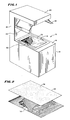
- FIG. 1 an electrostatic platemaking camera apparatus which is generally identified by the reference numeral 10.
- This apparatus 10 can be of the type sold by the A.B. Dick Company-under their trademark A.B. Dick 145 Photomat Platemaker or A.B. Dick 155 Electrostatic Mastermaker.
- Such electrostatic platemaking camera apparatus 10 includes a cabinet 12 having an upper table forming surface 14 on which there is positioned an image receiving area 16.
- a frame portion 18 Extending upwardly from the backside of the cabinet 12 is a frame portion 18 and extending forwardly from the frame portion 18 is a lens mounting overhead structure 20. Depending from the overhead structure 20 are lamps 22 and 24 positioned to illuminate the image receiving surface 16 on the table surface 14.
- a photograph 30 Positioned on and within the image receiving surface 16 is a photograph 30 and in accordance with the teachings of the present invention, an electrostatic integrated photoscreen 32 made in accordance with the teachings of the present invention is positioned over the photograph 30.
- FIG. 2 is shown an enlarged perspective view of the photograph 30 with an enlarged perspective view of the photoscreen 32 positioned above the photograph 30.
- the photoscreen 32 is made of a transparent film material such as acetate or mylar. In one preferred embodiment, the photoscreen 32 is made of 0.004 or 0.007 inch transparent mylar film.
- the photoscreen 32 has an array of light modulating, vignetting, light gray dots thereon together with an array of light modulating white solid dots mixed in or superimposed on the light gray vignetting dots.
- the vignetting dots are generally identified by reference numeral 34 in FIG. 2 and each dot 34 varies in density from a lightest area 76 (FIGS. 9-11) on the outside perimeter of the.dot 77 to a darkest core area 36 (FIGS. 9-11) in the extreme center of the dot 34 as shown in FIGS. 9 through 11 for dots 72.
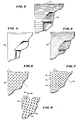
- FIG. 3 there is illustrated therein an artist's simulation of top left hand corner 38 of the photograph 30 showing the corner of a building.
- FIG. 4 is the artist's simulation of a reproduction 40 of the corner 38 shown in FIG. 3 using the platemaking camera apparatus 10 without the use of a photoscreen or mask over the photograph 30.
- the contrast is ultrahigh, dark shadows printing as black and light shadows printing as white with few midtones.
- FIG. 5 is an artist's simulation of a reproduction 50 of the corner 38 of the photograph 30 shown in FIG. 3 made with the platemaking camera apparatus 10 utilizing the photoscreen 32 of the present invention superimposed over the photograph 30 when the reproduction 50 is created.
- the dark areas are lightened and the light areas are darkened and the gray areas therebetween are shown more precisely.
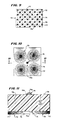
- FIG.6 is an enlarged view of the corner of a photoscreen 60 having an array of light modulating, varying density, light gray vignetting dots 62 which are photographically created on the photoscreen 60 at an angle of 45°.
- the vignetting dots 62 appear as lines forming an angle with the horizontal of approximately 45°.
- an array of light modulating white dots is superimposed over the vignetting dots.
- Such an array of dots is illustrated in FIG. 7.
- a photoscreen 70 is shown having an array of vignetting dots 72 photographically created on the photoscreen 70 at an angle of approximately 45°.
- a plurality of light modulating white dots 74 which are printed on the screen 70 at line angles of approximately 45° also.
- the white dots 74 are arranged in line with the vignetting dots 72 so that such dots 74 and 72 are in line with each other such as in line 76 as shown in FIG. 7.
- the vignetting dots 72 can be created on the photoscreen 70 using a so-called Levy glass screen having 60 to 160 lines per inch to create vignetting dots having a dot density of 60 to 160 rows of dots per inch.
- the light modulating white dots 74 are applied on the photoscreen 70 on the opposite side of the light gray vignetting dots 72 as shown in FIG. 9.
- the application of the white dots 74 is by transferring an ink film to the transparent substrate by a printing process.
- the same Levy glass screen having 40 to 160 lines per inch is used in the printing of the printed white dots.
- FIGS. 9-10 is shown a greatly enlarged/magnified bottom .
- surface 75 of the photoscreen 70 showing varying density light gray vignetting dots 72 and the white dots 74 which, for the sake of clarity, are shown as small black dots.
- the outer perimeter 76 of each vignetting dot 72 is very light gray and that the dot 72 darkens inwardly toward the center 77 of the dot which is the darkest gray part of the dot.
- the transparent film substrate 78 can be 0.004 to 0.007 inch thick with white dots 74 printed on the top surface 79 of the photoscreen 70 and with the vignetting dots 72 on the bottom surface 75.
- the center 74a of the white dot 74 is the thickest part of the dot 74 and the edge 74b is thinner, tapering to the top surface 79. This is caused by the molecular attraction of the material and such thinner edge 74b, modulates the light passing through the photoscreen.
- the white dots 74 are printed on the top surface 79 above a clear area 75a on the bottom surface 75 between the vignetting dots 72.
- a preferred dot density for both the vignetting dots 72 and the white dots 74 are approximately 85 dots per inch
- the optical density to the photoscreen 70 of the vignetting dots 72 and the white dots 74 can range from 5% to 40%. By this it is meant that the size of the dots will be 5% to 40% of the total space on the photoscreen. 0% would be no dots at all, i.e., a clear, transparent photoscreen 70 while 100% density would mean that the photoscreen 70 was completely covered with dots.
- a preferred vignetting dot size range is 25-30%. Again, this means that each vignetting dot will occupy 25-30% of the total space available on the photoscreen 70.
- a preferred white dot size is 25% of the total photoscreen space and the preferred vignetting dot size is 25% of the total photoscreen space.
- a preferred dot line angle is 45° as shown in FIG. 7, another line angle that can be used in 105°.
- Such a dot line angle is shown in FIG. 8 where a corner of a photoscreen 80 is shown with lines of vignetting dots 82 at an angle of 105° and with lines of white dots 84 positioned adjacent the lines of vignetting dots 82 and also at line angles of 105°.
- One line of vignetting dots 82 is identified by the reference numeral 86 and an adjacent line of white dots 84 is identified by the reference numeral 88.
- dot line angles of 45° and 105° are shown in FIGS. 7 and 8, it is to be understood that the vignetting dots 72 or 82 can have a line orientation of anywhere from 0° to 180°. Likewise the white dots 74 or 84 can have a line angle of anywhere from 0° to 180°.
- the vignetting dots were created with line angles of 45° while the white dots were created with line angles of 105°.
- the white dots can have a different line angle or orientation than the vignetting dots whereby some of the white dots are printed partially over vignetting dots.
- the white dots can be superimposed or printed on the array of vignetting dots in a random manner or in a ⁇ predetermined relationship to the vignetting dots.
- the white dots 74 are arranged in line with and interspersed in between the vignetting dots 72.
- each white dot ; 84 shown in FIG. 8 is positioned at the upper left hand corner of a vignetting dot 82.
- the white dots can have a different line angle and the array can be superimposed on the array of vignetting dots.
- Empirical tests with electrostatic platemaking camera apparatus have produced very good quality reproductions with half-tones which provide a good reproduction of the light gray and dark gray areas in between solid white and solid dark areas. Although not all of the different line angle arrangements and different positioning of the white solid dot array over the black vignetting dot array have been tested, those that have been tested provide good halftone reproduction. Accordingly, any photoscreen having vignetting dots and white dots as taught by the present invention should produce improved halftone reproductions.
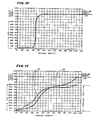
- FIG. 12 is shown a graph 88 of output density versus original density of a document where print on a plate was made without using a photoscreen.
- the lighter areas below 0.50 density
- the darker areas above 0.80 density
- density Logic 1/R, with R being reflectance or transmittance.
- FIG. 13 is a graph 90 of output print density vs original document density for a printing or plate made using the photoscreen 70 or 80 of the present invention.
- the graph 90 shows that a much better printing of the varying tones on the original document has been achieved using the photoscreen 70 or 80 as evidenced by the gradual increasing of halftone between 0.10 and 0.65 density. From 0.65 density and the 1.20 density, the increase is at a steep slope but still providing gradation in halftone reproduction. Then from 1.20 density to 2.10 density the increase is again more gradual.
- FIG. 13 Also shown in FIG. 13 is a graph 92 of percent of printing of dots printed on a piece of paper using the halftone printing plate made using the photoscreen of the present invention vs original document density.
- the improved halftone reproduction results shown in FIG. 13 are obtained by using the integrated photoscreen 70 or 80 of the present invention.
- Such photoscreen 70 or 80 is constructed of a clear transparent substrate material having on at least one surface thereof a plurality of varying density; light modulating vignetting, light gray dots which are in effect dots which vary in density from the outermost fringe to the central core.
- the photoscreen 70 or 80 also has one surface primarily constructed with a plurality of light modulating white dots which are in effect, dots which modulate the light reflected or transmitted. Both dots represent a decrease or reduction of the original document's continuous tone density range.
- the photoscreen's density range in combination with or added to the original document's density range represents an idean range to modulate the light which is then transmitted or reflected through a superior lens system and projected on the surface of a photosensitive member of an electrostatic offset platemaking camera.
- the projected light dissipates the electrostatic charge on the photosensitive member from the pattern of modulated light from the action of the photoscreen's integration of the original document's continuous tones and the varying density light modulating vignetting light gray and white dots.
- the dissipated pattern represents a negative image of the original which in reality now is called a halftone reproduction.
- the halftone is found to consist of a plural ity of dots which vary in size from the smallest dot to a larger dot which overlaps adjacent dots. This effect creates an optical effect of continuous tones by varying the dot sizes accordingly to the dissipated charge.
- This latent halftone negative image on the photoconductive layer is then developed by contacting it with a finely divided electrostatically attractable material, such as a resinous colored powder or liquid called a toner. The areas of the image which have been dissipated do not attract or receive the toner powder or liquid.
- the toner is held to the image areas by electrostatic charge fields on the layer.
- the toner is held proportionately to the charge field so that the greatest amount of material is deposited where the greatest charge field is located. Where there is a minimum charge, there is little or no material deposited. Where there is a minimum charge, there is little or no material deposited. Therefore, a toner image is produced to conform with the opposite of the latent halftone negative image previously placed on the photoreceptor.
- the toner is applied to the support surface of the printing plate and is suitably fixed thereto to form a permanent image.
- This fixing may take place by heat or vapor, which fuses the toner to the support material to which it has been applied.
- It is this image that is now on the electrostatic offset printing place that now represents a positive halftone image of the original document's continuous tones.
- the continuous tones of the original document now are halftone dots which vary in size from very small black dots to very large overlapping black dots.
- the minute changes in density of the original document are conveyed as minute changes in dot size on the electrostatic offset printing plate.
- the photoscreen is most useful in making a printing plate from a photograph in an electrostatic platemaking device but also can be used in other electrostatic devices such as copying machines.
- the photoscreen of the present invention provides a distinct advantage-over the more complicated prior art techniques for making halftone printing plates and reproductions therefrom with an electrostatic platemaking camera apparatus. Also, the photoscreen of the present invention can be used with office copying machines and with an offset camera to provide a halftone film positive or negative or a halftone photograph produced therefrom.
Landscapes
- Physics & Mathematics (AREA)
- General Physics & Mathematics (AREA)
- Facsimile Image Signal Circuits (AREA)
- Exposure And Positioning Against Photoresist Photosensitive Materials (AREA)
- Holo Graphy (AREA)
Priority Applications (1)
| Application Number | Priority Date | Filing Date | Title |
|---|---|---|---|
| AT84100303T ATE50073T1 (de) | 1983-01-12 | 1984-01-12 | Integrierter photoraster zur herstellung einer halbtonreproduktionsdruckplatte von einer photographie. |
Applications Claiming Priority (4)
| Application Number | Priority Date | Filing Date | Title |
|---|---|---|---|
| US45742283A | 1983-01-12 | 1983-01-12 | |
| US457422 | 1983-01-12 | ||
| US06/568,489 US4600666A (en) | 1983-01-12 | 1984-01-05 | Integrated photoscreen for making a halftone reproduction printing plate from a photograph |
| US568489 | 1990-08-16 |
Publications (3)
| Publication Number | Publication Date |
|---|---|
| EP0114068A2 true EP0114068A2 (de) | 1984-07-25 |
| EP0114068A3 EP0114068A3 (en) | 1985-06-05 |
| EP0114068B1 EP0114068B1 (de) | 1990-01-31 |
Family
ID=27038590
Family Applications (1)
| Application Number | Title | Priority Date | Filing Date |
|---|---|---|---|
| EP84100303A Expired EP0114068B1 (de) | 1983-01-12 | 1984-01-12 | Integrierter Photoraster zur Herstellung einer Halbtonreproduktionsdruckplatte von einer Photographie |
Country Status (8)
| Country | Link |
|---|---|
| US (1) | US4600666A (de) |
| EP (1) | EP0114068B1 (de) |
| AU (1) | AU568324B2 (de) |
| CA (1) | CA1211978A (de) |
| DE (1) | DE3481224D1 (de) |
| DK (1) | DK12384A (de) |
| NO (1) | NO840097L (de) |
| NZ (1) | NZ206773A (de) |
Cited By (1)
| Publication number | Priority date | Publication date | Assignee | Title |
|---|---|---|---|---|
| WO1993006527A1 (de) * | 1991-09-13 | 1993-04-01 | Alrane Inventing A.G. | Lichtbild |
Families Citing this family (12)
| Publication number | Priority date | Publication date | Assignee | Title |
|---|---|---|---|---|
| US4855277A (en) * | 1986-06-16 | 1989-08-08 | Hobart Corporation | Thermosensitive recording material having recording layer containing fluorescent dye |
| US4930020A (en) * | 1986-12-29 | 1990-05-29 | Martin James F | Facsimile transmission of photographic images |
| US4902899A (en) * | 1987-06-01 | 1990-02-20 | International Business Machines Corporation | Lithographic process having improved image quality |
| IL91054A0 (de) * | 1989-07-20 | 1990-02-09 | ||
| AU6178390A (en) * | 1989-08-21 | 1991-04-03 | Super Glue Corporation | Highlighting of document to be telecopied |
| US5061036A (en) * | 1990-04-17 | 1991-10-29 | Photon Imaging Corp. | Color page scanner using fiber optic bundle and a photosensor array |
| US5016047A (en) * | 1990-07-05 | 1991-05-14 | Nuarc Company, Inc. | Light-modifying apparatus for exposure devices |
| SG68563A1 (en) * | 1990-09-20 | 1999-11-16 | Illumination Research Group Pr | A display system |
| US6612729B1 (en) | 2000-03-16 | 2003-09-02 | 3M Innovative Properties Company | Illumination device |
| US6621973B1 (en) | 2000-03-16 | 2003-09-16 | 3M Innovative Properties Company | Light guide with protective outer sleeve |
| US7196822B2 (en) * | 2001-08-14 | 2007-03-27 | Amgraf, Inc. | Security document manufacturing method and apparatus using halftone dots that contain microscopic images |
| US11455737B2 (en) | 2012-12-06 | 2022-09-27 | The Boeing Company | Multiple-scale digital image correlation pattern and measurement |
Family Cites Families (5)
| Publication number | Priority date | Publication date | Assignee | Title |
|---|---|---|---|---|
| DE958529C (de) * | 1955-06-23 | 1957-02-21 | Herbst & Illig | Kontakt-Raster |
| BE635095A (de) * | 1962-07-17 | |||
| US3814608A (en) * | 1972-03-29 | 1974-06-04 | Howson Algraphy Ltd | Contact screens |
| US3905822A (en) * | 1973-10-23 | 1975-09-16 | Xerox Corp | Compound screen for object screening |
| US3912510A (en) * | 1973-10-23 | 1975-10-14 | Xerox Corp | Electrophotographic process employing a compound document screen |
-
1984
- 1984-01-05 US US06/568,489 patent/US4600666A/en not_active Expired - Fee Related
- 1984-01-06 NZ NZ206773A patent/NZ206773A/en unknown
- 1984-01-09 AU AU23168/84A patent/AU568324B2/en not_active Ceased
- 1984-01-11 DK DK12384A patent/DK12384A/da not_active Application Discontinuation
- 1984-01-11 NO NO840097A patent/NO840097L/no unknown
- 1984-01-11 CA CA000445066A patent/CA1211978A/en not_active Expired
- 1984-01-12 DE DE8484100303T patent/DE3481224D1/de not_active Expired - Lifetime
- 1984-01-12 EP EP84100303A patent/EP0114068B1/de not_active Expired
Cited By (1)
| Publication number | Priority date | Publication date | Assignee | Title |
|---|---|---|---|---|
| WO1993006527A1 (de) * | 1991-09-13 | 1993-04-01 | Alrane Inventing A.G. | Lichtbild |
Also Published As
| Publication number | Publication date |
|---|---|
| EP0114068B1 (de) | 1990-01-31 |
| DE3481224D1 (de) | 1990-03-08 |
| NZ206773A (en) | 1987-01-23 |
| CA1211978A (en) | 1986-09-30 |
| AU2316884A (en) | 1984-07-19 |
| NO840097L (no) | 1984-07-13 |
| DK12384D0 (da) | 1984-01-11 |
| AU568324B2 (en) | 1987-12-24 |
| EP0114068A3 (en) | 1985-06-05 |
| DK12384A (da) | 1984-08-20 |
| US4600666A (en) | 1986-07-15 |
Similar Documents
| Publication | Publication Date | Title |
|---|---|---|
| EP0114068B1 (de) | Integrierter Photoraster zur Herstellung einer Halbtonreproduktionsdruckplatte von einer Photographie | |
| EP0409608A2 (de) | Verfahren für Offset- und ähnliche Druckverfahren | |
| US4108654A (en) | Color electrophotographic process employing a document screen | |
| US5213043A (en) | Non-film lithographic imaging | |
| US3905822A (en) | Compound screen for object screening | |
| CA1095965A (en) | Multi frequency screen | |
| US2767093A (en) | Photo printing process | |
| CA1085905A (en) | Curved screen | |
| US4095889A (en) | Exposure system for an electrophotographic printing machine | |
| CA1106437A (en) | Removable screening system for a transparency reproduction machine | |
| CA1065955A (en) | Notch filter for color transparency copying machines | |
| CA1062762A (en) | Color dot screen for electro photography | |
| US5152225A (en) | Method of making a printing film and printing process using same | |
| US4283471A (en) | Printing screen and method of making same | |
| US4090786A (en) | Multi-color screen for electrophotographic printing | |
| US4066353A (en) | Half tone imaging system | |
| US6697170B2 (en) | Devices and methods for offset and similar printing systems | |
| US4072414A (en) | Screen for an electrophotographic printing machine | |
| JPS6225771A (ja) | 複写機の露光装置 | |
| JPH068067B2 (ja) | 画像複製物 | |
| JPS59176745A (ja) | 原稿から中間調再生画を形成する方法およびフオトスクリ−ン装置 | |
| US4394424A (en) | Printing screen and method of making same | |
| JPS6353573A (ja) | 複写機 | |
| US4495517A (en) | Printing screen and method of making same | |
| JPS6225743A (ja) | 複写機の露光装置 |
Legal Events
| Date | Code | Title | Description |
|---|---|---|---|
| PUAI | Public reference made under article 153(3) epc to a published international application that has entered the european phase |
Free format text: ORIGINAL CODE: 0009012 |
|
| AK | Designated contracting states |
Designated state(s): AT BE CH DE FR GB IT LI LU NL SE |
|
| PUAL | Search report despatched |
Free format text: ORIGINAL CODE: 0009013 |
|
| AK | Designated contracting states |
Designated state(s): AT BE CH DE FR GB IT LI LU NL SE |
|
| 17P | Request for examination filed |
Effective date: 19851205 |
|
| 17Q | First examination report despatched |
Effective date: 19861222 |
|
| GRAA | (expected) grant |
Free format text: ORIGINAL CODE: 0009210 |
|
| AK | Designated contracting states |
Kind code of ref document: B1 Designated state(s): AT BE CH DE FR GB IT LI LU NL SE |
|
| REF | Corresponds to: |
Ref document number: 50073 Country of ref document: AT Date of ref document: 19900215 Kind code of ref document: T |
|
| ITF | It: translation for a ep patent filed | ||
| REF | Corresponds to: |
Ref document number: 3481224 Country of ref document: DE Date of ref document: 19900308 |
|
| ET | Fr: translation filed | ||
| PLBE | No opposition filed within time limit |
Free format text: ORIGINAL CODE: 0009261 |
|
| STAA | Information on the status of an ep patent application or granted ep patent |
Free format text: STATUS: NO OPPOSITION FILED WITHIN TIME LIMIT |
|
| 26N | No opposition filed | ||
| PG25 | Lapsed in a contracting state [announced via postgrant information from national office to epo] |
Ref country code: GB Effective date: 19910112 Ref country code: AT Effective date: 19910112 |
|
| PG25 | Lapsed in a contracting state [announced via postgrant information from national office to epo] |
Ref country code: SE Effective date: 19910113 |
|
| PG25 | Lapsed in a contracting state [announced via postgrant information from national office to epo] |
Ref country code: LU Free format text: LAPSE BECAUSE OF NON-PAYMENT OF DUE FEES Effective date: 19910131 Ref country code: LI Effective date: 19910131 Ref country code: CH Effective date: 19910131 Ref country code: BE Effective date: 19910131 |
|
| PG25 | Lapsed in a contracting state [announced via postgrant information from national office to epo] |
Ref country code: NL Effective date: 19910801 |
|
| GBPC | Gb: european patent ceased through non-payment of renewal fee | ||
| NLV4 | Nl: lapsed or anulled due to non-payment of the annual fee | ||
| PG25 | Lapsed in a contracting state [announced via postgrant information from national office to epo] |
Ref country code: FR Effective date: 19910930 |
|
| REG | Reference to a national code |
Ref country code: CH Ref legal event code: PL |
|
| PG25 | Lapsed in a contracting state [announced via postgrant information from national office to epo] |
Ref country code: DE Effective date: 19911001 |
|
| REG | Reference to a national code |
Ref country code: FR Ref legal event code: ST |
|
| EUG | Se: european patent has lapsed |
Ref document number: 84100303.1 Effective date: 19910910 |