EP0114125A2 - Dispositif d'administration d'un médicament - Google Patents
Dispositif d'administration d'un médicament Download PDFInfo
- Publication number
- EP0114125A2 EP0114125A2 EP84300293A EP84300293A EP0114125A2 EP 0114125 A2 EP0114125 A2 EP 0114125A2 EP 84300293 A EP84300293 A EP 84300293A EP 84300293 A EP84300293 A EP 84300293A EP 0114125 A2 EP0114125 A2 EP 0114125A2
- Authority
- EP
- European Patent Office
- Prior art keywords
- medication
- housing
- application system
- skin
- flange
- Prior art date
- Legal status (The legal status is an assumption and is not a legal conclusion. Google has not performed a legal analysis and makes no representation as to the accuracy of the status listed.)
- Withdrawn
Links
Images


Classifications
-
- A—HUMAN NECESSITIES
- A61—MEDICAL OR VETERINARY SCIENCE; HYGIENE
- A61M—DEVICES FOR INTRODUCING MEDIA INTO, OR ONTO, THE BODY; DEVICES FOR TRANSDUCING BODY MEDIA OR FOR TAKING MEDIA FROM THE BODY; DEVICES FOR PRODUCING OR ENDING SLEEP OR STUPOR
- A61M37/00—Other apparatus for introducing media into the body; Percutany, i.e. introducing medicines into the body by diffusion through the skin
-
- A—HUMAN NECESSITIES
- A61—MEDICAL OR VETERINARY SCIENCE; HYGIENE
- A61K—PREPARATIONS FOR MEDICAL, DENTAL OR TOILETRY PURPOSES
- A61K9/00—Medicinal preparations characterised by special physical form
- A61K9/70—Web, sheet or filament bases ; Films; Fibres of the matrix type containing drug
- A61K9/7023—Transdermal patches and similar drug-containing composite devices, e.g. cataplasms
Definitions
- This invention relates generally to medication application systems and more particularly to medications and their containers adapted to dispense the medication contained in their interior through a micro-porous film to and through the skin of the patient.
- This type of medication application system is sometimes referred to as a trans-dermal application system or cell.
- the medication material is carried as a gelatinous material in a reservoir. While it would appear that this type of construction would overcome the limitations of the above-described bandage type applicators, those heretofore known have been difficult to fill and often subject to considerable lateral medication leakage with frequent secondary problems of staining of clothing or skin.
- systemically active drugs are used to fill the inventive medication container. These drugs are ones which, when applied to the skin, are absorbed through the body surface to which applied and are then dispersed in the body tissue by the patient's various circulatory systems.
- systemically active drugs employed in the practice of the invention are ones which are conventionally administered either orally or by injection with the object being to disperse the medication in the tissue to be treated at a controlled rate.
- trans-dermal application ethod of the invention Since with trans-dermal application a drug can be administered in localized area that it is desired to treat, and, since the skin layer is not broken, asepsis is not ordinarily a problem and many of the other difficulties of the prior art, including pain during dministration, are overcome by the trans-dermal application ethod of the invention.
- a principal object of the invention is to provide a new and improved medication application system that overcomes the foregoing recited and other limitations of the prior art.
- Still another object of the invention is to provide a medication system having a new and improved medication container that is readily fillable with a wide variety of medications at high production rates.
- Yet another object of the invention is to provide a medication administration system having a new and improved medication container capable of separately holding plural medication compositions for simultaneous application at the same or dissimilar rates.
- Another object of the invention is to provide in a medication administration system a new and improved medication container bar and color or otherwise codable to indicate the medication contents.
- a further object of the invention is to provide in a medication administration system a new and improved medication container that is capable of being filled by the prescriber or pharmacist supplier of the patient.
- a still further object of the invention is to provide in a medication administration system a new and improved medication container more comfortable in use than any heretofore known.
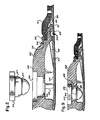
- FIGS 1 - 3 illustrate the principal embodiment of the invention.
- FIGs 1 and 3 there are shown top and bottom views of the complete medication container at 20 with Figure 2 being a cross-section thereof.
- a generally concave shaped housing 22 having an outwardly extending flange 23 at its periphery is closed on its open side by a micro-porous diaphragm or membrane 24 to form the medication container.
- the micro-porous membrane is advantageously secured to housing 22 as by heat sealing in the area of the annular depression 36 in the flange 23 near the edge of the housing. Because of this depressed location of the sealed edge, the somewhat rough edges of membrane 24 which might other wise irritate a patient's skin are prevented from coming into skin contact when the container is in use applied to the skin of a patient/user.
- a retaining plug 2G inserted in housing 22 is used to close and seal the filling aperture 28 in the housing after filling of the housing with a selected medication.
- a skin-adhering medical foam tape 30 is adhesively secured to flange 23 of housing 22 and mechanically secured thereto by retaining ring 32 which is, in turn, secured to housing 22 by hot staking at 34.
- Tape 30 is coated with medical adhesive 31 over its entire lower skin-contacting surface to achieve its skin-adhering qualities.
- a release sheet 38 is sealed to the foam tape by the same adhesive 31 that is used to adhere the foam tape to the skin of a patient. The release sheet prevents exposure of that adhesive before it is adhered to the skin.
- the release sheet 38 is coated with an adhesive release agent on the side toward the medical foams adhesive coating to reduce the tightness of the bond therebetween.
- the foam tape 30 has a central aperture 33.
- a central aperture 40 is formed in release sheet 38 at the same time aperture 33 is formed to permit direct contact of the micro-porous film with the patient's skin.
- the cell assembly is completed by a vapor barrier which advantageously is a 0.002 inch thick aluminum foil strip 42 having a commercial heat seal coating on one side which is heat sealed to the release sheet to block exterior access to the micro-porous membrane. This construction makes the complete cell airtight and, by preventing air or any other non-sterile material from contacting the micro-porous membrane and through it, the medication, thus preserves the medication in a sterile condition over a long shelf life.
- the housing 22 is made relatively thick, on the order of between 0.040 inches and 0.100 inches with a median of 0.060 inches. This contrasts with an average thickness of 0.020 inches in other similar prior art type applicators and this, in combination with the foil vapor barrier sealing strip 42, inhibits vapor transmission from the completed medication container. As a result it is not unusual to achieve a 3-year minimum shelf-life for the medication filled container of the invention whereas, prior art devices typically have a shelf-life of less than one year unless they are preserved in a separate sealed container.
- plug 26 is used to seal the filling aperture.
- plug 26 is of the same type described in the patent of Kenneth C. Allison and William H. Cooley, which issued October 5, 1982 as Patent No. 4,352,589, for a Blind Riveting and Sealing System.
- rivet 26 is uniquely configured in combination with housing 22 and its filling aperture 28 to effect a tight seal and by flexing locking flange 86 into beveled locking groove 84, lock itself in position.
- the sealing action occurs both under the head 88 of plug 26 and also in the plug shank area of forcefit immediately under the head where it engages housing aperture 28.
- the plug 26 and filling aperture 28 are reciprocally configured so that the top surface 44 of the housing 22 is smooth with the plug in place.
- the housing 22 is advantageously constructed by molding from radiation resistant clear polypropylene which material is substantially chemically inert in the presence of most medication solutions,
- the interior of bousing 22 contains plural identical reinforcing ribs 46. These ribs depend generally away from the interior surface of the housing 22. and assist in supporting the micro-porous membrane in the open area over which it extends. Because of the tapered shape of the ribs, the formation of air-pockets during filling is inhibited.
- the housing encloses a volume of substantially 2 cubic centimeters and has an open side covered by the micro-porous membrane of substantially 5 square centimeters.
- the micro-porous membrane 24 is of a commercially available type and, in the preferred embodiment, is 0.001 inches thick with a pore size of .02 x .2 micro-meters and having a pore volume of substantially 38%. Pores of this size prevent bacterial transmission either from the interior of the medication container to the skin or from the exterior to the interior of the container. Other membrane thicknesses, pore sizes and pore volumes may be used depending on the composition of the medication it is desired to accommodate.
- the foam tape 30 is constructed with a stripping handle 48 for grasping when pulling off the release sheet 38 together with foil vapor barrier strip 42.
- Tape 30 in the preferred embodiment is 1/16 inch thick white polyethylene closed cell foam. Because this material will be in contact with the user/patient's skin for at least several hours, a series of holes are cut into foam tape 30 to permit evaporation of t moisture from the patient's skin. These apertures are shown as two concentric rings of holes the inner ring of which is at a radius greater than that of flange 23. These holes permit the skin to "breath".
- release sheet 38 be high-density polyethylene 0.005" inches thick. This material has the combined desirable properties of toughness, and its ability to heat seal to the foil vapor barrier. Mylar has also been used for this application but is not preferred even though it is tougher, because of problems in adhering it to other materials.
- retaining ring 32 can be bar or color coded and/or otherwise marked to indicate the National Drug Code used by the pharmaceutical industry; such coding and other product or manufacturer designations ordinarily being applied to the filled medication containers to identify the drug in the package and hence lessen the possibility of administering the wrong drug.
- the retaining ring can be bar color coded or other indicia applied, somewhat in the manner symbolically shown in Figure 8 and achieve similar results.
- the marking of ring 32 is especially advantageous since the ring never is in contact with either the user/patient or the medication and hence the marking materials need not be medication compatible or non-allergenic.
- FIGs 6 and 7 illustrate alternative configurations of the housing 22 shown in Figures 1-4.
- the housing 22 comprises a cup-like single cavity construction.
- the basic external shape of the housing 48 is identical to that of Figure 1 but additionally, a dam 50 is inserted in the interior of the housing cavity dividing the cavity into two compartments having substantially identical volumes.
- Each of these cavities may be filled with a different medication solution or different concentrations of the same medi- cation, one of which might be a priming dose to rapidly establish a given blood level of medication followed by a sustained administration at a lower concentration.
- the dam 50 acts as a reinforcing rib
- the Figure 6 configuration has only two reinforcing ribs 56 and, it is frequently possible to eliminate both of these ribs.
- FIG. 7 alternative construction of the housing is similar to that of Figure 6 in that the housing is divided into two different size compartments.
- Housing 58 has a dam 60 dividing its interior into two compartments containing substantially 1/3 and 2/3, respectively, of the enclosed volume. Obviously other ratios and additional compartments could be created by relocation of the dam 60 or the addition of further dams.
- Filling apertures 62 and 64 permit the filling of the two separate compartments and reinforcing ribs 66, where used, function similarly to ribs 46 of Figure 1.
- a retaining plug such as that shown at 26 in Figure 2 is used to close and seal the filling aperture after filling.
- Figures 4 and 5 illustrate still further alternative constructions of the medication container of the invention to utilize alternative filling methods.
- the cell is filled by more or less conventional methods such as might be used to fill any container before a sealing closure is applied.
- the filling is done in a substantially different manner after the sealing closure is applied.
- the housing 63 is substantially identical to the housing 22 of Figure 2 except that it does not contain a filling aperture.
- the assembly is readied for filling by heat sealing a micro-porous membrane 70 to the housing in the same manner heretofore described.
- the membrane 70 is then wetted with an appropriate solution over substantially 3/4 of the area which covers the medication cavity as schematically indicated at 72.
- One appropriate solution because it is both inexpensive and sterile, is isopropyl alcohol.
- the membrane area that has been wetted is not air permeable except under fairly high pressure whereas the dry membrane is air permeable.
- a medication filling tube 78 is placed against the membrane in the wetted area and medication under pressure to move in the direction of arrow 74 applied to the exterior of membrane 70.
- the pressure used while above atmospheric, is on the order of a few inches of water.
- Medication then passes through the micro-porous membrane to fill the container.
- the air inside the container is forced out past the membrane in the direction of arrow 76 by the medication displacing it until the container is full of the medication solution. With only 2-3 inches of water as a working pressure, fill times have been approximately one (1) second.
- the Figure 5 embodiment is substantially identical to that of Figure 2 except that the filling aperture is filled with a molded in place medical grade soft rubber plug 80 in place of the plug 26. Then, filling is accomplished by means of a double hollow needle filling tool 82, one of which inserts the medication into the cell, the other permitting the escape of trapped interior air. When the tool 82 is withdrawn after filling, the plug 8a self-seals.
- coronary vasodilators such as Glyceryl trinitrate (nitro-glycerine) for the relief of angina pectoris
- general cardiac stimulators such as the Digitalis glucosides
- antiarrhyth- mics such as Quinidine
- antidiabetic agents such as Insulin
- These medications are all ordinarily placed in a physiologically neutral or slightly stronger aqueous saline (NaCl) solution on the order of 0.9% to 15%, 0.9% being essentially the normal salinity of the human body.
- NaCl physiologically neutral or slightly stronger aqueous saline
- One medication-solution combination that has proven especially effective as an analgesic and anti-inflammatory agent when placed in the inventive medication container, employs Aspirin (Acetyl salicylic acid) in a 31 ⁇ 2% aqueous saline solution with one- half percent of Polysorbate 80 (wetting agent).
- Aspirin Alcohol
- the Aspirin is placed in the solution in a concentration of between .15% and 2%, the solution being capable of absorbing about .25% Aspirin (0.136% by weight) and the excess, if any, remaining undissolved in the container. With only saturated solutions and no undissolved Aspirin, the contents of the container are completely absorbed through the skin in about 24 hours.
- Aspirin was mixed with a 31 ⁇ 2% NaCl solution containing 0.1% Polysorbate 80 (Polyoxylethylene) in a concentration of 136.3 mg per 100 ml and the containers applied to the external epiderma of an arthritic knee. After 24 hours, on average, 57.5 mg of Aspirin per 100 ml had been absorbed with substantial reduction in pain and inflammation commencing after about 3 hours and continuing for several hours (up to 6) after removal of the container from the knee.
- Polysorbate 80 Polyoxylethylene
- Another formulation useful for painkilling employs Acetaminophen in a solution concentration of between .05% to 20% with the preferred solution concentrations being between .4% and 2%.
- the .05% concentration appeared to be a bottom threshold below which effect could be noticed and the 20% concentration, the maximum that could be transferred under ideal conditions before removal of the container.
- an aqueous saline (NaCl) solution of between .02% and 31 ⁇ 2% containing Polysorbate 80 as a wetting agent in a concentration of 0.1% and Glycerol between 0% and 50%
- successful transfers of the entire medication contents of the container exclusive of glycerol to the patient took place over a period of between 24 hours and 3 days depending on the concentrations involved and the components of carrier solutions.
- Another painkilling, anti-inflammatory formulation usefully employed in the inventive medication container comprises Aspirin between 0.5% to 10% with a preferred range of .1% to 2%, Acetaminophen between 0.05% and 10% with a preferred range of 0.1% to 2% in a Sodium C loride aqueous solution between 0.02% and 20% with a preferred range of 0.2% to 3.5%, with a wetting agent Polyoxyethylene between .01% and 0.5% and with or without Glycerol to inhibit freezing.
- the painkilling, anti-inflammatory properties prove to be substan- tially the same as either of the first two examples.
- Sulindac is also an anti-inflammatory agent but, of considerably greater potency than Aspirin or Acetaminophen.
- an aqueous saline (NaCl) solution of between 0.02% and 20% (preferred 0.2% to 3.5%) in a concentration between .01% and .20% with a preferred range of .02% to .1%, favorable results were achieved similar to that described above in Examples 2 and 3, and without the side effects common with oral ingestion.
- nitro-glycerine may advantageously be administered over a considerable time period to provide relief from pains of angina pectoris.
- aqueous saline solution Sodium Chloride
- Digitalis glycosides may be administered over a sustained period trans-dermally to achieve good control, especially with patients who otherwise are careless in taking medications.
- 0.5 mg of digitalis is placed in 2 cc of a solution containing 40& propy- lene glycol, 10% alcohol and water to achieve a daily ministration rate of 0.25 m g.
- Insulin is capable of being administered trans-dermally when dissolved in saline solutions. It has been found that 40 units placed in suspension in a 3% aqueous saline solution with about 1.6% glycerine in the 2 CC volume of the inventive container transfers approximately 16-22 units per day.
- the glucocorticoids such as hydrocortisone and its synthetic analogs such as dexamethazone are readily absorbed through the skin and are of particular advantage in that application for the palliative treatment of chronic rheumatoid arthritis and other inflammatory ailments.
- Hydrocortisone in a concentration of 4 mg/ml in an aqueous 31 ⁇ 2% sodium chloride solution containing polysorbate 80 and methyl paraben, 0.18% as a preservative is absorbed at the rate of between 1.7 and 2mg per day of the hydrocortisone. Similar results are achieved with similar concentrations of dexamethazone sodium phosphate solution.
- Q uinidine is used in the treatment of arrhythmias, atrial fibrillation and ventricular tachycardia, among others.
- quinidine gluconate is employed in a concentration of 50 mg/ml in a sterile water solution, about 22 mg/ml are absorbed daily from the inventive device.
- an important feature of the invention is the discovery that varying strengths of saline solutions in trans-dermal containers effects the direction of flow, to or from the container, and the medication transfer rate and its duration.
- saline solutions are employed as a medication carrier in the container of the invention
- the salinity of the solution in the container taken in combination with the normal body salinity of the user/patient results in a force driving container contents either into or out of the medication container.
- This driving force must be accounted for in determining the permeability constant of the container and medication contents.
- sub-normal salinity results in medication migration to the user/patient (termed negative driving force) whereas salinity in excess of 0.9% results in body fluid migration into the container (termed positive driving force).
- the container For a negative driving force solution, the container is emptied, the body attracting the container contents.
- body fluids are attracted to the container which then continuously refills until it reaches normal body salinity.
- negative driving force solutions are preferred because the entire container contents will be dispensed in one or 2 days.
- positive driving force solutions are advantageous and preferred since they offer the feature of relatively high initial dosages with a tapering effect reducing the rate of ministration of the medication as the body fluid transported I into the container continuously dilutes the medication contents.
- the positive driving force solutions offer still another advantage.
Landscapes
- Health & Medical Sciences (AREA)
- Engineering & Computer Science (AREA)
- Veterinary Medicine (AREA)
- Animal Behavior & Ethology (AREA)
- Bioinformatics & Cheminformatics (AREA)
- Public Health (AREA)
- General Health & Medical Sciences (AREA)
- Dermatology (AREA)
- Life Sciences & Earth Sciences (AREA)
- Epidemiology (AREA)
- Pharmacology & Pharmacy (AREA)
- Medicinal Chemistry (AREA)
- Chemical & Material Sciences (AREA)
- Medical Informatics (AREA)
- Anesthesiology (AREA)
- Biomedical Technology (AREA)
- Heart & Thoracic Surgery (AREA)
- Hematology (AREA)
- Media Introduction/Drainage Providing Device (AREA)
Applications Claiming Priority (2)
| Application Number | Priority Date | Filing Date | Title |
|---|---|---|---|
| US459499 | 1983-01-20 | ||
| US06/459,499 US4460368A (en) | 1981-10-29 | 1983-01-20 | Trans-dermal medication system |
Publications (2)
| Publication Number | Publication Date |
|---|---|
| EP0114125A2 true EP0114125A2 (fr) | 1984-07-25 |
| EP0114125A3 EP0114125A3 (fr) | 1985-05-22 |
Family
ID=23825038
Family Applications (1)
| Application Number | Title | Priority Date | Filing Date |
|---|---|---|---|
| EP84300293A Withdrawn EP0114125A3 (fr) | 1983-01-20 | 1984-01-18 | Dispositif d'administration d'un médicament |
Country Status (3)
| Country | Link |
|---|---|
| US (1) | US4460368A (fr) |
| EP (1) | EP0114125A3 (fr) |
| JP (1) | JPS59186564A (fr) |
Cited By (8)
| Publication number | Priority date | Publication date | Assignee | Title |
|---|---|---|---|---|
| EP0171800A1 (fr) * | 1984-08-17 | 1986-02-19 | ALLPACK Industrielle Lohnverpackung GmbH & Co. KG. | Emplâtre adhésif thérapeutique et procédé pour sa fabrication |
| EP0208395A1 (fr) * | 1985-05-16 | 1987-01-14 | Euroceltique S.A. | Applicateur de médicament à travers la peau |
| FR2678514A1 (fr) * | 1991-07-05 | 1993-01-08 | Cabrera Fred | Dispositif pour l'absorption dermique de solutes medicamenteux. |
| DE19519593C1 (de) * | 1995-05-29 | 1996-08-29 | Horstmann Michael | Transdermales Therapeutisches System mit druckfarbenfreier Identifikation und Verfahren zu seiner Herstellung |
| WO1999009960A1 (fr) * | 1997-08-22 | 1999-03-04 | Lts Lohmann Therapie-Systeme Ag | Systemes plats d'administration therapeutique cutanee et transcutanee mettant en oeuvre un emplatre adhesif comme vecteur d'information, et mode de fabrication d'un tel emplatre |
| DE10039691C1 (de) * | 2000-08-14 | 2002-02-14 | Lohmann Therapie Syst Lts | Maskierung (Verblindung) von Arzneimitteln |
| EP1302202A3 (fr) * | 1994-05-10 | 2004-01-14 | Pal Svedman | Dispositif transdermique d'administration à travers la peau depourvue d'épithelium |
| US6851615B2 (en) | 1998-07-20 | 2005-02-08 | Noven Pharmaceuticals, Inc. | Method of individually tracking and identifying a drug delivery device |
Families Citing this family (54)
| Publication number | Priority date | Publication date | Assignee | Title |
|---|---|---|---|---|
| US4919648A (en) * | 1983-08-18 | 1990-04-24 | Drug Delivery Systems Inc. | High tack drug patch |
| US5591123A (en) * | 1983-08-18 | 1997-01-07 | Drug Delivery Systems Inc. | Programmable control mounting system for transdermal drug applicator |
| US4708716A (en) * | 1983-08-18 | 1987-11-24 | Drug Delivery Systems Inc. | Transdermal drug applicator |
| US5087240A (en) * | 1983-08-18 | 1992-02-11 | Drug Delivery Systems Inc. | Transdermal drug patch with conductive fibers |
| US4640689A (en) * | 1983-08-18 | 1987-02-03 | Drug Delivery Systems Inc. | Transdermal drug applicator and electrodes therefor |
| US4649075A (en) * | 1984-08-09 | 1987-03-10 | Leonora Jost | Transdermal and transmucosal vortexed foam devices and the method of making |
| US4605399A (en) * | 1984-12-04 | 1986-08-12 | Complex, Inc. | Transdermal infusion device |
| US4756710A (en) * | 1985-04-05 | 1988-07-12 | Merck & Co., Inc. | pH-Mediated drug delivery system |
| US5122127A (en) * | 1985-05-01 | 1992-06-16 | University Of Utah | Apparatus and methods for use in administering medicaments by direct medicament contact to mucosal tissues |
| US4710191A (en) * | 1985-12-16 | 1987-12-01 | Jonergin, Inc. | Therapeutic device for the administration of medicaments |
| US4917688A (en) * | 1987-01-14 | 1990-04-17 | Nelson Research & Development Co. | Bandage for transdermal delivery of systemically-active drug |
| US4820525A (en) * | 1987-09-17 | 1989-04-11 | American Home Products Corporation (Del.) | Transdermal drug delivery system |
| US4812305A (en) * | 1987-11-09 | 1989-03-14 | Vocal Rodolfo S | Well medicine strip |
| US4906475A (en) * | 1988-02-16 | 1990-03-06 | Paco Pharmaceutical Services | Estradiol transdermal delivery system |
| US5096892A (en) * | 1988-05-27 | 1992-03-17 | The Children's Medical Center Corporation | Arylsulfatase inhibition and potentiation of angiostatic steroids and heparin |
| US5019047A (en) * | 1989-06-16 | 1991-05-28 | Science Incorporated | Fluid delivery apparatus |
| US5240917A (en) * | 1991-04-03 | 1993-08-31 | Keimowitz Rudolph M | Suppression of thromboxane levels by percutaneous administration of aspirin |
| HRP921157A2 (en) | 1991-12-20 | 1994-10-31 | Lohmann Therapie Syst Lts | Transdermal system of applying acetilsalicilyc acid in antithrombosys therapy |
| US5756117A (en) * | 1992-04-08 | 1998-05-26 | International Medical Asscociates, Inc. | Multidose transdermal drug delivery system |
| US6071896A (en) * | 1992-06-16 | 2000-06-06 | Gundersen Clinic, Ltd. | Suppression of thromboxane levels by percutaneous administration of aspirin |
| DE4332093C2 (de) * | 1993-09-22 | 1995-07-13 | Lohmann Therapie Syst Lts | Transdermales therapeutisches System mit dem Wirkstoff Acetylsalicylsäure und Verfahren zu seiner Herstellung |
| KR0134151B1 (ko) * | 1994-05-23 | 1998-04-14 | 이형도 | 인슐린 패치 |
| US5827530A (en) * | 1996-02-05 | 1998-10-27 | Reed, Jr.; Fred Dewitt | Fillable patch for dermal or transdermal delivery |
| US7108681B2 (en) | 2000-10-16 | 2006-09-19 | Corium International, Inc. | Microstructures for delivering a composition cutaneously to skin |
| US7828827B2 (en) | 2002-05-24 | 2010-11-09 | Corium International, Inc. | Method of exfoliation of skin using closely-packed microstructures |
| US20030124174A1 (en) * | 2001-10-25 | 2003-07-03 | Endo Pharmaceuticals, Inc | Method for treating non-neuropathic pain |
| US7014630B2 (en) * | 2003-06-18 | 2006-03-21 | Oxyband Technologies, Inc. | Tissue dressing having gas reservoir |
| US20060200100A1 (en) * | 2003-06-18 | 2006-09-07 | Rosati Coni F | Method and apparatus for supplying gas to an area |
| WO2005007020A2 (fr) * | 2003-07-03 | 2005-01-27 | Corium International, Inc. | Pansement, dispositif d'administration d'ingredient et dispositif de fixation intraveineux et procede associe |
| US7470266B2 (en) * | 2003-09-16 | 2008-12-30 | I-Flow Corporation | Fluid medication delivery device |
| US20050112183A1 (en) * | 2003-11-25 | 2005-05-26 | Galer Bradley S. | Compositions and methods for treating neuropathic sensory loss |
| AT500095B8 (de) * | 2004-01-23 | 2007-02-15 | Braun Werner Mag | Transdermales abgabesystem |
| CA2560840C (fr) | 2004-03-24 | 2014-05-06 | Corium International, Inc. | Dispositif d'administration transdermique |
| CN102430158B (zh) | 2006-02-06 | 2014-09-10 | 凯希特许有限公司 | 结合减压伤口处理系统改进伤口敷裹物连接的系统和方法 |
| US20080114340A1 (en) * | 2006-11-01 | 2008-05-15 | Biotex, Inc. | System and method for reducing photon scatter in dermal tissue |
| EP2121111B1 (fr) | 2007-01-22 | 2018-03-14 | Corium International, Inc. | Applicateurs pour micro-aiguilles |
| US8911749B2 (en) | 2007-04-16 | 2014-12-16 | Corium International, Inc. | Vaccine delivery via microneedle arrays |
| EP2146689B1 (fr) | 2007-04-16 | 2020-08-12 | Corium, Inc. | Réseaux de micro-aiguilles coulées dans un solvant contenant un actif |
| US8206336B2 (en) * | 2008-06-16 | 2012-06-26 | Shantha Totada R | Methods for reducing pain using a transdermal local anesthetic patch with injection port in combination with an electromotive force |
| US7883488B2 (en) * | 2008-06-16 | 2011-02-08 | Shantha Totada R | Transdermal local anesthetic patch with injection port |
| US7883487B2 (en) * | 2008-06-16 | 2011-02-08 | Shantha Totada R | Transdermal local anesthetic patch with injection port |
| US8690841B2 (en) * | 2009-07-09 | 2014-04-08 | R. Gary Diaz | Wound care system |
| JP6327852B2 (ja) | 2010-05-04 | 2018-05-23 | コリウム インターナショナル, インコーポレイテッド | 微小突起アレイを使用した副甲状腺ホルモンの経皮送達のための方法及びデバイス |
| AU2013364053B2 (en) | 2012-12-21 | 2018-08-30 | Corium Pharma Solutions, Inc. | Microarray for delivery of therapeutic agent and methods of use |
| CA2903748C (fr) | 2013-03-12 | 2021-11-02 | Corium International, Inc. | Applicateurs de microprojection |
| AU2014237279B2 (en) | 2013-03-15 | 2018-11-22 | Corium Pharma Solutions, Inc. | Microarray with polymer-free microstructures, methods of making, and methods of use |
| US9962534B2 (en) | 2013-03-15 | 2018-05-08 | Corium International, Inc. | Microarray for delivery of therapeutic agent, methods of use, and methods of making |
| BR112015022625B1 (pt) | 2013-03-15 | 2023-01-31 | Corium, Inc | Aparelho de microestrutura para entrega de agente terapêutico |
| WO2014150285A2 (fr) | 2013-03-15 | 2014-09-25 | Corium International, Inc. | Applicateurs de microprojection d'impacts multiples et procédés d'utilisation |
| AU2014369916A1 (en) | 2013-12-24 | 2016-06-16 | Durect Corporation | Uses of oxygenated cholesterol sulfates (OCS) |
| WO2016036866A1 (fr) | 2014-09-04 | 2016-03-10 | Corium International, Inc. | Matrice de microstructures, procédé de production et procédés d'utilisation |
| US10857093B2 (en) | 2015-06-29 | 2020-12-08 | Corium, Inc. | Microarray for delivery of therapeutic agent, methods of use, and methods of making |
| US11071717B2 (en) | 2016-07-18 | 2021-07-27 | Ana R. Olivero | Anesthetic bandage |
| FR3086739B1 (fr) * | 2018-09-27 | 2021-02-12 | Maat Pharma | Recipient de lyophilisation |
Family Cites Families (14)
| Publication number | Priority date | Publication date | Assignee | Title |
|---|---|---|---|---|
| US3367332A (en) * | 1965-08-27 | 1968-02-06 | Gen Electric | Product and process for establishing a sterile area of skin |
| US3550589A (en) * | 1967-09-20 | 1970-12-29 | Lawrence B Wallerstein | Process and mechanism for making round end prepared cut bandages |
| US3797494A (en) * | 1969-04-01 | 1974-03-19 | Alza Corp | Bandage for the administration of drug by controlled metering through microporous materials |
| US3742951A (en) * | 1971-08-09 | 1973-07-03 | Alza Corp | Bandage for controlled release of vasodilators |
| US3996934A (en) * | 1971-08-09 | 1976-12-14 | Alza Corporation | Medical bandage |
| BE795384A (fr) * | 1972-02-14 | 1973-08-13 | Ici Ltd | Pansements |
| US4055672A (en) * | 1972-04-10 | 1977-10-25 | Standard Packaging Corporation | Controlled atmosphere package |
| US3972995A (en) * | 1975-04-14 | 1976-08-03 | American Home Products Corporation | Dosage form |
| US4117842A (en) * | 1977-02-24 | 1978-10-03 | Frank Hutchins | Treatment of conjunctivitis with powdered aluminum and eye protector/applicator |
| DE2902183A1 (de) * | 1979-01-20 | 1980-07-31 | Geb Schmidt Beate D Ringwelski | Vorrichtung zum aufbringen bzw. halten von nitrit- und/oder nitratverbindungen auf der haut |
| US4286592A (en) * | 1980-02-04 | 1981-09-01 | Alza Corporation | Therapeutic system for administering drugs to the skin |
| US4309996A (en) * | 1980-04-28 | 1982-01-12 | Alza Corporation | System with microporous releasing diffusor |
| US4297995A (en) * | 1980-06-03 | 1981-11-03 | Key Pharmaceuticals, Inc. | Bandage containing attachment post |
| US4460370A (en) * | 1981-10-29 | 1984-07-17 | Almedco, Inc. | Trans-dermal medication application cell |
-
1983
- 1983-01-20 US US06/459,499 patent/US4460368A/en not_active Expired - Fee Related
-
1984
- 1984-01-18 EP EP84300293A patent/EP0114125A3/fr not_active Withdrawn
- 1984-01-20 JP JP59008368A patent/JPS59186564A/ja active Pending
Cited By (12)
| Publication number | Priority date | Publication date | Assignee | Title |
|---|---|---|---|---|
| EP0171800A1 (fr) * | 1984-08-17 | 1986-02-19 | ALLPACK Industrielle Lohnverpackung GmbH & Co. KG. | Emplâtre adhésif thérapeutique et procédé pour sa fabrication |
| EP0208395A1 (fr) * | 1985-05-16 | 1987-01-14 | Euroceltique S.A. | Applicateur de médicament à travers la peau |
| FR2678514A1 (fr) * | 1991-07-05 | 1993-01-08 | Cabrera Fred | Dispositif pour l'absorption dermique de solutes medicamenteux. |
| WO1993000955A1 (fr) * | 1991-07-05 | 1993-01-21 | Fred Cabrera | Dispositif pour l'absorption dermique de solutes medicamenteux |
| US5558664A (en) * | 1991-07-05 | 1996-09-24 | Sarzaud; F. X. | Device for the dermal absorption of medicinal solutes |
| EP1302202A3 (fr) * | 1994-05-10 | 2004-01-14 | Pal Svedman | Dispositif transdermique d'administration à travers la peau depourvue d'épithelium |
| DE19519593C1 (de) * | 1995-05-29 | 1996-08-29 | Horstmann Michael | Transdermales Therapeutisches System mit druckfarbenfreier Identifikation und Verfahren zu seiner Herstellung |
| WO1996038187A1 (fr) * | 1995-05-29 | 1996-12-05 | Michael Horstmann | Systeme therapeutique transdermique a identification exempte d'encres d'imprimerie et son procede de fabrication |
| WO1999009960A1 (fr) * | 1997-08-22 | 1999-03-04 | Lts Lohmann Therapie-Systeme Ag | Systemes plats d'administration therapeutique cutanee et transcutanee mettant en oeuvre un emplatre adhesif comme vecteur d'information, et mode de fabrication d'un tel emplatre |
| AU737379B2 (en) * | 1997-08-22 | 2001-08-16 | Lts Lohmann Therapie-Systeme Gmbh | Identification for adhesive sheet-like dermal and trans- dermal therapeutic administration forms using an adhesive plaster as information carrier, and process for its production |
| US6851615B2 (en) | 1998-07-20 | 2005-02-08 | Noven Pharmaceuticals, Inc. | Method of individually tracking and identifying a drug delivery device |
| DE10039691C1 (de) * | 2000-08-14 | 2002-02-14 | Lohmann Therapie Syst Lts | Maskierung (Verblindung) von Arzneimitteln |
Also Published As
| Publication number | Publication date |
|---|---|
| EP0114125A3 (fr) | 1985-05-22 |
| JPS59186564A (ja) | 1984-10-23 |
| US4460368A (en) | 1984-07-17 |
Similar Documents
| Publication | Publication Date | Title |
|---|---|---|
| US4460368A (en) | Trans-dermal medication system | |
| US4460370A (en) | Trans-dermal medication application cell | |
| EP0249343B1 (fr) | Activation par l'humidité d'un système à libération transdermale des drogues | |
| KR930001082B1 (ko) | 피부 또는 점막에 유효약제의 투여장치 | |
| US4810499A (en) | Transdermal drug delivery system and method | |
| AU599619B2 (en) | Multicompartmentalized dermal and transdermal patches | |
| USRE39588E1 (en) | Transdermal drug delivery device | |
| CA1275216C (fr) | Dispositif medical pour l'administration transdermique par pulsations d'agentsayant une action biologique | |
| US4743249A (en) | Dermal and transdermal patches having a discontinuous pattern adhesive layer | |
| US4645502A (en) | Transdermal delivery of highly ionized fat insoluble drugs | |
| US4837027A (en) | Transdermal drug delivery device | |
| US5198223A (en) | Transdermal formulations, methods and devices | |
| EP0208395B1 (fr) | Applicateur de médicament à travers la peau | |
| EP0252459A1 (fr) | Système d'apport compartimenté agissant à travers la peau | |
| PT100502A (pt) | Composicoes farmaceuticas para aumentar a capacidade de permeacao na pele utilizando monolinoleato de glicerol | |
| KR870007704A (ko) | 향상된 생체학적 허용도를 갖는 투약시스템(Drug Delivery System) | |
| CA1309661C (fr) | Systeme d'administration transdermiques | |
| WO1989004179A1 (fr) | Formulations pharmaceutiques pour administration transcutanee | |
| US5662626A (en) | Plaster acting as a dosing device | |
| US20070212402A1 (en) | Patch |
Legal Events
| Date | Code | Title | Description |
|---|---|---|---|
| PUAI | Public reference made under article 153(3) epc to a published international application that has entered the european phase |
Free format text: ORIGINAL CODE: 0009012 |
|
| AK | Designated contracting states |
Designated state(s): CH DE FR GB IT LI |
|
| PUAL | Search report despatched |
Free format text: ORIGINAL CODE: 0009013 |
|
| AK | Designated contracting states |
Designated state(s): CH DE FR GB IT LI |
|
| STAA | Information on the status of an ep patent application or granted ep patent |
Free format text: STATUS: THE APPLICATION IS DEEMED TO BE WITHDRAWN |
|
| 18D | Application deemed to be withdrawn |
Effective date: 19860123 |
|
| RIN1 | Information on inventor provided before grant (corrected) |
Inventor name: ALLISON, ROGER D. Inventor name: ALLISON, CHARLOTTE C. Inventor name: ALLISON, KENNETH C. |