EP0114249A2 - Verfahren zum Unterscheiden zwischen komplexen Zeichenvorräten - Google Patents
Verfahren zum Unterscheiden zwischen komplexen Zeichenvorräten Download PDFInfo
- Publication number
- EP0114249A2 EP0114249A2 EP83111902A EP83111902A EP0114249A2 EP 0114249 A2 EP0114249 A2 EP 0114249A2 EP 83111902 A EP83111902 A EP 83111902A EP 83111902 A EP83111902 A EP 83111902A EP 0114249 A2 EP0114249 A2 EP 0114249A2
- Authority
- EP
- European Patent Office
- Prior art keywords
- characters
- character
- area
- region
- character set
- Prior art date
- Legal status (The legal status is an assumption and is not a legal conclusion. Google has not performed a legal analysis and makes no representation as to the accuracy of the status listed.)
- Granted
Links
Images
Classifications
-
- G—PHYSICS
- G06—COMPUTING OR CALCULATING; COUNTING
- G06V—IMAGE OR VIDEO RECOGNITION OR UNDERSTANDING
- G06V30/00—Character recognition; Recognising digital ink; Document-oriented image-based pattern recognition
- G06V30/10—Character recognition
- G06V30/14—Image acquisition
- G06V30/142—Image acquisition using hand-held instruments; Constructional details of the instruments
-
- G—PHYSICS
- G06—COMPUTING OR CALCULATING; COUNTING
- G06F—ELECTRIC DIGITAL DATA PROCESSING
- G06F18/00—Pattern recognition
- G06F18/20—Analysing
-
- G—PHYSICS
- G06—COMPUTING OR CALCULATING; COUNTING
- G06V—IMAGE OR VIDEO RECOGNITION OR UNDERSTANDING
- G06V30/00—Character recognition; Recognising digital ink; Document-oriented image-based pattern recognition
- G06V30/10—Character recognition
- G06V30/32—Digital ink
- G06V30/36—Matching; Classification
Definitions
- This invention relates to pattern recognition and particularly to recognition of complex handwritten characters including Chinese characters (Kanji), Hiragana characters and Katakana characters.
- a method for distinguishing between sets of handwritten characters whereby characters of a first character set are registered in a first.area of,the tablet and characters of a second character set are registered in a second area of the tablet.
- the second area is totally contained within the first area so that characters of different character sets can be written in the same general position but can be distinguished by overall size.
- This invention permits automatic recognition of character sets, thereby reducing the searching and sorting requirements of mixed character set data input, particularly in Chinese and Japanese writing systems.
- the invention is useful in data input, word processing, and data processing in general and as a teaching aid for the teaching of writing. The invention will be better understood upon reference to the following detailed description in connection with the accompanying drawings.
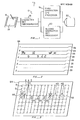
- Fig. 1 there is shown a block diagram of a generalized data input system 10 adapted to employ the method according to the invention.
- the system 10 includes a registration means such as an x-y tablet 12 of conventional design which is for example responsive to pressure applied on a face 14 to generate output signals representative of the location of a registration instrument within a field on the face 14.
- Output signals are provided to a character set discriminator 16 whose function is to distinguish among the character sets expected to be employed with the x-y tablet 12. According to the invention, discrimination among different character sets is determined by examination of the size or location of each cipher, as hereinafter explained.
- Signals recognized as representative of a first character set are routed to a first character set processor 18, wherein is located all of the functions necessary for recognition and reproduction of data employing the first character set.
- signals recognized as representative of characters of a second type are routed to a second character set processor 20.
- the system may be expanded to include three or more character set processors.
- the processed output information is routed to a common output device, such as a CRT display 22 or a data utilization system.
- FIG. 2 there is shown a diagram 24 for a tablet face useful for illustrating a method according to one embodiment of the invention.
- the face 14 of the x-y tablet 12 (Fig. 1) is laid out in rows of segments 26 and 28, and specifically in rows enumerated 1 for the first rows 26 and 2 for the second rows 28.
- the first rows 26 are reserved for first types of characters such as Kanji.
- the second rows 28 are reserved for second types of characters such as Katakana. Characters registered on the first rows are always recognized as Kanji and therefore such signals are routed to the first character set processor 18 ( F ig. 1) wherein the complex processing required of Kanji may be carried out and access may be had to the large K anji vocabulary.
- F ig. 1 the complex processing required of Kanji may be carried out and access may be had to the large K anji vocabulary.
- Simpler characters such as Katakana
- Second row signals are routed to the second character set processor where the relatively simpler and smaller character set may be processed in accordance with the processing system selected thereby.
- characters may be spaced laterally from one another whereby the order of the characters may be detected.
- a third line may be reserved for other characters.
- the second line may be reserved for all characters other than Kanji, since most other character sets of interest are likely to be relatively small and therefore may be integrated into a single character set processor 20.
- Figure 3 illustrates a still further embodiment of the invention.
- a face 124 comprises a grid having generally square regions A and subregions B, C, D and E wholly contained within the regions A.
- Two to five different character sets may be recognized by data input location by use of such a grid organization.
- section A may be reserved for Kanji, section A being defined as any combination of at least two subsections contained therein, as illustrated by the characters 30 and 32.
- Section E may be reserved for Katakana or the like, as illustrated by characters 34, 36 and 38.
- Section B may be reserved for Arabic-style numerals as well as Latin and Greek characters, as illustrated by characters 40 and 42.
- Each section A is reserved for one character. If only one subsection is employed, then the character set discriminator 16 (Fig. 1) can readily recognize that the character employed is not Kanji. Similarly, if a particular subsection is employed, the choice of subsection indicates to the character set discriminator 16 which character set is intended.
- the character set discriminator 16 may be readily implemented by any means for recognizing selected addresses within a two-dimensional array, since the output of an x-y tablet is a set of recognizable addresses.
- the face 14 of the tablet 12 may be provided with a visible background whereby a user can recognize sections and subsections. Characters may be written in a reasonably natural style with adaptation of size and character position as required by the selected face layout. For example, the subsections of each section A may be selected such that a user registers non-Kanji characters in the center of the sections A. Since non-Kanji characters are generally less complex writing style is easily adapted to the smaller size of the defined subsections.
Landscapes
- Engineering & Computer Science (AREA)
- Theoretical Computer Science (AREA)
- Computer Vision & Pattern Recognition (AREA)
- Physics & Mathematics (AREA)
- General Physics & Mathematics (AREA)
- Data Mining & Analysis (AREA)
- Multimedia (AREA)
- Life Sciences & Earth Sciences (AREA)
- Artificial Intelligence (AREA)
- Bioinformatics & Cheminformatics (AREA)
- Bioinformatics & Computational Biology (AREA)
- Evolutionary Biology (AREA)
- Evolutionary Computation (AREA)
- General Engineering & Computer Science (AREA)
- Character Discrimination (AREA)
Applications Claiming Priority (2)
| Application Number | Priority Date | Filing Date | Title |
|---|---|---|---|
| US06/459,283 US4531231A (en) | 1983-01-19 | 1983-01-19 | Method for distinguishing between complex character sets |
| US459283 | 1983-01-19 |
Publications (3)
| Publication Number | Publication Date |
|---|---|
| EP0114249A2 true EP0114249A2 (de) | 1984-08-01 |
| EP0114249A3 EP0114249A3 (en) | 1987-02-25 |
| EP0114249B1 EP0114249B1 (de) | 1992-05-20 |
Family
ID=23824146
Family Applications (1)
| Application Number | Title | Priority Date | Filing Date |
|---|---|---|---|
| EP83111902A Expired - Lifetime EP0114249B1 (de) | 1983-01-19 | 1983-11-28 | Verfahren zum Unterscheiden zwischen komplexen Zeichenvorräten |
Country Status (5)
| Country | Link |
|---|---|
| US (1) | US4531231A (de) |
| EP (1) | EP0114249B1 (de) |
| JP (1) | JPS59161786A (de) |
| KR (1) | KR890002580B1 (de) |
| DE (1) | DE3382563D1 (de) |
Cited By (6)
| Publication number | Priority date | Publication date | Assignee | Title |
|---|---|---|---|---|
| EP0157354A3 (en) * | 1984-03-28 | 1988-09-14 | Hitachi, Ltd. | Method for designating a recognition mode in a hand-written character/graphic recognizer |
| EP0519713A3 (en) * | 1991-06-21 | 1993-06-30 | Canon Kabushiki Kaisha | Character input method and apparatus |
| US5513278A (en) * | 1993-05-27 | 1996-04-30 | Matsushita Electric Industrial Co., Ltd. | Handwritten character size determination apparatus based on character entry area |
| US5991440A (en) * | 1991-06-21 | 1999-11-23 | Canon Kabushiki Kaisha | Method and apparatus for recognizing input handwritten characters associated with title information |
| US6366697B1 (en) | 1993-10-06 | 2002-04-02 | Xerox Corporation | Rotationally desensitized unistroke handwriting recognition |
| US6493464B1 (en) | 1994-07-01 | 2002-12-10 | Palm, Inc. | Multiple pen stroke character set and handwriting recognition system with immediate response |
Families Citing this family (20)
| Publication number | Priority date | Publication date | Assignee | Title |
|---|---|---|---|---|
| JPS6175980A (ja) * | 1984-09-21 | 1986-04-18 | Nippon Tsushin Kensetsu Kk | 手書き文字認識装置 |
| JPS61139893A (ja) * | 1984-12-11 | 1986-06-27 | Nippon Tsushin Kensetsu Kk | 手書き文字認識装置 |
| JPH07113954B2 (ja) * | 1984-12-27 | 1995-12-06 | キヤノン株式会社 | 情報処理方法 |
| JPH07117988B2 (ja) * | 1986-03-19 | 1995-12-18 | 株式会社日立製作所 | 手書き文字の切り出し方法 |
| JP2847715B2 (ja) * | 1988-08-30 | 1999-01-20 | ソニー株式会社 | 文字認識装置及び文字認識方法 |
| US5167016A (en) * | 1989-12-29 | 1992-11-24 | Xerox Corporation | Changing characters in an image |
| US5550932A (en) * | 1992-06-19 | 1996-08-27 | Pierce Companies, Inc. | Method for encoding MICR documents |
| JP3155616B2 (ja) * | 1992-06-25 | 2001-04-16 | キヤノン株式会社 | 文字認識方法及び装置 |
| US5546565A (en) * | 1993-06-21 | 1996-08-13 | Casio Computer Co., Ltd. | Input/output apparatus having a pen, and method of associating and processing handwritten image data and voice data |
| US5596350A (en) * | 1993-08-02 | 1997-01-21 | Apple Computer, Inc. | System and method of reflowing ink objects |
| IL111039A (en) * | 1994-09-22 | 1998-08-16 | Advanced Recognition Tech | Handwriting recognition system |
| US6295372B1 (en) | 1995-03-03 | 2001-09-25 | Palm, Inc. | Method and apparatus for handwriting input on a pen based palmtop computing device |
| TW338815B (en) * | 1995-06-05 | 1998-08-21 | Motorola Inc | Method and apparatus for character recognition of handwritten input |
| JPH096922A (ja) * | 1995-06-20 | 1997-01-10 | Sony Corp | 手書き文字認識装置 |
| US6055333A (en) * | 1995-12-28 | 2000-04-25 | Motorola, Inc. | Handwriting recognition method and apparatus having multiple selectable dictionaries |
| US5889888A (en) | 1996-12-05 | 1999-03-30 | 3Com Corporation | Method and apparatus for immediate response handwriting recognition system that handles multiple character sets |
| US6061472A (en) * | 1997-06-06 | 2000-05-09 | Microsoft Corporation | Method and mechanism to reduce handwriting recognizer errors using multiple decision trees |
| US6724936B1 (en) | 2000-08-23 | 2004-04-20 | Art-Advanced Recognition Technologies, Ltd. | Handwriting input device and method using a single character set |
| US7490296B2 (en) * | 2003-01-31 | 2009-02-10 | Microsoft Corporation | Utility object for specialized data entry |
| US8769427B2 (en) | 2008-09-19 | 2014-07-01 | Google Inc. | Quick gesture input |
Family Cites Families (6)
| Publication number | Priority date | Publication date | Assignee | Title |
|---|---|---|---|---|
| NL6918149A (de) * | 1969-12-03 | 1971-06-07 | ||
| US4021777A (en) * | 1975-03-06 | 1977-05-03 | Cognitronics Corporation | Character reading techniques |
| JPS5839356B2 (ja) * | 1975-12-25 | 1983-08-29 | 日本電気株式会社 | フオ−マツトベツニニンシキスル ジツジカンモジニンシキソウチ |
| US4139837A (en) * | 1977-06-22 | 1979-02-13 | Creative Ventures, Inc. | Information entry system |
| JPS5580183A (en) * | 1978-12-12 | 1980-06-17 | Nippon Telegr & Teleph Corp <Ntt> | On-line recognition processing system of hand-written character |
| JPS5617695A (en) * | 1979-07-23 | 1981-02-19 | Toshiba Corp | Garbage treatment vessel |
-
1983
- 1983-01-19 US US06/459,283 patent/US4531231A/en not_active Expired - Lifetime
- 1983-11-28 EP EP83111902A patent/EP0114249B1/de not_active Expired - Lifetime
- 1983-11-28 DE DE8383111902T patent/DE3382563D1/de not_active Expired - Fee Related
- 1983-12-15 KR KR1019830005948A patent/KR890002580B1/ko not_active Expired
-
1984
- 1984-01-18 JP JP59005846A patent/JPS59161786A/ja active Pending
Cited By (7)
| Publication number | Priority date | Publication date | Assignee | Title |
|---|---|---|---|---|
| EP0157354A3 (en) * | 1984-03-28 | 1988-09-14 | Hitachi, Ltd. | Method for designating a recognition mode in a hand-written character/graphic recognizer |
| EP0519713A3 (en) * | 1991-06-21 | 1993-06-30 | Canon Kabushiki Kaisha | Character input method and apparatus |
| US5991440A (en) * | 1991-06-21 | 1999-11-23 | Canon Kabushiki Kaisha | Method and apparatus for recognizing input handwritten characters associated with title information |
| US5513278A (en) * | 1993-05-27 | 1996-04-30 | Matsushita Electric Industrial Co., Ltd. | Handwritten character size determination apparatus based on character entry area |
| US6366697B1 (en) | 1993-10-06 | 2002-04-02 | Xerox Corporation | Rotationally desensitized unistroke handwriting recognition |
| US6816859B2 (en) | 1993-10-06 | 2004-11-09 | Xerox Corporation | Rotationally desensitized unistroke handwriting recognition |
| US6493464B1 (en) | 1994-07-01 | 2002-12-10 | Palm, Inc. | Multiple pen stroke character set and handwriting recognition system with immediate response |
Also Published As
| Publication number | Publication date |
|---|---|
| US4531231A (en) | 1985-07-23 |
| EP0114249B1 (de) | 1992-05-20 |
| DE3382563D1 (de) | 1992-06-25 |
| EP0114249A3 (en) | 1987-02-25 |
| KR890002580B1 (ko) | 1989-07-19 |
| KR840007290A (ko) | 1984-12-06 |
| JPS59161786A (ja) | 1984-09-12 |
Similar Documents
| Publication | Publication Date | Title |
|---|---|---|
| US4531231A (en) | Method for distinguishing between complex character sets | |
| US7742642B2 (en) | System and method for automated reading of handwriting | |
| US5513278A (en) | Handwritten character size determination apparatus based on character entry area | |
| JPH0562391B2 (de) | ||
| JPH09507937A (ja) | 手書き入力を分割する方法 | |
| JPH03175593A (ja) | オンライン文字認識装置 | |
| Toussaint et al. | Algorithms for recognizing contour-traced handprinted characters | |
| US5835625A (en) | Method and apparatus for optical character recognition utilizing proportional nonpredominant color analysis | |
| JPH0247788B2 (de) | ||
| JPH0516632B2 (de) | ||
| JPH0520794B2 (de) | ||
| JPH11184971A (ja) | 手書き文字認識機能を持つ文字入力装置及び方法 | |
| JP3388918B2 (ja) | 文字列読み取り装置 | |
| KR100234028B1 (ko) | 문자인식 시스템의 문자영역 구분방법 | |
| JPH05346974A (ja) | 文字認識装置 | |
| JPS61153787A (ja) | 情報処理装置 | |
| JP2804660B2 (ja) | 文書処理装置 | |
| JPS6165378A (ja) | 文字図形認識方法及び装置 | |
| JP2000181989A (ja) | 文字認識装置及びその方法並びにその方法をプログラムとして記録したコンピュータ読み取り可能な記録媒体 | |
| JPH0586585B2 (de) | ||
| JPS623472B2 (de) | ||
| JPH02181269A (ja) | 住所認識方式 | |
| JPS63142465A (ja) | 文字列分割方式 | |
| JPH0432433B2 (de) | ||
| JPS5757379A (en) | Character information input device |
Legal Events
| Date | Code | Title | Description |
|---|---|---|---|
| PUAI | Public reference made under article 153(3) epc to a published international application that has entered the european phase |
Free format text: ORIGINAL CODE: 0009012 |
|
| AK | Designated contracting states |
Designated state(s): CH DE FR GB IT LI NL |
|
| PUAL | Search report despatched |
Free format text: ORIGINAL CODE: 0009013 |
|
| AK | Designated contracting states |
Kind code of ref document: A3 Designated state(s): CH DE FR GB IT LI NL |
|
| 17P | Request for examination filed |
Effective date: 19870825 |
|
| 17Q | First examination report despatched |
Effective date: 19890606 |
|
| RAP1 | Party data changed (applicant data changed or rights of an application transferred) |
Owner name: COMMUNICATION INTELLIGENCE CORPORATION |
|
| GRAA | (expected) grant |
Free format text: ORIGINAL CODE: 0009210 |
|
| AK | Designated contracting states |
Kind code of ref document: B1 Designated state(s): CH DE FR GB IT LI NL |
|
| PG25 | Lapsed in a contracting state [announced via postgrant information from national office to epo] |
Ref country code: NL Effective date: 19920520 |
|
| ITF | It: translation for a ep patent filed | ||
| REF | Corresponds to: |
Ref document number: 3382563 Country of ref document: DE Date of ref document: 19920625 |
|
| ET | Fr: translation filed | ||
| NLV1 | Nl: lapsed or annulled due to failure to fulfill the requirements of art. 29p and 29m of the patents act | ||
| ITTA | It: last paid annual fee | ||
| PLBE | No opposition filed within time limit |
Free format text: ORIGINAL CODE: 0009261 |
|
| STAA | Information on the status of an ep patent application or granted ep patent |
Free format text: STATUS: NO OPPOSITION FILED WITHIN TIME LIMIT |
|
| 26N | No opposition filed | ||
| PGFP | Annual fee paid to national office [announced via postgrant information from national office to epo] |
Ref country code: DE Payment date: 19931223 Year of fee payment: 11 |
|
| PGFP | Annual fee paid to national office [announced via postgrant information from national office to epo] |
Ref country code: FR Payment date: 19931228 Year of fee payment: 11 |
|
| PGFP | Annual fee paid to national office [announced via postgrant information from national office to epo] |
Ref country code: CH Payment date: 19931230 Year of fee payment: 11 |
|
| PGFP | Annual fee paid to national office [announced via postgrant information from national office to epo] |
Ref country code: GB Payment date: 19940111 Year of fee payment: 11 |
|
| PG25 | Lapsed in a contracting state [announced via postgrant information from national office to epo] |
Ref country code: GB Effective date: 19941128 |
|
| PG25 | Lapsed in a contracting state [announced via postgrant information from national office to epo] |
Ref country code: LI Effective date: 19941130 Ref country code: CH Effective date: 19941130 |
|
| GBPC | Gb: european patent ceased through non-payment of renewal fee |
Effective date: 19941128 |
|
| PG25 | Lapsed in a contracting state [announced via postgrant information from national office to epo] |
Ref country code: FR Effective date: 19950731 |
|
| REG | Reference to a national code |
Ref country code: CH Ref legal event code: PL |
|
| PG25 | Lapsed in a contracting state [announced via postgrant information from national office to epo] |
Ref country code: DE Effective date: 19950801 |
|
| REG | Reference to a national code |
Ref country code: FR Ref legal event code: ST |