EP0114319A2 - Automatische Verstärkungsregelungsschaltung - Google Patents
Automatische Verstärkungsregelungsschaltung Download PDFInfo
- Publication number
- EP0114319A2 EP0114319A2 EP83112702A EP83112702A EP0114319A2 EP 0114319 A2 EP0114319 A2 EP 0114319A2 EP 83112702 A EP83112702 A EP 83112702A EP 83112702 A EP83112702 A EP 83112702A EP 0114319 A2 EP0114319 A2 EP 0114319A2
- Authority
- EP
- European Patent Office
- Prior art keywords
- collector
- emitter
- base
- transistor
- coupled
- Prior art date
- Legal status (The legal status is an assumption and is not a legal conclusion. Google has not performed a legal analysis and makes no representation as to the accuracy of the status listed.)
- Withdrawn
Links
Images
Classifications
-
- H—ELECTRICITY
- H04—ELECTRIC COMMUNICATION TECHNIQUE
- H04M—TELEPHONIC COMMUNICATION
- H04M1/00—Substation equipment, e.g. for use by subscribers
- H04M1/60—Substation equipment, e.g. for use by subscribers including speech amplifiers
- H04M1/6008—Substation equipment, e.g. for use by subscribers including speech amplifiers in the transmitter circuit
-
- H—ELECTRICITY
- H03—ELECTRONIC CIRCUITRY
- H03G—CONTROL OF AMPLIFICATION
- H03G11/00—Limiting amplitude; Limiting rate of change of amplitude
Definitions
- This invention relates, in general, to automatic gain control circuits and more particularly to a circuit that detects the onset of, and prevents saturation and cut off of an amplifying transistor of a speech network.
- An Electronic Telephone Chip typically comprises a dual tone multifrequency dialer, a speech network, a microprocessor, and a voltage regulator.
- a multitransistor circuit for draining excess signal current from the amplifying transistor.
- a pair of differentially connected PNP transistors will draw excess current from the collector of the NPN amplifying transistor and activate switching transistors that draw current from the base of the NP N amplifying transistor, thereby limiting the positive peak of the incoming signal.
- a similar arrangement comprising a pair of differentially connected NPN transistors and a number of switching transistors would limit the negative peaks. Such a configuration consumes excessive chip area and increases cost.
- an automatic gain control circuit having reduced chip area consumption that detects the onset of saturation and cut-off and limits the positive and negative peaks of an incoming signal by preventing an NPN transistor amplifier from going into cut-off or saturation.
- Another object of the present invention is to provide an automatic gain control circuit that has a reduced chip area consumption.
- an improved automatic gain control circuit having a differential pair of PNP transistors coupled to the collector of an NPN amplifying transistor for activating a limiting means on positive peaks of an output signal as the amplifying transistor approaches cut-off.
- a second emitter of the amplifying transistor acts as a collector drawing electrons injected into the base from the collector.
- the reverse current through the emitter activates the limiting means.
- the limiting means is coupled to the input terminal for limiting the positive and negative peaks beyond a predetermined level.
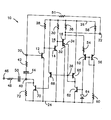
- the single figure is a schematic of the automatic gain. control circuit of the present invention.
- Transistors 12, 14, 16 form a three stage amplifier-network 18 which is coupled between input coupling terminal 20 and output terminal 22.
- the base and emitter of transistor 12 are connected to terminal 20 and voltage conductor 24, respectively.
- the collector of transistor 12 is connected to the base of transistor 14 and is coupled to voltage conductor 26 by resistor 28.
- Voltage conductor 26 has a voltage value greater than that of voltage conductor 24. Voltage conductor 24 may, for example, be grounded.
- the emitter of transistor 14 is connected to voltage conductor 24 and its collector is connected to the base of transistor 16 and is coupled to voltage conductor 26 by resistor 30..
- a compensation capacitor may be coupled between the collector and base of transistor 14. Emitters 32, 34 of transistor 16 are connected to voltage conductor 24 and node 36, respectively. A current limiting resistor, not shown, may be coupled between emitter 34 and node 36. The collector of transistor 16 is connected to output terminal 22 and is coupled to voltage conductor 26 by resistor 38. Transistors 12, 14, 16, function as a typical three stage amplifier for amplifying the signal applied to coupled terminal 20.
- Coupling terminal 20 is coupled to coupling terminal 40 by resistor 42 and capacitor 44 connected in series.
- Terminal 40 is coupled to input terminal 46 by resistor 48 apd capacitor 50 connected in series.
- Resistors 42, 48 and capacitors 44, 50 are external DC blocking and AC coupling ' devices.
- Resistor 51. is coupled between coupling terminal 20 and output terminal 22 for biasing transistors 12, 14, 16 and for providing a feedback path.
- the collector of transistor 16 is further coupled to emitter of PNP transistor 52 by resistor 54.
- PNP transistors 52, 56 comprise a differential pair, wherein the emitter of transistor 56 is coupled to voltage conductor 26 by resistor 58.
- the collector of transistor 56 is connected to both the bases of transistors 52, 56 and is coupled to voltage conductor 24 by resistor 60.
- the collector of transistor 52 is connected to the base of transistor 62 and the anode of diode 64.
- the differential pair of PNP transistors 52, 56 are biased so that transistor 52 turns on when the collector of transistor 16 reaches a voltage indicative of transistor 16 going into cut-off.
- the cathode of diode 64 and the emitter of transistor 62 are both connected to voltage conductor 24.
- the collector of transistor 62 is connected to both the collector of transistor 66 and node 36.
- the emitter and base of transistor 66 are connected to voltage conductor 26 and node 36, respectively.
- Transistor 68 has its emitter connected to voltage conductor 26 and its base connected to node 36.
- the collector of transistor 68 is connected to the base of transistor 70 so that transistors 68, 70 are responsive to the voltage at node 36.
- the collector and emitter of transistor 70 are connected to terminal 40 and voltage conductor 24, respectively.
- Biasing resistor 72 is coupled between terminal 40 and voltage conductor 24.
- an input signal representing a speech pattern for example, is applied to input terminal 46, and across resistor 48 and coupling capacitor 50 to terminal 40 and across resistor 42 and coupling capacitor 44 to terminal 20.
- the signal at terminal 20 is amplified by amplifier 18 with an output appearing at output terminal 22.
- the low peak of an input signal is limited by the differential pair transistors 52, 56 drawing current through resistor 38.
- the level at which this current is drawn is determined by transistor 56 and resistors 54, 58 , 60.
- transistor 52 is biased on, transistors 62, 66, 68, 70 are biased on, drawing current from terminal 4 0 , thereby limiting the input signal.
- the positive voltage on node 36 reverse biases emitter 34 of transistor 16, effectively taking emitter 34 out of the circuit.
- a high peak of the input signal at terminal 20 is limited by taking advantage of inverted transistor action of emitter 34 of transistor 16.
- emitter 34 of transistor 16 When the collector of transistor 16 begins to go into saturation, electrons are injected into the base and are collected by positively biased emitter 34. Current is thereby drawn through the bases of transistors 66, 68. Transistor 70 is thus turned on, pulling current from terminal 40 and limiting the input signal.
- the detector can limit the positive and negative peaks of an incoming signal with fewer components and a reduced chip area consumption.
Landscapes
- Engineering & Computer Science (AREA)
- Signal Processing (AREA)
- Control Of Amplification And Gain Control (AREA)
- Tone Control, Compression And Expansion, Limiting Amplitude (AREA)
Applications Claiming Priority (2)
| Application Number | Priority Date | Filing Date | Title |
|---|---|---|---|
| US453330 | 1982-12-27 | ||
| US06/453,330 US4503398A (en) | 1982-12-27 | 1982-12-27 | Automatic gain control circuit |
Publications (2)
| Publication Number | Publication Date |
|---|---|
| EP0114319A2 true EP0114319A2 (de) | 1984-08-01 |
| EP0114319A3 EP0114319A3 (de) | 1986-08-27 |
Family
ID=23800135
Family Applications (1)
| Application Number | Title | Priority Date | Filing Date |
|---|---|---|---|
| EP83112702A Withdrawn EP0114319A3 (de) | 1982-12-27 | 1983-12-16 | Automatische Verstärkungsregelungsschaltung |
Country Status (3)
| Country | Link |
|---|---|
| US (1) | US4503398A (de) |
| EP (1) | EP0114319A3 (de) |
| JP (1) | JPS59122211A (de) |
Cited By (2)
| Publication number | Priority date | Publication date | Assignee | Title |
|---|---|---|---|---|
| EP0264018A1 (de) * | 1986-09-30 | 1988-04-20 | Siemens Aktiengesellschaft | Verfahren zur Verstärkungsregelung in Fernsprechapparaten mit elektronischer Sprechschaltung und Vorrichtung zur Durchführung des Verfahrens |
| EP0817384A3 (de) * | 1991-09-20 | 1998-01-28 | Motorola, Inc. | Klemmschaltung mit quadratischem Kennlinienverlauf |
Families Citing this family (5)
| Publication number | Priority date | Publication date | Assignee | Title |
|---|---|---|---|---|
| US5118638A (en) * | 1988-03-18 | 1992-06-02 | Fuji Electric Co., Ltd. | Method for manufacturing MOS type semiconductor devices |
| WO2002101728A1 (es) * | 2001-06-11 | 2002-12-19 | Lear Automotive (Eeds) Spain, S.L. | Metodo y sistema para cancelacion de exos y ruidos en entornos con condiciones acusticas variables y altamente realimentados |
| US8331882B1 (en) | 2007-06-22 | 2012-12-11 | Panasonic Corporation | VSWR normalizing envelope modulator |
| US7554395B1 (en) * | 2007-06-28 | 2009-06-30 | Panasonic Corporation | Automatic low battery compensation scaling across multiple power amplifier stages |
| US7702300B1 (en) | 2007-07-12 | 2010-04-20 | Panasonic Corporation | Envelope modulator saturation detection using a DC-DC converter |
Family Cites Families (4)
| Publication number | Priority date | Publication date | Assignee | Title |
|---|---|---|---|---|
| FR1160295A (fr) * | 1956-11-15 | 1958-07-10 | Telephonie Ind Commerciale | Système amplificateur-limiteur de parasites à transistors pour postes téléphoniques |
| GB1286258A (en) * | 1969-10-22 | 1972-08-23 | Emi Ltd | Improvements in or relating to limiter circuits |
| GB1556169A (en) * | 1975-12-23 | 1979-11-21 | Ferranti Ltd | Transistor logic circuits |
| JPS5847093B2 (ja) * | 1980-05-29 | 1983-10-20 | 富士通株式会社 | シュミットトリガ回路 |
-
1982
- 1982-12-27 US US06/453,330 patent/US4503398A/en not_active Expired - Fee Related
-
1983
- 1983-12-16 EP EP83112702A patent/EP0114319A3/de not_active Withdrawn
- 1983-12-20 JP JP58240790A patent/JPS59122211A/ja active Pending
Cited By (3)
| Publication number | Priority date | Publication date | Assignee | Title |
|---|---|---|---|---|
| EP0264018A1 (de) * | 1986-09-30 | 1988-04-20 | Siemens Aktiengesellschaft | Verfahren zur Verstärkungsregelung in Fernsprechapparaten mit elektronischer Sprechschaltung und Vorrichtung zur Durchführung des Verfahrens |
| US4894863A (en) * | 1986-09-30 | 1990-01-16 | Siemens Aktiengesellschaft | Method for gain control in telephone sets having an electronic speech circuit, and apparatus for performing the method |
| EP0817384A3 (de) * | 1991-09-20 | 1998-01-28 | Motorola, Inc. | Klemmschaltung mit quadratischem Kennlinienverlauf |
Also Published As
| Publication number | Publication date |
|---|---|
| EP0114319A3 (de) | 1986-08-27 |
| JPS59122211A (ja) | 1984-07-14 |
| US4503398A (en) | 1985-03-05 |
Similar Documents
| Publication | Publication Date | Title |
|---|---|---|
| EP0482290A2 (de) | Stummschaltung für Audioverstärker | |
| US5036536A (en) | Electret microphone transmitter for use in telephone circuits | |
| US4503398A (en) | Automatic gain control circuit | |
| US4013964A (en) | Automatic gain control means for a single sideband radio receiver | |
| JPH0523522B2 (de) | ||
| US3898576A (en) | Direct-coupled amplifier provided with negative feedback | |
| US5339019A (en) | Current sink | |
| US3851269A (en) | Hum reduction in transistor amplifiers | |
| US4525638A (en) | Zener referenced threshold detector with hysteresis | |
| KR900007034B1 (ko) | 가변전자 임피던스 회로장치 | |
| US3056086A (en) | Squelch circuit | |
| US5999050A (en) | Differential amplifier, an integrated circuit, and a telephone | |
| JPS596549B2 (ja) | 電話機用3端子電源回路 | |
| US5027016A (en) | Low power transient suppressor circuit | |
| US3027518A (en) | Automatic gain control system | |
| US4255815A (en) | Electronic switching for AM-FM radio | |
| US4209714A (en) | Logarithmic amplifier | |
| US4017749A (en) | Transistor circuit including source voltage ripple removal | |
| US3431506A (en) | Electronically variable radio frequency attenuator | |
| US3395357A (en) | Automatic gain control system | |
| US3600698A (en) | Amplifier provided with automatic level control | |
| US3846711A (en) | Automatic gain control circuit | |
| US4717887A (en) | Differential amplifier stage having circuit elements for setting the gain to zero | |
| USRE30781E (en) | Logarithmic amplifier | |
| KR920010104B1 (ko) | 신호뮤팅회로 |
Legal Events
| Date | Code | Title | Description |
|---|---|---|---|
| PUAI | Public reference made under article 153(3) epc to a published international application that has entered the european phase |
Free format text: ORIGINAL CODE: 0009012 |
|
| AK | Designated contracting states |
Designated state(s): BE DE FR GB IT NL SE |
|
| PUAL | Search report despatched |
Free format text: ORIGINAL CODE: 0009013 |
|
| AK | Designated contracting states |
Kind code of ref document: A3 Designated state(s): BE DE FR GB IT NL SE |
|
| 17P | Request for examination filed |
Effective date: 19860911 |
|
| STAA | Information on the status of an ep patent application or granted ep patent |
Free format text: STATUS: THE APPLICATION IS DEEMED TO BE WITHDRAWN |
|
| 18D | Application deemed to be withdrawn |
Effective date: 19880706 |
|
| RIN1 | Information on inventor provided before grant (corrected) |
Inventor name: AKRAM, M. FAHEEM |