EP0114931A2 - Schaftmaschine - Google Patents
Schaftmaschine Download PDFInfo
- Publication number
- EP0114931A2 EP0114931A2 EP83109283A EP83109283A EP0114931A2 EP 0114931 A2 EP0114931 A2 EP 0114931A2 EP 83109283 A EP83109283 A EP 83109283A EP 83109283 A EP83109283 A EP 83109283A EP 0114931 A2 EP0114931 A2 EP 0114931A2
- Authority
- EP
- European Patent Office
- Prior art keywords
- hook
- lever
- knife
- swing lever
- cam
- Prior art date
- Legal status (The legal status is an assumption and is not a legal conclusion. Google has not performed a legal analysis and makes no representation as to the accuracy of the status listed.)
- Withdrawn
Links
- 239000004744 fabric Substances 0.000 claims abstract description 4
- 238000004519 manufacturing process Methods 0.000 claims abstract description 4
- 230000033001 locomotion Effects 0.000 claims description 35
- 230000007246 mechanism Effects 0.000 claims description 20
- 230000009191 jumping Effects 0.000 description 8
- 230000001939 inductive effect Effects 0.000 description 1
- 230000004048 modification Effects 0.000 description 1
- 238000012986 modification Methods 0.000 description 1
- 230000001360 synchronised effect Effects 0.000 description 1
Images
Classifications
-
- D—TEXTILES; PAPER
- D03—WEAVING
- D03C—SHEDDING MECHANISMS; PATTERN CARDS OR CHAINS; PUNCHING OF CARDS; DESIGNING PATTERNS
- D03C1/00—Dobbies
- D03C1/14—Features common to dobbies of different types
- D03C1/148—Eccentrics
-
- D—TEXTILES; PAPER
- D03—WEAVING
- D03C—SHEDDING MECHANISMS; PATTERN CARDS OR CHAINS; PUNCHING OF CARDS; DESIGNING PATTERNS
- D03C1/00—Dobbies
- D03C1/14—Features common to dobbies of different types
- D03C1/144—Features common to dobbies of different types linking to the heald frame
Definitions
- This invention relates to a dobby, and more specifically to a dobby capable of moving a heald frame up and down for production of fabric of a desired pattern without causing the heald frame to undergo any unnecessary jumping motion.
- a dobby is generally equipped with a jack lever, to which a heald frame is connected, and a vertical lever to which the jack lever is in turn pivotally connected.
- a pair of upper and lower hook levers is pivotally secured to both ends of the vertical lever respectively.
- the hook levers are respectively engageable with an upper and lower knife hooks attached in a pair and pivotally to a swing lever which is swung periodically.
- the knife hooks are alternately actuated toward their respective positions where they are engageable with their corresponding hook levers.
- the engagement between the hook levers and their corresponding knife hooks is controlled by a command device.
- the swinging motion of the swing lever is set excessivel; so as to keep a clearance between each knife hook and its corresponding hook lever when the knife hook, which is actuated toward the hook lever, assumes its advanced position, with a view toward ensuring smooth engagement between the knife hook and its corresponding hook lever.
- This excessive swinging motion of the swing lever may not be transmitted to the heald frame and may not raise any problem so long as the upper and lower knife hooks are alternately brought into engagement with their corresponding hook levers.
- the lower knife hook assuming the advanced position is for example brought into engagement with the lower hook lever when the upper knife hook has been brought into engagement at its advanced position with the upper hook lever and has then been moved to its retreated position so as to pull up the heald frame
- the heald frame is continually held at the upper position irrespective of the swinging motion of the swing lever.
- the swing lever lifts the heald frame excessively beyond a predetermined level via the upper knife hook while the lower knife hook is still in engagement with the lower hook lever.
- the heald frame is caused to undergo a jumping motion.
- This jumping motion of the heald frame develops an impactive vibration, whereby causing cut-off of warp yarns which extend through the heald frame.
- An object of this invention is thus to provide a dobby capable of suitably controlling the up-and-down motion of a heald frame without causing the heald frame to undergo any unnecessary jumping motion.
- a dobby including a vertical lever pivotally connected at a central portion thereof with a jack lever coupled with a heald frame and at both end portions thereof with hook levers, a swing lever periodically swung so that both end portions thereof move alternately toward and away from the vertical lever, knife hooks pivotally connected via shafts to their corresponding end portions of the swing lever and engageable with their corresponding hook levers and a command device adapted to control the engagement between the hook levers and their corresponding knife hooks so as to move the heald frame up and down for production of fabric of a desired pattern, which dobby is characterized in that the dobby further comprises an actuation mechanism to actuate the knife hooks in synchronization with the swinging motion of the swing lever, the knife hooks are eccentrically supported on their corresponding shafts, and the actuation mechanism actuates the knife hooks in such a manner that, when the end portions of the swing lever assume their respective most-advanced positions relative to the vertical lever,
- the knife hooks undergo eccentric motions relative to the swing lever so as to permit the knife hooks to form clearances at their advanced positions between the knife hooks per se and their corresponding hook levers. Therefore, it is unnecessary to make the swing lever itself to undergo any excessive swinging motion which would induce the jumping of the heald frame, thereby ensuring smooth engagement between the hook levers and their corresponding knife hooks.
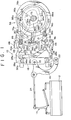
- a dobby 10 includes a jack lever 16 coupled via a conventionally well-known link mechanism 14 with a heald frame 12 which is supported displaceably up and down on an unillustrated loom frame, and a vertical lever 18 connected to the jack lever 16.
- the jack lever 16 has a C-like configuration as a whole and is pivotally connected at one end thereof with a stationary shaft 20 supported on the unillustrated loom frame.
- the other end of the jack lever 16 is pivotally secured, via a pivot 22, to a central part of the vertical lever 18.
- a connecting rod 24, which extends out from the link mechanism, is pivotally connected to the jack lever 16 at a point adjacent to the other end of the jack lever 16.
- An upper hook lever 28a and lower hook lever 28b are pivotally and respectively connected to both ends of the vertical lever 18 via their corresponding pivots 26a,26b.
- the hook levers 28a,28b extend parallel to each other at one side of the vertical lever 18.
- stoppers 30a, 30b which are respectively supported on the unillustrated loom frame are provided in such a manner that the hook levers 28a,28b can be brought into contact with their corresponding stoppers 30a,30b. Both stoppers 30a,30b control the upright position of the vertical lever 18.
- Knife hooks 32a,32b are provided corresponding to the hook levers 28a,28b.
- the knife hooks 32a,32b are turnably supported on their corresponding shafts 36a,36b which are in turn rotatably supported between upper end portions of the swing levers 34a,34b (see Fig. 3) and between lower end portions of the swing levers 34a,34b respectively.
- the knife hooks 32a,32b are respectively provided with hook portions 40,40 which are engageable with their matching hook portions 38,38 provided respectively at the free ends of their corresponding hook levers 28a,28b.
- the knife hooks 32a,32b also have cam faces 44,44 which are engageable respectively with hook stoppers 42a,42b.
- the hook stoppers 42a,42b are turnable about their corresponding pivots 46,46 supported on the unillustrated loom frame and are exerted with the tensile forces of their corresponding coil springs 48,48 as turning forces directed respectively towards the points of engagement between the hook levers 28a,28b and their corresponding knife hooks 32a,32b.
- Each of the hook stoppers 42a,42b is, as illustrated with respect to the lower hook lever 28b, kept in contact with its corresponding hook lever so as to hold the hook lever while the knife hook is kept out of engagement with its corresponding hook lever.
- Each of the hook stoppers 42a,42b is, as illustrated with respect to the upper hook lever 28a, is on the other hand released from its engagement with its corresponding hook lever by means of the cam face of the knife hook as soon as the hook lever has been brought into engagement with the knife hook.
- the knife hooks 32a,32b receive the tensile forces of their corresponding coil springs 50,50 as turning forces which are exerted about their corresponding shafts 36a,36b in directions away from their corresponding hook levers 28a,28b.
- Stoppers 52a,52b, to which one ends of the springs 50,50 are respectively connected, are supported on the swing levers 34a,34b movably together with the swing levers 34a,34b. As illustrated with respect to the upper knife hook 32b in Fig. 1, the stoppers 52 a ,52b may be brought into abutment against their corresponding knife hooks 32a,32b.
- the swing levers 34a,34b are swingable as a unitary member about a central shaft 54 which extends centrally through the swing levers 34a,34b, and are periodically swung about the central shaft 54 by means of a drive mechanism 56.
- the distance (E l ) between the center of the central shaft 54 and that of one of the shafts, i.e., the shaft 36a is equal to the distance (l 1 ) between the center of the central shaft 54 and that of other shaft, i.e., the shaft 36b.
- both end portions of the swing,levers 34a,34b are alternately moved toward and away from the vertical lever 18.
- the knife hooks 32a,32b provided at the end portions are engageable with their corresponding hook levers 28a,28b.
- the knife hooks 32a,32b are managed to engage with their corresponding hook levers 28a,28b by means of needles 58a,58b of a command device which has conventionally been well-known in the art, the knife hooks 32a,32b are turned about their corresponding shafts 36a,36b toward their corresponding hook levers 28a,28b and are then kept in engagement.
- the swing levers 34a,34b pull the hook levers 28a,28b rightwards as seen in Fig. 1 via their corresponding knife hooks 32a,32b with which the hook levers 28a,28b are respectively kept in engagement. If the upper knife hook 32a is for example selectively brought into engagement with its corresponding upper hook lever 28a and the upper hook lever 28a is thus pulled, the vertical lever 18 turns clockwise about the lower pivot 26b. This turning motion of the vertical lever 18 causes the jack lever 26 to lift the heald frame 12 to the upper position via the link mechanism 14.
- the vertical lever 18a turns counterclockwise about the upper pivot 26a. This turning motion of the vertical lever 18 causes the jack lever 26 to lift the heald frame 12 to the upper position via the link mechanism 14.
- the lowering of the heald frame 12 to the lower position is effected by the tensile force of a biasing spring.
- the lowering of the heald frame 12 to the lower position is effected by the swinging motions of an upper return knife 66a.and lower return knife 66b fixed on a swing lever 64 which is supported via a pivot 60 on the unillustrated loom frame and is coupled via a connecting rod 62 with the swing lever 34a.
- the swinging motions of the upper and lower return knives 66a,66b are synchronized with that of the swing lever 34a.
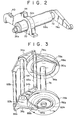
- the knife hooks 32a,32b are eccentrically supported on their corresponding shafts 36a,36b.
- an eccentric shaft 68a is rotatably fit over the shaft 36a so that the former shaft surrounds the latter shaft.
- the knife hook 32a is rotatably fit with a bearing 70 interposed therebetween.
- the eccentric shaft 68a has a journal 72 which is concentric with the shaft 36a, on which journal 72 an arm 74a is fixedly secured at one end thereof.
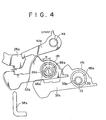
- the lower knife hook 32b is pivotally supported on its corresponding shaft 36b via an eccentric shaft 68b (see Fig. 3) and bearing which are similar to those employed for the upper knife hook 32a.
- an eccentric shaft 68b On a journal of the eccentric shaft 68b which receives the shaft 36b therein, one end of an arm 74b (see Fig. 3) is fixedly secured.
- An actuation mechanism for the arms 74a,74b is built in the drive mechanism 56 so as to actuate the arms 74a,74b in synchronization with the swing arms 34a,34b.
- the drive mechanism 56 is, as shown in Fig. 3, provided with a pair of circular cam wheels 78a,78b fixed at both ends of a drive shaft 76. Therefore, the cam wheels are integrally driven and rotated in the same direction and at the same speed.
- drive cam grooves 80a,80b for the swing levers 34a,34b are respectively formed surrounding the drive shaft 76.
- a roller 84a provided at the free end of an arm portion 82a which extends as an integral member from one of the swing levers, i.e., the swing lever 34a (see Fig. 1).
- a roller 84b provided at the free end of an arm portion 82b which extends as an integral member from the other swing lever 34b is received in the cam groove 80b of the other cam wheel 78b.
- Both cam grooves 80a,80b have the same shape and the swing levers 34a,34b undergo as a unitary unit one reciprocal swinging motion while the cam wheels 78a,78b rotate once.
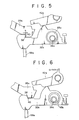
- cam grooves 86a,86b for their corresponding knife hooks are formed surrounding the drive shaft 76.
- the cam grooves 86a, 86b are formed substantially along base circles each having a center coincided with the center of rotation of the drive shaft 76 and a radius equal to the distance (1 1 ) from the central shaft 54 of-the swing levers 34a,34b to each of the shafts 36a,36b.
- cam roller 88a provided at the other end of the arm 74a for the upper knife hook 32a.
- the cam groove 86a includes an outwardly-deviated groove portion 90a, which extends radially and outwardly, in order to receive the roller 88a when the upper end portions of the swing levers 34a,34b are at their advanced positions respectively.
- a cam roller 88b provided at the other end of the arm 74b for the lower knife hook 32b is received in the cam groove 86b of the other cam wheel 78b.
- the cam groove 86b includes an outwardly-deviated groove portion, which extends radially and outwardly similar to the cam groove 86a, in order to receive the roller 88b therein when the lower end portions of the swing levers 34a,34b are respectively at the advanced positions.
- the outwardly-deviated groove portion of the cam groove 86b has a phase difference of 180? relative to the outwardly-deviated groove portion 90a of the cam groove 86a.
- the knife hooks 32a,32b do not undergo any eccentric motions about their corresponding shafts 36a, 36b. If the hook knife 32a supported on the upper end portion of the swing lever 34a moves for example from its retreated position (A) to its advanced position (B) in accordance with a swinging motion of the swing lever 34a, the arm 74a is swung counterclockwise, as seen in Fig. 4, about the shaft 36a because the cam roller 88a of the arm 74a engages with the outwardly-deviated groove portion 90a of the cam groove 86a at the advanced position. Owing to the swinging motion of the arm 74a, the eccentric shaft 68a is turned counterclockwise over an angle a about the shaft 36a at the advanced position B. As a result, the upper knife hook 32a undergoes a leftward eccentric motion over a distance h toward the upper hook lever 28a as illustrated by phantom lines in Fig. 4.
- the lower knife hook 32b temporarily undergoes the above-mentioned eccentric motion in order to establish the spacing h between the knife hook 32b per se and the lower hook lever 28b when the lower knife hook 32b, which assumes its advanced position, engages with the lower hook lever 28b so as to hold the heald frame 12 continuously at the raised position after, for example, the upper knife hook 32a has engaged at its advanced position with the upper hook lever 28a and then moved to its retreated position so as to lift the heald frame 12. Accordingly, the lower knife hook 32b and lower hook lever 28b can be brought into mutual engagement without causing the swing arms to undergo any excessive swinging motion while maintaining the engagement between the upper knife hook 32a and upper hook lever 28a. Consequently, the heald frame can be moved smoothly in accordance with the command from the command device without-causing the heald frame 12 to undergo such a jumping motion as seen in a loom equipped with a conventional dobby.
- the dobby of this invention can be applied as a passive dobby.
- the present invention can avoid vibrations, impacts and cut-off of warp yarns due to jumping of a heald frame and can also achieve an increased operation speed for a dobby and hence an improved work efficiency.
Landscapes
- Engineering & Computer Science (AREA)
- Textile Engineering (AREA)
- Looms (AREA)
- Sewing Machines And Sewing (AREA)
Applications Claiming Priority (2)
| Application Number | Priority Date | Filing Date | Title |
|---|---|---|---|
| JP57228596A JPS59125935A (ja) | 1982-12-29 | 1982-12-29 | ドビ− |
| JP228596/82 | 1982-12-29 |
Publications (2)
| Publication Number | Publication Date |
|---|---|
| EP0114931A2 true EP0114931A2 (de) | 1984-08-08 |
| EP0114931A3 EP0114931A3 (de) | 1984-10-17 |
Family
ID=16878830
Family Applications (1)
| Application Number | Title | Priority Date | Filing Date |
|---|---|---|---|
| EP83109283A Withdrawn EP0114931A3 (de) | 1982-12-29 | 1983-09-19 | Schaftmaschine |
Country Status (2)
| Country | Link |
|---|---|
| EP (1) | EP0114931A3 (de) |
| JP (1) | JPS59125935A (de) |
Families Citing this family (1)
| Publication number | Priority date | Publication date | Assignee | Title |
|---|---|---|---|---|
| JPS63161877U (de) * | 1987-04-09 | 1988-10-21 |
Family Cites Families (4)
| Publication number | Priority date | Publication date | Assignee | Title |
|---|---|---|---|---|
| DE1152070B (de) * | 1955-03-16 | 1963-07-25 | Staeubli Geb & Co | Doppelhub-Schaftmaschine |
| DE1275482B (de) * | 1958-04-11 | 1968-08-14 | Rueti Ag Maschf | Zwanglaeufig arbeitende Doppelhubschaftmaschine mit einer den Abstand zwischen den Rastflaechen der Zugmesser und den Zusatzmessern zur Herstellung des Einlesespiels verkuerzenden Einrichtung |
| DE1710200A1 (de) * | 1967-07-06 | 1971-10-21 | Erich Trumpelt | Doppelhub-Schaftmaschine |
| DE2338124C3 (de) * | 1973-07-27 | 1980-05-08 | Johann Kaiser Gmbh & Co Kg, Maschinenfabrik Und Eisengiesserei, 8580 Bayreuth | Doppelhub-Schaftmaschine Bauart Hattersley |
-
1982
- 1982-12-29 JP JP57228596A patent/JPS59125935A/ja active Granted
-
1983
- 1983-09-19 EP EP83109283A patent/EP0114931A3/de not_active Withdrawn
Also Published As
| Publication number | Publication date |
|---|---|
| JPS59125935A (ja) | 1984-07-20 |
| EP0114931A3 (de) | 1984-10-17 |
| JPS618176B2 (de) | 1986-03-12 |
Similar Documents
| Publication | Publication Date | Title |
|---|---|---|
| EP0452018B1 (de) | Vorrichtung zur Einstellung der Maschenlänge auf einer Flachstrickmaschine | |
| JP3249559B2 (ja) | 曲げ成形機械とその曲げ方法 | |
| KR950006386B1 (ko) | 웨브(web) 권취 방법 및 장치 | |
| EP0377049B1 (de) | Selbsttätige werkzeugauswechselvorrichtung für werkzeugmaschinen | |
| JPH05505505A (ja) | 巻線型回転子を備えた非同期電動機の短絡・ブラシリフティング装置 | |
| US4730641A (en) | Rotational dobby | |
| EP0034045B1 (de) | Negativ gesteuerte Doppelhub-Schaftmaschine | |
| US4250930A (en) | Reading device for dobbies or other weaving mechanism | |
| US4105228A (en) | Automatic knot-forming machine for the formation of the fisherman's knot | |
| US4106419A (en) | Sewing machine | |
| EP0485009B1 (de) | Vorrichtung zum Steuern einer Rotationsschaftmaschine für Webstühle, mit Nockenhebel und dazugehörigen Gegenstücken | |
| US4517908A (en) | Automatic notching device in a sewing machine | |
| JPS624470Y2 (de) | ||
| JPS5917598Y2 (ja) | 断裁機におけるカツタ−駆動装置 | |
| JP2866488B2 (ja) | ミシン | |
| US4766936A (en) | Card switching apparatus for dobby | |
| JPH0137494B2 (de) | ||
| SU445211A1 (ru) | Ремизоподъемна каретка с встречным движением ремизок | |
| US4699181A (en) | Rotary dobby | |
| JPS638777Y2 (de) | ||
| JPH0220223Y2 (de) | ||
| JPS59125935A (ja) | ドビ− | |
| JPH0244931B2 (de) | ||
| JPH0135729Y2 (de) | ||
| KR920002021Y1 (ko) | 직기의 위사선택장치 |
Legal Events
| Date | Code | Title | Description |
|---|---|---|---|
| PUAI | Public reference made under article 153(3) epc to a published international application that has entered the european phase |
Free format text: ORIGINAL CODE: 0009012 |
|
| AK | Designated contracting states |
Designated state(s): CH DE FR IT LI |
|
| PUAL | Search report despatched |
Free format text: ORIGINAL CODE: 0009013 |
|
| AK | Designated contracting states |
Designated state(s): CH DE FR IT LI |
|
| RHK1 | Main classification (correction) |
Ipc: D03C 1/28 |
|
| STAA | Information on the status of an ep patent application or granted ep patent |
Free format text: STATUS: THE APPLICATION IS DEEMED TO BE WITHDRAWN |
|
| 18D | Application deemed to be withdrawn |
Effective date: 19850618 |
|
| RIN1 | Information on inventor provided before grant (corrected) |
Inventor name: MIZUGUCHI, HIROYUKI |