EP0115021B1 - Procédé pour la réalisation de reliefs et de plaques d'impression positives - Google Patents
Procédé pour la réalisation de reliefs et de plaques d'impression positives Download PDFInfo
- Publication number
- EP0115021B1 EP0115021B1 EP83112806A EP83112806A EP0115021B1 EP 0115021 B1 EP0115021 B1 EP 0115021B1 EP 83112806 A EP83112806 A EP 83112806A EP 83112806 A EP83112806 A EP 83112806A EP 0115021 B1 EP0115021 B1 EP 0115021B1
- Authority
- EP
- European Patent Office
- Prior art keywords
- layer
- light
- exposure
- dye
- wavelength
- Prior art date
- Legal status (The legal status is an assumption and is not a legal conclusion. Google has not performed a legal analysis and makes no representation as to the accuracy of the status listed.)
- Expired
Links
- 238000000034 method Methods 0.000 title claims abstract description 68
- 238000007639 printing Methods 0.000 title claims abstract description 43
- 230000008569 process Effects 0.000 title claims abstract description 40
- 150000001875 compounds Chemical class 0.000 claims abstract description 25
- 239000003638 chemical reducing agent Substances 0.000 claims abstract description 22
- TZMSYXZUNZXBOL-UHFFFAOYSA-N 10H-phenoxazine Chemical compound C1=CC=C2NC3=CC=CC=C3OC2=C1 TZMSYXZUNZXBOL-UHFFFAOYSA-N 0.000 claims abstract description 3
- SQHWUYVHKRVCMD-UHFFFAOYSA-N 2-n,2-n-dimethyl-10-phenylphenazin-10-ium-2,8-diamine;chloride Chemical compound [Cl-].C12=CC(N(C)C)=CC=C2N=C2C=CC(N)=CC2=[N+]1C1=CC=CC=C1 SQHWUYVHKRVCMD-UHFFFAOYSA-N 0.000 claims abstract description 3
- DZBUGLKDJFMEHC-UHFFFAOYSA-O acridine;hydron Chemical compound C1=CC=CC2=CC3=CC=CC=C3[NH+]=C21 DZBUGLKDJFMEHC-UHFFFAOYSA-O 0.000 claims abstract description 3
- 238000004519 manufacturing process Methods 0.000 claims description 28
- 239000000203 mixture Substances 0.000 claims description 24
- 239000011230 binding agent Substances 0.000 claims description 13
- OARRHUQTFTUEOS-UHFFFAOYSA-N safranin Chemical compound [Cl-].C=12C=C(N)C(C)=CC2=NC2=CC(C)=C(N)C=C2[N+]=1C1=CC=CC=C1 OARRHUQTFTUEOS-UHFFFAOYSA-N 0.000 claims description 13
- 229910052739 hydrogen Inorganic materials 0.000 claims description 12
- 239000001257 hydrogen Substances 0.000 claims description 12
- LXCJGJYAOVCKLO-UHFFFAOYSA-N n-cyclohexyl-n-hydroxynitrous amide Chemical compound O=NN(O)C1CCCCC1 LXCJGJYAOVCKLO-UHFFFAOYSA-N 0.000 claims description 10
- 238000006116 polymerization reaction Methods 0.000 claims description 9
- 239000000654 additive Substances 0.000 claims description 8
- CXKWCBBOMKCUKX-UHFFFAOYSA-M methylene blue Chemical compound [Cl-].C1=CC(N(C)C)=CC2=[S+]C3=CC(N(C)C)=CC=C3N=C21 CXKWCBBOMKCUKX-UHFFFAOYSA-M 0.000 claims description 7
- 125000001997 phenyl group Chemical group [H]C1=C([H])C([H])=C(*)C([H])=C1[H] 0.000 claims description 7
- 239000003999 initiator Substances 0.000 claims description 6
- 229960000907 methylthioninium chloride Drugs 0.000 claims description 6
- 150000003839 salts Chemical class 0.000 claims description 6
- 125000004178 (C1-C4) alkyl group Chemical group 0.000 claims description 5
- 125000000217 alkyl group Chemical group 0.000 claims description 5
- 125000003118 aryl group Chemical group 0.000 claims description 5
- PGSADBUBUOPOJS-UHFFFAOYSA-N neutral red Chemical compound Cl.C1=C(C)C(N)=CC2=NC3=CC(N(C)C)=CC=C3N=C21 PGSADBUBUOPOJS-UHFFFAOYSA-N 0.000 claims description 5
- PVPBBTJXIKFICP-UHFFFAOYSA-N (7-aminophenothiazin-3-ylidene)azanium;chloride Chemical compound [Cl-].C1=CC(=[NH2+])C=C2SC3=CC(N)=CC=C3N=C21 PVPBBTJXIKFICP-UHFFFAOYSA-N 0.000 claims description 4
- 125000000229 (C1-C4)alkoxy group Chemical group 0.000 claims description 4
- 229910052760 oxygen Inorganic materials 0.000 claims description 4
- 239000002253 acid Substances 0.000 claims description 3
- 125000002252 acyl group Chemical group 0.000 claims description 3
- HTKFORQRBXIQHD-UHFFFAOYSA-N allylthiourea Chemical compound NC(=S)NCC=C HTKFORQRBXIQHD-UHFFFAOYSA-N 0.000 claims description 3
- 150000001450 anions Chemical class 0.000 claims description 3
- 125000003710 aryl alkyl group Chemical group 0.000 claims description 3
- 125000004122 cyclic group Chemical group 0.000 claims description 3
- 125000001624 naphthyl group Chemical group 0.000 claims description 3
- 125000000951 phenoxy group Chemical group [H]C1=C([H])C([H])=C(O*)C([H])=C1[H] 0.000 claims description 3
- 229910052717 sulfur Inorganic materials 0.000 claims description 3
- 125000003178 carboxy group Chemical group [H]OC(*)=O 0.000 claims description 2
- 229910052736 halogen Inorganic materials 0.000 claims description 2
- 150000002367 halogens Chemical class 0.000 claims description 2
- 125000000623 heterocyclic group Chemical group 0.000 claims description 2
- 125000003107 substituted aryl group Chemical group 0.000 claims description 2
- 125000000020 sulfo group Chemical group O=S(=O)([*])O[H] 0.000 claims description 2
- 238000005406 washing Methods 0.000 claims description 2
- 150000002431 hydrogen Chemical group 0.000 claims 5
- 125000002887 hydroxy group Chemical group [H]O* 0.000 claims 3
- UFHFLCQGNIYNRP-UHFFFAOYSA-N Hydrogen Chemical compound [H][H] UFHFLCQGNIYNRP-UHFFFAOYSA-N 0.000 claims 1
- HDCXQTPVTAIPNZ-UHFFFAOYSA-N n-({[4-(aminosulfonyl)phenyl]amino}carbonyl)-4-methylbenzenesulfonamide Chemical compound C1=CC(C)=CC=C1S(=O)(=O)NC(=O)NC1=CC=C(S(N)(=O)=O)C=C1 HDCXQTPVTAIPNZ-UHFFFAOYSA-N 0.000 claims 1
- 239000010410 layer Substances 0.000 description 172
- 239000000975 dye Substances 0.000 description 57
- -1 nitro aromatic compound Chemical class 0.000 description 41
- 239000010408 film Substances 0.000 description 22
- LYCAIKOWRPUZTN-UHFFFAOYSA-N Ethylene glycol Chemical compound OCCO LYCAIKOWRPUZTN-UHFFFAOYSA-N 0.000 description 21
- 239000003112 inhibitor Substances 0.000 description 16
- 150000003254 radicals Chemical class 0.000 description 15
- 125000004435 hydrogen atom Chemical group [H]* 0.000 description 12
- 238000012719 thermal polymerization Methods 0.000 description 11
- 239000000178 monomer Substances 0.000 description 9
- 229920002451 polyvinyl alcohol Polymers 0.000 description 8
- XLYOFNOQVPJJNP-UHFFFAOYSA-N water Substances O XLYOFNOQVPJJNP-UHFFFAOYSA-N 0.000 description 8
- 239000000470 constituent Substances 0.000 description 7
- 239000000463 material Substances 0.000 description 7
- 229910000831 Steel Inorganic materials 0.000 description 6
- PPBRXRYQALVLMV-UHFFFAOYSA-N Styrene Chemical compound C=CC1=CC=CC=C1 PPBRXRYQALVLMV-UHFFFAOYSA-N 0.000 description 6
- 230000000052 comparative effect Effects 0.000 description 6
- 229920001577 copolymer Polymers 0.000 description 6
- 238000002474 experimental method Methods 0.000 description 6
- 229920000642 polymer Polymers 0.000 description 6
- XAEFZNCEHLXOMS-UHFFFAOYSA-M potassium benzoate Chemical compound [K+].[O-]C(=O)C1=CC=CC=C1 XAEFZNCEHLXOMS-UHFFFAOYSA-M 0.000 description 6
- 239000010959 steel Substances 0.000 description 6
- LFQSCWFLJHTTHZ-UHFFFAOYSA-N Ethanol Chemical compound CCO LFQSCWFLJHTTHZ-UHFFFAOYSA-N 0.000 description 5
- RRHGJUQNOFWUDK-UHFFFAOYSA-N Isoprene Chemical compound CC(=C)C=C RRHGJUQNOFWUDK-UHFFFAOYSA-N 0.000 description 5
- 239000004372 Polyvinyl alcohol Substances 0.000 description 5
- 238000010521 absorption reaction Methods 0.000 description 5
- 239000002904 solvent Substances 0.000 description 5
- 230000001960 triggered effect Effects 0.000 description 5
- KAKZBPTYRLMSJV-UHFFFAOYSA-N Butadiene Chemical compound C=CC=C KAKZBPTYRLMSJV-UHFFFAOYSA-N 0.000 description 4
- 238000011161 development Methods 0.000 description 4
- MTHSVFCYNBDYFN-UHFFFAOYSA-N diethylene glycol Chemical compound OCCOCCO MTHSVFCYNBDYFN-UHFFFAOYSA-N 0.000 description 4
- 230000004069 differentiation Effects 0.000 description 4
- 125000004356 hydroxy functional group Chemical group O* 0.000 description 4
- 239000000843 powder Substances 0.000 description 4
- 239000010453 quartz Substances 0.000 description 4
- 230000005855 radiation Effects 0.000 description 4
- VYPSYNLAJGMNEJ-UHFFFAOYSA-N silicon dioxide Inorganic materials O=[Si]=O VYPSYNLAJGMNEJ-UHFFFAOYSA-N 0.000 description 4
- KWVGIHKZDCUPEU-UHFFFAOYSA-N 2,2-dimethoxy-2-phenylacetophenone Chemical compound C=1C=CC=CC=1C(OC)(OC)C(=O)C1=CC=CC=C1 KWVGIHKZDCUPEU-UHFFFAOYSA-N 0.000 description 3
- CERQOIWHTDAKMF-UHFFFAOYSA-N Methacrylic acid Chemical compound CC(=C)C(O)=O CERQOIWHTDAKMF-UHFFFAOYSA-N 0.000 description 3
- CNCOEDDPFOAUMB-UHFFFAOYSA-N N-Methylolacrylamide Chemical compound OCNC(=O)C=C CNCOEDDPFOAUMB-UHFFFAOYSA-N 0.000 description 3
- 150000001252 acrylic acid derivatives Chemical class 0.000 description 3
- NIXOWILDQLNWCW-UHFFFAOYSA-N acrylic acid group Chemical group C(C=C)(=O)O NIXOWILDQLNWCW-UHFFFAOYSA-N 0.000 description 3
- 239000000853 adhesive Substances 0.000 description 3
- 230000001070 adhesive effect Effects 0.000 description 3
- 230000008901 benefit Effects 0.000 description 3
- DZBUGLKDJFMEHC-UHFFFAOYSA-N benzoquinolinylidene Natural products C1=CC=CC2=CC3=CC=CC=C3N=C21 DZBUGLKDJFMEHC-UHFFFAOYSA-N 0.000 description 3
- 125000004432 carbon atom Chemical group C* 0.000 description 3
- 238000001035 drying Methods 0.000 description 3
- 230000000694 effects Effects 0.000 description 3
- 239000000945 filler Substances 0.000 description 3
- RAXXELZNTBOGNW-UHFFFAOYSA-N imidazole Natural products C1=CNC=N1 RAXXELZNTBOGNW-UHFFFAOYSA-N 0.000 description 3
- QSHDDOUJBYECFT-UHFFFAOYSA-N mercury Chemical compound [Hg] QSHDDOUJBYECFT-UHFFFAOYSA-N 0.000 description 3
- 229910052753 mercury Inorganic materials 0.000 description 3
- 125000002496 methyl group Chemical group [H]C([H])([H])* 0.000 description 3
- SHXOKQKTZJXHHR-UHFFFAOYSA-N n,n-diethyl-5-iminobenzo[a]phenoxazin-9-amine;hydrochloride Chemical compound [Cl-].C1=CC=C2C3=NC4=CC=C(N(CC)CC)C=C4OC3=CC(=[NH2+])C2=C1 SHXOKQKTZJXHHR-UHFFFAOYSA-N 0.000 description 3
- 238000007645 offset printing Methods 0.000 description 3
- 229920000728 polyester Polymers 0.000 description 3
- 238000007127 saponification reaction Methods 0.000 description 3
- 239000000243 solution Substances 0.000 description 3
- MSAHTMIQULFMRG-UHFFFAOYSA-N 1,2-diphenyl-2-propan-2-yloxyethanone Chemical compound C=1C=CC=CC=1C(OC(C)C)C(=O)C1=CC=CC=C1 MSAHTMIQULFMRG-UHFFFAOYSA-N 0.000 description 2
- SMZOUWXMTYCWNB-UHFFFAOYSA-N 2-(2-methoxy-5-methylphenyl)ethanamine Chemical compound COC1=CC=C(C)C=C1CCN SMZOUWXMTYCWNB-UHFFFAOYSA-N 0.000 description 2
- CCJAYIGMMRQRAO-UHFFFAOYSA-N 2-[4-[(2-hydroxyphenyl)methylideneamino]butyliminomethyl]phenol Chemical compound OC1=CC=CC=C1C=NCCCCN=CC1=CC=CC=C1O CCJAYIGMMRQRAO-UHFFFAOYSA-N 0.000 description 2
- JWAZRIHNYRIHIV-UHFFFAOYSA-N 2-naphthol Chemical compound C1=CC=CC2=CC(O)=CC=C21 JWAZRIHNYRIHIV-UHFFFAOYSA-N 0.000 description 2
- DZIHTWJGPDVSGE-UHFFFAOYSA-N 4-[(4-aminocyclohexyl)methyl]cyclohexan-1-amine Chemical compound C1CC(N)CCC1CC1CCC(N)CC1 DZIHTWJGPDVSGE-UHFFFAOYSA-N 0.000 description 2
- HRPVXLWXLXDGHG-UHFFFAOYSA-N Acrylamide Chemical compound NC(=O)C=C HRPVXLWXLXDGHG-UHFFFAOYSA-N 0.000 description 2
- XKRFYHLGVUSROY-UHFFFAOYSA-N Argon Chemical compound [Ar] XKRFYHLGVUSROY-UHFFFAOYSA-N 0.000 description 2
- CIWBSHSKHKDKBQ-JLAZNSOCSA-N Ascorbic acid Chemical compound OC[C@H](O)[C@H]1OC(=O)C(O)=C1O CIWBSHSKHKDKBQ-JLAZNSOCSA-N 0.000 description 2
- RYGMFSIKBFXOCR-UHFFFAOYSA-N Copper Chemical compound [Cu] RYGMFSIKBFXOCR-UHFFFAOYSA-N 0.000 description 2
- PEDCQBHIVMGVHV-UHFFFAOYSA-N Glycerine Chemical compound OCC(O)CO PEDCQBHIVMGVHV-UHFFFAOYSA-N 0.000 description 2
- QIGBRXMKCJKVMJ-UHFFFAOYSA-N Hydroquinone Chemical compound OC1=CC=C(O)C=C1 QIGBRXMKCJKVMJ-UHFFFAOYSA-N 0.000 description 2
- XEEYBQQBJWHFJM-UHFFFAOYSA-N Iron Chemical compound [Fe] XEEYBQQBJWHFJM-UHFFFAOYSA-N 0.000 description 2
- 239000004952 Polyamide Substances 0.000 description 2
- 239000004793 Polystyrene Substances 0.000 description 2
- JUJWROOIHBZHMG-UHFFFAOYSA-N Pyridine Chemical compound C1=CC=NC=C1 JUJWROOIHBZHMG-UHFFFAOYSA-N 0.000 description 2
- 239000012790 adhesive layer Substances 0.000 description 2
- WNLRTRBMVRJNCN-UHFFFAOYSA-N adipic acid Chemical compound OC(=O)CCCCC(O)=O WNLRTRBMVRJNCN-UHFFFAOYSA-N 0.000 description 2
- 150000001298 alcohols Chemical class 0.000 description 2
- AZDRQVAHHNSJOQ-UHFFFAOYSA-N alumane Chemical class [AlH3] AZDRQVAHHNSJOQ-UHFFFAOYSA-N 0.000 description 2
- 150000001408 amides Chemical class 0.000 description 2
- 125000005605 benzo group Chemical group 0.000 description 2
- ISAOCJYIOMOJEB-UHFFFAOYSA-N benzoin Chemical compound C=1C=CC=CC=1C(O)C(=O)C1=CC=CC=C1 ISAOCJYIOMOJEB-UHFFFAOYSA-N 0.000 description 2
- 229960002130 benzoin Drugs 0.000 description 2
- MTAZNLWOLGHBHU-UHFFFAOYSA-N butadiene-styrene rubber Chemical compound C=CC=C.C=CC1=CC=CC=C1 MTAZNLWOLGHBHU-UHFFFAOYSA-N 0.000 description 2
- WERYXYBDKMZEQL-UHFFFAOYSA-N butane-1,4-diol Chemical compound OCCCCO WERYXYBDKMZEQL-UHFFFAOYSA-N 0.000 description 2
- 239000001913 cellulose Substances 0.000 description 2
- 229920002678 cellulose Polymers 0.000 description 2
- 229910052802 copper Inorganic materials 0.000 description 2
- 239000010949 copper Substances 0.000 description 2
- 239000013039 cover film Substances 0.000 description 2
- 150000002009 diols Chemical class 0.000 description 2
- JBKVHLHDHHXQEQ-UHFFFAOYSA-N epsilon-caprolactam Chemical compound O=C1CCCCCN1 JBKVHLHDHHXQEQ-UHFFFAOYSA-N 0.000 description 2
- 150000002148 esters Chemical class 0.000 description 2
- 150000002170 ethers Chemical class 0.000 description 2
- 125000001495 ethyl group Chemical group [H]C([H])([H])C([H])([H])* 0.000 description 2
- WOLATMHLPFJRGC-UHFFFAOYSA-N furan-2,5-dione;styrene Chemical compound O=C1OC(=O)C=C1.C=CC1=CC=CC=C1 WOLATMHLPFJRGC-UHFFFAOYSA-N 0.000 description 2
- 125000005843 halogen group Chemical group 0.000 description 2
- NAQMVNRVTILPCV-UHFFFAOYSA-N hexane-1,6-diamine Chemical compound NCCCCCCN NAQMVNRVTILPCV-UHFFFAOYSA-N 0.000 description 2
- 239000007788 liquid Substances 0.000 description 2
- 230000003287 optical effect Effects 0.000 description 2
- NWVVVBRKAWDGAB-UHFFFAOYSA-N p-methoxyphenol Chemical compound COC1=CC=C(O)C=C1 NWVVVBRKAWDGAB-UHFFFAOYSA-N 0.000 description 2
- 229920002647 polyamide Polymers 0.000 description 2
- 229920001223 polyethylene glycol Polymers 0.000 description 2
- 229920005862 polyol Polymers 0.000 description 2
- 150000003077 polyols Chemical class 0.000 description 2
- 229920002635 polyurethane Polymers 0.000 description 2
- 239000004814 polyurethane Substances 0.000 description 2
- 238000012545 processing Methods 0.000 description 2
- 230000009467 reduction Effects 0.000 description 2
- PYWVYCXTNDRMGF-UHFFFAOYSA-N rhodamine B Chemical compound [Cl-].C=12C=CC(=[N+](CC)CC)C=C2OC2=CC(N(CC)CC)=CC=C2C=1C1=CC=CC=C1C(O)=O PYWVYCXTNDRMGF-UHFFFAOYSA-N 0.000 description 2
- 229920006395 saturated elastomer Polymers 0.000 description 2
- 239000007787 solid Substances 0.000 description 2
- UMGDCJDMYOKAJW-UHFFFAOYSA-N thiourea Chemical compound NC(N)=S UMGDCJDMYOKAJW-UHFFFAOYSA-N 0.000 description 2
- RUVINXPYWBROJD-ONEGZZNKSA-N trans-anethole Chemical compound COC1=CC=C(\C=C\C)C=C1 RUVINXPYWBROJD-ONEGZZNKSA-N 0.000 description 2
- ZIBGPFATKBEMQZ-UHFFFAOYSA-N triethylene glycol Chemical compound OCCOCCOCCO ZIBGPFATKBEMQZ-UHFFFAOYSA-N 0.000 description 2
- HVLLSGMXQDNUAL-UHFFFAOYSA-N triphenyl phosphite Chemical compound C=1C=CC=CC=1OP(OC=1C=CC=CC=1)OC1=CC=CC=C1 HVLLSGMXQDNUAL-UHFFFAOYSA-N 0.000 description 2
- AAAQKTZKLRYKHR-UHFFFAOYSA-N triphenylmethane Chemical compound C1=CC=CC=C1C(C=1C=CC=CC=1)C1=CC=CC=C1 AAAQKTZKLRYKHR-UHFFFAOYSA-N 0.000 description 2
- 150000003673 urethanes Chemical class 0.000 description 2
- 239000002966 varnish Substances 0.000 description 2
- 230000000007 visual effect Effects 0.000 description 2
- DNIAPMSPPWPWGF-VKHMYHEASA-N (+)-propylene glycol Chemical compound C[C@H](O)CO DNIAPMSPPWPWGF-VKHMYHEASA-N 0.000 description 1
- 229920002818 (Hydroxyethyl)methacrylate Polymers 0.000 description 1
- DNIAPMSPPWPWGF-GSVOUGTGSA-N (R)-(-)-Propylene glycol Chemical compound C[C@@H](O)CO DNIAPMSPPWPWGF-GSVOUGTGSA-N 0.000 description 1
- WDCYWAQPCXBPJA-UHFFFAOYSA-N 1,3-dinitrobenzene Chemical compound [O-][N+](=O)C1=CC=CC([N+]([O-])=O)=C1 WDCYWAQPCXBPJA-UHFFFAOYSA-N 0.000 description 1
- YPFDHNVEDLHUCE-UHFFFAOYSA-N 1,3-propanediol Substances OCCCO YPFDHNVEDLHUCE-UHFFFAOYSA-N 0.000 description 1
- AZQWKYJCGOJGHM-UHFFFAOYSA-N 1,4-benzoquinone Chemical compound O=C1C=CC(=O)C=C1 AZQWKYJCGOJGHM-UHFFFAOYSA-N 0.000 description 1
- 125000001637 1-naphthyl group Chemical group [H]C1=C([H])C([H])=C2C(*)=C([H])C([H])=C([H])C2=C1[H] 0.000 description 1
- WJFKNYWRSNBZNX-UHFFFAOYSA-N 10H-phenothiazine Chemical compound C1=CC=C2NC3=CC=CC=C3SC2=C1 WJFKNYWRSNBZNX-UHFFFAOYSA-N 0.000 description 1
- QPYKYDBKQYZEKG-UHFFFAOYSA-N 2,2-dimethylpropane-1,1-diol Chemical compound CC(C)(C)C(O)O QPYKYDBKQYZEKG-UHFFFAOYSA-N 0.000 description 1
- HIXDQWDOVZUNNA-UHFFFAOYSA-N 2-(3,4-dimethoxyphenyl)-5-hydroxy-7-methoxychromen-4-one Chemical compound C=1C(OC)=CC(O)=C(C(C=2)=O)C=1OC=2C1=CC=C(OC)C(OC)=C1 HIXDQWDOVZUNNA-UHFFFAOYSA-N 0.000 description 1
- BQZJOQXSCSZQPS-UHFFFAOYSA-N 2-methoxy-1,2-diphenylethanone Chemical compound C=1C=CC=CC=1C(OC)C(=O)C1=CC=CC=C1 BQZJOQXSCSZQPS-UHFFFAOYSA-N 0.000 description 1
- 125000004204 2-methoxyphenyl group Chemical group [H]C1=C([H])C(*)=C(OC([H])([H])[H])C([H])=C1[H] 0.000 description 1
- USDDHXNRSWIAES-UHFFFAOYSA-N 2-n-[4-(dimethylamino)phenyl]-7-n,7-n-dimethylphenazine-2,3,7-triamine;hydrochloride Chemical compound Cl.C1=CC(N(C)C)=CC=C1NC1=CC2=NC3=CC=C(N(C)C)C=C3N=C2C=C1N USDDHXNRSWIAES-UHFFFAOYSA-N 0.000 description 1
- 125000001622 2-naphthyl group Chemical group [H]C1=C([H])C([H])=C2C([H])=C(*)C([H])=C([H])C2=C1[H] 0.000 description 1
- KKAJSJJFBSOMGS-UHFFFAOYSA-N 3,6-diamino-10-methylacridinium chloride Chemical compound [Cl-].C1=C(N)C=C2[N+](C)=C(C=C(N)C=C3)C3=CC2=C1 KKAJSJJFBSOMGS-UHFFFAOYSA-N 0.000 description 1
- QZHXKQKKEBXYRG-UHFFFAOYSA-N 4-n-(4-aminophenyl)benzene-1,4-diamine Chemical compound C1=CC(N)=CC=C1NC1=CC=C(N)C=C1 QZHXKQKKEBXYRG-UHFFFAOYSA-N 0.000 description 1
- JSTCPNFNKICNNO-UHFFFAOYSA-N 4-nitrosophenol Chemical compound OC1=CC=C(N=O)C=C1 JSTCPNFNKICNNO-UHFFFAOYSA-N 0.000 description 1
- IICHURGZQPGTRD-UHFFFAOYSA-N 4-phenyldiazenylnaphthalen-1-amine Chemical compound C12=CC=CC=C2C(N)=CC=C1N=NC1=CC=CC=C1 IICHURGZQPGTRD-UHFFFAOYSA-N 0.000 description 1
- UFFRSDWQMJYQNE-UHFFFAOYSA-N 6-azaniumylhexylazanium;hexanedioate Chemical compound [NH3+]CCCCCC[NH3+].[O-]C(=O)CCCCC([O-])=O UFFRSDWQMJYQNE-UHFFFAOYSA-N 0.000 description 1
- YYVYAPXYZVYDHN-UHFFFAOYSA-N 9,10-phenanthroquinone Chemical compound C1=CC=C2C(=O)C(=O)C3=CC=CC=C3C2=C1 YYVYAPXYZVYDHN-UHFFFAOYSA-N 0.000 description 1
- NIXOWILDQLNWCW-UHFFFAOYSA-M Acrylate Chemical compound [O-]C(=O)C=C NIXOWILDQLNWCW-UHFFFAOYSA-M 0.000 description 1
- 229920002126 Acrylic acid copolymer Polymers 0.000 description 1
- KHBQMWCZKVMBLN-UHFFFAOYSA-N Benzenesulfonamide Chemical compound NS(=O)(=O)C1=CC=CC=C1 KHBQMWCZKVMBLN-UHFFFAOYSA-N 0.000 description 1
- IFAHPMDLRQANQE-UHFFFAOYSA-N COC(C(C1=C(C=CC=C1)CO)=O)C1=CC=CC=C1 Chemical compound COC(C(C1=C(C=CC=C1)CO)=O)C1=CC=CC=C1 IFAHPMDLRQANQE-UHFFFAOYSA-N 0.000 description 1
- 235000015655 Crocus sativus Nutrition 0.000 description 1
- 244000124209 Crocus sativus Species 0.000 description 1
- 244000215562 Heliotropium arborescens Species 0.000 description 1
- WOBHKFSMXKNTIM-UHFFFAOYSA-N Hydroxyethyl methacrylate Chemical compound CC(=C)C(=O)OCCO WOBHKFSMXKNTIM-UHFFFAOYSA-N 0.000 description 1
- UBUCNCOMADRQHX-UHFFFAOYSA-N N-Nitrosodiphenylamine Chemical compound C=1C=CC=CC=1N(N=O)C1=CC=CC=C1 UBUCNCOMADRQHX-UHFFFAOYSA-N 0.000 description 1
- 229920000459 Nitrile rubber Polymers 0.000 description 1
- 240000007594 Oryza sativa Species 0.000 description 1
- 235000007164 Oryza sativa Nutrition 0.000 description 1
- XYFCBTPGUUZFHI-UHFFFAOYSA-N Phosphine Chemical compound P XYFCBTPGUUZFHI-UHFFFAOYSA-N 0.000 description 1
- 229920002845 Poly(methacrylic acid) Chemical class 0.000 description 1
- 239000005062 Polybutadiene Substances 0.000 description 1
- 239000004698 Polyethylene Substances 0.000 description 1
- 239000004721 Polyphenylene oxide Substances 0.000 description 1
- 239000004743 Polypropylene Substances 0.000 description 1
- ZLMJMSJWJFRBEC-UHFFFAOYSA-N Potassium Chemical compound [K] ZLMJMSJWJFRBEC-UHFFFAOYSA-N 0.000 description 1
- OFOBLEOULBTSOW-UHFFFAOYSA-N Propanedioic acid Natural products OC(=O)CC(O)=O OFOBLEOULBTSOW-UHFFFAOYSA-N 0.000 description 1
- 229920002125 Sokalan® Chemical class 0.000 description 1
- 244000028419 Styrax benzoin Species 0.000 description 1
- 235000000126 Styrax benzoin Nutrition 0.000 description 1
- 235000008411 Sumatra benzointree Nutrition 0.000 description 1
- ZJCCRDAZUWHFQH-UHFFFAOYSA-N Trimethylolpropane Chemical compound CCC(CO)(CO)CO ZJCCRDAZUWHFQH-UHFFFAOYSA-N 0.000 description 1
- XSQUKJJJFZCRTK-UHFFFAOYSA-N Urea Natural products NC(N)=O XSQUKJJJFZCRTK-UHFFFAOYSA-N 0.000 description 1
- XTXRWKRVRITETP-UHFFFAOYSA-N Vinyl acetate Chemical compound CC(=O)OC=C XTXRWKRVRITETP-UHFFFAOYSA-N 0.000 description 1
- 241000404236 Zizina otis Species 0.000 description 1
- DPKHZNPWBDQZCN-UHFFFAOYSA-N acridine orange free base Chemical compound C1=CC(N(C)C)=CC2=NC3=CC(N(C)C)=CC=C3C=C21 DPKHZNPWBDQZCN-UHFFFAOYSA-N 0.000 description 1
- BGLGAKMTYHWWKW-UHFFFAOYSA-N acridine yellow Chemical compound [H+].[Cl-].CC1=C(N)C=C2N=C(C=C(C(C)=C3)N)C3=CC2=C1 BGLGAKMTYHWWKW-UHFFFAOYSA-N 0.000 description 1
- 229940023020 acriflavine Drugs 0.000 description 1
- 229920006397 acrylic thermoplastic Polymers 0.000 description 1
- WNLRTRBMVRJNCN-UHFFFAOYSA-L adipate(2-) Chemical compound [O-]C(=O)CCCCC([O-])=O WNLRTRBMVRJNCN-UHFFFAOYSA-L 0.000 description 1
- 235000011037 adipic acid Nutrition 0.000 description 1
- 239000001361 adipic acid Substances 0.000 description 1
- 230000002411 adverse Effects 0.000 description 1
- 125000003158 alcohol group Chemical group 0.000 description 1
- 150000001338 aliphatic hydrocarbons Chemical class 0.000 description 1
- 239000003513 alkali Substances 0.000 description 1
- 150000005215 alkyl ethers Chemical class 0.000 description 1
- XAGFODPZIPBFFR-UHFFFAOYSA-N aluminium Chemical compound [Al] XAGFODPZIPBFFR-UHFFFAOYSA-N 0.000 description 1
- 229910052782 aluminium Inorganic materials 0.000 description 1
- 125000003368 amide group Chemical group 0.000 description 1
- 229940011037 anethole Drugs 0.000 description 1
- 239000007864 aqueous solution Substances 0.000 description 1
- 229910052786 argon Inorganic materials 0.000 description 1
- 150000004945 aromatic hydrocarbons Chemical class 0.000 description 1
- 229960005070 ascorbic acid Drugs 0.000 description 1
- 235000010323 ascorbic acid Nutrition 0.000 description 1
- 239000011668 ascorbic acid Substances 0.000 description 1
- QVGXLLKOCUKJST-UHFFFAOYSA-N atomic oxygen Chemical compound [O] QVGXLLKOCUKJST-UHFFFAOYSA-N 0.000 description 1
- WURBFLDFSFBTLW-UHFFFAOYSA-N benzil Chemical compound C=1C=CC=CC=1C(=O)C(=O)C1=CC=CC=C1 WURBFLDFSFBTLW-UHFFFAOYSA-N 0.000 description 1
- 150000008366 benzophenones Chemical class 0.000 description 1
- 230000015572 biosynthetic process Effects 0.000 description 1
- 238000004061 bleaching Methods 0.000 description 1
- 229920001400 block copolymer Polymers 0.000 description 1
- 238000005266 casting Methods 0.000 description 1
- 239000003054 catalyst Substances 0.000 description 1
- 230000008859 change Effects 0.000 description 1
- 239000007795 chemical reaction product Substances 0.000 description 1
- 150000008280 chlorinated hydrocarbons Chemical class 0.000 description 1
- 125000001309 chloro group Chemical group Cl* 0.000 description 1
- 238000009833 condensation Methods 0.000 description 1
- 230000005494 condensation Effects 0.000 description 1
- 239000013078 crystal Substances 0.000 description 1
- UKJLNMAFNRKWGR-UHFFFAOYSA-N cyclohexatrienamine Chemical group NC1=CC=C=C[CH]1 UKJLNMAFNRKWGR-UHFFFAOYSA-N 0.000 description 1
- 125000000664 diazo group Chemical group [N-]=[N+]=[*] 0.000 description 1
- 150000001993 dienes Chemical class 0.000 description 1
- 238000009792 diffusion process Methods 0.000 description 1
- 125000005442 diisocyanate group Chemical group 0.000 description 1
- VFHVQBAGLAREND-UHFFFAOYSA-N diphenylphosphoryl-(2,4,6-trimethylphenyl)methanone Chemical compound CC1=CC(C)=CC(C)=C1C(=O)P(=O)(C=1C=CC=CC=1)C1=CC=CC=C1 VFHVQBAGLAREND-UHFFFAOYSA-N 0.000 description 1
- RTZKZFJDLAIYFH-UHFFFAOYSA-N ether Substances CCOCC RTZKZFJDLAIYFH-UHFFFAOYSA-N 0.000 description 1
- 238000001704 evaporation Methods 0.000 description 1
- 230000002349 favourable effect Effects 0.000 description 1
- 239000011888 foil Substances 0.000 description 1
- 235000011187 glycerol Nutrition 0.000 description 1
- 238000007646 gravure printing Methods 0.000 description 1
- 235000019382 gum benzoic Nutrition 0.000 description 1
- 239000000852 hydrogen donor Substances 0.000 description 1
- 125000002768 hydroxyalkyl group Chemical group 0.000 description 1
- 150000002443 hydroxylamines Chemical class 0.000 description 1
- 238000003384 imaging method Methods 0.000 description 1
- 230000000977 initiatory effect Effects 0.000 description 1
- 230000003993 interaction Effects 0.000 description 1
- 238000012432 intermediate storage Methods 0.000 description 1
- 239000011872 intimate mixture Substances 0.000 description 1
- 229910052742 iron Inorganic materials 0.000 description 1
- 230000001678 irradiating effect Effects 0.000 description 1
- 150000002576 ketones Chemical class 0.000 description 1
- VZCYOOQTPOCHFL-UPHRSURJSA-N maleic acid Chemical compound OC(=O)\C=C/C(O)=O VZCYOOQTPOCHFL-UPHRSURJSA-N 0.000 description 1
- 239000011976 maleic acid Substances 0.000 description 1
- 150000002734 metacrylic acid derivatives Chemical class 0.000 description 1
- XRLMKACGWPEZBZ-UHFFFAOYSA-N methyl 7-(dimethylamino)-4-hydroxy-3-oxophenoxazin-10-ium-1-carboxylate;chloride Chemical compound [Cl-].CN(C)C1=CC=C2[NH+]=C3C(C(=O)OC)=CC(=O)C(O)=C3OC2=C1 XRLMKACGWPEZBZ-UHFFFAOYSA-N 0.000 description 1
- 150000007522 mineralic acids Chemical class 0.000 description 1
- DNIAPMSPPWPWGF-UHFFFAOYSA-N monopropylene glycol Natural products CC(O)CO DNIAPMSPPWPWGF-UHFFFAOYSA-N 0.000 description 1
- SLCVBVWXLSEKPL-UHFFFAOYSA-N neopentyl glycol Chemical compound OCC(C)(C)CO SLCVBVWXLSEKPL-UHFFFAOYSA-N 0.000 description 1
- 229940117969 neopentyl glycol Drugs 0.000 description 1
- 230000007935 neutral effect Effects 0.000 description 1
- 125000003261 o-tolyl group Chemical group [H]C1=C([H])C(*)=C(C([H])=C1[H])C([H])([H])[H] 0.000 description 1
- 239000001301 oxygen Substances 0.000 description 1
- 125000001037 p-tolyl group Chemical group [H]C1=C([H])C(=C([H])C([H])=C1*)C([H])([H])[H] 0.000 description 1
- RUVINXPYWBROJD-UHFFFAOYSA-N para-methoxyphenyl Natural products COC1=CC=C(C=CC)C=C1 RUVINXPYWBROJD-UHFFFAOYSA-N 0.000 description 1
- WXZMFSXDPGVJKK-UHFFFAOYSA-N pentaerythritol Chemical compound OCC(CO)(CO)CO WXZMFSXDPGVJKK-UHFFFAOYSA-N 0.000 description 1
- 229950000688 phenothiazine Drugs 0.000 description 1
- OJMIONKXNSYLSR-UHFFFAOYSA-N phosphorous acid Chemical class OP(O)O OJMIONKXNSYLSR-UHFFFAOYSA-N 0.000 description 1
- 239000000049 pigment Substances 0.000 description 1
- 229920003023 plastic Polymers 0.000 description 1
- 239000002985 plastic film Substances 0.000 description 1
- 239000004014 plasticizer Substances 0.000 description 1
- 229920003229 poly(methyl methacrylate) Polymers 0.000 description 1
- 229920002037 poly(vinyl butyral) polymer Polymers 0.000 description 1
- 229920000058 polyacrylate Polymers 0.000 description 1
- 239000004584 polyacrylic acid Chemical class 0.000 description 1
- 229920002857 polybutadiene Polymers 0.000 description 1
- 229920001707 polybutylene terephthalate Polymers 0.000 description 1
- 229920000570 polyether Polymers 0.000 description 1
- 229920000573 polyethylene Polymers 0.000 description 1
- 229920000139 polyethylene terephthalate Polymers 0.000 description 1
- 239000005020 polyethylene terephthalate Substances 0.000 description 1
- 229920001195 polyisoprene Polymers 0.000 description 1
- 229920001155 polypropylene Polymers 0.000 description 1
- 229920002223 polystyrene Polymers 0.000 description 1
- 229920000166 polytrimethylene carbonate Polymers 0.000 description 1
- 229920000915 polyvinyl chloride Polymers 0.000 description 1
- 239000004800 polyvinyl chloride Substances 0.000 description 1
- 229910052700 potassium Inorganic materials 0.000 description 1
- 239000011591 potassium Substances 0.000 description 1
- ARJOQCYCJMAIFR-UHFFFAOYSA-N prop-2-enoyl prop-2-enoate Chemical compound C=CC(=O)OC(=O)C=C ARJOQCYCJMAIFR-UHFFFAOYSA-N 0.000 description 1
- 235000013772 propylene glycol Nutrition 0.000 description 1
- 229940043267 rhodamine b Drugs 0.000 description 1
- 235000009566 rice Nutrition 0.000 description 1
- 239000010979 ruby Substances 0.000 description 1
- 229910001750 ruby Inorganic materials 0.000 description 1
- 235000013974 saffron Nutrition 0.000 description 1
- 239000004248 saffron Substances 0.000 description 1
- 150000003384 small molecules Chemical class 0.000 description 1
- 239000007921 spray Substances 0.000 description 1
- 230000000087 stabilizing effect Effects 0.000 description 1
- 125000000547 substituted alkyl group Chemical group 0.000 description 1
- ISXSCDLOGDJUNJ-UHFFFAOYSA-N tert-butyl prop-2-enoate Chemical compound CC(C)(C)OC(=O)C=C ISXSCDLOGDJUNJ-UHFFFAOYSA-N 0.000 description 1
- 238000012360 testing method Methods 0.000 description 1
- UWHCKJMYHZGTIT-UHFFFAOYSA-N tetraethylene glycol Chemical compound OCCOCCOCCOCCO UWHCKJMYHZGTIT-UHFFFAOYSA-N 0.000 description 1
- VZCYOOQTPOCHFL-UHFFFAOYSA-N trans-butenedioic acid Natural products OC(=O)C=CC(O)=O VZCYOOQTPOCHFL-UHFFFAOYSA-N 0.000 description 1
- 229920006305 unsaturated polyester Polymers 0.000 description 1
- JOYRKODLDBILNP-UHFFFAOYSA-N urethane group Chemical group NC(=O)OCC JOYRKODLDBILNP-UHFFFAOYSA-N 0.000 description 1
- 229920001567 vinyl ester resin Polymers 0.000 description 1
- 125000000391 vinyl group Chemical group [H]C([*])=C([H])[H] 0.000 description 1
- 229920002554 vinyl polymer Polymers 0.000 description 1
- 239000001993 wax Substances 0.000 description 1
- 239000001018 xanthene dye Substances 0.000 description 1
Classifications
-
- G—PHYSICS
- G03—PHOTOGRAPHY; CINEMATOGRAPHY; ANALOGOUS TECHNIQUES USING WAVES OTHER THAN OPTICAL WAVES; ELECTROGRAPHY; HOLOGRAPHY
- G03F—PHOTOMECHANICAL PRODUCTION OF TEXTURED OR PATTERNED SURFACES, e.g. FOR PRINTING, FOR PROCESSING OF SEMICONDUCTOR DEVICES; MATERIALS THEREFOR; ORIGINALS THEREFOR; APPARATUS SPECIALLY ADAPTED THEREFOR
- G03F7/00—Photomechanical, e.g. photolithographic, production of textured or patterned surfaces, e.g. printing surfaces; Materials therefor, e.g. comprising photoresists; Apparatus specially adapted therefor
- G03F7/004—Photosensitive materials
- G03F7/09—Photosensitive materials characterised by structural details, e.g. supports, auxiliary layers
- G03F7/105—Photosensitive materials characterised by structural details, e.g. supports, auxiliary layers having substances, e.g. indicators, for forming visible images
-
- G—PHYSICS
- G03—PHOTOGRAPHY; CINEMATOGRAPHY; ANALOGOUS TECHNIQUES USING WAVES OTHER THAN OPTICAL WAVES; ELECTROGRAPHY; HOLOGRAPHY
- G03F—PHOTOMECHANICAL PRODUCTION OF TEXTURED OR PATTERNED SURFACES, e.g. FOR PRINTING, FOR PROCESSING OF SEMICONDUCTOR DEVICES; MATERIALS THEREFOR; ORIGINALS THEREFOR; APPARATUS SPECIALLY ADAPTED THEREFOR
- G03F7/00—Photomechanical, e.g. photolithographic, production of textured or patterned surfaces, e.g. printing surfaces; Materials therefor, e.g. comprising photoresists; Apparatus specially adapted therefor
- G03F7/004—Photosensitive materials
- G03F7/027—Non-macromolecular photopolymerisable compounds having carbon-to-carbon double bonds, e.g. ethylenic compounds
- G03F7/028—Non-macromolecular photopolymerisable compounds having carbon-to-carbon double bonds, e.g. ethylenic compounds with photosensitivity-increasing substances, e.g. photoinitiators
- G03F7/031—Organic compounds not covered by group G03F7/029
-
- Y—GENERAL TAGGING OF NEW TECHNOLOGICAL DEVELOPMENTS; GENERAL TAGGING OF CROSS-SECTIONAL TECHNOLOGIES SPANNING OVER SEVERAL SECTIONS OF THE IPC; TECHNICAL SUBJECTS COVERED BY FORMER USPC CROSS-REFERENCE ART COLLECTIONS [XRACs] AND DIGESTS
- Y10—TECHNICAL SUBJECTS COVERED BY FORMER USPC
- Y10S—TECHNICAL SUBJECTS COVERED BY FORMER USPC CROSS-REFERENCE ART COLLECTIONS [XRACs] AND DIGESTS
- Y10S430/00—Radiation imagery chemistry: process, composition, or product thereof
- Y10S430/1053—Imaging affecting physical property or radiation sensitive material, or producing nonplanar or printing surface - process, composition, or product: radiation sensitive composition or product or process of making binder containing
- Y10S430/1055—Radiation sensitive composition or product or process of making
- Y10S430/114—Initiator containing
- Y10S430/116—Redox or dye sensitizer
-
- Y—GENERAL TAGGING OF NEW TECHNOLOGICAL DEVELOPMENTS; GENERAL TAGGING OF CROSS-SECTIONAL TECHNOLOGIES SPANNING OVER SEVERAL SECTIONS OF THE IPC; TECHNICAL SUBJECTS COVERED BY FORMER USPC CROSS-REFERENCE ART COLLECTIONS [XRACs] AND DIGESTS
- Y10—TECHNICAL SUBJECTS COVERED BY FORMER USPC
- Y10S—TECHNICAL SUBJECTS COVERED BY FORMER USPC CROSS-REFERENCE ART COLLECTIONS [XRACs] AND DIGESTS
- Y10S430/00—Radiation imagery chemistry: process, composition, or product thereof
- Y10S430/1053—Imaging affecting physical property or radiation sensitive material, or producing nonplanar or printing surface - process, composition, or product: radiation sensitive composition or product or process of making binder containing
- Y10S430/1055—Radiation sensitive composition or product or process of making
- Y10S430/114—Initiator containing
- Y10S430/12—Nitrogen compound containing
- Y10S430/121—Nitrogen in heterocyclic ring
-
- Y—GENERAL TAGGING OF NEW TECHNOLOGICAL DEVELOPMENTS; GENERAL TAGGING OF CROSS-SECTIONAL TECHNOLOGIES SPANNING OVER SEVERAL SECTIONS OF THE IPC; TECHNICAL SUBJECTS COVERED BY FORMER USPC CROSS-REFERENCE ART COLLECTIONS [XRACs] AND DIGESTS
- Y10—TECHNICAL SUBJECTS COVERED BY FORMER USPC
- Y10S—TECHNICAL SUBJECTS COVERED BY FORMER USPC CROSS-REFERENCE ART COLLECTIONS [XRACs] AND DIGESTS
- Y10S430/00—Radiation imagery chemistry: process, composition, or product thereof
- Y10S430/1053—Imaging affecting physical property or radiation sensitive material, or producing nonplanar or printing surface - process, composition, or product: radiation sensitive composition or product or process of making binder containing
- Y10S430/1055—Radiation sensitive composition or product or process of making
- Y10S430/114—Initiator containing
- Y10S430/122—Sulfur compound containing
- Y10S430/123—Sulfur in heterocyclic ring
Definitions
- the invention relates to a positive-working process for the production of relief and / or printing forms, in which areas in which the polymerizability is suppressed are produced in a light-sensitive, photopolymerizable layer by imagewise exposure, and the still polymerizable areas of the layer by further exposure polymerized and then developed the relief and / or printing form by removing the unpolymerized layer portions.
- the known photosensitive, photopolymerizable recording materials for the production of relief and printing forms are generally negative working, i. H. when the photopolymerizable layer is exposed imagewise, the exposed areas of this layer are photopolymerized and become insoluble in solvents in which they were previously soluble, while the unexposed areas of the layer covered by the original copy remain soluble and are removed during the development of the relief and printing form.
- positive-working recording materials or positive-working imaging processes are understood to mean those in which the areas of the light-sensitive layer which correspond to the dark or opaque areas of the original are photopolymerized, while the areas which correspond to the light or transparent areas of the original the photosensitive layer remain essentially unpolymerized and are removed when the image relief is developed, leaving behind the photopolymerized areas.
- the photopolymerizable layer is subjected to a first imagewise exposure under conditions such that a gaseous polymerization inhibitor switches off the photoinitiator which has been excited by actinic light in the exposed areas without one significant polymerization has occurred.
- the photosensitive layer is then shielded from the gaseous inhibitor during a second, non-imagewise exposure with the same actinic light, photopolymerization taking place only in those areas in which the photoinitiator was not used up during the first imagewise exposure.
- this method not only requires very careful work to ensure the desired photopolymerization during the second exposure, but is also difficult to carry out in practice because of the treatment measures required.
- DE-B2-2 338 223 describes a process for the production of positive images, in which a photopolymerizable layer which contains a hydrogen donor, a hexaarylbisimidazole, an ethylenically unsaturated, free-radically polymerizable compound and a polymeric binder in certain proportions is firstly mixed with one Exposing high intensity radiation imagewise, thereby destroying the ability to photopolymerize in the exposed areas of the layer and then subjecting the entire layer to exposure to low intensity radiation, thereby initiating photopolymerization in the previously unexposed areas.
- a photopolymerizable layer which contains a hydrogen donor, a hexaarylbisimidazole, an ethylenically unsaturated, free-radically polymerizable compound and a polymeric binder in certain proportions is firstly mixed with one Exposing high intensity radiation imagewise, thereby destroying the ability to photopolymerize in the exposed areas of the layer and then subjecting the entire layer to exposure to
- a disadvantage of this method is that both the first, imagewise exposure and the second full-area exposure of the photopolymerizable layer with actinic light of the same wavelength is carried out and therefore a very precise and careful control of the light intensity is required to achieve the necessary and desired differentiation in to achieve the layer by photopolymerization.
- the total exposure times required are too long for practical use.
- US Pat. No. 3,556,794 describes in particular the production of visible, positive images; the production of relief and in particular printing forms is not mentioned here.
- the polymerization is initiated by irradiating the photopolymerizable mixtures with visible light.
- photopolymerization with visible light is generally not very advantageous for the production of relief and / or printing forms, since the light yield is unsatisfactory; consequently, the extent of the polymerization is often insufficient for the production of relief and / or printing forms. It is therefore sensible and, in practice, also customary to polymerize photosensitive, photopolymerizable recording materials for the production of relief and / or printing forms by exposure to UV light.
- the present invention was based on the object, starting from photosensitive, photopolymerizable layers, to show a positive working process for the production of relief and / or printing forms, in which the photopolymerization in the layer can be triggered by irradiation with light in the UV wavelength range, which allow the use of conventional lasers for the exposure and allow very short exposure times.
- the process should be simple and easy to carry out and lead to exact and true-to-original relief and / or printing forms with a well-designed relief structure.
- relief and / or printing forms which represent a positive image of an imagewise template and have the desired properties, can be produced quickly and easily by using a photopolymerizable layer, the at least one photopolymerizable compound, at least one with UV-light activatable photopolymerization initiator and a combination of a special dye and a reducing agent for this dye in the excited electron state contains, imagewise with longer-wave, in particular visible light to produce a compound which inhibits the photopolymerization in the layer, exposes the layer simultaneously or subsequently completely irradiated with UV light, as a result of which the areas of the layer which are not exposed to the longer-wave light are polymerized, and then the unpolymerized areas of the layer are removed with development of the relief and / or printing form
- the invention accordingly relates to a positive working method for producing relief and / or
- the invention furthermore relates to special embodiments of the method according to the invention in accordance with the following detailed description.
- photopolymerizable layers which, in addition to at least one photopolymerizable compound and at least one photoinitiator which can be activated by light in the wavelength range from 300 to 420 nm, contain an addition of the dyes and reducing agents mentioned, exposure to longer-wave, in particular visible, light increases the polymerizability of the Layer can be suppressed or inhibited in such a way that when the layer is exposed to UV light (300-420 nm) no significant polymerization takes place, so that the layer portions exposed in this way are removed without difficulty during the subsequent development of the relief and / or printing forms or can be washed out.
- UV light 300-420 nm
- DE-A1-29 31 553 describes the stabilizing effect of a mixture of phenothiazine and p-nitrosophenol for monomeric acrylic esters and some of the dyes of the formula (I), such as. B. methylene blue, are known as thermal polymerization inhibitors for photopolymerizable mixtures (see. For example. DE-OS 22 15 090), it was in no way foreseeable that the addition of the combination of a dye of formula (1) and the reducing agent can largely or completely prevent the photopolymerization in the layers photopolymerizable with UV light, especially after u. a. in US Pat. No. 3,556,794, US Pat. No. 3,097,097 and in JACS, Vol.
- Also particularly advantageous in the method according to the invention is an extremely rapid change in the absorption properties of the dye additives during image-wise exposure, which in no way negatively influences the processing of the photopolymerizable layer.
- the most diverse desired effects can be set within the given dye structures, from total bleaching of the dyes to a color shift of z. B. blue to red.
- This property of the layers to be used according to the invention considerably facilitates the assessment of the exposed forms in the method according to the invention for producing relief and / or printing forms. In practice, therefore, such dyes are preferred as additives that make the visual assessment of the exposed form the most favorable.
- the layers to be used in the process according to the invention contain as essential constituent a) one or more compounds with at least one photopolymerizable, olefinically unsaturated double bond.
- the known monomers, oligomers and / or unsaturated polymers commonly used for the production of relief molds and photopolymer high, low and offset printing plates can be used, the type of which depends on the intended use of the photopolymerizable layer, but also on the type of other mixture components and, in the preferred use of polymeric binders in the mixture of the layer, depending on the type and compatibility with these.
- Monomers and / or oligomers with 2 or more olefinically unsaturated, photopolymerizable double bonds are preferred alone or in a mixture with monomers with only one olefinically unsaturated, photopolymerizable double bond.
- Polymers with several side and / or terminal olefinically unsaturated double bonds can also be used as the sole photopolymerizable compound or in a mixture with the monomers and / or oligomers.
- suitable monomers are the di- and polyacrylates and methacrylates, as can be prepared by esterifying diols or polyols with acrylic acid or methacrylic acid.
- ethylene glycol, di, tri or tetraethylene glycol mono (meth) acrylate Monomers with two or more olefinically unsaturated bonds which contain urethane groups and / or amide groups, such as the low molecular weight compounds prepared from aliphatic diols of the type mentioned above, organic diisocyanates and hydroxyalkyl (meth) acrylates. Also mentioned are acrylic acid, methacrylic acid and their derivatives such as (meth) acrylamide, N-hydroxymethyl (meth) acrylamide or the (meth) acrylates of monoalcohols with 1 to 6 carbon atoms.
- the layers to be used in the process according to the invention preferably also contain one or more polymeric binders.
- the organic polymeric binders known and customary for the photopolymerizable mixtures for the production of relief and printing forms, which are compatible with the photopolymerizable, olefinically unsaturated compounds (a) which are also used, and - of course for the person skilled in the art - come into consideration here. should be soluble or dispersible in the developer solution in order to allow the uncrosslinked portions of the layer to be washed out after exposure.
- Suitable polymeric, olefinically saturated or unsaturated binders may be mentioned: unsaturated polyesters, linear polyamides and particularly alcohol-soluble copolyamides, as described in FR-PS 1 520 856, cellulose derivatives, in particular cellulose derivatives which can be washed out with alkaline water, vinyl alcohol polymers and polymers and Copolymers of vinyl esters of aliphatic monocarboxylic acids with 1 to 4 carbon atoms, such as of vinyl acetate, with different degrees of saponification, polyurethanes such as polyether urethanes and polyester urethanes, polyacrylic acid and polymethacrylic acid esters, styrene / butadiene, styrene / isoprene or styrene / butadiene / isoprene copolymers Styrene / maleic anhydride or styrene / maleic acid (semi) ester copolymers
- polyvinyl butyral or the reaction product of a polyvinyl alcohol mentioned in DE-OS-30 15 340 with a certain part of (meth) acrylic anhydride are also suitable as polymeric binders for the production of relief printing forms for flexographic printing.
- elastomeric diene polymers and copolymers for example of butadiene and / or isoprene, of which the block copolymers, the polybutadiene and / or polyisoprene blocks and polymer blocks made of styrene and / or contain a-Methyistyroi, are particularly preferred.
- the nitrile rubbers such as. B. the butadiene / acrylonitrile copolymers.
- polymeric binders are present in the photopolymerizable layer, their proportion is generally about 5 to 90% by weight, in particular 45 to 80% by weight, based on the sum of polymeric binder and photopolymerizable compound.
- the content of polymeric binder also depends in particular on the use of the photopolymerizable layer.
- the relevant patent literature shows which photopolymerizable, olefinically unsaturated monomers, oligomers and / or polymers can advantageously be combined with which polymeric binders.
- the photopolymerizable layers to be used in the process according to the invention contain at least one photoinitiator (b) which - in a manner known per se - triggers rapid photopolymerization in the layer when the layer is exposed to light in the wavelength range from 300 to 420 nm.
- the photoinitiator (b) is generally present in the photopolymerizable layer in amounts of from 0.01 to 10% by weight, preferably from 0.01 to 3% by weight, based on the sum of all components of the photopolymerizable layer.
- photoinitiators (b) z. B. acyloins and acyioin ethers and aromatic diketones and their derivatives in question.
- benzoin and a-hydroxymethyl-benzoin, and their alkyl ethers with 1 to 8 carbon atoms are very suitable;
- Benzil monoketals such as benzil-dimethyl ketal, benzil-methyl-ethyl ketal, benzil-methyl-benzyl ketal or benzil-neopentyl ketal; or diarylphosphine oxides as described in DE-OS 29 09 992, for example 2,6-dimethoxybenzoyidiphenylphosphine oxide or 2,4,6-trimethylbenzoyldiphenylphosphine oxide.
- the type and amount of the photoinitiators (b) are preferably selected such that only short minimum exposure times are required for triggering the photopolymerization when the photopolymerizable layer is exposed to light in the wavelength range from 300 to 420 nm, preferably in the wavelength range from 320 to 380 nm .
- the photoinitiators (b) are preferably not dyes.
- the photopolymerizable layers to be used in the process according to the invention contain a mixture of certain as an essential constituent Dyes (c1) with mild reducing agents (c2) for the respective dye (c1) used. It has surprisingly been found that the mixture (c1) + (c2) in the photopolymerizable layer does not trigger any noticeable photopolymerization when exposed to actinic light, but on the contrary when the layer is irradiated with light of a wavelength greater than 450 nm, in particular with visible light, a compound is generated which inhibits or prevents a photopolymerization in the layer triggered by the photoinitiator (b) so extensively and completely that the layer portions exposed in this way can be washed out with a developer liquid to form an excellent relief structure. Suitable combinations of dye (c1) and mild reducing agent (c2) can be easily determined with simple, few preliminary tests.
- Particularly suitable dyes (c1) of the formula (I) given are those from the series of the thiazinium dyes of the formula (II) where X e , A, B and the radicals R 1 to R 6 have the meanings given above.
- Examples of very suitable dyes in this class are: methylene blue (CI 52 015) and thionine (CI 52 025).
- suitable dyes are those from the series of phenoxazinium dyes of the formula (III): where X ⁇ , A, B and R 1 to R 6 have the meanings given.
- very suitable dyes in this class are: Capri Blue GN (CI 51 000), Zapone Real Blue 3 G (CI 51 005), Gallo Blue E (CI 51 040), Real New Blue 3 G (CI 51 175), Nile Blue A (CI 51 180 ), Real green M (Cl 51 210), real black L (CI 51 215) and rhodanil blue, the salt or amide from rhodamine B (Basic Violet 10, CI 45 170) and Nile blue (Basic Blue 12, CI 51 180).
- Compounds from the series of the phenazinium dyes of the formula (IV) are also particularly preferred: where X ⁇ , A, B and R 1 to R 6 have the meanings given above.
- very suitable dyes in this class are: neutral red (CI 50 040), neutral violet (CI 50 030), azine scarlet G (CI 50 045), rhodulin heliotrope 3 B (CI 50 055), neutral blue C (CI 50 150), Azine Green GB (CI 50 155), Safranin B (CI 50 200), Indamine Blue B (CI 50 204), Rhodulin Red G (CI 50215), Rhodulin Blue GG Extra (CI 50 220), Indazine GB (CI 50 221), Safranin T (CI 50 240), mauvein (CI 50 245), naphthyl red (CI 50 370) and nigrosine black T (CI 50415).
- acridinium dyes of the formula (V) may also be mentioned where X 9 , A, B, R 1 to R 7 have the meanings given above, of which suitable dyes may be mentioned: acriflavine (CI 46 000), acridine orange (CI 46 005), acridine scarlet J (CI 46 015), acridine yellow G (CI 46 025), Aurazin G (CI 46 030), Diamantphosphin GG (CI 46 035), Phosphin E (CI 46 045), Flaveosin (CI 46 060), Benzoflavin (CI 46 065) and Rheonin A (CI 46 075).
- suitable dyes may be mentioned: acriflavine (CI 46 000), acridine orange (CI 46 005), acridine scarlet J (CI 46 015), acridine yellow G (CI 46 025), Aurazin G (CI 46 030), Diamantphosphin GG (CI 46 035), Phos
- radical R 1 examples are hydrogen, methyl, ethyl, phenyl, 2-methoxyphenyl, 4-methylphenyl, 2,4-dimethylphenyl, 2-methylphenyl, 4-sulfophenyl, 2-methyl-3-sulfophenyl, 1-naphthyl, 2 -Naphthyl, 5,8-disulfo-2-naphthyl.
- radicals R 2 and R 3 are hydrogen, hydroxy, methoxy, di (p-diethylamino-phenyl) methyl, amino, N-methylamino, N-ethylamino, dimethylamino, diethylamino, N-phenylamino, N- (4-sulfophenyl ) -amino, N- (2,4-disulfophenyl) amino, N- (2-sulfo-4-aminophenyl) amino, N- (2-methylphenyl) amino, N- (3-methoxyphenyl) amino, N ( 4-diethylaminophenyl) amino, N- (4-dimethylaminophenyl) amino, N- (2-sulfo-4-methylamino-5-methylphenyl) amino, N- (5,8-disulfonaphthyl) amino, N-ethyl-N-benzylamino , Phenaziniumylamino
- radicals R 4 and R 5 are hydrogen, methyl, methoxy, sulfo, N-methylamino, N-ethylamino, dimethylamino, diethylamino, N-phenylamino and N (4-diethylaminophenyl) amino.
- radical R 6 are hydrogen, hydroxy, methoxy, chloro, bromo, carboxyl, carbmethoxy or N-acetylamino
- examples of the radical R 7 are hydrogen, methyl, ethyl, phenyl, 4-aminophenyl or 2-carboxyphenyl.
- Examples of the acid anion are Cl ⁇ , Br ⁇ , CIO ⁇ , HSO 4 ⁇ , CH 3 SO 4 ⁇ and similar known, in particular monovalent, inorganic and organic acid anions. Chlorohydrates are often very suitable salts.
- Examples of the radicals A and B are hydrogen, benz [a], dibenz [a, c], dibenz [a, f], dibenz [a, d], tetrabenz [a, c, d, f], optionally substituted ,
- Preferred dyes (c1) for the photopolymerizable layer are, because of their good effect, but also because of their aesthetic impression and a simple visual assessment of the relief and / or printing forms, neutral red (CI 50 040), saffron T (CI 50 240) and in particular also methylene blue (CI 52 015) and thionine (CI 52 025).
- the photopolymerizable layers to be used according to the invention contain, in combination with the dye (c1), a sufficient amount of a mild reducing agent for the dye (c1), which does not reduce the dye (c1) used in the absence of actinic light, that by exposure to light Wavelength greater than 450 nm, in particular visible light, however, can reduce dye (c1) in the excited electron state, in particular to semiquinone.
- a mild reducing agent for the dye (c1) which does not reduce the dye (c1) used in the absence of actinic light, that by exposure to light Wavelength greater than 450 nm, in particular visible light, however, can reduce dye (c1) in the excited electron state, in particular to semiquinone.
- mild reducing agents are ascorbic acid, anethole, thiourea, diethylallylthiourea, hydroxylamine derivatives, in particular N-allylthiourea and preferably salts of N-nitrosocyclohexyl-hydroxylamine, in
- the latter are also known as inhibitors against thermal polymerization in photopolymerizable mixtures.
- the amount of the mild reducing agent (c2) contained in the photopolymerizable layer is generally about 0.005 to 5% by weight, in particular 0.01 to 1% by weight, based on the sum of all constituents of the photopolymerizable layer. In many cases, the addition of 3 to 10 times the amount (weight ratio) of the dye used (c1) has proven successful.
- the photopolymerizable layers to be used according to the invention can of course also, in a known manner, also further ones for photopolymerizable layers Contain layers of common additives.
- these include in particular the inhibitors against thermal polymerization, such as. B. hydroquinone, p-methoxyphenol, dinitrobenzene, p-quinone, methylene blue, ß-naphthol, N-nitrosamines such as N-nitrosodiphenylamine, phosphorous acid esters such as triphenylphosphite, or the salts, especially the alkali and aluminum salts, of N-nitroso-cyclohexyl hydroxylamine.
- the inhibitors against thermal polymerization such as. B. hydroquinone, p-methoxyphenol, dinitrobenzene, p-quinone, methylene blue, ß-naphthol, N-nitrosamines such as N-nitrosodiphenylamine, phospho
- the thermal polymerization inhibitors are generally present in the photopolymerizable layer in an amount of 0.001 to 3% by weight and in particular in an amount of 0.003 to 1% by weight, based on the sum of all components of the photopolymerizable layer.
- the dyes contained as component (c1) and / or the reducing agents contained as component (c2) act simultaneously as thermal polymerization inhibitors in the layer, as is the case, for example, for methylene blue or the salts of N-nitroso-cyclohexylhydroxylamine is the case.
- thermal polymerization inhibitors can very well be used according to the invention in order to produce a compound on exposure of the photopolymerizable layer to light of a wavelength greater than 450 nm, which prevents the photopolymerization initiated by the photoinitiator (b), while these compounds inhibit the thermally induced polymerization in the regions of the layer which have not been irradiated with light of a wavelength greater than 450 nm, but do not adversely affect or impair the photopolymerization triggered by the photoinitiator (b).
- the photopolymerizable layers to be used in the process according to the invention may contain, for example, the customary and customary plasticizers, saturated low-molecular compounds with amide or alcohol groups, waxes, pigments, etc.
- Very advantageous layers for the production of photopolymer gravure forms contain, for example, finely divided, hard fillers, such as quartz powder.
- the photopolymerizable layers can be produced by the known and customary methods, for example by casting the layer from a solution of the constituents and evaporating the solvent.
- the photopolymerizable layers to be used in the process according to the invention are essentially solvent-free and - depending on the type of constituents used - can be liquid, but solid photopolymerizable layers are preferably used.
- the thickness of the photopolymerizable layer can be varied within wide limits and is primarily determined by the intended use of the relief and / or printing forms produced.
- the thickness of the photopolymerizable layer is generally in the range from 200 to 1 OOOwm; layers with a thickness in the range of approximately 50 to 500 lm are advantageously used for the production of rotogravure forms; Thinner layers can also be used for the production of rice patterns, offset printing plates or mask films.
- the photosensitive, photopolymerizable layer for the production of the relief and / or printing forms will be applied to a dimensionally stable support.
- the support can be pretreated mechanically, chemically and / or by providing an adhesive primer.
- adhesive layers can also be used in a known manner to achieve better adhesion.
- Examples of very suitable, solid, photopolymerizable layers for the production of relief molds and in particular letterpress molds contained: 35 to 90% by weight of at least one polymeric binder, in particular one or more copolyamides, one or more vinyl alcohol polymers or one or more elastomeric homo- or Copolymers; 6 to 60% by weight, in particular 8 to 45% by weight, of at least one low-molecular compound (a) with more than one photopolymerizable, olefinically unsaturated double bond or a mixture thereof with a low-molecular compound with only one photopolymerizable, olefinically unsaturated double bond; 0.2 to 6% by weight of a photoinitiator (b), 0.001 to 2% by weight of an inhibitor against thermal polymerization; 0.000 1 to 1% by weight, preferably 0.000 1 to 0.1% by weight, of a dye (c1) of the formula (1); and 0.005 to 5% by weight of a mild reducing agent (c2), the weight
- Such photopolymerizable layers advantageously contain as the polymeric binder a vinyl alcohol polymer or in particular an alcohol-soluble copolyamide of the type specified above, preferably in an amount of 20 to 93% by weight, in particular 45 to 87% by weight; as compound (a) with photopolymerizable, olefinically unsaturated double bonds, especially the diether from 2 mol of N-methylolacrylamide and 1 mol of ethylene glycol, optionally in a mixture with further photopolymerizable monomers, preferably in an amount of 2 to 50% by weight, in particular 5 to 30% by weight; the finely divided, hard fillers described in DE-OS 31 28 949, preferably finely divided quartz powder, in an amount of 2 to 50% by weight, in particular 5 to 25% by weight; preferably 0.2 to 5% by weight of photoinitiator (b); Dyes (c1) and reducing agents (c2) of the above-mentioned type and in the above-mentioned amount; and, if appropriate, other customary fill
- the processing of the photopolymerizable layers into the relief and / or printing forms takes place according to the invention in such a way that the photopolymerizable layer, which is preferably applied to a support, is imagewise exposed to light of a wavelength greater than 450 nm, in particular in the wavelength range of visible light, and simultaneously or subsequently over the entire surface is irradiated with light of a wavelength in the range from 300 to 420 nm, preferably in the range from 320 to 380 nm.
- the photopolymerizable layer is irradiated with light in the specified wavelength ranges means that a high proportion, preferably at least 80%, of the emitted radiation should lie in this wavelength range.
- the difference in the wavelength of the radiation used for the exposure can be small, but it should be sufficient in practice, i.e. the longer-wave light used for the image-wise exposure should not activate the photoinitiator (b) used and none or at least none trigger appreciable photopolymerization in the layer, while the shorter-wave light for the full-area exposure should show no or at least no significant interaction with the dye (c1) used, d. H.
- the absorption of the dye (c1) should not exceed 20%, preferably not more than 5%, of the maximum absorption of the dye (c1) in the region of the short-wave light used.
- the light sources used are therefore preferably selected and matched to the photopolymerizable layer in such a way that their emission maxima are in the range of the absorption of the photoinitiator (b) used or in the range of the absorption maximum of the dye (c1) used.
- Examples of possible light sources for imagewise exposure to light with a wavelength of more than 450 nm are incandescent lamps or halogen burners, but also iron or gallium-doped mercury lamps when the high UV component is filtered out by means of yellow filters, for example.
- Superactinic fluorescent tubes, for example are very suitable for full-surface exposure to light in the UV wavelength range.
- light sources can also be used which emit both visible and UV light, for example by using suitable filters.
- a particular advantage is that the conventional lasers can be used in the process according to the invention for exposing the photopolymerizable layer, provided that they emit light in the respective wavelength range. Examples of such lasers are argon lasers and ruby lasers.
- the exposure time depends in particular on the composition of the photopolymerizable layer and the light source (s) used and can be, for example, between 0.01 and 10 minutes.
- the duration for the imagewise exposure with the longer-wave light is in the range from a few seconds, for example 10 seconds, to max. a few minutes, about 2 minutes.
- times of significantly less than 1 minute have proven to be very practical for this exposure.
- Such short exposure times cannot be achieved with the previously used photopolymerizable layers.
- the exposure of the photopolymerizable layer to the light of the specified different wavelength ranges can take place in different ways.
- the imagewise exposure with the more boring light and the full-area exposure with the shorter-wave UV light can take place in succession in two separate steps, but they can also be carried out simultaneously in one process step.
- the imagewise exposure of the photopolymerizable layer can be carried out, for example, according to the known method of contact exposure, in that a transparent image, for example a reprofilm, is placed on the photosensitive layer and the layer is exposed to the longer-wave light through the film positive.
- the image original can then be peeled off from the image-wise exposed layer and this can be fully exposed with the short-wave UV light.
- a self-supporting, i.e. H. Carrier-free photopolymerizable layer or a layer used on a transparent support that is permeable to actinic light it is also possible to expose the entire surface of the back of the layer with the short-wave UV light at the same time as the image-wise exposure through the applied film positive.
- the image-wise exposure can also take place in the manner of a projection exposure, for example using a repro camera or by projecting a reproduction film bearing the image onto the photopolymerizable layer.
- the full-area exposure to UV light can also be heard at the same time as the imagewise exposure, for example by projecting the light sources for the shorter-wave UV light between the plane of the projection th film positive and the plane of the photopolymerizable layer are arranged.
- projection exposure when using a carrier-free photopolymerizable layer or a photopolymerizable layer applied to a transparent carrier, the full-area exposure with the shorter-wave UV light can take place from the back of the layer, possibly through the carrier.
- a thin, transparent cover layer or cover film is applied to the surface of the photopolymerizable layer in order, for example, to prevent unnecessary oxygen diffusion into the photopolymerizable layer.
- a cover layer or cover film can be made of the usual materials known for this, in particular polymers such as.
- polymers such as polyvinyl alcohol, polyethylene, polypropylene, polyvinyl chloride, polystyrene, polyester and others are formed.
- a film template for the exposure of the photopolymerizable layer, the image areas of which are only visible, ie. H. absorb in light of a wavelength greater than 450 nm, while the entire film, including the image, is completely or at least largely transparent to UV light in the wavelength range from 300 to 420 nm, in particular from 320 to 380 nm. If such a film positive is used, the exposure will advantageously be carried out with only a single light source which emits both visible light and UV light in the relevant wavelength ranges.
- the film template serves only as a mask for the light in the visible wavelength range, so that the photopolymerizable layer is exposed imagewise with the light of this wavelength, while the shorter-wave UV light strikes the entire surface of the photopolymerizable layer through the film template.
- the exposure can be carried out as contact exposure or in the form of a projection exposure.
- the photopolymerizable layer can also be exposed by means of a laser.
- a laser is used which emits light of a wavelength greater than 450 nm, in particular visible light.
- the imagewise exposure of the photopolymerizable layer with the laser is expediently carried out in such a way that the original image is scanned with a reading laser and the electrical information ultimately obtained, optionally after intermediate storage, is passed on to the writing laser, which then the photopolymerizable layer in accordance with the Light-dark information of the pictorial template exposed point by point or line by line.
- the laser beam can be moved back and forth over the photopolymerizable layer via a polygon mirror system, or it irradiates this layer on a rotating drum.
- exposure to the UV light with a wavelength of 300 to 420 nm, in particular 320 to 380 nm can be carried out line by line in parallel with the imagewise modulated laser beam, for example with a UV laser.
- the exposure of the photopolymerizable layer with lasers is u. a. therefore particularly advantageous, since in this case information stored by a computer or magnetic recording material can be used directly without the detour via the reprographic film for producing the relief and / or printing forms.
- the photopolymerization triggered thereby only takes place in the regions of the layer which have not been irradiated with the light of a wavelength greater than 450 nm .
- Suitable developer solvents are the solvents known and customary for photopolymerizable layers of the type in question, for example aliphatic hydrocarbons, chlorinated hydrocarbons, aromatic hydrocarbons, esters, ketones, ethers, but in particular alcohols, alcohol / water mixtures or aqueous systems, in particular water such.
- the resulting, developed relief and / or printing form is dried after development and, in some cases, expediently subjected to full-area post-exposure to UV light in the wavelength range from 300 to 420 nm. In the case of the production of gravure forms, longer drying at temperatures of approx. 70 to 100 ° C is advisable.
- the relief forms produced according to the invention can be used with great advantage as printing forms, in particular for high pressure, flexographic printing and also gravure printing.
- the printing forms produced according to the invention deliver excellent printing results even with large print runs.
- the method according to the invention is also suitable, for example, for the production of offset printing plates, mask films or resist patterns, for example for the production of printed circuits, printed circuit boards etc.
- the photopolymerizable layer was imagewise used for 30 seconds using a film positive. long exposure with a commercially available 1,000 W film lamp at a distance of 1 m. Immediately afterwards, the layer was 2 sec. long exposure over the entire surface in a flat exposure unit equipped with superactin fluorescent tubes ( ⁇ max 350 to 400 nm) with a quick start device, the layer being crosslinked at the locations which were covered by the black areas of the film positive during the imagewise exposure. The non-crosslinked, imagewise exposed layer portions were then washed out with an alcohol-water mixture.
- Example 2 The procedure was as in Example 1, but the addition of safranin T to the photopolymerizable layer was omitted. After the 2 sec. Continuous full-area exposure with the superactinic fluorescent tubes, the layer was completely cross-linked in this case. It was not possible to create a relief shape.
- Example 1 The procedure was as in Example 1, but this time the dye neutral red (C.I. 50040) was used in the same concentration instead of safranin T. Otherwise, the process conditions corresponded to those of Example 1. In this case too, a high-quality high-pressure mold was obtained, of which more than 100,000 prints could be printed in consistent quality.
- the dye neutral red C.I. 50040
- Example 2 The procedure was as in Example 1, but this time instead of safranin T, thionine (C.I. 52 025) was used. The time for the full-area exposure in the flat imagesetter was 10 seconds this time. This again resulted in a very high-volume, positive high-pressure mold.
- a photopolymerizable layer was produced on a steel sheet as a support from the same components.
- the imagewise exposure of the layer with visible light took place this time, however, at the same time as the full exposure to UV light.
- a pictorial, positive film template was first produced using a red diazo film.
- the film positive thus obtained was in the opaque areas for visible light in the wavelength range from 460 to 540 nm practically opaque (optical density greater than 2), while in the UV range (e.g. at 365 nm) it was completely transparent, ie also in the image-bearing areas (optical density approx. 0.13). This film positive was placed on the photopolymerizable layer.
- the exposure was carried out in a commercially available imagesetter with an iron-doped medium-pressure mercury burner, which had an output of 2 kW. After an exposure time of 30 sec. the layer was washed out with an alcohol-water mixture. A positive relief shape with an excellent relief structure was obtained.
- Example 4 The procedure was as in Example 1, but this time the triphenylmethane dye crystal violet (C.I. 42 555) was used instead of the safranin T.
- the photopolymerizable layer was exposed as described in Example 4. After an exposure time of only 2 sec. the layer was fully polymerized, while after an exposure time of only 1 sec. was still completely soluble. In this case, it was not possible to create a relief shape.
- a photopolymerizable layer produced according to Example 3 was exposed imagewise this time in the manner of a projection exposure.
- the film positive was in the film stage of a projector and was 1: 2 60 sec. long projected onto the photopolymerizable layer.
- the exposure to UV light was carried out simultaneously using two commercially available superactinic fluorescent tubes (5 watts), which completely illuminated the plate from a distance of 25 cm at an angle of approximately 30 ° to the plate normal. After this exposure, the plate was washed out with ethanol / water. The result was a flawless relief shape, which was ideal for high-pressure purposes.
- the photopolymerizable layer was exposed as described in Example 4. The layer was then 2 min. Washed out in a spray washer with 40 ° warm water. The resulting positive relief shape was ideal as a high-pressure shape. It was able to print more than 100,000 prints in a printing press without visible cliché wear.
- Example 6 The procedure was as in Example 6, but this time without the addition of safranin T in the photopolymerizable layer. It was not possible to make a relief shape using the procedure of Example 6.
- Example 6 The procedure was as in Example 6, but this time the addition of the potassium salt of N-nitrosocyclohexyl-hydroxylamine in the photopolymerizable layer was dispensed with. It was not possible to make a relief shape using the procedure of Example 6.
- a 200 .mu.m thick photopolymerizable layer of the following composition was applied to a 240 .mu.m thick steel sheet provided with an adhesive layer of polyurethane: 61 parts of a mixed polyamide soluble in aqueous alcohol consisting of approximately equal parts of hexamethylenediamine adipate, 4,4'-diamino-dicyclohexylmethane adipate and caprolactam, 27 parts of the diether from 1 mol of ethylene glycol and 2 mols of N-methylolacrylamide, 10 parts of finely divided quartz powder (type F 600 from the company Quarz-Werke Frechen), 2 parts of benzil dimethyl ketal, 0.3 part of the potassium salt of N-nitrosocyclohexylhydroxylamine and 0.02 Parts of the dye Safranin T (CI 50 240).
- the layer components were present in an intimate mixture.
- the photopolymerizable layer was 30 seconds by a negative, autotypical gravure. long exposed with the visible portion of the light of an iron-doped mercury lamp. The portion of the emitted light of a wavelength less than 450 nm was filtered out with a yellow filter. Immediately afterwards, the original image was removed from the layer and the entire surface of the layer for 1 second. long with exposed to superactinic fluorescent tubes. The soluble, unpolymerized portions of the layer were then washed out with an alcohol / water mixture. The resulting gravure form was dried at 80 ° C for 30 minutes. The wells were about 30 4 m deep and had steep flanks. High quality prints were obtained with this gravure form.
- a photopolymerizable layer of the following composition was produced on a steel sheet: 61 parts of a partially hydrolyzed polyvinyl alcohol (degree of saponification 80 to 82%, molecular weight approx. 25,000), 27 parts of the diether from 1 mol of ethylene glycol and 2 mols of N-methylolacrylamide, 10 parts finely divided quartz powder (as in Example 7), 2 parts of benzil dimethyl ketal, 0.3 part of the potassium salt of N-nitrosocyclohexylhydroxylamine and 0.02 part of the dye safranin T (CI 50 240).
- the photopolymerizable layer was exposed as described in Example 7 and aftertreated. An intaglio printing plate with 25 ⁇ m deep wells with steep flanks was obtained. Excellent printing results were also achieved with this gravure form.
Landscapes
- Physics & Mathematics (AREA)
- General Physics & Mathematics (AREA)
- Spectroscopy & Molecular Physics (AREA)
- Engineering & Computer Science (AREA)
- Architecture (AREA)
- Structural Engineering (AREA)
- Photosensitive Polymer And Photoresist Processing (AREA)
- Manufacture Or Reproduction Of Printing Formes (AREA)
- Materials For Photolithography (AREA)
- Inks, Pencil-Leads, Or Crayons (AREA)
- Printing Plates And Materials Therefor (AREA)
- Polymerisation Methods In General (AREA)
Claims (19)
grâce à quoi la faculté de polymérisation est affaiblie dans les zones exposées ; par une autre exposition à une lumière d'une zone de longueur d'onde de 300 à 420 nm on polymérise la zone de couche d'abord non exposée, encore photopolymérisable, puis on développe la forme en relief et/ou d'impression par élimination, en particulier par lavage, de la zone de couche non polymérisée, caractérisé par le fait que la couche contient une combinaison de
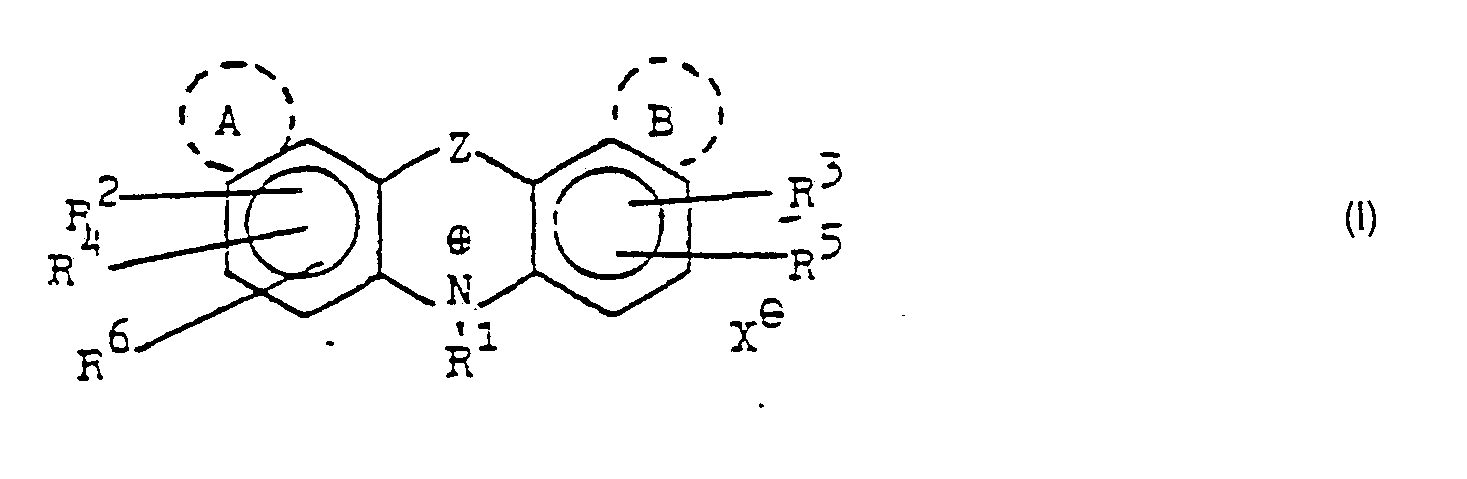
que l'on effectue l'exposition, selon une image, de la couche avec une lumière d'une longueur d'onde supérieure à 450 nm, en particulier dans la zone de longueur d'onde de la lumière visible, grâce à quoi est produit dans la couche, selon l'image, par réduction du colorant (c1), un composé qui inhibe une photopolymérisation dans la couche par activation du photoinitiateur (b) ou inactive le photoinitiateur et que l'autre exposition de la couche s'opère sur toute la surface simultanément ou successivement, grâce à quoi les zones de la couche non exposées à la lumière d'ondes plus longues sont polymérisées.
Priority Applications (1)
| Application Number | Priority Date | Filing Date | Title |
|---|---|---|---|
| AT83112806T ATE46582T1 (de) | 1982-12-28 | 1983-12-20 | Positiv arbeitendes verfahren zur herstellung von relief- und druckformen. |
Applications Claiming Priority (2)
| Application Number | Priority Date | Filing Date | Title |
|---|---|---|---|
| DE3248246 | 1982-12-28 | ||
| DE19823248246 DE3248246A1 (de) | 1982-12-28 | 1982-12-28 | Positiv arbeitendes verfahren zur herstellung von relief- und druckformen |
Publications (3)
| Publication Number | Publication Date |
|---|---|
| EP0115021A2 EP0115021A2 (fr) | 1984-08-08 |
| EP0115021A3 EP0115021A3 (en) | 1987-02-25 |
| EP0115021B1 true EP0115021B1 (fr) | 1989-09-20 |
Family
ID=6181925
Family Applications (1)
| Application Number | Title | Priority Date | Filing Date |
|---|---|---|---|
| EP83112806A Expired EP0115021B1 (fr) | 1982-12-28 | 1983-12-20 | Procédé pour la réalisation de reliefs et de plaques d'impression positives |
Country Status (7)
| Country | Link |
|---|---|
| US (1) | US4816379A (fr) |
| EP (1) | EP0115021B1 (fr) |
| JP (1) | JPS59147347A (fr) |
| AT (1) | ATE46582T1 (fr) |
| AU (1) | AU567531B2 (fr) |
| CA (1) | CA1261192A (fr) |
| DE (2) | DE3248246A1 (fr) |
Families Citing this family (19)
| Publication number | Priority date | Publication date | Assignee | Title |
|---|---|---|---|---|
| DE3248257A1 (de) * | 1982-12-28 | 1984-06-28 | Robert Bosch Gmbh, 7000 Stuttgart | Druckregelventil |
| EP0282201B1 (fr) * | 1987-03-09 | 1994-06-15 | Matsushita Electric Industrial Co., Ltd. | Procédé pour réaliser des patrons |
| WO1990010254A1 (fr) * | 1989-02-24 | 1990-09-07 | Bowling Green State University | Production de corps tridimensionnels par photopolymerisation |
| US5137800A (en) * | 1989-02-24 | 1992-08-11 | Stereographics Limited Partnership | Production of three dimensional bodies by photopolymerization |
| DE3914407A1 (de) * | 1989-04-29 | 1990-10-31 | Basf Ag | Strahlungsempfindliche polymere und positiv arbeitendes aufzeichnungsmaterial |
| US5391465A (en) * | 1989-06-20 | 1995-02-21 | Rohm And Haas Company | Method of using selected photoactive compounds in high resolution, acid hardening photoresists with near ultraviolet radiation wherein the photoresist comprise conventional deep UV photoacid generators |
| US5776661A (en) * | 1994-08-24 | 1998-07-07 | Macdermid Imaging Technology, Inc. | Process for imaging of liquid photopolymer printing plates |
| US5885746A (en) * | 1994-12-29 | 1999-03-23 | Tokyo Ohka Kogyo Co., Ltd. | Photosensitive resin composition, photosensitive printing plate using the same and method of manufacturing printing master plate |
| US5935758A (en) * | 1995-04-20 | 1999-08-10 | Imation Corp. | Laser induced film transfer system |
| US5945249A (en) * | 1995-04-20 | 1999-08-31 | Imation Corp. | Laser absorbable photobleachable compositions |
| FR2735718B1 (fr) * | 1995-06-22 | 1997-08-08 | Photomeca Egg | Procede de fabrication de plaques photopolymeres par phototransformation selective |
| AU3119397A (en) * | 1996-05-16 | 1997-12-05 | Napp Systems Inc. | Methods to increase the exposure sensitivity of photopolymerizable matrices and apparatus useful therefor |
| JPH09331206A (ja) * | 1996-06-12 | 1997-12-22 | Saitama Nippon Denki Kk | Tdma方式用携帯電話機のアンテナ整合部 |
| JP3405316B2 (ja) | 2000-03-27 | 2003-05-12 | 松下電器産業株式会社 | 高周波スイッチ |
| US7241557B2 (en) * | 2004-07-30 | 2007-07-10 | Agfa Graphics Nv | Photopolymerizable composition |
| TW200936702A (en) * | 2008-01-30 | 2009-09-01 | Dongjin Semichem Co Ltd | Novel organic sensitizers and method for preparing the same |
| DE102010000169A1 (de) * | 2010-01-22 | 2011-07-28 | Karlsruher Institut für Technologie, 76131 | Photosensitive Substanz mit Thioxanthonen als photodeaktivierbarem Photoinitiator zur Herstellung von kleinen Strukturen |
| CN103261331B (zh) * | 2010-12-13 | 2015-07-29 | 协和梅迪克斯株式会社 | 含有无色型色原体的水溶液的保存方法 |
| KR102582577B1 (ko) * | 2014-05-23 | 2023-09-25 | 가부시끼가이샤 레조낙 | 레지스트 패턴의 형성 방법, 프린트 배선판의 제조 방법, 투영 노광용 감광성 수지 조성물 및 감광성 엘리먼트 |
Family Cites Families (6)
| Publication number | Priority date | Publication date | Assignee | Title |
|---|---|---|---|---|
| US3573922A (en) * | 1965-04-23 | 1971-04-06 | Hughes Aircraft Co | Photopolymerizable composition and process |
| US3556794A (en) * | 1966-10-03 | 1971-01-19 | Hughes Aircraft Co | Method of inhibiting photopolymerization and products therefor |
| US3615452A (en) * | 1968-09-09 | 1971-10-26 | Gaf Corp | Dye-sensitized photopolymerization process |
| US3627656A (en) * | 1969-04-03 | 1971-12-14 | Hughes Aircraft Co | Catalyst systems for photo-chemical polymerization |
| CA1099435A (fr) * | 1971-04-01 | 1981-04-14 | Gwendyline Y. Y. T. Chen | Traduction non-disponible |
| DE3248257A1 (de) * | 1982-12-28 | 1984-06-28 | Robert Bosch Gmbh, 7000 Stuttgart | Druckregelventil |
-
1982
- 1982-12-28 DE DE19823248246 patent/DE3248246A1/de not_active Withdrawn
-
1983
- 1983-12-20 AT AT83112806T patent/ATE46582T1/de active
- 1983-12-20 EP EP83112806A patent/EP0115021B1/fr not_active Expired
- 1983-12-20 DE DE8383112806T patent/DE3380601D1/de not_active Expired
- 1983-12-21 CA CA000443944A patent/CA1261192A/fr not_active Expired
- 1983-12-23 AU AU22887/83A patent/AU567531B2/en not_active Ceased
- 1983-12-27 JP JP58244984A patent/JPS59147347A/ja active Pending
-
1985
- 1985-04-22 US US06/725,151 patent/US4816379A/en not_active Expired - Fee Related
Also Published As
| Publication number | Publication date |
|---|---|
| JPS59147347A (ja) | 1984-08-23 |
| EP0115021A3 (en) | 1987-02-25 |
| CA1261192A (fr) | 1989-09-26 |
| AU567531B2 (en) | 1987-11-26 |
| AU2288783A (en) | 1984-07-05 |
| DE3380601D1 (en) | 1989-10-26 |
| ATE46582T1 (de) | 1989-10-15 |
| EP0115021A2 (fr) | 1984-08-08 |
| US4816379A (en) | 1989-03-28 |
| DE3248246A1 (de) | 1984-06-28 |
Similar Documents
| Publication | Publication Date | Title |
|---|---|---|
| EP0359060B1 (fr) | Mélange photopolymérisable, matériau d'enregistrement fabriqué à partir de celui-ci et procédé de production de copies | |
| EP0767407B1 (fr) | Elément pour l'enregistrement multicouche utilisable pour la production des plaques d'impression flexographiques par transmission d'information digitale | |
| EP0115021A2 (fr) | Procédé pour la réalisation de reliefs et de plaques d'impression positives | |
| EP0332983B1 (fr) | Plaque d'impression photopolymérisable pour la fabrication de formes d'impression | |
| EP0248424B1 (fr) | Elément photosensible pour l'enregistrement | |
| JPS59104993A (ja) | 画像記録材料及び該材料で実施可能な画像記録法 | |
| EP0447930B1 (fr) | Composition photopolymérisable et matériau d'enregistrement ainsi produit | |
| DE2821053C3 (de) | Lichthärtbares Aufzeichnungsmaterial und damit durchführbares Bildaufzeichnungsverfahren | |
| EP0002805B1 (fr) | Matériaux de revêtement et d'enregistrement photodurcissables, tels que feuilles de transfert avec laque photosensible et matériaux-photorésist, contenant un photoinitiateur et un composé organique halogéné | |
| DE3342579A1 (de) | Bildaufzeichnungsmaterialien und damit durchfuehrbare bildaufzeichnungsverfahren | |
| EP0333012A2 (fr) | Plaque d'impression sensible à la lumière et photopolymérisable | |
| EP0331007B1 (fr) | Matériau d'enregistrement sensible à la lumière pour la fabrication des formes de gravure en creux, résistant aux rayures | |
| EP0797120B1 (fr) | Elément pour l'enregistrement multicouche utilisable pour la production des plaques d'impression flexographiques par transmission d'information digitale | |
| EP0248395A2 (fr) | Elément photosensible pour l'enregistrement | |
| DE2830143C2 (de) | Photopolymerisierbares Gemisch und photopolymerisierbares Aufzeichnungsmaterial | |
| EP0355335B1 (fr) | Milieu d'enregistrement photosensible, son utilisation et composé leuco approprié à cette utilisation | |
| EP0140353A2 (fr) | Matériel d'enregistrement photopolymérisable pour la fabrication de plaques d'impression et procédé pour la fabrication de plaques d'impression avec ce matériel | |
| EP0114341B1 (fr) | Couche contenant un colorant dans un mélange photopolymérisable et procédé pour la fabrication de relief et formes d'impressions | |
| EP0384366B1 (fr) | Elément d'enregistrement photosensible | |
| DE3909248A1 (de) | Lichtempfindliche zubereitung und verfahren zur herstellung von photoresisten und druckplatten | |
| DE3844451A1 (de) | Photopolymerisierbares system | |
| DE1966558C3 (de) | Fotografisches Verfahren zur Herstellung von bildmäßig modifizierten Metalloberflächen | |
| DE2338223C3 (de) | Fotopolymerisierbare, zum positiven Arbeiten befähigte Schicht | |
| DE2204244A1 (de) | Fotopolymerisierbares aufzeichnungsmaterial | |
| EP0599069B1 (fr) | Matériau d'enregistrement sensible à la lumière |
Legal Events
| Date | Code | Title | Description |
|---|---|---|---|
| PUAI | Public reference made under article 153(3) epc to a published international application that has entered the european phase |
Free format text: ORIGINAL CODE: 0009012 |
|
| AK | Designated contracting states |
Designated state(s): AT BE CH DE FR GB IT LI NL |
|
| PUAL | Search report despatched |
Free format text: ORIGINAL CODE: 0009013 |
|
| AK | Designated contracting states |
Kind code of ref document: A3 Designated state(s): AT BE CH DE FR GB IT LI NL |
|
| 17P | Request for examination filed |
Effective date: 19870117 |
|
| 17Q | First examination report despatched |
Effective date: 19880414 |
|
| GRAA | (expected) grant |
Free format text: ORIGINAL CODE: 0009210 |
|
| AK | Designated contracting states |
Kind code of ref document: B1 Designated state(s): AT BE CH DE FR GB IT LI NL |
|
| REF | Corresponds to: |
Ref document number: 46582 Country of ref document: AT Date of ref document: 19891015 Kind code of ref document: T |
|
| ITF | It: translation for a ep patent filed | ||
| REF | Corresponds to: |
Ref document number: 3380601 Country of ref document: DE Date of ref document: 19891026 |
|
| GBT | Gb: translation of ep patent filed (gb section 77(6)(a)/1977) | ||
| ET | Fr: translation filed | ||
| PLBE | No opposition filed within time limit |
Free format text: ORIGINAL CODE: 0009261 |
|
| STAA | Information on the status of an ep patent application or granted ep patent |
Free format text: STATUS: NO OPPOSITION FILED WITHIN TIME LIMIT |
|
| 26N | No opposition filed | ||
| ITTA | It: last paid annual fee | ||
| PGFP | Annual fee paid to national office [announced via postgrant information from national office to epo] |
Ref country code: FR Payment date: 19921111 Year of fee payment: 10 |
|
| PGFP | Annual fee paid to national office [announced via postgrant information from national office to epo] |
Ref country code: CH Payment date: 19921112 Year of fee payment: 10 |
|
| PGFP | Annual fee paid to national office [announced via postgrant information from national office to epo] |
Ref country code: AT Payment date: 19921117 Year of fee payment: 10 |
|
| PGFP | Annual fee paid to national office [announced via postgrant information from national office to epo] |
Ref country code: BE Payment date: 19921204 Year of fee payment: 10 |
|
| PGFP | Annual fee paid to national office [announced via postgrant information from national office to epo] |
Ref country code: GB Payment date: 19921216 Year of fee payment: 10 |
|
| PGFP | Annual fee paid to national office [announced via postgrant information from national office to epo] |
Ref country code: DE Payment date: 19921219 Year of fee payment: 10 |
|
| PGFP | Annual fee paid to national office [announced via postgrant information from national office to epo] |
Ref country code: NL Payment date: 19921231 Year of fee payment: 10 |
|
| PG25 | Lapsed in a contracting state [announced via postgrant information from national office to epo] |
Ref country code: DE Effective date: 19931215 |
|
| PG25 | Lapsed in a contracting state [announced via postgrant information from national office to epo] |
Ref country code: GB Effective date: 19931220 Ref country code: AT Effective date: 19931220 |
|
| PG25 | Lapsed in a contracting state [announced via postgrant information from national office to epo] |
Ref country code: LI Effective date: 19931231 Ref country code: CH Effective date: 19931231 Ref country code: BE Effective date: 19931231 |
|
| BERE | Be: lapsed |
Owner name: BASF A.G. Effective date: 19931231 |
|
| PG25 | Lapsed in a contracting state [announced via postgrant information from national office to epo] |
Ref country code: NL Effective date: 19940701 |
|
| NLV4 | Nl: lapsed or anulled due to non-payment of the annual fee | ||
| GBPC | Gb: european patent ceased through non-payment of renewal fee |
Effective date: 19931220 |
|
| PG25 | Lapsed in a contracting state [announced via postgrant information from national office to epo] |
Ref country code: FR Effective date: 19940831 |
|
| REG | Reference to a national code |
Ref country code: CH Ref legal event code: PL |
|
| REG | Reference to a national code |
Ref country code: FR Ref legal event code: ST |