EP0115054A2 - Polymères capables de subir l'élimination bêta comme couches de contrôle de diffusion dans des produits photographiques - Google Patents
Polymères capables de subir l'élimination bêta comme couches de contrôle de diffusion dans des produits photographiques Download PDFInfo
- Publication number
- EP0115054A2 EP0115054A2 EP83113009A EP83113009A EP0115054A2 EP 0115054 A2 EP0115054 A2 EP 0115054A2 EP 83113009 A EP83113009 A EP 83113009A EP 83113009 A EP83113009 A EP 83113009A EP 0115054 A2 EP0115054 A2 EP 0115054A2
- Authority
- EP
- European Patent Office
- Prior art keywords
- layer
- image
- polymer
- elimination
- product according
- Prior art date
- Legal status (The legal status is an assumption and is not a legal conclusion. Google has not performed a legal analysis and makes no representation as to the accuracy of the status listed.)
- Granted
Links
Images

Classifications
-
- C—CHEMISTRY; METALLURGY
- C07—ORGANIC CHEMISTRY
- C07D—HETEROCYCLIC COMPOUNDS
- C07D333/00—Heterocyclic compounds containing five-membered rings having one sulfur atom as the only ring hetero atom
- C07D333/02—Heterocyclic compounds containing five-membered rings having one sulfur atom as the only ring hetero atom not condensed with other rings
- C07D333/46—Heterocyclic compounds containing five-membered rings having one sulfur atom as the only ring hetero atom not condensed with other rings substituted on the ring sulfur atom
- C07D333/48—Heterocyclic compounds containing five-membered rings having one sulfur atom as the only ring hetero atom not condensed with other rings substituted on the ring sulfur atom by oxygen atoms
-
- G—PHYSICS
- G03—PHOTOGRAPHY; CINEMATOGRAPHY; ANALOGOUS TECHNIQUES USING WAVES OTHER THAN OPTICAL WAVES; ELECTROGRAPHY; HOLOGRAPHY
- G03C—PHOTOSENSITIVE MATERIALS FOR PHOTOGRAPHIC PURPOSES; PHOTOGRAPHIC PROCESSES, e.g. CINE, X-RAY, COLOUR, STEREO-PHOTOGRAPHIC PROCESSES; AUXILIARY PROCESSES IN PHOTOGRAPHY
- G03C8/00—Diffusion transfer processes or agents therefor; Photosensitive materials for such processes
- G03C8/42—Structural details
- G03C8/52—Bases or auxiliary layers; Substances therefor
- G03C8/54—Timing layers
Definitions
- novel monomers and polymers which comprise recurring units capable of undergoing ⁇ -elimination in an alkaline environment to convert a layer comprising one or more of said polymers from a condition of impermeability to alkali or materials soluble in or solubilized by an aqueous alkaline processing composition to a condition of substantial permeability thereto. It has also been discovered that layers comprising these novel polymers may be used as diffusion control interlayers or overcoats in photosensitive elements and negative components of diffusion transfer film units and as timing layers or overcoats in image-receiving elements and positive components of diffusion transfer film units.
- Another object of the present invention is to provide a novel image-receiving element adapted for use in diffusion transfer film units and comprising a diffusion control layer having predetermined permeability characteristics and comprising a novel polymer of the present invention.
- Still another object of the present invention is to provide a novel photosensitive element for use in diffusion transfer processes which photosensitive element comprises a diffusion control interlayer or overcoat having predetermined permeability characteristics and comprising a novel polymer of the present invention.
- novel polymers have been discovered which are capable of converting a layer comprising one or more of said polymers from a condition of impermeability to alkali or materials soluble in or solubilized by an aqueous alkaline processing composition to a condition of substantial permeability thereto by undergoing a B-elimination reaction in an alkaline environment. It has also been discovered that layers comprising these polymers can be used as diffusion control layers in diffusion transfer film units. These diffusion control layers have been found to be useful as overcoats or interlayers in photosensitive elements and negative components of diffusion transfer film units or as timing layers or overcoats in image-receiving elements and positive components of diffusion transfer film units.
- the diffusion control layers hereof function by forming an impermeable "barrier" layer which prevents passage or diffusion therethrough of either alkali or materials soluble in or solubilized by an aqueous alkaline processing composition for a predetermined length of time during processing of the film unit and then_converting over a relatively short time period to a condition of substantial permeability to these materials as a result of the polymers hereof undergoing S-elimination.
- These diffusion control layers are thus "hold-release” layers in that materials intended to be subject to diffusion control by the layer are “held” in place for a predetermined period of time and then are “released” in substantial quantity over a relatively short time period, i.e., allowed to rapidly diffuse through the layer.
- novel polymers of the present invention comprise essential recurring units capable of undergoing ⁇ -elimination and having the formula (I) wherein R is hydrogen, halogen (e.g., chloro) or lower alkyl (e.g., methyl); R 1 is alkylene (e.g., ethylene); and Z is an organic moiety capable under alkaline conditions of undergoing a ⁇ -elimination reaction.
- R is hydrogen, halogen (e.g., chloro) or lower alkyl (e.g., methyl);
- R 1 is alkylene (e.g., ethylene);
- Z is an organic moiety capable under alkaline conditions of undergoing a ⁇ -elimination reaction.
- a ⁇ -elimination reaction involves the elimination or removal of two groups from a parent molecule, these groups being substituted on adjacent atoms, i.e., beta to each other.
- the ⁇ -elimination reaction or removal results in the formation of a more unsaturated bond, usually a double bond, between the adjacent atoms.
- the organic moiety Z of the polymers of formula (I) is a moiety containing the atoms requisite for the conduct under alkaline conditions of a ⁇ -elimination reaction.
- the organic moiety Z hereinafter simply "a ⁇ -elimination moiety" will contain at least two interbonded carbon atoms, one of the carbon atoms containing an acid-labile proton capable of abstraction under alkaline conditions and an activating group effective to activate the ⁇ -elimination mechanism.
- the ⁇ -elimination moiety will contain at least the following wherein is shown an abstractable acid-labile proton and wherein Y represents a ⁇ -elimination activating group which activates the a-elimination reaction with the resulting formation of a compound containing a double bond between the interbonded carbon atoms.
- the ⁇ -elimination reaction and mechanism involved in the case where the B-elimination moiety Z is a moiety can be represented as follows: wherein B is an anionic base.
- the above reaction scheme indicates that the anionic polymer unit formed by the ⁇ -elimination is effectively a leaving group removed from the parent molecule (starting polymer) in order to effect formation of the double bond of the ethylene compound
- the activating group Y can be any group which is photographically innocuous and capable of stabilizing the carbanionic species formed by abstraction of the acid-labile proton by the anionic base.
- a study of such activating groups has been provided by J. Crosby and C.J.M. Stirling in J.Chem. Soc., B, 1970, p. 671.
- the ⁇ -elimination moiety Z can comprise a cyclic structure.
- Z can be the moiety wherein Y is a divalent radical or , A represents the atoms necessary with Y to complete a four- to seven-membered ring structure, and D and E are independently hydrogen, methyl or phenyl, provided that not more than one of D and E is methyl or phenyl. Preferably, both D and E will be hydrogen.
- A can, for example, represent a divalent radical such as methylene, dimethylene, trimethylene or tetramethylene to complete, with divalent radical Y, a four-, five-, six- or seven-membered ring structure.
- Suitable examples of cyclic Z B-elimination moieties include wherein D and E have the meanings aforedescribed.
- the ⁇ -elimination moiety, Z can also include cyclic structures wherein the activating group Y is a substituent.
- cyclic moieties are represented by the formula wherein A and E together represent the atoms necessary to complete with the carbon atoms to which they are bonded a five-, six- or seven-membered ring structure, D represents hydrogen, methyl or phenyl and Y is a ⁇ -eliminating activating group.
- D will represent hydrogen.
- Y can be any of the B-elimination activating groups hereinbefore described.
- Examples of cyclic ⁇ -elimination moieties Z wherein the activating group Y is a ring substituent include and wherein D and Y have the aforedescribed meanings.
- Preferred Y groups are alkylsulfonyl (e.g., methylsulfonyl), alkaryl- sulfonyl (e.g., p-tolylsulfonyl), cyano and nitro.
- D is hydrogen.
- Preferred polymers of this invention include those comprising recurring units of the following formulae:
- the polymers of this invention can be copolymers comprising the ⁇ -elimination monomeric units and a variety of comonomeric units incorporated into the polymer to impart thereto predetermined properties.
- the "hold time" i.e., the time interval during which a diffusion control layer remains impermeable during processing, can be affected by the relative hydrophilicity of the layer resulting from incorporation of a given comonomer or mixture of comonomers into the ⁇ -elimination polymer.
- the more hydrophobic the polymer the slower will be the rate of permeation of alkali into a diffusion control layer to initiate the B-elimination reaction, i.e., the longer the hold time.
- diffusion control interlayers in the negative component of the film unit be initially substantially permeable to alkali, water, and various other components of the processing composition while substantially impermeable to the image-providing.materials of the film unit up to a predetermined point in the development process.
- Such selective permeability may be achieved in the present invention by inclusion of appropriate comonomeric units, generally of a relatively hydrophilic nature, into the a-elimination polymers hereof or, more particularly, by "balancing" the hydrophobic and hydrophilic moieties to achieve the desired permeability.
- suitable comonomers for use in the present invention include acrylic acid; methacrylic acid; 2-acrylamido-2-methylpropane sulfonic acid; N-methyl acrylamide; methacrylamide: ethyl acrylate; butyl acrylate; methyl methacrylate; N-methyl methacrylamide; N-ethyl acrylamide; N-methylolacrylamide; N,N-dimethyl acrylamide; N,N-dimethyl methacrylamide; N-(n-propyl)acrylamide; N-isopropyl acrylamide; N-(8-hydroxy ethyl) acrylamide, N-( ⁇ -dimethylamino)acrylamide; N-(t-butyl) acrylamide; N-[ ⁇ -(dimethylamino)ethyl]methacrylamide; 2-[2'-(acrylamido)ethoxy]ethanol; N-(3'-methoxy propyl) - acrylamide; 2-acryla
- the ⁇ -elimination reaction which the S-elimination polymers of the diffusion control layers of this invention undergo ensures that those materials intended to be subject to diffusion control by the diffusion control layer are "held” in place for a predetermined period of time and then "released” over a relatively short time-period, the polymer layer undergoing a relatively rapid increase in hydrophilicity and water swellability and, thus, permeability as a result of the S-elimination reaction.
- the predetermined hold time may be adjusted as appropriate for a given photographic process by means such as controlling the mole ratio or proportion of ⁇ -elimination units in the polymer; altering the thickness of the diffusion control layer; incorporating appropriate comonomeric units into the ⁇ -elimination to impart thereto a desired hydrophobic/hydro- philic balance or degree of coalescence; utilizing different activating groups Y to affect the rate of ⁇ -elimination; or utilizing other materials, particularly polymeric materials, in the diffusion control layer to modulate the permeation therethrough of alkali or aqueous alkaline processing composition, thereby altering the time necessary for substantial ⁇ -elimination to occur.
- This latter means of adjusting the hold time of the layer may include, for example, utilization of a matrix polymer material having a predetermined permeability to alkali or aqueous alkaline processing composition as determined, for example, by the hydrophobic/hydro- philic balance or degree of coalescence thereof.
- a matrix polymer material having a predetermined permeability to alkali or aqueous alkaline processing composition as determined, for example, by the hydrophobic/hydro- philic balance or degree of coalescence thereof.
- increased permeability to alkali or aqueous alkaline processing composition and, thus, a shorter hold time may be obtained by increasing the hydrophilicity of the matrix polymer or decreasing the degree of coalescence.
- matrix polymers may also be used to modulate the permeability of the layers to alkali or materials soluble in or solubilized by an aqueous alkaline processing composition and thus affect the functionality.of' the layers within a film unit.
- relatively hydrophobic matrix polymers or matrix polymers having a relatively high degree of coalescence may help to render diffusion control layers hereof'substantially impermeable to alkali until B-elimination occurs, thus providing functionality to such layers as alkali neutralization timing layers or overcoat layers in image-receiving elements and positive components of diffusion transfer film units.
- relatively hydrophilic matrix polymers or matrix polymers having a relatively low degree of coalescence may help to render diffusion control layers hereof initially permeable to alkali while remaining impermeable to materials soluble in or solubilized by an aqueous alkaline processing composition, e.g., image dye-providing materials, until B-elimination occurs, thus providing functionality to such layers as interlayers or overcoat layers in photosensitive elements and negative components of diffusion transfer film units.
- Utilization of matrix polymers can thus provide an alternative or complementary means to the above-mentioned use of suitable comonomers in the ⁇ -elimination copolymers hereof as a method of modulating the hold time or functionality of the diffusion control layers of this invention. It will be understood, however, that the ⁇ -elimination reaction is necessary to achieve the relatively rapid change in permeability of the layer..
- Polymers which may be used as matrix polymers will generally be copolymers which comprise comonomeric units such as acrylic acid; methacrylic acid; methylmethacrylate; 2-acrylamido-2-methylpropane sulfonic acid; acrylamide; methacrylamide; N,N-dimethylacrylamide; ethylacrylate; butylacrylate; diacetone acrylamide; acrylamido acetamide; and methacrylamido acetamide.
- the comonomeric units, as well as the ratios thereof, should be chosen on the basis of the physical characteristics desired in the matrix polymer and in the diffusion control layer in which it is to be utilized. For example, a more hydrophilic and thus a generally more permeable matrix material can be'had by increasing the respective ratio of hydrophilic comonomers, such as acrylic acid or methacrylic acid, within the matrix polymer.
- Matrix polymer/ ⁇ -elimination polymer systems useful in the present invention include those listed below wherein MEMSEC designates N-(methacryloxyethyl)-S-methylsulfonylethyl carbamate, MEAPC designates N-methacryloxyethyl-2- acetylpropyl carbamate, MESC designates N-(methacryloxyethyl)-3-sulfolanyl carbamate, STY designates styrene, DAA designates diacetone acrylamide, BA designates butyl acrylate, AA designates acrylic acid, MMA designates methyl methacrylate and AMPS designates 2-acrylamido-2-methylpropane sulfonic acid. In the matrix systems listed below the specified ⁇ -elimination polymer was polymerized in the presence of the specified preformed matrix polymer. All ratios and proportions are in parts by weight:
- the silver halide emulsion is developed with an aqueous alkaline processing composition and, as a function of development, an imagewise distribution of diffusible image-providing material is formed which is transferred, at least in part, to the superposed image-receiving layer.
- the diffusion control layers,of such film units may be used to control diffusion of alkali or of the image-providing material in accordance with the disclosures contained herein.
- Film units within the present invention include those wherein the silver halide emulsion layers and the image-receiving layer are initially contained in separate elements.
- Such film units may thus comprise: (a) a photosensitive element comprising a support layer which is preferably opaque and a negative component comprising at least one photosensitive silver halide emulsion layer having associated therewith a diffusion transfer process image-providing material; (b) an image-receiving element comprising a support layer which may be opaque or transparent as appropriate for a given process and a positive component comprising an image-receiving layer; and (c) a diffusion control layer comprising the polymers of this invention in at least one of said photosensitive element or image-receiving element.
- the respective elements may be brought into superposition subsequent or prior to exposure. Subsequent to exposure, an aqueous alkaline processing composition is distributed between the superposed elements to initiate development. If the image-receiving element provides an opaque reflective background, the image formed may be viewed as a reflection print upon separation of the elements. By using a transparent image-receiving element, the resultant image may be viewed as a transparency upon separation of the elements. Alternatively, if the photosensitive element and/or processing composition contains a light reflecting layer, e.g., a white pigment such as titanium dioxide, the image may be viewed as a reflection print against the background provided by the light- . reflecting layer, without separation of.the elements.
- a light reflecting layer e.g., a white pigment such as titanium dioxide
- the photosensitive element may also comprise a neutralization layer, e.g., an acid polymer layer, and a timing layer positioned between the support layer and the negative component with the neutralization layer positioned adjacent the support.
- a neutralization layer e.g., an acid polymer layer
- a timing layer positioned between the support layer and the negative component with the neutralization layer positioned adjacent the support.
- Film units of this type include, for example, those comprising: (a) a photosensitive laminate comprising a composite structure containing, in sequence, an opaque support layer, preferably an actinic radiation-opaque flexible sheet material, a negative component comprising at least one photosensitive silver halide emulsion layer having associated therewith an image dye-providing material, a positive component comprising an image-receiving layer dyeable by the image dye-providing material, and a transparent support layer, preferably an actinic radiation transmissive flexible sheet material, the photosensitive laminate also comprising a diffusion control layer comprising the polymers of the present invention; (b) means retaining an aqueous alkaline processing composition integrated with the film unit so that the processing composition can be distributed between the negative and positive components.
- a light-reflecting pigment is preferably provided by the processing composition such that the distribution of the processing composition between the negative and positive components provides a light-reflecting layer against which a dye image formed in the image-receiving layer can be viewed without separation of the components.
- the diffusion control layers of this invention can also be used in integral negative-positive film units of the type described in U.S. Patent No. 3,594,165.
- Film units of this type include, for example, those comprising: (a) a photosensitive laminate comprising, in sequence, a transparent support layer, preferably an actinic radiation transmissive flexible sheet material, a positive component comprising an image-receiving layer, a processing composition permeable, light-reflecting layer against which a dye image formed in the image-receiving layer can be viewed, and a negative component comprising at least one photosensitive silver halide emulsion layer having associated therewith an image dye-providing material; (b) a transparent sheet superposed substantially coextensive the surface of the photosensitive laminate opposite the transparent layer; (c) means retaining an aqueous alkaline processing composition, which includes an opacifying agent, integrated with the film unit such that the processing composition can be distributed between the photosensitive laminate and the transparent sheet; and (d) a diffusion control layer
- Multicolor images may be prepared in the film units of the present invention which comprise at least two selectively sensitized silver halide emulsion layers, each associated with an image dye-providing material which provides an image dye possessing spectral absorption characteristics substantially complementary to the predominant sensitivity range of its associated emulsion.
- the most commonly employed negative components for forming multicolor images are of the tripack structure and contain blue, green, and red sensitive silver halide layers each having associated therewith in the same or a contiguous layer a yellow, a magenta, and a cyan image dye-providing material respectively.
- each of the silver halide emulsion layers, and its associated image dye-providing material be spaced from the remaining emulsion layers, and their associated image dye-providing materials, by separate alkaline solution permeable interlayers, such as those provided by the instant invention.
- each dye developer is associated with a separate silver halide emulsion layer and is, most preferably, substantially soluble in-the reduced form only at the first pH provided by the processing composition, possessing subsequent to photoexposure or processing a spectral absorption range substantially complementary to the predominant sensitivity range of its associated emulsion.
- the processing composition is applied and permeates the emulsion layers to initiate development of the latent image contained therein.
- the dye developer is immobilized or precipitated in exposed areas as a consequence of the development of the latent image.
- unexposed and partially exposed areas of the emulsion the dye developer is unreacted and diffusible and thus provides an imagewise distribution of unoxidized dye developer dissolved in the liquid processing composition, as a function of the point-to- point degree of exposure of the silver halide emulsion. At least part of this imagewise distribution of unoxidized dye developer is transferred, by imbibition, to a superposed image-receiving layer, said transfer substantially excluding oxidized dye developer.
- the image-receiving layer receives a depthwise diffusion, from the developed emulsion, of unoxidized dye developer without appreciably disturbing the imagewise distribution thereof to provide the reversed or positive color image of the developed image.
- the image-receiving layer may contain agents adapted to mordant or otherwise fix the diffused, unoxidized dye developer.
- the environmental pH of the film unit be adjusted downward to a second pH at which the residual dye developers remaining within the negative structure are precipitated or otherwise rendered non-diffusible in either their reduced or oxidized state.
- the pH adjustment is generally accomplished by means of an acid neutralization layer, preferably a polymeric acid layer, as detailed hereinbelow.
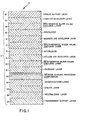
- FIG. 1 sets forth a perspective view of an integral film unit of the type described in referenced U.S. Patent No. 3,415,644, shown with the processing composition 26 distributed between the negative and positive components.
- Film unit 10 comprises photosensitive laminate 11 including in order, opaque support layer 12; cyan dye developer layer 13; red-sensitive silver halide emulsion layer 14; interlayer 15; magenta dye developer layer 16; green-sensitive silver halide emulsion layer 17; interlayer 18; yellow dye developer layer 19; blue-sensitive silver halide emulsion layer 20; overcoat layer 21; image-receiving layer 22; spacer layer 23; neutralizing layer 24; and transparent support layer 25.
- processing composition 26 initially retained in a rupturable container (not shown) is distributed between overcoat layer 21 and image-receiving layer 22 to initiate development of the silver halide emulsion layers.
- processing composition 26 permeates image-receiving layer 22 and spacer layer 23, to gain access to neutralizing layer 24 whereupon neutralization of the alkali occurs to lower the pH of the system to a level at which the dye developers are insoluble and non-diffusible, to provide thereby a stable color transfer image.
- spacer layer 23 and neutralizing layer 24 may be disposed intermediate support layer 12 and cyan dye developer layer 13, with neutralizing layer 24 positioned adjacent to support layer 12.
- the alkali provided by processing composition 26 permeates layers 13 through 21 and spacer layer 23 to gain access to neutralizing layer 24 whereupon neutralization of the alkali is effected as described hereinabove.
- a dye developer prematurely migrates to a silver halide layer other than the one with which it is initially associated, it may undergo oxidation to a non-diffusible species as a function of the development of this "wrong" layer and will be rendered incapable of transferring as intended to the image-receiving layer. As a result, accuracy in color reproduction and color saturation within the transfer image will be adversely affected.
- a portion of a second dye developer which should have undergone oxidation as a function of the development of this "wrong layer" remains in a reduced and diffusible state and, thus, may transfer to contaminate the resultant color transfer image.
- magenta dye-developer of layer 16 If it is possible for the magenta dye-developer of layer 16 to back-diffuse to red sensitive silver halide emulsion layer 14 before substantial development of this layer and resultant substantial formation of an imagewise distribution of the cyan dye developer in layer 13, some of the magenta dye developer may become oxidized and rendered non-diffusible as a function of red exposure and development of the red sensitive emulsion layer. Thus, there is produced a loss in magenta dye density in the transfer image. Moreover, that portion of cyan dye developer which should have been oxidized in preference to the magenta dye developer remains in the reduced form and may diffuse to image-receiving layer 22 with resultant cyan dye contamination of the transfer image. Thus, accurate color reproduction of a photographed object is hindered by such inter-image effects.
- the "hold-release" behavior of the interlayers of this invention provides advantages over those interlayers which allow a slow leaking of dye developer at the start of the processing interval in that the dye developers are better confined to their associated emulsion layer during the critical initial development interval and then released rapidly and in substantial quantity so as to allow rapid and essentially simultaneous transfer of the color image-forming materials.
- interlayers comprising the polymers of this invention may be used to provide increased capacity for accurate color reproduction over a range of temperatures.
- the lowering of the temperature at which processing occurs slows both the rate of development and the rate of dye diffusion. If the respective rates are slowed disproportionately, i.e., if the decrease in the development rate is proportionately greater than the decrease in the rate of diffusion, color reproduction may be adversely affected by diffusion of the dye away from its associated emulsion layer prior to substantial development of that layer.
- interlayers comprising the polymers of this invention which have been found to provide markedly longer "hold” times at lower temperatures, e.g., 7°C relative to the "hold” time observed at higher temperatures, e.g., 24°C.
- the interlayers may be utilized to hold the dye developer in association with the silver halide emulsion for longer time periods at lower temperatures to accommodate the system to slower development rates at these temperatures while allowing for a proportionately faster "release” as the temperature and development rate increase.
- polymers of this invention useful as interlayer materials as described hereinabove can also be utilized in overcoat layers of photosensitive elements or negative component overcoat layers such as overcoat layer 21 in FIG. 1.
- overcoat layers can be used, for example, to prevent premature migration of the dye developer most proximate to the distributed processing composition or to provide a means by which the various color image-forming materials may be made available essentially simultaneously to the mordant sites within the image-receiving layer.
- the processing compositions employed in diffusion transfer processes of the type contemplated herein usually are highly alkaline, having a pH in excess of 12 and frequently in excess of 14 or higher.
- the highly alkaline environment facilitates the conduct of dye diffusion to provide satisfactory diffusion rates and image dye densities.
- the environmental pH of the film unit be lowered to at least 11 or lower subsequent to substantial transfer image formation to achieve improved stability of the dye image.
- 3,415,644 discloses that in integral film units wherein the negative and positive components remain in a superposed contiguous relationship subsequent to substantial transfer image formation, an in-process adjustment of the environmental pH of the film unit from a pH at which transfer processing is operative to a pH at which dye transfer is inoperative subsequent to substantial transfer image formation is highly desirable in order to achieve a more stable dye transfer image in terms of the chemical and light stability of the image dye molecules and in terms of preventing post-processing transfer of residual image dye-providing materials within the negative structure to the image-receiving layer.
- reduction in the environmental pH of the film unit is preferably achieved by conduct of a neutralization reaction between the alkali provided by the processing composition and a layer comprising immobilized acid reactive sites, i.e., a neutralization layer.
- Preferred neutralization layers are those comprising a polymeric acid such as cellulose acetate hydrogen phthalate; polyvinyl hydrogen phthalate; polyacrylic acid; polystyrene sulfonic acid; and partial esters of polyethylene/maleic anhydride copolymers.
- Premature pH reduction as evidenced, for example, by a decrease in image dye density, can be prevented by disposing intermediate the neutralization layer and the distributed processing composition a spacer or timing layer which slows diffusion of the alkali toward the neutralization layer.
- diffusion control layers of this invention may be used as such timing layers, forming an alkali impermeable barrier for a predetermined time interval and then converting to a relatively alkali permeable condition upon occurrence of S-elimination to allow the alkali access to the neutralization layer in a rapid and quantitavely substantial fashion.
- timing layers comprising the $-elimination polymers hereof can be used in image-receiving elements of the type disclosed in U.S. Patent No. 3,362,819 or as a component part of the positive component of integral negative-positive film units of the type disclosed in previously referenced U.S. Patents Nos. 3,415,644 and 3,594,165.
- the timing and neutralization layers may be associated with the negative component as is disclosed, for example, in U.S. Patents Nos. 3,362,821 and 3,573,043.
- these layers may also be carried by the transparent sheet employed to facilitate application of the processing comppsition.
- Image-receiving element 27 comprises in order a support layer 28, a neutralizing layer 29, a spacer or timing layer 30 comprising a 6-elimination polymer of the present invention, and an image-receiving layer 31.
- the processing composition penetrates image-receiving layer 31 to provide a sufficient pH for image formation therein and is then subsequently neutralized by penetrating through timing layer 30 upon B-elimination of the diffusion control polymer contained therein to gain access to neutralizing layer 29.
- an overcoat layer comprising the polymers hereof may be provided to the image-receiving element or positive component of the film unit contiguous the image-receiving layer and opposite the neutralization layer.
- Overcoat layers of this type in this position within the film unit may function to control diffusion of alkali or materials soluble in or solubilized by an aqueous alkaline processing composition.
- the permeation characteristics of the polymers hereof utilized in timing layers can be evaluated by measuring the time necessary for downward adjustment of the environmental pH to a predetermined lower level as evidenced by color transition of an indicator dye, preferably initially contained in the processing composition, from a colored form at the initially high processing composition pH to a colorless form at said predetermined lower pH level. Evaluations of this type may be carried out utilizing a test structure comprising in order a support, a polymeric acid layer, a test timing layer, and an image-receiving layer.
- a transparent cover sheet is superposec coextensive the test structure contiguous to the image-receiving layer and an alkaline processing composition comprising an indicator dye which is highly colored at a pH of 12 or higher and colorless below a predetermined lower pH level of about 9 or 10 is spread between the cover sheet and the image-receiving layer.
- the indicator dye remains colored, and may be viewed as such through the transparent cover sheet, until the alkali penetrates through the test timing layer to gain access to the polymeric acid whereupon neutralization of a substantial portion of the alkali present occurs to lower the pH to a level at which the indicator dye is colorless.
- the measurement of the time necessary for substantial "clearing" of the indicator is generally referred to as the "clearing time".
- Test structures comprising timing layers which allow a slow initial leakage of alkali and gradually become more permeable show no precipitous change in color but rather a gradual clearing while structures comprising the timing layers described herein will show a precipitous change in color after an initial delay evidencing the rapid change in alkali permeability undergone by the timing layer upon a-elimination.
- the capacity of diffusion control layers comprising polymers hereof to delay permeation therethrough of dye image-providing materials until conversion by S-elimination to a relatively dye-permeable condition can be evaluated by utilization of the test structure shown in FIG. 3.
- transfer of the image dye-providing material through the test diffusion control layer is monitored in relation to time.
- the "hold-release" properties of the ⁇ -elimination polymer test material can be evaluated in simulation of the functioning of the material, e.g., an interlayer in a photosensitive element.
- Such test structure and a suitable method of evaluation are set forth in detail in Example 6.
- the polymerizable isocyanato estsrs (IV) utilized as starting materials for the production of the polymerizable monomeric carbamate compounds (III) of the invention include the isocyanatoalkyl esters of such ethylenically unsaturated acids as acrylic acid, methacrylic acid and 2-chloroacrylic acid.
- Alcohol compounds useful for the production of the monomeric carbamate compounds of formula (III) include any of those having the aforesaid formula Z-OH.
- Examples of aliphatic alcohols of the formula wherein A, D and E represent hydrogen, methyl or phenyl, except that not more than one of A, D and E is methyl or phenyl, include such substituted ethanol compounds as hydroxyethylmethylsulfone, p-tolylsulfonylethanol and ⁇ -hydroxypropionitrile.
- the monomeric carbamate compounds of formula (III) can be prepared in any of a variety of inert solvents. It will be appreciated that isocyanate groups exhibit reactivity toward compounds having a labile proton and, accordingly, hydroxyl-containing or amine-containing solvent materials will be desirably avoided.
- Suitable solvents include tetrahydrofuran, chloroform, dichloromethane, dimethylformamide, benzene, dioxane, toluene, acetone, methylethylketone, and ethyl acetate.
- the reaction may be conducted over a temperature range of about 0°C to about 100°C and preferably about 15°C to about 40°C.
- the reaction can be facilitated by use of a tin catalyst such as stannous octanoate, a tertiary amine catalyst such as triethylamine, a 4-dialkylaminopyridine catalyst, e.g., 4-(N,N-dimethylamino)pyridine or 4-pyrrolidino- pyridine. It has been found that the reaction proceeds with facility at ambient temperatures of about 25°C to 50°C in the presence of the above-mentioned 4-dialkylaminopyridine catalyst. If desired, a small amount of polymerization inhibitor such as hydroquinone or t-butylpyrocatechol can also be present during the reaction.
- a tin catalyst such as stannous octanoate
- a tertiary amine catalyst such as triethylamine
- 4-dialkylaminopyridine catalyst e.g., 4-(N,N-dimethylamino)pyridine or 4-pyrrolidino- pyr
- azobisisobutyronitrile potassium persulfate, sodium bisulfite, benzoyl peroxide, diacetyl peroxide, hydrogen peroxide, and diazoaminobenzene.
- the amount of catalyst used and the reaction temperature may be varied to suit particular needs.
- the polymerization should proceed satisfactorily by carrying out the reaction at a temperature between 25°C and 100°C and using less than 5% by weight of initiator, based on the starting weight of the polymerizable monomer or monomers.
- the polymers of the present invention i.e., the polymers of formula (I) can be prepared by resort to an alternative procedure.
- the monomeric polymerizable isocyanatoalkyl ester of formula (IV) can first be polymerized and the resulting polymer can be derivatized by reaction with a substituted alcohol of the formula Z-OH wherein Z has the aforedescribed meaning.
- Derivatization of the polymeric isocyanatoalkyl esters can be suitably conducted in the presence of an inert and substantially anhydrous solvent such as tetrahydrofuran, benzene, toluene, dioxane, ethyl acetate, methylethylketone, chloroform, or dichloromethane. If desired, the derivatization reaction may be facilitated by the presence of a suitable catalyst as mentioned hereinbefore.
- an inert and substantially anhydrous solvent such as tetrahydrofuran, benzene, toluene, dioxane, ethyl acetate, methylethylketone, chloroform, or dichloromethane.
- the derivatization reaction may be facilitated by the presence of a suitable catalyst as mentioned hereinbefore.
- the combined filtrates were stirred with 200 mls. of cold water containing 4 mls. of glacial acetic acid for 30 minutes.
- the organic phase was separated and washed with water twice (200 mls. of water each time).
- the organic phase was then washed with 200 mls. of freshly prepared 1% aqueous sodium bicarbonate solution, then with 200 mls. of water, then with 200 mls. of saturated sodium chloride solution and was dried using anhydrous sodium sulfate.
- 10 mgs. of 2,6-ditertiary butyl p-cresol were added to the methylene chloride solution and solvent was removed first using a rotary evaporator and then using a vacuum pump.
- ⁇ -isocyanatoethyl methacrylate (15.5 grams; 0.1 mole) and p-tolysulfonyl ethanol (20.2 grams; 0.1 mole) were dissolved in methylene chloride (100 mls.) in a 250-ml., three-necked flask equipped with a stirrer, thermometer and a water condenser topped with a drying tube.
- 4-(N,N-dimethylamino) pyridine (1.24 grams; 0.01 mole) was added and the contents stirred at ambient temperature for 24 hours. The addition of 4-(N,N-dimethylamino) pyridine was observed to cause an exotherm of about 10°-12°C.
- 3-hydroxysulfolane(81.70 grams; 0.60 mole) was dissolved in methylene chloride(250 mls.) in a 500-ml., round bottom flash equipped with magnetic stirrer, thermometer and water condenser topped with a drying tube.
- Anhydrous magnesium sulfate (5.0 grams) and 3-Angstrom, powdered zeolitic molecular sieve material(10.0 grams) were added and the contents were stirred for one hour at room temperature.
- ⁇ -isocyanatoethyl methacrylate(77.58 grams; 0.50 mole) and 6.11 grams (0.05 mole) of 4-(N,N-dimethylamino)pyridine were added in one portion.
- the resulting exotherm caused boiling of the methylene chloride and an ice bath was utilized to prevent refluxing.
- the reaction vessel was cooled for about 1.5 hours and was then stirred at room temperature overnight. Total reaction time was about 22.5 hours.
- the reaction contents were filtered, then stirred with 200 mls. of ice water and four mls. of glacial acetic acid for one-half hour.
- the aqueous phase was separated and the organic phase was washed sequentially with water(1 X 200 mls.), brine(l X 200 mls.), 1% sodium bicarbonate solution(l X 200 mls.), brine(1 X 200 mls.) and was dried with magnesium sulfate.
- the product was decolorized with charcoal, filtered and 15 mgs. of 4-methyl-2,6-ditert- butyl phenol were added. A viscous yellow liquid was recovered after evaporation of solvent in vacuo.
- the product which slowly crystallized on standing, was dissolved in a minimum of ethyl acetate (about 600 mls. product provided about 800 mls. of solution). Hexane(600 mls.) was added to the cloud point and the solution was cooled to -20°C. An additional 100-150 ml. quantity of hexane was added and the solution was again cooled.
- a matrix system comprising a matrix terpolymer consisting of 48.9 parts by weight of diacetone acrylamide, 42.6 parts by weight of butyl acrylate, 8.0 parts by weight of acrylic acid, and 0.5 parts by weight of 2-acrylamido-2-methylpropane sulfonic acid and a ⁇ -elimination copolymer consisting of 80 parts by weight of N-(methacryloxy- ethyl)- ⁇ -methylsulfonylethyl carbamate and 20 parts by weight of styrene wherein the ratio by weight of matrix polymer to B-elimination polymer is 78:22.
- the mixture was maintained at 65°C for one hour.
- the temperature was then lowered to 55°C and 1311 grams of I% sodium hydroxide solution and 33 grams of 18% dialyzed Dowfax solution were added over one-half hour.
- a transparent sheet 37 comprising a polyester clear film base was superposed with test structure 32 and an opaque alkaline processing composition 36 comprising: was introduced between polymeric test material layer 35 and transparent sheet 37 at a gap of 0.071 mm.
- an opaque alkaline processing composition 36 comprising: was introduced between polymeric test material layer 35 and transparent sheet 37 at a gap of 0.071 mm.
- the optical reflection density to red light of the sample was monitored through transparent support 33 as a function of time by use of a MacBeth Quanta-Log densitometer equipped with a strip-chart recorder.
- the density measured as a function of time was that of the cyan dye developer in the original dye-containing layer 34 and the cyan dye developer in polymer test layer 35.
- Dye developer which had diffused through test layer 35 into the processing composition was masked by the titanium dioxide contained therein and, thus, did not contribute to the red absorption. In this manner, the diffusion of dye developer through the test layer and into the processing composition could be monitored.
- Fig. 4 is shown a curve of red absorption density as a function of time where t 1 is the time for the cyan dye developer to become wetted by the processing composition, t 2 is the total time the cyan dye developer is held back by the polymer interlayer, D o is the absorption density after dissolution of the dye developer, and D f is the final absorption density of the residual dye developer remaining in layers 34 and 35 after completion of dye diffusion.
- the slope of the line segment between A and B is calculated and serves as an indication of the rapidity with which the test layer undergoes a change in dye permeability.
- the polymeric material prepared as described in EXAMPLE 5 herein was coated and evaluated as test layer 35 in the above-described test structure.
- Table I the values for t 1 and t 2 (in seconds) and slope are reported.
- the polymeric material of EXAMPLE 5 is referred to in Table I as Component X.
- Mixtures of Component X and Component Y (a copolymer of diacetone acrylamide/butylacrylate/acrylic acid/2-acrylamido-2-methylpropane sulfonic acid (50.5/44/5/0.5 parts by weight, respectively) were also evaluated in the same manner.
- the mixtures of Components X and Y were tested at weight proportions of 80/20, 65/35 and 55/45. Results are reported in Table I.
- a matrix system comprising a matrix terpolymer consisting of 48.9 parts by weight of diacetone acrylamide, 42.6 parts by weight of butyl acrylate, 8.0 parts by weight of acrylic acid, and 0.5 parts by weight of 2-acrylamido-2-methylpropane sulfonic acid and a B-elimination copolymer consisting of 80 parts by weight of N-(methacryloxyethyl)-3-sulfolanyl carbamate and 20 parts by weight of methyl methacrylate wherein the ratio by weight of matrix polymer to ⁇ -elimination polymer is 70:30.
- a polymeric matrix was prepared according to the procedure set forth in EXAMPLE 5 except as follows. Upon completion of the addition of streams a) through d), 274.5 grams of the resulting matrix polymer were treated in the following manner. Five grams of water and 1.08 grams of 18% dialyzed Dowfax solution were added to the polymer matrix.
- the matrix was purged with nitrogen and the temperature was raised to 55°C. Over a period of about 20 minutes, 51.5 grams of 1% sodium hydroxide solution were added in a dropwise manner. The resulting neutralized matrix polymer was held under a nitrogen atmosphere for 30 minutes.
- a photographic film unit according to the present invention was prepared in the following manner.
- a transparent polyethylene terephthalate support was coated in succession with the following layers:
- the photographic processing composition utilized for the evaluation contained the following ingredients at the stated weight percentages as follows:
Landscapes
- Chemical & Material Sciences (AREA)
- Organic Chemistry (AREA)
- Engineering & Computer Science (AREA)
- Architecture (AREA)
- Structural Engineering (AREA)
- Physics & Mathematics (AREA)
- General Physics & Mathematics (AREA)
- Addition Polymer Or Copolymer, Post-Treatments, Or Chemical Modifications (AREA)
- Organic Low-Molecular-Weight Compounds And Preparation Thereof (AREA)
Applications Claiming Priority (2)
| Application Number | Priority Date | Filing Date | Title |
|---|---|---|---|
| US454448 | 1982-12-29 | ||
| US06/454,448 US4458001A (en) | 1982-12-29 | 1982-12-29 | β-Eliminating polymers for diffusion control in photographic products |
Publications (3)
| Publication Number | Publication Date |
|---|---|
| EP0115054A2 true EP0115054A2 (fr) | 1984-08-08 |
| EP0115054A3 EP0115054A3 (en) | 1984-09-05 |
| EP0115054B1 EP0115054B1 (fr) | 1988-02-10 |
Family
ID=23804648
Family Applications (1)
| Application Number | Title | Priority Date | Filing Date |
|---|---|---|---|
| EP83113009A Expired EP0115054B1 (fr) | 1982-12-29 | 1983-12-22 | Polymères capables de subir l'élimination bêta comme couches de contrôle de diffusion dans des produits photographiques |
Country Status (6)
| Country | Link |
|---|---|
| US (1) | US4458001A (fr) |
| EP (1) | EP0115054B1 (fr) |
| JP (1) | JPS59130853A (fr) |
| AU (1) | AU569272B2 (fr) |
| CA (1) | CA1206156A (fr) |
| DE (1) | DE3375671D1 (fr) |
Families Citing this family (25)
| Publication number | Priority date | Publication date | Assignee | Title |
|---|---|---|---|---|
| US4631327A (en) * | 1982-12-29 | 1986-12-23 | Polaroid Corporation | β-Elimination polymers useful for providing diffusion control layers in diffusion transfer photographic products |
| US4865946A (en) * | 1983-03-28 | 1989-09-12 | Eastman Kodak Company | Temporary barrier layer for photographic element |
| DE3504336A1 (de) * | 1985-02-08 | 1986-08-14 | Hoechst Ag, 6230 Frankfurt | Polymerisierbare, hydroxylgruppen tragende carbamoyloxyalkyldicarbonsaeureester, verfahren zu ihrer herstellung und ihre verwendung |
| GB8603405D0 (en) * | 1986-02-12 | 1986-03-19 | Vickers Plc | Radiation sensitive material |
| US4873171A (en) * | 1988-05-02 | 1989-10-10 | Polaroid Corporation | Image-receiving element for diffusion transfer photographic product |
| US20070068125A1 (en) * | 2005-09-27 | 2007-03-29 | Brian Davis | Hoof treatment device having a dual-density pad and method |
| JP5548406B2 (ja) | 2008-08-22 | 2014-07-16 | 東京応化工業株式会社 | ポジ型レジスト組成物、レジストパターン形成方法、高分子化合物 |
| JP5469954B2 (ja) * | 2008-08-22 | 2014-04-16 | 東京応化工業株式会社 | ポジ型レジスト組成物、レジストパターン形成方法、高分子化合物 |
| JP5337576B2 (ja) * | 2008-10-07 | 2013-11-06 | 東京応化工業株式会社 | ポジ型レジスト組成物およびレジストパターン形成方法 |
| JP5542413B2 (ja) * | 2008-11-12 | 2014-07-09 | 東京応化工業株式会社 | レジスト組成物及びレジストパターン形成方法 |
| JP5337579B2 (ja) | 2008-12-04 | 2013-11-06 | 東京応化工業株式会社 | ポジ型レジスト組成物、レジストパターン形成方法 |
| JP5232663B2 (ja) * | 2009-01-14 | 2013-07-10 | 東京応化工業株式会社 | レジスト組成物、レジストパターン形成方法、高分子化合物及び化合物 |
| JP5232675B2 (ja) * | 2009-01-26 | 2013-07-10 | 東京応化工業株式会社 | ポジ型レジスト組成物及びそれを用いたレジストパターン形成方法、並びに高分子化合物 |
| JP5325600B2 (ja) | 2009-02-16 | 2013-10-23 | 東京応化工業株式会社 | ポジ型レジスト組成物、レジストパターン形成方法、高分子化合物 |
| JP5292133B2 (ja) * | 2009-03-09 | 2013-09-18 | 東京応化工業株式会社 | ポジ型レジスト組成物及びレジストパターン形成方法 |
| JP5346627B2 (ja) | 2009-03-10 | 2013-11-20 | 東京応化工業株式会社 | ポジ型レジスト組成物及びレジストパターン形成方法 |
| JP5244657B2 (ja) * | 2009-03-10 | 2013-07-24 | 東京応化工業株式会社 | ポジ型レジスト組成物、レジストパターン形成方法、高分子化合物 |
| JP5264575B2 (ja) * | 2009-03-11 | 2013-08-14 | 東京応化工業株式会社 | ポジ型レジスト組成物およびレジストパターン形成方法 |
| JP5470053B2 (ja) * | 2010-01-05 | 2014-04-16 | 東京応化工業株式会社 | ポジ型レジスト組成物、レジストパターン形成方法 |
| JP6002378B2 (ja) | 2011-11-24 | 2016-10-05 | 東京応化工業株式会社 | 高分子化合物の製造方法 |
| US8795947B2 (en) | 2012-03-22 | 2014-08-05 | Tokyo Ohka Kogyo Co., Ltd. | Resist composition and method of forming resist pattern |
| US8795948B2 (en) | 2012-03-22 | 2014-08-05 | Tokyo Ohka Kogyo Co., Ltd. | Resist composition, method of forming resist pattern and polymeric compound |
| JP5816716B2 (ja) * | 2014-05-01 | 2015-11-18 | 東京応化工業株式会社 | 高分子化合物 |
| EP3438144B1 (fr) * | 2016-03-31 | 2021-06-30 | Toray Industries, Inc. | Copolymère, agent mouillant, dispositif médical et son procédé de production |
| CN114751843B (zh) * | 2022-03-24 | 2024-04-30 | 山东能源集团有限公司 | 一种maun单体、其制备方法及应用 |
Family Cites Families (9)
| Publication number | Priority date | Publication date | Assignee | Title |
|---|---|---|---|---|
| US3852073A (en) * | 1970-12-31 | 1974-12-03 | Polaroid Corp | Silver halide emulsions comprising polymeric peptizers |
| US3928299A (en) * | 1971-04-30 | 1975-12-23 | Bayer Ag | Polymers which contain urethane groups and which are cross-linkable by vinyl polymerisation |
| US4201587A (en) * | 1978-09-15 | 1980-05-06 | Polaroid Corporation | Graft copolymers as diffusion control layers in photographic diffusion transfer products |
| US4297431A (en) * | 1978-09-15 | 1981-10-27 | Polaroid Corporation | Diffusion control layers in diffusion transfer photographic products |
| US4273690A (en) * | 1979-10-09 | 1981-06-16 | E. I. Du Pont De Nemours And Company | Coating compositions of an alkyd-acrylic graft copolymer |
| JPS6021370B2 (ja) * | 1979-11-05 | 1985-05-27 | 富士写真フイルム株式会社 | 写真感光材料 |
| US4288523A (en) * | 1980-03-14 | 1981-09-08 | Polaroid Corporation | Diffusion control layers in diffusion transfer photographic products |
| US4391895A (en) * | 1981-01-02 | 1983-07-05 | Polaroid Corporation | Diffusion control layers for diffusion transfer photographic film |
| US4461824A (en) * | 1982-12-29 | 1984-07-24 | Polaroid Corporation | Diffusion control layers in diffusion transfer photographic products |
-
1982
- 1982-12-29 US US06/454,448 patent/US4458001A/en not_active Expired - Lifetime
-
1983
- 1983-12-22 DE DE8383113009T patent/DE3375671D1/de not_active Expired
- 1983-12-22 CA CA000444123A patent/CA1206156A/fr not_active Expired
- 1983-12-22 EP EP83113009A patent/EP0115054B1/fr not_active Expired
- 1983-12-23 AU AU22885/83A patent/AU569272B2/en not_active Ceased
- 1983-12-28 JP JP58252469A patent/JPS59130853A/ja active Granted
Also Published As
| Publication number | Publication date |
|---|---|
| AU2288583A (en) | 1984-07-05 |
| EP0115054B1 (fr) | 1988-02-10 |
| EP0115054A3 (en) | 1984-09-05 |
| DE3375671D1 (en) | 1988-03-17 |
| US4458001A (en) | 1984-07-03 |
| JPH0423770B2 (fr) | 1992-04-23 |
| AU569272B2 (en) | 1988-01-28 |
| CA1206156A (fr) | 1986-06-17 |
| JPS59130853A (ja) | 1984-07-27 |
Similar Documents
| Publication | Publication Date | Title |
|---|---|---|
| EP0115054B1 (fr) | Polymères capables de subir l'élimination bêta comme couches de contrôle de diffusion dans des produits photographiques | |
| US4288523A (en) | Diffusion control layers in diffusion transfer photographic products | |
| US4297431A (en) | Diffusion control layers in diffusion transfer photographic products | |
| US4424272A (en) | Temporary polymeric mordants and elements containing same | |
| US4794067A (en) | Copolymeric mordants and photographic products and processes containing same | |
| EP0115053B1 (fr) | Couches de contrôle de diffusion dans des produits photographiques pour diffusion-transfert | |
| US4546159A (en) | Eliminating polymers useful in diffusion control layers | |
| US4522996A (en) | β-eliminating polymers for diffusion control in photographic products | |
| US5498505A (en) | Dye fixing element | |
| US4088499A (en) | Selectively permeable layers for diffusion transfer film units | |
| US4631327A (en) | β-Elimination polymers useful for providing diffusion control layers in diffusion transfer photographic products | |
| GB2068400A (en) | Xanthene dyes and photographic products and processes utilising them | |
| US4547451A (en) | Hydrolyzable diffusion control layers in photographic products | |
| EP0127787B1 (fr) | Produits photographiques comprenant des couches de contrôle de la diffusion hydrolysables | |
| US4284708A (en) | Photographic film unit for the production of colored transfer images | |
| EP0115701A1 (fr) | Composés xanthéniques et leur application en photographie | |
| EP0139963B1 (fr) | Unité integrale du film negativ- positif pour la transmission par diffusion avec un élément récepteur d'images comprenant une couche unitaire de réception d'image et de décolorisation | |
| US4546062A (en) | Polymeric pH-sensitive optical filter agents and articles including same | |
| US4539383A (en) | Temporary polymeric mordants containing acetoxybenzyl substituted quaternary ammonium groups | |
| EP0085002B1 (fr) | Couche de neutralisation et de réglage de la vitesse de diffusion pour matériaux photographiques en couleurs par transfert | |
| EP0617326B1 (fr) | Matériau photosensible pour la production d'images en couleur selon le procédé de diffusion de couleurs par transfert | |
| JP3144691B2 (ja) | 写真システム | |
| CA1148009A (fr) | Couche de controle de la diffusion dans des produits de transfert photographique par diffusion | |
| JPH0511419A (ja) | 色素固定要素 | |
| JPH01248151A (ja) | カラー拡散転写写真要素 |
Legal Events
| Date | Code | Title | Description |
|---|---|---|---|
| PUAI | Public reference made under article 153(3) epc to a published international application that has entered the european phase |
Free format text: ORIGINAL CODE: 0009012 |
|
| PUAL | Search report despatched |
Free format text: ORIGINAL CODE: 0009013 |
|
| AK | Designated contracting states |
Designated state(s): DE FR GB NL |
|
| AK | Designated contracting states |
Designated state(s): DE FR GB NL |
|
| 17P | Request for examination filed |
Effective date: 19850302 |
|
| GRAA | (expected) grant |
Free format text: ORIGINAL CODE: 0009210 |
|
| AK | Designated contracting states |
Kind code of ref document: B1 Designated state(s): DE FR GB NL |
|
| REF | Corresponds to: |
Ref document number: 3375671 Country of ref document: DE Date of ref document: 19880317 |
|
| ET | Fr: translation filed | ||
| PLBE | No opposition filed within time limit |
Free format text: ORIGINAL CODE: 0009261 |
|
| STAA | Information on the status of an ep patent application or granted ep patent |
Free format text: STATUS: NO OPPOSITION FILED WITHIN TIME LIMIT |
|
| 26N | No opposition filed | ||
| PGFP | Annual fee paid to national office [announced via postgrant information from national office to epo] |
Ref country code: FR Payment date: 19961108 Year of fee payment: 14 |
|
| PGFP | Annual fee paid to national office [announced via postgrant information from national office to epo] |
Ref country code: GB Payment date: 19961121 Year of fee payment: 14 |
|
| PGFP | Annual fee paid to national office [announced via postgrant information from national office to epo] |
Ref country code: DE Payment date: 19961125 Year of fee payment: 14 |
|
| PGFP | Annual fee paid to national office [announced via postgrant information from national office to epo] |
Ref country code: NL Payment date: 19961126 Year of fee payment: 14 |
|
| PG25 | Lapsed in a contracting state [announced via postgrant information from national office to epo] |
Ref country code: GB Free format text: LAPSE BECAUSE OF NON-PAYMENT OF DUE FEES Effective date: 19971222 |
|
| PG25 | Lapsed in a contracting state [announced via postgrant information from national office to epo] |
Ref country code: FR Free format text: THE PATENT HAS BEEN ANNULLED BY A DECISION OF A NATIONAL AUTHORITY Effective date: 19971231 |
|
| PG25 | Lapsed in a contracting state [announced via postgrant information from national office to epo] |
Ref country code: NL Free format text: LAPSE BECAUSE OF NON-PAYMENT OF DUE FEES Effective date: 19980701 |
|
| GBPC | Gb: european patent ceased through non-payment of renewal fee |
Effective date: 19971222 |
|
| NLV4 | Nl: lapsed or anulled due to non-payment of the annual fee |
Effective date: 19980701 |
|
| PG25 | Lapsed in a contracting state [announced via postgrant information from national office to epo] |
Ref country code: DE Free format text: LAPSE BECAUSE OF NON-PAYMENT OF DUE FEES Effective date: 19980901 |
|
| REG | Reference to a national code |
Ref country code: FR Ref legal event code: ST |