EP0115060A1 - Vorrichtung zum Spannen des Gestrickten an einer Rundstrickmaschine - Google Patents
Vorrichtung zum Spannen des Gestrickten an einer Rundstrickmaschine Download PDFInfo
- Publication number
- EP0115060A1 EP0115060A1 EP83113042A EP83113042A EP0115060A1 EP 0115060 A1 EP0115060 A1 EP 0115060A1 EP 83113042 A EP83113042 A EP 83113042A EP 83113042 A EP83113042 A EP 83113042A EP 0115060 A1 EP0115060 A1 EP 0115060A1
- Authority
- EP
- European Patent Office
- Prior art keywords
- elements
- knitwork
- tensioning
- cam
- reed
- Prior art date
- Legal status (The legal status is an assumption and is not a legal conclusion. Google has not performed a legal analysis and makes no representation as to the accuracy of the status listed.)
- Granted
Links
- 238000009940 knitting Methods 0.000 title claims abstract description 24
- 230000002093 peripheral effect Effects 0.000 claims description 2
- 239000004744 fabric Substances 0.000 description 8
- 230000015572 biosynthetic process Effects 0.000 description 4
- 238000010276 construction Methods 0.000 description 3
- 238000010586 diagram Methods 0.000 description 2
- 230000004048 modification Effects 0.000 description 2
- 238000012986 modification Methods 0.000 description 2
- 244000089486 Phragmites australis subsp australis Species 0.000 description 1
- 235000014676 Phragmites communis Nutrition 0.000 description 1
- 229910000831 Steel Inorganic materials 0.000 description 1
- 238000006073 displacement reaction Methods 0.000 description 1
- 230000009977 dual effect Effects 0.000 description 1
- 238000000926 separation method Methods 0.000 description 1
- 239000010959 steel Substances 0.000 description 1
- 238000011144 upstream manufacturing Methods 0.000 description 1
Images


Classifications
-
- D—TEXTILES; PAPER
- D04—BRAIDING; LACE-MAKING; KNITTING; TRIMMINGS; NON-WOVEN FABRICS
- D04B—KNITTING
- D04B15/00—Details of, or auxiliary devices incorporated in, weft knitting machines, restricted to machines of this kind
- D04B15/88—Take-up or draw-off devices for knitting products
Definitions
- This invention relates to a knitwork tensioning device for a knitting machine.
- Such devices generally provide a tension force which is applied across the region between the rollers and needles, and hence, owing to the separation and elasticity of the intervening knitwork, can not always prevent the knitwork loops being formed from following the needle movements.
- knit fabrics are formed which have patterns including short and long knitwork loops, then a different tension is exerted on the two loop types, as due to their different elasticity, and this may easily result in faulty loops.
- a further object is to provide such a device which is of simple construction and may be advantageously incorporated to any type, whether circular or flat, of knitting machine, and may also be used in combination with conventional roller devices.
- a knitwork tensioning device for a knitting machine having at least one needle bed,comprising a knitwork engagement and tensioning means located within the knitting machine, the device being characterized in that said means comprises a plurality of tensioning elements of substantially plate-like configuration supported at one portion thereof and each having an opposed portion located in the proximity of the needles, said opposed portion being movable between a knitwork disengagement position and a knitwork engagement and tensioning position in cooperation with a knitwork bearing surface on said needle bed.
- a device of the above type allows the knitwork to be held directly in the proximity of the needles, thus preventing them materially from dragging the knitwork loops therewith in their exiting movements.
- a somewhat elastic construction of the tensioning elements such as in the form of reed-like flexible elements, affords advantageous flexing capabilities for such elements, thereby it becomes possible to provide, through a simple articulated support of the individual elements and a rotational movement thereof, first an engagement of the knitwork with the needle bed inner surface, and secondly, upon the elements flexing as a result of a further slight rotation, automatic application of a gentle tension on the knitwork on the needle bed inner surface.
- the construction including individual tensioning elements cooperating with a bearing surface for the knitwork being formed advantageously enables said elements to span the whole are a of knitwork formation, and to also utilize the device for contoured open fabrics, by virtue of the tensioning elements being caused to act directly on the knitwork being formed.
- the tensioning element width may vary according to individual requirements, with the tensioning elements being allowed to simultaneously engage several loops in one course.
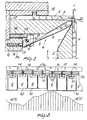
- the knitting machine 1 ( Figures 1 and 2) comprises a needle cylinder 2 and dial 3, wherein needles 4 and 5, respectively, are mounted slidably as driven in a conventional fashion.
- the machine 1 further comprises a means 6 for engaging and tensioning a knitwork 7, which means is located within the machine 1.
- Said means includes a plurality of reed-like tensioning elements 8, each supported at one end 9 inside the cylinder 2 and having an opposed end 10 located next to the needle 4,5. Said end 10 is configured for engagement with the knitwork 7, as explained hereinafter.
- the reed-like tensioning elements 8 each have their end 9 attached to a respective supporting element 11 in the form of a small block pivoted at 12 to a respective supporting bracket 13, the bracket 13 being fastened under the dial 3. It may be appreciated that in the embodiment shown, the reed-like tensioning elements 8 are laid side-by-side all around the axis of the machine 1, that is, they have a limited width and their pivot axes 12 are laid along a broken line enveloping a circumference concentric with the axis of the machine 1.
- each supporting element or block 11 there are arranged a pin 14 and small pivot pin 15 acting in opposite directions.
- the pin 14 is movable in a respective radial seat 16 in the dial holding structure 3a and its remote end from that engaging with the block 15 is adapted to follow the profile of a cam 17 which is carried by the cam structure 3b of the machine and, accordingly, driven of relative motion to the supporting structure for the reed-like elements 8.
- the cam 17 is of the ring type.
- the small pivot pin 15 is accommodated within a blind seat 18, and is subjected to the action of a spring 19, provided in the seat 18, to keep constant the engagement of the block 11 with the pin 14 and hence the engagement of the latter with the cam 17.
- each reed-like element 8 is arranged to bear on the inside bevel 3c of the dial 3, the pin 14 contacting then a depression 17a in the cam 17.
- One end 10 of each reed-like element 8 barely clears the outer circumference of the dial 3 without hindering the movement of the knitwork 7 through the gap between the cylinder 2 and dial 3.
- the knitwork 7 is pulled down by its own weight, or alternatively by a gentle action tensioner, not shown.
- the needles 4 of the cylinder 2 are raised (and the needles 5 of the dial 3 thrust outwards) and the knitwork loops are to be held back to prevent them from being dragged away by the needles 4,5, the radially outermost profile of the cam 17 becomes operative to push the pinsl4 slightly outwards and cause the supporting block 11 of the respective reed-like elements 8 to perform a partial rotation.
- This rotational movement results in the ends10 being moved into a position of engagement with the knitwork 7, which is clamped between said ends10 and the internal surface of the cylinder 2 on which the knitwork 7 rests.
- the cam 17, and consequently the thrust on the block 11, are designed to also impress on the reed-like elements 8 a deflection (position shown in full lines in Figure 2 and dash lines in Figure 1), thereby there occurs a slight downward displacement of the ends10 across the internal surface of the needle bed, which thing leads to a slight tension being applied to the knitwork loops.
- any movements of the loops is effectively prevented and the loops move past the respective needle latches of the exiting needles, and hence, into a position where they can be positively discharged on the successive re-entering movement of the needles 4,5.
- the engagement phase of the knitwork 7 is limited to the phase of outward movement of the needles 4,5, whereas during the re-entering phase of the needles the reed-like elements 8 are returned to an inoperative condition wherein the knitwork 7 is allowed to move down prior to being re-engaged at the following course.
- the relieve provided in the needle beds of Figure 2 advantageously increases the space available for inserting the knitwork between the needle beds and favors an increased pull after the clamping phase.
- the reed-like elements 8 are housed in the relieve of the dial 3, and in the engaged position, they engage the knitwork 7 in the relieve of the cylinder 2.
- the increased travel distance of the ends 10 of the reed-like elements 8 results in a stronger pull being applied on the knitwork 7.
- Figure 4 illustrates a reed-like element 8' having a hooked working end which can penetrate the courses and increase the pull force.
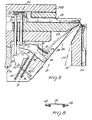
- a circular knitting machine 21 has a needle cylinder 22 and dial 23, with respective needles 24 and 25.
- the means 26 for engaging and tensioning the knitwork 27, again located within the machine, comprises a plurality of tensioning elements 28 of substantially plate-like configuration and being each supported at one portion within the cylinder 22 , each element having an opposed portion located in the proximity of the needles 24, 25.
- Each tensioning element 28 is pivoted at 29 to a respective first supporting element 30 in the form of a lever pivoted, in turn, at 31 to a supporting block 32 attached to the dial holder 23a.
- a spring 35 is placed between each tensioning element 28 and lever element 30 so as to pull the tensioning element 28 toward the dial 23.
- the spring 35 is only required to overcome the action due to the weight of the tensioning element 28, and will accordingly be a rather weak one.
- a more powerful spring 36 is arranged to act between the lever element 30 and a fixed point 37 to maintain the lever element 30 in contact with the rod-like element 33, and hence, the latter in contact with the ring cam 34.
- a stop 38 defines the home position of the lever element 30.
- each tensioning element 28 is connected, allowing a degree of play, through a respective link 39, to one end of a respective second lever element 40, pivoted at 41 to the supporting block 32 and having a peripheral section 42 in contact with one end of a rod-like control element 43.
- the latter is passed vertically through the dial 23 and dial holder 23a close to the rod-like element 33, and engages at its other end with the bottom profile of a ring cam 44, attached to the cam structure 23b.
- a spring 45 tends to hold the lever element 40 engaged with the rod-like element 43 and the latter with the cam 44.
- the tensioning elements 28 are of course arranged along a broken line, similarly to the reed-like elements 8. They may also be likened to reed-like elements, but having a greater thickness than the elements 8.
- the profile of the cams 34 and 44 for each yarn feed location is shown in Figure 7 where the needle pattern during the knitting phase is also shown schematically, similarly to the embodiment first- described hereinabove.
- the cam 34 has a profile including a substantially sharply downward sloping section 34a, a short horizontal section 34b, and a gently upward sloping section 34c followed by a long horizontal section 34d.
- the cam 44 has a substantially sharply downward sloping section 44a located slightly upstream of the section 34a (in the direction of movement of the needles), a horizontal section 44b as far as the end of the downward sloping section 34a of the cam 34, followed by a substantially vertical raising section 44c at the end of the downward sloping section 34a of the cam 34 and by a final horizontal section 44d.
- the device On completion of the withdrawal movement of the needles 24, 25, the device occupies the position indicated with full lines in Figure 5, and the rod-like elements 33 and 43 engage respectively with the sections 34d and 44d of the cams 34 and 44. Thereafter, as the needles 24 barely begin to move up, the section 34a of the cam 34 comes into operation, and the tensioning elements 28 will move into the position indicated with dash lines in Figure 5, as allowed by the play between the links 39 and lever elements 40, and the various springs provided. On reaching the lowermost point in the downward sloping section 34a, the section 44c of the cam 44 becomes operative, and owing to the springs coming into play, the position indicated with full lines in Figure 6 is reached.
- the tensioning elements could be each attached to a small block such as the block 11 in the embodiment of Figures 1-4 to support the block in an articulated fashion at one end of a lever pivoted to the structure which carries the needles of the dial 23. Another end of the lever, as well as the block itself, would then be controlled by respective rod-like elements under the action of suitably contoured cams and against the bias force of an elastic means, so as to move the tensioning elements with a component in the direction of the knitwork bearing surface on the needle bed.
- a pressure is exerted on the knitwork by the spring 45 along with a tension supplied by the spring 36.
- the springs 45 and 36 may be made adjustable.
- the device according to the invention is made up essentially of clamps or grippers, one element whereof is formed by the reed-like element proper, and the other by the machine needle bed. This affords a marked simplification of the tensioning device.
- the tensioning elements which may be steel reeds, have a width dimension which depends in particular on the needle density and steepness of the lift cams therefor. More specifically, the tensioning elements will be made wider where the cams are less steep, and viceversa. In a practical embodiment with a large diameter circular knitting machine, optimum results have been obtained with reed-like elements 30 mm wide. Of course, it would be preferable to have their ends10 follow the curved line of circular machines, at least above a certain width of the reed-like elements and below a certain diameter of the machines.
- the reed-like elements 8 could have their ends 9 attached to the dial holder 3a and the pins 14 could be arranged to act directly onto the surface of the respective reed-like elements to deflect them into their working position. Return of each reed-like element to its home position would be ensured by the elasticity of the element itself.
Landscapes
- Engineering & Computer Science (AREA)
- Textile Engineering (AREA)
- Knitting Machines (AREA)
Applications Claiming Priority (2)
| Application Number | Priority Date | Filing Date | Title |
|---|---|---|---|
| IT2503382 | 1982-12-29 | ||
| IT25033/82A IT1198421B (it) | 1982-12-29 | 1982-12-29 | Dispositivo di tensionamento della maglia in una macchina per maglieria |
Publications (2)
| Publication Number | Publication Date |
|---|---|
| EP0115060A1 true EP0115060A1 (de) | 1984-08-08 |
| EP0115060B1 EP0115060B1 (de) | 1986-11-12 |
Family
ID=11215487
Family Applications (1)
| Application Number | Title | Priority Date | Filing Date |
|---|---|---|---|
| EP83113042A Expired EP0115060B1 (de) | 1982-12-29 | 1983-12-23 | Vorrichtung zum Spannen des Gestrickten an einer Rundstrickmaschine |
Country Status (4)
| Country | Link |
|---|---|
| EP (1) | EP0115060B1 (de) |
| JP (1) | JPS59173352A (de) |
| DE (1) | DE3367636D1 (de) |
| IT (1) | IT1198421B (de) |
Citations (7)
| Publication number | Priority date | Publication date | Assignee | Title |
|---|---|---|---|---|
| US218460A (en) * | 1879-08-12 | Improvement in web-holiding mechanisms for knitting-machines | ||
| US3003342A (en) * | 1956-08-24 | 1961-10-10 | Bentley Eng Co Ltd | Fabric tensioning devices for knitting machines |
| FR1417697A (fr) * | 1964-12-16 | 1965-11-12 | Solis Soc A R L | Dispositif mécanique destiné à assurer la tension du tricot au cours de sa formation sur les métiers à cylindre rotatif pour la fabrication de bas et articles similaires |
| GB1208247A (en) * | 1968-04-19 | 1970-10-07 | Francesco Lonati | A pusher unit for double cylinder knitting machines |
| DE2809981A1 (de) * | 1977-03-11 | 1978-09-14 | Elitex Zavody Textilniho | Vorrichtung an einer rundstrickmaschine zum spannen und abziehen eines gestrickes |
| GB2013729A (en) * | 1978-01-25 | 1979-08-15 | Stoll & Co H | Take-down device for flat knitting machines |
| DE2916414A1 (de) * | 1978-04-24 | 1979-10-31 | Elitex Zavody Textilniho | Abzugs- und spannvorrichtung fuer eine rundstrickmaschine |
Family Cites Families (1)
| Publication number | Priority date | Publication date | Assignee | Title |
|---|---|---|---|---|
| DE1417697A1 (de) * | 1961-06-14 | 1968-10-10 | Kandler Dr Habil Ludwig | Verfahren zur Herstellung und erforderlichenfalls Regenerierung fein verteilter,hochaktiver fixierter Metalloxyd- bzw. Metallhydroxyd- oder Metallkatalysatoren |
-
1982
- 1982-12-29 IT IT25033/82A patent/IT1198421B/it active
-
1983
- 1983-12-23 EP EP83113042A patent/EP0115060B1/de not_active Expired
- 1983-12-23 DE DE8383113042T patent/DE3367636D1/de not_active Expired
- 1983-12-28 JP JP58252310A patent/JPS59173352A/ja active Granted
Patent Citations (7)
| Publication number | Priority date | Publication date | Assignee | Title |
|---|---|---|---|---|
| US218460A (en) * | 1879-08-12 | Improvement in web-holiding mechanisms for knitting-machines | ||
| US3003342A (en) * | 1956-08-24 | 1961-10-10 | Bentley Eng Co Ltd | Fabric tensioning devices for knitting machines |
| FR1417697A (fr) * | 1964-12-16 | 1965-11-12 | Solis Soc A R L | Dispositif mécanique destiné à assurer la tension du tricot au cours de sa formation sur les métiers à cylindre rotatif pour la fabrication de bas et articles similaires |
| GB1208247A (en) * | 1968-04-19 | 1970-10-07 | Francesco Lonati | A pusher unit for double cylinder knitting machines |
| DE2809981A1 (de) * | 1977-03-11 | 1978-09-14 | Elitex Zavody Textilniho | Vorrichtung an einer rundstrickmaschine zum spannen und abziehen eines gestrickes |
| GB2013729A (en) * | 1978-01-25 | 1979-08-15 | Stoll & Co H | Take-down device for flat knitting machines |
| DE2916414A1 (de) * | 1978-04-24 | 1979-10-31 | Elitex Zavody Textilniho | Abzugs- und spannvorrichtung fuer eine rundstrickmaschine |
Also Published As
| Publication number | Publication date |
|---|---|
| EP0115060B1 (de) | 1986-11-12 |
| IT1198421B (it) | 1988-12-21 |
| IT8225033A0 (it) | 1982-12-29 |
| JPS59173352A (ja) | 1984-10-01 |
| JPH0340138B2 (de) | 1991-06-18 |
| DE3367636D1 (en) | 1987-01-02 |
Similar Documents
| Publication | Publication Date | Title |
|---|---|---|
| US5040384A (en) | Method for setting up a fabric on a flat knitting machine | |
| EP3983587B1 (de) | Rundstrickmaschine und verfahren zum bewegen der nadeln in einer rundstrickmaschine | |
| US6240749B1 (en) | Flat knitting machine | |
| EP0115060B1 (de) | Vorrichtung zum Spannen des Gestrickten an einer Rundstrickmaschine | |
| JPS59137548A (ja) | ハンドグラインダー及びそのための自動閉止弁 | |
| JP4038262B2 (ja) | ホージャリー等の管状編物のシングルシリンダ機による製造方法 | |
| EP0683257B1 (de) | Rundstrickmaschine mit Platinen zum Festhalten des Gestricks | |
| US6176106B1 (en) | Dial or half-dial for single-cylinder circular hosiery knitting machines, particularly for producing tubular items closed at one longitudinal end | |
| US5186027A (en) | Circular knitting machine of the type with cylinder and dial with thread clamping and cutting device for manufacturing open fabric | |
| JPH03206161A (ja) | 横編機におけるシンカー装置 | |
| US3430464A (en) | Tubular hosiery tensioning device | |
| US4864833A (en) | Control device for adjusting the radial position of the sinkers in a circular knitting machine | |
| US2506968A (en) | Knitting machine | |
| US5097684A (en) | Apparatus to engage set-up fabric on a flat knitting machine | |
| US4033148A (en) | Needle selecting device | |
| GB2173220A (en) | Multisystem circular knitting machine | |
| US3115024A (en) | Apparatus and methods for making stockings and the like | |
| US4068498A (en) | Interlocking cams | |
| JPS5837422B2 (ja) | 円形横編機 | |
| RU2077621C1 (ru) | Ротационная двухцилиндровая кругловязальная машина | |
| US2082642A (en) | Sinker or web holder control | |
| US3200618A (en) | Knitting machine and method | |
| GB2061329A (en) | Cylinder and Dial Knitting Machine for Hosiery | |
| GB2043713A (en) | Needle selecting device for knitting machines | |
| US6164090A (en) | Needle actuation device for knitting machines |
Legal Events
| Date | Code | Title | Description |
|---|---|---|---|
| PUAI | Public reference made under article 153(3) epc to a published international application that has entered the european phase |
Free format text: ORIGINAL CODE: 0009012 |
|
| AK | Designated contracting states |
Designated state(s): CH DE FR GB LI |
|
| 17P | Request for examination filed |
Effective date: 19850205 |
|
| 17Q | First examination report despatched |
Effective date: 19860128 |
|
| GRAA | (expected) grant |
Free format text: ORIGINAL CODE: 0009210 |
|
| AK | Designated contracting states |
Kind code of ref document: B1 Designated state(s): CH DE FR GB LI |
|
| ET | Fr: translation filed | ||
| PG25 | Lapsed in a contracting state [announced via postgrant information from national office to epo] |
Ref country code: LI Effective date: 19861231 Ref country code: CH Effective date: 19861231 |
|
| REF | Corresponds to: |
Ref document number: 3367636 Country of ref document: DE Date of ref document: 19870102 |
|
| REG | Reference to a national code |
Ref country code: CH Ref legal event code: PL |
|
| PLBE | No opposition filed within time limit |
Free format text: ORIGINAL CODE: 0009261 |
|
| STAA | Information on the status of an ep patent application or granted ep patent |
Free format text: STATUS: NO OPPOSITION FILED WITHIN TIME LIMIT |
|
| 26N | No opposition filed | ||
| PGFP | Annual fee paid to national office [announced via postgrant information from national office to epo] |
Ref country code: FR Payment date: 19901218 Year of fee payment: 8 |
|
| PGFP | Annual fee paid to national office [announced via postgrant information from national office to epo] |
Ref country code: DE Payment date: 19901221 Year of fee payment: 8 |
|
| PGFP | Annual fee paid to national office [announced via postgrant information from national office to epo] |
Ref country code: GB Payment date: 19901224 Year of fee payment: 8 |
|
| PG25 | Lapsed in a contracting state [announced via postgrant information from national office to epo] |
Ref country code: GB Effective date: 19911223 |
|
| GBPC | Gb: european patent ceased through non-payment of renewal fee | ||
| PG25 | Lapsed in a contracting state [announced via postgrant information from national office to epo] |
Ref country code: FR Effective date: 19920831 |
|
| PG25 | Lapsed in a contracting state [announced via postgrant information from national office to epo] |
Ref country code: DE Effective date: 19920901 |
|
| REG | Reference to a national code |
Ref country code: FR Ref legal event code: ST |