EP0115078A2 - Elektrochromisches Druckmedium - Google Patents
Elektrochromisches Druckmedium Download PDFInfo
- Publication number
- EP0115078A2 EP0115078A2 EP83113165A EP83113165A EP0115078A2 EP 0115078 A2 EP0115078 A2 EP 0115078A2 EP 83113165 A EP83113165 A EP 83113165A EP 83113165 A EP83113165 A EP 83113165A EP 0115078 A2 EP0115078 A2 EP 0115078A2
- Authority
- EP
- European Patent Office
- Prior art keywords
- recording medium
- electrochromic
- medium according
- compound
- electrochromic recording
- Prior art date
- Legal status (The legal status is an assumption and is not a legal conclusion. Google has not performed a legal analysis and makes no representation as to the accuracy of the status listed.)
- Granted
Links
- 150000001875 compounds Chemical class 0.000 claims abstract description 35
- 239000000758 substrate Substances 0.000 claims abstract description 24
- 238000000034 method Methods 0.000 claims abstract description 15
- 125000000217 alkyl group Chemical group 0.000 claims abstract description 13
- 125000002252 acyl group Chemical group 0.000 claims abstract description 12
- 239000007800 oxidant agent Substances 0.000 claims abstract description 12
- 239000000203 mixture Substances 0.000 claims abstract description 8
- -1 inorganic acid salts Chemical class 0.000 claims description 12
- IOLCXVTUBQKXJR-UHFFFAOYSA-M potassium bromide Chemical compound [K+].[Br-] IOLCXVTUBQKXJR-UHFFFAOYSA-M 0.000 claims description 8
- 238000000576 coating method Methods 0.000 claims description 6
- 125000004432 carbon atom Chemical group C* 0.000 claims description 5
- 239000003795 chemical substances by application Substances 0.000 claims description 5
- 239000011248 coating agent Substances 0.000 claims description 5
- CPELXLSAUQHCOX-UHFFFAOYSA-M Bromide Chemical compound [Br-] CPELXLSAUQHCOX-UHFFFAOYSA-M 0.000 claims description 4
- 238000006056 electrooxidation reaction Methods 0.000 claims description 4
- JHJLBTNAGRQEKS-UHFFFAOYSA-M sodium bromide Chemical compound [Na+].[Br-] JHJLBTNAGRQEKS-UHFFFAOYSA-M 0.000 claims description 4
- SWLVFNYSXGMGBS-UHFFFAOYSA-N ammonium bromide Chemical compound [NH4+].[Br-] SWLVFNYSXGMGBS-UHFFFAOYSA-N 0.000 claims description 3
- VCCBEIPGXKNHFW-UHFFFAOYSA-N biphenyl-4,4'-diol Chemical compound C1=CC(O)=CC=C1C1=CC=C(O)C=C1 VCCBEIPGXKNHFW-UHFFFAOYSA-N 0.000 claims description 3
- 230000003647 oxidation Effects 0.000 claims description 3
- 238000007254 oxidation reaction Methods 0.000 claims description 3
- 125000004429 atom Chemical group 0.000 claims 1
- 229950011260 betanaphthol Drugs 0.000 claims 1
- 150000001649 bromium compounds Chemical group 0.000 claims 1
- 150000002894 organic compounds Chemical class 0.000 abstract 1
- 239000000975 dye Substances 0.000 description 20
- XLYOFNOQVPJJNP-UHFFFAOYSA-N water Substances O XLYOFNOQVPJJNP-UHFFFAOYSA-N 0.000 description 5
- CSCPPACGZOOCGX-UHFFFAOYSA-N Acetone Chemical compound CC(C)=O CSCPPACGZOOCGX-UHFFFAOYSA-N 0.000 description 4
- QTBSBXVTEAMEQO-UHFFFAOYSA-N Acetic acid Chemical compound CC(O)=O QTBSBXVTEAMEQO-UHFFFAOYSA-N 0.000 description 3
- 239000000463 material Substances 0.000 description 3
- WKBOTKDWSSQWDR-UHFFFAOYSA-N Bromine atom Chemical compound [Br] WKBOTKDWSSQWDR-UHFFFAOYSA-N 0.000 description 2
- FERIUCNNQQJTOY-UHFFFAOYSA-N Butyric acid Chemical compound CCCC(O)=O FERIUCNNQQJTOY-UHFFFAOYSA-N 0.000 description 2
- LFQSCWFLJHTTHZ-UHFFFAOYSA-N Ethanol Chemical compound CCO LFQSCWFLJHTTHZ-UHFFFAOYSA-N 0.000 description 2
- 229920002472 Starch Polymers 0.000 description 2
- 125000003236 benzoyl group Chemical group [H]C1=C([H])C([H])=C(C([H])=C1[H])C(*)=O 0.000 description 2
- GDTBXPJZTBHREO-UHFFFAOYSA-N bromine Substances BrBr GDTBXPJZTBHREO-UHFFFAOYSA-N 0.000 description 2
- 229910052794 bromium Inorganic materials 0.000 description 2
- 125000000484 butyl group Chemical group [H]C([*])([H])C([H])([H])C([H])([H])C([H])([H])[H] 0.000 description 2
- 125000001589 carboacyl group Chemical group 0.000 description 2
- 238000006243 chemical reaction Methods 0.000 description 2
- XBDQKXXYIPTUBI-UHFFFAOYSA-N dimethylselenoniopropionate Natural products CCC(O)=O XBDQKXXYIPTUBI-UHFFFAOYSA-N 0.000 description 2
- 125000001495 ethyl group Chemical group [H]C([H])([H])C([H])([H])* 0.000 description 2
- 229910052740 iodine Inorganic materials 0.000 description 2
- 239000011630 iodine Substances 0.000 description 2
- QTWZICCBKBYHDM-UHFFFAOYSA-N leucomethylene blue Chemical compound C1=C(N(C)C)C=C2SC3=CC(N(C)C)=CC=C3NC2=C1 QTWZICCBKBYHDM-UHFFFAOYSA-N 0.000 description 2
- BDAGIHXWWSANSR-UHFFFAOYSA-N methanoic acid Natural products OC=O BDAGIHXWWSANSR-UHFFFAOYSA-N 0.000 description 2
- 125000002496 methyl group Chemical group [H]C([H])([H])* 0.000 description 2
- CXKWCBBOMKCUKX-UHFFFAOYSA-M methylene blue Chemical compound [Cl-].C1=CC(N(C)C)=CC2=[S+]C3=CC(N(C)C)=CC=C3N=C21 CXKWCBBOMKCUKX-UHFFFAOYSA-M 0.000 description 2
- 229960000907 methylthioninium chloride Drugs 0.000 description 2
- 239000000243 solution Substances 0.000 description 2
- 235000019698 starch Nutrition 0.000 description 2
- 239000008107 starch Substances 0.000 description 2
- GEXXQHVMEXZRBL-UHFFFAOYSA-N 2-[3,7-bis(dimethylamino)phenothiazine-10-carbonyl]benzenesulfonic acid Chemical compound C12=CC=C(N(C)C)C=C2SC2=CC(N(C)C)=CC=C2N1C(=O)C1=CC=CC=C1S(O)(=O)=O GEXXQHVMEXZRBL-UHFFFAOYSA-N 0.000 description 1
- JNRLEMMIVRBKJE-UHFFFAOYSA-N 4,4'-Methylenebis(N,N-dimethylaniline) Chemical compound C1=CC(N(C)C)=CC=C1CC1=CC=C(N(C)C)C=C1 JNRLEMMIVRBKJE-UHFFFAOYSA-N 0.000 description 1
- OSWFIVFLDKOXQC-UHFFFAOYSA-N 4-(3-methoxyphenyl)aniline Chemical compound COC1=CC=CC(C=2C=CC(N)=CC=2)=C1 OSWFIVFLDKOXQC-UHFFFAOYSA-N 0.000 description 1
- ZCYVEMRRCGMTRW-UHFFFAOYSA-N 7553-56-2 Chemical compound [I] ZCYVEMRRCGMTRW-UHFFFAOYSA-N 0.000 description 1
- OAZWDJGLIYNYMU-UHFFFAOYSA-N Leucocrystal Violet Chemical compound C1=CC(N(C)C)=CC=C1C(C=1C=CC(=CC=1)N(C)C)C1=CC=C(N(C)C)C=C1 OAZWDJGLIYNYMU-UHFFFAOYSA-N 0.000 description 1
- ZLMJMSJWJFRBEC-UHFFFAOYSA-N Potassium Chemical compound [K] ZLMJMSJWJFRBEC-UHFFFAOYSA-N 0.000 description 1
- QAOWNCQODCNURD-UHFFFAOYSA-N Sulfuric acid Chemical class OS(O)(=O)=O QAOWNCQODCNURD-UHFFFAOYSA-N 0.000 description 1
- ZKURGBYDCVNWKH-UHFFFAOYSA-N [3,7-bis(dimethylamino)phenothiazin-10-yl]-phenylmethanone Chemical compound C12=CC=C(N(C)C)C=C2SC2=CC(N(C)C)=CC=C2N1C(=O)C1=CC=CC=C1 ZKURGBYDCVNWKH-UHFFFAOYSA-N 0.000 description 1
- 235000011054 acetic acid Nutrition 0.000 description 1
- 125000002777 acetyl group Chemical group [H]C([H])([H])C(*)=O 0.000 description 1
- 239000002253 acid Substances 0.000 description 1
- 239000012670 alkaline solution Substances 0.000 description 1
- 239000007864 aqueous solution Substances 0.000 description 1
- 229940092714 benzenesulfonic acid Drugs 0.000 description 1
- 125000004063 butyryl group Chemical group O=C([*])C([H])([H])C([H])([H])C([H])([H])[H] 0.000 description 1
- 239000003086 colorant Substances 0.000 description 1
- 239000003085 diluting agent Substances 0.000 description 1
- 238000002845 discoloration Methods 0.000 description 1
- 239000006185 dispersion Substances 0.000 description 1
- 238000001035 drying Methods 0.000 description 1
- 230000000694 effects Effects 0.000 description 1
- 230000005684 electric field Effects 0.000 description 1
- 238000005868 electrolysis reaction Methods 0.000 description 1
- 238000005562 fading Methods 0.000 description 1
- 235000019253 formic acid Nutrition 0.000 description 1
- 125000002485 formyl group Chemical group [H]C(*)=O 0.000 description 1
- 125000004051 hexyl group Chemical group [H]C([H])([H])C([H])([H])C([H])([H])C([H])([H])C([H])([H])C([H])([H])* 0.000 description 1
- XMBWDFGMSWQBCA-UHFFFAOYSA-N hydrogen iodide Chemical compound I XMBWDFGMSWQBCA-UHFFFAOYSA-N 0.000 description 1
- 150000002485 inorganic esters Chemical class 0.000 description 1
- 150000004694 iodide salts Chemical class 0.000 description 1
- PNDPGZBMCMUPRI-UHFFFAOYSA-N iodine Chemical compound II PNDPGZBMCMUPRI-UHFFFAOYSA-N 0.000 description 1
- 150000002497 iodine compounds Chemical class 0.000 description 1
- 150000002576 ketones Chemical class 0.000 description 1
- 238000004519 manufacturing process Methods 0.000 description 1
- 230000007246 mechanism Effects 0.000 description 1
- 229910021645 metal ion Inorganic materials 0.000 description 1
- 239000013528 metallic particle Substances 0.000 description 1
- 229910000402 monopotassium phosphate Inorganic materials 0.000 description 1
- 235000019796 monopotassium phosphate Nutrition 0.000 description 1
- 125000000740 n-pentyl group Chemical group [H]C([H])([H])C([H])([H])C([H])([H])C([H])([H])C([H])([H])* 0.000 description 1
- 125000001400 nonyl group Chemical group [H]C([*])([H])C([H])([H])C([H])([H])C([H])([H])C([H])([H])C([H])([H])C([H])([H])C([H])([H])C([H])([H])[H] 0.000 description 1
- 239000003960 organic solvent Substances 0.000 description 1
- PJNZPQUBCPKICU-UHFFFAOYSA-N phosphoric acid;potassium Chemical compound [K].OP(O)(O)=O PJNZPQUBCPKICU-UHFFFAOYSA-N 0.000 description 1
- 229910052700 potassium Inorganic materials 0.000 description 1
- 239000011591 potassium Substances 0.000 description 1
- 235000019260 propionic acid Nutrition 0.000 description 1
- 125000001501 propionyl group Chemical group O=C([*])C([H])([H])C([H])([H])[H] 0.000 description 1
- 125000001436 propyl group Chemical group [H]C([*])([H])C([H])([H])C([H])([H])[H] 0.000 description 1
- IUVKMZGDUIUOCP-BTNSXGMBSA-N quinbolone Chemical compound O([C@H]1CC[C@H]2[C@H]3[C@@H]([C@]4(C=CC(=O)C=C4CC3)C)CC[C@@]21C)C1=CCCC1 IUVKMZGDUIUOCP-BTNSXGMBSA-N 0.000 description 1
- 150000003839 salts Chemical class 0.000 description 1
- 239000002904 solvent Substances 0.000 description 1
- 238000005507 spraying Methods 0.000 description 1
- 230000000087 stabilizing effect Effects 0.000 description 1
- 125000004079 stearyl group Chemical group [H]C([*])([H])C([H])([H])C([H])([H])C([H])([H])C([H])([H])C([H])([H])C([H])([H])C([H])([H])C([H])([H])C([H])([H])C([H])([H])C([H])([H])C([H])([H])C([H])([H])C([H])([H])C([H])([H])C([H])([H])C([H])([H])[H] 0.000 description 1
- 150000003467 sulfuric acid derivatives Chemical class 0.000 description 1
Classifications
-
- B—PERFORMING OPERATIONS; TRANSPORTING
- B41—PRINTING; LINING MACHINES; TYPEWRITERS; STAMPS
- B41M—PRINTING, DUPLICATING, MARKING, OR COPYING PROCESSES; COLOUR PRINTING
- B41M5/00—Duplicating or marking methods; Sheet materials for use therein
- B41M5/20—Duplicating or marking methods; Sheet materials for use therein using electric current
Definitions
- the invention relates to an electrochromic printing medium, the substrate of which has a coating on at least one side.
- metal ions are introduced into the paper to be printed from one of the electrodes and are either linked to colorless materials that are already in the sheet to be printed to form colored areas or are precipitated as fine metallic particles.
- a disadvantage here is the consumption of the electrode during the printing process. This requires complicated pressure mechanisms with feed devices in order to keep the electrode functional.
- the electrodes are not consumed and the writing is carried out by an electrolytic change in the material that is already in the sheet to be printed.
- An example of such a method uses the reaction of starch and iodine to carry out the writing.
- the electrolysis of iodide of potassium or other iodide compound in the paper produces free iodides that react with the starch that is also in the paper, thereby forming a purple starch-iodine compound.
- Another example of such a system provides dry electrolytic printing using a special paper consisting of one or two metallized layers.
- the disadvantage here is the need for an expensive paper, which requires special layers of material and a voltage exceeding 100 volts for printing.
- Systems which are not consumable, such as the starch-iodine method have the disadvantage that no permanent printing is produced due to the fading of the printed markings and also due to discoloration of the paper during storage.
- electrochromic printing process Another type of electrochromic printing process is described in U.S. Patent 4,211,616, according to which the electrochromic printing composition contains an iodine compound as a color former, a bromide and an auxiliary dye to enhance the color of the printed characters.
- the auxiliary dye is one that tries to form additional compounds with the iodine, thereby stabilizing the printed characters.
- auxiliary colors examples include leukomethylene blue and derivatives, leuco crystal violet and 4,4'-methylene-bis-N, -N-dimethyl-aniline.
- the proposed leukomethylene blue derivatives contain p-sulfobenzoyl-leukomethylene blue, p-carboxybenzoyl-leukomethylene blue, symmetrical benzoyl leuko-N, N'-p-benzenesulfonic acid methylene blue and symmetrical benzoyl leuko-N-N'-p-naphtholsulfonic acid methylene blue.
- R represents an organic radical that, in the presence of bromine and after applying voltage, converts the leuco dye into a colored dye after the AR group has split off.
- the coating is carried out with a bromide compound in order to catalyze an electrooxidation of the leuco dye.
- Kitakohji et al. on pages 131 to 145 of the "Fujitsu Scientific & Technical Journal” in “dichromic electrolytic recording paper” suggest electrolytic printing by direct electroreaction of benzoyl leukomethylene blue using a voltage of approximately 170 or approximately 230 volts.
- U.S. Patents 3,713,996 and 3,726,769 relate to electrolytic electrosensitive printing.
- the invention achieves the object of creating an electrochromically printable medium which is suitable for a printing process which does not require any electrodes to be used up, manages with a simple recording paper and the electrical quantities required for the printing
- the use of integrated circuits enables the voltages, currents and times required for printing to be compatible with the values available from the integrated circuits.
- the electrochromic printing medium contains a substrate which has a coating of certain compounds on at least one side which act as leuco dyes.
- each R individually represents H or alkyl or acyl; each R 1 is specifically alkanoyl or alkyl of 1 to 4 carbon atoms; n is an integer between 0 and 5.
- sulfate esters can be used in some of the aforementioned compounds.
- the substrate is also coated with a weakened oxidizing agent to an extent sufficient to accelerate electrooxidation of the above compounds for the manufacture of a color image.
- the invention also relates to a method for electrochromic printing, which comprises the application of an electric field in a predetermined pattern on the electrochromically printable medium.
- Each R is individually an H or alkyl or acyl.
- the alkyl group and the acyl group may contain 1 to 22, preferably 1 to 4 carbon atoms. Examples of some alkyl groups are methyl, ethyl, butyl, amyl, hexyl, 2-hexyl, 2-ethylhexyl, nonyl and octadecyl. Examples of acyl groups contain alkanoyl groups which are obtained from formic acid, acetic acid, propionic acid and butyric acid.
- Each R is specifically an alkanoyl or alkyl group preferably having 1 to 4 carbon atoms.
- alkanoyl groups are formyl, acetyl, propionyl and butyryl.
- R 1 examples of some alkyl groups for R 1 are methyl, ethyl, butyl and propyl.
- n is an integer between 0 and 5, preferably between 0 and 2, and most preferably between 0 or 1. If n is 1 or 2, an exchange in the orthoposition relative to the OR group is preferred.
- inorganic esters of the above compounds such as sulfuric acid esters, are envisaged.
- Mixtures of the above compounds can be used. Mixtures of one or more of the above compounds with other types of compounds that act as leuco dyes can also be used.
- the compound can be applied to a substrate in the form of a solution or dispersion in water or an organic solvent depending on the dissolving characteristics of the compound used.
- suitable solvents for the abovementioned compounds of the formulas 4 to 12 are wine spirit such as ethanol and ketone such as acetone.
- Many of the above-mentioned compounds are soluble or easily dispersible in water or in aqueous alkaline solutions.
- the compound is generally used in amounts from about 2 to about 200 milligrams for a standard page (e.g. 205 x 279 mm substrate field). Of course, the relative amount of the compound is changed up or down depending on the size of the substrate used. Amounts greater than about 10 milligrams for the above-mentioned substrate size are generally not necessary, since about 10 milligrams are sufficient to saturate the substrate surface.
- the substrate surface is coated with a reduced oxidation agent such as a bromide compound.
- a reduced oxidation agent such as a bromide compound.
- suitable compounds are ammonium bromide, potassium bromide and sodium bromide. If desired, mixtures can also be used.
- the reduced form of an oxidizing agent such as a bromine salt compound is present in amounts from about 10 milligrams to about 1/4 gram per standard page.
- the reduced form of an oxidizing agent, such as a bromide compound is present in an amount to provide an oxidizing agent in a reduced form to dye weight ratio from about 1: 1 to about 30: 1. The preferred weight ratio is from about 5: 1 to about 10 : 1.
- the reduced form of an oxidation agent is present for producing an electrooxidation of the colorless compound (e.g. leuco dye) into a colored dye.
- the bromine is generated at the anode.
- a preferred bromide compound contains approximately 9% by weight ammonium bromide and preferably potassium bromide and a buffer such as 1.4% by weight KH 2 PO 4 .
- the substrate used can be ordinary paper. It is preferred that the medium be at least substantially free of color-forming agents that could attempt to chemically react with the dyes.
- At least one surface of the substrate is generally coated by supplying the reduced form of an oxidizing agent, such as a bromide compound, in the form of an aqueous solution or at least one of the above compounds.
- an oxidizing agent such as a bromide compound
- the compound can be fed and then the bromide ver bond, or both can be added in the same diluent depending on the solubility or dispersibility.
- the substrate can be impregnated with the compounds on both surfaces or even completely.
- the pressure connection used can be supplied to the substrate, such as ordinary paper, by spraying or other coating methods. This can be done shortly before printing or for a substrate to be used later.
- Non-consumable electrodes can preferably be used.
- a voltage of about 1.5 to about 15 volts is required when using a print medium in accordance with the present invention to effect a color change.
- about 5 volts or more is used to work with the electronic circuits.
- the voltage, the current and the required times are compatible with those parameters that occur in today's integrated circuits.
- the time used is generally about 100 to about 1000 microseconds.
- Currents up to approximately 4 milliamperes are required for a 0.025 mm electrode. The current value depends on the size of the electrode.
- an oxidizing agent such as a bromide compound
- printing cannot be obtained with the present invention.
- very weak printing is achievable, even when using very long pulses of about 10 to about 20 milliseconds at voltages up to 30 volts when the reduced form of an oxide tion agent is not used on the substrate containing compounds of the present invention.
- the conditions used for printing according to the present invention are very different from those required for dry electrolytic printing.
- the large voltages required for electrolytic printing make such media unsuitable for use with integrated circuits.
- the energy requirements are incompatible with those of integrated circuits.
- the substrate or paper is generally moistened with water immediately before printing.
- the pH of the water is around 7 in most cases.
- Ordinary paper (size 205 mm x 279 mm) is coated with a compound containing an aqueous compound of approximately 9% by weight potassium bromide and approximately 1.4% by weight potassium dihydrogen phosphate.
- the connection is filtered and sprayed onto the ordinary paper. After drying, the paper is coated with a solution of approximately 1% by weight 4,4'-diphenol in acetone, approximately 10 milligrams of the leuco dye per side.
- the paper is then fed to an electrolytic printer. Characters are then electrolytically printed on the paper by applying a predetermined voltage pattern of approximately 15 volts.
- the pulse time is approximately 700 microseconds.
- the electrode used is approximately 0.25 mm wide and the current used is about 4 milliamperes.
- the color of the printed characters is yellow.
- the present invention allows very high printing speeds of approximately 350 microseconds for one printing point.
- the characters printed under normal storage conditions are essentially permanent and do not fade. Even if a background is formed due to the successive development of the undeveloped parts, the printed characters are still quite perceptible.
- Example 1 The procedure of Example 1 is repeated with the exception that the dye used corresponds to Formula 5. The result is similar to that of Example 1.
- Example 1 The procedure of Example 1 is repeated with the exception that the dye used corresponds to Formula 6. The result is similar to that of Example 1, except that the color is yellow-green.
- Example 1 The procedure of Example 1 is repeated with the exception that the dye used corresponds to Formula 7. The result is similar to that of Example 1, except that the color is red.
- Example 1 The procedure of Example 1 is repeated with the exception that the dye used corresponds to Formula 8. The result is similar to that of Example 1, except that the color is red.
- Example 1 The procedure of Example 1 is repeated with the exception that the dye used corresponds to Formula 10. The result is similar to that of Example 1.
- Example 1 The procedure of Example 1 is repeated with the exception that the dye used corresponds to formula 12. The result is similar to that of Example 1, except that the color is reddish brown.
Landscapes
- Color Printing (AREA)
- Electrochromic Elements, Electrophoresis, Or Variable Reflection Or Absorption Elements (AREA)
- Inks, Pencil-Leads, Or Crayons (AREA)
Abstract


Description
- Die Erfindung bezieht sich auf ein elektrochromisches Druckmedium, dessen Substrat auf wenigstens einer Seite einen Überzug aufweist.
- Beim elektrolytischen Drucken sind mindestens zwei allgemeine Systeme des Druckverfahrens erkennbar. In einem derselben werden Metallionen von einer der Elektroden in das zu bedruckende Papier eingeführt und sind entweder mit farblosen Materialien verknüpft, die sich schon im zu bedruckenden Blatt befinden, um gefärbte Bereiche zu bilden oder sind ausgefällt als feine metallische Partikel.
- Ein Nachteil hierbei ist der Verbrauch der Elektrode beim Druckvorgang. Dies erfordert komplizierte Druckmechanismen mit Vorschubvorrichtungen, um-die Elektrode funktionsfähig zu halten.
- Bei einem anderen System werden die Elektroden nicht verbraucht, und das Schreiben wird durch eine elektrolytische Veränderung des Materiales, das schon im zu bedruckenden Blatt sich befindet, ausgeführt. Ein Beispiel eines derartigen Verfahrens verwendet die Reaktion von Stärke und Jod zur Ausführung des Schreibens. In diesem System erzeugt die Elektrolyse von Jodkali oder einer anderen Jodidverbindung in dem Papier freie Jodide, die mit der Stärke, die sich ebenfalls in dem Papier befindet, reagiert, wodurch ein purpurroter Stärke-Jod-Mehrstoff gebildet wird.
- Ein anderes Beispiel eines derartigen Systems sieht ein trockenes elektrolytisches Drucken vor, bei dem ein Spezialpapier verwendet wird, das aus einer oder zwei metallisierten Schichten besteht. Nachteilig ist hierbei das Erfordernis eines teuren Papieres, das spezielle Materialschichten und eine 100 Volt überschreitende Spannung für das Drucken erfordert. Die nicht einem Verbrauch unterliegenden Systeme, wie die Stärke-Jod-Methode, weisen den Nachteil auf, daß kein beständiger Druck erzeugt wird, infolge von Verblassens der gedruckten Markierungen und auch infolge einer Verfärbung des Papieres beim Speichern.
- Eine andere Art eines elektrochromischen Druckverfahrens ist in der US-Patentschrift 4 211 616 beschrieben, wonach die elektrochromische Druckzusammensetzung eine Jodverbindung als Farbbildner, ein Bromid und einen Hilfsfarbstoff enthalten, um die Farbe der gedruckten Zeichen zu steigern. Der Hilfsfarbstoff ist einer, der versucht, zusätzliche Verbindungen mit dem Jod zu bilden, wodurch die gedruckten Zeichen stabilisiert werden.
- Beispiele für derartige Hilfsfarben enthalten Leukomethylenblau und Derivate, Leukokristallviolett und 4,4'-Methylen-Bis-N,-N-Dimethyl-Anilin. Die vorgeschlagenen Leukomethylenblauderivate enthalten p-Sulfobenzoyl-Leukomethylenblau, p-Carboxybenzoyl-Leukomethylenblau, symmetrisches Benzoylleuko-N, N'-p-benzolsulfonsaures Methylenblau und symmetrisches Benzoylleuko-N-N'-p-naphtholsulfonsaures Methylenblau.
- Ein anderes elektrochromisches Aufzeichnungssubstrat ist in der US-Patentschrift 4 309 255 beschrieben und enthält ein wasserlösliches Salz von 3,7-Bis(Dimethyl- amino)-10-(2-Sulfobenzoyl)-Phenothiazin.
- In der US-Patentschrift 4 374 001 ist ein elektrochromisches Aufzeichnungsmedium beschrieben, dessen Substrat mit einem Leukofarbstoff der folgenden Formel überzogen ist:

- Kitakohji et al. schlagen auf Seiten 131 bis 145 des "Fujitsu Scientific & Technical Journal" in "Dichromisches elektrolytisches Aufzeichnungspapier" ein elektrolytisches Drucken vor durch direkte Elektroreaktion von Benzoylleukomethylenblau durch Verwendung einer Spannung ca. 170 oder ca. 230 Volt.
- Die US-Patentschriften 3 772 159, 3 816 838, 3 864 684, 3 871 972, 3 951 757, 3 974 041, 4 012 292, 4 133 933 und Re 29 427 sind von Interesse bezüglich Elektroaufzeichnungsglieder, die verschiedene Leukofarbstoffe zusätzlich zu anderen erforderlichen Komponenten aufweisen und sehr hohe Spannungen verwenden.
- Die US-Patentschriften 3 713 996 und 3 726 769 beziehen sich auf ein elektrolytisches elektrosensitives Drucken.
- Die Erfindung, wie sie in den Ansprüchen gekennzeichnet ist, löst die Aufgabe, ein elektrochromisch bedruckbares Medium zu schaffen, das für ein Druckverfahren geeignet ist, das keine sich aufbrauchende Elektroden benötigt, mit einem einfachen Aufzeichnungspapier auskommt und dessen für das Drucken erforderlichen elektrischen Größen den Einsatz von integrierten Schaltkreisen ermöglichen, d.h., die für das Drucken erforderlichen Spannungen, Ströme und Zeiten müssen mit den von_den integrierten Schaltkreisen lieferbaren Werten verträglich sein.
- Das elektrochromische Druckmedium enthält ein Substrat, das wenigstens auf einer Seite einen Überzug aus bestimmten Verbindungen trägt, die als Leukofarbstoffe wirken.
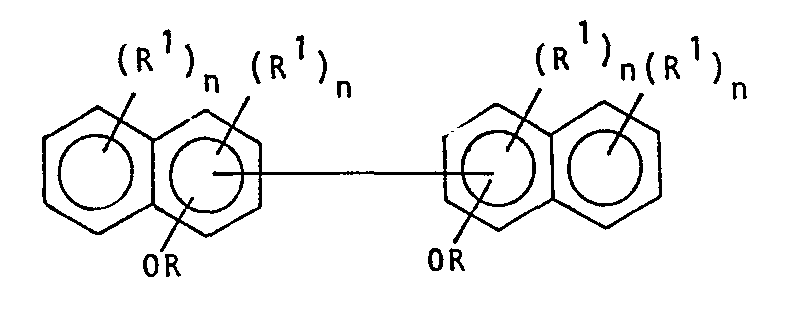
- Die verwendeten Verbindungen werden durch die nachstehenden Formeln dargestellt.


- In den vorstehenden Formeln stellt jedes R im einzelnen H oder Alkyl oder Acyl dar; jedes R1 im einzelnen Alkanoyl oder Alkyl mit 1 bis 4 Kohlenstoffatomen; n ist eine ganze Zahl zwischen 0 und 5.
- Zusätzlich können Sulfat-Ester in einigen der zuvor genannten Verbindungen verwendet werden.
- Darüber hinaus können Mischungen der oben genannten Verbindungen verwendet werden.
- Das Substrat ist auch mit einem abgeschwächten Oxidationsagens überzogen, von einem Ausmaß, das ausreicht, um eine Elektrooxidation der oben genannten Verbindungen zu beschleunigen für die Herstellung eines Farbbildes.
- Die Erfindung betrifft auch ein Verfahren für ein elektrochromisches Drucken, das die Anwendung eines elektrischen Feldes in einem vorherbestimmten Muster auf dem elektrochromisch bedruckbaren Medium aufweist.
- Die Erfindung erfordert das Überziehen von wenigstens einer Fläche mit wenigstens einer Verbindung der nachstehend angeführten Formeln:


- Jedes R ist im einzelnen eine Alkanoyl- oder Alkylgruppe mit vorzugsweise 1 bis 4 Kohlenstoffatomen. Beispiele für Alkanoylgruppen sind Formyl, Acetyl, Propionyl und Butyryl.
- Beispiele für einige Alkylgruppen für R1 sind Methyl, Äthyl, Butyl und Propyl.
- In der obigen Formel ist n eine ganze Zahl zwischen 0 und 5, vorzugsweise zwischen 0 und 2, und mit größtem Vorzug zwischen 0 oder 1. Wenn n 1 oder 2 ist, wird ein Austausch in der Orthoposition relativ zur OR Gruppe bevorzugt.
- Zusätzlich werden unorganische Ester der oben genannten Verbindungen, wie schwefelsaurer Säureester, ins Auge gefaßt.
- Beispiele für einige besondere Verbindungen, die entsprechend der Erfindung verwendet werden, enthalten


- Mischungen der oben genannten Verbindungen können verwendet werden. Auch Mischungen von einer oder mehrerer der oben genannten Verbindungen mit anderen Arten von Verbindungen, die als Leukofarbstoffe wirken, sind verwendbar.
- Die Verbindung kann an einem Substrat angewendet werden in der Form einer Lösung oder Dispersion in Wasser oder einem organischen Lösungsmittel in Abhängigkeit von den Auflösungscharakteristika der verwendeten Verbindung. Typische Beispiele geeigneter Lösungsmittel für die oben genannten Verbindungen der Formeln 4 bis 12 sind Weingeist wie Äthanol und Keton wie Aceton. Viele der oben genannten Verbindungen sind lösbar oder leicht dispergierbar in Wasser bzw. in wässrigen alkalischen Lösungen.
- Die Verbindung wird im allgemeinen in Mengen von ungefähr 2 bis etwa 200 Milligramm für eine Standardseite (z.B. 205 x 279 mm Substratfeld) verwendet. Natürlich wird die relative Menge der Verbindung nach oben oder unten verändert in Abhängigkeit von der Größe des verwendeten Substrates. Mengen größer als ca. 10 Milligramm für die oben genannte Substratgröße sind im allgemeinen nicht notwendig, da ungefähr 10 Milligramm ausreichen, um die Substratoberfläche zu saturieren.
- Zusätzlich ist die Substratoberfläche mit einem reduzierten Oxidationsagens wie einer Bromidverbindung überzogen. Beispiele derartiger geeigneter Verbindungen sind Ammoniumbromid, Kaliumbromid und Natriumbromid. Gewünschtenfalls können auch Mischungen verwendet werden. Die reduzierte Form eines Oxidationsagens wie einer Bromsalzverbindung liegt vor in Mengen von ungefähr 10 Milligramm bis ungefähr 1/4 Gramm pro Standardseite. Im allgemeinen ist die reduzierte Form eines Oxidationsagens, wie einer Bromidverbindung, in einer Menge vorhanden, um einen Oxidationsagens vorzusehen in einer reduzierten Form zum Farbstoffgewichtsverhältnis von ungefähr 1 : 1 bis ungefähr 30 : 1. Das bevorzugte Gewichtsverhältnis ist ungefähr 5 : 1 bis ungefähr 10 : 1. Mit Bromid als reduzierte Form eines Oxidationsagens wird angenommen, daß die nachfolgende Reaktion erzielt wird, wenn ein Stromimpuls das Substrat passiert, das folgende Druckverbindung trägt:

- Die reduzierte Form eines Oxidationsagens ist vorhanden für das Erzeugen einer Elektrooxidation der farblosen Verbindung (z.B. Leukofarbstoff) in einen farbigen Farbstoff. Das Brom wird an der Anode erzeugt.
- Eine bevorzugte Bromidverbindung enthält ungefähr 9 Gew.% Ammoniumbromid und vorzugsweise Kaliumbromid und einen Puffer wie 1,4 Gew.% KH2P04.
- Das verwendete Substrat kann gewöhnliches Papier sein. Es wird bevorzugt, daß das Medium wenigstens im wesentlichen frei von farbbildenden Agens ist, die versuchen könnten, mit den Farbstoffen chemisch zu reagieren.
- Wenigstens eine Oberfläche des Substrates ist im allgemeinen überzogen durch Zuführung der reduzierten Form eines Oxidationsagens, wie einer Bromidverbindung, in der Form einer wässrigen Lösung oder wenigstens einer der oben genannten Verbindungen. Wenn gewünscht, kann die Verbindung zugeführt werden und dann die Bromidverbindung, oder beide können in dem gleichen Verdünnungsmittel zugeführt werden in Abhängigkeit von der Lösbarkeit oder Dispergierbarkeit. Wenn gewünscht, kann das Substrat an beiden Oberflächen oder sogar vollständig mit den Verbindungen imprägniert werden.
- Die angesetzte Druckverbindung kann dem Substrat zugeführt werden, wie einem gewöhnlichen Papier, durch Aufsprühen oder andere Uberzugsverfahren. Dies kann erfolgen kurz vor dem Drucken oder auch für ein später zu verwendendes Substrat.
- Das Drucken kann in üblichen elektrolytischen Druckern erfolgen. Vorzugsweise können sich nichtverbrauchende Elektroden verwendet werden. Eine Spannung von ungefähr 1,5 bis ungefähr 15 Volt ist erforderlich, wenn ein Druckmedium entsprechend der vorliegenden Erfindung verwendet wird, um einen Farbwechsel zu bewirken. Im allgemeinen werden ungefähr 5 Volt oder mehr verwendet für ein Arbeiten mit den elektronischen Schaltkreisen. Die Spannung, der Strom und die erforderlichen Zeiten sind verträglich mit jenen Parametern, die in den heutigen integrierten Schaltkreisen auftreten. Die verwendete Zeit beträgt im allgemeinen ungefähr 100 bis ungefähr 1000 Mikrosekunden. Für eine 0,025 mm Elektrode sind Ströme bis zu ungefähr 4 Milliampere erforderlich. Der Stromwert ist abhängig von der Größe der Elektrode.
- Wenn die reduzierte Form eines Oxidationsagens, wie einer Bromidverbindung, nicht vorhanden ist, ist mit der vorliegenden Erfindung kein Drucken erhaltbar. Beispielsweise ist nur ein sehr schwaches Drucken erreichbar, sogar bei Verwendung sehr langer Impulse von ungefähr 10 bis ungefähr 20 Millisekunden bei Spannungen bis zu 30 Volt, wenn die reduzierte Form eines Oxidationsagens nicht verwendet wird, auf dem Verbindungen der vorliegenden Erfindung enthaltenden Substrat. Die für das Drucken entsprechend der vorliegenden Erfindung benutzten Bedingungen unterscheiden sich sehr von denen für ein trockenes elektrolytisches Drucken erforderlichen. Die für elektrolytisches Drucken erforderlichen großen Spannungen machen solche Medien ungeeignet für die Verwendung mit integrierten Schaltkreisen. Die Energieerfordernisse sind mit jenen von integrierten Schaltkreisen nicht verträglich.
- Das Substrat oder Papier ist im allgemeinen mit Wasser befeuchtet unmittelbar vor dem Drucken. Der pH-Wert des Wassers beträgt in den meisten Fällen ungefähr 7.
- Die folgenden, nicht einschränkenden Beispiele dienen der weiteren Darstellung der vorliegenden Erfindung.
- Gewöhnliches Papier (Größe 205 mm x 279 mm) wird mit einer Verbindung überzogen, die eine wässrige Verbindung von ungefähr 9 Gew.% Kaliumbromid und ungefähr 1,4 Gew.% Kaliumdihydrogenphosphat enthält. Die Verbindung wird gefiltert und auf das gewöhnliche Papier aufgesprüht. Nach dem Trocknen wird das Papier mit einer Lösung von ungefähr 1 Gew.% 4,4'-Diphenol in Aceton überzogen, und zwar mit ungefähr 10 Milligramm des Leukofarbstoffes pro Seite. Das Papier wird dann einem elektrolytischen Drucker zugeführt. Zeichen werden dann auf dem Papier elektrolytisch gedruckt durch Zuführung eines vorherbestimmten Spannungsmusters von ungefähr 15 Volt. Die Impulszeit beträgt ungefähr 700 Mikrosekunden. Die verwendete Elektrode ist ungefähr 0,25 mm breit, und der verwendete Strom beträgt ungefähr 4 Milliampere. Die Farbe der gedruckten Zeichen ist gelb.
- Die vorliegende Erfindung erlaubt sehr hohe Druckgeschwindigkeiten von ungefähr 350 Mikrosekunden für einen Druckpunkt. Die unter normalen Lagerbedingungen gedruckten Zeichen sind im wesentlichen permanent und verbleichen nicht. Sogar bei Bildung eines Hintergrundes infolge aufeinanderfolgender Entwicklung der unentwickelten Teile sind die gedruckten Zeichen noch ganz gut wahrnehmbar.
- Das Verfahren nach Beispiel 1 wird wiederholt mit der Ausnahme, daß der verwendete Farbstoff der Formel 5 entspricht. Das Resultat ist ähnlich dem von Beispiel 1.
- Das Verfahren nach Beispiel 1 wird wiederholt mit der Ausnahme, daß der verwendete Farbstoff der Formel 6 entspricht. Das Resultat ist ähnlich dem von Beispiel 1, außer, daß die Farbe gelbgrün ist.
- Das Verfahren nach Beispiel 1 wird wiederholt mit der Ausnahme, daß der verwendete Farbstoff der Formel 7 entspricht. Das Ergebnis ist ähnlich dem von Beispiel 1, außer, daß die Farbe rot ist.
- Das Verfahren nach Beispiel 1 wird wiederholt mit der Ausnahme, daß der verwendete Farbstoff der Formel 8 entspricht. Das Resultat ist ähnlich dem von Beispiel 1, außer, daß die Farbe rot ist.
- Das Verfahren nach Beispiel 1 wird wiederholt mit der Ausnahme, daß der verwendete Farbstoff der Formel 10 entspricht. Das Ergebnis ist ähnlich dem von Beispiel 1.
- Das Verfahren nach Beispiel 1 wird wiederholt mit der Ausnahme, daß der verwendete Farbstoff der Formel 12 entspricht. Das Ergebnis ist ähnlich dem von Beispiel 1, außer daß die Farbe rotbraun ist.
Claims (17)


Applications Claiming Priority (2)
| Application Number | Priority Date | Filing Date | Title |
|---|---|---|---|
| US06/459,929 US4444626A (en) | 1983-01-21 | 1983-01-21 | Electrochromic printing |
| US459929 | 1983-01-21 |
Publications (3)
| Publication Number | Publication Date |
|---|---|
| EP0115078A2 true EP0115078A2 (de) | 1984-08-08 |
| EP0115078A3 EP0115078A3 (en) | 1985-06-19 |
| EP0115078B1 EP0115078B1 (de) | 1989-04-26 |
Family
ID=23826731
Family Applications (1)
| Application Number | Title | Priority Date | Filing Date |
|---|---|---|---|
| EP83113165A Expired EP0115078B1 (de) | 1983-01-21 | 1983-12-28 | Elektrochromisches Druckmedium |
Country Status (5)
| Country | Link |
|---|---|
| US (1) | US4444626A (de) |
| EP (1) | EP0115078B1 (de) |
| JP (1) | JPS59138488A (de) |
| CA (1) | CA1212834A (de) |
| DE (1) | DE3379719D1 (de) |
Families Citing this family (19)
| Publication number | Priority date | Publication date | Assignee | Title |
|---|---|---|---|---|
| US4478687A (en) * | 1983-12-30 | 1984-10-23 | International Business Machines Corporation | Phenazine leucodyes for electrochromic recording |
| JP5257725B2 (ja) * | 2005-08-03 | 2013-08-07 | Dic株式会社 | エポキシ樹脂,エポキシ樹脂組成物,硬化物,半導体装置,エポキシ樹脂の製造法 |
| US7760614B2 (en) * | 2005-11-21 | 2010-07-20 | General Electric Company | Optical article having an electrically responsive layer as an anti-theft feature and a system and method for inhibiting theft |
| US7653919B2 (en) * | 2005-11-21 | 2010-01-26 | General Electric Company | Optical article having anti-theft feature and a system and method for inhibiting theft of same |
| US8202598B2 (en) * | 2005-11-21 | 2012-06-19 | Nbcuniversal Media, Llc | Optical article having an electrically responsive layer as an anti-theft feature and a system and method for inhibiting theft |
| US20070122735A1 (en) * | 2005-11-30 | 2007-05-31 | Wisnudel Marc B | Optical storage device having limited-use content and method for making same |
| US8361587B2 (en) * | 2007-07-31 | 2013-01-29 | Nbcuniversal Media, Llc | Enhanced security of optical article |
| US8229276B2 (en) * | 2007-09-28 | 2012-07-24 | Nbcuniversal Media, Llc | Limited play optical article |
| US8646106B2 (en) * | 2007-09-28 | 2014-02-04 | Nbcuniversal Media, Llc | Limited play optical article |
| US8118229B2 (en) * | 2007-09-28 | 2012-02-21 | Nbcuniversal Media, Llc | Method of printing marks on an optical article |
| US20090086291A1 (en) * | 2007-09-28 | 2009-04-02 | General Electric Company | Method of printing marks on an optical article |
| US20090249381A1 (en) * | 2008-03-31 | 2009-10-01 | General Electric Company | Player-readable code on optical media |
| US8051441B2 (en) * | 2008-03-31 | 2011-11-01 | Nbcuniversal Media, Llc | Player-readable code on optical media |
| US8473974B2 (en) * | 2008-05-13 | 2013-06-25 | Nbcuniversal Media, Llc | Activation system and method for activating an optical article |
| US8387876B2 (en) * | 2008-05-13 | 2013-03-05 | Nbcuniversal Media, Llc | Activation system and method for activating an optical article |
| US9514782B2 (en) * | 2008-05-13 | 2016-12-06 | Nbcuniversal Media, Llc | Method and system for activation of an optical article |
| US8488428B2 (en) * | 2008-05-14 | 2013-07-16 | Nbcuniversal Media, Llc | Enhanced security of optical article |
| US8097324B2 (en) * | 2008-05-14 | 2012-01-17 | Nbcuniversal Media, Llc | Enhanced security of optical article |
| US8284057B2 (en) * | 2008-09-23 | 2012-10-09 | Nbcuniversal Media, Llc | Security tag for optical media and processes for fabrication and attachment |
Family Cites Families (6)
| Publication number | Priority date | Publication date | Assignee | Title |
|---|---|---|---|---|
| FR1136607A (fr) * | 1955-11-29 | 1957-05-16 | Air Associates | Papier d'enregistrement électrolytique |
| JPS5133742B2 (de) * | 1972-03-24 | 1976-09-21 | ||
| CA990953A (en) * | 1972-11-30 | 1976-06-15 | Kimiaki Yoshino | Electrorecording sheet |
| GB1492834A (en) * | 1974-04-08 | 1977-11-23 | Canon Kk | Image recording member |
| JPS52101111A (en) * | 1976-02-21 | 1977-08-24 | Pilot Pen Co Ltd | Recording materials |
| US4374001A (en) * | 1981-02-05 | 1983-02-15 | International Business Machines Corporation | Electrolytic printing |
-
1983
- 1983-01-21 US US06/459,929 patent/US4444626A/en not_active Expired - Lifetime
- 1983-11-15 JP JP58213419A patent/JPS59138488A/ja active Pending
- 1983-11-24 CA CA000441868A patent/CA1212834A/en not_active Expired
- 1983-12-28 DE DE8383113165T patent/DE3379719D1/de not_active Expired
- 1983-12-28 EP EP83113165A patent/EP0115078B1/de not_active Expired
Also Published As
| Publication number | Publication date |
|---|---|
| DE3379719D1 (en) | 1989-06-01 |
| US4444626A (en) | 1984-04-24 |
| CA1212834A (en) | 1986-10-21 |
| JPS59138488A (ja) | 1984-08-08 |
| EP0115078A3 (en) | 1985-06-19 |
| EP0115078B1 (de) | 1989-04-26 |
Similar Documents
| Publication | Publication Date | Title |
|---|---|---|
| EP0115078B1 (de) | Elektrochromisches Druckmedium | |
| US4374001A (en) | Electrolytic printing | |
| DE2858332C2 (de) | ||
| DE2624385B2 (de) | Verfahren zur Herstellung eines · Musters auf Gegenständen aus Aluminiumlegierung | |
| DE2130846C3 (de) | Basisch substituierte Fluoranverbindungen und diese als Farbbildner enthaltende druckempfindliche Kopierpapiere | |
| EP0576848B1 (de) | Bedruckte Formkörper und Folien enthaltend Gelatine sowie Verfahren und Mittel zum Bedrucken | |
| DE2438741C2 (de) | Drucksystem | |
| DE69211071T2 (de) | Tintenstrahldruckpapier | |
| DE968854C (de) | Aufzeichnungsblatt fuer elektrische Aufzeichnungsgeraete, wie Faksimile- oder Bildtelegraphen | |
| US4478687A (en) | Phenazine leucodyes for electrochromic recording | |
| DE649281C (de) | Verfahren zum elektrochemischen Aufzeichnen elektrischer Stromvorgaenge | |
| EP0020974B1 (de) | In Wasser gelöste elektrochrome Druckfarbe und Verfahren zum Drucken mit dieser Druckfarbe | |
| DE2814824C2 (de) | ||
| DE2414201C3 (de) | Stromempfindliches Aufzeichnungsmaterial | |
| DE2450963C3 (de) | Verfahren zum Bedrucken und Versiegeln von anodisch oxydiertem Aluminium | |
| DE2112380A1 (de) | Vervielfaeltigungsmaterial zur Herstellung von Kopien,enthaltend ein unsichtbares Bild,sowie Mittel zur Entwicklung des unsichtbaren Bildes | |
| DE2113995C3 (de) | Basisch substituierte Fluoranverbindungen und deren Verwendung als Farbbildner für druckempfindliche Kopierpapiere | |
| DE2919837C2 (de) | ||
| DE2113452A1 (de) | Feuchtverfahren fuer Offsetdruck | |
| DE3203782A1 (de) | Schreibfarbe | |
| DE2953447T5 (de) | Ink compositions | |
| DE4316069C1 (de) | Druckfarbe zum Auftrag einer Entwicklerschicht und ihre Verwendung zur Herstellung eines druckempfindlichen Aufzeichnungsblattes | |
| DE2049279C3 (de) | Druckempfindliches Kopierpapier | |
| DE2953447C1 (de) | Tintenzusammensetzung | |
| DE3510324A1 (de) | Verfahren zum nachtraeglichen bedrucken von selbstklebebaendern |
Legal Events
| Date | Code | Title | Description |
|---|---|---|---|
| PUAI | Public reference made under article 153(3) epc to a published international application that has entered the european phase |
Free format text: ORIGINAL CODE: 0009012 |
|
| AK | Designated contracting states |
Designated state(s): DE FR GB IT |
|
| 17P | Request for examination filed |
Effective date: 19841123 |
|
| PUAL | Search report despatched |
Free format text: ORIGINAL CODE: 0009013 |
|
| AK | Designated contracting states |
Designated state(s): DE FR GB IT |
|
| 17Q | First examination report despatched |
Effective date: 19870302 |
|
| GRAA | (expected) grant |
Free format text: ORIGINAL CODE: 0009210 |
|
| AK | Designated contracting states |
Kind code of ref document: B1 Designated state(s): DE FR GB IT |
|
| REF | Corresponds to: |
Ref document number: 3379719 Country of ref document: DE Date of ref document: 19890601 |
|
| ET | Fr: translation filed | ||
| GBT | Gb: translation of ep patent filed (gb section 77(6)(a)/1977) | ||
| ITF | It: translation for a ep patent filed | ||
| PLBE | No opposition filed within time limit |
Free format text: ORIGINAL CODE: 0009261 |
|
| STAA | Information on the status of an ep patent application or granted ep patent |
Free format text: STATUS: NO OPPOSITION FILED WITHIN TIME LIMIT |
|
| 26N | No opposition filed | ||
| PGFP | Annual fee paid to national office [announced via postgrant information from national office to epo] |
Ref country code: GB Payment date: 19901119 Year of fee payment: 8 |
|
| PGFP | Annual fee paid to national office [announced via postgrant information from national office to epo] |
Ref country code: FR Payment date: 19901122 Year of fee payment: 8 |
|
| ITTA | It: last paid annual fee | ||
| PGFP | Annual fee paid to national office [announced via postgrant information from national office to epo] |
Ref country code: DE Payment date: 19901231 Year of fee payment: 8 |
|
| PG25 | Lapsed in a contracting state [announced via postgrant information from national office to epo] |
Ref country code: GB Effective date: 19911228 |
|
| GBPC | Gb: european patent ceased through non-payment of renewal fee | ||
| PG25 | Lapsed in a contracting state [announced via postgrant information from national office to epo] |
Ref country code: FR Effective date: 19920831 |
|
| PG25 | Lapsed in a contracting state [announced via postgrant information from national office to epo] |
Ref country code: DE Effective date: 19920901 |
|
| REG | Reference to a national code |
Ref country code: FR Ref legal event code: ST |