EP0115191A1 - Elektrische Stromkreisunterbrechungsvorrichtung - Google Patents
Elektrische Stromkreisunterbrechungsvorrichtung Download PDFInfo
- Publication number
- EP0115191A1 EP0115191A1 EP83307922A EP83307922A EP0115191A1 EP 0115191 A1 EP0115191 A1 EP 0115191A1 EP 83307922 A EP83307922 A EP 83307922A EP 83307922 A EP83307922 A EP 83307922A EP 0115191 A1 EP0115191 A1 EP 0115191A1
- Authority
- EP
- European Patent Office
- Prior art keywords
- actuating element
- conductive polymer
- dopant
- polymer
- circuit
- Prior art date
- Legal status (The legal status is an assumption and is not a legal conclusion. Google has not performed a legal analysis and makes no representation as to the accuracy of the status listed.)
- Withdrawn
Links
- 229920001940 conductive polymer Polymers 0.000 claims abstract description 25
- 239000002019 doping agent Substances 0.000 claims abstract description 20
- -1 picrate ions Chemical class 0.000 claims abstract description 15
- VLTRZXGMWDSKGL-UHFFFAOYSA-M perchlorate Inorganic materials [O-]Cl(=O)(=O)=O VLTRZXGMWDSKGL-UHFFFAOYSA-M 0.000 claims abstract description 10
- 229940075930 picrate Drugs 0.000 claims abstract description 6
- 229920000642 polymer Polymers 0.000 claims description 21
- 230000003647 oxidation Effects 0.000 claims description 13
- 238000007254 oxidation reaction Methods 0.000 claims description 13
- 239000000463 material Substances 0.000 claims description 10
- KAESVJOAVNADME-UHFFFAOYSA-N Pyrrole Chemical compound C=1C=CNC=1 KAESVJOAVNADME-UHFFFAOYSA-N 0.000 claims description 9
- 239000002360 explosive Substances 0.000 claims description 6
- 239000002202 Polyethylene glycol Substances 0.000 claims description 5
- 229920001223 polyethylene glycol Polymers 0.000 claims description 5
- 238000006243 chemical reaction Methods 0.000 claims description 2
- 239000003755 preservative agent Substances 0.000 claims description 2
- 230000002335 preservative effect Effects 0.000 claims description 2
- 150000003233 pyrroles Chemical class 0.000 claims description 2
- 229920000128 polypyrrole Polymers 0.000 abstract description 17
- VLTRZXGMWDSKGL-UHFFFAOYSA-N perchloric acid Chemical compound OCl(=O)(=O)=O VLTRZXGMWDSKGL-UHFFFAOYSA-N 0.000 abstract description 4
- 229910052751 metal Inorganic materials 0.000 abstract description 3
- 239000002184 metal Substances 0.000 abstract description 3
- 230000000694 effects Effects 0.000 abstract description 2
- WEVYAHXRMPXWCK-UHFFFAOYSA-N Acetonitrile Chemical compound CC#N WEVYAHXRMPXWCK-UHFFFAOYSA-N 0.000 description 15
- 238000002360 preparation method Methods 0.000 description 14
- 210000004027 cell Anatomy 0.000 description 7
- 239000000203 mixture Substances 0.000 description 7
- 239000003792 electrolyte Substances 0.000 description 6
- 238000005474 detonation Methods 0.000 description 5
- 238000000034 method Methods 0.000 description 5
- 230000009467 reduction Effects 0.000 description 5
- 239000000446 fuel Substances 0.000 description 4
- 229920001197 polyacetylene Polymers 0.000 description 4
- 239000000126 substance Substances 0.000 description 4
- OKKJLVBELUTLKV-UHFFFAOYSA-N Methanol Chemical compound OC OKKJLVBELUTLKV-UHFFFAOYSA-N 0.000 description 3
- ZMXDDKWLCZADIW-UHFFFAOYSA-N N,N-Dimethylformamide Chemical compound CN(C)C=O ZMXDDKWLCZADIW-UHFFFAOYSA-N 0.000 description 3
- 230000006378 damage Effects 0.000 description 3
- 238000005868 electrolysis reaction Methods 0.000 description 3
- 229910001220 stainless steel Inorganic materials 0.000 description 3
- 239000010935 stainless steel Substances 0.000 description 3
- 229920000265 Polyparaphenylene Polymers 0.000 description 2
- WYURNTSHIVDZCO-UHFFFAOYSA-N Tetrahydrofuran Chemical compound C1CCOC1 WYURNTSHIVDZCO-UHFFFAOYSA-N 0.000 description 2
- 230000015556 catabolic process Effects 0.000 description 2
- 238000006731 degradation reaction Methods 0.000 description 2
- 238000010438 heat treatment Methods 0.000 description 2
- 150000002500 ions Chemical class 0.000 description 2
- 239000000178 monomer Substances 0.000 description 2
- 150000004767 nitrides Chemical class 0.000 description 2
- BASFCYQUMIYNBI-UHFFFAOYSA-N platinum Chemical compound [Pt] BASFCYQUMIYNBI-UHFFFAOYSA-N 0.000 description 2
- 229920000767 polyaniline Polymers 0.000 description 2
- 239000000243 solution Substances 0.000 description 2
- 239000002904 solvent Substances 0.000 description 2
- 238000003756 stirring Methods 0.000 description 2
- IJGRMHOSHXDMSA-UHFFFAOYSA-N Atomic nitrogen Chemical compound N#N IJGRMHOSHXDMSA-UHFFFAOYSA-N 0.000 description 1
- OKTJSMMVPCPJKN-UHFFFAOYSA-N Carbon Chemical compound [C] OKTJSMMVPCPJKN-UHFFFAOYSA-N 0.000 description 1
- VEXZGXHMUGYJMC-UHFFFAOYSA-M Chloride anion Chemical compound [Cl-] VEXZGXHMUGYJMC-UHFFFAOYSA-M 0.000 description 1
- 229910013063 LiBF 4 Inorganic materials 0.000 description 1
- 241001082241 Lythrum hyssopifolia Species 0.000 description 1
- 241000577218 Phenes Species 0.000 description 1
- 229920002377 Polythiazyl Polymers 0.000 description 1
- XUIMIQQOPSSXEZ-UHFFFAOYSA-N Silicon Chemical compound [Si] XUIMIQQOPSSXEZ-UHFFFAOYSA-N 0.000 description 1
- 230000032683 aging Effects 0.000 description 1
- 239000000010 aprotic solvent Substances 0.000 description 1
- 230000008901 benefit Effects 0.000 description 1
- 238000007664 blowing Methods 0.000 description 1
- 229910052799 carbon Inorganic materials 0.000 description 1
- 239000000969 carrier Substances 0.000 description 1
- 210000005056 cell body Anatomy 0.000 description 1
- 239000011248 coating agent Substances 0.000 description 1
- 238000000576 coating method Methods 0.000 description 1
- 150000001875 compounds Chemical class 0.000 description 1
- 230000001066 destructive effect Effects 0.000 description 1
- 229910001873 dinitrogen Inorganic materials 0.000 description 1
- 238000002848 electrochemical method Methods 0.000 description 1
- 229910052732 germanium Inorganic materials 0.000 description 1
- GNPVGFCGXDBREM-UHFFFAOYSA-N germanium atom Chemical compound [Ge] GNPVGFCGXDBREM-UHFFFAOYSA-N 0.000 description 1
- 239000011521 glass Substances 0.000 description 1
- 239000008240 homogeneous mixture Substances 0.000 description 1
- 229910003437 indium oxide Inorganic materials 0.000 description 1
- PJXISJQVUVHSOJ-UHFFFAOYSA-N indium(iii) oxide Chemical compound [O-2].[O-2].[O-2].[In+3].[In+3] PJXISJQVUVHSOJ-UHFFFAOYSA-N 0.000 description 1
- 239000003999 initiator Substances 0.000 description 1
- 229920000592 inorganic polymer Polymers 0.000 description 1
- 239000007788 liquid Substances 0.000 description 1
- 229910021645 metal ion Inorganic materials 0.000 description 1
- 239000003921 oil Substances 0.000 description 1
- 229920000620 organic polymer Polymers 0.000 description 1
- 239000007800 oxidant agent Substances 0.000 description 1
- OXNIZHLAWKMVMX-UHFFFAOYSA-M picrate anion Chemical compound [O-]C1=C([N+]([O-])=O)C=C([N+]([O-])=O)C=C1[N+]([O-])=O OXNIZHLAWKMVMX-UHFFFAOYSA-M 0.000 description 1
- OXNIZHLAWKMVMX-UHFFFAOYSA-N picric acid Chemical compound OC1=C([N+]([O-])=O)C=C([N+]([O-])=O)C=C1[N+]([O-])=O OXNIZHLAWKMVMX-UHFFFAOYSA-N 0.000 description 1
- 229910003446 platinum oxide Inorganic materials 0.000 description 1
- 229910001414 potassium ion Inorganic materials 0.000 description 1
- 238000004382 potting Methods 0.000 description 1
- 230000008569 process Effects 0.000 description 1
- 230000001681 protective effect Effects 0.000 description 1
- 239000003586 protic polar solvent Substances 0.000 description 1
- 238000011946 reduction process Methods 0.000 description 1
- 230000004044 response Effects 0.000 description 1
- 239000000523 sample Substances 0.000 description 1
- 229910052710 silicon Inorganic materials 0.000 description 1
- 239000010703 silicon Substances 0.000 description 1
- KVCGISUBCHHTDD-UHFFFAOYSA-M sodium;4-methylbenzenesulfonate Chemical compound [Na+].CC1=CC=C(S([O-])(=O)=O)C=C1 KVCGISUBCHHTDD-UHFFFAOYSA-M 0.000 description 1
- 241000894007 species Species 0.000 description 1
- 239000000725 suspension Substances 0.000 description 1
- KBLZDCFTQSIIOH-UHFFFAOYSA-M tetrabutylazanium;perchlorate Chemical compound [O-]Cl(=O)(=O)=O.CCCC[N+](CCCC)(CCCC)CCCC KBLZDCFTQSIIOH-UHFFFAOYSA-M 0.000 description 1
- YLQBMQCUIZJEEH-UHFFFAOYSA-N tetrahydrofuran Natural products C=1C=COC=1 YLQBMQCUIZJEEH-UHFFFAOYSA-N 0.000 description 1
- JOXIMZWYDAKGHI-UHFFFAOYSA-M toluene-4-sulfonate Chemical compound CC1=CC=C(S([O-])(=O)=O)C=C1 JOXIMZWYDAKGHI-UHFFFAOYSA-M 0.000 description 1
- XLYOFNOQVPJJNP-UHFFFAOYSA-N water Substances O XLYOFNOQVPJJNP-UHFFFAOYSA-N 0.000 description 1
Images


Classifications
-
- H—ELECTRICITY
- H01—ELECTRIC ELEMENTS
- H01H—ELECTRIC SWITCHES; RELAYS; SELECTORS; EMERGENCY PROTECTIVE DEVICES
- H01H85/00—Protective devices in which the current flows through a part of fusible material and this current is interrupted by displacement of the fusible material when this current becomes excessive
- H01H85/02—Details
- H01H85/04—Fuses, i.e. expendable parts of the protective device, e.g. cartridges
- H01H85/05—Component parts thereof
- H01H85/055—Fusible members
- H01H85/06—Fusible members characterised by the fusible material
Definitions
- a known form of electrical circuit interruption device is the conventional metallic fuse which may be designed to operate at various current ratings but is generally unsatisfactory at low operating currents because it either takes a relatively long time to "blow” at moderate overloads or, if it is a "quick-blow” fuse, then its life-time at the rated current is relatively short - often a matter of only a few hours. This slowness of actuation is a particular problem in electronic equipment such as integrated circuits where moderate overload currents can be tolerated in operation for only very short intervals, and the short life-time of the "quick-blow” fuse is obviously inconvenient.
- the present invention provides an electrical circuit interruption device having an actuating element comprising an inherently electrically conductive polymer.
- conductive polymers Inherently electrically conductive polymers (hereinafter “conductive polymers”) can be selected which have a conductivity high enough to pass a substantial current, and can thus serve as the actuating element of the device according to the present invention.
- conductive polymers are highly advantageous for use as the actuating element in circuit protection devices, such as fuses, especially at low operating currents, by which is meant less than 1 Amp, preferably less than 200mA, more preferably less than 100mA, and especially less that 50mA. It has been found that at moderate to low overload currents, the time taken for the conductive polymer actuating element to "blow” (that is, to interrupt the circuit) is considerably shorter than found in conventional fuses of comparable life-time at the rated current of the device.
- the circuit interruption may be effected by reduction of the current to a negligible level e.g. by increasing the resistance of the actuating element, without physically destroying or breaking the actuating element.
- physical breakage or destruction is preferred.
- the conductive polymer is selected and-arranged so that the actuating element takes less than 60 seconds to interrupt the circuit when carrying twice the rated operating current, and is capable of continuously carrying its rated operating current for at least 24 hours.
- a SOmA rated device according to the present invention has been found to "blow" in 2 to 3 seconds at a current of 100mA (i.e. twice the rated current) whereas a conventional metal 50mA rated fuse continued to pass a 100mA current for about 17 minutes before "blowinq".
- Known electrically conductive polymers include polysulphur nitrides, polyanilines, polyphenylenes, polyacetylenes and polypyrroles.
- polysulphur nitrides e.g. ((SN)x
- polyanilines e.g.
- polyphenylenes e.g. ((SN)x)
- polyacetylenes require oxidation or reduction
- polypyrroles require oxidation.
- the process of oxidation (or reduction) is often called doping and a counter ion is required to associate itself with the (or reduced) polymer to balance the ionic charges therein. This counter-ion is often referred to as a dopant.
- dopants examples include BF 4 - , p-toluene sulphonate, Br , perchlorate ions, picrate ions and positively charged ions such as alkyl ammonium ions and metal ions such as potassium ions.
- Polyacetylenes may be prepared as described by H. Shirakawa et al, J. Polymer Sci., Polym. Chem. Ed., 12, 11 (1974); polyphenylenes may be prepared as described by J.K. Stille et al, J. Polymer Sci, Part D, 5, 385 (1971); polyanilines, polynaphthylamines and polythio- phenes may be prepared by methods analogous to the polypyrrole preparations described below.
- the phrase "electrically conductive polymer” will be used herein to mean any polymer or oligomer inherently capable of electrical conductivity or semi-conductivity, (hereinafter both included in the terms “electrical conductivity” or “electrically conductive”), including those requiring oxidation/reduction of the polymer and/or the presence of a “dopant” to render them electrically conductive.
- the aforesaid phrase includes inorganic polymers such as the polysulphur nitrides, and organic polymers such as the polypyrroles, all of which conduct electronically, electronic conduction being preferred for the present purposes.
- doping and "de-doping” will be taken to mean the oxidation/reduction processes used to convert the polymers between their less conductive and more conductive states; the term “dopants” will refer to the aforementioned counter-ions and to the materials used to provide the counter-ions which stabilise the more conductive form of the polymers; and the terms “undoped”, “doped” and “de-doped” will be understood accordingly.
- the preferred conductive polymers for use in the present invention are polypyrrole and its suitably conductive derivatives, e.g. poly(3,4-dimethylpyrrole). These polymers in their doped conductive state have the necessary resistance to degradation on.aging, and can be synthesised in suitable physical forms.
- Polypyrrole and suitably substituted derivatives may be prepared from pyrroles as shown by the accompanying general formula (I) in Fig. 1 of the accompanying drawings, in which R 1 to R 5 , which may be the same or different, represent possible substituents, although sufficient positions must be left unsubstituted to permit polymeri-sation, Electrically conductive polymers are generally believed to operate by means of a conjugated pi-electron system and it is understood that some substituents or combinations of substituents may interfere with the conjugated system so as to detract from or destroy the desired electrical conductivity. Acceptable substituents can be readily determined by simply testing the conductivity of the resulting polymer.
- Electrochemical methods of preparing electrically conductive polymers can be used as follows to produce the actuating element materials of the present invention.
- an electrochemical cell is used, wherein two electrodes (made from, for example, stainless steel, platinum or indium oxide coated glass) are immersed in an electrolyte mixture, suspension or solution.
- the electrolyte includes a material carrying groups which are ionisable into an appropriately charged ionic dopant species.
- the solvent or mixture of solvents may be chosen from protic and aprotic solvents, for example acetonitrile, tetrahydrofuran, dimethyl formamide, water-, methanol.
- To the electrolyte mixture is added the monomer species that is to be polymerised to form the desired electrically conductive polymer.
- Stirring of the resulting mixture may be required to achieve a homogeneous mixture.
- an electrically conducting film is formed on the appropriate electrode.
- positively charged polymers such as polypyrroles
- the film is formed on the anode and is partially oxidised and contains a negatively charged dopant to provide charge neutrality to the film.
- Chemical preparative methods can also be used, in which the monomer and the dopant are mixed with an oxidising agent in a suitable liquid vehicle.
- the electrolytic cell was powered by a D.C. power supply. Electrolysis of the electrolyte mixture was carried out by applying to the cell an electrical potential of 5V for a period of one hour, during which time the current density was lmAcm -2 .
- a brittle black film was deposited on the anode and was removed with difficulty to give a free-standing film, which could not be creased or folded in two like paper without fracturing.
- a flexible film of polypyrrole doped with perchlorate ions and incorporating polyethylene glycol was produced, the polyethylene glycol acting as a "fuel” for destructive oxidation (detonation) by the perchlorate ions under conditions of use described hereinafter.
- Self-supporting, preferably flexible, films of the conductive polymer may be advantageously used as the actuating element, although rigid films and films supported on suitable carriers are not excluded.
- Preferred polypyrrole derivatives and dopants include polypyrrole doped with chloride, fluoroborate, perchlorate, or p-toluene sulphonate ions, the last of these dopants tending to produce more flexible films.
- the invention also provides a method of protecting an electrical circuit comprising incorporating in the circuit a circuit interruption device of the present kind.
- Devices according to the present invention may be conveniently incorporated into electrical circuitry, for example in printed circuit boards, if desired in combination with other protective devices.
- the actuating element of the present invention may be enclosed in suitable preservative environments for example in vacuum or nitrogen gas or in a "potting" compound or electrically insulating oils if necessary, e.g. to minimise oxidation.
- suitable preservative environments for example in vacuum or nitrogen gas or in a "potting" compound or electrically insulating oils if necessary, e.g. to minimise oxidation.
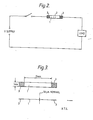
- Mode 1 When the overload current is relatively small, e.g. twice the rated current, the resistivity of the polymer increases in an area (3) towards the middle of the actuating element. Hence the current passing through the actuating element is substantially reduced and so the electrical equipment is protected.
- Mode 2 At a higher initial level of overload current, "blowing" occurs by actual physical destruction of the actuating element.
- Mode 2 may occur after Mode 1 if the applied voltage is increased to a sufficiently high level.
- Fig. 3 of the accompanying drawings A specific shape and arrangement of a device according to the invention are shown in Fig. 3 of the accompanying drawings. It will be appreciated that the dimensions and configuration of the conductive polymer actuating element may be selected to suit the inherent electrical resistivity of the polymer in order to produce a circuit interruption device of desired rating and overload performance. The dimensions and shape of the actuating element are thus not critical in themselves, but dimensions substantially as shown in Fig.3, with the conductivity of the polymer in the range from 10 to 500 ohms -1 cm -1 , have been found convenient in practice.
- a fuse as shown in Fig. 3 rated at 50 - 60 mA was prepared with an actuating element (1) comprising a strip of electrochemically prepared (see Preparation 2) polypyrrole doped with p-toluenesulphonate ions and having the dimensions indicated in Fig. 3, and a conductivity of 100 ohms cm
- a fuse was prepared as in Example 1 using BF 4 - doped polypyrrole prepared as in Preparation 1, having a conductivity of 11 ohm -1 cm -1 . At a current of 120 mA, the fuse "blew” by reducing the current to a negligible level in 225 milliseconds.
- the actuating element may carry materials which react chemically to enhance its circuit breaking function under overload currents. Materials which act to speed up the degradation or destruction of the actuating element"under overload currents are especially useful, for example small amounts of substances which oxidise very rapidly on heating or passage of overload electric current through the conductive polymer actuating element so as to destroy it and break the circuit more rapidly.
- the oxidising substance could be carried simply as a coating in a restricted area on the actuating element for oxidation on heating thereof, but it is possible in accordance with the present invention for doped systems to carry an explosive dopant, such as picrate ions, or a rapidly oxidising dopant such as perchlorate ions, preferably in the presence of a suitable "fuel" as described in Preparation 3 and 4 above capable of explosive reaction with the dopant, thus conveniently combining the functions of doping and oxidation.
- a suitable fuel for the perchlorate dopant could be any readily oxidisable material which can be suitably associated with the perchlorate ions in or on the conductive polymer to produce the desired effect. Conveniently, the film itself may provide adequate fuel for the oxidation.
- the circuit interruption device of this invention may be used as an electrical initiator or primer for explosive devices, e.g. a so-called "bridge wire", in which the relatively fast response of the present device at low overload currents may provide better control of detonation.
- a fuse was prepared as in Example 1 using per- chlorate/polyethylene glycol doped polypyrrole prepared as in Preparation 3, having a conductivity of 200 ohm -1 cm -1 . At a current of 120mA the fuse "blew" by detonation in 150 milliseconds.
- Example 1 was repeated using picrate-doped polypyrrole prepared as in Preparation 4, having a conductivity of 11 ohm -1 cm -1 . At a current of 120 mA the fuse "blew" by detonation in 1.1 seconds.
Landscapes
- Fuses (AREA)
- Polyoxymethylene Polymers And Polymers With Carbon-To-Carbon Bonds (AREA)
Applications Claiming Priority (2)
| Application Number | Priority Date | Filing Date | Title |
|---|---|---|---|
| GB8236696 | 1982-12-23 | ||
| GB8236696 | 1982-12-23 |
Publications (1)
| Publication Number | Publication Date |
|---|---|
| EP0115191A1 true EP0115191A1 (de) | 1984-08-08 |
Family
ID=10535214
Family Applications (1)
| Application Number | Title | Priority Date | Filing Date |
|---|---|---|---|
| EP83307922A Withdrawn EP0115191A1 (de) | 1982-12-23 | 1983-12-22 | Elektrische Stromkreisunterbrechungsvorrichtung |
Country Status (2)
| Country | Link |
|---|---|
| EP (1) | EP0115191A1 (de) |
| JP (1) | JPS59134523A (de) |
Cited By (5)
| Publication number | Priority date | Publication date | Assignee | Title |
|---|---|---|---|---|
| FR2626396A1 (fr) * | 1988-01-22 | 1989-07-28 | Oge Josette | Systeme permettant l'acquisition de reflexes instantanes du controle des retroviseurs par l'eleve |
| FR2648078A1 (fr) * | 1989-06-09 | 1990-12-14 | Boulet D Auria Terlizzi | Element d'electro-soudage en matiere plastique conductrice et raccord d'electro-soudage pour elements en matiere plastique realise a l'aide de celui-ci |
| US6440834B2 (en) | 1999-06-04 | 2002-08-27 | International Business Machines Corporation | Method and structure for a semiconductor fuse |
| US6528815B1 (en) | 1996-02-16 | 2003-03-04 | Koninkl Philips Electronics Nv | Write-once read-many electrical memory element of a conjugated polymer or oligomer |
| KR101278733B1 (ko) * | 2010-06-28 | 2013-06-25 | 후란스 벳도 가부시키가이샤 | 삼륜 자전거의 요동 장치 |
Families Citing this family (1)
| Publication number | Priority date | Publication date | Assignee | Title |
|---|---|---|---|---|
| JPS62161488U (de) * | 1985-12-27 | 1987-10-14 |
Citations (3)
| Publication number | Priority date | Publication date | Assignee | Title |
|---|---|---|---|---|
| US4293836A (en) * | 1979-07-11 | 1981-10-06 | San-O Industrial Co., Ltd. | Electrical fuse with an improved fusible element |
| EP0054420A2 (de) * | 1980-12-12 | 1982-06-23 | Matsushita Electric Industrial Co., Ltd. | Elektrisches Bauelement |
| EP0059342A1 (de) * | 1981-02-18 | 1982-09-08 | BASF Aktiengesellschaft | Verfahren zur Herstellung von stabilen elektrisch leitfähigen Polymeren und deren Verwendung |
-
1983
- 1983-12-22 EP EP83307922A patent/EP0115191A1/de not_active Withdrawn
- 1983-12-23 JP JP58252419A patent/JPS59134523A/ja active Pending
Patent Citations (3)
| Publication number | Priority date | Publication date | Assignee | Title |
|---|---|---|---|---|
| US4293836A (en) * | 1979-07-11 | 1981-10-06 | San-O Industrial Co., Ltd. | Electrical fuse with an improved fusible element |
| EP0054420A2 (de) * | 1980-12-12 | 1982-06-23 | Matsushita Electric Industrial Co., Ltd. | Elektrisches Bauelement |
| EP0059342A1 (de) * | 1981-02-18 | 1982-09-08 | BASF Aktiengesellschaft | Verfahren zur Herstellung von stabilen elektrisch leitfähigen Polymeren und deren Verwendung |
Cited By (7)
| Publication number | Priority date | Publication date | Assignee | Title |
|---|---|---|---|---|
| FR2626396A1 (fr) * | 1988-01-22 | 1989-07-28 | Oge Josette | Systeme permettant l'acquisition de reflexes instantanes du controle des retroviseurs par l'eleve |
| FR2648078A1 (fr) * | 1989-06-09 | 1990-12-14 | Boulet D Auria Terlizzi | Element d'electro-soudage en matiere plastique conductrice et raccord d'electro-soudage pour elements en matiere plastique realise a l'aide de celui-ci |
| US5229581A (en) * | 1989-06-09 | 1993-07-20 | Boulet D'auria, Terlizzi Et Cie | Electro-welding element of conductive plastic and an electro-welding coupling including said element for interconnecting pieces made of plastic |
| EP0402200A3 (de) * | 1989-06-09 | 1993-10-06 | Boulet-D'auria, Terlizzi & Cie | Elektro-Schweiss-Element aus leitendem Kunststoff und damit ausgestattete Elektro-Schweissmuffe zum Verbinden von Kunststoffgegenständen |
| US6528815B1 (en) | 1996-02-16 | 2003-03-04 | Koninkl Philips Electronics Nv | Write-once read-many electrical memory element of a conjugated polymer or oligomer |
| US6440834B2 (en) | 1999-06-04 | 2002-08-27 | International Business Machines Corporation | Method and structure for a semiconductor fuse |
| KR101278733B1 (ko) * | 2010-06-28 | 2013-06-25 | 후란스 벳도 가부시키가이샤 | 삼륜 자전거의 요동 장치 |
Also Published As
| Publication number | Publication date |
|---|---|
| JPS59134523A (ja) | 1984-08-02 |
Similar Documents
| Publication | Publication Date | Title |
|---|---|---|
| Watanabe et al. | Ionic conductivity of hybrid films composed of polyacrylonitrile, ethylene carbonate, and LiClO4 | |
| CA1318063C (en) | Highly conductive polymer composition and process for producing the same | |
| Jen et al. | Highly-conducting, poly (2, 5-thienylene vinylene) prepared via a soluble precursor polymer | |
| US5556700A (en) | Conductive polyaniline laminates | |
| US5917693A (en) | Electrically conductive polymer composition | |
| Bouridah et al. | Poly (dimethylsiloxane)-poly (ethylene oxide) based polyurethane networks used as electrolytes in lithium electrochemical solid state batteries | |
| EP0273643A2 (de) | Elektrische leitfähige substituierte Polyisothianaphthene | |
| EP0126064A1 (de) | Elektroaktive polymere | |
| US4505841A (en) | Fused 6,6,6-membered heterocyclic electroactive polymers | |
| US4691005A (en) | Thiophene derivative polymer, polymer composition, and methods for manufacture thereof | |
| Lewis et al. | Investigation of the applied potential limits for polypyrrole when employed as the active components of a two-electrode device | |
| US4663001A (en) | Electroconductive polymers derived from heterocycles polycyclic monomers and process for their manufacture | |
| Kakuta et al. | A rechargeable battery using electrochemically doped poly (N-vinylcarbazole) | |
| US4505843A (en) | Heterodiazole electroactive polymers | |
| US4620943A (en) | Bicarbazole-oxadiazole electroactive polymers | |
| US4502980A (en) | Dithiene electroactive polymers | |
| Genies et al. | In situ conductivity and photoconductivity measurements of polyaniline films | |
| US4519940A (en) | Triazole electroactive polymers | |
| JPS59134523A (ja) | 電気回路のしや断装置 | |
| US4657985A (en) | Multicomponent systems based on polythiophene | |
| GB2132426A (en) | Conductive-polymer circuit interruptor | |
| Jen et al. | The Optical, Electrochemical and Structure/Property Relationships of Poly (Heteroaromatic Vinylenes | |
| Oyama et al. | Electrochemical studies of fused-pyrrole systems | |
| Onoda et al. | Transient current peak on plasticized polyvinylchloride containing absorbed water | |
| EP0179659A2 (de) | Elektroaktive Carbazol-Oxadiazol-Polymere |
Legal Events
| Date | Code | Title | Description |
|---|---|---|---|
| PUAI | Public reference made under article 153(3) epc to a published international application that has entered the european phase |
Free format text: ORIGINAL CODE: 0009012 |
|
| 17P | Request for examination filed |
Effective date: 19840118 |
|
| AK | Designated contracting states |
Designated state(s): AT BE CH DE FR IT LI NL SE |
|
| STAA | Information on the status of an ep patent application or granted ep patent |
Free format text: STATUS: THE APPLICATION IS DEEMED TO BE WITHDRAWN |
|
| 18D | Application deemed to be withdrawn |
Effective date: 19851024 |
|
| RIN1 | Information on inventor provided before grant (corrected) |
Inventor name: ATKINS, IAN PAUL |